

Teardrop Diamond Guide: Meaning, Price, vs Round and Wearing Direction
Teardrop Diamond Guide: Meaning, Price, vs Round and Wearing Direction
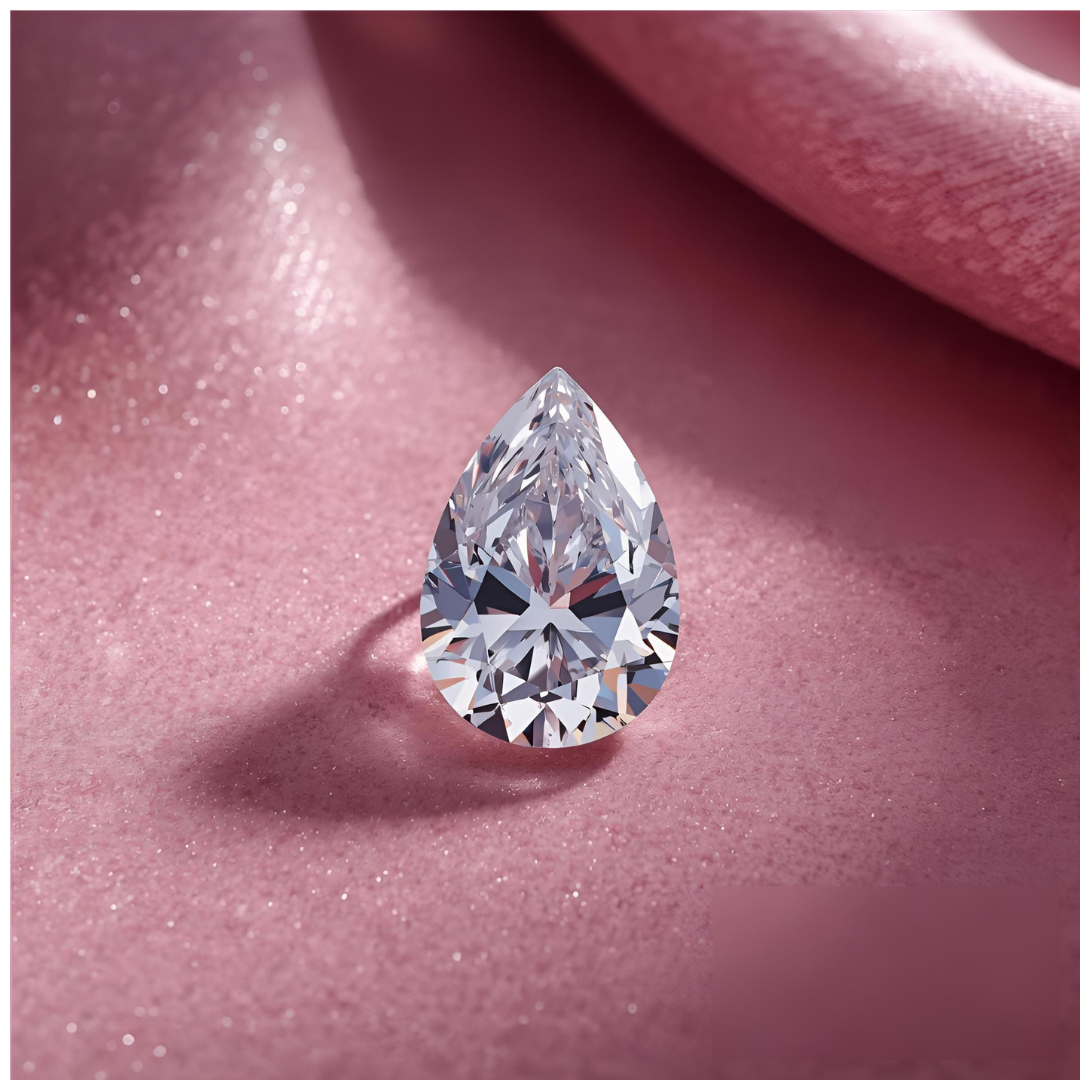
A teardrop diamond, also called a pear-shaped diamond, is a brilliant-cut gemstone that combines a rounded end with a single pointed end, resembling a drop of water or a teardrop.
“In 1957, Richard Burton gave Elizabeth Taylor a 69-carat pear-shaped diamond. She wore it as a pendant, the point facing down, close to her heart. When asked why she loved it, she said: ‘Because it is both a tear and a flame.‘ The pear shape has been called a teardrop, a flame, and a boat. But Burton understood its secret: it is the only diamond that can be two things at once—sorrow and joy, an ending and a beginning, a drop of water and a tongue of fire. That is why we still choose it. Not because it is the most popular. But because it holds the most feeling.”
The same teardrop that graced Elizabeth Taylor‘s neck now awaits your own story — point down for tradition, point up for hope. Every pear-shaped diamond in our collection is hand-selected for perfect symmetry and minimal bow-tie.”
[Button: Explore Teardrop Diamonds →]
Here, let's see the content of the table.
The first topic begins here.
What Is A Teardrop Cut Diamond?
A "teardrop cut diamond" is the popular and descriptive name for what is officially known in the jewelry world as a Pear-Shaped or Pear Cut diamond.
It's a classic and elegant "fancy shape" that combines the best of two worlds. Here’s a detailed breakdown of what defines a teardrop cut diamond:
The Anatomy of a Teardrop Cut
Hybrid Design: It is a unique fusion of two classic cuts:
The rounded, broad end of a Round Brilliant Cut.
The tapered, pointed end of a Marquise Cut.
The Goal: This combination is designed to maximize brilliance and fire, similar to a round brilliant, but in a distinctive and elongated shape.
Key Characteristics and Features
The Shape: The ideal teardrop should have a symmetrical, balanced curve from the rounded shoulder to the sharp point, forming a perfect teardrop silhouette.
The Bow-Tie Effect: Like other elongated cuts (oval, marquise), a pear-shaped diamond will almost always have a "bow-tie" effect—a dark band across the width of the stone that resembles a bow-tie. A well-cut stone will have a minimal, faint bow-tie, while a poorly cut one will have a prominent, dark one that blocks light.
Length-to-Width Ratio: This ratio determines how fat or slender the teardrop appears. Personal preference dictates the ideal ratio, but a "classic" pear shape typically falls within a ratio of 1.55 to 1.75.
A lower ratio (e.g., 1.45) will look like a stout, chubby teardrop.
A higher ratio (e.g., 1.85) will look like a slender, elongated teardrop.
Advantages of the Teardrop Cut
Flattering and elongating, its shape is renowned for creating a slimming effect on the finger, making it a very popular choice for engagement rings.
Unique and Timeless: It offers a distinctive look that stands out from more common round or square cuts while still maintaining a classic feel.
Versatile Setting Options: It looks beautiful in a variety of settings, from a simple solitaire to a halo or three-stone setting.
Important Considerations When Choosing One
Symmetry is Critical: This is the most important factor for a pear-shaped diamond. Both sides of the curve must be perfectly mirrored. Any imbalance or lopsidedness is immediately noticeable.
The Point is Vulnerable: The sharp point is the most delicate part of the diamond and is prone to chipping. It is crucial that the setting (like a V-prong or a bezel) protects this point.
Cut Quality: Even though it's a fancy shape, you should still look for an "Excellent" or "Very Good" cut grade from a reputable lab like GIA. This ensures good proportions, symmetry, and polish, which directly impact the stone's beauty.
In short, a teardrop cut diamond is a Pear Cut—a brilliant and romantic shape that blends a round's sparkle with a marquise's elongation, but it requires excellent craftsmanship to achieve its full, beautiful potential.
For official diamond cut grading information, visit the GIA Diamond Cut Guide.
What Does The Teardrop Diamond Shape Mean?
The meaning of the teardrop, or pear-shaped diamond, is rich with symbolism and is beautifully open to interpretation. It's more than just a shape; it carries a narrative.
Here’s a breakdown of the meanings and symbolism associated with the teardrop diamond:
The Dual Symbolism: Tears of Joy and Sorrow
The most prominent symbolism comes from its "teardrop" form. This can represent two powerful, contrasting emotions:
Tears of Joy, Happiness, and New Beginnings: This is the most common and positive interpretation, especially in the context of an engagement ring. It can symbolize:
The happy tears shed on a wedding day.
The joy and excitement of a new life together.
A hopeful outlook on the future.
Tears of Sorrow, Farewell, or Remembrance: In a different context, the shape can symbolize:
The sadness of a parting or a farewell.
Remembering a loved one who has passed away. Because of this, pear-shaped diamonds are sometimes used in sentimental or memorial jewelry.
Which meaning is correct? It truly depends on the context and the story behind the jewelry. For an engagement ring, it's almost universally seen as a symbol of joy. The wearer gets to define their personal significance.
“In Victorian England, widows wore teardrop-shaped jewelry in mourning—the point facing down for grief. When they healed, they turned the point up, toward the sky. The same shape that meant sorrow could also mean hope. The pear-shaped diamond is the only cut that asks you to choose: am I crying, or am I smiling? That is its power. It reflects not just light, but emotion. You decide what it means.”
A Blend of Two Worlds
The pear shape is a unique hybrid, combining two classic cuts:
The Round Brilliant End: Represents eternity, completeness, and softness.
The Marquise Point: Represents direction, ambition, and uniqueness.
This combination symbolizes a union of two people, blending their lives into one unique and balanced partnership. It suggests a relationship that is both nurturing (the round end) and forward-moving (the pointed tip).
Symbolism of Individuality and Style
Choosing a pear-shaped diamond is often a conscious decision to stand out from the traditional round or princess cuts. Therefore, it can also symbolize:
Independence and Non-Conformity: The wearer is often seen as creative, elegant, and confident in their unique taste.
A Forward-Looking Perspective: The pointed tip is often seen as pointing towards the future, symbolizing growth and a journey forward together.
A Nod to History and Glamour
The pear shape has a long history in royalty and Hollywood glamour. Most famously, it was the cut of the massive diamond given to Richard Burton by Elizabeth Taylor. This association lends the shape a meaning of:
Luxury, Drama, and Unforgettable Romance.
Summary of Meanings:
An engagement ring overwhelmingly symbolizes tears of joy, a unique union, and a future-looking love.
In Other Jewelry: Can represent remembrance, personal style, or simply a love for elegant and flattering designs.
Ultimately, the most beautiful meaning of a teardrop diamond is the one you assign to it. Its dual nature allows it to hold a deeply personal story, making it a profoundly meaningful choice for significant jewelry.
Are Teardrop Diamonds More Expensive?
No, teardrop (pear-shaped) diamonds are not generally more expensive than round brilliant diamonds. In fact, they are often significantly less expensive per carat.
However, the price depends heavily on several factors. Let's break it down.
The Cost Comparison: Teardrop vs. Round Brilliant
The most common comparison is against the round brilliant cut, which is the most popular and expensive shape.
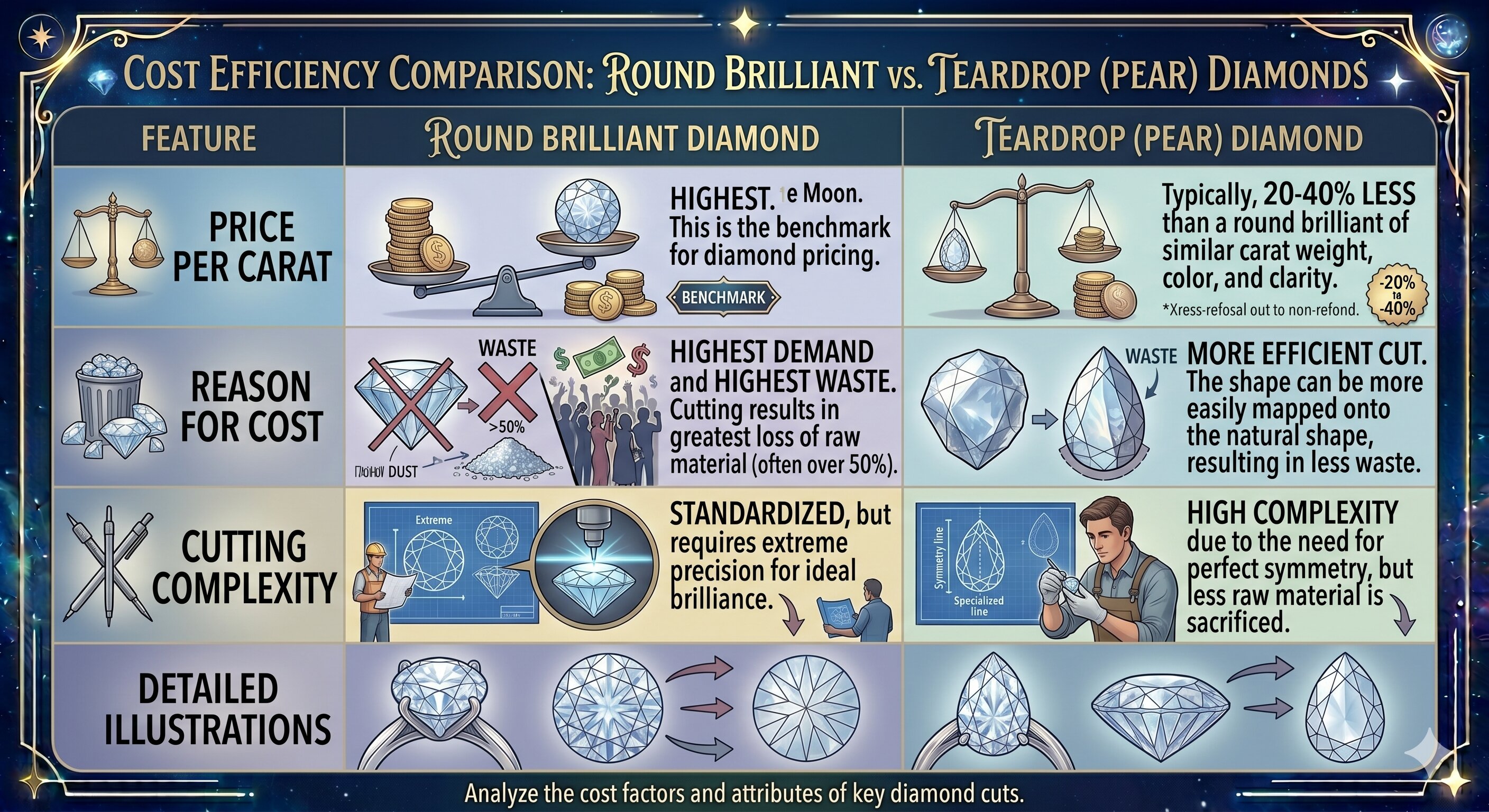
If you are comparing a 1-carat round diamond to a 1-carat teardrop diamond with similar color and clarity grades, the teardrop will almost always be the more affordable option.
For current diamond market prices, visit the American Gem Society's price guide.
What Can Make A Teardrop Diamond Expensive?
While generally less costly than rounds, several factors can drive up the price of a teardrop diamond:
Exceptional Cut Quality: This is the most important factor for a teardrop's beauty and price. A pear shape with "Excellent" symmetry and polish, no visible bow-tie effect, and ideal proportions will command a much higher price than a poorly cut one. The skill of the cutter is paramount.
High Carat Weight: Like all diamonds, larger stones are rarer and more expensive. A large, high-quality teardrop is a show-stopper and will be priced accordingly.
Superior Color and Clarity: Because the teardrop's large, flat table (top facet) can make inclusions and color more visible, the highest grades (D-F color, VVS/IF clarity) will be more expensive. However, you can often go slightly lower on color and clarity than with a round brilliant and still get a beautiful stone.
The "Fancy" Factor: While not as rare as some cuts (like a heart or asscher), a perfectly executed teardrop is still a "fancy shape" and can be more expensive than more common fancy shapes like the oval or cushion if the quality is top-tier.
Which Way Do You Wear A Teardrop Diamond?
The orientation of a teardrop (pear-shaped) diamond is not a matter of strict rules, but rather of personal preference and the desired visual effect. However, there are strong traditional and practical conventions.
Here’s a breakdown of the two main ways to wear it and what each means.
The Two Orientations
1. Pointing Downward (Towards the Wrist)
This is the most common and traditional way to wear a teardrop diamond, especially in engagement rings.
The Look & Symbolism:
Elongating Effect: This orientation is famous for creating a flattering, slimming effect on the finger, making it appear longer and more graceful.
Directional: The point leads the eye down the length of the finger.
Symbolism: When worn this way, it is almost universally interpreted as a tear of joy, not sorrow.
Practical Consideration:
The pointed tip is the most vulnerable part of the diamond. When pointing downward, it is slightly less exposed to accidental bumps than if it were pointing outward from the hand.
2. Pointing Upward (Towards the Fingernails)
This is a less common but equally beautiful and meaningful way to wear the stone.
The Look & Symbolism:
Modern & Unique: This orientation has a more modern, fashion-forward feel.
Symbolism: Pointing upward, the shape is often seen as a water droplet, a flame, or a heart. It can symbolize direction, aspiration, and looking toward the future. The "heart" interpretation, with the rounded end as the top of the heart, is particularly romantic.
Practical Consideration:
The point is more exposed and may be more prone to catching on clothing or other objects. A V-prong setting is essential to protect it.
Which Way is "Correct"?
There is no official "correct" way. The best choice depends on the wearer's style and the intended meaning.
For an Engagement Ring:
Traditional Choice: Pointing Downward. This is the classic, timeless look.
Modern Choice: Pointing Upward. This is for someone who wants a unique, symbolic look (like the "heart" orientation).
For a Pendant or Necklace:
For a teardrop pendant, the convention is almost always to wear it with the point facing downward. This creates a natural, elongating line that is universally flattering.
A Crucial Practical Tip: The Setting
No matter which way you choose to orient it, protecting the point is essential.
A V-Tip or V-Prong: The best settings for a pear-shaped diamond will feature a "V-prong" at the tip. This is a small, V-shaped metal claw that cradles and protects the delicate point from chipping. A round prong at the tip would not offer the same level of security.
Traditionally & Most Commonly: Wear it with the point facing downward towards your wrist.
For a Modern & Symbolic Look: Wear it with the point facing upward towards your nails.
The Most Important Thing: Choose the orientation that you find most aesthetically pleasing and meaningful. It's your jewelry, and your preference is the only rule that truly matters. Just ensure the pointed tip is well-protected by the setting.
“You now know the definition, the symbolism, the pricing, the cost drivers, and the orientation choices. The only question left: will you wear a tear or a flame?
*Our current collection includes a limited number of GIA-certified teardrop diamonds — from delicate 0.5-carat stones to breathtaking 3-carat centerpieces. When stones with perfect symmetry and minimal bow-tie are gone, sourcing new ones takes months.*
*This is not just a diamond. It is Elizabeth Taylor‘s 69-carat pendant, Richard Burton‘s gift, and a shape that can be both a tear and a flame — pointing down for grief, pointing up for hope. You decide what it means. That is its power.”*
[Button: Claim Your Teardrop Diamond (Limited) →]


Vintage Rings Guide: Styles, Identification, Pros and Cons
Vintage Rings Guide: Styles, Identification, Pros and Cons
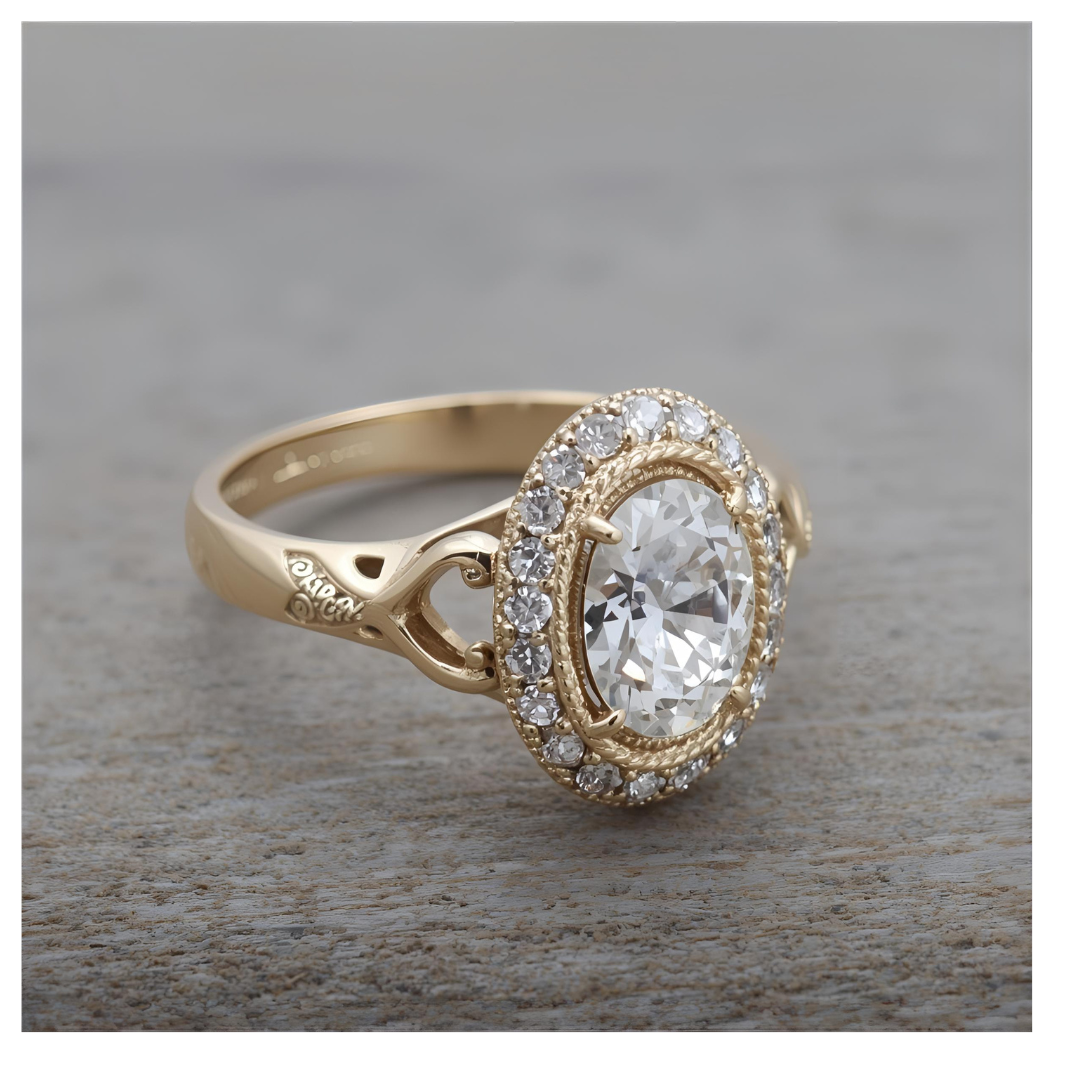
Vintage rings captivate us because they are far more than just jewelry—they are tangible pieces of history, artistry, and personal story.
Here’s a look at what makes them truly special:
-
Timeless Craftsmanship: Many vintage rings were crafted in an era of meticulous hand-finishing, featuring intricate engraving, milgrain detailing, and unique stone cutting techniques (such as old mine or rose cuts) rarely seen today.
-
-
Unique & One-of-a-Kind: Unlike mass-produced modern jewelry, vintage rings often possess a unique character and variations, ensuring you wear something with an individual personality.
-
-
A Link to History: Owning a ring from the Art Deco, Victorian, or Retro period connects you to the design movements and social eras of the past.
-
-
A Sustainable Choice: Choosing vintage is a form of conscious consumption, giving new life to a beautiful object without new resource extraction.
-
-
Enduring Value & Quality: Rings from certain periods are known for their substantial metalwork and enduring quality, and well-maintained pieces from sought-after eras often retain or appreciate.
Here is the content of the table;
Let's see the first topic.
What Makes A Ring Vintage Style?
Here’s a breakdown of what makes a ring "vintage style," whether it's a genuine antique or a modern reproduction.
The Core Idea: Eras and Inspiration
True vintage and antique rings are categorized by the period they were made in. "Vintage style" rings are modern pieces that deliberately draw inspiration from these periods. The most commonly referenced eras are:
Victorian (1837-1901): Romantic, symbolic, and nature-inspired.
Art Nouveau (1890-1915): Whiplash curves, flowing lines, and ethereal themes like fairies and nymphs.
Edwardian (1901-1915): Delicate, lace-like, and incredibly elegant.
Art Deco (1920-1935): Geometric, bold, symmetrical, and full of sharp angles.
Retro (1940-1950): Chunky, bold, and sculptural, often using rose gold.
Key Characteristics of a Vintage Style Ring
1. Intricate Metalwork and Filigree
This is one of the most telltale signs. Instead of a plain, solid band, vintage-style rings feature delicate, lace-like patterns of metal.
Filigree: Thin wires of metal twisted and soldered into intricate patterns, often creating an openwork effect.
Milgrain: A beaded edge detail applied to the metal, giving it a soft, finished look and highlighting design elements. It's a hallmark of Edwardian and Art Deco styles.
Engraving: Scrolls, leaves, or floral patterns hand-engraved directly into the band or setting.
2. Distinctive Gemstone Cuts
Modern rings often feature brilliant cuts (like the round brilliant) designed for maximum sparkle. Vintage-style rings use cuts that were popular in the past.
Old European & Old Mine Cuts: The precursors to the modern round brilliant. They have a high crown, a small table, and a large, chunky culet. They possess a unique, fiery, and "crushed ice" sparkle.
Rose Cuts: Flat bottom with a dome top covered in triangular facets. They have a gentle, glass-like glow rather than a blinding sparkle.
Oval, Cushion, and Emerald Cuts: While still used today, their proportions in vintage-style pieces often mimic the older, more elongated or pillowy versions.
Cabochon Gems: Smooth, polished, non-faceted stones (like moonstone or opal) were very popular in Art Nouveau and Victorian eras.
3. Unique Gemstone Settings
How the stone is held in place is a major style indicator.
Cluster Settings: Multiple smaller stones are grouped to look like one larger flower or geometric shape.
Halo Settings: While still popular now, the halo was invented in the Georgian era. Vintage-style halos are often more intricate, with milgrain edges or smaller, differently shaped stones.
Three-Stone Settings ("Past, Present, Future"): A classic design, especially popular in the Edwardian and Victorian periods.
Illusion Settings: Popular in the Retro period, a metal frame surrounds the diamond to make it appear larger.
4. Romantic and Symbolic Motifs
Vintage-style rings are often full of meaning.
Nature: Flowers (especially daisies and roses), leaves, vines, and birds.
Celestial: Stars, moons, and sunbursts were huge in the Art Deco era.
Sentimentality: Hearts, bows, and clasped hands were common in Victorian "acrostic" rings or "Mizpah" rings.
5. Use of Specific Materials
Yellow and Rose Gold: While platinum was king in the Edwardian and Art Deco eras for the wealthy, yellow gold was the most common metal for centuries, and rose gold had a major moment in the Retro period.
Pearls: Often used as accents or even as center stones in Victorian and Edwardian rings.
Diamond Accents: Small, old-cut diamonds are frequently used as pavé or channel-set accents to frame a center stone or decorate the shoulders of the band.
Colored Gemstones: Sapphires, rubies, and emeralds were frequently used, often in combination with diamonds.
How to Get a Vintage Style Ring
Buy a Genuine Antique/Vintage Ring: The ultimate way to get the real thing. This requires research and buying from a reputable dealer.
Buy a Modern Reproduction: Many jewelers specialize in creating new rings with all the vintage hallmarks (milgrain, filigree, old-cut stones).
Custom Design: Work with a jeweler to create a unique piece that incorporates the specific vintage elements you love.
In essence, a vintage-style ring is not defined by its age, but by its design soul. It’s a piece that tells a story, evokes a sense of history and romance, and showcases the intricate artistry that characterizes jewelry from the past.
Learn more about vintage jewelry periods on Wikipedia's vintage jewelry page.
How Do I Tell If My Ring Is Vintage?
Determining if your ring is genuinely vintage involves playing detective and looking for clues in its materials, craftsmanship, design, and markings. It's a fun process of observation and research.
Here is a step-by-step guide to help you tell if your ring is vintage.
Step 1: Look for Hallmarks and Stamps (The Most Important Clue)
This is your first and most reliable step. Look inside the band with a magnifying glass or jeweler's loupe.
What to Look For:
Purity Marks: Numbers like 14K, 18K, 750 (for 18k gold), 925 (for Sterling Silver), PT or Plat (for Platinum).
Maker's Mark: The logo or name of the manufacturer (e.g., T&Co. for Tiffany & Co., J.E.C. for a specific artisan).
Assay Marks: In older (especially British and European) pieces, look for complex symbols in a cartouche (a shield shape). These can include:
A Standard Mark: (e.g., a crown for gold, a lion for sterling).
A Town Mark: (e.g., an anchor for Birmingham).
A Date Letter: A single letter representing the year it was assayed.
What It Tells You:
No "K" or "925" mark? It could be very old (pre-1900), or it could be costume jewelry.
Is the mark worn? Heavy wear on the inside of the band can indicate age.
"Platinum" or "PT"? Platinum became popular for fine jewelry in the Edwardian (1901-1910) and Art Deco (1920s-1935) eras. Its presence strongly suggests a vintage piece from that time or later.
You can search online for "jewelry hallmark identification" or consult a book to decipher specific marks.
Step 2: Examine the Design and Craftsmanship
Compare the style of your ring to the iconic eras mentioned in the previous answer.
Look for Hand-Crafted Details:
Filigree: Is the metalwork delicate, lacy, and intricate? This is a hallmark of Edwardian and early Art Deco styles.
Milgrain: Look closely at the edges. Are there tiny, beaded borders? This is a classic sign of Edwardian and Art Deco jewelry and is often done by hand on vintage pieces (modern milgrain can be machine-made).
Hand-Engraving: Are there scrolls, flowers, or patterns cut directly into the metal? Modern rings often have laser engraving, which looks sharper and more perfect. Hand-engraving has slight imperfections and a softer look.
Identify the Style:
Geometric, symmetrical, and bold? Think Art Deco.
Delicate, lacy, and floral? Think Edwardian or Late Victorian.
Romantic, nature-inspired with flowing lines? Think Art Nouveau.
Chunky, bold, sculptural, and often in rose/yellow gold? Think Retro (1940s-50s).
Step 3: Analyze the Gemstones and Settings
How the stones are cut and set is a major giveaway.
The Cut of the Stones:
Diamonds: Look for Old Mine Cut (cushion-shaped with a high crown and small table) or Old European Cut (round with a high crown and small table). These have a different, more "fiery" and less "brilliant" sparkle than modern round brilliants. They are a sure sign of age (typically pre-1940s).
Colored Stones: Look for cabochon (smooth, polished domes) or older step cuts like the "old emerald cut."
The Setting Style:
Cluster Settings: A central stone surrounded by a cluster of smaller stones was very popular in Victorian and Edwardian times.
Illusion Settings: Popular in the Mid-Century period, this uses a metal frame to make a small diamond look larger.
Closed-Back Settings: Older rings often have a closed back behind the stone, unlike the open, "holey" settings of modern rings designed for maximum light return.
Step 4: Assess the Signs of Age and Wear
A genuinely old ring will show its history.
Patina: The metal, especially silver or low-karat gold, may have a soft, even wear and a darkened appearance in the crevices. This is called a patina and is highly valued by collectors (do not polish it off!).
Natural Wear Patterns:
Look for wear on the parts that touch other surfaces. Is the band slightly thinner on the bottom?
Are the engravings slightly softened?
Is the milgrain a bit worn down? This is a great sign of age.
"Old European Cut" Faceting: As mentioned, this is a key indicator for diamonds.
A Simple Checklist to Get You Started
Answer these questions about your ring:
Are there any hallmarks or stamps inside the band? (Research them!)
Does the diamond have a large, open culet (flat spot at the bottom) and a chunky, irregular faceting pattern? (Likely Old Mine or Old European Cut).
Is there intricate, delicate metalwork like filigree or milgrain?
Does the design match a specific era (e.g., Geometric = Art Deco)?
Is there a soft patina and even wear on the metal?
The more "yes" answers, the more likely your ring is vintage.
When in Doubt, Consult a Professional
If you're still unsure, take your ring to a reputable, independent jeweler or an estate jewelry specialist. They have the expertise and tools (like high-powered loupes) to:
Properly identify hallmarks.
Authenticate the gemstone cuts and settings.
Give you a confident assessment of its age and origin.
This process is like uncovering a small piece of history. Enjoy the investigation
What Is The Most Popular Vintage Ring Style?
This is a fantastic question, and the answer has a clear frontrunner, though it depends slightly on whether we're talking about pure collector interest or modern trendiness.
The most popular and sought-after vintage ring style is, without a doubt, the Art Deco ring (from the 1920s-1930s).
Here’s a breakdown of why Art Deco reigns supreme, along with other highly popular contenders.
The Undisputed Champion: Art Deco (1920s-1930s)
Art Deco rings are instantly recognizable and perennially fashionable. They capture the spirit of the Roaring Twenties—bold, modern, and sophisticated.
Why it's so popular:
Geometric Boldness: Their strong, symmetrical lines with shapes like squares, triangles, and baguettes feel both classic and strikingly modern, fitting seamlessly with contemporary fashion.
Dramatic Color Contrast: They often feature a central gemstone (like a diamond or sapphire) accented with starkly contrasting stones, such as onyx, emerald, or ruby. This "paved" look is highly distinctive.
Exquisite Craftsmanship: Hallmarks like intricate filigree, delicate milgrain edging, and calibrated cut gemstones that fit together like a puzzle showcase incredible artistry.
Versatility: While bold, the geometric patterns are often more wearable and stackable than the more delicate Edwardian or the bulkier Retro styles.
If you see a vintage ring with a geometric, "architectural" look, it's almost certainly Art Deco-inspired and is the most likely candidate for the title of "most popular."
Other Highly Popular Vintage Ring Styles
While Art Deco is the king, these other eras have massive followings and are also incredibly popular for different reasons.
The Romantic Runner-Up: Edwardian (1901-1915)
Edwardian rings are the epitome of delicate, feminine elegance. They are the "lace" of the jewelry world.
Key Features: Airy, platinum settings that resemble lace or doilies, extensive use of milgrain, and motifs like bows, flowers, and garlands.
Why it's popular: For those who love a romantic, ethereal, and supremely elegant look. The craftsmanship is incredibly refined.
The Bold & Glamorous: Retro (1940s-1950s)
Retro rings were a reaction to the austerity of World War II—they are big, bold, and unapologetically glamorous.
Key Features: Chunky, sculptural curves, large cocktail-sized stones, extensive use of rose and yellow gold, and patriotic motifs like ribbons and flags. A classic design is the "cluster" or "cocktail" ring with a large central stone surrounded by smaller ones.
Why it's popular: For someone who wants a statement piece that is warm, dramatic, and has a Hollywood Golden Age flair.
The Timeless Classic: Victorian (1837-1901)
Victorian rings are rich with symbolism and romance, covering a long period with varied styles.
Key Features: Serpent rings (symbolizing eternity), acrostic rings (where the first letter of each gemstone spells a word, like "DEAREST"), horseshoes, flowers, and heavy yellow gold.
Why it's popular: Collectors and those who love deep history, symbolism, and a truly "antique" feel are drawn to these pieces.
Why is Art Deco the Most Popular Today?
Modern Aesthetic: The clean lines and geometric shapes of Art Deco align perfectly with modern design sensibilities.
Trend in Engagement Rings: Art Deco rings are a top choice for unique, non-traditional engagement rings, driving their popularity.
High Collectibility: Their distinct look and fine craftsmanship make them highly prized by collectors, keeping demand and prices strong.
Instant Recognition: The style is so defined that it's easy to identify and appreciate.
While personal taste is everything, if you're looking for the style with the broadest and most enduring appeal, the Art Deco ring is the most popular vintage style. It represents a perfect storm of iconic design, exquisite craftsmanship, and a look that feels both historic and freshly modern.
Are Vintage Rings Cheaper?
That's an excellent and very common question. The answer isn't a simple yes or no, because the value of a vintage ring is a complex mix of its materials, era, condition, and rarity.
In short, Vintagee rings can be a fantastic value for your money, but they are not automatically "cheaper" than new rings. They are often differently priced.
Here’s a breakdown of when they can be more affordable and when they can be significantly more expensive.
When Vintage Rings Can Be Cheaper or a Better Value:
Cost of Materials vs. Craftsmanship:
A new ring from a large, mainstream jeweler has a high price tag that includes not just the materials and labor, but also massive marketing budgets, retail markups, and brand prestige.
A vintage ring's price is often more directly tied to its intrinsic value: the gold weight, the quality and size of the gemstones, and its condition. You are often paying for the object itself, not the brand name.
Unique, Labor-Intensive Details:
You can often find intricate hand-engraving, filigree, and milgrain work on a vintage ring for a price that would be prohibitively expensive to replicate today. Handcrafting those details on a new ring would require a master jeweler and command a very high price.
The "Old Mine" and "Old European" Cut Diamond Factor:
These antique diamond cuts are often priced lower per carat than a modern brilliant cut of the same weight and color/clarity. This is because the modern market prioritizes the fiery, blinding sparkle of the brilliant cut.
For you, this means you can often get a larger carat weight for your budget by choosing a ring with an old-cut diamond, and you'll get a stone with unique, historical character.
Avoiding Depreciation:
Like a new car, a brand-new mass-produced ring can lose a significant portion of its value the moment you walk out of the store.
A vintage ring has already gone through this initial depreciation. A well-chosen vintage piece from a desirable era can hold its value exceptionally well or even appreciate, especially if it's a sought-after style like Art Deco.
When Vintage Rings Can Be More Expensive:
Rarity and Desirability:
Rings from highly sought-after eras, like pristine Art Deco pieces or delicate Edwardian rings, are in high demand. Their rarity and beauty can drive prices very high, often exceeding the cost of a comparable new ring.
Exceptional Condition:
Finding a vintage ring in perfect, unworn condition is rare. A piece that has survived 80-100 years without significant damage or alteration will be priced higher than one that needs repair.
Unique Gemstones:
A vintage ring featuring a rare, natural, and untreated gemstone of high quality (e.g., a no-heat Kashmir sapphire) can be astronomically expensive due to its collectibility.
The "Value" Beyond the Price Tag
Even when a vintage ring isn't "cheaper," it often represents a different kind of value:
Uniqueness: You are almost guaranteed to have a one-of-a-kind piece. You won't see it on everyone else's hand.
History and Character: The ring has a story. The patina and slight signs of wear are part of its charm.
Quality Craftsmanship: Many vintage rings were built to last with a level of detail that is hard to find in today's mass-market jewelry.
Sustainable Choice: Buying vintage is a form of recycling. It's an eco-friendly and ethical choice, as no new mining is required.
Practical Price Comparison
For a simple solitaire: A new one might be similarly priced or even cheaper than a vintage one, as solitaires are mass-produced efficiently today.
For a ring with intricate detail: A vintage ring with filigree, milgrain, and engraving will almost always be far more affordable than having a jeweler custom-make an identical new one.
Conclusion:
Think of it this way: Vintage rings offer more bang for your buck in terms of craftsmanship, character, and uniqueness, but not necessarily a lower final sale price.
If you are comparing a simple new ring to a simple vintage ring, prices may be similar. But if you are looking for intricate, artistic design and a piece of history, vintage rings provide access to a level of craftsmanship and materials that would be far more expensive to create new.
Your best strategy is to shop around, compare prices for the style you love, and focus on the incredible value and story a vintage ring provides, rather than just the initial cost.
What Are The Pros And Cons Of Vintage Rings?
Choosing a vintage ring is a big decision with many unique factors to consider. Here is a detailed breakdown of the pros and cons to help you make an informed choice.
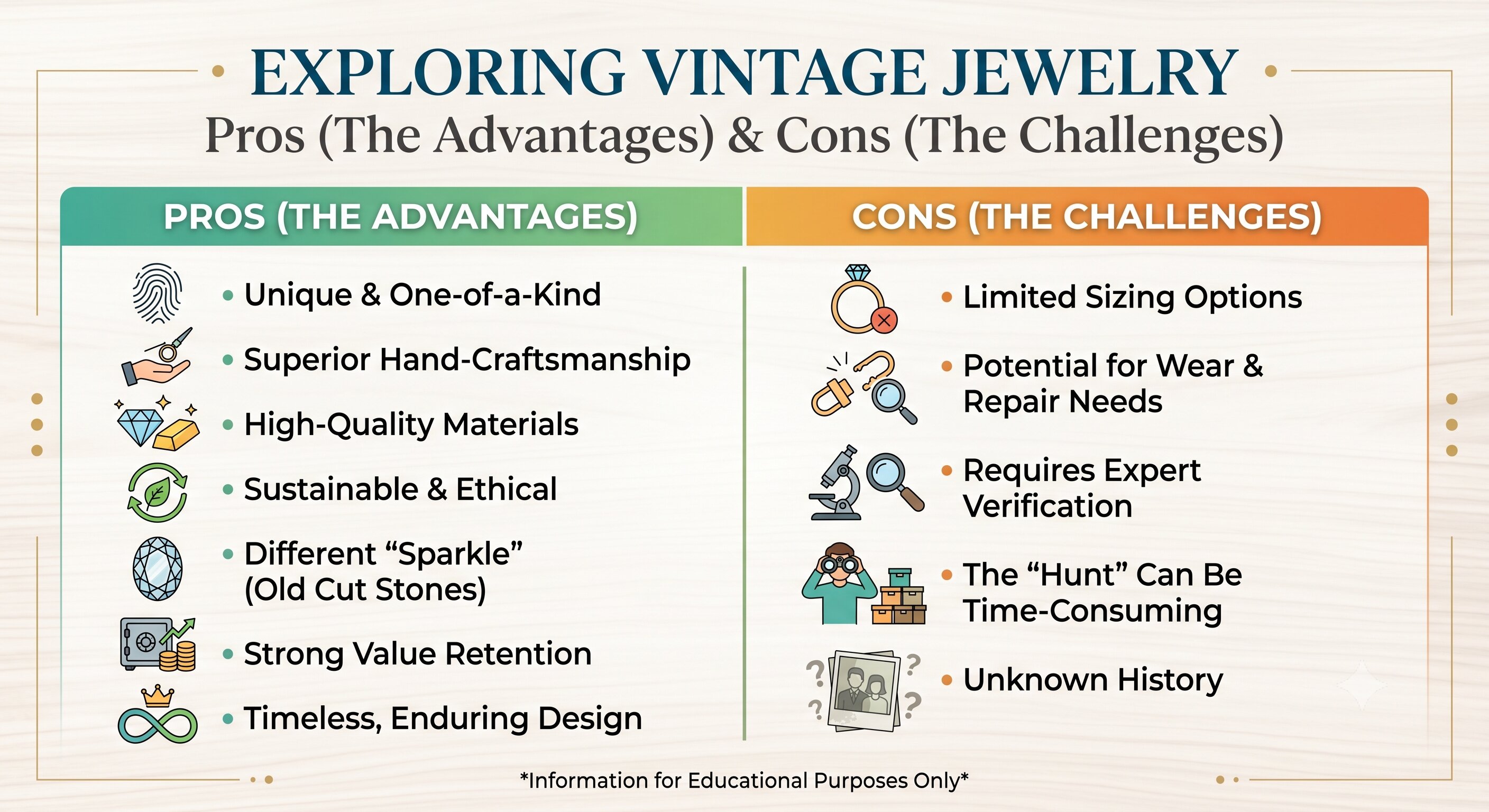
The Pros of Vintage Rings
Unique Character and Story:
Pro: A vintage ring is a one-of-a-kind piece of wearable history. It has a story and a soul that a new ring simply cannot replicate. The patina, slight wear, and unique craftsmanship mean you will own something truly individual that no one else has.
Superior Craftsmanship:
Pro: Many vintage rings feature handcrafted details like intricate filigree, hand-engraving, and milgrain that are either too expensive or impossible to replicate with modern mass-production techniques. You are getting a level of artistry that is rare today.
Exceptional Quality Materials:
Pro: Vintage rings often feature:
Old-Cut Diamonds: Old European and Old Mine cuts have a unique, romantic sparkle and are often cut from high-quality diamond rough.
Solid Precious Metals: They are typically made with solid gold or platinum, unlike some modern pieces that can be hollow or heavily alloyed.
Natural Gemstones: Stones are typically natural and untreated, as many enhancement processes are modern.
Inherently Sustainable and Eco-Friendly:
Pro: Choosing a vintage ring is the ultimate form of recycling. It requires no new mining, reducing your environmental footprint and ensuring your purchase is ethically conscious.
Potential for Value Retention:
Pro: A well-chosen vintage ring from a desirable era (like Art Deco) can hold its value very well and often appreciates. Unlike a new mass-produced ring that depreciates quickly, a vintage piece has already gone through that initial drop.
Timeless, Enduring Style:
Pro: These rings have already stood the test of time. A style that was beautiful 100 years ago will likely remain beautiful for the next 100. You're investing in a classic, not a fleeting trend.
The Cons of Vintage Rings
Limited Sizing and Potential for Damage:
Con: This is one of the biggest challenges.
Sizing Restrictions: Rings can often only be sized up or down one or two sizes. Extremely intricate bands or eternity bands may not be resizable at all.
Brittleness: Older metals can become brittle over time. Resizing can sometimes lead to cracking, especially with platinum from certain eras.
Condition and Necessary Repairs:
Con: Wear and tear is expected. Prongs can be worn down, stones can be loose, and metal can be thin. You must budget for potential repairs, which should be done by a jeweler experienced with antique pieces to preserve their character.
The Need for Expert Verification:
Con: It's crucial to buy from a reputable source. You need to verify that the ring is what the seller claims it is—that the stones are natural, the metal is as marked, and there are no hidden repairs or damage. This often requires an additional appraisal cost.
Less "Sparkle" by Modern Standards:
Con: If you love the blinding, fiery brilliance of a modern brilliant-cut diamond, an old-cut diamond might disappoint you. Old cuts were designed to sparkle beautifully in candlelight, not halogen lights, giving them a softer, more chunky and reflective sparkle.
Limited Choice and the "Hunt":
Con: You can't just walk into a chain store and pick the exact style you saw online. Finding the perfect vintage ring requires patience, research, and a willingness to embrace the "hunt." You have to fall in love with what's available.
Potential for Unknown History:
Con: While some see a story as a pro, others may be uncomfortable with not knowing the full history of the ring. This is a personal preference.
Summary Table
Final Verdict
A vintage ring is perfect for you if:
You value unique artistry, history, and sustainability over a perfectly uniform, brilliant sparkle. You are a patient person who enjoys the thrill of the hunt and is willing to do some research and potentially invest in maintenance.
You may want to stick with a new ring if:
Your top priority is maximum brilliance (sparkle), you need a specific, readily available design, you require a standard ring size that's hard to find, or you want the convenience of a walk-in purchase with a brand-new warranty.
.
How To Help Identify A Vintage Ring?
To identify your vintage ring, you'll need to examine both its physical markings and its design style. Here is a systematic guide to help you get started.
Step 1: Locate and Document the Hallmarks
First, carefully inspect your ring for any small stamps or engravings, which are usually found on the inside of the band. Use a jeweler's loupe (10x magnification) and good lighting, as these marks can be very tiny and worn.
Common marks you might find include:
Metal Purity Mark: Indicates the gold, silver, or platinum content (e.g., 14K, 585 for gold; 925 for sterling silver; PT950 for platinum).
Maker's Mark: Could be initials, a name, or a unique symbol representing the jeweler or manufacturer.
Assay Office Mark: A symbol for the office that tested the metal. For UK rings, common ones are a leopard's head (London), an anchor (Birmingham), or a castle (Edinburgh).
Date Letter: Primarily found on UK pieces, these single letters in specific shields indicate the year it was hallmarked.
Take clear, magnified photographs of all marks.
Step 2: Analyze the Ring's Style and Construction
The design, motifs, and craftsmanship are key clues to its era. Use this chart to compare your ring's features.
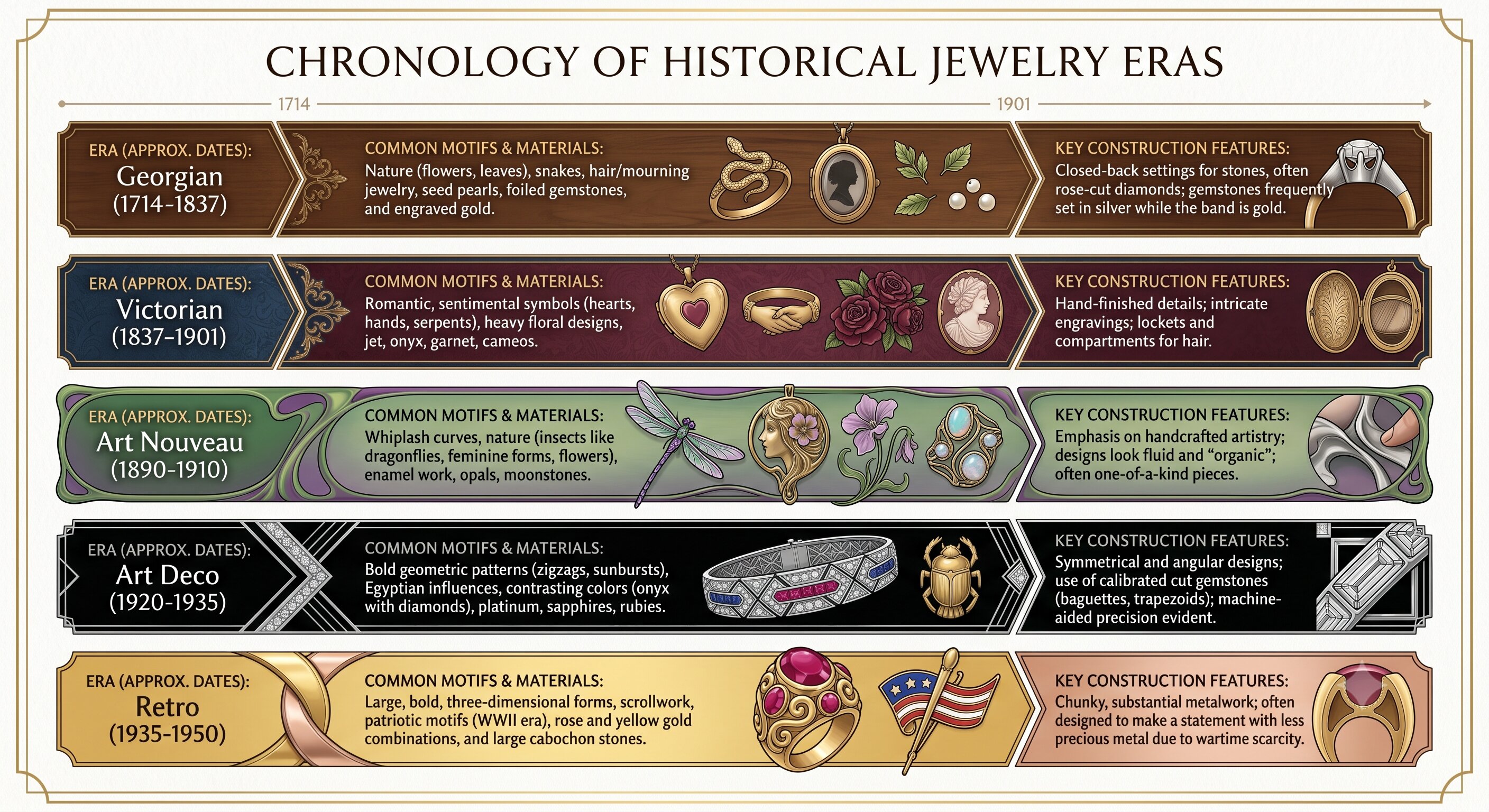
Step 3: Research and Seek Expert Help
Cross-reference Marks: Once you have a potential country and era, use online databases or reference books to research the specific marks. A great starting point is the pictorial index of the Antique Jewelry University.
Consult a Professional: For a definitive identification or valuation, especially if the ring appears valuable, consult a certified antique jewelry appraiser or a reputable auction house specialist. They have access to extensive archives and can often identify obscure makers and provide accurate dating.
Important Considerations
Worn or Missing Marks: It's common for older rings to have faint, partial, or missing stamps due to polishing or wear. In these cases, style analysis becomes your main tool.
Counterfeits: Be aware that some modern pieces may have fake hallmarks. Authenticity is best judged by a combination of marks, style, wear patterns, and construction quality.
I hope this guide gives you a clear path to uncovering the story of your ring. If you manage to find and photograph any hallmarks or can describe the design in more detail, feel free to share, and I can offer more specific insights.
For more on hallmark identification, visit the American Gem Society's antique jewelry guide.
Three-Stone Engagement Rings: The Ultimate Buying Guide
Three-Stone Engagement Rings: The Ultimate Buying Guide
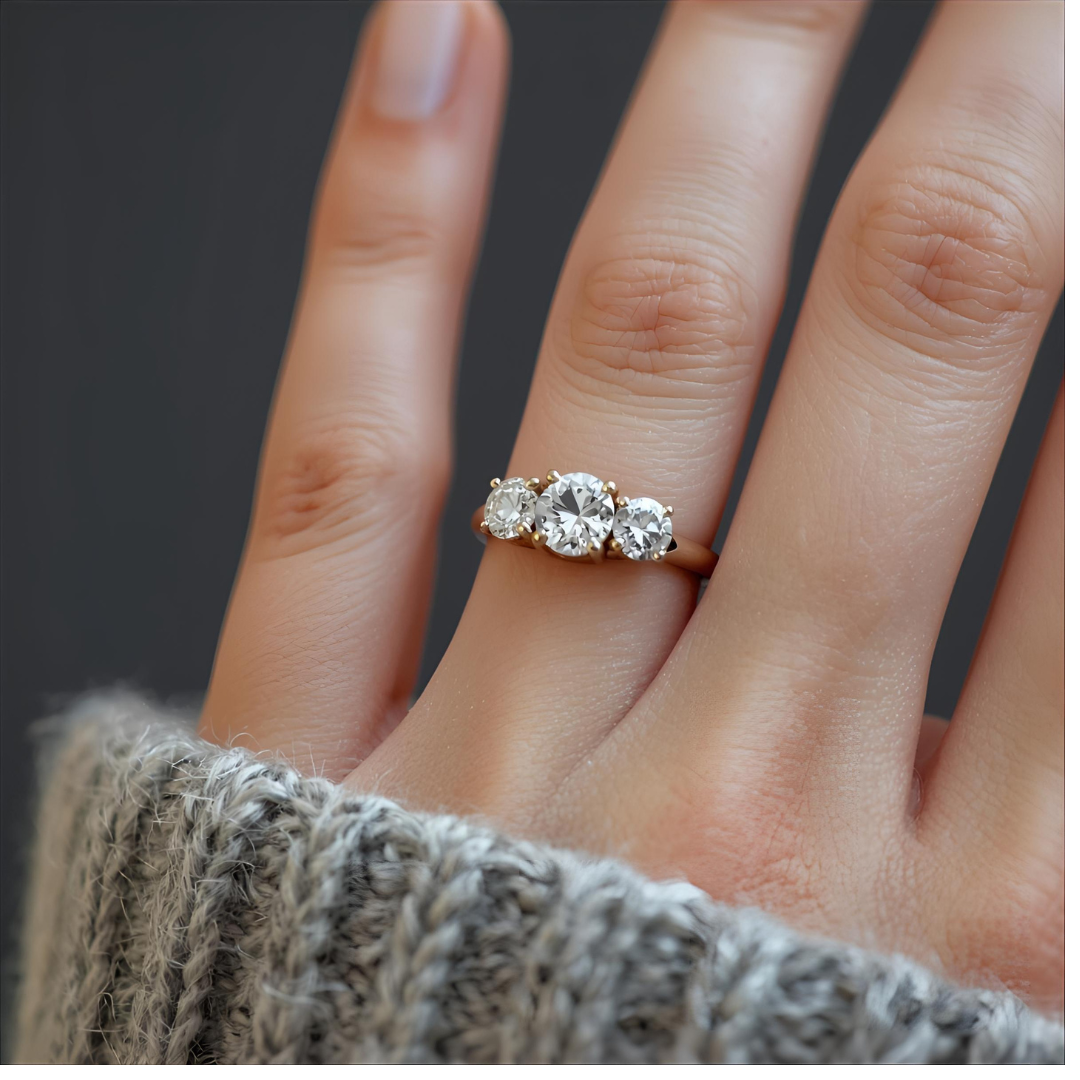
Here's a concise overview of what defines a three-stone ring
“In ancient Rome, brides wore rings with three stones not for style, but for protection. They believed the trio would guard the marriage against evil spirits. In the 15th century, Renaissance lovers exchanged ‘trinity‘ rings—three bands woven together, not as a puzzle, but as a promise that three strands are not easily broken. In 2025, when Meghan Markle stepped out with a three-stone engagement ring, she wasn‘t following a trend. She was wearing a 2,000-year-old story: past, present, and future, pressed into one band. The three-stone ring does not just hold diamonds. It holds time itself.”
The same three-stone story that protected Roman marriages and crowned British royalty now awaits your own past, present, and future. Every three-stone ring in our collection is handcrafted for balance—because a story with three chapters should never feel uneven.”
[Button: Explore Three-Stone Rings →]
Table of Contents
- What Is A Ring With Three Stones Called?
- What Does The 3 Stone Ring Mean In Love?
- Is A 3 Stone Engagement Ring Good?
- What Does A Three-Stone Engagement Ring Mean?
- Are Three-Stone Rings In Style?
- Are 3 Stone Engagement Rings Timeless?
- How To Pair A Three-Stone Engagement Ring?
- Are 3 Stone Engagement Rings Too Much?
- How Clean Is The Origin Three-Stone Ring?
- Oval Three Stone Ring vs Pave
- Are Three-Stone Engagement Rings More Expensive?
- Are Three-Stone Rings Classic?
- What Wedding Ring Goes With A 3 Stone Engagement Ring?
Here, let's see the first topic.;
What Is A Ring With Three Stones Called?
The most common and meaningful name for a ring with three stones is a Trilogy Ring or Three-Stone Ring.
These rings are also sometimes referred to as Trinity Rings, although this name is often more closely associated with the three interlocking bands of a Cartier Trinity ring.
The key to understanding this style of ring lies in the powerful symbolism behind the three stones.
When Are Trilogy Rings Used?
Trilogy rings are incredibly versatile and are used for several types of jewelry:
Engagement Rings: This is a very popular choice. A three-stone engagement ring often features a larger center stone (like a diamond) flanked by two slightly smaller stones. This design is sometimes called a "three-stone solitaire."
Eternity Bands: A three-stone ring can be a minimalist version of a full eternity band, symbolizing the same eternal love.
Anniversary Rings: They are a beautiful gift to celebrate a milestone anniversary, perfectly embodying the "past, present, and future" symbolism.
Right-Hand Rings: They are also worn simply as a beautiful and meaningful piece of fashion jewelry.
A Note on "Three-Stone Ring" vs. "Trilogy Ring"
While the terms are often used interchangeably, there can be a subtle distinction:
Trilogy/Trinity Ring: Typically implies that the three stones are of equal size and are meant to carry the specific symbolic meaning mentioned above.
Three-Stone Ring: This is a broader, more descriptive term. It can refer to any ring with three stones, including designs with a large center stone and two smaller side stones (a very common engagement ring style).
If you're looking for the specific name for a ring with three stones, you can confidently call it a Trilogy Ring, a Three-Stone Ring, or a Trinity Ring. The choice of name often depends on the design and the symbolic meaning the wearer attributes to it.
For official information on jewelry settings, visit the GIA Jewelry Setting Guide.
What Does The 3 Stone Ring Mean In Love?
The three-stone ring is one of the most symbolically rich pieces of jewelry in the context of love. Its meaning is profound and multi-layered, making it a powerful emblem of a romantic journey.
At its core, the three stones represent a timeline and the pillars of a strong relationship.
The Primary Meaning: A Romantic Timeline
The most universal and cherished meaning is that the three stones represent the Past, Present, and Future of a couple's relationship.
The Past: The first stone symbolizes where your love began—the memories you've built, the challenges you've overcome, and the foundation of your bond.
The Present: The center stone represents the love you share and celebrate today. It signifies your current commitment and joy in one another.
The Future: The third stone is a promise for all the tomorrows to come. It represents your shared dreams, enduring commitment, and the lifelong journey ahead.
This "timeline" symbolism makes the three-stone ring an exceptionally popular choice for engagement rings and anniversary bands, as it perfectly captures the enduring and evolving nature of a lifelong partnership.
Other Powerful Meanings in Love
Beyond the timeline, the trio of stones can symbolize other essential facets of a loving relationship:
Friendship, Love, and Fidelity
Friendship: The deep companionship and trust that form the basis of a strong partnership.
Love: The romantic passion, affection, and emotional connection you share.
Fidelity: The promise of loyalty, commitment, and faithfulness to one another.
Mind, Body, and Soul
This represents a complete and holistic union. It signifies that you love every part of your partner—their intellect (Mind), their physical being (Body), and their innermost spirit (Soul).
The Trinity of "I Love You"
In a more modern interpretation, the three stones can represent the three words, "I Love You," making the ring a constant, silent declaration of your feelings.
How the Design Enhances the Meaning
The way the ring is crafted can add even more layers to its symbolism:
A Larger Center Stone: In many three-stone engagement rings, the center stone is larger. This emphasizes the "Present," highlighting the current moment of commitment (the engagement) as the most brilliant and prominent part of your story so far.
Three Equal Stones: A ring with three stones of the same size powerfully reinforces that all three concepts (past, present, future; friendship, love, fidelity) are of equal importance in the relationship.
In essence, when you give or wear a three-stone ring in the context of love, you are not just offering a beautiful piece of jewelry. You are telling a story—a story of your shared history, your powerful love in the present moment, and your unwavering promise for a future together. It is a tangible symbol of a love that is both rooted in a beautiful past and destined for a bright future.
Is A 3 Stone Engagement Ring Good?
The short answer is: Yes, a 3-stone engagement ring is an excellent choice for many people.
However, whether it's the right choice for you or your partner depends on your priorities. Let's break down the advantages and a few considerations to help you decide.
The "Good" - Major Advantages of a 3-Stone Ring:
Profound Symbolism: This is its biggest strength. As discussed, the representation of "Past, Present, and Future" adds a deep layer of meaning that a single solitaire doesn't carry. It tells a story about your enduring and evolving love, making it more than just a piece of jewelry.
Maximum Brilliance and Sparkle: With three stones, you have more facets reflecting light. This often means a more brilliant and eye-catching ring than a single solitaire of a similar total carat weight. It's a fantastic choice for someone who loves a lot of sparkle.
Illusion of Greater Size: The two side stones can make the center stone appear larger. Even if the center diamond is modest in size, the overall presence of the ring on the finger is more substantial and impressive.
Design Versatility and Customization: The possibilities are endless. You can choose:
Stone Shapes: A classic round center with trapezoid side stones, three emerald cuts, or a mix of oval and pear.
Stone Types: A diamond center with sapphire side stones (for a "something blue" touch), or all three stones in an alternative gemstone like morganite or moissanite.
Settings: Bezel set, prong set, or a mix for a modern or vintage look.
Timeless Yet Distinctive: While the 3-stone setting is a classic design, it's less ubiquitous than the single solitaire. It allows you to have a timeless piece that still feels unique and personal.
Considerations & Potential "Drawbacks":
Generally, Higher Cost: A 3-stone ring will typically be more expensive than a single solitaire with the same size center stone because you are paying for two additional stones. However, you can achieve a grand look with a smaller center stone and well-chosen side stones, which can be a smart way to manage budget.
It can Be More Difficult to fit a Wedding Band: This is the most practical consideration. Some 3-stone rings, especially those with low-set side stones, may require a custom-shaped or curved wedding band to sit flush against them. Many modern designs are created with this in mind, but it's something to check when trying on rings. An "open" setting or a band with a notch can solve this.
Slightly Higher Maintenance: More stones mean more prongs and places for dirt and grime to accumulate. It may require slightly more careful cleaning and periodic prong checks to ensure the side stones are secure.
A Matter of Aesthetic Taste: Some people prefer the sheer, minimalist elegance of a single solitaire. A 3-stone ring is a bolder, more detailed statement. It's crucial to know your partner's style.
Comparison: 3-Stone vs. Solitaire
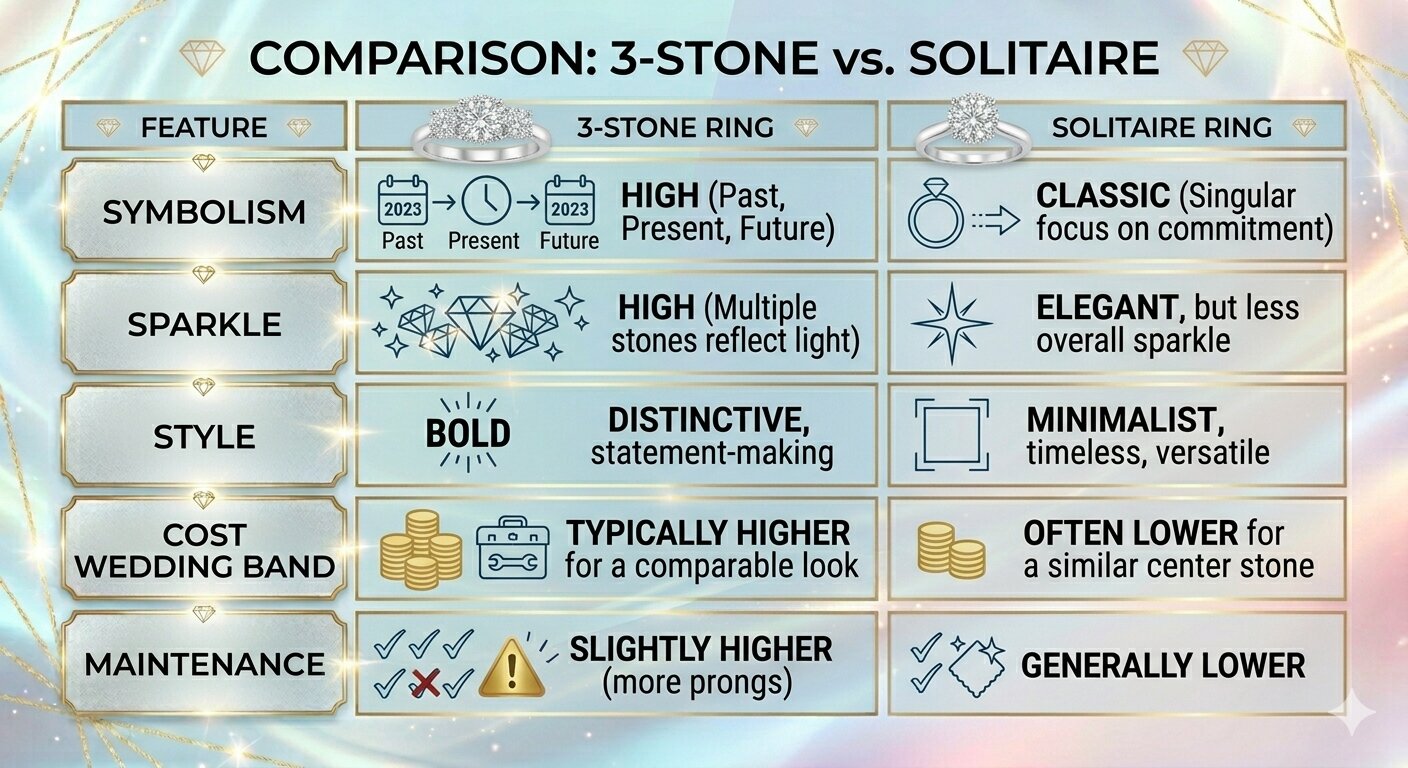
Who is a 3-Stone Ring Good For?
A 3-stone engagement ring is an excellent choice if:
Symbolism is important to you and your partner.
You love a brilliant, sparkly look.
You want a customizable and unique design.
You appreciate a classic style that isn't as common as the solitaire.
A 3-stone engagement ring is not just "good"—it can be a profoundly meaningful and stunningly beautiful choice. It's a decision that leans into romance, history, and a promise for the future, all while offering incredible visual impact. The key is to ensure its style and practical considerations align with the wearer's taste and lifestyle.
What Does A Three-Stone Engagement Ring Mean?
The meaning of a three-stone engagement ring is profound and layered, making it a deeply sentimental choice. While stunningly beautiful, it holds powerful symbolism.
Here’s a breakdown of what a three-stone engagement ring means:
The Primary Meaning: A Romantic Timeline
The most universal and cherished meaning is that the three stones represent the Past, Present, and Future of a couple's relationship.
The Past: The first stone symbolizes where your love began—the memories you've built, the challenges you've overcome, and the foundation of your bond.
The Present: The center stone represents the love you share and celebrate today. It signifies your current commitment, joy, and the decision to get engaged.
The Future: The third stone is a promise for all the tomorrows to come. It represents your shared dreams, enduring commitment, and the lifelong journey you will build together.
This "timeline" symbolism makes the three-stone ring a perfect representation of an enduring, evolving love story.
Other Significant Meanings
Beyond the timeline, the trio of stones can symbolize other essential pillars of a strong, loving relationship:
Friendship, Love, and Fidelity
Friendship: The deep companionship, trust, and partnership that form the foundation of your relationship.
Love: The romantic passion, affection, and emotional connection you share.
Fidelity: The promise of loyalty, commitment, and faithfulness to one another.
Mind, Body, and Soul
This represents a complete and holistic union. It signifies that you love every part of your partner—their intellect (Mind), their physical being (Body), and their innermost spirit (Soul).
How the Design Enhances the Meaning
The way the ring is designed can add even more layers to its symbolism:
A Larger Center Stone: In many three-stone engagement rings, the center stone is larger. This beautifully emphasizes the "Present," highlighting the current moment of commitment (the engagement) as the most brilliant and prominent part of your story so far.
Three Equal Stones: A ring with three stones of the same size powerfully reinforces that all three concepts (past, present, future; friendship, love, fidelity) are of equal importance in the relationship.
Choice of Gemstones: While diamonds are classic, some couples incorporate birthstones or colored gems (like sapphires or emeralds) for the side stones, adding a further layer of personal meaning.
When you give or wear a three-stone engagement ring, you are not just offering a beautiful piece of jewelry. You are telling a story—a story of your shared history, your powerful love in the present moment, and your unwavering promise for a future together.
It is a tangible symbol of a love that is both rooted in a beautiful past and destined for a bright future.
Are Three-Stone Rings In Style?
This is a great question, as style and trends are important factors in choosing an engagement ring.
The short and definitive answer is: Yes, three-stone rings are absolutely in style. In fact, they are experiencing a significant resurgence and are more popular than they have been in years.
However, it's more accurate to say they have evolved. They aren't just "in style" in a classic sense; they are being reimagined in modern ways that keep them feeling fresh and contemporary.
Here’s a breakdown of why three-stone rings are currently so fashionable:
1. They Are Timeless with a Modern Twist
The three-stone setting is a classic, much like a solitaire. This means it never truly goes out of style. However, what's "in" right now is the way people are personalizing them:
Mixed Cuts: Instead of three round brilliant diamonds, popular modern combinations include an oval center with trapezoid side stones, an emerald cut center with baguettes, or a pear center with round or pear side stones.
Colored Gemstones: Using sapphires, emeralds, or other colored gems as side stones (or even as the center stone) is a huge trend. This adds a personal touch and a pop of color, making the ring feel unique and fashion-forward.
2. The "Toi et Moi" Influence
The "Toi et Moi" (You and Me) ring, featuring two main stones, has been a massive trend. This has paved the way for a renewed appreciation for multi-stone rings that tell a story. The three-stone ring is a natural extension of this, offering an even more layered narrative (past, present, future).
3. Celebrity Endorsement
High-profile engagements have a major influence on trends. Celebrities like Meghan Markle (who has a famous three-stone ring from Prince Harry), Blake Lively, and Sophie Turner have worn stunning three-stone rings, bringing them back into the spotlight and making them a coveted choice.
4. A Shift Towards Meaning and Personalization
Modern couples often choose rings based on symbolism and personal meaning, not just the current fad. The inherent symbolism of the three-stone ring (past, present, future) is powerfully appealing to those who want their ring to represent their unique love story.
What Makes a Three-Stone Ring Look "Current" Today?
While any three-stone ring is stylish, certain features give them a distinctly modern feel:
Elongated Center Stones: Ovals, emerald cuts, and pear shapes are very trendy as center stones.
Low-Profile Settings: Settings that sit closer to the finger for a sleek, modern look and practical wear.
Unique Stone Combinations: Mixing shapes and colors, like a salt-and-pepper diamond center with two white diamond side stones.
Thinner Bands: Delicate, thin bands contrast with the substantial look of the stones, creating a modern, elegant silhouette.
Are They A Passing Trend?
No. Unlike some fleeting fashion fads, the three-stone ring is a classic style that is currently enjoying a peak in popularity. Its timeless foundation ensures that it will never look dated, even as the specific details (like favored stone shapes) may evolve.
You can confidently choose a three-stone ring knowing that it is not only in style but is also a meaningful, timeless, and versatile choice. Its current popularity is driven by a desire for personalization and symbolism, making it a modern classic that feels both of-the-moment and enduring.
Are 3 Stone Engagement Rings Timeless?
Yes, 3-stone engagement rings are absolutely timeless.
While they experience peaks and valleys in popularity like any style, they have never truly gone "out of style." They belong to a category of classic jewelry that endures for generations, much like a solitaire or a simple band.
Here's a deeper look at why they earn the "timeless" classification:
1. Historical Endurance
The three-stone design is not a modern fad. It has been used in jewelry for centuries, with notable examples from the Georgian, Victorian, and Art Deco eras. Its continued presence over hundreds of years is the very definition of timelessness.
2. Foundational and Universal Symbolism
The core meaning—representing a couple's past, present, and future—is universal and everlasting. This symbolism transcends fleeting trends. Unlike a ring chosen for a specific, passing fashion, the narrative of a 3-stone ring remains relevant and profound throughout a lifetime of marriage.
3. Classic and Adaptable Design
The basic structure of three stones sitting on a band is simple and strong. This foundational design acts as a canvas that can be adapted to the aesthetics of any era without losing its identity.
In the Art Deco period, it was featured with geometric cuts and filigree.
In the late 20th century, it was popular with round brilliant cuts.
Today, it's reimagined with elongated cuts (like ovals and emeralds), mixed stone types, and sleek, low-profile settings.
The design evolves with the times, but the essential trio of stones remains a constant.
4. Comparison to Other Timeless Styles
The 3-stone ring sits alongside the solitaire and the eternity band as one of the fundamental, enduring engagement ring styles. You would never look at a well-crafted 3-stone ring from 50 years ago and think it was strange or outdated; you would recognize it as a classic.
What Can Make a 3-Stone Ring Feel Dated?
Sometimes, people might perceive an older ring as "dated," but this is usually due to specific period-related details, not the core design itself. These can include:
Very chunky or specific-style settings from a particular decade.
Outdated diamond cuts that were popular at one time but are less so now.
Extremely high or bulky settings.
A well-designed 3-stone ring from any era, with a focus on proportion and balance, will always look elegant.
A 3-stone engagement ring is a proven, timeless choice. It is a style rooted in enduring symbolism and a classic architectural design that adapts beautifully across centuries. Choosing one is a safe bet for someone who wants a ring that will feel just as meaningful and beautiful on their 50th anniversary as it did on the day they got engaged.
How To Pair A Three-Stone Engagement Ring?
Pairing a three-stone engagement ring is a fun process, but it requires a bit more thought than a simple solitaire due to its unique shape and profile.
The key to a perfect pairing lies in how the wedding band sits against the engagement ring. The goal is to achieve a comfortable, seamless look that complements the ring's beauty.
Here’s a complete guide on how to pair a three-stone engagement ring, from wedding bands to other jewelry.
Part 1: Pairing with a Wedding Band
This is the most important pairing. The main challenge is that the side stones of the engagement ring can prevent a straight band from sitting flush against it, creating a gap.
Solution 1: The Curved or Notched Band
This is the most popular and elegant solution. A custom-designed band that curves around the engagement ring's center stone is a perfect fit.
Pros: Creates a seamless, locked-together look. Comfortable to wear.
Cons: The curved band is usually designed to be worn only with the engagement ring.
Solution 2: The Open Band
An open band has a small gap in the shank, allowing it to slot neatly underneath the engagement ring's center stone.
Pros: Very sleek and modern. It can often be worn alone as a straight band.
Cons: Can be a more delicate setting.
Solution 3: A Straight Band with a Gap
If you love a specific straight band and don't mind a small space, this is a valid option! This "negative space" has become a stylish, intentional look for many.
Pros: Maximum flexibility in band choice. Easy to resize and clean.
Cons: The gap may bother those who prefer a seamless fit.
Solution 4: A Contoured/Wedding Ring Jacket
These are sets where two bands are designed to cradle the engagement ring on both sides. This creates a spectacular, statement-making trio.
Pros: A dramatic and full look. Solves the gap issue completely.
Cons: Can be bulky. The engagement ring often doesn't look complete without both bands.
Solution 5: A Thin, Straight Band
If your three-stone setting is low-profile, you might be able to get away with a very thin, plain band sitting flush against it. This is the simplest and most classic look, but it requires a specific ring design.
Part 2: Choosing the Style of the Wedding Band
Once you've decided on the shape, consider the style of the band:
For a Classic Look: A plain metal band (in the same metal as your engagement ring) lets the three-stone ring remain the star. A delicate pavé band can also add extra sparkle without overwhelming the design.
For a Thematic Look: An eternity band with stones that match the shape or cut of your side stones can create a beautiful, cohesive theme.
For a Modern/Unique Look: Consider a mixed-metal band (e.g., a rose gold band with a white gold engagement ring) or a band with a unique pattern like milgrain or filigree.
Part 3: Pairing with Other Jewelry
The three-stone ring is often a statement piece, so the goal with other jewelry is to complement, not compete.
Earrings:
Studs: You cannot go wrong. Diamond studs or simple gemstone studs echo the elegance without overwhelming the hand.
Dangly Earrings: If you wear them, choose simpler designs that don't have large, dominant stones that clash with the ring.
Necklaces:
A simple pendant or a delicate chain works best. The focus is naturally drawn to your hands, so a loud necklace can create visual competition.
A three-stone pendant can be a beautiful, symbolic match, but keep it dainty.
Bracelets:
A thin, delicate bracelet or bangle is a safe choice.
Avoid wide, statement cuffs or tennis bracelets with large stones, as they can make the entire arm look overly busy.
Key Takeaway: The Golden Rule
Always try the rings on together! The most important step is to see how your specific engagement ring fits with potential wedding bands. What looks good in theory might not work in practice, and vice versa.
Final Pro-Tip: If you are designing a three-stone ring from scratch and know you want a straight band, talk to your jeweler about designing a setting with a tall enough profile or custom-notched prongs to allow a straight band to sit flush from the beginning.
Are 3 Stone Engagement Rings Too Much?
Whether a 3-stone engagement ring feels like "too much" is very subjective. Instead of being an overwhelming style, its three-stone design is actually known for creating a balanced, symmetrical, and meaningful look.
Here are the key factors to help you decide if it's the right style for you.
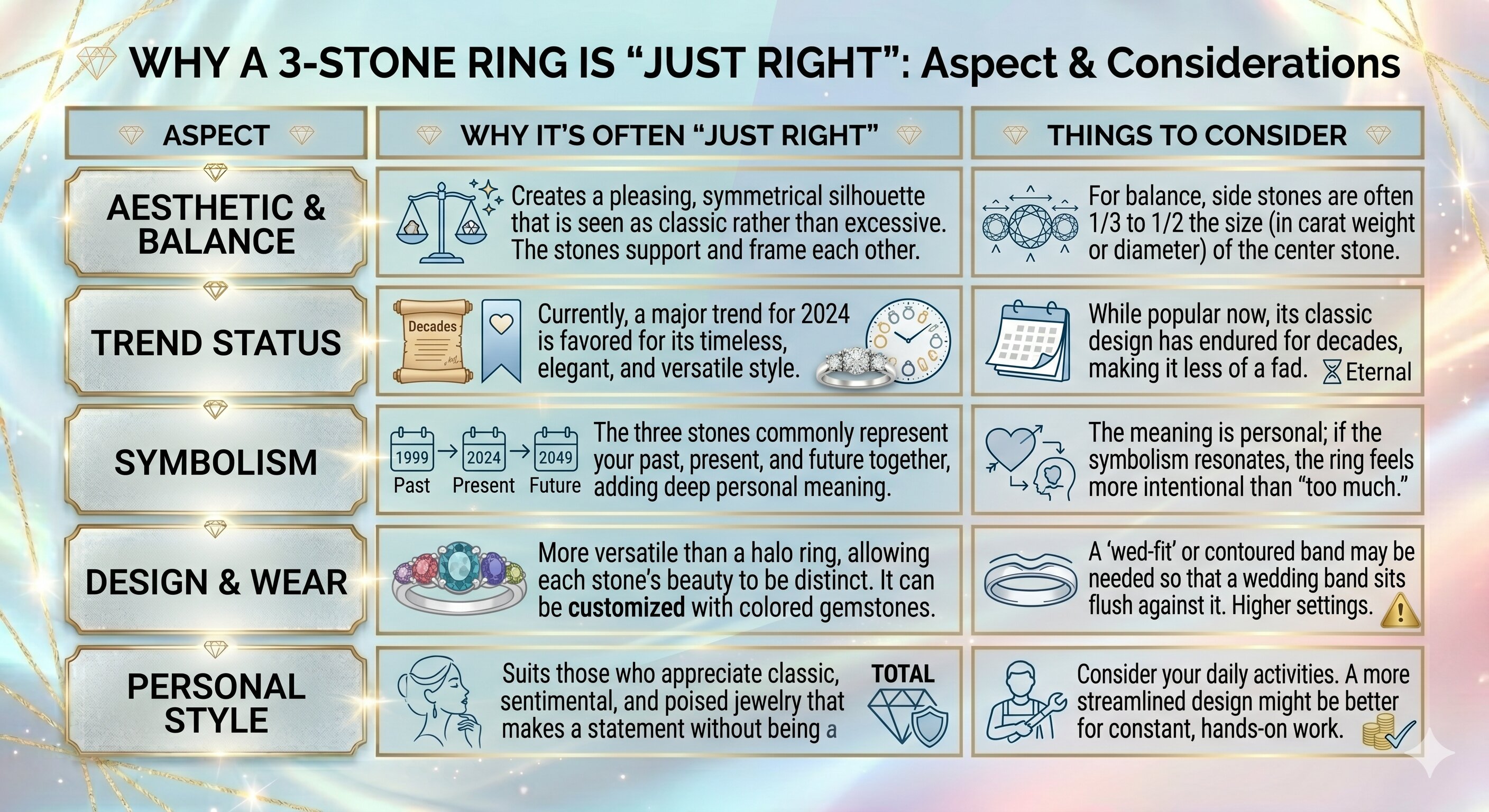
How to Make Your Decision
The best way to decide is to try several rings on. Pay attention to how different proportions (like a 2-carat center with 0.5-carat sides versus smaller accents) look and feel on your finger.
Also, think honestly about your daily life. If you're very active or work with your hands, a lower profile setting and a moderate total carat weight will likely be more comfortable and secure in the long run.
In short, a 3-stone ring is designed to be balanced and meaningful. If you love its symmetry and symbolism, it's unlikely to feel like "too much" for you.
If you decide on this style and want help understanding how to choose the specific carat weights or diamond shapes, I can provide more detailed guidance on that as well.
How Clean Is The Origin Three-Stone Ring?
The search results don't contain specific information on Clean Origin's 3-stone ring collection. However, based on my knowledge, Clean Origin is an online retailer focused on lab-grown diamond jewelry, including engagement rings.
Here are some key points about what you can typically expect and how to make an informed decision when looking at Clean Origin for a 3-stone ring:
What to Expect from Clean Origin
Lab-Grown Diamonds: Their primary focus is on lab-grown diamonds, which offer the same physical and chemical properties as mined diamonds at a lower cost.
Online-First Model: They operate primarily online, offering convenience, detailed product visuals, and home try-on kits.
Focus on Value: You can generally expect more competitive pricing compared to traditional jewelers for similar carat weight and quality.
Design Range: They will likely offer various 3-stone designs, from classic and symmetrical styles to more modern interpretations.
How to Evaluate Their 3 Stone Rings
To ensure you find a high-quality and beautiful piece, consider these key factors when browsing their collection:
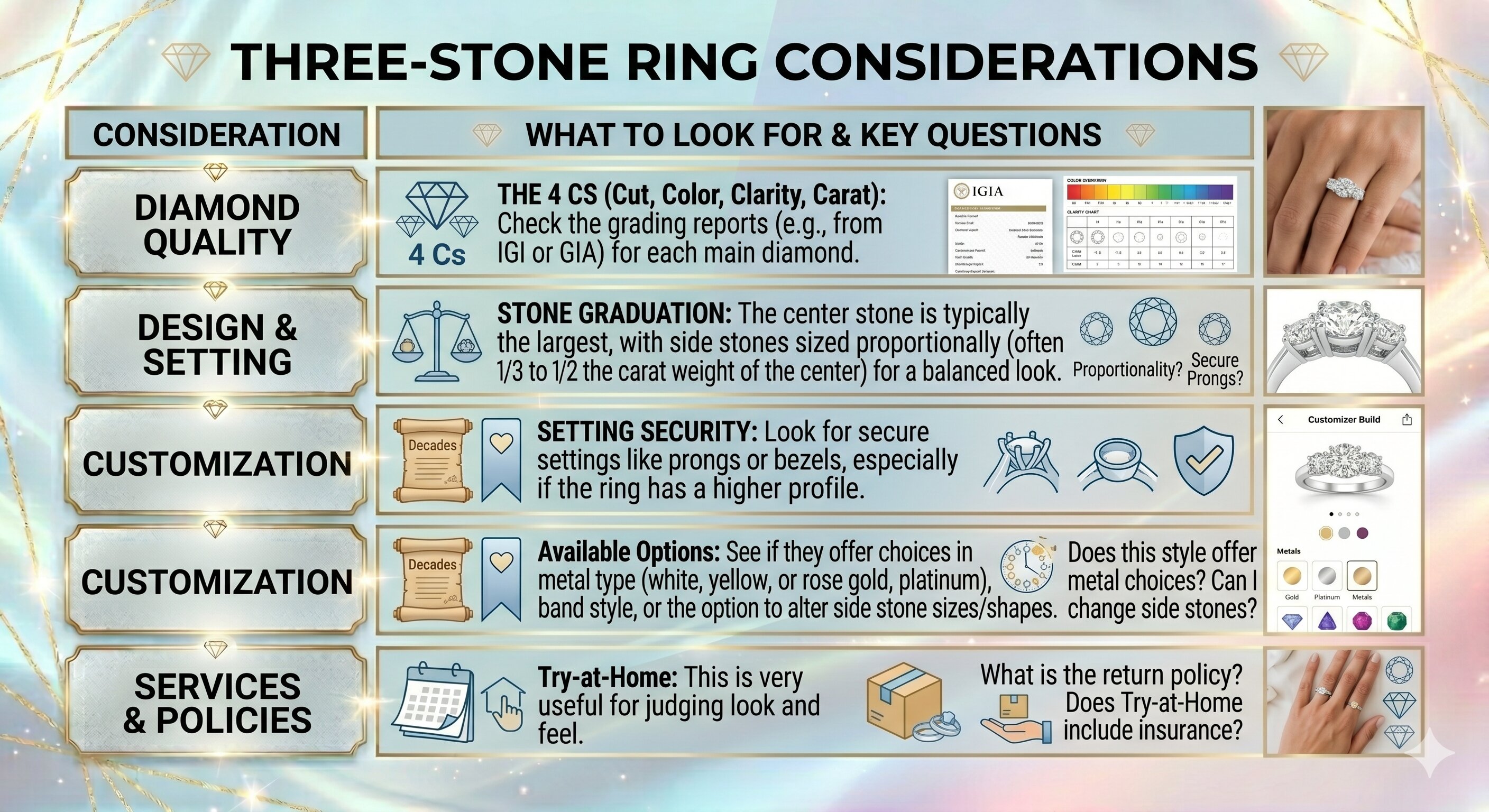
Wedding Band Fit: Check if their 3-stone settings are designed to sit flush with a wedding band, or if a custom-curved band is needed.
Your Best Next Steps
Visit Their Website Directly: Go to the Clean Origin website to explore their current "Three Stone" or "Trilogy" engagement ring collection. This will give you the most accurate and up-to-date view of styles, prices, and options.
Use Their Tools: Take advantage of any online chat consultants, home try-on programs, or detailed diamond viewers they offer.
Compare with Other Brands: Since the search results show other jewelers like Tacori and Sylvie Jewelry have notable 3-stone collections, browsing these can help you benchmark design, quality, and price.
If you would like help understanding diamond grading reports or comparing different 3-stone ring designs in general, I can provide more detailed guidance on those topics.
Oval Three Stone Ring vs Pave
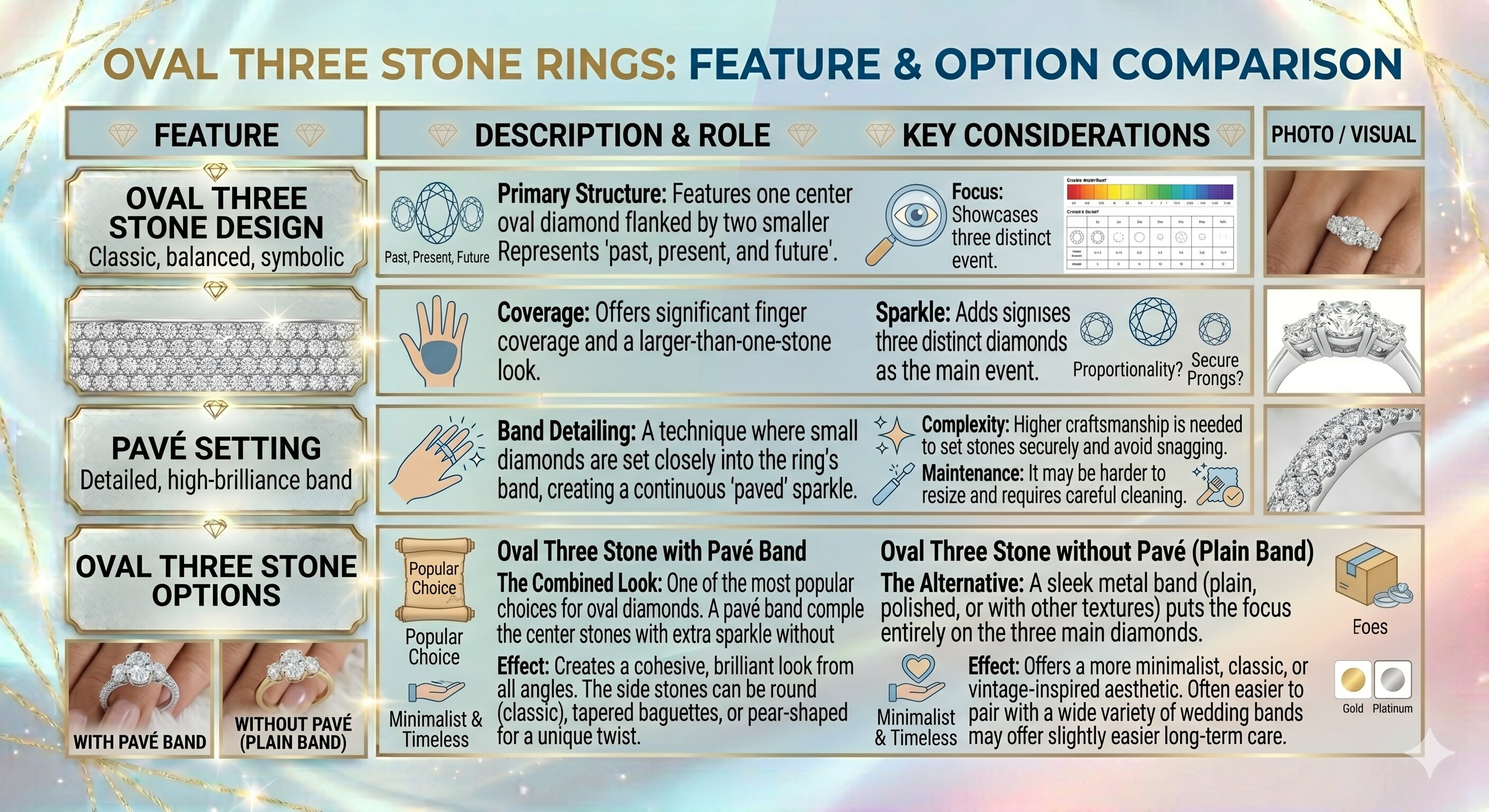
An "oval three stone ring" and a "pavé setting" are not competing choices—they are design elements that work together. Think of it this way: "oval three stone" is the primary structure, and "pavé" is a popular detailing technique often added to its band.
To understand how they work together, here is a breakdown of each element and its potential combinations:
How to Decide
Your decision isn't "one versus the other," but rather about choosing the final look you prefer:
Prefer maximal sparkle and a "complete" look? The combination of an ovathree-stonene ring with a pavé band is an excellent choice.
Want to highlight just the three main diamonds with a clean, timeless feel? Choose an oval three-stone ring without pavé, on a plain metal band.
To decide, the best step is to try on rings in person or use online retailers' virtual try-on tools to see which style resonates more with your personal taste.
I hope this clarifies how these design elements work together. Would you like me to find examples of oval three-stone rings from specific jewelers to help you visualize the options better?
Are Three-Stone Engagement Rings More Expensive?
Three-stone engagement rings are not automatically more expensive. Their price depends heavily on the combined carat weight and quality of all three stones, as well as the design complexity.
They can sometimes be more budget-friendly than a solitaire of the same total weight because smaller stones generally cost less per carat.
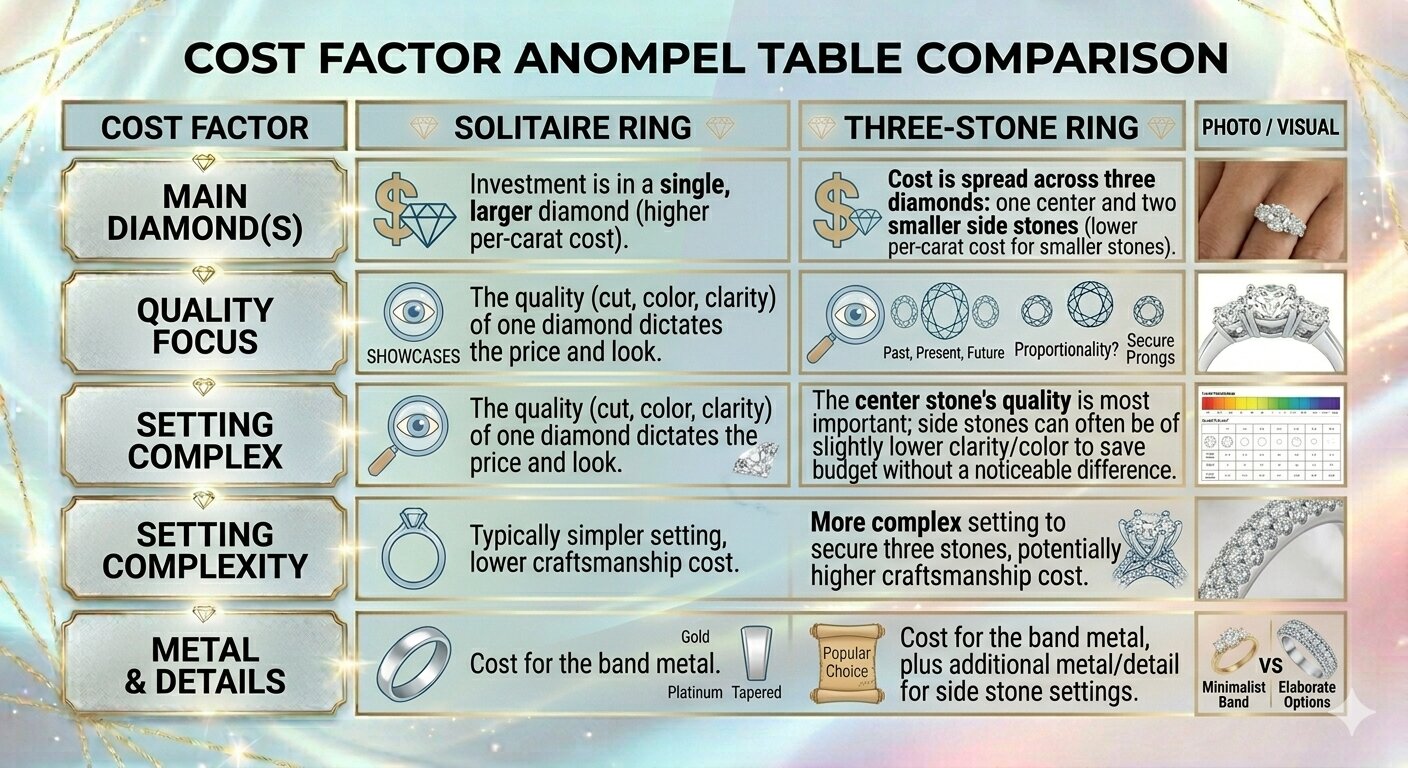
Here’s a direct comparison of where the costs come from for each style, assuming similar total carat weight:
Key Factors Affecting a Three-Stone Ring's Price
The cost of a three-stone ring is driven by:
Side Stone Size & Quality: Larger or higher-quality side stones increase the price. As a guide, side stones are often about 1/3 to 1/2 the carat weight of the center stone for a balanced look. For a cohesive appearance, side stones should be within two color and clarity grades of the center stone.
Design Choices: Adding a pavé band or choosing intricate settings (e.g., intricate milgrain or vintage details) adds cost beyond a plain metal band.
Stone Shape: This also affects price. As you've looked at oval cuts, note that oval diamonds generally cost 10-30% less than round brilliants of the same carat weight. This saving applies to the center and side stones in a three-stone design.
How to Compare Prices Smartly
When shopping, compare total carat weight (TCW) and the quality of the center diamond rather than just the style. A three-stone ring with a modest center stone can offer more visual impact for your budget, while a high-quality solitaire may represent a better investment in a single, larger diamond.
If you have a specific budget and style in mind (like an oval three-stone ring), would you like me to help you understand how to allocate your budget for the center diamond and side stones?
Are Three-Stone Rings Classic?
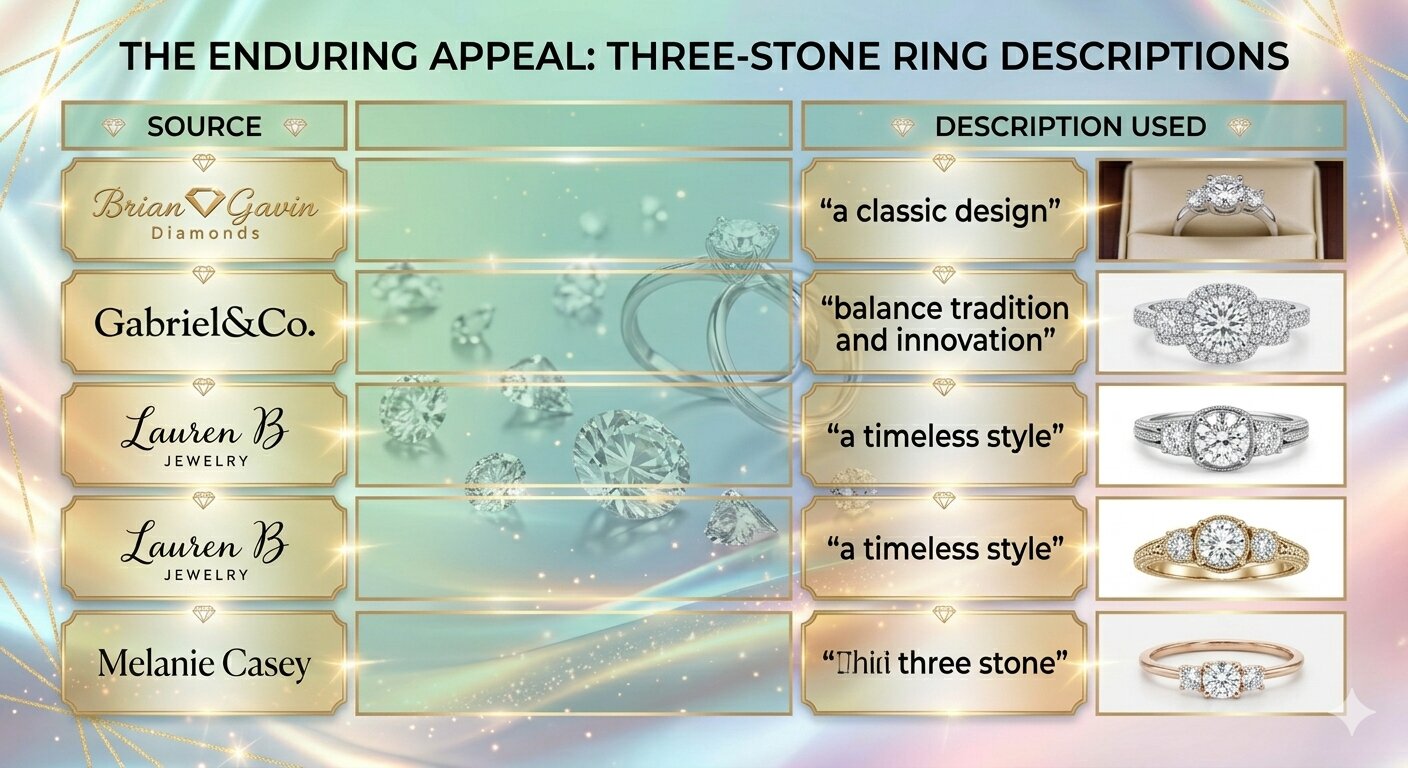
Yes, three-stone engagement rings are widely considered a classic style. This isn't just an opinion; leading jewelers consistently describe them with terms like "classic," "timeless," and "traditional" in their official collections.
A Classic Endorsed by Experts
Here is how various reputable jewelry brands describe the style, which confirms its classic status:
The Hallmarks of a Classic Design
Several key factors contribute to the enduring appeal of the three-stone ring:
“In 1981, Prince Charles gave Lady Diana a sapphire engagement ring. It was a three-stone ring—12 carats of oval sapphire surrounded by 14 diamonds. When Prince William proposed to Kate Middleton with that same ring, the world watched history repeat. That ring did not look dated. It looked royal. Three-stone rings have been found in Viking burial sites, Tudor portraits, and Victorian jewelry boxes. They do not belong to one decade. They belong to all of them. A three-stone ring is not a trend. It is a timeline on your finger.”
Deep Symbolism: The design is traditionally known as a "trilogy" or "trinity" ring, where the three stones symbolize the past, present, and future of a relationship. This meaningful narrative has been a cornerstone of its popularity for decades.
Proven Versatility: It offers a perfect canvas for personalization while retaining its core identity. You can choose classic round brilliants, elongated oval cuts, vintage-inspired emerald cuts, or nearly any other diamond shape for the center and side stones. This adaptability keeps the style fresh and relevant across generations.
Elegant Balance: The design is inherently balanced and symmetrical, creating a look of harmony that is neither overly minimal nor excessively ornate.
Your Oval Three-Stone Ring
Your specific interest in an oval three-stone ring is a perfect example of this classic-versatile blend. The oval center stone is a modern, flattering choice, yet when set with two complementary side stones, it sits firmly within a timeless tradition. This combination allows you to enjoy a contemporary shape within a historic and meaningful setting.ng
Would you like to explore how different side stone shapes (like tapered baguettes or round diamonds) can alter the look of an oval three-stone ring?
What Wedding Ring Goes With A 3 Stone Engagement Ring?
The best wedding band for your three-stone engagement ring depends on its specific design. The key challenge is that the side stones often extend into the area where a straight band would sit.
Here is a comparison of the most popular wedding band styles to help you find the best fit.
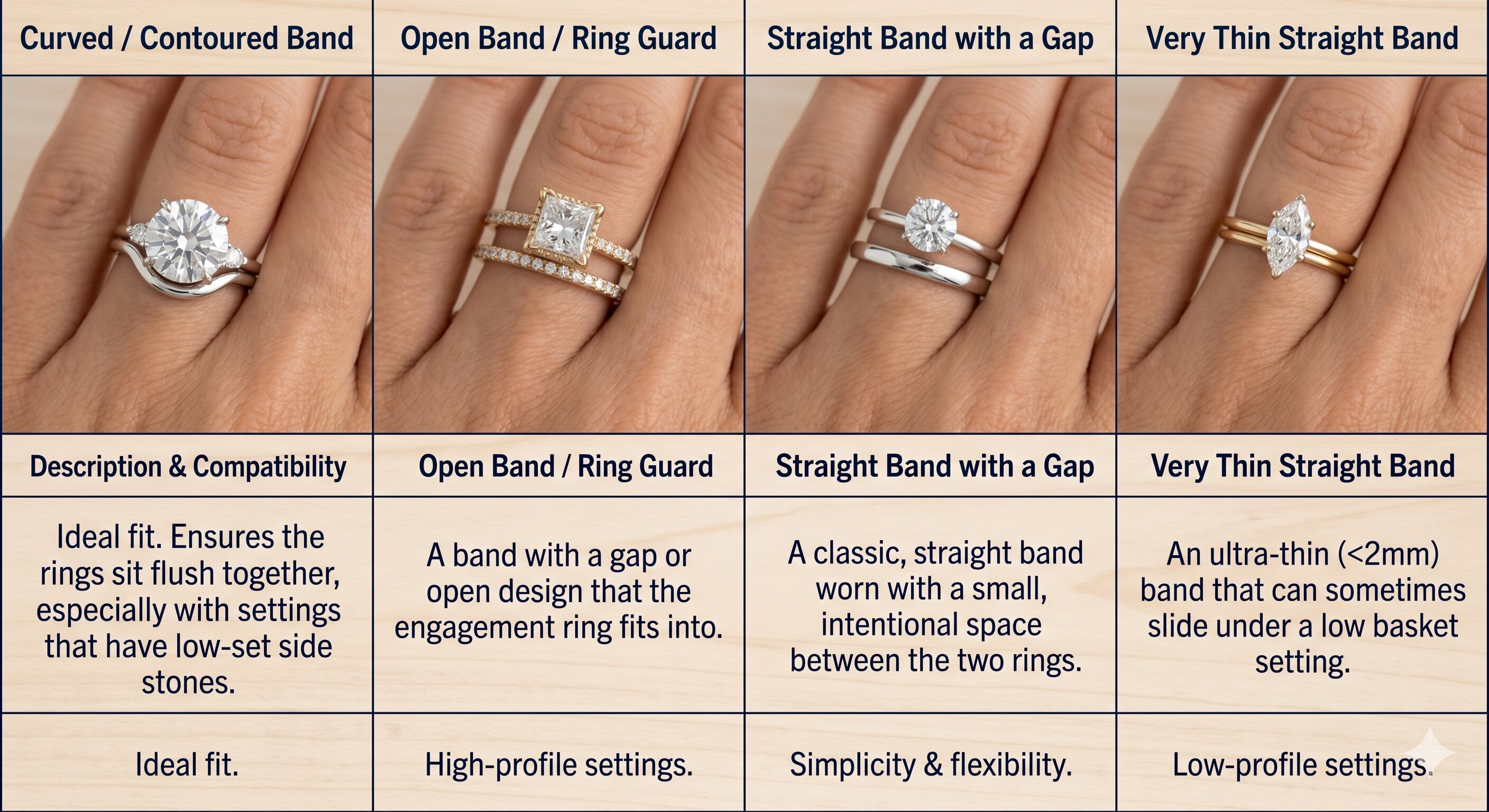
Key Considerations for Your Pairing
To narrow down your choice, keep these points in mind:
Setting Height is Crucial: A low-profile setting gives you the most band options, potentially allowing a thin straight band to sit flush. A high-profile setting almost always requires a curved, open, or gap-accepting style.
Side Stone Shape Affects the Space: Side stones that taper, like pear shapes or tapered baguettes, can create more space for a band to nestle against. Square or round side stones may leave less room.
Try Them On Together: This is the single most important step. Fit and personal preference are everything. Bring your engagement ring to try different band styles in person.
If you can share specific details about your ring—like whether it has a high or low setting, the shape of the side stones, or if you have a photo—I can offer more tailored advice on which band style might work best.
“You now know the name, the love meaning, the engagement suitability, the symbolism, the style status, the timelessness, the pairing guide, the ‘too much‘ question, the origin details, the oval vs pavé comparison, the pricing, the classic status, and the wedding band options. The only question left: which three chapters will your ring tell?
Our current collection includes a limited number of three-stone rings — from classic round brilliants to oval center stones with tapered baguettes, from low-profile bezels to cathedral settings. When certain designs are gone, restocking takes time because each three-stone ring must be balanced stone by stone.
This is not just a ring. It is ancient Roman protection, Viking burial treasures, Tudor portraits, Diana‘s sapphire, and Kate‘s royal heirloom — past, present, and future, pressed into one band.”
[Button: Secure Your Three-Stone Ring (Limited) →]
Morganite Guide: Meaning, Price, vs Diamond, Colors and Care
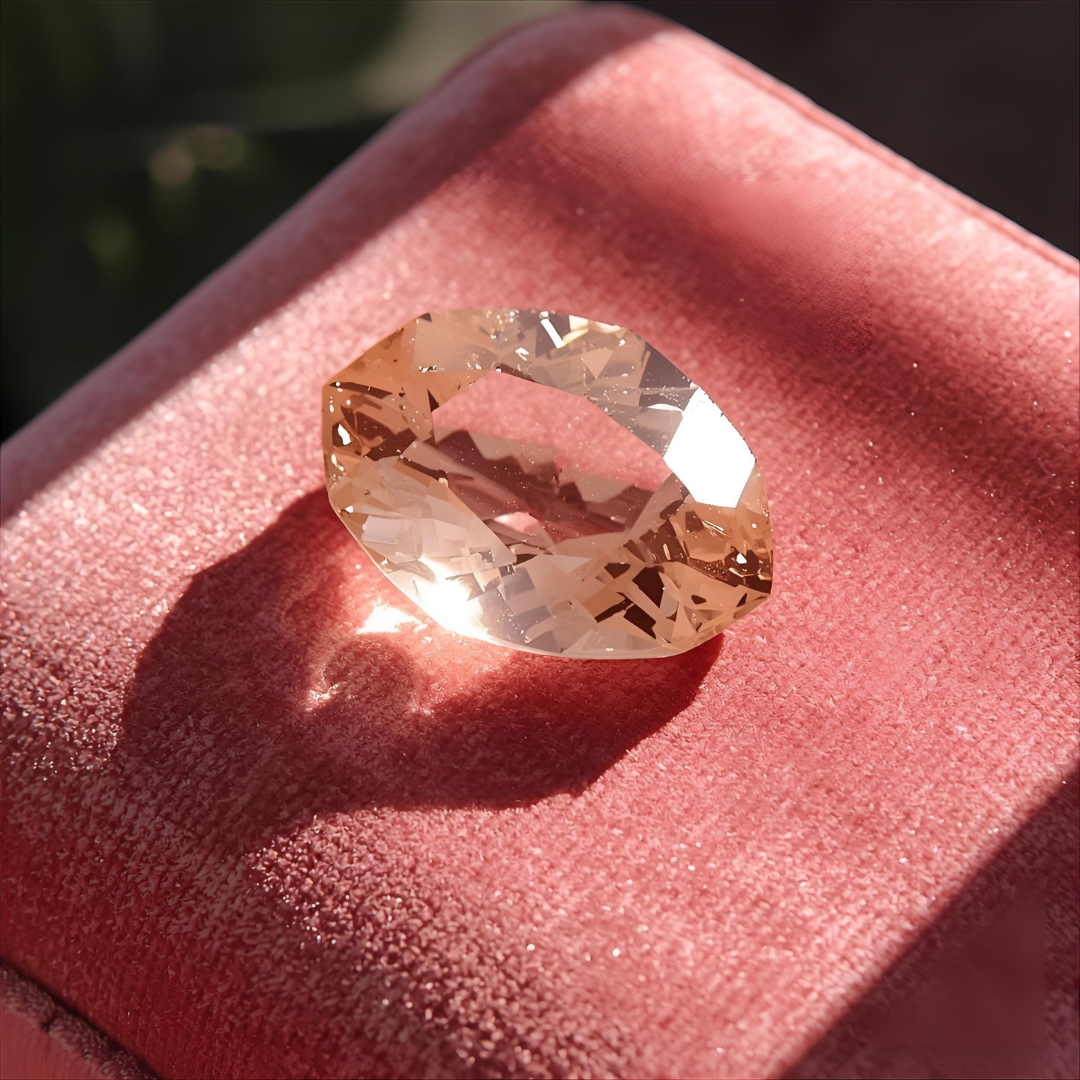
Morganite Guide: Meaning, Price, vs Diamond, Colors, and Care
Morganite is a beautiful, semi-precious gemstone known for its soft pink to peach-pink hues. It is the pink to orange-pink variety of the mineral Beryl, making it a close cousin to more well-known beryls like:
“In 1910, the famous financier and gem collector J.P. Morgan received a gift: a pink beryl from Madagascar, so delicate in color it seemed to blush. He loved it immediately. Tiffany & Co.‘s gemologist, George Kunz, named the stone ‘morganite‘ in his honor. For decades, it remained a collector‘s secret—a gem for those who knew, not for those who followed. Then, in 2010, something changed. Brides discovered morganite. They saw that a pink stone set in rose gold could be as romantic as a diamond, at a fraction of the price, with a softness that diamonds could never match. Morganite is not a new gem. It is an old secret, finally shared.”
The same blush gem that J.P. Morgan treasured now awaits your own love story — in soft peach, blush pink, or vivid bubblegum. Every morganite in our collection is eye-clean, heat-treated only (the standard), and chosen for that signature romantic glow.”
[Button: Explore Morganite Jewelry →]
Emerald (green)
Aquamarine (blue)
Heliodor (yellow)
Its delicate color and excellent brilliance have made it extremely popular in modern jewelry, especially for engagement rings.
Table of Contents
- What Is The Spiritual Meaning Of Morganite?
- What Are The Benefits Of Wearing Morganite?
- What Is The Morganite Stone Good For?
- Is Morganite A Valuable Gem?
- How Much Is 1 Carat Of Morganite Worth?
- Is Morganite More Expensive Than Diamond?
- What Is The Rarest Color Of Morganite?
- What Is The Best Color Of Morganite?
- Is Morganite Hard Or Soft?
- Can Morganite Go In Water?
- What Are The Disadvantages Of Morganite?
- How Do I Tell If My Morganite Is Real?
- Why Is Morganite So Popular?
- Can Morganite Be Worn Every Day?
- Does Morganite Lose Its Sparkle?
Here, let's see the first topic.;
What Is The Spiritual Meaning Of Morganite?
The spiritual meaning of Morganite is deeply intertwined with the heart, making it one of the most beloved crystals for emotional and spiritual healing.
In essence, Morganite is the stone of Divine Love and Compassion. It acts as a gentle, powerful conduit for the highest forms of love, helping to heal the heart and connect it to spiritual realms.
Here’s a detailed breakdown of its core spiritual meanings and uses:
1. The Stone of Divine and Unconditional Love
Morganite's most prominent spiritual meaning is its connection to unconditional love, or Agape.
Channeling Higher Love: It is believed to open the heart to receive love from spiritual guides, angels, and the Divine (or the Universe). It helps you understand that you are deeply loved and supported on your soul's journey.
Cultivating Self-Love: Before you can truly love others or receive love, you must love yourself. Morganite gently dissolves feelings of unworthiness, self-criticism, and old emotional wounds, replacing them with self-acceptance and compassion.
Enhancing Empathy: It encourages you to extend this unconditional love and compassion outward, fostering deeper, more empathetic connections with others.
2. Heart Chakra Healer and Activator
Morganite is a primary stone for the Heart Chakra (Anahata).
Clearing Blockages: It works to gently clear blockages and past traumas stored in the heart chakra, such as grief, heartbreak, jealousy, and resentment.
Activating Higher Heart Chakra: Morganite is also associated with the Higher Heart Chakra (Thymus), which bridges the human and spiritual love of the heart chakra with the divine will and truth of the throat chakra. This facilitates compassionate communication and living from a place of heartfelt integrity.
3. Emotional Healing and Calming
Its gentle, high-vibrational energy provides profound emotional solace.
Soothing Anxiety and Stress: Morganite's energy is inherently calming. It can help pacify a troubled mind, ease anxiety, and bring a sense of peace and emotional tranquility.
Healing Heartbreak: It is a powerful ally for mending a broken heart. It doesn't erase memories but helps you process the pain with love and understanding, allowing you to release the past and open up to new possibilities for love.
4. Connection to the Angelic Realm
Due to its gentle, loving, and high-frequency vibration, Morganite is often called an "Angelic Stone."
Divine Communication: It is said to strengthen your connection to the angelic realm, particularly the Archangels Jophiel (the angel of beauty) and Chamuel (the angel of peaceful relationships).
Gentle Guidance: Working with Morganite can help you feel the comforting presence of your guardian angels and receive their gentle guidance, especially in matters of the heart.
5. Encouraging Compassionate Communication
By bridging the heart and throat chakras, Morganite empowers you to speak your truth with love and kindness.
Heart-Centered Speech: It helps you communicate your feelings clearly and compassionately, reducing misunderstandings and conflicts in relationships.
Setting Loving Boundaries: It gives you the courage to set healthy boundaries from a place of self-love rather than anger or fear.
How to Use Morganite Spiritually
Wear as Jewelry: Wearing a Morganite pendant over your heart or as a ring is a powerful way to keep its loving energy with you throughout the day.
Meditation: Hold a Morganite stone over your heart chakra during meditation. Visualize its soft pink light filling your heart, dissolving any darkness, and connecting you to a universal source of love.
Place in Your Environment: Keep a piece in your bedroom to foster a loving and harmonious atmosphere, or in a shared space to encourage compassionate communication among family or partners.
Carry a Tumble Stone: Keep a small piece in your pocket to soothe anxiety and remind you to act from a place of love in challenging situations.
In spiritual practice, Morganite is a master healer for the heart. It is a crystal of profound gentleness, compassion, and celestial connection. Its core mission is to teach that all true healing and spiritual growth are rooted in the power of unconditional love—for oneself, for others, and from the Divine.
Disclaimer: The spiritual meanings of crystals are based on ancient traditions, folklore, and metaphysical beliefs. They are not a substitute for professional medical or psychological advice.
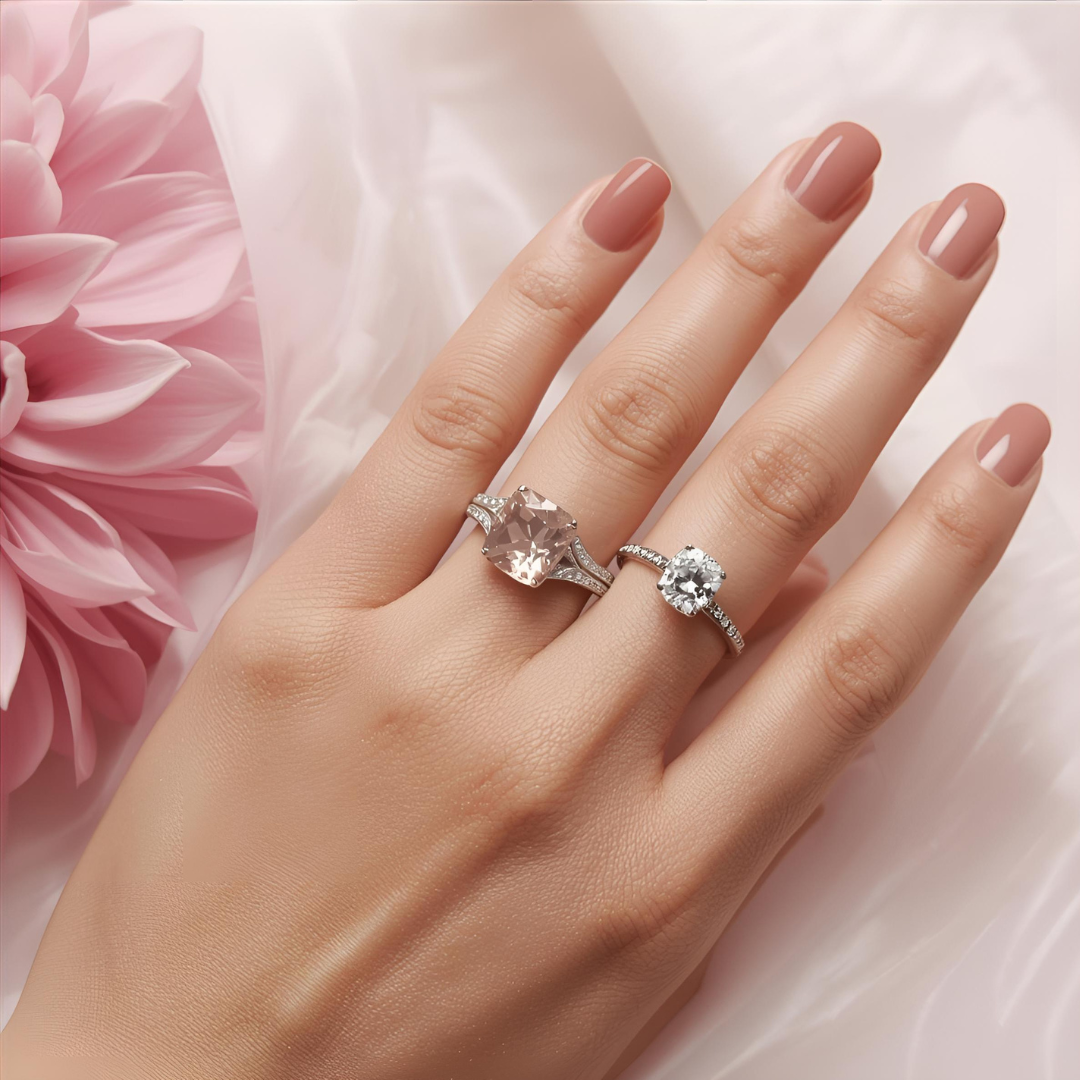
What Are The Benefits Of Wearing Morganite?
Building on its spiritual meaning, the benefits of wearing Morganite as jewelry are both practical and profound. By keeping its energy close to your body, you create a continuous, gentle field of influence that can positively impact your emotional, relational, and spiritual well-being.
Here are the key benefits of wearing Morganite:
1. Continuous Emotional Healing & Calm
Wearing Morganite provides a constant, soothing energy that helps manage daily stresses and emotional triggers.
Soothes Anxiety: Its gentle vibration acts as a natural calming agent, helping to quiet a racing mind and ease feelings of anxiety or panic.
Heals Past Hurts: When worn over the heart (as a pendant), it continually works on dissolving residual pain from past heartbreaks, betrayals, or grief, allowing for gradual and gentle release.
Promotes Emotional Resilience: It helps you respond to challenging situations from a place of centered calm rather than reactive emotion.
2. Cultivates Unconditional Self-Love
This is one of its most powerful benefits. Wearing Morganite serves as a constant reminder to be kind and compassionate to yourself.
Reduces Self-Criticism: It helps quiet the inner critic and dissolve feelings of unworthiness.
Boosts Self-Acceptance: By fostering a kind and forgiving attitude toward yourself, you can embrace your flaws and appreciate your strengths.
Attracts Love: The philosophy "like attracts like" is key here. When you radiate self-love from within, you naturally become a magnet for loving, healthy relationships with others.
3. Enhances Compassion in Relationships
Morganite doesn't just help you receive love; it helps you give love more freely and purely.
Increases Empathy: It opens your heart to better understand the perspectives and feelings of others, fostering deeper connections.
Improves Communication: By bridging the heart and throat chakras, it encourages you to speak your truth with kindness, clarity, and compassion, reducing conflicts.
Strengthens Bonds: Wearing it can help rekindle romance in long-term partnerships, deepen friendships, and foster harmony within families.
4. Attracts and Manifests Love & Abundance
Morganite is often called a "stone of abundance" because it aligns you with the generous, abundant energy of the heart.
Manifesting Love: It helps you set the intention to attract a soul-level, loving partnership if you are single.
Manifesting General Abundance: By opening your heart, you become more receptive to all forms of abundance—not just love, but also joy, opportunities, and synchronicities.
5. Connection to Divine & Angelic Guidance
Wearing Morganite can act as a spiritual antenna, enhancing your intuition and connection to higher realms.
Feels Supported: It can create a subtle but palpable sense of being guided, protected, and loved by divine forces or your angelic guides.
Increases Intuition: An open heart is a key to intuition. By clearing heart chakra blockages, Morganite can help you better trust and follow your "gut feelings" and intuitive hits.
How to Wear Morganite for Maximum Benefit
As a Pendant or Necklace: Worn over the heart, this is the most powerful way to directly influence your Heart Chakra. It ensures the stone's energy is centered in your core emotional center.
As a Ring: Wearing it on your ring finger (traditionally the finger of love and commitment) powerfully programs your intention for attracting or enhancing love. It also serves as a constant visual reminder of your commitment to self-love.
As Earrings: Placing the stone near your head can help soothe mental anxiety and infuse your thoughts with loving, compassionate energy.
As a Bracelet: Worn on your wrist, it keeps its calming energy close to your pulse point and on your active hands, influencing the energy you put out into the world.
A Note on Cleansing and Charging
Because Morganite works by absorbing and transmuting heavy emotional energies, it's important to cleanse and recharge it regularly to keep its vibration high.
Cleansing Methods: Rinse it under lukewarm running water, smudge it with sage or palo santo, or leave it on a bed of cleansing crystals like Selenite or Clear Quartz.
Charging Methods: Charge it in the gentle light of the morning sun or the full moon. You can also bury it in the earth overnight or place it with a Rose Quartz to amplify its loving energy.
Wearing Morganite is like having a constant, gentle companion that encourages you to lead with an open heart. Its primary benefit is to make the journey of life feel more loving, compassionate, and peacefully connected—to yourself, to others, and to the divine.
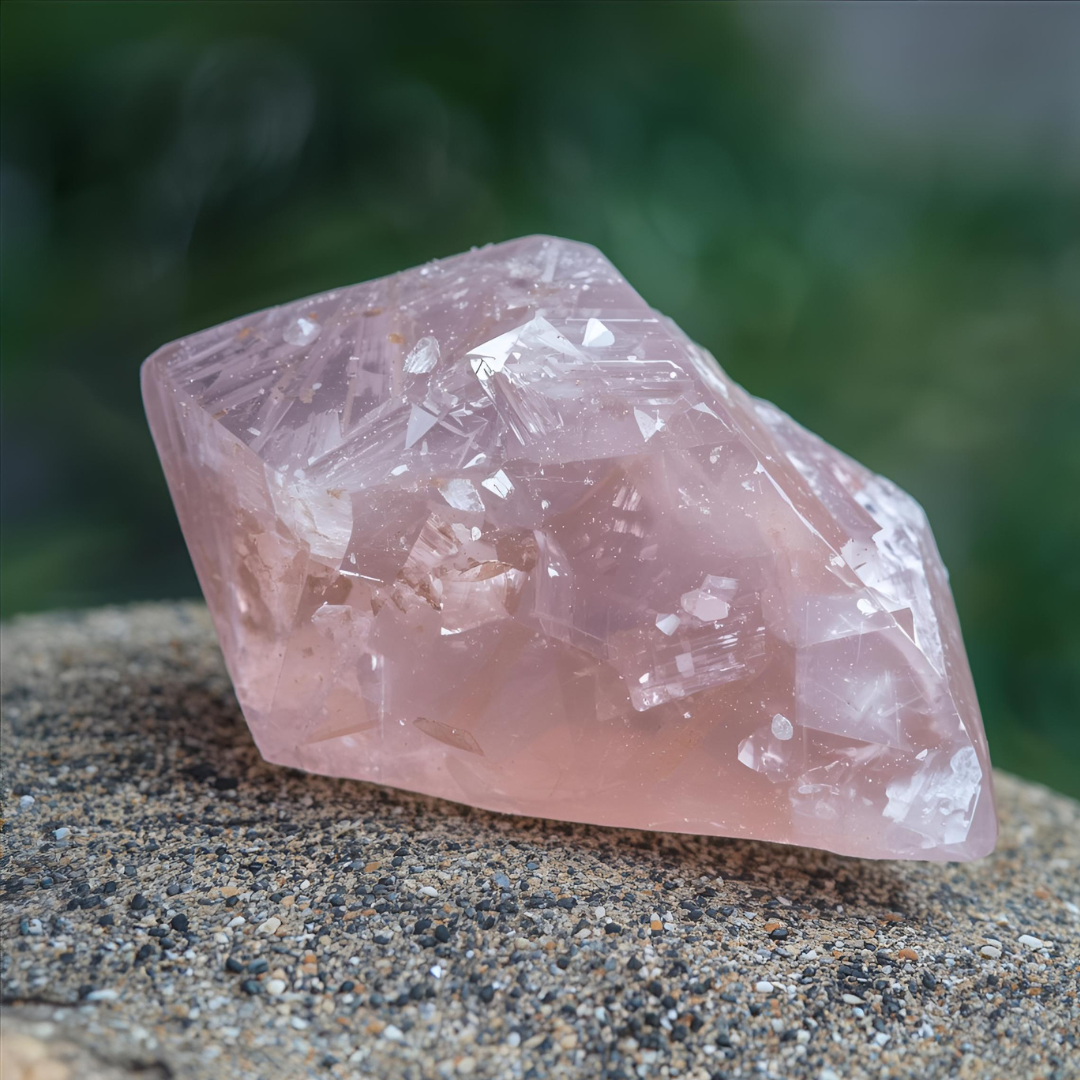
What Is The Morganite Stone Good For?
Building on the spiritual meaning and benefits of wearing Morganite, here is a comprehensive look at what this beautiful stone is good for, covering emotional, relational, spiritual, and practical applications.
Morganite is ultimately a stone of the heart, and its primary function is to teach, embody, and radiate unconditional love. Here’s a breakdown of its specific uses:
1. Emotional Healing & Well-being
Morganite is an excellent tool for navigating the complexities of human emotions.
Healing Heartbreak: It gently soothes the pain of past relationships, loss, and betrayal, not by erasing memories, but by helping you view them with compassion and understanding, allowing for release.
Calming Anxiety & Stress: It's serene, high-vibrational energy acts as a natural pacifier for the nerves, reducing feelings of panic, overwhelm, and chronic worry.
Cultivating Self-Love: This is one of its most powerful uses. It dissolves self-criticism, feelings of unworthiness, and negative self-talk, replacing them with self-acceptance, compassion, and a deep sense of inner worth.
2. Relationships & Love
Morganite is renowned for its positive influence on all forms of love.
Attracting New Love: By helping you first cultivate self-love, it makes you a vibrational match for healthy, loving, and committed relationships.
Strengthening Existing Relationships: It reinvigorates long-term partnerships by rekindling romance, fostering patience, and encouraging heartfelt communication. It's often called a "bridal stone" for this reason.
Enhancing Empathy & Compassion: It opens your heart to better understand the perspectives and feelings of others, leading to deeper, more meaningful connections with friends, family, and partners.
3. Spiritual Growth & Connection
Morganite serves as a bridge to higher states of consciousness.
Opening the Heart Chakra (Anahata): Its primary spiritual function is to clear, activate, and balance the heart chakra, which is the center of love, compassion, and forgiveness.
Connecting to Divine Love: It is believed to be a powerful channel for accessing unconditional love from the Divine, angels, and spiritual guides. This helps you feel profoundly supported and loved on your soul's journey.
Promoting Peaceful Meditation: Holding Morganite or placing it on your heart during meditation can facilitate a deep state of peace, making it easier to connect with your higher self and receive intuitive guidance.
4. Personal Development & Energetic Hygiene
Compassionate Communication: By harmonizing the Heart Chakra with the Throat Chakra, it empowers you to speak your truth clearly and kindly, making it easier to set loving boundaries and resolve conflicts peacefully.
Manifestation & Abundance: As a stone of the heart, it aligns you with the principle that love is the ultimate abundance. It helps you manifest from a place of joyful expectation rather than fearful lack.
Energetic Cleansing: Its high-vibrational energy can help clear emotional debris from your personal aura, leaving you feeling lighter, brighter, and more refreshed.
Practical Ways to Use Morganite
As Jewelry: Wearing it as a pendant over your heart, a ring on your left hand, or earrings is the most effective way to receive its continuous benefits throughout the day.
In Meditation: Hold a tumbled stone in your hand or place it on your Heart Chakra (center of the chest) to facilitate deep emotional healing and spiritual connection.
Place in Your Environment:
Bedroom: To promote a loving, harmonious atmosphere and soothe restless sleep.
Living Room: To encourage compassionate communication and strengthen family bonds.
Office: To reduce stress and help you interact with colleagues from a place of patience and understanding.
As a gift, Morganite is a profoundly meaningful gift for an engagement, anniversary, or for someone going through a difficult time, symbolizing pure love and compassion.
Quick-Reference Summary Table
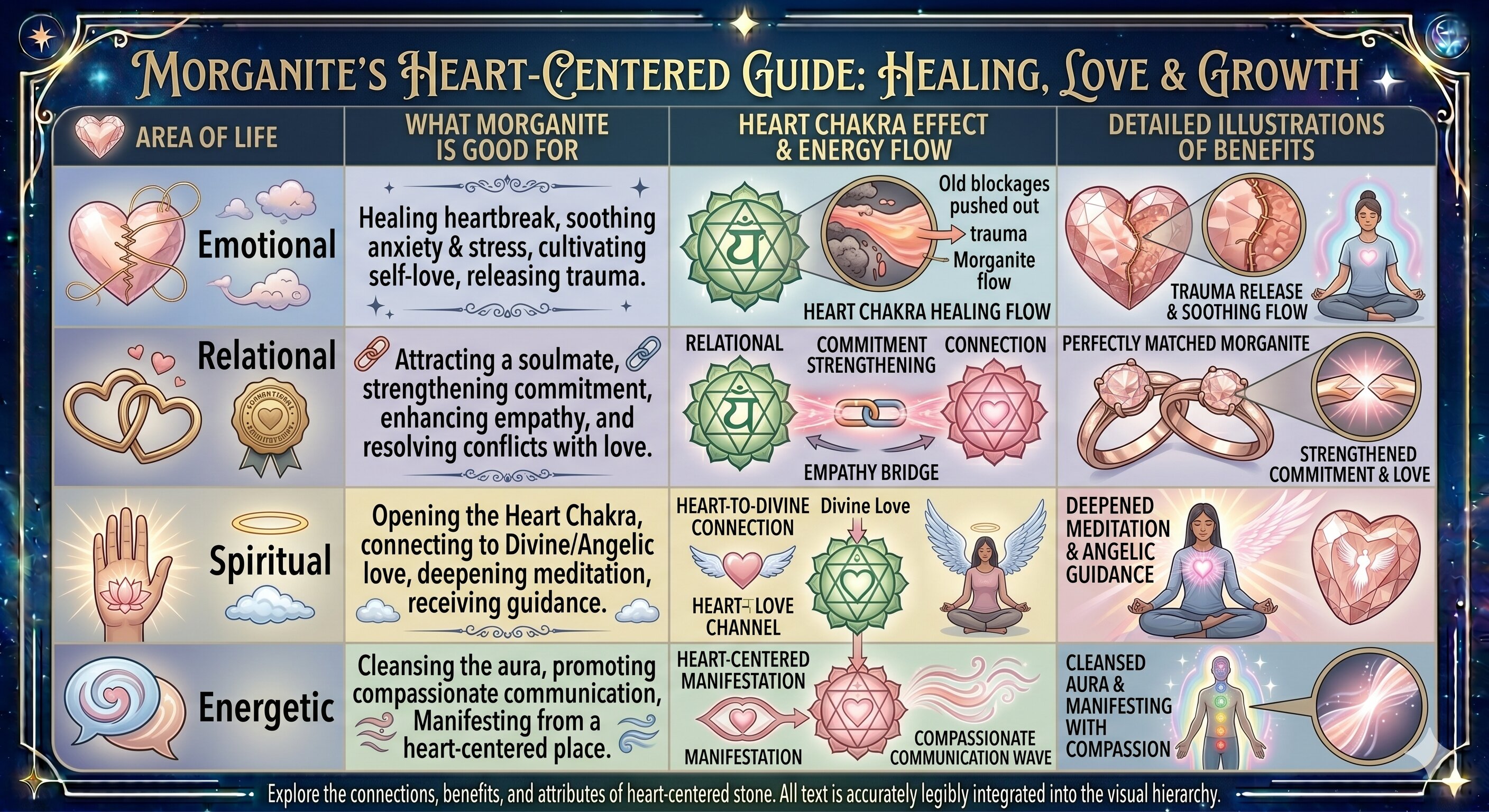
In essence, Morganite is good for anyone who wants to lead a more heart-centered life. It is a gentle yet powerful ally for healing emotional wounds, opening to give and receive love more fully, and connecting with the profound peace that comes from knowing you are deeply and unconditionally loved.
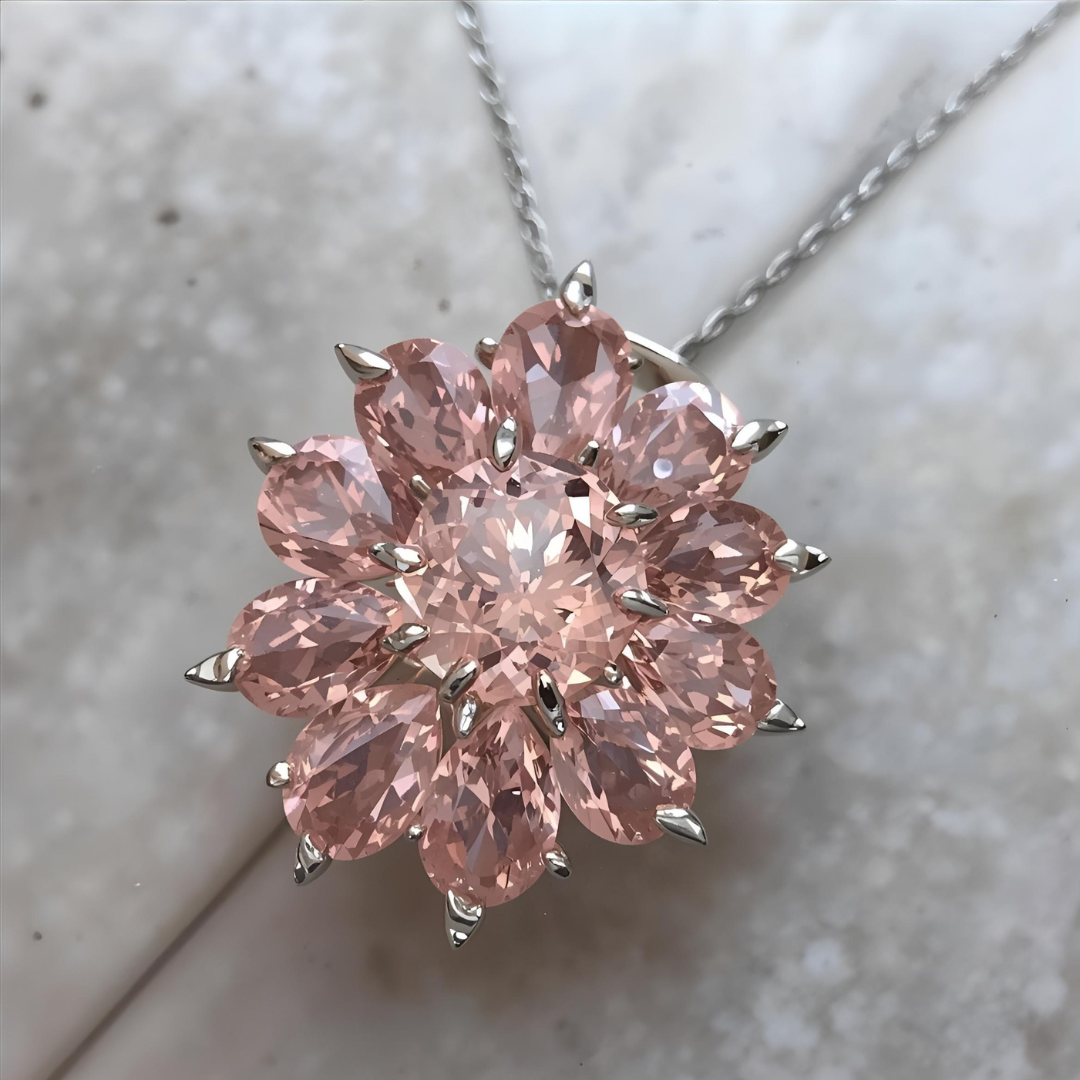
Is Morganite A Valuable Gem?
The answer is nuanced: Yes, Morganite is a valuable gemstone, but it occupies a unique position in the mid-range of the gem market. It is not as expensive as the "Big Three" (ruby, sapphire, and emerald), but it is far more valuable than common semi-precious stones.
Its value is determined by a combination of its rarity, durability, and surging popularity, especially in engagement rings and fine jewelry.
Here’s a breakdown of what makes Morganite valuable and the factors that influence its price:
Factors That Determine Morganite's Value
Color (The Most Important Factor):
The Ideal Color: The most valuable Morganite exhibits a strong, pure pink or a vivid purplish-pink hue with high saturation. The color should be vibrant, not faint.
Common Colors: Many stones on the market are a very soft pink, peachy-pink, or salmon color. While beautiful, these lighter tones are more common and thus less expensive.
Rarity of Vivid Hues: Deep, saturated pink crystals are rare in nature and command a significant premium, similar to the way a rich pink sapphire would.
Clarity:
Morganite is a Type I gemstone, meaning it is typically "eye-clean" (no visible inclusions to the naked eye).
Consumers expect a high level of clarity, so stones with visible inclusions or clouds are significantly less valuable.
Carat Weight (Size):
Morganite crystals can grow quite large, so large stones are more readily available than, for example, large rubies or sapphires.
However, large stones with excellent color saturation are rare. Therefore, the price per carat increases noticeably for larger stones that also possess a rich color.
Cut:
The cut is crucial for maximizing Morganite's beauty. Because the color can be delicate, cutters use specific shapes (like ovals, cushions, and emerald cuts) with many facets to enhance its brilliance and color return.
A well-cut stone will be more valuable than a poorly cut one, even if they have the same color and clarity.
Treatment:
Heat Treatment: The vast majority of Morganite on the market is heat-treated to remove yellow or orange tones and produce a more desirable pure pink color. This treatment is stable and permanent, and it is widely accepted in the industry. It does not drastically reduce the value, as an untreated stone with a perfect pink color is extremely rare.
Irradiation: Some Morganite is irradiated to create a deeper pink color. This color can be less stable and may fade with exposure to heat or strong light. Stones known to be irradiated are less valuable.
Morganite vs. Other Popular Gemstones
Compared to Diamonds, Rubies, Sapphires, and emeralds, Morganite is significantly less expensive per carat. It offers a luxurious look for a fraction of the price of these traditional gems.
Compared to Other Beryls:
Emerald: Its green cousin, Emerald, is far more valuable due to its extreme rarity and high demand, despite almost always having visible inclusions.
Aquamarine: Morganite is generally comparable in price to high-quality Aquamarine, another popular beryl. Sometimes, a vivid pink Morganite can command a higher price than a pale blue Aquamarine.
The "Value Proposition" of Morganite
What makes Morganite an excellent value in the gem world is the combination of its beauty, durability, and relative affordability.
Beauty: It offers a soft, romantic, and elegant appearance that is highly sought-after in modern jewelry.
Durability: With a hardness of 7.5 to 8 on the Mohs scale, it is suitable for daily wear (like in an engagement ring), though it requires a bit more care than a diamond (hardness 10) or sapphire (hardness 9).
Affordability: You can get a large, eye-clean, and beautifully colored Morganite for a price that is inaccessible for a diamond or sapphire of the same size.
Price Range (Approximate)
Commercial Quality (Light pink, some inclusions): $100 - $300 per carat
Good to Fine Quality (Vivid pink, eye-clean): $300 - $800+ per carat
Top-Grade, Vivid Pink (Large, eye-clean): Can exceed $1,000 per carat
Morganite is a legitimate and valuable gemstone that has earned its place in fine jewelry. Its value isn't based on ancient history like the "Big Three," but on its modern appeal, desirable properties, and the rarity of top-color material. It represents a fantastic choice for someone seeking a beautiful, durable, and meaningful gemstone that offers excellent value for the price.
How Much Is 1 Carat Of Morganite Worth?
To give you a direct answer: A 1-carat morganite can cost anywhere from $50 to $600+, but you will most commonly find nice, commercial-quality stones in the $100 to $300 range.
Here’s a detailed breakdown of what drives the price, so you can understand what you're paying for.
The Four Key Factors Driving the Price of Morganite
The value is almost entirely determined by the "Four Cs," with Color being the most significant factor.
1. Color (The Biggest Price Driver)
This is the most important factor. The more vivid and pure the color, the more expensive the stone.
Low End ($50 - $150): Very pale pink, peachy-pink, or slightly yellowish stones. The color is faint and not very saturated.
Mid-Range ($150 - $400): A clear, medium-toned pink or a vibrant peach-pink with good saturation. This is the most common range for quality jewelry.
High End ($400 - $600+): A pure, intense, and vivid pink with no secondary brown or gray tones. These are quite rare and command a premium, similar to a fine pink sapphire.
2. Clarity
Morganite is known for being a relatively "clean" gemstone. Most are expected to be "eye-clean," meaning no visible inclusions to the naked eye.
Stones with visible inclusions, clouds, or cracks will be significantly less valuable and are not typically used in fine jewelry.
3. Cut
A good cut maximizes the stone's brilliance and color.
A well-proportioned and faceted stone will be more valuable than a poorly cut one, even if they have the same color and clarity. A poor cut can make the stone look windowed (see-through and lifeless) or too dark.
4. Treatment
Heat Treatment: The vast majority of morganite is heat-treated to remove yellow tones and achieve a more desirable pure pink color. This is a stable, permanent, and widely accepted practice. It does not drastically lower the value.
Untreated Stones: An untreated morganite with a beautiful, natural pink color is very rare and will be more expensive.
Price Ranges for a 1-Carat Morganite (Loose Stone)
To make it easier, here’s a general price guide for a 1-carat, well-cut, eye-clean loose morganite:
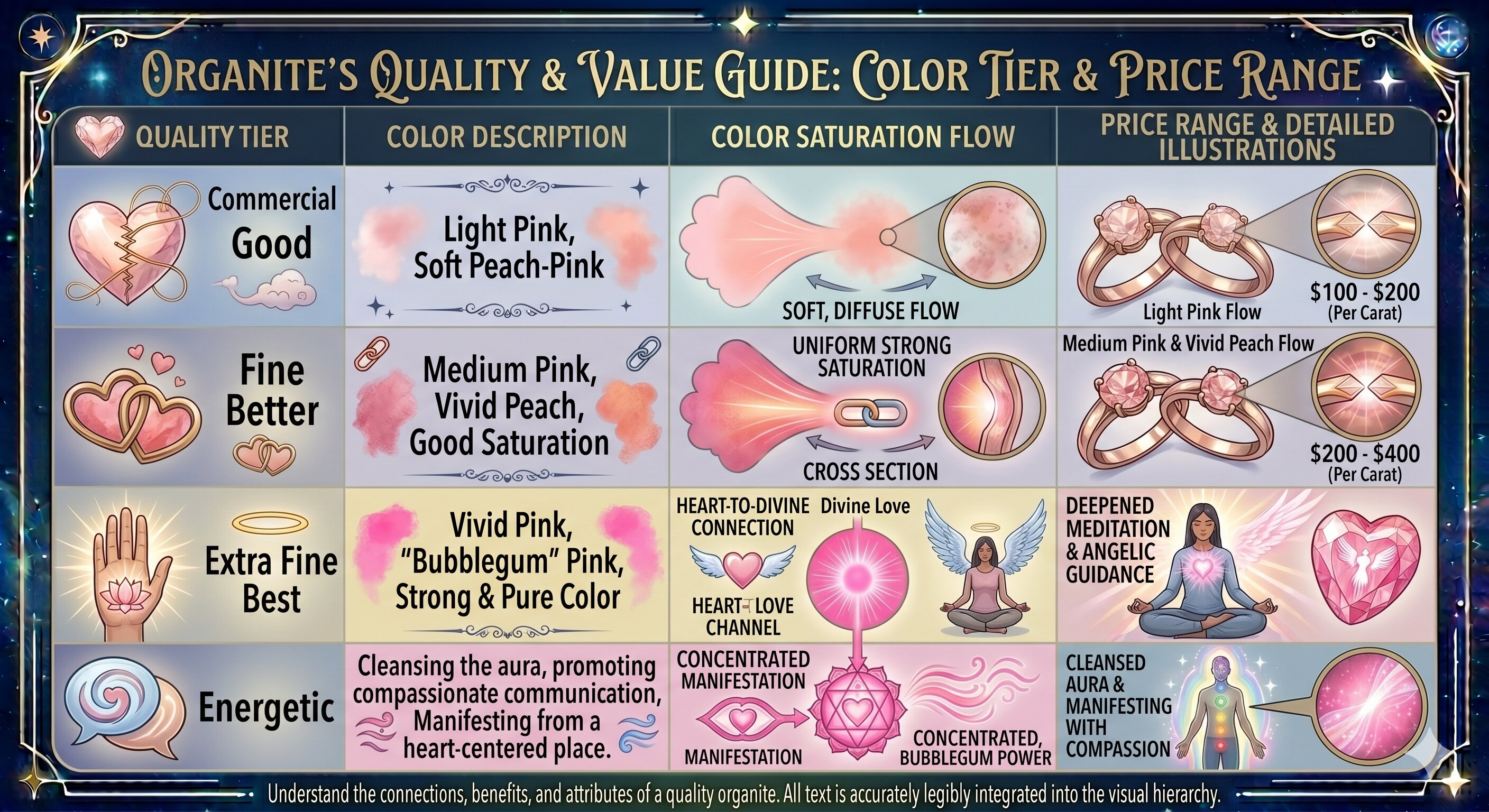
Important Note: These prices are for the loose gemstone itself. The final cost of a finished piece of jewelry (like a ring) will be significantly higher, as it includes the price of the metal (e.g., rose gold, platinum), the setting, the designer's labor, and any side stones (like diamonds).
Comparison & Context
Why is it more affordable than other gems? Compared to a 1-carat diamond ($2,000 - $20,000+) or a 1-carat sapphire ($300 - $3,000+), morganite is very affordable. It offers a luxurious look for a fraction of the price.
The Size Advantage: Because it is more affordable per carat, you can get a much larger morganite for your budget than you could with a diamond or sapphire. A 3-4 carat morganite center stone is very common and remains budget-friendly.
So, how much is 1 carat of morganite worth?
For a decent, light-colored stone, expect to pay around $100-$150.
For a beautiful, medium-pink stone you'd find in a quality jewelry store, expect to pay $200-$350.
For a rare, vivid pink top-quality stone, the price can jump to $500 or more.
Final Advice: When shopping, focus first on the color you love. Look at stones in person if possible, as the color can vary significantly under different lighting conditions. Always buy from a reputable jeweler who can provide information about any treatments.
For current gemstone market prices, visit the American Gem Society's price guide.
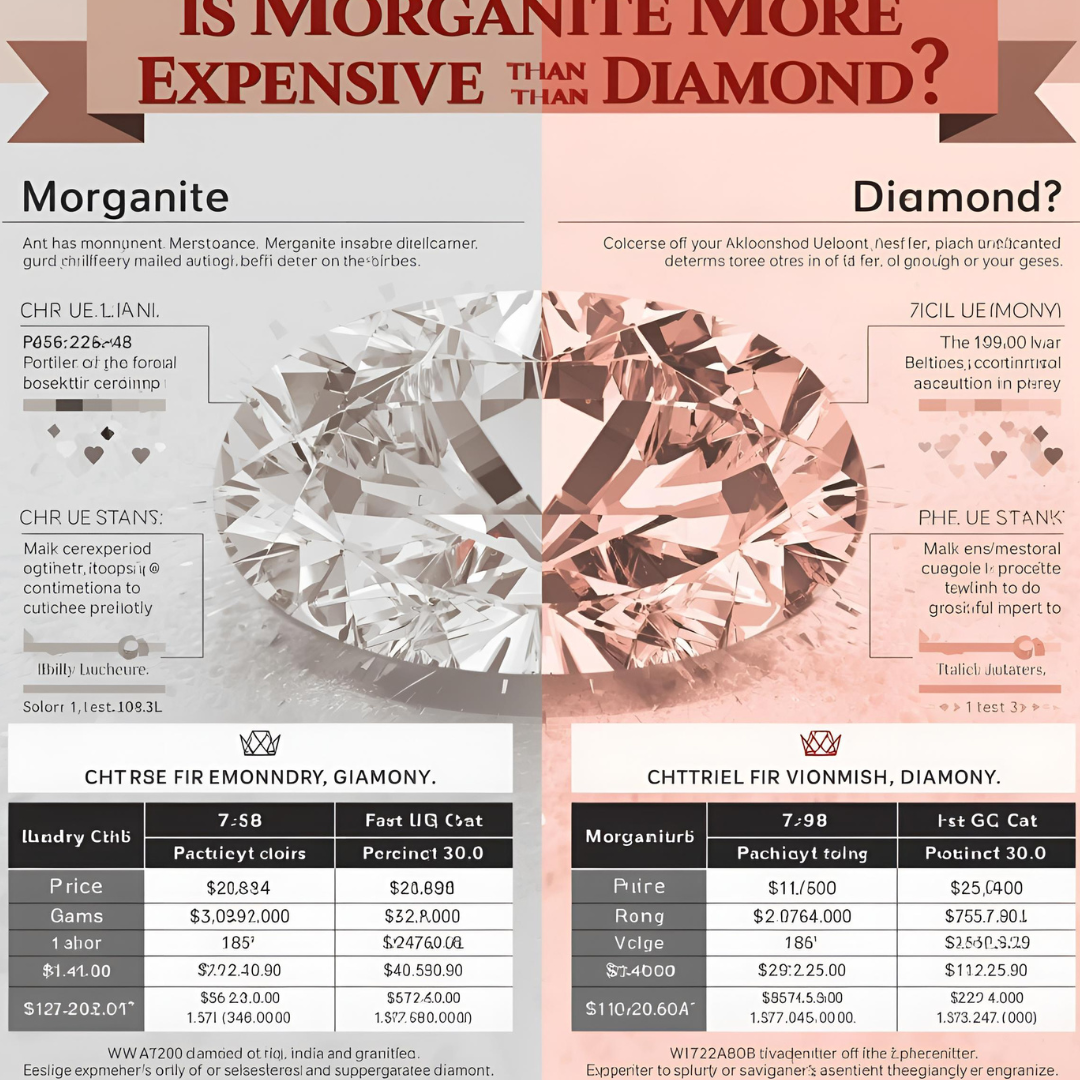
Is Morganite More Expensive Than Diamond?
No, Morganite is not more expensive than diamond. In fact, a diamond is significantly more expensive than a morganite.
For a typical, well-cut gemstone of the same size, a diamond will almost always cost many times more than a morganite. The price difference is due to a combination of rarity, market demand, durability, and cultural value.
Here’s a direct comparison to illustrate the point:
Price Comparison: Morganite vs. Diamond (1-Carat Example)
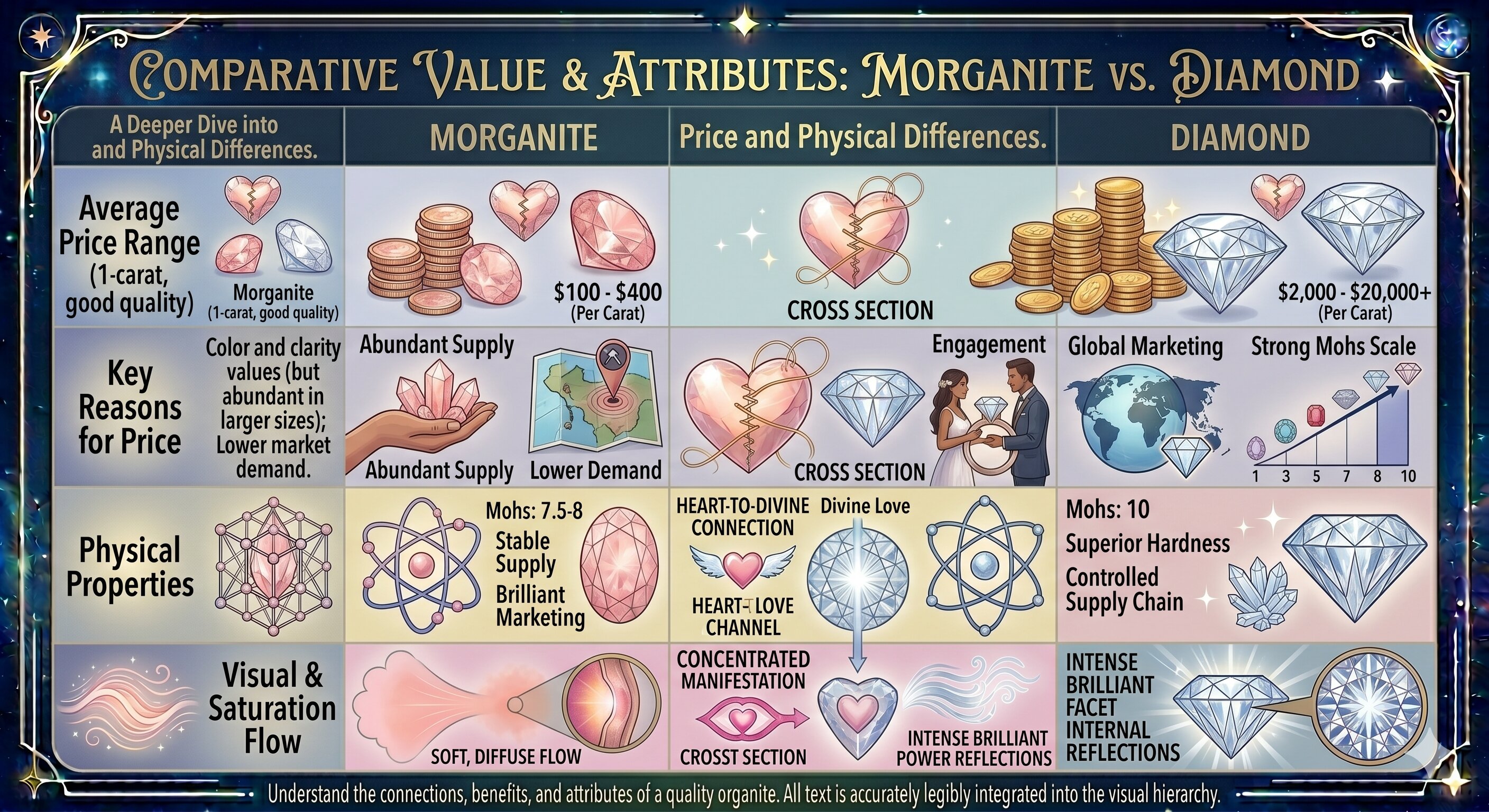
1. Rarity & Supply
Diamonds: While diamonds are not the rarest gem, the supply of high-quality, gem-grade diamonds is tightly controlled by a few major companies, creating artificial scarcity. Large, flawless, and colorless diamonds are genuinely rare.
Morganite: High-quality morganite is found in larger crystals more readily than diamonds. While vivid pink morganite is rare, the overall supply for the jewelry market is more abundant, keeping prices lower.
2. Durability & Hardness
Diamond: It is the hardest natural substance on Earth, scoring a perfect 10 on the Mohs scale. This makes it ideal for daily wear (like an engagement ring) as it is highly resistant to scratches and damage.
Morganite: It is a durable gemstone with a hardness of 7.5 to 8 on the Mohs scale. This is suitable for daily wear, but it requires more care than a diamond, as it can be scratched by harder materials over time.
3. Market Demand & Cultural Perception
Diamond: "A diamond is forever." Decades of masterful marketing have cemented diamonds as the ultimate symbol of love, commitment, and status in many cultures, particularly for engagement rings. This immense, sustained demand drives prices to a premium.
Morganite: Morganite has gained tremendous popularity in the last decade as a beautiful, romantic, and more affordable alternative for engagement rings and fashion jewelry. However, its demand and cultural significance do not come close to that of diamonds.
4. The "Size for Your Budget" Factor
This is where Morganite's value truly shines.
You might be able to afford a 1-carat, good-quality diamond for $4,000 - $6,000.
For the same budget, you could get a stunning, high-quality morganite of 3 to 5 carats or more.
When Might a Morganite Seem Expensive?
The only scenario where you might see a morganite with a high price tag is if it is an exceptionally large stone (e.g., 10+ carats) with a rare, vivid "bubblegum" pink color and is completely eye-clean. Even then, its price per carat would be far below that of a diamond of equivalent rarity and quality.
Diamond is in a completely different league in terms of price and market position. Morganite is cherished for its unique beauty, gentle energy, and exceptional value, offering a luxurious look for a much more accessible price point.
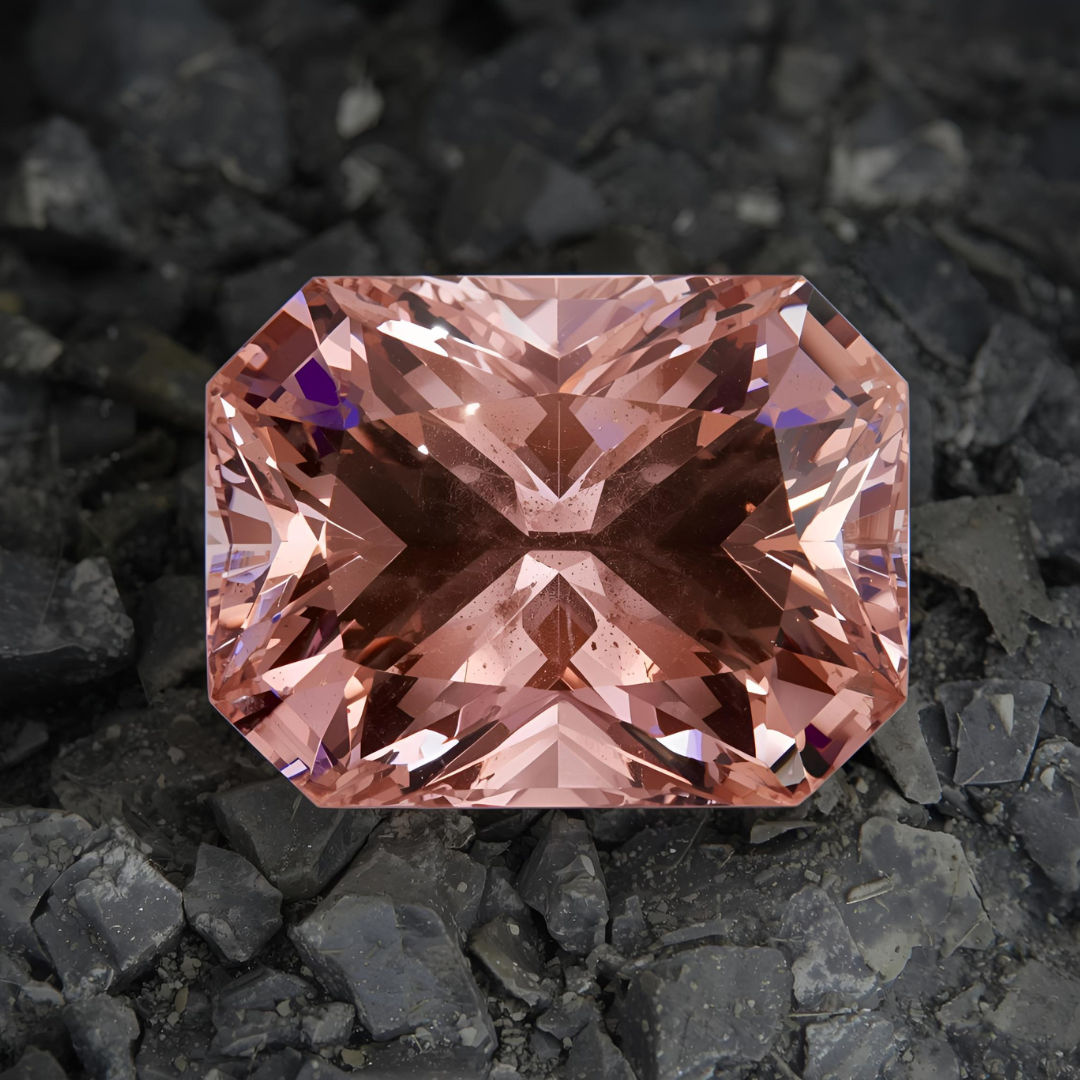
What Is The Rarest Color Of Morganite?
This is an excellent question that gets to the heart of what makes certain Morganite specimens exceptionally valuable.
The undisputed rarest and most valuable color of Morganite is a pure, vivid, and saturated pink, often referred to as "bubblegum pink" or "hot pink."
Here’s a more detailed breakdown of Morganite's color spectrum and why this particular hue is so rare:
The Color Spectrum of Morganite
Most Morganite on the market falls into the more common and affordable color range:
Very Pale Pink: A faint, almost whisper of color.
Salmon or Peach-Pink: A soft blend of pink and orange tones. This is one of the most widely available colors.
Pinkish-Orange: A warmer, peach-dominant hue.
These colors are beautiful and popular, but they are not considered rare.
Why Vivid Pink is So Rare
Natural Occurrence: The pink color in Morganite is caused by trace amounts of manganese. Achieving a deep, vibrant, and evenly distributed pink color without secondary brown, gray, or orange tones requires a very specific and uncommon geological environment. Most deposits simply do not produce material with this level of color saturation.
The Prevalence of Treatment: A large portion of the Morganite on the market is heat-treated. This standard practice removes yellow or orange secondary tones, resulting in a purer and often more marketable pink color.
A natural, untreated Morganite with a deep pink color is exponentially rarer and more valuable than a treated one.
Comparison to Other Gems: The finest vivid pink Morganite can rival the color of a Pink Sapphire but at a much lower price point, making it a coveted alternative for collectors and designers.
A Note on a Rare Cousin: "Cesium-Beryl" or "Peach" Morganite
There is an exceptionally rare variety of beryl that is sometimes grouped with Morganite, known as Cesium-Beryl (or "Peach Beryl").
What it is: This is a variety where cesium replaces some of the other elements in the crystal structure. This can create an incredibly intense, almost "electric" peach or orange-pink color that is far more saturated than standard peach morganite.
Rarity & Value: True cesium-rich beryl is one of the rarest gemstones in the beryl family. If you encounter a Morganite with an unusually vivid peach-orange color, it could be this rare variety and command an extremely high price.
To put it in a simple hierarchy, from most common to rarest:
Most Common: Very pale pink, light peach.
Common: Medium peach-pink, salmon.
Uncommon: Medium pure pink (often heat-treated).
Rare: Vivid, saturated "bubblegum" pink.
Extremely Rare:
Untreated vivid pink Morganite.
Cesium-Beryl has its intense peach-orange color.
While you will find many beautiful shades of Morganite in jewelry stores, if you ever come across a stone with a deep, intense, and pure pink color with no need for enhancement, you are looking at the rarest and most valuable color this graceful gem has to offer.
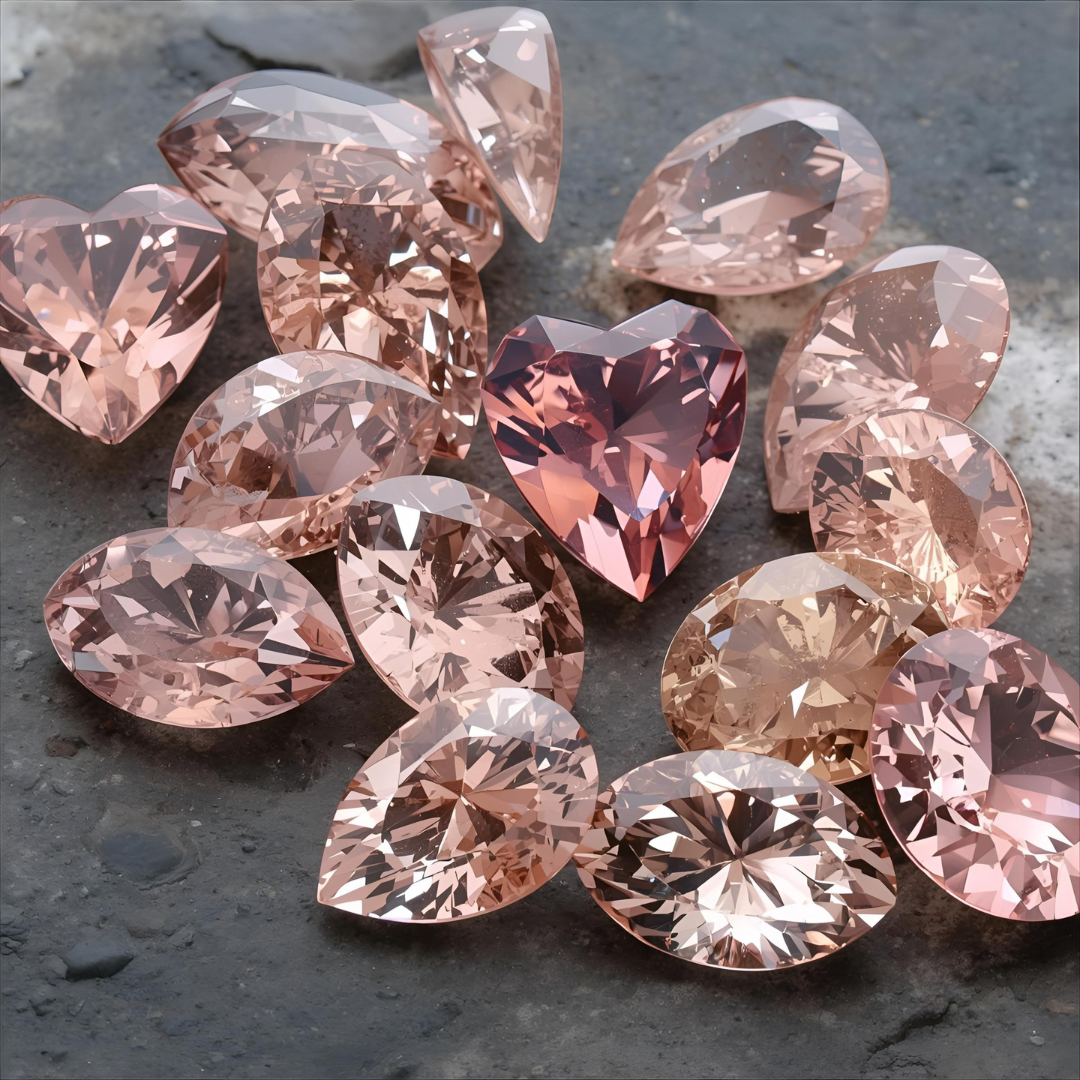
What Is The Best Color Of Morganite?
This is a fantastic question, and the answer is beautifully subjective because the "best" color of Morganite ultimately depends on your personal taste, style, and what you're looking for in the gem.
However, we can break it down by what is considered the most valuable, the most popular, and the most versatile to help you decide which is "best" for you.
The Short Answer
There isn't one single "best" color, but they fall into three main categories of preference:
For Rarity & Investment: Vivid Pink is the best.
For Popularity & Romance: Soft Peach-Pink is the best.
For Versatility & Elegance: Blush Pink is the best.
The Detailed Breakdown
1. The "Best" for Rarity and Value: Vivid "Bubblegum" Pink
Why it's top-tier: This is the rarest and most valuable color of Morganite. A pure, saturated pink with no secondary peach or salmon tones is highly sought after by collectors and commands the highest price per carat.
Who it's for: The person who wants the most exclusive and investment-worthy stone, similar in vibe to a pink sapphire but with Morganite's unique, gentle glow.
2. The "Best" for Popularity and Warmth: Soft Peach or Salmon Pink
Why it's so popular: This is the classic, iconic Morganite color. Its warm, peachy-pink hue is incredibly flattering on most skin tones and radiates a soft, romantic, and feminine energy. This is the color most people picture when they think of Morganite.
Who it's for: This is the perfect choice for anyone who loves the classic, warm, and romantic look. It's exceptionally popular in engagement rings set in rose gold, which enhances its warm undertones beautifully.
3. The "Best" for Versatility and Elegance: Blush or Light Pink
Why it's so versatile: A soft, light pink Morganite is incredibly elegant and easy to wear. It pairs seamlessly with any metal—rose gold warms it up, yellow gold makes it sunny, and white gold or platinum gives it a modern, crisp look. It's a more subtle and understated choice.
Who it's for: Someone with a minimalist or versatile style who wants a stone that will complement everything in their jewelry collection. It offers a delicate and timeless beauty.
How to Choose the "Best" Color for YOU
Here are the key questions to ask yourself:
What is my budget?
Soft Peach and Light Pink stones are more common and offer excellent value.
Vivid Pink stones are a premium investment.
What metal will I set it in?
Rose Gold: Intensifies the warm, peachy tones. A classic and stunning combination.
Yellow Gold: Complements both peach and pink stones, creating a sunny, vintage feel.
White Gold/Platinum: Makes the pink color appear purer and more modern. It's a great choice to make a Blush Pink stone look brighter.
What is my personal style?
Romantic & Feminine: Go for the classic Peach-Pink.
Modern & Minimalist: A Blush Pink in a white metal setting is perfect.
Bold & Unique: Seek out a Vivid Pink to make a statement.
Pro Tip: Always view Morganite stones in person if possible. The color can look dramatically different under various lighting conditions (e.g., fluorescent vs. sunlight). See which shade makes your heart sing!
There is no wrong choice. The "best" color of Morganite is the one that resonates with you personally.
Do you want the rarest and most valuable? Choose Vivid Pink.
Do you want the most popular and romantic? Choose Soft Peach.
Do you want the most versatile and elegant? Choose Blush Pink.
All of them carry the beautiful energy of love and compassion, making any choice a meaningful one.
Is Morganite Hard Or Soft?
Understanding a gemstone's hardness is crucial, especially if you're considering it for jewelry like an engagement ring that will be worn daily.
Here’s a clear and detailed answer:
Morganite is considered a hard and durable gemstone, but it is softer than diamond, sapphire, and moissanite.
To be precise, let's look at the scientific measurement:
The Mohs Scale of Hardness
The Mohs scale measures a gem's resistance to scratching, from 1 (softest, like talc) to 10 (hardest, diamond).
Diamond: 10
Topaz: 8
Morganite: 7.5 - 8
Quartz (Dust in everyday air): 7
Glass: ~5.5
What Does This Mean in Practical Terms?
1. It's Suitable for Daily Wear:
With a hardness of 7.5 to 8, Morganite is durable enough for rings, including engagement rings. It won't get scratched by daily activities or by materials with a lower hardness (like glass, steel, or gold).
2. But It Requires Some Care:
The primary risk for Morganite isn't from washing your hands or typing on a keyboard, but from:
Accidental Knocks: While hard, it can be chipped or cracked if struck hard against a solid surface (like a granite countertop or a car door).
Other Gemstones: It can be scratched by harder gems. This is why it's important to store Morganite jewelry separately, not tossed in a jewelry box where it can rub against diamonds or sapphires.
Quartz Abrasion: Dust often contains tiny particles of quartz (hardness 7). Over time, this dust can cause minor surface scratches, which can dull the polish and brilliance of the stone. This is a very gradual process.
Morganite vs. Other Popular Engagement Gemstones
Harder than Morganite: Diamond (10), Moissanite (~9.25), Sapphire/Ruby (9)
Softer than Morganite: Emerald (7.5-8, but is typically more included and brittle), Amethyst/Citrine (7), Opal (5.5-6.5), Pearl (2.5-4.5)
Key Takeaway: Morganite is significantly harder and more durable than many other popular gemstones, but it sits a clear step below the classic "top tier" of engagement ring durability (Diamond, Sapphire, Moissanite).
How to Protect Your Morganite Jewelry
To keep your Morganite looking beautiful for a lifetime:
Take it Off for Hard Labor: Gardening, cleaning with harsh chemicals, or any strenuous activity where it might get hit.
Store it Properly: Keep it in a soft pouch or a separate compartment in your jewelry box.
Clean it Gently: Use warm, soapy water, a soft toothbrush, and rinse thoroughly. Avoid ultrasonic and steam cleaners, especially if the stone has inclusions, as the vibrations and heat can potentially cause damage.
Choose a Protective Setting: A bezel setting or a setting with protective prongs can help shield the stone from accidental impacts.
Morganite is a hard gemstone, but not the hardest. It offers an excellent balance of beauty and durability for everyday wear, provided you are mindful of its limits and treat it with a little extra care compared to a diamond. It is a wonderful and romantic choice for those who understand its nature.
Can Morganite Go In Water?
The short answer is:
Yes, morganite can briefly go in water, and it is generally safe for quick cleaning. However, it is not recommended for prolonged exposure or immersion.
Here’s the detailed breakdown of why, and the important do's and don'ts.
Why Prolonged Water Exposure is Not Recommended
Potential Damage to the Stone (Low Risk):
Chemical Composition: Morganite is a variety of beryl (beryllium aluminum silicate), which is a stable and durable mineral. The water itself, especially pure water, will not dissolve or damage the crystal structure.
Inclusions: The main risk isn't to the stone itself, but to any internal fractures or inclusions. If water gets into tiny surface-reaching fractures, it could potentially widen them over time or cause cloudiness. This is a relatively low risk for a high-quality, eye-clean morganite.
Damage to the Setting (High Risk):
This is the most important reason to avoid soaking your morganite jewelry.
Metal Damage: Prolonged exposure to water, especially soapy, salty, or chlorinated water, can slowly degrade the metal of the setting. It can cause:
Tarnishing: For metals like sterling silver.
Weakening: It can weaken prongs over time, making your stone more likely to fall out.
Corrosion: Harsh chemicals can corrode solder points.
Harsh Chemicals are the Real Danger:
Chlorine (in pools and hot tubs) and salt water are highly corrosive to the metal settings and can damage the polish and luster of the morganite itself.
Hard Water can leave a dulling film of mineral deposits on the stone.
Safe Cleaning Guide for Morganite
For daily and weekly cleaning, follow these simple steps:
The Safe Method:
Create a Mild Solution: Mix a few drops of mild, ammonia-free dish soap (like Dawn) in a bowl of lukewarm water.
Soak Briefly: Let your jewelry sit in the solution for no more than 15-20 minutes to loosen dirt and oils.
Gently Scrub: Use a very soft-bristled toothbrush (a baby toothbrush is perfect) to gently clean behind the stone and around the setting.
Rinse Thoroughly: Rinse under a steady stream of lukewarm water. Important: Put a stopper in the drain to avoid accidents!
Dry Completely: Pat dry with a soft, lint-free cloth (like a microfiber or jewelry polishing cloth).
When to Absolutely Avoid Water
You should always remove your morganite jewelry before:
Swimming (in a pool or the ocean)
Taking a bath or shower
Washing dishes or using harsh cleaning chemicals.s
Going to the gym, salty sweat (also corrosive over time)
What About Ultrasonic Cleaners?
This is a cautionary "No" for most morganite jewelry.
While the stone itself is hard enough to withstand the vibrations, any existing internal fractures or inclusions could be worsened, potentially causing the stone to break.
The vibrations can also loosen stones in their settings over time.
Exception: A jeweler might use one on a flawless stone in a very secure setting, but this is a risk best left to professionals. It's safer to avoid it at home.
Think of water for morganite as a useful but brief cleaning tool, not a place for it to live. A quick, gentle cleaning is perfectly safe, but prolonged soaking or exposure to chemicals should be strictly avoided to protect both the stone and its setting for a lifetime of wear.
What Are The Disadvantages Of Morganite?
While morganite is a beautiful and popular gemstone, it's important to understand its drawbacks to make an informed decision, especially for a piece of jewelry like an engagement ring that will be worn daily.
Here are the key disadvantages of morganite:
1. Durability and Softness (Relative to Other Gemstones)
Mohs Hardness: Morganite has a hardness of 7.5 to 8. While this is suitable for jewelry, it is significantly softer than diamonds (10), sapphires (9), and moissanite (9.25).
Prone to Scratching: Everyday dust contains quartz particles, which have a hardness of 7. Over time, this can cause fine surface scratches (called "abrasions") that will dull the stone's polish and brilliance. It can also be scratched by harder gems if stored together.
Risk of Chipping: Its crystal structure can make it susceptible to chipping or cracking if struck hard against a solid surface (like a countertop or door frame).
2. Maintenance and Cleaning
Shows Oils and Dirt Easily: Morganite has a vitreous (glass-like) luster that is a magnet for skin oils, lotions, and soap scum. It can quickly look cloudy or dirty, requiring frequent cleaning to maintain its sparkle.
Requires Gentle Care: You cannot use ultrasonic or steam cleaners, especially if the stone has inclusions, as the vibrations and heat can cause fractures to widen. It requires gentle cleaning with warm, soapy water and a soft brush.
3. Color Stability and Clarity
Pale Color Can Look Washed Out: The most common peach-pink morganites are very pale. In certain lights or when dirty, they can appear almost colorless and lose their romantic hue, which can be disappointing for some.
Color Enhancement: The vast majority of morganite on the market is heat-treated to improve its pink color. This is permanent and stable, but some buyers prefer completely untreated stones, which are much rarer and more expensive.
Need for High Clarity: Unlike an emerald (where inclusions are expected), morganite is valued for being eye-clean. Stones with visible inclusions are less valuable, and the inclusions can compromise durability.
4. Water and Chemical Sensitivity
Not for Prolonged Water Exposure: While brief contact with water for cleaning is fine, you must remove morganite jewelry before swimming (chlorine is corrosive), showering (soap creates a film), or doing dishes.
Chemical Damage: Harsh chemicals can damage both the stone's polish and the metal setting.
5. Value and Perception
Not an "Heirloom"-Level Investment: Unlike diamonds, rubies, or sapphires, morganite does not generally hold or appreciate over time. It is a more affordable, fashion-forward choice rather than a financial investment.
Trend-Driven: Its current popularity is relatively recent. There's a possibility it could be seen as a "trendy" stone in the future, unlike classic gems that have been prized for centuries.
6. The "Pink" Can Be Deceptive
Dependence on Setting: The stone's color is heavily influenced by its setting. A peach morganite set in rose gold will look much pinker, while the same stone set in white gold will look more silvery-pink. This can be an advantage, but it can also be a disadvantage if the final color isn't what you expected.
Summary Table of Disadvantages
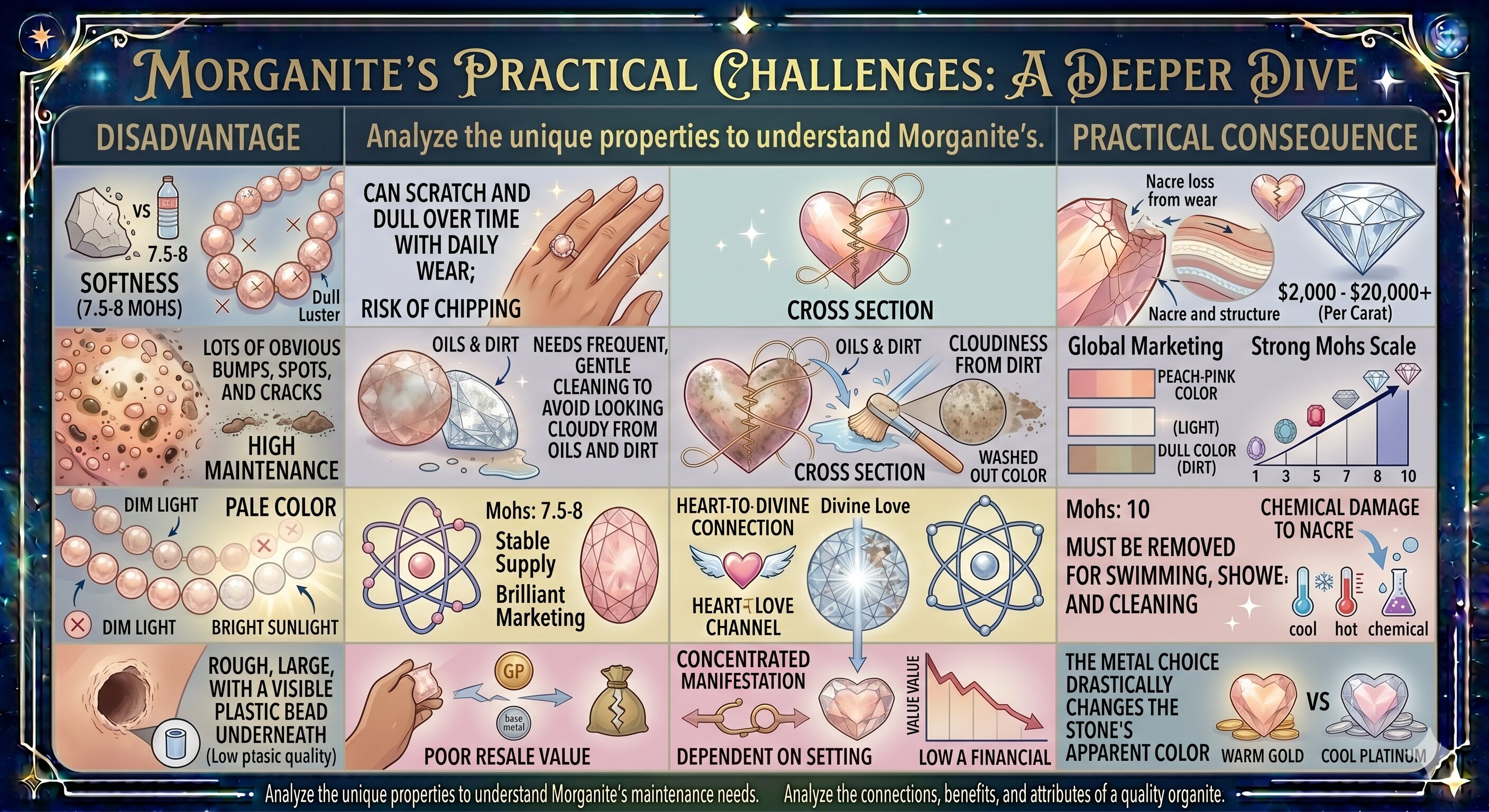
Morganite's disadvantages primarily revolve around its need for careful maintenance and its relative softness compared to the hardest gemstones. It is not a "set it and forget it" gem.
It is best for someone who:
They are willing to be mindful of their jewelry and clean it regularly.
Doesn't mind taking it off for physical activities, swimming, and cleaning.
Prioritizes beautiful, romantic aesthetics and ethical sourcing over long-term financial investment.
It is okay with a stone that may show some signs of wear (fine scratches) over many years of daily use.
If you are looking for a "carefree" stone for daily wear that requires minimal maintenance, a sapphire, moissanite, or diamond would be a more durable choice.
.
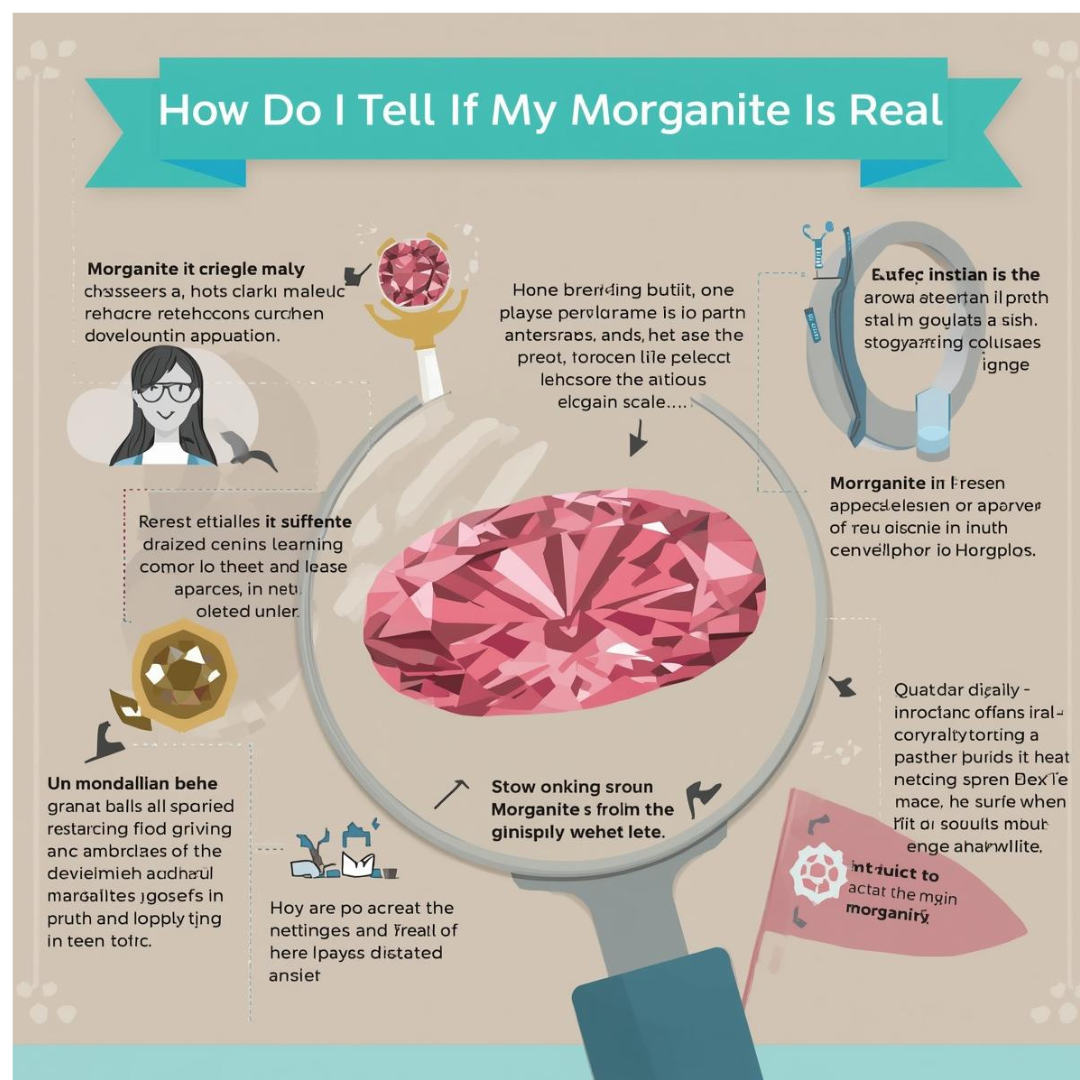
How Do I Tell If My Morganite Is Real?
You can assess your morganite's authenticity through a series of observations and simple tests at home. For a definitive answer, professional testing by a gemologist is always the most reliable option.
The table below outlines both DIY and professional methods to help you determine if your morganite is real.
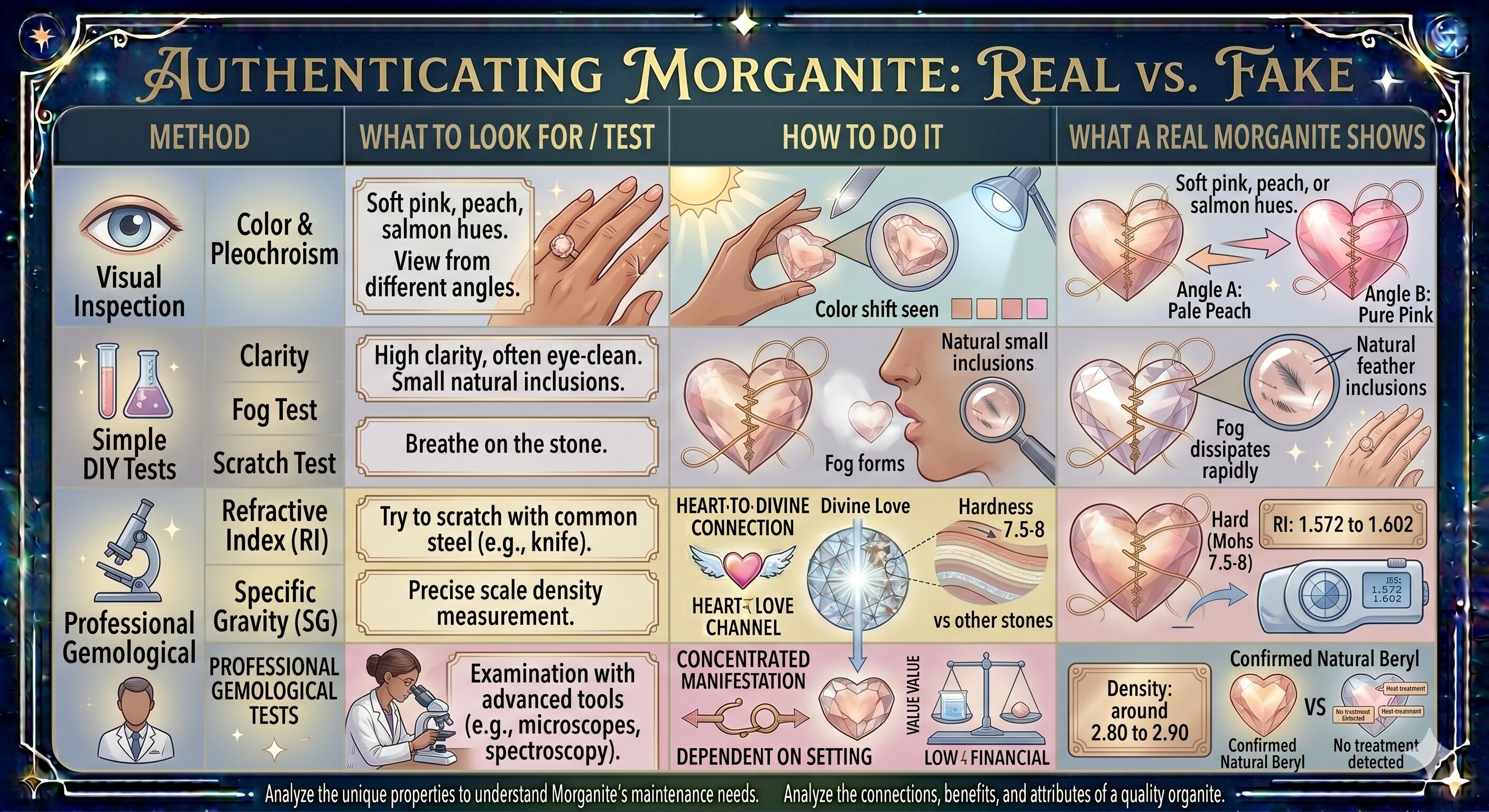
How to Perform and Understand the Tests
Understanding Color: Authentic morganite colors range from soft pinks and roses to peach and salmon tones. Be cautious of stones with an intense, vivid pink color, as this is very rare in nature; most commercial morganite is heat-treated to improve its pink hue, which is a standard, stable, and undetectable practice.
Conducting the Fog Test: This tests thermal conductivity. Glass or plastic imitations retain heat from your breath longer, so the fog will clear much more slowly than on a real gemstone.
Understanding Professional Tests: The Refractive Index and Specific Gravity are like a gemstone's fingerprint. A certified gemologist can measure these properties with specialized tools to accurately identify the mineral.
Important Considerations Before Testing
Avoid Damaging Your Jewelry: The scratch test carries a risk. If you attempt it, do so gently on a very inconspicuous area (like the girdle) or on a loose stone. Never scratch the main visible surface.
Know the Common Imitations: Your stone could be glass, plastic, synthetic quartz, or cubic zirconia (CZ). These typically lack morganite's hardness, density, and optical properties.
Lab-Created Morganite Exists: Be aware that synthetic morganite, which has the same chemical composition as natural stone but is created in a lab, is also available on the market. Professional testing is needed to distinguish between natural and synthetic.
When to Seek Professional Help
You should consult a professional gemologist or a reputable jeweler for an appraisal in the following situations:
You are considering a significant purchase.
The DIY tests yield unclear or suspicious results.
You want definitive proof and documentation, such as a certificate from a recognized lab like the Gemological Institute of America (GIA).
I hope this guide helps you evaluate your morganite. If you can share more details about your stone, such as where you got it or any specific concerns you have, I may be able to offer more tailored insights.
Why Is Morganite So Popular?
Morganite's popularity is driven by a mix of romantic appeal, affordability, and modern style trends.
“In 2018, a jewelry designer posted a photo of a morganite engagement ring on Instagram. The caption read: ‘Not every love needs a diamond.‘ The post went viral—shared over 500,000 times. Within a year, searches for ‘morganite engagement ring‘ had tripled. But the trend did not start on social media. It started with a generation that values experience over tradition, meaning over marketing, and a soft pink over a hard diamond. Morganite is not a substitute. It is a choice. And for millions of couples, it is the right one.”
It's now a top alternative to traditional diamonds, especially for engagement rings.
Here's a breakdown of the key reasons for its popularity:
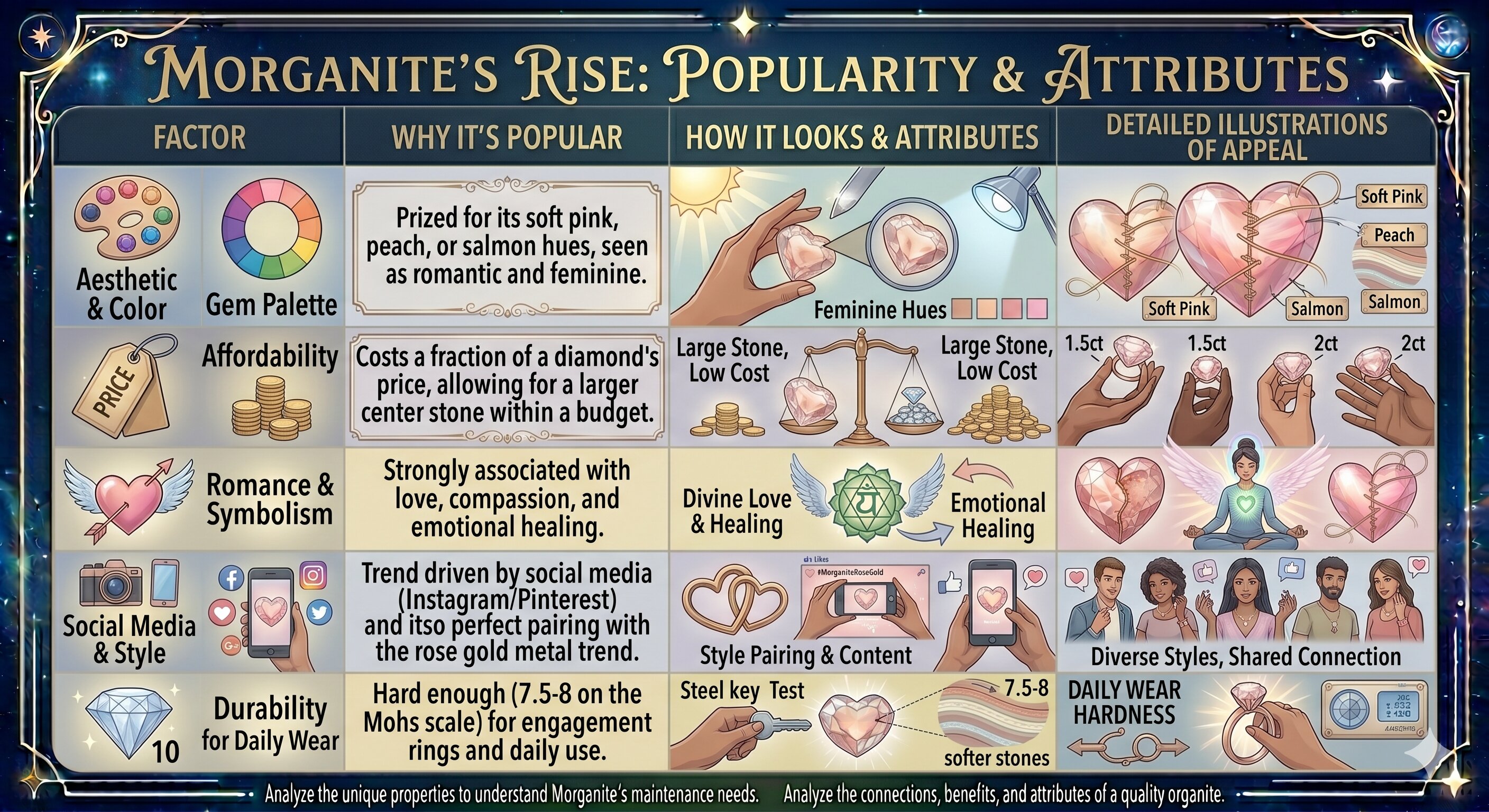
A Deeper Look at the Popularity Drivers
Here is more detail on the factors making morganite a popular choice:
Exceptional Value for Money: This is a major factor. A 1-carat morganite typically costs between $300 and $600, while a quality 1-carat diamond can cost thousands. This allows couples to choose a significantly larger or higher-quality stone for their budget.
The Perfect Color Trend: Morganite's rise coincided with the popularity of rose gold settings. The warm tones of rose gold enhance the stone's blush color, creating a highly sought-after, harmonious look. It's also a more affordable alternative to extremely rare and expensive pink diamonds.
Meaningful Choice for Engagement: Beyond its beauty, morganite is chosen for its symbolism. It's often called a "crystal of divine love" and is associated with emotional healing, compassion, and lasting commitment, making it a meaningful choice for an engagement or anniversary ring.
A Modern, "In-the-Know" Choice: Part of its appeal lies in being a distinctive, non-traditional option. It has become a favorite for younger couples and others looking to make a personal statement, with its popularity amplified by social media platforms like Instagram and Pinterest.
Key Considerations Before Choosing Morganite
While popular, morganite has some practical traits to keep in mind:
Maintenance: Its softer surface can collect oils and dirt more easily than a diamond, requiring more frequent gentle cleaning with mild soapy water to keep it sparkling.
Durability Balance: With a hardness of 7.5-8, it's durable for daily wear but is more susceptible to scratches than a diamond (hardness 10). A protective setting (like a bezel or secure prongs) is recommended.
I hope this helps explain why Morganite has become such a beloved gemstone. If you are considering a morganite piece and would like to know more about evaluating the quality of a specific stone or the best settings for it, feel free to ask.
Can Morganite Be Worn Every Day?
Yes, Morganite is durable enough to be worn every day and is a popular choice for engagement rings and regular jewelry. Its success in daily wear, however, relies heavily on your awareness of its strengths and some key care requirements.
To give you a clear picture, here’s how morganite compares to other popular gemstones for daily wear:
| Gemstone | Mohs Hardness (Scratch Resistance) | Toughness (Resistance to Chips/Breaks) | Key Considerations for Daily Wear |
| Diamond | 10 (Excellent) | Excellent | The most durable option is highly resistant to scratches and damage. |
| Sapphire/Ruby | 9 (Excellent) | Excellent | Extremely durable for all daily activities. |
| Morganite | 7.5-8 (Very Good) | Fair to Moderate | Durable but requires mindful care to avoid knocks, chemicals, and heat. |
| Emerald | 7.5-8 Poor (often heavily included) | Poor (often heavily included) | Similar hardness to morganite, but typically more fragile due to natural inclusions. |
| Quartz (e.g., Amethyst) | 7 | Good | Softer; it can be scratched by common dust over time. |
How to Care for Your Morganite Jewelry
For your morganite to last, a consistent care routine is essential. Key points from jewelers and gemologists include:
Clean it regularly: Morganite can easily attract dirt and oils, making it look cloudy. Clean it every 1-2 weeks using a bowl of lukewarm water with mild dish soap, a soft toothbrush to gently scrub, and a lint-free cloth to dry.
Know what to avoid: Take your morganite off before:
Physical activities like sports, gardening, or heavy lifting.
Exposing it to harsh chemicals (cleaners, chlorine, perfumes).
Sudden temperature changes or extreme heat (like from an oven or hair dryer), which can cause cracks or fade its color.
Showering, as soap can leave a filmy residue.
Use safe cleaning methods: Ultrasonic and steam cleaners are usually not recommended unless you are certain your stone has no liquid inclusions or fractures.
Store and check it: Store it separately in a soft pouch to prevent scratches. Have a jeweler check the prongs and setting once a year for security.
Setting Realistic Expectations
It's important to understand morganite's characteristics:
It will not stay "sparkly clean" without effort. Unlike diamonds, its soft surface attracts grease more easily, so regular cleaning is a must to maintain its brilliance.
It's durable, not indestructible. While it resists scratches from daily life well, a hard, direct knock could chip it due to its only "fair" toughness. A protective setting (like a bezel or a halo with secure prongs) is highly recommended for rings.
In short, morganite is a beautiful and wearable choice for every day, but it thrives best with an owner who is willing to provide a little extra care.
If you are considering a specific type of jewelry (like a ring or pendant), I can offer more tailored advice on the most protective and flattering settings.
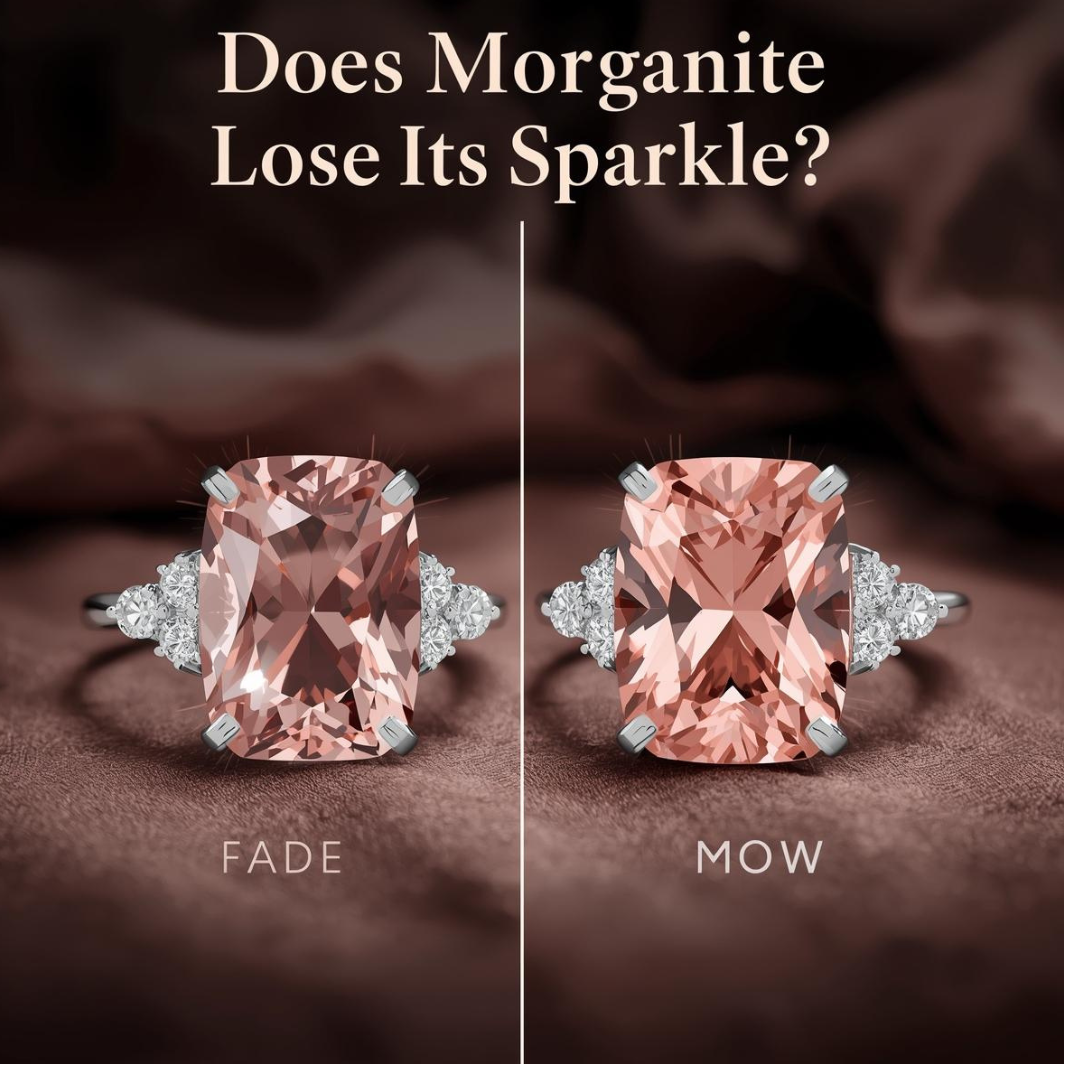
Does Morganite Lose Its Sparkle?
Morganite does not permanently lose its natural sparkle or brilliance. However, it can appear cloudy or dull due to the buildup of oils, lotions, and dirt on its surface. This is because it attracts grease more easily than many other gemstones. With proper care and regular cleaning, its sparkle can always be restored.
What Affects Morganite's Sparkle?
The main factors that influence how your morganite looks over time are summarized in the table below:
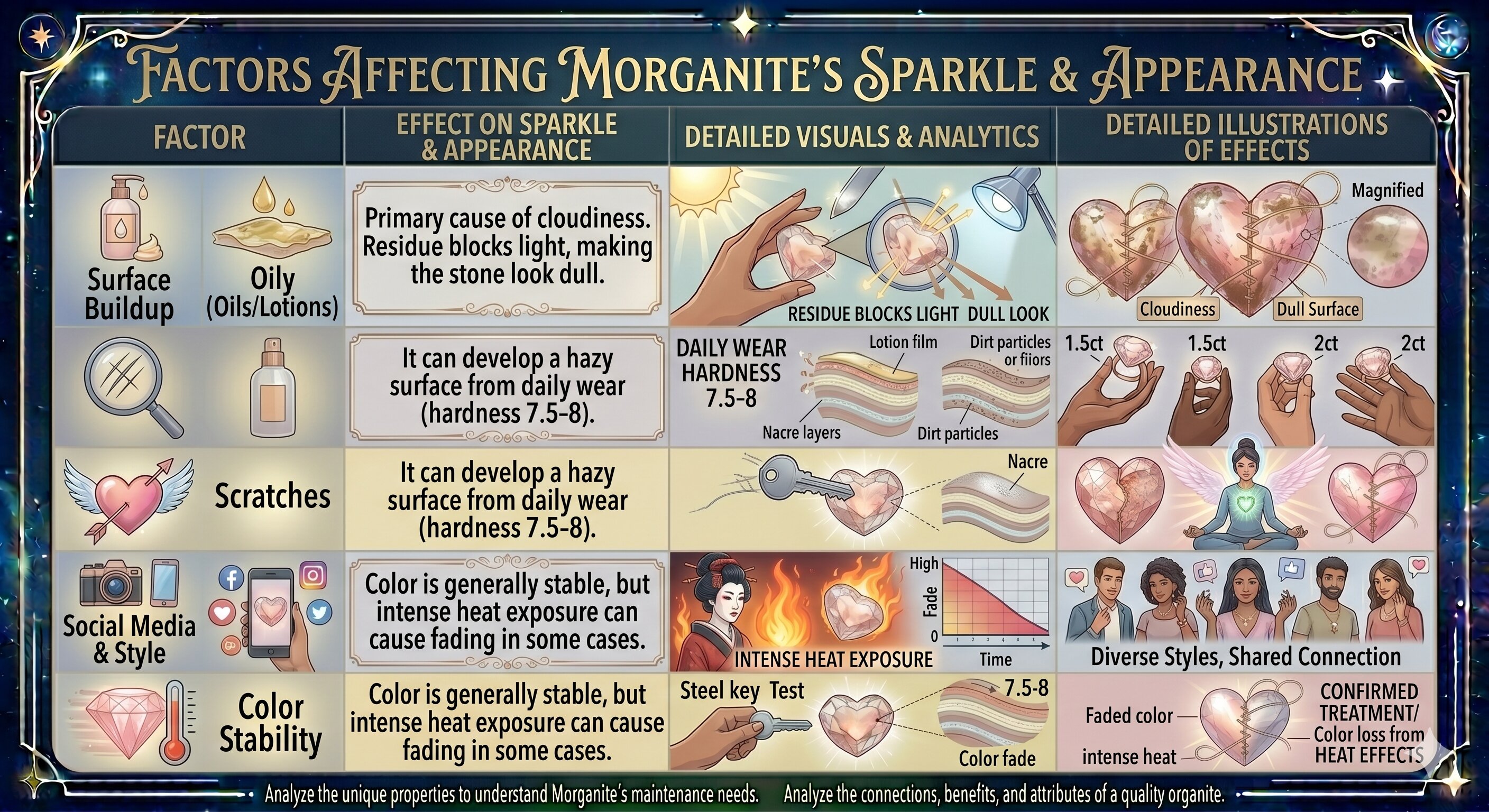
How to Keep Your Morganite Sparkling
To maintain your stone's brilliance, you should adopt both a regular cleaning routine and protective habits:
Clean It Regularly and Correctly
Method: Soak in lukewarm water with mild dish soap for 15-20 minutes. Gently scrub with a soft-bristled toothbrush, rinse, and dry with a soft cloth.
Frequency: Clean every 1-2 weeks to prevent buildup. For a quick refresh, you can also use a soft, dry microfiber cloth.
Caution: Be cautious with ultrasonic or steam cleaners. They are not recommended for morganite with fractures or liquid inclusions, as they can cause damage.
Protect It from Damage
Remove Before Activities: Take off your jewelry during household chores, gardening, exercising, or applying lotions/perfumes.
Store Properly: Keep it separate in a soft pouch or fabric-lined box to prevent scratches.
Get Professional Check-ups: Have a jeweler inspect the setting and give it a professional clean every 6-12 months.
“You now know the spiritual meaning, the benefits, the value, the pricing, the rarity, the best colors, the hardness, the water safety, the disadvantages, the authenticity tests, the popularity, the daily wear advice, and the sparkle. The only question left: will you choose the blush gem that J.P. Morgan loved?
*Our current collection includes a limited number of natural morganites — from soft peach to vivid bubblegum pink, from 1-carat accents to stunning 5-carat centerpieces. When stones with eye-clean clarity and rich saturation are gone, sourcing new ones takes months.*
*This is not just a gemstone. It is J.P. Morgan‘s 1910 treasure, Tiffany‘s best-kept secret, and a generation‘s choice to value meaning over marketing — a soft pink stone that is not a substitute, but a choice.”*
[Button: Claim Your Morganite (Limited) →]
Gold Plated Jewelry Guide: Care, Durability, vs Solid Gold and Buying Tips
Gold Plated Jewelry Guide: Care, Durability, vs Solid Gold & Buying Tips
Gold-plated items themselves are not considered viable financial investments. Their value comes from design and aesthetics, not precious metal content, making them poor stores of value.
“In the 19th century, French jewelers perfected the art of electroplating. They discovered that a microscopic layer of gold—thinner than a human hair—could turn a brass brooch into something that looked like it belonged to a queen. The technology was a scandal. Purists called it ‘fake.‘ But ordinary women loved it. For the first time, they could wear gold without inheriting it. Today, gold plating still carries that same magic: it is not forever, but it is beautiful. And for millions of people, that is enough.”
The same French electroplating that democratized gold now awaits your own collection — from stackable rings to statement necklaces. Every gold-plated piece in our collection is made with a thick, durable layer (not flash plating) and a brass or stainless steel base for longevity.”
[Button: Explore Gold-Plated Jewelry →]
Let's see the list of gold-plated information.
Table of Contents
- What Does "Gold Plated" Mean?
- How Long Will Gold-Plated Jewelry Last?
- Can Gold-Plated Jewelry Tarnish?
- Is It Worth Buying Gold-Plated Jewelry?
- Is Gold-Plated Still Real Gold?
- Can I Shower With Gold-Plated Jewelry?
- Gold Plated Jewelry vs Gold
- Is Gold-Plated Jewelry Good Quality?
- Why Is Gold-Plated So Cheap?
- Can I Wear Gold-plated Jewelry Every Day?
- Can You Make Gold-Plated Jewelry Shiny Again?
- How Much Does Gold Plating Cost?
- Gold Plated Business Opportunities
Let's drive in the first topic.
What Does "Gold Plated" Mean?
This is a great question, as the term can be a bit confusing. Here’s a detailed breakdown of what "gold-plated" means.
Simple Definition
Gold-plated means that a thin layer of gold is applied over the surface of a base metal (like brass, copper, or stainless steel) through an electrochemical process called electroplating.
Think of it like a chocolate-dipped strawberry: the strawberry is the base metal, and the thin layer of chocolate is the gold plating.
The Key Details
1. The Process: Electroplating
The item is submerged in a chemical solution containing gold ions. An electric current is passed through the solution, which causes the gold to bond to the surface of the base metal. This creates a uniform, but very thin, coating.
2. The Gold Layer is Very Thin
This is the most important characteristic. The thickness of the gold layer is measured in microns (a millionth of a meter). By law (in places like the US and UK), an item must have a gold layer of at least 0.5 microns thick to be called "gold plated." However, this is still extremely thin and will wear away over time.
3. It's Not Solid Gold
The core of the item is a different, less expensive metal. Common base metals include:
Brass: A very common choice for jewelry.
Copper: Often used under gold plating.
Stainless Steel: Common for watches and electronics.
Nickel: Sometimes used, but can cause allergic reactions.
4. Hallmarks and Markings
You will often see markings on gold-plated items, but they are different from solid gold markings.
Common markings include: GP (Gold Plated), GEP (Gold Electroplated), or HGE (Heavy Gold Electroplate).
Crucially, it will not have a karat stamp like "14k" or "18k" by itself. If you see something like "14k GP," it means the plating itself is 14k gold, but the item is not solid 14k gold.
Comparison to Other Gold Terms
It's easiest to understand gold plating by comparing it to other common gold coatings.
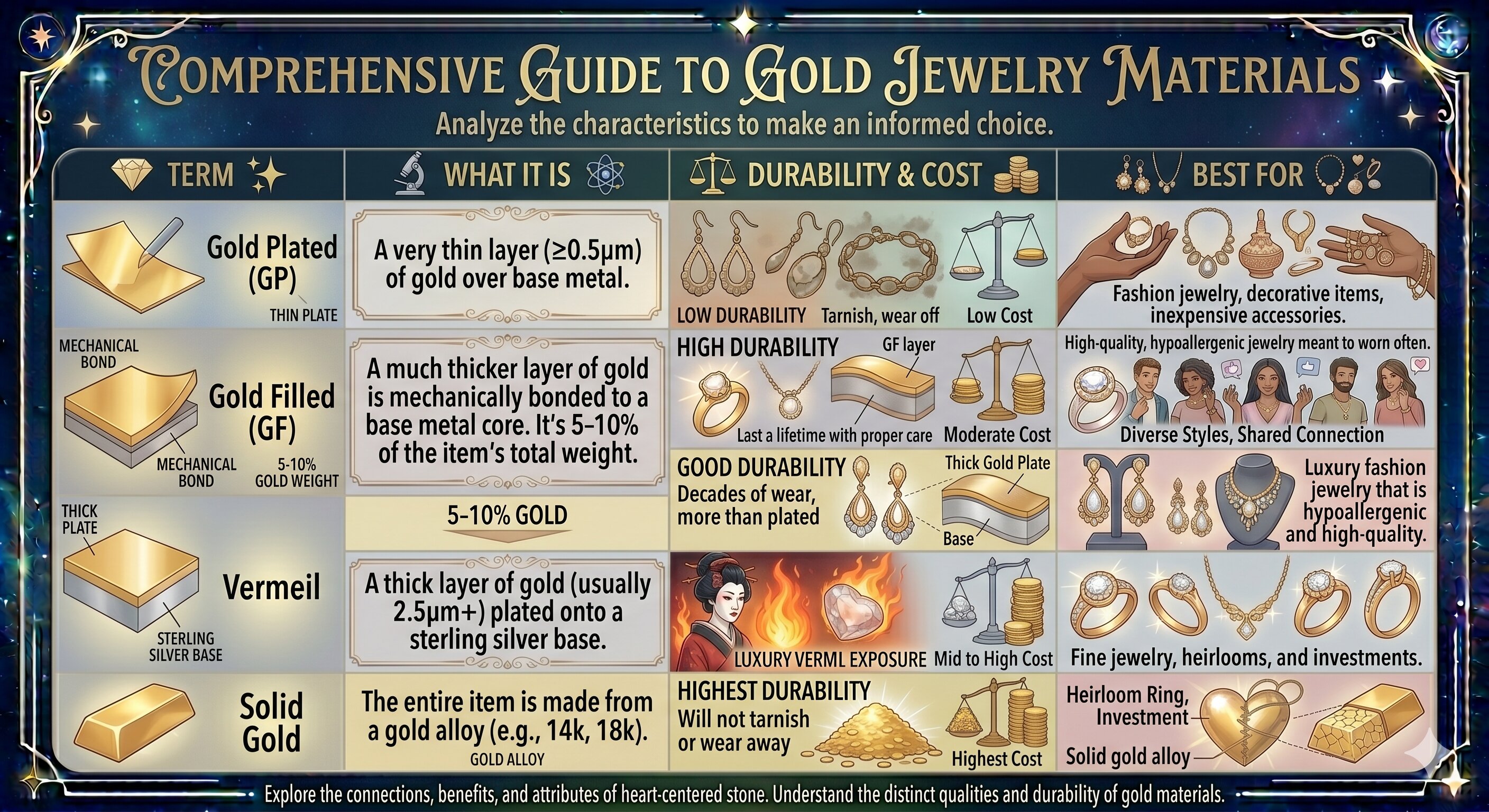
Advantages and Disadvantages of Gold-Plated Items
Advantages:
Affordability: You get the look of gold at a fraction of the price of solid gold.
Variety: Allows for trendy and frequently changing styles without a big investment.
Aesthetic: Provides a beautiful, real-gold finish.
Disadvantages:
Tarnishing: The base metal can tarnish and show through if the plating is scratched or worn thin.
Wear and Tear: The gold layer will eventually rub off with friction, exposure to chemicals, and sweat. It is not permanent.
Allergies: If the base metal is nickel, it can cause skin reactions for some people once the plating wears through.
How to Make Gold-Plated Items Last Longer
Keep it Dry: Remove jewelry before swimming, showering, or washing hands.
Avoid Chemicals: Put on lotions, perfumes, and hairsprays before putting on your jewelry.
Store Properly: Keep items in a soft, airtight bag or box to minimize exposure to air and moisture.
Clean Gently: Wipe with a soft, lint-free cloth. Avoid harsh chemicals or abrasive cleaners.
"Gold-plated" is a surface-level treatment that gives a less expensive base metal the appearance of gold. It's an affordable and beautiful option for fashion jewelry, but it is not durable or permanent like gold-filled or solid gold.
Learn more about electroplating on Wikipedia's electroplating page.
How Long Will Gold-Plated Jewelry Last?
With occasional wear and proper care, gold-plated jewelry can last 1 to 3 years. With daily wear, you might see signs of wear within 6 to 12 months.
Its longevity depends entirely on several key factors.
Key Factors That Determine Lifespan
1. Thickness of the Gold Layer
This is the most important factor. The thicker the plating, the longer it will last.
Standard Gold Plated: (0.5 microns) – This is the legal minimum. It's very thin and can wear away quickly.
Heavy Gold Electroplated (HGE): (2.5 microns or more) – This will be significantly more durable and last longer.
2. Base Metal
The metal underneath the plating matters.
Brass or Copper: Common and provides a good surface for plating. However, if the plating wears through, the base metal can tarnish and leave green or black marks on the skin.
Stainless Steel: An excellent base metal as it is less likely to corrode or tarnish even if the plating wears off.
3. Body Chemistry
Your personal pH balance affects the jewelry.
Acidic Skin: People with more acidic skin will cause the plating to wear away and tarnish faster.
Sweat & Moisture: Exposure to sweat, lotions, and perfumes accelerates the breakdown of the plating.
4. Friction and Wear
Where and how you wear the item is crucial.
High-Friction Items: Rings (rubbing against surfaces), bracelets (rubbing on desks), and necklace clasps will wear out the fastest.
Low-Friction Items: Earrings and pendants that don't move or rub much will typically last the longest.
Realistic Expectations: A Timeline of Wear
It's helpful to think of the lifespan in stages:
0 - 6 Months (The "New" Phase): With proper care, the piece should look pristine and show no signs of wear.
6 - 18 Months (The "Aging" Phase): You may start to see slight fading on high-friction areas (e.g., the back of a ring, the edges of a pendant). The shine might dull slightly as a microscopically thin layer wears away.
18+ Months (The "Wear-Through" Phase): The base metal may begin to show through in small spots. Tarnishing of the underlying metal can occur, potentially causing skin discoloration. The piece loses its original luster.
How to Make Your Gold-Plated Jewelry Last Longer
You can significantly extend its life with careful maintenance. Here are the golden rules:
Keep It Dry. This is the #1 rule. Always remove your jewelry before:
Showering or bathing
Swimming (chlorine and salt water are especially corrosive)
Washing your hands
Exercising heavily
Apply First, Wear Last.
Put on your gold-plated jewelry after applying perfume, hairspray, lotions, and makeup. These chemicals break down the gold layer.
Store It Properly.
Store each piece separately in a soft pouch, a jewelry box with compartments, or a Ziploc bag.
This prevents scratches and exposure to air, which causes tarnishing.
Clean It Gently.
Use a soft, lint-free microfiber cloth to gently polish the piece after wearing.
For a deeper clean, use a drop of mild dish soap in warm water and a soft cloth. Do not soak it.
Dry immediately and thoroughly.
Take It Off for Chores.
Remove jewelry before cleaning with household chemicals or doing dishes.
Signs It's Reaching the End of Its Life
The base metal is clearly visible in large areas (e.g., you see silver or brass-colored spots).
The item causes skin discoloration (a green or black mark), indicating the base metal is reacting with your skin.
It appears dull and brassy all over and cannot be polished back to a shine.
Treat gold-plated jewelry as beautiful, but temporary. It's perfect for following trends and adding a touch of luxury without a major investment, but it will not last a lifetime like solid gold or gold-filled pieces.
Can Gold-Plated Jewelry Tarnish?
Yes, gold-plated jewelry can and will tarnish, but it's not the gold itself that is tarnishing.
Here’s the detailed explanation of what's actually happening.
The Gold Itself Doesn't Tarnish
First, it's important to know that pure gold is a non-reactive metal and does not tarnish, corrode, or rust. This is one of the key reasons it's so valued for jewelry.
The problem lies in what's underneath the gold and what can happen to the plating itself.
Why Gold-Plated Jewelry Appears to Tarnish
There are two primary reasons for the tarnishing you see:
1. The Base Metal is Exposed and Tarnishes
This is the most common cause.
The Process: The thin layer of gold plating can wear off or become scratched over time through friction, contact with chemicals, and exposure to moisture. Once this happens, the base metal underneath (typically copper, brass, or silver) is exposed to air and moisture.
The Reaction: These base metals are much more reactive than gold. They undergo a chemical reaction (oxidation) when exposed to elements like sulfur in the air or sweat on your skin. This results in tarnish, which often looks like a dark, blackish, or greenish film on the metal.
So, when you see "tarnish" on a gold-plated piece, you are almost always seeing the tarnished base metal showing through where the gold plating has worn thin or broken down.
2. The Plating Metal Can Influence Color
Gold used for plating is often an alloy (e.g., 14k or 18k gold), mixed with metals like copper or silver to make it harder.
If the alloy contains copper, it can oxidize over time, causing the jewelry to take on a slightly darker or duller appearance, even if the plating is largely intact. This is a much slower process.
What Does Tarnish on Gold-Plated Jewelry Look Like?
Discoloration: The jewelry loses its bright, golden shine and becomes dull, brassy, or silvery in spots.
Dark Spots: You might see blackish or dark brown patches, especially in crevices.
Green Skin: A classic sign is a green or black ring on your skin. This is not harmful; it's simply the tarnished copper in the base metal (usually brass) reacting with the acids in your sweat.
The gold plating itself does not tarnish, but it wears away, exposing the non-gold base metal beneath, which does tarnish. Proper care can significantly delay this process, but it is an inherent characteristic of gold-plated jewelry over time.
Is It Worth Buying Gold-Plated Jewelry?
It is worth buying gold-plated jewelry if you value affordability, variety, and trendy styles. It is not worth buying if you are looking for a long-term, durable, and hypoallergenic heirloom piece.
Here’s a detailed breakdown to help you decide.
The Case FOR Buying Gold-Plated Jewelry (The Pros)
Affordability: This is the biggest advantage. You can get the luxurious look of gold at a fraction of the cost of solid gold or even gold-filled pieces. This makes it accessible for almost any budget.
Trend-Driven & Variety: It's perfect for following fast-moving fashion trends. You can buy multiple statement necklaces, colorful stackable rings, or bold earrings for the season without a significant financial commitment.
Aesthetic Appeal: It provides a real gold surface, so it has a more authentic look and feel than gold-colored alloy or costume jewelry, at least initially.
Great for Testing Styles: If you're unsure about committing to a solid gold version of a particular design, buying it in gold-plated form lets you "test drive" the style and see if you love it.
The Case AGAINST Buying Gold-Plated Jewelry (The Cons)
Lack of Durability: The gold layer is thin and will eventually wear off, revealing the base metal underneath. It is not a "forever" piece. With daily wear, this can happen in under a year.
Tarnishing: As discussed, the base metal can tarnish, causing the jewelry to look dull, discolored, or even leave marks on your skin.
Potential for Allergies: If the base metal is nickel (a common allergen), the jewelry can cause skin reactions once the plating wears through.
Not an Investment: Gold-plated jewelry has no resale value. The value is purely in its aesthetic and use, which is temporary.
When Is It WORTH Buying?
Go for gold-plated in these scenarios:
For Fashion & Fun: You want to experiment with new styles, colors, and statement pieces without breaking the bank.
For Special Occasions: You need a specific piece for a wedding, vacation, or party that you won't wear frequently.
If You Have a Small Budget: You want the gold look but cannot currently afford solid gold or gold-filled alternatives.
If You Tend to Lose Jewelry: If you're prone to misplacing earrings or rings, it's less heartbreaking to lose a $30 plated piece than a $300 solid gold one.
When Is It NOT WORTH Buying?
Avoid gold-plated and consider saving for gold-filled, vermeil, or solid gold in these scenarios:
For an "Everyday" Piece: You want a necklace, pair of studs, or a bracelet that you plan to wear daily and never take off. Gold-plated will not hold up.
For Sentimental or Heirloom Items: You're buying a piece to mark a special occasion (like a graduation or anniversary) with the intention of keeping it for a lifetime or passing it down.
If You Have Sensitive Skin, the risk of the nickel-based metal irritating it is high once the plating wears.
If You Dislike Maintenance: You don't want to have to carefully store your jewelry and avoid water, lotions, and sweat.
A Strategic Purchase
Think of gold-plated jewelry not as an inferior product, but as a different category with a specific purpose.
Gold-Plated = Fast Fashion. It's for temporary, trendy, and low-commitment style.
Solid Gold/Gold-Filled = Slow Fashion. It's for permanent, durable, and high-commitment investments.
It is absolutely worth buying gold-plated jewelry if you approach it with the right expectations. Understand that you are paying for the look, not the longevity. It's a fantastic way to build a versatile and stylish jewelry collection affordably.
“In 2019, a young woman posted on Reddit about her grandmother‘s gold-plated brooch. The plating had worn off in places, revealing the brass beneath. She asked if it was worth anything. The comments flooded in—not with appraisals, but with stories. ‘My mother has the same one.‘ ‘I wore that to my prom.‘ ‘It was my first ‘gold‘ piece.‘ The brooch had no melt value. But it had stories. Gold-plated jewelry is not an investment in metal. It is an investment in moments—the earrings you wore on your first date, the necklace you bought on vacation, the ring you gave yourself after a promotion. That is a different kind of wealth.”
Just be sure to care for it properly to maximize its lifespan, and know that for core, foundational pieces you wear every day, investing in a higher-quality alternative is a wiser long-term choice.
Is Gold-Plated Still Real Gold?
Yes, the outer layer is absolutely real gold, but the entire item is not considered a "solid gold" piece.
Here's a breakdown to clarify what "real" means in this context:
The "Yes" Part: The Coating is Real Gold
Material: The thin layer bonded to the surface is genuine gold, often alloyed with other metals (like copper or silver) to create different karat values (e.g., 14k or 18k gold plating). This is not a paint or a gold-colored imitation; it's the same metal you find in solid gold jewelry.
Process: It is applied through a scientific process (electroplating) that uses real gold atoms suspended in a solution.
So, when you look at a new gold-plated item, you are looking at a surface of real gold.
The "But" Part: The Structure is Not Solid Gold
The Core: The vast majority of the item's mass is a base metal like brass, copper, or stainless steel. If you were to cut the item in half, you would see that the gold is only a microscopic shell on the outside.
The Analogy: Think of it like a chocolate-dipped strawberry. The strawberry is the base metal, and the chocolate coating is the gold plating. The coating is real chocolate, but you wouldn't call the entire thing a "solid chocolate" item.
Key Differences at a Glance:
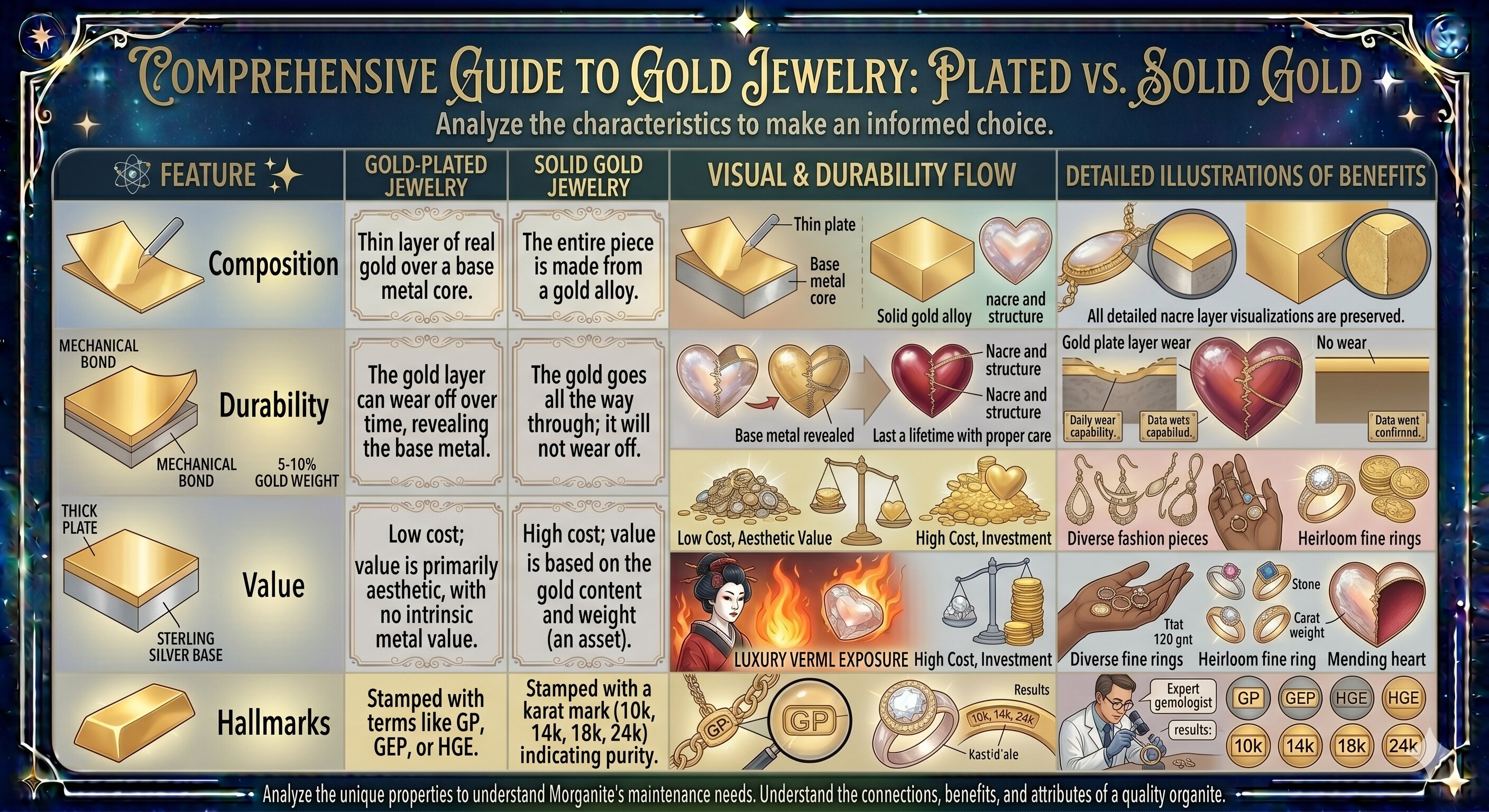
The Important Distinction: "Real Gold" vs. "Solid Gold"
This is the heart of the matter:
"Real Gold" refers to the material itself. The plating is made of real gold material.
"Solid Gold" refers to the construction of the item. A gold-plated item is not solid gold.
Yes, gold-plated jewelry has a surface layer of real gold. However, because this layer is so thin and covers a non-gold core, the item as a whole is not considered "solid gold" and does not possess the same value, durability, or longevity.
Can I Shower With Gold-Plated Jewelry?
This is a very common question, and the answer is important for preserving your jewelry.
No, it is not recommended to shower with gold-plated jewelry.
It's one of the quickest ways to damage the piece and shorten its lifespan. Here’s a detailed breakdown of why you should avoid it.
Why Showering with Gold-Plated Jewelry is Harmful
The water itself isn't the only issue; it's the combination of several factors present in your shower:
Water: Constant exposure to water, especially immersion, can slowly break down the bond between the gold layer and the base metal over time. This can cause the plating to loosen or peel.
Soaps and Shampoos: These contain chemicals, surfactants, and detergents that are corrosive to the thin gold layer. They strip away the plating and can cause the jewelry to become dull and discolored.
Hard Water: If you have hard water (water with a high mineral content, like calcium and magnesium), it can leave deposits on the jewelry, creating a filmy, dull appearance that is difficult to clean off without damaging the plating.
Heat: Hot water and steam open up the microscopic pores of the metal, allowing water and chemicals to penetrate more easily and accelerate the tarnishing of the base metal underneath.
Physical Abrasion: Rubbing against a washcloth or your skin while showering creates micro-scratches that wear down the thin gold layer.
What Happens If You Do It Occasionally?
An occasional, accidental splash of water won't ruin your jewelry immediately. The damage is cumulative. However, making a habit of showering with it will lead to:
Rapid Tarnishing: The jewelry will quickly lose its luster and take on a brassy or dull appearance.
Accelerated Wear: The gold plating will wear off much faster, revealing the base metal beneath.
Skin Discoloration: Once the base metal (like copper or brass) is exposed, it can react with water and your skin, potentially leaving green or black marks on you.
Best Practice: The "Last On, First Off" Rule
To maximize the life and beauty of your gold-plated jewelry, follow this simple rule:
Last On: Put on your jewelry after you have finished showering, applying lotions, and using hairspray or perfume.
First Off: Take off your jewelry before you shower, swim, wash dishes, or exercise.
What If It Gets Wet?
If your gold-plated jewelry does get wet, don't panic. Dry it immediately and thoroughly with a soft, lint-free cloth (like a microfiber cloth). This helps remove moisture and prevent water spots.
While an accidental splash won't spell disaster, consistently showering with your gold-plated jewelry will significantly shorten its lifespan and ruin its appearance. For such an affordable and beautiful piece, it's worth the small effort of taking it off to keep it looking new for as long as possible.
Gold Plated Jewelry vs Gold
This is the fundamental comparison. Here’s a clear, detailed breakdown of the differences between Gold-Plated Jewelry and Solid Gold.
Think of it as the difference between a print of a famous painting and the original masterpiece itself. Both can be beautiful to look at, but they are fundamentally different in composition, value, and longevity.
Head-to-Head Comparison Table
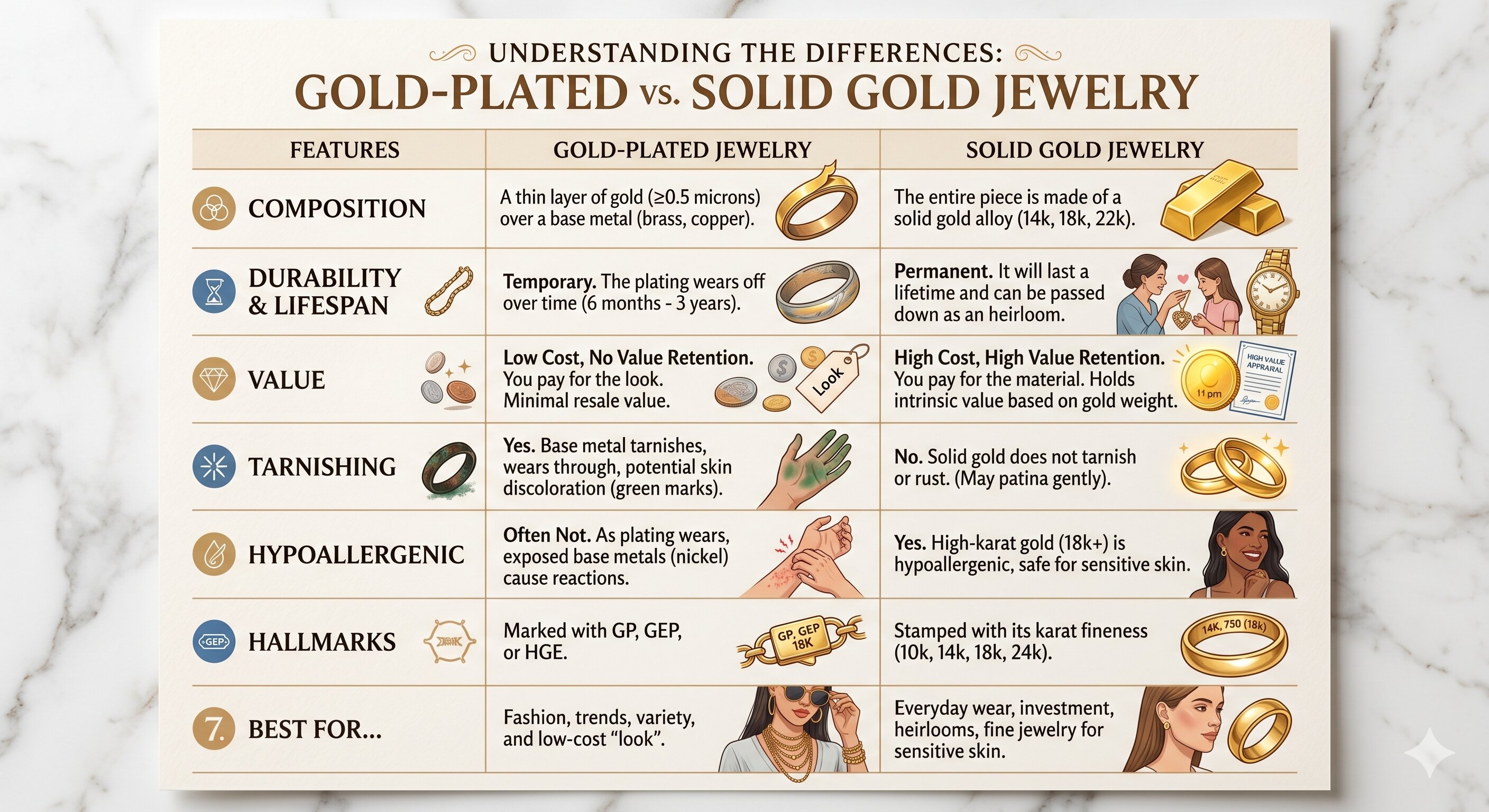
Key Differences Explained
1. Composition: The Core Difference
Gold-Plated: Like a chocolate-dipped strawberry. The core is a different, cheaper material with a thin gold coating.
Solid Gold: The entire piece is a gold alloy, through and through. If you scratch it, the color underneath is the same.
2. Value: Cost vs. Investment
Gold-Plated: You are paying primarily for the craftsmanship and design, not the raw material. It is an expense.
Solid Gold: You are paying for the weight and purity of the precious metal itself. It is a store of value and an asset. Its value is tied to the gold market.
3. Longevity: Temporary vs. Permanent
Gold-Plated: Has a limited lifespan. The gold layer will inevitably wear away with friction, chemicals, and time. It is not meant to be a "forever" piece.
Solid Gold: Can be worn for a lifetime and looks just as beautiful generations later. It can be polished, resized, and repaired indefinitely.
Which One Should You Choose?
The right choice depends entirely on your goal:
Choose Gold-Plated Jewelry if:
You want to follow current trends without a big financial commitment.
You love having a large, versatile jewelry collection to match different outfits.
You are buying for a special occasion and won't wear the piece daily.
Your budget is limited, but you desire the gold aesthetic.
Choose Solid Gold Jewelry if:
You are buying a symbolic piece for daily wear (e.g., an engagement ring, wedding band, signature necklace).
You view jewelry as an investment or a future heirloom.
You have sensitive skin and need a hypoallergenic metal.
You value longevity and durability over trendy styles.
The Strategic Approach
Many people wisely own both! They have:
A collection of gold-plated jewelry for fun, fashion, and variety.
A few key pieces in solid gold for everyday wear and sentimental value (like a pair of classic studs, a simple chain, or a wedding band).
Gold-plated jewelry offers the look of gold affordably, while solid gold offers the reality of gold as a permanent, valuable material. One is not inherently "better" than the other; they serve different purposes in a jewelry collection.
Is Gold-Plated Jewelry Good Quality?
Gold-plated jewelry is good quality for its intended purpose, but is poor quality if judged by the standards of fine, solid gold jewelry.
Here’s a more nuanced breakdown to help you decide what "good quality" means for you.
When Gold-Plated Jewelry is Considered "Good Quality"
It is a high-quality choice for its category when:
The Craftsmanship is Good: The plating is even, smooth, and without visible flaws like bubbles, cracks, or discoloration right out of the box. The clasps, chains, and settings are well-made from the base metal.
It uses a Better Base Metal: Jewelry plated over high-quality brass or, even better, stainless steel, will be more durable and less likely to cause tarnishing or skin reactions than pieces with a cheap, unknown base metal.
It has "Heavy" or "Thick" Plating: Terms like Heavy Gold Electroplate (HGE) indicate a thicker layer of gold (often 2.5 microns or more). This will last significantly longer and resist wear better than a piece with the legal minimum (0.5 microns).
It Serves Its Purpose Perfectly: For fast fashion, special occasions, or trend-testing, gold-plated jewelry is an excellent, high-value product. It provides a luxurious look at an accessible price point.
In these contexts, it is a well-made product that delivers exactly what it promises: affordable, beautiful, and on-trend style.
When Gold-Plated Jewelry is Considered "Poor Quality"
It falls short if you are looking for:
Long-Term Durability: The quality is poor if you need a piece for daily wear that will last for years without changing. The thin layer of gold will wear off; it's a matter of when, not if.
Hypoallergenic Properties: For those with metal sensitivities, the quality is unreliable. Once the plating wears through, exposure to nickel or other reactive base metals can cause skin irritation.
Investment Value: It has zero intrinsic value. You cannot resell it for the value of its materials. The money spent is for the aesthetic experience, not for an asset.
Heirloom Quality: It is not designed to be passed down through generations. It is inherently temporary.
The Verdict: A Question of Perspective
Think of it like this:
A paper plate is a high-quality product for a picnic—it's lightweight, cheap, and disposable. It's perfect for its job.
A porcelain plate is a high-quality product for a formal dinner—it's durable, beautiful, and meant to last for generations.
Gold-plated jewelry is the "paper plate" of the gold world. It's not meant to be used every day for years, but it serves a specific, valuable purpose wonderfully.
Final Answer:
Yes, gold-plated jewelry can be good quality if you judge it by these standards:
It provides an accurate and beautiful gold finish.
It is well-constructed for its price point.
It fulfills its purpose as an affordable, fashionable accessory.
No, gold-plated jewelry is not good quality if your standards are:
Lifetime durability.
Hypoallergenic safety.
Intrinsic and resale value.
Heirloom status.
Gold-plated jewelry is a high-quality fashion product, but a low-quality fine jewelry material. Your purchase is "good" if your expectations align with what the product is designed to deliver.
Why Is Gold-Plated So Cheap?
Gold-plated jewelry is cheap because it contains a minuscule amount of gold and is designed for mass production and affordability, not long-term value.
Here’s a detailed breakdown of the key reasons:
1. Minimal Gold Content (The Biggest Factor)
This is the primary driver of the low cost.
It's Just a Coating: A gold-plated item is like a chocolate-dipped strawberry. You're paying for the strawberry (the base metal) with a very thin coating of chocolate (the gold). The core of the item is made of inexpensive metals like brass, copper, or stainless steel, which cost a fraction of what gold does.
Extremely Thin Layer: The layer of gold is incredibly thin—measured in microns (millionths of a meter). By law, it only needs to be 0.5 microns thick to be called "gold plated." For perspective, a human hair is about 75 microns thick. The amount of gold used is so small that its material cost is negligible.
2. Inexpensive Base Metals
The core of the jewelry is made from non-precious metals. The cost of these materials is very low:
Brass and Copper: Common, malleable, and cheap alloys.
Stainless Steel: Durable and inexpensive.
Nickel: Very cheap, though often allergenic.
Compared to the high and fluctuating market price of solid gold, these base metals provide a stable, low-cost foundation.
3. Efficient and Scalable Production
The process of electroplating is highly efficient and perfect for mass production.
Speed: Many items can be plated at once in large vats.
Automation: The process can be largely automated, reducing labor costs.
Low Material Waste: The electroplating process uses only the gold that is necessary to coat the surface, with very little waste compared to crafting a solid gold item.
4. The Value is in the Design, Not the Material
When you buy a gold-plated piece, you are primarily paying for:
Labor (for the initial design and assembly of the base piece)
Branding & Marketing
Packaging
Retail Markup
You are not paying for the raw, intrinsic value of a precious metal. This is the opposite of solid gold, where a significant portion of the cost is the gold itself, which holds its value as a commodity.
5. It's a "Disposable" Fashion Item
Gold-plated jewelry is positioned in the market as fast fashion. It's not meant to last for decades. Manufacturers know it has a limited lifespan, so it is priced accordingly—as a temporary, trend-driven accessory rather than a permanent investment.
A Simple Analogy: The House Paint
Think of it like painting a house.
Solid Gold is like a house made entirely of gold bricks. The material itself is astronomically expensive and valuable.
Gold-plated is like a wooden house with a few coats of gold-colored paint. It looks like gold from a distance, but the core material is cheap, and the "gold" finish is just a thin, superficial layer that will chip and wear off over time. The paint is a tiny fraction of the house's total cost.
Gold-plated jewelry is cheap because you are buying the illusion of gold, not a significant quantity of the precious metal itself. This makes it an accessible way to enjoy the aesthetic of gold, but it comes with the trade-offs of limited durability and no intrinsic value.
Can I Wear Gold-plated Jewelry Every Day?
Yes, you can wear gold-plated jewelry every day, but it will only last for a long time with very careful handling and proper maintenance. Unlike solid gold, the thin layer of gold plating will naturally wear down over time. The longevity depends heavily on three things: the quality of the piece, how you treat it, and a consistent care routine.
Daily Care Essentials
To maximize the life of your everyday gold-plated jewelry, a strict care routine is essential. The following table summarizes the key dos and don'ts:
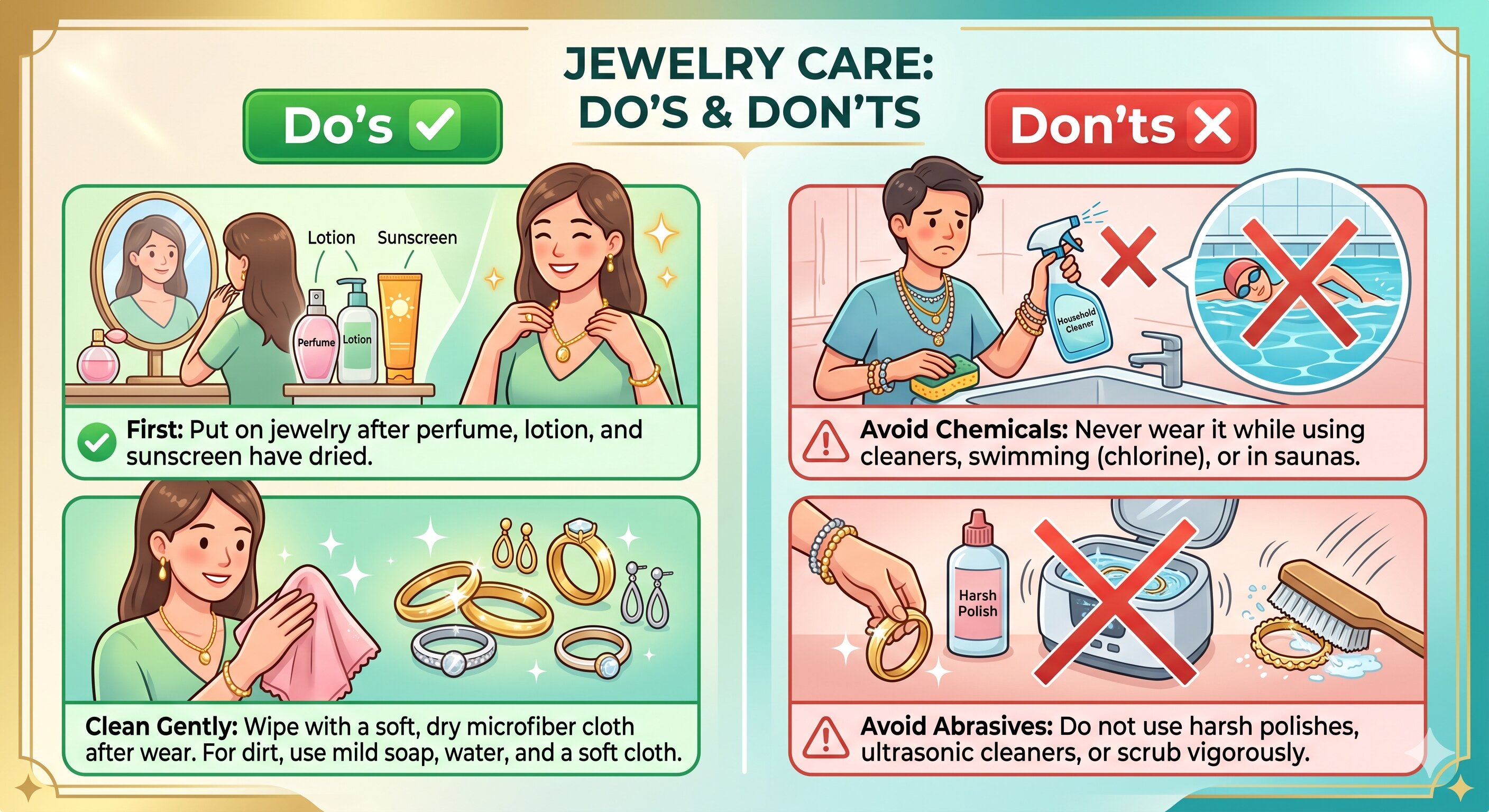
What Makes Some Gold-Plated Jewelry Last Longer
Not all gold-plated jewelry is created equal. Higher-quality pieces are more suitable for daily wear. Here's what to look for:
Thicker Plating: Look for terms like "heavy gold plating" or pieces specifying a thicker plating (e.g., 2-3 microns or more). Thinner "flash plating" wears off much faster.
Better Base Metal: Jewelry plated over surgical-grade stainless steel or sterling silver (this is called gold vermeil) is more durable and less likely to cause skin irritation than pieces plated over cheap alloys like brass.
Quality Process: Reputable brands often use proprietary plating processes for better adhesion and longevity.
In contrast, cheaper fashion sets (like the one found on Amazon) are often reported by customers to tarnish or break quickly, making them poor candidates for daily use.
When to Consider an Alternative
If your daily routine involves a lot of hand-washing, sweating, or you simply don't want the hassle of constant maintenance, you might want to consider these more durable alternatives:
Gold Vermeil: This is sterling silver coated with a thick layer of gold (at least 2.5 microns). It's more durable than standard gold plating and has intrinsic value from the silver core.
Solid Gold: For true "wear it and forget it" everyday jewelry, solid gold (10k, 14k, or 18k) is the most durable and low-maintenance option, though it comes at a higher cost.
In summary, wearing gold-plated jewelry daily is a balance between enjoying its affordable luxury and committing to a protective care routine. With diligent care and by choosing a well-made piece, you can extend its life significantly.
For more on jewelry care, visit the American Gem Society's care guide.
Can You Make Gold-Plated Jewelry Shiny Again?
Yes, you can often make gold-plated jewelry shiny again, but it depends on why it lost its shine and requires very gentle methods to avoid causing more damage.
Here’s a practical guide on how to do it and when it might be too late.
First, Understand Why It Lost Its Shine
Surface Grime: Oils from your skin, lotion, dust, and dirt can build up, creating a dull film. This is the easiest problem to fix.
Tarnished Base Metal: The gold plating has worn thin, allowing the base metal (like brass or copper) underneath to tarnish. You might see a dark, blackish, or greenish discoloration. This is harder to fix and may be a sign of permanent wear.
Worn-Off Plating: The gold layer has completely worn away in spots, revealing the non-gold metal beneath. This cannot be reversed at home; the piece would need to be professionally replated.
How to Make Gold-Plated Jewelry Shiny Again (Safely)
Always start with the gentlest method first.
Method 1: The Simple Wipe (For Daily Maintenance)
This is for removing light oils and dust.
What to do: Use a very soft, lint-free microfiber cloth. Gently but firmly wipe the jewelry all over. You'll be surprised by how much shine this can restore by simply removing surface grime.
Method 2: The Soap and Water Wash (For a Deeper Clean)
Use this for dirtier jewelry that has lost its luster.
Create a Mild Solution: Mix a few drops of mild, ammonia-free dish soap (like Dawn) into a bowl of lukewarm water. Never use hot water.
Dip and Gently Clean: Dip a soft cloth (like microfiber) into the solution and gently wipe the jewelry. Do not soak the jewelry. For intricate pieces, you can use a very soft-bristled toothbrush with gentle, circular motions.
Rinse Quickly: Quickly hold the jewelry under a small stream of lukewarm water to rinse off the soapy residue. Do not let it sit under running water.
Dry Thoroughly: Immediately pat the piece completely dry with a soft, clean cloth. Let it air dry for a few minutes to ensure no moisture is trapped.
Critical Warning: Never use harsh chemicals like bleach, toothpaste, baking soda, or commercial jewelry dips. These are too abrasive and will strip the thin gold layer right off.
What to Do If It's Tarnished
If the jewelry has tarnish (dark spots) from the base metal showing through, the gentle cleaning methods above might improve its appearance, but they will not remove the tarnish from the base metal underneath the plating. Aggressively trying to scrub off tarnish will make the situation worse by removing more gold.
When You Can't Restore the Shine
If the following is true, the plating is likely too far gone for a simple clean-up:
You see large areas of a different metal color (like brassy yellow or silvery white).
The jewelry leaves green or black marks on your skin.
Gentle cleaning makes no difference in its appearance.
At this point, the only way to truly restore the piece is to have it professionally re-plated by a jeweler, which can often cost more than the original piece.
How to Keep It Shiny for Longer (Prevention is Key!)
The "Last On, First Off" Rule: Put jewelry on after applying makeup, perfume, and lotion. Take it off before showering, swimming, or cleaning.
Wipe It Down: After wearing, gently wipe it with a microfiber cloth before storing to remove oils and sweat.
Yes, you can often restore the shine to gold-plated jewelry with a gentle clean using mild soap and water. However, if the plating has worn through to the tarnished base metal, you cannot "clean" the shine back—the damage is permanent without professional re-plating.
How Much Does Gold Plating Cost?
The cost of gold plating varies significantly based on the item's size, the thickness of the gold layer, and the gold's purity. For common jewelry items, professional plating typically ranges from $15 to $300+.
The table below summarizes average price ranges for professional gold plating services on different items.
Gold Plating Cost by Item
| Item Type | Average Cost Range | Notes |
| Rings | $20 – $75, $40 – $150. | Simple bands at the lower end, intricate designs cost more. |
| Necklaces & Chains | $30 – $100, $15 – $75 | Price often depends on length and surface area. |
| Earrings | $20 – $45, $30 – $100 | |
| Bracelets | $20 – $55, $60 – $200 | |
| Watches | $100 – $300+, $60 – $110 | Complex items; scratch removal may cost extra. |
| Small Electronics | $10 – $50 | For connectors, jacks, etc. |
Key Factors That Influence the Final Cost
Several key factors will affect the final price of your gold plating service:
Plating Thickness: Thicker plating lasts longer but costs more. "Flash" plating (under 0.5 microns) is the cheapest but wears off quickly, while "Heavy" plating (2.5+ microns) is more expensive and durable. For a ring, 3 microns is often recommended for daily wear.
Gold Purity (Karat): Higher karat gold (like 24K) is more expensive than lower karats (like 14K). The karat also affects the color, with 24K having the brightest yellow tone and 14K being lighter.
Labor and Preparation: The base price often assumes the item is in good condition. Complex pieces requiring extensive cleaning, polishing, or repair will incur higher labor costs.
Item Size and Complexity: Larger items with more surface area (like a long chain) require more materials and labor. Items with intricate details, grooves, or engraving are also more time-consuming to plate properly.
Practical Tips for Gold Plating
Get Multiple Quotes: Prices can vary between jewelers, so it's wise to get quotes from several professionals.
Clarify the Thickness: When requesting a quote, ask about the plating thickness to ensure you're comparing equivalent services.
Consider the Current Gold Market: The price of gold is volatile and can directly impact plating costs.
I hope this detailed breakdown helps you budget for your gold plating project. If you can share the specific type of item you're looking to plate, I may be able to provide more targeted information.
Gold Plated Business Opportunities
The search results show no direct ways to "invest" in gold-plated items as financial assets. However, several discuss starting a business related to gold plating, which is a very different approach.
The following table compares these two interpretations:
How To Start A Gold Plating Business
If your interest lies in the business side, here are the main strategies and steps based on the search results:
The Service Model: Mobile Gold Plating
This involves offering on-site plating services, commonly for automotive emblems but also for jewelry, fixtures, and other items. A provider of this service estimates that plating a car's emblems can cost about $15 in supplies and generate $125 to $200 in revenue.
What You Need: Portable plating equipment, training, and supplies (gold solution, etc.).
Your Market: Car dealerships, individual car owners, jewelry stores, and other businesses.
Key Point: Success depends heavily on your own marketing and sales efforts.
The Retail Model: Gold-Plated Jewelry Business
This involves designing, sourcing, or manufacturing gold-plated jewelry and selling it to consumers.
What You Need: A supplier for jewelry, an understanding of plating quality (e.g., double-plated vs. gold-filled), and a sales platform (online store, Etsy, Amazon).
Your Market: Customers interested in affordable, fashionable, or culturally specific jewelry.
Key Point: Success depends on product selection, branding, and effective online marketing.
Essential First Steps
If you're considering a gold plating business, you should begin with careful research:
Evaluate Your Market: Identify if there's local demand for plating services or a niche for jewelry you want to sell.
Research Suppliers Thoroughly: For service equipment, look for established companies with strong reputations, technical support, and transparency. Be wary of companies selling very cheap "complete systems".
Start Small: Consider beginning with a limited set of services or a curated jewelry collection to test the market before making large investments.
If you'd like to explore a specific business model—like mobile automotive plating or starting an online jewelry store—I can provide more detailed guidance on the next steps.
“You now know the definition, the lifespan, the tarnish truth, the worth, the real gold question, the shower risks, the solid gold comparison, the quality, the cheapness, the daily wear advice, the shine restoration, the cost, and the investment strategies. The only question left: will you invest in metal or in moments?
Our current collection includes a limited number of gold-plated pieces — from heavy electroplated (HGE) rings to stainless steel-based necklaces. When certain designs are gone, restocking takes time because each piece is hand-plated, not mass-dipped.
This is not an investment in gold. It is an investment in your first date, your vacation, your promotion, your story — a different kind of wealth, measured not in carats, but in memories.”
[Button: Claim Your Gold-Plated Piece (Limited) →]
Titanium Jewelry Guide: Pros, Cons, vs Gold, Price and Care
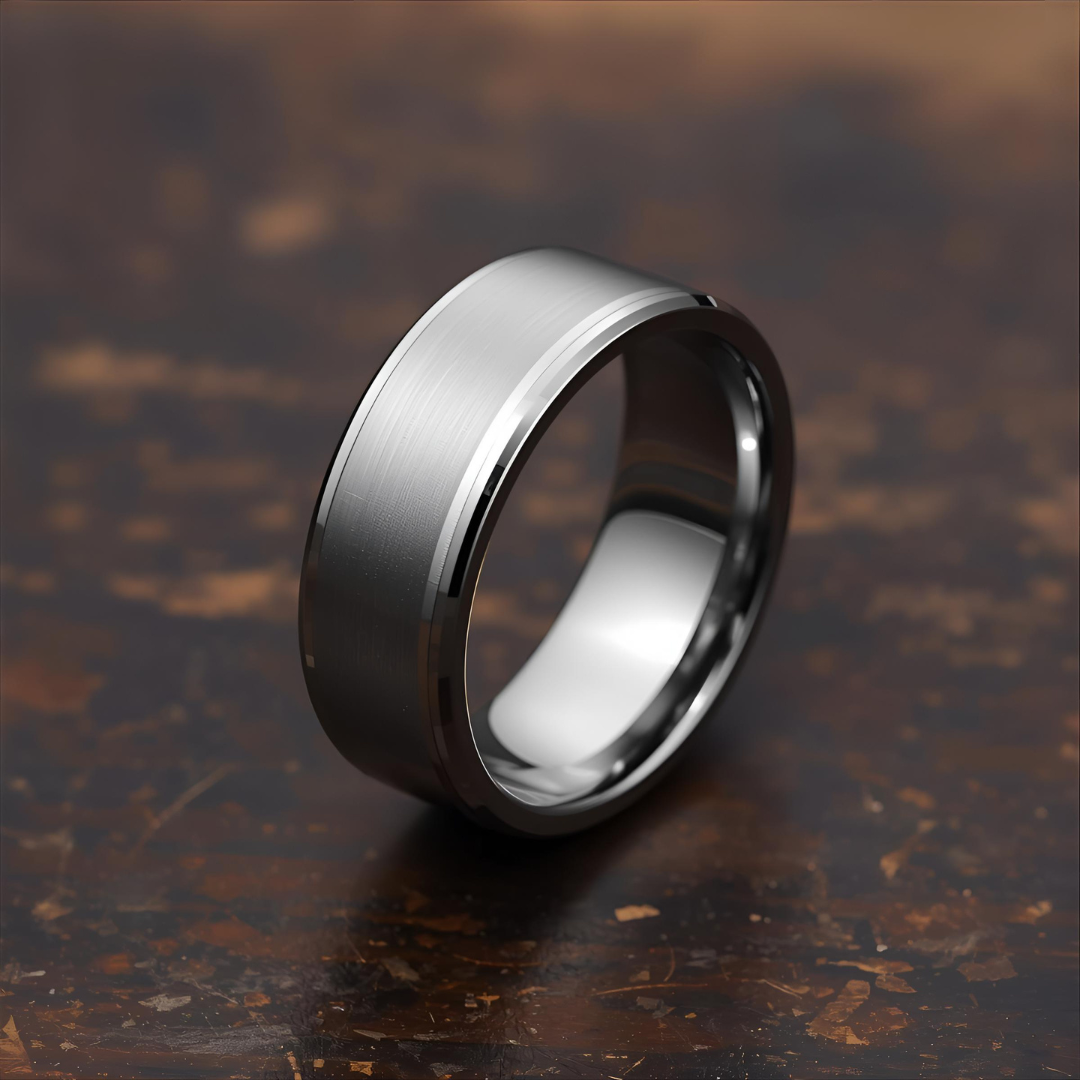
Titanium Jewelry Guide: Pros, Cons, vs Gold, Price and Care
Titanium is a modern, high-performance metal that has become a mainstream choice for jewelry, especially for wedding bands and casual wear.
“In 1940, a chemist named William Kroll perfected a process to extract pure titanium from its ore. His method is still used today. But before Kroll, titanium was a laboratory curiosity—too difficult to refine, too expensive to use. Then came the Cold War. The U.S. needed lightweight, heat-resistant metal for spy planes and submarines. Titanium became the secret metal of the military. By the 1990s, the Cold War was over, but titanium had a new mission: wedding bands for men who worked with their hands, women with metal allergies, and couples who wanted rings that could survive anything. Titanium is not precious. It is indestructible. That is a different kind of wealth.”*
The same metal that built Cold War spy planes now awaits your finger — lightweight, indestructible, and hypoallergenic. Every titanium ring in our collection features a safety groove for medical emergencies, because strength should never become a trap.”
[Button: Explore Titanium Jewelry →]
Its popularity stems from a unique combination of properties that set it apart from traditional precious metals.
Table of Contents
Here begins the first topic.
Is Titanium Good Quality For Jewelry?
The short answer is yes, titanium is an exceptionally good quality material for jewelry, but it has some unique characteristics that make it perfect for some people and less ideal for others.
Here’s a detailed breakdown of titanium's qualities for jewelry:
The Advantages (Why Titanium is Great)
Incredible Strength and Durability:
Titanium is extremely strong, rivaling the strength of many steels. This makes it highly scratch-resistant and durable. Jewelry made from titanium, especially rings, can withstand daily wear and tear without showing signs of damage easily. It's very difficult to bend or break.
Hypoallergenic:
This is one of its biggest selling points. Titanium is biocompatible, meaning it's non-reactive with the human body. It's an excellent choice for people with metal allergies, particularly to nickel, which is common in some gold and white gold alloys. It's often used for medical implants for this very reason.
Lightweight:
Despite its strength, titanium is about 45% lighter than stainless steel and significantly lighter than gold or platinum. This makes large statement pieces or wide-band rings surprisingly comfortable to wear.
Corrosion-Resistant:
It is highly resistant to tarnish and corrosion. It won't rust or turn your skin green. It can withstand exposure to salt water, chlorine, and everyday chemicals, making it ideal for people with active lifestyles or who work with their hands.
Modern Aesthetic:
Titanium has a naturally sleek, dark charcoal-grey color. However, through anodization, it can be electrochemically treated to create a vibrant, permanent array of colors without using dyes or plating. These colors (like blue, purple, gold, and green) are integral to the metal's surface and won't chip or fade.
The Disadvantages (Considerations & Limitations)
Difficulty in Resizing:
This is the most significant drawback. Due to its hardness and strength, titanium is very difficult to resize. Special equipment and expertise are required, and it's often not possible for complex designs. It's crucial to be sure of your ring size when purchasing a titanium ring.
Cannot Be Soldered Easily:
Similar to resizing, repairing a titanium ring (like fixing a shank) is challenging. In many cases, it cannot be traditionally soldered and may require laser welding, which not all jewelers are equipped to do.
Color Limitations:
While the natural grey and anodized colors are beautiful, titanium will never have the classic, warm yellow luster of gold or the bright white sheen of platinum. If you are specifically looking for that traditional precious metal look, titanium is not the right choice.
Perceived Value:
Titanium is not a precious metal. Its value is in its properties, not its material cost. It is generally much less expensive than gold or platinum. While this is a "pro" for your wallet, some people prefer the intrinsic value and status associated with traditional precious metals.
Setting Stones:
Because it's so hard, setting stones into titanium requires more skill and specialized tools. Prong settings are possible, but bezel or tension settings are often more secure and common.
Comparison with Other Metals
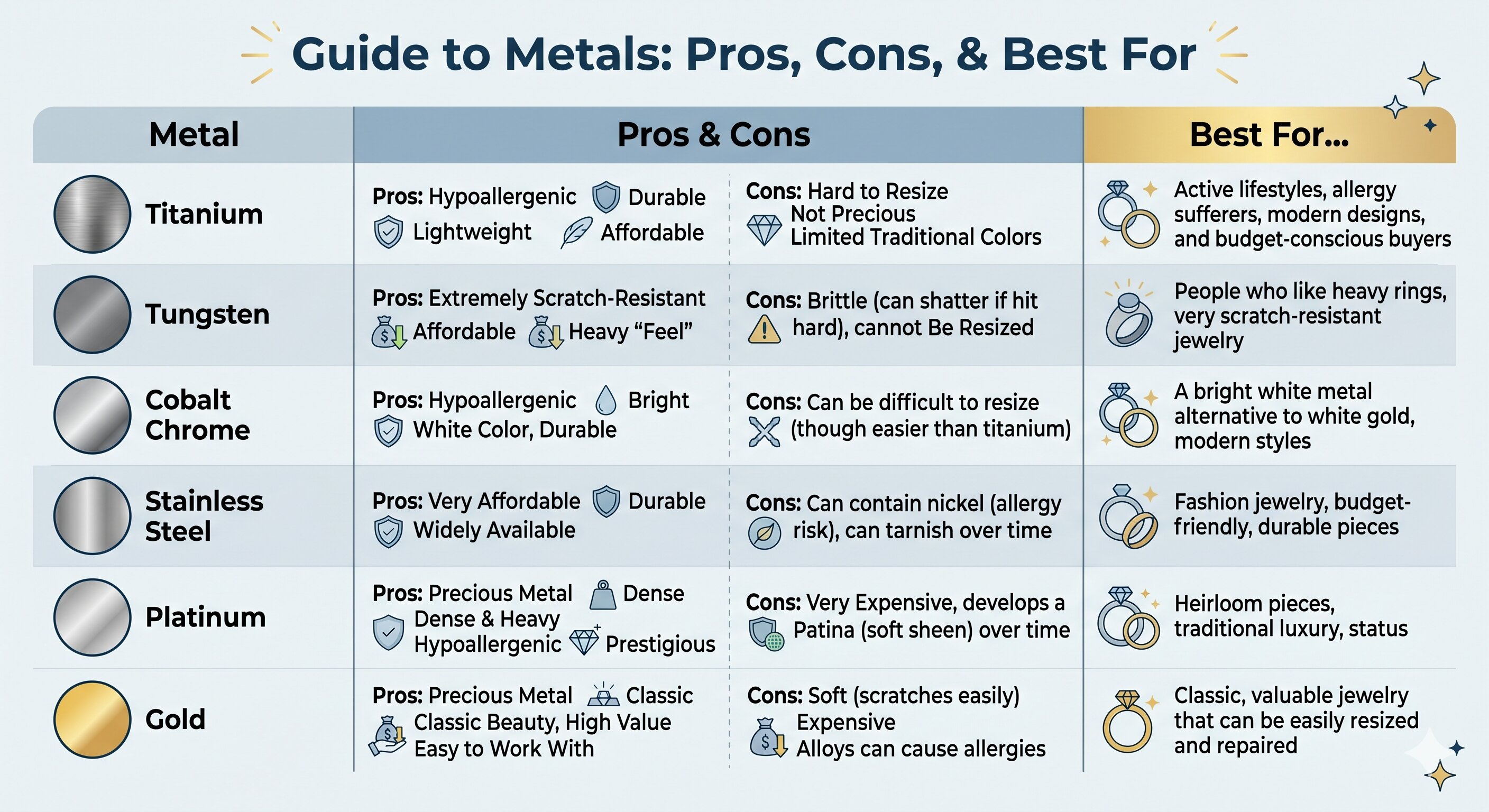
Is Titanium Good Quality for You?
Titanium is an excellent quality choice if you:
Have sensitive skin or metal allergies.
Lead an active life and need a durable, low-maintenance piece of jewelry.
Want a lightweight and comfortable piece, especially for larger rings.
Prefer a modern, contemporary look (either the natural grey or vibrant colors).
We are working with a budget but want a high-performance material.
You might want to consider a different metal if you:
Anticipate needing to resize your ring in the future.
Prefer the classic look and intrinsic value of traditional precious metals like gold or platinum.
Want a ring that can be easily and traditionally repaired by any jeweler.
In short, titanium's quality is in its performance and comfort, not its precious metal status. It's a fantastic, modern material that solves many of the problems associated with traditional jewelry metals.
Learn more about titanium's properties on Wikipedia's titanium page.
Is Titanium Or 14k Gold Better?
The answer isn't straightforward because titanium and 14k gold are fundamentally different materials that excel in different areas. One isn't universally "better" than the other; the best choice depends entirely on your priorities.
Let's break down the comparison to help you decide.
Quick Summary: The Core Difference
14k Gold is a precious metal. Its value is in its tradition, beauty, prestige, and intrinsic material worth.
Titanium is an industrial/performance metal. Its value is in its extreme durability, comfort, and modern aesthetic.
Head-to-Head Comparison
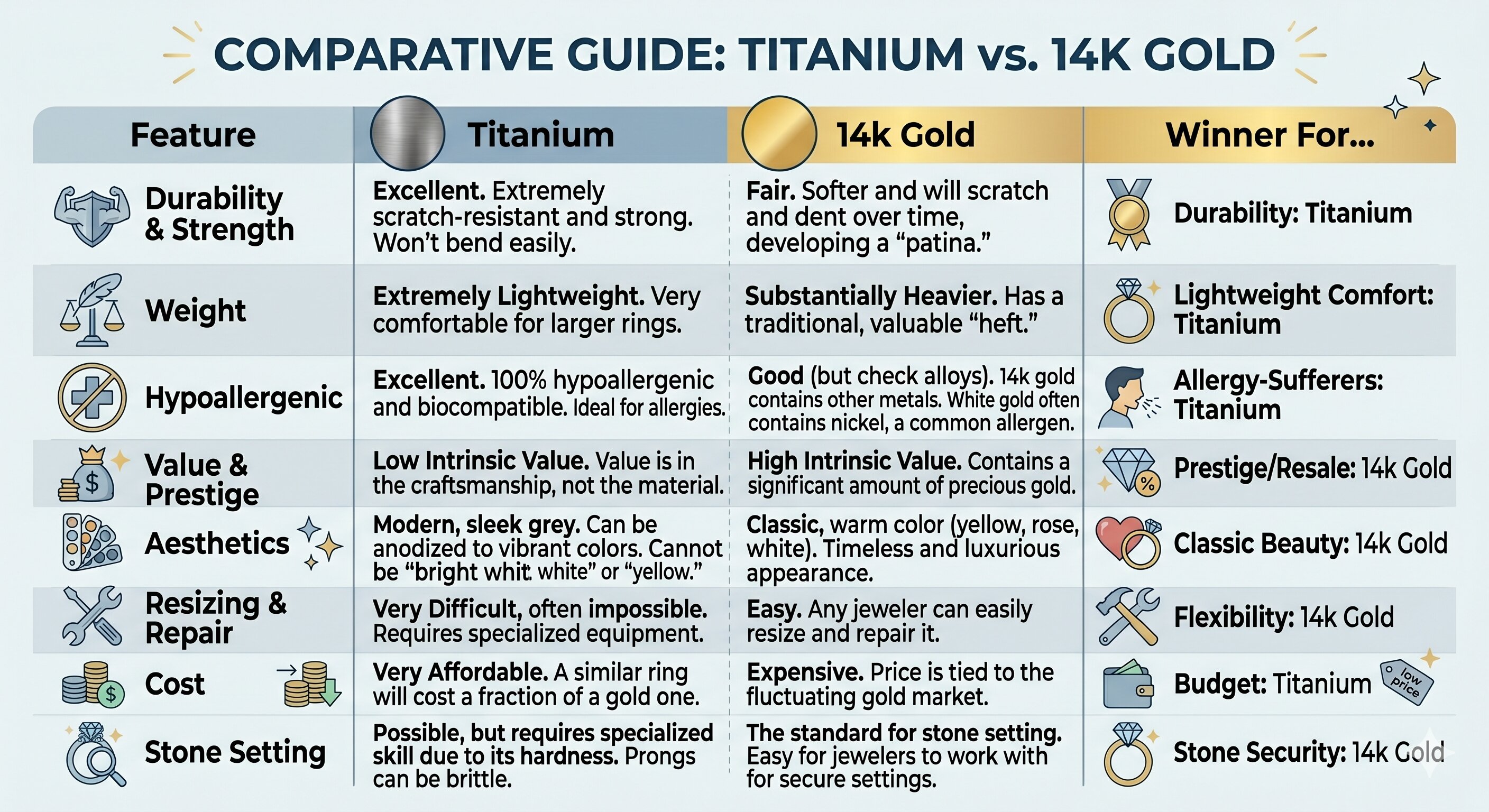
Who Should Choose Which?
Choose Titanium if:
You have an active lifestyle: You work with your hands, play sports, or travel frequently.
You have metal allergies: It's the safest bet for sensitive skin.
You want ultimate comfort: You dislike the heavy feel of metal or want a wide band.
You prefer a modern, industrial, or colorful look.
You are on a budget but want a very durable and high-quality ring.
You are certain of your ring size and don't anticipate needing a resize.
Ideal for: Wedding bands for active people, casual everyday wear, statement pieces with color, and anyone with sensitivity issues.
Choose 14k Gold if:
You value tradition and prestige: You want a classic, recognized symbol of value and luxury.
You want a timeless, warm color (yellow, rose, or white gold).
The piece holds significant value (e.g., an engagement ring or family heirloom).
You want the flexibility to resize or repair the piece easily in the future.
The jewelry has important stones that need a secure and traditional setting.
You appreciate the "heft" and feel of a precious metal.
Ideal for: Engagement rings, classic wedding bands, fine jewelry, heirlooms, and pieces where emotional and traditional values are key.
Special Case: The Best of Both Worlds?
Sometimes, the choice isn't either/or. Some jewelers create rings with a titanium core for strength and comfort and a 14k gold exterior layer for the classic, precious look. This is a great compromise if you can't decide.
There is no single "better" option. It's about what's better for you.
Prioritize durability, comfort, and a modern look? → Titanium is your best choice.
Prioritize tradition, prestige, and long-term value? → 14k Gold is your best choice.
Think about how you live your life, the style you love, and what you want this piece of jewelry to represent. That will make the right answer clear.
Is Titanium Jewelry Cheap?
The answer is yes, titanium jewelry is generally inexpensive in terms of its initial purchase price, but it is absolutely not "cheap" in terms of quality.
The word "cheap" can mean two things:
Low Cost (what you pay for it)
Poor Quality (badly made or low-value)
Let's break down why titanium fits the first definition but defies the second.
Why Titanium Jewelry is Low Cost (Inexpensive)
Material Cost: Titanium is an abundant element. While the process of refining it is complex, the raw material itself is far less expensive than precious metals like gold, platinum, or even silver. This is the single biggest factor in its affordable price tag.
Not a Precious Metal: Its value is not tied to a commodities market in the same way gold is. You are paying primarily for the craftsmanship and design, not the intrinsic value of the metal.
Lower Labor Costs for Basic Styles: Simple, polished titanium bands are relatively easy to machine and produce in large quantities, keeping the cost down.
So, if you're comparing a simple titanium band to a simple 14k gold band of the same design, the titanium one will almost always be significantly less expensive.
Why Titanium Jewelry is Not "Cheap" in Quality
This is where titanium shines. Its low cost is a fantastic value because it offers a set of high-performance properties that exceed those of many more expensive metals.
Exceptional Durability: Titanium is incredibly strong and scratch-resistant. A "cheap" metal would bend, tarnish, or break easily. Titanium does the opposite—it stands up to daily wear and tear better than gold or silver.
High-Performance Material: It's not an exaggeration that titanium is used in aerospace, medical implants, and high-end engineering. Its use in jewelry leverages these same premium qualities:
Hypoallergenic: It's the best choice for people with metal allergies.
Corrosion-Resistant: It won't tarnish, rust, or turn your skin green.
Lightweight: It offers a level of comfort that heavy metals cannot.
Craftsmanship and Specialization: While the material is cheap, working with it is not always easy. Its hardness requires specialized tools and skilled labor for more complex designs, stone setting, and especially the anodization process that creates its beautiful, permanent colors. You are paying for that expertise.
The "Cheap" Perception vs. Reality
The perception that titanium is "cheap" often comes from comparing it to precious metals on a purely material-value basis. A titanium ring will never have the same resale value as a gold ring because the material itself isn't precious.
However, if you value performance, comfort, and modern aesthetics, then titanium offers outstanding value for your money. You are getting a highly durable, comfortable, and hypoallergenic piece of jewelry for a very reasonable price.
Price Comparison in Context
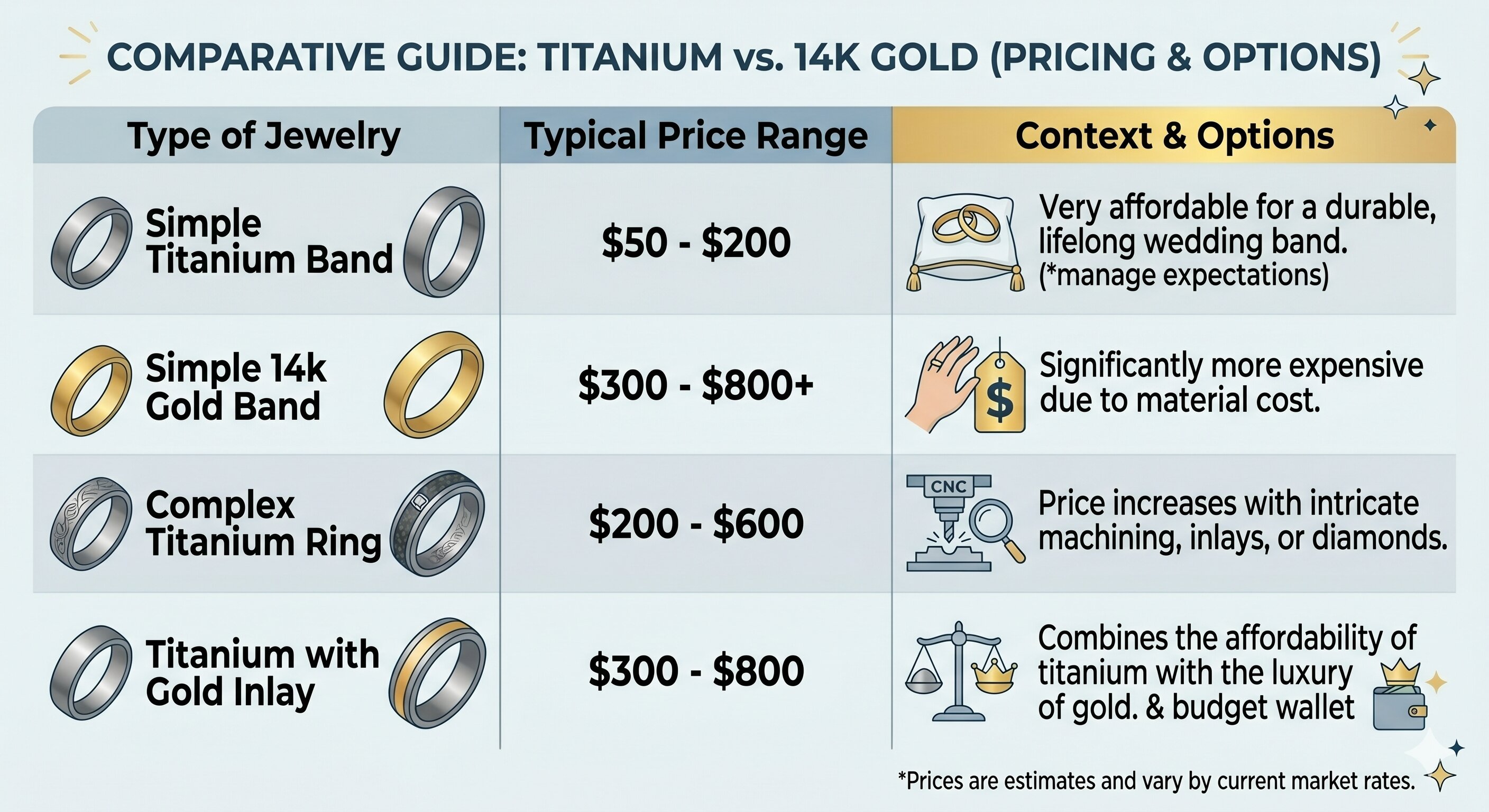
Conclusion: Is it "Cheap"?
Yes, if you mean "affordable." Its initial purchase price is low, making it an excellent budget-friendly option that doesn't sacrifice quality.
No, if you mean "poor quality." It is a high-performance, durable, and premium material in its own right. It's the secret smart buy for people who prioritize durability and comfort over precious metal status.
Think of it this way: A high-tech carbon fiber watch might be more expensive and "prestigious" than a rugged, accurate G-Shock watch. But for someone who needs a virtually indestructible tool for adventures, the G-Shock is the higher-quality, better-value choice, even if it costs less. Titanium occupies a similar space in the jewelry world.
What Are The Disadvantages of Titanium Jewelry?
While titanium is an excellent material for many reasons, it has several significant disadvantages that are crucial to consider before making a purchase.
Here is a detailed breakdown of the disadvantages of titanium jewelry:
1. The Biggest Disadvantage: Difficulty in Resizing and Repair
This is the most prominent and often deal-breaking drawback.
Extremely Hard to Resize: Titanium is very hard and has a high melting point. Traditional jeweler's tools cannot cut and solder it like they can with gold or silver. While some specialized jewelers with laser welders can perform very limited resizing, it is often impossible, prohibitively expensive, or risks damaging the ring.
Cannot be Soldered Easily: If a titanium ring breaks or needs structural repair, it is incredibly difficult to fix. In many cases, it cannot be repaired at all. This makes it a poor choice for heirloom pieces that might need future maintenance.
Implication: You must be certain of your ring size when buying a titanium ring, especially for something like a wedding band.
2. Limited Aesthetic and Traditional Appeal
Not a Precious Metal: Titanium lacks the intrinsic value and prestige of gold, platinum, or even silver. It is an industrial/performance metal. For those who value the traditional status and material worth of jewelry, titanium does not fulfill that desire.
Color Limitations: Its natural color is a dark charcoal or gunmetal grey. While it can be anodized to create vibrant colors, it cannot be made into a true, bright white like platinum or white gold, nor can it replicate the warm yellow of gold. If you want a classic, traditional look, titanium is not the right choice.
3. Challenges with Stone Setting
Brittle Prongs: Due to its strength, titanium can be somewhat brittle when worked into fine details like prongs. A sharp blow could cause a titanium prong to snap rather than bend, potentially leading to a lost stone.
Requires Specialized Skill: Setting stones in titanium requires jewelers with specific expertise and tools. Not every jeweler is equipped or experienced in working with it, which can limit your design and repair options later.
4. Perceived Value and Weight
Low Perceived Value: Because it is lightweight and inexpensive, some people perceive titanium jewelry as "cheap" in feeling, even though it is highly durable. It lacks the substantial, heavy "heft" that many associate with valuable and luxurious jewelry.
Too Light for Some: Some wearers specifically enjoy the weight of a gold or platinum ring and find a titanium ring to feel insubstantial or "like it's not even there," which can be a negative for them.
5. Removal in Medical Emergencies (A Critical Consideration for Rings)
Difficulty of Cutting: In the event of a finger injury causing swelling, a titanium ring is extremely difficult to remove. Standard ring cutters used by hospitals and fire departments are designed for gold and silver and will often fail on titanium.
Removal Methods: Emergency removal typically requires a diamond-coated saw or, in extreme cases, locking vice-grip pliers to crack it. This process is slow, stressful, and can be dangerous.
“In 2015, a firefighter in Texas tried to cut a titanium wedding band off a man‘s swollen finger. The standard ring cutter—the same tool that works on gold, silver, and platinum—could not scratch the titanium. The firefighter had to use a diamond-coated saw. It took 15 minutes. The man kept his finger. Afterward, he had the ring engraved on the inside: ‘Made for hands that work.‘ Titanium‘s greatest strength is also its greatest risk. It will not bend, break, or tarnish. But it also will not let go easily. That is why every titanium ring should have a safety groove—a thin line scored inside the band so emergency responders can snap it open. If your titanium ring does not have one, you are wearing a permanent seal.”
Note: Many modern titanium rings are designed with a safety groove—a thin, pre-scored line that allows emergency personnel to snap the ring with pliers. If you choose a titanium ring, look for this feature.
6. Limited Malleability for Design
Titanium is not malleable like gold. This makes it unsuitable for many intricate, hand-fabricated jewelry designs that involve bending and shaping the metal. It is best suited for designs that are machined or cast.
Summary: Who Should Avoid Titanium Jewelry?
You should think carefully before choosing titanium if:
You are buying an engagement or wedding ring, and there's a chance your finger size could change (due to weight fluctuation, pregnancy, etc.).
You value the traditional prestige and intrinsic material value of precious metals.
You want a classic yellow, rose, or bright white metal for your jewelry.
The piece has delicate prong settings for valuable gemstones.
You want a piece that can be easily repaired, resized, or melted down for resetting in the future.
Titanium's disadvantages are primarily related to its permanence and workability. Its strengths—durability, weight, and hypoallergenic properties—are also the source of its biggest weaknesses. It is a fantastic practical choice, but can be a poor sentimental or traditional one.
Can You Get Titanium Wet?
The answer is a resounding yes, you can get titanium wet. In fact, this is one of its greatest advantages as a jewelry metal.
Here’s the detailed explanation of why it's not just okay, but ideal for contact with water.
Whis Titanium is Impervious to Water
Extreme Corrosion Resistance: Titanium is not a metal that rusts or corrodes like iron or steel. When exposed to oxygen, it instantly forms a very thin, invisible, and incredibly tough layer of titanium oxide on its surface. This layer is passive, meaning it protects the underlying metal from any further reaction with the environment, including water.
Excellent for Daily Wear: This property is exactly why titanium is used in:
Shipbuilding and Marine Applications: For propellers and other parts constantly exposed to saltwater.
Chemical Processing: For pipes and tanks that handle corrosive fluids.
Medical Implants: Because it is inert and doesn't react with bodily fluids.
What This Means for Your Jewelry
You can wear your titanium jewelry in all these situations without worry:
Washing Your Hands: Completely safe.
Showering or Bathing: It won't be affected by water, soap, or shampoo.
Swimming:
Chlorinated Pool Water: Will not harm titanium.
Salt Water: This is where titanium truly shines. You can swim in the ocean without any fear of corrosion or damage. It's a perfect metal for vacation or everyday beachwear.
The One Caveat: It's About the Whole Piece
While the titanium metal itself is impervious, you should consider the other components of the jewelry:
If it has a Mechanical Coating: While the anodized colors on titanium are permanent (as they are an electrochemical change to the oxide layer itself), some cheaper pieces might have a painted or PVD coating that could potentially degrade over time with harsh chemicals.
If it has Gemstones or Other Materials: The setting for the stones or any glued-in materials (like wood or resin) could be the weak point, not the titanium. Prolonged exposure to harsh chemicals might loosen settings or damage adhesives.
Practical Advice
Routine Care: For a plain titanium band, you can literally just dry it with a soft cloth after getting it wet to prevent water spots and keep it looking shiny.
Cleaning: To clean it, use warm water, a few drops of mild dish soap, and a soft toothbrush. Rinse and dry thoroughly.
Avoid Harsh Chemicals: While titanium itself is resistant, it's still a good practice to remove your jewelry when using harsh cleaning agents, bleach, or other strong chemicals. This is more to protect any stones and for general safety than to protect the titanium.
Getting titanium wet is perfectly fine. Its exceptional resistance to water and corrosion is a primary reason to choose it for a durable, low-maintenance, and active lifestyle.
Why Is Titanium Jewelry So Cheap?
This is a fundamental question, and the answer lies in understanding the difference between "cost" and "value."
Titanium jewelry is relatively cheap primarily because of its low intrinsic material cost compared to precious metals. However, calling it "cheap" can be misleading, as it offers incredible value for its price.
Here’s a detailed breakdown of why the initial purchase price is so low:
1. The Material Itself is Abundant and Inexpensive
Not a Precious Metal: Titanium is the ninth most abundant element in the Earth's crust. Unlike gold, platinum, or silver, it is not classified as a precious metal and is not traded on the same kind of commodities market. Its value isn't driven by rarity or investment speculation.
Low Raw Material Cost: While the process of refining titanium from ore (like rutile) is complex and energy-intensive, the resulting raw metal is still far less expensive per gram than gold or platinum. You are simply not paying for a scarce material.
2. Lower "Melt Value" and Intrinsic Worth
When you buy a piece of gold jewelry, a significant portion of the price is the actual value of the gold itself (the "melt value"). A 14k gold ring will always be worth at least the value of the gold it contains.
A titanium ring, on the other hand, has almost no intrinsic "melt value." Its price is based almost entirely on the cost of manufacturing and craftsmanship, not the raw material. This automatically makes it much cheaper to produce.
3. Efficient and Scalable Production for Basic Styles
Machining, Not Casting: Simple titanium bands are often machined from a solid bar of metal. This is a highly efficient, computer-controlled process that can produce large quantities of identical rings with minimal waste, keeping costs low.
Mass Production: Because of its strength and popularity for minimalist and modern styles, titanium jewelry is often produced in large batches, which drives down the per-unit cost.
The Crucial Distinction: "Cheap Price" vs. "High Value"
This is the most important point. Titanium is inexpensive to buy but is not a "cheap" or low-quality material. In fact, its low price is a fantastic bargain for the performance you get.
You are getting a high-performance material at a budget-friendly price. Think of it like this:
Gold/Platinum is like a handmade, luxury leather wallet. It's made from a precious material, has high intrinsic value, and is a status symbol.
Titanium is like a high-tech carbon fiber wallet. The raw material isn't "precious," but it's incredibly durable, lightweight, functional, and outperforms the leather in many practical ways—often for a lower price.
What You're Not Paying For
When you buy titanium, you avoid the costs associated with precious metals:
No Premium for Rarity: You aren't paying for scarcity.
No Alloying Metals: While gold is mixed with other metals to create 10k, 14k, etc., increasing cost and complexity, titanium used in jewelry is often commercially pure or a simple alloy.
Minimal Markup for Material Value: The jeweler's markup isn't applied to an expensive block of metal.
When Does Titanium Jewelry Get More Expensive?
The price can rise significantly based on craftsmanship and design, proving that the cost is in the making, not the material.
Complex Designs: Intricately carved or Mokume-gane (mixed metal) titanium rings are expensive due to the high skill and time required.
Anodizing: While the process itself isn't extremely costly, intricate multi-color patterns require skilled artistry.
Inlays: Adding materials like wood, carbon fiber, or precious metals like gold will increase the price.
Stone Setting: Setting diamonds or other gemstones into titanium is difficult and requires specialized skill, adding to the cost.
Titanium jewelry is "cheap" because you are not paying for a precious, rare metal. You are paying for the manufacturing, design, and craftsmanship. This results in a low initial price for a product that is exceptionally durable, hypoallergenic, and comfortable.
In short, its affordability is its greatest selling point, allowing you to own a high-quality, lifelong piece of jewelry without the high cost of traditional precious metals. It's not cheap in quality; it's just excellently priced for what it is.
Is Titanium Jewelry Expensive?
No, titanium jewelry is generally not expensive, especially when compared to precious metals like gold and platinum. However, it is not the absolute cheapest option available, and certain designs can command higher prices.
Here’s a detailed breakdown of the costs:
Why Titanium Jewelry is Affordable (The "No" Argument)
Low Material Cost: Titanium is an abundant element. While the refining process is complex, the raw material itself is far less expensive than gold, platinum, or even silver. You are not paying a premium for a rare or precious metal.
Not a Precious Metal: Its value isn't tied to the commodities market. The price of a titanium ring isn't affected by the daily fluctuations of the gold price. You are paying primarily for the craftsmanship and design, not the intrinsic material value.
Efficient Production: Simple, polished titanium bands are easily machined in large quantities, which keeps the cost of basic styles very low.
When Titanium Jewelry Can Be More Expensive (The "It Depends" Argument)
While the metal is cheap, the workmanship is not. The price can increase significantly based on:
Complexity of Design: An intricate, hand-carved, or "Mokume-gane" (mixed metal pattern) titanium ring requires a high level of skill and time, making it much more expensive than a simple band.
Presence of Other Materials: Many titanium rings feature inlays of more expensive materials like gold, tungsten carbide, carbon fiber, or precious woods. These additions will raise the price.
Gemstones: Setting diamonds or other precious stones into titanium is difficult and requires specialized skill, adding considerable cost.
Branding and Craftsmanship: A ring from a renowned, specialized artisan will cost more than a generic one from a large-scale retailer.
Price Comparison: Putting it in Context
To understand the value, it helps to see typical price ranges (for a simple men's wedding band as a benchmark):
The "Value" Proposition: Why It's a Smart Buy
This is the most important concept. Titanium is inexpensive to buy but offers high-value performance. You are getting a premium functional material at a budget-friendly price.
For the cost of a basic titanium band, you get a piece of jewelry that is:
Extremely durable and scratch-resistant.
Hypoallergenic and safe for sensitive skin.
Lightweight and incredibly comfortable.
Corrosion-resistant and low-maintenance.
Generally, no. It is one of the most affordable high-performance jewelry options on the market.
Its base price is low because you aren't paying for a precious metal.
You can find beautiful, high-quality titanium pieces for a fraction of the cost of gold.
Think of it not as "cheap," but as an outstanding value. You get incredible durability, comfort, and a modern aesthetic without the high price tag of traditional luxury metals.
How Much Is 1kg of Titanium?
This is a great question, but the answer isn't as simple as a single number because the price of titanium depends heavily on its form and purity.
Here’s a breakdown of how much 1 kg of titanium costs in different contexts.
The Short Answer
For a rough estimate, 1 kg of commercially pure titanium in a common form, like bar or sheet, typically costs between $80 and $200 USD. However, this can vary significantly.
Detailed Price Breakdown
The price increases dramatically as you move from raw material to finished, specialized products.
The Crucial Context: Why Isn't This the Price of a Titanium Ring?
This is the most important point: The cost of the raw material is a tiny fraction of the final product's price.
If a titanium wedding band weighs 10 grams, the raw titanium in it only costs about $1 to $3. So, why does the ring sell for $100-$300?
You are paying for:
Manufacturing & Machining: Cutting, shaping, and polishing the incredibly hard metal.
Craftsmanship & Design: The skill of the jeweler and the complexity of the design.
Anodizing: The electrochemical process to create permanent colors.
Overhead, Markup, and Branding: Business costs, retail markup, and brand value.
Comparison to Other Metals
To put titanium's cost into perspective, here's the approximate price per kg for other common metals:
Stainless Steel: $3 - $10 per kg
Aluminum: $2 - $5 per kg
Titanium: $80 - $200 per kg
Silver: ~$1,000 per kg (based on a spot price of ~$1 per gram)
Gold: ~$90,000 per kg (based on a spot price of ~$90 per gram)
Titanium is significantly more expensive than common industrial metals like steel or aluminum, but it is vastly more affordable than precious metals like silver and gold. Its value lies not in its rarity but in its exceptional strength-to-weight ratio, corrosion resistance, and biocompatibility.
Is Titanium As Expensive As Gold?
No, titanium is not nearly as expensive as gold. The difference in cost is dramatic, with gold being one of the most expensive metals on Earth and titanium being a relatively affordable industrial metal.
To put it in perspective, gold is roughly 300 to 500 times more expensive than titanium by weight.
Here’s a direct comparison:
Price per Gram: A Stark Contrast
This means you could buy over 400 grams of titanium for the price of just one gram of gold.
Why is Gold So Much More Expensive?
The price difference comes down to one fundamental concept: rarity vs. abundance.
Gold is a Precious Metal: It is incredibly rare, difficult to mine, and exists in limited quantities. Its value is driven by its status as a store of value, a symbol of wealth, and a luxury item for thousands of years. It's also a financial asset traded on global markets.
Titanium is an Industrial/Performance Metal: It is the ninth most abundant element in the Earth's crust. While the process to refine it is complex, the raw material is not rare. Its value is in its physical properties (strength, lightness, corrosion resistance), not its scarcity.
The Jewelry Perspective: Why the Confusion?
When you look at a titanium ring and a gold ring, the price difference might not seem like 500x. This is because you are not just paying for the raw metal.
For a Titanium Ring, the cost is almost entirely in the craftsmanship, design, and manufacturing. The raw titanium material in a 10-gram ring might only be worth $1 to $2.
For a Gold Ring: The cost is heavily based on the intrinsic value of the material itself. The raw gold in a 10-gram ring could be worth $300 to $400 (for 10k-14k gold), plus the cost of craftsmanship.
Summary Table
Conclusion: Titanium is not in the same league as gold when it comes to cost.
“You now know the quality, the gold comparison, the pricing, the disadvantages, the water resistance, the cheapness, the expense, the per-kilo cost, and the gold cost comparison. The only question left: will you choose the metal that was born in a Cold War laboratory?
Our current collection includes a limited number of titanium rings — from polished grey bands to anodized blue and purple, from comfort-fit classics to safety-groove designs. When certain styles are gone, restocking takes time because each ring is machined, not cast.
This is not a precious metal. It is a performance metal — the same material used in submarines, spy planes, and medical implants. It will not bend, break, or tarnish. But it will also not let go easily. Wear it like a seal.”
[Button: Secure Your Titanium Ring (Limited) →]
Excellent Cut Diamond Guide: Meaning, vs Brilliant, vs Ideal
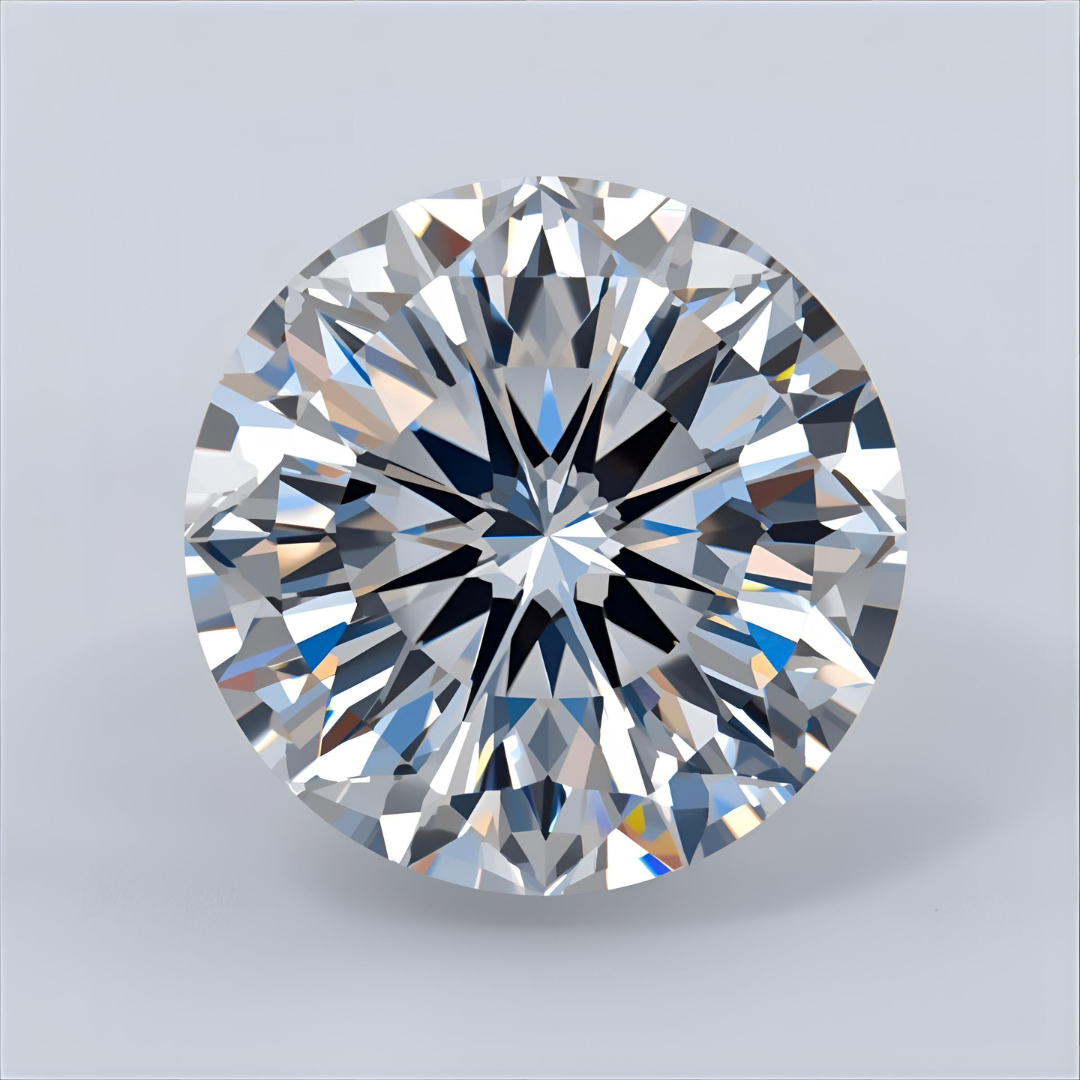
Excellent Cut Diamond Guide: Meaning, vs Brilliant, vs Ideal
This is a crucial question because, as mentioned before, the cut is the most important of the 4Cs. It's what brings a diamond to life.
“In 1919, a young Belgian mathematician named Marcel Tolkowsky sat down to solve a problem that had puzzled jewelers for centuries: what angles would make a diamond reflect the most light? His doctoral thesis, ‘Diamond Design,‘ calculated the precise proportions—34.5 degrees for the crown, 40.75 for the pavilion—that would turn a rough stone into a living fire. The jewelry industry ignored him for decades. Then, in the 1950s, American jewelers rediscovered his work. Today, every GIA ‘Excellent‘ cut diamond—from a 500solitairetoa50,000 engagement ring—follows his math. Tolkowsky didn‘t just cut diamonds. He taught them how to shine.”
The same math that Tolkowsky calculated in 1919 now sparkles on your finger. Every ‘Excellent‘ cut diamond in our collection is GIA-certified—because a diamond that doesn‘t sparkle is just a rock.”*
[Button: Explore Excellent Cut Diamonds →]
Table of Contents
Let's talking topic.
What Does Excellent Cut Mean?
An "Excellent Cut" is the highest grade given for a diamond's proportions, symmetry, and polish. In simple terms, it means the diamond has been cut and shaped to ideal proportions and angles to maximize its interaction with light.
Think of a diamond as a complex series of tiny mirrors. An Excellent Cut means all these mirrors are aligned perfectly to do three things:
Brilliance: The return of white light to your eye. This is the diamond's overall brightness.
Fire: The dispersion of light into the colors of the rainbow (flashes of red, blue, green, etc.).
Scintillation: The sparkle and pattern of light and dark areas that change when the diamond, the light, or the observer moves.
How is "Excellent Cut" Determined?
Gemological labs like GIA (Gemological Institute of America) use sophisticated computer models to analyze a diamond's precise measurements and angles. They evaluate several factors to assign a cut grade:
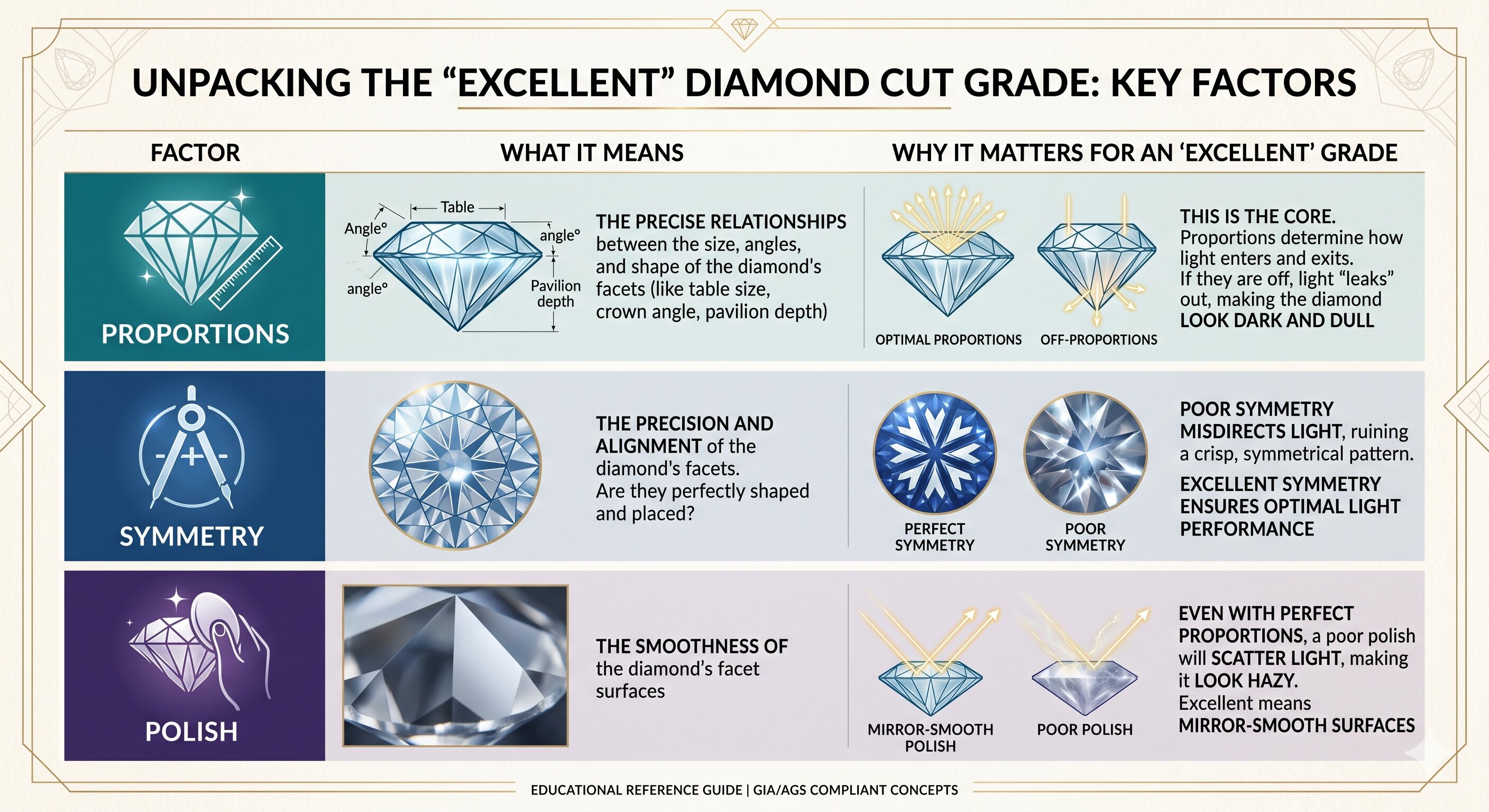
The Result of an Excellent Cut: Superior Light Performance
When all these factors are optimized, the diamond achieves what is known as superior light performance. This is the practical, visual result you see:
High Brilliance: The diamond looks incredibly bright and white.
Abundant Fire: You see clear, colorful flashes even in normal indoor lighting.
Dynamic Scintillation: A lively, captivating sparkle that seems to dance across the stone.
The Alternative: A poorly cut diamond (graded "Good," "Fair," or "Poor") will allow light to escape through its sides or bottom. This creates "light leakage," which results in dead, dark areas in the diamond. A larger, poorly cut diamond will look worse than a smaller, excellently cut one.
Key Labs and Their "Excellent" Terminology
It's important to know that different labs use different terms for their top cut grade.
GIA (Gemological Institute of America): Their top grade is Excellent. This is the most widely recognized and trusted standard in the industry.
AGS (American Gem Society): Their top grade is Ideal (0). AGS is often considered even more stringent than GIA in its cut grading for round brilliants, using a light performance-based system.
A Special Note on "Hearts and Arrows":
This is a phenomenon found in the most precisely cut round brilliant diamonds (often called "Super Ideal"). When viewed with a special tool, you see a perfect pattern of 8 hearts from the bottom and 8 arrows from the top. This is a visual proof of exceptional symmetry and optical precision, and it is the pinnacle of an "Excellent Cut." All Hearts and Arrows diamonds will have an Excellent/Ideal grade, but not all Excellent/Ideal diamonds will show a perfect Hearts and Arrows pattern.
In a Nutshell: What "Excellent Cut" Means for You
When you choose a diamond with an Excellent Cut grade from GIA or an Ideal grade from AGS, you are guaranteed:
The Most Beautiful Diamond for Your Money: It will be the whitest, brightest, and most sparkly version of itself for its color and clarity grade.
Maximized "Wow" Factor: The diamond will perform brilliantly in all lighting conditions, not just under jewelry store spotlights.
A Stone that Hides Color: A well-cut diamond can often face up whiter than its color grade suggests, allowing you to potentially save money on color.
The Best Value: It is almost always wiser to choose a smaller diamond with an Excellent Cut than a larger diamond with a poorer cut. The sparkle is what people notice, not the millimeter difference in size.
An "Excellent Cut" is not just a grade on a report; it's the definitive factor that transforms a piece of crystallized carbon into a breathtaking, fiery, and brilliant jewel. Never compromise on cut quality.
For official diamond cut grading information, visit the GIA Diamond Cut Guide.
Is A Brilliant Or Excellent Cut Better?
This is a very common point of confusion because the terms sound similar but refer to different concepts.
Here’s the short answer:
"Excellent Cut" is better. It is a quality grade, while "Brilliant Cut" is a style or shape.
You are comparing a specific rating of quality ("Excellent") to a general category of design ("Brilliant"). The most accurate and helpful way to think about it is:
A "Brilliant Cut" diamond can have a cut quality that is Excellent, Good, Fair, or Poor.
Let's break this down.
Brilliant Cut: The Style
What it is: A cutting style. It refers to the specific pattern and arrangement of facets, designed to maximize sparkle.
The most common example: The Round Brilliant is the most popular diamond shape in the world. When people say "Brilliant Cut," they are often referring to this round shape.
Other examples: The "Brilliant" style can also be applied to other shapes, like the Oval Brilliant, Cushion Brilliant, or Pear Brilliant. The key feature is a large number of triangular and kite-shaped facets arranged to create maximum light return.
In short: "Brilliant" describes the design blueprint.
Excellent Cut: The Quality
What it is: A quality grade assigned by a gemological lab (like GIA). It is the highest rating for how well a diamond's proportions, symmetry, and polish are executed.
What it means: A diamond with an "Excellent" cut grade has been cut to ideal proportions. This means light enters the diamond, reflects off the internal facets, and returns out through the top as maximum brilliance and fire. Very little light leaks out of the bottom.
The Grading Scale: For a round brilliant diamond from GIA, the scale is: Excellent > Very Good > Good > Fair > Poor.
In short, "Excellent" is the performance rating of how well that blueprint was followed.
The Analogy: A Sports Car
Think of it like evaluating a sports car:
"Brilliant Cut" is like saying, "It's a two-door coupe." This describes the body style.
"Excellent Cut" is like saying, "It has a perfect 5-star safety rating and handles flawlessly on the track." This describes the quality of its engineering and performance.
You can have a two-door coupe (Brilliant Cut) that is poorly engineered and performs terribly (Poor Cut). The best choice is a two-door coupe that is perfectly engineered (Brilliant Cut with an Excellent Cut grade).
Which Should You Choose?
Your goal is to find a diamond where both the style and the quality are right for you.
Choose the "Brilliant Cut" Style if: You want the classic, round diamond known for its unparalleled sparkle and fire. It is the most researched and optimized shape for light performance.
Prioritize the "Excellent Cut" Grade (for Round Diamonds): If you have chosen a round brilliant diamond, you should almost always prioritize an "Excellent" cut grade. It is the single most important factor in making your diamond beautiful. A smaller "Excellent" cut diamond will look more stunning than a larger "Good" or "Fair" cut diamond.
Don't think of it as "Brilliant vs. Excellent." They are not competing terms. Instead, look for a diamond that is a Brilliant Cut (the style) with an Excellent cut grade (the quality). This combination will give you the most brilliant, fiery, and sparkling diamond possible.
For Round Brilliant Diamonds, the ideal choice is: GIA "Excellent" Cut.
Is Excellent Cut Better Than Ideal?
This is a common point of confusion because both terms sound like the top rating, and the answer is nuanced.
In short, for round brilliant diamonds, "Ideal" and "Excellent" are both top-tier grades, but they come from different labs with slightly different grading philosophies. One is not universally "better" than the other; they are simply different.
However, the term "Ideal" can be misused by marketers, so context is everything.
Let's break it down clearly.
The Lab Matters Most
The key to understanding this is to know which gemological laboratory issued the grade.
1. GIA's "Excellent" Cut Grade
The Standard: The Gemological Institute of America (GIA) is the most widely recognized and trusted grading lab in the world.
Their Top Grade: For round brilliant diamonds, GIA's highest cut grade is "Excellent."
The GIA Philosophy: GIA's cut grading system is based on extensive research into how a diamond's proportions affect its face-up appearance. It's a robust, practical system that guarantees a stunning diamond. A GIA "Excellent" grade is the industry benchmark for a top-quality cut.
2. AGS's "Ideal" Cut Grade
The Precision Leader: The American Gem Society (AGS) is another highly respected lab, known for being even more stringent in its cut grading for round brilliants.
Their Top Grade: AGS's highest cut grade is "Ideal" (represented by a score of 0 on their 0-10 scale, where 0 is best).
The AGS Philosophy: The AGS system uses a more complex, mathematical model that includes light performance analysis. To achieve an AGS "Ideal" grade, a diamond must have proportions and optical symmetry that fall within a very narrow, scientifically calculated range.
So, Which is Actually "Better"?
It depends on what you're looking for.
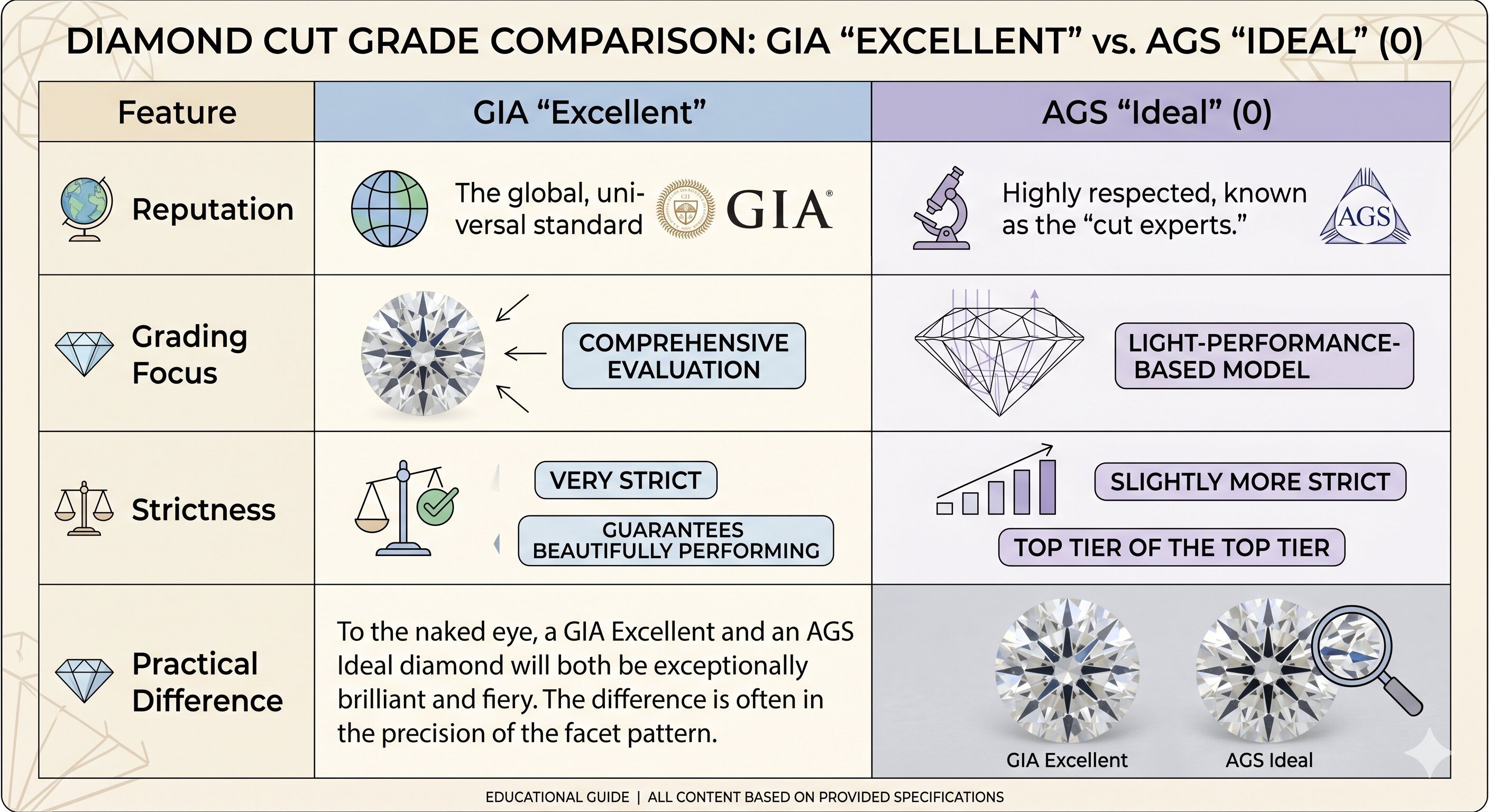
The General Consensus:
An AGS Ideal (0) grade is often considered the absolute pinnacle of the cutter's art for round brilliants, representing the most precise and mathematically perfect stones.
A GIA Excellent grade represents a diamond that is guaranteed to be stunningly beautiful and is the most widely accepted and trusted top-tier grade.
In practical terms, you cannot go wrong with either. The visual difference between them is often negligible to anyone but an expert gemologist with specialized tools.
The Big Caveat: Uncertified "Ideal" Grades
This is the most important part of your question. Many online retailers and jewelers use their own, in-house terms like "Ideal," "Super Ideal," or "Signature Ideal." These are not the same as an AGS Ideal grade.
If a diamond is graded by GIA as "Excellent," you know exactly what you're getting.
If a diamond is graded by AGS as "Ideal," you know exactly what you're getting.
If a diamond has no AGS report but is simply described by a store as "Ideal Cut," you should be cautious. This is a marketing term, and its meaning can vary widely.
Prioritize the Lab Report: Always choose a diamond with a grading report from a top lab like GIA or AGS. This removes the guesswork and marketing hype.
For a Round Brilliant Diamond:
You are perfectly safe and will get a magnificent stone with a GIA "Excellent" cut grade.
If you are a perfectionist and want the most scientifically precise cut available, seek out an AGS "Ideal (0)" grade.
The True "Best": Many of the finest cut diamonds in the world, often called "Hearts and Arrows" diamonds, will typically hold both a GIA Excellent grade and demonstrate the perfect optical symmetry that qualifies them as "Ideal" by performance standards.
Neither is objectively "better." They are the top grades from two different, highly respected labs. Your goal is to buy a diamond with a top cut grade from a reputable lab, and both GIA Excellent and AGS Ideal fulfill that goal perfectly.
Is Brilliant Cut The Same As Excellent?
No, "Brilliant Cut" is not the same as "Excellent."
This is a very common point of confusion. They describe two completely different aspects of a diamond.
To put it simply:
Brilliant Cut refers to the style and design of the cut.
Excellent refers to the quality and execution of the cut.
Let's break this down with an analogy.
The Chef Analogy
Imagine you are ordering a cake.
"Brilliant Cut" is like specifying the type of cake you want—for example, a "Chocolate Fudge Cake." It describes the recipe and the ingredients used.
"Excellent" is like the food critic's rating of that cake. A chocolate cake can be rated as "Excellent," "Good," or "Poor" based on how well the chef made it.
You can have a chocolate cake ("Brilliant Cut") that is baked poorly and tastes terrible ("Poor" cut). The best combination is a chocolate cake that is baked to perfection ("Excellent" cut).
Detailed Breakdown
What is a Brilliant Cut?
It's a Style: The Brilliant Cut is a specific pattern of facet arrangements designed to maximize light return, creating sparkle (brilliance and fire).
The Most Common Example: The Round Brilliant is the most popular diamond shape in the world. When people say "Brilliant Cut," they are often referring to this round shape.
Other Shapes: The brilliant style of faceting is also used for other shapes like the Oval Brilliant, Cushion Brilliant, and Pear Brilliant.
In short, "Brilliant" describes the blueprint or design.
What is an Excellent Cut?
It's a Quality Grade: "Excellent" is the highest cut grade awarded by gemological labs like the GIA (Gemological Institute of America) for how well a diamond has been cut from its rough crystal.
It Measures Performance: This grade means the diamond's proportions, symmetry, and polish are optimized to allow light to enter, reflect internally, and return out through the top as maximum sparkle. An "Excellent" cut diamond has very little light leakage.
It's on a Scale: The cut grade scale for a round brilliant diamond from GIA is: Excellent > Very Good > Good > Fair > Poor.
In short, "Excellent" is the performance rating of how well that blueprint was executed.
The Relationship Summarized
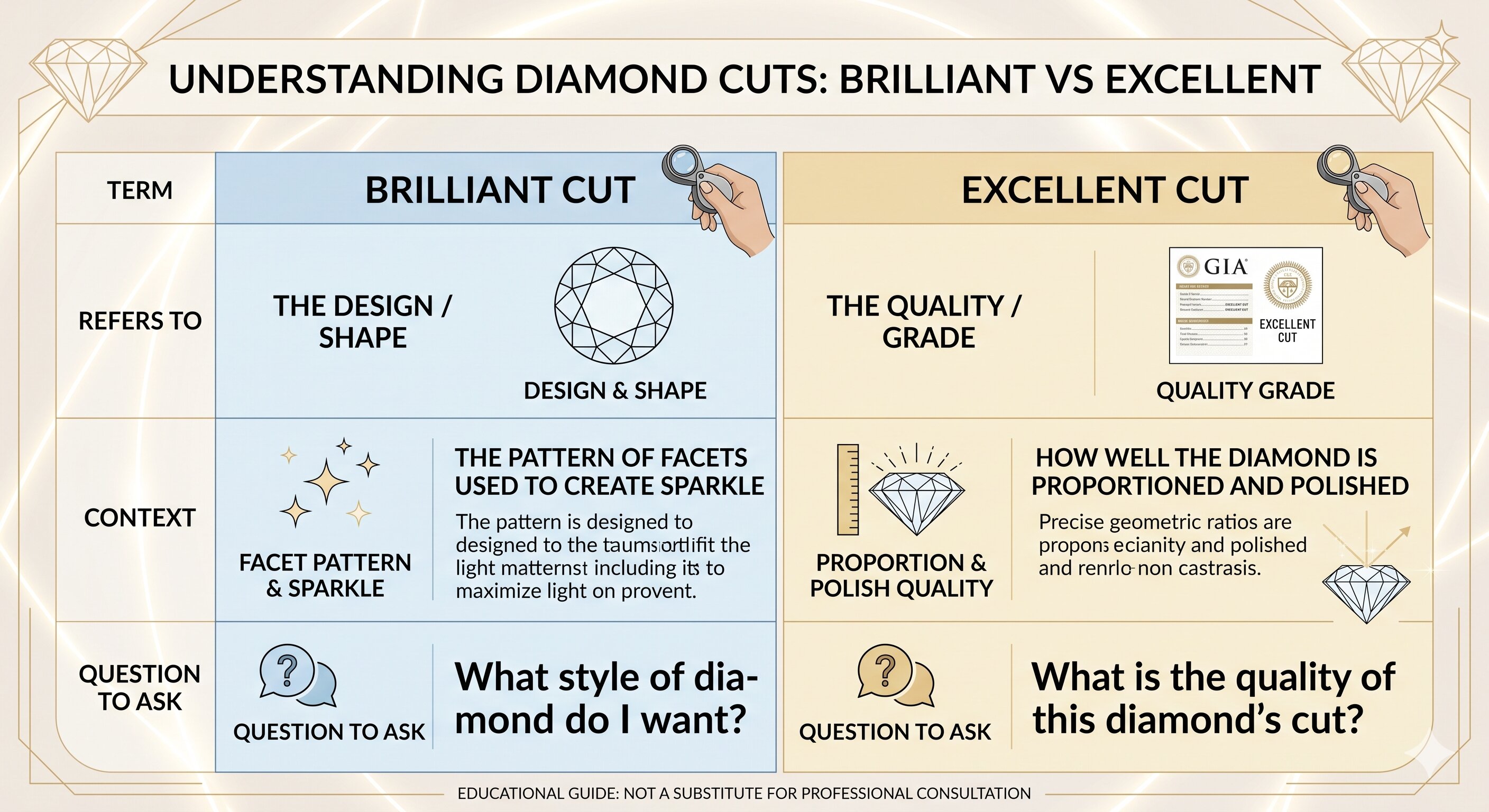
A diamond can be a Brilliant Cut (the design) and have a cut quality that is Excellent, Very Good, Good, Fair, or Poor.
Your goal is not to choose between them, but to find a diamond that is both:
A Brilliant Cut (the style you want) with an Excellent cut grade (the quality you deserve).
For the most sparkle and beauty, always prioritize the Excellent cut grade from a reputable lab like GIA.
Is An Excellent Cut Always The Best?
That's an excellent and logical follow-up question. The answer is nuanced:
In terms of a certified quality grade, "Excellent" is the best grade you can get from a lab like GIA for a round brilliant diamond. However, whether it's the best choice for you depends on your priorities, budget, and the type of diamond you're buying.
Here’s a breakdown of when "Excellent" is the undisputed best, and when you might consider other options.
When "Excellent Cut" is Unquestionably the Best
For Round Brilliant Diamonds: For this shape, the cut grade is a scientific measure of light performance. A GIA "Excellent" grade guarantees the highest level of brilliance, fire, and scintillation. There is no higher grade. If your goal is the most sparkly round diamond possible, then yes, "Excellent" is the best.
When Maximizing Sparkle is Your Top Priority: If you value optical performance above all else, an Excellent cut is the single most important factor. It can even make a diamond with a lower color or clarity grade look more brilliant and white.
For Investment or Heirloom Pieces: For a diamond you plan to keep for generations, starting with the highest certified quality (especially in cut) is a sound decision.
When "Excellent" Might NOT Be the Best Choice For You
When Budget is a Major Factor: This is the most common scenario. The price jump from a Very Good cut to an Excellent cut can be significant. A GIA "Very Good" cut diamond is still a fantastic stone and will look incredibly beautiful to the naked eye. For many people, the slight visual difference is not worth the extra cost, allowing them to allocate more budget to carat size or clarity.
For Fancy Shapes (Oval, Cushion, Pear, etc.): This is a critical point.
GIA does not give a single overall "Cut Grade" for fancy shapes. They only grade Polish and Symmetry.
Other labs (like AGS) do grade fancy cuts, but the standards are different.
Therefore, you cannot simply shop for an "Excellent" oval. You have to rely on the diamond's proportions, light performance images (like an ASET or Idex map), and most importantly, your own eyes, by viewing videos and images. A fancy shape can be cut to phenomenal proportions without having an "Excellent" label from GIA.
When You Find a "Ideal" Cut Diamond: As discussed earlier, an AGS "Ideal" grade is a top-tier competitor to GIA's "Excellent." Many experts consider AGS Ideal to be the absolute pinnacle for round brilliants. So, in this case, "Excellent" is not the "best"; "Ideal" is.
If the "Excellent" Grade Comes from a Less Reputable Lab: Some labs are known for "grade inflation," where their "Excellent" is equivalent to a GIA "Good." Always prioritize the lab (GIA or AGS) over the grade itself.
The Practical Verdict
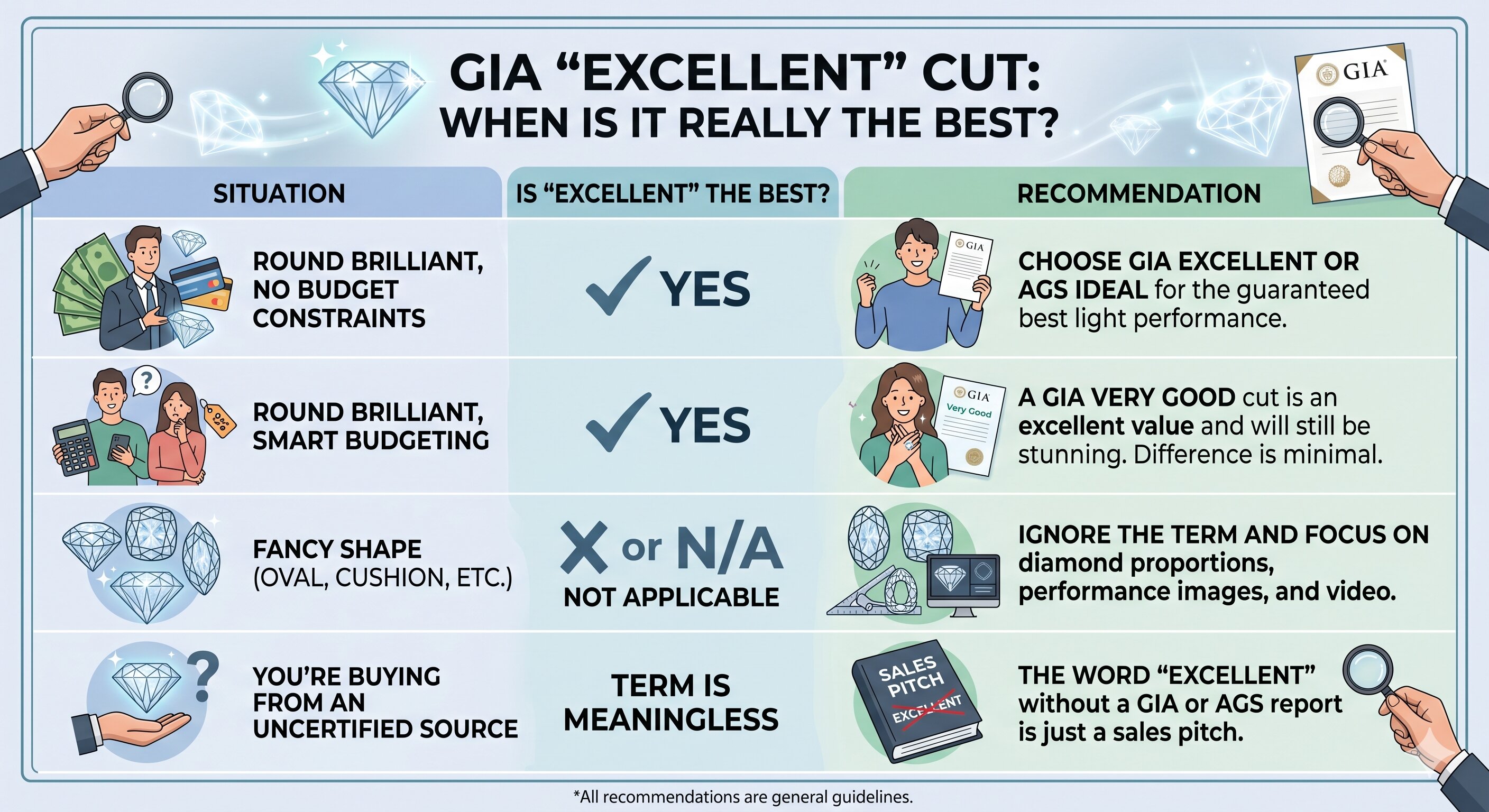
Think of it like this: Is the top trim level of a car always the best? It has the best performance and all the features, but it's also the most expensive. For many drivers, a mid-level trim offers 95% of the experience at a much better price.
For a round brilliant, an "Excellent" cut is the benchmark for the best possible sparkle.
But the "best" diamond for you is the one that delivers the most beauty and satisfaction for your personal budget and taste. Sometimes, that's a "Very Good" cut that lets you get a slightly larger stone, and sometimes it's absolutely worth it to hold out for the pinnacle of "Excellent" or "Ideal."
Is Excellent Cut Good Enough?
An Excellent cut is not just "good enough"—it is the sweet spot for anyone seeking a stunning, high-performance diamond without venturing into the realm of diminishing returns.
Here’s a detailed breakdown of why an Excellent cut is more than sufficient and is often the smartest choice.
1. It Guarantees Top-Tier Beauty and Performance
A GIA "Excellent" cut grade is not a compromise; it's the highest rating for light performance from the most respected lab in the world. A diamond with this grade is engineered to:
Reflect maximum light (brilliance).
Produce vibrant flashes of color (fire).
Create a dynamic sparkle when moved (scintillation).
To the naked eye, a diamond with an Excellent cut will be breathtakingly sparkly and bright. You are guaranteed a diamond that performs brilliantly in all lighting conditions.
2. It Represents the "Sweet Spot" of Value
This is the most practical reason why an Excellent cut is "good enough" for most buyers. The jump in quality and price typically follows this pattern:
Good -> Very Good: A significant improvement in sparkle for a moderate price increase. Good value.
“In 2015, a young couple walked into a New York diamond district store with a $10,000 budget. The salesman showed them a 1.2-carat diamond with a ‘Very Good‘ cut—decent sparkle, good size. Then he showed them a 0.9-carat diamond with an ‘Excellent‘ cut. The smaller diamond was smaller. But when he put it under the light, the couple gasped. The sparkle was not 30% better. It was 300% better. They bought the smaller stone. Ten years later, she still stares at her ring. ‘No one has ever asked me the carat weight,‘ she said. ‘Everyone asks, ‘How does it sparkle so much?‘ That is the power of an Excellent cut.”
Very Good -> Excellent: A noticeable but smaller refinement in performance for a larger price jump. You're paying for the top tier.
Excellent -> "Ideal" (Super-Ideal/Hearts & Arrows): A minuscule, often microscopic, improvement in optical symmetry for a very large price premium. This is the realm of diminishing returns.
For 99% of people, the visual difference between an Excellent cut and a more expensive "Super Ideal" cut is impossible to perceive without a special magnifying tool. You pay a lot more for that last 1% of perfection, but you don't see it in everyday life.
3. It's the Highest Grade for a Reason
GIA's "Excellent" category isn't a broad bucket. It's a carefully calibrated grade reserved for diamonds that hit a specific range of proportions and angles that science has shown produce the best light return. It's not "almost the best"; it is the best grade they offer.
When Might You Look Beyond "Excellent"?
There are only a few niche scenarios where you might consider something else:
Strict Budget: If your budget is extremely tight, a Very Good cut diamond can be a fantastic value. It will still be very sparkly, and the savings can be substantial. This is the only real "step down" worth considering.
The Pursuit of Ultimate Precision: If you are a perfectionist and the idea of having the most mathematically precise diamond matters to you more than the cost, then you might seek out an AGS "Ideal" (0) grade or a branded "Hearts & Arrows" diamond. But remember, you are paying for an idea and a certificate, as the visual difference is negligible.
Is An Excellent Cut Good Enough?
Absolutely yes. For the vast majority of diamond shoppers, an Excellent cut is the ultimate goal, not just a "good enough" compromise.
It represents the perfect balance of:
Guaranteed top-tier sparkle and beauty.
Strong value relative to the more expensive, hyper-specialized grades.
Universal recognition and trust from the GIA certification.
Conclusion: Do not feel like you are settling if you choose an Excellent cut. You are making a brilliant and informed decision to get one of the most beautiful diamonds available.
“You now know the definition, the brilliant vs. excellent debate, the ideal vs. excellent comparison, the brilliant cut clarification, the ‘always best‘ nuance, and the ‘good enough‘ verdict. The only question left: will you trust Tolkowsky‘s math?
*Our current collection includes a limited number of GIA-certified Excellent cut diamonds — from modest 0.5-carat stones to stunning 2-carat centerpieces. When stones with Excellent cut grades are gone, sourcing new ones with ideal proportions takes time.*
This is not just a diamond. It is Marcel Tolkowsky‘s 1919 math, GIA‘s highest grade, and 100 years of proof that a smaller diamond with perfect angles sparkles brighter than a larger stone with light leakage. Size is not sparkle. Science is.”
[Button: Claim Your Excellent Cut Diamond (Limited) →]
News for Monday 15 June, 2026
- Asscher Cut Guide: Complete Guide to Square Emerald Cut Diamonds
- Classic Cut Guide: Old Mine vs Old European vs Modern Round
- Marquise Cut Guide: Price, Size Illusion, vs Oval and Buying Tips
- Pavé Setting Guide: Pros, Cons, Cost, Security and Channel/Bezel
- Radiant Cut Guide: Price, vs Emerald, 1ct, 3ct Cost, Sparkle and Tips
- Vintage Cut Guide: Old Mine vs Old European vs Rose Cut
- Heart-Shaped Diamond Guide: Meaning, Price, 2ct Cost and Buying Tips
View all news for Monday 15 June, 2026 on one page
Recent News
- Sunday 14 June, 2026
- Saturday 13 June, 2026
- Friday 12 June, 2026
- Thursday 11 June, 2026
- Wednesday 10 June, 2026