

Bezel Setting Guide: Benefits, Styles, and Buying Tips
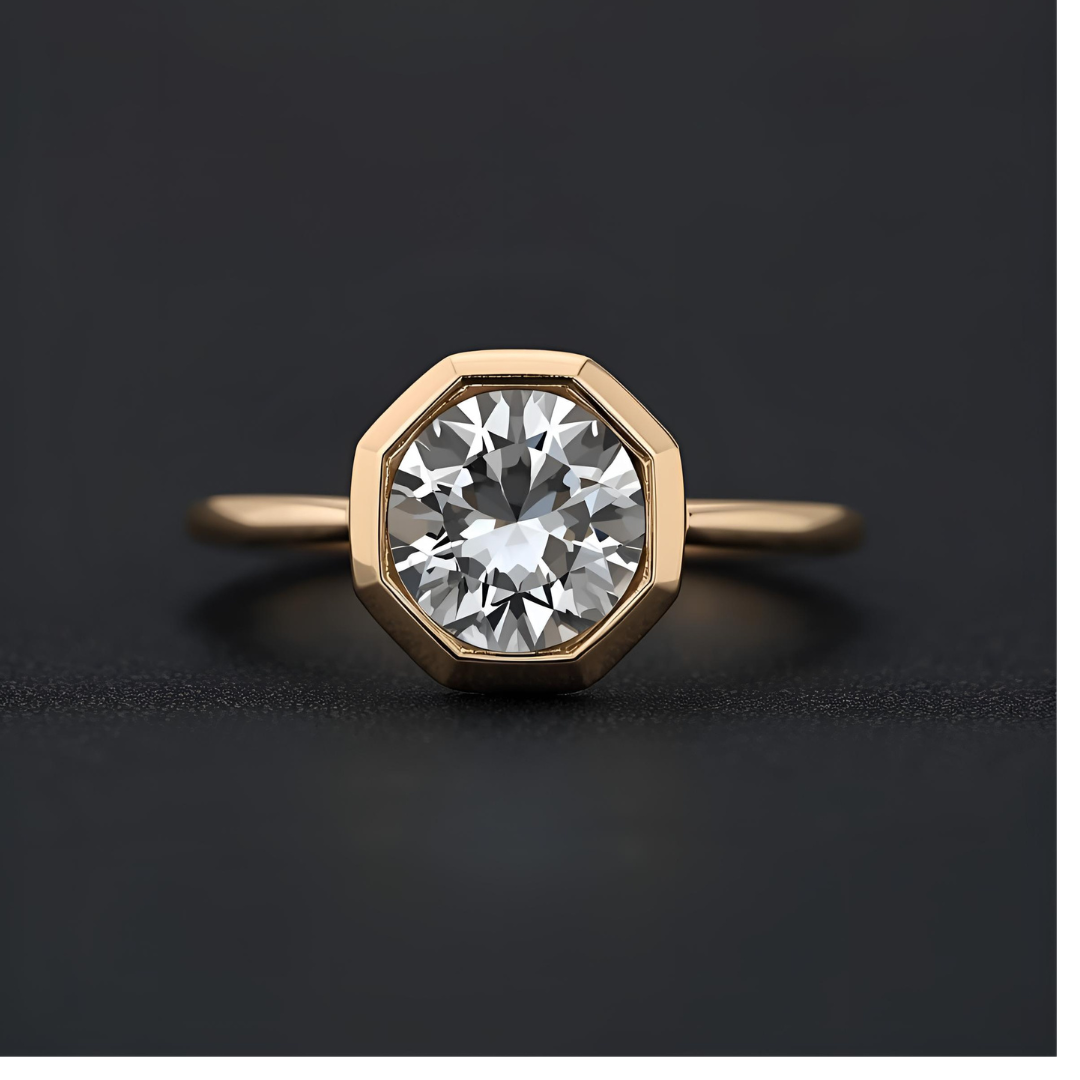
Bezel Setting Guide: Benefits, Styles, and Buying Tips
In 1953, Sir Edmund Hillary and Tenzing Norgay became the first men to reach the summit of Mount Everest. Few people know that Hillary carried something precious with him—not on his finger, but tucked safely inside his jacket.
It was a ring for his wife, set not with prongs, but with a full metal rim. A bezel setting.
"Prongs would have caught on ropes," he later explained. "The stone might have chipped against the ice and rock. But a bezel? It wraps around the stone like armor. It doesn't snag. It doesn't bend. It simply holds."
That ring traveled to the top of the world and back—enduring sub-zero temperatures, violent winds, and constant impacts. And it arrived home perfect.
This is why adventurers, soldiers, and anyone who lives an active life chooses the bezel setting. It's not the flashiest choice. It's the smartest.
The same setting that protected a ring to the top of Everest now awaits your own active life — whether you‘re a nurse, a gardener, a parent, or simply someone who refuses to take off their jewelry. Every bezel setting in our collection is handcrafted for security, from full bezels to partials.”
[Button: Explore Bezel Setting Rings →]
What Is A Bezel Setting?
Of course! Let's dive deep into the world of the bezel setting.
In simple terms, a bezel setting is a style of mounting a gemstone (like a diamond, sapphire, etc.) in which a thin strip of metal (the "bezel") completely or partially wraps around the stone's girdle (its widest point) to secure it in place. Here is the table of contents;
It's one of the oldest, most secure, and most modern-looking settings available.
Key Characteristics of a Bezel Setting
The Bezel Wall: This is the defining feature. It's a thin, custom-formed rim of metal that is pressed or rubbed over the edge of the gemstone. It can be a full circle or a partial one.
Security: Because the gemstone is surrounded and held by metal, it is extremely secure. The chances of the stone being knocked loose, chipped, or falling out are minimal.
Modern & Sleek Aesthetic: Bezels offer a clean, smooth, and continuous line. They have a minimalist, contemporary look that is very popular in modern jewelry design.
Protection: The metal rim protects the gemstone's edges and girdle from direct impacts, which is ideal for active lifestyles or for softer stones.
Types of Bezel Settings
There are two main types:
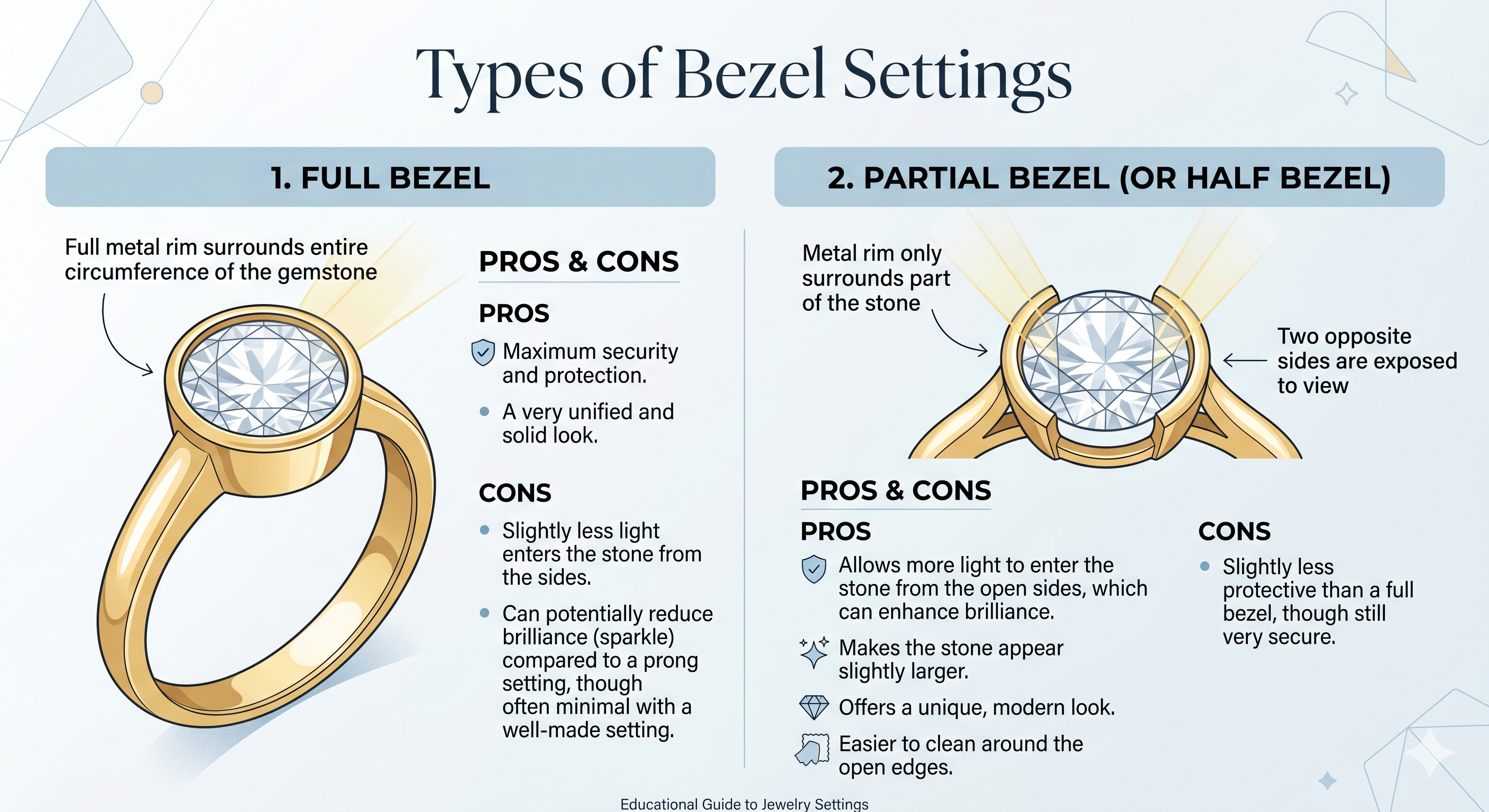
1. Full Bezel
A complete circle of metal surrounds the entire circumference of the gemstone.
Pros: Maximum security and protection. A very unified and solid look.
Cons: Slightly less light enters the stone from the sides, which can potentially reduce brilliance (sparkle) compared to a prong setting, though this effect is often minimal with a well-made setting.
2 . Partial Bezel (or Half Bezel)
The metal rim only surrounds part of the stone, leaving two opposite sides exposed.
Pros: Allows more light to enter the stone from the open sides, which can enhance brilliance. It also makes the stone appear slightly larger and offers a unique, modern look. It's easier to clean around the open edges.
Cons: Slightly less protective than a full bezel, though still very secure.
Bezel vs. Prong Setting: A Quick Comparison
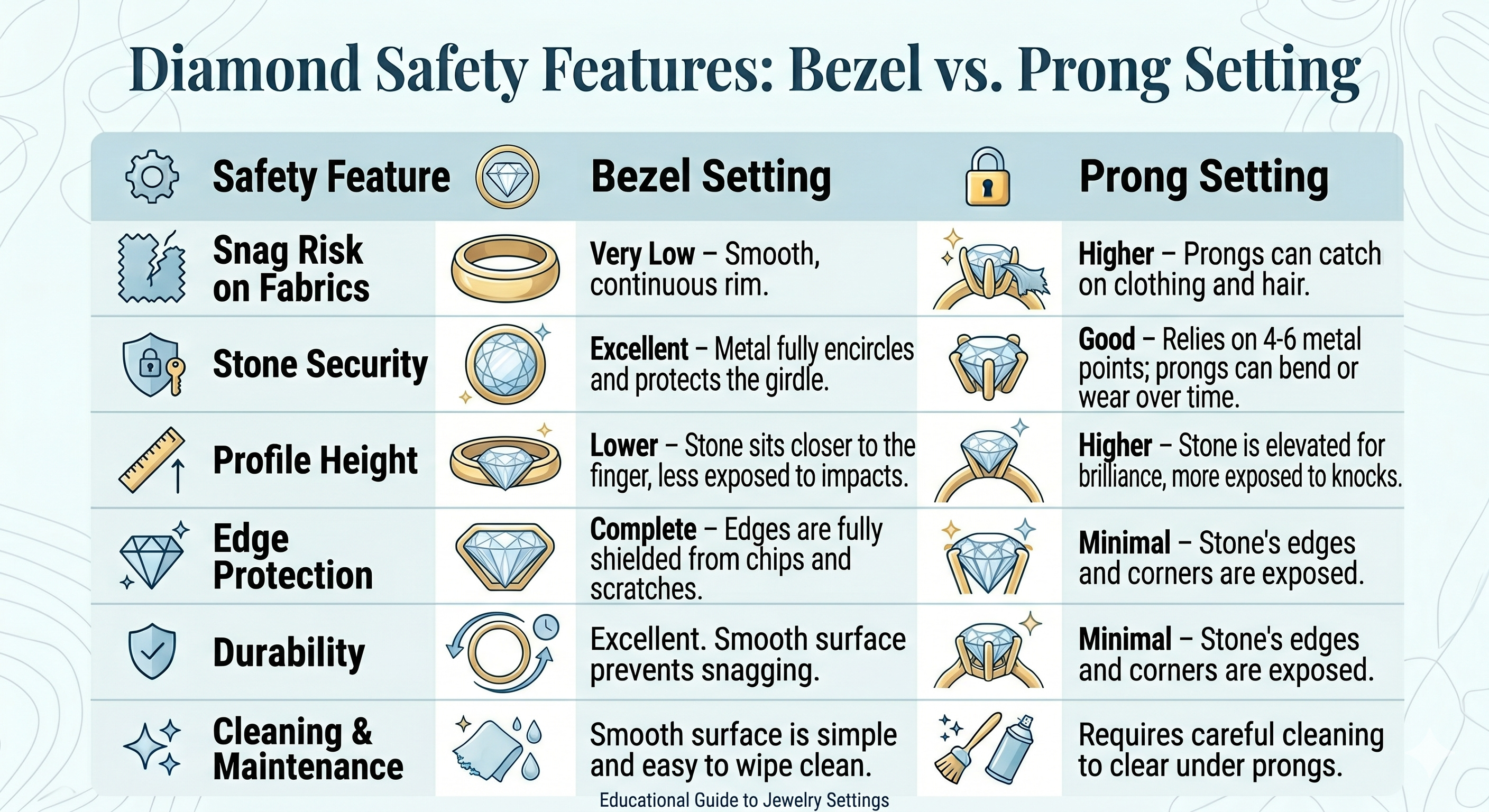
The Process of Creating a Bezel Setting
Creating a bezel is a skilled jewelry technique:
Measurement: The jeweler precisely measures the gemstone.
Fabrication: A strip of metal (usually the same as the ring's shank, e.g., platinum or gold) is cut and shaped into a perfect circle or oval to match the stone's girdle.
Soldering: This bezel wire is carefully soldered onto the base plate of the setting.
Setting: The gemstone is placed inside the bezel. Using a special tool (a bezel rocker or burnisher), the jeweler gently and evenly presses the top edge of the metal over the stone's crown, locking it securely in place. This requires a steady hand to avoid scratching the stone.
Variations and Styles
Collet Setting: A pre-made, tube-like bezel that is soldered onto the piece. Often used for standard round stones.
Flush Bezel (Gypsy Setting): The stone is set into a hole drilled into the metal, so its table (top) is flush with the metal's surface. Extremely secure and low-profile. Common in men's rings.
Open Back Bezel: The back of the setting is open, allowing maximum light to pass through the stone, enhancing its brilliance. Used for transparent stones.
Closed Back Bezel: A solid metal backing covers the back of the stone. This can be used to enhance the color of certain stones or create a specific look.
It is a permanent setting; resizing a bezel-set ring can be more complex than a prong-set one.
For official information on jewelry settings, visit the GIA Jewelry Setting Guide.
Who Is A Bezel Setting For?
A bezel setting is an excellent choice for:
People with active lifestyles (healthcare workers, gardeners, athletes).
Anyone who values security and doesn't want to worry about their stone.
Those who prefer a modern, minimalist aesthetic.
Individuals who dislike the feeling of prongs catching on sweaters or hair.
Owners of softer gemstones (like opals or emeralds) benefit from the extra protection.
Is the Bezel Set More Expensive?
That's an excellent question. The short answer is:
Yes, a bezel setting is generally more expensive than a classic prong setting.
However, the price difference isn't always huge, and it's important to understand why it costs more and whether it's the right choice for you.
Let's break down the reasons for the cost and the pros and cons.
Why a Bezel Setting is More Expensive
More Metal Weight:
A bezel is a continuous band of metal that surrounds the entire girdle (the outer edge) of the gemstone.
A prong setting uses only a few small "claws" to hold the stone.
Simply put, a bezel uses significantly more gold or platinum, which is a major factor in the price of any piece of jewelry.
Higher Labor and Skill Requirement:
Crafting a bezel is a more complex and time-consuming process. The jeweler must perfectly form the metal strip to the exact contours of the stone.
It requires a high level of skill to ensure the stone is set securely and evenly without any gaps or warping. This precision labor costs more than the relatively simpler process of soldering and polishing prongs.
Is the Extra Cost Worth It?
This depends entirely on your priorities:
Choose a Bezel Setting if you value:
Security and Peace of Mind: It's the most protective setting available.
Low Maintenance: You don't want to worry about frequent jewelry check-ups.
A Modern or Minimalist Aesthetic: You love the smooth, clean lines.
An Active Lifestyle: If you work with your hands, work out, or are generally hard on your jewelry.
Protecting a Valuable or Delicate Stone: Ideal for soft stones like opals or emeralds, or for heirloom stones.
Choose a Prong Setting if you value:
Maximizing Sparkle and Brilliance: The open design allows the most light to enter and exit the stone.
A Traditional, Classic Look: The timeless appearance of a solitaire diamond engagement ring.
Making the Stone Appear Larger: Since it covers less of the gem, a prong setting can make a stone look bigger for its carat weight.
Yes, a bezel-set piece of jewelry will typically have a higher price tag than a comparable prong-set piece due to the increased materials and skilled labor involved.
Is a Bezel Setting Right for You?
- ✅ Active Lifestyles: Healthcare workers, gardeners, athletes, parents
- ✅ Soft Stone Owners: Opals, emeralds, turquoise (needs edge protection)
- ✅ Modern Style Lovers: Clean, minimalist, architectural aesthetic
- ✅ Snag Haters: No more catching on sweaters, hair, or gloves
- ✅ Low Maintenance Seekers: Less worry about loose prongs
- ❌ Maximum Sparkle Priority: If you want absolute maximum brilliance, prong settings let in more light
What Are The Disadvantages Of Bezel Setting?
Does a bezel setting make a diamond look larger?
A bezel setting does not make the diamond's actual size (carat weight) look larger, but it can create the illusion of a larger overall appearance.
Here’s the breakdown of how it works, both for and against the "larger look":
How a Bezel Can Make a Diamond Look Larger
It creates a Larger Silhouette: The continuous metal rim adds a border around the diamond. When you glance at the ring, your eye often takes in the entire bezel-set structure, not just the diamond itself. This can make the total footprint on your finger appear larger than a prong-set diamond of the same carat weight.
Analogy: Think of a picture with a thick matte and frame. The picture itself is the same size, but the whole framed piece on the wall commands more attention and looks bigger.
The Reflection Effect: A well-crafted bezel, especially in a highly polished white metal like platinum or white gold, can act as a mirror. It reflects light onto the sides of the diamond and can blend seamlessly with the diamond's edge, making it difficult to tell where the metal ends and the diamond begins. This blurring of lines can enhance the perceived size.
It provides a Stable Base for Illusion Effects: Because the bezel securely holds the entire girdle, it's an excellent setting for fancy-shaped diamonds (like ovals, pears, or marquise). The bezel can emphasize the length or width of these shapes, making them look more substantial.
How A Bezel Can Make A Diamond Look Smaller
It covers the Girdle: This is the main point against it. A prong setting elevates the diamond and leaves its entire circumference (the girdle) visible. A bezel physically covers the girdle with metal. Since you're not seeing the full outer edge of the diamond, the visible face-up table can appear slightly smaller than it would in a prong setting.
It Can Reduce Light Entry: While a well-designed bezel doesn't significantly impact brilliance, a very thick or poorly made bezel can block a small amount of light from entering the diamond from the sides. Less light can mean less sparkle, and a less sparkly diamond can sometimes appear less prominent.
The Verdict: Illusion vs. Actual Measurement
To visualize this, imagine two identical 1-carat round diamonds:
In a Prong Setting: You see the entire diameter of the diamond. It might look like a perfect, defined circle that's floating. The focus is entirely on the exposed stone.
In a Bezel Setting: You see the diamond's table (top surface), but its outer edge is bordered by metal. The overall piece you see is a metal circle containing the diamond. The total diameter of the ring's head is larger.
So, which effect wins?
It often comes down to personal perception and the specific design.
If you are someone who focuses on the exact borders of the diamond, you might think the bezel makes it look smaller.
If you take in the entire ring head as a single unit, you will likely perceive the bezel-set diamond as having a larger presence on your finger.
Pro Tip: The Best of Both Worlds
If you love the security of a bezel but want to maximize the look of size, consider these options:
A "Halo": A bezel-set center stone is the perfect foundation for a halo of smaller diamonds. The bezel around the center stone seamlessly integrates with the halo, creating a massive, continuous sparkly surface that dramatically increases the overall appearance of size.
A Thin, Knife-Edge Bezel: Modern jewelers can create very delicate bezels that use the least amount of metal necessary to secure the stone. This minimizes the coverage on the girdle while still providing superior security.
A Half-Bezel: This setting uses two bezel arms on opposite sides of the diamond, leaving the other two sides open. It offers more protection than prongs and a modern look, while showing more of the diamond's circumference.
Are Bezel Settings Old-fashioned?
Bezel settings are not old-fashioned. While they are one of the oldest jewelry setting techniques, originating in ancient times, they are currently enjoying a major resurgence and are considered a sleek, modern, and highly trendy choice.
Why Bezel Settings Are Timeless, Not Dated
The appeal of a bezel lies in its clean, architectural lines and practical benefits, which feel relevant in any era.
Modern Popularity: Major publications like Vogue note that bezel settings are a significant trend for 2025, and recent celebrity choices (like Taylor Swift's engagement ring) have brought them back into the spotlight.
Contemporary Benefits: The style is praised for its security, durability, and low-maintenance design, which suits active, modern lifestyles. The smooth metal rim prevents snagging on clothing.
Versatile Aesthetic: Bezel settings provide a minimalist, "clean" look that aligns with current tastes. They work equally well with vintage-inspired details or ultra-modern, sculptural bands.
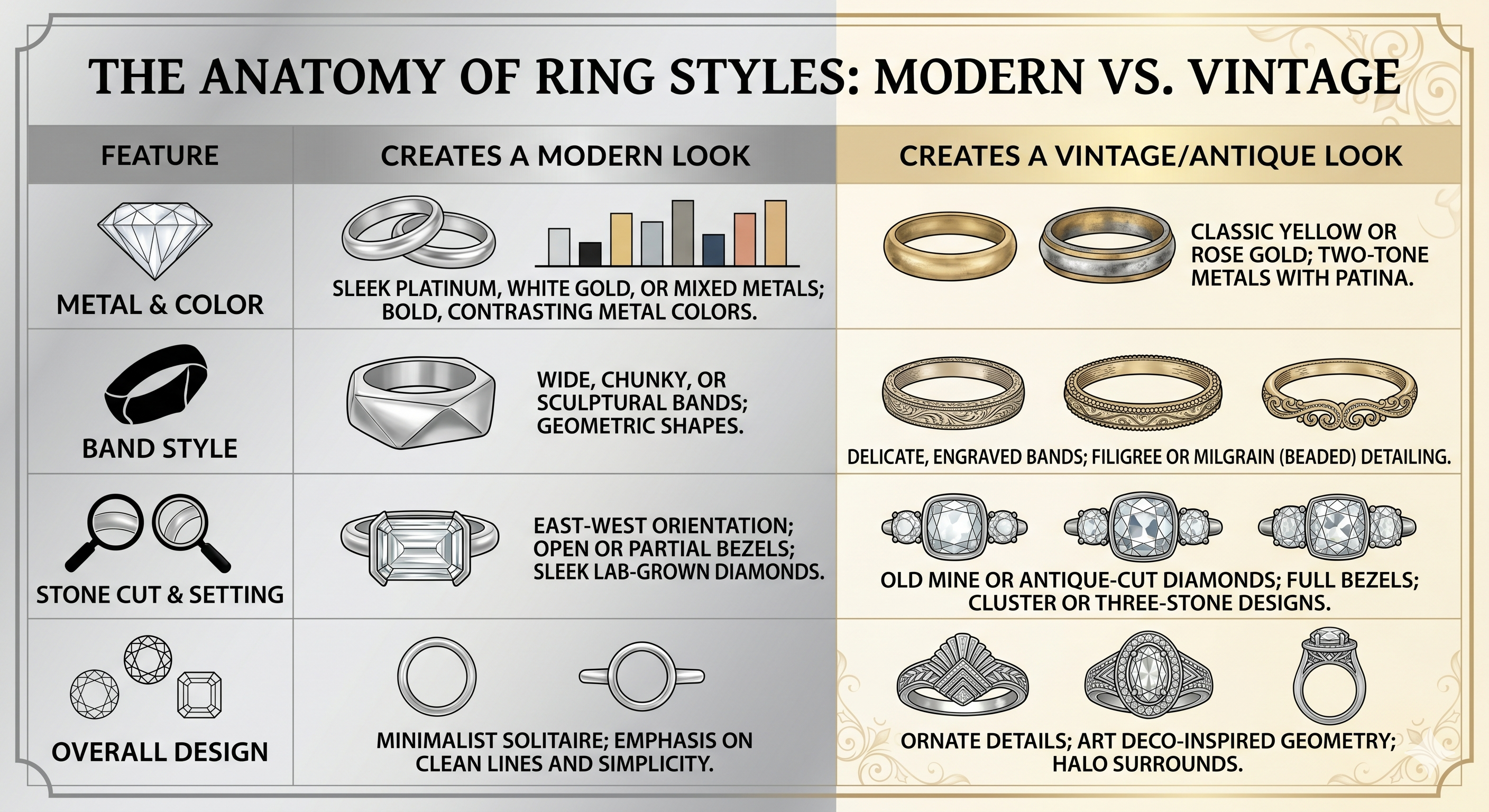
What Makes a Bezel Look Modern vs. Vintage
Whether a bezel ring feels contemporary or antique depends entirely on its specific design, not the setting style itself. Here's how the details change the look:
How to Choose a Bezel Setting
When selecting a bezel ring, consider these factors to get the look you want:
For Maximum Security & Low Profile: A full bezel is the most protective option.
For More Sparkle & Light: A partial, semi-, or open bezel exposes more of the stone's edges, potentially increasing its brilliance.
For a Unique Look: A flush bezel sets the stone level with the band surface for an ultra-smooth, modern feel.
In short, a bezel setting is a classic style that has been successfully reinvented for contemporary tastes. Its current popularity proves it's a fresh and stylish choice.
If you have a specific style in mind (like Art Deco, ultra-minimalist, or something with colored gemstones), I can offer more tailored information on what to look for.
Is A Bezel Setting Timeless?
Yes, a bezel setting is timeless. Its design has been cherished for thousands of years precisely because it combines enduring elegance with practical durability, making it a perennially relevant choice.
Historical & Modern Evidence of Timelessness
Its longevity is proven both by history and current trends:
Ancient Origins: Used in ancient Egyptian, Roman, and Byzantine jewelry, the bezel is one of the oldest setting techniques.
Modern Resurgence: As noted in the previous answer, it is a highlighted trend for 2025 in major fashion publications and has been popularized recently by celebrities.
Why the Bezel Has Endured for Millennia
Its timelessness comes from a powerful combination of form and function:
Unmatched Protection: The continuous metal rim fully encircles the stone, securing it firmly and protecting its edges from chipping—a practical advantage that never goes out of style.
Clean, Architectural Aesthetic: The smooth lines offer a minimalist look that fits seamlessly into any era, from antique to ultra-modern design languages.
Practical Elegance: Its low profile and snag-free design make it ideal for everyday wear, suiting active lifestyles across generations.
What Makes a Bezel "Timeless" vs. "Trendy"
While the setting itself is timeless, specific designs can feel more tied to a particular era. A "timeless" bezel often leans on simplicity and balance.

A Fundamentally Enduring Choice
A bezel setting is a fundamentally enduring choice. It transcends fleeting trends because its core advantages—security, sleek aesthetics, and comfort—are always in demand. Choosing a bezel is less about following fashion and more about selecting a proven, intelligent design for a piece meant to last a lifetime.
If you are considering a bezel for a specific type of jewelry, like an engagement ring or a pendant, I can provide more focused insights on what to consider.
Is A Bezel Setting Modern Or Classic?
A bezel setting is both modern and classic. It is a classic design with ancient origins that is currently experiencing a strong modern revival. Its unique ability to bridge eras makes it a versatile and enduring choice.
The Dual Nature of Bezel Settings
The bezel's design is simple enough to adapt to any period's aesthetic, making it perennially relevant.
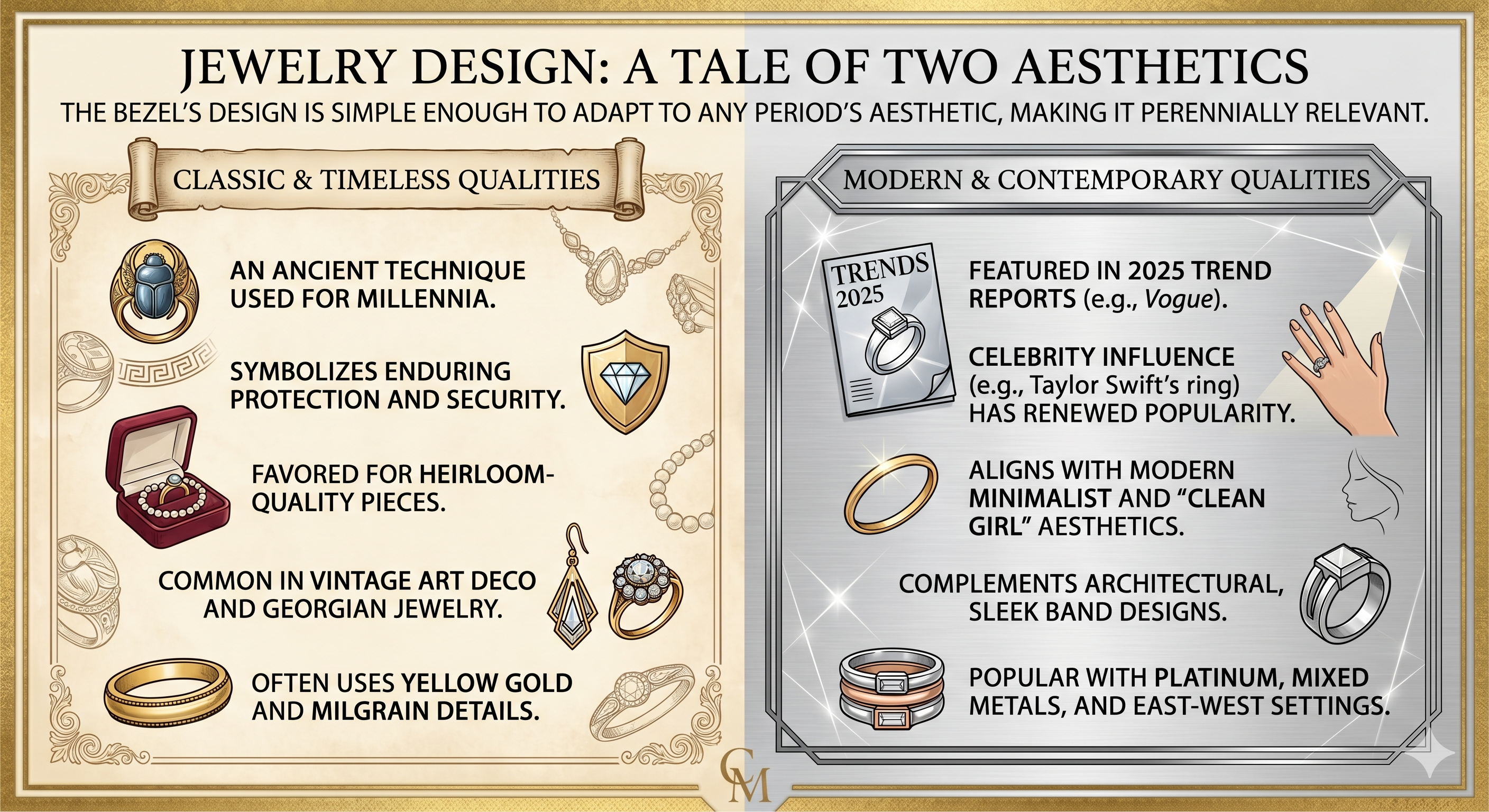
How Design Choices Influence the Style
You can lean into either the classic or modern side through specific design choices:
For a "Classic" Look: Opt for yellow or rose gold, a round- or cushion-cut stone, a delicate band with milgrain or engraving, and a full bezel.
For a "Modern" Look: Choose platinum or white gold, a geometric cut (like an emerald or Asscher), a bold, sculptural band, an east-west orientation, or an open/partial bezel.
Ultimately, the bezel setting is a chameleon. Its fundamental design is so strong and simple that it can be executed to feel either deeply traditional or strikingly contemporary.
If you're considering a bezel for a specific piece (like an engagement ring or a signature necklace), describing the style you're drawn to can help me offer more specific guidance on achieving that look.
What Are The Benefits Of The Bezel Setting?
Based on your questions, it seems you're looking for a secure, elegant, and practical jewelry setting. The bezel setting is an excellent choice that meets all these criteria, offering a unique combination of style and substance.
The core benefit of a bezel setting is that it offers unparalleled security and protection for a gemstone by encircling it with a continuous rim of metal. This fundamental design provides several major advantages, especially for active lifestyles or daily wear.
Primary Benefits of the Bezel Setting
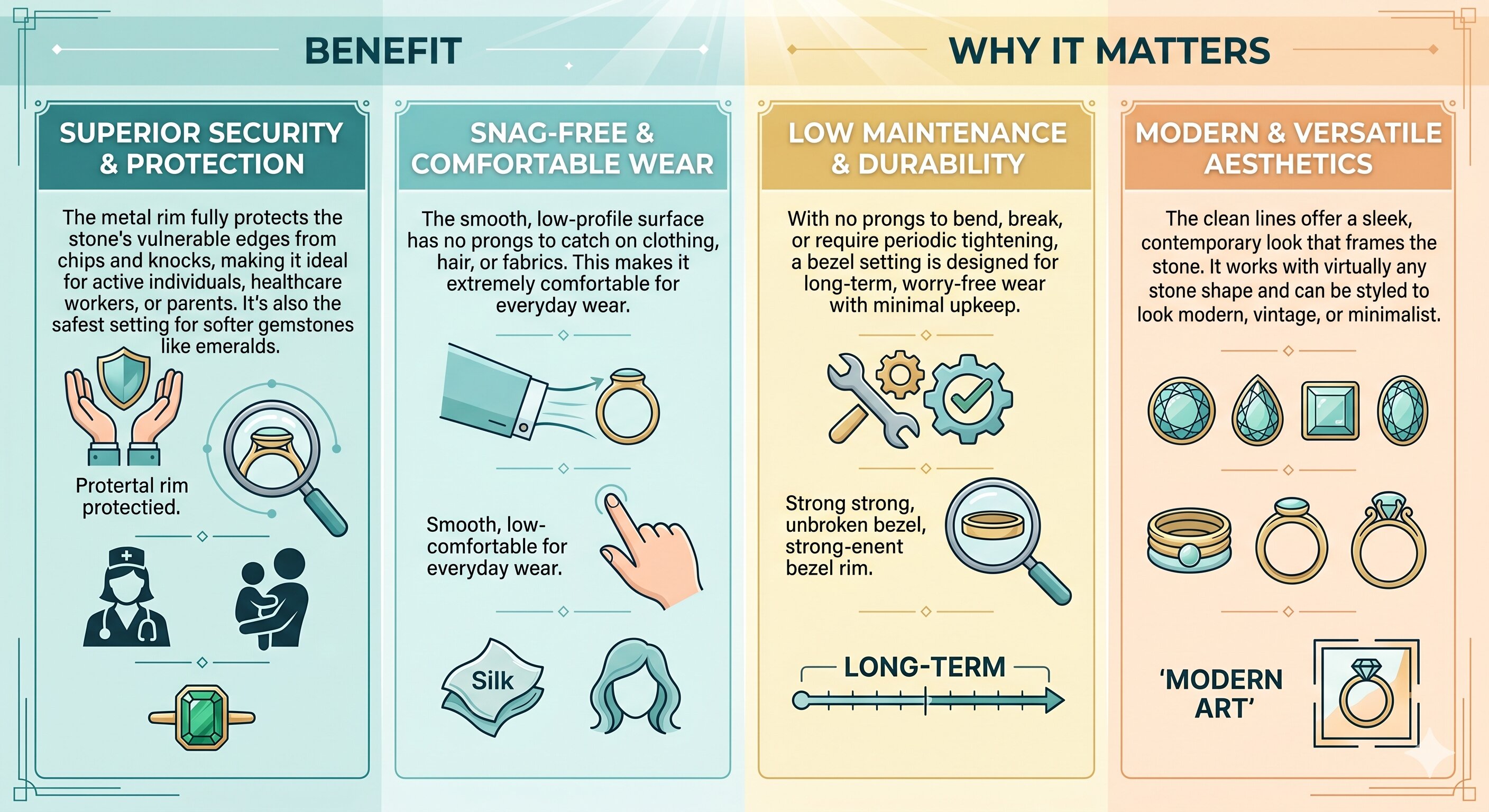
“In the 19th century, sailors wore bezel-set signet rings to stamp wax seals on letters sent from distant ports. The smooth metal rim meant the ring wouldn‘t snag on ropes during storms. In World War II, pilots chose bezel-set rings for the same reason — no prongs to catch on parachute cords or cockpit controls. When Hillary climbed Everest, he chose a bezel. When your grandmother gardened, she chose a bezel. When you type, cook, exercise, and sleep, you might choose a bezel too. It is not the setting for a life in a glass case. It is the setting for a life fully lived.”
Points to Consider
A balanced view is important. The main considerations with bezel settings are:
Light Performance: The metal rim can slightly reduce the amount of light entering the stone from the sides, which may alter its sparkle compared to a prong setting. Some designs use open or semi-bezels to allow more light in.
Perception of Size: A full bezel can make a stone appear slightly smaller because it covers the outer edge. Opting for a thin bezel or a metal color that matches the stone can create an illusion of a larger size.
Cost: They often use more metal and require skilled craftsmanship, which can make them more expensive than simpler prong settings.
Is A Bezel Right for You?
A bezel setting is an outstanding choice if your top priorities are security, low maintenance, and modern elegance. It's perfect for anyone with an active, hands-on lifestyle who wants to wear their jewelry every day without worry.
If your primary goal is to maximize the traditional sparkle and fire of a diamond and you prefer a classic look, a prong setting might be more suitable.
Note: If you choose a bezel, regular cleaning is still important. Dirt can accumulate where the metal meets the stone. Gentle cleaning with a soft brush, mild soap, and warm water is recommended.
If you have a specific gemstone or a particular style in mind (like Art Deco or ultra-minimalist), I can help you explore what type of bezel design might work best.
Is Bezel Setting Good for Everyday Wear?
Based on your questions about safety and practicality, yes, bezel settings are widely regarded as excellent for everyday wear. Multiple jewelers highlight their security and comfort as ideal for a busy, active lifestyle.
Their popularity stems from a combination of protective design and modern aesthetics that offer peace of mind without sacrificing style.
Core Benefits for Daily Wear
Here are the main reasons a bezel setting works so well every day:
Superior Security & Protection: The continuous metal rim fully encircles the stone, protecting its edges from chips and knocks. This is perfect for active individuals, healthcare workers, or parents.
Smooth & Snag-Free Comfort: With no prongs to catch on clothing, hair, or fabrics, the smooth, low-profile design is exceptionally comfortable and prevents accidental pulls.
Low Maintenance & Durability: Unlike prong settings that need periodic checking and tightening, a well-made bezel is designed for long-term, worry-free wear with minimal upkeep.
Modern & Versatile Style: The clean, architectural lines offer a sleek look that fits both contemporary and minimalist aesthetics, making it a stylish choice for any occasion.
Choosing the Right Bezel for Daily Life
Not all bezels are the same. The best type for you depends on your priorities for security, sparkle, and style.
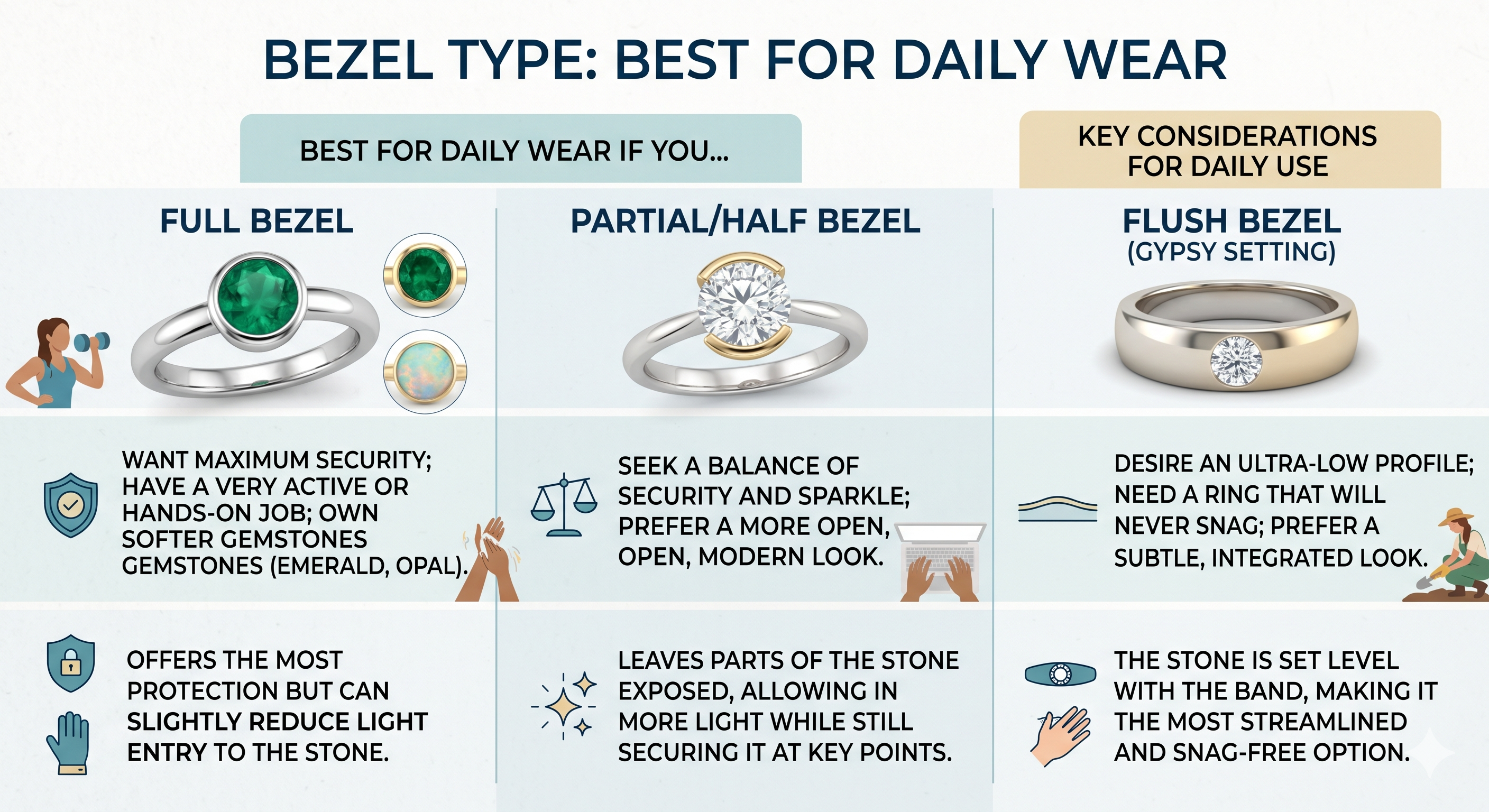
Points to Consider
For a complete view, it helps to know the common trade-offs mentioned with bezel settings:
Light & Sparkle: The metal rim can slightly reduce light entering the stone compared to a prong setting, which may affect its traditional brilliance. A partial bezel or an open-back design can mitigate this.
Perception of Size: A full bezel can make the center stone appear slightly smaller as it covers the outer edge. Opting for a thin bezel or a metal color that matches the stone can minimize this effect.
Craftsmanship & Cost: They often require more metal and skilled craftsmanship, which can make them more expensive than simpler prong settings. Quality craftsmanship is crucial for a secure and lasting setting.
Final Recommendation
A bezel setting is an outstanding, practical choice if your top priorities for an everyday piece are security, low maintenance, and modern comfort. It's designed to integrate seamlessly into an active life.
If maximizing traditional sparkle and a classic look is your primary goal, a prong setting might be more suitable, though it requires more care.
Note: For the best everyday performance, ensure your bezel setting is well-crafted by a reputable jeweler. Also, regular gentle cleaning is still recommended to prevent dirt from building up where the metal meets the stone.
I hope this detailed breakdown helps you decide. If you can tell me what kind of jewelry you're considering (e.g., engagement ring, pendant, stud earrings) or describe your typical daily activities, I can offer more specific advice on which bezel type might be the perfect fit for your lifestyle.
Learn more about jewelry care on the American Gem Society's care guide.
“You now know the history, the benefits, the disadvantages, the timelessness, the modern vs. classic debate, and the everyday practicality. The only question left: will you choose the setting that has survived pharaohs, soldiers, sailors, and the summit of Everest?
Our current collection includes a limited number of bezel-set rings — from full bezels for maximum protection to partial bezels for more light, and flush settings for an ultra-low profile. When certain styles are gone, restocking takes time because each bezel is hand-fitted to its specific stone.
This is not just a setting. It is 4,000 years of Egyptian goldsmiths, Roman soldiers, WWII pilots, and Everest climbers — the ring that never catches, never loosens, and never lets go.”
[Button: Secure Your Bezel Ring (Limited) →]


Sterling Silver Guide: 925 Meaning, Care, vs Silver and Green Skin
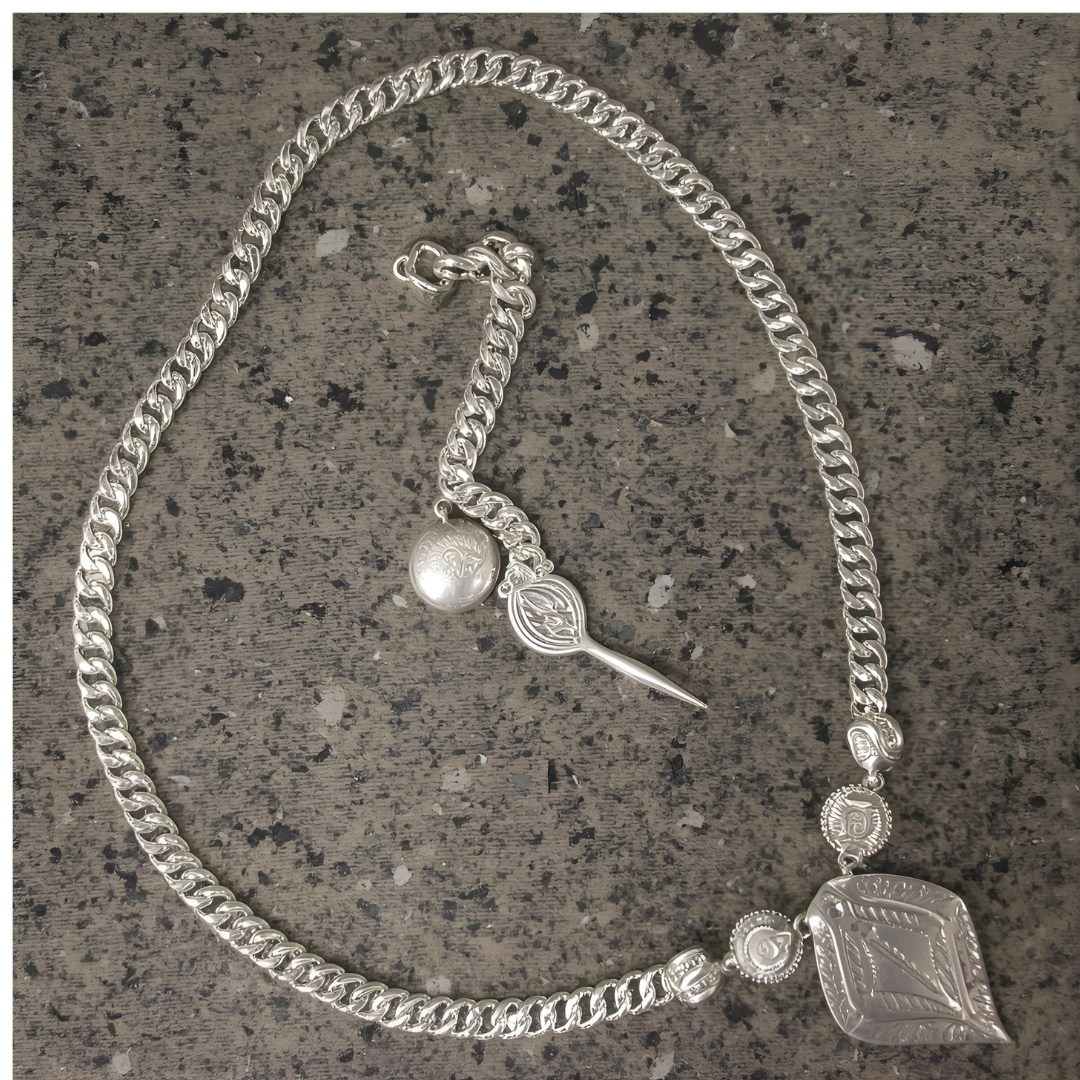
Sterling Silver Guide: 925 Meaning, Care, vs Silver and Green Skin
The Metal That Changed the World
In the 14th century, a German alchemist discovered something remarkable. By mixing pure silver with a small amount of copper, he created a metal that was strong enough for everyday use but still beautiful enough for royalty.
He called it "sterling silver."
The name may come from the Easterlings—German merchants who brought this new alloy to England—or from the Old English word for "little star." Either way, sterling silver quickly became the standard for coins, cutlery, and jewelry across Europe.
Today, that 92.5% silver / 7.5% copper formula is still used around the world. It's the reason your grandmother's silverware survived a century of use. It's the reason sterling silver rings can be worn every day without bending or breaking.
Affordable. Durable. Timeless. That's the power of sterling.
“In 1788, a silversmith named Paul Revere became a folk hero. But before his midnight ride, he was America’s finest silversmith. Revere worked almost exclusively in sterling silver — creating tea sets, bowls, and flatware that are still intact in museums today.
His secret was the 92.5% formula: pure enough to hold value, strong enough to last centuries. When Revere died in 1818, his workshop had produced over 5,000 pieces of sterling silver. Every one of them is still collectible today.
Sterling silver does not fade, does not break, and does not lose its worth. It simply waits — for the next hand, the next table, the next story.”
The same metal that Paul Revere trusted and the Titanic preserved now awaits your everyday elegance. Every sterling silver piece in our collection is stamped with the 925 hallmark — guaranteed 92.5% pure silver, crafted for daily wear.”
[Button: Explore Sterling Silver Jewelry →]
Here is a detailed explanation of what sterling silver is.
Table of Contents
- What Is Sterling Silver?
- Is Sterling Silver Real Or Fake Silver?
- Is Sterling Silver Good Quality?
- How Much Is Sterling Silver Worth Now?
- Is Sterling Silver Costlier than Silver?
- Is Sterling Silver Better Than 925?
- Is Sterling Silver Good For A Ring?
- Is Sterling Silver Good For Everyday Wear?
- Can You Wear Sterling Silver In Water?
- How Do You Clean Sterling Silver?
- What Is The Best, Sterling Silver Or Plated Silver?
- Does Sterling Silver Turn Green?
Let's begin the topic.
What Is Sterling Silver?
Sterling silver is a precious metal alloy made of 92.5% pure silver and 7.5% other metals, usually copper.
This specific composition is key. Pure silver (known as fine silver) is too soft for most functional and decorative uses, like jewelry, cutlery, and hollowware. The addition of a stronger metal, like copper, creates an alloy that is much more durable and practical while retaining the beautiful luster and value of silver.
The Key Details
1. The "925" Stamp (The Hallmark of Authenticity)
Because sterling silver is a regulated standard, genuine pieces are almost always marked with a hallmark. The most common hallmark is "925". This number signifies the 92.5% purity of the silver content. You can usually find this stamp in an inconspicuous place, like the inside of a ring band, on the clasp of a necklace, or on the back of a piece of flatware.
Other common hallmarks include:
"Sterling"
"Ster"
If a piece of jewelry claiming to be sterling silver does not have one of these marks, you should be skeptical of its authenticity.
2. Why Not Use Pure Silver?
Pure Silver is Soft: Fine silver (99.9% pure) is very malleable and can be easily bent, scratched, or dented.
Durability for Wear: The 7.5% copper additive gives sterling silver the necessary strength and hardness to hold its shape, withstand daily wear, and support settings for gemstones.
3. The One "Downside": Tarnishing
The one characteristic that requires a bit of maintenance is tarnishing.
What is it? Tarnish is a dark discoloration or dulling of the surface.
What causes it? Sterling silver tarnishes when the copper in the alloy reacts with sulfur compounds in the air or on your skin. This reaction forms a layer of silver sulfide. It is not rust (which is iron oxide), and it is not harmful.
Prevention & Care: Tarnish is easily removable with a special polishing cloth, liquid silver polish, or even a mild DIY solution (like baking soda and aluminum foil). Storing sterling silver in airtight bags or tarnish-preventive cloths can significantly slow down the tarnishing process.
4. Common Uses of Sterling Silver
Jewelry: This is the most common use. Rings, necklaces, bracelets, earrings, and cufflinks are frequently made from sterling silver.
Flatware and Hollowware: High-quality cutlery, tea sets, trays, and decorative bowls.
Musical Instruments: Some flutes and piccolos are made from sterling silver for its specific tonal qualities.
Awards and Trophies: The Oscars (Academy Awards) statuettes are made from bronze plated with 24-karat gold, but for many years, they were cast from Britannia metal and plated in copper, silver, and gold.
Sterling Silver vs. Other Similar Metals
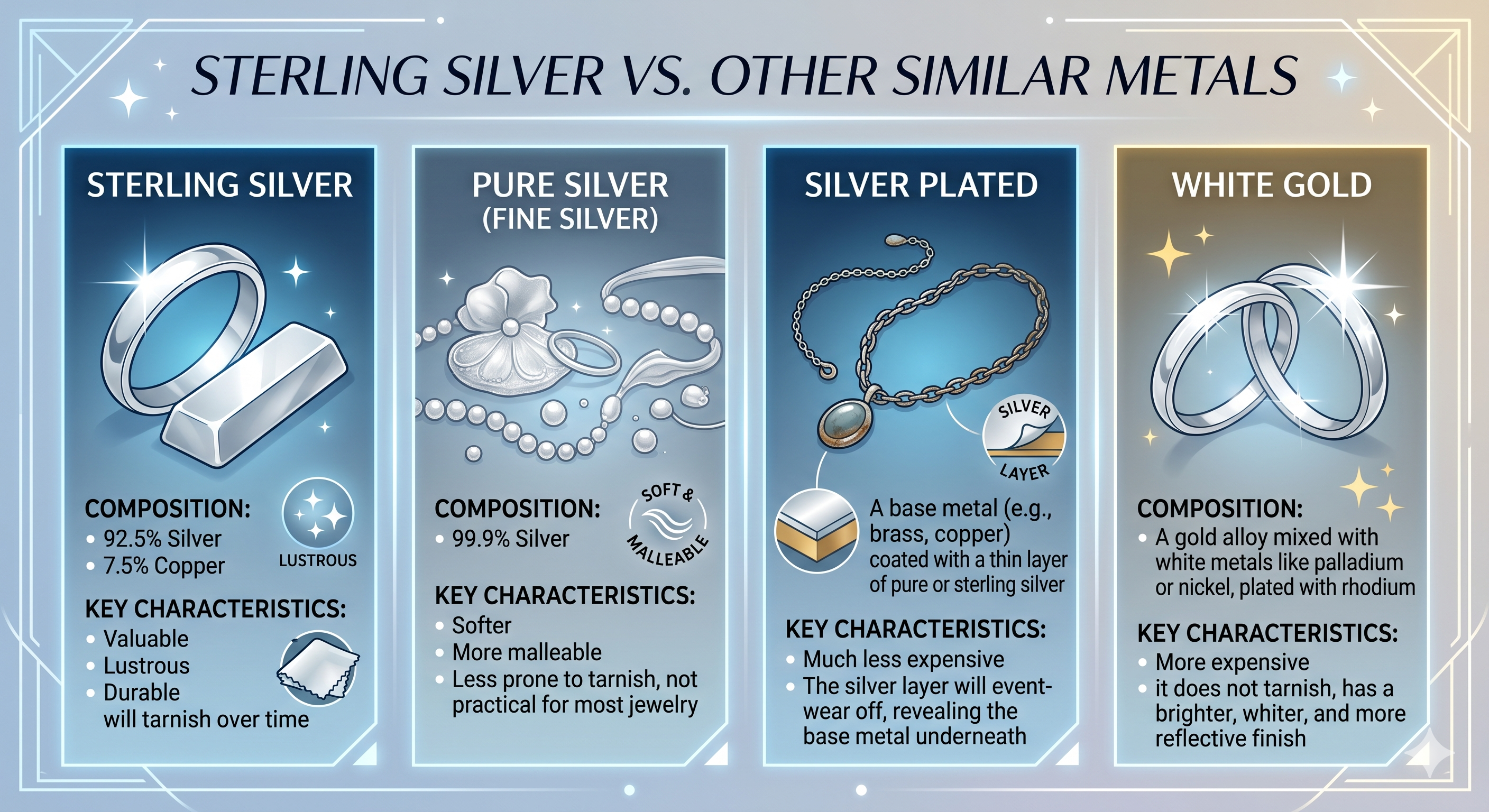
In short, sterling silver is the standard for high-quality, durable silver goods. Its 92.5% purity makes it a precious metal, its "925" stamp is your guarantee of authenticity, and its tendency to tarnish is a natural and manageable characteristic. It offers an excellent balance of beauty, value, and durability.
Learn more about sterling silver's properties on Wikipedia's sterling silver page.
Is Sterling Silver Real Or Fake Silver?
Sterling silver is absolutely REAL silver.
It is not "fake." In fact, it is the standard grade of silver used for virtually all high-quality jewelry, flatware, and decorative items.
The confusion often comes from comparing it to other materials that are called "silver." Here’s the simple breakdown:
Why Sterling Silver is "Real Silver"
It's Mostly Pure Silver: Sterling silver is made of 92.5% pure silver. The majority of the material is the genuine, precious metal.
It's a Regulated Standard: The term "sterling silver" is a legally defined standard of quality, not a marketing gimmick. An item stamped with "925," "Sterling," or "Ster" certifies that it meets this 92.5% purity standard.
It Has Intrinsic Value: Because of its high silver content, sterling silver has significant intrinsic value based on the weight and current market price of silver. It is a precious metal investment, unlike "fake" alternatives.
What People Often Mistake for "Real Silver" (And Why It's Confusing)
When people ask if something is "real silver," they are often trying to distinguish it from these common alternatives:
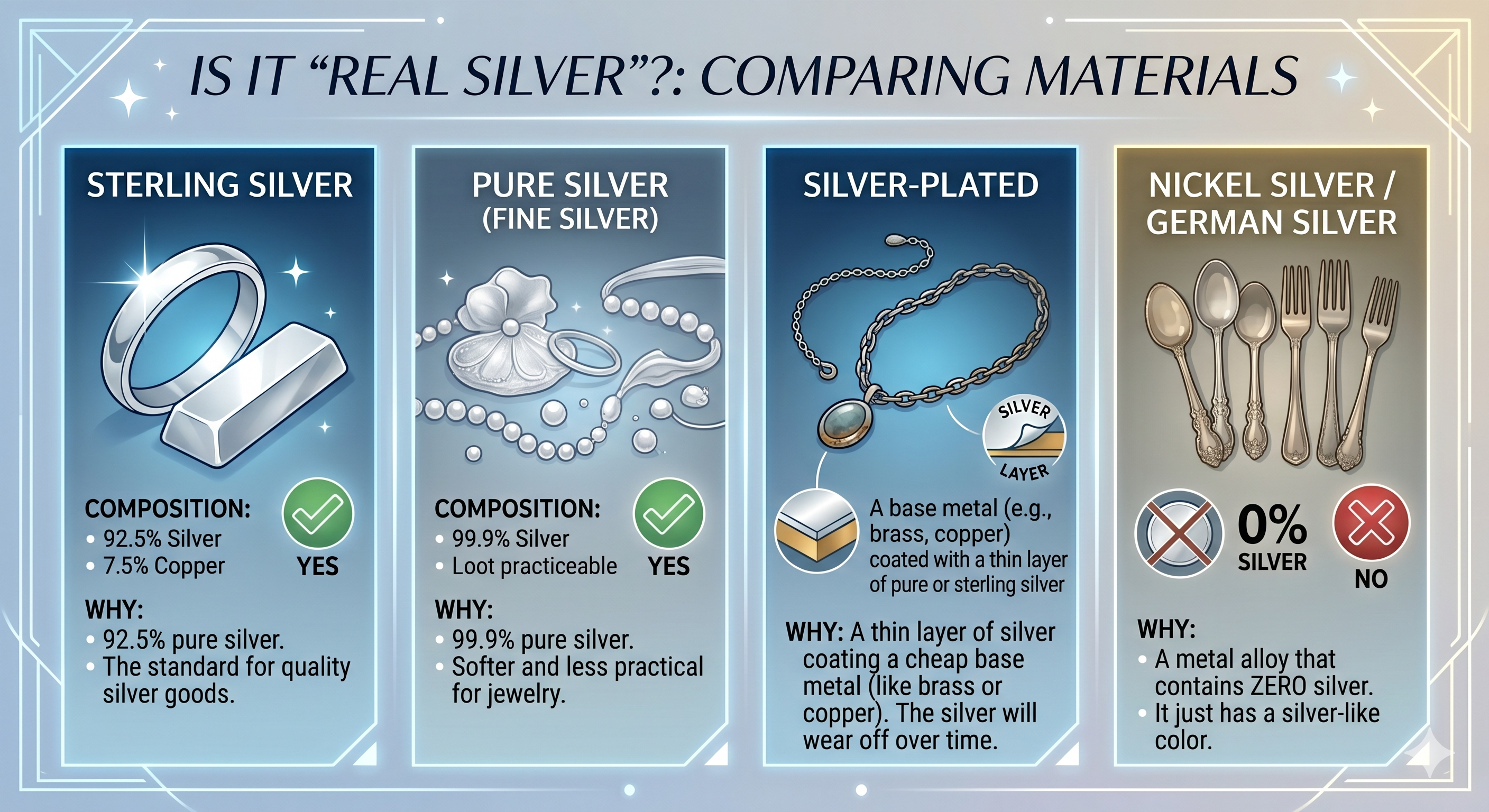
The Simple Test for "Real" Sterling Silver
To know if you have real sterling silver, look for the hallmark. This is the manufacturer's guarantee of authenticity stamped directly onto the item.
Look for these stamps:
925 (the most common and universal)
Sterling
Ster
If you see one of these stamps, you are holding real sterling silver. If you don't see a stamp, or you see marks like "SP" (Silver Plated) or "NS" (Nickel Silver), then it is not solid sterling silver.
Sterling silver is not fake; it is the practical and standard form of real silver used for durable and beautiful goods. It is definitely "real silver," and its 92.5% purity is what makes it both valuable and usable.
Is Sterling Silver Good Quality?
Yes, sterling silver is considered good quality, especially when you balance its cost, durability, and appearance. However, like any material, its "goodness" depends on your expectations and what you're comparing it to.
Let's break down why it's a quality choice and in what contexts.
The "Yes" - Why Sterling Silver is Good Quality
It's a Precious Metal: Sterling silver is 92.5% pure silver, placing it in the category of precious metals alongside gold and Platinum. This gives it intrinsic value and distinguishes it from cheap costume jewelry or base metals.
Ideal Balance of Purity and Durability: As discussed before, pure silver is too soft. The 7.5% alloy (usually copper) makes sterling silver strong enough for everyday wear while retaining the beautiful luster and value of silver. This makes it durable yet malleable enough for intricate designs.
Hypoallergenic Properties: For most people, sterling silver is hypoallergenic and safe for sensitive skin. The high silver content is non-reactive. (Note: A very small number of people can be sensitive to the copper used in the alloy, but this is rare.)
Timeless Value and Appearance: It offers the classic, bright luster of silver that has been valued for centuries. It's a versatile metal that works for both casual and formal jewelry and maintains a status of elegance.
Accessible Price Point: This is a key factor in its quality proposition. It provides the look and feel of a precious metal at a fraction of the cost of white gold or platinum, making fine jewelry accessible to a wider audience.
The Nuances - Considerations and "Quality" Depends On Context
To give a complete picture, it's important to understand its relative position:
It Requires Maintenance (Tarnishing): The primary "downside" is that it tarnishes. A quality piece that requires occasional polishing is different from a low-quality item, but this maintenance factor is something to consider versus metals that don't tarnish, like platinum or stainless steel.
Compared to Other Metals:
vs. Pure Silver: Sterling silver is higher quality for functional use (like jewelry) because it's more durable.
vs. Silver-Plated: Sterling silver is dramatically higher quality. Silver plating is a thin layer over a cheap base metal that will wear off. Sterling silver is solid and lasts a lifetime.
vs. White Gold/Platinum: Here, sterling silver is the more affordable, entry-level precious metal. White gold and platinum are more durable, heavier, and much more expensive. They are often considered a step above in terms of luxury and longevity, especially for permanent items like engagement rings.
Craftsmanship Matters: The "quality" of a sterling silver item isn't just about the metal. A poorly made sterling silver ring with weak clasps and rough finishes is not a high-quality item. A well-made piece from a reputable artisan or brand, with excellent construction and finishing, is absolutely good quality.
Verdict: Is Sterling Silver Good Quality?
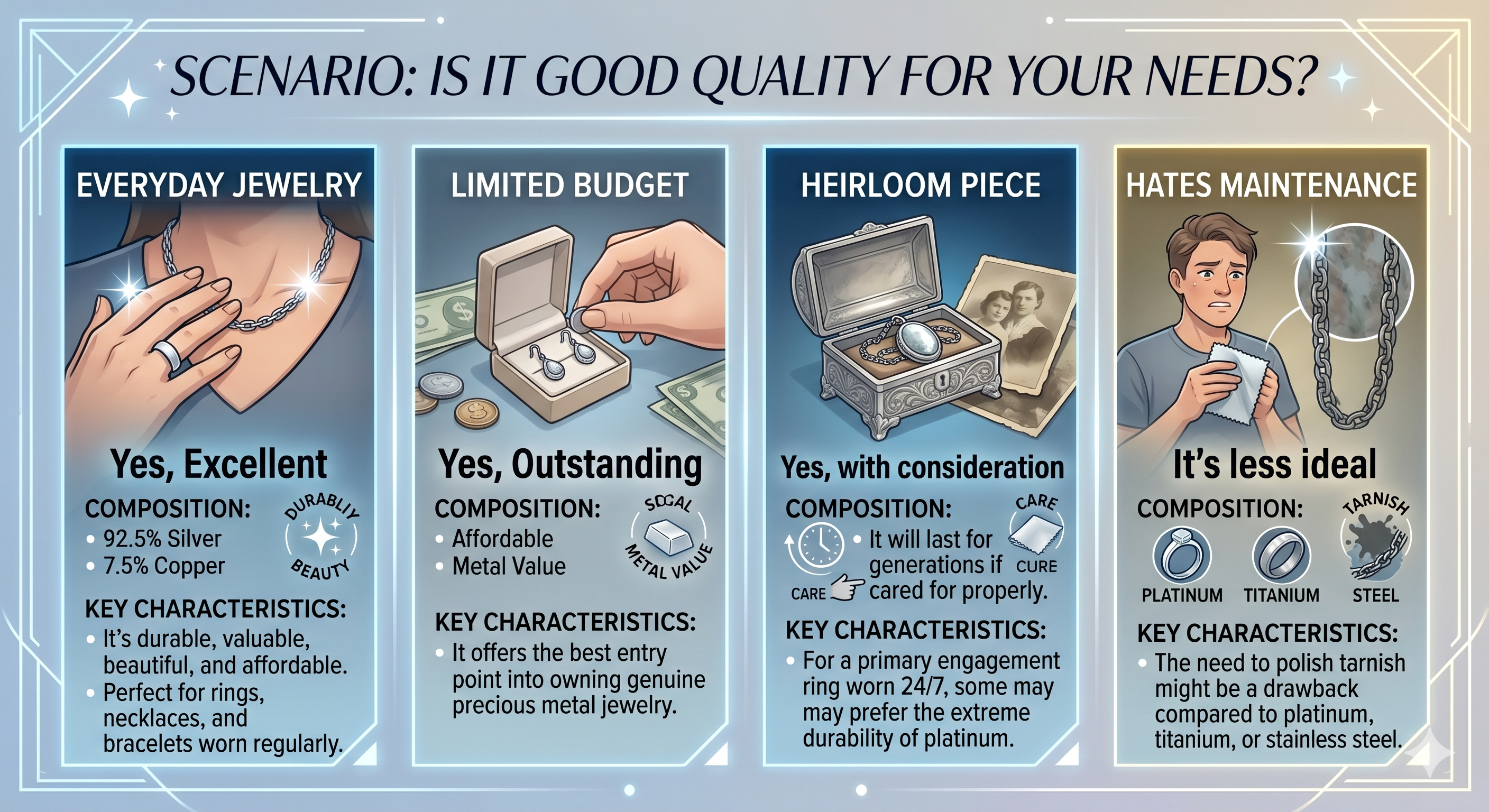
Think of sterling silver as the reliable, high-value choice in the world of precious metals. It is unambiguously good quality—a solid, valuable, and beautiful material that sits well above fashion jewelry but below the ultra-premium price point of platinum.
For the vast majority of people looking for beautiful, durable, and real jewelry, sterling silver is an excellent and smart choice.
How Much Is Sterling Silver Worth Now?
This is a common question, but the answer has two distinct parts: its value as a raw material (the "melt value") and its price as a finished product (like jewelry).
Here’s a breakdown of how sterling silver is valued.
1. The Base Value: "Melt Value" or Intrinsic Value
This is the value of the sterling silver itself based on the current market price of pure silver. It's what a refinery or scrap buyer would pay you for the metal.
How to Calculate the Melt Value:
Find the Current Spot Price of Silver: This changes constantly throughout the trading day. You can check it on financial websites like Kitco.com, JMBullion.com, or a simple web search for "silver spot price." The price is given per troy ounce of pure silver.
Example: Let's assume the spot price is $28.00 per troy ounce.
Account for Sterling Silver's Purity: Sterling silver is only 92.5% pure silver.
Calculation: Spot Price x 0.925
*Example: $28.00 x 0.925 = $25.90 per troy ounce.*
Weigh Your Item in Troy Ounces: Standard kitchen scales use avoirdupois ounces. Precious metals use troy ounces (1 troy ounce = 31.1 grams).
Weigh your item in grams and divide by 31.1 to get the weight in troy ounces.
*Example: A 20-gram ring. 20 / 31.1 = 0.643 troy ounces.*
Final Calculation:
(Spot Price) x 0.925 x (Weight in Troy Ounces) = Melt Value
*Example: $28.00 x 0.925 x 0.643 = $16.65*
So, the intrinsic meltdown value of that example ring is about $16.65.
Important Note: If you sell to a scrap buyer, they will pay you less than this calculated value (often 60-80% of it) to cover their refining costs and profit margin.
2. The Retail Price: What You Pay for Finished Goods
This is the price you pay when you buy a sterling silver item from a jeweler or retailer. It is much higher than the melt value and includes:
Cost of Materials: The melt value we calculated.
Manufacturing & Labor: The cost of designing, casting, soldering, polishing, and setting any stones.
Brand Markup: Well-known brands (like Tiffany & Co.) command a significant premium for their name and craftsmanship.
Retail Markup: The store's overhead (rent, staff, utilities) and profit.
Gemstones: If the piece has gemstones (even semi-precious ones), they add substantial value.
Antique or Artistic Value: Unique, antique, or handcrafted artisan pieces have value beyond their metal content.
Examples of Retail Price Ranges:
A simple sterling silver ring: $30 - $150
A sterling silver chain necklace: $50 - $300+
A pair of sterling silver earrings with gemstones: $75 - $400+
A designer sterling silver piece: $200 - $1,000+
Summary: What Determines the Price?
| If you are... | Then the value is based on... |
| Selling scrap silver | Melt Value (calculated from spot price, purity, and weight). |
| Buying a new piece | Retail Price (melt value + craftsmanship + brand + gemstones). |
| Selling a vintage/jewelry piece | A mix of its melt value and its resale value as a finished good (condition, brand, and style matter greatly). |
For current silver spot prices, visit the Kitco Precious Metals Price Guide.
Is Sterling Silver Costlier than Silver?
That's an excellent and subtle question. The answer is a bit nuanced because it depends on what you mean by "silver."
In short:
Compared to Pure (Fine) Silver, Sterling silver is generally less expensive for a finished item of the same size, even though pure silver is purer.
Compared to Silver-Plated: Sterling silver is significantly more expensive.
Here’s a detailed breakdown of why.
1. Sterling Silver vs. Pure Silver (Fine Silver)
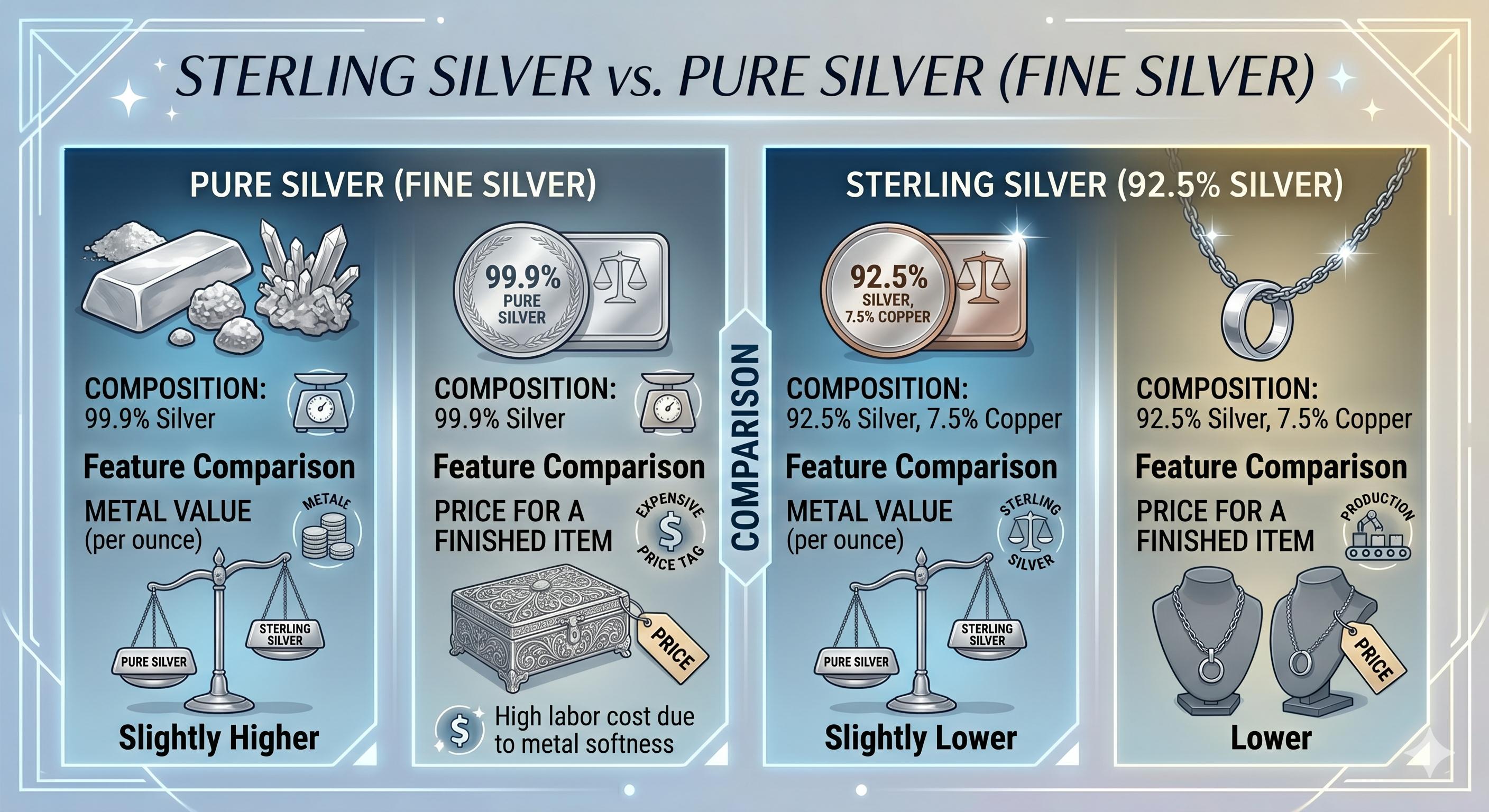
Why is this?
While pure silver has a slightly higher raw material value per ounce (because it's purer), it is rarely used for jewelry or functional items because it's too soft.
If an artisan were to make a ring from pure silver, it would be extremely difficult to work with, would not hold gemstones securely, and would be easily damaged.
Because of this, any finished item made from pure silver would be a specialty, artistic piece, and the high labor cost and rarity would make it more expensive than a similar item made from the much more practical sterling silver.
Analogy: Imagine a sculptor. A block of pure, soft clay might be slightly more expensive than a block of clay mixed with a hardener. But the statue made from the hardened clay is a usable, sellable product, while the pure clay block is mostly just a raw material.
2. Sterling Silver vs. Silver-Plated
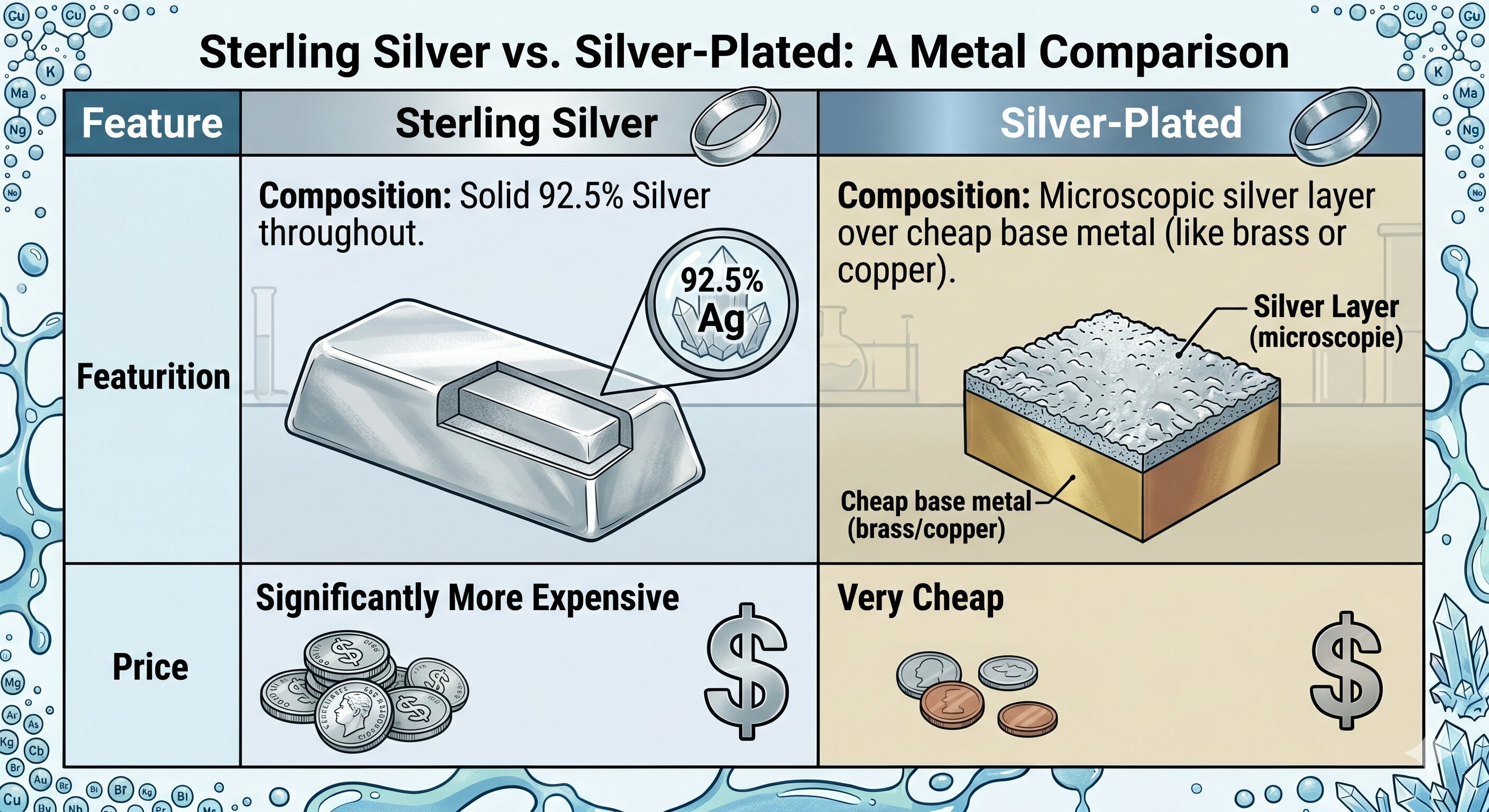
Why is this?
This is a clear case of "you get what you pay for." Sterling silver is a solid precious metal with intrinsic value. Silver-plated items have almost no intrinsic metal value, as the layer of silver is incredibly thin and will eventually wear off, revealing the cheap base metal underneath.
Summary: Which is More Costly?
To avoid confusion, let's be specific:
If you are buying a piece of JEWELRY: A piece made from pure (fine) silver would be the most costly and rare option. Sterling silver is the standard, high-quality, and more affordable precious metal option.
If you are comparing raw MATERIAL value, Pure silver has a slightly higher value per ounce than sterling silver.
If you see a "silver" item at a very low price, it is almost certainly silver-plated, which is the least costly option and not a precious metal.
In everyday terms, when people ask about jewelry, the cost hierarchy is:
Most Costly: Pure Silver (Fine Silver) Jewelry (rare) > Sterling Silver > Silver-Plated Least Costly
So, for the item you are most likely to buy and wear, sterling silver offers the perfect balance of cost, beauty, and durability, making it more costly than plated jewelry but generally less costly than items made from pure silver.
Is Sterling Silver Better Than 925?
No, sterling silver is not better than 925. They are the same thing.
The term "925" is simply the universal hallmark that certifies and proves an item is made of sterling silver.
Think of it this way:
"Sterling Silver" is the name of the material.
"925" is its official ID card.
The Relationship Explained
When you see "925" stamped on a piece of jewelry or silverware, it is a guarantee from the manufacturer that the item meets the legal standard for sterling silver: 92.5% pure silver.
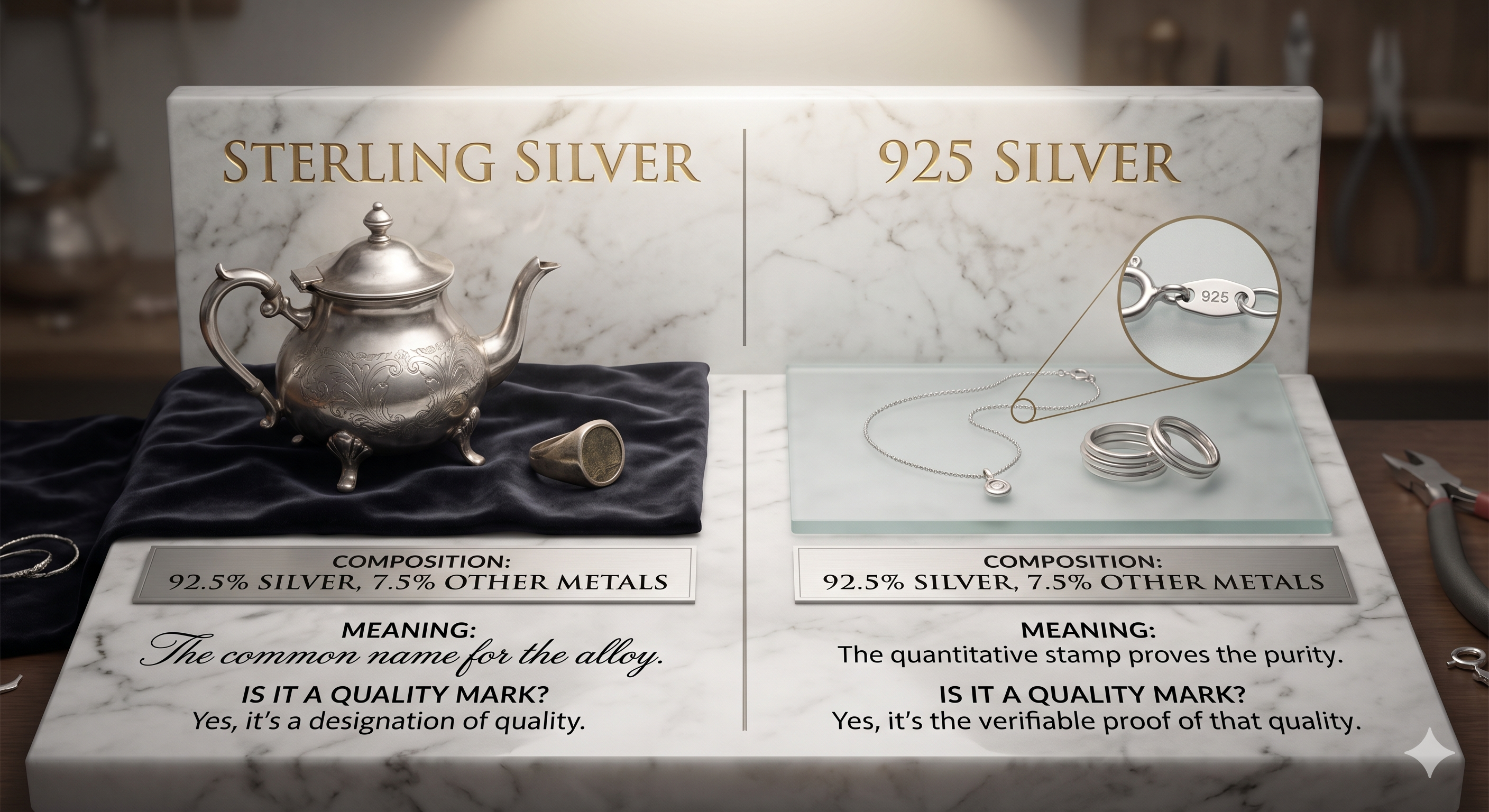
Why Two Terms?
The two terms are used in slightly different contexts:
"Sterling Silver" is used in descriptive language.
Example: "This necklace is made of beautiful sterling silver."
"925" is used as a mark of authentication on the physical product itself.
Example: When you look at the clasp of the necklace, you'll find a tiny stamp that says "925."
What You Should Look For
If you are buying a piece and want to ensure it's genuine sterling silver, you should actively look for the "925" stamp. A piece that is described as "sterling silver" but lacks this hallmark should be treated with suspicion.
There is no difference in quality, value, or material. "Sterling Silver" and "925 Silver" are two ways of saying the same thing. One is the common name, and the other is the technical certification. So, when you see "925," you can be confident you are holding a genuine piece of sterling silver.
Is Sterling Silver Good For A Ring?
Absolutely, sterling silver is an excellent choice for a ring, and it's one of the most popular materials used in jewelry for very good reasons. However, like any material, it has its pros and cons.
Here’s a detailed breakdown to help you decide if it's the right choice for your ring.
The "Pros" - Why Sterling Silver is Great for Rings
Durability & Strength: The 7.5% alloy (usually copper) makes sterling silver strong enough for daily wear. It's far more durable than pure silver, so it can withstand the bumps and knocks that a ring on your hand is likely to encounter.
Beautiful Appearance: It has a bright, brilliant white luster that is classic and timeless. It looks fantastic on its own and provides a stunning, neutral backdrop for gemstones.
Affordability: This is a major advantage. Sterling silver offers the look and feel of a precious metal at a fraction of the cost of white gold or platinum. This allows you to get a larger or more detailed design for your budget.
Hypoallergenic: For the vast majority of people, sterling silver is hypoallergenic and safe for sensitive skin. The high silver content is non-reactive.
Versatility in Design: It's a relatively soft metal (compared to platinum but harder than gold), which makes it ideal for intricate carvings, detailed designs, and artisan craftsmanship.
The "Cons" - Important Considerations
Tarnishing: This is the primary drawback. Sterling silver will tarnish over time when exposed to air and moisture, turning it a dull yellow, brown, or black. This is not a sign of poor quality; it's a natural chemical reaction.
Solution: Tarnish is easily removed with a polishing cloth. You can also slow it down by storing your ring in an airtight bag when not in wear and keeping it away from chemicals (like chlorine, lotions, and perfumes).
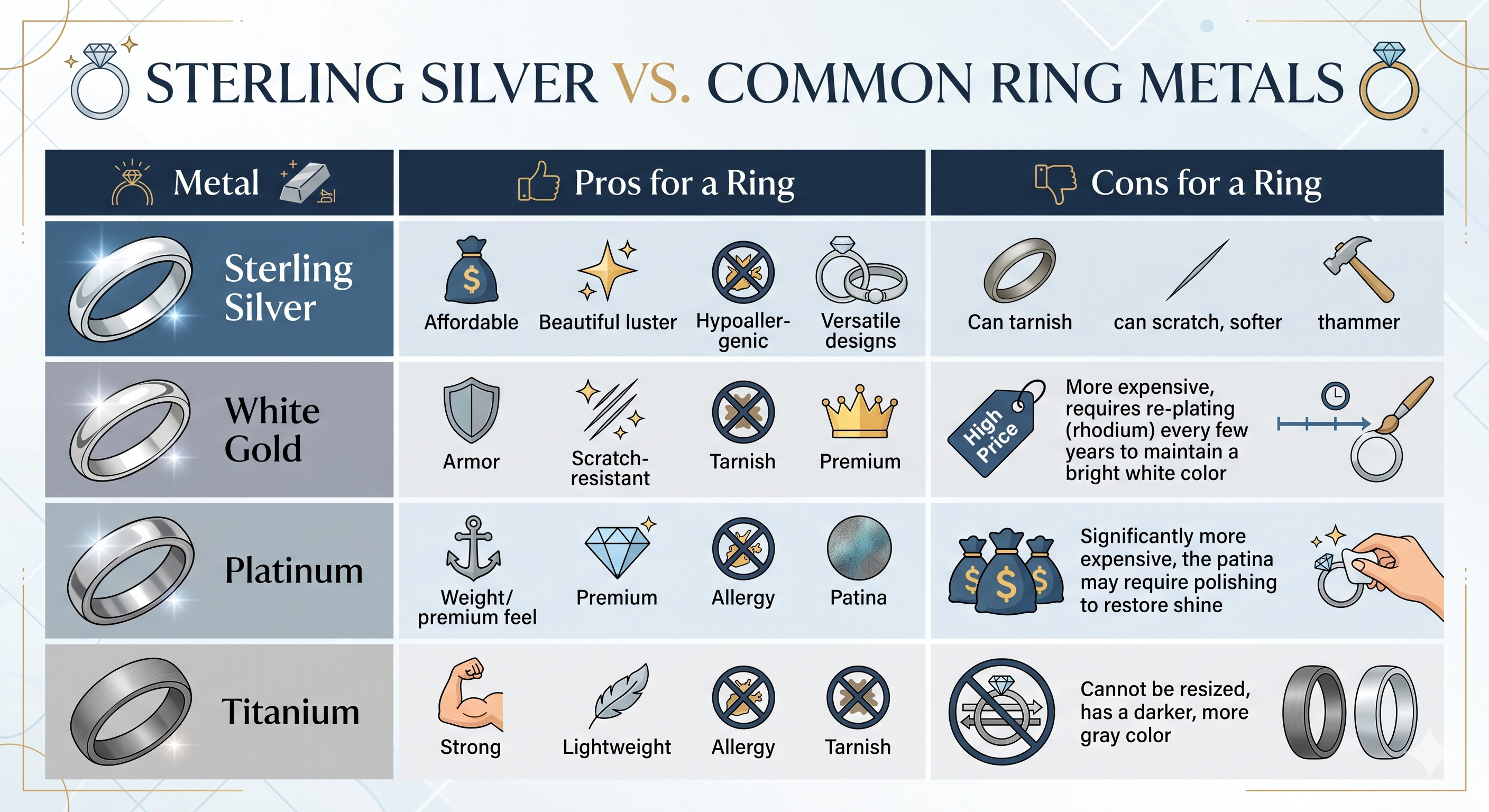
Softness (Relative to Other Metals): While durable, it is softer than platinum, titanium, or tungsten carbide. This means:
It can scratch over time, developing a "patina" that some people enjoy but others dislike.
For rings with very thin bands or delicate prongs holding expensive gemstones, it may not be as secure as platinum over many decades.
Potential for Allergic Reaction (Rare): A small number of people are sensitive to the copper used in the alloy. This can cause minor skin discoloration (a green or black mark) or, very rarely, irritation. This is more common if the ring is tight and traps moisture against the skin.
“In 1912, the RMS Titanic sank in the Atlantic. Among the wreckage, divers later recovered a sterling silver locket — still intact, still legible, still shining after decades in salt water. The copper in the alloy had protected it from complete corrosion.
Sterling silver is not indestructible. But it is stubborn. It survives shipwrecks, house fires, and grandmother‘s jewelry boxes. That is why we still choose it: not because it is perfect, but because it endures. A sterling silver ring will not last forever. But it will last long enough — for your lifetime, and maybe for someone else‘s too.”
Sterling Silver vs. Common Ring Metals
Verdict: Is a Sterling Silver Ring a Good Choice?
Yes, for the vast majority of people and situations, it is a fantastic choice.
It's particularly ideal for:
Everyday Fashion Rings: Perfect for stacking, statement rings, or daily wear.
Budget-Conscious Buyers: You get incredible style and quality for your money.
Trying New Styles: It allows you to experiment with bold designs without a major financial commitment.
People with Sensitive Skin: It's a safe and comfortable option for most.
You might want to consider a different metal:
You are looking for an engagement or wedding band you plan to wear 24/7 for decades without any maintenance or visible wear.
You strongly dislike the idea of polishing your jewelry to remove tarnish.
You have a known sensitivity to copper.
Sterling silver offers the best balance of beauty, affordability, and durability for a ring. As long as you understand and are comfortable with the minimal maintenance required, it is an outstanding and highly recommended choice.
Is Sterling Silver Good For Everyday Wear?
The short answer is: Yes, sterling silver is an excellent choice for everyday wear.
It strikes the perfect balance of durability, beauty, and affordability. However, "good for everyday wear" doesn't mean you can ignore it completely. Think of it like a nice pair of leather shoes—they're great for daily use, but you need to take basic care of them.
Here’s why sterling silver is a top choice for daily jewelry, along with the realistic downsides and how to manage them.
Why Sterling Silver Is Great for Everyday Wear (The Pros)
Durability: Because it's alloyed with copper, sterling silver is much harder and more resistant to scratching and bending than pure silver. A well-made sterling silver ring or chain can easily last a lifetime of daily wear.
Hypoallergenic (for most people): While a small percentage of people have a sensitivity to nickel (not in real sterling) or copper, sterling silver is generally considered safe for sensitive skin. It's a far better choice than cheap costume jewelry made of mystery metals.
Easy to Clean & Maintain: Bringing it back to life is simple. A quick polish with a soft cloth removes most everyday tarnish. For heavier tarnish, a few minutes in a baking soda and aluminum foil bath makes it look brand new.
Timeless & Versatile: Sterling silver matches everything—casual t-shirts, formal business wear, and elegant evening gowns. It never goes out of style.
Affordable to Replace/Repair: Unlike gold or platinum, losing a sterling silver earring or breaking a chain is not a financial disaster. This makes it less stressful to wear daily.
The Realities of Daily Wear (The Cons)
This is where your previous questions come into play. You will experience these things, but they are manageable.
It Will Tarnish: This is the biggest fact of life with sterling silver. Daily exposure to air, humidity, sweat, and skin oils will cause it to develop a dark, yellowish, or black film (tarnish). It's not damaged, just a chemical reaction.
Manage it b: Polishing it once a week or every other week with a jewelry cloth.
It Can Turn Your Skin Green (Occasionally): As we covered, the copper can react with your sweat to leave a faint green or black stain.
Manage it by applying clear nail polish to the inside of rings, keeping your jewelry dry, and taking it off before intense workouts.
It Can Scratch: Softer than gold or platinum, sterling silver will develop a "patina" of micro-scratches over time. Some people love this look; others don't.
Manage it by: Taking it off before heavy manual labor, gardening, or moving furniture. Store it in a soft pouch, not loose in a drawer.
The Most Important Rule for Daily Wear: Remove It During These 3 Activities
To get the longest life out of your daily-wear sterling silver, you must develop one simple habit: Take it off before:
Showering, Swimming, or Doing Dishes. (Water + chlorine + soap = rapid tarnish and potential damage).
Working Out or Heavy Sweating. (Salt in sweat accelerates tarnish and the green-skin reaction).
Applying Lotions, Sunscreens, or Perfumes. (Chemicals in these products can react with the metal). Put your jewelry on after your products have dried.
If you follow that one rule, your sterling silver will stay beautiful for years.
When is Sterling Silver Not Good for Everyday Wear?
There are a few specific situations where you might want to choose a different metal for your daily piece:
For Very Delicate Items: A super thin chain (like 0.5mm) or a ring with a very thin band (under 1mm) is more prone to bending or breaking with daily stress. Choose a sturdier chain (1.5mm+) or band.
For High-Impact Jobs/Activities: If you are a construction worker, mechanic, rock climber, or potter, your jewelry will take a beating. A tungsten or titanium ring might be more durable. Or, simply remove your sterling jewelry during work hours.
For Severe Metal Allergies: If you have a confirmed copper allergy (rare, but possible), you will react to sterling silver. In that case, look for hypoallergenic metals like titanium, niobium, or platinum.
How to Choose a Sterling Silver Piece for Daily Wear
Not all sterling silver is created equal. Look for these features for the best daily-wear piece:
Look for the .925 Stamp: Guarantees it's real sterling silver, not cheap plated metal.
Choose a Thicker Gauge: For chains, 1.5mm or thicker. For rings, a band width of at least 2mm.
Consider "Argentium" Silver: This is a modern sterling silver alloy that replaces some copper with germanium. It is much more tarnish-resistant (up to 10x more) and harder than traditional sterling. It's the best choice for everyday wear if you can find it.
Examine the Finish: A well-polished piece will resist tarnish slightly better than a matte or textured finish.
Can You Wear Sterling Silver In Water?
You asked this earlier, and the short answer remains: Technically yes, but you really shouldn't if you want to keep it looking good.
Since you're asking again, let me give you an even clearer, more direct summary of the risks and the one simple rule to remember.
The One Simple Rule
"Sterling silver is for wearing, not for getting wet."
Treat it like a nice pair of leather shoes or a silk shirt. It can survive an accidental splash, but you would never intentionally wear them in the shower or pool.
What Happens in Different Types of Water? (Quick Chart)
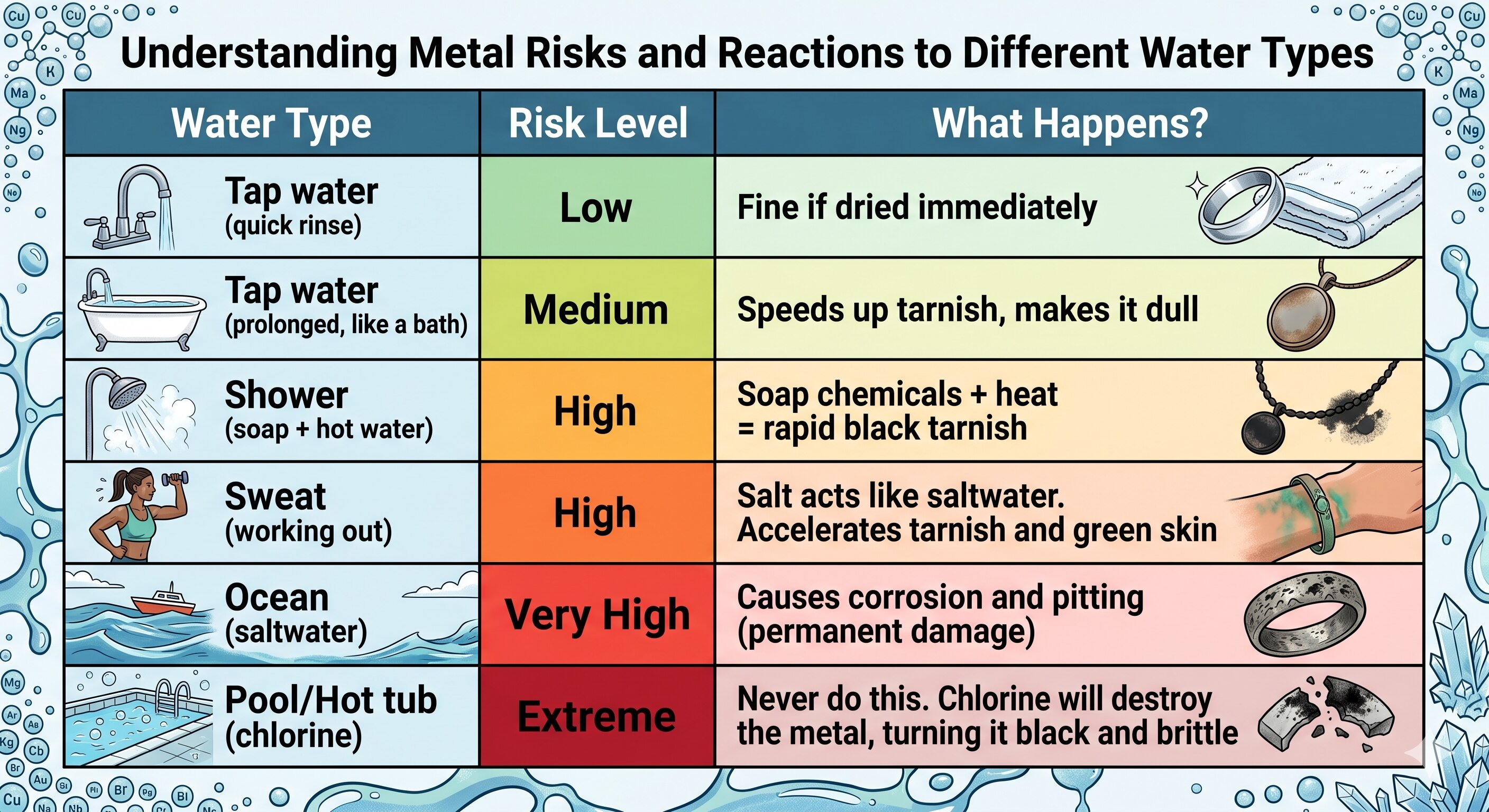
The Only Two Exceptions (Rare)
Pure silver (.999): No copper, so it resists water better. But it's very soft and uncommon for jewelry.
Sealed jewelry: Coated with clear resin or e-coating. But that coating wears off over time.
What If You Forget and Get It Wet?
Don't panic. Just do this immediately:
Rinse with clean tap water (to remove chlorine/salt/soap).
Pat completely dry with a soft cloth.
Let it air dry for 10-15 minutes before storing.
Accidental splash while washing hands? No problem. Dry it off.
Showering, swimming, doing dishes? Take it off first.
Sterling silver will not dissolve or instantly break in water. But regular water exposure will make it dull, black, and eventually damaged. A few seconds to remove a ring or necklace is well worth keeping it beautiful for years.
How Do You Clean Sterling Silver?
Cleaning sterling silver effectively involves understanding why it tarnishes and choosing the right method based on how dirty it is.
Tarnish is a layer of silver sulfide that forms when silver reacts with sulfur in the air or from substances like lotion, perfume, or even some foods. The copper in the sterling silver alloy makes this reaction more likely.
Here is a quick guide to the most recommended cleaning methods, from gentlest to strongest:
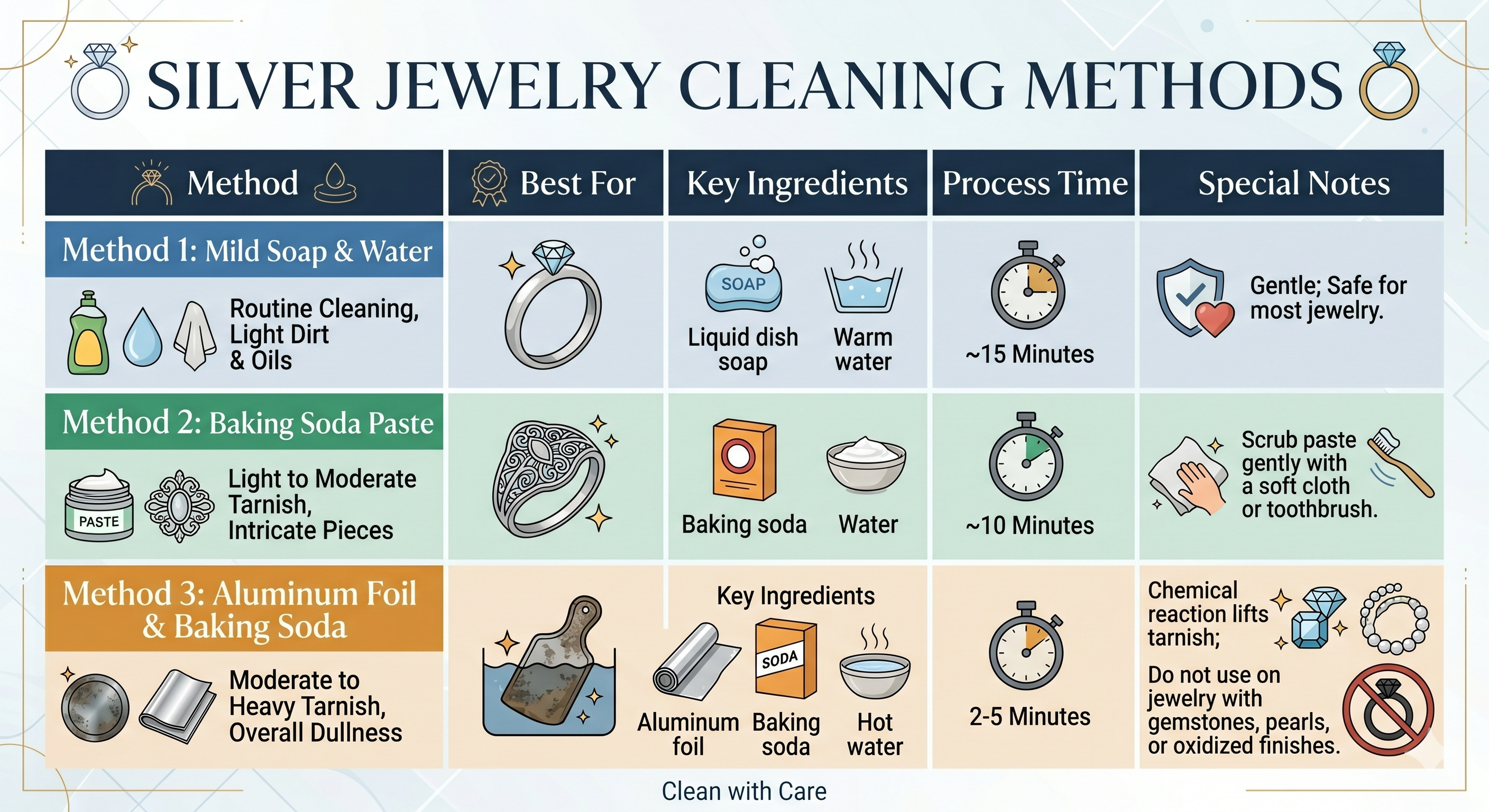
Step-by-Step Cleaning Methods
For Routine Cleaning: Mild Soap & Water
This is the safest method for maintaining your pieces after wear.
Mix a few drops of mild dish soap in a bowl of warm water.
Soak the jewelry for 5-10 minutes to loosen dirt.
Gently scrub with a soft-bristled toothbrush, especially in crevices.
Rinse thoroughly under cool water.
Dry completely with a soft, lint-free cloth before storing.
For Noticeable Tarnish: Baking Soda Paste
A slightly abrasive paste can help scrub away tarnish.
Mix baking soda with a little water to form a thick paste.
Apply the paste to the jewelry with your fingers, a soft cloth, or a toothbrush.
Gently rub the item, then let it sit for 2-3 minutes.
Rinse thoroughly with warm water and dry completely with a soft cloth.
For Heavy Tarnish: Aluminum Foil Soak
This method uses a safe chemical reaction (electrolysis) where the tarnish (silver sulfide) transfers from the silver to the aluminum foil.
Line a heat-safe bowl with aluminum foil (shiny side up).
Place the tarnished silver on the foil, ensuring contact.
Sprinkle 1-2 tablespoons of baking soda over the jewelry.
Carefully pour boiling water into the bowl to cover the items. You should see immediate fizzing.
Let it soak for 2-5 minutes, then remove with tongs.
Rinse with cool water, dry thoroughly, and buff with a clean cloth.
Important Warnings and Storage Tips
What to Avoid: Never use harsh chemicals like bleach, ammonia, or Windex. Avoid abrasive pads or rough brushing that can scratch the silver.
Special Cases:
Gemstones & Pearls: Do not use the aluminum foil method or submerge porous stones (like pearls, opals, or emeralds). Clean only with a damp cloth.
Oxidized Silver: This has a deliberate dark finish. Clean only with a dry soft cloth, as polishing will remove the intended antique look.
How to Store & Prevent Tarnish:
Store pieces individually in anti-tarnish pouches or a cloth-lined box to prevent scratches and reduce air exposure.
Keep silver in a cool, dry place. Adding a piece of chalk or a silica gel packet to your storage box can help absorb moisture.
Put jewelry on last when getting ready. Remove it before swimming, showering, cleaning, or applying lotions and perfumes.
When to Seek a Professional
Consider professional cleaning for valuable, antique, or complex pieces with delicate gemstones. Jewelers can also perform polishing, but note that polishing removes a tiny layer of metal each time and should only be done occasionally.
I hope this helps you restore your silver's shine. If you can tell me whether your piece is plain silver, has gemstones, or has a blackened (oxidized) design, I can give you more specific advice.
For more on jewelry care, visit the American Gem Society's care guide.
What Is The Best, Sterling Silver Or Plated Silver?
Choosing between sterling silver and silver-plated items depends on what you value more: long-term durability and intrinsic value, or a lower initial cost.
Here’s a quick comparison of their key differences:
.png)
How To Tell Them Apart
When evaluating an item, the easiest and safest method is to check for a hallmark. Sterling silver is always marked with terms like "Sterling," ".925," or "925". Silver-plated items may have marks like "EP," "EPNS," or "Silver Plate," but many have no marks at all.
Look for Wear: On plated items, you might see discoloration (like reddish copper showing through) or flaking where the thin silver layer has worn away.
Get a Professional Evaluation: For a definitive answer, visit a reputable jeweler or precious metal buyer who can use an XRF analyzer to test the metal content without damage. Avoid acid tests, as they can harm the item.
Which One is Right for You?
Choose Sterling Silver for: Heirloom-quality jewelry you'll wear daily, items with significant sentimental or investment value, or if you have sensitive skin.
Silver Plating is Suitable for: Fashion jewelry where you want the "look" for a season, decorative household items, or costume pieces where low cost is the priority.
Ultimately, there is no single "best" choice—it depends on your needs for quality, budget, and purpose.
I hope this helps you make a clear decision. If you'd like to know more about how to identify a hallmark on a specific piece you have, feel free to ask!
Beautiful. Affordable. Everyday elegant.
Does Sterling Silver Turn Green?
The short answer is: Yes, sterling silver can cause your skin to turn green or black, but it's not due to the silver itself.
Here’s the detailed breakdown of why it happens, what's actually causing the color, and how to prevent it.
The Real Culprit: Copper and Your Body Chemistry
Sterling silver is an alloy, meaning it's a mixture of metals. Pure silver (99.9%) is too soft for jewelry, so it's mixed with other metals to make it durable. By definition, sterling silver is 92.5% silver and 7.5% other metals, almost always copper.
The green or black discoloration comes from a reaction involving that copper.
Oxidation: Your skin’s sweat and natural oils contain salt, acids (like fatty acids), and sulfur compounds.
The Chemical Reaction: These compounds react with the copper in the sterling silver. This reaction forms copper chloride or copper sulfate.
The Green Stain: Copper chloride and copper sulfate are greenish-blue in color. This compound transfers onto your skin, leaving a greenish stain.
Key Point: This is not rust, and it's not harmful. It’s simply a chemical stain, similar to when a penny leaves a green mark on your skin.
What about the color black?
Sometimes, sterling silver leaves a black or dark grey mark instead of green. This is usually due to a different reaction with sulfur (found in the air, certain foods like eggs, and some body chemistries). This creates silver sulfide (the same black tarnish you see on old silverware), which can also rub off on your skin.
Why It Happens to Some People and Not Others
Not everyone's skin reacts to sterling silver. The green effect depends entirely on the individual's body chemistry. You're more likely to experience it if:
Your sweat is more acidic (often due to diet, medication, or stress).
You use certain lotions, perfumes, or soaps that contain chemicals that accelerate the reaction with copper.
You live in a humid climate (moisture speeds up the reaction).
You wear the jewelry while exercising or sleeping, exposing it to more sweat and friction.
How to Prevent Sterling Silver from Turning Your Skin Green
Apply a Barrier: The simplest solution. Paint a thin coat of clear nail polish on the inside of the ring (or the parts that touch your skin). This creates a physical barrier between the metal and your skin.
Keep it Dry: Remove your jewelry before showering, swimming, exercising, or doing dishes. Moisture and sweat are the main accelerants.
Remove Before Lotions: Put on your lotions, sunscreens, and perfumes first, let them dry completely, then put on your jewelry.
Clean it Regularly: Use a soft polishing cloth to remove the tarnish (silver sulfide) that can build up and rub off on your skin.
The Most Important Takeaway: Is it real sterling silver?
Real, high-quality sterling silver will not turn your skin green quickly or dramatically. A quick, faint green smudge after wearing a ring for 12 hours on a hot day is normal.
However, if your jewelry turns your skin green immediately or a very dark green/black within an hour, it's almost certainly NOT real sterling silver. It is likely a cheap base metal like nickel, brass, or copper, plated with a microscopic layer of silver. The underlying metal is reacting violently with your skin.
How to check: Look for the hallmark. Real sterling silver is almost always stamped with .925 or STER.
Summary
Does real sterling silver (.925) turn skin green? Yes, occasionally, due to the copper in the alloy reacting with your body chemistry. It's normal, harmless, and preventable.
Is my jewelry fake if it turns my skin green? Not necessarily. But if it's extremely bad or instant, it's very likely fake or a very low-quality silver plate.
How to stop it? Clear nail polish on the inside of the jewelry is the most effective fix.
Shop our sterling silver collection—the smart choice for real jewelry that doesn't break the bank. [Shop Sterling Silver Rings →]
Channel Setting Guide: Pros, Cons, Safety and Cost vs Pavé
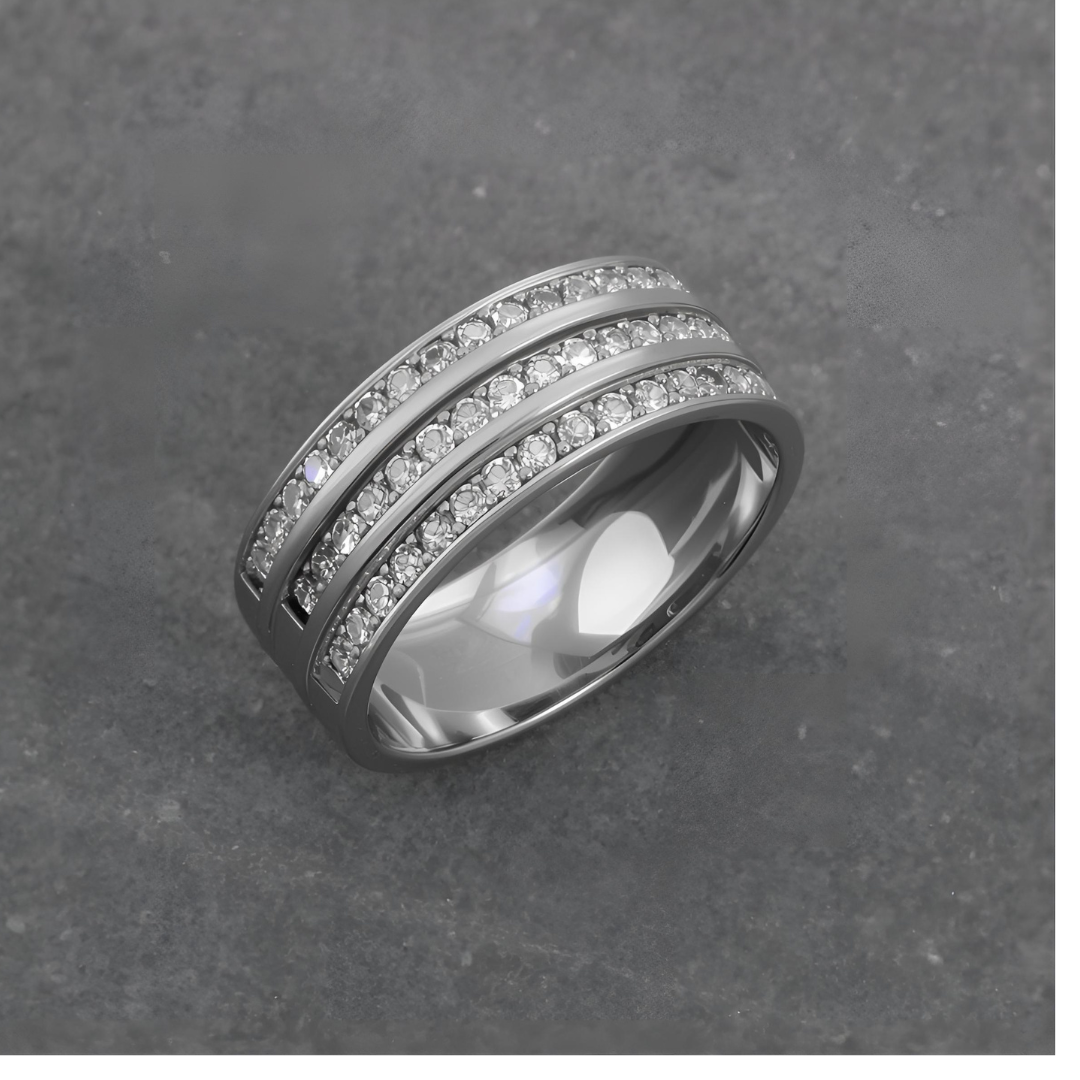
Channel Setting Guide: Pros, Cons, Safety, and Cost vs Pavé
In 1953, Queen Elizabeth II wore a very special piece of jewelry to her coronation—a bracelet set with rows of diamonds, each one nestled snugly between two metal walls, with no prongs in sight.
That bracelet, now known as the "Channel Set Diamond Bracelet," became one of her most worn pieces. Why? Because channel setting is the most comfortable way to wear multiple stones.
No prongs to catch on her gloves. No gaps for dirt to hide. Just a smooth, continuous line of sparkle that glides over the skin.
For a queen who spent her days greeting world leaders and her nights at state banquets, channel setting offered something priceless: effortless elegance.
The same setting that graced a queen‘s bracelet and Hollywood‘s brightest stars now awaits your own everyday elegance — no prongs, no snags, just a smooth line of sparkle. Every channel setting ring in our collection is crafted with closed ends for maximum security.”
[Button: Explore Channel Setting Rings →]
Channel Setting Ring Meaning
A channel setting ring is a jewelry method where gemstones are set into a channel created by two parallel walls of metal.
Table of Contents
In simple terms, a channel setting is a method of securing gemstones (usually diamonds) in a ring by suspending them between two parallel walls of metal, creating a smooth, seamless "channel" of stones.
Think of it like a beautiful, paved path of gems set flush within the band of the ring.
Here’s a more detailed breakdown:
How a Channel Setting Works
The "Channel": The jeweler creates a groove or a channel from a solid piece of metal. This channel has two vertical walls on either side.
Securing the Stones: The gemstones are carefully slid into this channel. Each stone sits snugly against its neighbors.
The "Rail": The top edges of the metal walls are then gently rolled or pressed over the girdle (the widest part) of the gems. This holds the stones securely in place without the use of individual prongs.
Key Characteristics & Visual Appearance
Sleek and Continuous: The stones are set in a straight or curved line with no metal separating them from the sides, creating an uninterrupted line of sparkle.
Smooth and Snag-Free: Because there are no prongs, the surface is very smooth. This makes it an excellent choice for people with active lifestyles or those who work with their hands, as it's less likely to catch on clothing or hair.
Modern and Uniform: It offers a clean, modern, and elegant look. The symmetry of the stones is a major part of its appeal.
Advantages of a Channel Setting
Excellent Security: The stones are extremely well-protected. With metal on both sides and no exposed edges, it's very difficult for a stone to become loose or fall out.
Durability: The design protects the stones from impact and everyday wear and tear.
Comfort: The smooth, low-profile design is very comfortable to wear.
Enhances the Band: It can make the ring's band look more substantial and luxurious. It's a popular choice for wedding bands and eternity rings.
Disadvantages of a Channel Setting
Less Brilliance than Prong Settings: Because a significant portion of the top and bottom of each stone is covered by metal, less light can enter and exit the stone. This can result in slightly less sparkle and brilliance compared to a prong setting, which allows more light in from all angles.
Difficult to Repair/Resize: Resizing a channel-set ring can be very challenging and expensive, especially if it's a full eternity band (with stones all the way around). It can also be difficult for a jeweler to access and tighten an individual stone if it becomes loose.
Accumulation of Dirt: Over time, dirt and grime can build up in the channel, making the stones look dull. Regular cleanings are necessary to maintain its sparkle.
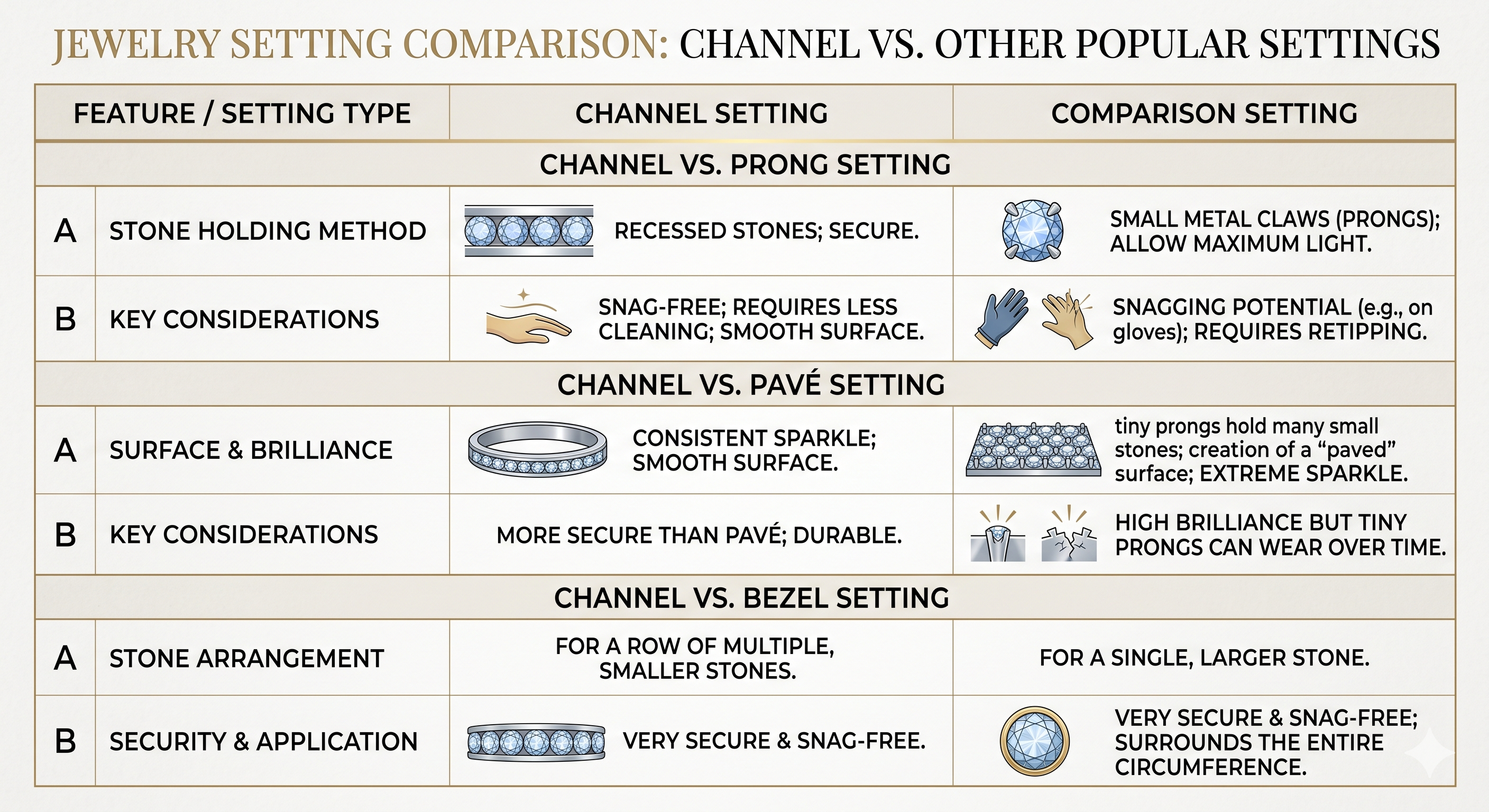
Channel Setting vs. Other Popular Settings
Common Uses for Channel Settings
Wedding Bands and Eternity Rings: This is the most classic use, often featuring a single or double row of channel-set diamonds.
Accenting an Engagement Ring: It's frequently used on the shank (band) of an engagement ring to add extra sparkle and detail alongside a central stone.
Three-Stone Rings: Sometimes the side stones are set in vertical channels.
In summary, a channel setting is a stylish, secure, and durable choice that prioritizes a smooth, modern look and protection for the gemstones, making it an excellent option for everyday wear.
For official information on jewelry settings, visit the GIA Jewelry Setting Guide.
Are Channel Set Rings More Expensive?
The answer isn't a simple yes or no, because the cost of a channel-set ring depends on a balance of several factors, some of which can make it less expensive, and others that can make it more expensive than other styles.
Here’s a breakdown to help you understand the pricing:
Factors That Can Make Channel Set Rings Less Expensive
Potential for Lower Diamond Quality:
Because the channel setting protects the stones and hides their sides, jewelers often use diamonds with slightly lower grades in color and clarity (e.g., SI clarity, I-J color). The metal walls mask imperfections, and the reduced light performance means extreme brilliance is not the priority.
Result: Using these more affordable stones can significantly lower the overall cost compared to a ring that requires high-quality, eye-clean stones.
No Cost for Multiple Prongs:
A pavé setting, for example, requires the intricate and labor-intensive work of carving out and setting dozens of tiny prongs. Channel setting avoids this prong-work altogether.
Factors That Can Make Channel Set Rings More Expensive
Higher Labor and Craftsmanship Cost:
Creating a perfect channel requires a highly skilled artisan. The metal walls must be milled with absolute precision. Each stone must be perfectly calibrated (cut to an exact size) to fit snugly in the row without gaps.
Result: This specialized labor can be more costly than the labor for a simpler prong setting.
More Metal Weight:
Channel settings require a substantial amount of metal to create the two strong, parallel walls. This increased gold or platinum weight adds to the raw material cost of the ring.
Difficulty in Resizing and Repair:
While not an upfront cost, it's an important long-term cost consideration. Resizing a channel-set ring is very difficult and expensive. If a stone becomes loose, repairing it is complex. This can add to the lifetime cost of owning the ring.
Cost Comparison vs. Other Settings
vs. Prong-Set Ring: A channel-set eternity band will often be comparable to or slightly more expensive than a prong-set eternity band of similar carat weight. This is because the labor and metal savings from a lack of prongs are offset by the higher craftsmanship and metal weight of the channel. A channel setting is almost always more expensive than a simple 4-prong setting for a single stone.
vs. Pavé-Set Ring: This is the most common comparison. A channel set ring can be less expensive than a pavé ring of the same carat weight and diamond quality. Why? Pavé requires extremely precise and time-consuming labor to set all the tiny prongs. However, if the pavé ring uses lower-quality diamonds than the channel ring, the pavé ring could be cheaper.
A channel-set ring is not inherently more expensive, but it is often priced higher due to its craftsmanship and metal content, not because of the diamonds used.
To generalize: You are often paying more for the expert labor and precious metal than for the diamonds themselves. For a similar style (like an eternity band), a channel-set ring will typically be in a similar price range to a pavé or prong-set band, with the final cost being determined by the specific diamond quality and the jeweler's labor rates.
When shopping, compare rings based on:
Total carat weight of the diamonds.
Type of metal (platinum vs. gold) and its weight.
The quality of the diamonds (if disclosed).
The reputation of the jeweler.
Are Channel Set Diamonds Safe?
Excellent and very important question. When it comes to security and protection, channel-set diamonds are considered one of the safest and most durable settings available.
Here’s a detailed breakdown of why they are so safe, along with the few vulnerabilities to be aware of.
Why Channel Set Diamonds Are Very Safe
Excellent Protection from Impact: The two parallel metal walls act as a "bumper" for the diamonds. The gems are shielded from knocks and bumps from the sides, which is a common way stones in prong settings get damaged or dislodged.
No Prongs to Snag or Wear Down: Unlike prong or pavé settings, there are no tiny metal claws that can bend, break, or wear thin over time. This eliminates the most common point of failure for lost stones in other settings.
Stones are secured from the Top: The gemstones are held in place by the "rails" of the channel—the metal lips that are pressed over the girdle of each stone. This creates a continuous, strong hold along the entire row of diamonds.
Stones Support Each Other: Because the diamonds are set side-by-side with no gaps, they act as a single, solid unit. This collective strength makes it very difficult for an individual stone to work itself loose.
In short, for everyday wear and tear, a channel setting is one of the most secure choices you can make.
Potential Vulnerabilities and Important Considerations
While extremely secure, no setting is completely infallible. Here are the potential risks and maintenance needs for a channel set ring:
The "Open Channel" Risk (Most Common Issue):
On some older or lower-quality channel settings, the ends of the channel might be open. If the ring is hit hard from the side, a diamond could potentially be forced out of this open end.
Modern Solution: Most high-quality channel settings today are "closed-end" or "French-set," meaning the ends of the channel are capped with metal, eliminating this risk. Always ask your jeweler if the channel is closed.
Difficulty in Identifying a Loose Stone:
It can be very hard to tell if a single diamond has become loose because they are all packed so tightly together. A loose stone might not rattle or be obvious until it's on the verge of falling out.
Wear and Tear on the Metal Rails:
Over many years, the metal lips that hold the stones can wear down, especially if the ring is made from a softer gold like 14k or 18k. If these rails wear too thin, they can lose their grip.
Challenging Repairs:
If a stone does become loose or falls out, or if the channel walls get bent, the repair is complex and requires a highly skilled jeweler. It is often more expensive to fix than a simple prong retipping.
How to Keep Your Channel Set Ring Safe?
Keeping a channel set ring safe requires a combination of daily care, mindful wearing habits, and professional maintenance. The channel setting, where stones are set side-by-side within a "channel" of metal with no prongs, is prized for its sleek look and security, but it has its own unique vulnerabilities.
Buy Quality: Purchase from a reputable jeweler who uses a closed-channel design and sturdy metal.
Get Regular Inspections: Have a jeweler inspect your ring every 6-12 months. They have special tools to check if any stones are loose and if the metal rails are still strong.
Clean It Regularly: Dirt and grime can build up in the channel, making the stones look dull and potentially putting pressure on the setting over time. Regular cleanings will keep it sparkling and allow you to spot any issues.
Be Realistic: While very durable, no jewelry is indestructible. It's still wise to remove your ring during heavy manual work, gym sessions, or other high-impact activities.
The Verdict
Yes, channel-set diamonds are exceptionally safe for daily wear. Their design prioritizes security and protection above all else, making them an ideal choice for wedding bands, eternity rings, and for people with active lifestyles.
The key is to ensure you have a well-made, modern channel setting and to maintain it with regular professional check-ups.
Learn more about jewelry care on the American Gem Society's care guide.
Are Channel Set Rings Good?
Channel set rings are a unique and popular jewelry choice. Their suitability depends heavily on your priorities for security, design, and maintenance. Here is a quick overview of their main advantages and disadvantages:
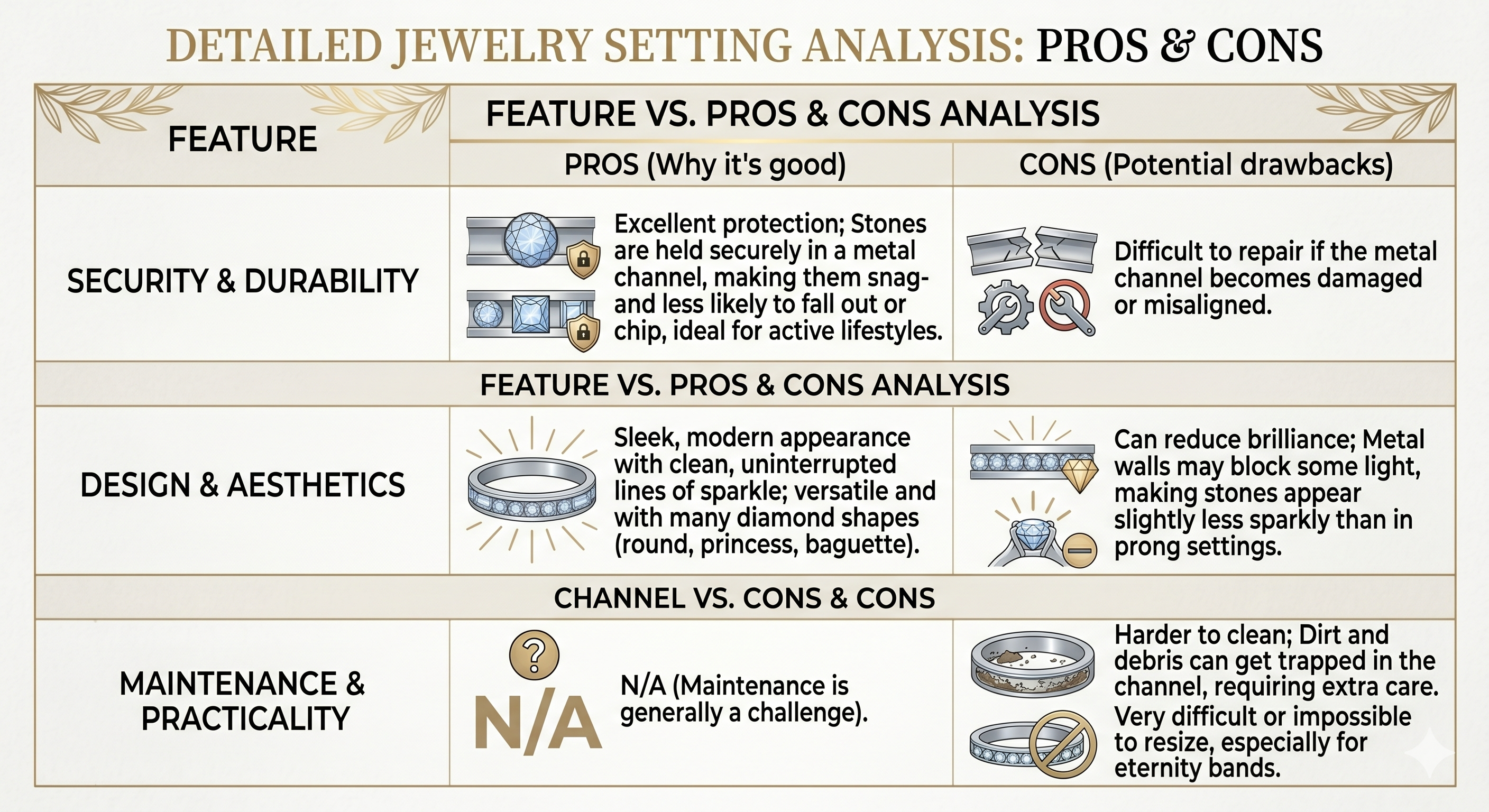
What Makes a Channel Setting Different?
A channel setting involves placing a row of gemstones into a groove or "channel" carved into the ring's band, secured by two metal walls. This differs significantly from pavé settings, where small stones are held on the surface by tiny metal beads.
Key Features That Define a Channel Setting
To truly understand what makes it different, focus on these three characteristics:
“In the 1940s, a New York jeweler named Paul Flato invented the modern channel setting. His clients included Hollywood stars like Greta Garbo and Rita Hayworth. Flato wanted a ring that looked like a single, seamless ribbon of diamonds — no metal visible between stones, no prongs to distract the eye. His solution was to carve a groove into the band, drop stones into it, and press the metal walls over their edges. The result was revolutionary: diamonds that seemed to hold themselves. Today, when you wear a channel-set ring, you are wearing a piece of Hollywood history — the setting that made diamonds look like they were floating.”
1. The "Two-Rail" Security System
Unlike a prong setting that holds a single stone with four or six individual fingers of metal, a channel setting uses two continuous, solid bars of metal running along the entire length of the stones. One bar sits on the inside of the ring (next to the finger) and one on the outside. The stones are dropped into the "channel" created between them, and then the metal edges are pressed down (burnished) over the stones' girdles.
What this means for you: This is one of the most secure ways to set a row of small stones. If one prong on a pave ring breaks, you can lose a stone. With a channel, the entire side rail would have to be damaged to lose a stone. It's ideal for active lifestyles.
2. A Smooth, Continuous Profile
Because there are no prongs, beads, or shared claw marks between the stones, the finished channel setting feels perfectly smooth to the touch. Run your finger over a channel-set band, and it will feel like a single, solid piece of metal.
What this means for you: It will never snag on sweaters, hair, gloves, or delicate fabrics. This is a major practical advantage for an everyday-wear ring like a wedding band.
3. Uninterrupted Light Show (With a Catch)
The stones are held only on their sides. Their crowns (tops) and pavilions (bottoms) are fully exposed. In a well-executed channel setting, the stones are placed directly next to each other, creating a near-continuous line of sparkle. From the top, it looks like a solid ribbon of diamonds.
The catch (The "Gap" Myth): The photo you provided perfectly illustrates the main visual difference. Because the stones are held only by their sides, and the metal on the inside of the band is often curved, you can sometimes see small triangular gaps under the stones. This is normal and a hallmark of a true channel setting. Novice jewelers might fill this gap with metal (creating a modified bezel-channel), but that would block light from below, reducing the stones' brilliance.
“You now know the history, the security, the cost factors, the safety, and the pros and cons. The only question left: will you choose the setting that keeps stones in perfect formation?
Our current collection includes a limited number of channel setting rings — from classic wedding bands to engagement rings with channel-set accents. When certain designs are gone, restocking takes time because each channel must be milled with precision to fit stones without gaps.
This is not just a setting. It is the Roman‘s lattice, the Art Deco modernist‘s line, the queen‘s favorite bracelet, and Hollywood‘s floating diamonds — stones that march together, prong-free, for a lifetime.”
[Button: Secure Your Channel Setting Ring (Limited) →]
Prong Setting Guide: 4 vs 6 Prongs, Security, Size and Types
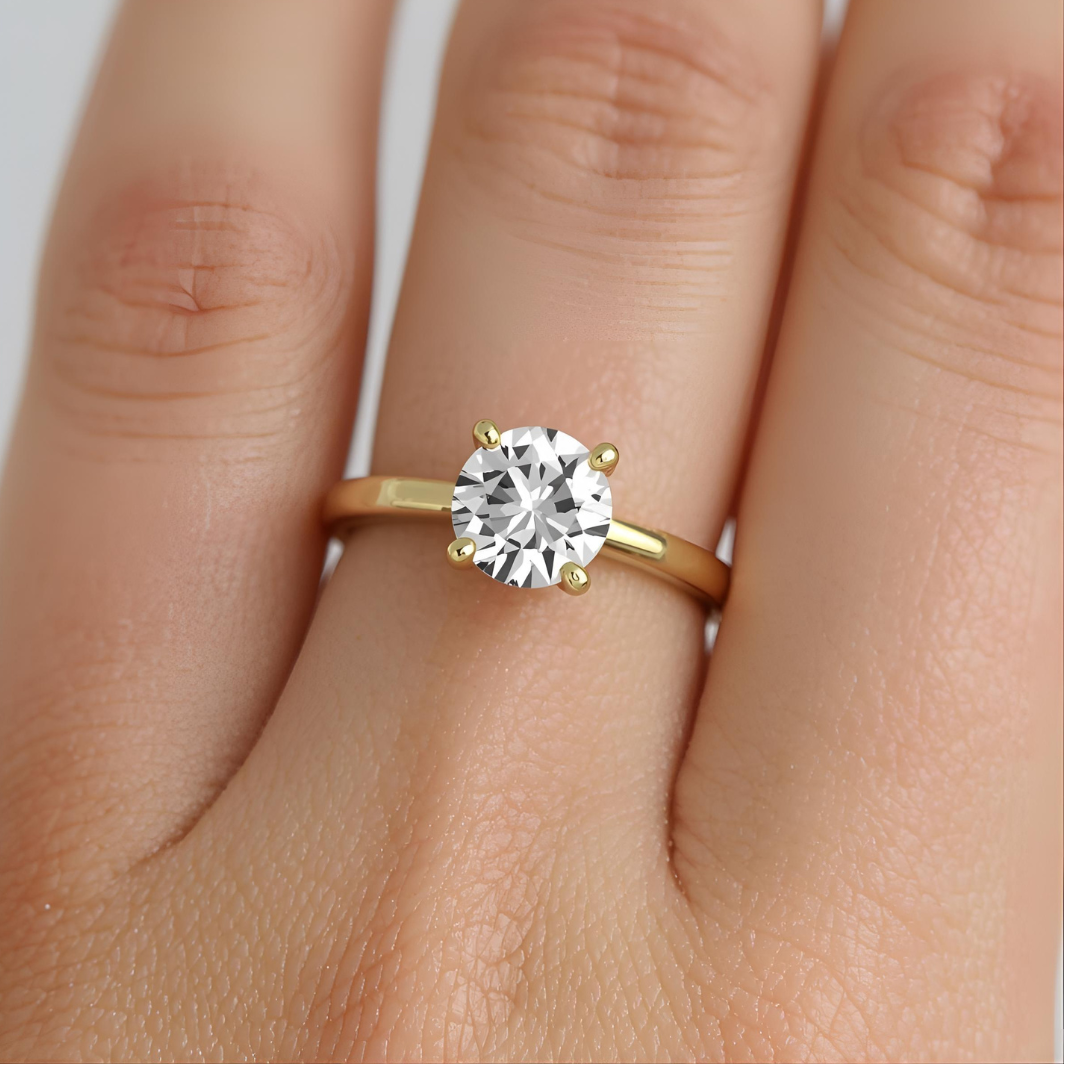
Prong Setting Guide: 4 vs 6 Prongs, Security, Size, and Types
The Engagement Ring That Almost Fell Off
Sarah thought she had found the perfect ring—a beautiful diamond set in delicate prongs. Six months later, she reached into her coat pocket and felt something horrible: an empty setting.
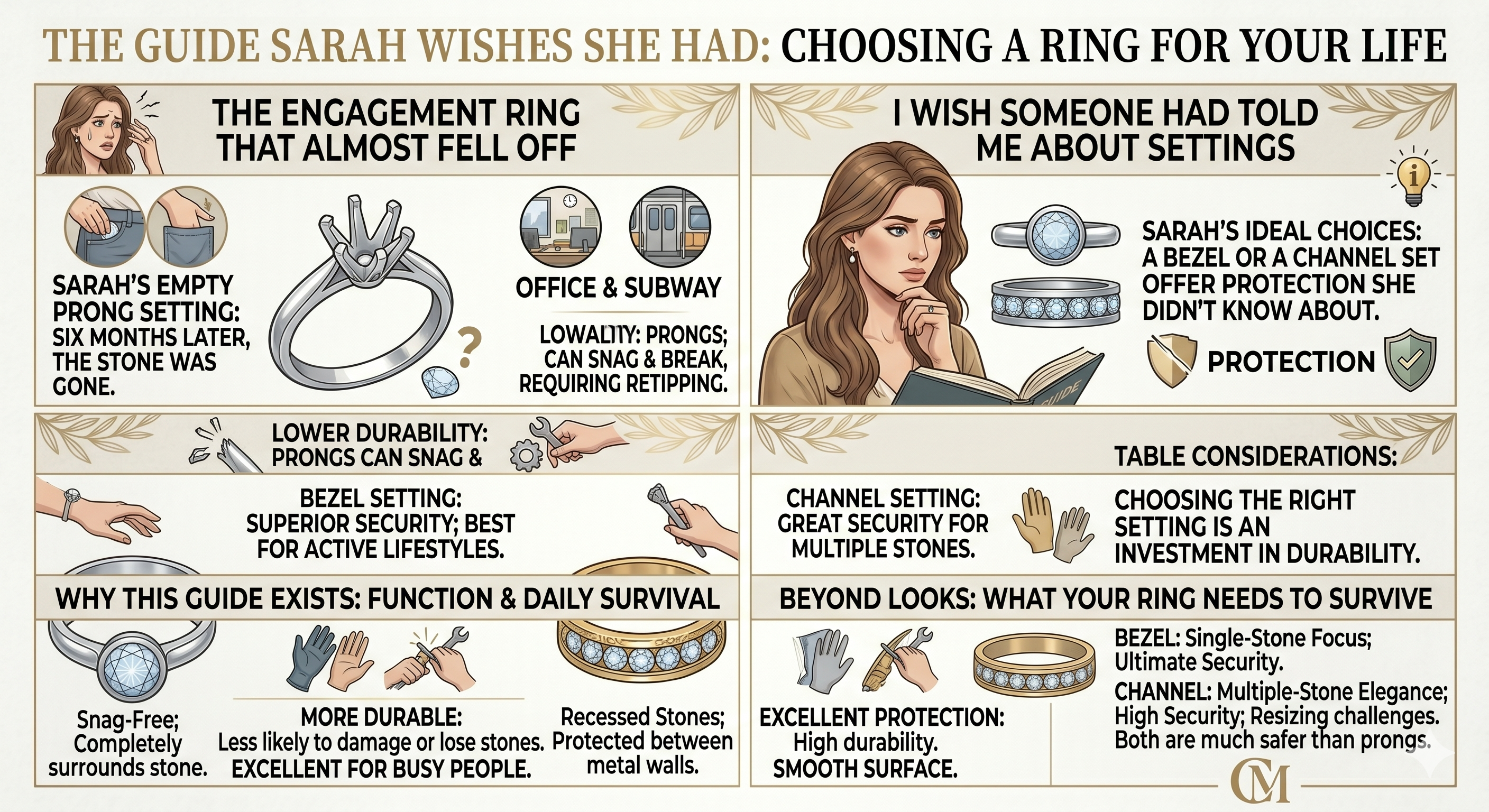
The diamond had fallen out somewhere between the office and the subway. She never found it.
"I wish someone had told me about settings," she says now. "I would have chosen a bezel or a channel set. I just didn't know."
“In 1886, Charles Lewis Tiffany solved this problem forever. He introduced the Tiffany Setting — a six-prong mounting that lifted the diamond up, allowing light to enter from every angle. Before that, diamonds were mostly set in closed-back bezels, hidden and dark. Tiffany‘s innovation was revolutionary: the diamond no longer sat in a box of metal. It floated. It caught light from the sides, from the bottom, from everywhere. Today, the six-prong setting is still the most copied engagement ring design in history. Sarah‘s story is a tragedy of a poorly made setting, not the prong setting itself. Because when prongs are done right, they don‘t just hold a diamond. They let it shine like nothing else can.”
The same setting that revolutionized engagement rings in 1886 now awaits your own love story. Every prong setting in our collection is hand-finished — from classic 6-prong Tiffany-style to sleek 4-prong solitaires. Because a diamond that catches light catches hearts.”*
[Button: Explore Prong Setting Rings →]
That's why this guide exists. Choosing a ring setting isn't just about looks. It's about how you live, what you do, and what you need your ring to survive.
Let's find your perfect match.
Here is a detailed explanation of the Prong Setting, one of the most popular and classic techniques in jewelry. Here are the details about the Prong setting the table of contents.;
What Is Prong Setting?
Prong Setting: Simple Definition
A prong setting is a metal claw or wire that extends from the base of a piece of jewelry to hold a gemstone securely in place. It is the most common type of setting for diamond engagement rings, especially solitaires, because it uses minimal metal, allowing maximum light to enter the stone and enhance its brilliance.
Key Characteristics of a Prong Setting
The Prongs: These are the small metal "claws" that you can see and feel. They are bent over the gemstone's girdle (its widest part) to secure it.
The Head: The collection of prongs and the base they are attached to is often called the "head." This head is then soldered onto the ring's shank or band.
Minimalist Metal: It uses the least amount of metal possible to hold the stone, making the gemstone the undeniable star of the show.
“In the 19th century, jewelers called prongs ‘claws‘ — not because they looked like animal feet, but because they gripped the stone with the same tenacity. A well-made prong does not merely hold a diamond. It cradles it, like fingers holding a candle flame. The number of prongs tells a story: four prongs for a square stone, six prongs for a round one, eight prongs for a stone you never want to lose. The Tiffany setting chose six because six prongs create a perfect hexagon around a round stone — the strongest geometric shape in nature. A prong setting is not a cage. It is a promise: this stone is safe, but it will never be hidden.”
Anatomy of a Prong Setting
Prong: The metal claw that holds the stone.
Head/Base: The platform the prongs are attached to.
Girdle: The widest part of the gemstone, where the prongs grip.
Culet: The bottom point of a faceted stone (like a diamond), which can sometimes be seen through the base.
Advantages of a Prong Setting
Maximizes Light & Brilliance: This is its biggest advantage. With less metal covering the stone, more light can enter from all angles, reflect off the internal facets, and return as sparkle (brilliance, fire, and scintillation).
Showcases the Stone: It elevates the stone away from the band, making it the central focus and often making it appear larger.
Versatile & Classic: It works with almost any gemstone shape (round, princess, oval, etc.) and is a timeless style that never goes out of fashion.
Easier to Clean: Because it's so open, it's easier to clean the stone and the underside, preventing dirt and grime from building up.
Allows for Secure Side Stones: Prong settings are ideal for setting smaller accent stones on a band or halo.
Disadvantages of a Prong Setting
Prone to Snagging: The prongs can catch on clothing, hair, or other fabrics. This is a common issue, especially with higher settings.
Requires Maintenance: Over time, prongs can wear down or become loose. It's crucial to have them checked by a jeweler every 6-12 months to ensure the stone is still secure.
Less Protective: Compared to other settings (like a bezel), it offers less protection to the edges and girdle of the gemstone, making it more vulnerable to chips and impacts.
Potential for Damage: If a prong is bent or broken, the gemstone can easily fall out and be lost.
For official information on jewelry settings, visit the GIA Jewelry Setting Guide.
What Is The Best Prong Setting?
Excellent question! While there is no single "best" prong setting that wins for every situation, we can identify the best prong setting for specific goals, such as security, appearance, or stone shape.
The "best" choice is a balance of security, style, and practicality.
Here’s a breakdown of the top contenders and what makes them the best in different categories.
The Top Contenders for "Best Prong Setting"
1 . For Maximum Security: The Six-Prong Setting
Why it's the best: Simple math, six prongs holding the stone are stronger and more secure than four. If one prong becomes loose, the other five still have a firm grip, significantly reducing the risk of losing the stone.
Best for: Round brilliant diamonds. The six prongs create a hexagonal shape that beautifully frames a round stone, making it look perfectly circular.
Trade-off: The additional prongs cover slightly more of the diamond's crown (the top part) than a four-prong setting, but the increase in security is often worth it.
2. For Maximum Sparkle and a Modern Look: The Four-Prong Setting
Why it's the best: With only four points of contact, less metal covers the gemstone. This allows more light to enter and exit the stone, which can maximize its brilliance and make it appear slightly larger from the top down. It offers a more modern, square-like silhouette.
Best for: Those who prioritize sparkle over ultimate security and prefer a contemporary aesthetic. It works well with many stone shapes.
Trade-off: It is slightly less secure than a six-prong setting. If one prong fails, the stone is held by only three points, making it vulnerable.
Best Prong Setting by Stone Shape
The "best" prongs often depend on the shape of your gemstone.
For Round, Oval, and Cushion Cuts: Both four and six prongs work well. Six prongs are recommended for stones over 1 carat for added security.
For Princess, Square, and Emerald Cuts: Four prongs are standard, typically placed at the corners. A V-prong on the four corners can enhance the geometric look and protect the sharp angles.
For Pear, Marquise, and Heart Shapes: The "best" setting must include V-prongs at the pointed ends. A V-prong is a prong that is folded into a "V" shape to cradle a delicate point and prevent it from chipping or snagging. A minimum of a V-prong at the tip and two standard prongs on the rounded end is essential.
Key Factors That Make Any Prong Setting "The Best"
Beyond the number of prongs, these details are crucial for quality and security:
Prong Material: The prongs should be made from a durable metal. Platinum is often considered the best for prongs because it is incredibly strong and wear-resistant. 18k Gold is also excellent, while 14k offers a great balance of durability and color.
Prong Shape and Finish:
Claw Prongs: Offer a very secure hold and a decorative, often vintage, look.
Round Prongs: Are common, durable, and less likely to snag than sharp claw prongs.
Double Prongs: Using two thin prongs instead of one thick one at each point is a design feature that adds security and a unique, detailed look.
Prong Height and Profile: The prongs should be substantial enough to hold the stone securely, yet can be worn down over time. A skilled jeweler can ensure they are the right height and thickness for long-term wear.
Final Recommendation: The "Safest Bet"
If we have to choose one all-around "best" for a classic round diamond solitaire, the winner is:
The Six-Prong Setting in Platinum.
Why: It offers the perfect balance of superior security, timeless elegance (thanks to the Tiffany legacy), and excellent light performance. The strength of platinum prongs further minimizes long-term wear and tear.
Quick Guide: How to Choose Your "Best" Prong Setting
My #1 priority is security. → Choose a Six-Prong setting.
I want my stone to look as large and sparkly as possible. → Choose a Four-Prong setting.
4-Prong vs. 6-Prong: Quick Comparison
| Feature | 4-Prong | 6-Prong |
|---|---|---|
| Security | Good | Excellent |
| Perceived Size | Larger | Slightly smaller |
| Sparkle | Maximum | Very high |
| Aesthetic | Modern, square silhouette | Classic, round silhouette |
| Best For | Maximizing size & sparkle |
Security & daily wear |
My stone has sharp points (Pear, Marquise). → Choose a setting with V-Prongs at the points.
I have an active lifestyle and worry about snagging. → Choose Round Prongs over Claw Prongs, or consider a lower-profile setting like a Bezel.
I want a vintage or custom look. → Choose Double Prongs or Claw Prongs.
What Types of Prong Settings?
Prong settings are far more varied than just four or six claws. The type of prong setting affects the ring's security, style, and how the gemstone is presented.
Here is a detailed breakdown of the different types of prong settings, categorized for clarity.
Category 1: By Number of Prongs
This is the most common way to classify prong settings.
1. Four-Prong Setting
Description: Four metal claws hold the stone at cardinal points (like 12, 3, 6, and 9 o'clock).
Effect on a Round Stone: Makes the stone look more square or cushion-shaped.
Pros: Allows more light to enter, maximizing brilliance; modern and minimalist look.
Cons: Slightly less secure than a six-prong setting; if one prong fails, the stone is vulnerable.
Best for: A modern aesthetic and maximizing the perceived size and sparkle of the stone.
2. Six-Prong Setting
Description: Six metal claws hold the stone, creating a hexagonal outline.
Effect on a Round Stone: Enhances and reinforces the round shape.
Pros: Superior security; classic, timeless look (epitomized by the Tiffany Setting).
Cons: Covers slightly more of the diamond's crown.
Best for: Anyone prioritizing security and the classic round solitaire look.
Category 2: By Prong Shape and Style
The shape of the prong tip dramatically changes the ring's character.
3. Round Prongs
Description: The most common type, featuring prongs with a rounded, ball-like tip.
Pros: Very durable, less likely to snag on clothing compared to claw prongs.
Cons: Can look a bit bulky on very delicate rings.
Best for: Everyday wear and a classic, low-maintenance look.
4. Claw Prongs / Talon Prongs
Description: Prongs that are filed to a point, resembling an animal's claw.
Pros: Offers a very secure grip; elegant, decorative, and often used in vintage-inspired designs.
Cons: More likely to snag on fabrics like sweaters or stockings.
Best for: Creating a vintage, custom, or high-end look; securing larger stones.
5. V-Prongs (Chevron Prongs)
Description: Prongs that are folded into a "V" shape.
Pros: Excellent for protecting the delicate points of fancy-shaped stones from chipping.
Cons: A more specialized pris ong is used only where needed.
Best for: Pear, Marquise, and Heart-shaped stones. They are almost always used at the tips.
6. Tab Prongs
Description: Flat, rectangular prongs that offer a sharp, geometric look.
Pros: Very modern and architectural aesthetic; provides a unique, flat surface that can be decorated with milgrain or engraving.
Cons: The flat edges can be more prone to catching than rounded prongs.
Best for: Modern, art deco, and geometric jewelry designs; often used with emerald and baguette-cut stones.
Category 3: Advanced and Decorative Variations
These styles combine multiple prongs or integrate them with other setting techniques.
7. Double Prong Setting
Description: Two thin prongs are used at each holding point instead of one thick one.
Pros: Adds a layer of intricate detail and security; creates a more delicate and custom look.
Cons: Requires more skill to create and maintain.
Best for: A bespoke, high-jewelry appearance; often seen in vintage and custom designs.
8. Shared Prong Setting
Description: A single prong is shared between two adjacent stones in a row. Common in eternity bands and some three-stone rings.
Pros: Creates a continuous line of sparkle with very little metal visible; allows more light to enter the stones.
Cons: If one prong is damaged, the two stones become loose. Can be less secure than a setting where each stone has its own prongs.
Best for: Channel-set alternatives and eternity bands where a seamless look is desired.
9. Trellis Setting
Description: A decorative setting where the prongs are not straight upright but are twisted or curved, often in an "X" shape, before holding the center stone.
Pros: Extremely elegant and ornate; adds significant visual interest and a vintage feel.
Cons: A more complex design can be harder to clean; it may not suit a minimalist taste.
Best for: Creating a dramatic, romantic, and unique centerpiece ring.
Summary Table for Quick Reference
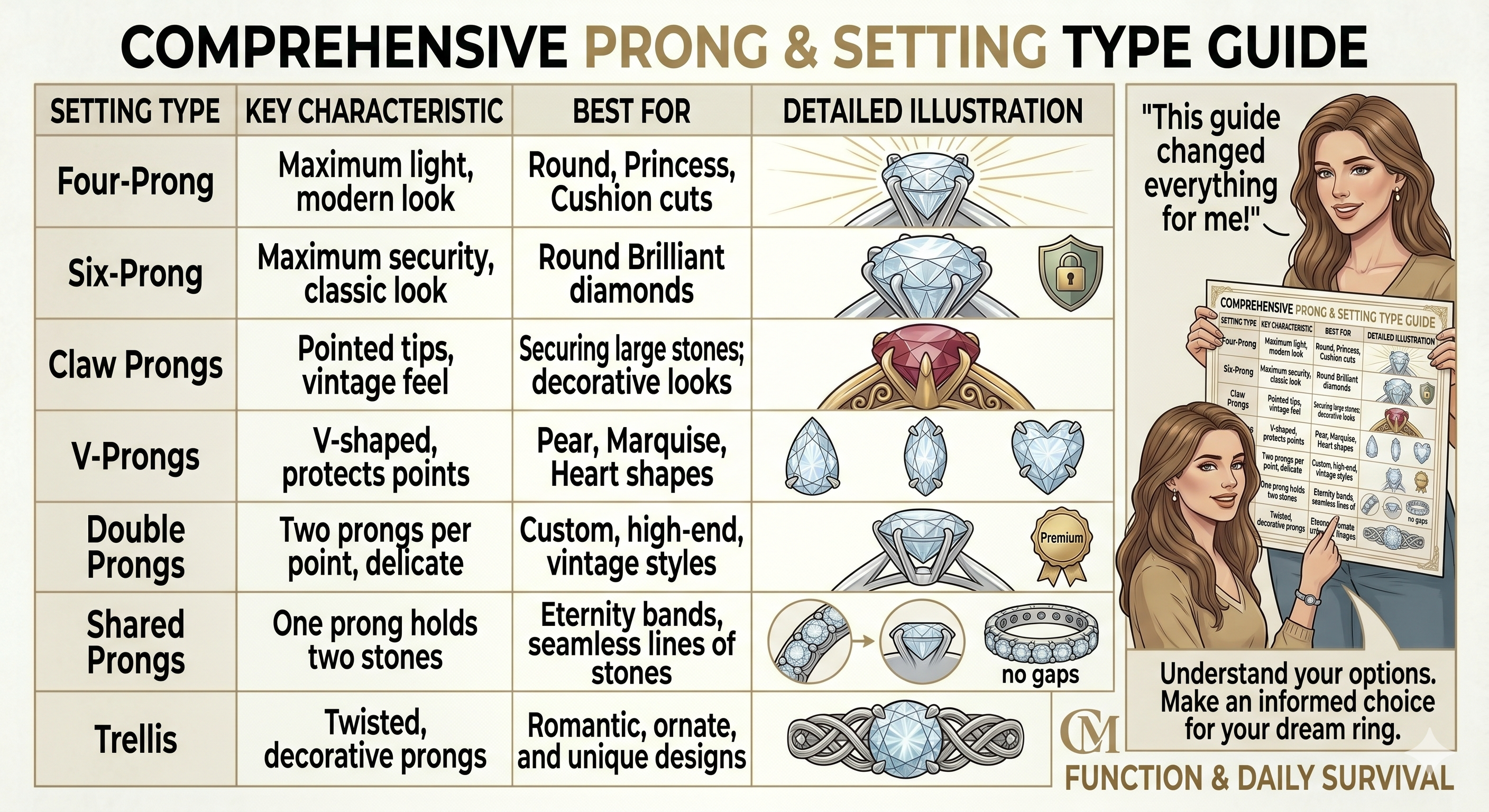
How to Choose the Right Type for You
Prioritize Security? → Choose Six-Prong or V-Prongs for pointed stones.
Want Maximum Sparkle? → Choose Four-Prong.
Have a Vintage Style? → Choose Claw Prongs or a Trellis setting.
Want a Modern Look? → Choose Tab Prongs or Four-Prong with round tips.
Love the Details? → Choose Double Prongs.
The best type of prong setting ultimately depends on your personal style, the shape of your gemstone, and your lifestyle. A good jeweler can show you examples of each to help you decide.
Which Prong Setting Makes Diamonds Look Bigger?
The winner for making a diamond look bigger is, without a doubt, the Four-Prong Setting.
Here’s a detailed breakdown of why, along with other design tricks that can enhance the effect.
The Champion: Four-Prong Setting
Why it wins:
Less Metal, More Diamond: With only four points of contact instead of six, less of the diamond's surface (specifically the crown and table) is covered by metal. This exposes more of the diamond to the eye, allowing it to appear larger.
Square Illusion: On a round diamond, four prongs create a square-like silhouette. Our eyes tend to perceive this squared-off shape as taking up more space on the finger than the perfectly round shape framed by six prongs.
Visual Comparison:
A four-prong setting can make a diamond of the same carat weight look noticeably larger from a top-down view compared to a six-prong setting.
Runners-Up & Design Tricks to Enhance Size
While the four-prong is the best starting point, you can amplify the effect with these design choices:
1. The Peg Head (or Tiffany Style) Setting
What it is: This is a type of prong setting where the "head" (the base holding the prongs and diamond) is elevated on a thin, single stem and soldered onto the band.
Why it works: By lifting the diamond high above the band, it's completely isolated and unobstructed. This maximizes light entry from all angles, which increases brilliance and makes the diamond more prominent. The high profile creates a larger visual presence.
2. Thin, Delicate Prongs
What it is: Using prongs that are as thin and refined as structurally possible.
Why it works: This is an extension of the "less metal" principle. Slim, knife-edge, or claw prongs cover a minimal amount of the diamond, making the stone itself the absolute focus.
3. A Knife-Edge Band
What it is: A band that is thin and tapers to a sharp edge, rather than being a thick, rounded, or flat strip of metal.
Why it works: A delicate band creates a visual contrast that makes the center diamond appear more substantial by comparison. A thick, chunky band can easily dwarf the same diamond.
4. An Illusion Setting (Advanced Prong Use)
What it is: A metal base (often engraved or patterned) is built into the ring head, extending slightly under the girdle of the diamond. The prongs are then attached to this base.
Why it works: The metal base acts as a "halo" or frame, tricking the eye into perceiving the diamond as being one continuous size with its metal foundation. This is a very effective, though less common, way to increase perceived size.
The Trade-Off: Why You Might Not Always Choose Four Prongs
It's crucial to know the downside. The very feature that makes a four-prong setting look bigger is also its weakness: less security.
A six-prong setting is significantly more secure. If one prong fails in a six-prong setting, five others are still holding the stone. In a four-prong setting, if one fails, only three remain, making the diamond vulnerable to falling out.
A six-prong setting also makes a round diamond look more classically "round."
Quick Guide: Which to Choose?
To MAXIMIZE Perceived Size: Choose a Four-Prong setting on a thin, knife-edge band.
To MAXIMIZE Security: Choose a Six-Prong setting (it will still look large, just not as large as the four-prong equivalent).
For a Diamond over 1.5 Carats: A six-prong setting is often recommended for security, as the size of the stone is already impressive.
For a Fancy Shape (Oval, Cushion, etc.): A four-prong setting is standard and will also provide the maximum size appearance.
Which Prong Setting Is Most Secure?
This is a critical question when choosing a ring for everyday wear, especially for an active lifestyle.
The most secure prong setting is, unequivocally, the Six-Prong Setting.
Here’s a detailed breakdown of why it wins, along with other key factors that contribute to a secure setting.
The Winner: Six-Prong Setting
Why it's the most secure:
Simple Mathematics: With six points of contact holding the gemstone, the grip is distributed more evenly around the stone's circumference.
Redundancy is Safety: If one prong in a six-prong setting becomes damaged or worn down, you still have five other prongs firmly holding the stone. This provides a critical safety net, drastically reducing the chance of the stone falling out before you can get it repaired.
Superior Grip: It simply holds more of the stone's girdle (its widest edge), making it much harder for the stone to become dislodged from an impact.
Best For: Round brilliant diamonds. The six-prong design also enhances the stone's round shape, making it a classic and secure choice.
Trade-off: The six prongs cover slightly more of the diamond's crown than a four-prong setting, but the increase in security is almost always worth this minimal visual trade-off.
The Runner-Up: Four-Prong Setting
The four-prong setting is beautiful and popular, but it is less secure than the six-prong.
The Vulnerability: If a single prong in a four-prong setting is damaged, the stone is now being held by only three prongs. This creates a significant weak point, and the stone can easily become loose, rotate, or even fall out.
When it's Secure Enough: For a stone that is worn less frequently or for someone with a less active lifestyle, a well-made four-prong setting is still a solid and classic choice. Its advantage is that it shows off more of the stone.
Beyond the Number: Other Critical Factors for Security
The number of prongs is just the starting point. The design and execution of the prongs are equally important.
1. V-Prongs for Pointed Stones
What they are: Prongs folded into a "V" shape to cradle a pointed end.
Why they're secure: They provide the most secure and protective method for holding the delicate points of stones like Marquise, Pear, and Heart shapes. A standard round prong on a point is a recipe for chipping and damage.
2. The Prong Head & Setting Height
Low-Profile Setting: A setting that sits lower and closer to the finger is inherently more secure because it's less likely to be knocked against surfaces.
High/“Peg Head” Setting: While beautiful and classic, a very high setting is more exposed and vulnerable to impacts that can bend prongs.
3. Prong Material and Thickness
Metal Type: Platinum is the most secure metal for prongs. It is incredibly durable and wear-resistant, meaning the prongs themselves are less likely to thin out over time. While strong, gold (especially 14k and 18k) is more malleable and can wear down faster.
Substantial Prongs: Prongs need to have enough metal to be strong. While very thin, delicate prongs are fashionable, they can be a security risk for a valuable stone meant for daily wear. A jeweler can ensure they are thick enough to be secure while still being aesthetically pleasing.
4. Double Prongs
While often a design choice, using two prongs at each corner (common with square stones) can add an extra layer of security. If one thin prong fails, its partner is still there.
Quick Guide: Choosing for Maximum Security
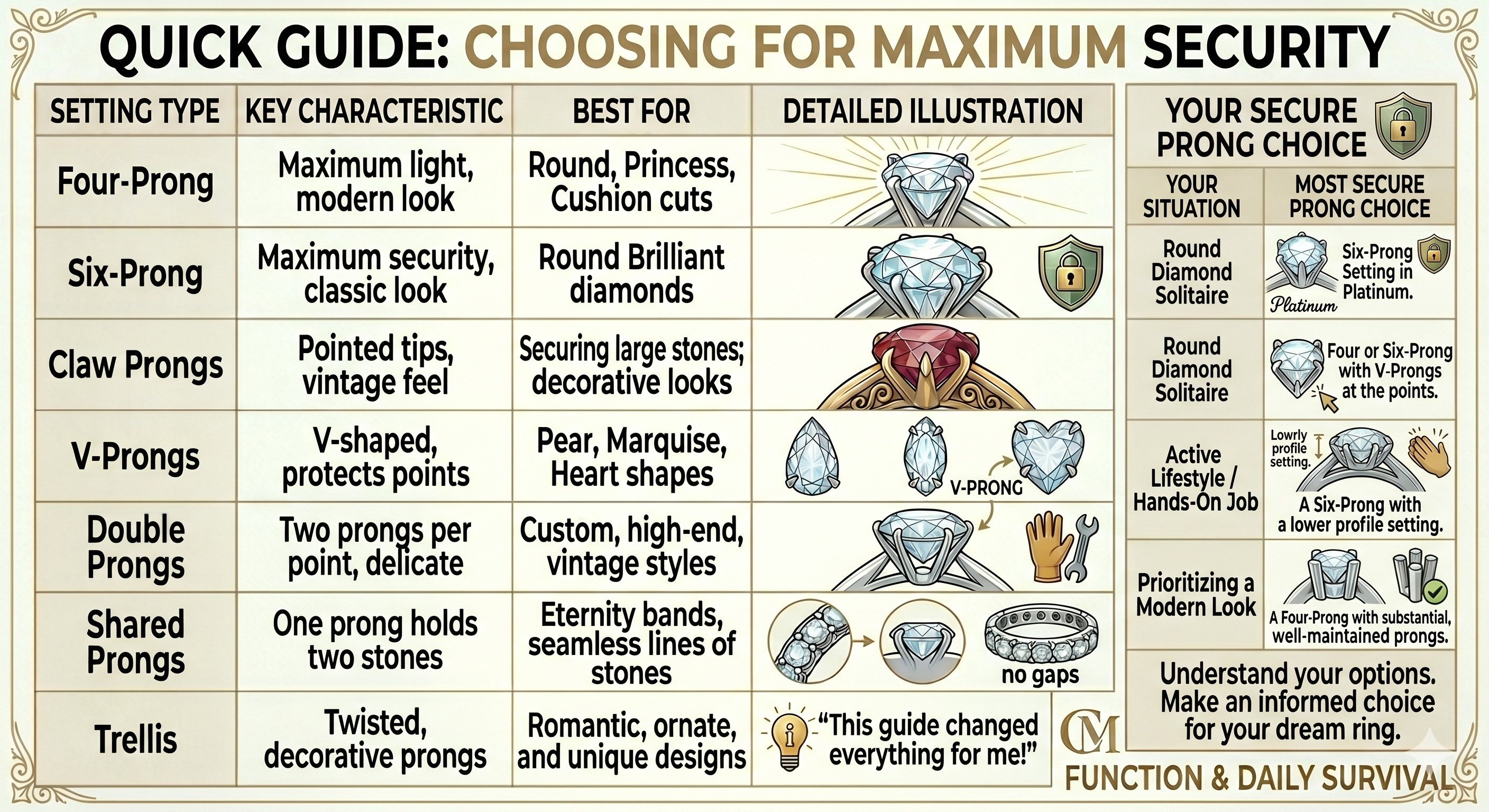
The Most Important Factor of All: Maintenance
No prong setting is 100% secure forever. The single most important thing you can do to keep your stone safe is regular maintenance.
Home Checks: Gently run your fingernail over the prongs once a month. They should feel smooth and solid. If you feel a catch or a sharp edge, a prong may be lifting.
Professional Inspections: Have a professional jeweler inspect your ring every 6 to 12 months. They will check for worn-down metal, loose prongs, and structural issues you can't see with the naked eye.
For the absolute most secure prong setting, choose a six-prong setting and commit to a schedule of professional inspections. This combination offers the best possible protection for your precious gemstone.
Learn more about jewelry care on the American Gem Society's care guide.
For Which Diamond Shape Can A V-Prong Setting Be Used?
Here is a breakdown of the diamond shapes that benefit most from aV-prong setting, categorized by how essential it is.
Category 1: Highly Recommended (Almost Essential)
These shapes have very sharp, delicate points that are highly susceptible to chipping. A V prong is strongly advised for these.
Princess Cut: This square-shaped diamond has four sharp, 90-degree corners. These are extremely vulnerable. V-prongs are considered the standard and most secure way to set all four corners of a princess-cut diamond.
Marquise Cut: This "football-shaped" diamond has two pointed ends. Both ends should be secured with V prongs to protect them from impact.
Pear Cut: This teardrop-shaped diamond has one rounded end and one pointed end. The single point is very delicate and must be protected with a V prong for long-term security.
Heart Cut: The distinct cleft at the top of the heart creates two delicate points. Using V prongs at the top of the heart is crucial to protect this defining feature.
Radiant Cut & Emerald Cut (on the corners): While sometimes set with beveled corners, the sharp corners of these rectangular or square step-cut diamonds are also prime candidates for V prongs for enhanced protection.
In short, if the diamond shape has a sharp point, it needs a V prong.
Category 2: Aesthetic Choice (Not for Protection)
For these shapes, a V prong is not necessary for security, but can be used as a design element to create a specific look.
Round Brilliant Cut: A round diamond has no points, so it doesn't need V-prongs for protection. However, a jeweler might use them as a stylistic choice to create a modern, geometric look, often placing them at the cardinal points (12, 3, 6, and 9 o'clock) instead of standard round prongs.
Oval Cut: Similar to the round, an oval doesn't have sharp points. However, some designers use small V prongs on the ends of the oval to accentuate its elongated shape and add a unique design flair, even though the ends are rounded.
Visual Summary Table
| Diamond Shape | Why Use a V Prong? | Where to Place It |
| Princess Cut | Protection of four sharp corners. | On all four corners. |
| Marquise Cut | Protection of two pointed ends. | On both tips. |
| Pear Cut | Protection of the single pointed tip. | On the pointed end. |
| Heart Cut | Protection of the two points in the cleft. | On top of the heart. |
| Radiant/Emerald | Protection of the sharp corners. | On the four corners. |
| Round Brilliant | Aesthetics (geometric, modern look). | Optional, at cardinal points. |
| Oval Cut | Aesthetics (to accentuate the ends) | Optional, on the two ends. |
Key Takeaway
The V-prong setting is fundamentally a functional feature for protection. Its use is dictated by the geometry of the diamond.
For pointed shapes (Princess, Marquise, Pear, Heart): A V prong is a critical security measure.
For rounded shapes (Round, Oval): A V prong is a purely decorative design choice.
When selecting a setting for a diamond with points, always ensure the jeweler is using V prongs to protect your investment from chipping and damage.
What Is The Prong Setting For A Marquise Diamond?
The marquise diamond, with its elongated, "football-shaped" silhouette and two pointed ends, requires a specific prong setting to highlight its beauty and, most importantly, protect its vulnerable tips.
The best and most classic prong setting for a marquise diamond is a setting that uses V-prongs on both pointed ends.
The Standard & Most Secure Setting: Dual V-Prongs
This is the gold standard for a reason. It directly addresses the marquise cut's primary vulnerability.
Why it's essential: The two sharp points of a marquise diamond are extremely prone to chipping if struck. A standard round prong would sit awkwardly on the point, leaving it exposed. A V-prong is custom-shaped to cradle and wrap around the point, providing a secure shield against impact.
Typical Configuration: Most marquise settings use a total of 4 or 6 prongs.
In a 4-prong setting, the two main prongs are the V-prongs on the ends. The other two prongs are standard (like claw prongs) secured on the long, curved sides.
In a 6-prong setting, you have the two V-prongs on the ends, and then four prongs along the sides (two on each long curve). This offers even more security.
While the dual V-prong setting is the top recommendation, other styles work beautifully and offer different aesthetic benefits.
1. The Six-Prong Setting with V-Tips
This is a very secure and popular choice.
How it works: Two V-prongs protect the tips. The four additional prongs are spaced evenly along the curved sides.
Best for: Those who want maximum security and a classic, well-anchored look. The extra prongs can make the stone look even more elongated.
2. The Bezel Setting (Ultimate Security)
A bezel is a fantastic, modern alternative to prongs.
How it works: A thin metal rim completely encircles the entire outline of the marquise diamond, including both points.
Pros: This offers the highest level of protection possible, making it ideal for an active lifestyle. It also creates a sleek, modern look.
Cons: It covers more of the diamond's edge than prongs, which can slightly reduce the perceived size and brilliance for some viewers.
3. The Five-Prong "Trellis" Setting
This is a beautiful and secure hybrid option.
How it works: The two points are secured with V-prongs. The stone is then set at a diagonal within a basket, with three additional prongs on the sides creating a trellis-like structure underneath.
Best for: Adding vintage-inspired detail and allowing a lot of light to enter the diamond from the sides, boosting its brilliance.
4. The Halo Setting with V-Prongs
To maximize visual impact, a halo is a brilliant choice.
How it works: The marquise diamond is surrounded by a circle of smaller diamonds. Crucially, the halo itself should be set with V-prongs or a protective bezel at the tips to safeguard the center stone.
Best for: Creating a dramatic, larger-looking piece of jewelry. The halo adds significant sparkle and carat weight appearance.
Key Considerations for Your Marquise Setting
Prong Style: Claw prongs are a great choice as they are minimalistic and grip the diamond well with less metal visibility.
The "Bow-Tie" Effect: Marquise diamonds are famous for having a dark, bow-tie-shaped shadow across the center if cut poorly. A good setting can't fix a bad cut, but a skilled jeweler can ensure the prongs are placed to minimize any accentuation of this effect.
Orientation: This is a major style decision!
North-South (Traditional): The stone points lengthwise along the finger. This is the classic orientation and is fantastic for elongating the finger.
East-West (Modern): The stone is set horizontally across the finger. This is a unique, fashion-forward look that is increasingly popular.
The Gallery Rail: Ensure the setting has a sturdy gallery rail (the metal structure underneath the stone). This provides critical support and prevents the prongs from bending if they snag on something.
What to AVOID
Settings with Round Prongs on the Points: This is the biggest mistake. It leaves the tips exposed and insecure.
A Flimsy, Low-Profile Setting: A setting that sits too low or has weak, thin prongs will not offer adequate protection for this elongated shape.
Summary & Final Recommendation
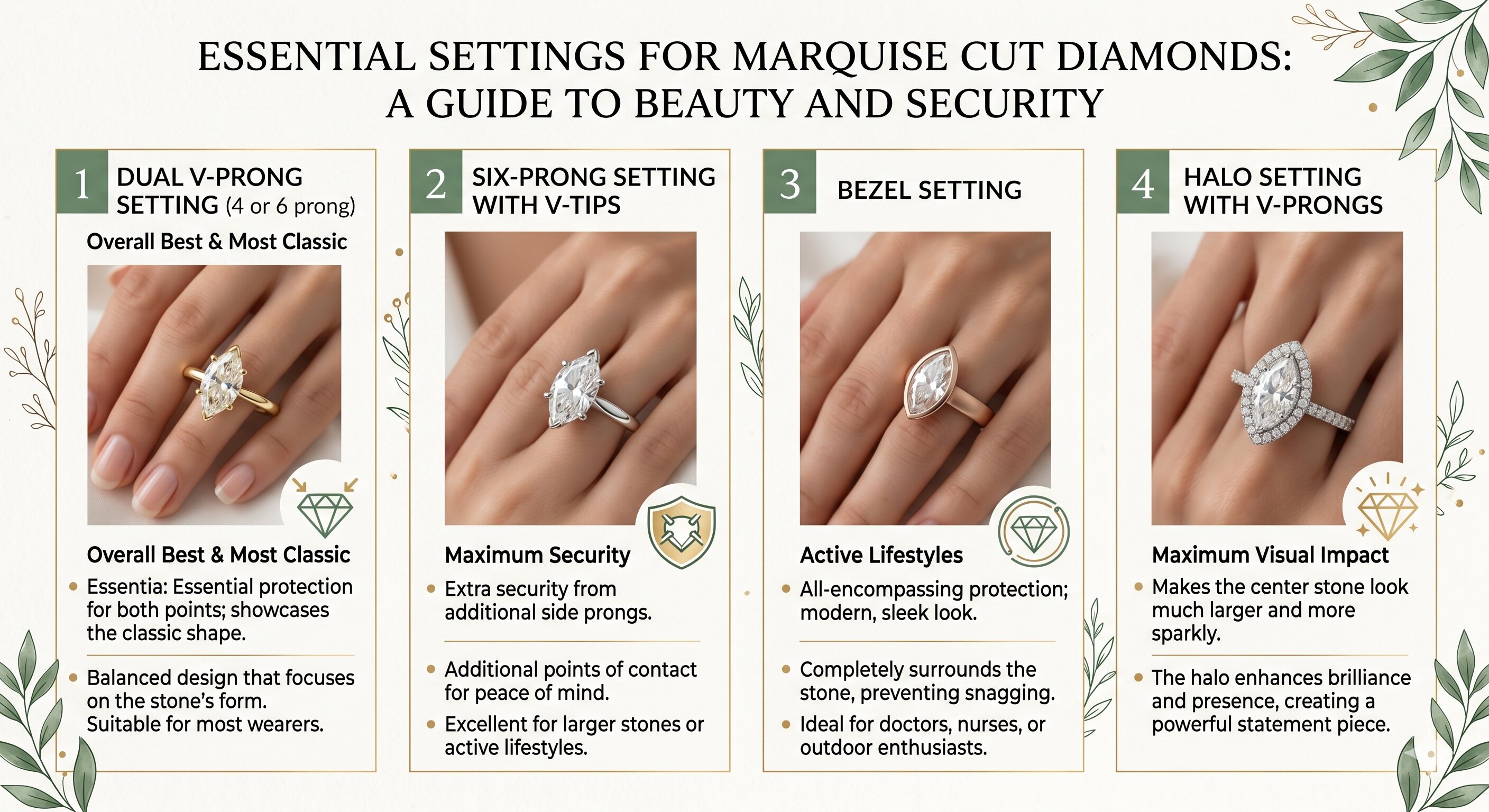
Final Verdict: For a marquise diamond, always choose a setting that uses V-prongs on both pointed ends. The classic 4 or 6-prong setting with dual V-prongs is the most recommended choice as it perfectly balances security, elegance, and the diamond's inherent beauty.
Still not sure? Explore each setting in detail:
“You now know the history, the pros and cons, the best prong types for each stone shape, the security differences, and the marquise-specific advice. The only question left: will you trust your stone to the setting that lets it shine brightest?
*Our current collection includes a limited number of prong-set rings — from delicate 4-prong solitaires to secure 6-prong classics, double-prong vintage styles, and V-prongs for pointed stones. When certain designs are gone, restocking takes time because each prong is hand-shaped and polished.*
This is not just a setting. It is 140 years of Tiffany‘s genius, the diamond‘s best friend, and the most copied design in jewelry history — a few small claws that hold the world‘s hardest substance, trusting light to do the rest.”
[Button: Secure Your Prong Setting Ring (Limited) →]
Ring Setting Guide: Types, Best for Daily Wear, and Size Tips
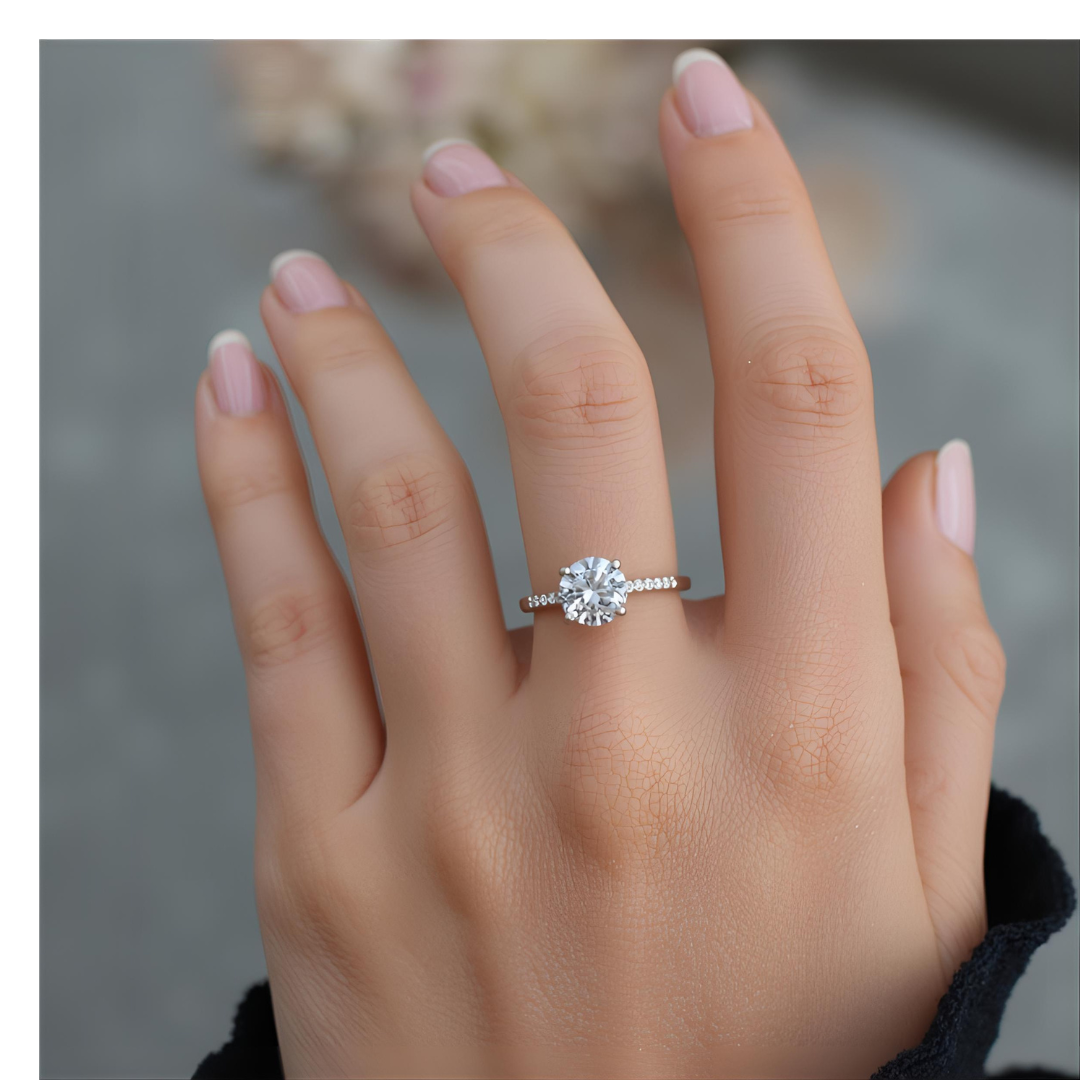
Ring Setting Guide: Types, Best for Daily Wear, and Size Tips
The Engagement Ring That Almost Fell Off
Sarah thought she had found the perfect ring—a beautiful diamond set in delicate prongs. Six months later, she reached into her coat pocket and felt something horrible: an empty setting.
The diamond had fallen out somewhere between the office and the subway. She never found it.
"I wish someone had told me about settings," she says now. "I would have chosen a bezel or a channel set. I just didn't know."
The same choice that has faced lovers for centuries now awaits your own ring. Whether you need a bezel for security, a prong for sparkle, or a pavé for drama, every setting in our collection is crafted by jewelers who understand what‘s at stake.”
[Button: Explore All Ring Settings →]
That's why this guide exists. Choosing a ring setting isn't just about looks. It's about how you live, what you do, and what you need your ring to survive.
“In 1886, Charles Lewis Tiffany solved Sarah‘s problem before it existed. He introduced the Tiffany Setting — a six-prong mounting that lifted the diamond up, allowing light to enter from every angle. But more importantly, his prongs were engineered with precision: thick enough to hold, shaped to avoid snags, and made from platinum that wouldn‘t wear thin. Sarah‘s ring failed because her setting was poorly made, not because the prongs were bad. The right setting, crafted by the right hands, doesn‘t fail. That is what this guide will help you find: not just a beautiful ring, but one that stays beautiful — and stays on your finger.”
Let's find your perfect match.
Table of Contents
What Is A Ring Setting?
A ring setting is the metal framework that holds a gemstone securely in place on a ring. It's the "architecture" of the jewelry, and it is one of the most important elements determining a ring's overall style, security, and functionality.
Think of it as the combination of the base, support beams, and protective frame for your gemstone.
The Primary Functions of a Ring Setting
Security: Its most critical job is to hold the gemstone firmly and prevent it from falling out.
Style & Design: The setting defines the ring's character—whether it's classic, modern, vintage, or minimalist.
Protection: It can shield the gemstone's vulnerable edges from chipping and damage.
Showcase: It enhances the stone's beauty by allowing the right amount of light to enter and reflect, maximizing its sparkle.
Comfort: The design of the setting affects how the ring feels on your finger (e.g., a low-profile setting is less likely to snag on clothing).
For official information on jewelry settings, visit the GIA Jewelry Setting Guide.
What Does Ring Setting Mean?
Excellent question! In jewelry, "ring setting" refers to the specific style and method used to hold a gemstone (or diamond) securely in place on a ring. It's one of the most important design elements, as it determines not only the ring's appearance and style but also its security, durability, and the amount of light entering the stone (affecting its brilliance).
You can think of it as the "architecture" or "mount" for the gemstone.
The Two Main Purposes of a Ring Setting:
Security: To hold the gemstone firmly and protect it from falling out or getting damaged.
Style & Design: To define the ring's overall aesthetic—whether it's modern, vintage, minimalist, or ornate. It also influences how the stone is presented (e.g., raised high or nestled low).
Key Functions of a Setting:
Reveals the Stone: A good setting maximizes the stone's beauty by allowing light to enter and reflect from all angles.
Protects the Stone: It shields vulnerable edges (such as the girdle) and points (such as the culet of a diamond) from chipping.
Complements the Metal: The setting integrates the stone with the band and any side stones or accent details.
Affects Wearability: Some settings sit high and may snag on clothing (e.g., prong settings), while others sit flush and are very low-profile (e.g., bezel settings).
Common Types of Ring Settings (with meanings/styles):
Here’s a quick guide to the most popular settings:
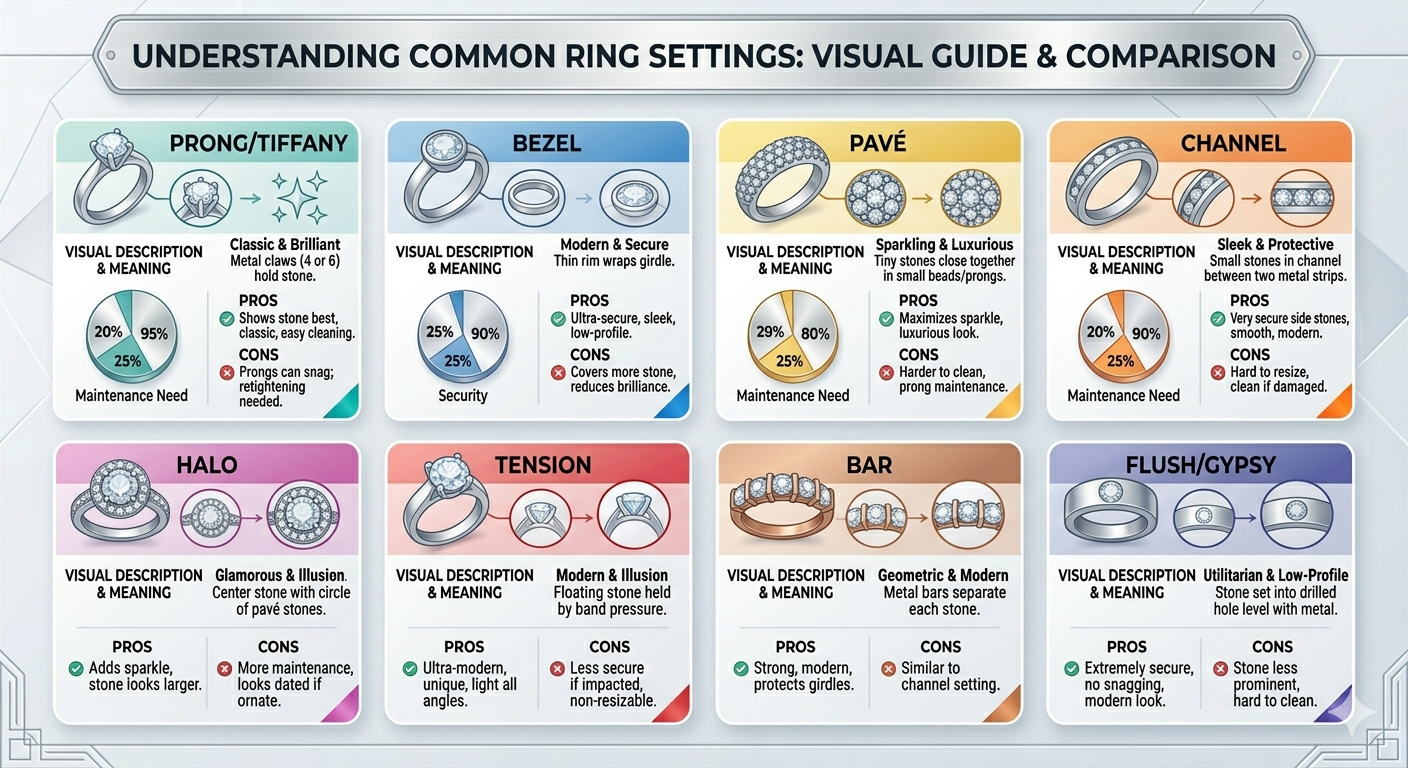
How to Choose a Setting: Factors to Consider
Lifestyle: Active or hands-on work? A bezel or flush setting is more durable.
Style Preference: Love classic elegance? Prong. Prefer modern lines? Bezel or tension. Want maximum sparkle? Halo or pavé.
Stone Security: If security is your top concern, bezel and channel are excellent choices.
Stone Shape: Certain settings complement specific shapes (e.g., a bezel looks great with a cushion cut, prongs are classic for rounds).
Maintenance: Are you willing to get prongs checked regularly? If not, consider a low-maintenance bezel.
The ring setting is the design and metal framework that holds your gemstone. It’s a crucial choice that balances aesthetics, security, and practicality. When selecting an engagement ring or any significant piece of jewelry, understanding the setting helps you choose a design that perfectly fits your personal style and daily life.
What Are The Different Types of Ring Settings?
“In 15th-century Europe, ring settings were simple — stones were glued into metal cups or held by a single clumsy prong. Then, Renaissance goldsmiths discovered that bending multiple metal claws over a stone‘s edge could hold it forever. By the 1700s, jewelers had perfected the prong, the bezel, and the channel — three settings that remain unchanged today. The Art Deco era of the 1920s added the pavé (French for ‘paved‘) — tiny stones set so close together they looked like a solid carpet of diamonds. And in 1960, a German designer invented the tension setting — a stone held by nothing but the pressure of the metal band itself. Every setting in this guide has survived centuries. The question is not which is newest. It is what fits your hand, your life, and your story.”
Here are the most popular setting styles, each with a distinct look and purpose.
What it is: Metal claws (called prongs) that extend from the base to grip the gemstone.
Pros: Maximizes light exposure for superior sparkle; classic and versatile.
Cons: Prongs can snag and require periodic maintenance to stay secure.
Best for: Solitaire rings and showcasing a single, beautiful stone.
What it is: A custom-fitted metal rim that surrounds the entire circumference of the gemstone.
Pros: Extremely secure and protective; modern look; smooth surface that doesn't snag.
Cons: Covers more of the gemstone's edges, which can reduce the perceived size and slightly limit light entry compared to a prong setting.
Best for: Active lifestyles, modern designs, and protecting softer gemstones.
What it is: A row of gemstones set into a channel between two vertical metal walls. There is no metal between the stones.
Pros: Very secure, sleek look, and a smooth surface.
Cons: Can be difficult to resize; requires skilled craftsmanship.
Best for: Eternity bands and accent stones on a wedding band.
4. Pavé Setting
What it is: (Pronounced pah-vay). The band is covered with many small gemstones set very close together, held in place by tiny metal beads or prongs. The name comes from the French for "paved."
Pros: Creates a continuous surface of sparkle, making the ring look incredibly brilliant.
Cons: The tiny prongs can wear down over time; they can be harder to clean.
Best for: Adding extra sparkle and luxury to a band, often used as an accent to a center stone.
5. Halo Setting
What it is: A center stone surrounded by a circle (or "halo") of smaller pavé-set stones.
Pros: Makes the center stone appear significantly larger and more brilliant; adds a vintage or glamorous touch.
Cons: A more intricate design can be harder to clean.
Best for: Creating a dramatic, eye-catching effect and maximizing the visual impact of the center stone.
6. Tension Setting
What it is: A modern setting where the gemstone appears to be "floating" between two sides of the metal band, held by the pressure (tension) of the metal.
Pros: Ultra-modern and dramatic; allows light to hit the stone from all angles.
Cons: Requires a very strong metal and expert engineering; can be less secure if damaged, and is often difficult to resize.
Best for: A bold, contemporary statement.
Summary Table
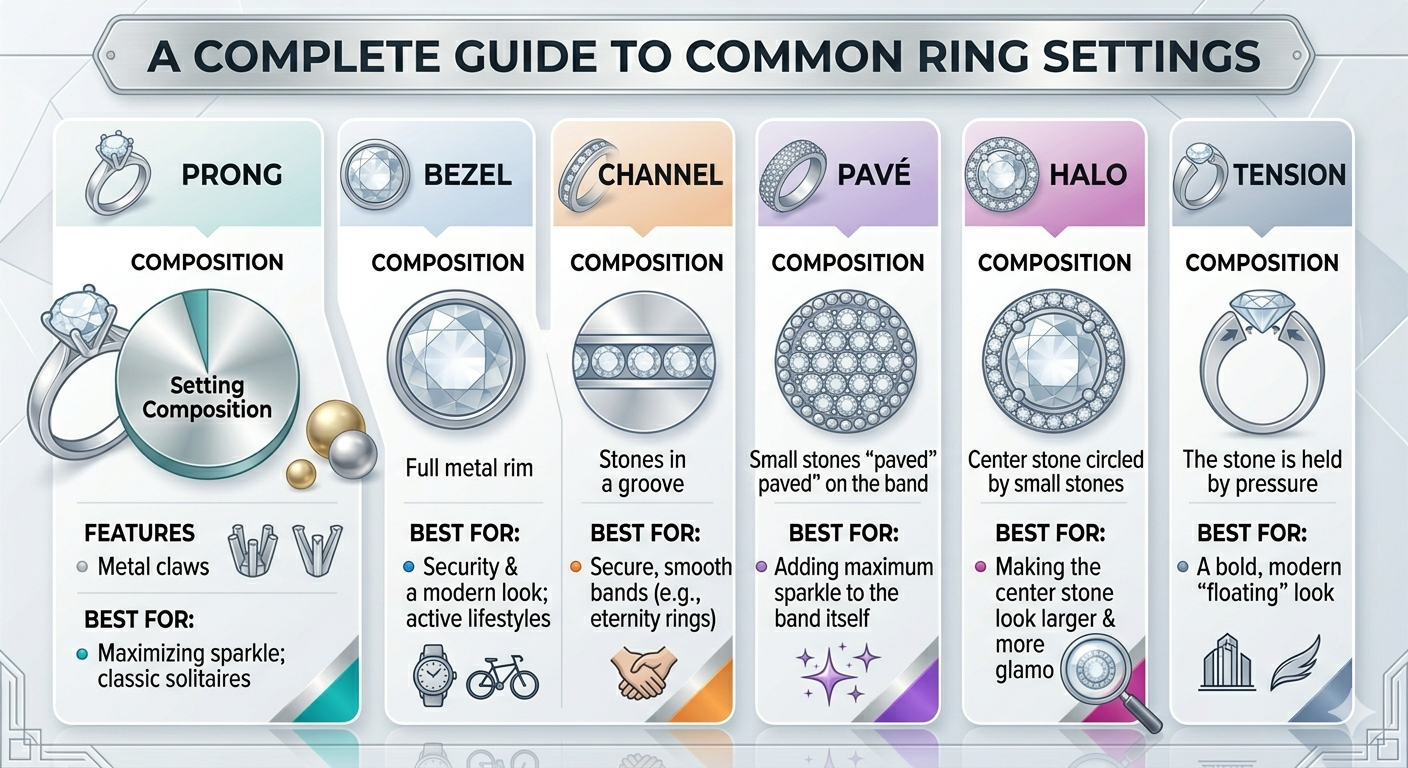
The setting is fundamental to a ring's identity. It works in concert with the metal and the gemstone(s) to create a piece of jewelry that is not only beautiful but also perfectly suited to the wearer.
What Ring Setting Is Best For Daily Wear?
For daily wear, the best ring setting is one that balances security, comfort, and your personal style. The top choices generally prioritize a low profile to minimize snagging and a secure hold to protect the stone.
The ideal setting for you depends heavily on your daily activities. Here’s a comparison of the most recommended settings for daily wear:
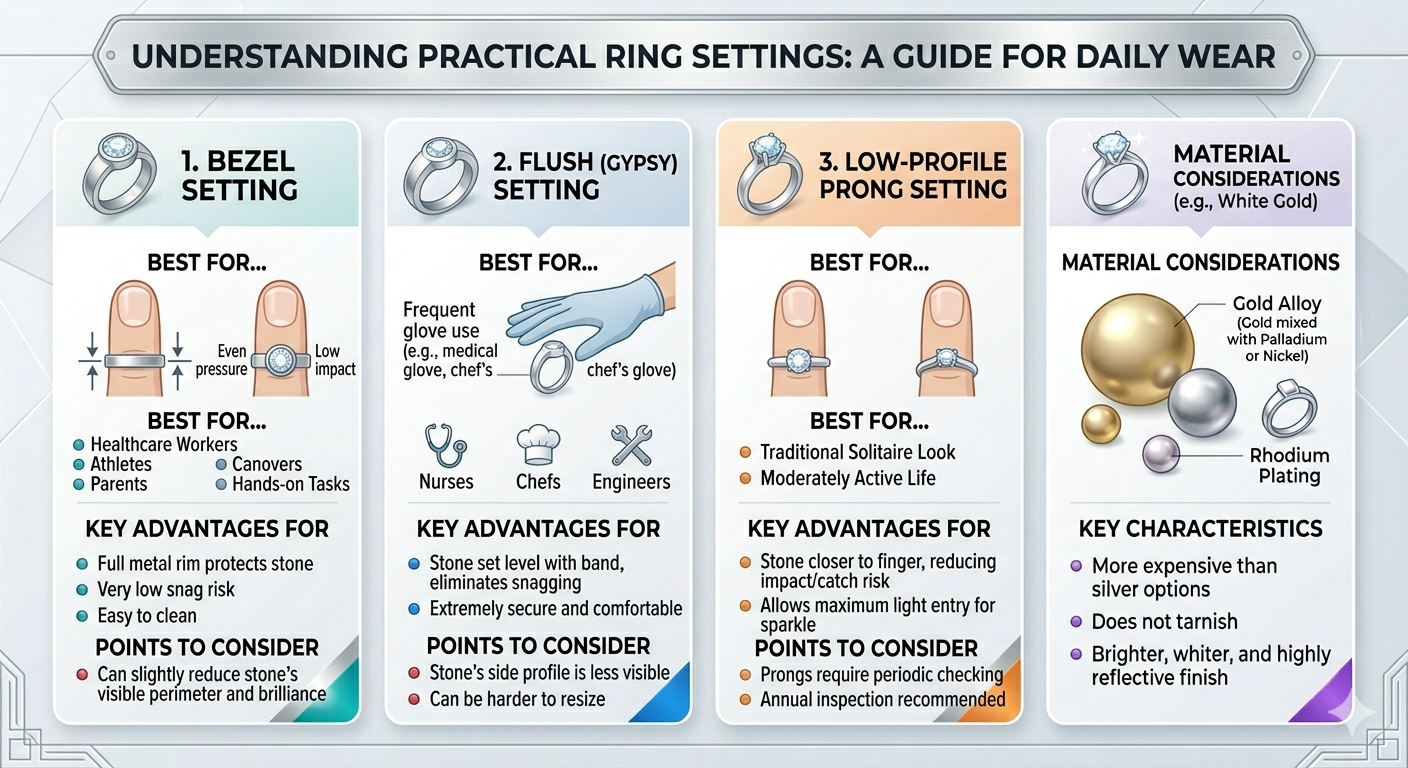
How to Choose Based on Your Lifestyle
Your daily routine is the most important factor:
Highly Active/Hands-On Professions (Nurse, Mechanic, Athlete): Prioritize security and smoothness. A bezel or flush setting in a durable metal like platinum is highly recommended.
Moderately Active/Office Work: You have more flexibility. A low-profile prong setting offers a classic look with good security, or a low-set halo for extra sparkle.
For Minimalist or Stackable Styles: Consider a plain band, a channel-set band (stones protected between metal walls), or a delicate pavé band for subtle sparkle.
Additional Factors for a Durable Daily Ring
Beyond the setting, these elements are crucial:
Metal Matters: Platinum is the most durable and requires the least maintenance. 14K or 18K gold (white, yellow, or rose) is classic but softer and will show scratches more.
Stone Shape & Hardness: For daily wear, round and oval diamonds are most resilient. If choosing a gemstone, ensure it's hard enough (e.g., sapphire, ruby). Avoid very soft stones like opal or emerald for a ring you never take off.
Practical Tips: Ensure a proper fit to avoid loss. Ensure your ring. Remove it during high-risk activities like heavy lifting, gym workouts, swimming, or using harsh chemicals. Schedule a professional cleaning and inspection at least once a year.
To refine your choice further, it would help to know:
What does your typical day look like (e.g., office work, hands-on tasks, frequent gym visits)?
Do you have a strong preference for a particular style (e.g., classic solitaire, modern, vintage-inspired)?
Choose Your Setting Based on Lifestyle
| Lifestyle | Recommended Setting | Why |
|---|---|---|
| Highly Active (nurse, mechanic, athlete) | Bezel, Flush | No snagging, maximum protection |
| Office Work / Moderately Active | Low Prong, Channel | Classic look with good security |
| Minimalist / Stackable | Plain Band, Channel, Pavé | Sleek, versatile, comfortable |
| Max Sparkle / Photography | Prong, Pavé, Halo | Maximum light entry, brilliant |
Learn more about jewelry care on the American Gem Society's care guide.
Which Ring Setting Makes A Diamond Look Bigger?
Several ring settings are designed to make a diamond appear larger by creating optical illusions with surrounding stones or metal, or by minimizing visual competition.
The most effective settings for this purpose, along with specific design tips, are outlined below.
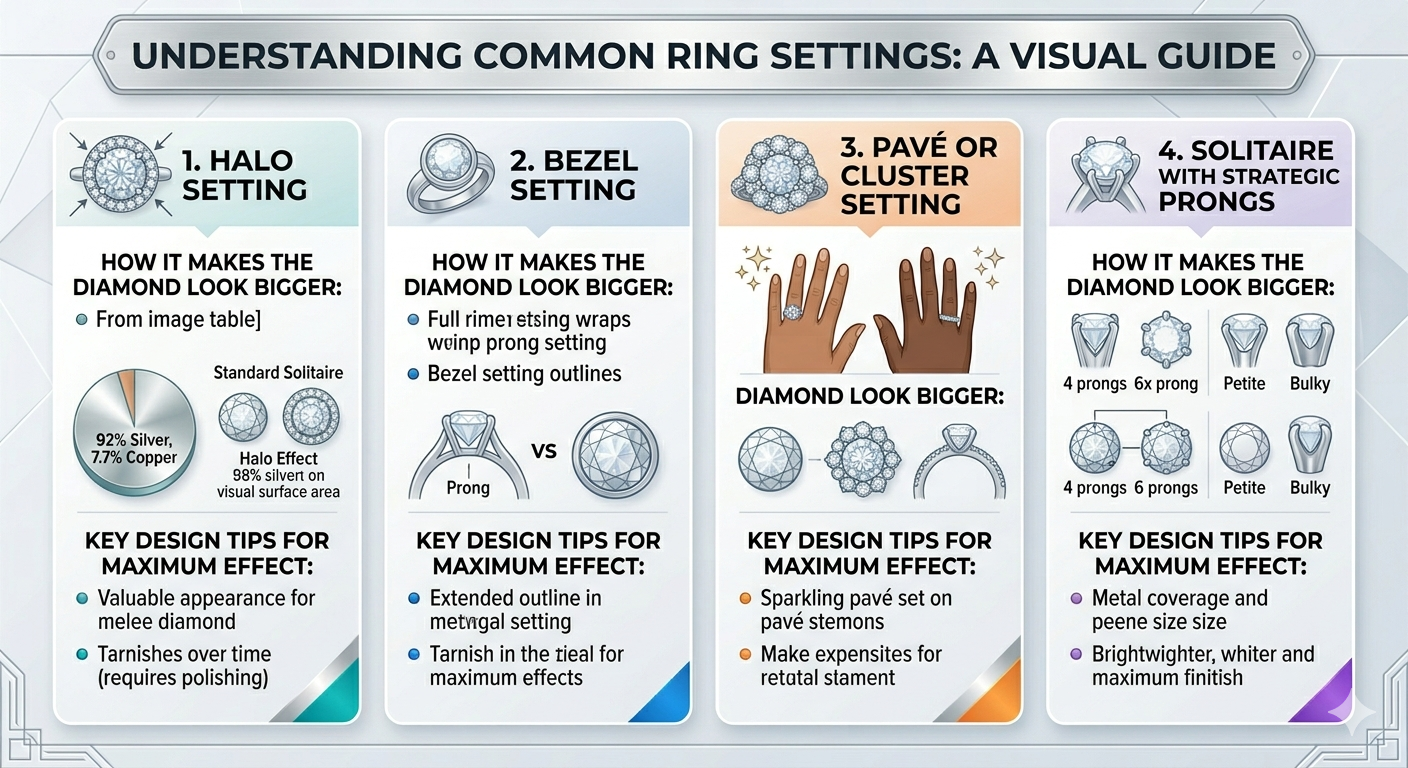
Key Design Choices to Enhance Size
Beyond the main setting, these design elements have a major impact:
Band Width & Profile: A thinner band (1.8mm - 2.2mm) creates a visual contrast that makes the diamond appear larger. A tapered shank (band that narrows as it approaches the stone) achieves a similar effect.
Setting Height: A higher setting (like a cathedral style) raises the diamond closer to the eye and allows more light to enter, which can enhance its presence. However, this can make the ring more prone to snagging.
What to Avoid: Large side stones in a three-stone ring can compete with and diminish the center stone. Overly thick or bulky bands will visually overwhelm the diamond.
How to Choose the Right Setting for You
Your choice should balance the desire for size with other priorities:
For Maximum Sparkle & Illusion: A Halo setting is the most dramatic for size enhancement.
For a Modern, Secure, and Active Lifestyle: A Bezel setting offers excellent protection, a contemporary look, and still effectively enlarges the diamond's silhouette.
For Classic Brilliance: A Solitaire with four petite prongs on a thin band showcases the diamond's inherent beauty with minimal distraction, letting it shine on its own.
Considering your previous question about daily wear, a bezel or a low-profile pavé setting would offer a great combination of enhanced size, security, and comfort for active use.
I hope this helps you visualize the options. To give more tailored advice, what is the shape of the diamond you have in mind?
Can You Buy A Setting Without The Diamond?
Yes, you can absolutely buy a ring setting without a diamond. This is a common practice known as purchasing a "setting only," "ring mount," or "semi-mount". Many jewelers and online retailers offer this service, especially for engagement rings.
There are two main approaches to doing this, each with different processes:
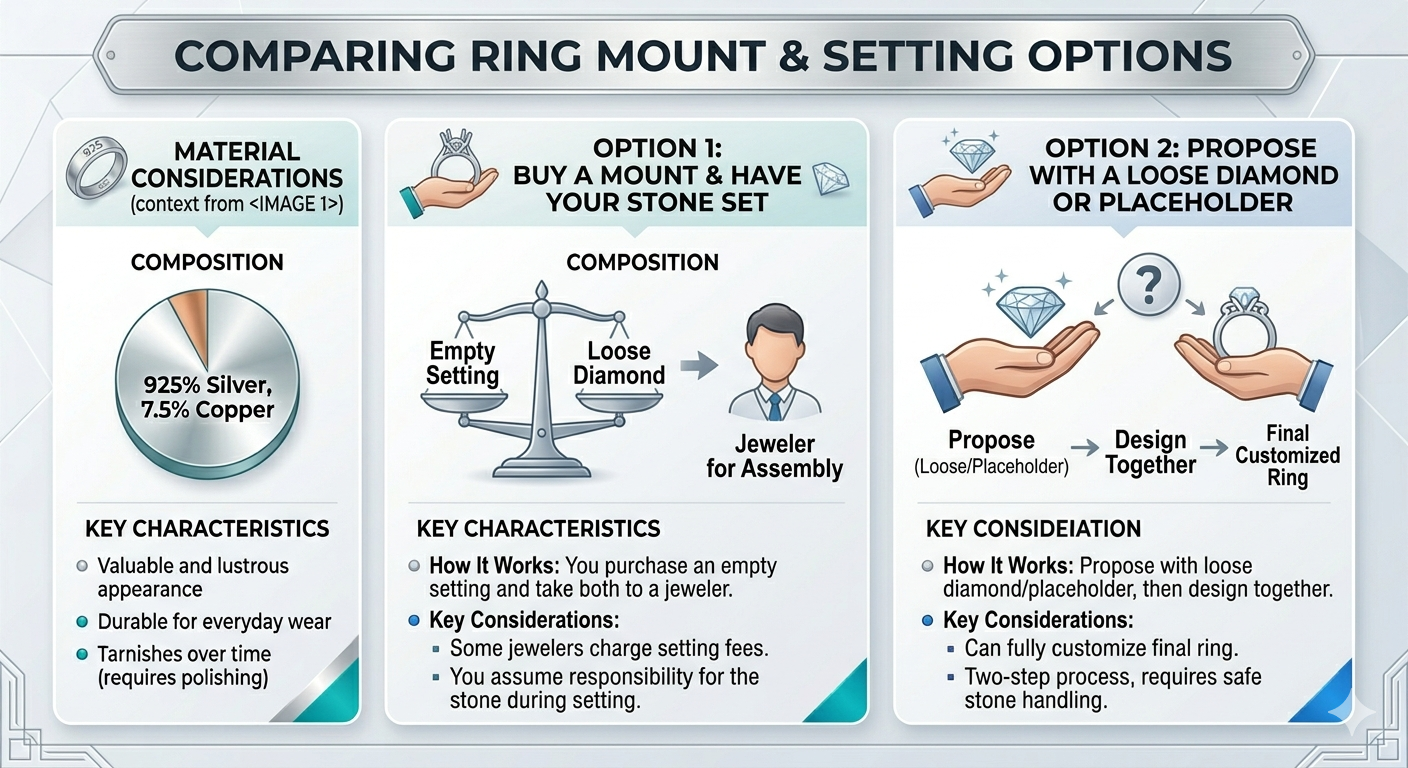
Practical Steps & Important Considerations
If you're considering this route, here are key points to keep in mind:
Be Clear with Your Jeweler: Before buying anything, talk to your chosen jeweler. Ask if they are willing to set a diamond purchased elsewhere, as not all jewelers offer this service. They may need to verify the diamond's certification and specifications first.
Understand the Costs and Responsibility: Using two different suppliers can complicate shipping and insurance. If something goes wrong (like a stone is damaged during setting), it may be harder to determine who is responsible if multiple parties are involved. Many jewelers recommend buying both the diamond and setting from the same source to have a single point of contact and warranty.
It's Ideal for Customization and Heirloom Stones: This approach is perfect if you have a specific, unique design in mind or if you want to reuse a diamond from a family heirloom or an existing piece of jewelry.
Ultimately, buying a setting separately gives you maximum flexibility, but it requires more coordination than buying a pre-set ring. The best choice depends on your priorities—whether it's complete customization, using a special stone, or simplicity.
To help you decide, what is your main reason for considering buying the setting separately? Are you planning to use a diamond you already own, or do you want to design a completely custom ring?
Still not sure? Explore each setting in detail:
“You now know the history, the options, the daily-wear winners, the size illusions, and the separate-setting buying process. The only question left: which setting will hold your story?
Our current collection includes a limited number of rings in every major setting type — from secure bezels to brilliant prongs, from pavé halos to channel-set eternity bands. When certain settings are gone, restocking takes time because each setting is handcrafted for its specific stone.
This is not just a setting. It is 500 years of jewelers‘ wisdom — the prong that never snags, the bezel that never loosens, the channel that never collects dirt, and the tension that never fails. Sarah lost her diamond. You won‘t lose yours.”
[Button: Find Your Perfect Setting (Limited) →]
News for Friday 12 June, 2026
- Tanzanite Ring Guide: Meaning, Price, Care and Buying Tips
- Topaz Stone Guide: Healing Properties, Colors, Price and Care
View all news for Friday 12 June, 2026 on one page
Recent News
- Thursday 11 June, 2026
- Wednesday 10 June, 2026
- Tuesday 09 June, 2026
- Monday 08 June, 2026
- Sunday 07 June, 2026