

Channel Setting Guide: Pros, Cons, Safety and Cost vs Pavé
Channel Setting Guide: Pros, Cons, Safety, and Cost vs Pavé
In 1953, Queen Elizabeth II wore a very special piece of jewelry to her coronation—a bracelet set with rows of diamonds, each one nestled snugly between two metal walls, with no prongs in sight.
That bracelet, now known as the "Channel Set Diamond Bracelet," became one of her most worn pieces. Why? Because channel setting is the most comfortable way to wear multiple stones.
No prongs to catch on her gloves. No gaps for dirt to hide. Just a smooth, continuous line of sparkle that glides over the skin.
For a queen who spent her days greeting world leaders and her nights at state banquets, channel setting offered something priceless: effortless elegance.
The same setting that graced a queen‘s bracelet and Hollywood‘s brightest stars now awaits your own everyday elegance — no prongs, no snags, just a smooth line of sparkle. Every channel setting ring in our collection is crafted with closed ends for maximum security.”
[Button: Explore Channel Setting Rings →]
Channel Setting Ring Meaning
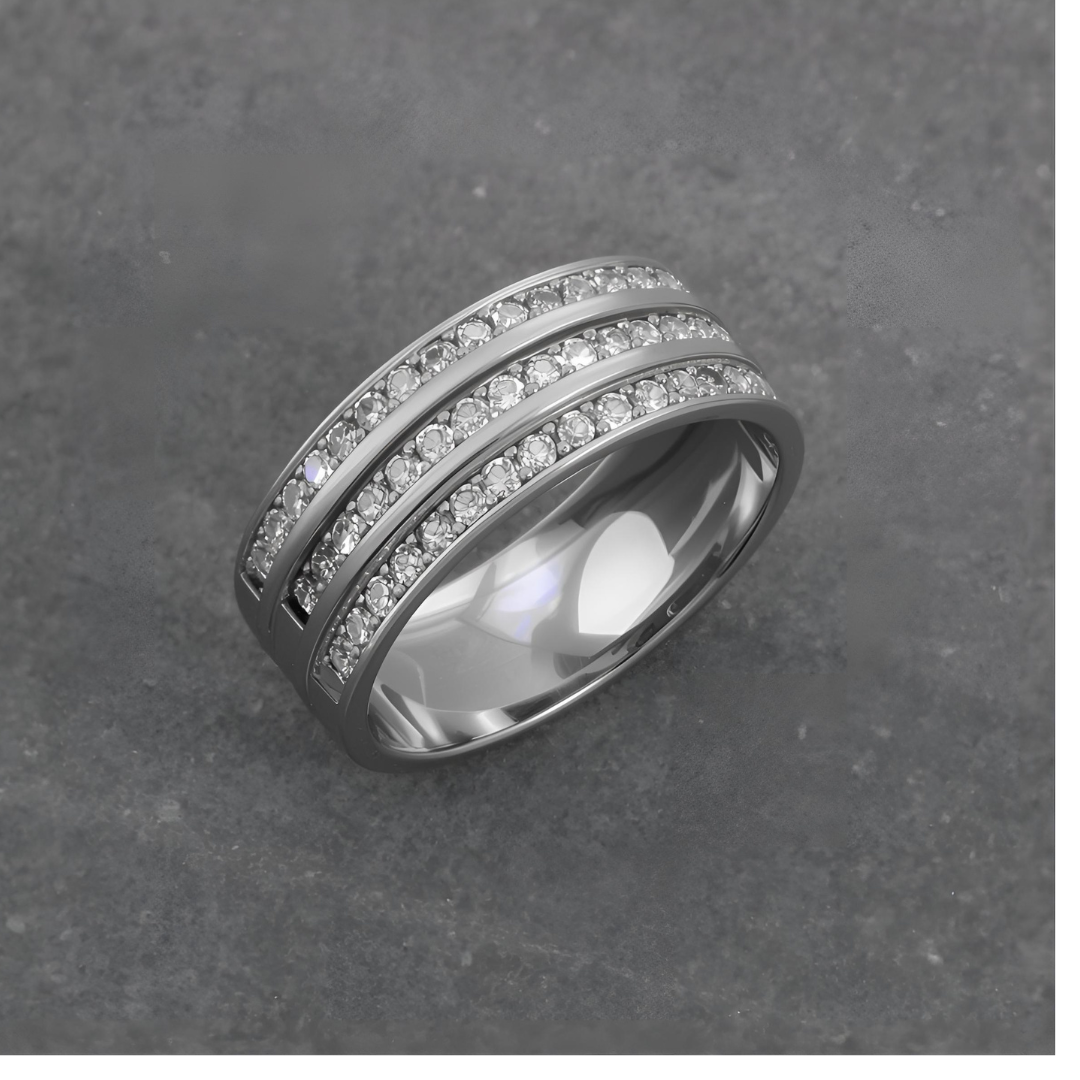
A channel setting ring is a jewelry method where gemstones are set into a channel created by two parallel walls of metal.
Table of Contents
In simple terms, a channel setting is a method of securing gemstones (usually diamonds) in a ring by suspending them between two parallel walls of metal, creating a smooth, seamless "channel" of stones.
Think of it like a beautiful, paved path of gems set flush within the band of the ring.
Here’s a more detailed breakdown:
How a Channel Setting Works
The "Channel": The jeweler creates a groove or a channel from a solid piece of metal. This channel has two vertical walls on either side.
Securing the Stones: The gemstones are carefully slid into this channel. Each stone sits snugly against its neighbors.
The "Rail": The top edges of the metal walls are then gently rolled or pressed over the girdle (the widest part) of the gems. This holds the stones securely in place without the use of individual prongs.
Key Characteristics & Visual Appearance
Sleek and Continuous: The stones are set in a straight or curved line with no metal separating them from the sides, creating an uninterrupted line of sparkle.
Smooth and Snag-Free: Because there are no prongs, the surface is very smooth. This makes it an excellent choice for people with active lifestyles or those who work with their hands, as it's less likely to catch on clothing or hair.
Modern and Uniform: It offers a clean, modern, and elegant look. The symmetry of the stones is a major part of its appeal.
Advantages of a Channel Setting
Excellent Security: The stones are extremely well-protected. With metal on both sides and no exposed edges, it's very difficult for a stone to become loose or fall out.
Durability: The design protects the stones from impact and everyday wear and tear.
Comfort: The smooth, low-profile design is very comfortable to wear.
Enhances the Band: It can make the ring's band look more substantial and luxurious. It's a popular choice for wedding bands and eternity rings.
Disadvantages of a Channel Setting
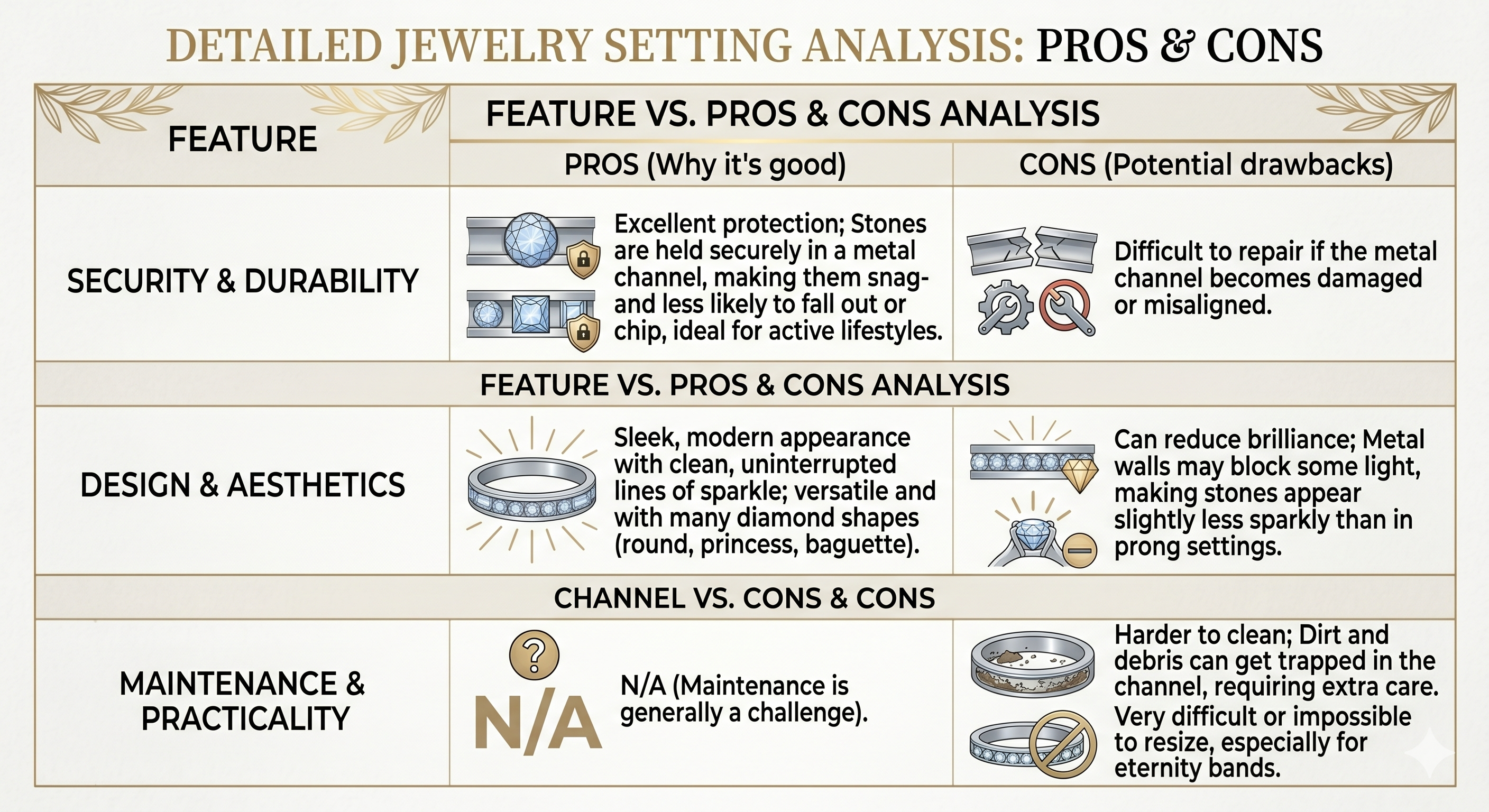
Less Brilliance than Prong Settings: Because a significant portion of the top and bottom of each stone is covered by metal, less light can enter and exit the stone. This can result in slightly less sparkle and brilliance compared to a prong setting, which allows more light in from all angles.
Difficult to Repair/Resize: Resizing a channel-set ring can be very challenging and expensive, especially if it's a full eternity band (with stones all the way around). It can also be difficult for a jeweler to access and tighten an individual stone if it becomes loose.
Accumulation of Dirt: Over time, dirt and grime can build up in the channel, making the stones look dull. Regular cleanings are necessary to maintain its sparkle.
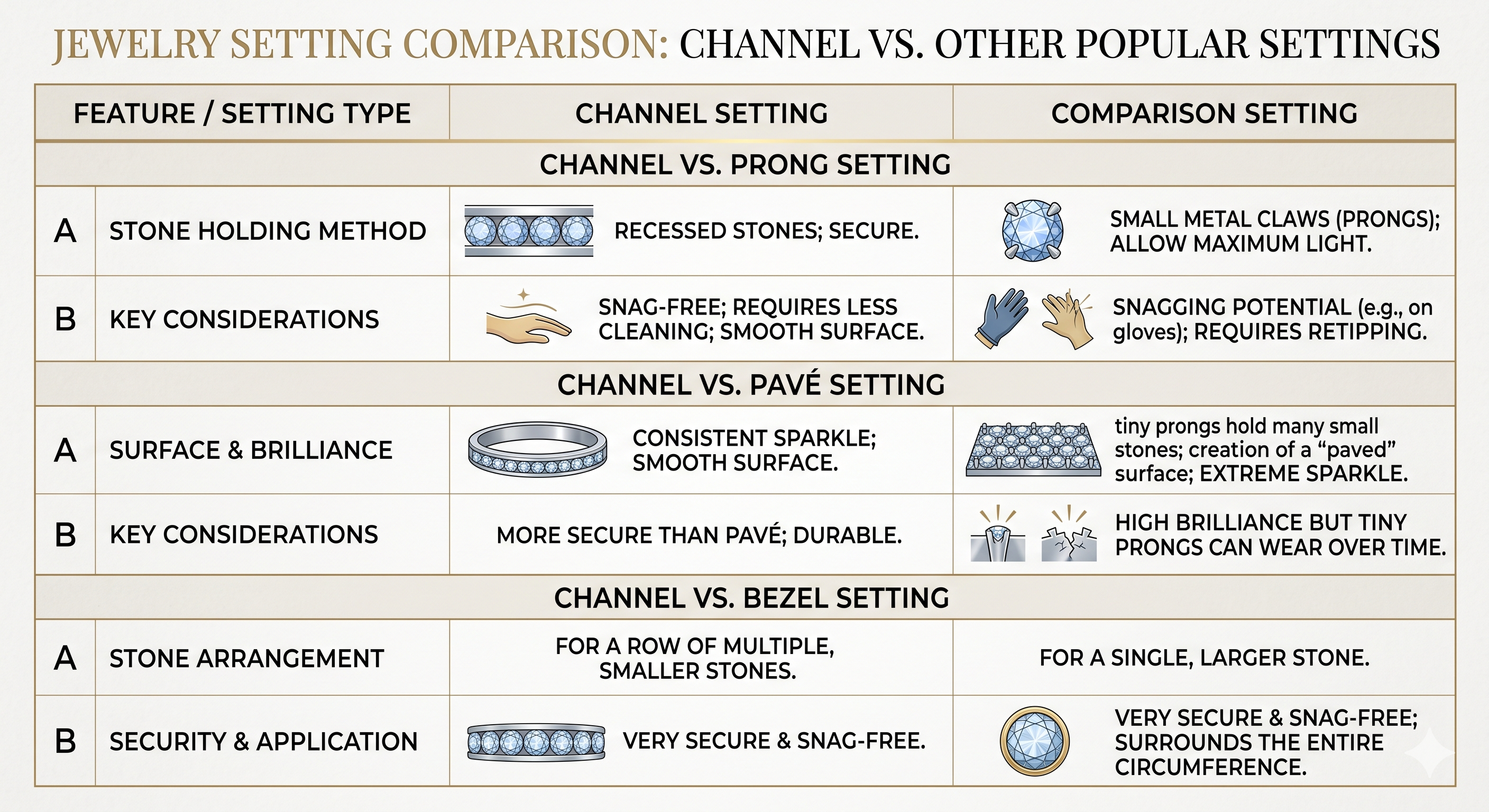
Channel Setting vs. Other Popular Settings
Common Uses for Channel Settings
Wedding Bands and Eternity Rings: This is the most classic use, often featuring a single or double row of channel-set diamonds.
Accenting an Engagement Ring: It's frequently used on the shank (band) of an engagement ring to add extra sparkle and detail alongside a central stone.
Three-Stone Rings: Sometimes the side stones are set in vertical channels.
In summary, a channel setting is a stylish, secure, and durable choice that prioritizes a smooth, modern look and protection for the gemstones, making it an excellent option for everyday wear.
For official information on jewelry settings, visit the GIA Jewelry Setting Guide.
Are Channel Set Rings More Expensive?
The answer isn't a simple yes or no, because the cost of a channel-set ring depends on a balance of several factors, some of which can make it less expensive, and others that can make it more expensive than other styles.
Here’s a breakdown to help you understand the pricing:
Factors That Can Make Channel Set Rings Less Expensive
Potential for Lower Diamond Quality:
Because the channel setting protects the stones and hides their sides, jewelers often use diamonds with slightly lower grades in color and clarity (e.g., SI clarity, I-J color). The metal walls mask imperfections, and the reduced light performance means extreme brilliance is not the priority.
Result: Using these more affordable stones can significantly lower the overall cost compared to a ring that requires high-quality, eye-clean stones.
No Cost for Multiple Prongs:
A pavé setting, for example, requires the intricate and labor-intensive work of carving out and setting dozens of tiny prongs. Channel setting avoids this prong-work altogether.
Factors That Can Make Channel Set Rings More Expensive
Higher Labor and Craftsmanship Cost:
Creating a perfect channel requires a highly skilled artisan. The metal walls must be milled with absolute precision. Each stone must be perfectly calibrated (cut to an exact size) to fit snugly in the row without gaps.
Result: This specialized labor can be more costly than the labor for a simpler prong setting.
More Metal Weight:
Channel settings require a substantial amount of metal to create the two strong, parallel walls. This increased gold or platinum weight adds to the raw material cost of the ring.
Difficulty in Resizing and Repair:
While not an upfront cost, it's an important long-term cost consideration. Resizing a channel-set ring is very difficult and expensive. If a stone becomes loose, repairing it is complex. This can add to the lifetime cost of owning the ring.
Cost Comparison vs. Other Settings
vs. Prong-Set Ring: A channel-set eternity band will often be comparable to or slightly more expensive than a prong-set eternity band of similar carat weight. This is because the labor and metal savings from a lack of prongs are offset by the higher craftsmanship and metal weight of the channel. A channel setting is almost always more expensive than a simple 4-prong setting for a single stone.
vs. Pavé-Set Ring: This is the most common comparison. A channel set ring can be less expensive than a pavé ring of the same carat weight and diamond quality. Why? Pavé requires extremely precise and time-consuming labor to set all the tiny prongs. However, if the pavé ring uses lower-quality diamonds than the channel ring, the pavé ring could be cheaper.
A channel-set ring is not inherently more expensive, but it is often priced higher due to its craftsmanship and metal content, not because of the diamonds used.
To generalize: You are often paying more for the expert labor and precious metal than for the diamonds themselves. For a similar style (like an eternity band), a channel-set ring will typically be in a similar price range to a pavé or prong-set band, with the final cost being determined by the specific diamond quality and the jeweler's labor rates.
When shopping, compare rings based on:
Total carat weight of the diamonds.
Type of metal (platinum vs. gold) and its weight.
The quality of the diamonds (if disclosed).
The reputation of the jeweler.
Are Channel Set Diamonds Safe?
Excellent and very important question. When it comes to security and protection, channel-set diamonds are considered one of the safest and most durable settings available.
Here’s a detailed breakdown of why they are so safe, along with the few vulnerabilities to be aware of.
Why Channel Set Diamonds Are Very Safe
Excellent Protection from Impact: The two parallel metal walls act as a "bumper" for the diamonds. The gems are shielded from knocks and bumps from the sides, which is a common way stones in prong settings get damaged or dislodged.
No Prongs to Snag or Wear Down: Unlike prong or pavé settings, there are no tiny metal claws that can bend, break, or wear thin over time. This eliminates the most common point of failure for lost stones in other settings.
Stones are secured from the Top: The gemstones are held in place by the "rails" of the channel—the metal lips that are pressed over the girdle of each stone. This creates a continuous, strong hold along the entire row of diamonds.
Stones Support Each Other: Because the diamonds are set side-by-side with no gaps, they act as a single, solid unit. This collective strength makes it very difficult for an individual stone to work itself loose.
In short, for everyday wear and tear, a channel setting is one of the most secure choices you can make.
Potential Vulnerabilities and Important Considerations
While extremely secure, no setting is completely infallible. Here are the potential risks and maintenance needs for a channel set ring:
The "Open Channel" Risk (Most Common Issue):
On some older or lower-quality channel settings, the ends of the channel might be open. If the ring is hit hard from the side, a diamond could potentially be forced out of this open end.
Modern Solution: Most high-quality channel settings today are "closed-end" or "French-set," meaning the ends of the channel are capped with metal, eliminating this risk. Always ask your jeweler if the channel is closed.
Difficulty in Identifying a Loose Stone:
It can be very hard to tell if a single diamond has become loose because they are all packed so tightly together. A loose stone might not rattle or be obvious until it's on the verge of falling out.
Wear and Tear on the Metal Rails:
Over many years, the metal lips that hold the stones can wear down, especially if the ring is made from a softer gold like 14k or 18k. If these rails wear too thin, they can lose their grip.
Challenging Repairs:
If a stone does become loose or falls out, or if the channel walls get bent, the repair is complex and requires a highly skilled jeweler. It is often more expensive to fix than a simple prong retipping.
How to Keep Your Channel Set Ring Safe?
Keeping a channel set ring safe requires a combination of daily care, mindful wearing habits, and professional maintenance. The channel setting, where stones are set side-by-side within a "channel" of metal with no prongs, is prized for its sleek look and security, but it has its own unique vulnerabilities.
Buy Quality: Purchase from a reputable jeweler who uses a closed-channel design and sturdy metal.
Get Regular Inspections: Have a jeweler inspect your ring every 6-12 months. They have special tools to check if any stones are loose and if the metal rails are still strong.
Clean It Regularly: Dirt and grime can build up in the channel, making the stones look dull and potentially putting pressure on the setting over time. Regular cleanings will keep it sparkling and allow you to spot any issues.
Be Realistic: While very durable, no jewelry is indestructible. It's still wise to remove your ring during heavy manual work, gym sessions, or other high-impact activities.
The Verdict
Yes, channel-set diamonds are exceptionally safe for daily wear. Their design prioritizes security and protection above all else, making them an ideal choice for wedding bands, eternity rings, and for people with active lifestyles.
The key is to ensure you have a well-made, modern channel setting and to maintain it with regular professional check-ups.
Learn more about jewelry care on the American Gem Society's care guide.
Are Channel Set Rings Good?
Channel set rings are a unique and popular jewelry choice. Their suitability depends heavily on your priorities for security, design, and maintenance. Here is a quick overview of their main advantages and disadvantages:
What Makes a Channel Setting Different?
A channel setting involves placing a row of gemstones into a groove or "channel" carved into the ring's band, secured by two metal walls. This differs significantly from pavé settings, where small stones are held on the surface by tiny metal beads.
Key Features That Define a Channel Setting
To truly understand what makes it different, focus on these three characteristics:
“In the 1940s, a New York jeweler named Paul Flato invented the modern channel setting. His clients included Hollywood stars like Greta Garbo and Rita Hayworth. Flato wanted a ring that looked like a single, seamless ribbon of diamonds — no metal visible between stones, no prongs to distract the eye. His solution was to carve a groove into the band, drop stones into it, and press the metal walls over their edges. The result was revolutionary: diamonds that seemed to hold themselves. Today, when you wear a channel-set ring, you are wearing a piece of Hollywood history — the setting that made diamonds look like they were floating.”
1. The "Two-Rail" Security System
Unlike a prong setting that holds a single stone with four or six individual fingers of metal, a channel setting uses two continuous, solid bars of metal running along the entire length of the stones. One bar sits on the inside of the ring (next to the finger) and one on the outside. The stones are dropped into the "channel" created between them, and then the metal edges are pressed down (burnished) over the stones' girdles.
What this means for you: This is one of the most secure ways to set a row of small stones. If one prong on a pave ring breaks, you can lose a stone. With a channel, the entire side rail would have to be damaged to lose a stone. It's ideal for active lifestyles.
2. A Smooth, Continuous Profile
Because there are no prongs, beads, or shared claw marks between the stones, the finished channel setting feels perfectly smooth to the touch. Run your finger over a channel-set band, and it will feel like a single, solid piece of metal.
What this means for you: It will never snag on sweaters, hair, gloves, or delicate fabrics. This is a major practical advantage for an everyday-wear ring like a wedding band.
3. Uninterrupted Light Show (With a Catch)
The stones are held only on their sides. Their crowns (tops) and pavilions (bottoms) are fully exposed. In a well-executed channel setting, the stones are placed directly next to each other, creating a near-continuous line of sparkle. From the top, it looks like a solid ribbon of diamonds.
The catch (The "Gap" Myth): The photo you provided perfectly illustrates the main visual difference. Because the stones are held only by their sides, and the metal on the inside of the band is often curved, you can sometimes see small triangular gaps under the stones. This is normal and a hallmark of a true channel setting. Novice jewelers might fill this gap with metal (creating a modified bezel-channel), but that would block light from below, reducing the stones' brilliance.
“You now know the history, the security, the cost factors, the safety, and the pros and cons. The only question left: will you choose the setting that keeps stones in perfect formation?
Our current collection includes a limited number of channel setting rings — from classic wedding bands to engagement rings with channel-set accents. When certain designs are gone, restocking takes time because each channel must be milled with precision to fit stones without gaps.
This is not just a setting. It is the Roman‘s lattice, the Art Deco modernist‘s line, the queen‘s favorite bracelet, and Hollywood‘s floating diamonds — stones that march together, prong-free, for a lifetime.”
[Button: Secure Your Channel Setting Ring (Limited) →]


Other news for Saturday 13 June, 2026
- Ring Finger Meaning: Which Finger for Wedding, Single and More | Complete Guide
- Bezel Setting Guide: Benefits, Styles, and Buying Tips
- Sterling Silver Jewelry Guide: 925 Meaning, Care and Green Skin Fix
- Prong Setting Guide: 4 vs 6 Prongs, Security, Size and Types
- Ring Setting Guide: Types, Best for Daily Wear, and Size Tips
View all news for Saturday 13 June, 2026 on one page
News for Friday 12 June, 2026
- Tanzanite Ring Guide: Meaning, Price, Care and Buying Tips
- Topaz Stone Guide: Healing Properties, Colors, Price and Care
View all news for Friday 12 June, 2026 on one page
Recent News
- Thursday 11 June, 2026
- Wednesday 10 June, 2026
- Tuesday 09 June, 2026
- Monday 08 June, 2026
- Sunday 07 June, 2026