

Prong Setting Guide: 4 vs 6 Prongs, Security, Size and Types
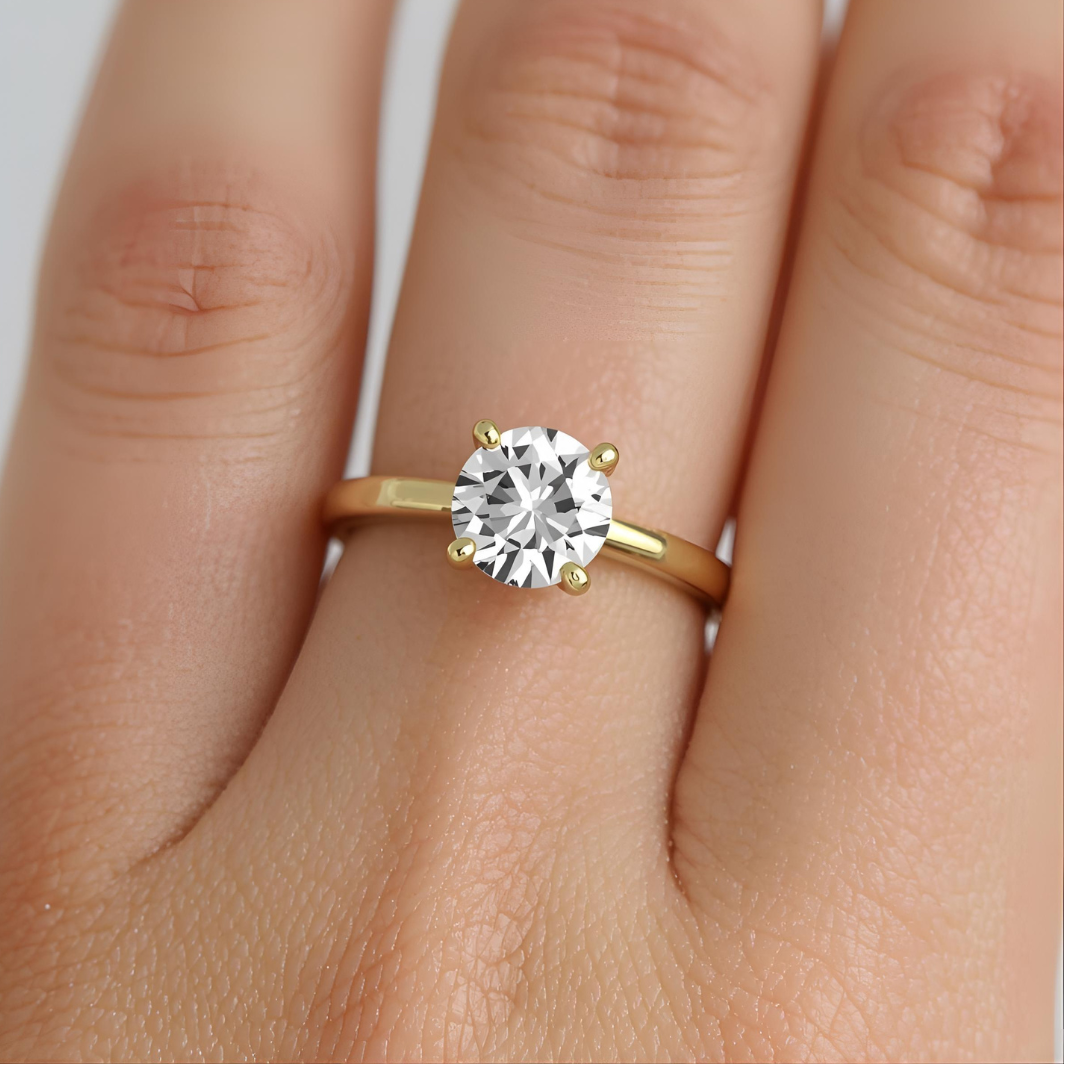
Prong Setting Guide: 4 vs 6 Prongs, Security, Size, and Types
The Engagement Ring That Almost Fell Off
Sarah thought she had found the perfect ring—a beautiful diamond set in delicate prongs. Six months later, she reached into her coat pocket and felt something horrible: an empty setting.
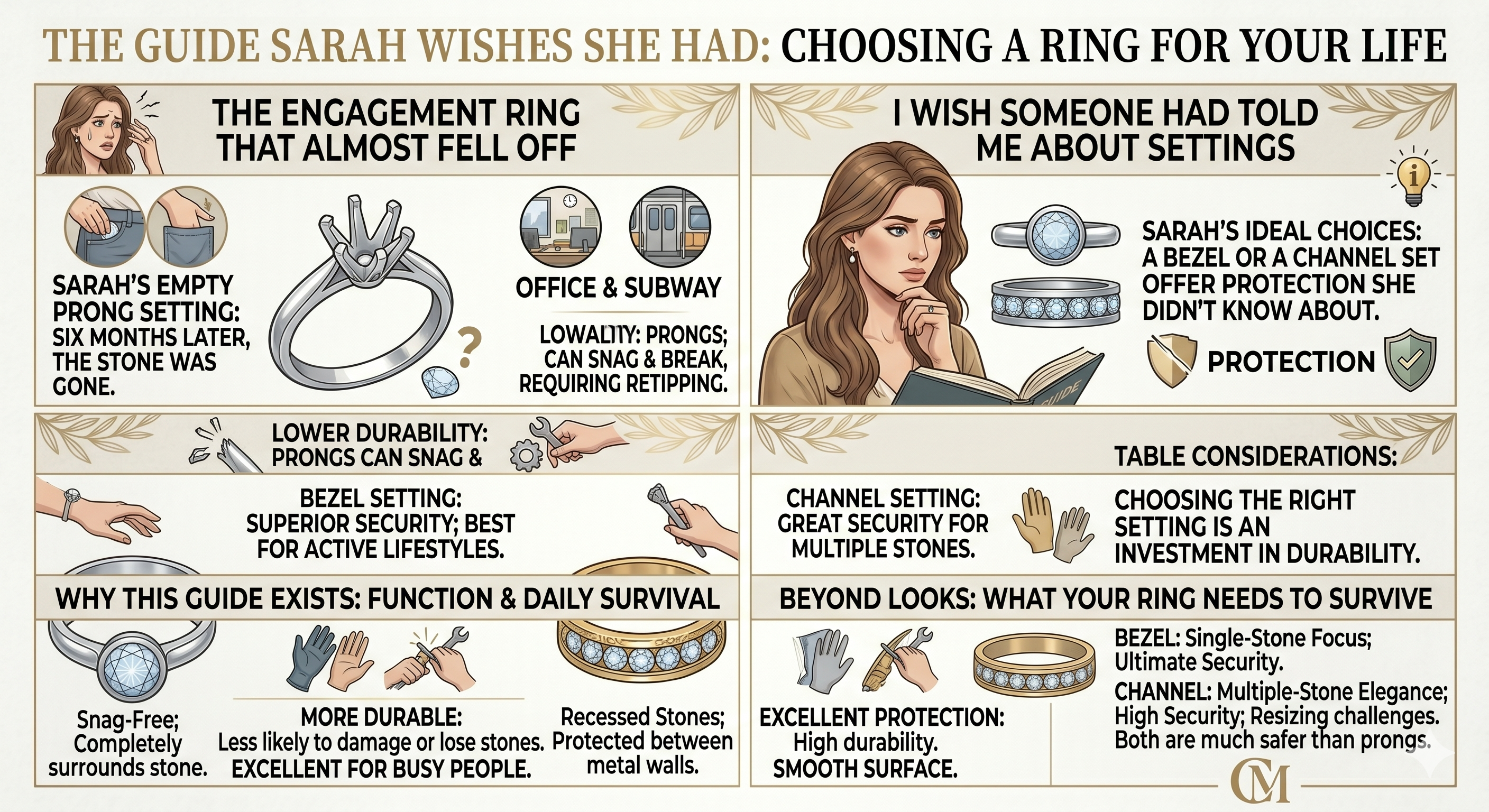
The diamond had fallen out somewhere between the office and the subway. She never found it.
"I wish someone had told me about settings," she says now. "I would have chosen a bezel or a channel set. I just didn't know."
“In 1886, Charles Lewis Tiffany solved this problem forever. He introduced the Tiffany Setting — a six-prong mounting that lifted the diamond up, allowing light to enter from every angle. Before that, diamonds were mostly set in closed-back bezels, hidden and dark. Tiffany‘s innovation was revolutionary: the diamond no longer sat in a box of metal. It floated. It caught light from the sides, from the bottom, from everywhere. Today, the six-prong setting is still the most copied engagement ring design in history. Sarah‘s story is a tragedy of a poorly made setting, not the prong setting itself. Because when prongs are done right, they don‘t just hold a diamond. They let it shine like nothing else can.”
The same setting that revolutionized engagement rings in 1886 now awaits your own love story. Every prong setting in our collection is hand-finished — from classic 6-prong Tiffany-style to sleek 4-prong solitaires. Because a diamond that catches light catches hearts.”*
[Button: Explore Prong Setting Rings →]
That's why this guide exists. Choosing a ring setting isn't just about looks. It's about how you live, what you do, and what you need your ring to survive.
Let's find your perfect match.
Here is a detailed explanation of the Prong Setting, one of the most popular and classic techniques in jewelry. Here are the details about the Prong setting the table of contents.;
What Is Prong Setting?
Prong Setting: Simple Definition
A prong setting is a metal claw or wire that extends from the base of a piece of jewelry to hold a gemstone securely in place. It is the most common type of setting for diamond engagement rings, especially solitaires, because it uses minimal metal, allowing maximum light to enter the stone and enhance its brilliance.
Key Characteristics of a Prong Setting
The Prongs: These are the small metal "claws" that you can see and feel. They are bent over the gemstone's girdle (its widest part) to secure it.
The Head: The collection of prongs and the base they are attached to is often called the "head." This head is then soldered onto the ring's shank or band.
Minimalist Metal: It uses the least amount of metal possible to hold the stone, making the gemstone the undeniable star of the show.
“In the 19th century, jewelers called prongs ‘claws‘ — not because they looked like animal feet, but because they gripped the stone with the same tenacity. A well-made prong does not merely hold a diamond. It cradles it, like fingers holding a candle flame. The number of prongs tells a story: four prongs for a square stone, six prongs for a round one, eight prongs for a stone you never want to lose. The Tiffany setting chose six because six prongs create a perfect hexagon around a round stone — the strongest geometric shape in nature. A prong setting is not a cage. It is a promise: this stone is safe, but it will never be hidden.”
Anatomy of a Prong Setting
Prong: The metal claw that holds the stone.
Head/Base: The platform the prongs are attached to.
Girdle: The widest part of the gemstone, where the prongs grip.
Culet: The bottom point of a faceted stone (like a diamond), which can sometimes be seen through the base.
Advantages of a Prong Setting
Maximizes Light & Brilliance: This is its biggest advantage. With less metal covering the stone, more light can enter from all angles, reflect off the internal facets, and return as sparkle (brilliance, fire, and scintillation).
Showcases the Stone: It elevates the stone away from the band, making it the central focus and often making it appear larger.
Versatile & Classic: It works with almost any gemstone shape (round, princess, oval, etc.) and is a timeless style that never goes out of fashion.
Easier to Clean: Because it's so open, it's easier to clean the stone and the underside, preventing dirt and grime from building up.
Allows for Secure Side Stones: Prong settings are ideal for setting smaller accent stones on a band or halo.
Disadvantages of a Prong Setting
Prone to Snagging: The prongs can catch on clothing, hair, or other fabrics. This is a common issue, especially with higher settings.
Requires Maintenance: Over time, prongs can wear down or become loose. It's crucial to have them checked by a jeweler every 6-12 months to ensure the stone is still secure.
Less Protective: Compared to other settings (like a bezel), it offers less protection to the edges and girdle of the gemstone, making it more vulnerable to chips and impacts.
Potential for Damage: If a prong is bent or broken, the gemstone can easily fall out and be lost.
For official information on jewelry settings, visit the GIA Jewelry Setting Guide.
What Is The Best Prong Setting?
Excellent question! While there is no single "best" prong setting that wins for every situation, we can identify the best prong setting for specific goals, such as security, appearance, or stone shape.
The "best" choice is a balance of security, style, and practicality.
Here’s a breakdown of the top contenders and what makes them the best in different categories.
The Top Contenders for "Best Prong Setting"
1 . For Maximum Security: The Six-Prong Setting
Why it's the best: Simple math, six prongs holding the stone are stronger and more secure than four. If one prong becomes loose, the other five still have a firm grip, significantly reducing the risk of losing the stone.
Best for: Round brilliant diamonds. The six prongs create a hexagonal shape that beautifully frames a round stone, making it look perfectly circular.
Trade-off: The additional prongs cover slightly more of the diamond's crown (the top part) than a four-prong setting, but the increase in security is often worth it.
2. For Maximum Sparkle and a Modern Look: The Four-Prong Setting
Why it's the best: With only four points of contact, less metal covers the gemstone. This allows more light to enter and exit the stone, which can maximize its brilliance and make it appear slightly larger from the top down. It offers a more modern, square-like silhouette.
Best for: Those who prioritize sparkle over ultimate security and prefer a contemporary aesthetic. It works well with many stone shapes.
Trade-off: It is slightly less secure than a six-prong setting. If one prong fails, the stone is held by only three points, making it vulnerable.
Best Prong Setting by Stone Shape
The "best" prongs often depend on the shape of your gemstone.
For Round, Oval, and Cushion Cuts: Both four and six prongs work well. Six prongs are recommended for stones over 1 carat for added security.
For Princess, Square, and Emerald Cuts: Four prongs are standard, typically placed at the corners. A V-prong on the four corners can enhance the geometric look and protect the sharp angles.
For Pear, Marquise, and Heart Shapes: The "best" setting must include V-prongs at the pointed ends. A V-prong is a prong that is folded into a "V" shape to cradle a delicate point and prevent it from chipping or snagging. A minimum of a V-prong at the tip and two standard prongs on the rounded end is essential.
Key Factors That Make Any Prong Setting "The Best"
Beyond the number of prongs, these details are crucial for quality and security:
Prong Material: The prongs should be made from a durable metal. Platinum is often considered the best for prongs because it is incredibly strong and wear-resistant. 18k Gold is also excellent, while 14k offers a great balance of durability and color.
Prong Shape and Finish:
Claw Prongs: Offer a very secure hold and a decorative, often vintage, look.
Round Prongs: Are common, durable, and less likely to snag than sharp claw prongs.
Double Prongs: Using two thin prongs instead of one thick one at each point is a design feature that adds security and a unique, detailed look.
Prong Height and Profile: The prongs should be substantial enough to hold the stone securely, yet can be worn down over time. A skilled jeweler can ensure they are the right height and thickness for long-term wear.
Final Recommendation: The "Safest Bet"
If we have to choose one all-around "best" for a classic round diamond solitaire, the winner is:
The Six-Prong Setting in Platinum.
Why: It offers the perfect balance of superior security, timeless elegance (thanks to the Tiffany legacy), and excellent light performance. The strength of platinum prongs further minimizes long-term wear and tear.
Quick Guide: How to Choose Your "Best" Prong Setting
My #1 priority is security. → Choose a Six-Prong setting.
I want my stone to look as large and sparkly as possible. → Choose a Four-Prong setting.
4-Prong vs. 6-Prong: Quick Comparison
| Feature | 4-Prong | 6-Prong |
|---|---|---|
| Security | Good | Excellent |
| Perceived Size | Larger | Slightly smaller |
| Sparkle | Maximum | Very high |
| Aesthetic | Modern, square silhouette | Classic, round silhouette |
| Best For | Maximizing size & sparkle |
Security & daily wear |
My stone has sharp points (Pear, Marquise). → Choose a setting with V-Prongs at the points.
I have an active lifestyle and worry about snagging. → Choose Round Prongs over Claw Prongs, or consider a lower-profile setting like a Bezel.
I want a vintage or custom look. → Choose Double Prongs or Claw Prongs.
What Types of Prong Settings?
Prong settings are far more varied than just four or six claws. The type of prong setting affects the ring's security, style, and how the gemstone is presented.
Here is a detailed breakdown of the different types of prong settings, categorized for clarity.
Category 1: By Number of Prongs
This is the most common way to classify prong settings.
1. Four-Prong Setting
Description: Four metal claws hold the stone at cardinal points (like 12, 3, 6, and 9 o'clock).
Effect on a Round Stone: Makes the stone look more square or cushion-shaped.
Pros: Allows more light to enter, maximizing brilliance; modern and minimalist look.
Cons: Slightly less secure than a six-prong setting; if one prong fails, the stone is vulnerable.
Best for: A modern aesthetic and maximizing the perceived size and sparkle of the stone.
2. Six-Prong Setting
Description: Six metal claws hold the stone, creating a hexagonal outline.
Effect on a Round Stone: Enhances and reinforces the round shape.
Pros: Superior security; classic, timeless look (epitomized by the Tiffany Setting).
Cons: Covers slightly more of the diamond's crown.
Best for: Anyone prioritizing security and the classic round solitaire look.
Category 2: By Prong Shape and Style
The shape of the prong tip dramatically changes the ring's character.
3. Round Prongs
Description: The most common type, featuring prongs with a rounded, ball-like tip.
Pros: Very durable, less likely to snag on clothing compared to claw prongs.
Cons: Can look a bit bulky on very delicate rings.
Best for: Everyday wear and a classic, low-maintenance look.
4. Claw Prongs / Talon Prongs
Description: Prongs that are filed to a point, resembling an animal's claw.
Pros: Offers a very secure grip; elegant, decorative, and often used in vintage-inspired designs.
Cons: More likely to snag on fabrics like sweaters or stockings.
Best for: Creating a vintage, custom, or high-end look; securing larger stones.
5. V-Prongs (Chevron Prongs)
Description: Prongs that are folded into a "V" shape.
Pros: Excellent for protecting the delicate points of fancy-shaped stones from chipping.
Cons: A more specialized pris ong is used only where needed.
Best for: Pear, Marquise, and Heart-shaped stones. They are almost always used at the tips.
6. Tab Prongs
Description: Flat, rectangular prongs that offer a sharp, geometric look.
Pros: Very modern and architectural aesthetic; provides a unique, flat surface that can be decorated with milgrain or engraving.
Cons: The flat edges can be more prone to catching than rounded prongs.
Best for: Modern, art deco, and geometric jewelry designs; often used with emerald and baguette-cut stones.
Category 3: Advanced and Decorative Variations
These styles combine multiple prongs or integrate them with other setting techniques.
7. Double Prong Setting
Description: Two thin prongs are used at each holding point instead of one thick one.
Pros: Adds a layer of intricate detail and security; creates a more delicate and custom look.
Cons: Requires more skill to create and maintain.
Best for: A bespoke, high-jewelry appearance; often seen in vintage and custom designs.
8. Shared Prong Setting
Description: A single prong is shared between two adjacent stones in a row. Common in eternity bands and some three-stone rings.
Pros: Creates a continuous line of sparkle with very little metal visible; allows more light to enter the stones.
Cons: If one prong is damaged, the two stones become loose. Can be less secure than a setting where each stone has its own prongs.
Best for: Channel-set alternatives and eternity bands where a seamless look is desired.
9. Trellis Setting
Description: A decorative setting where the prongs are not straight upright but are twisted or curved, often in an "X" shape, before holding the center stone.
Pros: Extremely elegant and ornate; adds significant visual interest and a vintage feel.
Cons: A more complex design can be harder to clean; it may not suit a minimalist taste.
Best for: Creating a dramatic, romantic, and unique centerpiece ring.
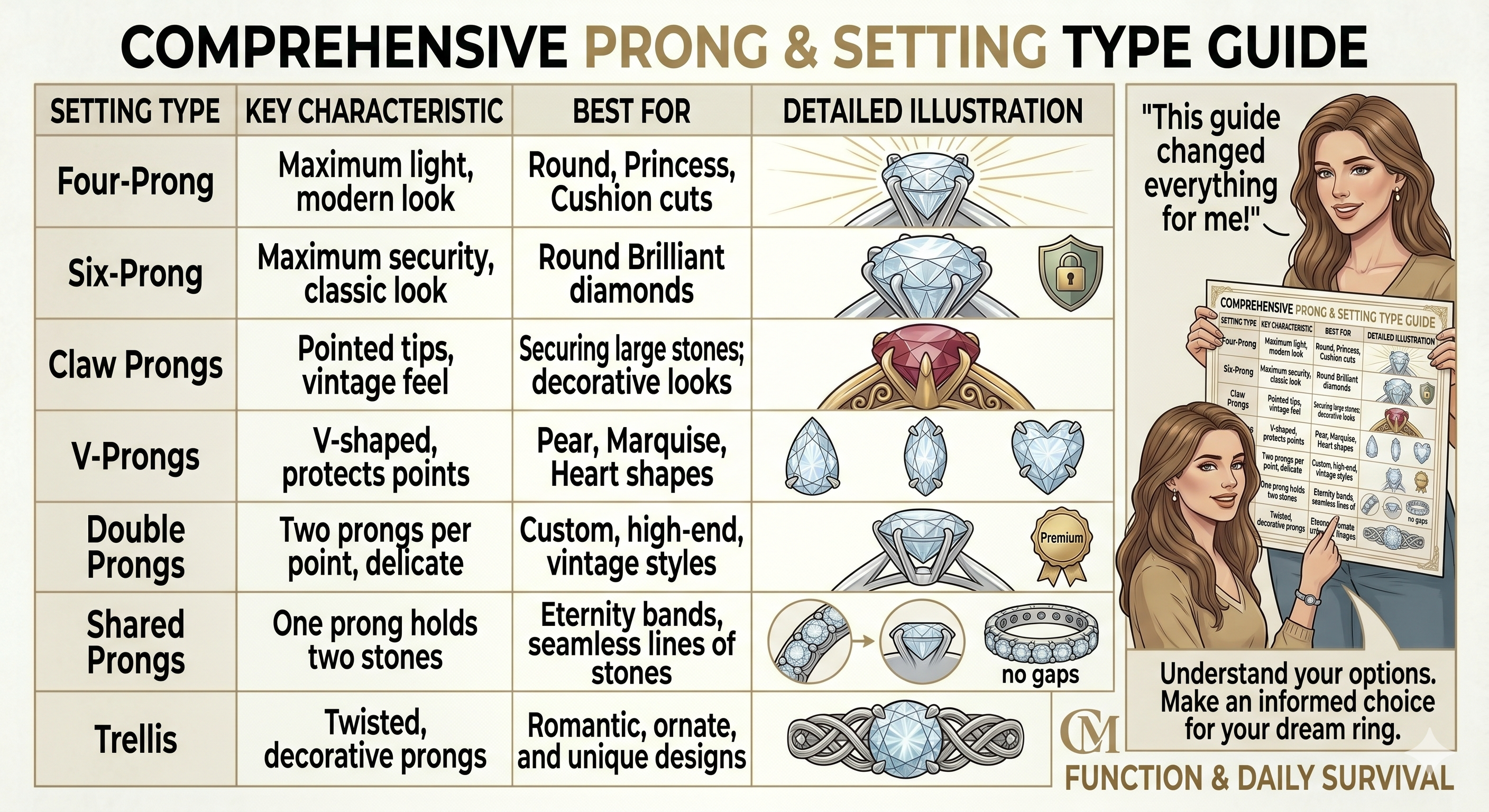
Summary Table for Quick Reference
How to Choose the Right Type for You
Prioritize Security? → Choose Six-Prong or V-Prongs for pointed stones.
Want Maximum Sparkle? → Choose Four-Prong.
Have a Vintage Style? → Choose Claw Prongs or a Trellis setting.
Want a Modern Look? → Choose Tab Prongs or Four-Prong with round tips.
Love the Details? → Choose Double Prongs.
The best type of prong setting ultimately depends on your personal style, the shape of your gemstone, and your lifestyle. A good jeweler can show you examples of each to help you decide.
Which Prong Setting Makes Diamonds Look Bigger?
The winner for making a diamond look bigger is, without a doubt, the Four-Prong Setting.
Here’s a detailed breakdown of why, along with other design tricks that can enhance the effect.
The Champion: Four-Prong Setting
Why it wins:
Less Metal, More Diamond: With only four points of contact instead of six, less of the diamond's surface (specifically the crown and table) is covered by metal. This exposes more of the diamond to the eye, allowing it to appear larger.
Square Illusion: On a round diamond, four prongs create a square-like silhouette. Our eyes tend to perceive this squared-off shape as taking up more space on the finger than the perfectly round shape framed by six prongs.
Visual Comparison:
A four-prong setting can make a diamond of the same carat weight look noticeably larger from a top-down view compared to a six-prong setting.
Runners-Up & Design Tricks to Enhance Size
While the four-prong is the best starting point, you can amplify the effect with these design choices:
1. The Peg Head (or Tiffany Style) Setting
What it is: This is a type of prong setting where the "head" (the base holding the prongs and diamond) is elevated on a thin, single stem and soldered onto the band.
Why it works: By lifting the diamond high above the band, it's completely isolated and unobstructed. This maximizes light entry from all angles, which increases brilliance and makes the diamond more prominent. The high profile creates a larger visual presence.
2. Thin, Delicate Prongs
What it is: Using prongs that are as thin and refined as structurally possible.
Why it works: This is an extension of the "less metal" principle. Slim, knife-edge, or claw prongs cover a minimal amount of the diamond, making the stone itself the absolute focus.
3. A Knife-Edge Band
What it is: A band that is thin and tapers to a sharp edge, rather than being a thick, rounded, or flat strip of metal.
Why it works: A delicate band creates a visual contrast that makes the center diamond appear more substantial by comparison. A thick, chunky band can easily dwarf the same diamond.
4. An Illusion Setting (Advanced Prong Use)
What it is: A metal base (often engraved or patterned) is built into the ring head, extending slightly under the girdle of the diamond. The prongs are then attached to this base.
Why it works: The metal base acts as a "halo" or frame, tricking the eye into perceiving the diamond as being one continuous size with its metal foundation. This is a very effective, though less common, way to increase perceived size.
The Trade-Off: Why You Might Not Always Choose Four Prongs
It's crucial to know the downside. The very feature that makes a four-prong setting look bigger is also its weakness: less security.
A six-prong setting is significantly more secure. If one prong fails in a six-prong setting, five others are still holding the stone. In a four-prong setting, if one fails, only three remain, making the diamond vulnerable to falling out.
A six-prong setting also makes a round diamond look more classically "round."
Quick Guide: Which to Choose?
To MAXIMIZE Perceived Size: Choose a Four-Prong setting on a thin, knife-edge band.
To MAXIMIZE Security: Choose a Six-Prong setting (it will still look large, just not as large as the four-prong equivalent).
For a Diamond over 1.5 Carats: A six-prong setting is often recommended for security, as the size of the stone is already impressive.
For a Fancy Shape (Oval, Cushion, etc.): A four-prong setting is standard and will also provide the maximum size appearance.
Which Prong Setting Is Most Secure?
This is a critical question when choosing a ring for everyday wear, especially for an active lifestyle.
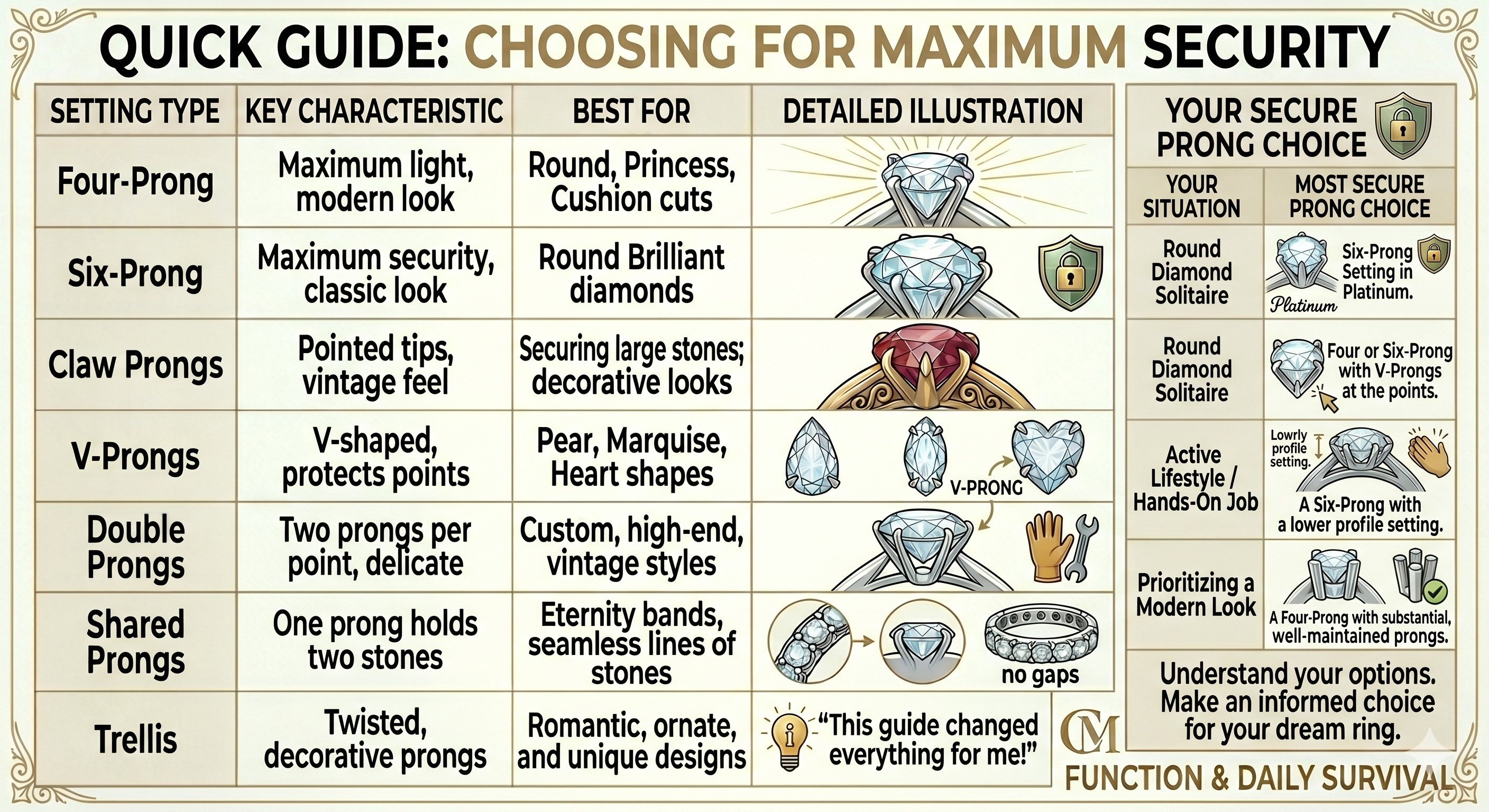
The most secure prong setting is, unequivocally, the Six-Prong Setting.
Here’s a detailed breakdown of why it wins, along with other key factors that contribute to a secure setting.
The Winner: Six-Prong Setting
Why it's the most secure:
Simple Mathematics: With six points of contact holding the gemstone, the grip is distributed more evenly around the stone's circumference.
Redundancy is Safety: If one prong in a six-prong setting becomes damaged or worn down, you still have five other prongs firmly holding the stone. This provides a critical safety net, drastically reducing the chance of the stone falling out before you can get it repaired.
Superior Grip: It simply holds more of the stone's girdle (its widest edge), making it much harder for the stone to become dislodged from an impact.
Best For: Round brilliant diamonds. The six-prong design also enhances the stone's round shape, making it a classic and secure choice.
Trade-off: The six prongs cover slightly more of the diamond's crown than a four-prong setting, but the increase in security is almost always worth this minimal visual trade-off.
The Runner-Up: Four-Prong Setting
The four-prong setting is beautiful and popular, but it is less secure than the six-prong.
The Vulnerability: If a single prong in a four-prong setting is damaged, the stone is now being held by only three prongs. This creates a significant weak point, and the stone can easily become loose, rotate, or even fall out.
When it's Secure Enough: For a stone that is worn less frequently or for someone with a less active lifestyle, a well-made four-prong setting is still a solid and classic choice. Its advantage is that it shows off more of the stone.
Beyond the Number: Other Critical Factors for Security
The number of prongs is just the starting point. The design and execution of the prongs are equally important.
1. V-Prongs for Pointed Stones
What they are: Prongs folded into a "V" shape to cradle a pointed end.
Why they're secure: They provide the most secure and protective method for holding the delicate points of stones like Marquise, Pear, and Heart shapes. A standard round prong on a point is a recipe for chipping and damage.
2. The Prong Head & Setting Height
Low-Profile Setting: A setting that sits lower and closer to the finger is inherently more secure because it's less likely to be knocked against surfaces.
High/“Peg Head” Setting: While beautiful and classic, a very high setting is more exposed and vulnerable to impacts that can bend prongs.
3. Prong Material and Thickness
Metal Type: Platinum is the most secure metal for prongs. It is incredibly durable and wear-resistant, meaning the prongs themselves are less likely to thin out over time. While strong, gold (especially 14k and 18k) is more malleable and can wear down faster.
Substantial Prongs: Prongs need to have enough metal to be strong. While very thin, delicate prongs are fashionable, they can be a security risk for a valuable stone meant for daily wear. A jeweler can ensure they are thick enough to be secure while still being aesthetically pleasing.
4. Double Prongs
While often a design choice, using two prongs at each corner (common with square stones) can add an extra layer of security. If one thin prong fails, its partner is still there.
Quick Guide: Choosing for Maximum Security
The Most Important Factor of All: Maintenance
No prong setting is 100% secure forever. The single most important thing you can do to keep your stone safe is regular maintenance.
Home Checks: Gently run your fingernail over the prongs once a month. They should feel smooth and solid. If you feel a catch or a sharp edge, a prong may be lifting.
Professional Inspections: Have a professional jeweler inspect your ring every 6 to 12 months. They will check for worn-down metal, loose prongs, and structural issues you can't see with the naked eye.
For the absolute most secure prong setting, choose a six-prong setting and commit to a schedule of professional inspections. This combination offers the best possible protection for your precious gemstone.
Learn more about jewelry care on the American Gem Society's care guide.
For Which Diamond Shape Can A V-Prong Setting Be Used?
Here is a breakdown of the diamond shapes that benefit most from aV-prong setting, categorized by how essential it is.
Category 1: Highly Recommended (Almost Essential)
These shapes have very sharp, delicate points that are highly susceptible to chipping. A V prong is strongly advised for these.
Princess Cut: This square-shaped diamond has four sharp, 90-degree corners. These are extremely vulnerable. V-prongs are considered the standard and most secure way to set all four corners of a princess-cut diamond.
Marquise Cut: This "football-shaped" diamond has two pointed ends. Both ends should be secured with V prongs to protect them from impact.
Pear Cut: This teardrop-shaped diamond has one rounded end and one pointed end. The single point is very delicate and must be protected with a V prong for long-term security.
Heart Cut: The distinct cleft at the top of the heart creates two delicate points. Using V prongs at the top of the heart is crucial to protect this defining feature.
Radiant Cut & Emerald Cut (on the corners): While sometimes set with beveled corners, the sharp corners of these rectangular or square step-cut diamonds are also prime candidates for V prongs for enhanced protection.
In short, if the diamond shape has a sharp point, it needs a V prong.
Category 2: Aesthetic Choice (Not for Protection)
For these shapes, a V prong is not necessary for security, but can be used as a design element to create a specific look.
Round Brilliant Cut: A round diamond has no points, so it doesn't need V-prongs for protection. However, a jeweler might use them as a stylistic choice to create a modern, geometric look, often placing them at the cardinal points (12, 3, 6, and 9 o'clock) instead of standard round prongs.
Oval Cut: Similar to the round, an oval doesn't have sharp points. However, some designers use small V prongs on the ends of the oval to accentuate its elongated shape and add a unique design flair, even though the ends are rounded.
Visual Summary Table
| Diamond Shape | Why Use a V Prong? | Where to Place It |
| Princess Cut | Protection of four sharp corners. | On all four corners. |
| Marquise Cut | Protection of two pointed ends. | On both tips. |
| Pear Cut | Protection of the single pointed tip. | On the pointed end. |
| Heart Cut | Protection of the two points in the cleft. | On top of the heart. |
| Radiant/Emerald | Protection of the sharp corners. | On the four corners. |
| Round Brilliant | Aesthetics (geometric, modern look). | Optional, at cardinal points. |
| Oval Cut | Aesthetics (to accentuate the ends) | Optional, on the two ends. |
Key Takeaway
The V-prong setting is fundamentally a functional feature for protection. Its use is dictated by the geometry of the diamond.
For pointed shapes (Princess, Marquise, Pear, Heart): A V prong is a critical security measure.
For rounded shapes (Round, Oval): A V prong is a purely decorative design choice.
When selecting a setting for a diamond with points, always ensure the jeweler is using V prongs to protect your investment from chipping and damage.
What Is The Prong Setting For A Marquise Diamond?
The marquise diamond, with its elongated, "football-shaped" silhouette and two pointed ends, requires a specific prong setting to highlight its beauty and, most importantly, protect its vulnerable tips.
The best and most classic prong setting for a marquise diamond is a setting that uses V-prongs on both pointed ends.
The Standard & Most Secure Setting: Dual V-Prongs
This is the gold standard for a reason. It directly addresses the marquise cut's primary vulnerability.
Why it's essential: The two sharp points of a marquise diamond are extremely prone to chipping if struck. A standard round prong would sit awkwardly on the point, leaving it exposed. A V-prong is custom-shaped to cradle and wrap around the point, providing a secure shield against impact.
Typical Configuration: Most marquise settings use a total of 4 or 6 prongs.
In a 4-prong setting, the two main prongs are the V-prongs on the ends. The other two prongs are standard (like claw prongs) secured on the long, curved sides.
In a 6-prong setting, you have the two V-prongs on the ends, and then four prongs along the sides (two on each long curve). This offers even more security.
While the dual V-prong setting is the top recommendation, other styles work beautifully and offer different aesthetic benefits.
1. The Six-Prong Setting with V-Tips
This is a very secure and popular choice.
How it works: Two V-prongs protect the tips. The four additional prongs are spaced evenly along the curved sides.
Best for: Those who want maximum security and a classic, well-anchored look. The extra prongs can make the stone look even more elongated.
2. The Bezel Setting (Ultimate Security)
A bezel is a fantastic, modern alternative to prongs.
How it works: A thin metal rim completely encircles the entire outline of the marquise diamond, including both points.
Pros: This offers the highest level of protection possible, making it ideal for an active lifestyle. It also creates a sleek, modern look.
Cons: It covers more of the diamond's edge than prongs, which can slightly reduce the perceived size and brilliance for some viewers.
3. The Five-Prong "Trellis" Setting
This is a beautiful and secure hybrid option.
How it works: The two points are secured with V-prongs. The stone is then set at a diagonal within a basket, with three additional prongs on the sides creating a trellis-like structure underneath.
Best for: Adding vintage-inspired detail and allowing a lot of light to enter the diamond from the sides, boosting its brilliance.
4. The Halo Setting with V-Prongs
To maximize visual impact, a halo is a brilliant choice.
How it works: The marquise diamond is surrounded by a circle of smaller diamonds. Crucially, the halo itself should be set with V-prongs or a protective bezel at the tips to safeguard the center stone.
Best for: Creating a dramatic, larger-looking piece of jewelry. The halo adds significant sparkle and carat weight appearance.
Key Considerations for Your Marquise Setting
Prong Style: Claw prongs are a great choice as they are minimalistic and grip the diamond well with less metal visibility.
The "Bow-Tie" Effect: Marquise diamonds are famous for having a dark, bow-tie-shaped shadow across the center if cut poorly. A good setting can't fix a bad cut, but a skilled jeweler can ensure the prongs are placed to minimize any accentuation of this effect.
Orientation: This is a major style decision!
North-South (Traditional): The stone points lengthwise along the finger. This is the classic orientation and is fantastic for elongating the finger.
East-West (Modern): The stone is set horizontally across the finger. This is a unique, fashion-forward look that is increasingly popular.
The Gallery Rail: Ensure the setting has a sturdy gallery rail (the metal structure underneath the stone). This provides critical support and prevents the prongs from bending if they snag on something.
What to AVOID
Settings with Round Prongs on the Points: This is the biggest mistake. It leaves the tips exposed and insecure.
A Flimsy, Low-Profile Setting: A setting that sits too low or has weak, thin prongs will not offer adequate protection for this elongated shape.
Summary & Final Recommendation
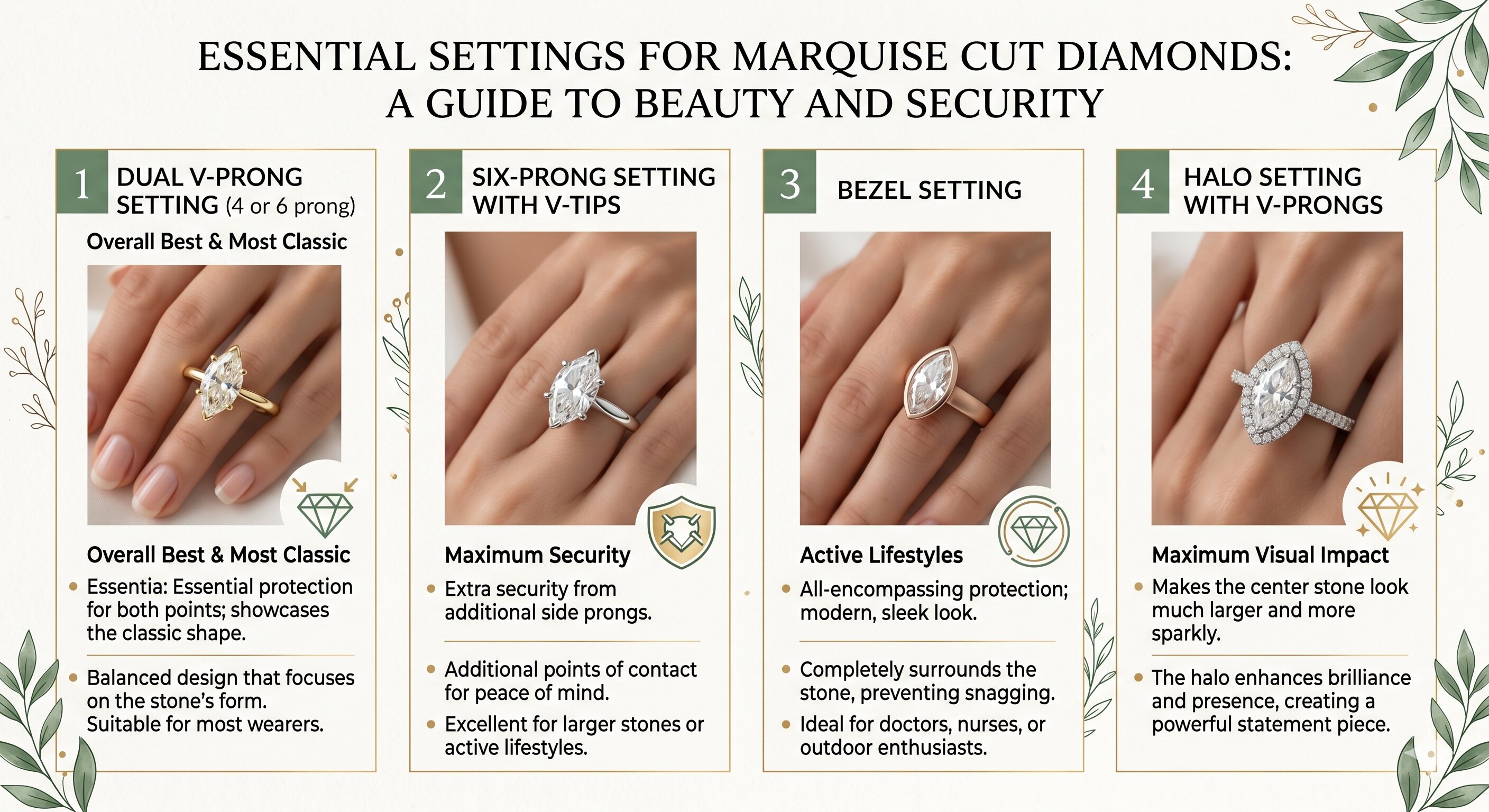
Final Verdict: For a marquise diamond, always choose a setting that uses V-prongs on both pointed ends. The classic 4 or 6-prong setting with dual V-prongs is the most recommended choice as it perfectly balances security, elegance, and the diamond's inherent beauty.
Still not sure? Explore each setting in detail:
“You now know the history, the pros and cons, the best prong types for each stone shape, the security differences, and the marquise-specific advice. The only question left: will you trust your stone to the setting that lets it shine brightest?
*Our current collection includes a limited number of prong-set rings — from delicate 4-prong solitaires to secure 6-prong classics, double-prong vintage styles, and V-prongs for pointed stones. When certain designs are gone, restocking takes time because each prong is hand-shaped and polished.*
This is not just a setting. It is 140 years of Tiffany‘s genius, the diamond‘s best friend, and the most copied design in jewelry history — a few small claws that hold the world‘s hardest substance, trusting light to do the rest.”
[Button: Secure Your Prong Setting Ring (Limited) →]


Other news for Saturday 13 June, 2026
- Ring Finger Meaning: Which Finger for Wedding, Single and More | Complete Guide
- Bezel Setting Guide: Benefits, Styles, and Buying Tips
- Sterling Silver Jewelry Guide: 925 Meaning, Care and Green Skin Fix
- Channel Setting Guide: Pros, Cons, Safety and Cost vs Pavé
- Ring Setting Guide: Types, Best for Daily Wear, and Size Tips
View all news for Saturday 13 June, 2026 on one page
News for Friday 12 June, 2026
- Tanzanite Ring Guide: Meaning, Price, Care and Buying Tips
- Topaz Stone Guide: Healing Properties, Colors, Price and Care
View all news for Friday 12 June, 2026 on one page
Recent News
- Thursday 11 June, 2026
- Wednesday 10 June, 2026
- Tuesday 09 June, 2026
- Monday 08 June, 2026
- Sunday 07 June, 2026