

Oval Cut Diamond Guide: Price, vs Round, vs Radiant and Buying Tips
Oval Cut Diamond Guide: Price, vs Round, vs Radiant, and Buying Tips
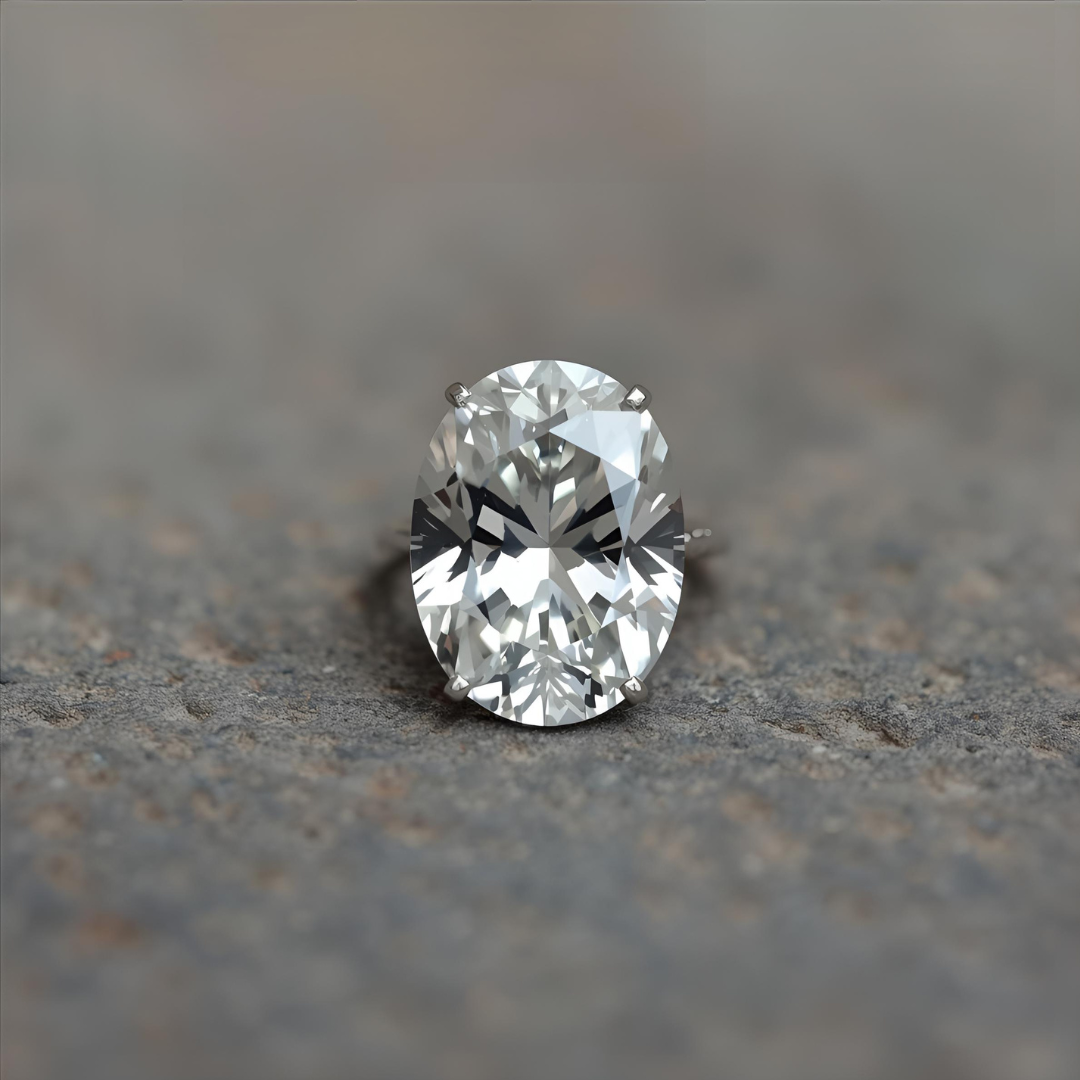
An Oval Cut is a brilliant-cut gemstone (most commonly a diamond) that has an elongated, elliptical shape. Think of it as a rounded rectangle or a stretched-out circle.
“In 1957, a Russian-born diamond cutter named Lazare Kaplan sat at his workbench in New York City. He had a piece of rough diamond that was too flat for a round brilliant, too long for a cushion. So he did what innovators do: he invented a new shape. Kaplan‘s ‘oval brilliant cut‘ solved a problem cutters had faced for centuries—how to maximize brilliance in an elongated stone without losing sparkle. Today, his design is the second most popular diamond shape in the world. Kaplan didn‘t just cut a diamond. He proved that a diamond doesn‘t have to be round to be brilliant.”
The same shape that Lazare Kaplan invented in 1957 now elongates your finger and your budget. Every oval diamond in our collection is hand-selected for minimal bow-tie and excellent symmetry—because an oval should sparkle, not shadow.”
[Button: Explore Oval Cut Diamonds →]
It's famous for combining the classic sparkle of the most popular shape (the round brilliant) with a unique and flattering elongated form.
Table of Contents
- What Does The Oval Cut Mean?
- Are Oval Cut Diamonds More Expensive?
- Is Round Cut Or Oval Cut Better?
- Is Oval Or Radiant Cut Better?
- Why Are Oval Cuts So Popular?
- What Is The Best Size For An Oval Cut?
- Is An Oval A Good Diamond Cut?
- Is Oval Cut Timeless?
- How To Decide Between the Pear or Oval Cut?
- How Decide Between Oval And Emerald?
Here we talk about the first topic.
What Does The Oval Cut Mean?
In the simplest terms, an oval cut is a brilliant-cut gemstone (most famously a diamond) shaped like an ellipse, similar to a rounded rectangle.
However, it's much more than just a shape. Here’s a detailed breakdown of what the "oval cut" means, including its characteristics, history, and advantages.
Key Characteristics of an Oval Cut:
Shape: It's an elongated circle, blending the classic beauty of a round cut with a unique, elongated shape.
Faceting Pattern: It uses a brilliant-style faceting pattern. This means it has 58 facets (including the culet), just like a modern Round Brilliant Cut. This specific arrangement is designed to maximize light return, creating exceptional sparkle, fire, and brilliance.
Length-to-Width Ratio: This is a crucial aspect of an oval's appearance. It describes how elongated the stone is.
A ratio of 1.35 to 1.50 is considered "classic" and is the most popular, offering a balanced elongation.
A lower ratio (closer to 1.20) will look more like a rounded, "chubby" oval.
A higher ratio (1.60 and above) will appear very long and narrow, sometimes called a "marquise-style" oval.
The choice is purely personal preference.
Advantages of Choosing an Oval Cut:
Illusion of Size: This is one of its biggest selling points. Because of its larger surface area (the "table"), an oval cut diamond will look larger face-up than a round brilliant of the same carat weight.
Elongating Effect on Fingers: The elongated shape creates a flattering, slimming effect on the fingers, making hands appear longer and more elegant.
Brilliance and Sparkle: Thanks to its brilliant faceting, it possesses a sparkle very close to that of a round brilliant, which is the benchmark for brilliance.
Modern yet Timeless: It offers a unique and modern alternative to the round brilliant while still maintaining a classic, timeless feel.
Hides Some Inclusions Well: The elongated shape and complex facet pattern can help conceal minor imperfections (inclusions) better than a step-cut shape like an emerald or Asscher cut.
History and Origin
While elongated diamond shapes have existed for centuries, the modern oval brilliant cut we know today was created in the late 1950s and early 1960s by a Russian diamond cutter named Lazare Kaplan. He is renowned for his ability to cut stones to maximize their beauty and was a pioneer in transforming irregularly shaped rough diamonds into stunning gemstones. His design perfected the facet arrangement to minimize the "bow-tie" effect common in elongated cuts.
Important Considerations When Buying an Oval Cut:
The Bow-Tie Effect: This is a dark, bow-tie-shaped shadow that can appear across the center of many fancy shapes, brilliant cuts, including ovals. It's caused by light leakage due to the stone's proportions and facet angles.
Almost all ovals have some degree of a bow-tie. The key is to find one where the effect is minimal to faint and not a prominent, dark, distracting black band. Always examine the stone in person or via high-quality videos.
Symmetry: The oval should be perfectly symmetrical. Both ends (the "shoulders") should be evenly rounded, and the two halves of the stone should be mirror images of each other.
Color: The color in an oval cut can sometimes be concentrated at the ends (the tips). Because of this, some people can go slightly lower on the color grade (e.g., choose a G or H color) without the stone facing up with a visible yellow tint, especially if it's set in yellow or rose gold.
Proportions and Girdle: As with any diamond, the overall proportions (table %, depth %) are critical for optimal light performance. A girdle that is too thin can make the stone prone to chipping, while one that is too thick can add unnecessary weight (carats) where you don't see it.
The oval cut is a brilliant, elegant, and practical choice for an engagement ring or other fine jewelry. It combines the timeless sparkle of a round diamond with a unique, flattering shape that often appears larger for its carat weight. When chosen carefully—paying close attention to the bow-tie effect, symmetry, and proportions—it results in a stunning and captivating gemstone.
Are Oval Cut Diamonds More Expensive?
Here’s the straightforward answer, followed by the important details:
No, oval-cut diamonds are generally not more expensive than round brilliant diamonds. In fact, they are typically 20-30% less expensive per carat than round diamonds of similar quality.
However, they can be more expensive than other fancy shapes (like cushions or princess cuts). Let's break down the "why" behind this.
The Price Comparison:
This is the most common comparison, and the round brilliant is the benchmark.
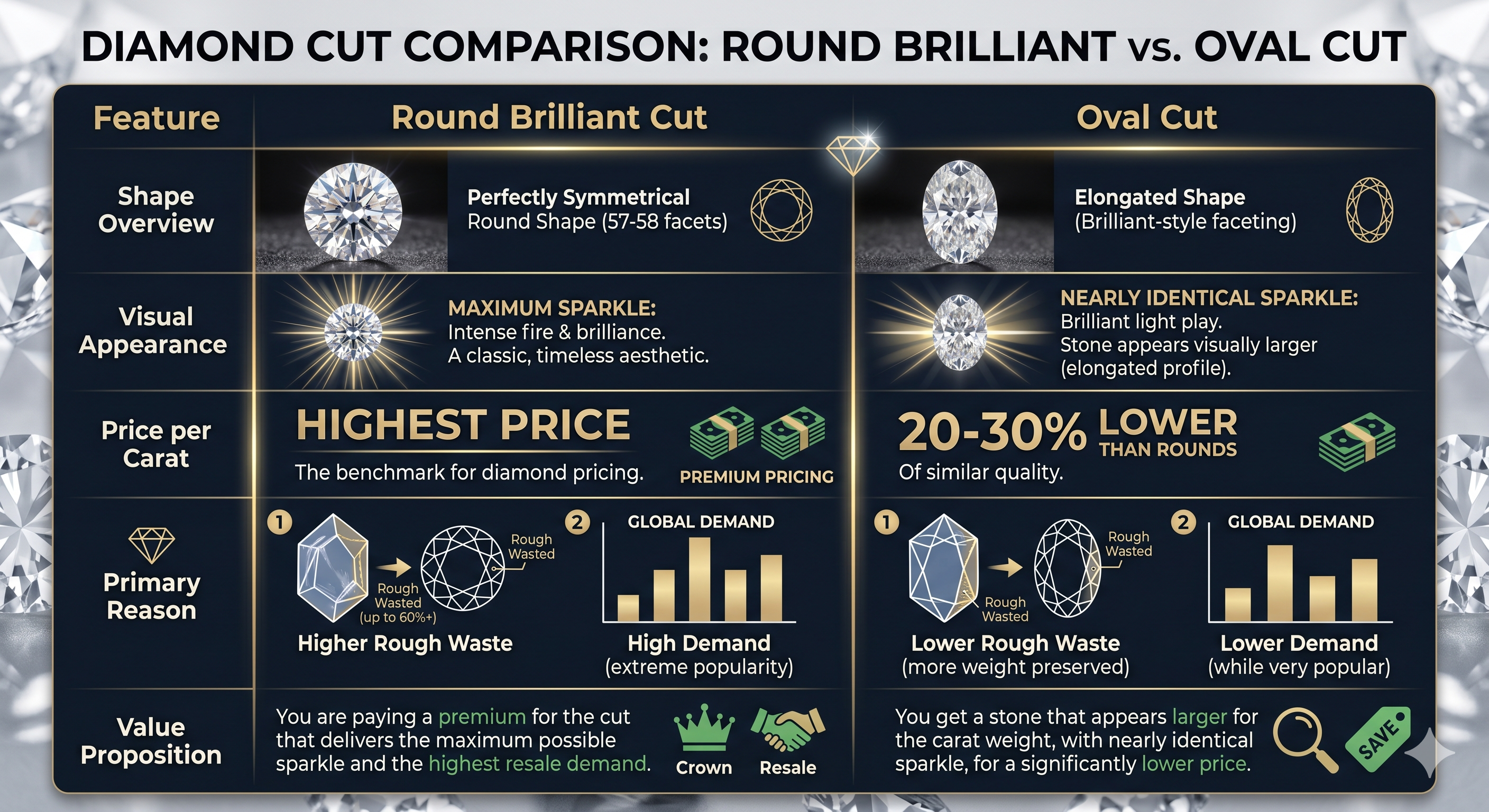
If you are choosing between a round and an oval of the same carat weight and quality (Color, Clarity), the oval will almost always be the more budget-friendly option.
Why Are Ovals Priced the Way They Are?
Several factors influence the final price of an oval diamond:
Demand and Popularity:
Ovals are the second most popular choice for engagement rings after rounds. This high demand keeps their prices stable and stronger than other fancy shapes, but they haven't surpassed the round's premium.
Cut Quality and the "Bow-Tie Effect":
This is a major factor. A well-cut oval with minimal or no visible "bow-tie" (the dark shadow across the center) will command a higher price. Cutters spend more time and skill to achieve this, and these premium stones are rarer. A poorly cut oval with a severe bow-tie will be significantly cheaper.
Carat Weight and Shape:
The elongated shape means an oval will look larger than a round of the same carat weight. This perceived size is a huge part of their appeal. However, as with all diamonds, prices jump at "magic" carat weights (e.g., 1.0 ct, 1.5 ct, 2.0 ct).
Color and Clarity:
Color: Because color can sometimes be concentrated at the tips of the oval, you can often go slightly lower on the color grade (e.g., G or H) without seeing a yellow tint, especially in a yellow gold setting. This can save money.
Clarity: The many facets of the brilliant cut help hide inclusions, so you can often choose a lower clarity grade (e.g., VS1, VS2, or even a clean SI1) without visible flaws. This also reduces cost.
Oval vs. Other Fancy Shapes
Compared to Cushion, Princess, or Emerald Cuts, Ovals are often similarly priced or slightly more expensive due to their current high popularity. A premium is placed on a well-executed oval cut.
Compared to Pear or Marquise: These are generally in a similar price range, with the final cost depending more on the individual stone's cut quality and characteristics.
Are oval-cut diamonds more expensive? Not compared to rounds. They offer a fantastic opportunity to get a larger-looking, brilliantly sparkling diamond for a better price per carat.
Are they "cheap"? Absolutely not. They are still precious diamonds. You are paying for a highly desirable, beautiful, and skillfully cut gemstone. Their pricing represents a very compelling value in the diamond market, which is a key reason for their surge in popularity.
For current diamond market prices, visit the American Gem Society's price guide.
Is Round Cut Or Oval Cut Better?
That's the million-dollar question, and the honest answer is: there is no objectively "better" cut. The choice between a round cut and an oval cut is entirely subjective and depends on your personal priorities for style, budget, and finger appearance.
To help you decide, here is a direct comparison of their key differences.
Round Brilliant vs. Oval Cut: Head-to-Head
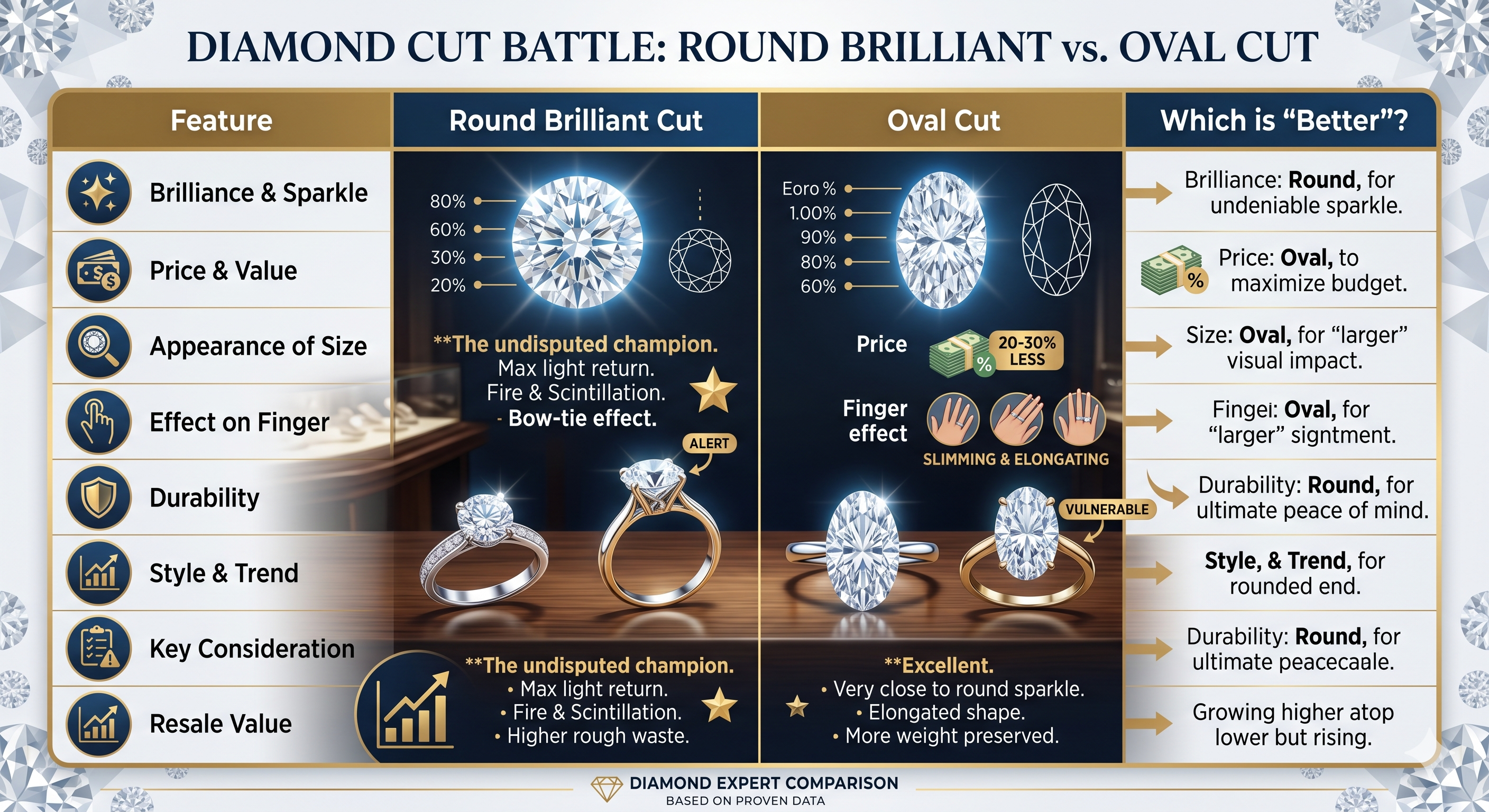
How to Choose: Which is Better FOR YOU?
Ask yourself these questions:
Choose a Round Brilliant Cut if:
Sparkle is your #1 priority. You want the absolute maximum brilliance science can create.
You are a traditionalist and love the classic, timeless look.
You want the easiest buying experience with clear-cut grades (Excellent, Very Good, etc.).
You prioritize durability and want the most robust shape.
Resale value is an important consideration for you.
Choose an Oval Cut if:
You want the best value for your money. You'd rather have a larger-looking stone or save 20-30% on the same budget.
You want a unique yet timeless style that stands out from the crowd.
You love how the elongated shape looks on your hand and want a flattering, finger-lengthening effect.
You are willing to inspect stones carefully (in person or via video) to find one with a minimal bow-tie effect.
Round Cut is the king of sparkle, tradition, and resale value. You pay a premium for this top-tier performance.
Oval Cut is the queen of value, elegance, and modern style. It offers incredible beauty and a larger appearance for a more accessible price.
If possible, try on both shapes! Your personal reaction to how each looks on your hand will be the most important deciding factor. Both are breathtakingly beautiful choices—it just comes down to what you value most.
Is Oval Or Radiant Cut Better?
Choosing between an Oval and a Radiant cut depends on your priorities—sparkle, finger shape, budget, and style. Both are elongated shapes that create a slimming effect on the finger, but they have distinct differences.
Here’s a direct comparison to help you decide.

Detailed Breakdown
1. Sparkle & Brilliance
Oval: Produces a similar sparkle to a Round Brilliant (the sparkliest shape). It has distinct, bold flashes of light (fire) and white light (brilliance). However, ovals are prone to a "bow-tie" effect—dark shadows across the center. A well-cut oval minimizes this.
Radiant: Produces a "crushed ice" sparkle—millions of tiny, glittery facets. It's very forgiving (hides inclusions well) but can appear milky or cloudy in some cuts. It doesn't have the same bold fire as an oval but offers a unique, modern sparkle.
2. Finger Coverage
Both make fingers look longer and slimmer due to their elongated shape.
Winner: Tie. But an oval often looks slightly larger per carat because of its more open facet pattern.
3. Durability (for daily wear)
Oval: Less durable. The pointed ends (tips) are vulnerable to chipping if knocked hard. Requires protective settings (e.g., bezel, V-prongs).
Radiant: More durable. The cropped corners are less prone to chipping than the sharp tips of an oval. Better for an active lifestyle.
4. Hiding Imperfections
Radiant wins here. Its crushed-ice facet pattern scatters light and effectively hides inclusions (spots, feathers) and color (looks whiter even at lower color grades like J-K).
Oval shows inclusions more easily, especially in the center. You typically need a higher clarity grade (VS2 or better) for an oval.
5. Cost (for comparable carat size)
Oval: Generally less expensive than Radiant because demand is slightly lower than Round, and more rough diamonds are retained.
Radiant: Can be slightly more expensive due to higher labor costs for cutting all those facets, but still much cheaper than a Round.
6. Setting Style
Oval: Looks stunning in solitaire, halo, or three-stone settings. Often paired with a pavé band for extra sparkle.
Radiant: Shines in halo settings (especially with a hidden halo) or as a solitaire with double prongs. Popular in east-west settings.
Which One Is Better For You?
Choose Oval Cut if:
You want a soft, romantic, classic look.
You love the sparkle of a Round but want something more unique.
You want the largest possible face-up size for your budget.
You don't mind checking for a minimal bow-tie effect.
You prefer a vintage or delicate aesthetic.
Choose Radiant Cut if:
You love modern, geometric, bold designs.
You prefer "crushed ice" sparkle over bold flashes.
You want a more durable diamond for daily wear (e.g., engagement ring for an active job).
You want to maximize color and clarity (a J-color radiant looks like an H-color oval).
You like step-cut style (like Emerald) but want more fire.
Why Are Oval Cuts So Popular?
The surge in popularity of oval-cut diamonds, especially for engagement rings, is no accident. It's driven by a powerful combination of visual appeal, smart value, and modern trends.
“In 2018, Hailey Bieber stepped out with a massive oval diamond on her finger—estimated between 6 and 12 carats. Within weeks, searches for ‘oval engagement ring‘ tripled. But the oval‘s popularity didn‘t start with Hailey. In 1970, Princess Margaret wore an oval diamond engagement ring. In 1990, Elizabeth Taylor owned an oval diamond brooch. In 2010, Blake Lively‘s oval diamond ring set another wave of trends. The oval has never been out of style. It just waits quietly, generation after generation, for someone to rediscover what Lazare Kaplan knew in 1957: that a circle stretched just a little becomes something even more beautiful.”
Here’s a breakdown of the key reasons why oval cuts are so popular:
1. The Illusion of Size: "Bigger Look" for Your Budget
This is arguably the biggest driver. Due to its elongated shape and larger surface area (the "table"), an oval diamond appears significantly larger face-up than a round brilliant of the same carat weight. For budget-conscious couples, this means you can either get a much larger-looking stone for your money or choose a lighter carat weight and save significantly.
2. The Flattering, Elongating Effect
The oval shape is universally flattering on the hand. Its length creates a visual effect of elongating and slimming the finger, making hands look more elegant. This psychological "perk" is a major selling point that other shapes, like round or cushion, don't offer in the same way.
3. A Perfect Blend of Classic & Unique
For years, the round brilliant was the default choice. Many people today want something that feels more personal and distinctive without being overly unconventional. The oval cut strikes this balance perfectly:
Classic: It has the timeless brilliance and sparkle of a round cut, thanks to its similar faceting pattern.
Unique: It stands out from the crowd. It says the wearer has an eye for style that is elegant yet not mainstream.
4. Brilliant Sparkle (Close to a Round)
While the round brilliant is engineered for maximum sparkle, the oval cut comes incredibly close. Its brilliant-style faceting (typically 58 facets) means it offers exceptional fire, brilliance, and scintillation. People don't have to sacrifice the classic diamond sparkle they love to get a more unique shape.
5. Celebrity and Social Media Influence
When high-profile celebrities like Hailey Bieber (rhodium-covered oval), Blake Lively, and Kate Middleton choose oval diamond engagement rings, it creates a massive trend. These "style icons" make the cut aspirational. Furthermore, platforms like Instagram and Pinterest are flooded with images of oval rings, continuously reinforcing their desirability and modern aesthetic.
6. Versatility in Setting Styles
Oval diamonds are incredibly versatile and look stunning in a wide variety of settings:
Solitaire: Let the unique shape take center stage.
With side stones: Looks beautiful with trapezoid, pear, or round side stones.
Three-stone settings: the past, present, and future.
East-West setting: A trendy, modern orientation where the oval is set horizontally.
Halo setting: A halo of smaller diamonds can enhance the perceived size and brilliance even further.
7. Better Value Than Round Brilliant
As discussed in a previous question, oval diamonds are typically 20-30% less expensive per carat than round brilliants of similar quality. This better value proposition makes a high-quality, larger-looking diamond more accessible, which is a huge draw.
The One Caveat: The "Bow-Tie Effect"
It's important to note that almost all oval cuts have some degree of a "bow-tie effect"—a dark, bow-tie-shaped shadow across the center caused by light leakage. However, a well-cut oval will have a minimal or faint bow-tie. The popularity of ovals has led to cutters becoming more skilled at minimizing this effect, and consumers have become more educated about what to look for.
The oval cut's popularity isn't due to one single factor, but a "perfect storm" of benefits: it looks larger and more flattering on the hand, offers brilliant sparkle, feels both classic and unique, is promoted by influencers, and provides excellent value for money. It’s a shape that truly caters to modern desires.
What Is The Best Size For An Oval Cut?
Excellent question! However, the "best" size for an oval cut is highly personal and depends on your finger, your budget, your style preferences, and your lifestyle.
There isn't a single "best" size, but we can identify the most popular and satisfying sizes and give you a framework to choose the best one for you.
The Most Popular & "Sweet Spot" Sizes
Based on market trends and customer satisfaction, the most sought-after sizes for oval diamonds are in the 1.50 to 2.50-carat range. Here’s a breakdown of what you can expect in terms of visual impact:
1.00 - 1.50 Carats: A classic and elegant choice. This size range is noticeable, sophisticated, and works beautifully on small to average-sized fingers (ring sizes 4-6.5). It's a great balance between presence and budget.
1.50 - 2.00 Carats: This is the current "sweet spot." It offers a substantial and luxurious look that truly showcases the oval's elongated shape. It appears large without being overwhelming for everyday wear for most people.
2.00 - 3.00+ Carats: This is a statement-making size. It offers a bold, luxurious, and undeniable presence on the hand. At this size, the quality of the cut becomes even more critical to avoid a strong bow-tie effect.
How to Choose the Best Size FOR YOU: 3 Key Factors
To find your perfect size, consider these three elements together:
1. Your Finger Size and Shape (The Most Important Factor)
The same carat weight will look very different on a size 4 finger versus a size 8 finger. The goal is to achieve beautiful "finger coverage."
Smaller Fingers (Size 4-5): A 1.0-1.5 carat oval will look proportionally large and dramatic.
Average Fingers (Size 6-7): The 1.5-2.5 carat range is ideal for achieving a balanced, substantial look.
Larger Fingers (Size 8+): YoConsiderove to achieve significant finger coverage. A smaller stone might look disproportionate.
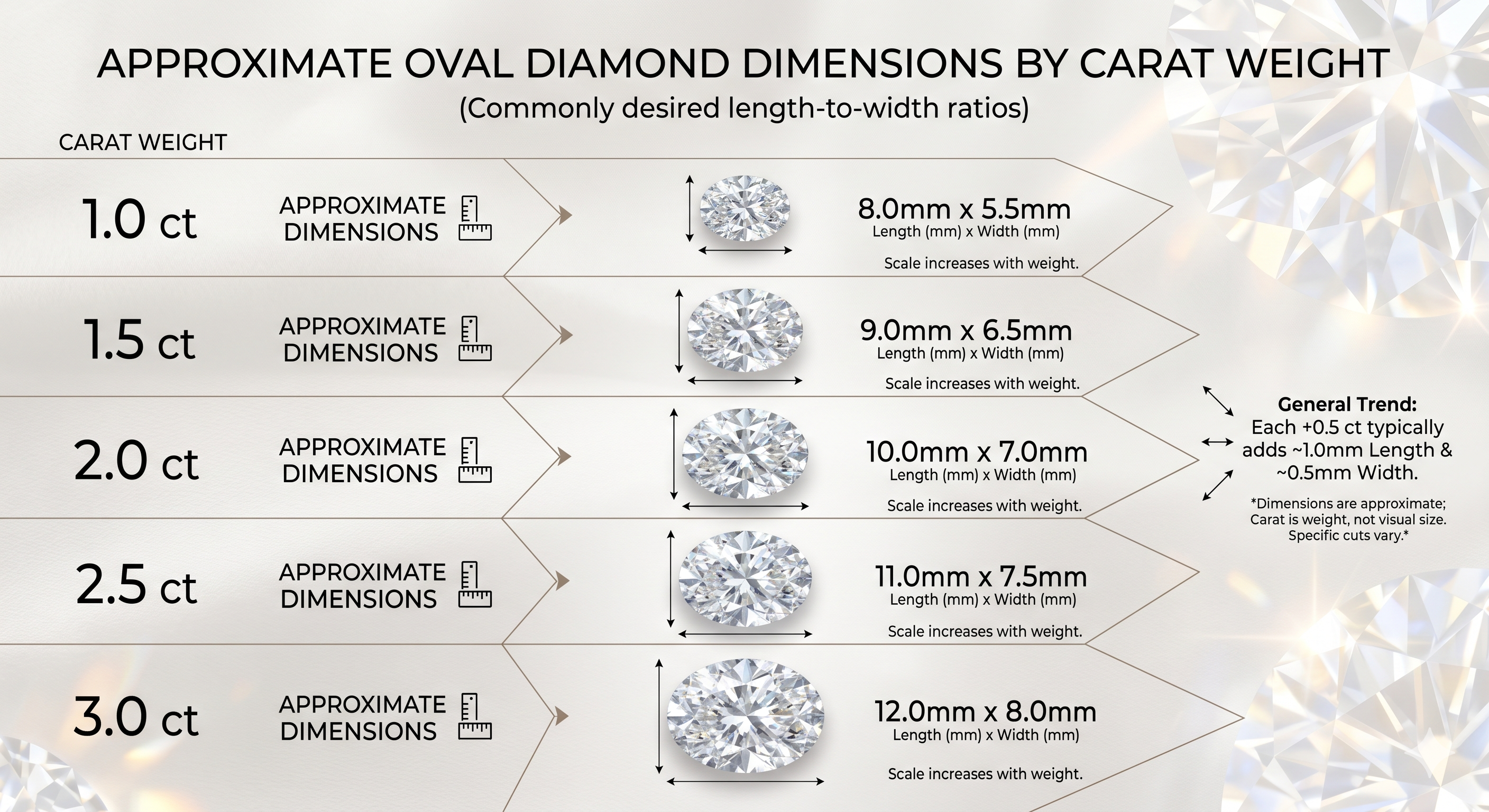
Pro Tip: Don't just focus on carat weight. Look at the millimeter dimensions (length x width). A well-cut 1.5-carat oval might be 10x7mm, while another could be 9x6mm. The 10x7mm will look much larger.
2. Your Budget
Remember the oval's great value: you can often afford a larger carat size than you could with a round brilliant.
Set a realistic budget for the entire ring (setting + diamond).
Be prepared to make trade-offs. A larger carat size might mean selecting a slightly lower color (G-H instead of D-F) or clarity (VS2-SI1 instead of VVS) to stay on budget, which is often a smart compromise with ovals.
3. Your Lifestyle and Personal Style
Active or Hands-On Lifestyle: If you work with your hands, work out frequently, or are generally active, a very large stone (e.g., 3+ carats) might feel impractical or get caught on things. A moderate size (1.0-2.0 carats) in a secure, lower-profile setting might be better.
Style Preference: Do you prefer "understated elegance" or "bold glamour"? Let your personal style guide you.
Understated Elegance: 1.0 - 1.8 carats
Bold Glamour: 2.0+ carats
A Quick Reference Guide: Carat Weight to Millimeter Size
This table gives you a rough idea of what to expect. Note: These are approximate dimensions and will vary based on the individual cut.
Final Recommendation and Pro Tip
There is no single "best" size, but the 1.5 to 2.0-carat range is widely considered the ideal balance of impressive size, beautiful proportion, and value for the average buyer.
The #1 Best Way to Decide:
Try them on! This is the most crucial step.
Go to a jeweler and try on different sizes on your actual finger.
If that's not possible, use online "ring sizers" or even cut out paper templates in the millimeter dimensions listed above and tape them to your finger.
Seeing the size on your own hand is the only way to know what truly feels and looks right for you. Your perfect size is the one that makes you smile every time you look at it.
Is An Oval A Good Diamond Cut?
Yes, absolutely. An oval cut is not just a good diamond cut; for the right person, it can be a fantastic and brilliant choice.
However, whether it's the best cut for you depends on what you prioritize. Here’s a balanced look at why ovals are highly regarded, along with a few considerations.
The "Good": Why Oval Cuts Are an Excellent Choice
Exceptional Brilliance and Sparkle: The oval cut uses a brilliant-style faceting pattern (typically 58 facets), just like a round brilliant. This means it is engineered to reflect a tremendous amount of light, resulting in incredible sparkle, fire, and brilliance. It is second only to the round brilliant in its ability to dazzle.
Illusion of Larger Size: This is one of its biggest advantages. Due to its elongated shape and larger surface area (the "table"), an oval diamond appears larger face-up than a round brilliant of the same carat weight. This gives you more visual impact for your budget.
Flattering and Elongating Effect: The oval shape is universally flattering on the hand. Its length creates an elegant, slimming effect, making fingers appear longer and more slender.
Modern yet Timeless Style: It offers a unique and fashionable alternative to the very common round brilliant, while still maintaining a classic, timeless feel. It’s distinctive without being overly unconventional.
Great Value: Oval diamonds are typically 20-30% less expensive per carat than round brilliants of comparable quality. This allows you to either get a larger stone or a higher quality stone for the same budget.
The Considerations: What to Watch For
To ensure you get a "good" oval, you need to be an informed buyer. A poorly cut oval is not a good choice.
The Bow-Tie Effect: This is the most critical factor. It's a dark, bow-tie-shaped shadow that appears across the center of many fancy-shaped diamonds, including ovals, caused by light leakage.
Almost all ovals have some degree of a bow-tie. A well-cut oval will have a minimal or faint one. A severe, dark bow-tie is a sign of poor cut and should be avoided. Always view the stone in person or via high-quality videos.
Cut Quality is Less Standardized: Unlike round brilliants, which have strict "Cut Grade" certifications (e.g., Excellent, Very Good), the cut grading for ovals is not as standardized. This puts more responsibility on you to visually assess the stone's performance.
Durability at the Ends: While diamonds are very hard, the pointed ends (especially if cut very thin) can be more vulnerable to chipping compared to the robust round brilliant. A well-made setting (like a V-prong) can protect the ends.
Symmetry is Key: A quality oval must be symmetrical. Both shoulders (the curved ends) should be evenly rounded, and the two halves should be mirror images of each other.
The Verdict: Who is an Oval Cut "Good" For?
An oval cut is an EXCELLENT choice if you:
Want the sparkle of a round brilliant but desire a more unique shape.
You are looking for the best value and want a larger-looking diamond for your budget.
Love how the elongated shape flatters your finger.
Appreciate a style that is both modern and timeless.
Are you willing to spend a little extra time inspecting stones to find one with a minimal bow-tie and great symmetry?
An oval is a brilliant, beautiful, and smart diamond cut. It combines the best of the round brilliant's sparkle with a unique, flattering shape and better value. As long as you carefully select a well-cut stone to minimize the bow-tie effect, an oval diamond is not just "good"—it's a truly stunning and rewarding choice.
Is Oval Cut Timeless?
That's a fantastic and crucial question. The answer isn't a simple yes or no, but a nuanced "Yes, but with an important distinction."
Here’s a detailed breakdown to understand the "timelessness" of the oval cut.
The Case FOR Oval Being Timeless
It's a Classic Shape, Not a Fad: The oval shape itself is not new. It has existed for centuries, with its modern, brilliant-cut version perfected in the 1960s. Unlike some shapes that come and go with dramatic trend cycles (like the ultra-geometric "Asscher" in the Art Deco era or the "Heart" shape), the oval has maintained a consistent, low-level presence for decades. It has a historical precedent.
It's Rooted in a Timeless Cut: The faceting pattern of a modern oval is based on the Round Brilliant cut, which is the undisputed, most timeless diamond shape of all. It borrows its sparkle and fire from this classic, meaning its fundamental appeal is based on a timeless principle: maximum brilliance.
It has "Quiet" Periods, not "Out" Periods: A truly timeless shape remains relevant and never falls completely out of favor. The oval has never truly been "out." Instead, it has experienced periods of being a "quiet classic" and periods of being a "trending classic," like it is now. Its current popularity is a surge, not an invention.
The Case for Oval Being a "Modern Classic"
This is the important distinction. While it has timeless qualities, many experts categorize it as a "Modern Classic."
The Round Brilliant is the Benchmark for Timeless: When people say "timeless" in the diamond world, they are almost always picturing the round brilliant. It has been the consistent, number-one choice for over a century with no significant dips in popularity. It is the safe, forever-choice.
Ovals Have Trend Cycles: The oval's popularity is undeniably cyclical. It experienced a peak in the 60s-70s, faded a bit, and has now exploded in popularity again in the last 5-10 years. Its current ultra-popular status means that, in the future, a ring from this era might be identified as "from the 2020s," much like a pear-shaped diamond can signal the 1980s.
The Bottom Line: Is an Oval Cut a Timeless Choice for You?
Yes, an oval cut is a timeless enough choice for the following reasons:
Its beauty is based on the classic principles of light performance and an elegant, soft shape.
It will never look garish or strange. Its proportions are inherently balanced and pleasing to the eye.
It offers a flattering, elongated silhouette that has universal and enduring appeal.
However, it carries a slight whisper of the era in which it was purchased, much like a halo setting does today. This isn't a bad thing—it gives the ring a story.
Final Verdict:
Think of it this way:
The Round Brilliant is like a little black dress. It is the ultimate, unchanging classic.
The Oval Cut is like a perfectly tailored trench coat. It is also a classic, but its specific details (like the size of the lapels or the hardware) can subtly place it in a certain decade, without ever making it look truly "out of fashion."
If you love the oval, you are choosing a shape with deep roots, enduring elegance, and fantastic sparkle. It may not be as eternally ubiquitous as the round, but it is a sophisticated and beautiful choice that will remain elegant for a lifetime.
How To Decide Between the Pear or Oval Cut?
Choosing between a pear and an oval cut diamond is about balancing a classic, soft shape with a more distinctive, symbolic one. Both are brilliant cuts that sparkle brightly but offer very different looks and feels.
Here is a detailed comparison to help you decide:
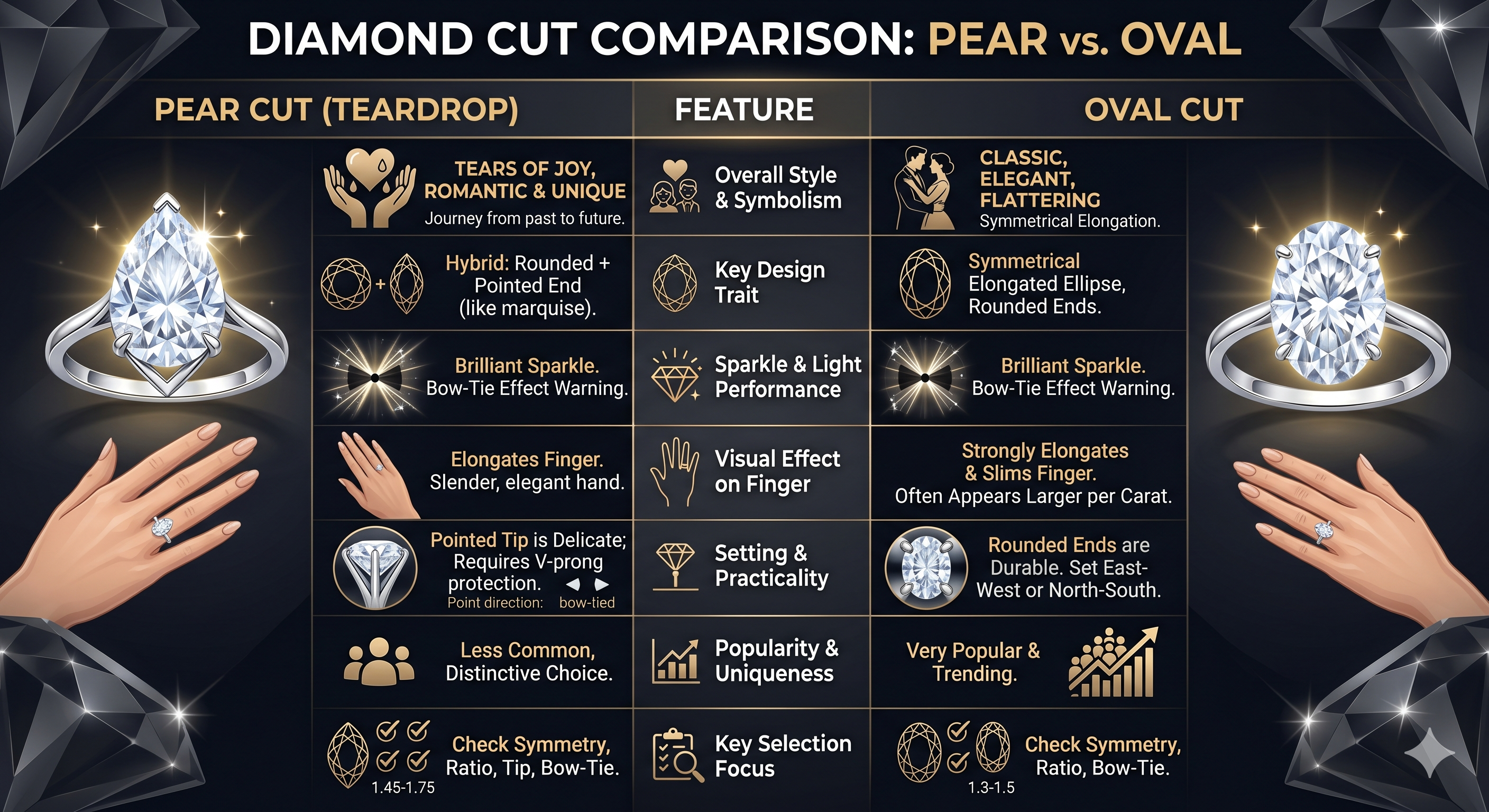
Aesthetic and Character Differences
The core difference is in the silhouette and feel:
Pear Cut is for those who love a story and symbolism. It's romantic, directional, and makes a distinctive statement. Choosing whether to wear the point towards or away from the hand is a personal style decision.
Oval Cut is for those who prefer timeless, balanced elegance. It's soft, symmetrical, and offers a brilliant, modern take on the classic round shape without being overly trendy.
Practical Considerations
Durability: The pointed tip of a pear cut is its vulnerability. A V-prong or bezel setting is highly recommended to protect it from chipping. The oval's rounded ends are less prone to damage.
Setting Style: Both shapes work beautifully in solitaire, halo, or three-stone settings. The pear's direction adds a layer of customization, while the oval offers flexibility in orientation.
Choosing the Stone: For both cuts, personal inspection is non-negotiable. You must look at the diamond in different lights to assess the severity of the bow-tie effect, which is not captured on a certificate. Symmetry is also critical for both shapes.
How to Make Your Decision
Visual Preference: Look at pictures and, most importantly, try both shapes on your hand. Which silhouette do you connect with more?
Lifestyle Fit: Do you prefer a low-maintenance shape (oval), or are you willing to ensure the setting protects a delicate point (pear)?
Symbolism vs. Classic: Does the unique symbolism and directionality of the pear appeal to you, or do you prefer the balanced, timeless nature of the oval?
Try with a Band: Visualize how each shape will look with a wedding band. Some find pairing a band with a pear cut requires more consideration.
Ultimately, your choice depends on whether you are drawn to the distinctive, storytelling nature of the Pear or the harmonious, classic elongation of the Oval.
If you have a preference for a certain carat size or budget, I can help explain how that might influence the appearance and options for each shape.
How Decide Between Oval And Emerald?
Choosing between an oval and an emerald cut comes down to a difference in style and light performance. Oval diamonds are brilliant, sparkly, and romantic, while emerald cuts are sleek, architectural, and sophisticated.
Here’s a side-by-side comparison of their key features:
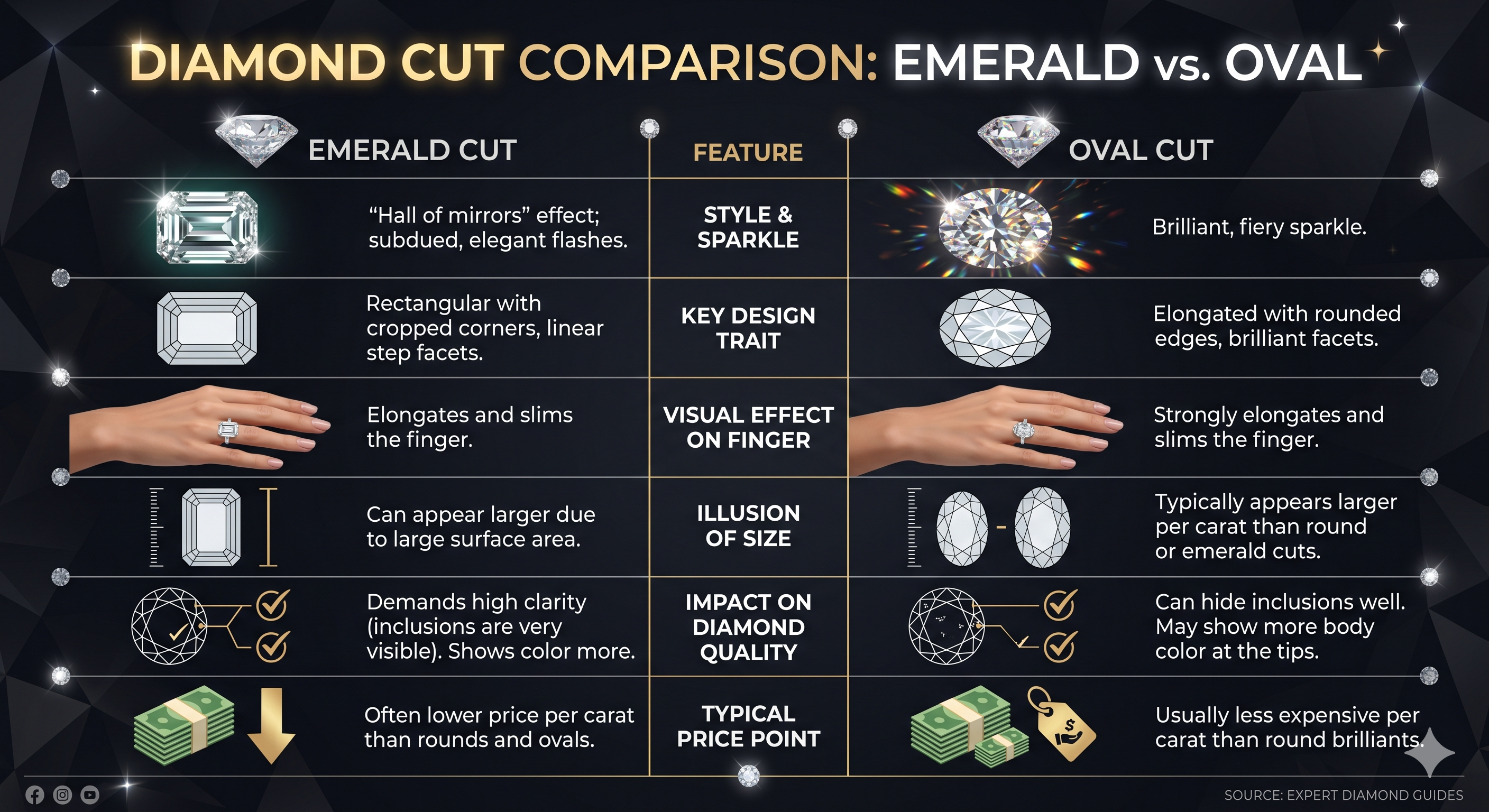
Aesthetic and Character
The most significant difference is in how they interact with light. An oval cut is designed for maximum sparkle and fire, offering a brilliant, eye-catching display similar to a round diamond. An emerald cut is a "step cut," creating a clean, hall-of-mirrors effect with broad, flashing planes of light, prioritizing elegance and clarity over intense sparkle.
Stylistically, emerald cuts are associated with Art Deco, vintage-inspired, or minimalist modern looks. Ovals lean toward romantic, soft, and glamorous styles.
Practical Considerations
Budget & Value: Emerald cuts can offer a lower price per carat. Ovals can make a diamond appear larger for its carat weight, offering value in perceived size.
Diamond Selection: For an emerald cut, prioritize high clarity (VS2 or better) and a good color grade (G or higher) as flaws and color are more visible. For an oval, assess the bowtie effect in person, as it varies widely and isn't graded on certificates.
Lifestyle & Setting: Both shapes elongate the finger. Emerald cuts have flat, snag-free corners, which can be practical. Ovals have rounded edges but delicate,e pointed ends that need protection in their setting. Popular settings for emerald cuts include solitaire, three-stone, or bezel. Ovals look stunning in halo, pavé, or vintage settings.
How to Decide
Define Your Priority: Is it fiery brilliance (Oval) or elegant, geometric clarity (Emerald)?
Consider Your Style: Are your aesthetics more modern/minimalist (Emerald) or romantic/glamorous (Oval)?
Try Them On: This is crucial. Seeing them on your hand is the best way to judge which shape you connect with and to evaluate the bowtie in ovals or the clarity in emeralds.
Consult an Expert: A trusted jeweler can show you a selection of both cuts, explain the nuances of quality, and help you find a stone with excellent proportions.
In summary, let your personal style be your guide: choose the Oval for brilliant sparkle and a romantic feel, or the Emerald for architectural elegance and sophisticated flash.
I hope this detailed comparison helps you feel more confident in your decision. Would you like me to elaborate on specific setting styles or diamond quality factors for either cut?
“You now know the origin, the price comparison, the round vs. oval debate, the popularity reasons, the size guide, the timelessness, and the pear/emerald comparisons. The only question left: will you choose the shape that stretches toward the future?
*Our current collection includes a limited number of GIA-certified oval diamonds — from delicate 0.8-carat stones to stunning 3-carat centerpieces. When stones with minimal bow-tie and ideal length-to-width ratios are gone, sourcing new ones takes time.*
This is not just a diamond. It is Lazare Kaplan‘s 1957 invention, Hailey Bieber‘s trend, and 70 years of proof that a diamond doesn‘t have to be round to be brilliant — it just has to be oval.”
[Button: Claim Your Oval Diamond (Limited) →]
Back to Complete Amethyst Stone Guide


Other news for Sunday 14 June, 2026
- Round Brilliant Cut Guide: Price, Facets, vs Other Cuts and Buying Tips
- The Allure of the Cushion Cut Diamond: What You Need to Know
- Square Cut Diamond Guide: Princess, Cushion, Asscher and Radiant
- 24K Gold Guide: Purity, Price, vs 18K, Investment and Buying Tips
- 22K Gold Guide: Purity, Price, vs 24K/18K, Daily Wear and Care
- Pear Cut Diamond Guide: Price, vs Round, Sparkle and Buying Tips
- Solitaire Setting Guide: 4 vs 6 Prong, Security, Unique Ideas and Comfort
View all news for Sunday 14 June, 2026 on one page
News for Saturday 13 June, 2026
- Ring Finger Meaning: Which Finger for Wedding, Single and More | Complete Guide
- Bezel Setting Guide: Benefits, Styles, and Buying Tips
- Sterling Silver Jewelry Guide: 925 Meaning, Care and Green Skin Fix
- Channel Setting Guide: Pros, Cons, Safety and Cost vs Pavé
- Prong Setting Guide: 4 vs 6 Prongs, Security, Size and Types
- Ring Setting Guide: Types, Best for Daily Wear, and Size Tips
View all news for Saturday 13 June, 2026 on one page
Recent News
- Friday 12 June, 2026
- Thursday 11 June, 2026
- Wednesday 10 June, 2026
- Tuesday 09 June, 2026
- Monday 08 June, 2026