

Round Brilliant Cut Guide: Price, Facets, vs Other Cuts and Buying Tips
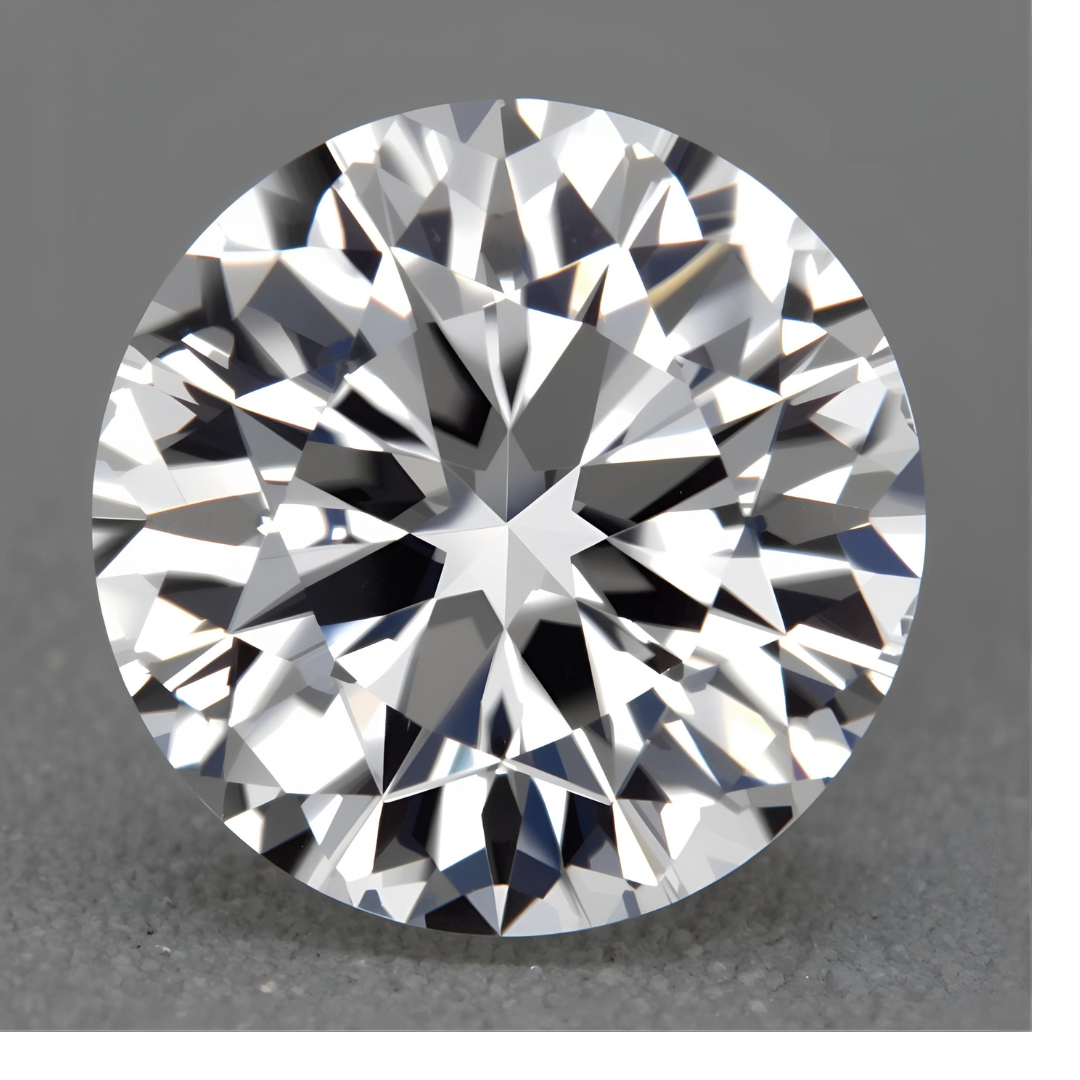
Round Brilliant Cut Guide: Price, Facets, vs Other Cuts and Buying Tips
Here is a detailed explanation of what a Round Brilliant Cut is.
The Simple Definition
A Round Brilliant Cut is the most popular and classic diamond shape in the world. It is characterized by its perfectly circular outline and a specific facet pattern designed to maximize brilliance (white light return), fire (flashes of color), and scintillation (sparkle).
Here is the table of contents.;
What Is A Round Brilliant Cut?
Key Characteristics: Why It's "Brilliant"
The term "Brilliant Cut" refers to the specific arrangement of 57 or 58 facets (the flat, polished surfaces). This geometric pattern was perfected through mathematical calculations to optimize the diamond's interaction with light. The facets are arranged as follows:
Table: The large, flat facet on the top.
Crown: The upper section above the girdle (the diamond's widest point). It consists of 8 bezel facets, 8 star facets, and 16 upper-girdle facets (32 total crown facets).
Pavilion: The lower section below the girdle. It consists of 8 pavilion facets and 16 lower-girdle facets (24 total pavilion facets).
Culet: The tiny point at the bottom. When faceted, it counts as the 58th facet. On modern diamonds, it is often a microscopic point and is not counted.
The magic of the Brilliant Cut lies in how these facets work together:
Light enters through the crown.
It is reflected from one pavilion facet to another inside the diamond (a property called Total Internal Reflection).
The light is reflected out through the crown to the viewer's eye, creating an explosion of sparkle.
A Brief History: The Evolution to Perfection
The Round Brilliant Cut we know today is the result of centuries of evolution:
Old European Cut (c. 1800s): The precursor. It had a similar facet pattern but a smaller table, higher crown, and larger culet. It was cut for candlelight, creating a "chunkier," more fiery sparkle.
The Tolkowsky Ideal (1919): Mathematician Marcel Tolkowsky published his doctoral thesis, which calculated the precise angles and proportions needed to balance brilliance and fire. This established the theoretical "Ideal Cut" and is the foundation for modern Round Brilliant cuts.
Modern Brilliant Cut (Late 20th Century): With advanced computer modeling and cutting technology, cutters can now achieve incredible precision, creating diamonds that perform even better than Tolkowsky's original model.
Why is the Round Brilliant Cut So Popular?
Maximum Sparkle: Its design is scientifically proven to reflect more light than any other shape. It is the ultimate shape for brilliance and fire.
Timelessness: It's a classic that never goes out of style, ensuring its beauty and value remain constant.
Versatility: It looks stunning in any style of setting, from a simple solitaire to an elaborate halo.
Forgiving Nature: Its brilliant facets are excellent at hiding minor inclusions (internal flaws) and color tints, meaning you can sometimes opt for a slightly lower clarity or color grade without it being noticeable to the naked eye.
Round Brilliant Cut vs. Other Cuts
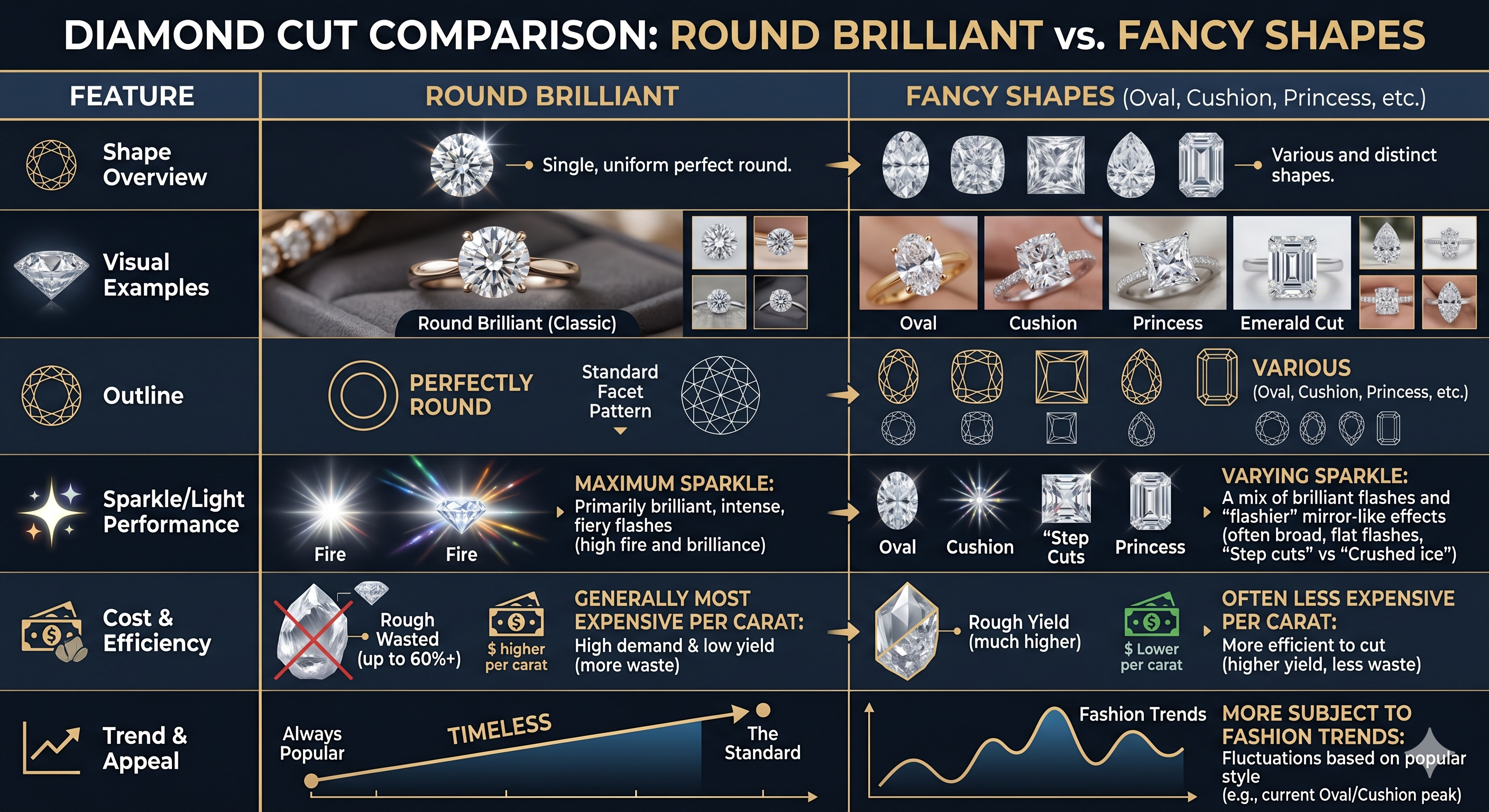
In short, the Round Brilliant Cut is the benchmark for diamond cuts. It is the product of centuries of refinement and optical science, engineered to produce the greatest possible sparkle. Its timeless beauty and unparalleled light performance are what make it the number one choice for engagement rings and fine jewelry worldwide.
For official diamond cut grading information, visit the GIA Diamond Cut Guide.
Are Round Brilliant Diamonds More Expensive?
Yes, absolutely. Round Brilliant diamonds are consistently the most expensive diamond shape per carat.
Here’s a detailed breakdown of why this is the case, often referred to as the "Round Brilliant Premium."
The Top 3 Reasons for the Higher Cost
1. Highest Yield Loss (The Biggest Factor)
When a rough diamond crystal (which is typically an octahedron, like two pyramids stuck together) is cut into a round shape, a tremendous amount of the original material is lost.
The Process: To achieve the perfect symmetry and proportions of a Round Brilliant, the cutter must grind away significant portions of the rough stone. A fancy shape (like an oval, pear, or cushion) can often be cut to follow the natural shape of the rough crystal more closely.
The Numbers: It's common for over 60% of the original rough diamond to be lost during the cutting of a Round Brilliant. For fancy shapes, the yield loss is typically lower, around 40-50%.
The Implication: Because so much more rough material is wasted, the cost of that "waste" is factored into the price of the finished round diamond.
2. Unmatched Demand and Popularity
The Round Brilliant is the most classic, timeless, and sought-after diamond shape in the world. Its unparalleled sparkle and traditional appeal create incredibly high and consistent demand.
Basic Economics: High demand + limited supply = higher price. This universal popularity ensures that round diamonds always command a premium in the market.
3. Cutting Complexity and Labor
Achieving the perfect proportions and symmetry for a Round Brilliant is a highly skilled and time-consuming process.
Precision is Key: The cut grade is critical for a round diamond's beauty. To achieve an "Excellent" or "Ideal" cut grade, the cutter must place 57/58 facets with extreme precision. There is very little room for error.
Expert Craftsmanship: This requires more labor hours from master cutters compared to many fancy shapes, adding to the final cost.
Putting It into Perspective: A Price Comparison
While prices fluctuate based on the "4Cs" (Carat, Cut, Color, Clarity), you can generally expect a significant price difference.
On average, a Round Brilliant diamond will be 20-40% more expensive per carat than a fancy shape diamond of similar carat weight, color, and clarity.
Example:
If a 1-carat, G-color, VS1-clarity Oval diamond costs $6,000, a comparable Round Brilliant diamond could easily cost between $7,200 and $8,400.
Is the Premium Worth It?
This is a personal decision, but here’s how to think about it:
Yes, if your priority is maximum sparkle, the Round Brilliant cut is scientifically engineered to provide the best possible light performance (brilliance and fire). You are paying for the ultimate in sparkle.
Yes, if you value timelessness and resale value: The round shape is a perennial classic that never goes out of style and generally holds its value better on the resale market.
No, if your priority is size per budget: If you have a fixed budget and want the largest possible diamond, choosing a fancy shape (like an oval, radiant, or cushion) will allow you to get a larger carat weight for your money.
The higher price of a Round Brilliant diamond is not arbitrary. It directly reflects the high cost of raw material waste, immense consumer demand, and the expert craftsmanship required to create its legendary sparkle.
Round Brilliant vs. Fancy Shapes: Price & Features Comparison
| Feature | Round Brilliant | Fancy Shapes (Oval, Cushion, Pear) | |||
|---|---|---|---|---|---|
| Price per Carat | Most expensive (benchmark) | 20-40% less expensive | |||
| Sparkle (Brilliance & Fire) | Maximum (scientifically engineered) | Very good, but less than round | |||
| Rough Diamond Waste |
|
40-50% loss | |||
| Timelessness | Classic, never goes out of style | Trend-sensitive, unique appeal | |||
| Hides Inclusions/Color | Excellent (forgiving) | Moderate (varies by shape) | |||
| Resale Value | Stronger, more liquid | Weaker, more niche demand |
How Many Cuts Are In A Round Brilliant Diamond?
The terminology can be a bit tricky here. While we often say "cuts," the more precise term is facets (the flat, polished surfaces).
A standard modern Round Brilliant Cut diamond has 57 or 58 facets.
Here is a detailed breakdown of where those facets are located:
The Official Count: 57 or 58?
The number depends on whether the tiny point at the bottom, called the culet, is faceted into a flat surface or left as a sharp point.
57 Facets: This is the most common count for modern diamonds. It includes everything except a faceted culet. The culet is a microscopic sharp point.
58 Facets: This count includes a faceted culet. The cutter adds one very small, flat facet to the point at the bottom to prevent it from chipping. This was more common in older cuts but is still seen today.
The Facet Breakdown (Using the 57-facet standard)
Here is the anatomy of a Round Brilliant, from top to bottom:
1. The Crown (The Top Half)
Table Facet: The large, flat octagonal facet on the very top. (1 facet)
Star Facets: 8 triangular facets that surround the table.
Bezel Facets (or Crown Main Facets): 8 kite-shaped facets that form the outer edge of the crown.
Upper Girdle Facets: 16 small, irregular facets just above the girdle.
Total Crown Facets: 1 (Table) + 8 (Star) + 8 (Bezel) + 16 (Upper Girdle) = 33 Facets
2. The Girdle (The Widest Part)
This is the thin band that separates the crown from the pavilion. While it is a "part" of the diamond, it is not typically counted as a facet unless it is faceted (which is rare in rounds).
3. The Pavilion (The Bottom Half)
Pavilion Facets (or Pavilion Main Facets): 8 long, kite-shaped facets that come to a point at the bottom.
Lower Girdle Facets: 16 small, irregular facets just below the girdle.
Total Pavilion Facets: 8 (Pavilion Main) + 16 (Lower Girdle) = 24 Facets
The Grand Total
Crown (33) + Pavilion (24) = 57 Facets
If the culet is faceted, you add that one, making it 58 facets.
Why So Many Facets?
This specific number and arrangement of 57/58 facets is not random. It is the result of optical science and centuries of refinement. Each facet acts as a tiny mirror, designed to:
Capture light from above.
Reflect it internally around the diamond.
Return it to the viewer's eye as that famous, fiery sparkle (brilliance and fire).
In short, the 57 or 58 facets of a Round Brilliant are the key to its status as the ultimate sparkle machine.
Why Is The Round And Brilliant Cut Popular In Diamonds?
Of course. The popularity of the Round Brilliant Cut is not accidental; it's the result of a powerful combination of science, psychology, and market forces. It is, quite simply, the benchmark against which all other diamond cuts are measured.
Here’s a breakdown of the key reasons for its enduring dominance:
1. Unmatched Sparkle: The Scientific Reason
This is the most important factor. The Round Brilliant Cut is engineered for maximum light performance.
Optimal Proportions: Its specific arrangement of 57 or 58 facets is the result of mathematical calculations (pioneered by Marcel Tolkowsky in 1919) designed to achieve the perfect balance of three optical effects:
Brilliance: The return of white light. The facets act like tiny mirrors, bouncing light around inside the diamond and reflecting it to your eye in a dazzling shower of brightness.
Fire: The dispersion of light into flashes of spectral color (rainbows). The precise angles of the Round Brilliant maximize this "prism effect."
Scintillation: The sparkle and pattern of light and dark areas that flash when the diamond, the light, or the observer moves.
No other shape reflects as much light as efficiently as the Round Brilliant. It is, objectively, the sparkliest diamond shape.
2. Timelessness and Tradition: The Psychological Reason
The round shape is a classic symbol of perfection, eternity, and commitment.
Enduring Style: While fancy shapes (like ovals, pears, or cushions) go in and out of fashion, the Round Brilliant has remained the consistent, timeless choice for over a century. It never looks dated.
The "Safe" Choice: Because it's so universally loved and recognized, it's often seen as a safe, romantic, and traditional choice for significant pieces like engagement rings. You can be confident it will be appreciated now and decades from now.
3. Versatility and Beauty in Any Setting: The Practical Reason
A Round Brilliant diamond looks stunning in virtually any setting or style of jewelry.
Adaptable: It shines as a solitaire (where its own beauty takes center stage), looks magnificent surrounded by a halo of smaller diamonds, and works perfectly in more complex designs like three-stone rings or vintage-inspired settings.
Complements All Hands: Its symmetrical, non-directional shape is flattering on every finger, regardless of hand shape or size.
4. Forgiveness and Performance: The "Smart" Reason
The cut of a Round Brilliant is exceptionally good at hiding some of the imperfections that can affect other shapes.
Hides Inclusions: The complex facet pattern and brilliance can mask minor internal flaws (inclusions) better than many fancy shapes with larger, more open facets.
Minimizes Color: The intense white light return can make a near-colorless diamond (like a G or H color) face up as bright and white as a higher-grade, more expensive stone. This can allow you to prioritize the all-important Cut grade and save on Color and Clarity.
5. Market and Resale Value: The Economic Reason
High Demand: As the most popular shape by a significant margin, demand is always high. This sustained demand helps maintain its value over time.
Better Resale Value: While diamonds are not investments, a high-quality Round Brilliant typically has a stronger and more liquid resale market than most fancy shapes, simply because more people are looking for it.
Think of it this way:
Round Brilliant: The classic, high-performance sedan. It's engineered for peak performance (sparkle), is universally admired, holds its value well, and is a safe, brilliant choice.
Fancy Shapes (Oval, Cushion, Pear, etc.): The unique and stylish coupes. They offer a distinct look, can appear larger for the same carat weight, and are often more affordable, but their appeal can be more subjective and trend-sensitive.
Ultimately, the Round Brilliant Cut's popularity stems from the fact that it delivers what people most want from a diamond: the most spectacular, guaranteed, and timeless sparkle.
How Much Is A 2 Carat Round Brilliant?
Of course. This is a very common question, but the answer requires some important details because the price of a 2-carat round brilliant diamond has an extremely wide range.
You can expect a starting price of around $8,000-$10,000 for a diamond with noticeable compromises, but a beautiful, well-chosen stone will typically fall in the $15,000 to $35,000+ range.
The final price is almost entirely determined by the other three "Cs": Cut, Color, and Clarity.
Here is a detailed breakdown to help you understand the price spectrum.
The Primary Factor: The "Graded" Quality
The table below outlines realistic price ranges for a 2-carat round brilliant diamond with a GIA or AGS certificate (the most respected labs). Prices are for the diamond alone, not set in a ring.
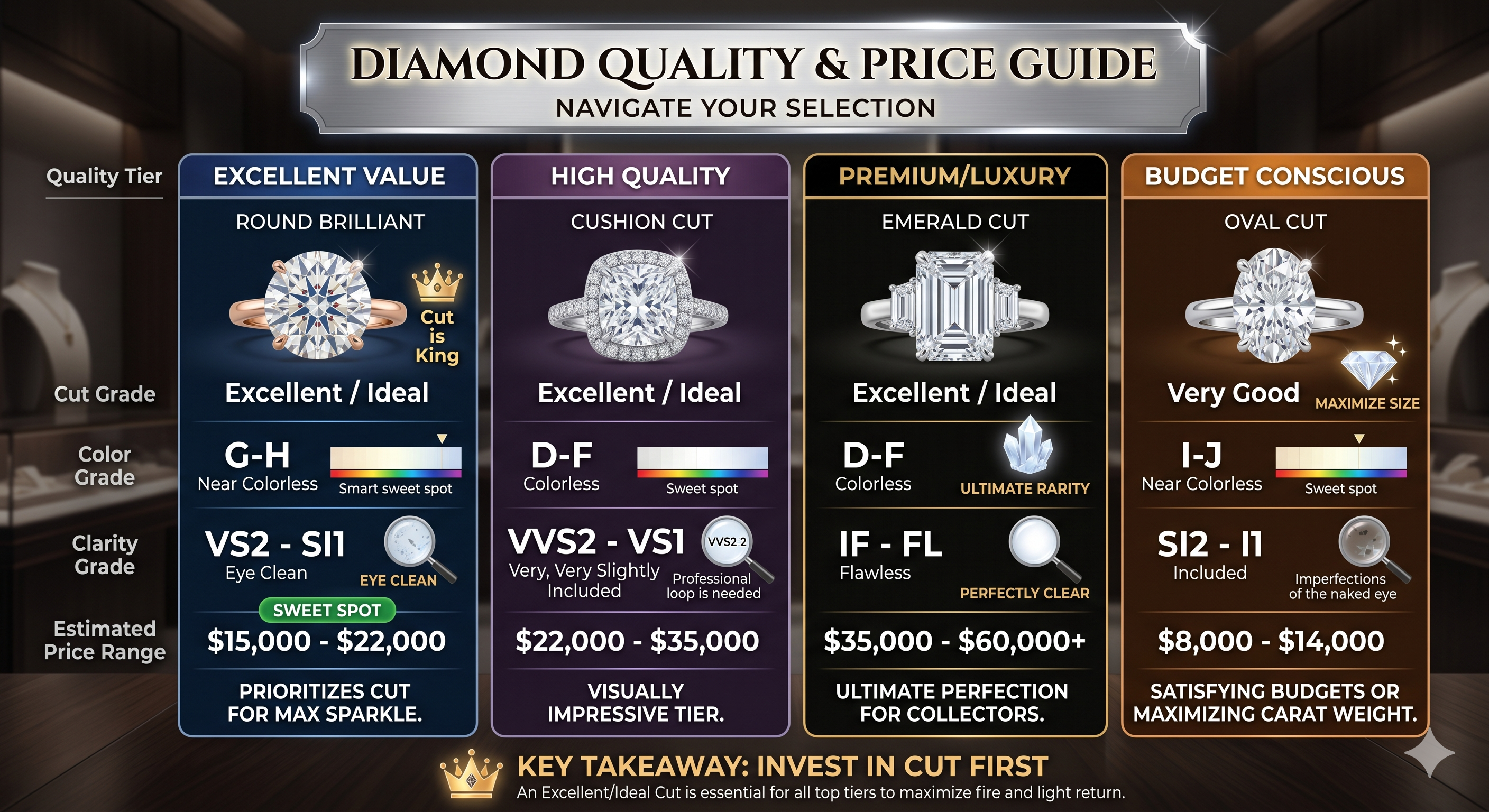
Key Factors That Change the Price Dramatically
1. Cut Quality (The Most Important "C")
This is what makes a round brilliant sparkle. Never compromise on cut.
Excellent/Ideal Cut: Commands the highest premium. It will be breathtakingly sparkly. This is what you're paying for.
Very Good Cut: Less expensive, but the light performance will be noticeably less brilliant.
Good & Fair Cut: These will look dull and lifeless compared to a higher-cut stone. It's not worth the savings.
2. Color Grade (How "White" the Diamond Is)
Colorless (D-F): The rarest and most expensive. They appear perfectly white.
Near Colorless (G-J): The sweet spot for value. To the naked eye, a G or H color will look just as white as a D when set in a ring, but costs significantly less.
Faint Color (K and below): Will have a visible yellow or brown tint. Prices drop significantly.
3. Clarity Grade (The Inclusions and Blemishes)
Flawless (FL) to Internally Flawless (IF): Extremely rare and expensive.
VVS1-VVS2 (Very, Very Slightly Included): Tiny inclusions are difficult for a skilled grader to see. High price.
VS1-VS2 (Very Slightly Included): The perfect balance. Inclusions are not visible to the naked eye. Excellent value.
SI1-SI2 (Slightly Included): The best value tier. SI1 inclusions are often "eye-clean" (not visible without magnification). SI2 is riskier but can sometimes be eye-clean.
I1 (Included) and below: Inclusions are visible to the naked eye and affect brilliance. Prices are low, but so is beauty.
4. Certification (The Diamond's Report Card)
A diamond without a certificate from a reputable lab like GIA (Gemological Institute of America) or AGS (American Gem Society) is a major risk. Their grading is strict and consistent. Other labs are often more lenient with their grades, which can mislead you into overpaying.
5. Fluorescence
None or Faint Fluorescence: Has no impact on price or appearance for the vast majority of diamonds.
Strong or Very Strong Fluorescence: Can cause a discount of 5-15% because, in rare cases, it can make a diamond look hazy or oily. However, it can also make a lower-color (e.g., J or K) diamond appear whiter.
Real-World Price Examples (Approximate)
A "Sweet Spot" Diamond: A 2-carat, G-color, VS2 clarity, Excellent Cut round brilliant from a reputable online retailer will cost around $18,000 - $21,000.
A High-End Diamond: A 2-carat, D-color, VVS1 clarity, Ideal Cut round brilliant will cost $30,000+.
A Budget Diamond: A 2-carat, I-color, SI2 clarity, Very Good Cut round brilliant might be found for $11,000 - $13,000, but you must check it carefully for visible color or inclusions.
Don't Forget the Setting!
The prices above are for the diamond alone. The ring setting (the metal and any side stones) is an additional cost.
A simple solitaire setting in 14k gold can cost $500 - $1,000.
A more elaborate pave, or halo setting in platinum, may cost $1,500 - $4,000+.
While you can find a 2-carat round brilliant for under $10,000, a beautiful, well-balanced stone that delivers the sparkle you expect will typically be an investment of $15,000 to $25,000. Always prioritize an Excellent/Ideal Cut and use a reputable vendor who provides high-quality imagery and videos.
For current diamond market prices, visit the American Gem Society's price guide.
Back to Complete Amethyst Stone Guide


Other news for Sunday 14 June, 2026
- The Allure of the Cushion Cut Diamond: What You Need to Know
- Square Cut Diamond Guide: Princess, Cushion, Asscher and Radiant
- 24K Gold Guide: Purity, Price, vs 18K, Investment and Buying Tips
- 22K Gold Guide: Purity, Price, vs 24K/18K, Daily Wear and Care
- Oval Cut Diamond Guide: Price, vs Round, vs Radiant and Buying Tips
- Pear Cut Diamond Guide: Price, vs Round, Sparkle and Buying Tips
- Solitaire Setting Guide: 4 vs 6 Prong, Security, Unique Ideas and Comfort
View all news for Sunday 14 June, 2026 on one page
News for Saturday 13 June, 2026
- Ring Finger Meaning: Which Finger for Wedding, Single and More | Complete Guide
- Bezel Setting Guide: Benefits, Styles, and Buying Tips
- Sterling Silver Jewelry Guide: 925 Meaning, Care and Green Skin Fix
- Channel Setting Guide: Pros, Cons, Safety and Cost vs Pavé
- Prong Setting Guide: 4 vs 6 Prongs, Security, Size and Types
- Ring Setting Guide: Types, Best for Daily Wear, and Size Tips
View all news for Saturday 13 June, 2026 on one page
Recent News
- Friday 12 June, 2026
- Thursday 11 June, 2026
- Wednesday 10 June, 2026
- Tuesday 09 June, 2026
- Monday 08 June, 2026