

Radiant Cut Guide: Price, vs Emerald, 1ct, 3ct Cost, Sparkle and Tips
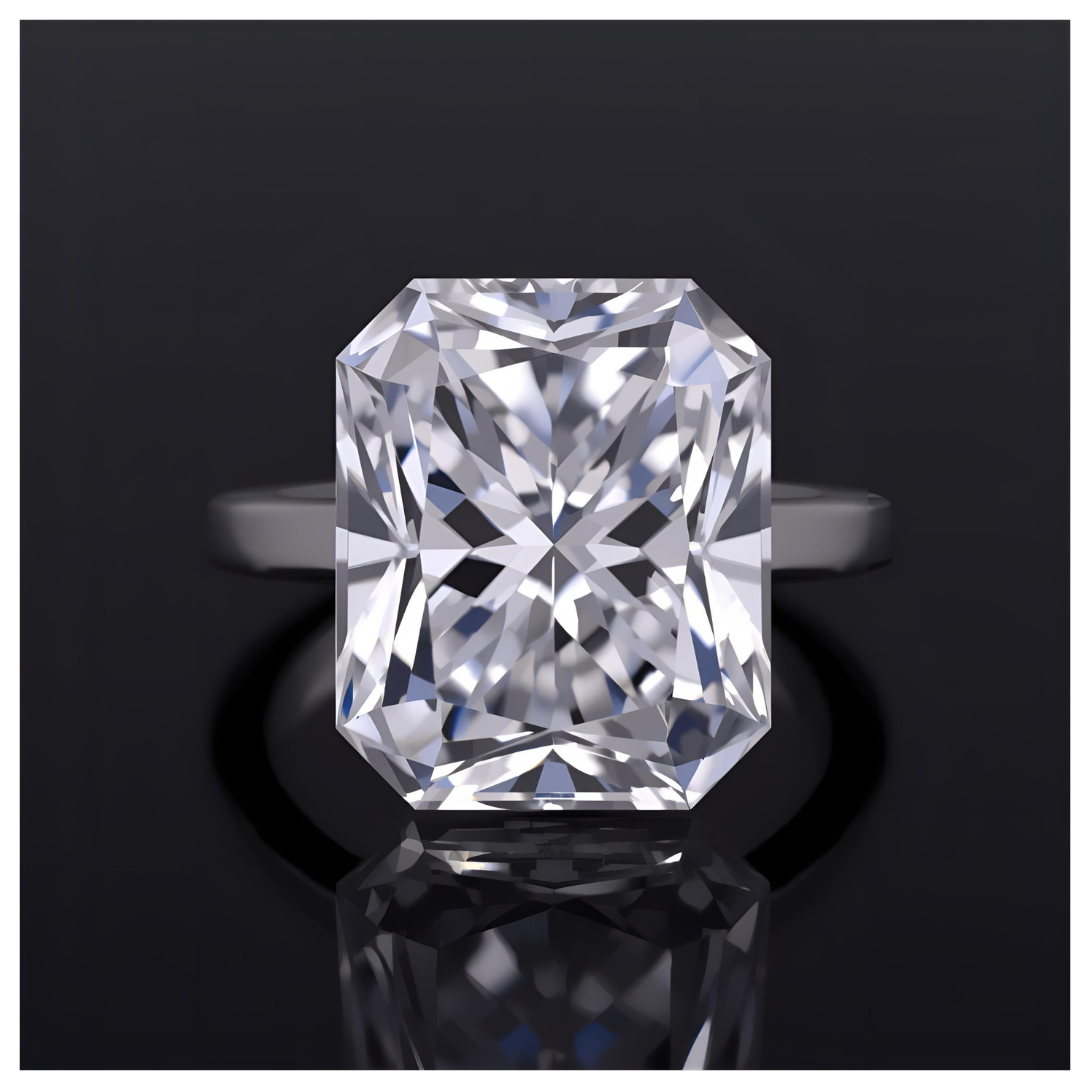
Radiant Cut Diamonds: Everything You Need to Know
The Radiant Cut diamond is a unique and brilliant modern diamond shape that combines the classic outline of an emerald cut with the intense sparkle of a Round Brilliant.
“In 1977, a New York diamond cutter named Henry Grossbard did something that jewelers had said was impossible. He wanted a square diamond that sparkled like a round brilliant—without the sharp, vulnerable corners of a princess cut. He spent years experimenting with facet patterns, losing thousands of carats of rough. Finally, he succeeded. He called his creation the ‘Radiant Cut.‘ The jewelry industry was skeptical. Then the women saw it. They saw a diamond that had the elegance of an emerald cut and the fire of a round—without compromise. Today, the radiant cut is one of the most beloved fancy shapes in the world. Grossbard proved that sometimes, the best ideas are the ones everyone said couldn‘t work.”
The same cut that Grossbard invented in 1977 now awaits your own modern love story — in square or rectangular, crushed ice or brilliant. Every radiant cut diamond in our collection is hand-selected for minimal bow-tie and maximum fire.”
[Button: Explore Radiant Cut Diamonds →]
Here is the table of contents;
- What Is A Radiant Cut Diamond?
- Is A Radiant Cut Diamond More Expensive?
- What Is The Most Affordable Cut Of Diamonds?
- What Is The Best Size For A Radiant Cut Diamond?
- How Big Is A 1 Carat Radiant Cut Diamond?
- How Much Does A 1 Carat Radiant Cut Diamond Cost?
- How Much Is A 3 Carat Diamond Radiant Cut?
- What Is The Most Expensive Type Of Diamond Cut?
- Is Emerald Cheaper Than Radiant?
- Is Radiant Cut A Good Diamond?
- Which Diamond Cut Gives The Most Sparkle?
What Is A Radiant Cut Diamond?
Here is a comprehensive guide to the radiant cut diamond.
A radiant cut diamond is a rectangular or square-shaped brilliant-cut diamond with clipped (cut-off) corners and 70 facets. It was first created in 1977 by diamond cutter Henry Grossbard.
The key innovation of the radiant cut is its unique combination:
The shape and elegance of a step-cut (like an emerald cut).
The sparkle and fire of a brilliant-cut (like a round brilliant).
This hybrid design makes it exceptionally brilliant and fiery, while its clipped corners make it more durable and resistant to chipping compared to other square-shaped diamonds.
Key Characteristics of a Radiant Cut Diamond
1. The Cut and Faceting
This is the most defining feature. Unlike the long, parallel steps of an emerald cut, the radiant cut has a complex faceting pattern on both its crown (top) and pavilion (bottom). This intricate arrangement is designed to maximize light return, creating a dazzling display of fire (flashes of color) and brilliance (white light).
2. Shape and Length-to-Width Ratio
Radiant cuts are most commonly found in a rectangular shape, but a perfectly square radiant is also very popular.
Square Radiant: Has a length-to-width ratio of 1.00 to 1.05. This looks like a square with cropped corners and is a modern, balanced choice.
Rectangular Radiant: Has a length-to-width ratio of 1.10 to 1.50+. A ratio of 1.20 to 1.40 is often considered the "classic" elongated look.
The ratio you choose is a matter of personal preference and can affect how the diamond looks on your finger.
3. The Cropped Corners
The clipped corners are a signature element. They not only give the diamond its distinctive look but also add practical durability, making it a great choice for active lifestyles and a secure setting for prongs.
Radiant Cut vs. Other Popular Cuts
It's often compared to the cushion cut and the emerald cut.
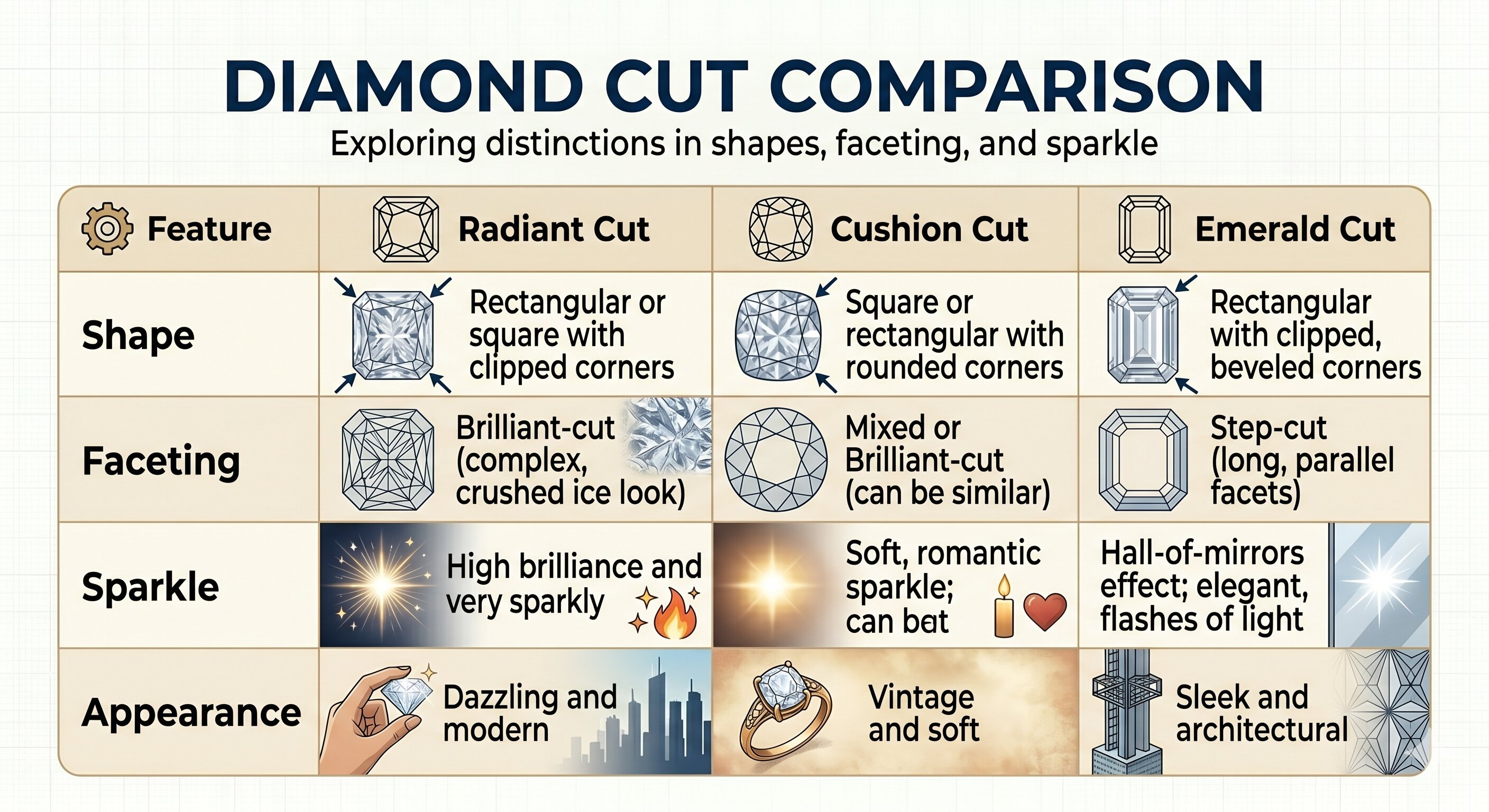
The "Crushed Ice" Effect: Many radiant cut diamonds exhibit a "crushed ice" appearance, where the facets look like small, shimmering pieces of ice. This is a result of the brilliant faceting pattern and is a matter of taste—some love it, while others prefer a cleaner, more defined facet pattern.
Advantages of Choosing a Radiant Cut
Unmatched Brilliance: It is one of the most brilliant of the fancy-shaped diamonds, competing closely with the round brilliant.
Flattering Shape: The elongated rectangular shape can create the illusion of longer, slimmer fingers.
Durability: The clipped corners protect the diamond from damage, making it ideal for everyday wear in an engagement ring.
Versatility: It looks stunning in almost any setting, from a classic solitaire to an elaborate halo. A halo can enhance its sparkle and make it look even larger.
Hides Color Well: The intense sparkle can help mask body color. This means you can often opt for a slightly lower color grade (e.g., J or K) compared to a step-cut diamond, such as an emerald cut, without the tint being noticeable to the naked eye.
“In 2015, a radiant cut diamond appeared on the red carpet—worn by a young actress who paired it with a simple platinum band. The ring had no halo, no side stones, no embellishment. Just the diamond. It was 4 carats of crushed-ice fire, and it stopped every camera. Within weeks, searches for ‘radiant cut engagement ring‘ had doubled. The radiant had been invented in the 1970s, but it took forty years for the world to catch up. The radiant cut does not scream. It sparkles. And when the light hits it just right, it is impossible to look away.”
Potential Disadvantages
The "Crushed Ice" Look: As mentioned, this is not for everyone. If you prefer clean, geometric lines of light, an emerald or Asscher cut might be preferable.
Bow-Tie Effect: Elongated fancy shapes, including radiants, can sometimes display a dark "bow-tie" shape across the center if they are cut poorly. A well-cut radiant will have a minimal or non-existent bow-tie.
Complex Grading: Because it's a fancy shape, the "Cut" grade from labs like GIA is not as straightforward as for a round brilliant. You need to rely on your eyes and the expertise of a reputable jeweler to assess its beauty.
What to Look For When Buying a Radiant Cut
Cut Quality is King: This is the most important factor. Look for a diamond with excellent symmetry and polish. Examine it in various lightings to check for an obvious bow-tie.
Choose Your Shape: Decide if you want a square or a rectangular look and what length-to-width ratio you prefer.
Clarity: Due to its brilliant facets, it is more forgiving of inclusions than a step-cut. VS2 to SI1 clarity grades are often excellent value, as long as the inclusions are not visible to the naked eye.
Color: You have flexibility. For a white metal setting (such as white gold/platinum), a G-H color is a great target. For yellow gold, you can go even lower (I-J-K), and the stone will still face up white.
The radiant cut is the perfect choice for someone who loves the look of a rectangular diamond but wants the maximum amount of sparkle and scintillation. It's a modern, vibrant, and durable shape that offers a brilliant alternative to the more subdued emerald cut.
For official diamond cut grading information, visit the GIA Diamond Cut Guide.
Is A Radiant Cut Diamond More Expensive?
The answer is nuanced, but generally, no, a radiant cut diamond is not more expensive than a round brilliant cut; in fact, it is often significantly less expensive for a diamond of similar carat weight and quality.
Here’s a detailed breakdown of the cost factors:
The Short Answer: Radiant vs. Round Brilliant
When comparing the two most popular shapes, the round brilliant cut is almost always more expensive than a radiant cut (and most other fancy shapes).
You can expect to pay 20-40% less for a radiant cut diamond compared to a round brilliant of the same carat weight, color, and clarity.
Why Round Brilliant Cuts Are More Expensive
Higher Demand: The round brilliant is the most classic and popular shape, accounting for over 75% of all diamond sales. This immense demand allows retailers to command a higher price.
Greater Rough Waste: Cutting a round diamond from a raw crystal (rough) results in the most material loss. To achieve its perfect symmetry and brilliance, more of the original diamond is wasted. This "yield loss" is a major cost driver.
Cost Factors Specific to Radiant Cut Diamonds
While cheaper than rounds, the price of a radiant cut can vary based on several factors:
1. Carat Weight
This is the biggest factor. As with all diamonds, price increases exponentially with carat weight.
2. Cut Quality (The Most Important Factor for Sparkle)
Unlike round brilliants, fancy shapes like the radiant do not receive a single overall "Cut Grade" from GIA. Instead, they are graded on Polish and Symmetry. A diamond with an "Excellent" rating in both will command a higher price than one with "Good" or "Very Good." A well-cut radiant will have:
Excellent light performance (high brilliance and fire).
A minimal or non-existent bow-tie effect (the dark band across the center seen in some elongated shapes).
A poorly cut radiant will look dull and lifeless, even with high color and clarity. Never sacrifice cut quality to save money.
3. Length-to-Width Ratio & Personal Preference
Square Radiants (ratio 1.00-1.05) can sometimes be priced slightly higher than rectangular ones because they require a more "chunky" piece of rough to achieve the square shape, which can be less common.
"Ideal" Proportions: Certain ratios are more popular and may carry a slight premium, but this is largely subjective.
4. Color (More Forgiving)
The radiant cut's brilliant faceting pattern is excellent at hiding body color. This means you can often choose a lower color grade (e.g., G-J) and the diamond will still face up white, especially in a yellow gold setting. This can lead to significant savings compared to an emerald cut, which requires a higher color grade.
5. Clarity (More Forgiving)
Similarly, the complex facets can help to conceal small inclusions. You can often safely choose a VS2 or SI1 clarity grade without any visible imperfections to the naked eye. This is another area for potential savings.
Price Comparison Table (Approximate)
Let's assume a 1.50-carat diamond with G color, VS2 clarity, and Excellent polish/symmetry.
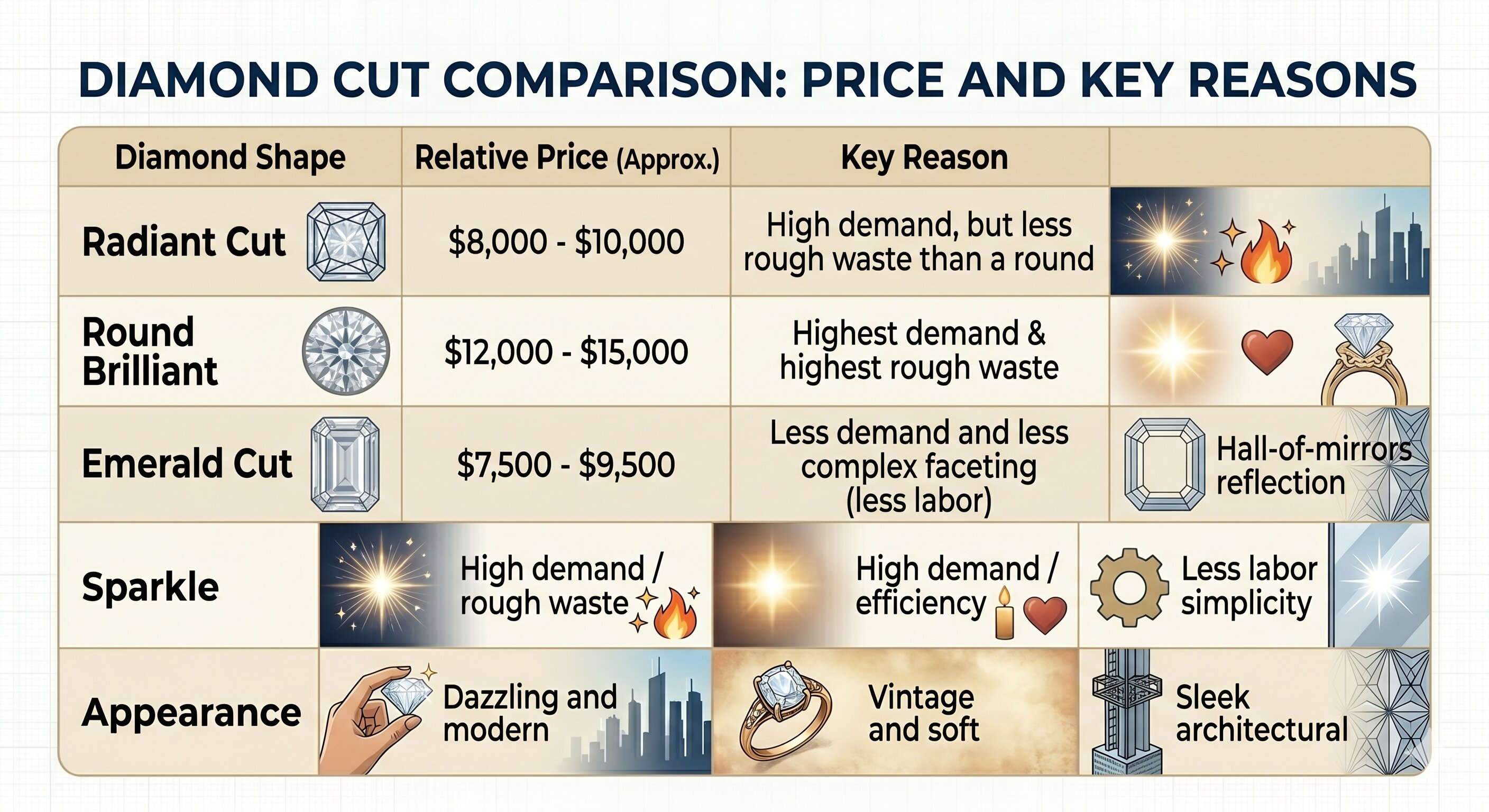
Note: Prices are illustrative and can vary based on retailer and specific diamond characteristics.
Is A Radiant Cut More Expensive?
Compared to a Round Brilliant? No, it is significantly less expensive. You get more carat weight for your budget.
Compared to other Fancy Shapes (Cushion, Princess, Oval)? Prices are generally comparable. A radiant might be slightly more expensive than a cushion but similarly priced to a well-cut oval. The price difference here comes down more to specific retailer markups and the individual diamond's quality.
Compared to Step-Cuts (Emerald, Asscher)? It can be slightly more expensive due to the more complex faceting and labor involved, but the difference is usually small.
The radiant cut offers a fantastic balance of modern brilliance, a flattering shape, and excellent value for money, especially when you consider the savings over a round brilliant and its ability to mask color and clarity characteristics.
What Is The Most Affordable Cut Of Diamonds?
Based on consistent industry data, the most affordable diamond cuts are typically Cushion, Princess, Oval, and Marquise. This is because they are much more efficient to cut from rough diamonds compared to the classic Round Brilliant cut, which is consistently the most expensive.
Here is a quick comparison of the most affordable diamond shapes:
| Diamond Shape | Why It's More Affordable | Key Style Characteristics |
| Cushion Cut | Very efficient yield from rough diamond; less material wasted. | Soft, "pillow-like" square shape with rounded corners. Vintage charm with good sparkle. |
| Princess Cut | Retains a high percentage (up to ~80%) of the original rough diamond. | Modern, square shape with sharp corners. Excellent brilliance, second only to round. |
| Oval Cut | Efficient cut that also creates the visual illusion of a larger stone. | Elongated shape that flatters the finger. Brilliance similar to a round diamond. |
| Marquise Cut | Less popular demand compared to rounds and other fancy shapes. | Bold, elongated shape with pointed ends. Known for making the diamond appear very large. |
Why Price Varies by Shape
The cost difference primarily comes from two factors:
Cutting Efficiency: Round diamonds lose about 50-60% of the rough diamond during cutting, while shapes like Princess or Cushion lose far less, making them more cost-effective to produce.
Market Demand: The round brilliant is by far the most popular shape, which drives its price higher. Choosing a "fancy shape" (any shape that isn't round) can save you 25% or more compared to a round diamond of similar carat weight and quality.
Balancing Affordability with Your Priorities
While the shapes above offer great value, here’s how to align your choice with other goals:
For Maximum Sparkle on a Budget: The Princess cut is renowned for its fiery brilliance.
For a Modern Look: The geometric Princess or elongated Oval are popular contemporary choices.
For a Vintage Feel: The Cushion cut is a classic with old-world charm.
Since you were previously interested in the Radiant cut, it is also a more affordable option than a round diamond. It offers a brilliant, sparkling look and typically sits in a competitive mid-range price point.
If you have a specific style in mind (like a solitaire or halo setting) or a particular budget range, I can offer more tailored suggestions on what to look for.
What Is The Best Size For A Radiant Cut Diamond?
This is a fantastic question, as the "best" size for a radiant cut diamond is a balance of personal preference, hand proportion, budget, and practicality.
There is no single "best" size, but we can identify a sweet spot that most people find ideal, along with key factors to help you decide.
The Quick Answer: The Popular Sweet Spot
For a radiant cut diamond, the most popular and often recommended size range is between 1.50 carats and 3.00 carats.
Within this range:
2.00 carats is a hugely popular "goldilocks" size—it's substantial and impressive without being overwhelming for everyday wear.
1.50 to 2.50 carats offers a brilliant presence that is clearly visible and makes a statement, while often remaining within a reasonable budget for many.
However, the "best" size for you depends on the following key factors:
1. The Most Important Factor: Face-Up Size (in Millimeters)
Carat weight measures weight, not physical size. Two radiant diamonds of the same carat weight can look very different in size depending on their length-to-width ratio and how they are cut.
Always look at the millimeter dimensions! A well-proportioned radiant cut's size is determined by its spread across your finger.
Here’s a general guide to carat weight vs. approximate face-up size:
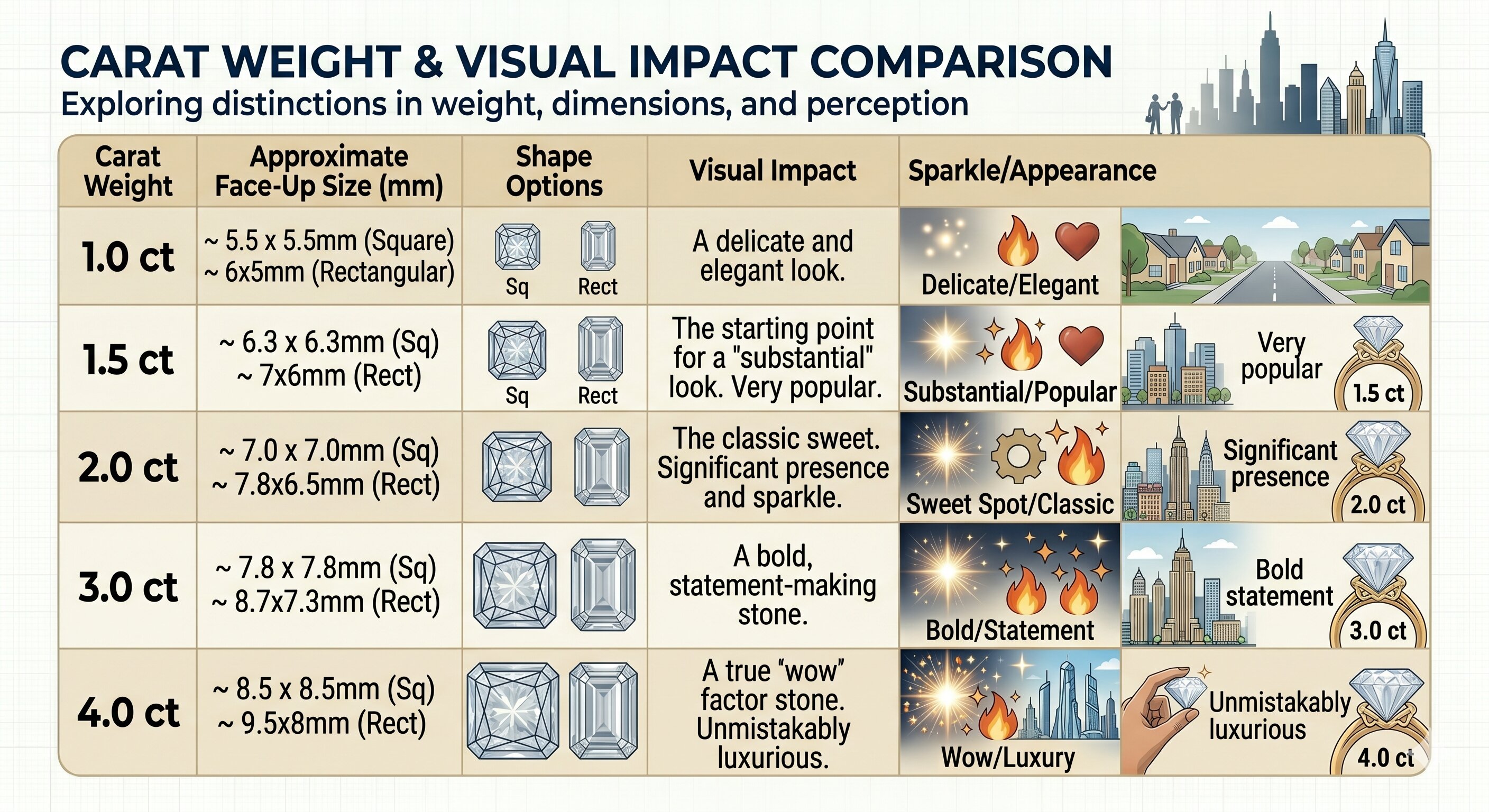
Key Takeaway: A 2-carat radiant will look significantly larger than a 1-carat, but the difference between a 2-carat and a 3-carat, while noticeable, is more about achieving a "statement" look.
2. Finger Size and Hand Proportion
This is crucial for how the diamond will look on you.
Smaller Hands (Finger Size 3-5): A 1.0 - 2.0 carat radiant will look proportionally large and very impactful. A 1.5-carat stone can look perfect and substantial.
Average Hands (Finger Size 6-7): The 1.5 - 3.0 carat range is ideal. A 2-carat stone is a fantastic choice for a balanced, impressive look.
Larger Hands (Finger Size 8+): To achieve a proportional look, you may want to consider 2.5 carats and above. A 3-carat or larger stone will look harmonious and not undersized.
3. Length-to-Width Ratio (The Shape)
This dramatically affects the perception of size.
Square Radiant (Ratio 1.00 - 1.05): Will look "chunkier" and cover more of the finger's width.
Rectangular Radiant (Ratio 1.20 - 1.40): Will create a more elongated, finger-lengthening effect. A longer stone can feel larger even if its carat weight is the same as a square one.
4. Budget and Quality Trade-Offs
Size is just one part of the "Four Cs." As carat weight increases, so does the price, exponentially. You may need to make trade-offs:
To maximize size on a budget, you might choose a slightly lower color (e.g., J instead of G) or clarity (SI1 instead of VS2), which the radiant cut can often hide well. Never sacrifice Cut quality for size, as a poorly cut large diamond will look dull.
The price jump from 1.9 to 2.0 carats can be significant due to "magic sizes" (e.g., 1.0, 1.5, 2.0, 3.0 ct). Sometimes, choosing a 1.8-carat stone can save you a lot of money with a nearly identical visual size.
5. Lifestyle and Personal Style
Understated & Classic: 1.0 - 1.5 carats
Balanced & Modern: 1.5 - 2.5 carats
Bold & Glamorous: 3.0+ carats
Consider your daily activities. A very large stone might feel impractical for some, while others will love the statement.
Final Recommendation and Pro Tip
The best way to determine the perfect size is to try them on.
Go to a jeweler and try on dummy rings (CZ placeholders) in different carat weights and shapes (both square and rectangular radiants).
Take pictures and see how they look in everyday lighting.
Focus on the millimeter measurements more than the carat weight alone.
While the 2-carat radiant cut is the crowd-pleasing sweet spot for its perfect balance of size, sparkle, and prestige, the "best" size is ultimately the one that looks and feels right on your hand and fits your budget without compromising on cut quality.
How Big Is A 1 Carat Radiant Cut Diamond?
This is a great question, as a 1-carat radiant cut diamond can look different depending on its proportions.
Here’s a detailed breakdown of how big a 1-carat radiant cut diamond is, with visual comparisons to help you picture it.
The Short Answer: Physical Dimensions
A 1-carat radiant cut diamond typically measures between 5.5 - 6.5 millimeters in length and 5.0 - 5.5 millimeters in width.
The exact dimensions depend heavily on the Length-to-Width Ratio (L/W Ratio) you choose:
For a "Square" Radiant: The dimensions will be around 5.5mm x 5.5mm (L/W Ratio ~1.0 - 1.05).
For an "Elongated" Radiant: The dimensions will be closer to 6.2mm x 5.2mm (L/W Ratio ~1.2).
Visual Comparisons to Everyday Objects
To help you visualize, a 1-carat radiant diamond is roughly the size of:
A standard pencil eraser.
A single Lifesaver mint (the hole-in-the-center candy).
About the width of two grains of long-grain rice placed side-by-side.
Here is an image to help you visualize its scale on a hand:
(This is a mockup to illustrate the approximate size. The actual appearance will vary based on the diamond's ratio and the wearer's finger size.)
Key Factor: How Shape (L/W Ratio) Affects Perception of Size
The "biggest" looking 1-carat radiant isn't necessarily the heaviest, but the one with the most strategic face-up spread.
Square Radiant (L/W Ratio 1.0 - 1.05): Will look chunky and cover more of the width of the finger. It has a modern, substantial presence.
Rectangular Radiant (L/W Ratio 1.2 - 1.4): Will create an illusion of being larger because of its elongated shape. It covers more length on the finger, which can be very flattering.
Crucial Note: A poorly cut diamond can be "spready" (large but shallow) and lack sparkle, or "deep" (small-faced for its weight) and look smaller. Always prioritize a well-cut diamond for the best combination of size and brilliance.
How It Looks on Different Finger Sizes
The perceived size of a 1-carat radiant is greatly influenced by the wearer's hand.
On a size 4-5 finger: A 1-carat radiant will look quite substantial and dominant.
On a size 6-7 finger (the U.S. average): It will look elegant and proportionate—a classic, solid choice.
On a size 8+ finger: It will look more delicate and modest.
1-Carat Radiant vs. Other 1-Carat Shapes
Due to its cut-off corners, a 1-carat radiant can have a slightly larger face-up appearance than a 1-carat round brilliant, which typically measures about 6.5mm in diameter. It will look very similar in size to a 1-carat cushion cut.
Is A1-Carat Radiant a Good Choice?
Yes, it's an excellent choice for many, offering a beautiful balance of brilliance, modern style, and carat weight.
Pros: It's a recognized, "real" diamond size with significant sparkle. It's often more affordable than a 1-carat round brilliant. Its shape is flattering on most hands.
Consideration: If your primary goal is a "wow" factor or maximum finger coverage, you may want to consider moving up to a 1.5-carat stone, which offers a more dramatic increase in surface area.
A 1-carat radiant cut diamond is a classic, elegant size that provides impressive sparkle. To truly judge, the best practice is to look at a real diamond or a high-quality replica and pay attention to its millimeter measurements rather than just the carat weight.
How Much Does A 1 Carat Radiant Cut Diamond Cost?
This is a practical question, but the answer has a very wide range because the price of a 1-carat radiant cut diamond depends heavily on the quality of its cut, color, and clarity.
However, to give you a direct answer, you can expect a general price range.
The Short Answer: Price Range
For a well-cut 1-carat radiant diamond, expect a starting price of around $2,500 to $3,000 for a stone with decent quality, ranging up to $6,000 - $8,000+ for a stone with exceptional quality (e.g., D-F color, VVS clarity).
Budget-Friendly Range: $2,500 - $4,000
Mid-Range (Best Value): $4,000 - $6,000
High-End / Premium Range: $6,000+
Detailed Price Breakdown: What Drives the Cost?
The price of a 1-carat radiant is determined by the "Four Cs," with Cut Quality being the most important for sparkle.
1. Cut Quality (The Most Important Factor)
Unlike round brilliants, radiant cuts don't get a single "Cut Grade" from GIA. You need to look for:
Excellent Polish & Symmetry: This is a must for a high-performing stone and adds to the cost.
Visual Appeal: A well-cut radiant will have minimal to no "bow-tie" effect and fantastic sparkle. This is where buying from a reputable vendor who provides videos is crucial. A poorly cut stone, even with high color and clarity, will be cheaper but look dull.
2. Color Grade (How Forgiving is the Radiant Cut?)
The radiant's brilliance hides color well. This is where you can save money.
Near Colorless (G-H-I): Excellent value. The stone will face up white, especially in a white gold or platinum setting. This is the sweet spot.
Colorless (D-E-F): Premium price for perfection.
Faint Color (J-K): A great budget option, particularly if set in yellow gold.
3. Clarity Grade (Also Forgiving)
The complex facets are great at hiding inclusions.
VS2-SI1: The sweet spot. Inclusions are typically not visible to the naked eye. This offers the best value.
VVS1-VVS2: Pays a premium for flawless perfection under magnification.
SI2: Can be a good budget option, but the diamond must be carefully checked to ensure inclusions aren't visible.
Sample Price Scenarios (from Reputable Online Retailers)
Here are some real-world examples to illustrate how the grades affect the price for a 1-carat radiant:
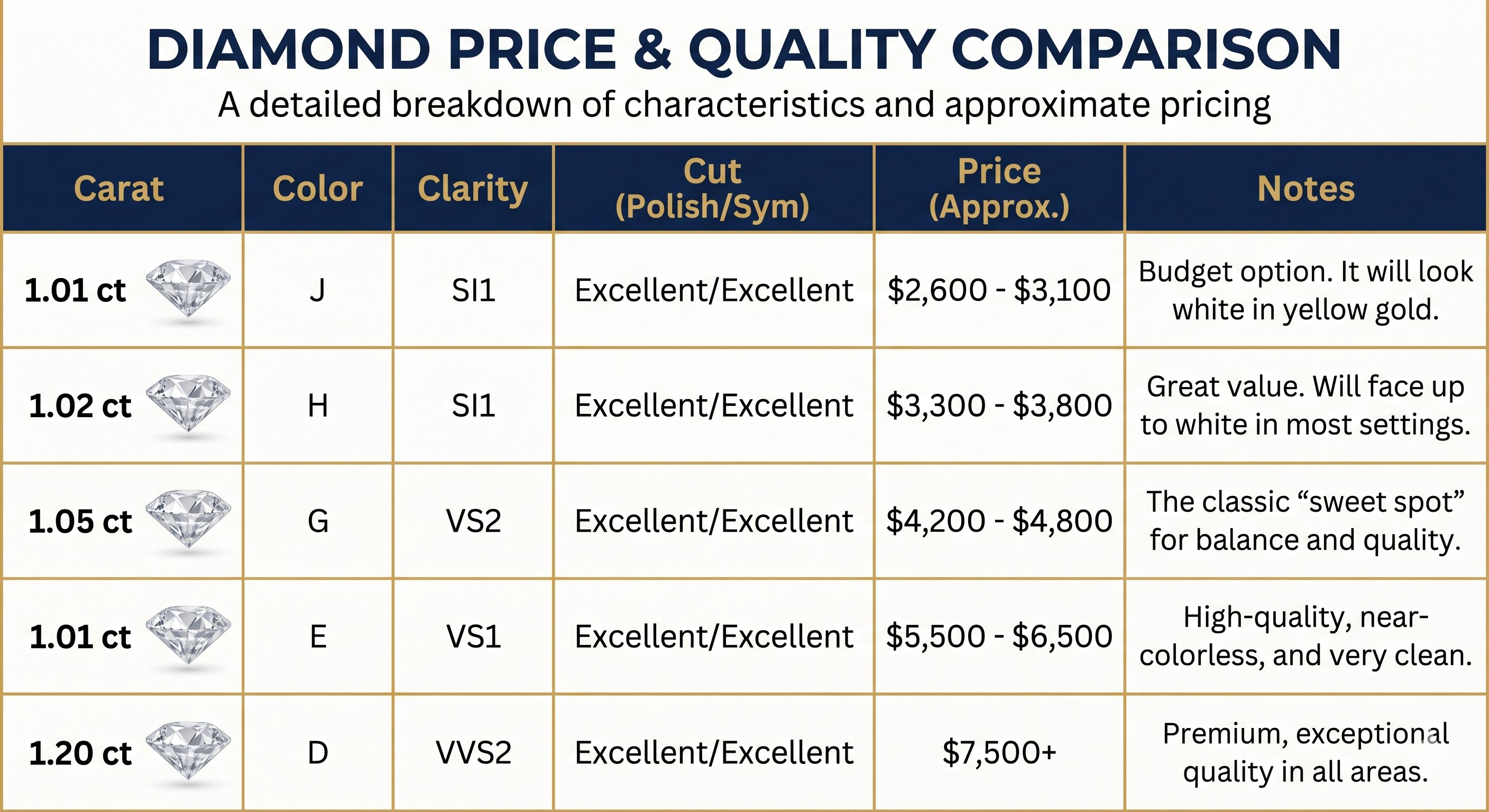
Note: Prices are illustrative and can vary. Always check current market prices.
Radiant Cut vs. Round Brilliant Cost
As discussed previously, a radiant cut is almost always less expensive than a round brilliant of the same carat weight and quality. A 1-carat round brilliant of similar G/VS2 quality would likely cost 20-30% more than the radiant examples above.
How to Get the Best Value for Your 1-Carat Radiant
Prioritize Cut: Never sacrifice cut quality. It's the key to a diamond's sparkle.
Be Flexible on Color: Choose a G or H color instead of a D-F. You'll save a lot without seeing a difference.
Target VS2/SI1 Clarity: These grades offer the best balance of eye-cleanliness and price.
Final Takeaway: While you can find a 1-carat radiant for as low as $2,500, planning a budget of $3,500 to $5,000 will allow you to select a beautiful, well-cut stone with excellent color and clarity that you will be thrilled with for a lifetime. Always review high-quality videos and certificates (from GIA or AGS) before purchasing.
How Much Is A 3 Carat Diamond Radiant Cut?
The price of a 3-carat radiant cut diamond is where budgets can vary dramatically, as you are now in the "statement stone" category. The quality of the diamond's characteristics (the 4Cs) has a massive impact on the price.
The Short Answer: Price Range
For a 3-carat radiant cut diamond, you can expect a starting price of around $15,000 for a stone with decent specifications, ranging up to $50,000+ for a stone of exceptional, premium quality.
Entry-Level Range: $15,000 - $25,000
Mid-Range (Sweet Spot): $25,000 - $40,000
High-End / Premium Range: $40,000 - $60,000+
Detailed Price Breakdown: Why the Range is So Wide
At this carat weight, every step up in color and clarity comes with a significant price jump. The most important factor remains Cut Quality, as a poorly cut 3-carat diamond will be a large, but dull, disappointment.
1. Cut Quality (The Driver of Sparkle)
This is non-negotiable. A 3-carat diamond with a poor cut will look dead and glassy. Look for:
Excellent Polish and Symmetry (from GIA/AGS reports).
Minimal Bow-Tie Effect. This is critical in elongated fancy shapes. Always review high-quality videos.
2. Color Grade (More Flexibility)
The radiant cut's brilliance still helps mask color, but in a larger stone, lower color grades can become more noticeable.
I-J Color: A budget option. The tint may be visible in a white metal setting, but can work well in yellow or rose gold.
G-H Color: The best value spot. The stone will appear white to the naked eye for most people, while saving thousands over the top grades.
D-E-F Color: You pay a significant premium for the absolute top tier of colorlessness.
3. Clarity Grade (Crucial for "Cleanliness")
With a larger table (surface area), inclusions are easier to see. You need to be more careful with a 1 or 2-carat stone.
SI1-SI2: Can be a risk. You must ensure the diamond is "eye-clean," meaning no inclusions are visible to the naked eye. This requires careful vetting.
VS2-VS1: The recommended sweet spot. Offers an excellent balance of being eye-clean without paying the premium for "flawless under magnification."
VVS2 and above: A luxury premium for absolute perfectionism.
Sample Price Scenarios (Illustrative)
Here are examples to show how the grades impact the price for a 3-carat radiant:
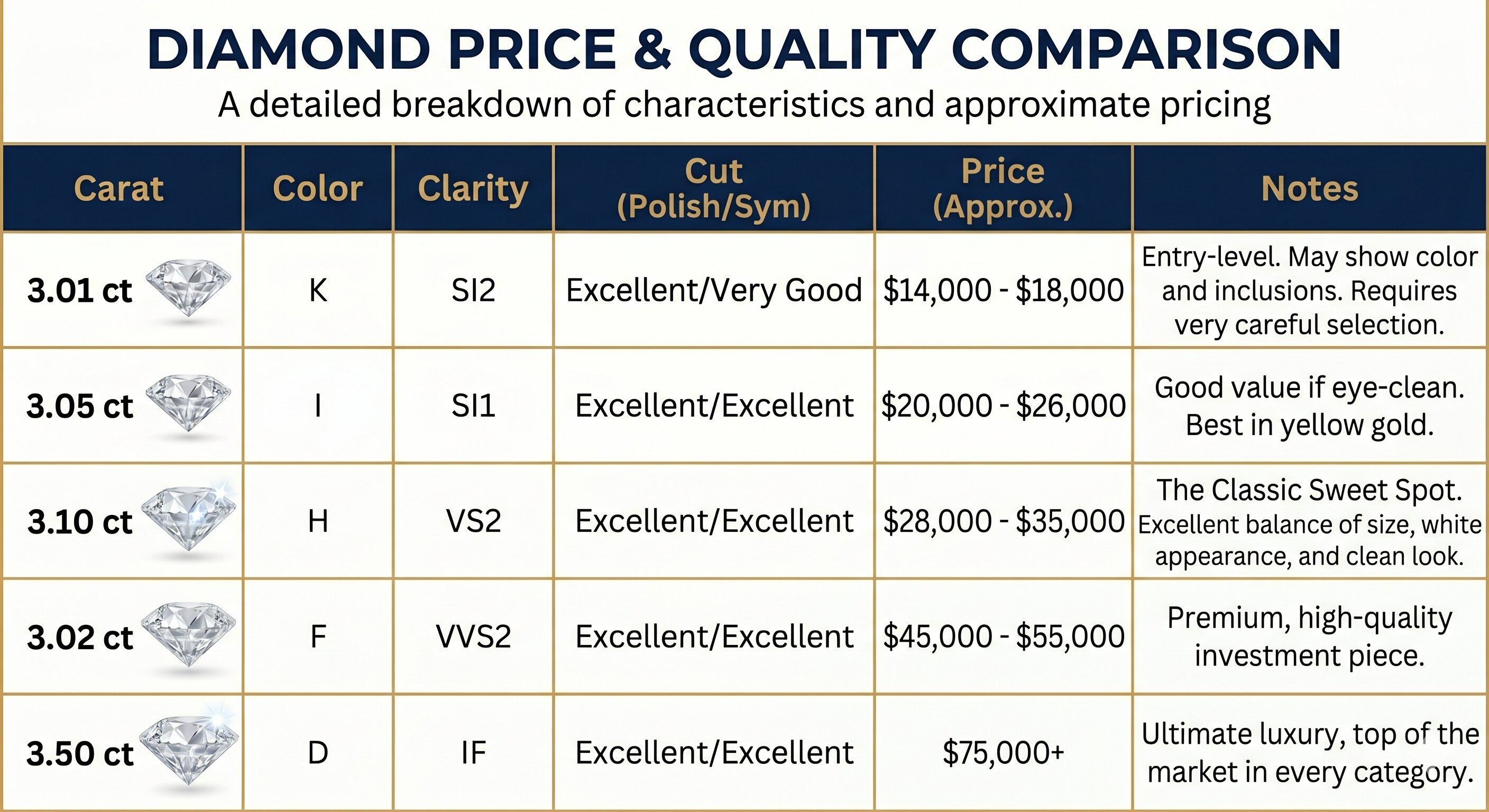
Note: Prices are estimates and can fluctuate based on the retailer, market conditions, and the specific diamond's characteristics.
Key Considerations for a 3-Carat Radiant
The Setting Cost: A 3-carat diamond requires a very well-made, sturdy setting, often in platinum or heavy gold. This can add $1,000 - $3,000+ to the total cost.
Certification is Mandatory: Only consider diamonds graded by reputable labs like the GIA (Gemological Institute of America) or AGS (American Gem Society). This ensures you are paying for the quality you are told you're getting.
The "Magic Size" Premium: 3 carats is a major milestone weight. A 2.90-carat diamond will be significantly less expensive than a 3.00-carat diamond of otherwise identical quality. Consider "undersized" stones for better value.
Must See a Video: Never buy a diamond of this value based on a certificate alone. You must see a high-definition video to judge its sparkle, light performance, and check for the bow-tie effect.
A beautiful, well-proportioned 3-carat radiant cut diamond that is eye-clean and faces up white will typically fall in the $25,000 to $40,000 range. Planning a budget within this window will allow you to select a spectacular stone that represents a lifetime investment.
As always, purchasing from a reputable and transparent vendor who provides videos and expert guidance is the key to a successful purchase at this level.
What Is The Most Expensive Type Of Diamond Cut?
This is an excellent question with a nuanced answer. While many people assume the most expensive shape is also the one with the most complex cut, the reality is driven more by economics and physics than pure artistry.
Here’s a breakdown, from the definitive winner to the notable exceptions.
The Definitive Answer: The Round Brilliant Cut
The round brilliant cut is almost universally the most expensive diamond cut per carat. This isn't because it's the "best," but because of a combination of three key factors:
Highest Demand: It is by far the most popular and classic shape, accounting for over 75% of all diamond sales. This immense, consistent demand allows retailers to command a higher price.
Greatest Rough Waste: Cutting a round brilliant from a raw diamond crystal (rough) results in the most material loss. To achieve its perfect symmetry and 58 facets, more of the original diamond is wasted. This "yield loss" can be over 60%, meaning more than half of the rough stone is lost. This lost weight is factored directly into the price.
Most Complex Cutting: Achieving the precise proportions and angles required for optimal light performance (brilliance and fire) requires the most skill and labor from the master cutter.
In short, you pay a premium for its popularity, the high cost of the wasted rough, and the expertise needed to create its unmatched sparkle. This premium is often called the "Round Brilliant Premium," and it can be 20-40% higher than a fancy-shaped diamond of similar carat weight, color, and clarity.
The Exception: When "Fancy" Cuts Become the Most Expensive
While round is generally the most expensive type of cut, certain rare and exceptional "fancy-shaped" diamonds can surpass it in absolute price. This happens in two main scenarios:
1. Extremely Rare Fancy Shapes & Proportions
Some shapes are so rare and difficult to cut that they command astronomical prices, especially at high carat weights.
The Asscher Cut: A square step-cut with clipped corners and a high crown. A high-quality, large Asscher is very rare and requires a specific type of rough, making it exceptionally expensive.
The Emerald Cut: While often less expensive per carat than a round, a flawless, large (e.g., 10-carat+) D-color emerald cut can have a higher total price due to its rarity and the incredible quality of rough needed (it must be virtually perfect, as its open table shows every flaw).
Perfectly Square Cuts: A perfectly square Princess or Radiant cut (with a 1:1 ratio) can be more expensive than a rectangular one of the same weight because it requires a more "chunky" piece of rough, which is less common.
2. The "Rockefeller" Green Emerald Cut
This is the ultimate example of an exception. The 18-carat emerald-cut "Rockefeller Green" diamond sold for over $5.5 million per carat in 2017. In this case, the color (a rare, fancy, vivid green) was the primary driver of value, not the cut. However, the elegant emerald cut was chosen to best showcase that incredible color.
Summary: A Two-Part Answer
For the Vast Majority of Diamond Purchases, The Round Brilliant Cut is the most expensive type of diamond cut due to market demand, high rough waste, and cutting complexity.
In the World of Ultra-Rare, High-Jewelry Auctions: An exceptionally rare Fancy Colored Diamond (like a blue, pink, or green) or an extremely large, flawless fancy shape (like a perfect Asscher or Emerald) can become the most expensive diamond in the world, regardless of its cut. In these cases, rarity, color, and size trump the cut itself as the primary value drivers.
So, if you are comparing a 1-carat H-color, VS1 clarity diamond in different shapes, the round brilliant will almost always be the most expensive option on the certificate. But if you're looking at a record-breaking auction, all bets are off
Is Emerald Cheaper Than Radiant?
The relationship between emerald and radiant cut diamond prices is a classic example of how different factors balance each other out.
Here’s the straightforward answer, followed by the crucial details.
The Short Answer
Yes, an emerald cut diamond is generally slightly cheaper per carat than a radiant cut diamond of the same carat weight, color, and clarity.
However, these initial savings can sometimes disappear once you account for the higher quality grades an emerald cut requires to look its best.
The Detailed Breakdown: Why the Price Difference?
The price difference comes down to three main factors: cutting cost, demand, and quality requirements.
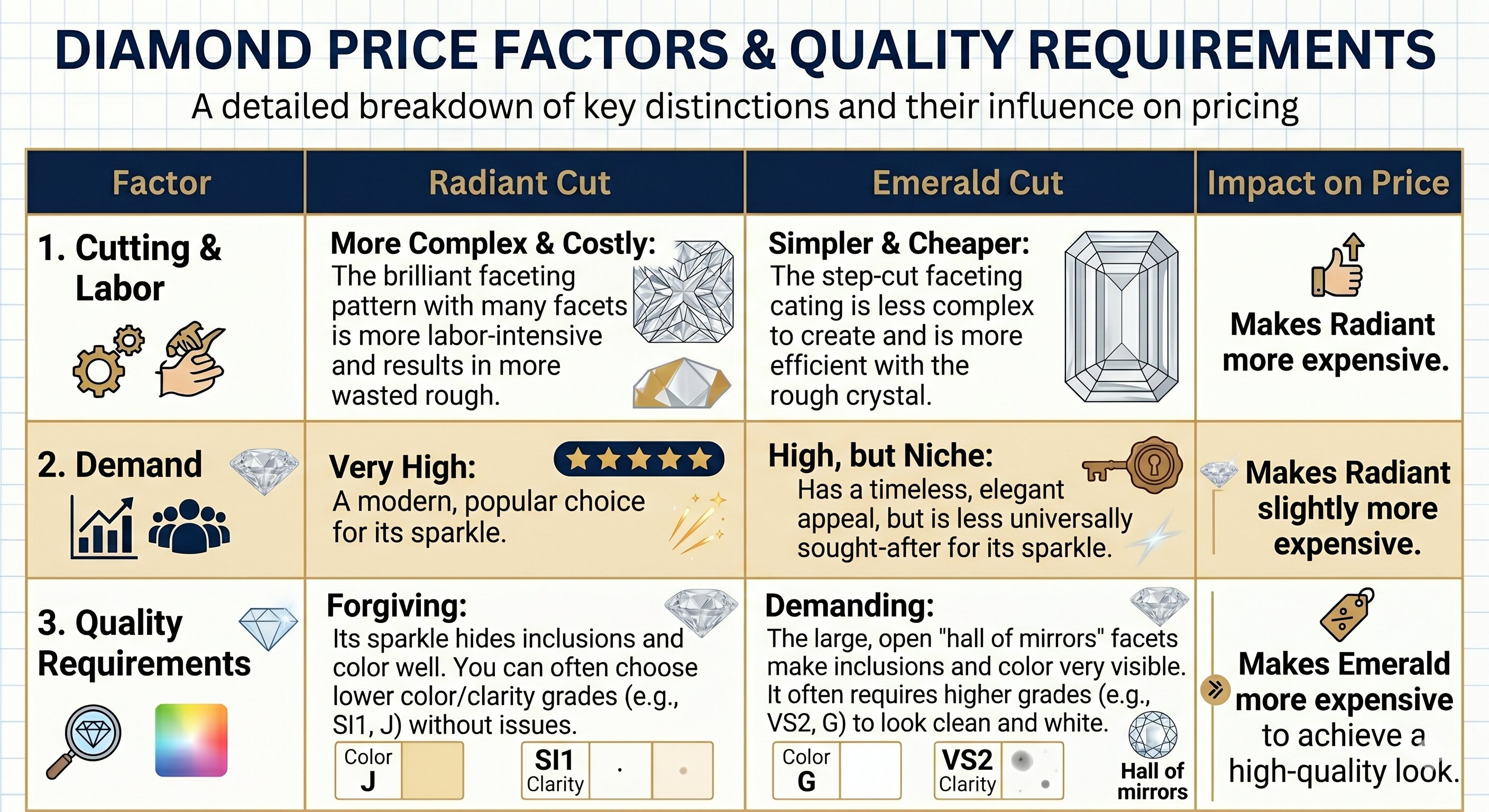
Let's look at how this plays out with an example. Imagine you're comparing two 2-carat diamonds.
Scenario A: Same Specifications
Radiant Cut: 2.0ct, J color, SI1 clarity = $10,000
Emerald Cut: 2.0ct, J color, SI1 clarity = $9,000
Verdict: The emerald is cheaper. However, the J color and SI1 inclusions would likely be very visible and undesirable in the emerald cut, making this a poor choice.
Scenario B: Achieving a Beautiful Result
Radiant Cut: 2.0ct, I color, SI1 clarity (will still face up white and eye-clean) = $11,000
Emerald Cut: 2.0ct, G color, VS2 clarity (needed to be eye-clean and white) = $12,500
Verdict: In this case, the emerald cut ends up being more expensive because you had to "buy better" to get a stone that looks good.
Which is Truly "Cheaper" for You?
If you are comparing diamonds with the same certificate grades, the emerald cut will almost always be cheaper.
If you are comparing diamonds that look equally beautiful and clean to the naked eye, the diamond cut will often be cheaper because you can get away with lower (and less expensive) color and clarity grades.
The radiant cut's higher manufacturing cost is often offset by the emerald cut's need for superior raw material. For the savvy buyer, the radiant cut can offer better value because its brilliance is more forgiving of imperfections, giving you more flexibility with your budget.
Your Choice Should Depend On:
Choose an Emerald Cut if you love its elegance and are willing to invest in higher color/clarity for that flawless, glassy look.
Choose a Radiant Cut if you want maximum sparkle and are looking for the most visual impact for your budget, potentially saving money on color and clarity.
Is Radiant Cut A Good Diamond?
Yes, absolutely. The radiant cut is an excellent diamond choice for a wide range of people, and it's consistently one of the most popular fancy shapes for very good reasons.
Whether it's the "good" choice for you depends on your personal preferences and priorities. Here’s a balanced look at why it's so highly regarded.
Key Advantages (Why it's a GREAT Diamond)
Unmatched Brilliance and Sparkle:
This is its signature feature. As a hybrid cut, it combines the outline of a step-cut (like an emerald) with the faceting of a brilliant-cut (like a round). The result is a diamond that explodes with fire (flashes of color) and brilliance (white light). If you love a fiery, sparkly diamond, the radiant delivers.
Modern and Versatile Style:
The radiant cut feels both contemporary and timeless. Its clipped corners give it a distinct, geometric look that stands out from more traditional rounds and ovals.
Durable and Practical:
The clipped corners are a key design feature for durability. They are less prone to chipping compared to the sharp points of a princess cut or the vulnerable corners of an emerald cut. This makes it a fantastic choice for an engagement ring meant for daily wear.
Excellent Value for Money:
It is significantly less expensive than a round brilliant of the same carat weight and quality (often 20-40% less). This means you can get a larger or higher-quality stone for your budget.
Its sparkle is forgiving of color and inclusions. You can often choose a near-colorless grade (G-J) and a slightly included grade (SI1-VS2) without the imperfections being visible to the naked eye, stretching your budget further.
Flattering on the Finger:
The elongated rectangular versions of the radiant cut create a beautiful, finger-lengthening effect. It's available in a square shape as well, offering flexibility to match your style.
Potential Considerations (Things to Be Aware Of)
The "Crushed Ice" Effect:
This is the most important aesthetic consideration. The complex faceting can create a pattern of very small, shimmering facets that some describe as "crushed ice." Some people adore this look for its dynamic, intricate sparkle. Others prefer the clearer, more defined flashes of an emerald or Asscher cut. It's crucial to see a radiant diamond in person or via video to see if you love this effect.
Bow-Tie Effect:
Like many elongated fancy shapes (ovals, marquise), poorly cut radiants can display a dark, bow-tie-shaped area across the center. A well-cut radiant will have a minimal or non-existent bow-tie.
Less "Classic" than a Round:
While hugely popular, it doesn't have the centuries-long classic status of the round brilliant. If a timeless, traditional look is your top priority, a round might be a safer bet.
Who is the Radiant Cut Perfect For?
Someone who wants maximum sparkle in a non-round shape.
A person with a modern, bold sense of style.
Someone with an active lifestyle who needs a durable ring.
A savvy shopper looking for the best visual impact for their budget.
The radiant cut is not just a "good" diamond; it's a spectacular choice for the right person. Its winning combination of fiery brilliance, modern elegance, practical durability, and great value makes it a top contender in the world of diamond shapes.
The radiant cut is an excellent diamond. Your decision should come down to whether you personally love its distinctive sparkle (including the potential "crushed ice" look) over the cleaner lines of a step-cut or the classic perfection of a round brilliant.
Which Diamond Cut Gives The Most Sparkle?
The Round Brilliant Cut is the undisputed choice for maximum sparkle. It is scientifically engineered to reflect the most light to your eye due to its specific proportions and classic 57 or 58-facet pattern.
While other shapes can also be brilliant, they achieve different visual effects and require different considerations. The table below compares key features:
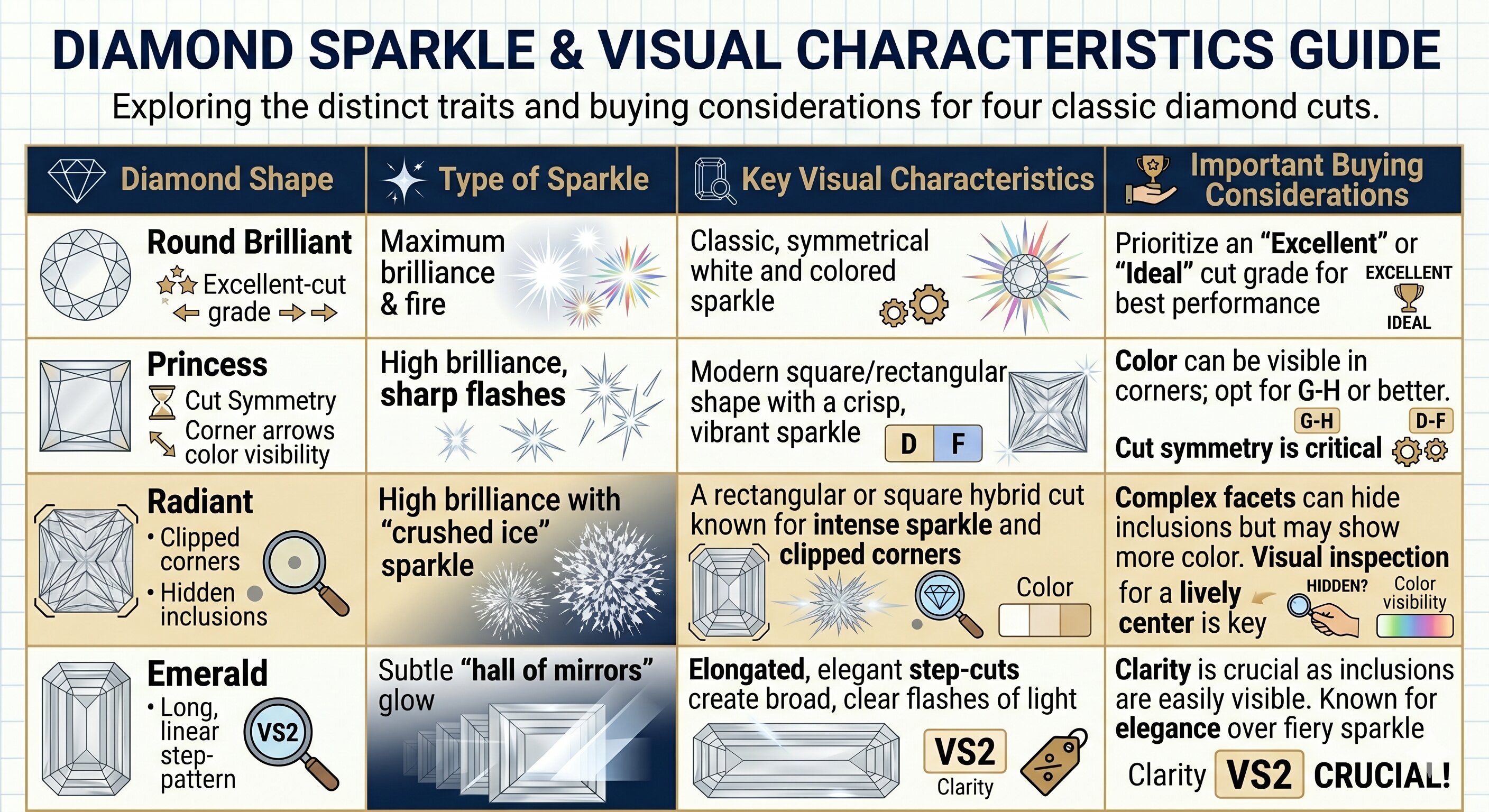
Regardless of shape, the quality of the cut is the single most important factor for a diamond's sparkle. A poorly cut round diamond will look dull, while a superbly cut fancy shape can be exceptionally brilliant. Always prioritize cut grade when shopping. For shapes other than round, also closely examine videos and images, as cut standards are less standardized.
How to Decide
Your choice depends on what you value most:
Choose the Round Brilliant if your top priority is achieving the absolute maximum, scientific brilliance, a nd timelessness.
Consider a fancy shape (like Princess, Oval, or Radiant) if you prefer a unique style and are willing to research for a well-cut stone, accepting a slightly different (but still stunning) type of sparkle.
Since you recently asked about Radiant cuts, would you like to know more about how its sparkle specifically compares to the Round Brilliant, or are you interested in learning about other brilliant fancy shapes like the Oval or Cushion?
“You now know the definition, the cost comparisons, the affordable options, the emerald comparison, the size guide, the 1-carat specs, the 1-carat pricing, the 3-carat pricing, the most expensive cuts, the emerald vs radiant debate, the quality assessment, and the sparkle ranking. The only question left: will you choose the cut that sparkles like a round but dares to be square?*
*Our current collection includes a limited number of GIA-certified radiant cut diamonds — from square radiants (1.00 ratio) to elongated (1.40 ratio), from entry-level 1-carat stones to breathtaking 3-carat centerpieces. When stones with minimal bow-tie and excellent symmetry are gone, sourcing new ones takes time.*
This is not just a diamond. It is Henry Grossbard‘s 1977 invention, the jewelry industry‘s skepticism, and 40 years of waiting for the world to catch up — a diamond that has the elegance of an emerald cut and the fire of a round, without compromise.”
[Button: Claim Your Radiant Cut Diamond (Limited) →]


Other news for Monday 15 June, 2026
- Asscher Cut Guide: Complete Guide to Square Emerald Cut Diamonds
- Classic Cut Guide: Old Mine vs Old European vs Modern Round
- Marquise Cut Guide: Price, Size Illusion, vs Oval and Buying Tips
- Pavé Setting Guide: Pros, Cons, Cost, Security and Channel/Bezel
- Vintage Cut Guide: Old Mine vs Old European vs Rose Cut
- Heart-Shaped Diamond Guide: Meaning, Price, 2ct Cost and Buying Tips
View all news for Monday 15 June, 2026 on one page
News for Sunday 14 June, 2026
- Round Brilliant Cut Guide: Price, Facets, vs Other Cuts and Buying Tips
- The Allure of the Cushion Cut Diamond: What You Need to Know
- Square Cut Diamond Guide: Princess, Cushion, Asscher and Radiant
- 24K Gold Guide: Purity, Price, vs 18K, Investment and Buying Tips
- 22K Gold Guide: Purity, Price, vs 24K/18K, Daily Wear and Care
- Oval Cut Diamond Guide: Price, vs Round, vs Radiant and Buying Tips
- Pear Cut Diamond Guide: Price, vs Round, Sparkle and Buying Tips
- Solitaire Setting Guide: 4 vs 6 Prong, Security, Unique Ideas and Comfort
View all news for Sunday 14 June, 2026 on one page
Recent News
- Saturday 13 June, 2026
- Friday 12 June, 2026
- Thursday 11 June, 2026
- Wednesday 10 June, 2026
- Tuesday 09 June, 2026