

Classic Cut Guide: Old Mine vs Old European vs Modern Round
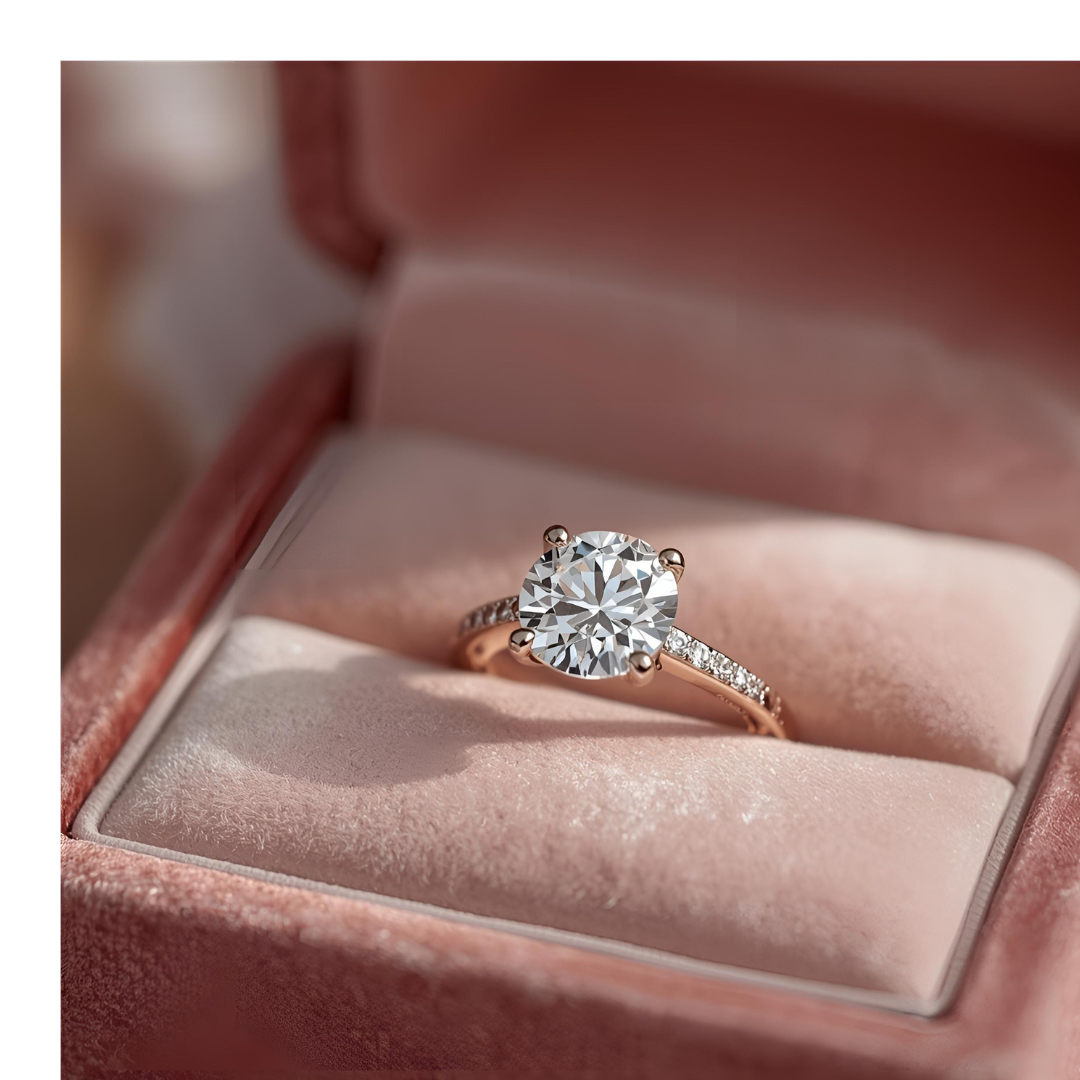
Classic Cut Guide: Old Mine vs Old European vs Modern Round
Of course! "Classic Cut" is a term that carries significant meaning in two primary fields: fashion (garment cutting) and gemology (diamond cutting).
“In 1953, when Queen Elizabeth II was crowned, she wore the Sovereign‘s Sceptre. Set in it was the Cullinan I—the largest clear-cut diamond in the world. It is not a round brilliant. It is an Old Mine Cut, with a high crown, a small table, and a sparkle designed not for LED lights, but for candle flames. That diamond was cut in 1908. It has outlasted two World Wars, the British Empire‘s decline, and seven decades of the Queen‘s reign. Classic cuts are not ‘old-fashioned.‘ They are the diamonds that history forgot to replace.”
The same cut that crowned a queen now awaits your own timeless style — whether you choose an Old Mine Cut, an Old European Cut, or a modern Round Brilliant. Every classic cut diamond in our collection is hand-selected for that enduring sparkle that never looks dated.”
Table of Contents
[Button: Explore Classic Cut Diamonds →]
The core idea in both is the same: a timeless, enduring style that prioritizes proportion, balance, and elegance over fleeting trends.
What Is A Classic Cut?
Here’s a breakdown of what "Classic Cut" means in each context.
1. Classic Cut in Fashion & Tailoring
In fashion, a "classic cut" refers to a garment with a timeless silhouette that is not influenced by the extremes of current fashion trends. It's the foundation of a versatile and long-lasting wardrobe.
Key Characteristics of a Classically Cut Garment:
Clean Lines & Simple Silhouette: Think of an A-line skirt, a straight-leg trouser, a shift dress, or a single-breasted blazer. The shape is recognizable and unfussy.
Excellent Proportion and Balance: The garment is designed to flatter a wide range of body types, neither too tight nor too oversized. The shoulders, waist, and hemline are in harmonious proportion.
High-Quality Fabric and Construction: Classic cuts are almost always made with better materials and feature precise tailoring, sturdy seams, and fine details like functional buttonholes and well-constructed linings.
Timelessness: A classically cut piece from 20 years ago can still look modern and appropriate today. Examples include the Chanel jacket, the trench coat, the button-down Oxford shirt, and the little black dress.
Versatility: These pieces act as the building blocks of a wardrobe because they mix and match easily and can be dressed up or down.
In short, in fashion, a classic cut is the opposite of a "fad" or "trendy" cut. It's an investment in style that endures.
2. Classic Cut in Diamonds and Gemology
In the world of diamonds, "Classic Cut" is a specific and historical term. It does not refer to the modern Round Brilliant Cut that is most popular today. Instead, it refers to its direct ancestors, which were cut by hand before the advent of electric-powered precision machinery.
The most common diamond cuts referred to as "Classic Cut" or "Old Mine Cut" are:
- Old Mine Cut:
Era: Popular during the Georgian and Victorian eras (1700s - 1800s).
Shape: A squarish or cushion shape with a high crown, small table, and a large, open culet (the point at the bottom of the diamond).
Facets: It has a distinctive facet pattern that is less regular than modern cuts. The charm is in its imperfections and the soft, romantic "candlelight" sparkle it was designed to produce.
- Old European Cut:
Era: The precursor to the modern Round Brilliant, popular in the late 19th and early 20th centuries (Edwardian, Art Nouveau, Art Deco periods).
Shape: Rounder than the Old Mine Cut.
Facets: It still has a high crown, small table, and an open culet, but the facet arrangement is more circular. It exhibits more fire (flashes of color) than an Old Mine Cut but less brilliance (white light return) than a modern cut.
Characteristics of Classic Cut Diamonds:
Hand-Cut: They were cut based on the rough diamond's natural shape, not a computer-modeled ideal.
Warmer, Softer Sparkle: They were designed to perform best in candlelight and gaslight, creating a chunky, fiery sparkle rather than the blinding white brilliance of a modern diamond.
Antique Charm: They are prized for their historical value, unique character, and the craftsmanship of a bygone era.
Important Note: Today, the term "classic" is often mistakenly used to describe the modern Round Brilliant Cut because it is now the most standard and popular choice. However, in strict gemological and antique jewelry contexts, "Classic Cut" refers to the old mine and old European cuts.
Summary
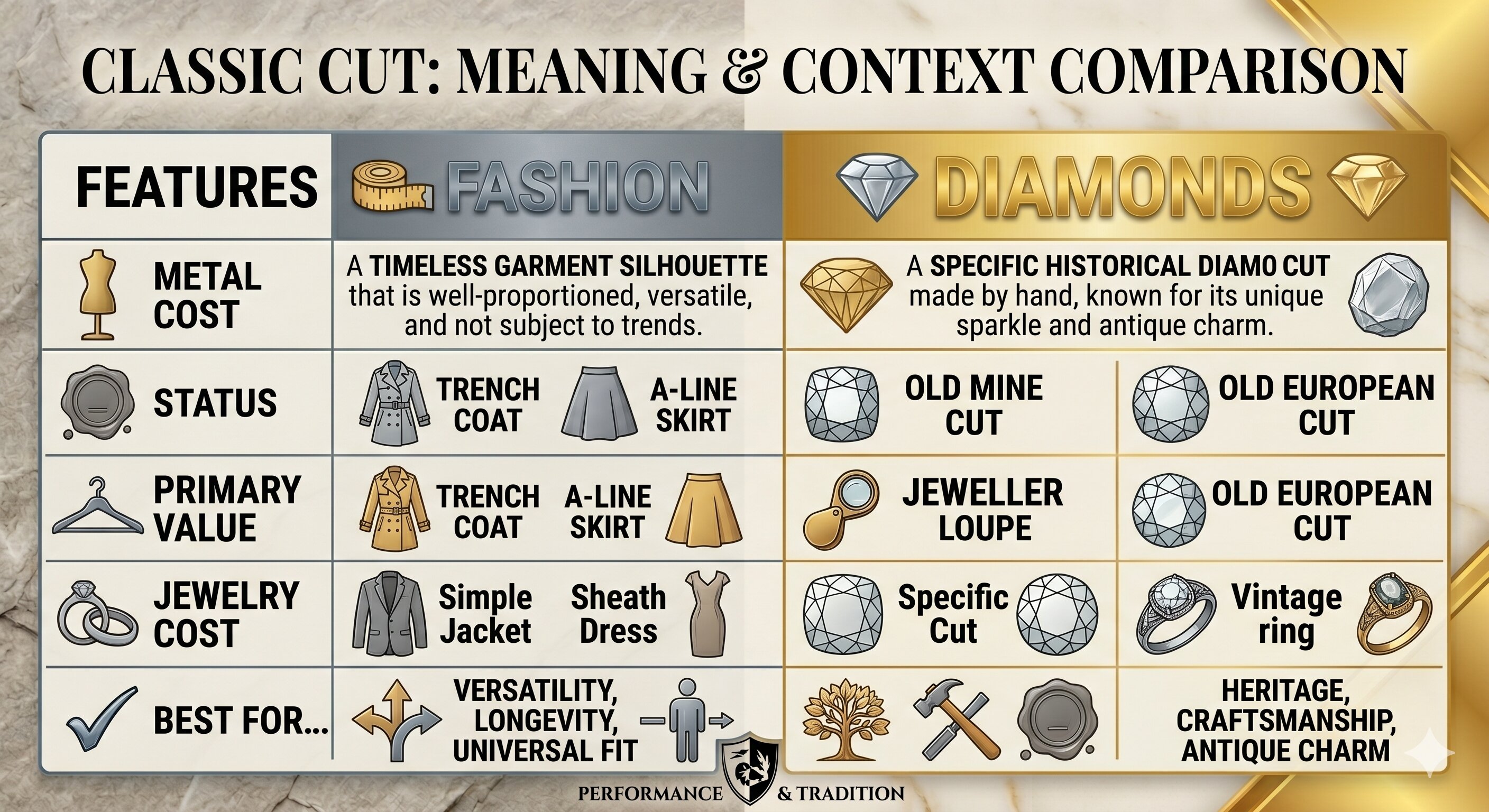
So, when you hear "Classic Cut," the key is to identify the context. In both cases, it signifies a style that has stood the test of time.
Is A Classic Cut Suitable For All Ages?
This is an excellent question, and the answer is a resounding yes; a classic cut is supremely suitable for all ages.
The very essence of a "classic cut" is its timelessness, which inherently transcends age. However, the reason it works and the styling might shift slightly depending on the wearer's life stage and personal taste.
Let's break it down for both fashion and diamonds.
1. Classic Cut in Fashion: Ageless Style
A classically cut garment is a wardrobe staple because it focuses on universally flattering the human form, not on chasing youth-centric trends.
For Young Adults (20s & 30s): Classic cuts provide a foundation of sophistication. A well-cut blazer, a simple sheath dress, or straight-leg trousers can be the building blocks of a professional wardrobe or a versatile casual style. They convey confidence and polish.
For Middle Age (40s & 50s): This is often where the value of classic cuts becomes most apparent. These pieces are forgiving, elegant, and focus on quality over quantity. They help create a "capsule wardrobe" that is easy to manage, always looks appropriate, and emphasizes good fit and luxurious fabric.
For Seniors (60+): Comfort, ease, and elegance are paramount. Classic cuts are perfect because they are never too tight, too short, or overly trendy. A classic-cut cardigan, a trench coat, or a pair of well-tailored trousers offers effortless style that is both comfortable and dignified.
Why it Works for All Ages:
Focus on Fit and Fabric: It prioritizes how a garment fits and feels, which is important at any age.
Versatility: A classic piece can be styled up or down with accessories, making it adaptable for a college student, a working professional, or a retiree.
Avoids "Mutton Dressed as Lamb": For older women, classic cuts provide a graceful, age-appropriate style that remains chic and modern without trying to mimic trends meant for younger people.
2. Classic Cut in Diamonds: Timeless Appeal
When referring to diamonds (like the Old Mine or Old European Cut), the answer is similarly universal, but with considerations for personal style.
For a Younger Person: A classic cut diamond can be a unique, non-conformist choice. It appeals to those who love vintage style, history, and character. It tells a story and stands out from the ubiquitous modern brilliant cuts.
For the Middle-Aged or Older Person: These cuts often carry a sense of heritage and romance. They may resemble heirloom pieces from a grandparent's era, evoking a sense of nostalgia and timeless elegance. Their softer sparkle is often described as more "romantic" and less "flashy" than a modern cut.
Why it Works for All Ages:
Inherent Beauty: The charm of a hand-cut stone with its unique facets and fiery sparkle is appealing regardless of the wearer's age.
Connection to the Past: Age doesn't diminish the beauty of an antique; it enhances it. Wearing a classic cut diamond is like wearing a piece of history, which can be meaningful at any stage of life.
Unique & Personal: It's a choice that reflects personal taste rather than a default setting, which is an ageless quality.
The One Consideration: Personal Style Over Biological Age
The true determinant of whether a classic cut is suitable is not age, but personal style.
A 70-year-old with a bold, artistic personality might rock a large, geometric "classic cut" diamond from the Art Deco era.
A 25-year-old minimalist might prefer the clean lines of a classically cut A-line dress and a simple, understated Old European cut solitaire.
Yes, a classic cut is universally suitable for all ages. Its defining characteristic is its endurance beyond the fleeting trends of any particular decade or generation. Whether it's a perfectly tailored coat or a historic diamond, a classic cut represents a commitment to enduring style, quality, and elegance—truly timeless values.
In short, Classic cuts are less about how old you are and more about loving a style that lasts.
What Is The Best Type Of Diamond Cut?
This is one of the most important questions in choosing a diamond, and the answer is nuanced.
The short answer is: There is no single "best" diamond cut for everyone. The "best" cut is the one that best aligns with your personal priorities, which typically balance three things: Brilliance (brightness), Fire (flashes of color), and personal Style/Budget.
However, from a technical and performance perspective, the Round Brilliant Cut is widely considered the champion of light performance and is the most popular choice for a reason.
Let's break down the top contenders and the factors that make them "best" in different categories.
1. The "Best" for Maximum Sparkle: Round Brilliant Cut
This is the undisputed king of sparkle. Its design is the result of over 100 years of scientific and mathematical optimization to maximize light return.
Why it's a top contender: The Round Brilliant's specific facet pattern (usually 57 or 58 facets) is engineered to act like a series of tiny mirrors. It captures light, reflects it internally, and sends it back to your eye in a breathtaking display of both white light (brilliance) and colored light (fire).
Pros: Unmatched sparkle, timeless popularity, holds value well, and a vast selection.
Cons: It is the most expensive cut per carat. Because so much of the rough diamond is lost during the cutting process, you pay a premium for that brilliance.
Best for: The person who wants the ultimate in sparkle and timeless tradition and is willing to pay a premium for it.
2. The "Best" for Modern Style & Value: Fancy Shapes (Princess, Cushion, Oval)
"Fancy Shapes" refers to any diamond cut that isn't round. They often offer a larger surface area (face-up size) for the same carat weight and are generally less expensive than rounds.
Princess Cut: The second most popular cut. It's a square or rectangular cut with sharp, uncut corners and exceptional brilliance. It's a modern, clean, and geometric choice.
Cushion Cut: A square or rectangular cut with rounded corners, resembling a pillow. It offers a beautiful blend of brilliance and a softer, romantic fire. Very popular in vintage and modern styles.
Oval Cut: Has become extremely popular recently. It offers sparkle very similar to a Round Brilliant, but in an elongated shape that can make the finger look longer and slimmer.
Other popular fancy shapes: Emerald Cut (elegant, "hall of mirrors" effect), Pear Cut (teardrop shape), Marquise Cut (elongated with pointed ends).
Best for: Someone looking for a larger-looking stone, a modern or unique style, and excellent value for their budget.
3. The "Best" for Vintage/Unique Character: Antique "Classic" Cuts
As discussed previously, these are the "Classic Cuts" like the Old Mine Cut and Old European Cut.
Why they're a top contender: They are full of personality, history, and a unique, soft, chunky sparkle that is very different from the clinical brilliance of a modern cut. They are a statement of individuality.
Pros: One-of-a-kind look, historical charm, often less expensive than a modern brilliant of the same carat weight.
Cons: Their sparkle is less bright and more "romantic." They may have more visible inclusions (character) and are not for someone seeking maximum flash.
Best for: The non-conformist who loves history, romance, and a unique, story-filled diamond.
How to Decide: Your Personal "Best Cut" Checklist
Ask yourself these questions:
What is my top priority: Sparkle, Size, or Style?
Sparkle: Round Brilliant.
Size (on a budget): Oval, Pear, or Marquise.
Style/Uniqueness: Antique Cut, Emerald Cut, or Asscher Cut.
What is my budget?
If budget is no object and you want the brightest sparkle, go for a well-cut Round Brilliant.
If you want to maximize the perceived size of your diamond, choose a Fancy Shape.
What is my personal or my partner's style?
Classic & Traditional: Round Brilliant, Princess.
Modern & Edgy: Emerald, Asscher, Radiant.
Vintage & Romantic: Cushion, Oval, Old European Cut.
Feminine & Elongating: Oval, Pear, Marquise.
The Most Important Factor of All: Cut Quality
Regardless of the shape you choose, the quality of the cut is the most important of the 4Cs. A poorly cut Round Brilliant will look dull and lifeless. A superbly cut Emerald Cut will be mesmerizing.
For Round Brilliants, look for a cut grade of Excellent/ Ideal from a reputable lab (like GIA or AGS).
For Fancy Shapes, cut grading is less standardized. You must rely on expert advice, certifications, and most importantly, your own eyes (or a high-quality video) to judge its sparkle and appeal.
The "safest" and most brilliant cut is the Round Brilliant.
The "best value" and most style-versatile cuts are the Fancy Shapes, like Oval, Cushion, and Princess.
The "most unique" cuts are the Antique and Step Cut, such as Emerald and Asscher.
The true "best" diamond is the one that takes your breath away when you look at it.
How Long Does A Classic Cut Last?
That's an excellent question, and the answer gets to the very heart of why "classic" styles are so revered.
The lifespan of a classic cut can be looked at in two ways: its physical longevity and its style longevity. In both cases, the answer is remarkably positive.
1. Physical Longevity: How Long the Item Itself Lasts
This depends entirely on the material and craftsmanship, but a true classic cut is built to last for generations.
In Fashion:
A classically cut garment made with high-quality materials (e.g., 100% wool, 100% cotton, 100% silk) and superior construction (e.g., fully lined, fine seam finishing, sturdy buttons) can easily last 10, 20, or even 50+ years with proper care.
Why it lasts: The focus on quality means the fabric is durable, and the construction is meant to withstand wear and tear. A fast-fashion trendy top might fall apart after a season, but a classic-cut wool blazer is an investment meant for decades.
The Limiting Factor: It's often not the garment itself that gives out, but slight changes in the owner's body size over a lifetime. The timeless design, however, makes it a prime candidate for tailoring and alterations.
In Diamonds:
This is the ultimate answer for physical longevity. A diamond is the hardest natural substance on earth (a 10 on the Mohs scale of hardness).
A classic cut diamond (like an Old Mine or Old European Cut) is not just for your lifetime; it will last for millennia.
These antique cuts have already survived for 100-200 years or more and are still as stunning as the day they were cut. With basic care to avoid hard knocks that could cause chipping, a diamond is essentially permanent.
2. Style Longevity: How Long It Remains Fashionable
This is where the "classic" label truly shines. A classic cut has indefinite style longevity.
In Fashion:
A classic cut is designed to be timeless, not trendy. It transcends the fleeting fashions of any particular season or decade.
A trench coat, a little black dress, a well-tailored pair of jeans, or a button-down shirt from the 1980s can still look completely appropriate and chic today.
While minor details (like lapel width or trouser break) might subtly change, the fundamental silhouette remains perpetually in style.
The lifespan of its style is essentially unlimited because it is the foundation upon which trends come and go.
In Diamonds:
The style longevity of a classic cut diamond is also immense, but with an interesting twist.
As an Antique: An Old Mine or Old European cut has permanent style value as a piece of history and art. Its beauty is not dependent on modern trends; in fact, its uniqueness is its strength. It will always be cherished by those who appreciate vintage and antique jewelry.
As a Concept: The concept of the classic Round Brilliant Cut (which is often mistakenly called "classic") also has indefinite style longevity. It is the most popular and timeless choice for an engagement ring for a reason—its design is perfected for sparkle and will never look dated.
How Long Does a Classic Cut Last?
In short: A classic cut is designed to outlive you.
Physically, a well-made classic garment can last a lifetime and be passed down, while a classic cut diamond is virtually eternal.
Stylistically, a classic cut never truly "goes out of style." It remains relevant and elegant decade after decade.
Therefore, the lifespan of a classic cut isn't measured in years, but in generations. It's the opposite of a disposable trend. When you invest in a classic cut, you are investing in a piece that is built to endure, both in your wardrobe and in the world of style.
What Is The Rarest Diamond Cut?
The rarest diamond cuts are generally antique cuts that are no longer commercially produced or extremely difficult and wasteful to execute. While fancy colored diamonds get most of the attention for rarity, the cut itself can make a diamond exceptionally rare.
Here’s a breakdown of the rarest diamond cuts, from uncommon to the absolute most elusive.
Top Contenders for the Rarest Diamond Cut
1. The "True" Old Mine Cut
While Old Mine Cuts themselves are found in antique jewelry, a "true" Old Mine Cut from the 18th or early 19th century, with all its characteristic imperfections (a high crown, small table, open culet, and a slightly lumpy, chunky appearance), is becoming increasingly rare. Many have been re-cut into modern brilliants to "improve" their sparkle, destroying their historical character.
2. The Jubilee Cut
Developed in the late 19th century, the Jubilee cut is a complex precursor to the modern round brilliant. It features 80 facets, which is significantly more than the standard 57 of a modern brilliant. Its complexity and the fact that it was only produced for a short time make it very rare. It's known for its incredible fire but is seldom seen today.
3. The Ashoka Cut
This is a modern cut but is exceptionally rare due to its specific requirements. Named for the jeweler William Goldberg's famous diamond, the Ashoka is an elongated cushion cut with rounded ends and 62 facets. The rarity comes from the strict proportions and the fact that it can only be cut from a rough diamond of exceptional quality and size (usually over 10 carats). The cutting process is incredibly wasteful, making it a luxury few undertake.
4. The Briolette Cut
This is one of the oldest cuts in the world, dating back to the 12th century. It is a pear-shaped, double rose cut (facetted on both sides) with no girdle or crown, drilled to hang as a bead. The cutting process is incredibly difficult and labor-intensive, as the entire stone must be perfectly symmetrical and faceted by hand. It is rarely used in modern jewelry.
The Rarest of the Rare: The True Rose Cut
While the cuts above are rare, many experts reserve the title of "rarest" for the original, unfaceted-back Rose Cut.
What it is: An antique cut dating back to the 1500s. It has a flat bottom and a dome top covered in triangular facets, coming to a single point at the top, resembling a rosebud.
Why it's the rarest: The original Rose Cut had no facets on its base. While modern interpretations and "double rose cuts" (facetted on both sides) exist, a genuine, historical Rose Cut with a completely flat, unfaceted base is a museum piece. They were cut for candlelight, giving them a soft, subtle, and glimmering sparkle rather than the fiery brilliance we expect today. Almost none are produced commercially now, as the cut does not maximize modern ideals of sparkle.
What Makes a Diamond Cut Rare?
Several factors contribute to a cut's rarity:
Labor Intensity: Cuts like the Briolette or original Rose Cut require immense handcrafting skill and time.
Economic Waste: Cuts like the Ashoka require sacrificing a significant amount of the original rough diamond, making them economically unviable for most stones.
Historical Period: Many antique cuts are simply not made anymore because modern technology and tastes have moved on. They are relics of a specific time.
Lack of Demand: Most consumers want the brilliant sparkle of a modern round or oval. There is little commercial demand for less flashy historical cuts, so few are produced.
Among Antique Cuts: The original Rose Cut and well-preserved Old Mine Cuts are exceptionally rare.
Among Modern Cuts: The Ashoka Cut is arguably the rarest due to its stringent requirements and economic impracticality.
“In 2017, a 2.6-carat Rose Cut diamond sold at auction for 1.8million—over 700,000 per carat. It was not the most brilliant diamond. It was not the most colorless. It had a flat bottom, no pavilion, and a domed top covered in triangular facets. It was cut in the 17th century, probably in India, and had been passed through royal families for 300 years. The buyer did not want sparkle. He wanted a diamond that had seen the rise and fall of empires. That is the power of a rare cut: it is not just a gem. It is a witness.”
If you are looking for the ultimate rarity, you would be searching for a historical, original Rose Cut diamond in its unaltered state. It represents a snapshot of diamond-cutting history that has been almost entirely lost to time.
Is A Classic Cut High Maintenance?
The answer is pleasantly straightforward: No, a classic cut is not high maintenance. In fact, it is often one of the lowest-maintenance choices you can make.
This holds for both fashion and diamonds, for reasons rooted in their timeless design and quality.
1. Classic Cut in Fashion: Low Maintenance
A classically cut garment is designed for ease and longevity, not for high-strung care.
Why it's Low Maintenance:
Timeless Style: The biggest maintenance burden it saves you from is style maintenance. You won't have to constantly worry if it's still "in fashion." It remains appropriate season after season, year after year. This is the opposite of a trendy piece that requires you to update your wardrobe constantly.
Durable Materials: Classic cuts are typically made from high-quality, natural fabrics like wool, cotton, silk, and linen. These materials are more resilient and age more gracefully than many synthetic fabrics. They can be professionally cleaned and pressed, returning to their original shape again and again.
Superior Construction: With strong seams, good linings, and quality stitching, these garments are built to withstand the wear and tear of regular use without falling apart. They don't require you to "baby" them.
Easy to Care For: While they often require proper care (e.g., dry cleaning for a wool blazer), their durability means they don't need this attention as frequently. A well-made classic piece can be worn many times between cleanings without showing wear.
In short, A classic cut saves you the mental and financial maintenance of constantly chasing trends and replacing cheaply made items.
2. Classic Cut in Diamonds (Antique Cuts): Moderately Low Maintenance
When we talk about "classic cut" diamonds (Old Mine, Old European), they require a slightly different consideration than modern cuts, but they are still not high maintenance.
Considerations for Antique Diamond Cuts:
Durability: A diamond is still a diamond—the hardest natural material. It will not scratch or wear down.
The Setting (This is Key): The maintenance level is often determined by the antique setting, not the diamond itself. Prongs in antique rings can wear down over decades. A reputable jeweler should always check the security of the setting before you wear an antique piece.
Potential for Chipping: Some antique cuts, with their open culets (the point at the bottom) or facet structures, can be slightly more vulnerable to chipping at the girdle (the edge) if struck hard. This is a minor risk, but one to be aware of. A protective setting can mitigate this.
Cleaning: They clean just as easily as any other diamond with warm water, mild soap, and a soft brush. Their charm often lies in a bit of "patina," so they don't need to be perfectly spotless to look beautiful.
Comparison to Modern Cuts:
A modern Round Brilliant cut is engineered for maximum sparkle and is extremely robust. In this specific sense, it might be considered the most low-maintenance diamond cut. However, the difference is negligible for everyday wear. An antique cut is not a fragile flower; it has already survived for 100+ years!
Summary: Is a Classic Cut High Maintenance?
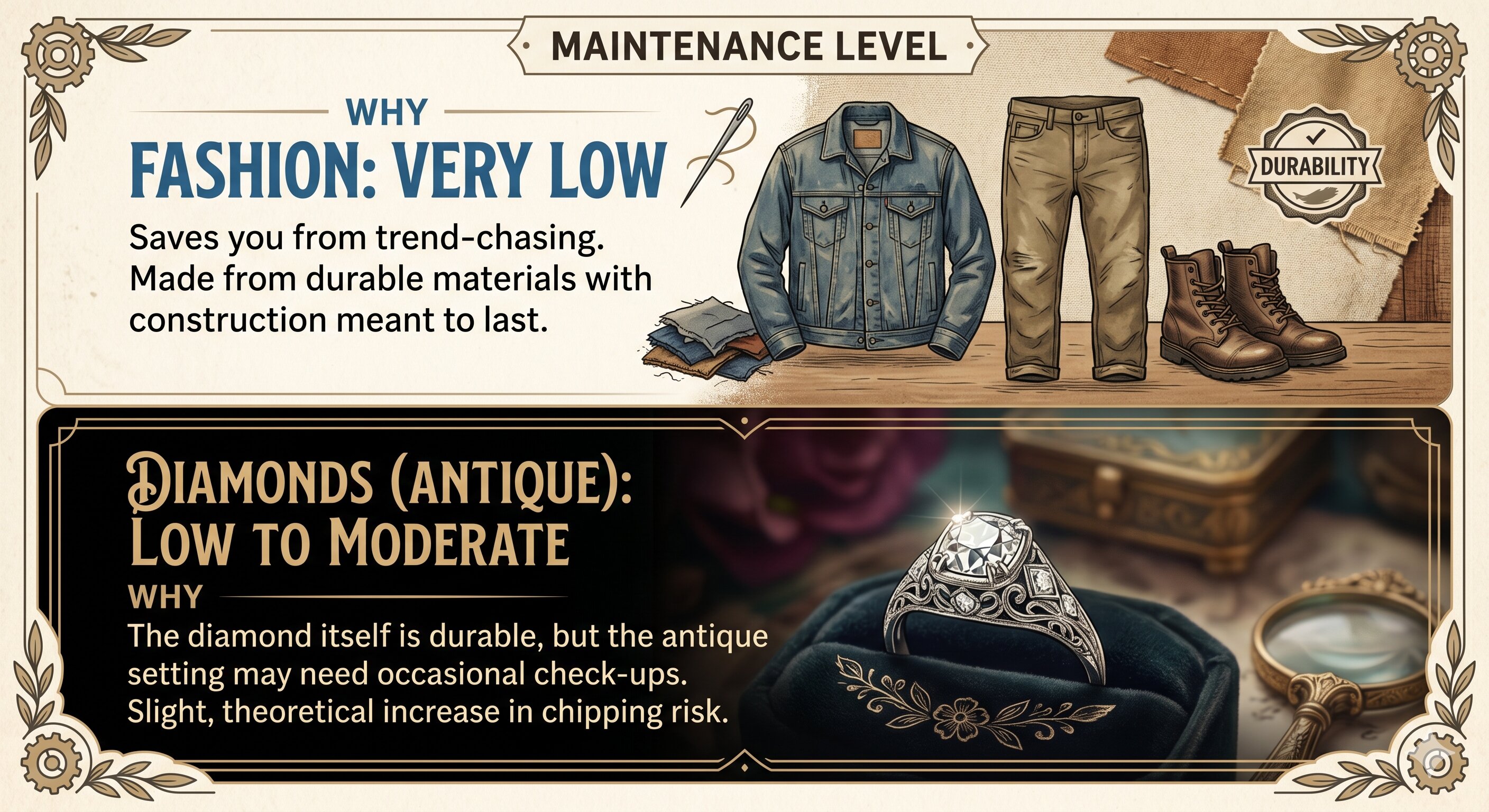
Conclusion:
Far from being high maintenance, a classic cut is an investment in simplicity and longevity. It removes the stress of obsolescence and constant repair.
“You now know the definition (fashion vs. diamonds), the age suitability, the best cut debate, the longevity, the rarest cuts, and the maintenance level. The only question left: will you choose a cut that outlasts empires?
Our current collection includes a limited number of classic cut diamonds — from Old Mine Cuts to Old European Cuts, from Rose Cuts to modern Round Brilliants. When true antique cuts are gone, they are gone. No one is cutting new Old Mine diamonds.
*This is not just a diamond. It is Queen Elizabeth‘s Cullinan I, the 17th-century Rose Cut, and 100 years of proof that some cuts never go out of style—because they were never in style. They were just always right.”*
[Button: Secure Your Classic Cut Diamond (Limited) →]


Other news for Monday 15 June, 2026
- Asscher Cut Guide: Complete Guide to Square Emerald Cut Diamonds
- Marquise Cut Guide: Price, Size Illusion, vs Oval and Buying Tips
- Pavé Setting Guide: Pros, Cons, Cost, Security and Channel/Bezel
- Radiant Cut Guide: Price, vs Emerald, 1ct, 3ct Cost, Sparkle and Tips
- Vintage Cut Guide: Old Mine vs Old European vs Rose Cut
- Heart-Shaped Diamond Guide: Meaning, Price, 2ct Cost and Buying Tips
View all news for Monday 15 June, 2026 on one page
News for Sunday 14 June, 2026
- Round Brilliant Cut Guide: Price, Facets, vs Other Cuts and Buying Tips
- The Allure of the Cushion Cut Diamond: What You Need to Know
- Square Cut Diamond Guide: Princess, Cushion, Asscher and Radiant
- 24K Gold Guide: Purity, Price, vs 18K, Investment and Buying Tips
- 22K Gold Guide: Purity, Price, vs 24K/18K, Daily Wear and Care
- Oval Cut Diamond Guide: Price, vs Round, vs Radiant and Buying Tips
- Pear Cut Diamond Guide: Price, vs Round, Sparkle and Buying Tips
- Solitaire Setting Guide: 4 vs 6 Prong, Security, Unique Ideas and Comfort
View all news for Sunday 14 June, 2026 on one page
Recent News
- Saturday 13 June, 2026
- Friday 12 June, 2026
- Thursday 11 June, 2026
- Wednesday 10 June, 2026
- Tuesday 09 June, 2026