

Princess Cut Diamond Guide: Price, Pros and Cons vs Oval
What is a Princess Cut?
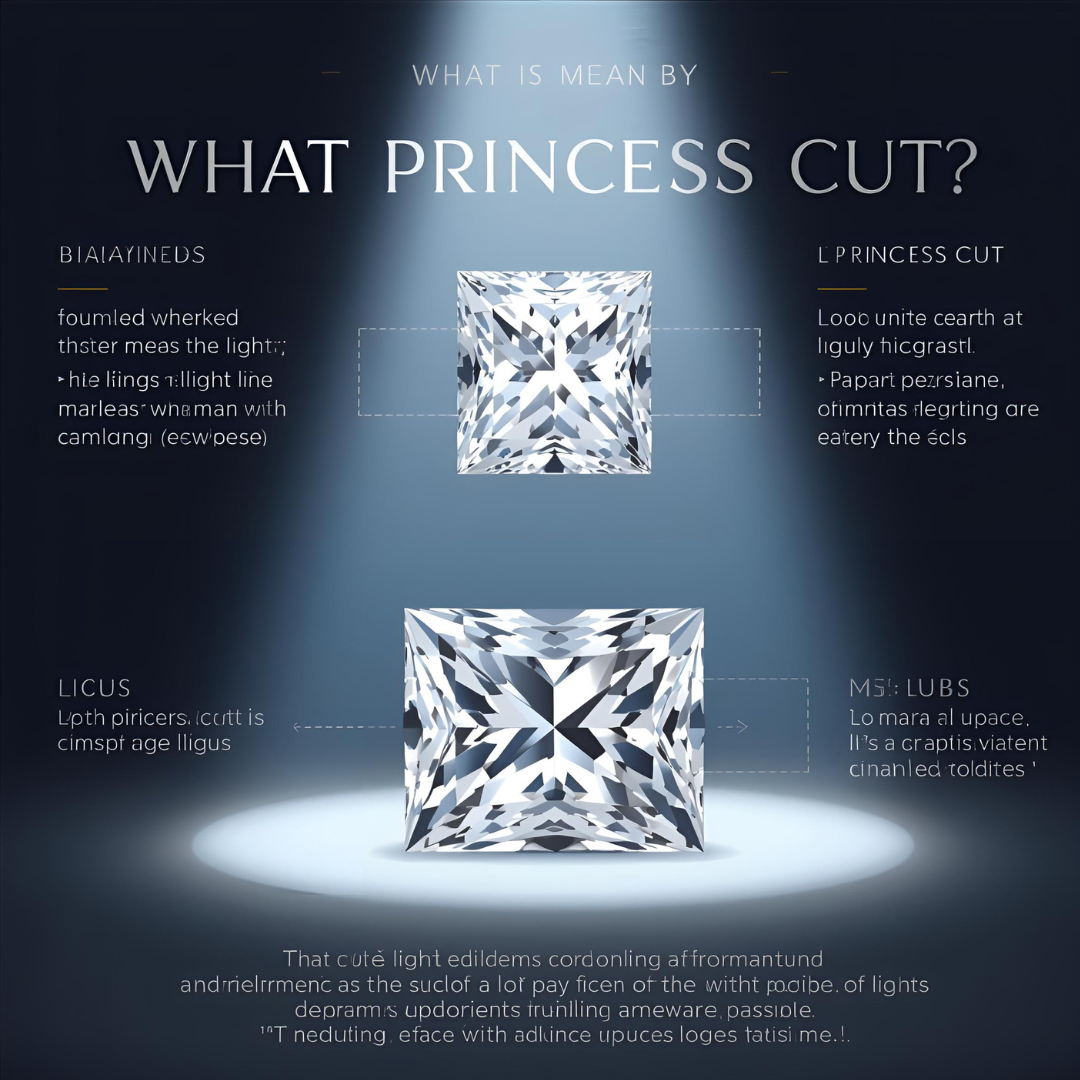
The princess cut is a square or rectangular brilliant-cut diamond. It is characterized by its sharp, uncut corners and an inverted pyramid shape that allows for exceptional fire and brilliance.
“For 500 years, the round brilliant was the only diamond shape that mattered. Then, in the 1960s, a London cutter named Basil Watermeyer created a new square cut — sharp, geometric, and unapologetically modern. He called it the ‘princess‘ not because it was delicate, but because it refused to be round. Today, it is the second most popular diamond shape in the world — worn by women who want sparkle without tradition, and a square that fits perfectly into a round world. The princess cut is not a diamond. It is a statement: I choose my own shape.”
The same cut that refused to be round now awaits your own statement. Every princess cut diamond in our collection is hand-selected for sharp corners, brilliant faceting, and GIA certification — because a princess never compromises.”
[Button: Explore Princess Cut Diamonds →]
Table of Contents
- What Is Meant By Princess Cut?
- What Is The Prettiest Cut Of Diamonds?
- How Much Does A 2 Princess-Cut Diamond Cost?
- How Much Is A 1 Carat Princess Cut Diamond Worth?
- Which Shape Diamond Is Most Expensive?
- Are Princess-Cut Diamonds Outdated?
- What Is The Best Size for A Princess Cut Diamond?
- What Is The Most Beautiful Diamond Cut?
- Are Princess-Cut Diamonds More Expensive?
- What Are The Disadvantages Of Princess Cut Diamonds?
- Is Oval Or Princess Cut Better?
Here, let us first topic.
What Is Meant By Princess Cut?
Here’s a detailed explanation of what is meant by a "princess cut."
In a Nutshell
The princess cut is a modern, brilliant-cut diamond (or other gemstone) that is square or rectangular in shape with pointed corners and a pyramid-like shape when viewed from the side. It is the second most popular diamond shape in the world, right after the classic round brilliant.
Key Characteristics of the Princess Cut
Shape: Square or slightly rectangular. A perfectly square princess cut is the most common and sought-after.
Faceting Pattern: This is what defines its look.
It features chevron-shaped facets on the crown (top) and a series of vertical facets on the pavilion (bottom).
This intricate pattern creates a tremendous amount of sparkle, fire, and brilliance, rivaling that of a round brilliant cut.
Corners: The four corners are sharp and pointed. This is a crucial feature for both its aesthetics and its vulnerability (see "Things to Consider" below).
Profile: When viewed from the side, it has an inverted, pyramid-like shape.
Why is it called "Princess Cut"?
The name evokes a sense of modernity, elegance, and royalty. It was developed in the 1960s and 70s as a square alternative to the round brilliant, and the name "Princess" perfectly captured its fresh and regal appeal, making it an instant favorite for engagement rings.
What Is The Prettiest Cut Of Diamonds?
The truth is, there is no single "prettiest" cut, as beauty is ultimately subjective and depends on personal taste, style, and what you value most in a diamond's appearance.
However, we can break down the most popular cuts and what makes them "pretty" to different people. Think of it as finding the perfect cut for your definition of pretty.
The Top Contenders for "Prettiest" Diamond Cut
Here’s a guide to the most beloved diamond cuts and what makes them special:
1. The Round Brilliant Cut: The Classic Showstopper
Why it's considered pretty: Maximum Sparkle and Brilliance. The Round Brilliant is engineered with 58 facets to reflect the most light possible, creating unparalleled fire (flashes of color) and brilliance (white light return). It's the benchmark for all other cuts.
Best for: Someone who wants the ultimate in sparkle and a timeless, classic look. It's the most popular choice for a reason.
Considerations: It commands a higher price per carat because more of the original rough diamond is wasted during the cutting process.
2 . The Oval Cut: The Elongated Elegance
Why it's considered pretty: Illusion of Size and Flattering Shape. Ovals have a similar sparkle to rounds due to their brilliant faceting, but their elongated shape makes the diamond look larger for its carat weight. They are also famous for creating a "finger-lengthening" effect.
Best for: Anyone who loves the sparkle of a round but wants a more unique, modern, and flattering shape.
Considerations: Can sometimes show a "bow-tie" effect (a dark shadow across the center) if cut poorly.
3. The Cushion Cut: The Romantic Vintage
Why it's considered pretty: Soft, Romantic Sparkle. This cut combines a square or rectangular shape with rounded corners, resembling a pillow (hence the name). It often has larger, chunkier facets that create a beautiful, watery, and soft sparkle, often with a vintage feel.
Best for: Lovers of vintage, antique, or romantic styles. It has a cozy, elegant glow.
Considerations: The sparkle is less "fiery" and more "chunky" compared to a round brilliant.
4 . The Princess Cut: The Modern Geometric
Why it's considered pretty: Crisp, Contemporary Brilliance. As we discussed, it's the most popular fancy shape. It offers excellent sparkle in a sharp, modern square shape. Its clean lines and geometric precision are very appealing.
Best for: Someone with a modern, bold style who loves a square shape and lots of sparkle.
Considerations: The pointed corners are vulnerable and require a protective setting.
5. The Emerald Cut: The Hollywood Glamour
Why it's considered pretty: Elegant Hall-of-Mirrors Effect. Instead of sparkle, the Emerald Cut is known for its "hall of mirrors" effect, with long, clean, parallel flashes of light. Its large, open table (top surface) showcases the diamond's clarity and has an air of old-money, Art Deco glamour.
Best for: Someone with sophisticated, elegant taste who prefers clean lines and dramatic flashes over scattered sparkle.
Considerations: It emphasizes clarity, so a higher clarity grade is often recommended.
6. The Pear Cut: The Teardrop Fantasy
Why it's considered pretty: Unique and Flattering Hybrid, a combination of the round brilliant and the marquise cut, the pear shape is unique and graceful. It also creates an illusion of length on the finger.
Best for: Someone who wants a distinctive, romantic, and dramatic look.
Considerations: Also prone to a bow-tie effect, and the pointed tip can be delicate.
How to Decide Which is "Prettiest" for You
Ask yourself these questions:
What kind of light do I love most?
Fire & Brilliance (Sparkle): Round Brilliant, Oval, Princess, Cushion.
Flash & Elegance (Hall-of-Mirrors): Emerald, Asscher, Baguette.
What is my personal style?
Classic/Timeless: Round Brilliant, Emerald.
Modern/Geometric: Princess, Asscher.
Vintage/Romantic: Cushion, Oval, Pear.
Unique/Artistic: Marquise, Radiant, Heart.
What is most practical for my lifestyle?
Rounds and ovals are very durable. Shapes with points (Pear, Marquise, Princess) need protective settings.
The Final Verdict
While the Round Brilliant Cut is scientifically engineered to be the "most brilliant," the title of "prettiest" is a personal crown you award yourself.
Princess Cut vs. Other Popular Diamond Cuts
| Cut Type | Shape | Brilliance | Durability | Price (vs Round) |
|---|---|---|---|---|
| Round Brilliant | Circular | Highest | Excellent | Benchmark (most expensive) |
| Princess Cut | Square/rectangular | Very high | Fair (corners vulnerable) | 20-30% less than round |
| Oval Cut | Elongated round | Very high | Very good | 20-30% less than round |
| Cushion Cut | Square with rounded corners | High (softer sparkle) | Good | 20-40% less than round |
| Emerald Cut | Rectangular step-cut | Lower (hall of mirrors) | Good | 30-40% less than round |
The best advice: Look at them in person! A diamond's beauty is in its performance, and seeing how different shapes capture and play with light is the only way to know which one truly speaks to you. The prettiest diamond is the one that takes your breath away.
How Much Does A 2 Princess-Cut Diamond Cost?
The price of a 2-carat princess cut diamond can vary dramatically, much like the price of a 2-bedroom apartment can vary based on its location, condition, and amenities.
Instead of a single number, it's best to think in terms of a price range.
For a well-chosen 2-carat princess cut diamond, you can expect a general range of:
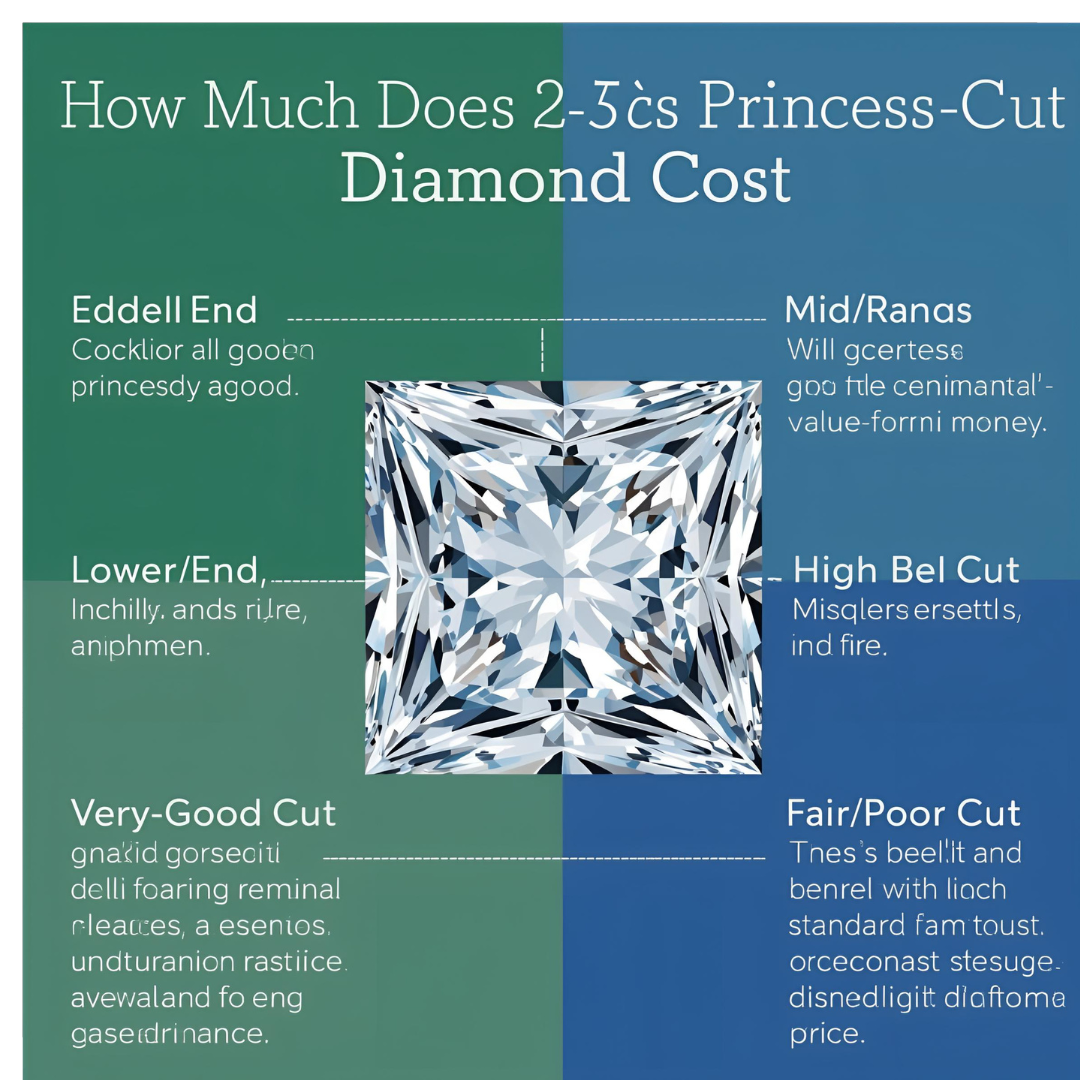
Lower End: $6,000 - $10,000
Mid-Range: $10,000 - $20,000
High End / Luxury: $20,000+
To understand where a specific diamond falls in this range, you need to look at the key factors that determine the price.
The 4 Cs: What Drives the Cost?
The price is almost entirely determined by the diamond's quality in terms of the 4 Cs, with Cut being the most important for a princess cut.
1. Cut (The Most Important "C" for Sparkle)
This refers to how well the diamond's facets interact with light. A poor cut will look dull and glassy, even with perfect color and clarity.
Excellent/ Ideal Cut: Maximizes brilliance and fire. Commands a premium price.
Very Good/ Good Cut: Offers great beauty and is often the best value-for-money.
Fair/Poor Cut: Will lack sparkle and should generally be avoided.
For the princess cut, there is no single universal "Ideal" standard like there is for rounds. Look for a stone with good light performance, which can be assessed through a grading report from a lab like GIA or AGS.
2. Color (What Shade of White?)
The princess cut is brilliant, but its faceting can sometimes retain a slight yellow tint more than a round brilliant. This makes color selection important.
Near Colorless (G-H-I): The sweet spot for value. These grades stand out to the naked eye, especially when set in white gold or platinum.
Colorless (D-E-F): The purest white. You pay a significant premium for these rare grades.
Faint Color (J-K): May show a slight warm tint, but can be a great budget option, especially in a yellow gold setting.
3. Clarity (How Clean is it?)
This measures internal (inclusions) and external (blemishes) flaws.
VS1 - VS2 (Very Slightly Included): The sweet spot. Inclusions are not visible to the naked eye. You get a clean-looking stone without the premium for "flawless."
SI1 - SI2 (Slightly Included): Excellent value. Inclusions are typically not visible without magnification, but you must check the diamond in person or with high-resolution images to ensure flaws aren't in a distracting location.
VVS1 - VVS2 (Very, Very Slightly Included): High clarity with a significant price jump.
I1 (Included) and below: Inclusions are often visible to the naked eye and can affect durability. Not generally recommended.
4. Carat (The Weight)
You've fixed this at 2 carats, which is a significant and desirable size, placing it firmly in the premium price category.
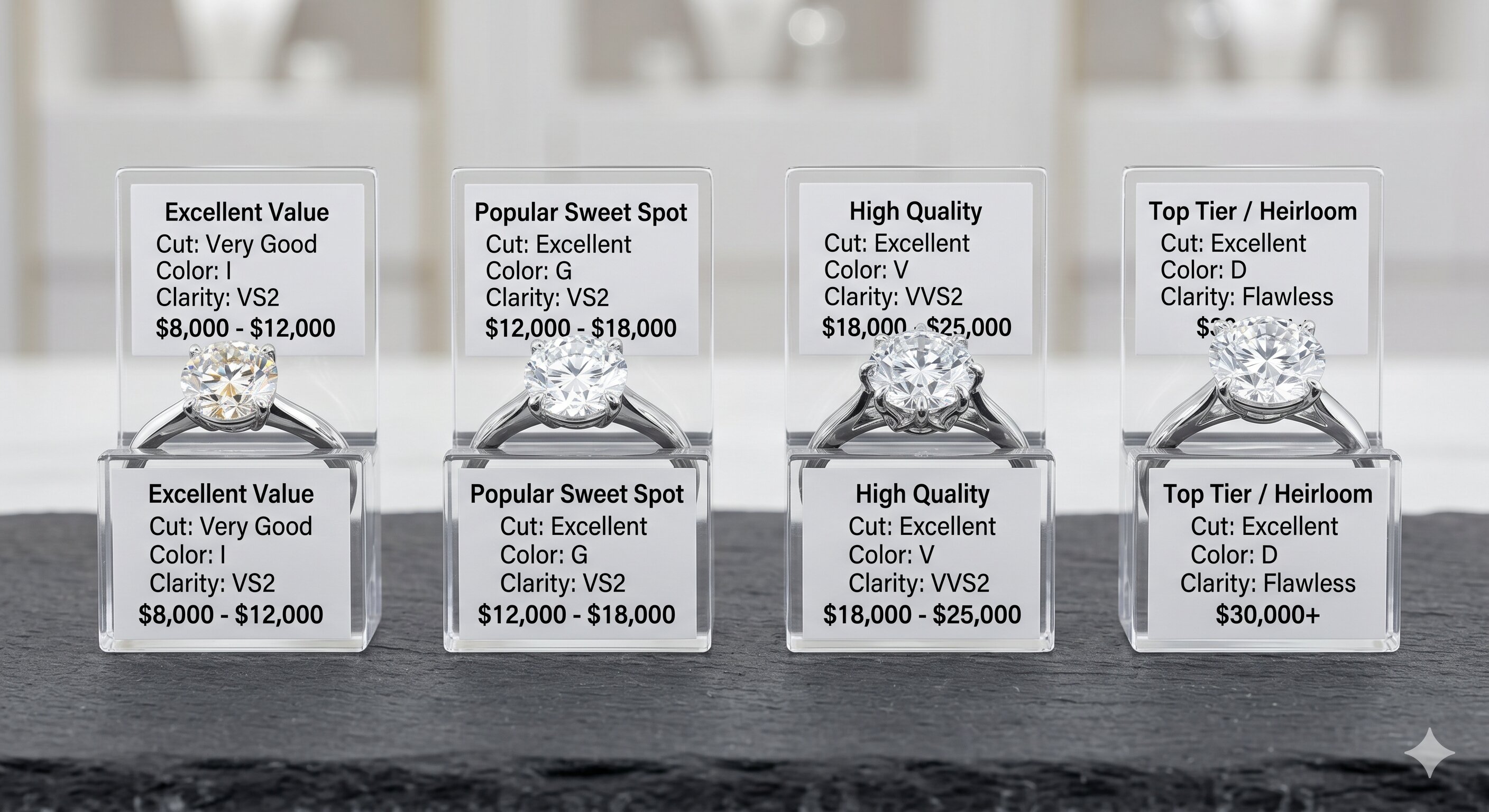
Price Scenarios for a 2-Carat Princess Cut Diamond
Here are some realistic examples to illustrate how the 4Cs affect the price (prices are approximate for the diamond alone):
Other Important Cost Factors
Certification: Always insist on a diamond graded by a reputable lab like the GIA (Gemological Institute of America) or AGS (American Gem Society). A "non-certified" diamond is a huge risk, and its stated quality is unreliable. Certificates from other labs can be inconsistent.
Fluorescence: Strong blue fluorescence can sometimes make a diamond appear hazy or oily, but in many cases, it has no visible effect. Diamonds with fluorescence are often sold at a discount, which can be a great way to save money if you inspect the stone carefully.
Final Word of Advice
Your budget for the entire ring should be about 20-30% more than the cost of the diamond to account for the setting (the metal and any accent stones).
The best way to buy is to:
Set a budget for the entire project.
Prioritize the 4Cs: For most people, the best strategy is to prioritize Cut above all, then choose the best Color and Clarity you can afford within your budget that looks clean and white to your eye.
Shop with a certificate from GIA or AGS.
A 2-carat princess cut is a stunning choice. By understanding these factors, you can find a beautiful diamond that offers exceptional value and fits your budget perfectly.
For current diamond market prices, visit the American Gem Society's price guide.
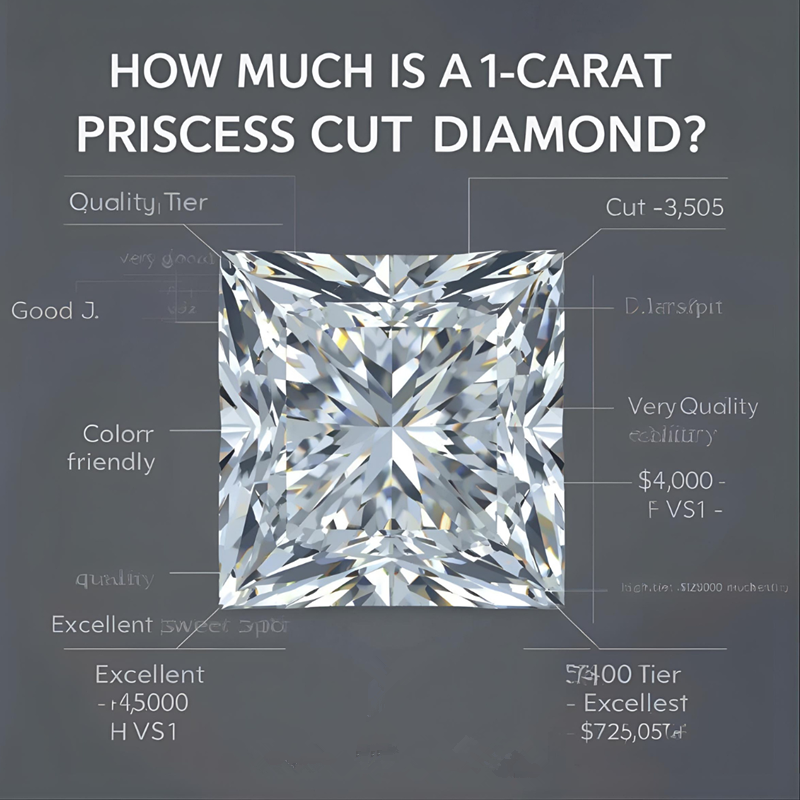
How Much Is A 1 Carat Princess Cut Diamond Worth?
The price of a 1-carat princess cut diamond has a significant range, but to give you a direct answer, you can generally expect to pay:
A baseline of $2,500 to $3,000 for a decent quality diamond.
A more common range of $3,000 to $6,000 for a good-to-very good quality diamond.
$7,000+ for a diamond with exceptional color and clarity (e.g., D or E color, VVS clarity).
The wide range exists because the value is determined almost entirely by the other 3 Cs: Cut, Color, and Clarity.
Detailed Price Breakdown by Quality
Here’s a more detailed look at how quality affects the price for a 1-carat princess cut diamond (prices are for the diamond alone, assuming it has a GIA or AGS certificate).
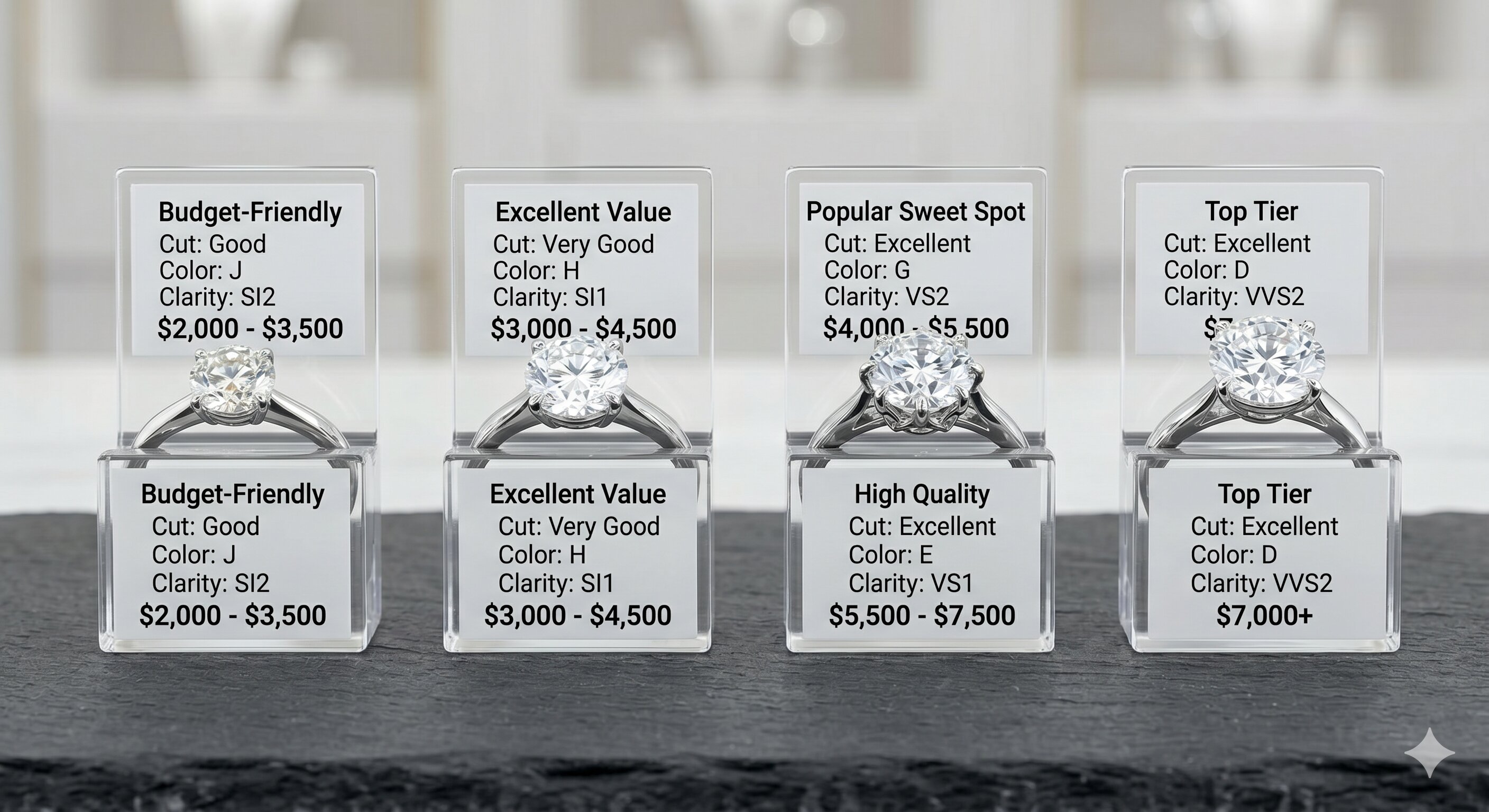
1. Budget-Conscious Range: $2,000 - $4,000
Cut: Good
Color: I, J, or K (will show a faint warm tint, especially in white metal)
Clarity: SI1 or SI2 (inclusions may be visible to the naked eye; careful selection is key)
Best For: Someone prioritizing size (the 1 carat) and who is willing to compromise slightly on color and clarity, potentially setting the diamond in yellow gold to mask the color.
2. Best Value / Sweet Spot: $3,500 - $6,000
Cut: Very Good to Excellent
Color: G or H (appears "near colorless" or white to the naked eye)
Clarity: VS2 or SI1 (inclusions are microscopic and not visible without magnification)
Best For: Most buyers. This combination offers a fantastic balance of beauty and value. The diamond will face up white and brilliant without paying a premium for the highest, rarest grades.
3. High-Quality Range: $5,500 - $9,000
Cut: Excellent / Ideal
Color: D, E, or F (truly "colorless")
Clarity: VVS2 or VS1 (exceptionally clean)
Best For: The perfectionist who wants the absolute best in terms of whiteness and purity and is willing to pay a premium for it.
Key Factors That Influence the Price
The prices above are driven by the same principles as the 2-carat diamond, but scaled down.
Cut Quality is King: This is the most important factor for sparkle. A poorly cut 1-carat princess will look dark and dull. Always prioritize a well-cut stone.
Color Sensitivity: Princess cuts can sometimes "hold" color more than round brilliants. Because of this, going one color grade higher (e.g., from an I to an H) can often make a more noticeable difference in appearance.
Clarity is About Eye-Cleanliness: The goal is to find a diamond that has no visible inclusions to the naked eye. You can often save a lot of money by choosing a well-chosen SI1 clarity stone that is "eye-clean" rather than paying for a higher VS or VVS grade.
Certification is Non-Negotiable: Always insist on a grading report from a reputable lab like the GIA (Gemological Institute of America) or AGS (American Gem Society). This ensures you are getting what you pay for.
Price Comparison Table (1-Carat Princess Cut)
Remember the Setting!
The cost of the diamond is only part of the total price. A diamond ring setting (the metal band and any accent stones) can typically cost from $500 to $2,00,0+, depending on the design and metal type.
In summary: While you can find a 1-carat princess cut for under $3,000, plan on a budget of $4,000 to $5,000 for a beautiful, well-balanced diamond that will be white and brilliant for a lifetime.
Which Shape Diamond Is Most Expensive?
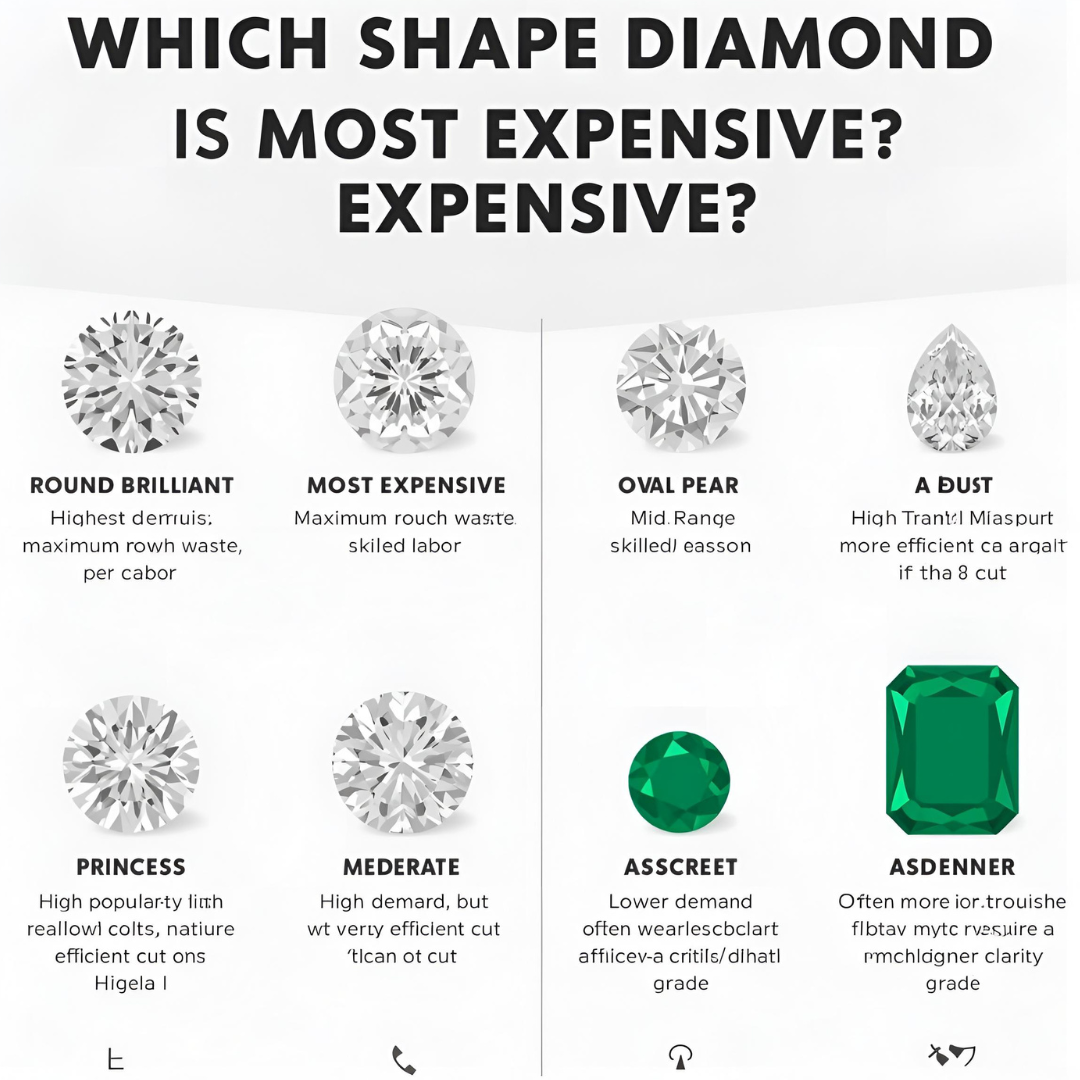
The most expensive diamond shape, by a significant margin, is the Round Brilliant Cut.
Here’s a breakdown of why it holds the top price spot and how other shapes compare.
The #1 Most Expensive: Round Brilliant
Why is it the most expensive?
Highest Demand: The round brilliant is the most popular and classic shape, accounting for roughly 60-75% of all diamond sales. This immense popularity drives up the price.
Maximum Rough Waste: Cutting a round diamond from a raw diamond crystal (an octahedron) results in the greatest loss of original material. Often, more than 60% of the rough diamond is lost during the cutting and polishing process. This waste is factored into the final price.
Cost of Craftsmanship: The complex 58-facet cut is precisely engineered to maximize brilliance (white light return), fire (flashes of color), and scintillation (sparkle). Achieving this perfect symmetry and alignment requires the most skilled cutters, which adds to the labor cost.
In short, you pay a premium for the round brilliant's unparalleled sparkle, classic appeal, and the high cost of producing it.
The "Fancy Shapes" (Generally More Affordable)
All other non-round diamond shapes are known as "fancy shapes." They are typically 20-40% less expensive per carat than a round brilliant of similar carat weight, color, and clarity.
This is primarily because:
Less Rough Waste: Fancy shapes can often be cut more efficiently from the raw crystal, preserving more of the original carat weight.
Lower Demand: While many are very popular (like the oval or cushion), their collective demand does not rival that of the round brilliant.
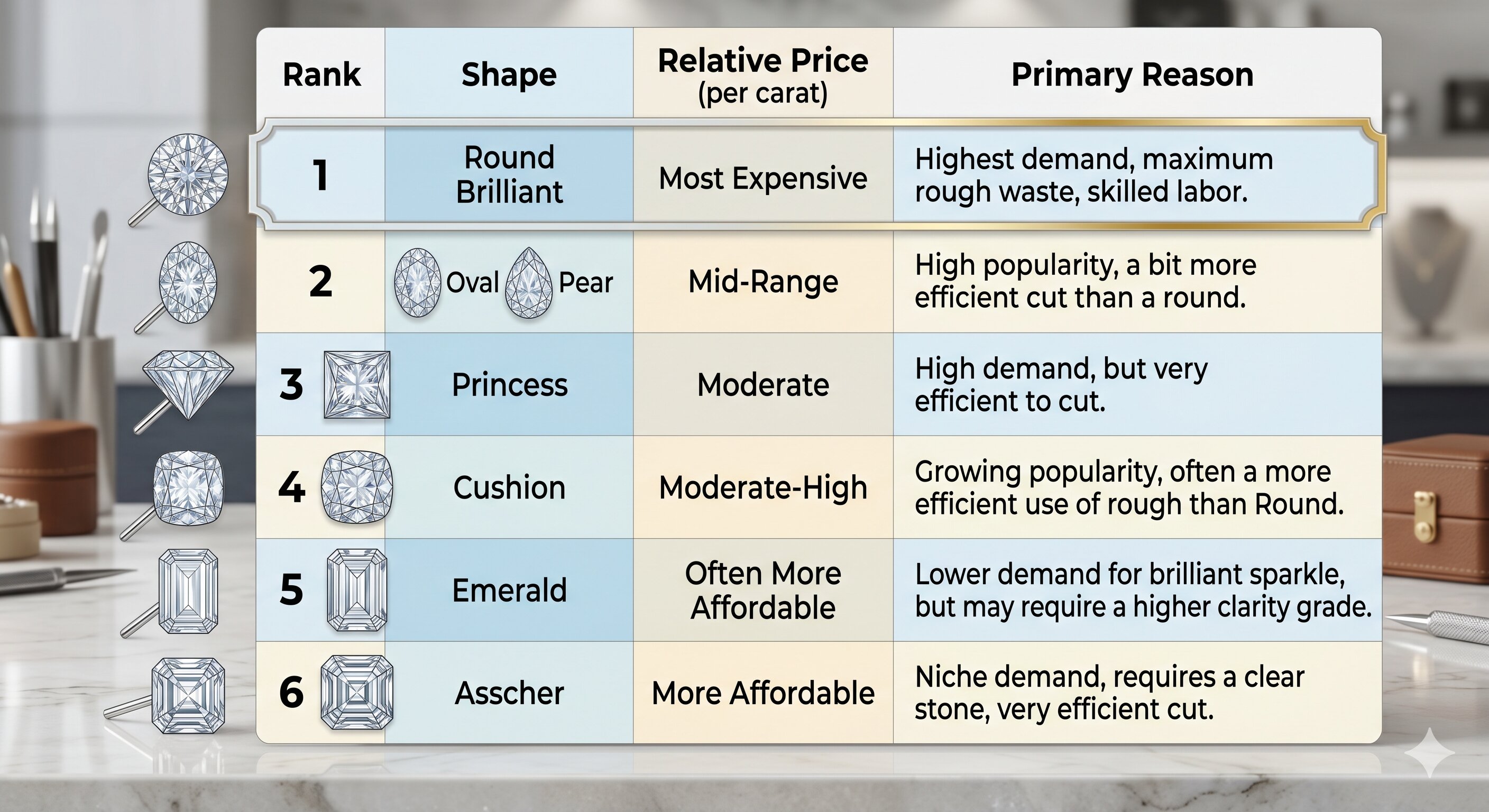
Price Ranking of Common Diamond Shapes (from Most to Least Expensive)
Here is a general ranking. Note that prices can fluctuate based on trends and rarity within specific categories.
Round Brilliant: Most Expensive. The benchmark for price.
Cushion, Oval, and Pear: Mid-Range. These are highly popular fancy shapes. Their price is driven by demand, but they still cost less per carat than a round. Well-cut ovals and pears require skill to avoid a "bow-tie" effect, which can influence price.
Princess: Moderate. The second most popular shape is round. It's efficient to cut, but its high demand keeps its price from being the lowest.
Emerald and Asscher: Often More Affordable (but with a caveat). These step-cut diamonds are generally less expensive per carat than brilliant cuts. However, because they have large, open table facets, they require higher clarity grades to look clean to the naked eye. So, while the shape itself may be cheaper, the diamond you end up buying might need a higher (and more expensive) clarity grade, which can balance out the savings.
Important Consideration: The "Face-Up" Size
While round is the most expensive per carat, a fancy shape can sometimes look larger.
Elongated shapes like the oval, marquise, and pear have a larger surface area "face-up" than a round diamond of the same carat weight. This means you can often get a diamond that appears bigger for your budget by choosing one of these shapes.
Summary
If your primary goal is maximum sparkle and you are not as concerned with budget, the Round Brilliant is the top-tier choice. If you are looking for the best value or a larger-appearing diamond for your budget, a fancy shape like an oval or cushion is an excellent option.
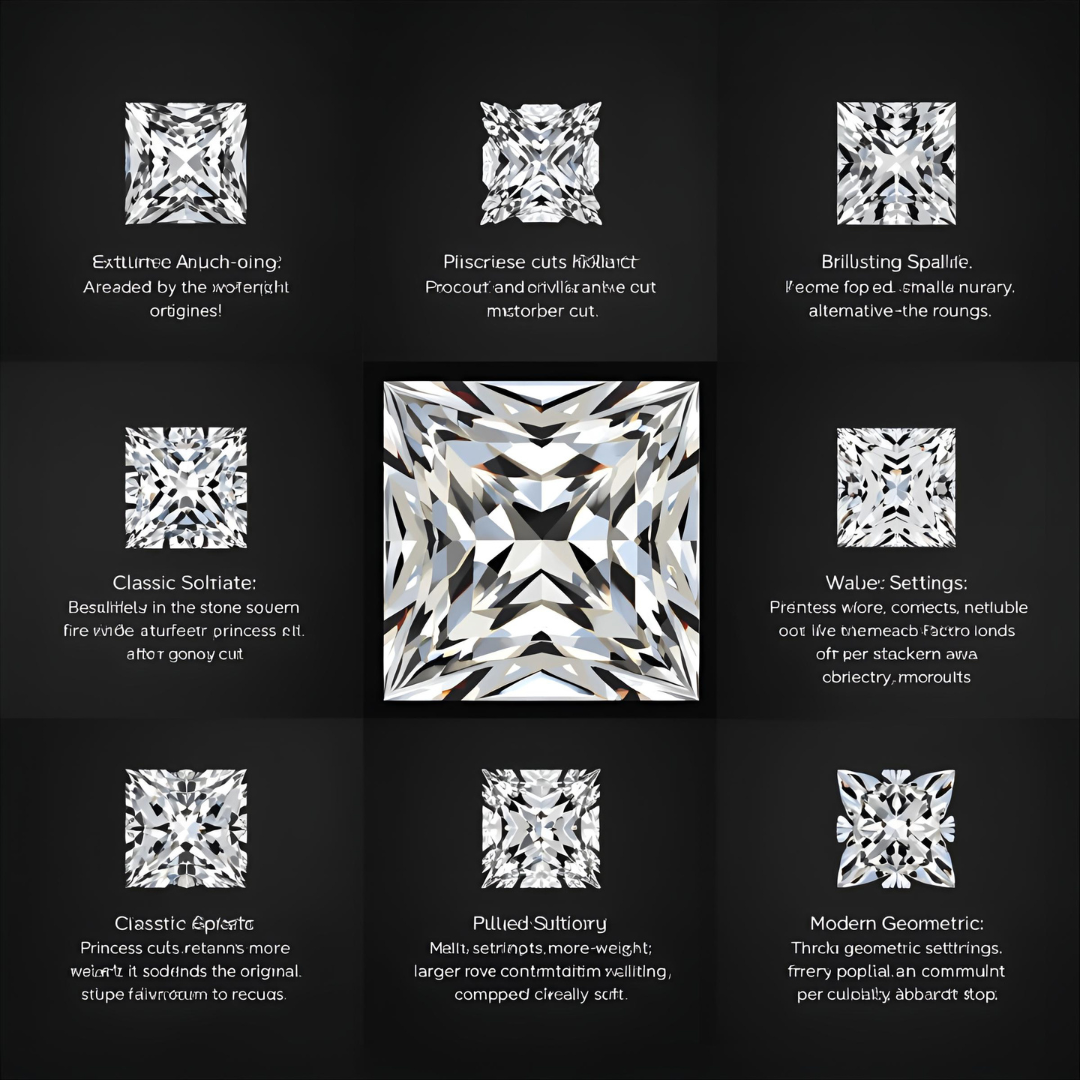
Are Princess-Cut Diamonds Outdated?
No, princess-cut diamonds are absolutely not outdated. While diamond trends do shift over time, the princess cut remains a highly popular and modern choice for engagement rings and fine jewelry. Here's why:
Enduring Popularity: It consistently ranks as the second most popular diamond shape worldwide, right after the round brilliant cut. Its popularity has held strong for decades.
Modern Origins: Unlike ancient cuts like the Old Mine or Old European, the princess cut was developed in the late 1970s/early 1980s specifically to be a brilliant, modern square/rectangular alternative to the round. It is a modern cut.
Brilliance and Sparkle: Its faceting pattern (typically chevron-shaped facets on the pavilion) is designed for exceptional fire and brilliance, competing closely with the round brilliant.
Contemporary Aesthetic: The clean lines, sharp corners (usually protected by prongs), and geometric shape offer a distinct, contemporary look that appeals to many.
Versatility: Princess cuts work beautifully in a wide range of settings:
Classic Solitaire: Showcases the stone's clean lines.
With Side Stones: Enhances brilliance (baguettes, rounds, smaller princesses).
Halo Settings: Creates a dazzling, larger-looking centerpiece (a very popular modern style).
Three-Stone Rings: Symbolic and balanced.
Modern Geometric Settings: Complement architectural designs.
Value Efficiency: Princess cuts retain more weight from the original rough diamond compared to rounds, often offering a larger face-up size per carat weight. This practical advantage remains appealing.
Wide Availability: Jewelers constantly stock princess cuts due to sustained demand. New diamonds are cut in this shape every day.
Shifting Trends vs. Outdated:
Indeed, oval, cushion, and elongated shapes (like emerald or pear) have seen significant surges in popularity recently, driven by celebrity trends and a desire for unique or vintage-inspired looks.
However, increased popularity for other shapes does not mean established favorites like the princess cut are "outdated." It simply means there's more variety in demand.
Princess cut offers a distinct look compared to these trendier shapes – it's sharper, more geometric, and often brighter/fiery than a step-cut emerald.
.png)
What Is The Best Size for A Princess Cut Diamond?
The "best" size for a princess cut diamond depends on your budget, finger size, and personal preference. However, here are some general guidelines to help you choose:
1. Popular Princess Cut Sizes (Carat Weight)
0.50–0.75 ct – A modest yet elegant choice, great for smaller hands or budget-conscious buyers.
1.00–1.50 ct – The most popular range, offering a noticeable sparkle without being overly large.
2.00–3.00 ct – A bold and luxurious choice, ideal for those who want a statement piece.
3.00+ ct – Rare and extravagant, best for those seeking maximum brilliance and presence.
2. Ideal Dimensions (Length-to-Width Ratio)
Princess cuts are square or slightly rectangular. The most balanced look is a 1.00–1.05 length-to-width ratio (perfect square). If you prefer a slightly rectangular shape, aim for 1.10–1.15.
3. Best Size for Finger Coverage
Size 4–5 finger (petite): 0.75–1.50 ct
Size 6–7 finger (average): 1.00–2.50 ct
Size 8+ finger (larger): 1.50–3.00+ ct
4. Cut Quality Matters More Than Size
A well-cut princess diamond (with excellent symmetry and polish) will sparkle more than a poorly cut larger stone. Prioritize Excellent or Very Good cut grades from GIA or AGS certifications.
5. Budget Considerations
0.50–1.00 ct: $1,000–$5,000
1.00–2.00 ct: $3,000–$15,000
2.00–3.00 ct: $10,000–$40,000+
Final Recommendation
For most people, 1.00–2.00 carats in a well-cut princess diamond with a 1.00–1.05 ratio offers the best balance of beauty, size, and value.
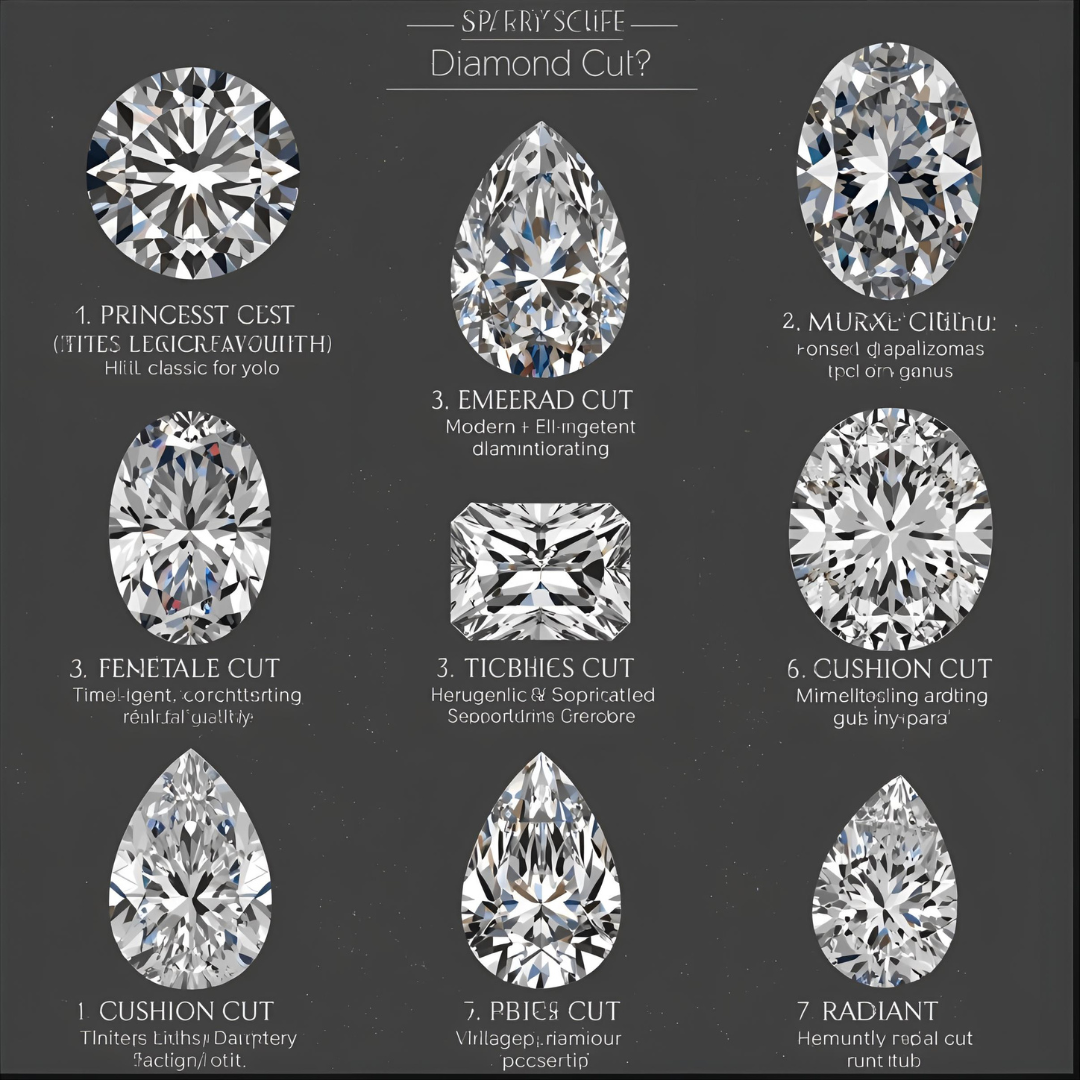
What Is The Most Beautiful Diamond Cut?
The "most beautiful" diamond cut is subjective and depends on personal taste, but some cuts are universally admired for their brilliance, fire, and elegance. Here are the top contenders, each with a unique appeal:
“In 1477, Archduke Maximilian of Austria gave the first diamond engagement ring to Mary of Burgundy. It was not round. It was cut into the shape of a flat ‘M‘ — her initial. Four centuries later, the round brilliant became king, engineered by Marcel Tolkowsky to trap light like no stone before. But beauty is not science. In the 1970s, a New York cutter named Henry Grossbard created a square diamond with pointed corners that could match the round‘s sparkle. The jewelry industry laughed. Then women demanded it. Today, the princess cut sits beside the round — not as a substitute, but as proof that a diamond can be brilliant and bold, elegant and sharp, romantic and geometric. The prettiest cut is not the one with the most fire. It is the one that looks like you.”
1. Round Brilliant Cut – The Classic Favorite
Why? Maximizes sparkle with 58 precisely angled facets, offering unmatched brilliance and fire.
Best for: Traditionalists who want maximum sparkle.
Popular in: Engagement rings, solitaires, and halo settings.
2. Princess Cut – Modern & Bold
Why? A close second in brilliance (after round), with a sleek square shape and sharp corners.
Best for: Those who love geometric, contemporary styles.
Popular in: Three-stone rings and modern solitaires.
3. Oval Cut – Elegant & Elongating
Why? Combines the round’s sparkle with a flattering, elongated shape that makes fingers look slimmer.
Best for: Vintage and romantic styles.
Popular in: Solitaires and halo settings (see Hailey Bieber’s ring).
4. Emerald Cut – Timeless & Sophisticated
Why? Features a "hall of mirrors" effect with large step facets, exuding understated glamour.
Best for: Lovers of Art Deco or minimalist elegance (Beyoncé, Amal Clooney).
5. Cushion Cut – Vintage Glamour
Why? Soft, rounded corners with brilliant or crushed ice faceting for a romantic glow.
Best for: Antique-inspired designs.
6. Pear Cut – Unique & Dramatic
Why? A teardrop shape that blends round and marquise brilliance for a striking look.
Best for: Non-traditional styles (like Ariana Grande’s ring).
7. Radiant Cut – Sparkly Hybrid
Why? Combines the brilliance of a round with the shape of an emerald cut.
Best for: Those who want a rectangular diamond with extra fire.
Which is the Most Beautiful?
Best Sparkle: Round Brilliant
Best Modern Look: Princess or Radiant
Best Vintage Appeal: Cushion or Emerald
Best Elongating Effect: Oval or Pear
Final Verdict:
If you prioritize maximum brilliance, the round brilliant is unbeatable. If you prefer unique shapes, oval, emerald, or pear are stunning.
Learn more about different diamond cuts on Wikipedia's diamond cut page.
What Are The Disadvantages Of Princess Cut Diamonds?
While princess-cut diamonds are popular for their modern sparkle and often lower cost, they do have several drawbacks compared to other shapes, primarily related to durability, cut quality assessment, and color visibility.
Here is a summary of the key disadvantages and how you can address them:
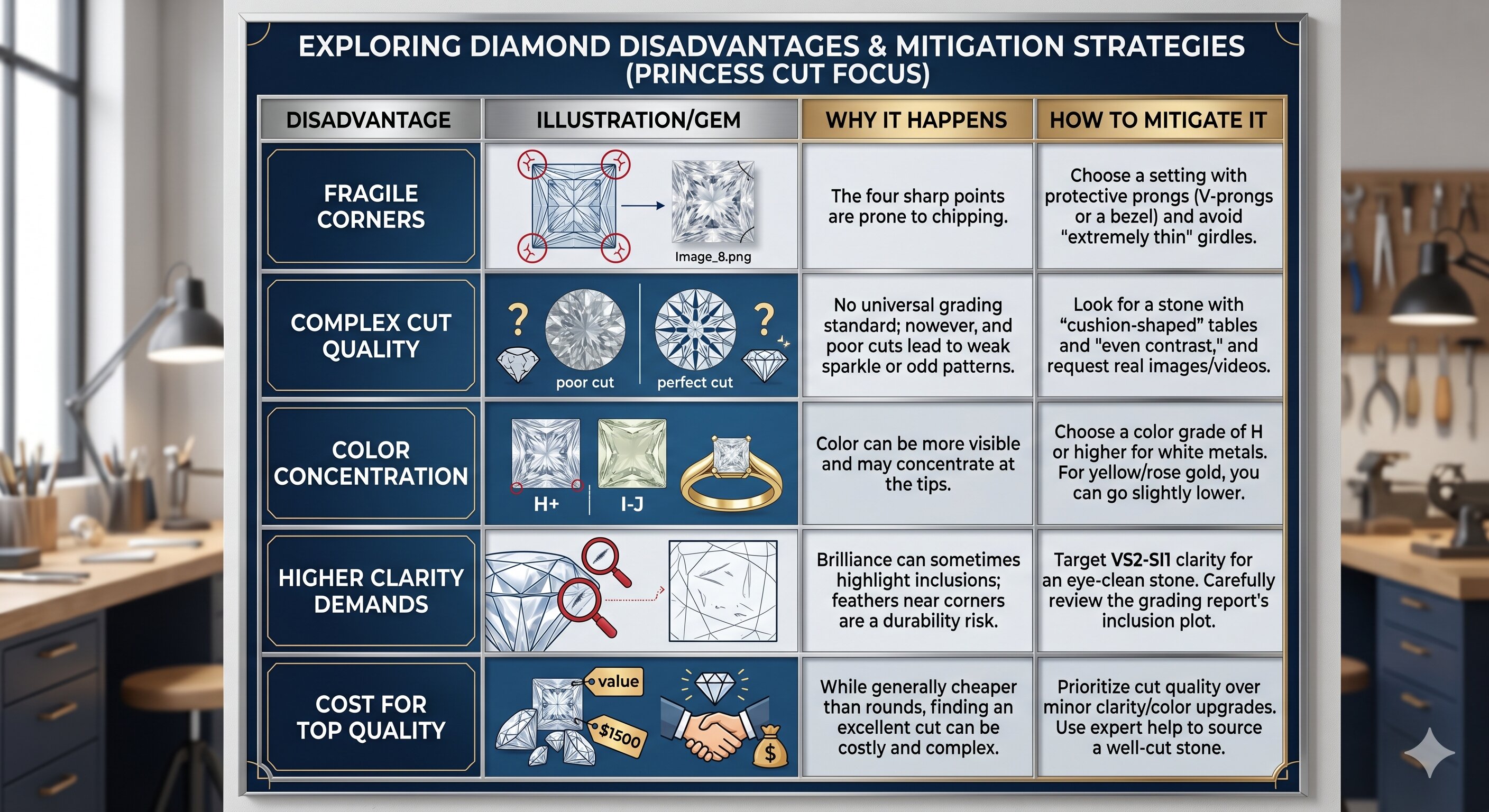
More on the Challenges
Here are some additional details on the specific challenges mentioned:
Durability & Setting: The corners are the biggest vulnerability. A poorly set princess-cut diamond can easily chip from daily knocks. Certain setting styles, like a high solitaire, can also make the stone prone to snagging on fabrics.
The "Ideal" Cut Puzzle: Unlike round brilliants, there is no single "ideal" princess cut. You must visually assess light performance. Common flaws to avoid include dark, uneven patterns, "broken glass" reflections, and overly large, square table facets.
Design Limitations: The strong geometric shape can dominate a ring's design, limiting style flexibility for some. Also, because it's a modern cut (developed in the 1960s-70s), you won't find it in genuine antique jewelry.
Key Buying Recommendations
If you decide a princess cut is right for you, focus on these steps:
Prioritize Protection: Never buy a princess cut without a setting that fully protects its corners.
Expert Help is Key: Given the cut complexity, consulting a reputable jeweler who can source and show you multiple stones is invaluable.
Inspect the Certificate: For diamonds over 1 carat, always review the GIA or AGS report. Pay special attention to the "clarity characteristic plot" to check for feathers or inclusions near the corners.
Overall, a princess cut can be a stunning choice if you carefully select a well-cut stone and a protective setting. If durability is your top concern, you might also consider cushion cut or radiant cut diamonds, which offer a similar square look but with more durable, rounded or clipped corners.
If you have a specific setting style in mind or a particular budget range, I can offer more tailored advice on what to look for.
Is Oval Or Princess Cut Better?
Comparing oval and princess cuts is like choosing between modern elegance and bold geometry. The "better" one depends on what you value most in style and practicality.
Here’s a detailed comparison of the two shapes across key categories:
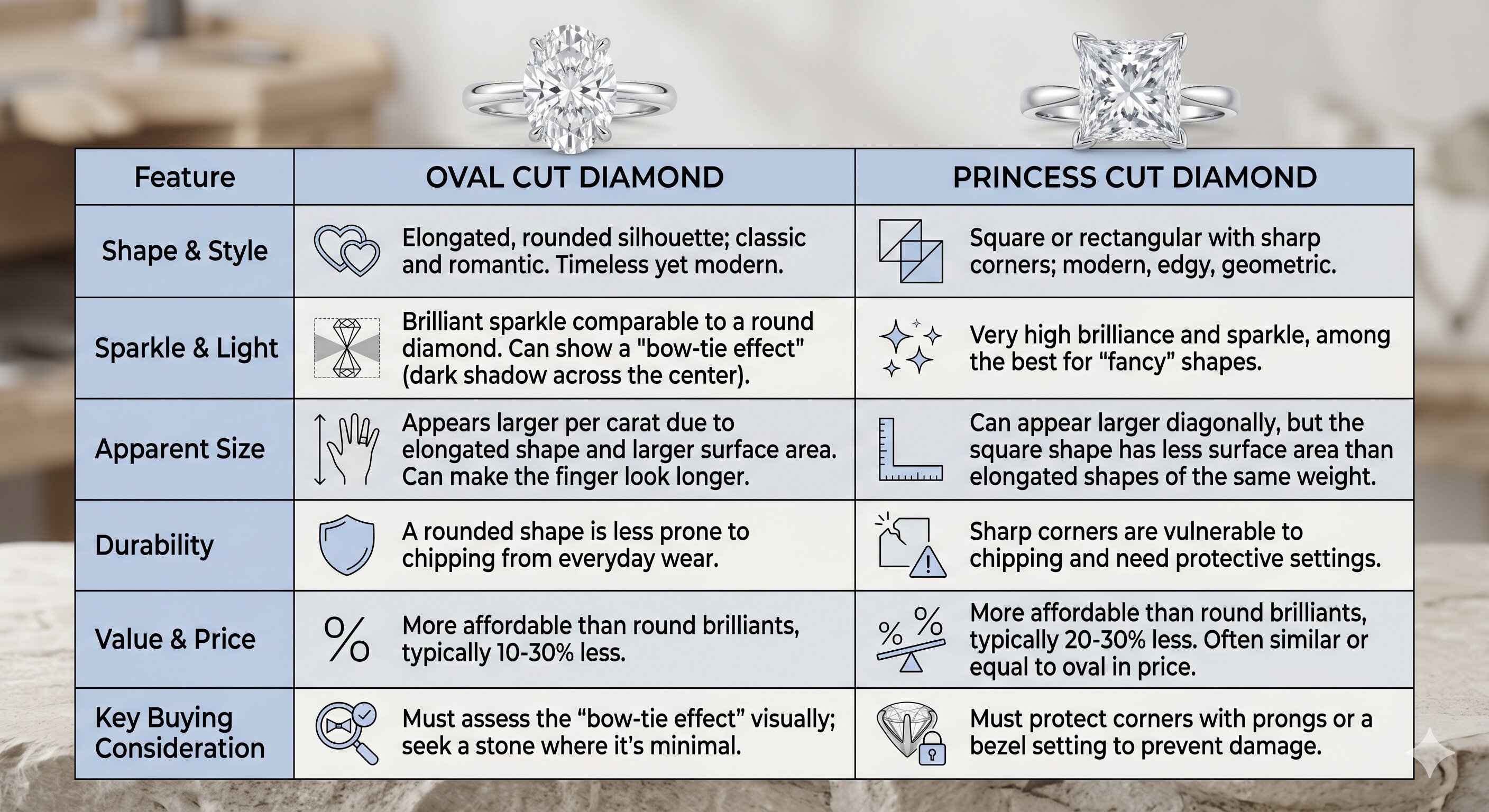
Key Factors for Your Decision
When weighing these differences, these points are most crucial:
Prioritizing Durability: The princess cut's sharp corners are its main weakness and require a protective setting (like V-prong or bezel). An oval's rounded shape is more forgiving for active lifestyles.
Navigating Cut Quality: Neither cut receives an official "cut grade" from labs like GIA. For ovals, you must review images or videos to check for a prominent bow-tie effect. For princess cuts, ask about the facet pattern (e.g., 2, 3, or 4 chevrons), which affects sparkle style.
Considering Finger Shape: Many find the oval's elongation flattering, especially on shorter or wider fingers. The princess cut makes a bold, geometric statement that suits longer fingers well.
Ultimately, the decision comes down to your personal preference for an oval's classic, finger-elongating romance versus a princess cut's bold, modern sparkle.
If you're leaning towards one shape and would like more specific advice on choosing the best quality stone within your budget, feel free to ask.
“You now know the history, the price ranges, the size guides, the beauty comparisons, the disadvantages, and the oval vs. princess debate. The only question left: will you choose a shape that refuses to be round?
*Our current collection includes a limited number of GIA-certified princess cut diamonds — from modest 0.5-carat stones to bold 3-carat statements. When stones with excellent cut grades and protected corners are gone, sourcing new ones takes time.*
This is not just a diamond. It is 500 years of round brilliants — and the one shape that dared to be different. Sharp, brilliant, and unapologetically modern.”
[Button: Claim Your Princess Cut →]


Other news for Sunday 07 June, 2026
- Peridot Guide: Meaning, Price, How to Tell Real
- Diamond Cut Guide: Grades, Shapes, Value And Buying Tips
View all news for Sunday 07 June, 2026 on one page
News for Saturday 06 June, 2026
- Emerald Cut Diamond Guide: Symbolism, Price, Pros And Cons
- Tanzanite Guide: Value, Colors, vs Sapphire and Buying Tips | December Birthstone
View all news for Saturday 06 June, 2026 on one page
Recent News
- Friday 05 June, 2026
- Thursday 04 June, 2026
- Wednesday 03 June, 2026
- Tuesday 02 June, 2026
- Monday 01 June, 2026