

Diamond Cut Guide: Grades, Shapes, Value And Buying Tips
"Diamond cut" is one of the most important concepts in diamond evaluation, but it's often misunderstood.
“For 600 years, diamonds were dark. Ancient cutters could only polish natural octahedral crystals into simple points — beautiful but lifeless. Then, in 15th-century Europe, an unknown craftsman ground down the top of a diamond to create the first ‘table cut.‘ Light entered for the first time. A hidden fire awakened. That single moment began humanity‘s longest quest: to unlock the soul inside the hardest stone on Earth.”
Here’s a comprehensive breakdown.
Table of Contents
- What Is A Diamond Cut Called?
- What Is The History Of Diamond Cutting?
- How Does Diamond Cut Affect Its Brilliance?
- What Is The Best Cut Of A Diamond?
- What Are The Different Grades Of Diamond Cut?
- Why Is A Diamond's Cut So Important?
- How Does Diamond Cut Affect Its Value?
- Which Cut Of Diamond Is The Most Valuable?
- What Is The Least Popular Cut Of Diamonds?
- What Is The Rarest Diamond Cut?
- What Is The Cheapest Cut Of Diamonds?
- What Is The Most Perfect Cut Diamond?
- Which Diamond Cut Do You Love Most?
- Can Diamonds Cut Even The Hardest Glass?
Let's talk about the first part of the content.
What Is A Diamond Cut Called?
This is an excellent question because the term "diamond cut" is used in two different but related ways, which often confuses.
The simple answer is that the overall term is simply a "Cut."
However, you need to know the two contexts in which it's used:
1. Cut as a Shape or Style (The Most Common Meaning)
When most people ask, What cut is that diamond?" they are referring to its overall shape and facet pattern. This is the diamond's style name.
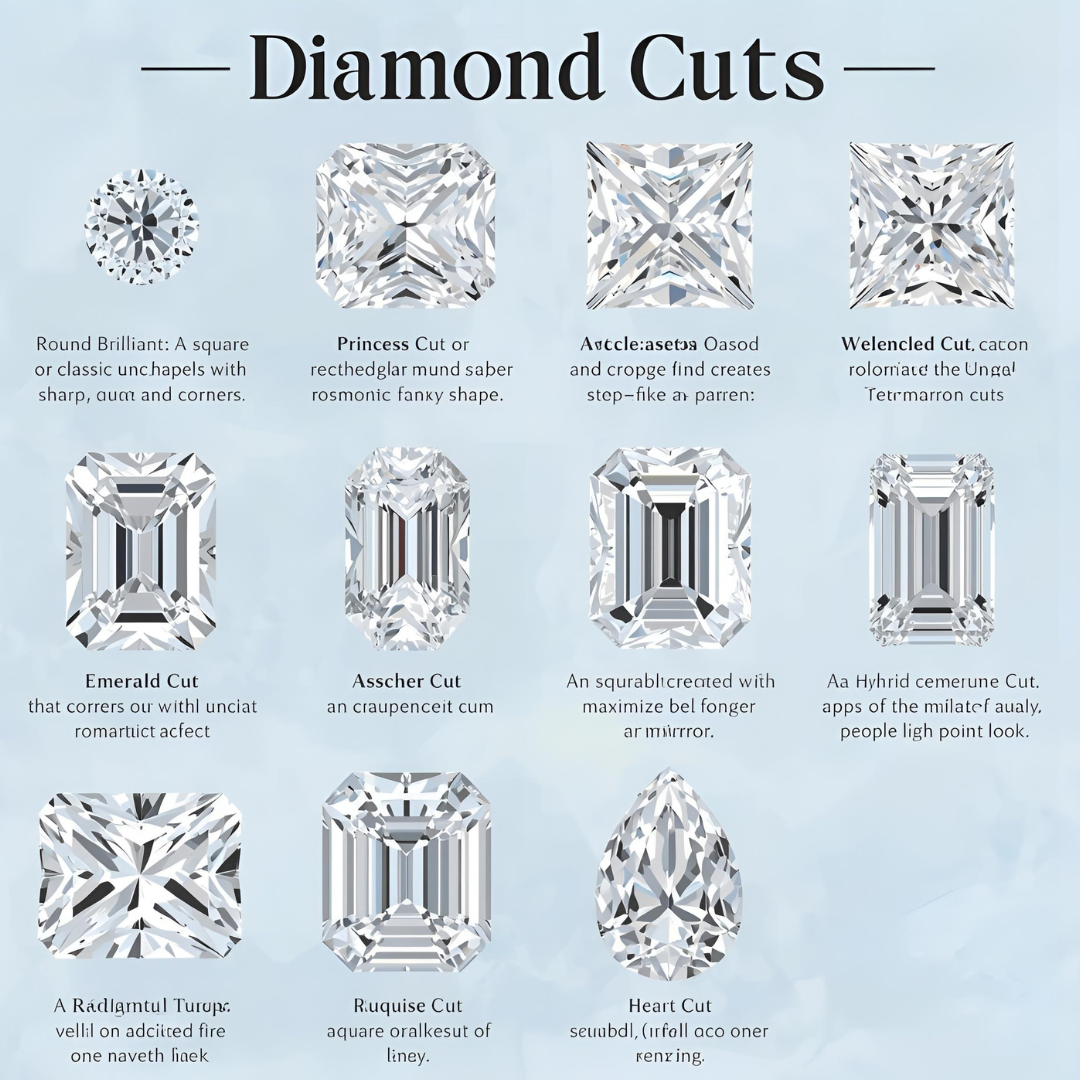
Popular Diamond Cuts (Shapes) include:
Round Brilliant: The most popular and classic shape, known for its exceptional fire and brilliance.
Princess Cut: A square or rectangular cut with sharp, uncut corners. It's the most popular fancy shape.
Cushion Cut: A square or rectangular cut with rounded corners, resembling a pillow. It has a vintage, romantic feel.
Oval Cut: An elongated round shape that can make the finger look longer and slimmer.
Emerald Cut: A rectangular cut with cropped corners and step-like facets. It emphasizes clarity and creates a "hall of mirrors" effect.
Asscher Cut: A square version of the emerald cut, with a similar stepped facet pattern and a high crown.
Marquise Cut: A football-shaped cut with pointed ends, designed to maximize carat weight and create a dramatic look.
Pear Cut: A hybrid teardrop shape, combining the round and marquise cuts.
Radiant Cut: A rectangular or square cut with trimmed corners and a brilliant-style facet pattern, combining the elegance of an emerald cut with the sparkle of a round.
Heart Cut: The ultimate symbol of romance, shaped like a heart.
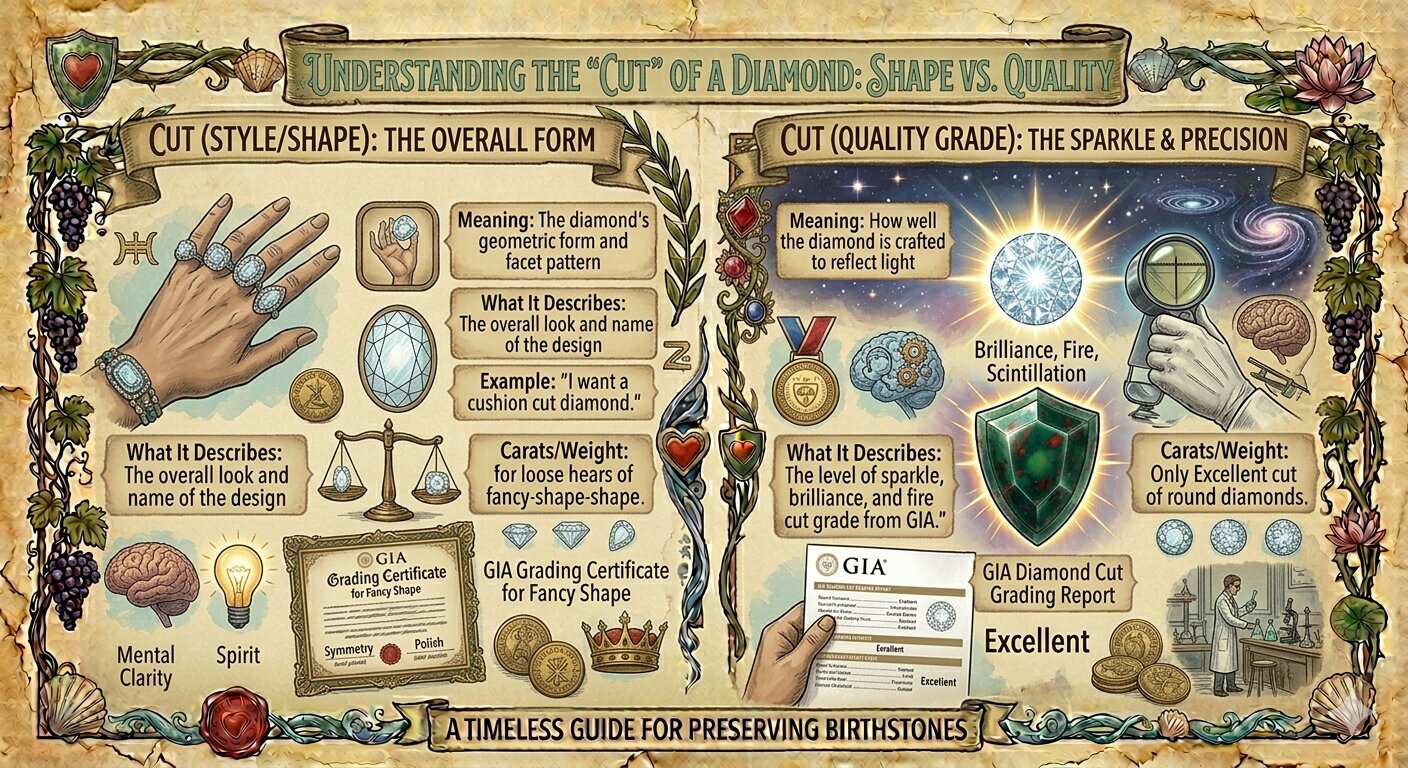
2. Cut as a Quality Grade (The Most Important "C")
In the world of diamond grading (the 4 Cs: Cut, Color, Clarity, Carat), "Cut" refers specifically to how well a diamond's facets interact with light.
This is not about the shape, but about the quality of craftsmanship—the diamond's proportions, symmetry, and polish. A high-quality cut is what gives a diamond its famous sparkle (brilliance), fire (flashes of color), and scintillation (pattern of light and dark areas).
For Round Brilliant diamonds, the Cut Grade is standardized by labs like the GIA (Gemological Institute of America) as follows:
Excellent / Ideal: The highest grade. Maximizes brilliance and fire.
Very Good: High brilliance and fire. A great value, as imperfections are often invisible to the naked eye.
Good: Reflects most of the light that enters. A balance of quality and price.
Fair: Allows a significant amount of light to leak out from the sides or bottom, reducing brilliance.
Poor: Most light leaks out, making the diamond appear dull and lifeless.
Important Note: For fancy shapes (like oval, princess, emerald, etc.), most labs do not give a single overall "Cut Grade." Instead, they grade Polish and Symmetry separately.
Summary Table for Clarity
So, to answer your question directly:
The overall term is a "cut." But when you're talking about a diamond, you need to specify if you mean its shape (e.g., a round cut) or its quality of sparkle (e.g., an excellent cut). For the best diamond, you should choose both a shape you love and the highest cut quality you can afford.
What Is The History Of Diamond Cutting?
The history of diamond cutting is a fascinating journey of human ingenuity, slowly unlocking the hidden fire within the diamond. It's a story that evolves from simply enhancing a diamond's natural shape to the complex, computer-designed masterpieces of today.
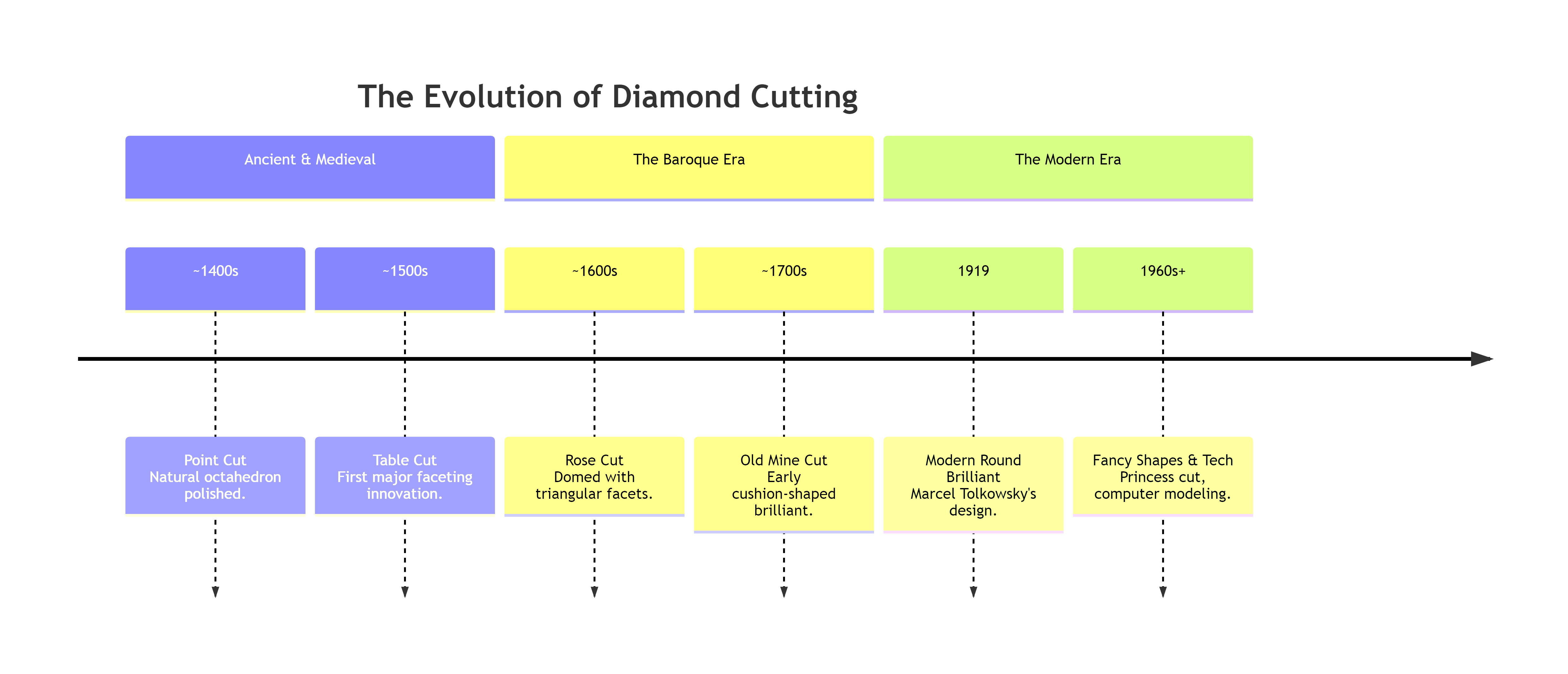
Here is a timeline of the key developments in diamond cutting:
The Early Days: The Point Cut and the Natural
The Point Cut (c. 14th Century): This was the very first attempt at "cutting" a diamond. Artisans would simply polish the natural octahedral crystals of a diamond to smooth out the surfaces and create a symmetrical, pointed shape. It was essentially a polished version of the diamond's natural form.
A Revolutionary Discovery: The Table Cut
The Table Cut (c. 15th Century): This was a monumental breakthrough. Cutters realized that by grinding down the top point of a Point Cut diamond, they could create a flat "table" facet. This not only made the diamond less likely to shatter but also allowed more light to enter and reflect, revealing the first glimpses of a diamond's potential for brilliance. The bottom point was also ground down to create a small "culet" facet.
The Birth of True Brilliance: The Rose and Old Mine Cut
The Rose Cut (c. 16th Century): Developed to save weight from rough crystals that were too flat to make good Point or Table Cuts. The Rose Cut features a flat bottom with a dome-shaped crown covered in triangular facets, resembling a rosebud. It was very popular for centuries, but lacked the fire of modern cuts because it had no pavilion (bottom) to reflect light through the top.
The Old Mine Cut (c. 17th - 18th Century): This is the precursor to today's brilliant cuts. With the discovery of diamond dust polishing, cutters could create more complex facets. The Old Mine Cut has a cushion-like shape (often square or rectangular with rounded corners), a high crown, a small table, and a large culet. It was designed to perform well in candlelight, with a deep, chunky sparkle that we now associate with antique jewelry.
The Old European Cut (c. 19th Century): The direct predecessor of the Modern Round Brilliant. It is rounder than the Old Mine Cut and features 58 facets, but it still has a higher crown, smaller table, and larger culet than modern standards. Its fire and brilliance are distinctive and highly sought after in antique pieces.
“In 1919, a young Belgian mathematician named Marcel Tolkowsky did what no jeweler had dared. He treated the diamond not as art, but as physics. Using light refraction equations, he calculated the exact angles a diamond needed to trap light and throw it back as fire. His thesis, ‘Diamond Design,‘ changed everything. Every brilliant-cut diamond you see today — from a 500 solitaire to a 50,000 engagement ring — follows his math. Tolkowsky didn’t just cut diamonds. He taught them how to shine.”
The Scientific Revolution: The Modern Round Brilliant
The Modern Round Brilliant Cut (1919): This is the turning point where art met science. Belgian mathematician and diamond cutter Marcel Tolkowsky calculated the ideal proportions and facet angles to maximize a diamond's brilliance (white light return) and fire (dispersion of colored light). His 1919 thesis, Diamond Design, established the blueprint for the 58-facet round cut that dominates the market today. While modern cuts have been refined with laser cutting and computer modeling, they still adhere closely to Tolkowsky's foundational principles.
The Modern Era and Fancy Shapes
Advancements in Technology (Mid-20th Century to Present): The invention of motorized diamond saws and laser cutting technology allowed for greater precision and the creation of new, complex shapes that were previously impossible.
Proliferation of Fancy Cuts (1960s - Present): With new technology, cutters began experimenting extensively. The Princess Cut was invented in the 1960s, the Radiant Cut in the 1970s, and many others have been developed and refined. Today, computer modeling (using software like Sarin and OGI) allows cutters to map the inclusions within a rough diamond and calculate the cut that will yield the largest, most brilliant stone with the fewest flaws.
Summary of Key Drivers in History:
Maximize Sparkle: The constant drive to increase brilliance and fire.
Preserve Carat Weight: The economic incentive to lose as little of the original rough diamond as possible.
Technology: Each leap in technology (diamond dust, motorized tools, lasers, computers) opened new possibilities for shape and precision.
Fashion: Changing tastes in jewelry styles dictated the popularity of different cuts throughout the centuries.
So, from a simple, polished, natural crystal to a gem cut with atomic-level precision, the history of diamond cutting is the history of our quest to master and magnify nature's hardest material into its most brilliant treasure.
Learn more about the history of diamond cutting on Wikipedia's diamond cutting page.
How Does Diamond Cut Affect Its Brilliance?
This is the most crucial aspect of understanding a diamond's beauty. Simply put, the cut is the primary factor that determines a diamond's brilliance, fire, and scintillation.
Think of a diamond as a complex mirror system. The cut is the quality of the engineering that determines how efficiently light travels through the stone and back to your eye.
Here’s a breakdown of how a diamond's cut directly affects its brilliance:
The Ideal Journey of Light: Brilliance in Action
When a diamond is cut to ideal proportions, light behaves in the following way:
Entrance: Light enters through the diamond's table (the top, flat facet).
Refraction: The light bends (refracts) and travels into the body of the diamond.
Reflection: The light hits the pavilion's facets (the bottom half) and is reflected from one side to the other, like a mirror.
Return: The light is reflected up through the crown (the top half) and out through the table to your eye.
This perfect path creates the maximum amount of white light return, which we see as brilliance.
How a Poor Cut Kills the Brilliance
When the proportions of the cut are off, even slightly, light "leaks" out of the diamond instead of returning to your eye. This results in a dull, dark, or glassy appearance.
The two most common problems are:
1. Shallow Cut
What happens: The diamond is too shallow and flat. The pavilion is too shallow.
The effect: Light enters and, instead of reflecting up, it leaks out through the bottom of the stone.
What you see: The diamond appears watery, glass-like, and lacks sparkle. It will look larger for its carat weight, but it will be lifeless.
2. Deep Cut
What happens: The diamond is too deep. The pavilion is too steep.
The effect: Light enters and reflects, but it bounces to the wrong place inside the stone and escapes out the side.
What you see: The diamond looks dark in the center, especially under normal lighting. It will appear smaller for its carat weight.
The Three Components of Sparkle, Governed by Cut
The cut doesn't just control white light (brilliance); it controls all aspects of a diamond's sparkle:
Brilliance: The return of white light. This is the foundation of a diamond's brightness and is directly controlled by the precision of the cut's angles and proportions.
Fire: The dispersion of light into the colors of the rainbow (flashes of red, blue, green, etc.). A well-cut diamond acts like a prism, separating white light into its spectral colors. If the cut is poor, there simply isn't enough light being returned to create visible fire.
Scintillation: The pattern of light and dark areas, and the sparkle you see when the diamond, the light, or the observer moves. It's the "wink and blink" of sparkle. This is controlled by the symmetry and arrangement of the facets. Poor symmetry creates an unbalanced and chaotic sparkle pattern.
The "Cut Grade" is Your Guide
This is why gemological labs like the GIA (Gemological Institute of America) assign a Cut Grade for round brilliant diamonds. This grade is a direct assessment of how well the diamond's design and craftsmanship will translate into real-world beauty.
Excellent/Ideal Cut: Maximizes light return. The diamond will be exceptionally brilliant, fiery, and scintillating.
Very Good Cut: Reflects nearly as much light as an Excellent cut, but at a lower price. Differences are often invisible to the untrained eye.
Good Cut: Reflects most light that enters. A practical choice that balances cost with beauty.
Fair & Poor Cut: Allows significant light to leak out. The diamond will appear noticeably dull and lifeless.
A diamond's cut is not its shape, but its performance. It is the single most important factor in determining a diamond's beauty and sparkle.
A high-quality cut makes a diamond brilliant, fiery, and lively.
A poor-quality cut makes a diamond dull, dark, and lifeless, no matter how high its color or clarity grades are.
This is why experts often say: Prioritize Cut above all else. A well-cut diamond will be stunning, even with slightly lower color or clarity, while a poorly cut diamond will be disappointing, even if it is flawless and colorless.
What Is The Best Cut Of A Diamond?
The answer is nuanced because the "best" cut depends on what you value most: maximum sparkle, personal style, or budget.
However, if we define "best" as the cut that delivers the ultimate in brilliance, fire, and scintillation (sparkle), there is a clear winner.
The Top Tier for Maximum Sparkle: The Ideal/Excellent Round Brilliant Cut
For pure, undeniable, science-based sparkle, the Round Brilliant Cut with an "Excellent" or "Ideal" grade is universally recognized as the best.
Why it wins:
Engineered for Perfection: Its 58-facet pattern is the result of precise mathematical calculations (pioneered by Marcel Tolkowsky) designed to maximize light return. No other shape reflects as much white light (brilliance) and colored fire back to the viewer's eye.
Rigorous Grading: For round brilliants, gem labs like GIA (Gemological Institute of America) provide a definitive Cut Grade (Excellent, Very Good, Good, etc.). This takes the guesswork out of finding a truly exceptional performer.
Unmatched Popularity: Because of its superior sparkle, it has been the most popular choice for engagement rings for over a century. Its timelessness ensures it will never go out of style.
The Key Takeaway: If your primary goal is to get the most sparkle for your money, a Round Brilliant with an Excellent cut grade is the undisputed champion.
But What About Other Shapes? The "Fancy Shape" Contenders
If you value unique style and personality, the "best" cut might be a different one. These are often called "fancy shapes." They are stunning in their own right, but are cut to prioritize the shape's character and size retention from the rough diamond crystal.
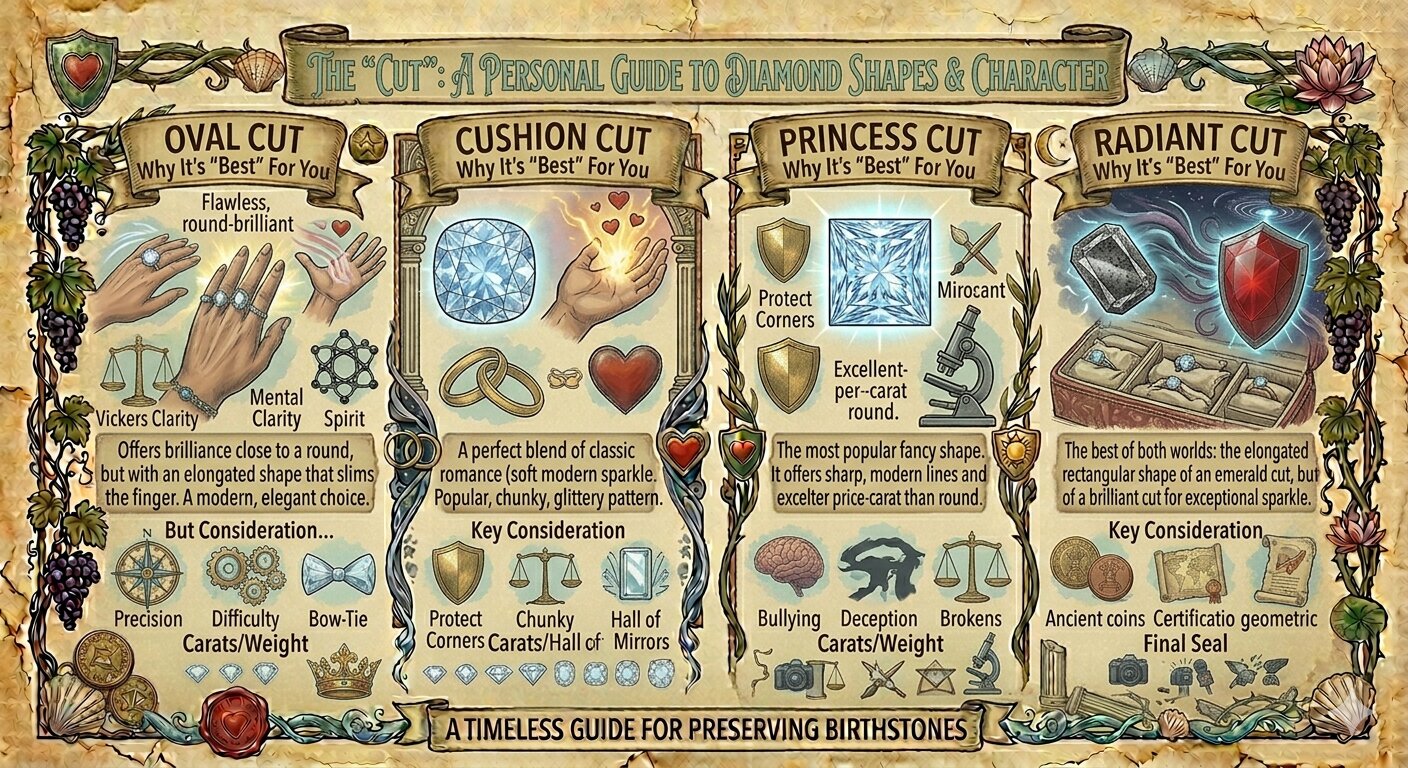
Here are the top contenders and what makes them "best" for different reasons:
How to Choose the Best Cut for YOU
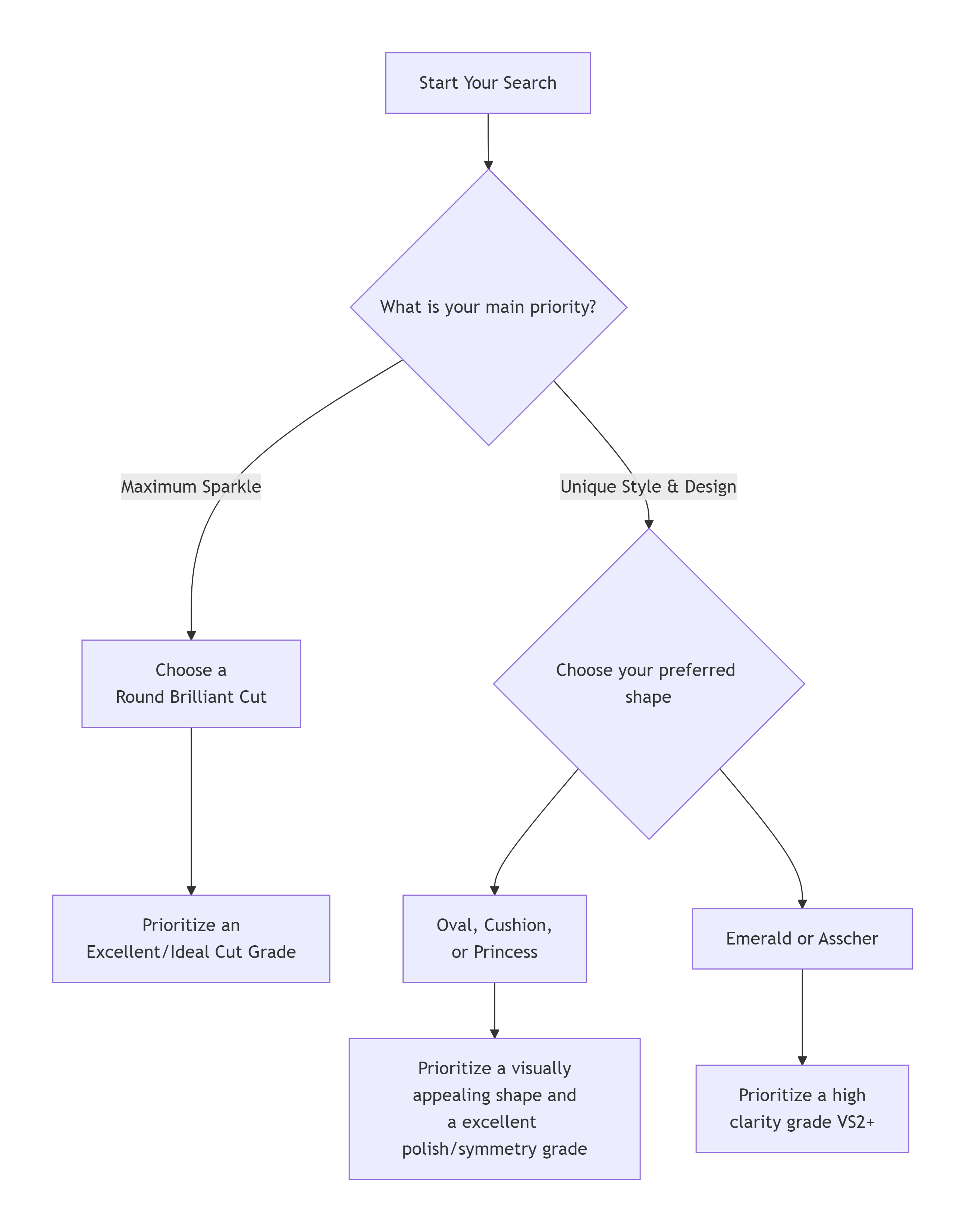
Follow this simple decision guide:
The "Best" for Unmatched Sparkle: Round Brilliant Cut (Excellent/Ideal Grade)
The "Best" for Style & Value: Oval, Cushion, or Princess Cut with excellent proportions.
The "Best" for Vintage Elegance: Emerald or Asscher Cut with high clarity.
No matter which shape you choose, always prioritize the quality of the cut. A well-cut diamond of any shape will be more beautiful than a poorly-cut diamond of the "most popular" shape. It is the factor that brings the diamond to life.
Why Is A Diamond's Cut So Important?
Understanding diamond cut grades is essential because it's the most important factor in a diamond's beauty and sparkle.
The grading system differs slightly between Round Brilliant diamonds and Fancy-shaped diamonds (like oval, princess, cushion, etc.).
1. Cut Grades for Round Brilliant Diamonds
For round diamonds, laboratories like the GIA (Gemological Institute of America) provide a single, overall Cut Grade. This is the most straightforward and standardized system. It is based on a combination of factors:
Proportions: The relationships between the diamond's dimensions (like table size, crown angle, and pavilion depth).
Symmetry: The precision of the facet shapes and their alignment.
Polish: The smoothness of the facet surfaces.
Here are the official GIA Cut Grades, from best to worst:
Excellent (or Ideal)
What it means: The highest standard. Represents the top ~3% of diamond quality. It is cut to maximize brilliance and fire.
Light Performance: Reflects nearly all light that enters it, creating exceptional sparkle and brightness. This is the most sought-after and valuable grade.
Recommendation: The best choice if your priority is ultimate sparkle and budget is not the primary constraint.
Very Good
What it means: A high-quality cut. Reflects most of the light that enters it, similar to an Excellent cut.
Light Performance: To the naked eye, it will often be nearly indistinguishable from an Excellent cut. It may sacrifice a tiny amount of brilliance for a slightly larger diameter (carat weight spread).
Recommendation: Excellent value. You get exceptional beauty, often at a more accessible price point than an Excellent grade.
Good
What it means: A solid, medium-grade cut.
Light Performance: Reflects a majority of the light, but a noticeable amount leaks out. It will appear noticeably less brilliant than higher grades, especially in dim lighting.
Recommendation: A budget-conscious choice. The diamond will have sparkle, but it will lack the "wow" factor of the top tiers.
Fair
What it means: A poorly cut diamond.
Light Performance: Allows significant light to leak out from the sides and bottom. The diamond will appear noticeably dull and dark.
Recommendation: Generally not recommended for center stones in fine jewelry due to its weak sparkle.
Poor
What it means: The lowest grade.
Light Performance: Most light leaks out immediately. The diamond will appear very dark and glass-like, with little to no sparkle.
Recommendation: Avoid. The savings in price are not worth the complete lack of beauty.
2. "Cut Grades" for Fancy Shape Diamonds
This is where it gets different and a bit more complex. For fancy shapes (oval, pear, emerald, cushion, etc.), GIA and other labs do NOT provide an overall Cut Grade.
Instead, they grade two related characteristics:
Polish: The smoothness of the facet surfaces. (Grades: Excellent, Very Good, Good, Fair, Poor)
Symmetry: The precision of the facet shape and alignment. (Grades: Excellent, Very Good, Good, Fair, Poor)
Why no overall grade? There is no single "ideal" proportion set for fancy shapes. Beauty in these shapes is more subjective—some prefer an elongated oval, while others prefer a plumper cushion.
How to Assess a Fancy Shape's Cut:
Since there's no overall grade, you must rely on:
Proportion Tables: Compare the diamond's measurements (like depth % and table %) to recommended ranges for that specific shape.
Visual Inspection: This is crucial. Look at the diamond in person or via high-quality video.
Look for light patterns: Is it bright and sparkly, or are there large, dark, dead areas?
Avoid the "Bow-Tie Effect": In elongated shapes (oval, marquise, pear), a dark, bow-tie-shaped shadow across the center is common, but a severe one indicates a poor cut.
Specialized Grading: Some vendors (like James Allen, Blue Nile) or specialized labs (like AGA) provide their own cut grades for fancy shapes, which can be very helpful.
Summary Table: Cut Grades for Round Brilliant Diamonds
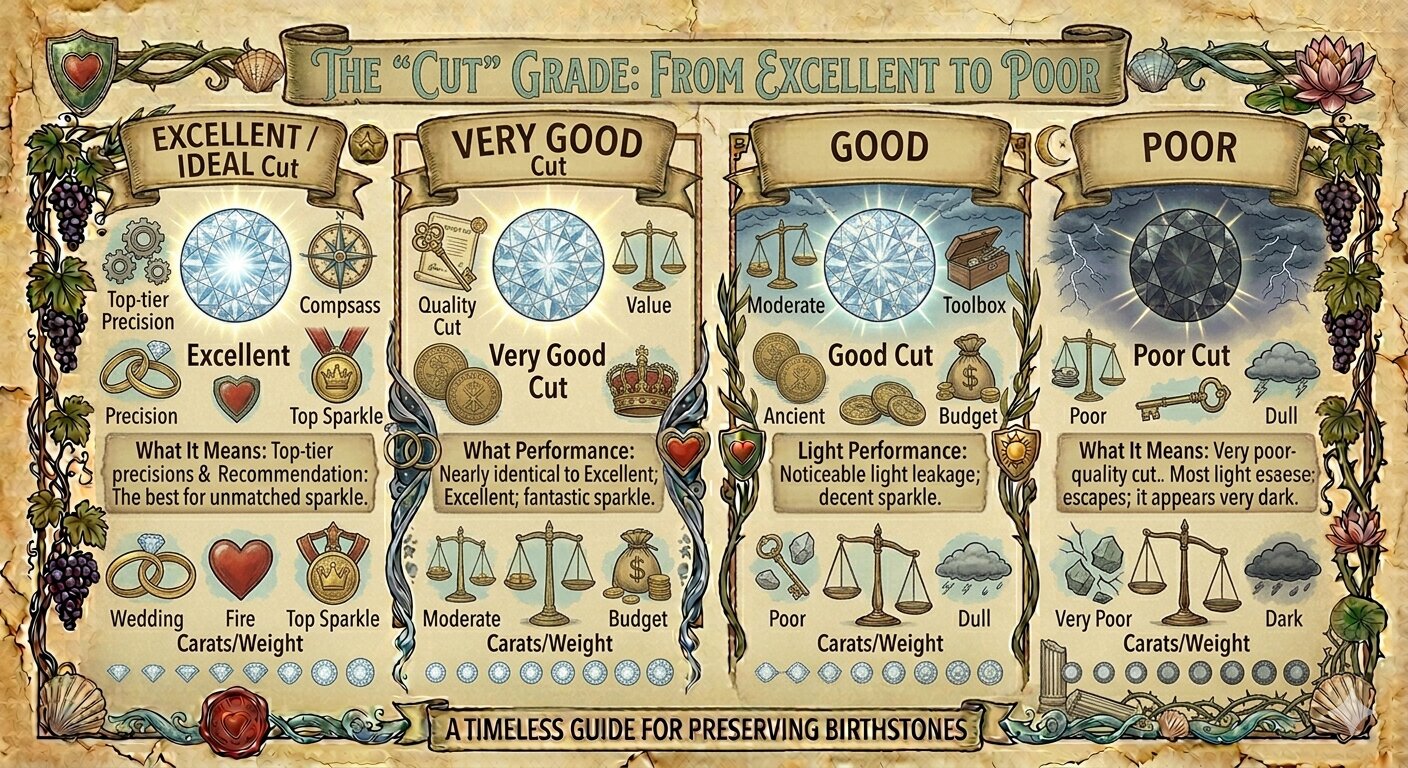
For Round Diamonds: Prioritize the Cut Grade. An Excellent or Very Good grade is highly recommended.
For Fancy Shapes: Prioritize Polish and Symmetry grades of Excellent or Very Good, and always review the diamond's proportions and, most importantly, see it with your own eyes (or a high-quality video) to judge its sparkle and pattern.
The cut grade is not just a technical specification; it's the key to the diamond's very soul—its sparkle. Never compromise on it.
For official cut grade standards, refer to the GIA Diamond Cut Guide.
Why Is A Diamond's Cut So Important?
Of all the 4Cs (Cut, Color, Clarity, Carat), the cut is paramount. It's often called the most important "C" for one fundamental reason:
The cut is what unlocks a diamond's light performance, determining its sparkle, fire, and ultimate beauty.
Think of it this way: A diamond is essentially a complex mirror and prism system. The cut is the quality of the engineering that makes that system work.
Here’s a breakdown of why it's so critical:
1. Cut Directly Controls the Sparkle
A diamond's famous sparkle isn't automatic. It's a direct result of how well it's cut. This sparkle is broken down into three elements, all governed by the cut:
Brilliance: The return of white light to your eye. A well-cut diamond acts like a perfect mirror system, bouncing light around inside and reflecting it out, making it look intensely bright.
Fire: The dispersion of light into flashes of rainbow color. A well-cut diamond acts like a precise prism, splitting white light into its spectral colors.
Scintillation: The play of light and dark areas and the sparkling flashes you see when the diamond, the light, or you move. This is controlled by the number, arrangement, and symmetry of the facets.
A poor cut cripples this entire process, resulting in a dull, dark, or glassy stone.
2. It Can Make or Break the Diamond's Appearance (Even with Perfect Color and Clarity)
This is the most practical reason for its importance. Consider two diamonds:
Diamond A: Flawless Clarity (FL), Colorless (D), but with a "Poor" cut.
Diamond B: Slightly Included Clarity (SI1), Near Colorless (G), but with an "Excellent" cut.
Diamond B will be dramatically more beautiful and impressive to the naked eye. Light leakage in the poorly cut Diamond A will make it look dead, completely wasting its superior color and clarity. The well-cut Diamond B will be a fiery, brilliant spectacle where its minor inclusions will be virtually invisible amidst all the sparkle.
3. It's the Only "C" Heavily Influenced by Human Skill
Color & Clarity are gifts from nature; they are inherent in the rough diamond crystal.
Carat Weight is a simple measure of nature's size.
Cut, however, is a testament to human artistry and craftsmanship. A master cutter analyzes the rough diamond and makes strategic decisions to unveil its hidden beauty, balancing the desire for maximum sparkle against the retention of carat weight.
A skilled cutter can transform a mediocre piece of rough into a dazzling gem, while a poor cutter can ruin a potentially perfect diamond.
The Simple Analogy: A Room with Windows
Imagine a diamond as a room with mirrors on the walls and floor, and a single window in the ceiling (the table).
An Excellent Cut: The room is perfectly proportioned. Light streams in the window, bounces brilliantly off every mirror, and floods back out, illuminating the entire room.
A Shallow Cut (Too wide and flat): The room is too shallow. The mirrors are poorly angled, so light comes in the window and immediately escapes out the floor, leaving the room dark.
A Deep Cut (Too narrow and tall): The room is like a deep well. Light comes in the window, bounces around, but gets trapped and escapes out the sides, leaving the center of the room in shadow.
Why You Should Prioritize Cut
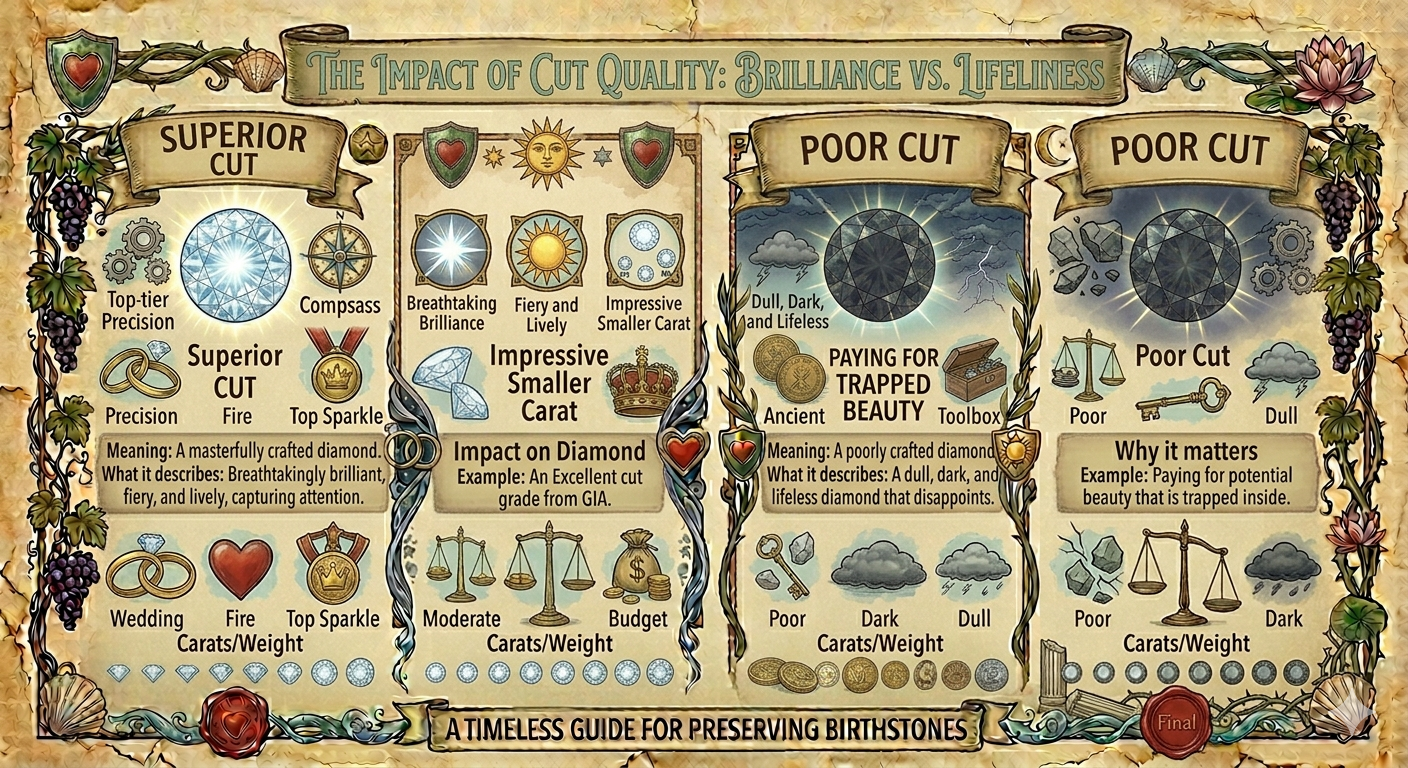
The cut is the diamond's soul. It is the difference between a mere piece of crystallized carbon and a captivating, living fire. When buying a diamond, always prioritize the cut grade above all else. It is the single greatest determinant of its beauty and your ultimate satisfaction.
How Does Diamond Cut Affect Its Value?
The cut of a diamond is a major driver of its value, but its relationship is more complex than the other 4Cs. It doesn't just add value; a poor cut can actively destroy the value of a diamond's inherent color and clarity.
Here’s a breakdown of how diamond cut affects value, from both a buyer's and seller's perspective.
The Core Principle: Cut is the Multiplier of Beauty (and Price)
Think of it as an equation:
(Color + Clarity + Carat) x Cut = Perceived Value and Price
A fantastic cut (a high multiplier) makes all the other Cs shine brighter. A poor cut (a low multiplier) makes even the best color and clarity appear dull, diminishing their contribution.
How a High-Quality Cut INCREASES Value
Maximizes Scarcity and Desirability:
Cutting a diamond to "Ideal" or "Excellent" proportions requires sacrificing more of the original rough diamond crystal. This means the final polished diamond will have a lower carat weight than if it were cut poorly to retain size.
This deliberate sacrifice of carat weight for beauty creates a scarcer, more desirable product. The rarity of such expertly cut stones commands a premium price.
Direct Premium Pricing:
A diamond with an "Excellent" cut grade from a reputable lab like GIA will always cost significantly more per carat than a "Good" or "Fair" cut diamond of the same carat weight, color, and clarity. The price jump between "Very Good" and "Excellent" is especially notable.
Justifies a Higher Price for the Other Cs:
A D-color, Flawless clarity diamond with a poor cut is a paradox. Its superior color and clarity are wasted because the poor cut prevents them from being visible. No one will pay a premium for color and clarity they can't see.
The same D-color, Flawless diamond with an Excellent cut is the pinnacle of achievement. Its perfect cut allows its perfect color and clarity to fully express themselves, justifying its astronomical price.
Stronger Resale Value:
Well-cut diamonds from recognized brands (e.g., Hearts On Fire, Brian Gavin) or with top lab grades retain their value better on the secondary market. They are always in demand because their beauty is undeniable.
How a Low-Quality Cut DECREASES Value
The "Heavy" or "Spready" Diamond Trap:
A shallow-cut diamond may have a larger diameter (face-up size) for its carat weight. While this might seem like a good deal, it's a false economy.
The light leaks out of the bottom, making the diamond look glassy and dead. The market severely discounts these stones because they lack the fundamental quality of brilliance.
The "Deep" or "Lumpy" Diamond Discount:
A deep-cut diamond retains more weight from the rough, but this weight is "hidden" in its bottom half (pavilion), making it look smaller face-up.
Light escapes from the sides, creating a dark center. You are essentially paying for carat weight that you cannot see. These diamonds are also heavily discounted.
Destroys the Value of Other Attributes:
As mentioned, a poor cut makes high color and clarity grades irrelevant. A buyer would be wiser to buy a G-color, VS2-clarity diamond with an Excellent cut than a D-color, IF-clarity diamond with a Good cut. The former will be more beautiful and often cost less.
Practical Price Comparison (Illustrative)
Let's imagine three 1.00-carat, G-color, VS1-clarity Round Brilliant diamonds with different cut grades. Their relative price per carat might look like this:
.png)
Special Case: "Ideal" or "Super-Ideal" Branded Cuts
Some diamonds are cut to even more exacting standards than GIA "Excellent." Brands like Hearts On Fire or A CUT ABOVE® command a substantial premium because they guarantee an exceptional level of craftsmanship, light performance, and optical symmetry. You are paying for a brand promise of the absolute best possible cut.
The Cut-Value Relationship
For Round Brilliants: The Cut Grade is a direct and powerful value indicator. Excellent/Ideal commands the highest price, while Poor/Fair is deeply discounted.
For Fancy Shapes: Since there's no overall cut grade, value is determined by the quality of the polish, symmetry, and most importantly, the visual appeal (e.g., a strong "bow-tie" in an oval cut reduces its value).
The Bottom Line for Buyers: Prioritize cut above all else. A well-cut diamond maximizes the visual impact of your budget. Paying for a high-quality cut means you are paying for proven, visible beauty, which is the entire point of buying a diamond. A larger, poorly cut diamond is a worse value than a smaller, brilliantly cut one.
Which Cut Of Diamond Is The Most Valuable?
This is a fundamental question in the world of diamonds, and the answer has a crucial twist.
The most valuable diamond cut is the Round Brilliant Cut.
However, this simple answer requires a vital explanation: It is only the most valuable when it is cut to an Excellent or Ideal grade.
Here’s a breakdown of why and how other cuts compare.
Why the Round Brilliant Cut Commands the Highest Price
Maximum Sparkle: As discussed previously, the Round Brilliant's 58-facet pattern is scientifically engineered to deliver the ultimate in brilliance (white light) and fire (colored light). This superior light performance is what most buyers desire, creating the highest demand.
Highest Demand: It is the most popular and classic choice for engagement rings by a significant margin, often comprising over 75% of all solitaire sales. High demand with limited supply drives up the price.
Greatest Rough Waste: Cutting a round diamond from a rough diamond crystal results in the most weight loss. To create a 1-carat round brilliant, a cutter may start with nearly 2 carats of rough material. This lost weight is factored into the final price.
Stringent Grading: The GIA and AGS have strict, specific cut grades for rounds. Achieving an "Excellent" or "Ideal" grade certifies its top-tier performance, adding a premium.
The Key Nuance: A poorly cut Round Brilliant is actually one of the least valuable diamonds per carat. Its high value is entirely dependent on its cut quality.
What About Other "Fancy Shape" Diamonds?
As the chart shows, all other shapes (known as "fancy shapes") are typically less expensive per carat than a Round Brilliant of the same quality. This includes popular cuts like the Princess, Cushion, and Oval.
Why are they less expensive?
Efficient Cutting: They can be cut from the rough crystal with less waste, preserving more of the original carat weight.
Lower Demand: While popular, they don't have the same massive, universal demand as the round brilliant.
However, rarity and desirability within fancy shapes can create exceptions. For example:
A perfectly cut, large, and flawless Emerald or Asscher cut can be exceptionally valuable due to its rarity and elegance.
An "Ideal" cut Oval or Cushion from a premium brand will command a higher price than a standard one.
Summary: What Drives the Highest Value?
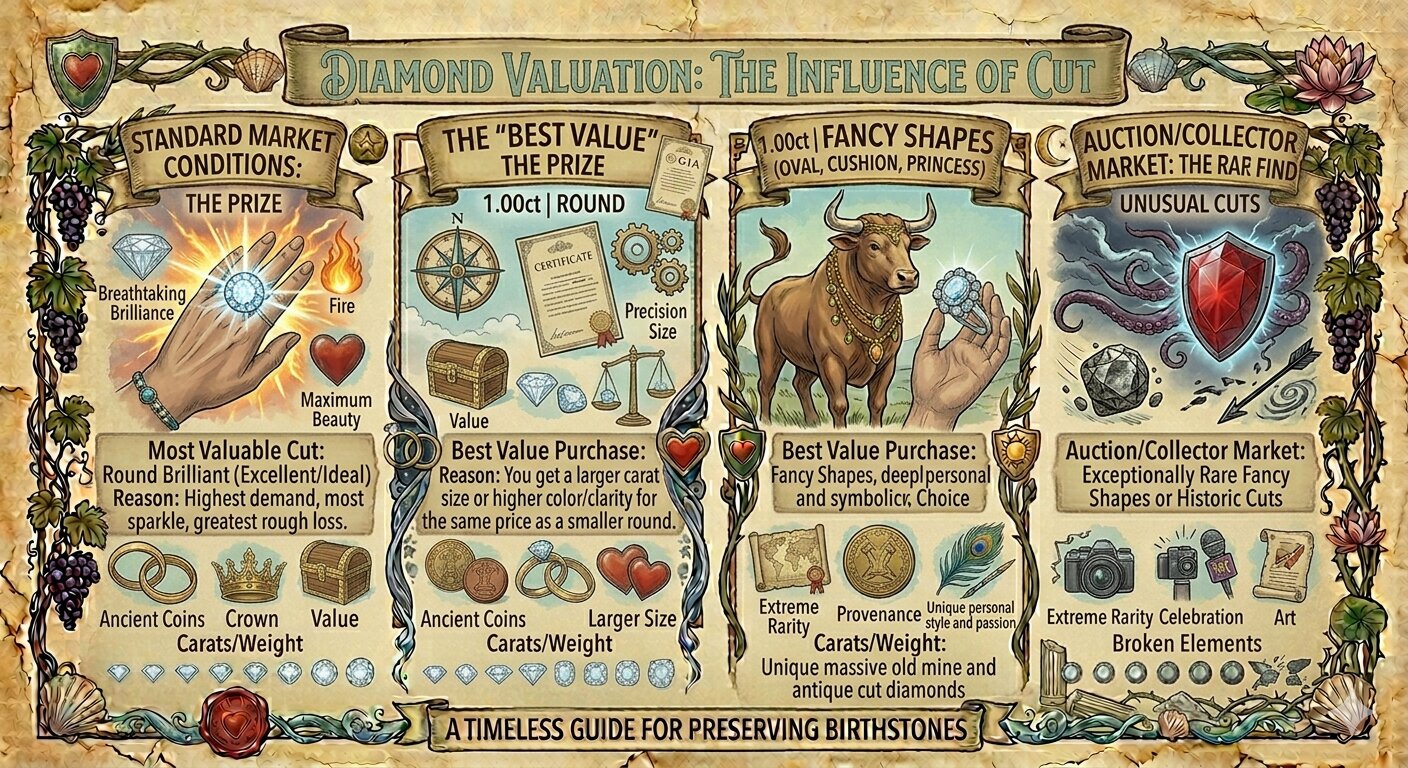
The Round Brilliant Cut with an Excellent/Ideal grade is the most valuable diamond cut in the commercial market. It is the benchmark against which all other diamonds are priced. If you are looking for the diamond that holds its value and represents the peak of sparkle, this is the choice.
However, "valuable" doesn't always mean "best for you." For many, the better value is a beautiful, fancy shape that offers a unique look and a larger size for the same budget.
What Is The Least Popular Cut Of Diamonds?
This is an interesting question because "least popular" can mean a few different things—it can refer to cuts that are rarely used in modern jewelry, commercially unsuccessful ones, or simply ones that have fallen out of fashion.
Based on current market trends and sales data, the title for the least popular classic diamond cut is generally a contest between a few specific shapes.
The Main Contenders for the Least Popular Cut
1. The Heart Cut
This is often considered the least popular mainstream cut for a few key reasons:
Difficulty and Cost: It is one of the most challenging and expensive shapes to cut symmetrically. A poorly cut heart will look lopsided and awkward.
Niche Appeal: Its overtly romantic and sentimental symbolism can feel too specific or clichéd for some.
Practicality: The delicate cleft (the top dip) and point are vulnerable to chipping.
While it has a dedicated following, its overall market share is extremely small compared to rounds, ovals, or princess cuts.
2. The Triangle Cut (Trillion or Trilliant)
This is a close runner-up. The triangle cut is striking and modern, but its sharp, geometric nature limits its appeal.
Usage: It is most often used as accent stones in three-stone settings rather than as a center stone.
Style: Its bold, angular look is an acquired taste and doesn't have the timeless, universal appeal of a round or cushion cut.
Setting Challenges: The three sharp points are extremely prone to chipping and require very protective settings.
3. The French Cut
This is a historical cut that is genuinely rare in modern jewelry. You rarely see it as a center stone today.
What it is: A square cut with a "checkerboard" pattern of facets, typically seen in antique jewelry from the early 20th century.
Why it's unpopular: It has less brilliance and fire than modern brilliant cuts. Its charm is in its vintage, geometric sparkle, which is not what most modern buyers are seeking.
4. The Baguette Cut
Like the triangle cut, the baguette is popular as an accent stone but is rarely chosen as a center stone.
Why it's not a center stone: It is a step cut, like the emerald cut, but with even fewer facets. It offers very little brilliance or fire, instead providing quiet, elegant flashes of light. It looks small for its carat weight and does not have the "wow factor" people want in a solitaire.
Summary Table
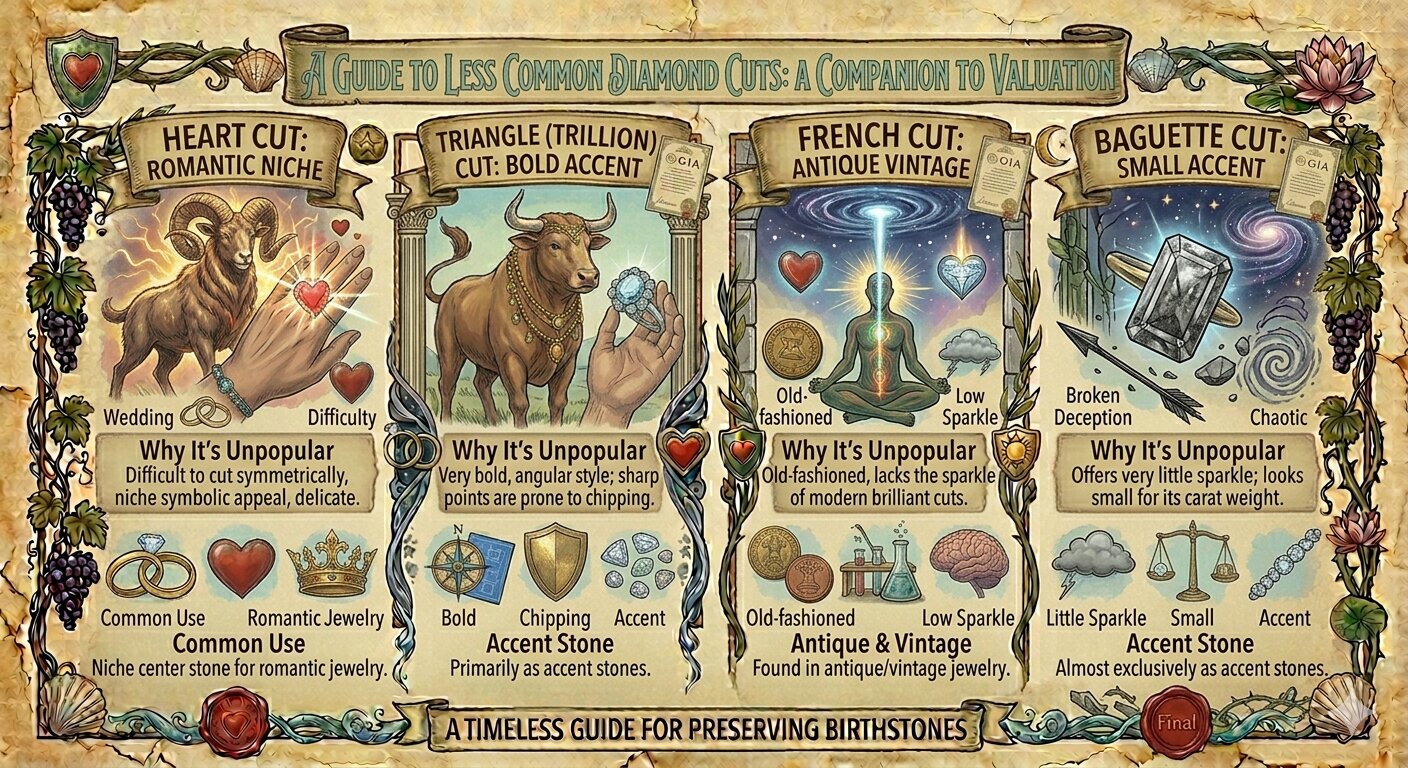
If we're talking about a cut that is sold as a center stone in modern jewelry, the Heart Cut is typically considered the least popular.
However, it's important to remember that "least popular" does not mean "bad." These unique cuts can be the perfect choice for someone seeking a highly individual and distinctive piece of jewelry. A well-cut heart or a striking trillion cut can be a beautiful statement piece for the right person.
What Is The Rarest Diamond Cut?
This is a fascinating topic that goes beyond the usual list of popular shapes. The "rarest" diamond cuts generally fall into two categories: historical cuts that are no longer used and extremely complex modern cuts that are prohibitively difficult to create.
Here’s a breakdown of the rarest diamond cuts, from historical anomalies to modern marvels.
1. The Rarest Historical Cut: The Mazarin Cut
Named after Cardinal Mazarin in the 17th century, this is a pivotal cut in diamond history but is essentially extinct in modern jewelry.
Why it's rare: It was the first true "brilliant" cut, a development from the old Point and Table cuts. It featured a total of 34 facets (including the table and culet), which was revolutionary for its time.
You'll never see it new: The Mazarin cut was quickly superseded by more advanced cuts like the Old Mine Cut and the Peruzzi cut. Any Mazarin-cut diamonds in existence are antique museum pieces, not newly cut stones.
2. The Rarest Modern "Secret" Cut: The Higashi Cut
The Higashi Cut is the rarest of the rare in the contemporary world. It's not a shape, but a specific brand of cut known for its mind-boggling precision.
Why it's rare: The process is incredibly secretive and performed by a single master cutter in New York. The facets are cut to such perfect symmetry and polish that they create an almost "liquid" or metallic effect, with unparalleled brilliance and fire.
The Barrier: Extremely limited production, an intensely laborious process, and a price tag that is many times higher than a standard ideal-cut diamond. It is the pinnacle of the cutter's art.
3. The Rarest Due to Difficulty & Obscurity: The Jubilee Cut
The Jubilee is a stunning round cut, but it is exceptionally rare to find.
Why it's rare: It features 80 facets (40 on the crown, 40 on the pavilion), significantly more than the standard 57-58 of a Round Brilliant. This requires an immense level of skill and time to execute correctly without making the stone look "shattered."
The Result: When done perfectly, it creates an explosion of fire and scintillation. However, because it's so difficult and expensive to cut, and because the market is dominated by the standard Round Brilliant, very few are ever produced.
4. The "Grand Trio" of Complex Modern Rarities
These three cuts are legendary for their facet count and complexity. You will rarely encounter them in a typical jewelry store.
The King Cut (Fantasy Cut): This is a family of cuts, but the most famous version has 145 facets. It's a masterpiece of geometric complexity.
The Magna Cut (Fantasy Cut): Another ultra-complex cut with a facet count often exceeding 100. The goal is to maximize light performance through the sheer number of reflective surfaces.
The 105-Cut "Leo" Diamond: A branded cut designed to have 105 facets, with a specific pattern visible through the table. Its rarity is due to its proprietary and patented nature.
Why Are These Cuts So Rare?
Economic Impossibility: Cutting a stone like a Jubilee or a King Cut requires discarding significantly more of the original rough diamond. The time and skill required are immense, making the final cost astronomical for a stone that may not have a broad market.
Lost Artistry: Cuts like the Mazarin are simply not practiced anymore. The knowledge may exist, but the style is obsolete.
Proprietary Secrecy: Cuts like the Higashi are guarded trade secrets, available only from one source by one master.
Lack of Demand: The market overwhelmingly demands Round Brilliant, Princess, and Oval cuts. There is little commercial incentive for cutters to produce these ultra-rare, complex stones.
Rarest Historical Cut: Mazarin Cut (no longer made, only found in antiques).
Rarest Modern Master Cut: Higashi Cut (a single source, secretive, ultra-precise).
Rarest Due to Complexity: Jubilee, King, and Magna Cuts (prohibitively difficult and expensive to produce correctly).
While a standard Round Brilliant is the most popular for a reason, these rare cuts represent the absolute pinnacle of the diamond cutter's art, pushing the boundaries of what is possible with light and geometry.
What Is The Cheapest Cut Of Diamonds?
The answer isn't as simple as naming a single shape, because the "cheapest" option is a combination of the shape and, more importantly, the cut quality.
However, we can break it down clearly.
The Cheapest Diamond Shape
The cheapest common diamond shape is generally the Round Brilliant Cut.
Wait, what? That seems counterintuitive because it's the most popular and often the most expensive! Here's the crucial distinction:
A well-cut Round Brilliant is the most expensive per carat.
A poorly-cut Round Brilliant is often the cheapest diamond you can find.
Why a poorly-cut round is so cheap:
When cutters have low-quality rough diamond material, they often cut it into a round shape because it's the most forgiving shape to cut quickly and retain weight. However, they sacrifice all the proportions and angles that create sparkle. The result is a diamond that is dull, glassy, and has no life. Because it has such poor performance, its price plummets, making it the "cheapest" option on a per-carat basis.
The Best Value for a Quality Diamond
If you want a diamond that actually looks beautiful but want to maximize your budget, you should look at "Fancy Shapes." These are generally less expensive per carat than a well-cut Round Brilliant because:
Less Waste: They can be cut from rough diamond crystals more efficiently, retaining more of the original carat weight.
Lower Demand: While popular, they don't have the same massive, universal demand as the Round Brilliant.
The best value fancy shapes are typically:
Cushion Cut
Oval Cut
Radiant Cut
Princess Cut (though it's very popular, it's still usually cheaper than a round)
For example, a 1-carat, VS1 clarity, G-color oval diamond with a Very Good cut might cost 20-30% less than a round diamond with the same specs and cut quality.
The Ultimate "Cheapest" Option: Low-Cut Quality in Any Shape
This is the most important takeaway. The single biggest factor that lowers a diamond's price is a poor cut grade. You can find a "cheap" diamond in any shape if you ignore cut quality.
A "Fair" or "Poor" cut grade will always be significantly cheaper than a "Good," "Very Good," or "Excellent" cut grade, regardless of whether it's round, oval, or cushion.
This is a false economy. A poorly cut diamond lacks sparkle and beauty, which is the entire point of owning a diamond. You are paying for a stone that will look dull and glassy.
Summary: How to Find the Cheapest Diamond
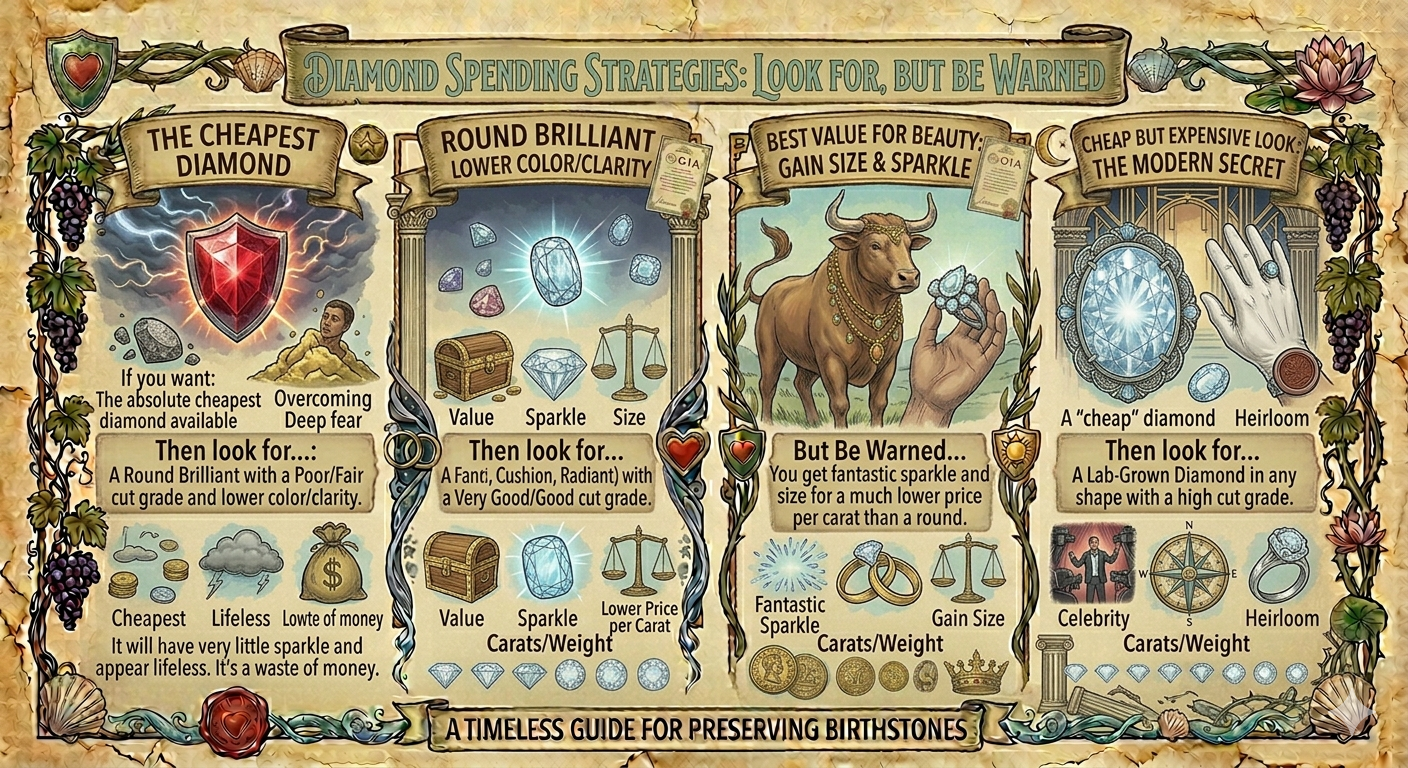
The cheapest cut of diamond is a poorly cut Round Brilliant.
However, the smartest way to save money is to choose a well-cut fancy shape (like an oval or cushion) or to explore lab-grown diamonds, which allow you to prioritize an excellent cut without breaking the bank. Never sacrifice cut quality for a lower price—it defeats the purpose of buying a diamond.
What Is The Most Perfect Cut Diamond?
This question gets to the very heart of what makes a diamond spectacular. The concept of the "most perfect cut" is a blend of precise science and artistic achievement.
The short answer is that the Round Brilliant Cut is universally considered the foundation for the "most perfect" diamond due to its engineered brilliance. However, true perfection is found in a specific grade and level of execution within that cut.
Here’s a detailed breakdown:
1. The Shape: The Round Brilliant Cut
For pure, objective light performance, the Round Brilliant Cut is the undisputed champion.
Why? It is the result of decades of mathematical calculation and optical engineering. Its 57- or 58-facet pattern is specifically designed to maximize light return.
Brilliance (White Light): It reflects more white light to the eye than any other shape.
Fire (Colored Light): Its specific angles are optimized to act as a prism, splitting light into flashes of spectral colors most effectively.
Scintillation (Sparkle): The symmetrical arrangement of facets creates a balanced and lively sparkle pattern.
No other shape has been as scientifically refined for maximum sparkle as the Round Brilliant.
2. The Grade: "Ideal" or "Excellent" Cut
Not all Round Brilliants are created equal. The "most perfect" examples receive the highest grade from gemological laboratories.
GIA (Gemological Institute of America): The top grade is Excellent. A diamond with this grade has been measured and proven to have proportions, polish, and symmetry that place it in the top tier of light performance.
AGS (American Gem Society): The top grade is Ideal (0 on their 0-10 scale). AGS grading is often considered even more stringent on light performance, sometimes using ray-tracing technology to verify it.
A Round Brilliant with a Triple Excellent grade (Cut, Symmetry, Polish) from GIA or an Ideal grade from AGS is as close to "officially perfect" as you can get.
3. The "Ideal" Proportions and Light Performance
The term "Ideal Cut" is often used to describe diamonds cut to specific, historically significant proportions that maximize beauty. While Marcel Tolkowsky's 1919 calculations laid the groundwork, modern ideals have been refined.
The "most perfect" diamonds will have proportions within a very narrow, sweet spot that ensures light is reflected out through the top of the diamond, rather than leaking out the bottom.
Key parameters for a perfect Round Brilliant include:
Table %: 54-57%
Depth %: 59-62.5%
Crown Angle: 34-35 degrees
Pavilion Angle: 40.6-41 degrees
Very Thin to Slightly Thick Girdle
No Culet or Pointed Culet
4. The Pinnacle: "Hearts and Arrows" Diamonds
This is the absolute peak of the "perfect cut." A Hearts and Arrows (H&A) diamond is a Round Brilliant cut to such extreme precision and symmetry that it exhibits a unique optical pattern.
When viewed from the top (crown), you see a perfect pattern of eight symmetrical arrows.
When viewed from the bottom (pavilion), you see a perfect pattern of eight symmetrical hearts.
This effect is only possible when every single facet is perfectly aligned and angled. Hearts and Arrows is a designation beyond a simple "Excellent" grade and represents the highest level of the cutter's art. These diamonds are typically certified by specialized labs and command a significant premium.
The Hierarchy of "Perfection"
Good/Standard Round Brilliant: Nice, has sparkle.
Excellent/Ideal Round Brilliant: Exceptional sparkle, the best choice for most people seeking top quality.
Super-Ideal Round Brilliant (Hearts and Arrows): The absolute pinnacle of cut, with verifiable perfect symmetry and the highest possible light performance. This is the "most perfect cut diamond."
The most perfect cut diamond is a Hearts and Arrows Round Brilliant that holds top grades (like AGS Ideal 0 or GIA Triple Excellent) and exhibits perfect optical symmetry. It represents the ultimate marriage of natural material and human craftsmanship, engineered to produce the most magnificent display of light possible.
For the highest cut grade standards, visit the American Gem Society's AGS Ideal guide.
Which Diamond Cut Do You Love Most?
That's such a wonderful question! While I don't have personal feelings, I can absolutely share the most admired and beloved cuts based on their characteristics and timeless appeal.
If I were to highlight the most celebrated one, it would be the Round Brilliant Cut. It's the undisputed classic for a reason. Its 58-facet design is engineered for maximum fire, brilliance, and scintillation—meaning it sparkles from every angle, more than any other shape. It’s a perennial favorite, holding over 75% of the market for engagement rings.
However, "love" is personal! Other cuts win hearts for their unique personalities:
Oval Cut: Offers the brilliance of a round but with an elongating, flattering effect on the finger. It feels both classic and modern.
Emerald Cut: For those who love elegance and clarity over intense sparkle. Its long, clean step-cut facets create a "hall of mirrors" effect that is sophisticated and timeless.
Cushion Cut: A romantic blend of a square shape with rounded corners and brilliant facets. It has a soft, vintage appeal with lots of fire.
Marquise Cut: Dramatic and regal. Its elongated shape maximizes carat weight, making the stone appear larger, and can beautifully flatter the hand.
Pear Cut: Poetic and unique, combining the sparkle of a round with the elongation of a marquise. It’s a symbol of tears and joy, making it deeply meaningful.
Ultimately, the "best" cut is the one that captures your heart. It's about the interplay of light, the symbolism, and how it reflects the wearer's style.
Do you lean towards timeless brilliance, clean lines, vintage romance, or dramatic shape? That's the real key to finding your match.
Can Diamonds Cut Even The Hardest Glass?
Yes, a diamond can cut almost all types of glass. This is because diamond is the hardest natural material known (rating a 10 on the Mohs scale), while common glass has a much lower hardness rating.
However, your question about the "hardest glass" is insightful. There are special, ultra-hard glass-like materials, such as AM-III, that can scratch the surface of a diamond. This is a unique laboratory creation, not the glass you encounter in everyday life.
How Hardness Determines What Cuts What
The ability to cut or scratch is governed by the Mohs scale of hardness, where a harder material can scratch a softer one.
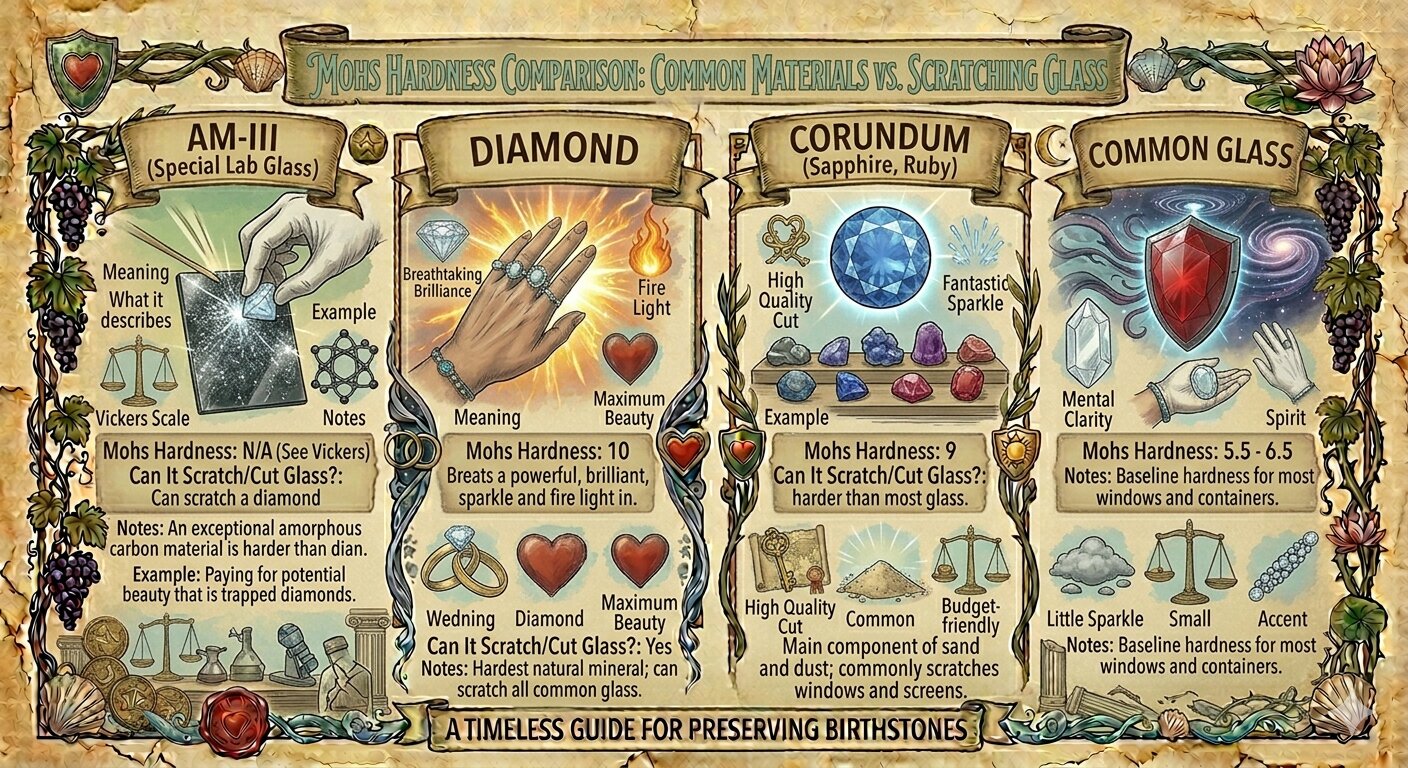
Key Point: Hardness is specifically about scratch resistance, not overall strength. A diamond is hard but can be shattered by a direct impact because it is brittle. Conversely, steel is softer but much tougher.
Practical Applications and Special Cases
Industrial Cutting: Diamonds are commonly used in specialized tools to cut and shape glass, especially for thick or precision work like mosaics.
Advanced "Glasses": Materials like sapphire crystal (used in premium watches) and chemically strengthened glasses (like some phone screens) have higher hardness (up to Mohs 9). While very scratch-resistant, they can still be worked with diamond tools.
The Exception – AM-III: As noted, this lab-created material proves that "glass" isn't always softer. With a Vickers hardness measured at 113 GPa (compared to natural diamond's 70-100 GPa), it inverts the usual relationship.
How to Protect Your Glass from Scratches
To prevent scratches on everyday glass:
Clean gently with soft cloths to avoid grinding dust (which contains quartz) into the surface.
Use protective measures like screen protectors for phones. High-quality tempered glass protectors typically have a hardness of around Mohs 7.
Avoid contact with common harder materials like ceramics, certain metals, and jewelry stones like sapphire or topaz.
In summary, diamond scribe can cut all conventional glass, but the frontier of material science has produced exotic substances that challenge this rule.
If you're curious about the difference between lab-grown and natural diamonds for such industrial uses, I can provide more details on that as well.
“You now know the history, the science, the grades, and the secrets of diamond cuts. The only question left: which cut tells your story?
Our current collection includes a limited number of ‘Hearts and Arrows‘ round brilliants — the rarest cut grade, with perfect optical symmetry. When they‘re gone, sourcing new ones takes months.
This is not just a diamond. It is 600 years of human ingenuity, captured in one stone — forged under pressure, cut with precision, and ready for your forever.”
[Button: Claim a Hearts and Arrows Diamond →]
Back to Complete Gemstone Guide


Other news for Sunday 07 June, 2026
- Princess Cut Diamond Guide: Price, Pros and Cons vs Oval
- Peridot Guide: Meaning, Price, How to Tell Real
View all news for Sunday 07 June, 2026 on one page
News for Saturday 06 June, 2026
- Emerald Cut Diamond Guide: Symbolism, Price, Pros And Cons
- Tanzanite Guide: Value, Colors, vs Sapphire and Buying Tips | December Birthstone
View all news for Saturday 06 June, 2026 on one page
Recent News
- Friday 05 June, 2026
- Thursday 04 June, 2026
- Wednesday 03 June, 2026
- Tuesday 02 June, 2026
- Monday 01 June, 2026