

Excellent Cut Diamond Guide: Meaning, vs Brilliant, vs Ideal
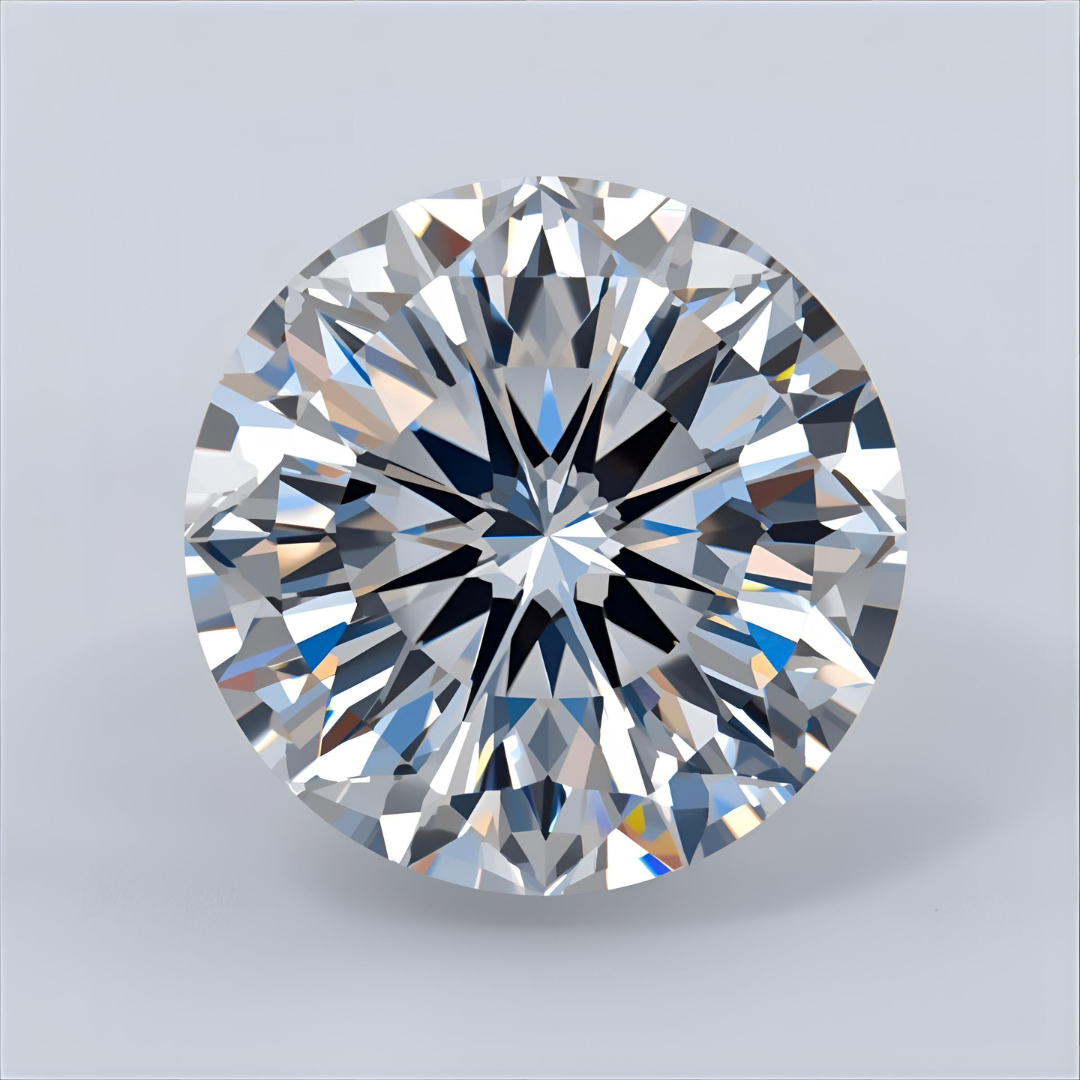
Excellent Cut Diamond Guide: Meaning, vs Brilliant, vs Ideal
This is a crucial question because, as mentioned before, the cut is the most important of the 4Cs. It's what brings a diamond to life.
“In 1919, a young Belgian mathematician named Marcel Tolkowsky sat down to solve a problem that had puzzled jewelers for centuries: what angles would make a diamond reflect the most light? His doctoral thesis, ‘Diamond Design,‘ calculated the precise proportions—34.5 degrees for the crown, 40.75 for the pavilion—that would turn a rough stone into a living fire. The jewelry industry ignored him for decades. Then, in the 1950s, American jewelers rediscovered his work. Today, every GIA ‘Excellent‘ cut diamond—from a 500solitairetoa50,000 engagement ring—follows his math. Tolkowsky didn‘t just cut diamonds. He taught them how to shine.”
The same math that Tolkowsky calculated in 1919 now sparkles on your finger. Every ‘Excellent‘ cut diamond in our collection is GIA-certified—because a diamond that doesn‘t sparkle is just a rock.”*
[Button: Explore Excellent Cut Diamonds →]
Table of Contents
Let's talking topic.
What Does Excellent Cut Mean?
An "Excellent Cut" is the highest grade given for a diamond's proportions, symmetry, and polish. In simple terms, it means the diamond has been cut and shaped to ideal proportions and angles to maximize its interaction with light.
Think of a diamond as a complex series of tiny mirrors. An Excellent Cut means all these mirrors are aligned perfectly to do three things:
Brilliance: The return of white light to your eye. This is the diamond's overall brightness.
Fire: The dispersion of light into the colors of the rainbow (flashes of red, blue, green, etc.).
Scintillation: The sparkle and pattern of light and dark areas that change when the diamond, the light, or the observer moves.
How is "Excellent Cut" Determined?
Gemological labs like GIA (Gemological Institute of America) use sophisticated computer models to analyze a diamond's precise measurements and angles. They evaluate several factors to assign a cut grade:
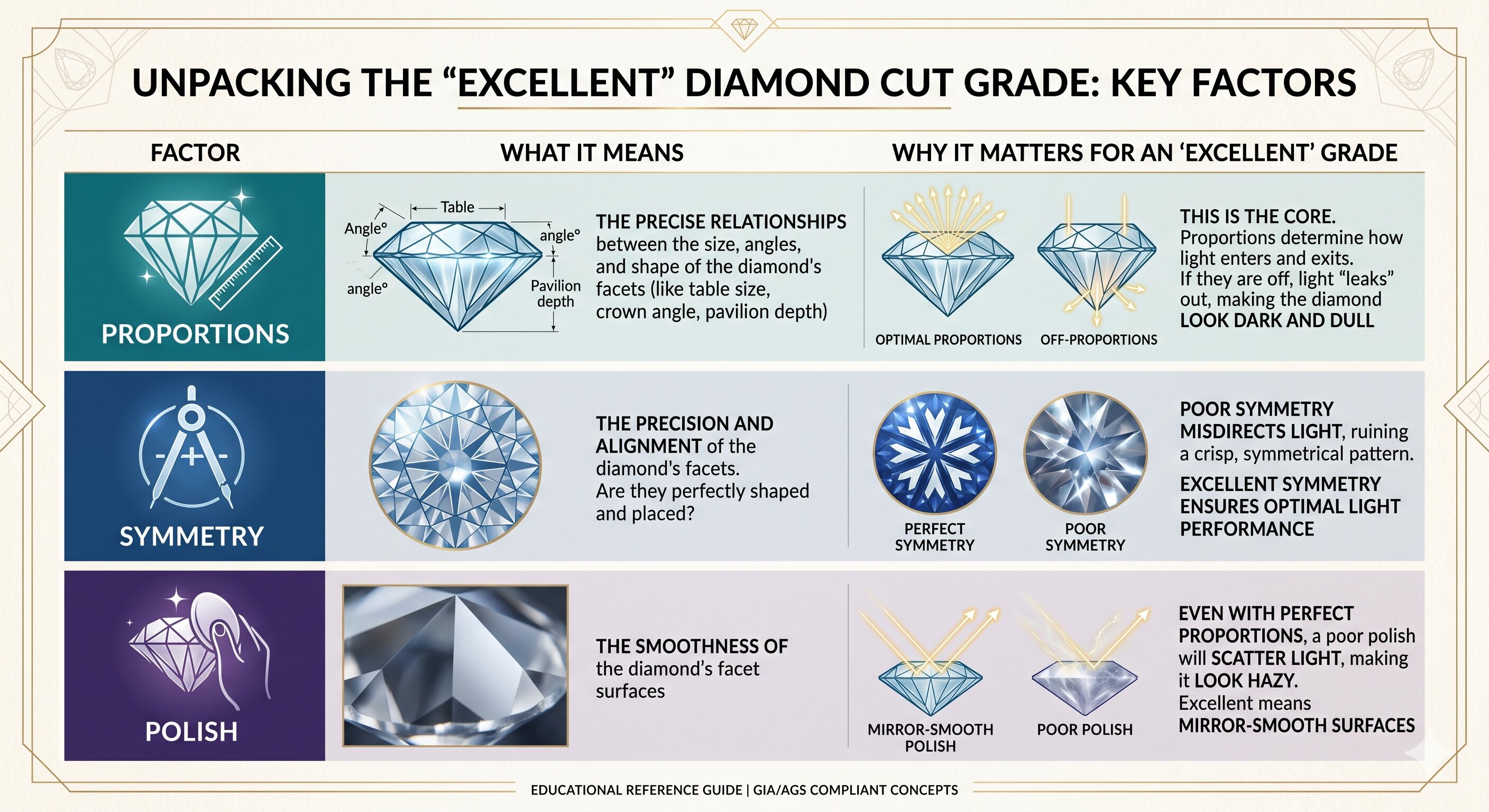
The Result of an Excellent Cut: Superior Light Performance
When all these factors are optimized, the diamond achieves what is known as superior light performance. This is the practical, visual result you see:
High Brilliance: The diamond looks incredibly bright and white.
Abundant Fire: You see clear, colorful flashes even in normal indoor lighting.
Dynamic Scintillation: A lively, captivating sparkle that seems to dance across the stone.
The Alternative: A poorly cut diamond (graded "Good," "Fair," or "Poor") will allow light to escape through its sides or bottom. This creates "light leakage," which results in dead, dark areas in the diamond. A larger, poorly cut diamond will look worse than a smaller, excellently cut one.
Key Labs and Their "Excellent" Terminology
It's important to know that different labs use different terms for their top cut grade.
GIA (Gemological Institute of America): Their top grade is Excellent. This is the most widely recognized and trusted standard in the industry.
AGS (American Gem Society): Their top grade is Ideal (0). AGS is often considered even more stringent than GIA in its cut grading for round brilliants, using a light performance-based system.
A Special Note on "Hearts and Arrows":
This is a phenomenon found in the most precisely cut round brilliant diamonds (often called "Super Ideal"). When viewed with a special tool, you see a perfect pattern of 8 hearts from the bottom and 8 arrows from the top. This is a visual proof of exceptional symmetry and optical precision, and it is the pinnacle of an "Excellent Cut." All Hearts and Arrows diamonds will have an Excellent/Ideal grade, but not all Excellent/Ideal diamonds will show a perfect Hearts and Arrows pattern.
In a Nutshell: What "Excellent Cut" Means for You
When you choose a diamond with an Excellent Cut grade from GIA or an Ideal grade from AGS, you are guaranteed:
The Most Beautiful Diamond for Your Money: It will be the whitest, brightest, and most sparkly version of itself for its color and clarity grade.
Maximized "Wow" Factor: The diamond will perform brilliantly in all lighting conditions, not just under jewelry store spotlights.
A Stone that Hides Color: A well-cut diamond can often face up whiter than its color grade suggests, allowing you to potentially save money on color.
The Best Value: It is almost always wiser to choose a smaller diamond with an Excellent Cut than a larger diamond with a poorer cut. The sparkle is what people notice, not the millimeter difference in size.
An "Excellent Cut" is not just a grade on a report; it's the definitive factor that transforms a piece of crystallized carbon into a breathtaking, fiery, and brilliant jewel. Never compromise on cut quality.
For official diamond cut grading information, visit the GIA Diamond Cut Guide.
Is A Brilliant Or Excellent Cut Better?
This is a very common point of confusion because the terms sound similar but refer to different concepts.
Here’s the short answer:
"Excellent Cut" is better. It is a quality grade, while "Brilliant Cut" is a style or shape.
You are comparing a specific rating of quality ("Excellent") to a general category of design ("Brilliant"). The most accurate and helpful way to think about it is:
A "Brilliant Cut" diamond can have a cut quality that is Excellent, Good, Fair, or Poor.
Let's break this down.
Brilliant Cut: The Style
What it is: A cutting style. It refers to the specific pattern and arrangement of facets, designed to maximize sparkle.
The most common example: The Round Brilliant is the most popular diamond shape in the world. When people say "Brilliant Cut," they are often referring to this round shape.
Other examples: The "Brilliant" style can also be applied to other shapes, like the Oval Brilliant, Cushion Brilliant, or Pear Brilliant. The key feature is a large number of triangular and kite-shaped facets arranged to create maximum light return.
In short: "Brilliant" describes the design blueprint.
Excellent Cut: The Quality
What it is: A quality grade assigned by a gemological lab (like GIA). It is the highest rating for how well a diamond's proportions, symmetry, and polish are executed.
What it means: A diamond with an "Excellent" cut grade has been cut to ideal proportions. This means light enters the diamond, reflects off the internal facets, and returns out through the top as maximum brilliance and fire. Very little light leaks out of the bottom.
The Grading Scale: For a round brilliant diamond from GIA, the scale is: Excellent > Very Good > Good > Fair > Poor.
In short, "Excellent" is the performance rating of how well that blueprint was followed.
The Analogy: A Sports Car
Think of it like evaluating a sports car:
"Brilliant Cut" is like saying, "It's a two-door coupe." This describes the body style.
"Excellent Cut" is like saying, "It has a perfect 5-star safety rating and handles flawlessly on the track." This describes the quality of its engineering and performance.
You can have a two-door coupe (Brilliant Cut) that is poorly engineered and performs terribly (Poor Cut). The best choice is a two-door coupe that is perfectly engineered (Brilliant Cut with an Excellent Cut grade).
Which Should You Choose?
Your goal is to find a diamond where both the style and the quality are right for you.
Choose the "Brilliant Cut" Style if: You want the classic, round diamond known for its unparalleled sparkle and fire. It is the most researched and optimized shape for light performance.
Prioritize the "Excellent Cut" Grade (for Round Diamonds): If you have chosen a round brilliant diamond, you should almost always prioritize an "Excellent" cut grade. It is the single most important factor in making your diamond beautiful. A smaller "Excellent" cut diamond will look more stunning than a larger "Good" or "Fair" cut diamond.
Don't think of it as "Brilliant vs. Excellent." They are not competing terms. Instead, look for a diamond that is a Brilliant Cut (the style) with an Excellent cut grade (the quality). This combination will give you the most brilliant, fiery, and sparkling diamond possible.
For Round Brilliant Diamonds, the ideal choice is: GIA "Excellent" Cut.
Is Excellent Cut Better Than Ideal?
This is a common point of confusion because both terms sound like the top rating, and the answer is nuanced.
In short, for round brilliant diamonds, "Ideal" and "Excellent" are both top-tier grades, but they come from different labs with slightly different grading philosophies. One is not universally "better" than the other; they are simply different.
However, the term "Ideal" can be misused by marketers, so context is everything.
Let's break it down clearly.
The Lab Matters Most
The key to understanding this is to know which gemological laboratory issued the grade.
1. GIA's "Excellent" Cut Grade
The Standard: The Gemological Institute of America (GIA) is the most widely recognized and trusted grading lab in the world.
Their Top Grade: For round brilliant diamonds, GIA's highest cut grade is "Excellent."
The GIA Philosophy: GIA's cut grading system is based on extensive research into how a diamond's proportions affect its face-up appearance. It's a robust, practical system that guarantees a stunning diamond. A GIA "Excellent" grade is the industry benchmark for a top-quality cut.
2. AGS's "Ideal" Cut Grade
The Precision Leader: The American Gem Society (AGS) is another highly respected lab, known for being even more stringent in its cut grading for round brilliants.
Their Top Grade: AGS's highest cut grade is "Ideal" (represented by a score of 0 on their 0-10 scale, where 0 is best).
The AGS Philosophy: The AGS system uses a more complex, mathematical model that includes light performance analysis. To achieve an AGS "Ideal" grade, a diamond must have proportions and optical symmetry that fall within a very narrow, scientifically calculated range.
So, Which is Actually "Better"?
It depends on what you're looking for.
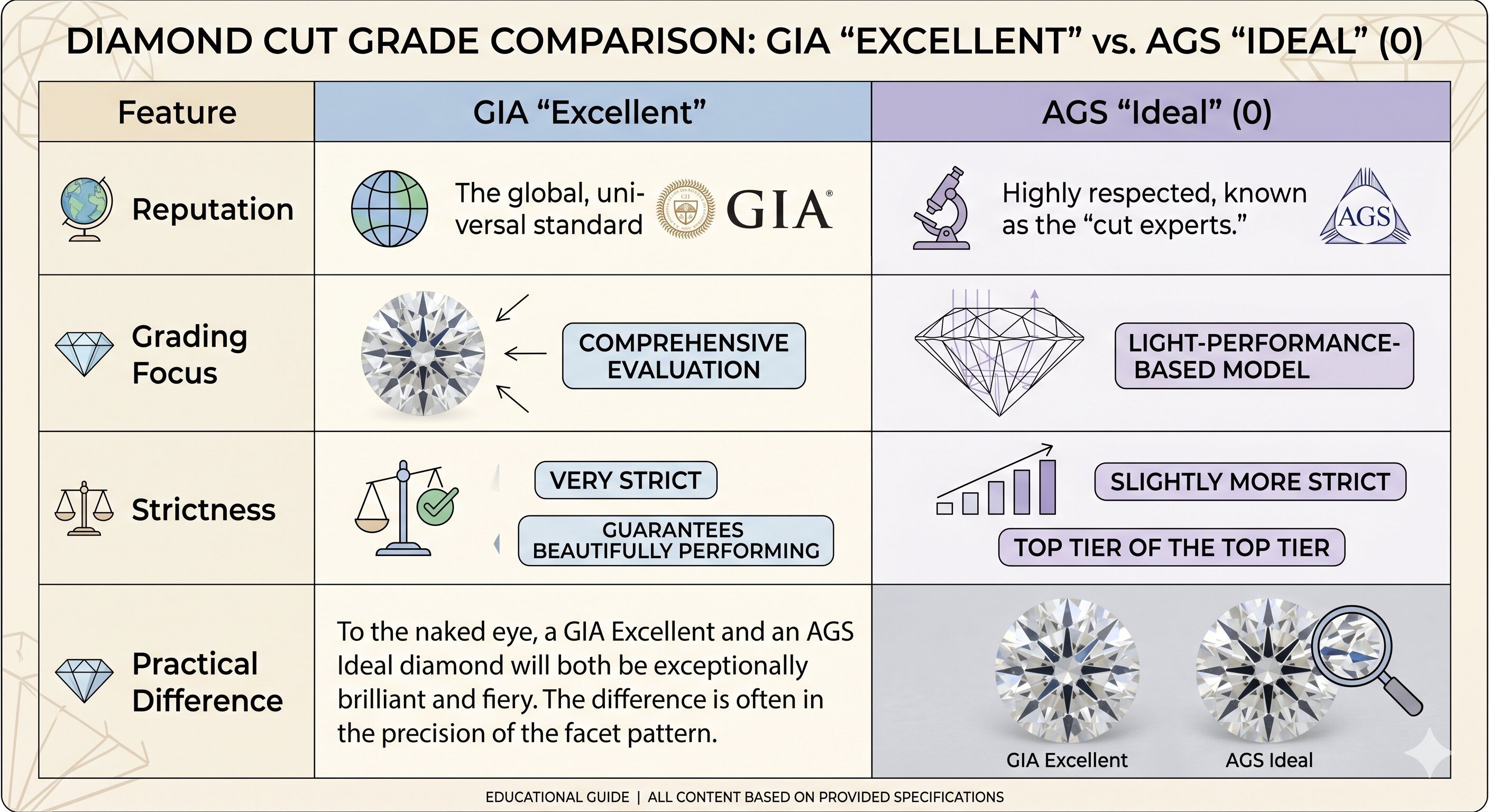
The General Consensus:
An AGS Ideal (0) grade is often considered the absolute pinnacle of the cutter's art for round brilliants, representing the most precise and mathematically perfect stones.
A GIA Excellent grade represents a diamond that is guaranteed to be stunningly beautiful and is the most widely accepted and trusted top-tier grade.
In practical terms, you cannot go wrong with either. The visual difference between them is often negligible to anyone but an expert gemologist with specialized tools.
The Big Caveat: Uncertified "Ideal" Grades
This is the most important part of your question. Many online retailers and jewelers use their own, in-house terms like "Ideal," "Super Ideal," or "Signature Ideal." These are not the same as an AGS Ideal grade.
If a diamond is graded by GIA as "Excellent," you know exactly what you're getting.
If a diamond is graded by AGS as "Ideal," you know exactly what you're getting.
If a diamond has no AGS report but is simply described by a store as "Ideal Cut," you should be cautious. This is a marketing term, and its meaning can vary widely.
Prioritize the Lab Report: Always choose a diamond with a grading report from a top lab like GIA or AGS. This removes the guesswork and marketing hype.
For a Round Brilliant Diamond:
You are perfectly safe and will get a magnificent stone with a GIA "Excellent" cut grade.
If you are a perfectionist and want the most scientifically precise cut available, seek out an AGS "Ideal (0)" grade.
The True "Best": Many of the finest cut diamonds in the world, often called "Hearts and Arrows" diamonds, will typically hold both a GIA Excellent grade and demonstrate the perfect optical symmetry that qualifies them as "Ideal" by performance standards.
Neither is objectively "better." They are the top grades from two different, highly respected labs. Your goal is to buy a diamond with a top cut grade from a reputable lab, and both GIA Excellent and AGS Ideal fulfill that goal perfectly.
Is Brilliant Cut The Same As Excellent?
No, "Brilliant Cut" is not the same as "Excellent."
This is a very common point of confusion. They describe two completely different aspects of a diamond.
To put it simply:
Brilliant Cut refers to the style and design of the cut.
Excellent refers to the quality and execution of the cut.
Let's break this down with an analogy.
The Chef Analogy
Imagine you are ordering a cake.
"Brilliant Cut" is like specifying the type of cake you want—for example, a "Chocolate Fudge Cake." It describes the recipe and the ingredients used.
"Excellent" is like the food critic's rating of that cake. A chocolate cake can be rated as "Excellent," "Good," or "Poor" based on how well the chef made it.
You can have a chocolate cake ("Brilliant Cut") that is baked poorly and tastes terrible ("Poor" cut). The best combination is a chocolate cake that is baked to perfection ("Excellent" cut).
Detailed Breakdown
What is a Brilliant Cut?
It's a Style: The Brilliant Cut is a specific pattern of facet arrangements designed to maximize light return, creating sparkle (brilliance and fire).
The Most Common Example: The Round Brilliant is the most popular diamond shape in the world. When people say "Brilliant Cut," they are often referring to this round shape.
Other Shapes: The brilliant style of faceting is also used for other shapes like the Oval Brilliant, Cushion Brilliant, and Pear Brilliant.
In short, "Brilliant" describes the blueprint or design.
What is an Excellent Cut?
It's a Quality Grade: "Excellent" is the highest cut grade awarded by gemological labs like the GIA (Gemological Institute of America) for how well a diamond has been cut from its rough crystal.
It Measures Performance: This grade means the diamond's proportions, symmetry, and polish are optimized to allow light to enter, reflect internally, and return out through the top as maximum sparkle. An "Excellent" cut diamond has very little light leakage.
It's on a Scale: The cut grade scale for a round brilliant diamond from GIA is: Excellent > Very Good > Good > Fair > Poor.
In short, "Excellent" is the performance rating of how well that blueprint was executed.
The Relationship Summarized
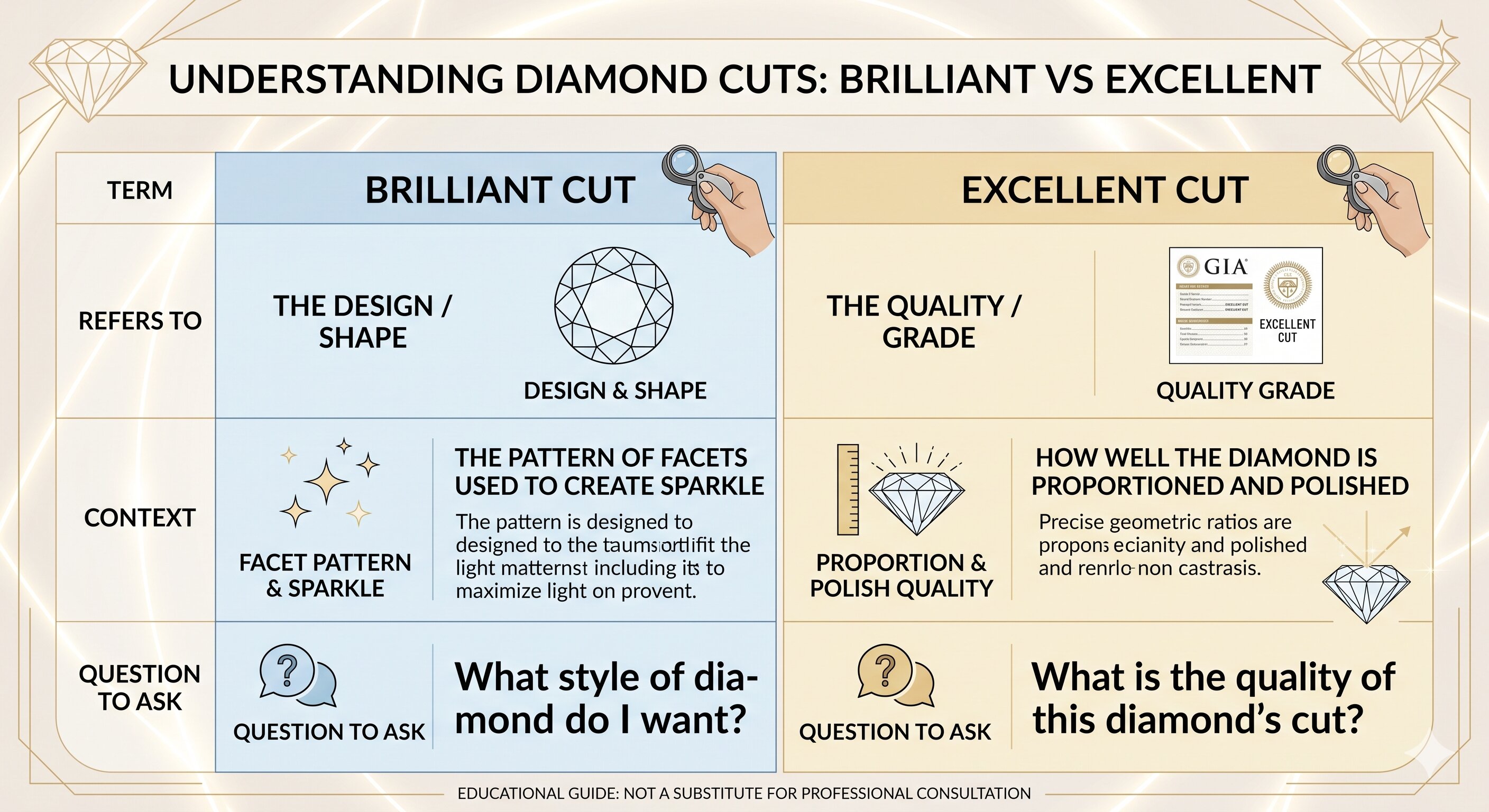
A diamond can be a Brilliant Cut (the design) and have a cut quality that is Excellent, Very Good, Good, Fair, or Poor.
Your goal is not to choose between them, but to find a diamond that is both:
A Brilliant Cut (the style you want) with an Excellent cut grade (the quality you deserve).
For the most sparkle and beauty, always prioritize the Excellent cut grade from a reputable lab like GIA.
Is An Excellent Cut Always The Best?
That's an excellent and logical follow-up question. The answer is nuanced:
In terms of a certified quality grade, "Excellent" is the best grade you can get from a lab like GIA for a round brilliant diamond. However, whether it's the best choice for you depends on your priorities, budget, and the type of diamond you're buying.
Here’s a breakdown of when "Excellent" is the undisputed best, and when you might consider other options.
When "Excellent Cut" is Unquestionably the Best
For Round Brilliant Diamonds: For this shape, the cut grade is a scientific measure of light performance. A GIA "Excellent" grade guarantees the highest level of brilliance, fire, and scintillation. There is no higher grade. If your goal is the most sparkly round diamond possible, then yes, "Excellent" is the best.
When Maximizing Sparkle is Your Top Priority: If you value optical performance above all else, an Excellent cut is the single most important factor. It can even make a diamond with a lower color or clarity grade look more brilliant and white.
For Investment or Heirloom Pieces: For a diamond you plan to keep for generations, starting with the highest certified quality (especially in cut) is a sound decision.
When "Excellent" Might NOT Be the Best Choice For You
When Budget is a Major Factor: This is the most common scenario. The price jump from a Very Good cut to an Excellent cut can be significant. A GIA "Very Good" cut diamond is still a fantastic stone and will look incredibly beautiful to the naked eye. For many people, the slight visual difference is not worth the extra cost, allowing them to allocate more budget to carat size or clarity.
For Fancy Shapes (Oval, Cushion, Pear, etc.): This is a critical point.
GIA does not give a single overall "Cut Grade" for fancy shapes. They only grade Polish and Symmetry.
Other labs (like AGS) do grade fancy cuts, but the standards are different.
Therefore, you cannot simply shop for an "Excellent" oval. You have to rely on the diamond's proportions, light performance images (like an ASET or Idex map), and most importantly, your own eyes, by viewing videos and images. A fancy shape can be cut to phenomenal proportions without having an "Excellent" label from GIA.
When You Find a "Ideal" Cut Diamond: As discussed earlier, an AGS "Ideal" grade is a top-tier competitor to GIA's "Excellent." Many experts consider AGS Ideal to be the absolute pinnacle for round brilliants. So, in this case, "Excellent" is not the "best"; "Ideal" is.
If the "Excellent" Grade Comes from a Less Reputable Lab: Some labs are known for "grade inflation," where their "Excellent" is equivalent to a GIA "Good." Always prioritize the lab (GIA or AGS) over the grade itself.
The Practical Verdict
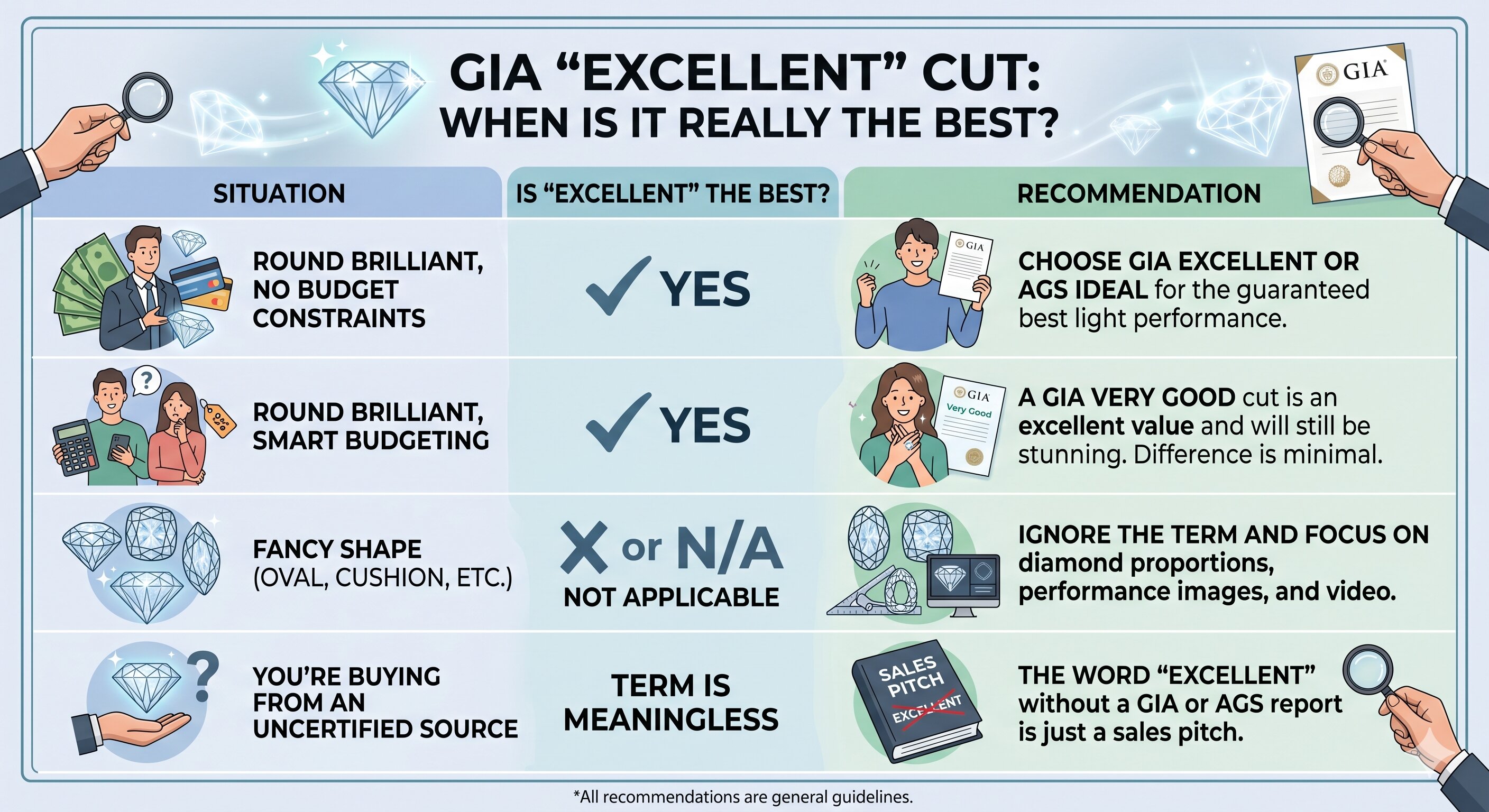
Think of it like this: Is the top trim level of a car always the best? It has the best performance and all the features, but it's also the most expensive. For many drivers, a mid-level trim offers 95% of the experience at a much better price.
For a round brilliant, an "Excellent" cut is the benchmark for the best possible sparkle.
But the "best" diamond for you is the one that delivers the most beauty and satisfaction for your personal budget and taste. Sometimes, that's a "Very Good" cut that lets you get a slightly larger stone, and sometimes it's absolutely worth it to hold out for the pinnacle of "Excellent" or "Ideal."
Is Excellent Cut Good Enough?
An Excellent cut is not just "good enough"—it is the sweet spot for anyone seeking a stunning, high-performance diamond without venturing into the realm of diminishing returns.
Here’s a detailed breakdown of why an Excellent cut is more than sufficient and is often the smartest choice.
1. It Guarantees Top-Tier Beauty and Performance
A GIA "Excellent" cut grade is not a compromise; it's the highest rating for light performance from the most respected lab in the world. A diamond with this grade is engineered to:
Reflect maximum light (brilliance).
Produce vibrant flashes of color (fire).
Create a dynamic sparkle when moved (scintillation).
To the naked eye, a diamond with an Excellent cut will be breathtakingly sparkly and bright. You are guaranteed a diamond that performs brilliantly in all lighting conditions.
2. It Represents the "Sweet Spot" of Value
This is the most practical reason why an Excellent cut is "good enough" for most buyers. The jump in quality and price typically follows this pattern:
Good -> Very Good: A significant improvement in sparkle for a moderate price increase. Good value.
“In 2015, a young couple walked into a New York diamond district store with a $10,000 budget. The salesman showed them a 1.2-carat diamond with a ‘Very Good‘ cut—decent sparkle, good size. Then he showed them a 0.9-carat diamond with an ‘Excellent‘ cut. The smaller diamond was smaller. But when he put it under the light, the couple gasped. The sparkle was not 30% better. It was 300% better. They bought the smaller stone. Ten years later, she still stares at her ring. ‘No one has ever asked me the carat weight,‘ she said. ‘Everyone asks, ‘How does it sparkle so much?‘ That is the power of an Excellent cut.”
Very Good -> Excellent: A noticeable but smaller refinement in performance for a larger price jump. You're paying for the top tier.
Excellent -> "Ideal" (Super-Ideal/Hearts & Arrows): A minuscule, often microscopic, improvement in optical symmetry for a very large price premium. This is the realm of diminishing returns.
For 99% of people, the visual difference between an Excellent cut and a more expensive "Super Ideal" cut is impossible to perceive without a special magnifying tool. You pay a lot more for that last 1% of perfection, but you don't see it in everyday life.
3. It's the Highest Grade for a Reason
GIA's "Excellent" category isn't a broad bucket. It's a carefully calibrated grade reserved for diamonds that hit a specific range of proportions and angles that science has shown produce the best light return. It's not "almost the best"; it is the best grade they offer.
When Might You Look Beyond "Excellent"?
There are only a few niche scenarios where you might consider something else:
Strict Budget: If your budget is extremely tight, a Very Good cut diamond can be a fantastic value. It will still be very sparkly, and the savings can be substantial. This is the only real "step down" worth considering.
The Pursuit of Ultimate Precision: If you are a perfectionist and the idea of having the most mathematically precise diamond matters to you more than the cost, then you might seek out an AGS "Ideal" (0) grade or a branded "Hearts & Arrows" diamond. But remember, you are paying for an idea and a certificate, as the visual difference is negligible.
Is An Excellent Cut Good Enough?
Absolutely yes. For the vast majority of diamond shoppers, an Excellent cut is the ultimate goal, not just a "good enough" compromise.
It represents the perfect balance of:
Guaranteed top-tier sparkle and beauty.
Strong value relative to the more expensive, hyper-specialized grades.
Universal recognition and trust from the GIA certification.
Conclusion: Do not feel like you are settling if you choose an Excellent cut. You are making a brilliant and informed decision to get one of the most beautiful diamonds available.
“You now know the definition, the brilliant vs. excellent debate, the ideal vs. excellent comparison, the brilliant cut clarification, the ‘always best‘ nuance, and the ‘good enough‘ verdict. The only question left: will you trust Tolkowsky‘s math?
*Our current collection includes a limited number of GIA-certified Excellent cut diamonds — from modest 0.5-carat stones to stunning 2-carat centerpieces. When stones with Excellent cut grades are gone, sourcing new ones with ideal proportions takes time.*
This is not just a diamond. It is Marcel Tolkowsky‘s 1919 math, GIA‘s highest grade, and 100 years of proof that a smaller diamond with perfect angles sparkles brighter than a larger stone with light leakage. Size is not sparkle. Science is.”
[Button: Claim Your Excellent Cut Diamond (Limited) →]


Other news for Tuesday 16 June, 2026
- Teardrop Diamond Guide: Meaning, Price, vs Round and Wearing Direction
- Vintage Rings Guide: Styles, Identification, Pros and Cons
- Diamond 4Cs Guide: Cut,Color,Clarity,Carat,Prices and Buying Tips
- Three-Stone Engagement Rings: The Ultimate Buying Guide
- Morganite Guide: Meaning, Price, vs Diamond, Colors and Care
- Gold Plated Jewelry Guide: Care, Durability, vs Solid Gold and Buying Tips
- Titanium Jewelry Guide: Pros, Cons, vs Gold, Price and Care
- Art Deco Jewelry: History, Value and How to Identify Authentic Pieces
View all news for Tuesday 16 June, 2026 on one page
News for Monday 15 June, 2026
- Asscher Cut Guide: Complete Guide to Square Emerald Cut Diamonds
- Classic Cut Guide: Old Mine vs Old European vs Modern Round
- Marquise Cut Guide: Price, Size Illusion, vs Oval and Buying Tips
- Pavé Setting Guide: Pros, Cons, Cost, Security and Channel/Bezel
- Radiant Cut Guide: Price, vs Emerald, 1ct, 3ct Cost, Sparkle and Tips
- Vintage Cut Guide: Old Mine vs Old European vs Rose Cut
- Heart-Shaped Diamond Guide: Meaning, Price, 2ct Cost and Buying Tips
View all news for Monday 15 June, 2026 on one page
Recent News
- Sunday 14 June, 2026
- Saturday 13 June, 2026
- Friday 12 June, 2026
- Thursday 11 June, 2026
- Wednesday 10 June, 2026