

Titanium Jewelry Guide: Pros, Cons, vs Gold, Price and Care
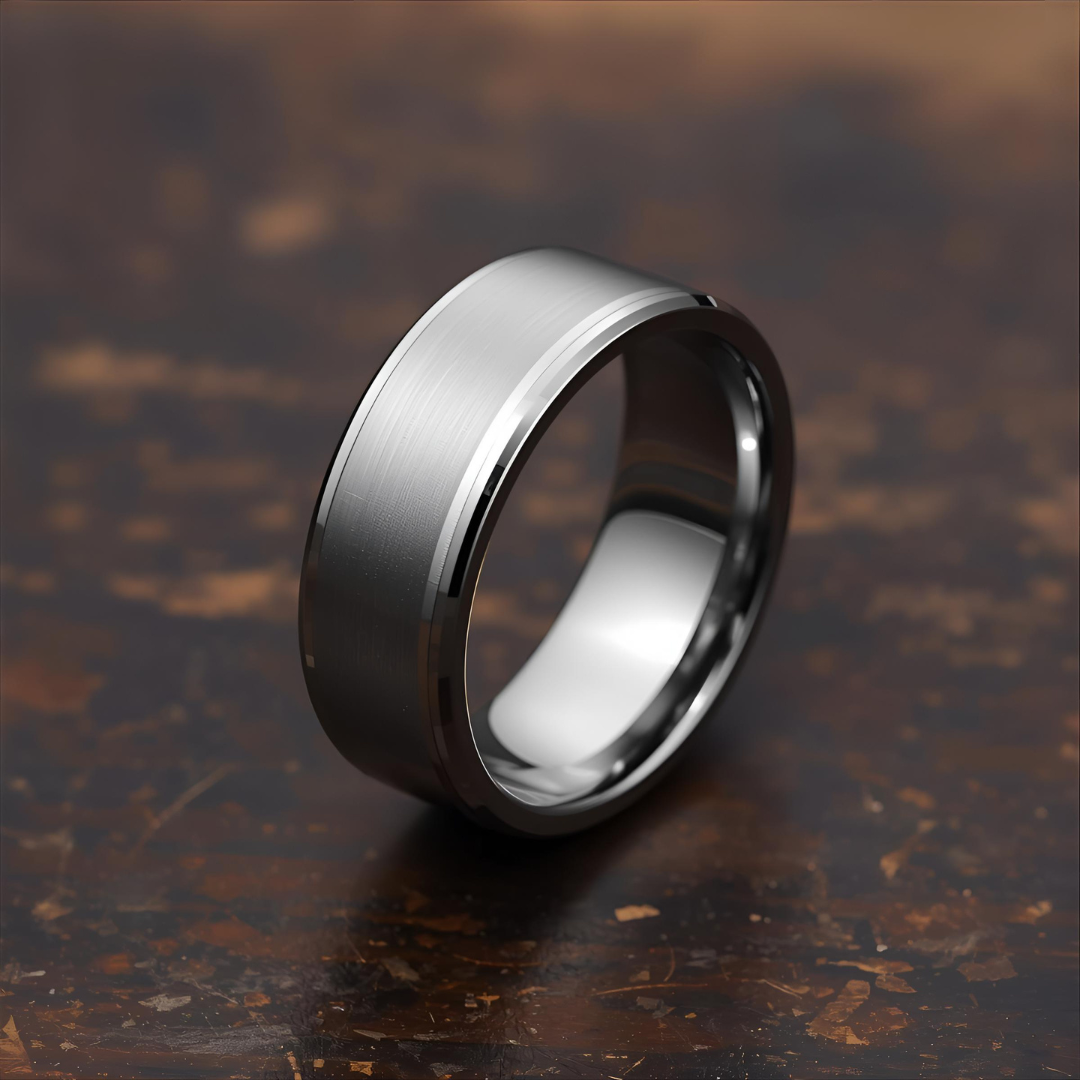
Titanium Jewelry Guide: Pros, Cons, vs Gold, Price and Care
Titanium is a modern, high-performance metal that has become a mainstream choice for jewelry, especially for wedding bands and casual wear.
“In 1940, a chemist named William Kroll perfected a process to extract pure titanium from its ore. His method is still used today. But before Kroll, titanium was a laboratory curiosity—too difficult to refine, too expensive to use. Then came the Cold War. The U.S. needed lightweight, heat-resistant metal for spy planes and submarines. Titanium became the secret metal of the military. By the 1990s, the Cold War was over, but titanium had a new mission: wedding bands for men who worked with their hands, women with metal allergies, and couples who wanted rings that could survive anything. Titanium is not precious. It is indestructible. That is a different kind of wealth.”*
The same metal that built Cold War spy planes now awaits your finger — lightweight, indestructible, and hypoallergenic. Every titanium ring in our collection features a safety groove for medical emergencies, because strength should never become a trap.”
[Button: Explore Titanium Jewelry →]
Its popularity stems from a unique combination of properties that set it apart from traditional precious metals.
Table of Contents
Here begins the first topic.
Is Titanium Good Quality For Jewelry?
The short answer is yes, titanium is an exceptionally good quality material for jewelry, but it has some unique characteristics that make it perfect for some people and less ideal for others.
Here’s a detailed breakdown of titanium's qualities for jewelry:
The Advantages (Why Titanium is Great)
Incredible Strength and Durability:
Titanium is extremely strong, rivaling the strength of many steels. This makes it highly scratch-resistant and durable. Jewelry made from titanium, especially rings, can withstand daily wear and tear without showing signs of damage easily. It's very difficult to bend or break.
Hypoallergenic:
This is one of its biggest selling points. Titanium is biocompatible, meaning it's non-reactive with the human body. It's an excellent choice for people with metal allergies, particularly to nickel, which is common in some gold and white gold alloys. It's often used for medical implants for this very reason.
Lightweight:
Despite its strength, titanium is about 45% lighter than stainless steel and significantly lighter than gold or platinum. This makes large statement pieces or wide-band rings surprisingly comfortable to wear.
Corrosion-Resistant:
It is highly resistant to tarnish and corrosion. It won't rust or turn your skin green. It can withstand exposure to salt water, chlorine, and everyday chemicals, making it ideal for people with active lifestyles or who work with their hands.
Modern Aesthetic:
Titanium has a naturally sleek, dark charcoal-grey color. However, through anodization, it can be electrochemically treated to create a vibrant, permanent array of colors without using dyes or plating. These colors (like blue, purple, gold, and green) are integral to the metal's surface and won't chip or fade.
The Disadvantages (Considerations & Limitations)
Difficulty in Resizing:
This is the most significant drawback. Due to its hardness and strength, titanium is very difficult to resize. Special equipment and expertise are required, and it's often not possible for complex designs. It's crucial to be sure of your ring size when purchasing a titanium ring.
Cannot Be Soldered Easily:
Similar to resizing, repairing a titanium ring (like fixing a shank) is challenging. In many cases, it cannot be traditionally soldered and may require laser welding, which not all jewelers are equipped to do.
Color Limitations:
While the natural grey and anodized colors are beautiful, titanium will never have the classic, warm yellow luster of gold or the bright white sheen of platinum. If you are specifically looking for that traditional precious metal look, titanium is not the right choice.
Perceived Value:
Titanium is not a precious metal. Its value is in its properties, not its material cost. It is generally much less expensive than gold or platinum. While this is a "pro" for your wallet, some people prefer the intrinsic value and status associated with traditional precious metals.
Setting Stones:
Because it's so hard, setting stones into titanium requires more skill and specialized tools. Prong settings are possible, but bezel or tension settings are often more secure and common.
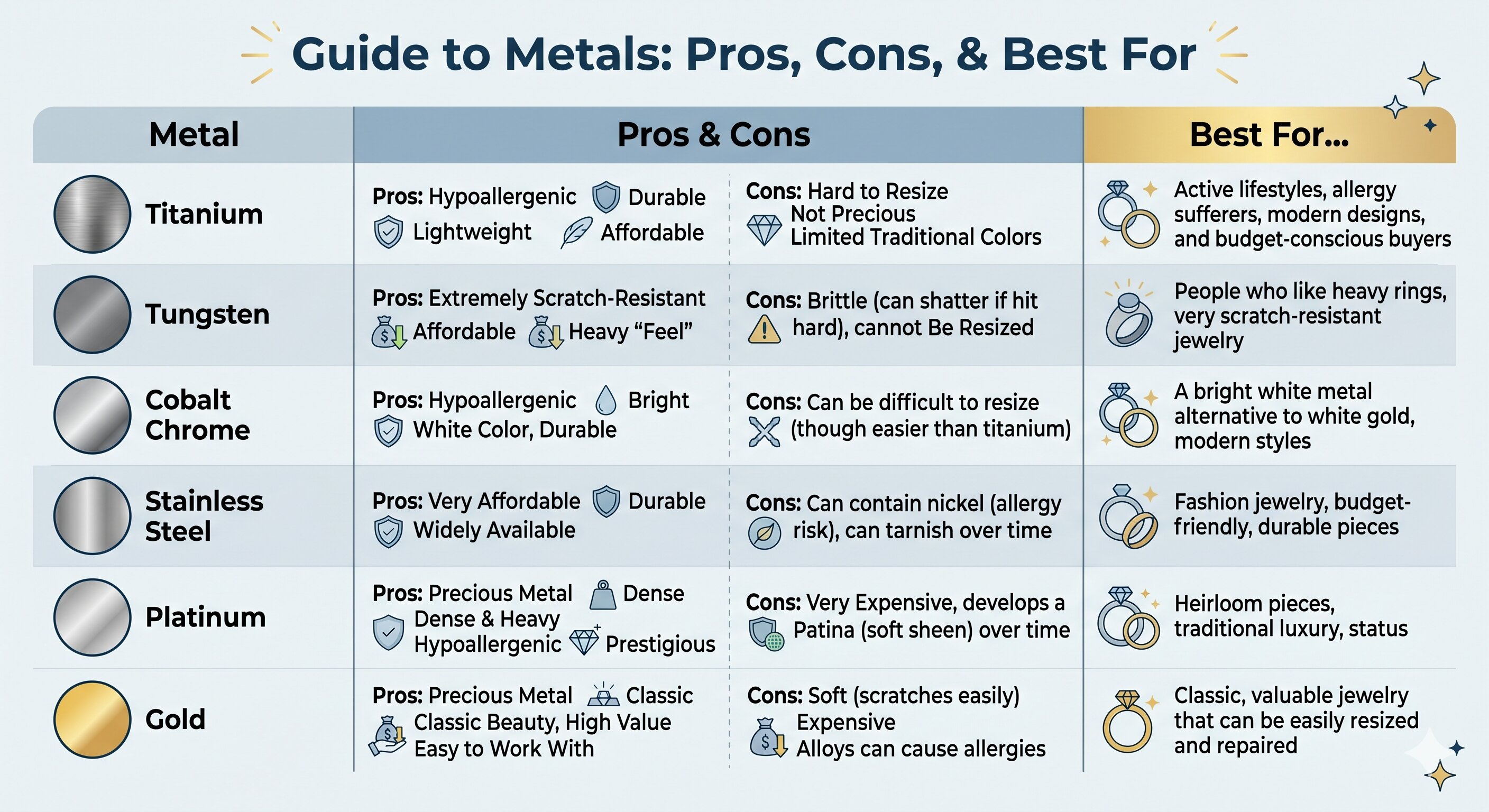
Comparison with Other Metals
Is Titanium Good Quality for You?
Titanium is an excellent quality choice if you:
Have sensitive skin or metal allergies.
Lead an active life and need a durable, low-maintenance piece of jewelry.
Want a lightweight and comfortable piece, especially for larger rings.
Prefer a modern, contemporary look (either the natural grey or vibrant colors).
We are working with a budget but want a high-performance material.
You might want to consider a different metal if you:
Anticipate needing to resize your ring in the future.
Prefer the classic look and intrinsic value of traditional precious metals like gold or platinum.
Want a ring that can be easily and traditionally repaired by any jeweler.
In short, titanium's quality is in its performance and comfort, not its precious metal status. It's a fantastic, modern material that solves many of the problems associated with traditional jewelry metals.
Learn more about titanium's properties on Wikipedia's titanium page.
Is Titanium Or 14k Gold Better?
The answer isn't straightforward because titanium and 14k gold are fundamentally different materials that excel in different areas. One isn't universally "better" than the other; the best choice depends entirely on your priorities.
Let's break down the comparison to help you decide.
Quick Summary: The Core Difference
14k Gold is a precious metal. Its value is in its tradition, beauty, prestige, and intrinsic material worth.
Titanium is an industrial/performance metal. Its value is in its extreme durability, comfort, and modern aesthetic.
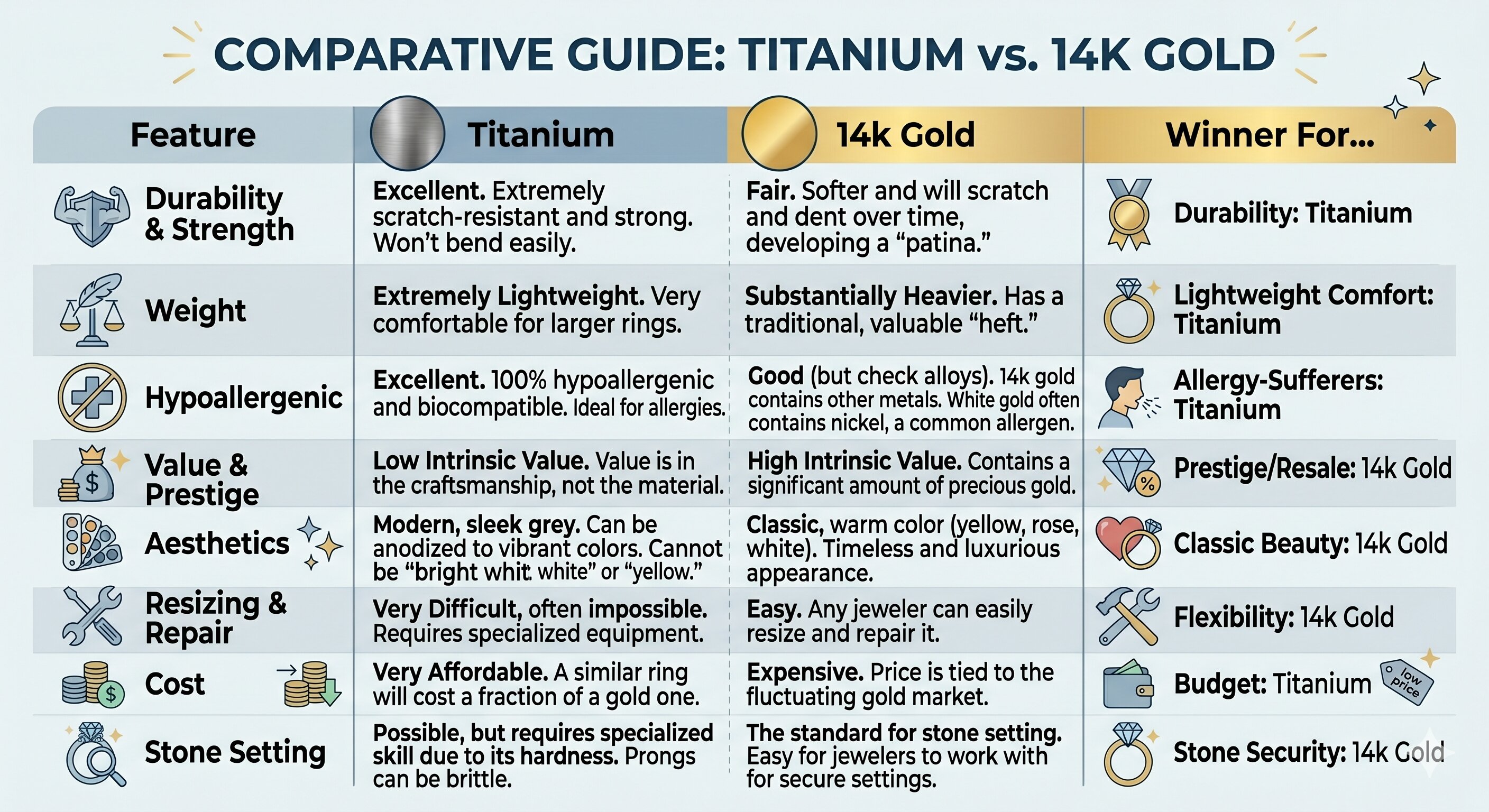
Head-to-Head Comparison
Who Should Choose Which?
Choose Titanium if:
You have an active lifestyle: You work with your hands, play sports, or travel frequently.
You have metal allergies: It's the safest bet for sensitive skin.
You want ultimate comfort: You dislike the heavy feel of metal or want a wide band.
You prefer a modern, industrial, or colorful look.
You are on a budget but want a very durable and high-quality ring.
You are certain of your ring size and don't anticipate needing a resize.
Ideal for: Wedding bands for active people, casual everyday wear, statement pieces with color, and anyone with sensitivity issues.
Choose 14k Gold if:
You value tradition and prestige: You want a classic, recognized symbol of value and luxury.
You want a timeless, warm color (yellow, rose, or white gold).
The piece holds significant value (e.g., an engagement ring or family heirloom).
You want the flexibility to resize or repair the piece easily in the future.
The jewelry has important stones that need a secure and traditional setting.
You appreciate the "heft" and feel of a precious metal.
Ideal for: Engagement rings, classic wedding bands, fine jewelry, heirlooms, and pieces where emotional and traditional values are key.
Special Case: The Best of Both Worlds?
Sometimes, the choice isn't either/or. Some jewelers create rings with a titanium core for strength and comfort and a 14k gold exterior layer for the classic, precious look. This is a great compromise if you can't decide.
There is no single "better" option. It's about what's better for you.
Prioritize durability, comfort, and a modern look? → Titanium is your best choice.
Prioritize tradition, prestige, and long-term value? → 14k Gold is your best choice.
Think about how you live your life, the style you love, and what you want this piece of jewelry to represent. That will make the right answer clear.
Is Titanium Jewelry Cheap?
The answer is yes, titanium jewelry is generally inexpensive in terms of its initial purchase price, but it is absolutely not "cheap" in terms of quality.
The word "cheap" can mean two things:
Low Cost (what you pay for it)
Poor Quality (badly made or low-value)
Let's break down why titanium fits the first definition but defies the second.
Why Titanium Jewelry is Low Cost (Inexpensive)
Material Cost: Titanium is an abundant element. While the process of refining it is complex, the raw material itself is far less expensive than precious metals like gold, platinum, or even silver. This is the single biggest factor in its affordable price tag.
Not a Precious Metal: Its value is not tied to a commodities market in the same way gold is. You are paying primarily for the craftsmanship and design, not the intrinsic value of the metal.
Lower Labor Costs for Basic Styles: Simple, polished titanium bands are relatively easy to machine and produce in large quantities, keeping the cost down.
So, if you're comparing a simple titanium band to a simple 14k gold band of the same design, the titanium one will almost always be significantly less expensive.
Why Titanium Jewelry is Not "Cheap" in Quality
This is where titanium shines. Its low cost is a fantastic value because it offers a set of high-performance properties that exceed those of many more expensive metals.
Exceptional Durability: Titanium is incredibly strong and scratch-resistant. A "cheap" metal would bend, tarnish, or break easily. Titanium does the opposite—it stands up to daily wear and tear better than gold or silver.
High-Performance Material: It's not an exaggeration that titanium is used in aerospace, medical implants, and high-end engineering. Its use in jewelry leverages these same premium qualities:
Hypoallergenic: It's the best choice for people with metal allergies.
Corrosion-Resistant: It won't tarnish, rust, or turn your skin green.
Lightweight: It offers a level of comfort that heavy metals cannot.
Craftsmanship and Specialization: While the material is cheap, working with it is not always easy. Its hardness requires specialized tools and skilled labor for more complex designs, stone setting, and especially the anodization process that creates its beautiful, permanent colors. You are paying for that expertise.
The "Cheap" Perception vs. Reality
The perception that titanium is "cheap" often comes from comparing it to precious metals on a purely material-value basis. A titanium ring will never have the same resale value as a gold ring because the material itself isn't precious.
However, if you value performance, comfort, and modern aesthetics, then titanium offers outstanding value for your money. You are getting a highly durable, comfortable, and hypoallergenic piece of jewelry for a very reasonable price.
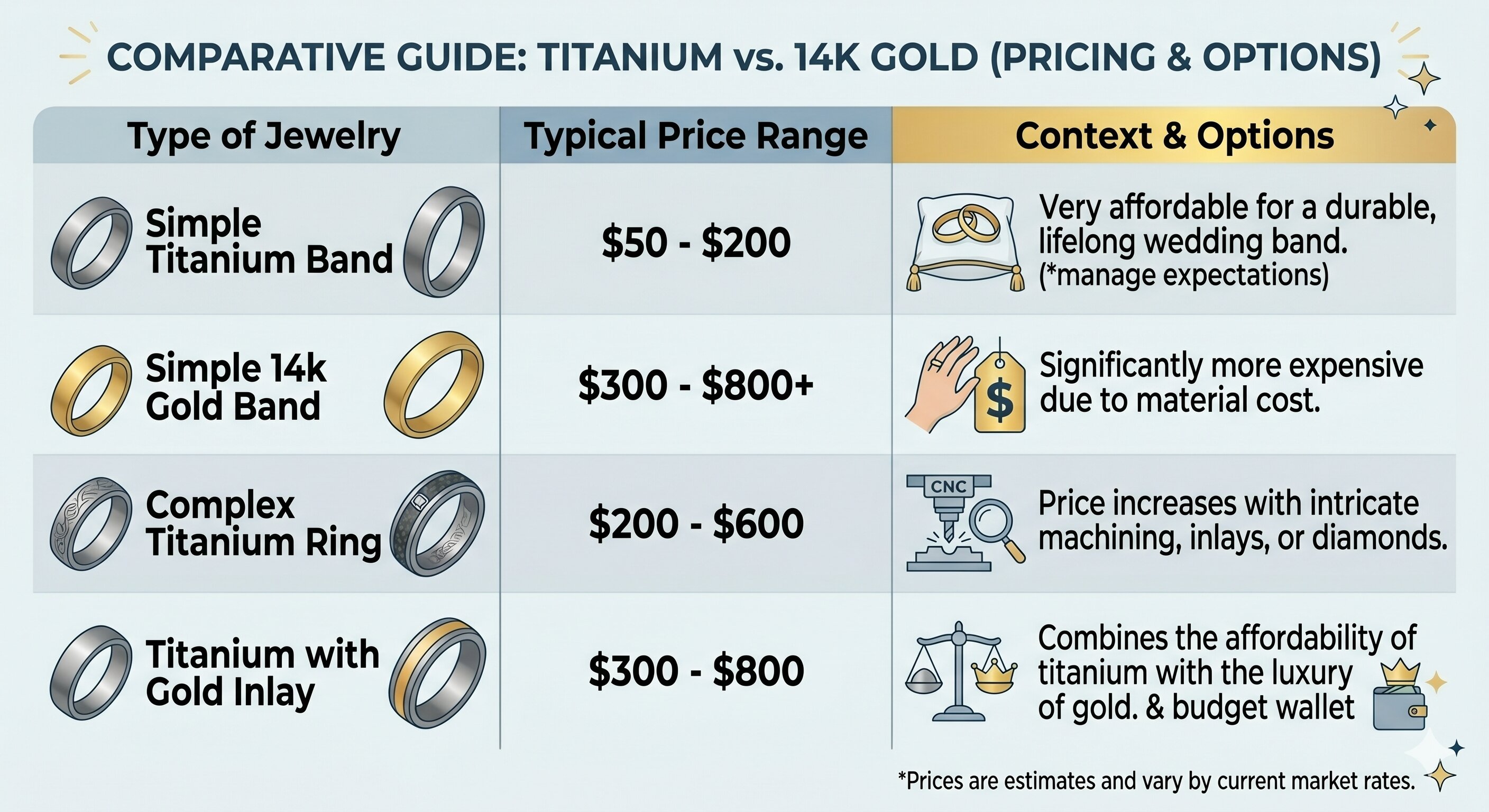
Price Comparison in Context
Conclusion: Is it "Cheap"?
Yes, if you mean "affordable." Its initial purchase price is low, making it an excellent budget-friendly option that doesn't sacrifice quality.
No, if you mean "poor quality." It is a high-performance, durable, and premium material in its own right. It's the secret smart buy for people who prioritize durability and comfort over precious metal status.
Think of it this way: A high-tech carbon fiber watch might be more expensive and "prestigious" than a rugged, accurate G-Shock watch. But for someone who needs a virtually indestructible tool for adventures, the G-Shock is the higher-quality, better-value choice, even if it costs less. Titanium occupies a similar space in the jewelry world.
What Are The Disadvantages of Titanium Jewelry?
While titanium is an excellent material for many reasons, it has several significant disadvantages that are crucial to consider before making a purchase.
Here is a detailed breakdown of the disadvantages of titanium jewelry:
1. The Biggest Disadvantage: Difficulty in Resizing and Repair
This is the most prominent and often deal-breaking drawback.
Extremely Hard to Resize: Titanium is very hard and has a high melting point. Traditional jeweler's tools cannot cut and solder it like they can with gold or silver. While some specialized jewelers with laser welders can perform very limited resizing, it is often impossible, prohibitively expensive, or risks damaging the ring.
Cannot be Soldered Easily: If a titanium ring breaks or needs structural repair, it is incredibly difficult to fix. In many cases, it cannot be repaired at all. This makes it a poor choice for heirloom pieces that might need future maintenance.
Implication: You must be certain of your ring size when buying a titanium ring, especially for something like a wedding band.
2. Limited Aesthetic and Traditional Appeal
Not a Precious Metal: Titanium lacks the intrinsic value and prestige of gold, platinum, or even silver. It is an industrial/performance metal. For those who value the traditional status and material worth of jewelry, titanium does not fulfill that desire.
Color Limitations: Its natural color is a dark charcoal or gunmetal grey. While it can be anodized to create vibrant colors, it cannot be made into a true, bright white like platinum or white gold, nor can it replicate the warm yellow of gold. If you want a classic, traditional look, titanium is not the right choice.
3. Challenges with Stone Setting
Brittle Prongs: Due to its strength, titanium can be somewhat brittle when worked into fine details like prongs. A sharp blow could cause a titanium prong to snap rather than bend, potentially leading to a lost stone.
Requires Specialized Skill: Setting stones in titanium requires jewelers with specific expertise and tools. Not every jeweler is equipped or experienced in working with it, which can limit your design and repair options later.
4. Perceived Value and Weight
Low Perceived Value: Because it is lightweight and inexpensive, some people perceive titanium jewelry as "cheap" in feeling, even though it is highly durable. It lacks the substantial, heavy "heft" that many associate with valuable and luxurious jewelry.
Too Light for Some: Some wearers specifically enjoy the weight of a gold or platinum ring and find a titanium ring to feel insubstantial or "like it's not even there," which can be a negative for them.
5. Removal in Medical Emergencies (A Critical Consideration for Rings)
Difficulty of Cutting: In the event of a finger injury causing swelling, a titanium ring is extremely difficult to remove. Standard ring cutters used by hospitals and fire departments are designed for gold and silver and will often fail on titanium.
Removal Methods: Emergency removal typically requires a diamond-coated saw or, in extreme cases, locking vice-grip pliers to crack it. This process is slow, stressful, and can be dangerous.
“In 2015, a firefighter in Texas tried to cut a titanium wedding band off a man‘s swollen finger. The standard ring cutter—the same tool that works on gold, silver, and platinum—could not scratch the titanium. The firefighter had to use a diamond-coated saw. It took 15 minutes. The man kept his finger. Afterward, he had the ring engraved on the inside: ‘Made for hands that work.‘ Titanium‘s greatest strength is also its greatest risk. It will not bend, break, or tarnish. But it also will not let go easily. That is why every titanium ring should have a safety groove—a thin line scored inside the band so emergency responders can snap it open. If your titanium ring does not have one, you are wearing a permanent seal.”
Note: Many modern titanium rings are designed with a safety groove—a thin, pre-scored line that allows emergency personnel to snap the ring with pliers. If you choose a titanium ring, look for this feature.
6. Limited Malleability for Design
Titanium is not malleable like gold. This makes it unsuitable for many intricate, hand-fabricated jewelry designs that involve bending and shaping the metal. It is best suited for designs that are machined or cast.
Summary: Who Should Avoid Titanium Jewelry?
You should think carefully before choosing titanium if:
You are buying an engagement or wedding ring, and there's a chance your finger size could change (due to weight fluctuation, pregnancy, etc.).
You value the traditional prestige and intrinsic material value of precious metals.
You want a classic yellow, rose, or bright white metal for your jewelry.
The piece has delicate prong settings for valuable gemstones.
You want a piece that can be easily repaired, resized, or melted down for resetting in the future.
Titanium's disadvantages are primarily related to its permanence and workability. Its strengths—durability, weight, and hypoallergenic properties—are also the source of its biggest weaknesses. It is a fantastic practical choice, but can be a poor sentimental or traditional one.
Can You Get Titanium Wet?
The answer is a resounding yes, you can get titanium wet. In fact, this is one of its greatest advantages as a jewelry metal.
Here’s the detailed explanation of why it's not just okay, but ideal for contact with water.
Whis Titanium is Impervious to Water
Extreme Corrosion Resistance: Titanium is not a metal that rusts or corrodes like iron or steel. When exposed to oxygen, it instantly forms a very thin, invisible, and incredibly tough layer of titanium oxide on its surface. This layer is passive, meaning it protects the underlying metal from any further reaction with the environment, including water.
Excellent for Daily Wear: This property is exactly why titanium is used in:
Shipbuilding and Marine Applications: For propellers and other parts constantly exposed to saltwater.
Chemical Processing: For pipes and tanks that handle corrosive fluids.
Medical Implants: Because it is inert and doesn't react with bodily fluids.
What This Means for Your Jewelry
You can wear your titanium jewelry in all these situations without worry:
Washing Your Hands: Completely safe.
Showering or Bathing: It won't be affected by water, soap, or shampoo.
Swimming:
Chlorinated Pool Water: Will not harm titanium.
Salt Water: This is where titanium truly shines. You can swim in the ocean without any fear of corrosion or damage. It's a perfect metal for vacation or everyday beachwear.
The One Caveat: It's About the Whole Piece
While the titanium metal itself is impervious, you should consider the other components of the jewelry:
If it has a Mechanical Coating: While the anodized colors on titanium are permanent (as they are an electrochemical change to the oxide layer itself), some cheaper pieces might have a painted or PVD coating that could potentially degrade over time with harsh chemicals.
If it has Gemstones or Other Materials: The setting for the stones or any glued-in materials (like wood or resin) could be the weak point, not the titanium. Prolonged exposure to harsh chemicals might loosen settings or damage adhesives.
Practical Advice
Routine Care: For a plain titanium band, you can literally just dry it with a soft cloth after getting it wet to prevent water spots and keep it looking shiny.
Cleaning: To clean it, use warm water, a few drops of mild dish soap, and a soft toothbrush. Rinse and dry thoroughly.
Avoid Harsh Chemicals: While titanium itself is resistant, it's still a good practice to remove your jewelry when using harsh cleaning agents, bleach, or other strong chemicals. This is more to protect any stones and for general safety than to protect the titanium.
Getting titanium wet is perfectly fine. Its exceptional resistance to water and corrosion is a primary reason to choose it for a durable, low-maintenance, and active lifestyle.
Why Is Titanium Jewelry So Cheap?
This is a fundamental question, and the answer lies in understanding the difference between "cost" and "value."
Titanium jewelry is relatively cheap primarily because of its low intrinsic material cost compared to precious metals. However, calling it "cheap" can be misleading, as it offers incredible value for its price.
Here’s a detailed breakdown of why the initial purchase price is so low:
1. The Material Itself is Abundant and Inexpensive
Not a Precious Metal: Titanium is the ninth most abundant element in the Earth's crust. Unlike gold, platinum, or silver, it is not classified as a precious metal and is not traded on the same kind of commodities market. Its value isn't driven by rarity or investment speculation.
Low Raw Material Cost: While the process of refining titanium from ore (like rutile) is complex and energy-intensive, the resulting raw metal is still far less expensive per gram than gold or platinum. You are simply not paying for a scarce material.
2. Lower "Melt Value" and Intrinsic Worth
When you buy a piece of gold jewelry, a significant portion of the price is the actual value of the gold itself (the "melt value"). A 14k gold ring will always be worth at least the value of the gold it contains.
A titanium ring, on the other hand, has almost no intrinsic "melt value." Its price is based almost entirely on the cost of manufacturing and craftsmanship, not the raw material. This automatically makes it much cheaper to produce.
3. Efficient and Scalable Production for Basic Styles
Machining, Not Casting: Simple titanium bands are often machined from a solid bar of metal. This is a highly efficient, computer-controlled process that can produce large quantities of identical rings with minimal waste, keeping costs low.
Mass Production: Because of its strength and popularity for minimalist and modern styles, titanium jewelry is often produced in large batches, which drives down the per-unit cost.
The Crucial Distinction: "Cheap Price" vs. "High Value"
This is the most important point. Titanium is inexpensive to buy but is not a "cheap" or low-quality material. In fact, its low price is a fantastic bargain for the performance you get.
You are getting a high-performance material at a budget-friendly price. Think of it like this:
Gold/Platinum is like a handmade, luxury leather wallet. It's made from a precious material, has high intrinsic value, and is a status symbol.
Titanium is like a high-tech carbon fiber wallet. The raw material isn't "precious," but it's incredibly durable, lightweight, functional, and outperforms the leather in many practical ways—often for a lower price.
What You're Not Paying For
When you buy titanium, you avoid the costs associated with precious metals:
No Premium for Rarity: You aren't paying for scarcity.
No Alloying Metals: While gold is mixed with other metals to create 10k, 14k, etc., increasing cost and complexity, titanium used in jewelry is often commercially pure or a simple alloy.
Minimal Markup for Material Value: The jeweler's markup isn't applied to an expensive block of metal.
When Does Titanium Jewelry Get More Expensive?
The price can rise significantly based on craftsmanship and design, proving that the cost is in the making, not the material.
Complex Designs: Intricately carved or Mokume-gane (mixed metal) titanium rings are expensive due to the high skill and time required.
Anodizing: While the process itself isn't extremely costly, intricate multi-color patterns require skilled artistry.
Inlays: Adding materials like wood, carbon fiber, or precious metals like gold will increase the price.
Stone Setting: Setting diamonds or other gemstones into titanium is difficult and requires specialized skill, adding to the cost.
Titanium jewelry is "cheap" because you are not paying for a precious, rare metal. You are paying for the manufacturing, design, and craftsmanship. This results in a low initial price for a product that is exceptionally durable, hypoallergenic, and comfortable.
In short, its affordability is its greatest selling point, allowing you to own a high-quality, lifelong piece of jewelry without the high cost of traditional precious metals. It's not cheap in quality; it's just excellently priced for what it is.
Is Titanium Jewelry Expensive?
No, titanium jewelry is generally not expensive, especially when compared to precious metals like gold and platinum. However, it is not the absolute cheapest option available, and certain designs can command higher prices.
Here’s a detailed breakdown of the costs:
Why Titanium Jewelry is Affordable (The "No" Argument)
Low Material Cost: Titanium is an abundant element. While the refining process is complex, the raw material itself is far less expensive than gold, platinum, or even silver. You are not paying a premium for a rare or precious metal.
Not a Precious Metal: Its value isn't tied to the commodities market. The price of a titanium ring isn't affected by the daily fluctuations of the gold price. You are paying primarily for the craftsmanship and design, not the intrinsic material value.
Efficient Production: Simple, polished titanium bands are easily machined in large quantities, which keeps the cost of basic styles very low.
When Titanium Jewelry Can Be More Expensive (The "It Depends" Argument)
While the metal is cheap, the workmanship is not. The price can increase significantly based on:
Complexity of Design: An intricate, hand-carved, or "Mokume-gane" (mixed metal pattern) titanium ring requires a high level of skill and time, making it much more expensive than a simple band.
Presence of Other Materials: Many titanium rings feature inlays of more expensive materials like gold, tungsten carbide, carbon fiber, or precious woods. These additions will raise the price.
Gemstones: Setting diamonds or other precious stones into titanium is difficult and requires specialized skill, adding considerable cost.
Branding and Craftsmanship: A ring from a renowned, specialized artisan will cost more than a generic one from a large-scale retailer.
Price Comparison: Putting it in Context
To understand the value, it helps to see typical price ranges (for a simple men's wedding band as a benchmark):
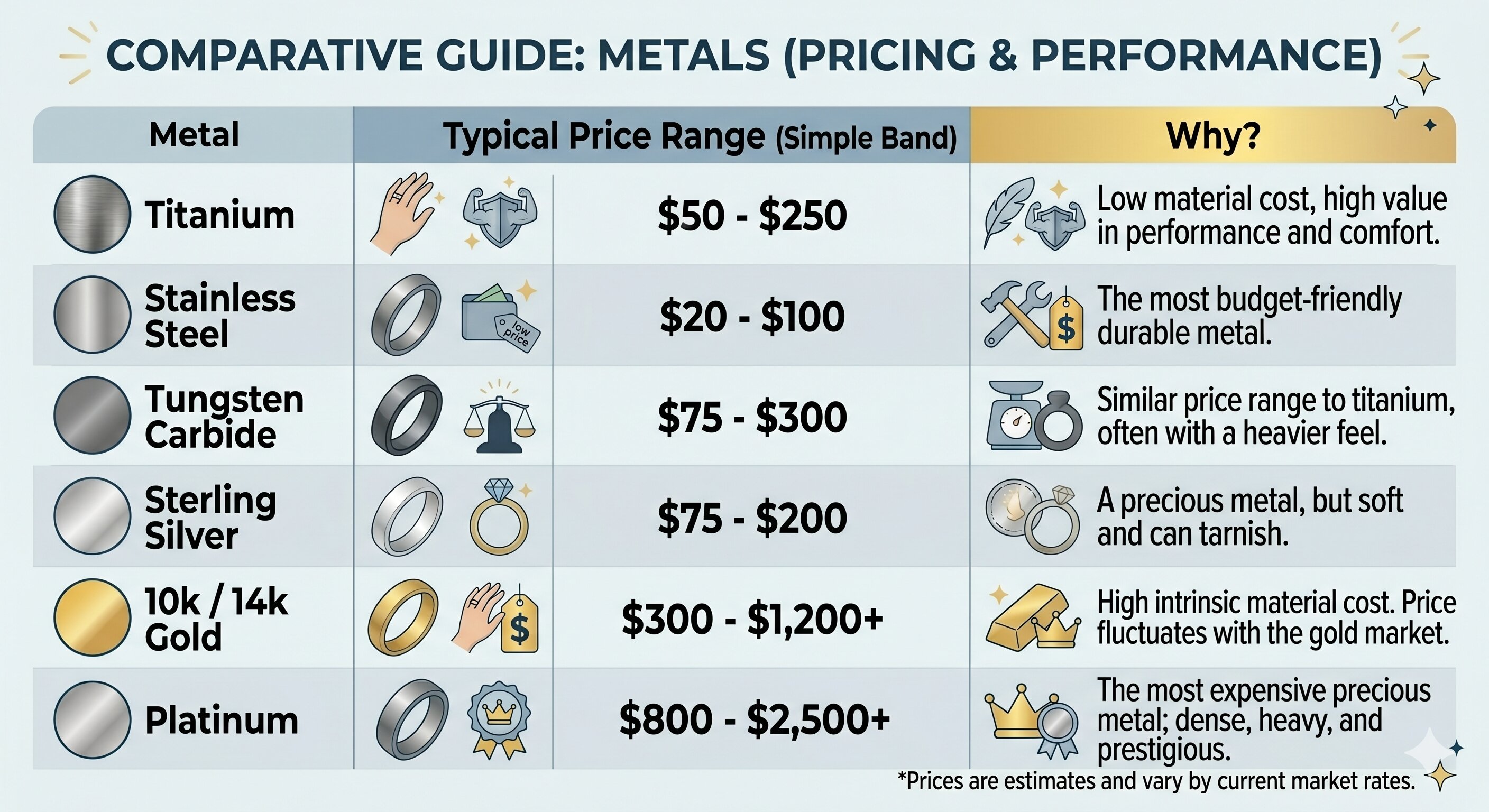
The "Value" Proposition: Why It's a Smart Buy
This is the most important concept. Titanium is inexpensive to buy but offers high-value performance. You are getting a premium functional material at a budget-friendly price.
For the cost of a basic titanium band, you get a piece of jewelry that is:
Extremely durable and scratch-resistant.
Hypoallergenic and safe for sensitive skin.
Lightweight and incredibly comfortable.
Corrosion-resistant and low-maintenance.
Generally, no. It is one of the most affordable high-performance jewelry options on the market.
Its base price is low because you aren't paying for a precious metal.
You can find beautiful, high-quality titanium pieces for a fraction of the cost of gold.
Think of it not as "cheap," but as an outstanding value. You get incredible durability, comfort, and a modern aesthetic without the high price tag of traditional luxury metals.
How Much Is 1kg of Titanium?
This is a great question, but the answer isn't as simple as a single number because the price of titanium depends heavily on its form and purity.
Here’s a breakdown of how much 1 kg of titanium costs in different contexts.
The Short Answer
For a rough estimate, 1 kg of commercially pure titanium in a common form, like bar or sheet, typically costs between $80 and $200 USD. However, this can vary significantly.
Detailed Price Breakdown
The price increases dramatically as you move from raw material to finished, specialized products.
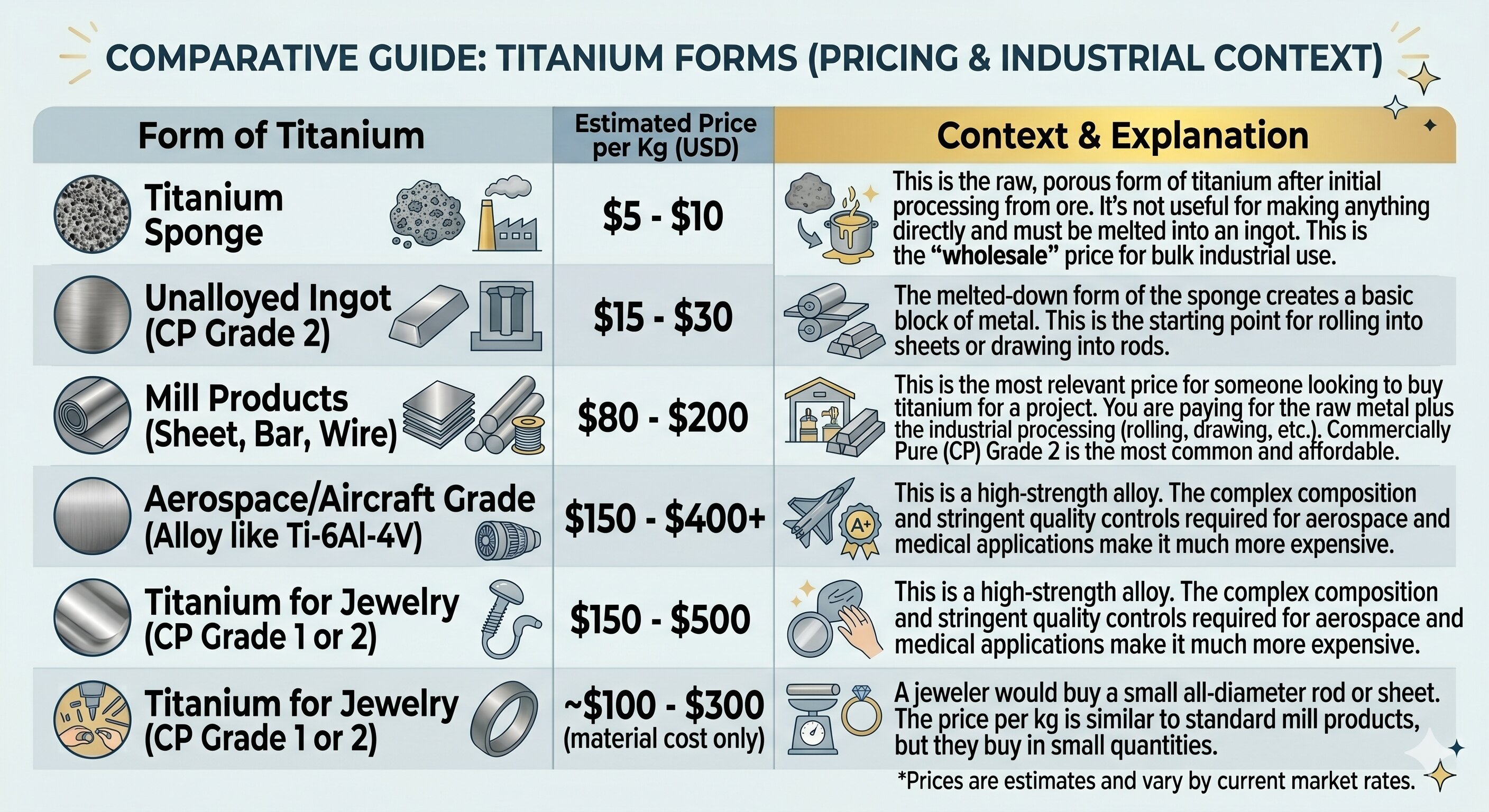
The Crucial Context: Why Isn't This the Price of a Titanium Ring?
This is the most important point: The cost of the raw material is a tiny fraction of the final product's price.
If a titanium wedding band weighs 10 grams, the raw titanium in it only costs about $1 to $3. So, why does the ring sell for $100-$300?
You are paying for:
Manufacturing & Machining: Cutting, shaping, and polishing the incredibly hard metal.
Craftsmanship & Design: The skill of the jeweler and the complexity of the design.
Anodizing: The electrochemical process to create permanent colors.
Overhead, Markup, and Branding: Business costs, retail markup, and brand value.
Comparison to Other Metals
To put titanium's cost into perspective, here's the approximate price per kg for other common metals:
Stainless Steel: $3 - $10 per kg
Aluminum: $2 - $5 per kg
Titanium: $80 - $200 per kg
Silver: ~$1,000 per kg (based on a spot price of ~$1 per gram)
Gold: ~$90,000 per kg (based on a spot price of ~$90 per gram)
Titanium is significantly more expensive than common industrial metals like steel or aluminum, but it is vastly more affordable than precious metals like silver and gold. Its value lies not in its rarity but in its exceptional strength-to-weight ratio, corrosion resistance, and biocompatibility.
Is Titanium As Expensive As Gold?
No, titanium is not nearly as expensive as gold. The difference in cost is dramatic, with gold being one of the most expensive metals on Earth and titanium being a relatively affordable industrial metal.
To put it in perspective, gold is roughly 300 to 500 times more expensive than titanium by weight.
Here’s a direct comparison:
Price per Gram: A Stark Contrast
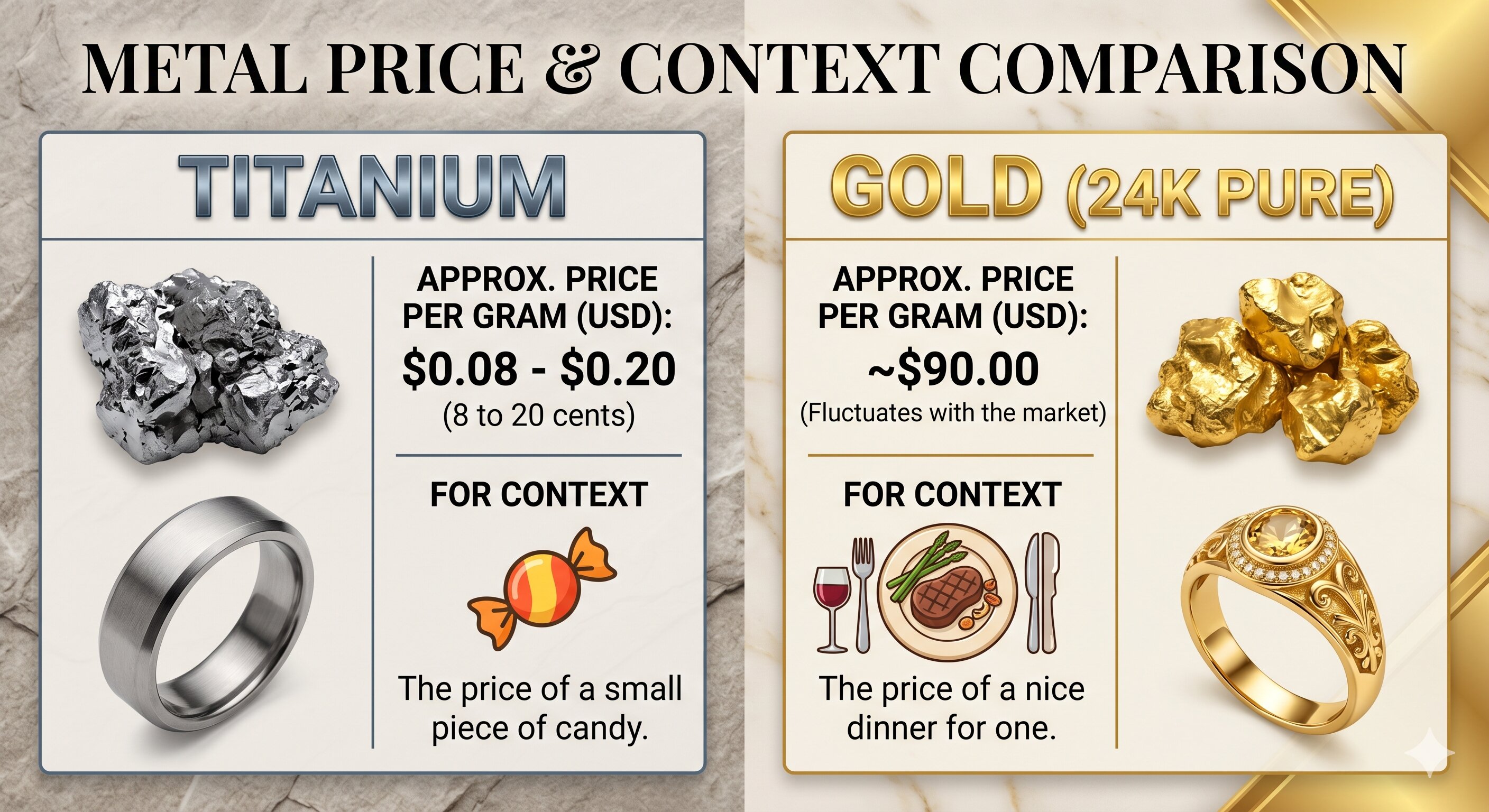
This means you could buy over 400 grams of titanium for the price of just one gram of gold.
Why is Gold So Much More Expensive?
The price difference comes down to one fundamental concept: rarity vs. abundance.
Gold is a Precious Metal: It is incredibly rare, difficult to mine, and exists in limited quantities. Its value is driven by its status as a store of value, a symbol of wealth, and a luxury item for thousands of years. It's also a financial asset traded on global markets.
Titanium is an Industrial/Performance Metal: It is the ninth most abundant element in the Earth's crust. While the process to refine it is complex, the raw material is not rare. Its value is in its physical properties (strength, lightness, corrosion resistance), not its scarcity.
The Jewelry Perspective: Why the Confusion?
When you look at a titanium ring and a gold ring, the price difference might not seem like 500x. This is because you are not just paying for the raw metal.
For a Titanium Ring, the cost is almost entirely in the craftsmanship, design, and manufacturing. The raw titanium material in a 10-gram ring might only be worth $1 to $2.
For a Gold Ring: The cost is heavily based on the intrinsic value of the material itself. The raw gold in a 10-gram ring could be worth $300 to $400 (for 10k-14k gold), plus the cost of craftsmanship.
Summary Table
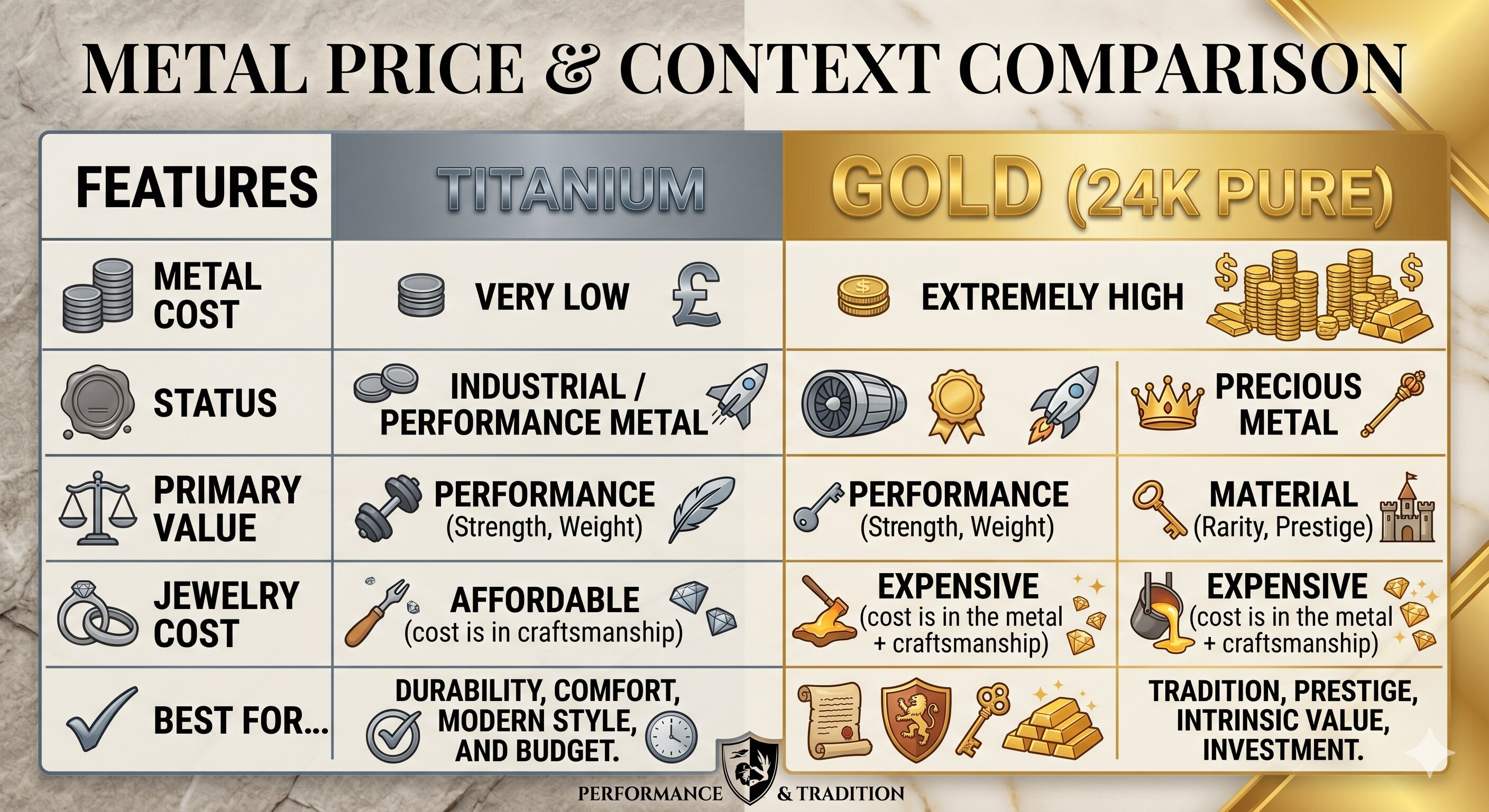
Conclusion: Titanium is not in the same league as gold when it comes to cost.
“You now know the quality, the gold comparison, the pricing, the disadvantages, the water resistance, the cheapness, the expense, the per-kilo cost, and the gold cost comparison. The only question left: will you choose the metal that was born in a Cold War laboratory?
Our current collection includes a limited number of titanium rings — from polished grey bands to anodized blue and purple, from comfort-fit classics to safety-groove designs. When certain styles are gone, restocking takes time because each ring is machined, not cast.
This is not a precious metal. It is a performance metal — the same material used in submarines, spy planes, and medical implants. It will not bend, break, or tarnish. But it will also not let go easily. Wear it like a seal.”
[Button: Secure Your Titanium Ring (Limited) →]


Other news for Tuesday 16 June, 2026
- Teardrop Diamond Guide: Meaning, Price, vs Round and Wearing Direction
- Vintage Rings Guide: Styles, Identification, Pros and Cons
- Diamond 4Cs Guide: Cut,Color,Clarity,Carat,Prices and Buying Tips
- Three-Stone Engagement Rings: The Ultimate Buying Guide
- Morganite Guide: Meaning, Price, vs Diamond, Colors and Care
- Gold Plated Jewelry Guide: Care, Durability, vs Solid Gold and Buying Tips
- Excellent Cut Diamond Guide: Meaning, vs Brilliant, vs Ideal
- Art Deco Jewelry: History, Value and How to Identify Authentic Pieces
View all news for Tuesday 16 June, 2026 on one page
News for Monday 15 June, 2026
- Asscher Cut Guide: Complete Guide to Square Emerald Cut Diamonds
- Classic Cut Guide: Old Mine vs Old European vs Modern Round
- Marquise Cut Guide: Price, Size Illusion, vs Oval and Buying Tips
- Pavé Setting Guide: Pros, Cons, Cost, Security and Channel/Bezel
- Radiant Cut Guide: Price, vs Emerald, 1ct, 3ct Cost, Sparkle and Tips
- Vintage Cut Guide: Old Mine vs Old European vs Rose Cut
- Heart-Shaped Diamond Guide: Meaning, Price, 2ct Cost and Buying Tips
View all news for Monday 15 June, 2026 on one page
Recent News
- Sunday 14 June, 2026
- Saturday 13 June, 2026
- Friday 12 June, 2026
- Thursday 11 June, 2026
- Wednesday 10 June, 2026