

Platinum Guide: Price, vs White Gold, Daily Wear and Investment
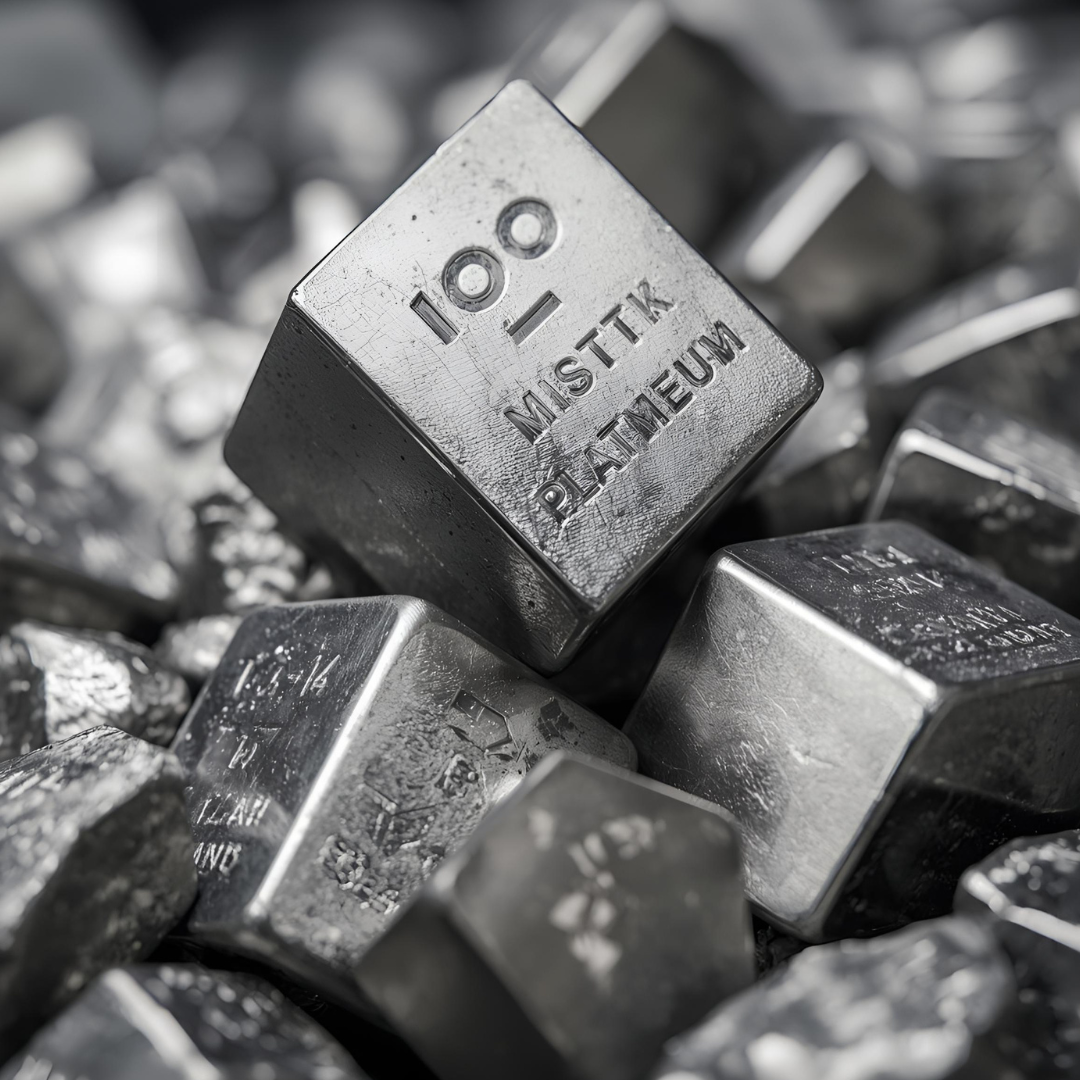
Platinum Guide: Price vs White Gold, Daily Wear, a nd Investment
Long before platinum became the metal of choice for engagement rings, it arrived on Earth from outer space.
During the Late Heavy Bombardment—a period about 4 billion years ago when asteroids pummeled our young planet—platinum was delivered in massive quantities. Scientists believe most of the platinum on Earth today came from these cosmic impacts.
Ancient Egyptians found platinum in small grains mixed with gold as early as 1200 BCE. They prized it for its mysterious luster but couldn't melt it—their fires weren't hot enough.
When Spanish conquistadors discovered platinum in Colombia, they called it platina—"little silver"—and considered it a worthless nuisance. They threw it back into the rivers.
Today, we know better. Platinum is 30 times rarer than gold. It doesn't tarnish. It doesn't fade. And it came from the stars.
The same metal that conquistadors threw away now awaits your own forever promise — from engagement rings to wedding bands. Every platinum piece in our collection is 95% pure (Pt950), handcrafted for daily wear, and built to outlast generations.
[Button: Explore Platinum Jewelry →]
“In 1788, Spanish conquistadors in Colombia found platinum mixed with gold. They called it ‘platina‘ — ‘little silver‘ — and considered it a worthless nuisance. It wouldn‘t melt in their fires. It was too heavy. So they threw it back into the rivers.
For centuries, platinum was the metal that no one wanted. Then, in the 19th century, French and Russian jewelers discovered that platinum could hold diamonds more securely than any other metal. Louis Cartier began using it in his‘garland style‘ jewelry — delicate lace-like creations that were impossible in gold.
By 1900, platinum had gone from river trash to the most exclusive metal in the world. Today, when you wear platinum, you are wearing a metal that conquistadors threw away — and that kings fought to own. The only thing that changed was not the metal. It was our understanding of its worth.”
Let's begin the table of contents.
To truly understand what kind of metal it is, we need to look at its properties and how it's classified. Here’s a breakdown of what makes platinum so special.
What Metal Is Platinum?
At its simplest, platinum is a chemical element, a pure metal found on the periodic table with the symbol Pt and atomic number 78.
1. It's a Precious Metal
This is the category most people are familiar with. Platinum belongs to the elite group of rare, naturally occurring metals of high economic value, alongside:
Gold (Au)
Silver (Ag)
Palladium (Pd), etc.
Its rarity, beautiful silvery-white appearance, and resistance to tarnish make it highly desirable for jewelry and investment.
2. It's a Noble Metal
This is a scientific classification. Noble metals are resistant to corrosion and oxidation in moist air. This is why platinum doesn't rust or tarnish like iron or silver.
Key Property: It is highly unreactive. You can dip platinum in most acids, and it won't corrode.
Other Noble Metals: Gold, Rhodium, Ruthenium.
3. It's a Transition Metal
This is its formal classification on the periodic table. Transition metals are found in the central block of the periodic table and are known for:
High melting and boiling points: Platinum has an extremely high melting point of 1,768°C (3,215°F).
High density: It is a very heavy metal; a cube of platinum with 1-foot sides would weigh over 1,300 pounds (about 590 kg).
Good conductors of heat and electricity.
Malleability and Ductility: It can be hammered into thin sheets and drawn into fine wire.
Catalytic properties: This is one of platinum's most important modern uses.
Key Characteristics of Platinum:
Color: Silvery-white, giving it a bright, reflective luster.
Durability: It is much harder and more durable than gold, making it excellent for jewelry that needs to withstand daily wear (like engagement rings).
Hypoallergenic: Because it is so unreactive, it is an excellent choice for people with metal allergies.
Rarity: It is 30 times rarer than gold. All the platinum ever mined would fit into an average-sized living room.
Common Uses of Platinum:
Jewelry: Known for its purity (often 95% pure, compared to 75% for 18k gold), strength, and beautiful white sheen.
Catalytic Converters: Their most significant industrial use. It helps convert harmful pollutants from vehicle exhaust (like carbon monoxide) into less harmful substances (like carbon dioxide and water vapor).
Industrial Catalysts: Used in the production of fertilizers, explosives, and for refining petroleum.
Medical and Laboratory Equipment: Used for pacemaker electrodes, dental implants, and lab crucibles because it does not react with other substances.
Investment: Minted into bars and coins, similar to gold and silver.
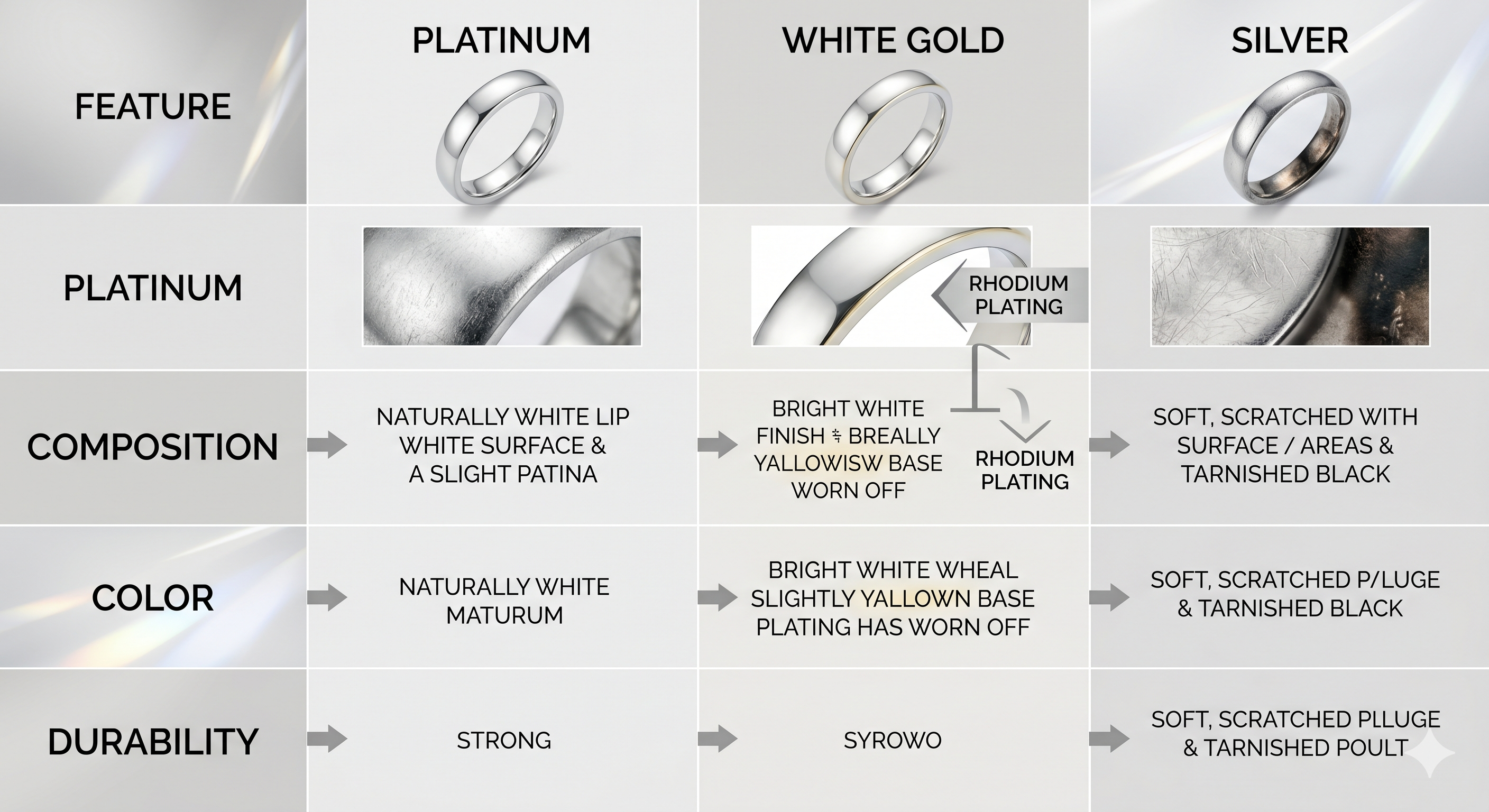
Comparison to Other White Metals:
People often confuse platinum with white gold and silver. Here’s a quick guide:
“In 1953, when Sir Edmund Hillary reached the summit of Mount Everest, he carried a platinum brooch for his wife. He chose platinum not because it was expensive, but because it would not tarnish in the extreme cold. In 1969, when Neil Armstrong stepped onto the moon, the Apollo 11 astronauts carried a platinum medallion — because platinum is the only metal that can survive the vacuum of space without corroding. From the top of the world to the surface of the moon, platinum has been the metal of extremes. It does not fade. It does not crack. It simply endures. That is why we choose it for rings that promise forever. Not because it is flashy, but because it will still be here when we are not.”
In summary: Platinum is a rare, noble, and transition metal, prized for its stunning silvery-white appearance, incredible durability, and vital role in industry and technology.
Learn more about platinum's properties on Wikipedia's platinum page.
How Much Is 1g of Platinum?
The price of platinum, like all precious metals, fluctuates constantly based on the global market. Therefore, I cannot give you a single, exact number, but I can provide a clear picture of its value range and the factors that affect it.
As of my last update, I do not have live data. However, I can tell you how to find the current price and what to expect.
The Short Answer (Based on Recent Trends)
Historically, the price of 1 gram of platinum has often been less than that of 1 gram of gold. In recent years, it has typically ranged from $25 to $35 USD per gram.
To get the absolute live price, you should check a reliable financial source.
How to Find the Live Price
The price of platinum is set by the global "spot price."
Search Online: A simple search for "platinum spot price" or "price of platinum per gram" will bring up live tickers.
Understanding the Price You'll Actually Pay
This is the most important part. The "spot price" is the wholesale price for a raw ounce of metal. When you buy a small quantity like 1 gram, you will pay more due to several factors:
Premium: This is the extra cost over the spot price that covers the minting, fabrication, distribution, and a small profit margin for the dealer. The smaller the item, the higher the premium per gram.
Form of Platinum: The price varies drastically depending on what you're buying.
Taxes and Shipping: These can add to the final cost.
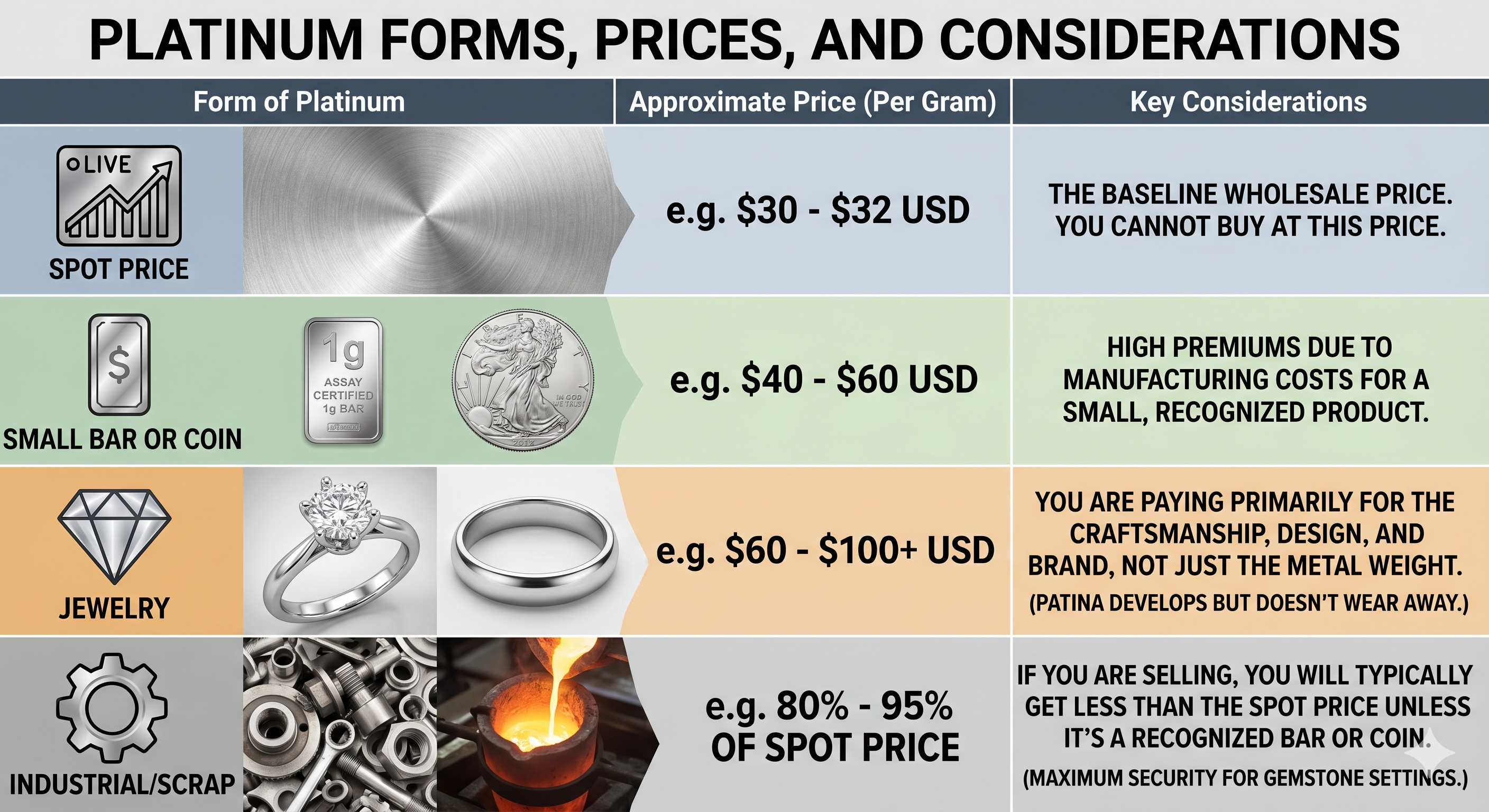
Price Breakdown by Form (Approximate Estimates)
Here’s a realistic look at what you might pay for 1 gram of platinum in different forms:
Comparison to Other Precious Metals (Per Gram)
To give you context, here is the typical price hierarchy of major precious metals:
Rhodium: The most expensive (significantly higher than all others).
Gold: Consistently more expensive than platinum per gram.
Platinum: Historically cheaper than gold, but rarer.
Palladium: Has been more expensive than platinum in recent years due to high industrial demand.
Silver: By far the least expensive (usually less than $1 per gram).
Why is Platinum Valuable?
As discussed in the previous question, its value comes from:
Extreme Rarity: 30 times rarer than gold.
High Industrial Demand: Its use in catalytic converters for diesel vehicles and other chemical processes creates constant demand.
Jewelry Demand: Prized for its durability and beautiful, dense white luster.
Investment Demand: Seen as a store of value and a hedge against inflation.
While the base price for 1 gram of platinum is generally between $25 and $35, the price you pay at a dealer for a 1-gram bar will be closer to $40-$60 due to premiums. Always check a live spot price and compare prices from reputable dealers before making a purchase.
For current platinum spot prices, visit the Kitco Precious Metals Price Guide.
Is Platinum Worth More Than Gold?
Historically and based on rarity alone, platinum should be more expensive than gold. However, as of the last several years (since about 2015), gold has consistently held a higher market price per ounce.
So, in the current market, no, platinum is not worth more than gold. Gold is more expensive.
Let's break down why this is the case and the fascinating dynamics behind it.
The Price Comparison: A Snapshot
Platinum: It is about 30 times rarer than gold.
Gold: Is about 2-3 times more expensive than platinum (per ounce).
This seems counterintuitive, so here’s the explanation.
Why Platinum Should Be More Expensive
Extreme Rarity: All the platinum ever mined would fit into an average-sized living room. Its annual mining output is only a fraction of gold's.
Density and Purity: Platinum is denser and heavier than gold. A platinum ring will be heavier than a gold ring of the same size. Jewelry is also often 95% pure (Pt950), compared to 75% pure for 18k gold.
Industrial Difficulty: Platinum has a much higher melting point and is more difficult to extract and refine.
Why Gold Is Actually More Expensive Now
The price is not just about rarity; it's about demand and market perception.
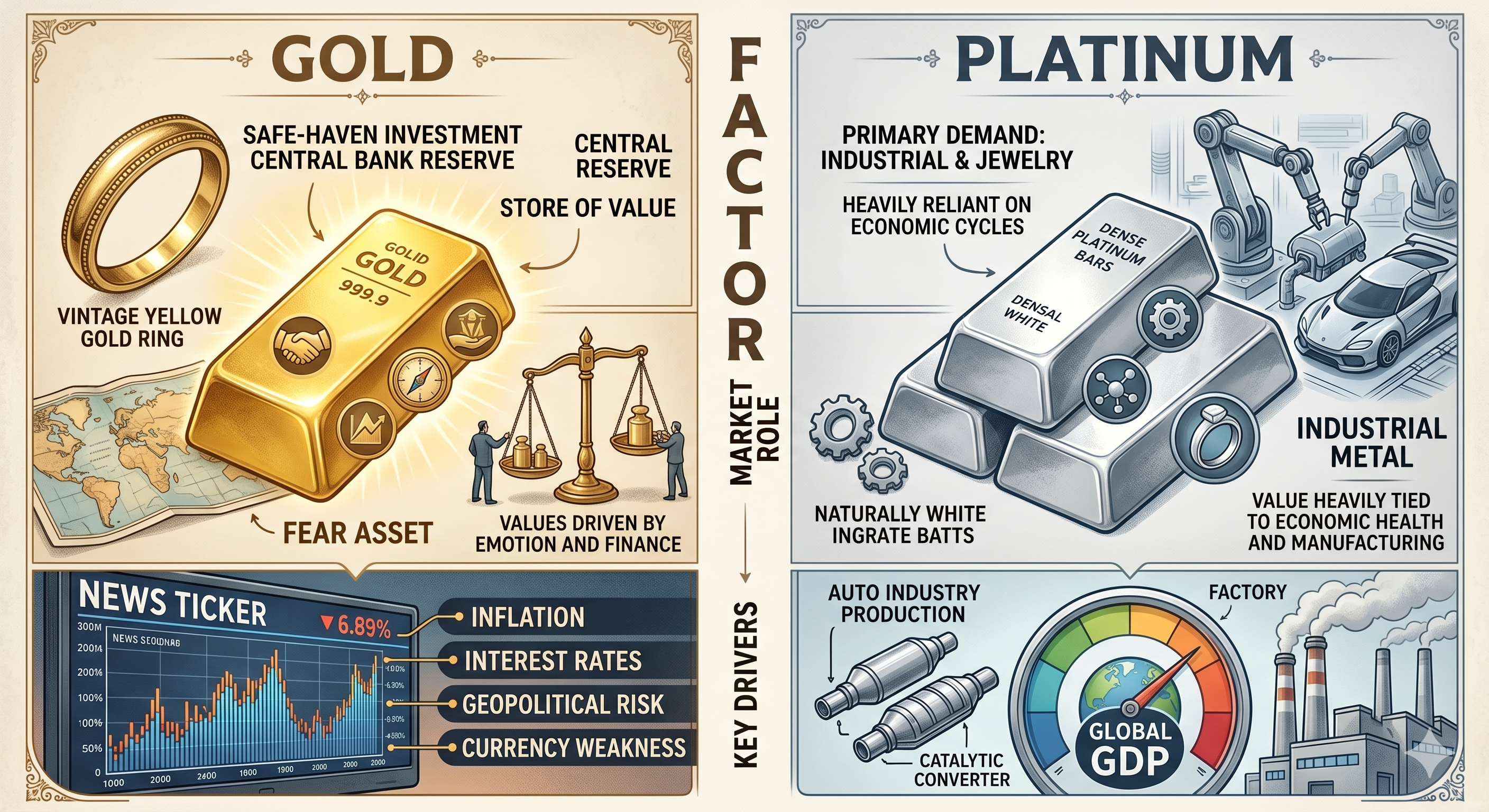
Here’s what happened to platinum:
Diesel Decline: The 2015 "Dieselgate" scandal and a global shift away from diesel cars (which use more platinum in catalytic converters) significantly reduced a major source of demand.
Economic Sensitivity: Platinum's price drops during economic downturns (like the 2008 crisis or the COVID-19 pandemic) because factories slow down.
Substitution: Automakers have become better at using less platinum or substituting it with the cheaper (but now often more expensive) palladium.
Gold's Strength: Meanwhile, gold has seen massive investment demand due to low interest rates, high inflation, and global uncertainty.
Investment & Jewelry Perspective
For Investors: Some see platinum as undervalued and a potential investment opportunity, betting that its price will eventually correct to be above gold's again. However, it's a much more volatile and speculative bet than gold.
For Jewelry Buyers: Platinum offers excellent value for money. You are getting a rarer, denser, more durable, and purer metal for a lower price per ounce than gold. This is why it's often favored for high-end, durable pieces like engagement rings.
While gold currently has a higher market price due to its unshakable role as a financial safe-haven, platinum is the rarer metal and is often considered the better value in jewelry for its superior durability and purity.
Does Platinum Turn Yellow?
This is a common concern, especially for people investing in platinum jewelry.
The direct and reassuring answer is: No, pure platinum itself does not turn yellow.
Platinum is a noble metal, which means it is highly resistant to tarnish and corrosion. The bright, silvery-white color you see when it's new is its natural, permanent color. It will not oxidize or change color like silver or copper.
However, there are a few reasons why a platinum item might appear to lose its luster or take on a different hue, and it's almost always due to surface-level issues.
Why Your Platinum Might Look Discolored
Here are the most common reasons:
Surface Scratches and the "Patina":
This is the most frequent cause of a perceived color change. Platinum is a soft, malleable metal. When it gets scratched, it doesn't lose metal (like gold does); instead, the metal is displaced. Over time, these tiny scratches build up a matte, frosted-looking surface called a patina.
What it looks like: It doesn't look yellow, but rather a less reflective, dull gray or white. This patina is often considered a sign of quality and enduring love in jewelry circles, as it shows the piece has been worn and cherished.
Dirt, Oils, and Grime:
Just like any object you handle frequently, platinum jewelry can accumulate a film of lotion, soap, skin oils, and everyday dirt. This grime can make the platinum look dull, less white, and in certain lights, it might even have a slight yellowish or off-white tint.
Solution: A simple cleaning with a soft jewelry cloth, a mild soap solution, and a soft-bristled brush (like a baby toothbrush) will almost always restore its original brilliant shine.
Rhodium Plating (A Common Misconception):
This is a crucial point! Many people confuse platinum with white gold.
White Gold: Is naturally a slightly yellowish or grayish color. To give it a bright, white finish, it is almost always plated with a thin layer of rhodium, another platinum-group metal that is very white and shiny.
What happens: Over time, this rhodium plating wears off, revealing the natural color of the white gold beneath, which can look yellow in comparison. This does not happen with platinum, as its natural color is already white.
Alloyed Metals:
Pure platinum (Pt1000) is too soft for most jewelry, so it is often alloyed with other metals for strength. Common alloy metals include:
Ruthenium and Iridium: These are also white metals and will not change platinum's color.
Cobalt: This is another common alloy that maintains a white color.
It is highly unlikely that a reputable jeweler would use an alloy that would cause yellowing.
Summary Table: Platinum vs. Other Metals
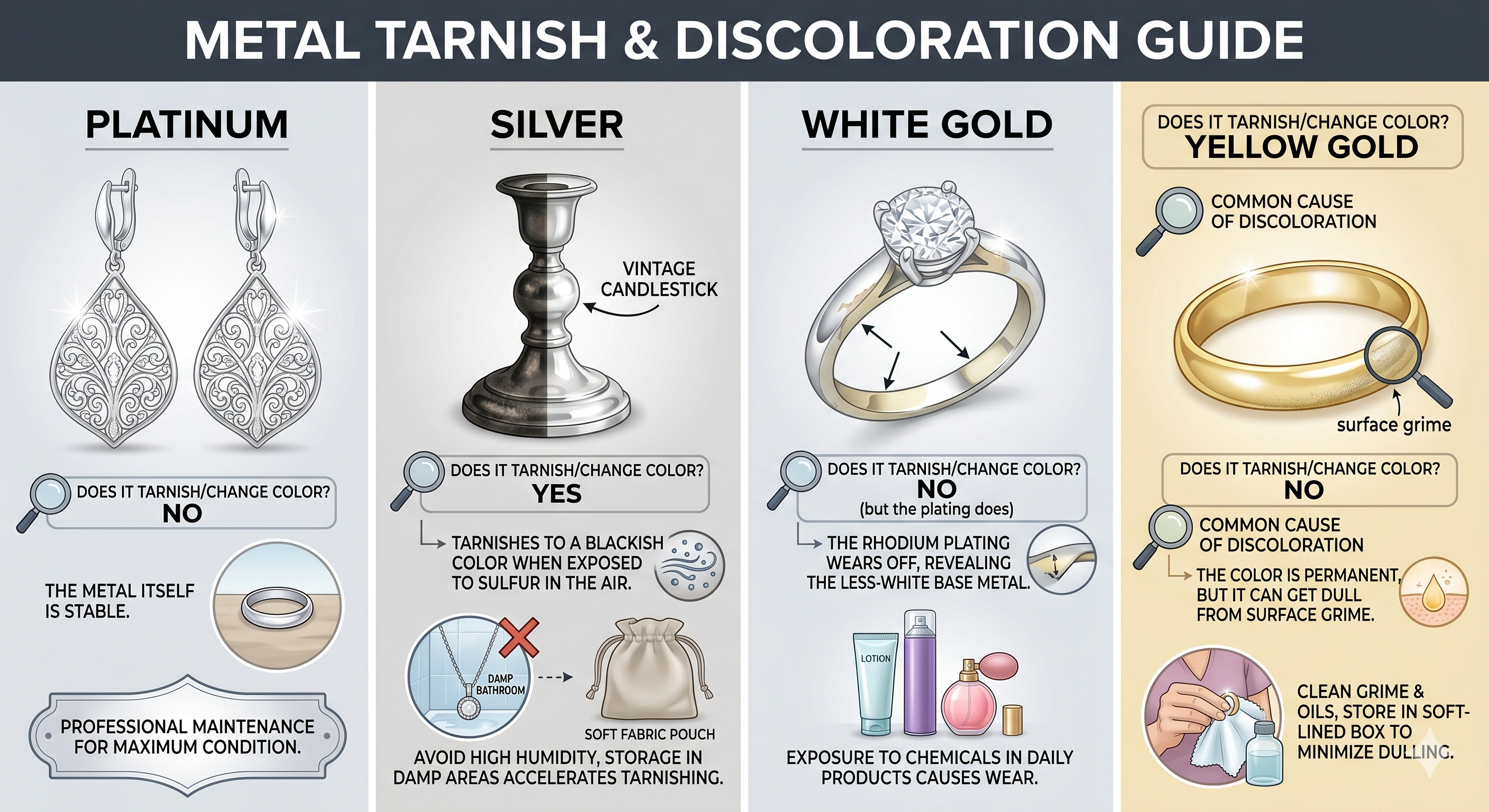
What to Do If Your Platinum Looks Yellow
Clean It First: Give it a gentle clean with warm water, a drop of dish soap, and a soft brush. This will remove any oils or dirt that are clouding its surface.
If Still Dull, Take it to a Jeweler: If cleaning doesn't restore the shine, a professional jeweler can easily polish the platinum to remove the patina and surface scratches, bringing back its original mirror-like finish. Unlike rhodium-plated white gold, this is a permanent restoration of the metal itself, not just a new coating.
You can be confident that your platinum will not turn yellow. Any loss of its brilliant shine is a surface-level issue that can be easily and completely reversed with simple cleaning or polishing.
What Is The Disadvantage Of Platinum?
While platinum is a magnificent metal prized for its beauty and durability, it does have several distinct disadvantages, especially when compared to other precious metals like gold.
The drawbacks can be grouped into a few key areas:
1. Cost: The High Initial Price
More Expensive Than Gold (for the raw material): While the market price per ounce of platinum is often lower than that of gold, the final cost of a piece of platinum jewelry is almost always higher. This is because:
Higher Purity: Jewelry platinum is typically 95% pure (Pt950), while 18k gold is only 75% pure. You are simply using more precious metal.
Density: Platinum is denser and heavier than gold. A platinum ring of the same size will weigh significantly more, increasing the cost based on weight alone.
2. Weight and Feel
Heaviness: Its high density makes it very heavy. Some people love the substantial, luxurious "heft" of platinum. Others may find a large platinum ring or bracelet to be uncomfortably heavy for daily wear.
3. Maintenance and Surface Finish
Develops a Patina: This is one of the most debated characteristics. Platinum is soft and malleable. Over time, it develops a satiny, matte finish called a patina from microscopic scratches.
Proponents see this as a desirable, understated "lived-in" look that signifies quality and history.
Those who see it as a disadvantage prefer the constant high-gloss, reflective shine of polished white gold. Restoring the original mirror-like polish requires a professional jeweler.
4. Durability (A Mixed Bag)
Scratch-Prone: While platinum is very strong and resistant to breaking or wearing thin, its surface is relatively soft and scratches more easily than 18k white gold.
Important Note: When platinum scratches, the metal is displaced rather than lost. It's like pushing sand to the side. This is different from gold, where the material is actually worn away. A jeweler can often re-polish a scratched platinum piece to look new again.
5. Limited Design and Repair Flexibility
Difficulty for Intricate Designs: Its strength and high melting point make it more challenging for jewelers to work with, especially for very delicate, filigree, or detailed designs. Gold is generally more malleable for complex craftsmanship.
Harder to Resize and Repair: Due to its strength and high melting point, resizing or repairing platinum requires more skill, time, and specialized equipment, which can make these services more expensive.
6. Market and Resale Value
Poorer Resale Value: This is a significant disadvantage for those who view jewelry as an investment. The market for reselling pre-owned platinum jewelry is much smaller than for gold. You will rarely get back the high premium you paid for the craftsmanship and metal. Gold, due to its universal role as a currency and investment, has a much more liquid and straightforward resale market.
Summary Table: Disadvantages at a Glance
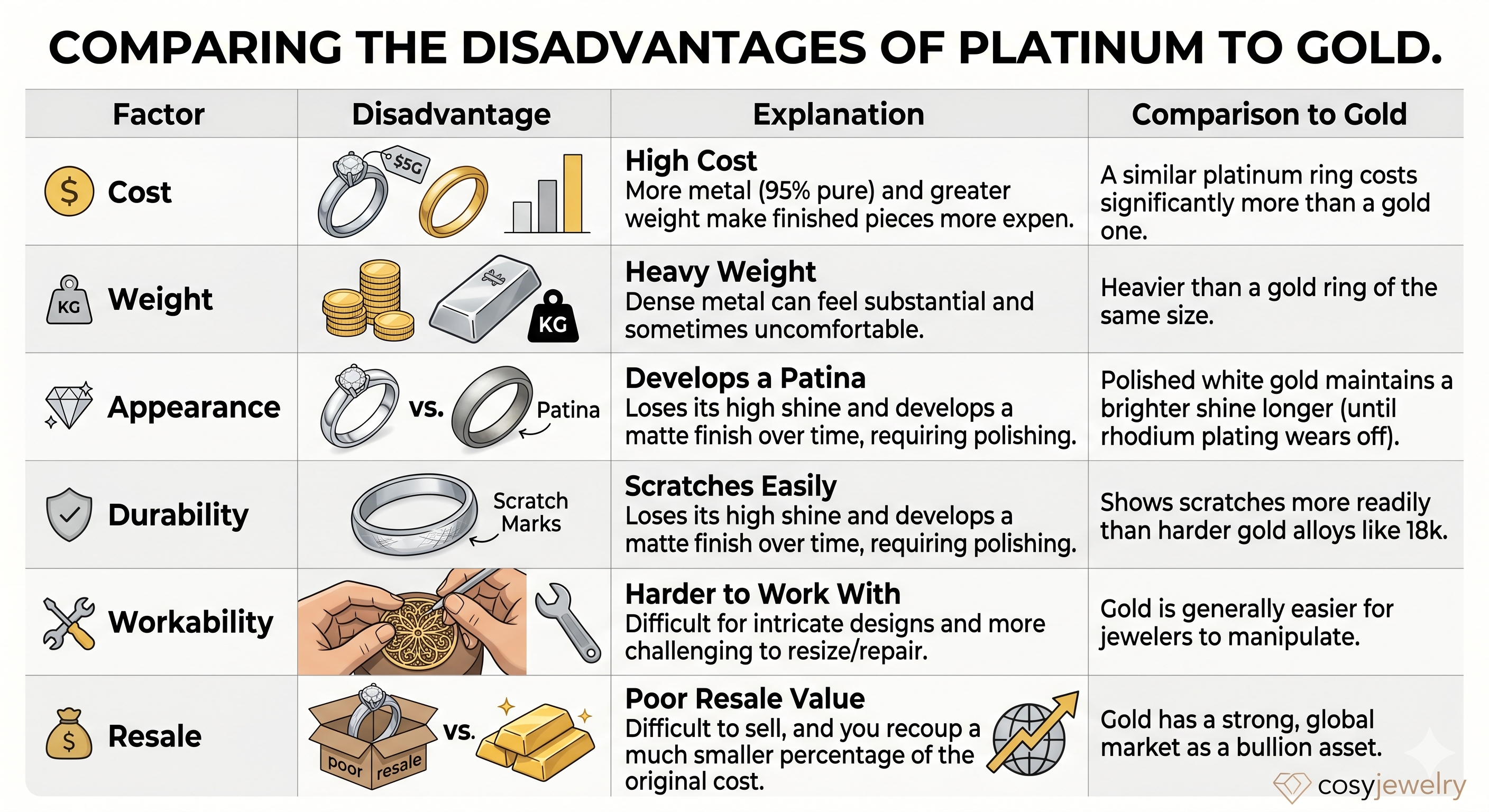
Who Might Want to Avoid Platinum?
Platinum is an excellent choice for someone who:
Prioritizes purity and a natural white color.
Values extreme durability and longevity (e.g., for an engagement ring worn daily).
Has metal allergies and needs a hypoallergenic metal.
Appreciates the weight and patina as signs of quality.
However, you might prefer white gold if you:
Have a stricter budget.
Prefer a lighter-weight piece of jewelry.
Want a consistently bright, reflective shine (and don't mind getting it re-plated with rhodium every few years).
We are planning on a very intricate, delicate design.
Is Platinum A Good Investment?
The answer isn't a simple yes or no, as platinum is one of the most divisive and speculative investments in the precious metals world.
Here’s a balanced look at the arguments for and against investing in platinum.
The Bull Case: Reasons Why Platinum Could Be a Good Investment
Extreme Rarity:
Platinum is 30 times rarer than gold. All the platinum ever mined would fit into an average-sized living room. In the long run, fundamental scarcity often supports value.
Deep Discount to Gold:
Historically, platinum almost always traded at a premium to gold. Since 2015, this relationship has flipped. Many investors see this as a major opportunity, believing platinum is significantly undervalued and due for a "mean reversion" where its price rises to meet or exceed gold's again.
High Industrial Demand & The Green Economy:
Platinum's primary use is in industry, especially:
Catalytic Converters: It is essential for reducing emissions in diesel vehicles. While the diesel passenger car market has declined, diesel still dominates heavy machinery, trucks, and ships.
Hydrogen Economy: This is the most compelling future catalyst. Platinum is a critical catalyst in hydrogen fuel cells, which produce clean electricity. If the hydrogen economy takes off, demand for platinum could surge.
Constrained Supply:
Over 70% of the world's platinum comes from South Africa, where mining is plagued by deep-level mining challenges, labor unrest, and persistent energy shortages (load-shedding). This makes supply fragile and susceptible to disruptions, which can cause sharp price spikes.
Investment Diversification:
It behaves differently from gold and stocks. Adding a small amount of platinum to a diversified portfolio can potentially reduce overall risk.
The Bear Case: Reasons for Caution
Economic Sensitivity:
Unlike gold (a "safe-haven" asset), platinum is an industrial commodity. Its price is tightly linked to global economic health. During recessions or manufacturing slowdowns, demand and price can fall sharply.
Technological Substitution:
The auto industry is constantly seeking to use less platinum or replace it with cheaper alternatives, like palladium. The rise of Electric Vehicles (EVs), which don't need catalytic converters at all, is a major long-term threat to a key source of demand.
Volatility:
Platinum is a much smaller market than gold, making it far more volatile. Its price can swing wildly based on industrial data, auto sales figures, or supply news from South Africa.
Weak Investment Demand & Liquidity:
Gold has a massive and deeply entrenched investment market (coins, bars, central banks, ETFs). Platinum's investment market is tiny in comparison. This means it can be harder to sell large quantities quickly, and it lacks the same "store of value" prestige.
Unpredictable Hydrogen Future:
While the hydrogen story is exciting, it is still speculative and years away from making a significant impact on platinum demand. Betting on platinum based solely on this is a high-risk gamble.
.png)
How to Invest in Platinum (If You Decide To)
If you believe the bull case, the most common ways to invest are:
Physical Platinum: Buying coins (e.g., American Eagle, Canadian Maple Leaf) or bars from reputable dealers. Be aware of high premiums over the spot price and secure storage.
ETFs (Exchange-Traded Funds): Funds like the abrdn Physical Platinum Shares ETF (PPLT) hold physical platinum bullion. This is the easiest way for most people to get exposure without storing metal.
Mining Stocks: Buying shares of companies that mine platinum (e.g., Anglo American Platinum, Impala Platinum). This is even more volatile, as it adds company-specific risks.
So, Is It a Good Investment?
Platinum is not a core, safe-haven holding like gold. It is a speculative, high-risk, high-potential-reward investment.
It might be a good investment for you if:
You have a well-diversified portfolio and want to add a small, speculative position.
You believe the global economy will remain strong.
You are betting on the hydrogen economy becoming a reality.
You strongly believe the price discount on gold is unsustainable.
You should avoid it if:
You are a conservative investor seeking capital preservation.
You are worried about a potential economic downturn.
You want a highly liquid asset you can sell easily at any time.
Never invest more than you are willing to lose in platinum. Consider it a tactical bet on specific economic and technological trends, not a foundational pillar of your wealth.
Which Is Better, Platinum Or White Gold?
The choice between platinum and white gold isn't about one being objectively "better" than the other, but about which is better for you, based on your priorities for budget, maintenance, appearance, and lifestyle.
Here’s a detailed comparison to help you decide.
Quick Summary: The Core Difference
Platinum: A naturally white, heavy, and durable pure metal (typically 95% pure). It's the premium, low-maintenance long-term choice.
White Gold: An alloy of yellow gold mixed with white metals (like nickel or palladium) and plated with a very white metal called rhodium. It's the popular, budget-friendly choice that requires periodic upkeep.
Head-to-Head Comparison
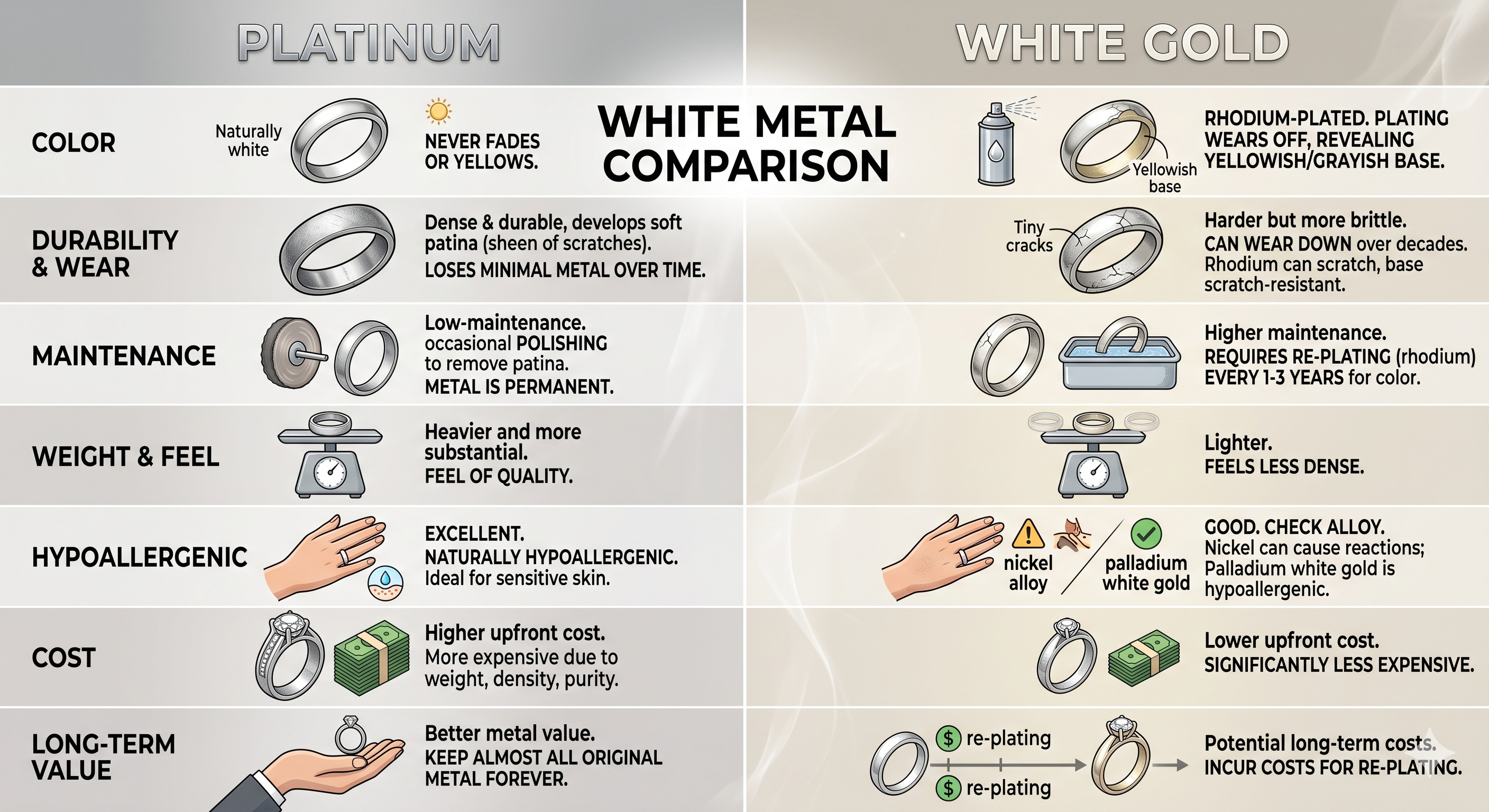
How to Choose: Which One is Right for You?
Choose PLATINUM:
"I want the best, and money is not the primary concern." You value premium quality and are willing to pay for it.
"I want a 'lifetime metal' for an engagement ring or wedding band." Its durability and permanence are perfect for a piece worn every day, forever.
"I hate maintenance and don't want to worry about replating." You prefer a metal that ages gracefully and only needs an occasional polish.
"I have sensitive skin or metal allergies." Its purity makes it the safest choice.
"I love the feel of a heavy, substantial piece of jewelry."
Choose WHITE GOLD :
"I need to stick to a budget." It gives you the bright white look of platinum for a significantly lower initial price.
"I don't mind the occasional maintenance." You're okay with getting your jewelry re-plated every few years to keep it bright white.
"I prefer a lighter-weight piece of jewelry." The lighter feel is more comfortable for you.
"I like the brightest possible white finish." A fresh rhodium plating is the brightest white available, brighter than platinum's natural white.
The Visual Test: A Helpful Analogy
Think of it like cars:
Platinum is like a heavy-duty, premium sedan with a solid metal body. It might get surface scratches over time, but it's built to last a lifetime with just basic care (washing and waxing/polishing).
White Gold is like a sleek, affordable sports car with a brilliant custom paint job (the rhodium plating). To keep it looking showroom-new, you need to repaint it every few years, but the engine and frame (the gold alloy) are solid.
Both are excellent choices for beautiful, white jewelry.
For maximum durability, low maintenance, and a premium feel, choose Platinum.
For a lower initial cost and the brightest white color, and if you don't mind periodic upkeep, choose White Gold.
There is no wrong answer, only the right answer for your personal preferences and priorities. The best advice is to visit a reputable jeweler and hold and try on both. The difference in weight and feel can often be the deciding factor.
Can I Wear Platinum Every Day?
Absolutely, yes. Platinum is one of the best metals you can choose for everyday wear, which is why it's so highly recommended for lifetime pieces like engagement rings and wedding bands.
Here’s a breakdown of why it's so suitable and what you can expect over time.
Why Platinum is Excellent for Daily Wear
Extreme Durability: Platinum is a strong, tough metal that is highly resistant to breaking, cracking, or wearing thin. It holds gemstones very securely, making it an ideal setting for valuable stones like diamonds.
Density and Longevity: Because it is so dense and heavy, platinum withstands the rigors of daily life exceptionally well. While it can scratch, it loses very little metal over decades of wear. When gold scratches, metal is actually lost; when platinum scratches, the metal is merely displaced, forming what is called a patina.
Hypoallergenic: Being 95% pure (typically Pt950), platinum is an excellent choice for those with sensitive skin or metal allergies, as it contains no common irritants like nickel.
The "Patina": The Key to Understanding Daily Wear
This is the most important concept to grasp when wearing platinum daily.
What is it? A patina is a soft, satiny sheen that develops on the surface of the metal over time from millions of microscopic scratches.
Is it a bad thing? This is a matter of taste.
Many people love it: They see the patina as a desirable, distinguished "living finish." It proves the ring is real, well-loved, and has a history. It's an understated, matte look that many find beautiful.
If you prefer a high-shine look: If you want your ring to always look brand-new and mirror-polished, the patina will be a drawback.
The great news is that the patina is not permanent. A jeweler can easily polish the ring to restore it to its original, brilliant, high-shine finish. This process removes a tiny, negligible amount of metal.
What to Expect: A Realistic Timeline
First 6-12 months: Your new platinum jewelry will have a bright, mirror-like polish.
After 1-3 years of daily wear: You will likely notice the shine softening into a more satiny, matte finish (the patina). The metal itself will remain strong and intact.
As needed: When you feel the piece looks too dull, take it to a professional jeweler for polishing. They can make it look new again in no time.
Comparison for Daily Wear: Platinum vs. White Gold
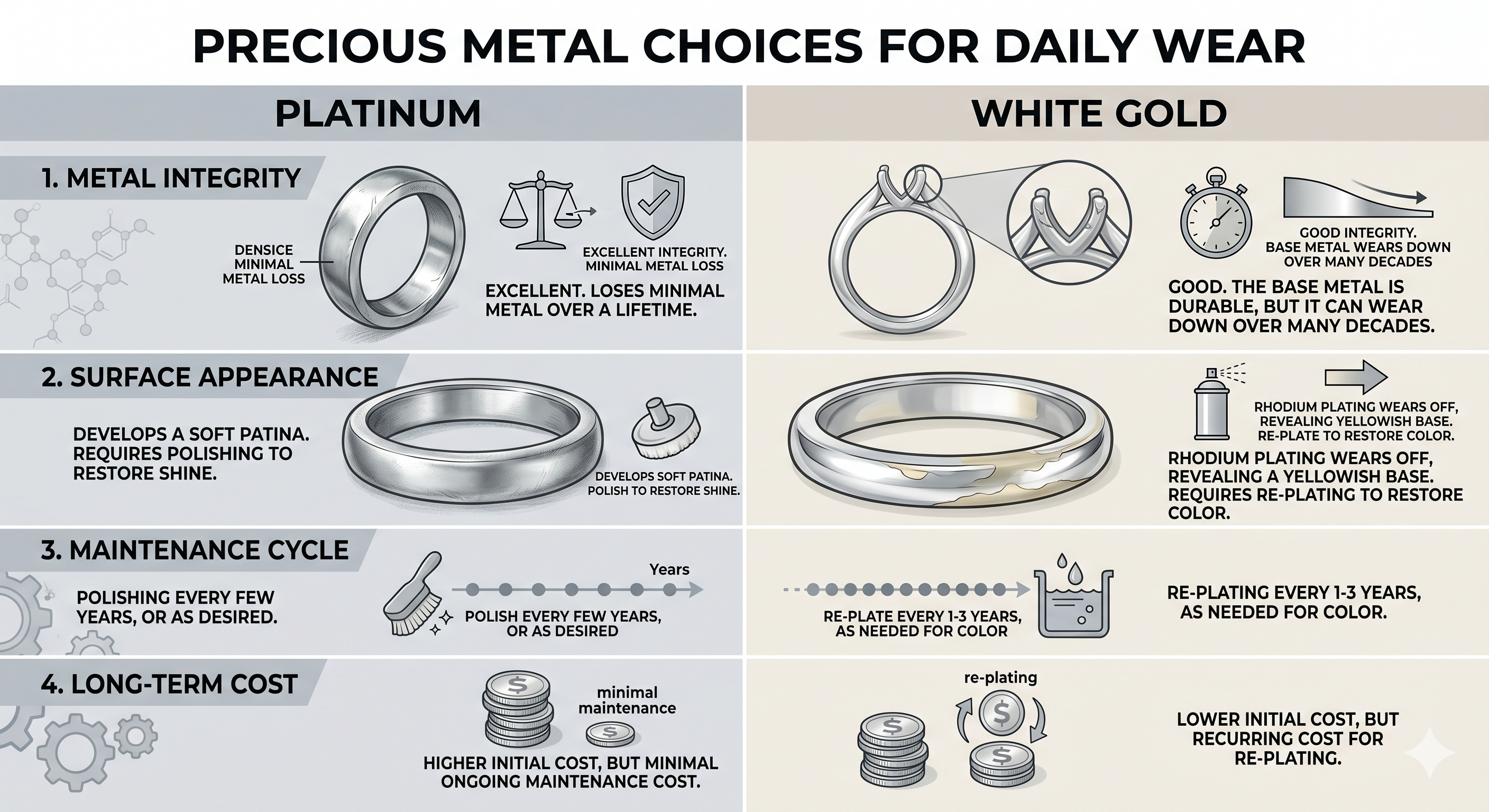
Yes, you can and should wear platinum every day. It is built to last a lifetime.
Choose Platinum: You want the most durable, long-lasting metal that ages gracefully and requires less frequent, less expensive maintenance. You are okay with—or even love—the idea of it developing a soft patina.
Consider White Gold: You prefer a consistently bright white look and don't mind the recurring task and cost of getting it re-plated every couple of years.
For a piece you plan to wear every day for the rest of your life, platinum's resilience and timeless character make it an outstanding choice.
For more on jewelry care, visit the American Gem Society's care guide.
What Color Does Platinum Fade To?
Platinum does not technically "fade" or change its fundamental color.
Unlike other metals that undergo a chemical reaction (like silver tarnishing black), platinum's core color remains the same. However, its surface appearance can change over time. Here’s what really happens:
The "Patina": A Sign of Character, Not Fading
With daily wear, platinum develops a soft, matte, satin-like finish called a patina.
What it looks like: The patina is not a new color, but a dulling of the mirror-like shine. It appears as a consistent, frosted, whitish-gray sheen across the surface of the metal.
What it is NOT: It does not turn yellow, brown, or black.
Why Does This Happen?
Platinum is a relatively soft (though very strong) and malleable metal. When it gets scratched through daily wear, the metal is displaced rather than being worn away (as happens with gold). These millions of tiny, microscopic scratches scatter light instead of reflecting it directly, creating the soft, matte appearance we call a patina.
Platinum vs. Other Metals: A Key Distinction
This is the most important point to understand:
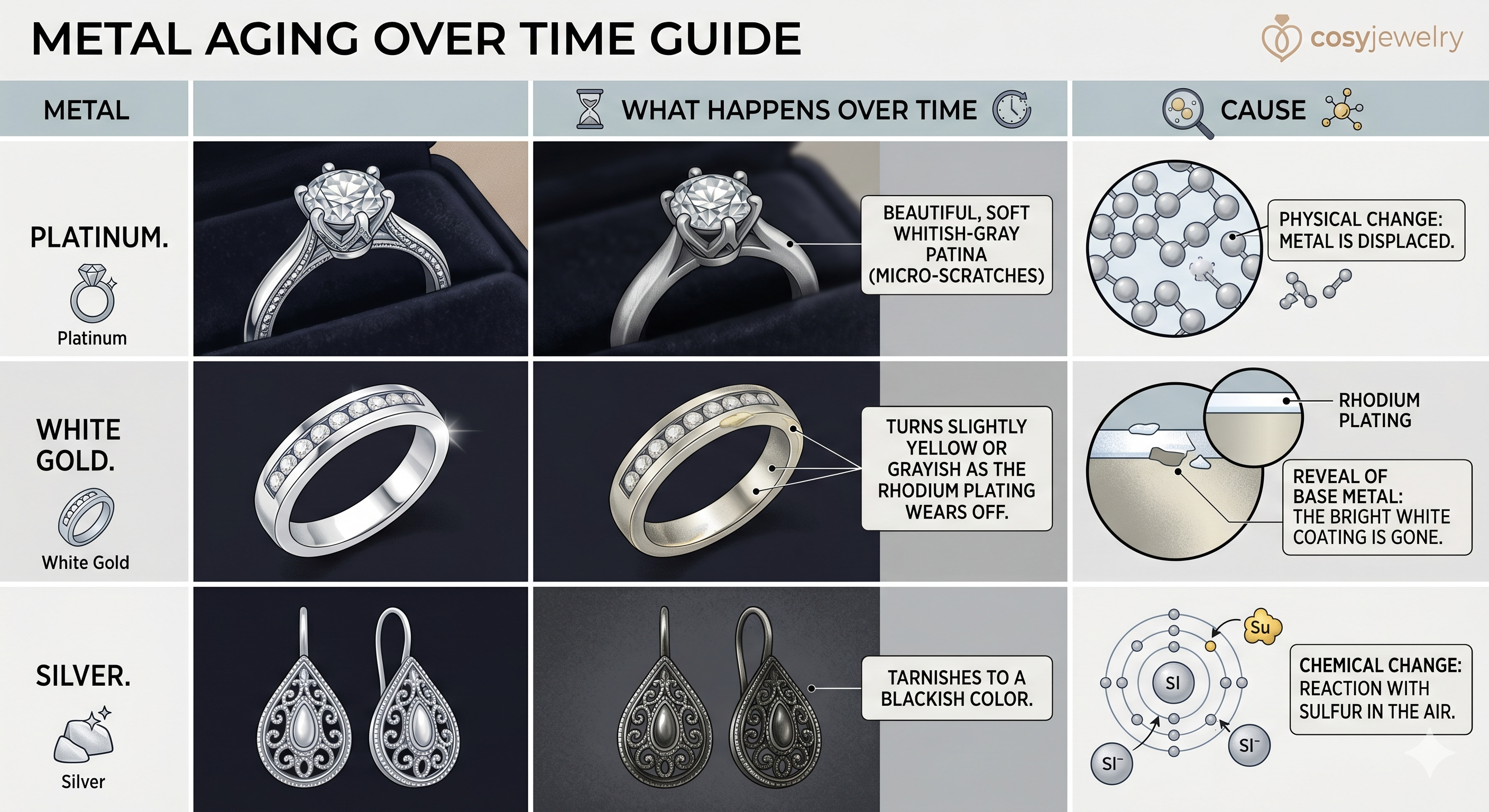
So, if you see a platinum ring that looks "yellow," it is almost certainly not platinum, or it is covered in dirt and skin oils. A simple professional cleaning will confirm this.
What to Do About the Patina
The patina is not permanent and is easily reversed.
It's a Matter of Preference: Many people love the patina! It gives the jewelry a distinguished, "lived-in" look that signifies quality and history. It's understated and elegant.
Easy to Restore: If you prefer the original high-shine, mirror finish, a jeweler can easily polish the platinum. This process smooths out the microscopic scratches, restoring the brilliant, like-new luster. Unlike re-plating white gold, this is a simple process that doesn't add a new layer—it just restores the original metal surface.
Platinum does not fade to a different color. Its natural, bright white color is permanent. The whitish-gray patina it develops is simply a change in surface texture from scratches, which can be polished away at any time to restore the original shine.
“You now know the cosmic origin, the price, the gold comparison, the yellowing truth, the disadvantages, the investment case, the white gold debate, the daily wear advice, and the color truth. The only question left: will you wear the metal that came from the stars?
Our current collection includes a limited number of platinum rings — from classic solitaires to intricate pavé bands. When platinum stock is gone, restocking takes time because it is 30 times rarer than gold and mined in only a few places on Earth.
This is not just a metal. It is asteroid dust from 4 billion years ago, the conquistador‘s trash, the king‘s treasure, the mountaineer‘s choice, and the astronaut‘s companion — a metal that does not fade, does not crack, and will still be here when we are not.”
[Button: Secure Your Platinum Ring (Limited) →]


News for Thursday 09 October, 2025
View all news for Thursday 09 October, 2025 on one page
Recent News
- Saturday 04 October, 2025
- Sunday 28 September, 2025
- Friday 12 September, 2025
- Wednesday 10 September, 2025
- Tuesday 09 September, 2025