

Vintage Cut Guide: Old Mine vs Old European vs Rose Cut
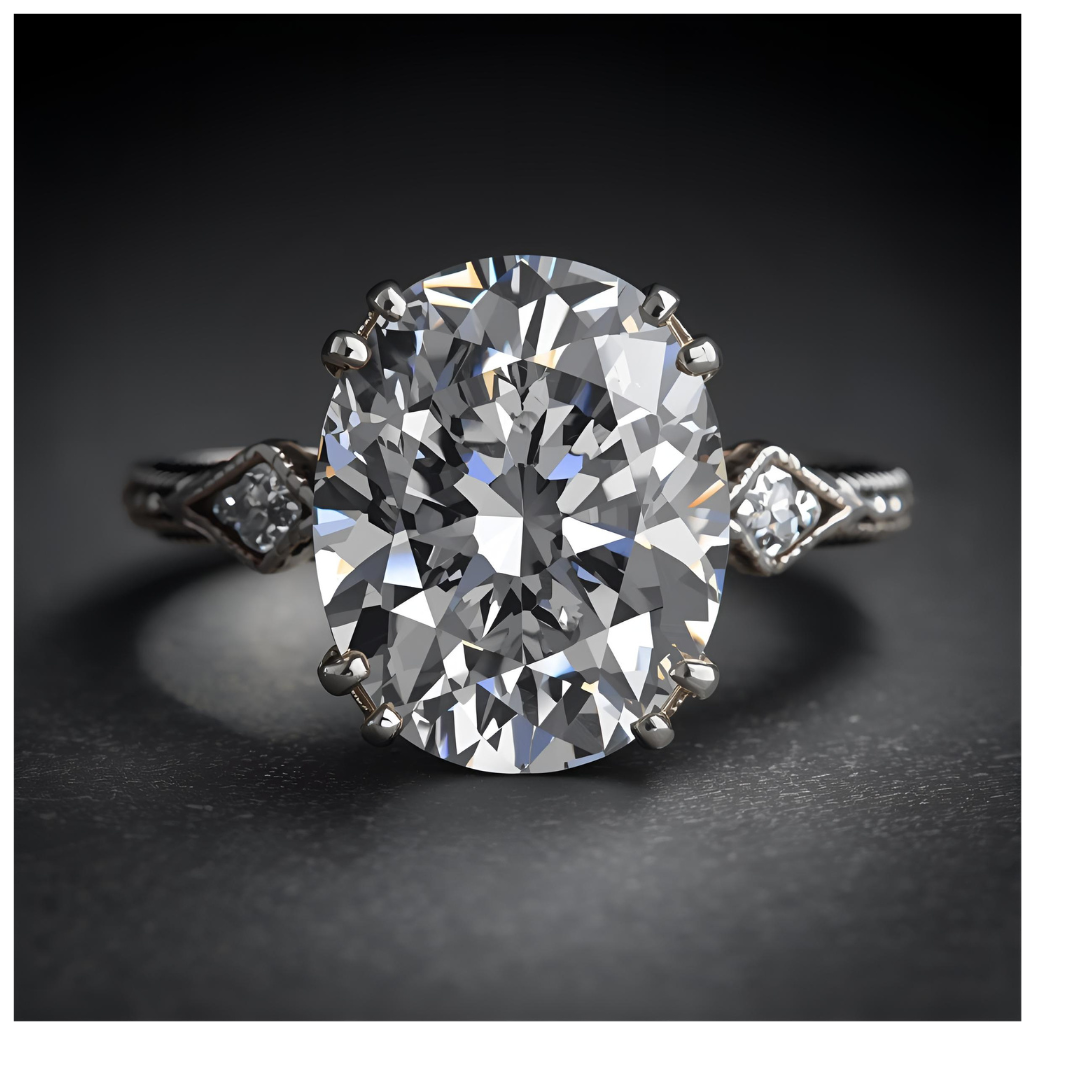
Vintage Cut Guide: Old Mine vs Old European vs Rose Cut
That's an excellent question. The term "vintage cut" can refer to two distinct but related concepts, depending on whether one is discussing clothing/fashion or diamonds/gemstones.
“In 1902, the Asscher brothers of Amsterdam invented a square diamond cut with stepped facets and cropped corners. It became the signature of the Art Deco era—a time when geometry was glamour, and symmetry was sin. But by the 1950s, the round brilliant had taken over, and the Asscher faded. For decades, it sat in jewelry boxes, forgotten. Then, in the early 2000s, something happened. Brides started asking for ‘that square vintage diamond.‘ The Asscher was reborn. Vintage cuts do not die. They wait. They wait for a generation that finally understands: perfection is not the same as beauty.”
The same cuts that defined the Art Deco era now await your own timeless story — from Old European cuts to Old Mine cuts, from Rose cuts to Transitional cuts. Every vintage cut diamond in our collection is hand-selected for character, not perfection.”
[Button: Explore Vintage Cut Diamonds →]
Table of Contents
What Is A Vintage Cut?
Here’s a breakdown of both meanings.
1. Vintage Cut in Fashion
In the context of clothing, a vintage cut refers to the specific silhouette, pattern, and construction techniques that were popular in a particular historical era (typically anything from the 1920s to the 1980s).
It's not just about an "old-fashioned" look; it's about the precise way a garment is shaped to fit the body, reflecting the ideals of beauty and style of its time.
Key Characteristics of Vintage Clothing Cuts:
Era-Specific Silhouettes: Each decade has its own distinctive shape.
1920s: Dropped waists, straight and boxy "flapper" shapes.
1930s-1940s: Bias cuts that cling to the body, defined shoulders, and nipped-in waists.
1950s: The quintessential hourglass figure—full skirts, tiny defined waists (often with cinched belts), and structured bodices.
1960s: A-line shifts, trapeze shapes, and mod styles that move away from the defined waist.
1970s: Flowing, hippie-inspired maxi dresses, wrap dresses, and wide-legged pants.
Different Sizing: Vintage clothing often uses different sizing standards than modern clothing. A vintage size 12 might be closer to a modern size 6 or 8. They were also often cut for a different posture and foundation garment (e.g., girdles, bullet bras).
Attention to Detail & Construction: Vintage garments often feature details rarely found in modern fast fashion, such as French seams, bound buttonholes, and generous seam allowances, allowing for alterations.
Fabrication: They are made from natural fibers like silk, cotton, wool, and rayon, which were more common before the widespread use of polyester.
Why People Seek Vintage Cuts:
Unique Silhouette: They offer shapes that are hard to find in contemporary clothing (e.g., the dramatic 1950s hourglass).
Quality and Durability: Often better-made than modern equivalents.
Individuality: To stand out from mass-produced trends.
2. Vintage Cut in Diamonds and Gemstones
In the world of diamonds, a vintage cut (or "old mine cut" / "old European cut") refers to gemstones that were cut by hand before the development of modern precision machinery and computer algorithms. These cuts prioritize the gem's character and "fire" (the sparkle of colored light) over the uniform brilliance of modern stones.
Key Characteristics of Vintage Cut Diamonds:
Hand-Cut Symmetry: They are less symmetrical and precise than modern cuts. Facets might be slightly uneven, and the stone may not be perfectly round.
A High Pavilion and Small Table: They were cut to perform best under candlelight and early electric light, resulting in a chunkier, deeper appearance with a smaller top facet (table).
An Open Culet: The point at the bottom of the diamond (the culet) was often left flat or open, which can sometimes be seen as a small black dot through the table when looking face-up.
Extra Fire: The facet arrangement often creates a "chunkier," more prismatic sparkle with flashes of rainbow color, rather than the intense white brilliance of a modern stone.
Common Types:
Old European Cut: The direct predecessor to the modern round brilliant. Roundish shape, high crown, and small table.
Old Mine Cut: The precursor to the Old European Cut. Often has a cushion-like shape, a high crown, and a large culet.
Rose Cut: Flat bottom with a dome top covered in triangular facets, resembling a rosebud.
Transitional Cut: A bridge between old cuts and modern brilliants, showing more symmetry but still cut by hand.
Why People Seek Vintage Cut Gemstones:
Romance and History: Each stone has a unique story and was crafted by hand.
Unique Character: The imperfections and unique light performance are seen as desirable traits.
Antique Aesthetic: They are the perfect choice for antique and vintage-style jewelry (e.g., Art Deco, Victorian).
Summary of Differences
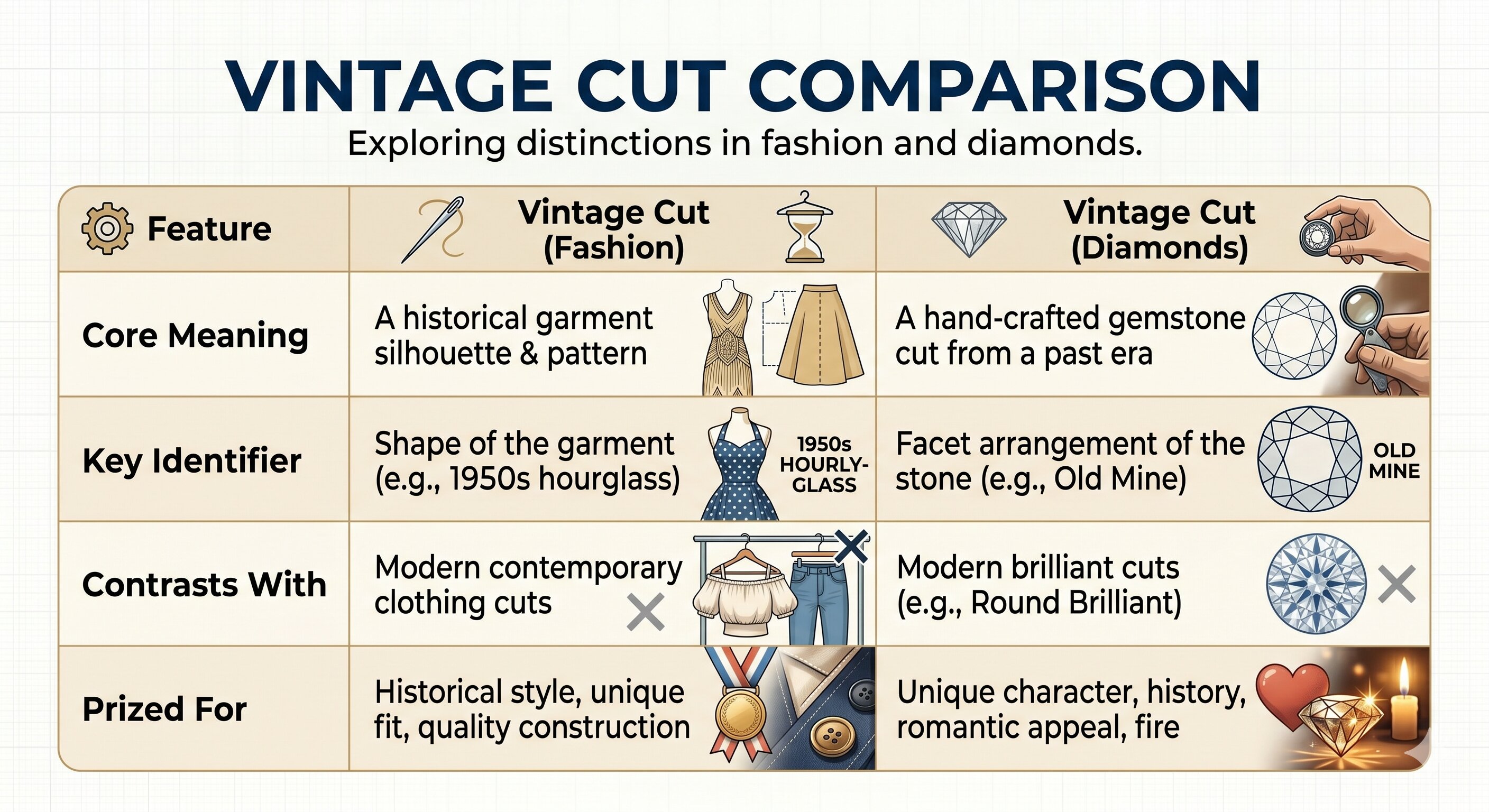
In short, whether in fashion or gems, a "vintage cut" signifies a specific, historical way of crafting something, resulting in a unique aesthetic and character that differs from its modern counterparts
For official diamond cut grading information, visit the GIA Diamond Cut Guide.
What Is Meant By Vintage Style?
While "vintage cut" is a technical term, "vintage style" is a broader aesthetic concept. It refers to the conscious imitation or evocation of the styles, aesthetics, and trends from the past, typically from the 1920s through the 1980s.
It's important to distinguish it from simply wearing or using actual vintage items. "Vintage style" is about capturing the essence of a bygone era, often using modern pieces, reproductions, or a curated mix of old and new.
Here’s a breakdown of what is meant by "vintage style":
Core Idea: Conscious Nostalgia
Vintage style is a deliberate choice to incorporate the design, fashion, and cultural elements of a previous generation into modern life. It's a form of storytelling through aesthetics.
Key Characteristics of Vintage Style
1. Era-Specific Inspiration:
People who adopt a vintage style often draw inspiration from a specific decade. Each decade has its own iconic look:
1920s: Flapper dresses, cloche hats, long pearl necklaces, Art Deco patterns, dropped waists, and fringe.
1930s: Bias-cut satin dresses, sleek silhouettes, backless gowns, and the rise of glamorous Hollywood style.
1940s: High-waisted trousers, tailored shoulder pads (the "power shoulder"), A-line skirts, victory rolls hairstyles, and utilitarian chic from the WWII era.
1950s: The quintessential "vintage" look for many—full circle skirts, nipped-in waists, pencil skirts, sweater sets, polka dots, and rockabilly culture.
1960s: Mod shift dresses, bold geometric patterns, go-go boots, psychedelic prints, and the early hippie movement.
1970s: Bell-bottom jeans, maxi dresses, peasant blouses, disco glam, earth tones, and bohemian (boho) patterns.
2. Focus on Specific Elements:
It's not always about a full head-to-toe costume. Vintage style can be achieved through key pieces or details:
Silhouette: The overall shape of an outfit (e.g., the 1950s hourglass).
Fabric: Using materials common in the past, like silk charmeuse, tweed, lace, or specific prints (e.g., retro florals, novelty prints).
Accessories: A crucial component. Think cat-eye glasses, a structured vintage-style handbag, a silk scarf, gloves, or classic pumps.
Hair and Makeup: Victory rolls, pin curls, winged eyeliner, red lips, or feathered 70s hair are integral to completing the look.
3. Quality and Craftsmanship Aesthetic:
Vintage style often rejects the disposable nature of fast fashion. It embraces an aesthetic of durability, natural fabrics, and details that suggest a bygone era of quality, even if the item is new.
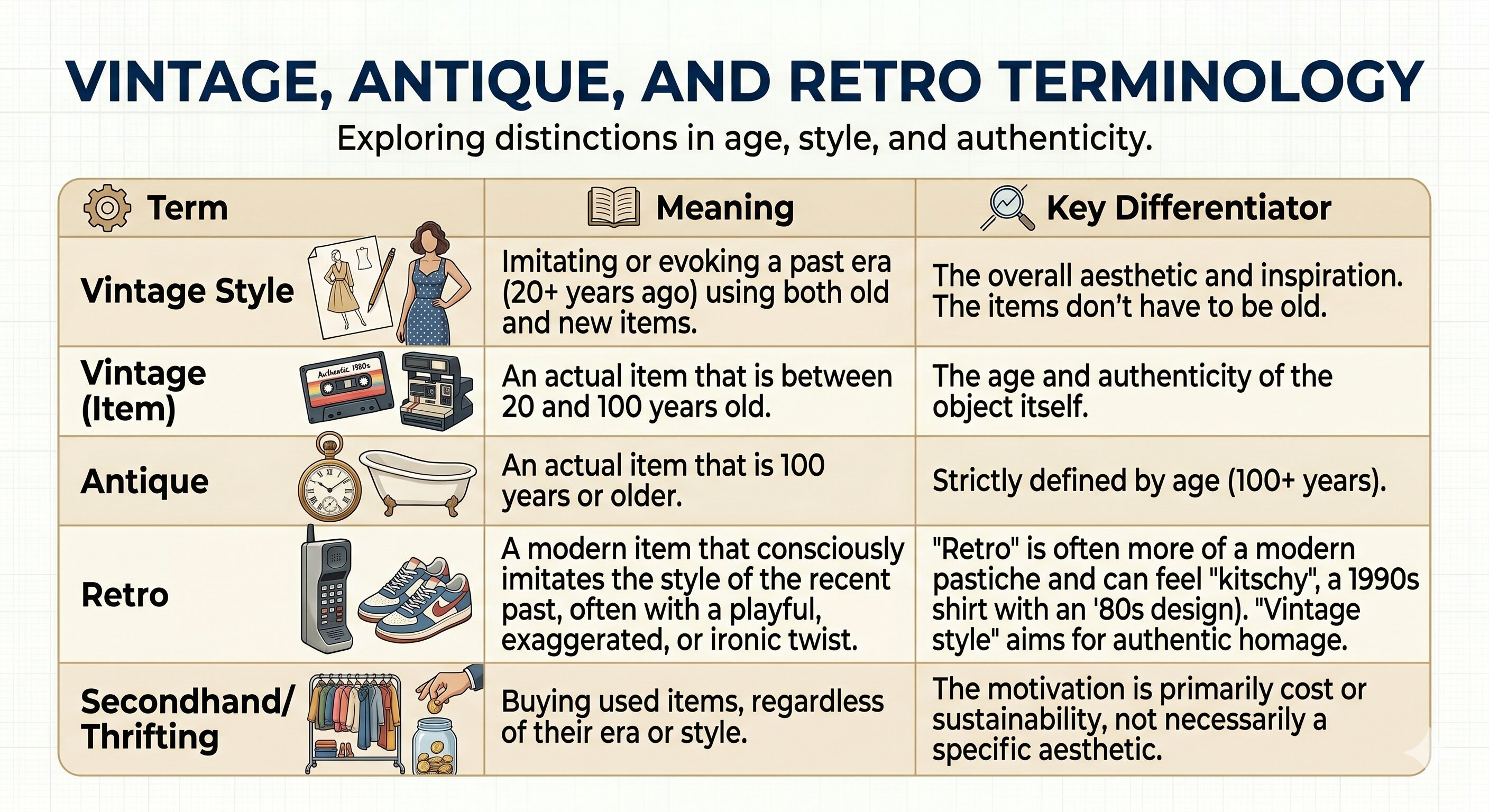
Vintage Style vs. Related Terms
It's helpful to compare it to similar concepts:
Why Do People Embrace Vintage Style?
Individuality and Self-Expression: It's a way to stand out from current, mass-produced trends and curate a unique personal identity.
Appreciation for Quality and Design: There's an admiration for the construction, fabrics, and design details of the past.
Romance and Nostalgia: It connects the wearer to a romanticized vision of the past, even an era they didn't live through.
Sustainability: Wearing true vintage items or well-made reproductions is a form of anti-fast-fashion, promoting reuse and reducing waste.
Cultural Connection: It can be a way to honor family heritage, a subculture (like rockabilly or steampunk), or a beloved historical period.
In essence, vintage style is a form of aesthetic time travel. It’s the active and enthusiastic incorporation of the past's visual language into one's present-day life, driven by nostalgia, individuality, and a deep appreciation for the design of previous eras.
Does Vintage Mean High Quality?
That's a fantastic and crucial question. The short answer is: Not necessarily.
While "vintage" often implies the potential for high quality, it is not a direct synonym for it. The association exists for good reasons, but it's important to understand the nuances.
Here’s a breakdown of why vintage gets linked with quality and when it doesn't live up to that reputation.
Why Vintage is OFTEN Associated with High Quality (The "Survivorship Bias")
This is the most important concept to understand. The vintage items we see today are the ones that survived.
The "Survivorship Bias": We don't see the poorly made items from the past because they fell apart, were thrown away, or worn to rags decades ago. The items that lasted 20, 50, or 70 years were typically the better-constructed ones made from durable materials. This creates a skewed perception that everything from the past was made better.
Durability over Disposability: Before the rise of fast fashion and planned obsolescence, many goods (especially clothing, furniture, and appliances) were designed to last. They were investments.
Clothing: Used natural fibers (silks, wools, high-quality cottons), had finer finishes (like French seams), and included features like generous seam allowances for alterations.
Furniture: Often uses solid wood and proper joinery (dovetail joints) instead of particleboard and staples.
Craftsmanship: Many vintage items were made with a higher degree of human hands-on work, both in design and manufacturing, which can lead to a level of detail and sturdiness that is expensive or rare today.
Why Vintage CAN ALSO Mean Low Quality
There Was Always "Fast Fashion": Every era had its low-end, cheaply produced goods. A polyester leisure suit from the 1970s or a flimsy, mass-produced dress from the 1950s was not a high-quality item then, and it isn't now. It just happens to be old.
The Effects of Time and Wear:
Fabric Degradation: Even the most beautiful silk can become brittle and shatter. Elastic dies. Linen can weaken. A garment can be perfectly construed, but simply be too fragile to wear.
Stains, Holes, and Damage: Vintage items may have irreparable flaws, moth holes, persistent odors, or stains that have set over decades.
Outdated Technology: In areas like electronics or cars, "vintage" often means less efficient, less safe, and less reliable than their modern counterparts. A vintage amplifier might have a wonderful "warm" sound, but it could also be prone to overheating and require constant maintenance.
Past Manufacturing Limitations: Sometimes, modern manufacturing techniques actually produce superior quality. For example, the precision of a modern brilliant-cut diamond creates more sparkle than a hand-cut vintage one. Modern waterproof and breathable fabrics (like GORE-TEX) outperform older raincoat materials.
How to Think About Vintage and Quality
Instead of a simple "yes" or "no," it's better to think of it as a filter for potential quality.
Vintage is a sign of potential. When you find a vintage item, it has passed the first test of time. The question is, "Was it high-quality to begin with, and has it been preserved well?"
You must evaluate each item individually. Check the seams, the fabric content, the joints and sand, and the hardware. Look for signs of wear and damage. An item's condition is just as important as its age.
"Vintage" describes age, not condition. An item can be vintage and be in pristine, "deadstock" condition, or it can be vintage and be a tattered wreck.
Vintage does not automatically mean high quality, but the best vintage items represent a level of quality and durability that can be hard to find in today's mass market.
The association exists because the low-quality items from the past are no longer with us, leaving behind a curated selection of the tougher, better-cared-for pieces. When you buy vintage, you are hunting for those high-quality survivors.
Are Vintage Diamonds Worth Anything?
Yes, absolutely. Vintage diamonds are not only worth something, but they can also be highly valuable and sought-after. However, their value is determined by a different set of criteria than modern diamonds.
Think of it like a classic car versus a new one. The new car is valued for its latest technology, efficiency, and perfect condition. The classic car is valued for its history, unique design, character, and rarity.
Here’s a detailed breakdown of what makes vintage diamonds valuable and how their worth is assessed.
Key Factors That Determine the Value of a Vintage Diamond
1. The "Cut" is King (And It's Different from Modern Cuts)
This is the most important factor for vintage diamonds. The cut refers to the geometric proportions and faceting style.
Historical Significance: Cuts like the Old European Cut (the direct predecessor to the modern round brilliant) or the Old Mine Cut (a cushion-shaped cut with a high crown and large culet) are prized for their historical charm and the skill of the hand-cutting process.
Unique Light Performance: These older cuts were designed to perform under candlelight. They prioritize "fire" (the flash of rainbow colors) over the stark white "brilliance" of a modern diamond. This creates a soft, romantic, and chunky sparkle that many people find captivating and unique.
Rarity: You cannot walk into a modern jewelry chain and buy a true, hand-cut Old Mine Cut diamond. Their scarcity adds to their value.
2. The Four Cs Still Matter, But Are Applied Differently
Carat Weight: This is a straightforward measure. Larger diamonds are rarer and more valuable, all else being equal.
Color: Vintage diamonds often have a warmer body color (like K, L, M on the color scale, or even lower). In the modern market, this would lower the value. However, in a vintage setting, a warm color can be desirable and authentic to the period. Truly colorless vintage diamonds are exceptionally rare and command a premium.
Clarity: Similar to color, the standards were different. Inclusions were more common and accepted. The key is that the inclusions do not compromise the diamond's structural integrity or completely obscure its beauty. An "eye-clean" vintage diamond is a great find.
Cut (Again): As mentioned above, this is the defining characteristic. Grading reports like the GIA will now grade some older cuts, but they do so with a different set of standards, acknowledging their unique proportions.
3. Provenance and History
A diamond with a documented history, especially if it can be linked to a specific era (like the Art Deco or Victorian periods) or, in rare cases, a famous previous owner, can have its value significantly increased. The story behind the stone is a tangible part of its worth.
4. The Setting and Overall Jewelry Piece
Vintage diamonds are often valued as part of their original setting.
Authenticity: A diamond in its original, undisturbed Art Deco, Edwardian, or Retro-era mounting is often more valuable than the stone alone. Dismantling a period piece can destroy historical and artistic value.
Craftsmanship: The quality of the metalwork (e.g., intricate milgrain, filigree, or hand-engraving) adds considerable value to the entire piece.
Style: Highly desirable styles like Art Deco are massively popular, which can drive up the price of a complete ring or brooch.
The Potential Downsides (What Can Lower Value)
Damage: Chips, large cracks, or poor re-cutting attempts can severely diminish a diamond's value.
Heavily Included or Cloudy Stones: If the inclusions make the diamond look dull or milky, it will be less valuable.
Being "Out of Style": While less common now, some vintage styles can be less sought-after than others, affecting the price of the complete piece.
Unknown Origin: Without a lab report from a reputable gemological institute (like GIA or AGS), it can be harder to command top dollar, as buyers have less certainty about what they are getting.
So, Are They a Good Investment?
As a Financial Investment: It can be speculative. The market for vintage diamonds is more niche than for modern ones. Their value is subject to the whims of fashion and collector interest.
As an Emotional and Aesthetic Investment: Absolutely. You are purchasing a one-of-a-kind piece of wearable history with unique character and charm that cannot be replicated by a modern, machine-cut diamond. You are paying for art and story, not just a commodity.
Conclusion
Yes, vintage diamonds are absolutely worth something, and often a significant amount. Their value lies in a combination of:
Rarity and Unique Character
Historical Craftsmanship
Distinctive Visual Appeal (softer, more fiery sparkle)
Antique Setting and Provenance
“In 2016, a 24-carat Old Mine Cut diamond sold at auction for $1.5 million. It was not the most brilliant diamond. It was not the most colorless. It had inclusions visible to the naked eye, a slightly off-round shape, and a culet that looked like a small window into the stone. But it had something no modern diamond could claim: it had been cut by hand in the 18th century, polished by a candle flame, and worn by three generations of one family. You cannot buy that story in a mall. You cannot order it online. You can only find it in the stones that time forgot. That is why vintage diamonds are priceless—not because they are perfect, but because they are irreplaceable.”
If you have a vintage diamond, it is highly recommended to have it appraised by a qualified gemologist or appraiser who specializes in antique and estate jewelry. They will understand the nuances of valuing these unique treasures and can give you the most accurate assessment of their worth.
“You now know the two meanings (fashion vs. gems), the vintage style aesthetic, the quality misconception, and the vintage diamond value. The only question left: will you choose a stone that was cut by candlelight?
Our current collection includes a limited number of genuine vintage cut diamonds — from Old European rounds to Old Mine cushions, from Rose cuts to Asschers. When these hand-cut stones are gone, they are gone. No machine will make another.
This is not just a diamond. It is the Asscher brothers‘ 1902 invention, the Art Deco‘s signature, the candlelit ballroom‘s sparkle — a stone that is not perfect, but is irreplaceable. Perfection is boring. Character is forever.”
[Button: Claim Your Vintage Cut Diamond (Limited) →]


Other news for Monday 15 June, 2026
- Asscher Cut Guide: Complete Guide to Square Emerald Cut Diamonds
- Classic Cut Guide: Old Mine vs Old European vs Modern Round
- Marquise Cut Guide: Price, Size Illusion, vs Oval and Buying Tips
- Pavé Setting Guide: Pros, Cons, Cost, Security and Channel/Bezel
- Radiant Cut Guide: Price, vs Emerald, 1ct, 3ct Cost, Sparkle and Tips
- Heart-Shaped Diamond Guide: Meaning, Price, 2ct Cost and Buying Tips
View all news for Monday 15 June, 2026 on one page
News for Sunday 14 June, 2026
- Round Brilliant Cut Guide: Price, Facets, vs Other Cuts and Buying Tips
- The Allure of the Cushion Cut Diamond: What You Need to Know
- Square Cut Diamond Guide: Princess, Cushion, Asscher and Radiant
- 24K Gold Guide: Purity, Price, vs 18K, Investment and Buying Tips
- 22K Gold Guide: Purity, Price, vs 24K/18K, Daily Wear and Care
- Oval Cut Diamond Guide: Price, vs Round, vs Radiant and Buying Tips
- Pear Cut Diamond Guide: Price, vs Round, Sparkle and Buying Tips
- Solitaire Setting Guide: 4 vs 6 Prong, Security, Unique Ideas and Comfort
View all news for Sunday 14 June, 2026 on one page
Recent News
- Saturday 13 June, 2026
- Friday 12 June, 2026
- Thursday 11 June, 2026
- Wednesday 10 June, 2026
- Tuesday 09 June, 2026