

Square Cut Diamond Guide: Princess, Cushion, Asscher and Radiant
Square Cut Diamond Guide: Princess, Cushion, Asscher, and Radiant
Excellent question! When people refer to a "square cut" diamond, they are most commonly talking about the Princess Cut.
“In the late 1970s, a London cutter named Basil Watermeyer created a square diamond with sharp corners and a brilliant faceting pattern. He called it the ‘princess‘ not because it was delicate, but because it refused to be round. For 500 years, the round brilliant had been king. Then came the princess—geometric, modern, and unapologetically square. It is now the second most popular diamond shape in the world. The princess cut is not a compromise. It is a statement: I choose my own shape.”
The same cut that refused to be round now awaits your own modern love story — whether you choose a brilliant princess, a romantic cushion, a vintage Asscher, or a radiant hybrid. Every square-cut diamond in our collection is hand-selected for symmetry and sparkle.”
[Button: Explore Square Cut Diamonds →]
However, "square cut" is a bit of a general term in the jewelry world, and it actually refers to a family of diamond shapes that have a square outline when viewed from above.
Table of Contents
What Is A Square Cut Diamond Called?
Here are the main types of square-cut diamonds, starting with the most popular:
1. The Princess Cut (The Most Common Square Cut)
This is the definitive modern square cut and is the second most popular diamond shape in the world (after the round brilliant).
Key Features:
Perfectly square or nearly square shape.
Sharp, uncropped corners.
A brilliant-style faceting pattern (like a round diamond), which gives it exceptional sparkle and fire.
Why it's popular: It combines a contemporary square shape with the dazzling brilliance of a round diamond. It often has a lower price per carat than a round brilliant because it retains more of the original rough diamond.
2. The Asscher Cut (A Vintage, Art Deco Square)
The Asscher cut is a distinctive and elegant square cut with a vintage feel.
Key Features:
A square shape with cropped corners, giving it an octagonal outline.
A "step-cut" faceting pattern, with concentric rows of facets that create a "hall of mirrors" effect (similar to an emerald cut).
A high crown and a small table, which creates a deep, luminous look.
Appeal: It is known for its classic, geometric beauty and incredible clarity, though it shows less fiery sparkle and more flashes of light (brilliance vs. scintillation).
3. The Cushion Cut (The Soft Square)
The cushion cut is a classic shape that often appears as a square with softly rounded corners.
Key Features:
A square or rectangular shape with pronounced rounded corners, resembling a pillow or cushion.
Can have either a "brilliant" faceting pattern for more sparkle or a "chunky" faceting pattern for a more antique look.
Appeal: It offers a romantic, soft, and vintage appearance with large, open facets that showcase the diamond's clarity.
4. The Radiant Cut (The Brilliant Square with Cropped Corners)
The Radiant cut is a brilliant hybrid, combining the shape of an emerald cut with the faceting of a round brilliant.
Key Features:
A square or rectangular shape with beveled, cropped corners.
A brilliant faceting pattern on both the crown and pavilion, making it exceptionally sparkly.
Appeal: It was the first rectangular cut to have a completely brilliant faceting pattern. The cropped corners make it more durable than a Princess cut and help hide color in the diamond.
Quick Comparison Guide
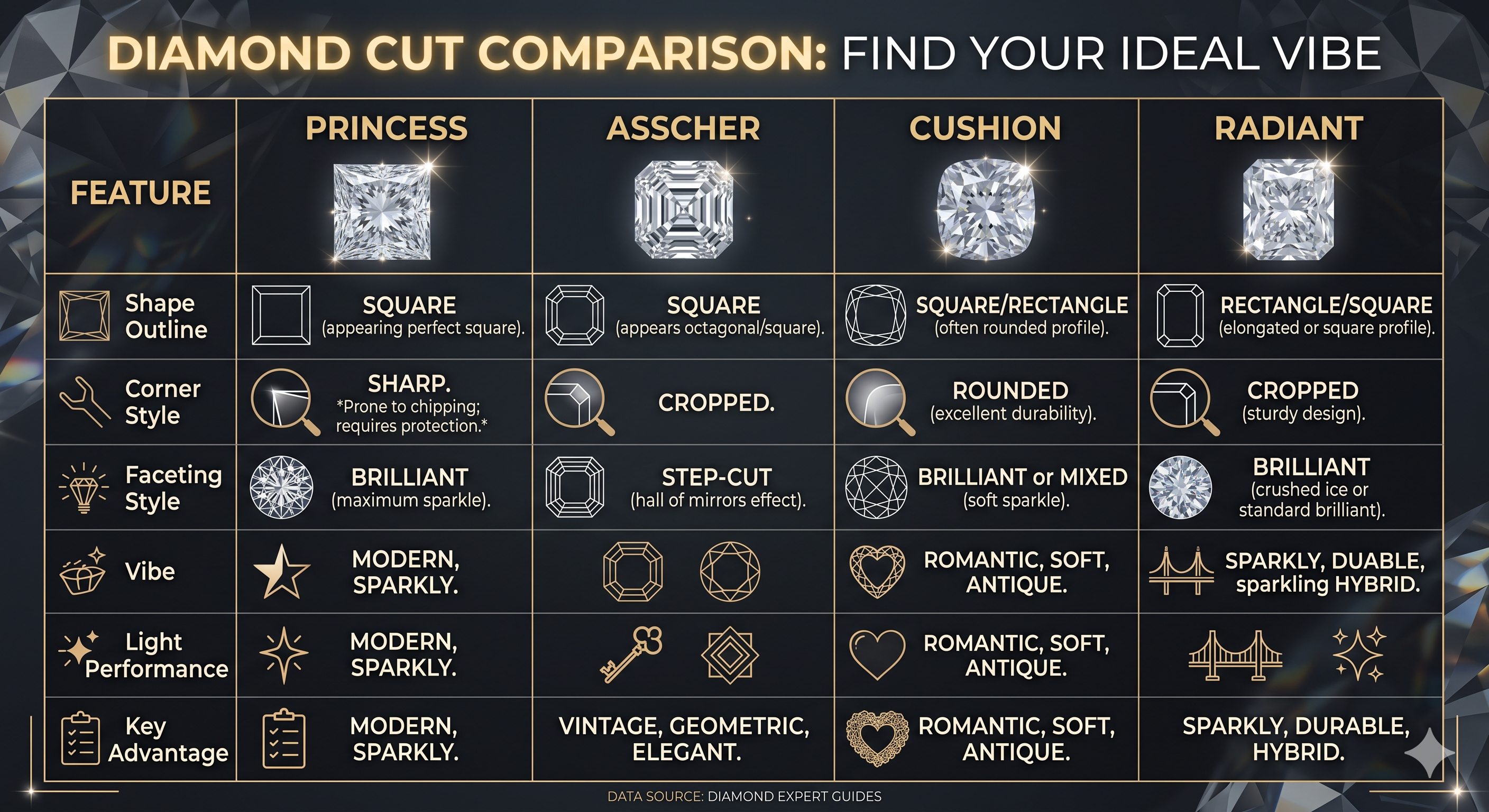
If someone says "square cut diamond," they are most likely referring to the Princess Cut. However, it's always best to clarify, as it could also mean a Cushion, Asscher, or Radiant cut depending on the specific style they have in mind.
Pro Tip: Princess-cut diamonds have very sharp corners that can be prone to chipping. It is highly recommended to set them in a protective setting (like a V-prong or bezel) at the four corners.
For official diamond cut grading information, visit the GIA Diamond Cut Guide.
Is A Square-cut Diamond Good?
That's an excellent and practical question. The short answer is: Yes, a square-cut diamond can be an excellent choice, but "good" depends heavily on your priorities and which specific square cut you choose.
They offer a fantastic blend of modern style, brilliance, and often, better value than a round diamond. However, they have unique characteristics you need to be aware of.
Let's break down the pros and cons, primarily focusing on the most popular square cut: the Princess Cut.
Advantages of Square Cut Diamonds (Why They Are "Good")
Modern and Stylish: Square cuts, especially the Princess and Asscher, offer a contemporary, geometric aesthetic that many find more unique and modern than the traditional round brilliant.
Exceptional Brilliance: The Princess and Radiant cuts use a brilliant-style faceting pattern, meaning they are engineered to sparkle with both fire (flashes of color) and brilliance (white light) nearly as much as a round diamond.
Excellent Value for Money: This is a major advantage. Square cuts retain more of the original rough diamond crystal than a round cut. Because of this higher yield, you often get a larger-looking diamond for the same price per carat. A 1-carat princess cut will typically cost significantly less than a 1-carat round brilliant.
Flattering on the Finger: The elongated appearance of square shapes (especially when set with side stones) can create a flattering, finger-lengthening effect.
Variety within the Category: As we discussed, "square cut" isn't one thing. You can choose the fiery and modern Princess, the soft and romantic Cushion, or the vintage and elegant Asscher.
Potential Disadvantages & Things to Consider (The "But...")
Durability of Corners (Crucial for Princess Cuts): The sharp, pointed corners of a Princess cut diamond are its most vulnerable points and can be prone to chipping if struck hard. This is the single biggest practical concern.
Solution: Always set a Princess cut in a protective setting.
such as a V-prong or a bezel setting at the four corners.
Bow-Tie Effect: Elongated or square-shaped fancy cuts (especially Ovals, Marquise, and Cushion/Radiant/Asscher cuts) can suffer from a "bow-tie" effect. This is a dark, bow-tie-shaped shadow that appears across the center of the diamond when viewed from above, caused by light leakage. A well-cut diamond will minimize this, so it's essential to inspect the stone in person or via high-quality video.
Color and Clarity Can Be More Visible:
Color: In brilliant square cuts (like Princess), the facets can sometimes make body color slightly more noticeable than in a round brilliant. You might need to choose a color grade one step higher (e.g., a G instead of an H) for it to look "colorless" to the naked eye.
Clarity: In step-cuts (like the Asscher), the large, open table facets act like windows, making inclusions (flaws) much easier to see. For an Asscher, you should prioritize a higher clarity grade (e.g., VS2 or better).
Cut is Still King (and More Complex): For round brilliants, cut grading is standardized (Excellent, Very Good, etc.). For fancy shapes like square cuts, there is no universal "Ideal" cut grade. It's more subjective and requires careful visual inspection. GIA certificates for fancy shapes don't give a Cut grade, only Polish and Symmetry.
Quick Guide: Which Square Cut is "Good" For You?
Choose a Princess Cut if: You want the ultimate in modern sparkle and brilliance, you're budget-conscious, and you ensure it's set in a protective setting.
Choose a Cushion Cut if: You love a soft, romantic, or antique vibe. You prefer a mix of brilliant sparkle and larger, "chunkier" facets.
Choose an Asscher Cut if: You are drawn to bold, vintage, Art Deco geometry and value mesmerizing clarity and hall-of-mirrors effects over fiery sparkle.
Choose a Radiant Cut if: You want the brilliance of a Princess cut but with the added durability of cropped corners, and you like a hybrid look.
Is a square-cut diamond good? Absolutely. It can be a brilliant, beautiful, and smart financial choice.
It's a GREAT choice if: you value modern style, want maximum sparkle for your budget, and are willing to pay attention to cut quality and setting protection.
You might prefer a Round Brilliant if: your top priority is the absolute maximum, scientifically proven brilliance, and you want the simplest, most standardized cut grading system.
“In 1902, the Asscher brothers of Amsterdam invented a square cut with cropped corners and concentric step facets—a ‘hall of mirrors‘ that dazzled the Art Deco world. For decades, it was the diamond of royalty. Then the princess cut arrived, and the Asscher faded. But in the 2000s, a revival began. Celebrities chose Asscher cuts for their vintage glamour. Jewelers rediscovered its quiet elegance. The Asscher did not die. It simply waited. Square cuts are like that—they don‘t scream. They sit on your finger and let the light find them. That is their power. Not to shout, but to be seen.”
The best advice is always to look at them in person. Compare a few square cuts side-by-side with a round brilliant. Your eyes will tell you which sparkle and style you truly love.
How Much Is A 1 Carat Square Cut Diamond Worth?
This is a crucial question, and the answer is: There is no single price. The value of a 1-carat square cut diamond can range from roughly $1,000 to over $12,000 for a natural diamond.
The price depends entirely on the "Four Cs" (Cut, Color, Clarity, and Carat), with the specific type of square cut and whether the diamond is natural or lab-grown being the most significant factors.
To give you a practical understanding, let's break it down.
The Biggest Factor: Natural vs. Lab-Grown
This is the most significant determinant of price today.
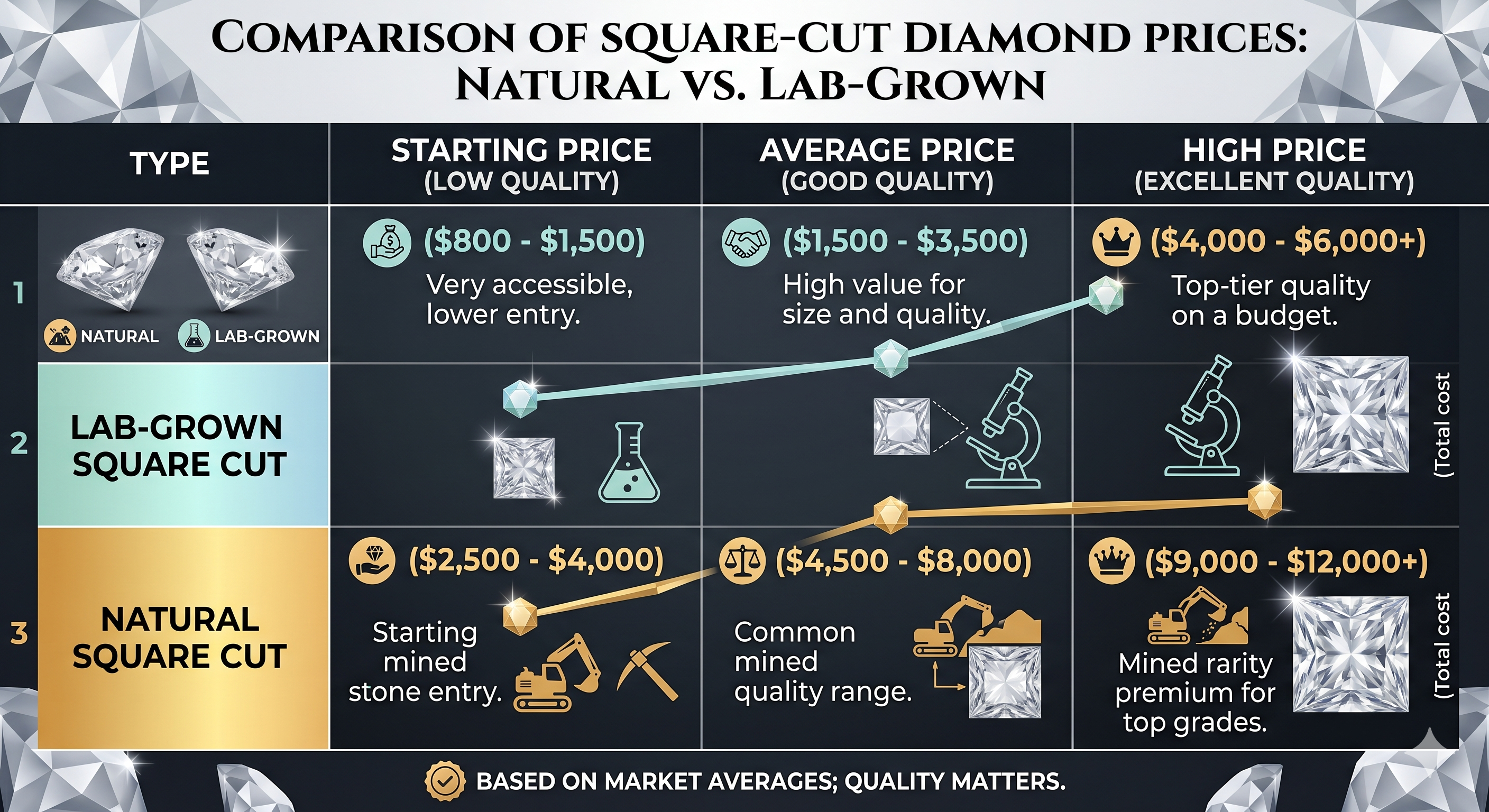
Why the huge difference? Lab-grown diamonds are physically and chemically identical but are created in a week, making them far more abundant and less expensive than mined diamonds.
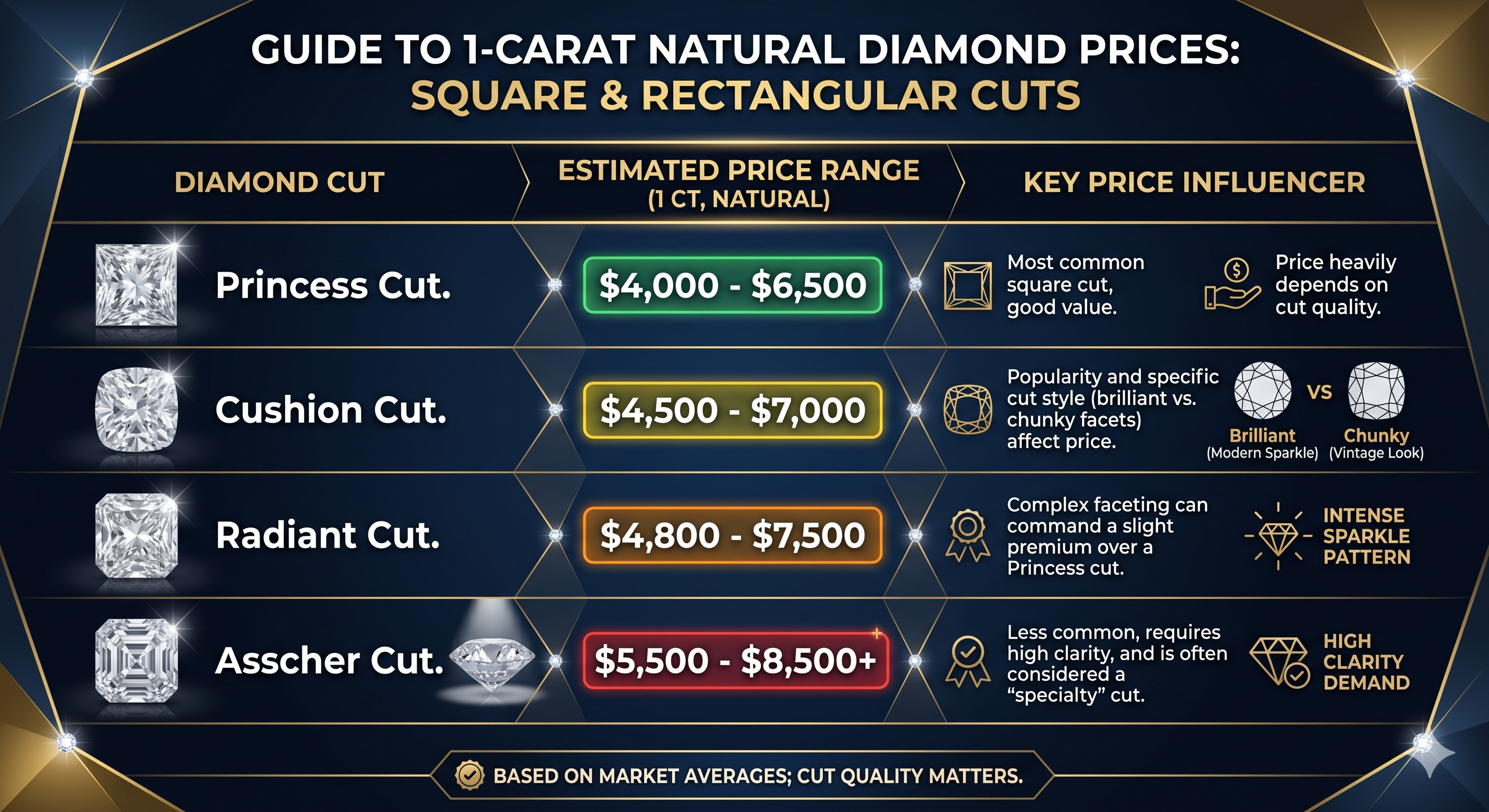
For comparison: A 1-carat Round Brilliant with similar specs would typically cost $6,500 - $9,000, making square cuts generally a better value per carat.
The Real Price Drivers: The Other "Cs"
The following chart illustrates how the two most variable "Cs" - Color and Clarity - dramatically impact the price of a 1-carat diamond, using a Princess cut as an example. Notice the sharp price increase for the highest grades.
As you can see, prioritizing the "eye-clean" and "near-colorless" grades (like the G/VS1 or I/SI1 in the chart) offers the best balance of beauty and value for most people.
How to Get a Realistic Price
Define Your Type: First, decide between Natural and Lab-Grown. This will set your overall budget.
Choose a Shape: Narrow it down to Princess, Cushion, Radiant, or Asscher.
Set Quality Ranges: You don't need a "D Flawless" stone. For the best value, aim for:
Color: G-H (Near Colorless)
Clarity: VS2-SI1 (Eye-Clean)
Cut: Very Good or Excellent (This is critical for sparkle, even in shapes without a formal GIA cut grade).
Shop Retailers: Prices vary significantly. Always get a certificate from a reputable lab (like GIA or AGS).
Example for a Realistic Budget:
A beautiful, eye-clean 1-carat lab-grown princess cut with G color and VS2 clarity will likely cost between $1,800 and $2,800.
A comparable natural diamond with the same specs would likely cost between $5,000 and $6,500.
Final Recommendation: Use online diamond search engines (like James Allen, Blue Nile, or Brilliant Earth) to filter for the exact specifications you want. This will give you the most accurate, real-time market price for a 1-carat square cut diamond.
For current diamond market prices, visit the American Gem Society's price guide.
Is Square Cut The Same As Princess Cut?
No, "Square Cut" is not the same as "Princess Cut," though they are closely related. Princess Cut is the most common specific type of square-shaped diamond, but the term "Square Cut" is not a standard industry name and can refer to several different diamond shapes.
"Square Cut" is a descriptive term for diamonds with a square outline. It is not a specific cut and can include several distinct styles like the Princess, Cushion, Asscher, and Radiant cuts.
"Princess Cut" is a specific and popular diamond shape. Its technical name is "square modified brilliant," which combines a square outline with a brilliant-style faceting pattern for maximum sparkle. True princess cuts have sharp, pointed 90-degree corners.
To help you see the differences, here’s a comparison of popular square-shaped diamond cuts:
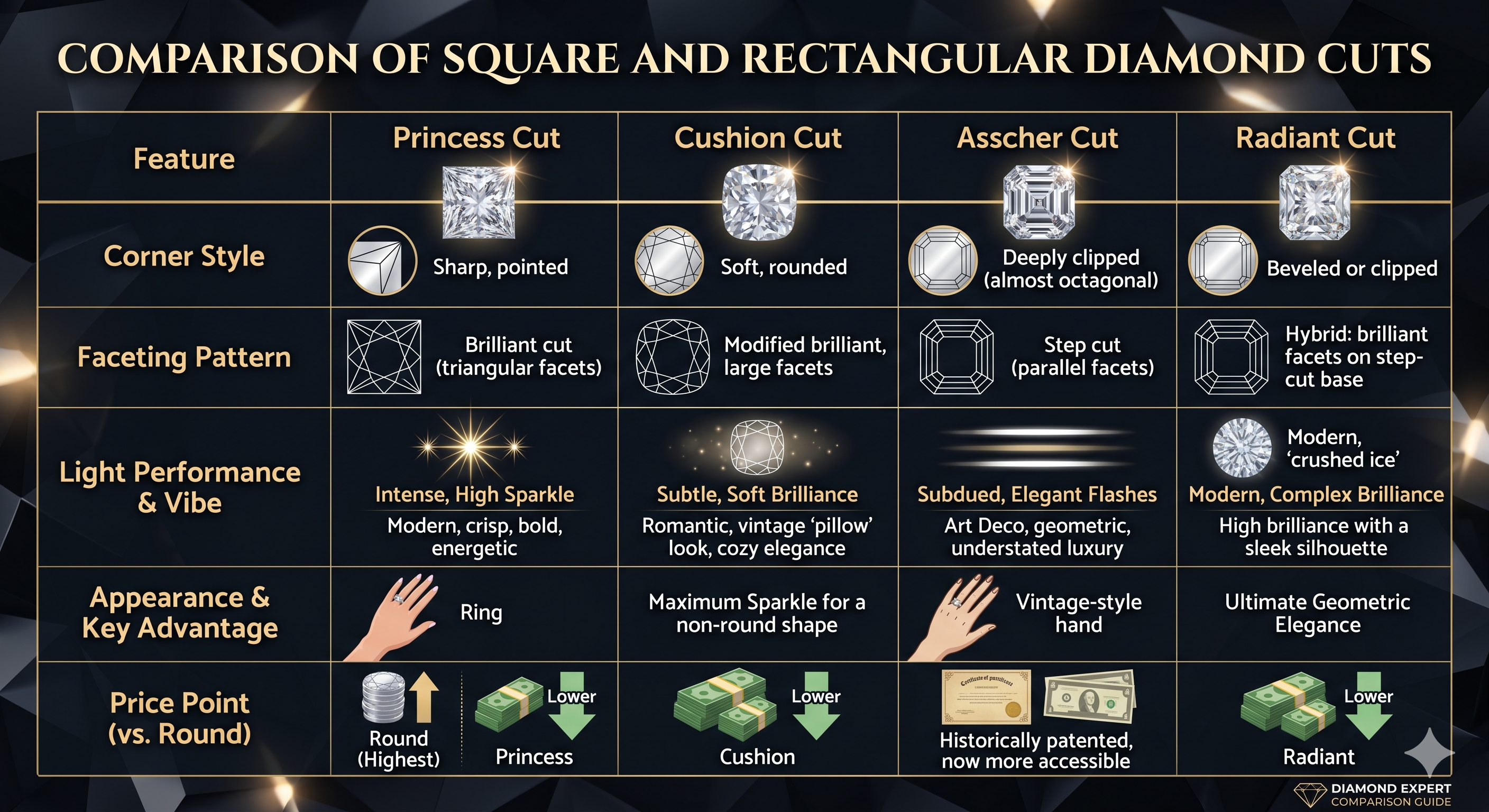
Key Facts About Princess Cut Diamonds
Popularity: It is the second most popular diamond cut after the round brilliant, often used in engagement rings.
Value: They are generally 10-25% less expensive per carat than round brilliant diamonds because the cutting process wastes less of the original stone.
Consideration: The sharp corners can be prone to chipping, so it's important to choose a setting (like a four-prong or bezel) that protects them.
How to Ensure You Get What You Want
To avoid confusion when shopping:
Use Specific Names: Instead of asking for a "square cut," specify the exact cut you want, like Princess, Cushion, or Asscher.
Check the Certificate: Look at the diamond grading report (e.g., from GIA or AGS). A true princess cut will often be described as "Square Modified Brilliant".
Look at the Corners: Visually, the sharp, pointed corners are the easiest way to identify a classic princess cut.
In short, while a princess cut is square, not all square-shaped diamonds are princess cuts.
I hope this helps clarify the terminology.
“You now know the names, the types, the pros and cons, the pricing, and the terminology. The only question left: which square will you choose?
Our current collection includes a limited number of GIA-certified square cut diamonds — from brilliant princess cuts to soft cushions, from vintage Asschers to radiant hybrids. When stones with ideal proportions are gone, sourcing new ones takes time.
This is not just a diamond. It is Basil Watermeyer‘s 1970s rebellion, the Asscher brothers‘ Art Deco masterpiece, and 500 years of round brilliants finally being challenged — a shape that says: I choose my own corners.”
[Button: Claim Your Square Cut Diamond (Limited) →]
Back to Complete Amethyst Stone Guide


Other news for Sunday 14 June, 2026
- Round Brilliant Cut Guide: Price, Facets, vs Other Cuts and Buying Tips
- The Allure of the Cushion Cut Diamond: What You Need to Know
- 24K Gold Guide: Purity, Price, vs 18K, Investment and Buying Tips
- 22K Gold Guide: Purity, Price, vs 24K/18K, Daily Wear and Care
- Oval Cut Diamond Guide: Price, vs Round, vs Radiant and Buying Tips
- Pear Cut Diamond Guide: Price, vs Round, Sparkle and Buying Tips
- Solitaire Setting Guide: 4 vs 6 Prong, Security, Unique Ideas and Comfort
View all news for Sunday 14 June, 2026 on one page
News for Saturday 13 June, 2026
- Ring Finger Meaning: Which Finger for Wedding, Single and More | Complete Guide
- Bezel Setting Guide: Benefits, Styles, and Buying Tips
- Sterling Silver Jewelry Guide: 925 Meaning, Care and Green Skin Fix
- Channel Setting Guide: Pros, Cons, Safety and Cost vs Pavé
- Prong Setting Guide: 4 vs 6 Prongs, Security, Size and Types
- Ring Setting Guide: Types, Best for Daily Wear, and Size Tips
View all news for Saturday 13 June, 2026 on one page
Recent News
- Friday 12 June, 2026
- Thursday 11 June, 2026
- Wednesday 10 June, 2026
- Tuesday 09 June, 2026
- Monday 08 June, 2026