

Round Brilliant Cut Guide: Price, Facets, vs Other Cuts and Buying Tips
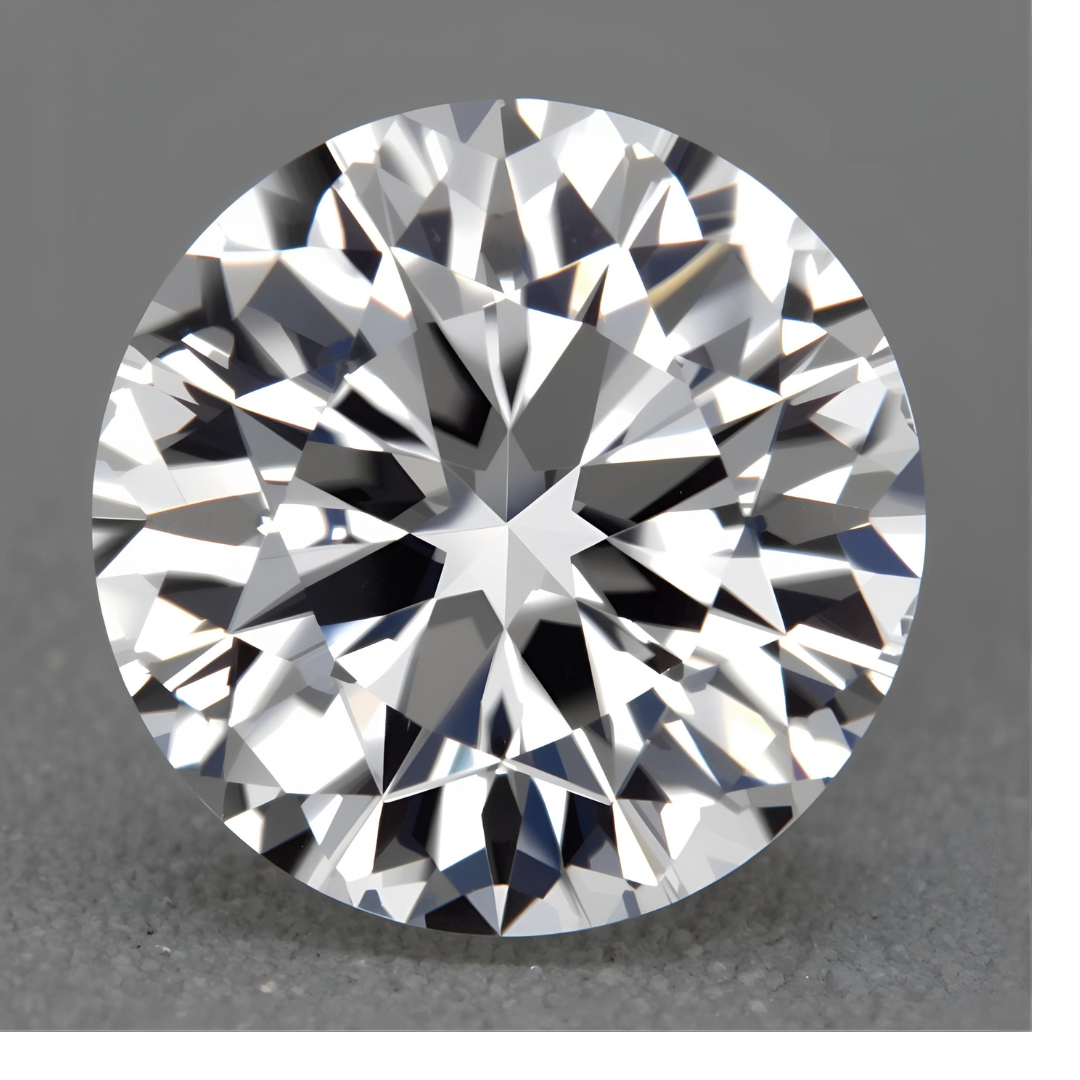
Round Brilliant Cut Guide: Price, Facets, vs Other Cuts and Buying Tips
Here is a detailed explanation of what a Round Brilliant Cut is.
The Simple Definition
A Round Brilliant Cut is the most popular and classic diamond shape in the world. It is characterized by its perfectly circular outline and a specific facet pattern designed to maximize brilliance (white light return), fire (flashes of color), and scintillation (sparkle).
Here is the table of contents.;
What Is A Round Brilliant Cut?
Key Characteristics: Why It's "Brilliant"
The term "Brilliant Cut" refers to the specific arrangement of 57 or 58 facets (the flat, polished surfaces). This geometric pattern was perfected through mathematical calculations to optimize the diamond's interaction with light. The facets are arranged as follows:
Table: The large, flat facet on the top.
Crown: The upper section above the girdle (the diamond's widest point). It consists of 8 bezel facets, 8 star facets, and 16 upper-girdle facets (32 total crown facets).
Pavilion: The lower section below the girdle. It consists of 8 pavilion facets and 16 lower-girdle facets (24 total pavilion facets).
Culet: The tiny point at the bottom. When faceted, it counts as the 58th facet. On modern diamonds, it is often a microscopic point and is not counted.
The magic of the Brilliant Cut lies in how these facets work together:
Light enters through the crown.
It is reflected from one pavilion facet to another inside the diamond (a property called Total Internal Reflection).
The light is reflected out through the crown to the viewer's eye, creating an explosion of sparkle.
A Brief History: The Evolution to Perfection
The Round Brilliant Cut we know today is the result of centuries of evolution:
Old European Cut (c. 1800s): The precursor. It had a similar facet pattern but a smaller table, higher crown, and larger culet. It was cut for candlelight, creating a "chunkier," more fiery sparkle.
The Tolkowsky Ideal (1919): Mathematician Marcel Tolkowsky published his doctoral thesis, which calculated the precise angles and proportions needed to balance brilliance and fire. This established the theoretical "Ideal Cut" and is the foundation for modern Round Brilliant cuts.
Modern Brilliant Cut (Late 20th Century): With advanced computer modeling and cutting technology, cutters can now achieve incredible precision, creating diamonds that perform even better than Tolkowsky's original model.
Why is the Round Brilliant Cut So Popular?
Maximum Sparkle: Its design is scientifically proven to reflect more light than any other shape. It is the ultimate shape for brilliance and fire.
Timelessness: It's a classic that never goes out of style, ensuring its beauty and value remain constant.
Versatility: It looks stunning in any style of setting, from a simple solitaire to an elaborate halo.
Forgiving Nature: Its brilliant facets are excellent at hiding minor inclusions (internal flaws) and color tints, meaning you can sometimes opt for a slightly lower clarity or color grade without it being noticeable to the naked eye.
Round Brilliant Cut vs. Other Cuts
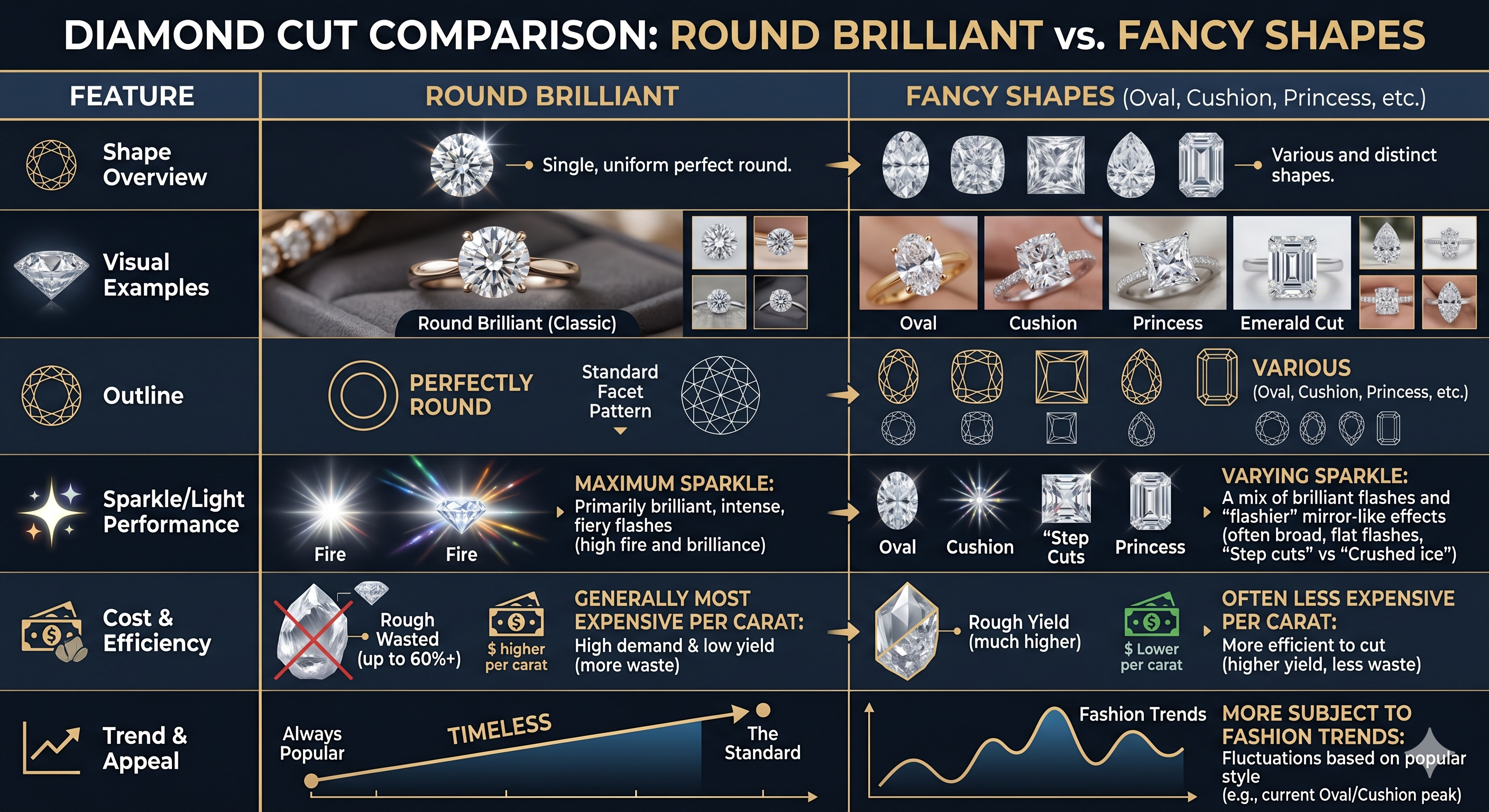
In short, the Round Brilliant Cut is the benchmark for diamond cuts. It is the product of centuries of refinement and optical science, engineered to produce the greatest possible sparkle. Its timeless beauty and unparalleled light performance are what make it the number one choice for engagement rings and fine jewelry worldwide.
For official diamond cut grading information, visit the GIA Diamond Cut Guide.
Are Round Brilliant Diamonds More Expensive?
Yes, absolutely. Round Brilliant diamonds are consistently the most expensive diamond shape per carat.
Here’s a detailed breakdown of why this is the case, often referred to as the "Round Brilliant Premium."
The Top 3 Reasons for the Higher Cost
1. Highest Yield Loss (The Biggest Factor)
When a rough diamond crystal (which is typically an octahedron, like two pyramids stuck together) is cut into a round shape, a tremendous amount of the original material is lost.
The Process: To achieve the perfect symmetry and proportions of a Round Brilliant, the cutter must grind away significant portions of the rough stone. A fancy shape (like an oval, pear, or cushion) can often be cut to follow the natural shape of the rough crystal more closely.
The Numbers: It's common for over 60% of the original rough diamond to be lost during the cutting of a Round Brilliant. For fancy shapes, the yield loss is typically lower, around 40-50%.
The Implication: Because so much more rough material is wasted, the cost of that "waste" is factored into the price of the finished round diamond.
2. Unmatched Demand and Popularity
The Round Brilliant is the most classic, timeless, and sought-after diamond shape in the world. Its unparalleled sparkle and traditional appeal create incredibly high and consistent demand.
Basic Economics: High demand + limited supply = higher price. This universal popularity ensures that round diamonds always command a premium in the market.
3. Cutting Complexity and Labor
Achieving the perfect proportions and symmetry for a Round Brilliant is a highly skilled and time-consuming process.
Precision is Key: The cut grade is critical for a round diamond's beauty. To achieve an "Excellent" or "Ideal" cut grade, the cutter must place 57/58 facets with extreme precision. There is very little room for error.
Expert Craftsmanship: This requires more labor hours from master cutters compared to many fancy shapes, adding to the final cost.
Putting It into Perspective: A Price Comparison
While prices fluctuate based on the "4Cs" (Carat, Cut, Color, Clarity), you can generally expect a significant price difference.
On average, a Round Brilliant diamond will be 20-40% more expensive per carat than a fancy shape diamond of similar carat weight, color, and clarity.
Example:
If a 1-carat, G-color, VS1-clarity Oval diamond costs $6,000, a comparable Round Brilliant diamond could easily cost between $7,200 and $8,400.
Is the Premium Worth It?
This is a personal decision, but here’s how to think about it:
Yes, if your priority is maximum sparkle, the Round Brilliant cut is scientifically engineered to provide the best possible light performance (brilliance and fire). You are paying for the ultimate in sparkle.
Yes, if you value timelessness and resale value: The round shape is a perennial classic that never goes out of style and generally holds its value better on the resale market.
No, if your priority is size per budget: If you have a fixed budget and want the largest possible diamond, choosing a fancy shape (like an oval, radiant, or cushion) will allow you to get a larger carat weight for your money.
The higher price of a Round Brilliant diamond is not arbitrary. It directly reflects the high cost of raw material waste, immense consumer demand, and the expert craftsmanship required to create its legendary sparkle.
Round Brilliant vs. Fancy Shapes: Price & Features Comparison
| Feature | Round Brilliant | Fancy Shapes (Oval, Cushion, Pear) | |||
|---|---|---|---|---|---|
| Price per Carat | Most expensive (benchmark) | 20-40% less expensive | |||
| Sparkle (Brilliance & Fire) | Maximum (scientifically engineered) | Very good, but less than round | |||
| Rough Diamond Waste |
|
40-50% loss | |||
| Timelessness | Classic, never goes out of style | Trend-sensitive, unique appeal | |||
| Hides Inclusions/Color | Excellent (forgiving) | Moderate (varies by shape) | |||
| Resale Value | Stronger, more liquid | Weaker, more niche demand |
How Many Cuts Are In A Round Brilliant Diamond?
The terminology can be a bit tricky here. While we often say "cuts," the more precise term is facets (the flat, polished surfaces).
A standard modern Round Brilliant Cut diamond has 57 or 58 facets.
Here is a detailed breakdown of where those facets are located:
The Official Count: 57 or 58?
The number depends on whether the tiny point at the bottom, called the culet, is faceted into a flat surface or left as a sharp point.
57 Facets: This is the most common count for modern diamonds. It includes everything except a faceted culet. The culet is a microscopic sharp point.
58 Facets: This count includes a faceted culet. The cutter adds one very small, flat facet to the point at the bottom to prevent it from chipping. This was more common in older cuts but is still seen today.
The Facet Breakdown (Using the 57-facet standard)
Here is the anatomy of a Round Brilliant, from top to bottom:
1. The Crown (The Top Half)
Table Facet: The large, flat octagonal facet on the very top. (1 facet)
Star Facets: 8 triangular facets that surround the table.
Bezel Facets (or Crown Main Facets): 8 kite-shaped facets that form the outer edge of the crown.
Upper Girdle Facets: 16 small, irregular facets just above the girdle.
Total Crown Facets: 1 (Table) + 8 (Star) + 8 (Bezel) + 16 (Upper Girdle) = 33 Facets
2. The Girdle (The Widest Part)
This is the thin band that separates the crown from the pavilion. While it is a "part" of the diamond, it is not typically counted as a facet unless it is faceted (which is rare in rounds).
3. The Pavilion (The Bottom Half)
Pavilion Facets (or Pavilion Main Facets): 8 long, kite-shaped facets that come to a point at the bottom.
Lower Girdle Facets: 16 small, irregular facets just below the girdle.
Total Pavilion Facets: 8 (Pavilion Main) + 16 (Lower Girdle) = 24 Facets
The Grand Total
Crown (33) + Pavilion (24) = 57 Facets
If the culet is faceted, you add that one, making it 58 facets.
Why So Many Facets?
This specific number and arrangement of 57/58 facets is not random. It is the result of optical science and centuries of refinement. Each facet acts as a tiny mirror, designed to:
Capture light from above.
Reflect it internally around the diamond.
Return it to the viewer's eye as that famous, fiery sparkle (brilliance and fire).
In short, the 57 or 58 facets of a Round Brilliant are the key to its status as the ultimate sparkle machine.
Why Is The Round And Brilliant Cut Popular In Diamonds?
Of course. The popularity of the Round Brilliant Cut is not accidental; it's the result of a powerful combination of science, psychology, and market forces. It is, quite simply, the benchmark against which all other diamond cuts are measured.
Here’s a breakdown of the key reasons for its enduring dominance:
1. Unmatched Sparkle: The Scientific Reason
This is the most important factor. The Round Brilliant Cut is engineered for maximum light performance.
Optimal Proportions: Its specific arrangement of 57 or 58 facets is the result of mathematical calculations (pioneered by Marcel Tolkowsky in 1919) designed to achieve the perfect balance of three optical effects:
Brilliance: The return of white light. The facets act like tiny mirrors, bouncing light around inside the diamond and reflecting it to your eye in a dazzling shower of brightness.
Fire: The dispersion of light into flashes of spectral color (rainbows). The precise angles of the Round Brilliant maximize this "prism effect."
Scintillation: The sparkle and pattern of light and dark areas that flash when the diamond, the light, or the observer moves.
No other shape reflects as much light as efficiently as the Round Brilliant. It is, objectively, the sparkliest diamond shape.
2. Timelessness and Tradition: The Psychological Reason
The round shape is a classic symbol of perfection, eternity, and commitment.
Enduring Style: While fancy shapes (like ovals, pears, or cushions) go in and out of fashion, the Round Brilliant has remained the consistent, timeless choice for over a century. It never looks dated.
The "Safe" Choice: Because it's so universally loved and recognized, it's often seen as a safe, romantic, and traditional choice for significant pieces like engagement rings. You can be confident it will be appreciated now and decades from now.
3. Versatility and Beauty in Any Setting: The Practical Reason
A Round Brilliant diamond looks stunning in virtually any setting or style of jewelry.
Adaptable: It shines as a solitaire (where its own beauty takes center stage), looks magnificent surrounded by a halo of smaller diamonds, and works perfectly in more complex designs like three-stone rings or vintage-inspired settings.
Complements All Hands: Its symmetrical, non-directional shape is flattering on every finger, regardless of hand shape or size.
4. Forgiveness and Performance: The "Smart" Reason
The cut of a Round Brilliant is exceptionally good at hiding some of the imperfections that can affect other shapes.
Hides Inclusions: The complex facet pattern and brilliance can mask minor internal flaws (inclusions) better than many fancy shapes with larger, more open facets.
Minimizes Color: The intense white light return can make a near-colorless diamond (like a G or H color) face up as bright and white as a higher-grade, more expensive stone. This can allow you to prioritize the all-important Cut grade and save on Color and Clarity.
5. Market and Resale Value: The Economic Reason
High Demand: As the most popular shape by a significant margin, demand is always high. This sustained demand helps maintain its value over time.
Better Resale Value: While diamonds are not investments, a high-quality Round Brilliant typically has a stronger and more liquid resale market than most fancy shapes, simply because more people are looking for it.
Think of it this way:
Round Brilliant: The classic, high-performance sedan. It's engineered for peak performance (sparkle), is universally admired, holds its value well, and is a safe, brilliant choice.
Fancy Shapes (Oval, Cushion, Pear, etc.): The unique and stylish coupes. They offer a distinct look, can appear larger for the same carat weight, and are often more affordable, but their appeal can be more subjective and trend-sensitive.
Ultimately, the Round Brilliant Cut's popularity stems from the fact that it delivers what people most want from a diamond: the most spectacular, guaranteed, and timeless sparkle.
How Much Is A 2 Carat Round Brilliant?
Of course. This is a very common question, but the answer requires some important details because the price of a 2-carat round brilliant diamond has an extremely wide range.
You can expect a starting price of around $8,000-$10,000 for a diamond with noticeable compromises, but a beautiful, well-chosen stone will typically fall in the $15,000 to $35,000+ range.
The final price is almost entirely determined by the other three "Cs": Cut, Color, and Clarity.
Here is a detailed breakdown to help you understand the price spectrum.
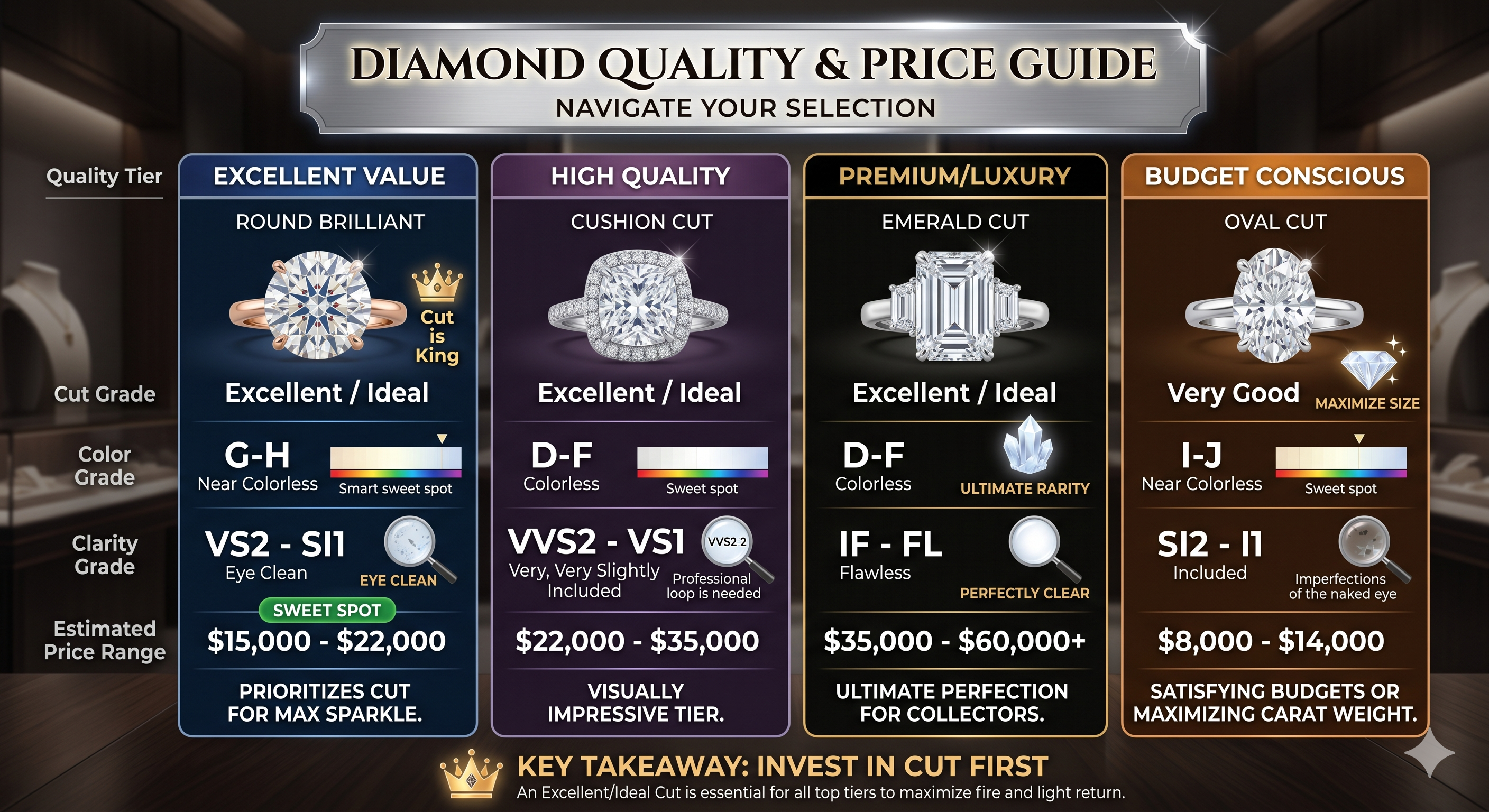
The Primary Factor: The "Graded" Quality
The table below outlines realistic price ranges for a 2-carat round brilliant diamond with a GIA or AGS certificate (the most respected labs). Prices are for the diamond alone, not set in a ring.
Key Factors That Change the Price Dramatically
1. Cut Quality (The Most Important "C")
This is what makes a round brilliant sparkle. Never compromise on cut.
Excellent/Ideal Cut: Commands the highest premium. It will be breathtakingly sparkly. This is what you're paying for.
Very Good Cut: Less expensive, but the light performance will be noticeably less brilliant.
Good & Fair Cut: These will look dull and lifeless compared to a higher-cut stone. It's not worth the savings.
2. Color Grade (How "White" the Diamond Is)
Colorless (D-F): The rarest and most expensive. They appear perfectly white.
Near Colorless (G-J): The sweet spot for value. To the naked eye, a G or H color will look just as white as a D when set in a ring, but costs significantly less.
Faint Color (K and below): Will have a visible yellow or brown tint. Prices drop significantly.
3. Clarity Grade (The Inclusions and Blemishes)
Flawless (FL) to Internally Flawless (IF): Extremely rare and expensive.
VVS1-VVS2 (Very, Very Slightly Included): Tiny inclusions are difficult for a skilled grader to see. High price.
VS1-VS2 (Very Slightly Included): The perfect balance. Inclusions are not visible to the naked eye. Excellent value.
SI1-SI2 (Slightly Included): The best value tier. SI1 inclusions are often "eye-clean" (not visible without magnification). SI2 is riskier but can sometimes be eye-clean.
I1 (Included) and below: Inclusions are visible to the naked eye and affect brilliance. Prices are low, but so is beauty.
4. Certification (The Diamond's Report Card)
A diamond without a certificate from a reputable lab like GIA (Gemological Institute of America) or AGS (American Gem Society) is a major risk. Their grading is strict and consistent. Other labs are often more lenient with their grades, which can mislead you into overpaying.
5. Fluorescence
None or Faint Fluorescence: Has no impact on price or appearance for the vast majority of diamonds.
Strong or Very Strong Fluorescence: Can cause a discount of 5-15% because, in rare cases, it can make a diamond look hazy or oily. However, it can also make a lower-color (e.g., J or K) diamond appear whiter.
Real-World Price Examples (Approximate)
A "Sweet Spot" Diamond: A 2-carat, G-color, VS2 clarity, Excellent Cut round brilliant from a reputable online retailer will cost around $18,000 - $21,000.
A High-End Diamond: A 2-carat, D-color, VVS1 clarity, Ideal Cut round brilliant will cost $30,000+.
A Budget Diamond: A 2-carat, I-color, SI2 clarity, Very Good Cut round brilliant might be found for $11,000 - $13,000, but you must check it carefully for visible color or inclusions.
Don't Forget the Setting!
The prices above are for the diamond alone. The ring setting (the metal and any side stones) is an additional cost.
A simple solitaire setting in 14k gold can cost $500 - $1,000.
A more elaborate pave, or halo setting in platinum, may cost $1,500 - $4,000+.
While you can find a 2-carat round brilliant for under $10,000, a beautiful, well-balanced stone that delivers the sparkle you expect will typically be an investment of $15,000 to $25,000. Always prioritize an Excellent/Ideal Cut and use a reputable vendor who provides high-quality imagery and videos.
For current diamond market prices, visit the American Gem Society's price guide.
Back to Complete Amethyst Stone Guide


The Allure of the Cushion Cut Diamond: What You Need to Know
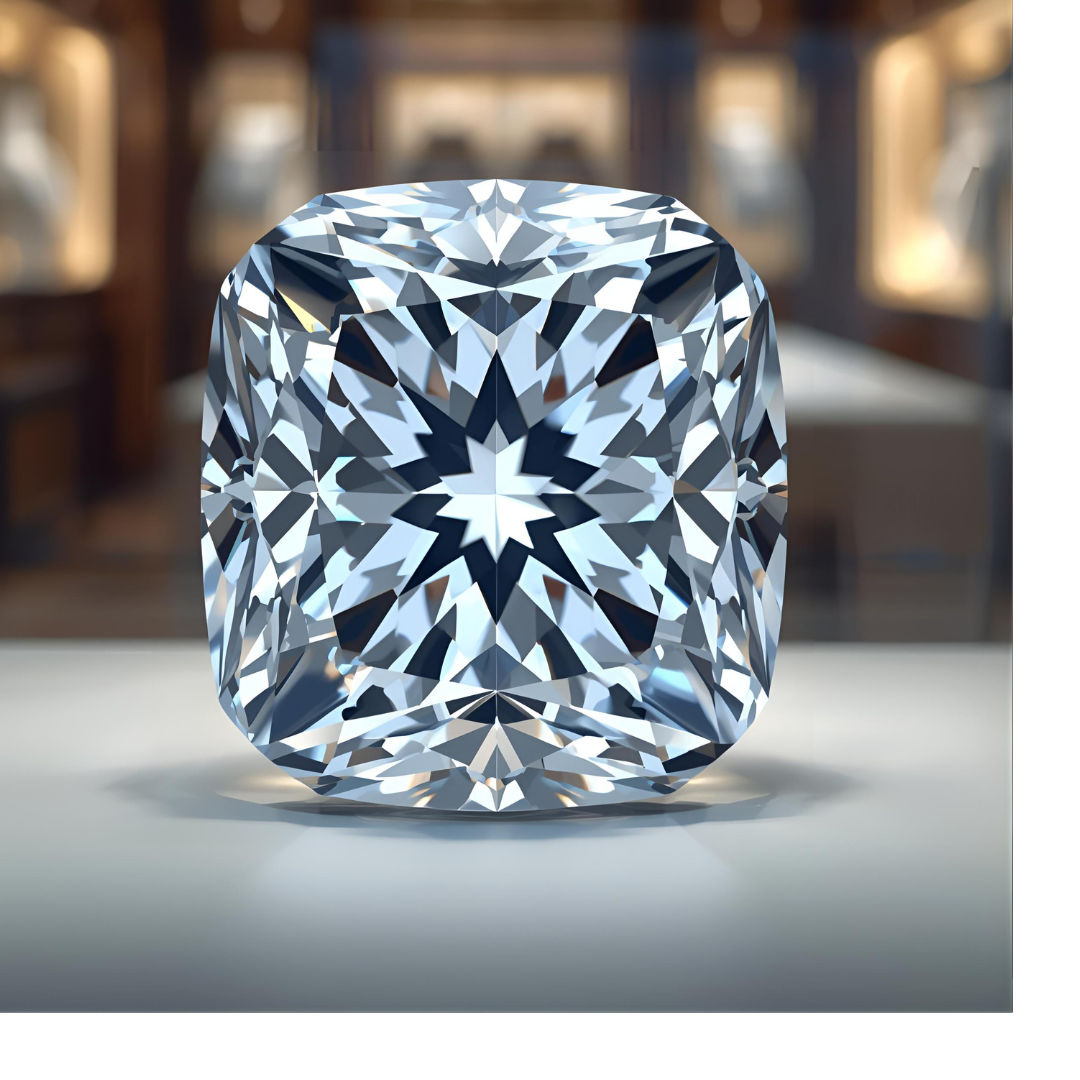
The Allure of the Cushion Cut Diamond: What You Need to Know
Cushion-cut diamonds are a timeless choice with a blend of vintage charm and modern sparkle.
“In the 18th century, before electricity, diamonds were judged by candlelight. The ‘old mine cut‘—the cushion‘s ancestor—was designed to glow in the soft, flickering flames of ballrooms and boudoirs. Its deep pavilion and large facets caught the fire of wax and wick. When the Hope Diamond—one of the most famous gemstones in history—was cut, it was shaped as a cushion. When the Regent Diamond, once owned by Marie Antoinette, was displayed in the Louvre, it was on a cushion. For 300 years, the cushion cut has been the diamond of romance—not because it is the most sparkly, but because it glows like memory itself.”
The same cut that glowed in candlelit ballrooms now awaits your own love story — whether you choose chunky vintage facets or modern crushed ice. Every cushion cut diamond in our collection is hand-selected for that unmistakable pillow-soft sparkle.”
[Button: Explore Cushion Cut Diamonds →]
They are popular for their rounded square or rectangular shape (like a pillow), excellent fire (colorful flashes of light), and are generally more affordable than round brilliants.
Here is all you want to know about the content.
- What Does A Cushion Cut Diamond Say About You?
- What Is The History of The Cushion Cut Diamond?
- Is Cushion Cut A Good Diamond?
- What Are The Characteristics Of A Cushion Cut Diamond?
- What Are the Different Styles of Cushion Cut Diamonds?
- How Much Does A Cushion Cut Diamond Cost?
- Is A Cushion Cut Diamond A Real Diamond?
- Are Cushion-Cut Rings Out of Style?
- Are Cushion Cuts Trendy Or Classic?
- Emerald Cut vs Elongated Cushion
- Cushion Cut vs Princess Cut
Let's first topic.
What Does A Cushion Cut Diamond Say About You?
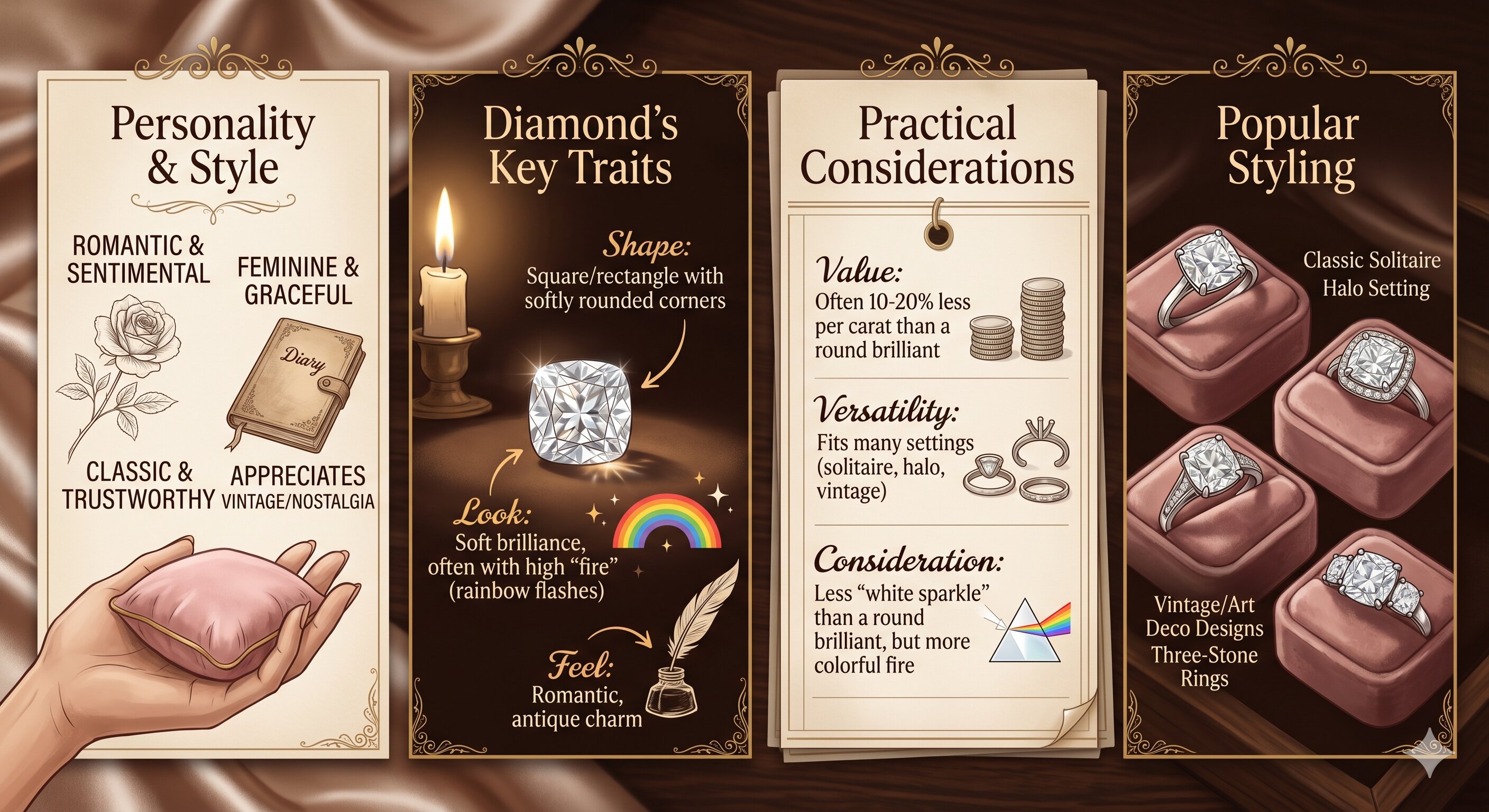
A cushion cut diamond often suggests you value romance, timeless elegance, and warmth. Its soft, pillow-like shape and historical charm attract those with a classic yet individualistic style.
The table below summarizes what this choice often says about you, along with the diamond's key traits and popular styles.
What Is The History of The Cushion Cut Diamond?
History & Evolution
The cushion cut has a rich history, evolving from the "old mine cut" of the 18th and 19th centuries, which was designed to sparkle beautifully under candlelight.
Its enduring popularity, especially during romantic eras like the Victorian period, contributes to its symbolism of enduring love and commitment.
The modern version retains the soft shape but is cut with more facets for enhanced brilliance.
Learn more about the history of diamond cuts on Wikipedia's diamond cut page.
“In 1958, the Smithsonian Institution acquired the Hope Diamond. It had been a cushion cut for over two centuries—passed from French kings to English bankers to American socialites. When it arrived in Washington, crowds lined up for hours to see its deep blue glow. But what they didn‘t know was that the Hope Diamond‘s cushion shape was not chosen for its rarity. It was chosen because the cushion cut, with its soft corners and deep belly, is the only cut that can hold a diamond‘s history without hiding it. Every scratch, every facet, every imperfection tells a story. That is what a cushion cut says about you: that you are not afraid of the past. You wear it like a jewel.”
Is Cushion Cut A Good Diamond?
Yes, a cushion cut diamond is a very good choice for many people, especially if you appreciate vintage charm and romantic appeal. However, whether it's the right diamond for you depends on your personal priorities regarding style, sparkle, and the selection process.
To give you a clear overview, here are the key advantages and considerations:
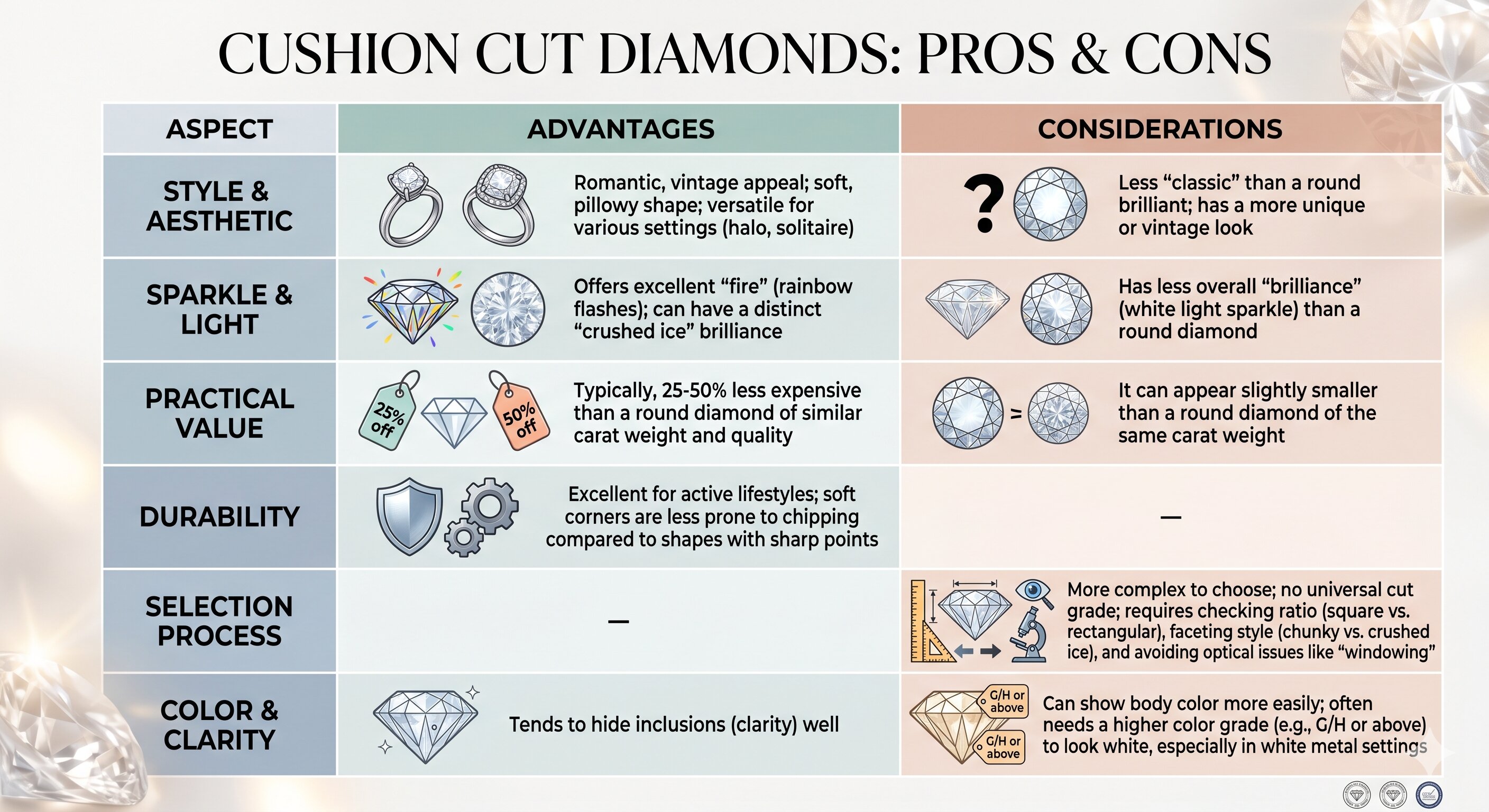
Is the Cushion Cut Right for You?
A cushion cut is a great choice if you check several of these boxes:
You love vintage, romantic, or antique-inspired styles.
You prefer a softer, more unique look than the ultra-common round brilliant.
Getting good value for your budget is important to you.
You have an active lifestyle and want a durable shape.
You're willing to invest a bit more time in selecting the exact right stone, ideally with expert help or by viewing it in person/video.
It might be less ideal if:
Maximum, fiery white sparkle is your absolute top priority.
You prefer a shape with a perfectly standardized and easy selection process.
You want the diamond that looks the largest possible per carat.
I hope this detailed comparison helps you make a more informed choice. If you are also considering other diamond shapes (like round brilliant, oval, or emerald), I can provide a similar analysis to help you compare.
What Are The Characteristics Of A Cushion Cut Diamond?
A cushion cut diamond's defining feature is its square or rectangular shape with softly rounded corners, resembling a pillow or cushion. This shape has a rich historical connection to the "old mine cut" from the 1700s.
Here is a summary of its main characteristics:
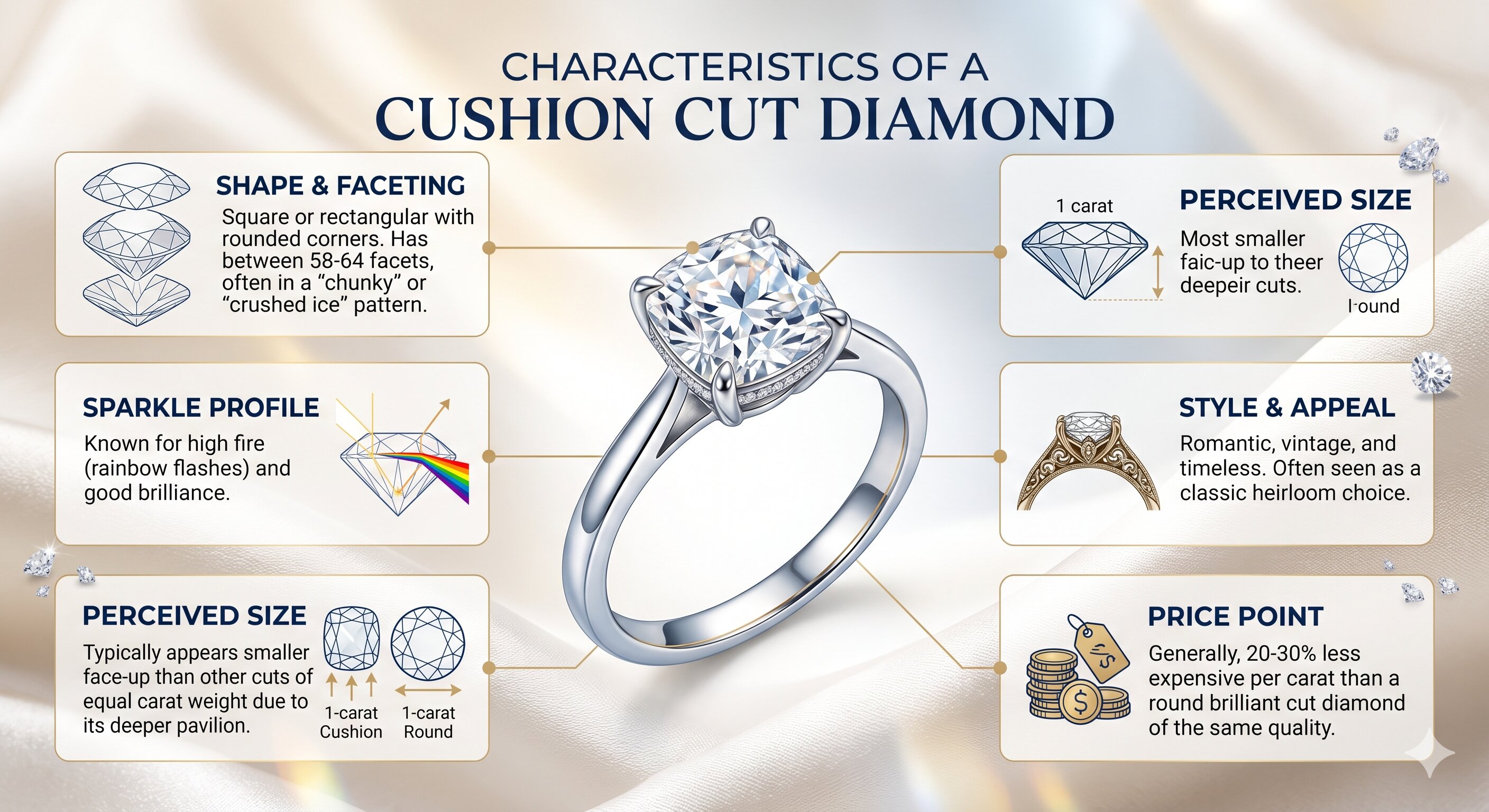
Detailed Look at Key Features
Facet Pattern Variation: Cushion cuts can look quite different:
Chunky facets: Show broader, more distinct flashes of light for an antique, romantic look.
Crushed ice facets: Create a glimmering, splintered effect for a modern sparkle.
Shape (Length-to-Width Ratio): You can choose the visual shape by looking at the length-to-width (L/W) ratio.
Square (1.00–1.05 L/W): Most popular; gives a classic, balanced shape.
Elongated (1.15+ L/W): Rectangular; can make the finger appear longer.
Historical Roots: It evolved from the 18th-century "old mine cut", designed to sparkle under candlelight. Many world-famous diamonds (like the Hope Diamond) are cushion cuts.
For official diamond cut grading information, visit the GIA Diamond Cut Guide.
What Are the Different Styles of Cushion Cut Diamonds?
Cushion-cut diamonds come in several distinct styles, mainly differing by their facet pattern. These patterns significantly change how the diamond sparkles and its overall look. Here are the three main styles:
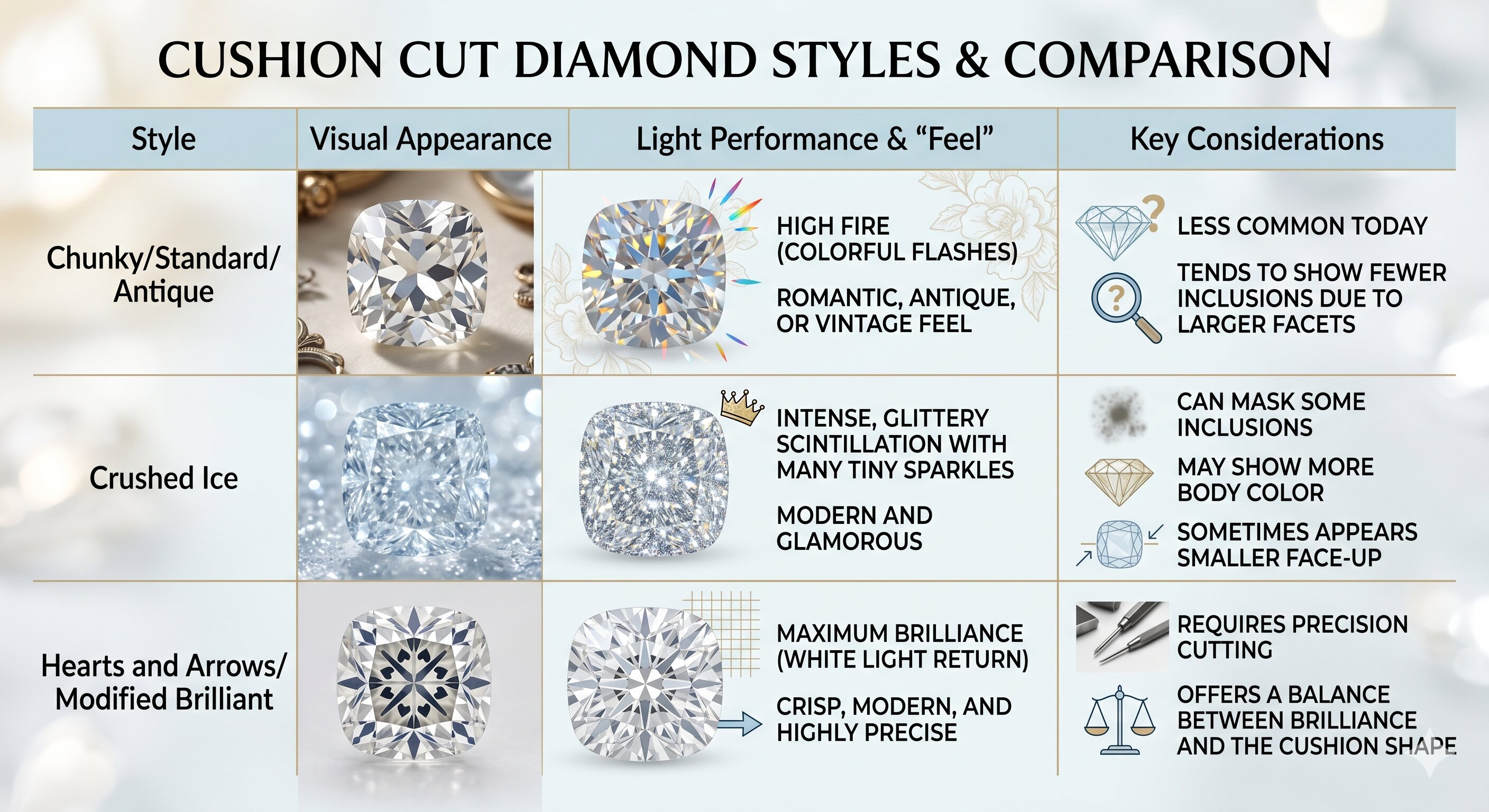
How This Compares to Other Cuts
If you're comparing shapes, it's useful to know:
A radiant cut has a similar facet pattern to a crushed ice cushion but with sharp, cut corners for a more angular look.
A princess cut is also square but has sharp, pointed corners.
I hope this helps you distinguish between the different cushion cut styles. If you're curious about how a specific style, like a crushed ice cushion, compares in detail to a radiant cut, I can provide a more focused comparison.
How Much Does A Cushion Cut Diamond Cost?
The cost of a cushion-cut diamond depends mainly on its carat weight and quality. Compared to popular round brilliants, cushion cuts are often more affordable, costing around 25% less for a similar quality stone.
Based on current market data, here are the average price ranges for loose, natural cushion cut diamonds:
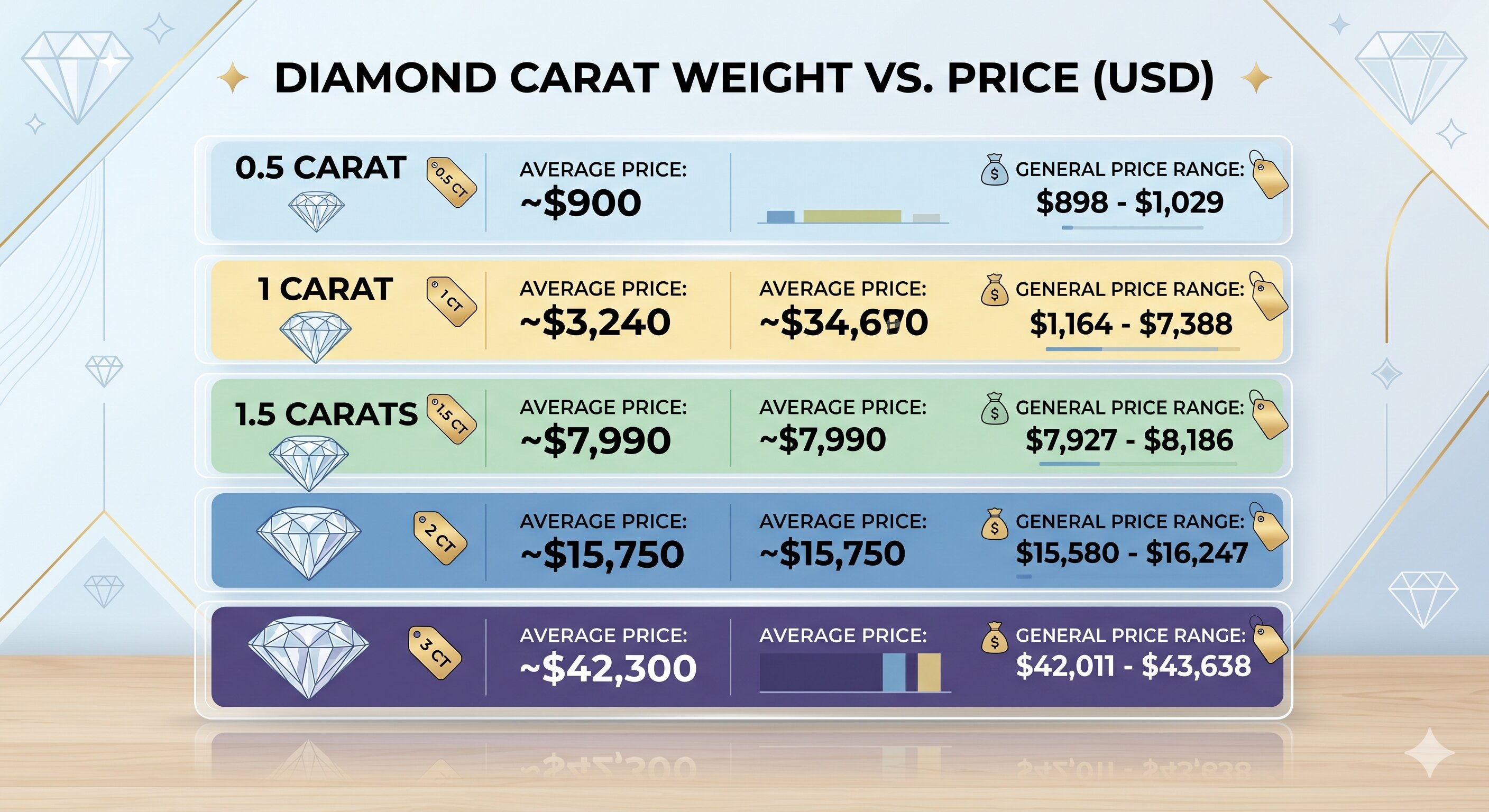
What Makes the Price Change?
These price ranges are largely determined by the "4Cs":
Carat: The single biggest factor. As shown above, price increases significantly with size, especially over 1 carat.
Color & Clarity: Higher grades cost more. For a balanced budget, near-colorless (G-H) and clarity grades like VS2 or SI1 are popular.
Cut: A well-cut cushion diamond sparkles beautifully. Since cushion cuts don't have a universal cut grade, rely on high-quality videos or in-person viewing to judge sparkle.
Practical Buying Examples
For a $3,000 Budget: You could likely find a ~1-carat cushion diamond with G-H color and VS2 clarity.
For a $15,000 Budget: This could get you a ~2-carat stone, or a high-quality ~1.5-carat diamond with excellent color and clarity.
How to Get the Best Value
Compare Shapes: A 1-carat round brilliant averages over $5,000, while a cushion is about $3,240. You can often get a larger or higher-quality cushion for the same budget.
Consider Styles: The "crushed ice" facet style may allow for a slightly lower clarity grade, as its many facets can hide tiny inclusions.
Prioritize Viewing: Always review diamonds via high-resolution videos (available on retailer sites like Ritani or Blue Nile) or in person to ensure you love their individual sparkle.
I hope this detailed breakdown helps you with your budget planning. If you can share your target carat size or price range, I could provide more specific guidance on what quality to expect.
For current diamond market prices, visit the American Gem Society's price guide.
Is A Cushion Cut Diamond A Real Diamond?
Yes, a cushion cut diamond is absolutely a real diamond. It refers specifically to a shape and style of cutting, not the diamond's authenticity.
The confusion often arises because the term describes the cut (how the diamond is faceted), not the type of diamond. A cushion cut diamond can be either:
Natural Diamond: Mined from the earth.
Lab-Grown Diamond: Created in a laboratory with identical chemical and physical properties.
Why the Confusion Exists
The term "cushion" describes the diamond's pillow-like shape with rounded corners. It is one of many established diamond cuts, like the round brilliant or princess cut. It doesn't indicate if the stone is natural, lab-created, or a simulant like cubic zirconia.
How to Verify a Diamond's Authenticity
To confirm you are buying a real diamond, look for these, not just the shape:
Reputable Certification: Always insist on a grading report from a major gemological lab like the GIA (Gemological Institute of America) or AGS (American Gem Society). The certificate will detail the "4Cs" (Cut, Color, Clarity, Carat) and confirm it is a natural or lab-grown diamond.
Purchase from Trusted Sources: Buy from established, reputable jewelers who provide full transparency and certificates.
Understand the "4Cs": A real diamond's value is assessed through these grades, which will be listed on its certificate.
In short, "cushion cut" describes the shape; certification proves it's a real diamond. If you are looking at a specific diamond and would like help understanding its certificate, feel free to share the details.
Are Cushion-Cut Rings Out of Style?
No, cushion-cut diamond rings are not out of style. In fact, for 2026, they are positioned as one of the most popular and trending engagement ring choices, frequently highlighted alongside other sought-after shapes like ovals and emerald cuts.
The trend is not just about the basic shape; it's driven by specific, modern interpretations that update this classic cut. Below is a summary of the key ways cushion cuts are trending:
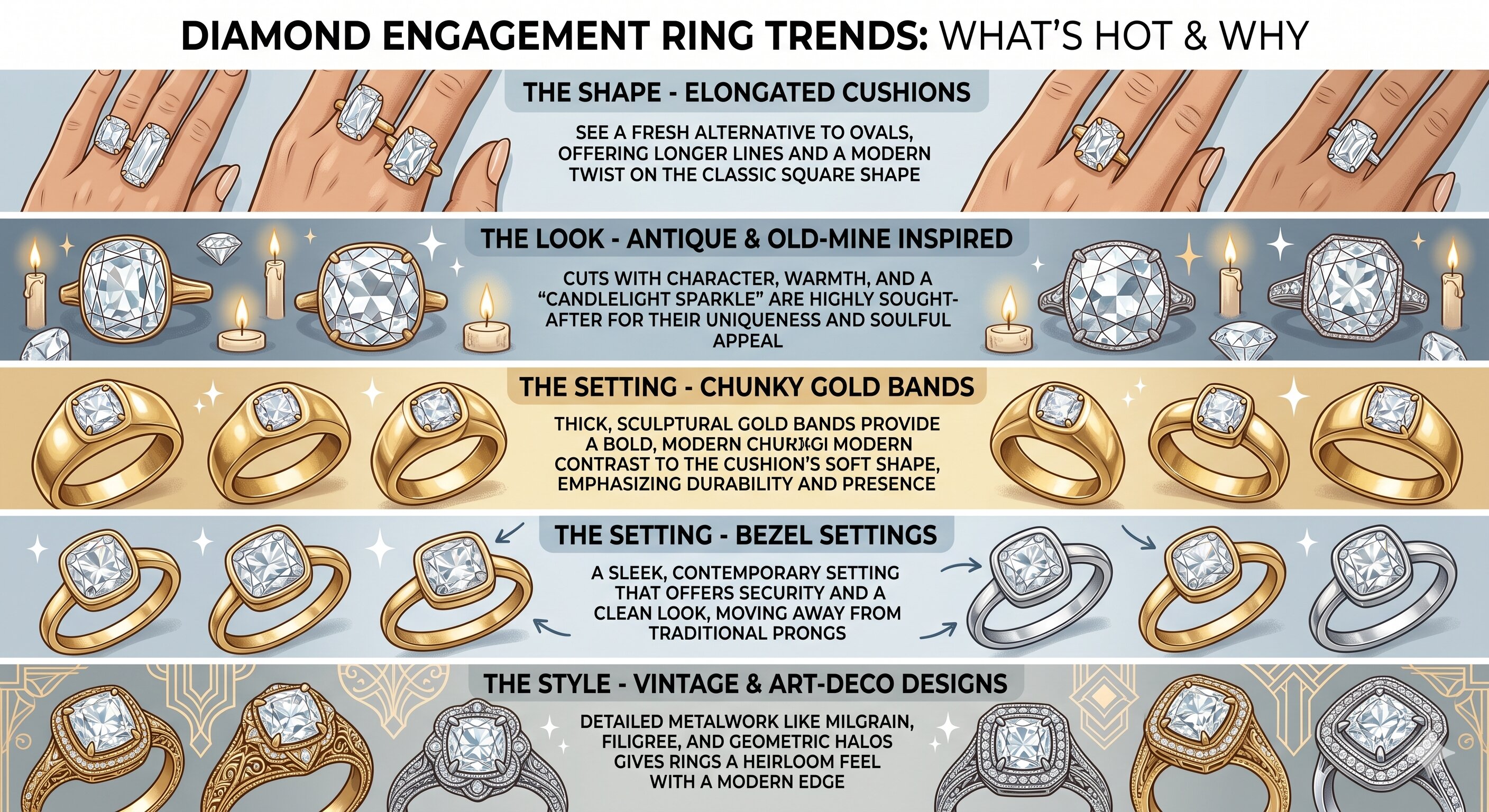
Why Cushion Cuts Are Timeless
Beyond the 2026 trends, the cushion cut has enduring appeal because it is a classic silhouette. Its soft, romantic shape has been cherished for centuries, evolving from the 18th-century "Old Mine Cut". This long history means it's a shape that has consistently remained in fashion, making it a safe choice for a piece meant to last a lifetime.
Celebrity influence is also a significant factor in the current trend, with stars like Zendaya, Taylor Swift, and Miley Cyrus recently choosing or being gifted cushion-cut rings.
Choosing a Timeless Cushion Cut
To pick a cushion cut ring that will feel stylish for years to come:
Embrace Modern Proportions: Consider an elongated cushion for a contemporary look that flatters the finger.
Select a Durable Setting: The trending chunky band or bezel setting is not only stylish but also offers excellent protection for everyday wear.
Focus on Quality: Regardless of trends, prioritize a well-cut stone with good proportions. Reviewing a diamond in person or via high-quality video is the best way to judge its sparkle.
In summary, if you're drawn to the romantic, soft-cornered look of a cushion cut, you can choose one with confidence—it is both a historically significant and currently fashionable choice.
If you have a particular setting style (like halo, three-stone, or Solitaire) in mind and would like to know how it's being interpreted in the latest trends, feel free to ask for more details.
Are Cushion Cuts Trendy Or Classic?
Cushion-cut diamonds are uniquely positioned as both timeless classics and hot trends, with their current popularity being a modern reinterpretation of their historic appeal.
Here's a breakdown of how they embody both qualities:
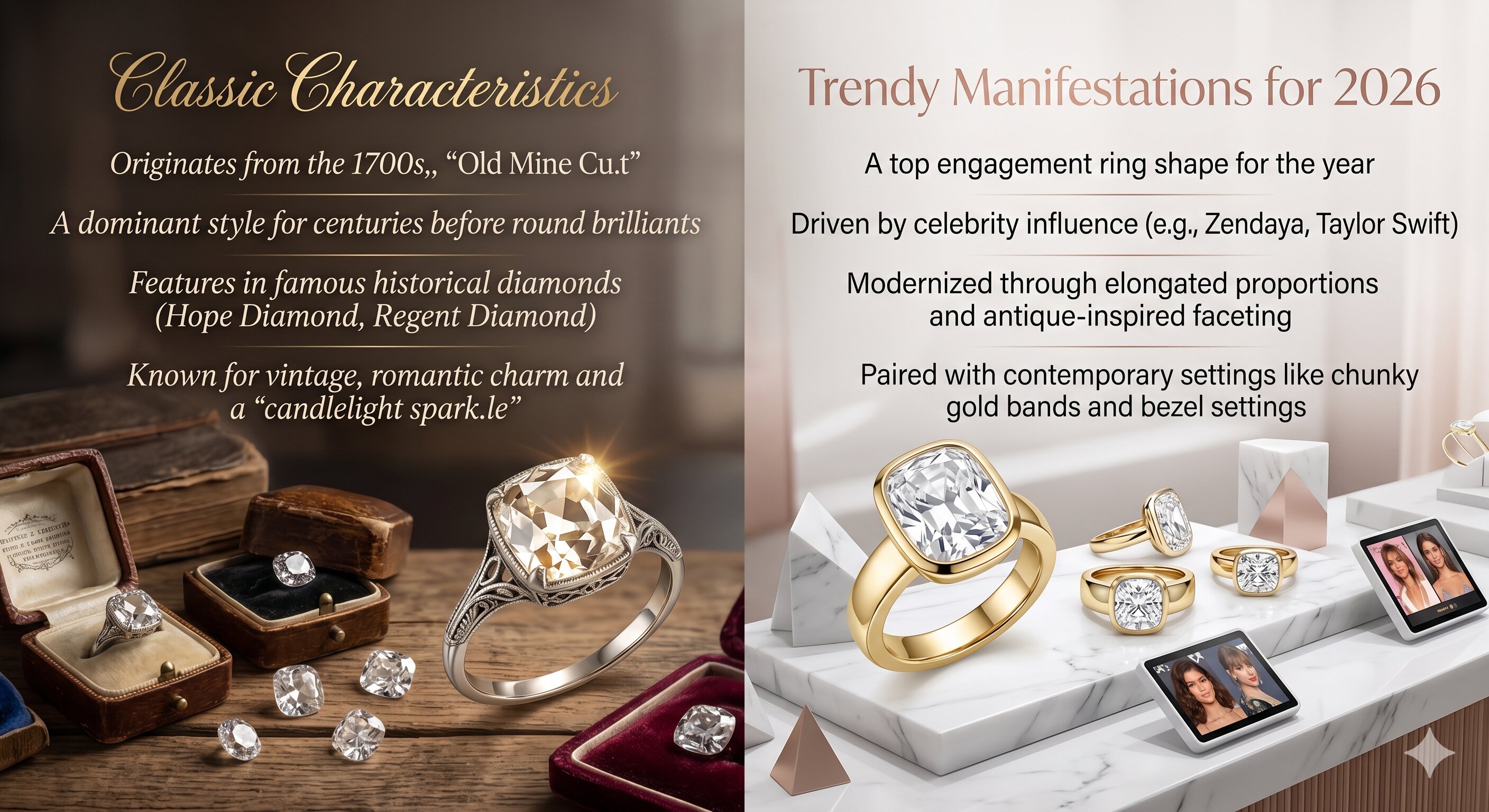
Choosing a Timeless Cushion
Since "trends" can change, here is how to ensure your cushion cut remains a classic:
Focus on Quality: A well-proportioned, symmetrical stone will always look beautiful. High-quality specifications for cushion cuts include an ideal depth between 60-68% and a table between 57-65%.
Avoid Faddish Exaggerations: A slightly elongated shape (e.g., length-to-width ratio of 1.05-1.15) offers a modern look, while extremely rectangular shapes are more fashion-specific.
Select a Complementary Setting: Classic styles like a simple solitaire or a delicate halo will never look dated.
In summary, the cushion cut is a classic shape currently enjoying a major trend, especially in its elongated and antique-inspired forms.
If you are considering specific diamond proportions (like a 1.10 ratio) or a particular setting style (chunky band vs. halo), feel free to ask for more detailed advice.
Emerald Cut vs Elongated Cushion
To directly compare an emerald cut and an elongated cushion cut, think of them as offering two distinct diamond experiences: one is about sophisticated clarity and bold geometry, while the other prioritizes romantic sparkle and soft curves.
Here is a breakdown of their key differences:
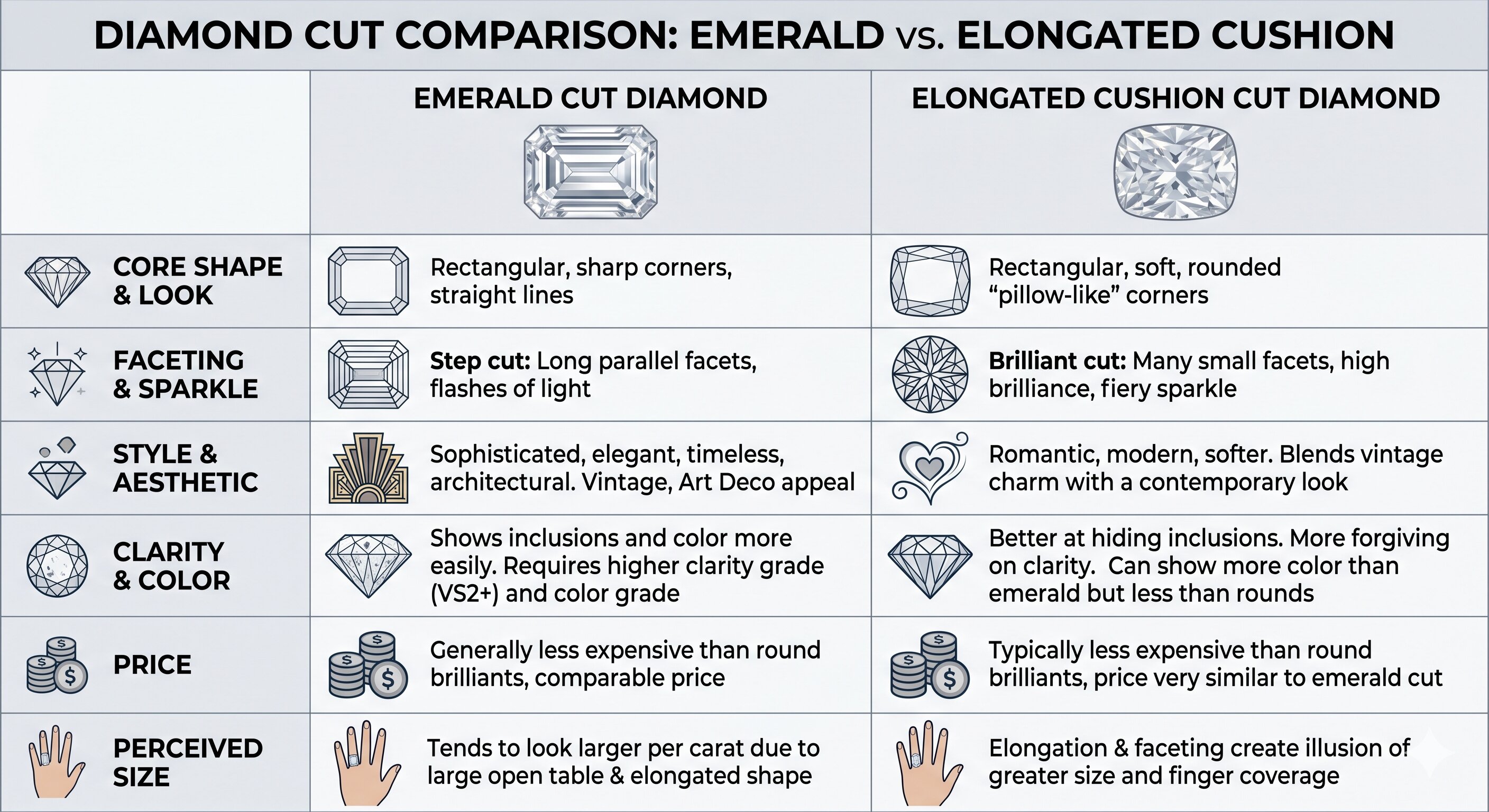
Key Factors for Your Decision
When choosing between the two, focus on these practical aspects:
The "Sparkle" Factor: This is the biggest differentiator. Do you prefer the dramatic, linear flashes of the hall of mirrors (Emerald), or the abundant, scattered sparkle and fire of a Brilliant cut (Elongated Cushion)?
Clarity Requirements: With an emerald cut, you'll likely need to invest in a higher clarity grade (VS2 or above) to avoid visible inclusions. Cushion cuts are more forgiving, potentially saving you money on clarity.
Shape Proportions: For an elongated cushion, a length-to-width ratio between 1.15 and 1.25 is popular for a balanced rectangular look. For emerald cuts, a classic rectangular shape falls between 1.30 and 1.50.
Hand Appearance: Both shapes are known for creating a finger-lengthening effect due to their elongated forms.
Which One is for You?
Choose an Emerald Cut if:
You are drawn to clean lines, bold geometry, and understated elegance.
You love the sophisticated, "hall of mirrors" flash over intense sparkle.
You appreciate vintage, Art Deco-inspired style.
Choose an Elongated Cushion Cut if:
You want the softness of rounded corners but the modern look of an elongated shape.
Maximum sparkle and brilliance are your top priorities.
You want a romantic, modern aesthetic with a vintage touch.
The best way to decide is to see them in person or via high-quality videos. If you know your preferred style (e.g., solitaire, halo, three-stone) and have a budget in mind, I can help you explore what to look for in a specific diamond for that setting.
What Is The Difference Between A Cushion Cut And A Princess Cut?
Here’s a comparison between cushion and princess cut diamonds. While both can appear square, they have very different characteristics.
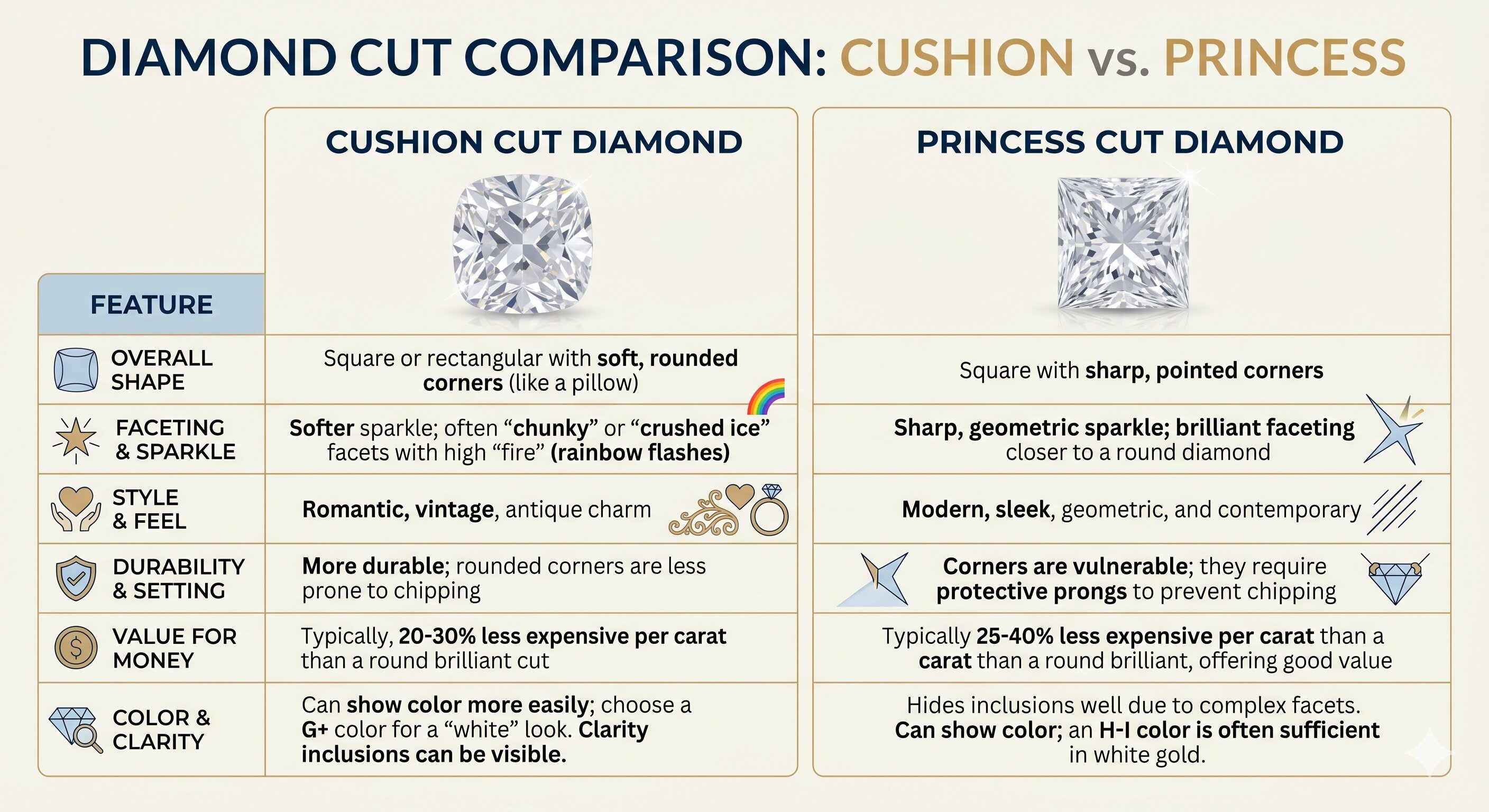
Practical Implications and How to Choose
These differences influence how each diamond looks, feels, and wears:
Protection and Setting: The princess cut's sharp corners are its biggest weak point and must be protected by a secure four-prong (or similar) setting. Cushion cuts, with their rounded corners, are naturally more durable for daily wear.
Size Perception and Budget: Both cuts offer better value than a round brilliant. A princess cut may appear to have a larger diagonal measurement, while a cushion cut’s face-up size can vary with its specific proportions.
Style Match: Your choice heavily depends on aesthetic preference. The cushion cut has an enduring, romantic, and vintage vibe. The princess cut offers a clean, bold, and modern look.
Key Decision Factors
Consider these points to help decide:
Choose a Cushion Cut if you love vintage or romantic styles, prefer a softer, more diffused sparkle, and want a durable shape for an active lifestyle.
Choose a Princess Cut if you prefer a modern, geometric look with sharp, brilliant sparkle similar to a round diamond, and are comfortable with a setting that protects its corners.
I hope this detailed comparison helps you narrow down your choice. If you are considering specific settings (like a halo or solitaire) and would like to know which cut tends to look best, I can provide further insights.
“You now know the personality, the history, the characteristics, the styles, the prices, the authenticity, the trend status, and the comparisons (round, emerald, princess). The only question left: will you choose the diamond that glows like candlelight?
Our current collection includes a limited number of GIA-certified cushion cut diamonds — from antique-style chunky facets to modern crushed ice, and from square classics to elongated rectangles. When stones with ideal proportions and minimal bow-tie are gone, sourcing new ones takes time.
This is not just a diamond. It is the Hope Diamond‘s shape, Marie Antoinette‘s Regent, and 300 years of romance — the cut that doesn‘t just sparkle. It glows.”
[Button: Claim Your Cushion Cut Diamond (Limited) →]
Square Cut Diamond Guide: Princess, Cushion, Asscher and Radiant
Square Cut Diamond Guide: Princess, Cushion, Asscher, and Radiant
Excellent question! When people refer to a "square cut" diamond, they are most commonly talking about the Princess Cut.
“In the late 1970s, a London cutter named Basil Watermeyer created a square diamond with sharp corners and a brilliant faceting pattern. He called it the ‘princess‘ not because it was delicate, but because it refused to be round. For 500 years, the round brilliant had been king. Then came the princess—geometric, modern, and unapologetically square. It is now the second most popular diamond shape in the world. The princess cut is not a compromise. It is a statement: I choose my own shape.”
The same cut that refused to be round now awaits your own modern love story — whether you choose a brilliant princess, a romantic cushion, a vintage Asscher, or a radiant hybrid. Every square-cut diamond in our collection is hand-selected for symmetry and sparkle.”
[Button: Explore Square Cut Diamonds →]
However, "square cut" is a bit of a general term in the jewelry world, and it actually refers to a family of diamond shapes that have a square outline when viewed from above.
Table of Contents
What Is A Square Cut Diamond Called?
Here are the main types of square-cut diamonds, starting with the most popular:
1. The Princess Cut (The Most Common Square Cut)
This is the definitive modern square cut and is the second most popular diamond shape in the world (after the round brilliant).
Key Features:
Perfectly square or nearly square shape.
Sharp, uncropped corners.
A brilliant-style faceting pattern (like a round diamond), which gives it exceptional sparkle and fire.
Why it's popular: It combines a contemporary square shape with the dazzling brilliance of a round diamond. It often has a lower price per carat than a round brilliant because it retains more of the original rough diamond.
2. The Asscher Cut (A Vintage, Art Deco Square)
The Asscher cut is a distinctive and elegant square cut with a vintage feel.
Key Features:
A square shape with cropped corners, giving it an octagonal outline.
A "step-cut" faceting pattern, with concentric rows of facets that create a "hall of mirrors" effect (similar to an emerald cut).
A high crown and a small table, which creates a deep, luminous look.
Appeal: It is known for its classic, geometric beauty and incredible clarity, though it shows less fiery sparkle and more flashes of light (brilliance vs. scintillation).
3. The Cushion Cut (The Soft Square)
The cushion cut is a classic shape that often appears as a square with softly rounded corners.
Key Features:
A square or rectangular shape with pronounced rounded corners, resembling a pillow or cushion.
Can have either a "brilliant" faceting pattern for more sparkle or a "chunky" faceting pattern for a more antique look.
Appeal: It offers a romantic, soft, and vintage appearance with large, open facets that showcase the diamond's clarity.
4. The Radiant Cut (The Brilliant Square with Cropped Corners)
The Radiant cut is a brilliant hybrid, combining the shape of an emerald cut with the faceting of a round brilliant.
Key Features:
A square or rectangular shape with beveled, cropped corners.
A brilliant faceting pattern on both the crown and pavilion, making it exceptionally sparkly.
Appeal: It was the first rectangular cut to have a completely brilliant faceting pattern. The cropped corners make it more durable than a Princess cut and help hide color in the diamond.
Quick Comparison Guide
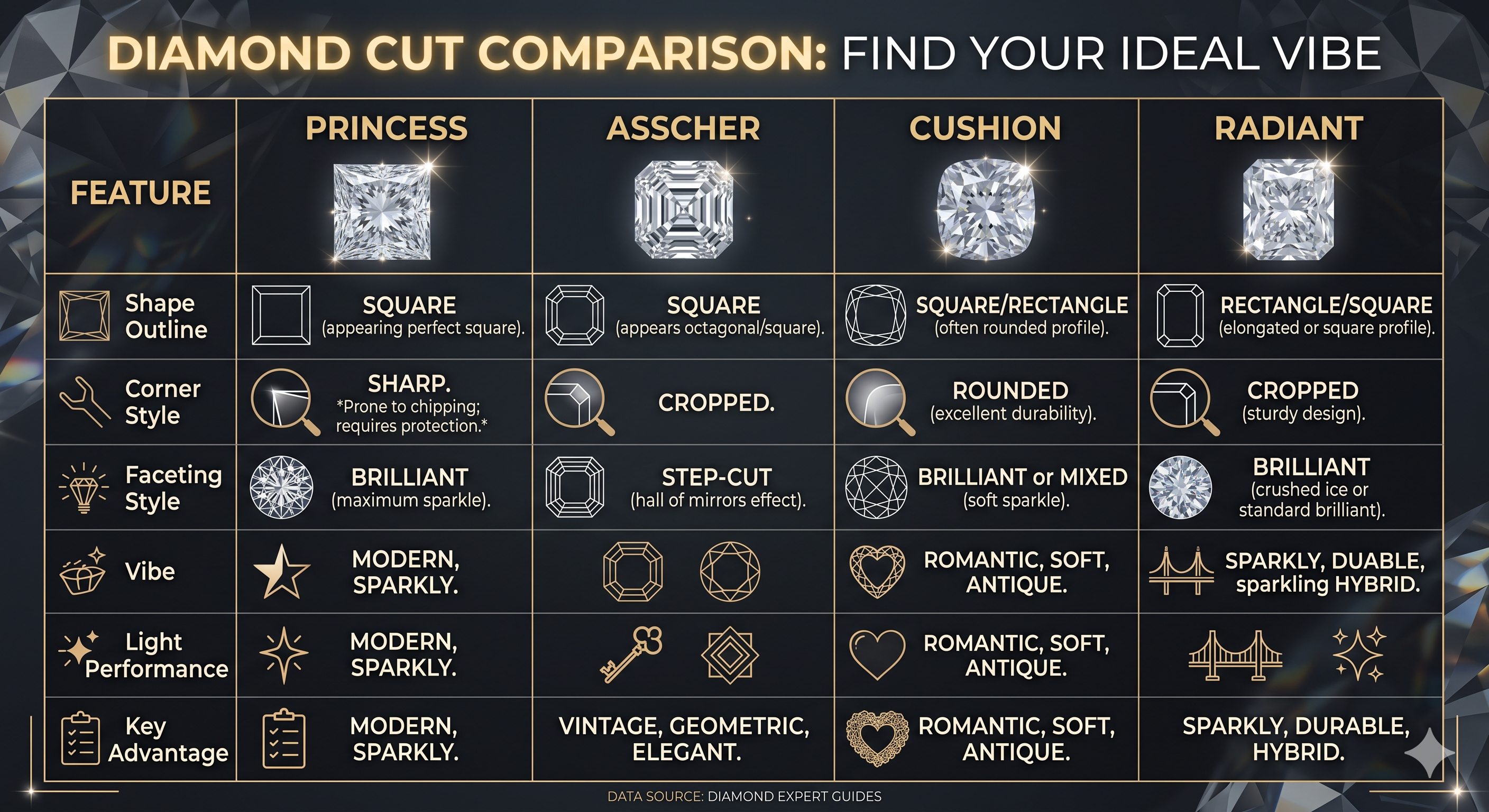
If someone says "square cut diamond," they are most likely referring to the Princess Cut. However, it's always best to clarify, as it could also mean a Cushion, Asscher, or Radiant cut depending on the specific style they have in mind.
Pro Tip: Princess-cut diamonds have very sharp corners that can be prone to chipping. It is highly recommended to set them in a protective setting (like a V-prong or bezel) at the four corners.
For official diamond cut grading information, visit the GIA Diamond Cut Guide.
Is A Square-cut Diamond Good?
That's an excellent and practical question. The short answer is: Yes, a square-cut diamond can be an excellent choice, but "good" depends heavily on your priorities and which specific square cut you choose.
They offer a fantastic blend of modern style, brilliance, and often, better value than a round diamond. However, they have unique characteristics you need to be aware of.
Let's break down the pros and cons, primarily focusing on the most popular square cut: the Princess Cut.
Advantages of Square Cut Diamonds (Why They Are "Good")
Modern and Stylish: Square cuts, especially the Princess and Asscher, offer a contemporary, geometric aesthetic that many find more unique and modern than the traditional round brilliant.
Exceptional Brilliance: The Princess and Radiant cuts use a brilliant-style faceting pattern, meaning they are engineered to sparkle with both fire (flashes of color) and brilliance (white light) nearly as much as a round diamond.
Excellent Value for Money: This is a major advantage. Square cuts retain more of the original rough diamond crystal than a round cut. Because of this higher yield, you often get a larger-looking diamond for the same price per carat. A 1-carat princess cut will typically cost significantly less than a 1-carat round brilliant.
Flattering on the Finger: The elongated appearance of square shapes (especially when set with side stones) can create a flattering, finger-lengthening effect.
Variety within the Category: As we discussed, "square cut" isn't one thing. You can choose the fiery and modern Princess, the soft and romantic Cushion, or the vintage and elegant Asscher.
Potential Disadvantages & Things to Consider (The "But...")
Durability of Corners (Crucial for Princess Cuts): The sharp, pointed corners of a Princess cut diamond are its most vulnerable points and can be prone to chipping if struck hard. This is the single biggest practical concern.
Solution: Always set a Princess cut in a protective setting.
such as a V-prong or a bezel setting at the four corners.
Bow-Tie Effect: Elongated or square-shaped fancy cuts (especially Ovals, Marquise, and Cushion/Radiant/Asscher cuts) can suffer from a "bow-tie" effect. This is a dark, bow-tie-shaped shadow that appears across the center of the diamond when viewed from above, caused by light leakage. A well-cut diamond will minimize this, so it's essential to inspect the stone in person or via high-quality video.
Color and Clarity Can Be More Visible:
Color: In brilliant square cuts (like Princess), the facets can sometimes make body color slightly more noticeable than in a round brilliant. You might need to choose a color grade one step higher (e.g., a G instead of an H) for it to look "colorless" to the naked eye.
Clarity: In step-cuts (like the Asscher), the large, open table facets act like windows, making inclusions (flaws) much easier to see. For an Asscher, you should prioritize a higher clarity grade (e.g., VS2 or better).
Cut is Still King (and More Complex): For round brilliants, cut grading is standardized (Excellent, Very Good, etc.). For fancy shapes like square cuts, there is no universal "Ideal" cut grade. It's more subjective and requires careful visual inspection. GIA certificates for fancy shapes don't give a Cut grade, only Polish and Symmetry.
Quick Guide: Which Square Cut is "Good" For You?
Choose a Princess Cut if: You want the ultimate in modern sparkle and brilliance, you're budget-conscious, and you ensure it's set in a protective setting.
Choose a Cushion Cut if: You love a soft, romantic, or antique vibe. You prefer a mix of brilliant sparkle and larger, "chunkier" facets.
Choose an Asscher Cut if: You are drawn to bold, vintage, Art Deco geometry and value mesmerizing clarity and hall-of-mirrors effects over fiery sparkle.
Choose a Radiant Cut if: You want the brilliance of a Princess cut but with the added durability of cropped corners, and you like a hybrid look.
Is a square-cut diamond good? Absolutely. It can be a brilliant, beautiful, and smart financial choice.
It's a GREAT choice if: you value modern style, want maximum sparkle for your budget, and are willing to pay attention to cut quality and setting protection.
You might prefer a Round Brilliant if: your top priority is the absolute maximum, scientifically proven brilliance, and you want the simplest, most standardized cut grading system.
“In 1902, the Asscher brothers of Amsterdam invented a square cut with cropped corners and concentric step facets—a ‘hall of mirrors‘ that dazzled the Art Deco world. For decades, it was the diamond of royalty. Then the princess cut arrived, and the Asscher faded. But in the 2000s, a revival began. Celebrities chose Asscher cuts for their vintage glamour. Jewelers rediscovered its quiet elegance. The Asscher did not die. It simply waited. Square cuts are like that—they don‘t scream. They sit on your finger and let the light find them. That is their power. Not to shout, but to be seen.”
The best advice is always to look at them in person. Compare a few square cuts side-by-side with a round brilliant. Your eyes will tell you which sparkle and style you truly love.
How Much Is A 1 Carat Square Cut Diamond Worth?
This is a crucial question, and the answer is: There is no single price. The value of a 1-carat square cut diamond can range from roughly $1,000 to over $12,000 for a natural diamond.
The price depends entirely on the "Four Cs" (Cut, Color, Clarity, and Carat), with the specific type of square cut and whether the diamond is natural or lab-grown being the most significant factors.
To give you a practical understanding, let's break it down.
The Biggest Factor: Natural vs. Lab-Grown
This is the most significant determinant of price today.
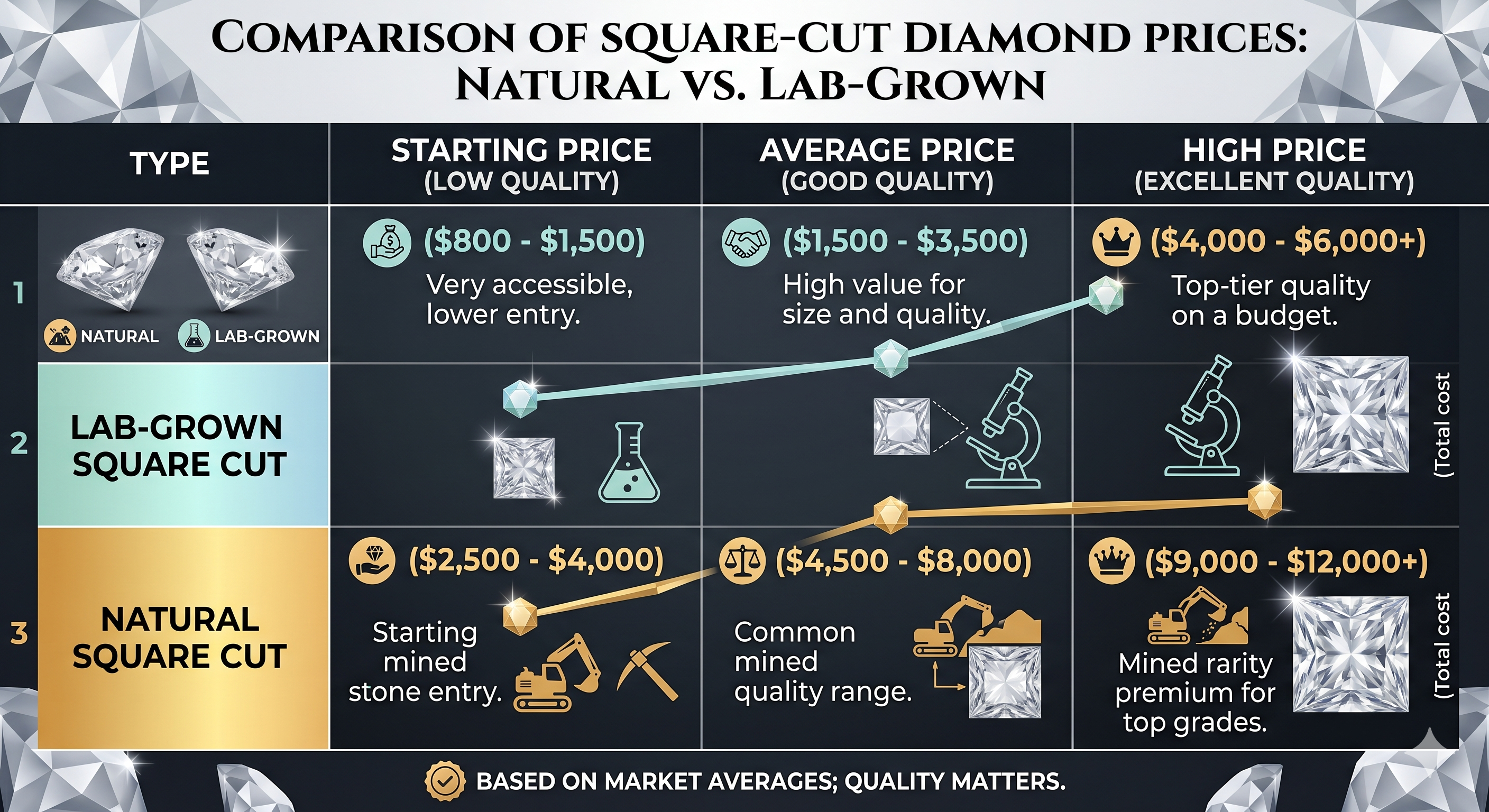
Why the huge difference? Lab-grown diamonds are physically and chemically identical but are created in a week, making them far more abundant and less expensive than mined diamonds.
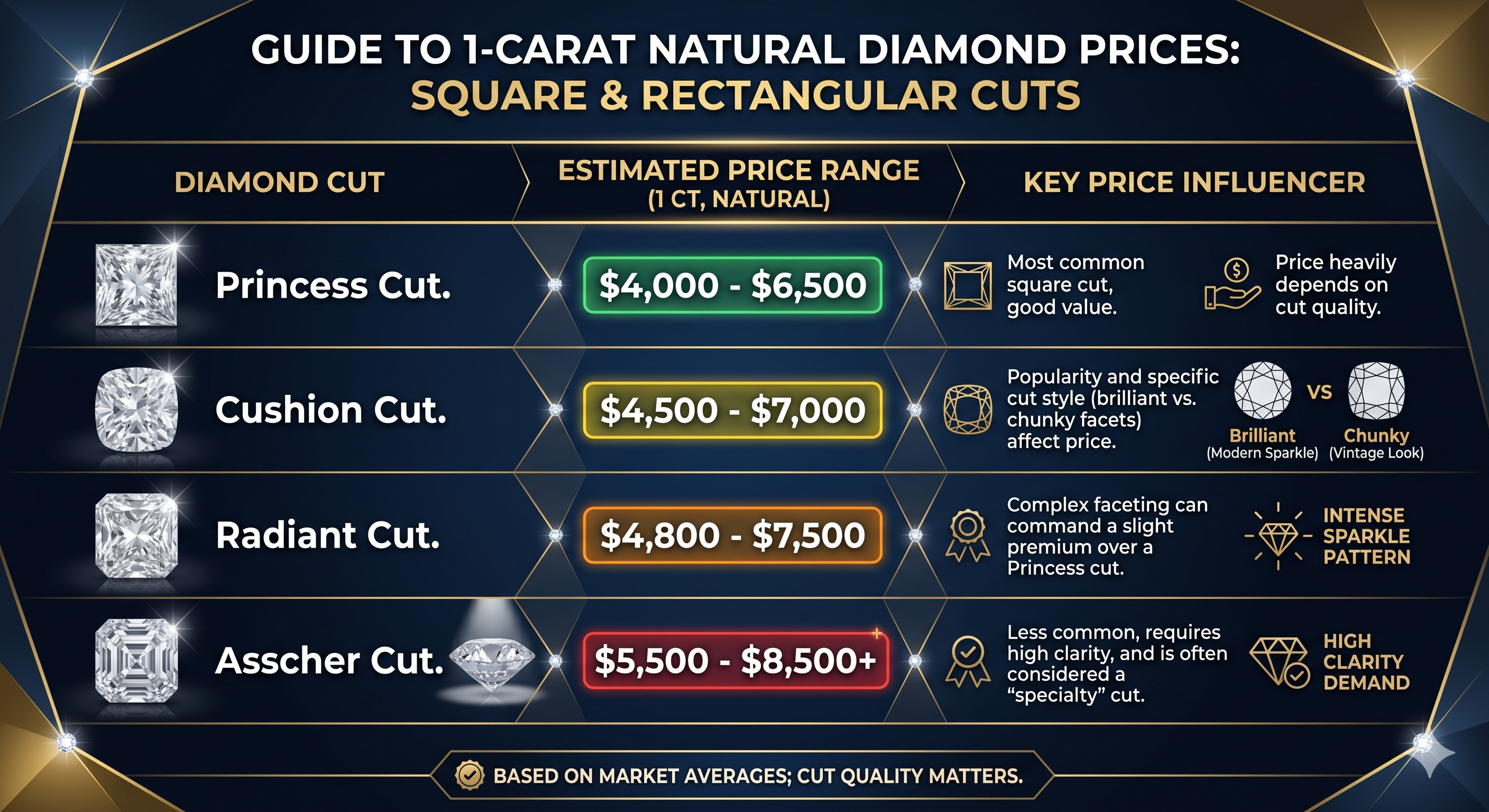
For comparison: A 1-carat Round Brilliant with similar specs would typically cost $6,500 - $9,000, making square cuts generally a better value per carat.
The Real Price Drivers: The Other "Cs"
The following chart illustrates how the two most variable "Cs" - Color and Clarity - dramatically impact the price of a 1-carat diamond, using a Princess cut as an example. Notice the sharp price increase for the highest grades.
As you can see, prioritizing the "eye-clean" and "near-colorless" grades (like the G/VS1 or I/SI1 in the chart) offers the best balance of beauty and value for most people.
How to Get a Realistic Price
Define Your Type: First, decide between Natural and Lab-Grown. This will set your overall budget.
Choose a Shape: Narrow it down to Princess, Cushion, Radiant, or Asscher.
Set Quality Ranges: You don't need a "D Flawless" stone. For the best value, aim for:
Color: G-H (Near Colorless)
Clarity: VS2-SI1 (Eye-Clean)
Cut: Very Good or Excellent (This is critical for sparkle, even in shapes without a formal GIA cut grade).
Shop Retailers: Prices vary significantly. Always get a certificate from a reputable lab (like GIA or AGS).
Example for a Realistic Budget:
A beautiful, eye-clean 1-carat lab-grown princess cut with G color and VS2 clarity will likely cost between $1,800 and $2,800.
A comparable natural diamond with the same specs would likely cost between $5,000 and $6,500.
Final Recommendation: Use online diamond search engines (like James Allen, Blue Nile, or Brilliant Earth) to filter for the exact specifications you want. This will give you the most accurate, real-time market price for a 1-carat square cut diamond.
For current diamond market prices, visit the American Gem Society's price guide.
Is Square Cut The Same As Princess Cut?
No, "Square Cut" is not the same as "Princess Cut," though they are closely related. Princess Cut is the most common specific type of square-shaped diamond, but the term "Square Cut" is not a standard industry name and can refer to several different diamond shapes.
"Square Cut" is a descriptive term for diamonds with a square outline. It is not a specific cut and can include several distinct styles like the Princess, Cushion, Asscher, and Radiant cuts.
"Princess Cut" is a specific and popular diamond shape. Its technical name is "square modified brilliant," which combines a square outline with a brilliant-style faceting pattern for maximum sparkle. True princess cuts have sharp, pointed 90-degree corners.
To help you see the differences, here’s a comparison of popular square-shaped diamond cuts:
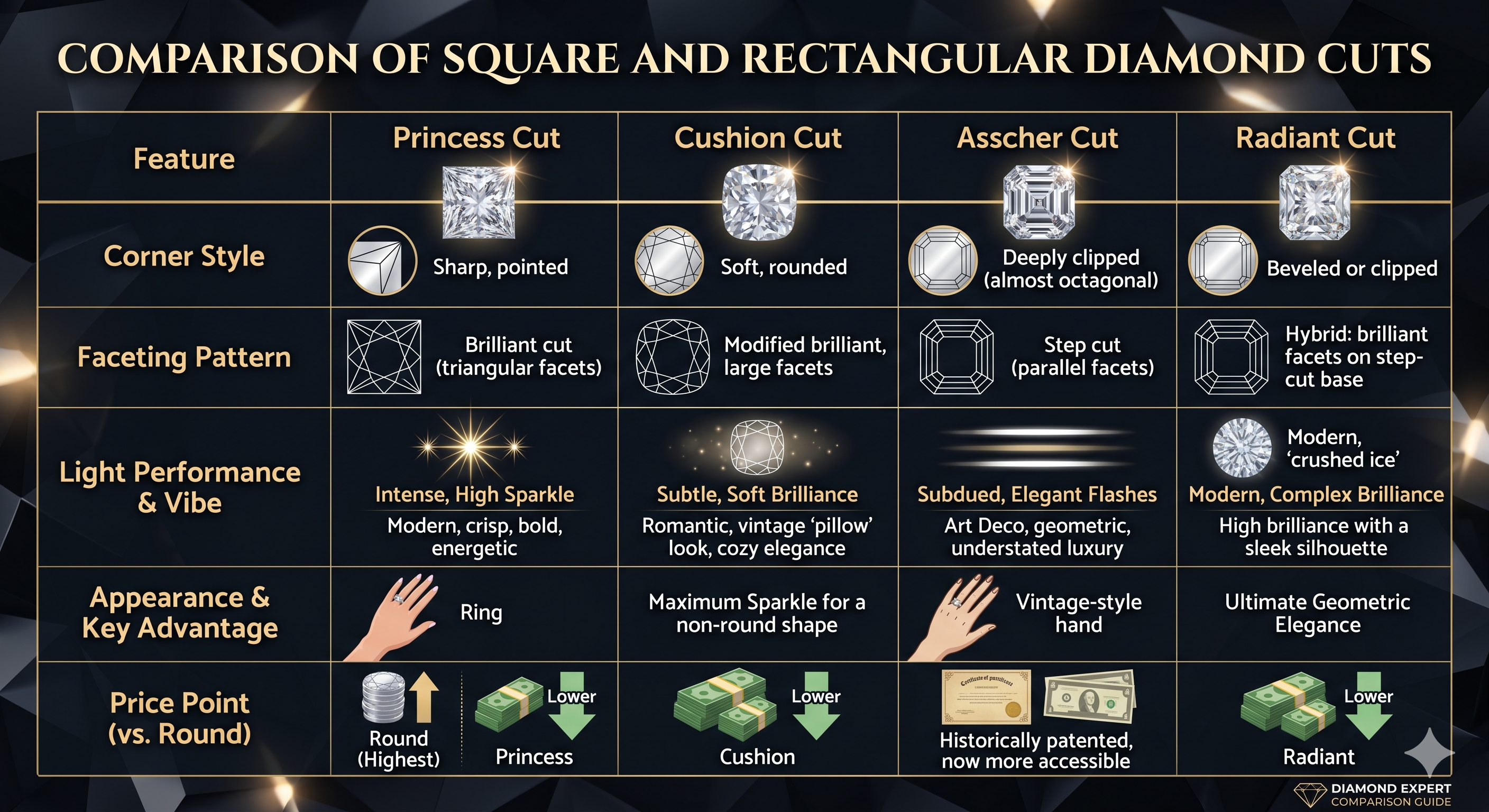
Key Facts About Princess Cut Diamonds
Popularity: It is the second most popular diamond cut after the round brilliant, often used in engagement rings.
Value: They are generally 10-25% less expensive per carat than round brilliant diamonds because the cutting process wastes less of the original stone.
Consideration: The sharp corners can be prone to chipping, so it's important to choose a setting (like a four-prong or bezel) that protects them.
How to Ensure You Get What You Want
To avoid confusion when shopping:
Use Specific Names: Instead of asking for a "square cut," specify the exact cut you want, like Princess, Cushion, or Asscher.
Check the Certificate: Look at the diamond grading report (e.g., from GIA or AGS). A true princess cut will often be described as "Square Modified Brilliant".
Look at the Corners: Visually, the sharp, pointed corners are the easiest way to identify a classic princess cut.
In short, while a princess cut is square, not all square-shaped diamonds are princess cuts.
I hope this helps clarify the terminology.
“You now know the names, the types, the pros and cons, the pricing, and the terminology. The only question left: which square will you choose?
Our current collection includes a limited number of GIA-certified square cut diamonds — from brilliant princess cuts to soft cushions, from vintage Asschers to radiant hybrids. When stones with ideal proportions are gone, sourcing new ones takes time.
This is not just a diamond. It is Basil Watermeyer‘s 1970s rebellion, the Asscher brothers‘ Art Deco masterpiece, and 500 years of round brilliants finally being challenged — a shape that says: I choose my own corners.”
[Button: Claim Your Square Cut Diamond (Limited) →]
Back to Complete Amethyst Stone Guide
24K Gold Guide: Purity, Price, vs 18K, Investment and Buying Tips
24K Gold Guide: Purity, Price, vs 18K, Investment and Buying Tips
24K Gold refers to gold that is 99.9% pure (or 99.99% in some standards), with no other metals mixed in.
Let's see the list of 24k information.
Table of Contents
The Simple Answer
What Does 24K Gold Mean?
24K gold is pure gold. The "K" stands for karat (or carat), which is the unit used to measure the purity of gold. 24K is the highest karat rating possible, meaning it is 99.9% pure gold with no other metals mixed in.
The Detailed Explanation
1. The Karat System Explained
Gold in its pure form is very soft and malleable. To make it more durable for use in jewelry and other items, it is alloyed (mixed) with other metals like copper, silver, zinc, or nickel.
The karat system divides the purity into 24 parts:
24 Karats: 24 out of 24 parts are gold. This is 100% gold (or as close as possible, typically 99.9%).
18 Karats: 18 out of 24 parts are gold. This is 75% gold (18/24 = 0.75).
14 Karats: 14 out of 24 parts are gold. This is 58.3% gold (14/24 ≈ 0.583).
10 Karats: 10 out of 24 parts are gold. This is 41.7% gold (10/24 ≈ 0.417). This is the minimum to be legally called "gold" in the United States.
2. Characteristics of 24K Gold
Color: A distinct, rich, and vibrant yellow color. It is the "true" color of gold.
Value: It has the highest intrinsic value because it is almost pure gold. Its price is directly tied to the live market price of gold.
Durability: This is its biggest drawback. 24K gold is very soft and easily scratched, bent, or deformed. It is not practical for everyday jewelry like rings or bracelets.
Hypoallergenic: Because it contains no other alloy metals, it is ideal for people with metal allergies.
3. Comparison with Lower Karats
4. Common Uses for 24K Gold
Because of its softness, 24K gold is not used for most rings or bracelets. Instead, you'll find it in:
Investment Gold: Gold bars, bullion, and coins (like the Canadian Maple Leaf or American Buffalo) are often 24K.
Electronics: Its excellent conductivity and corrosion resistance make it valuable for high-end electronics.
Decorative Items: Leafing (gold leaf) is used in art, architecture, and on food.
Certain Types of Jewelry: It is used in some traditional jewelry (especially in Asia and the Middle East), where it is treated with great care, and in earrings or pendants that are less prone to impact.
24K = Pure Gold: It is the benchmark for gold purity (99.9%).
Not for Everyday Jewelry: Its softness makes it impractical for rings or bracelets meant for daily use.
Highest Intrinsic Value: Its price is closest to the spot price of gold.
Look for the Hallmark: Authentic 24K gold items will be stamped with 24K, 999, or 1000.
So, when you see "24K gold," you are looking at the real, unadulterated article—beautiful, valuable, but also delicate.
Learn more about gold purity and karats on Wikipedia's gold carat page.
What Number Is 24K Gold?
This gets to the heart of how gold purity is measured.
The number for 24K gold is 999 (or sometimes 1000).
This means it is 99.9% pure gold.
Here’s a breakdown of what that number means and how it relates to other systems:
The Numbering Systems for Gold Purity
There are two main ways to express the purity of gold: the Karat System and the Millesimal Fineness System.
1. The Karat System (K)
This system divides gold into 24 parts.
24K means 24 out of 24 parts are gold.
This is pure gold, or as close as you can get.
2. The Millesimal Fineness System (the Number)
This system expresses purity in parts per thousand.
Pure gold is represented as 1000.
Since it's virtually impossible to refine gold to 100% purity, the highest standard for gold is 999, meaning 999 parts per thousand are gold, or 99.9% pure.
So, 24K and 999 are two different ways of saying the same thing: the gold is virtually pure.
Quick Reference Chart
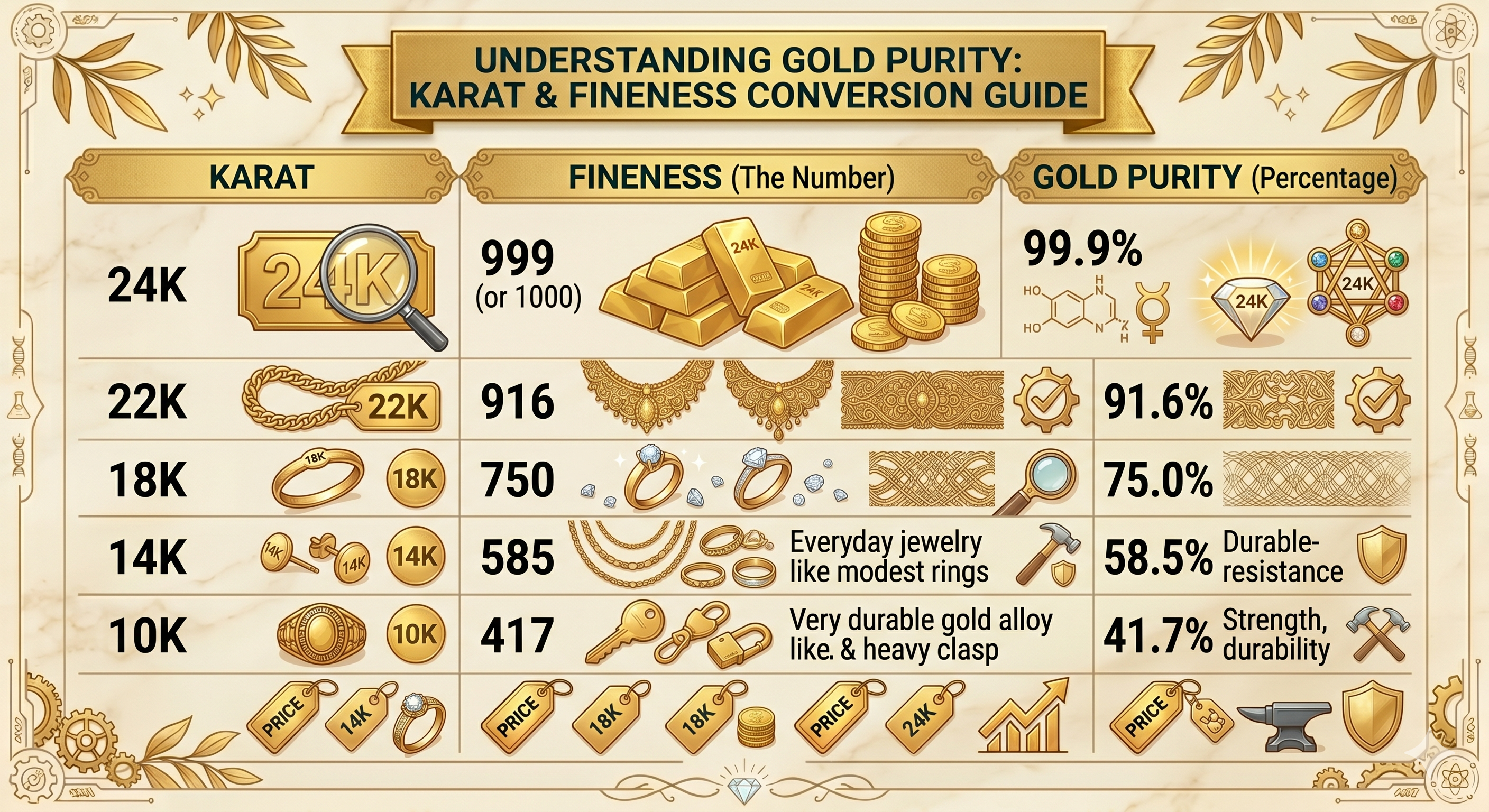
How to Find the Number
When you buy a piece of gold, look for a small stamp or hallmark. A 24K gold item will be stamped with one of the following:
24K
999
1000
When someone asks, "What number is 24K gold?" the direct answer is 999. This number confirms its status as the highest purity of gold commonly available, making it the most valuable but also the softest form.
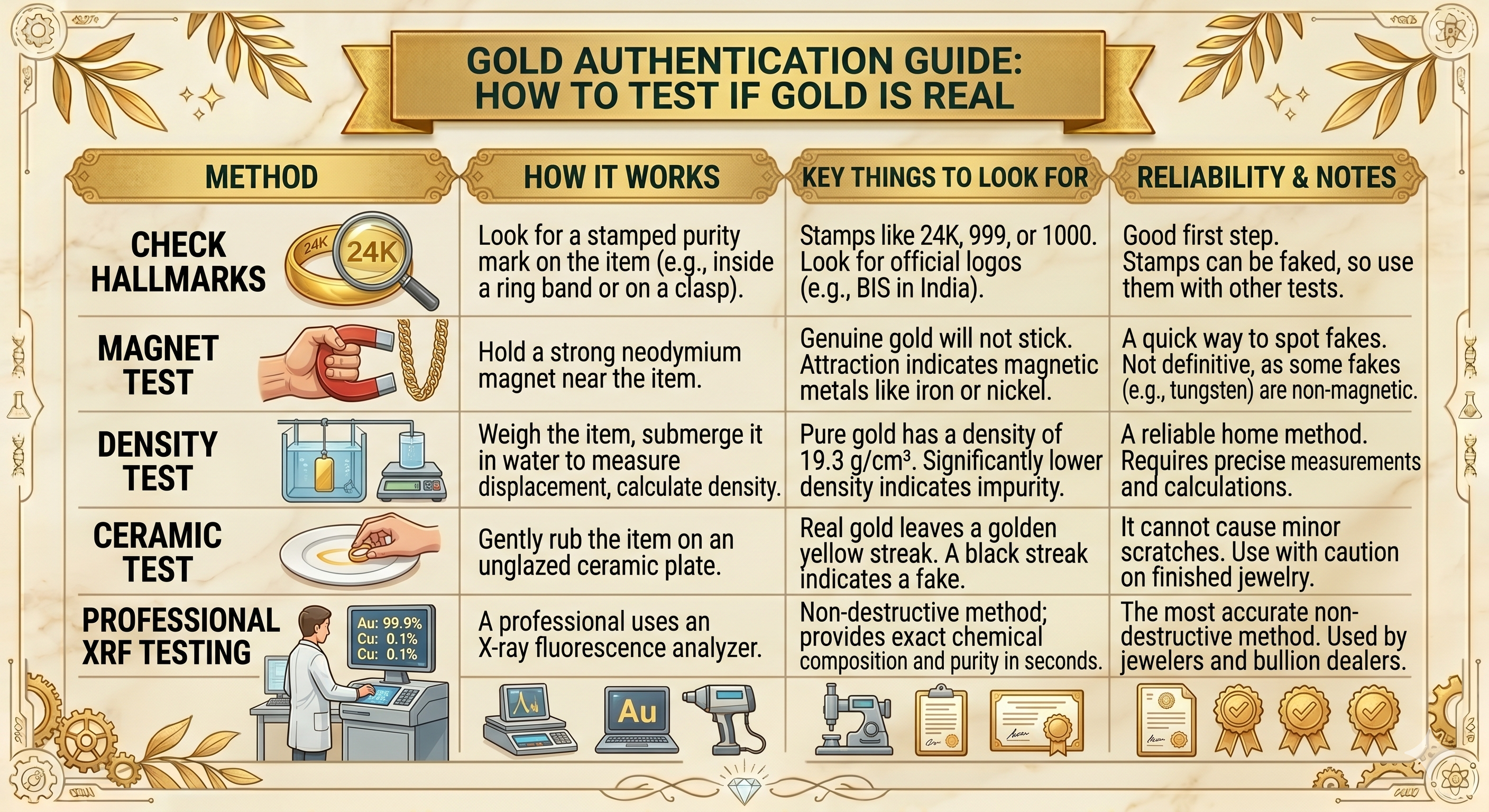
How To Verify 24K Gold?
Verifying 24K gold can be done through a series of simple at-home checks and more advanced professional methods. The table below summarizes the most common techniques, ranging from quick visual inspections to scientific tests.
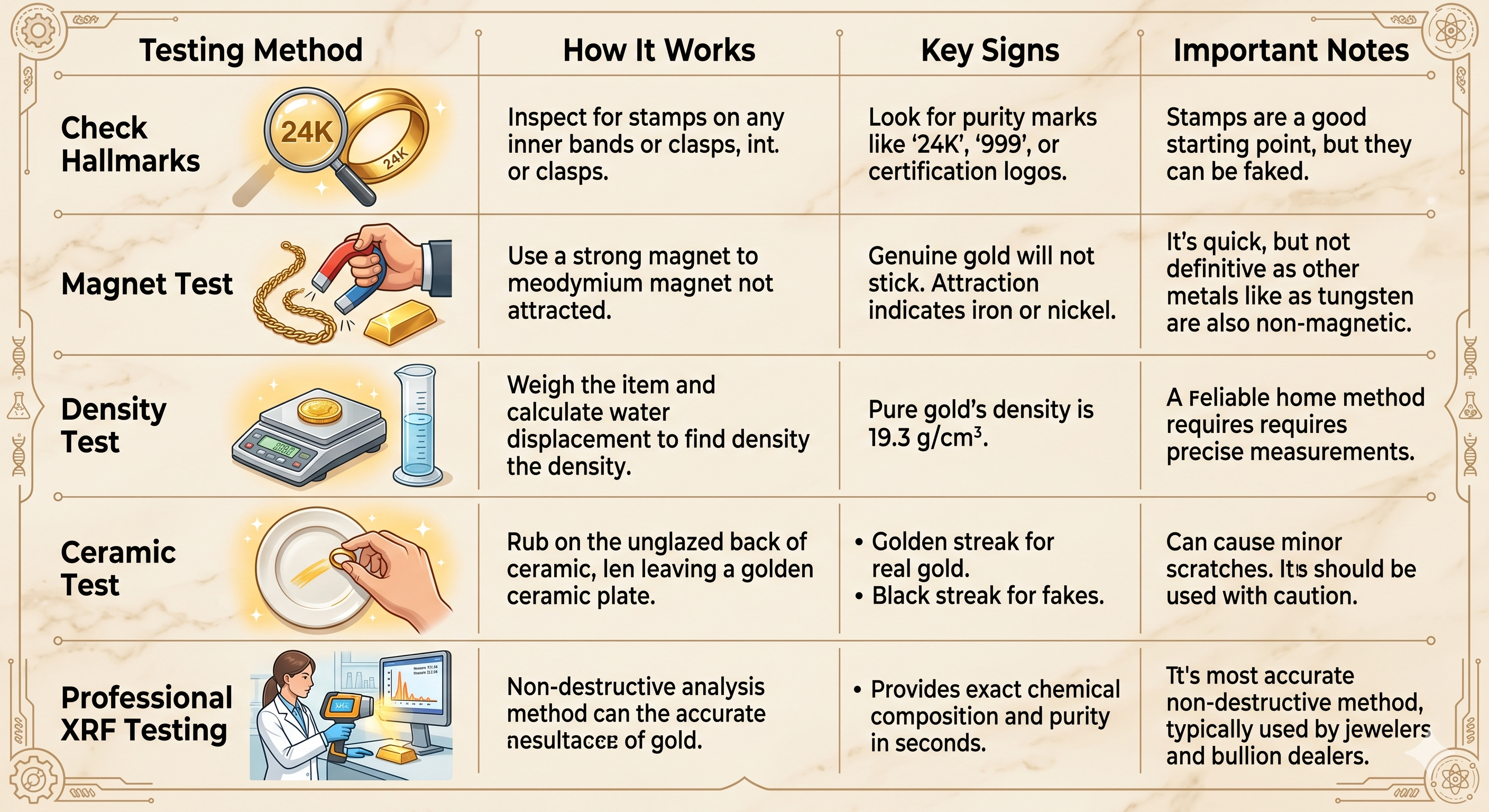
Other Home Verification Methods
Several other simple tests can provide additional clues, though they should be used with caution.
The Float Test: Drop the item into a glass of water. Genuine gold is very dense and will sink directly to the bottom. Fake or gold-plated items may float or sink slowly.
The Vinegar Test: Place a drop of white vinegar on the gold. Real gold will not change color, while other metals may tarnish or react. This is generally safe, but avoid harsh chemicals like nitric acid without proper training.
Visual and Physical Inspection: Look for signs of wear. Real gold has a consistent color and does not tarnish. If you see discoloration like green or black spots, or if the surface is flaking, it is likely gold-plated.
⚠️ Important Cautions and When to See a Pro
Avoid Destructive Tests at Home: Do not try acid tests, fire assays, or anything that involves scratching, biting, or applying harsh chemicals to your gold without proper training and safety equipment. These methods can permanently damage your item and are unsafe.
Trust but Verify Hallmarks: A stamp is a good sign, but it is not a guarantee of authenticity. Counterfeiters often stamp fake items with realistic-looking hallmarks.
Seek Professional Help for Valuable Items: For high-value bars, coins, or heirloom jewelry, a professional appraisal is the best choice. Jewelers use XRF technology for precise, damage-free verification.
I hope this guide helps you verify your gold with confidence. If you have a specific type of item you'd like to verify, feel free to ask for more tailored advice.
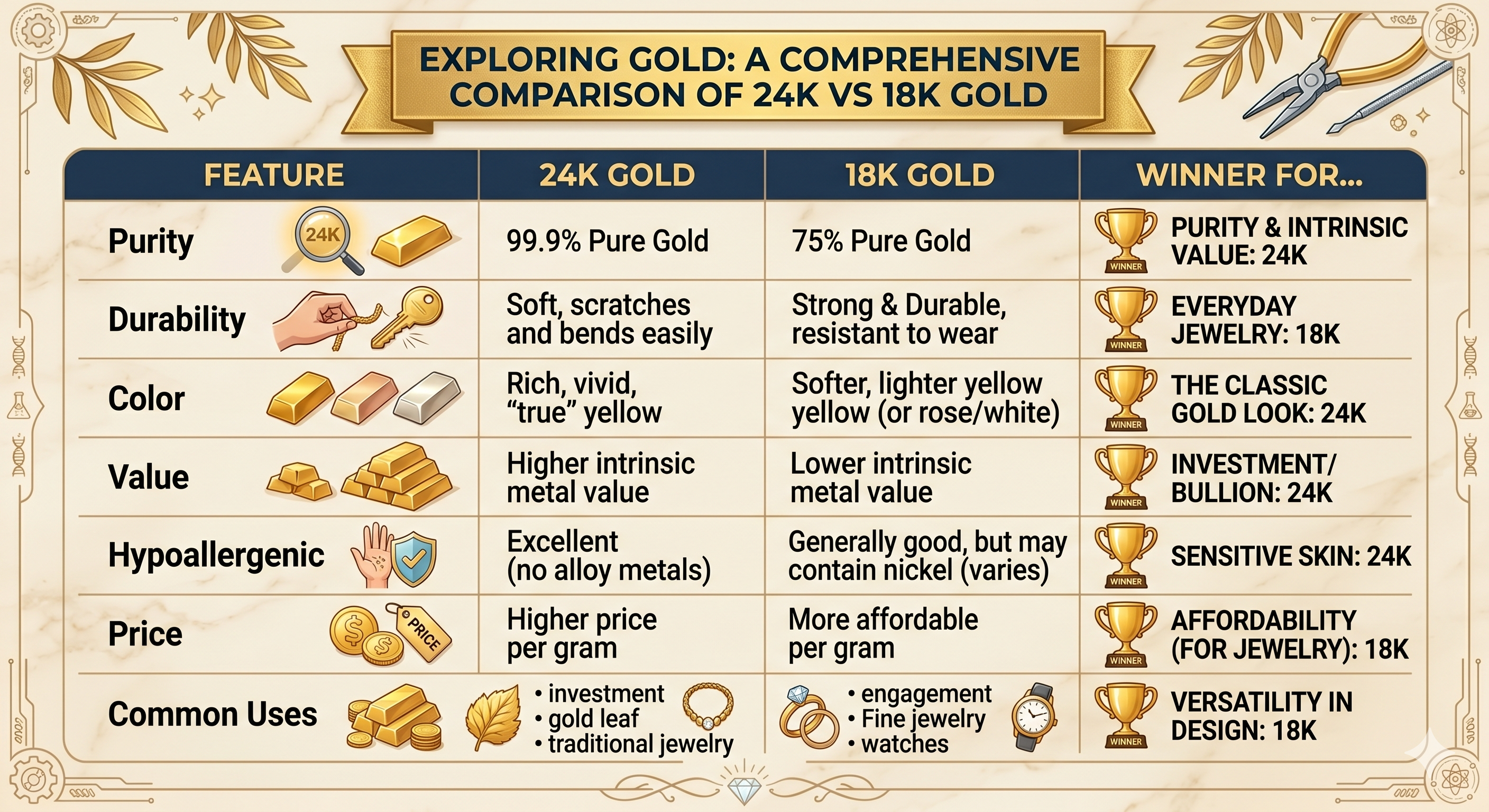
Which Is Better, 24K or 18K Gold?
The choice between 24K and 18K gold isn't about one being objectively "better" than the other, but about which is better for your specific needs and priorities.
They are fundamentally different materials, each with its own strengths and weaknesses. Here’s a detailed comparison to help you decide.
Quick Summary
Choose 24K Gold if your top priorities are purity, investment value, and the richest yellow color, and you are okay with it being less durable for everyday wear.
Choose 18K Gold if your top priorities are durability, intricate jewelry designs (especially with stones), and a slightly more subtle color, and you are willing to sacrifice a small amount of pure gold content.
Detailed Comparison Table
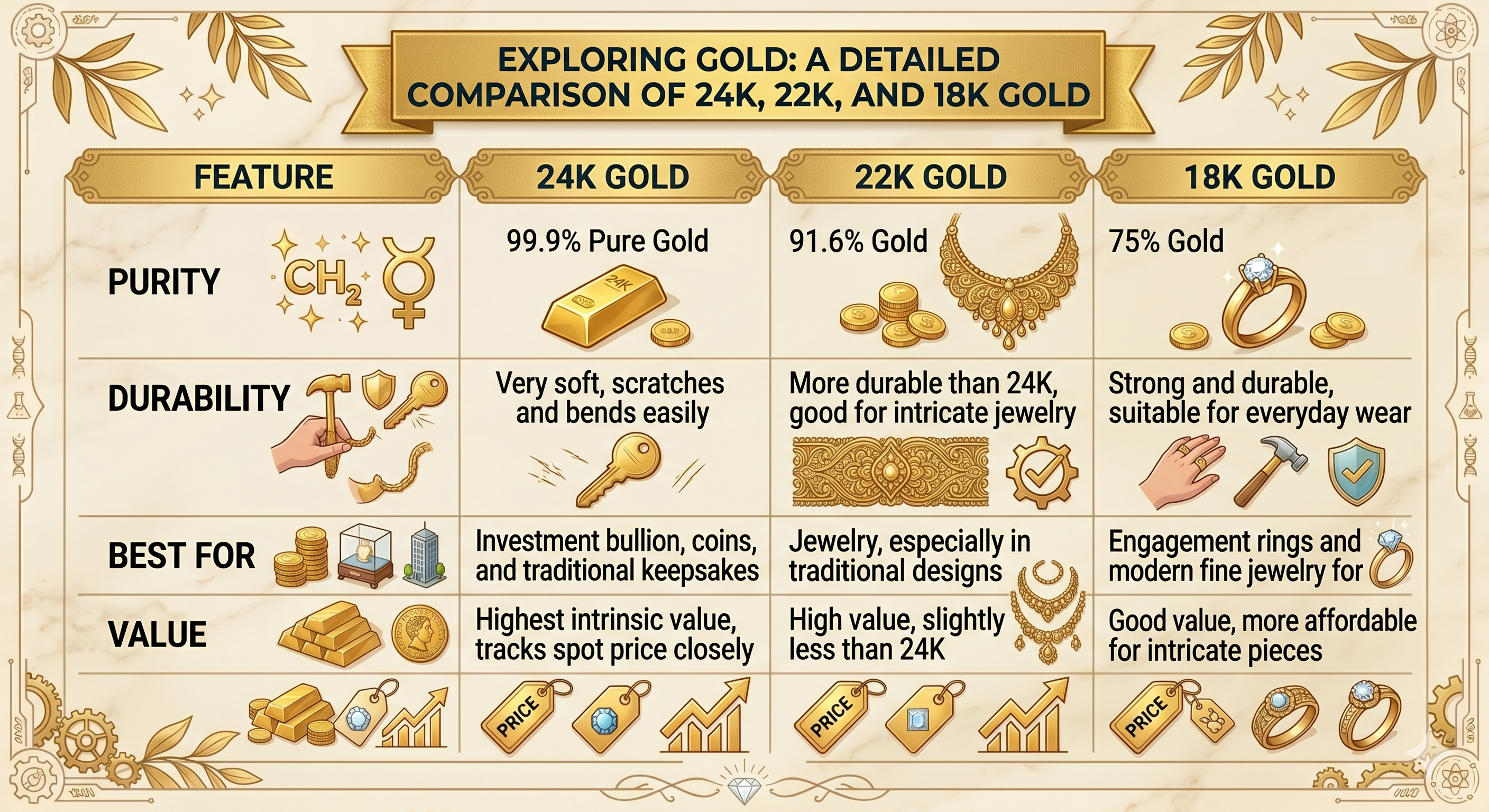
In-Depth Analysis
When to Choose 24K Gold
Investment: For gold bars, bullion coins, and savings, 24K is the standard. You are buying pure gold with the highest metal content.
Traditional & Cultural Jewelry: In many cultures (like in South Asia and the Middle East), 24K gold is preferred for its purity, value, and status symbol. These pieces are often worn on special occasions rather than daily.
The Ultimate Gold Color: If you love the intense, warm, and unmistakable color of pure gold, 24K is unmatched.
Severe Metal Allergies: Since it contains no other metals, it's the safest choice for those with sensitive skin.
The Big Drawback: Its softness means a 24K gold ring will quickly show scratches and can easily get misshapen.
When to Choose 18K Gold
Everyday & Lifetime Jewelry: This is the primary reason to choose 18K. Its durability makes it ideal for:
Engagement and Wedding Rings: They withstand daily knocks and wear.
Jewelry with Gemstones: It provides a secure and strong setting for precious stones (like diamonds, sapphires, etc.) that would risk falling out of a softer 24K setting.
Design Versatility: The 25% alloy content allows jewelers to create different colors:
18K White Gold: Alloyed with palladium or nickel.
18K Rose Gold: Alloyed with copper.
A More Subtle Look: The color is a lighter, more subtle yellow than 24K, which many people prefer for its understated elegance.
The Trade-off: You are getting less pure gold, so the intrinsic metal value is lower than an equivalent weight in 24K.
Which Should You Buy?
Ask yourself these questions:
What is it for?
An investment or a savings piece? → 24K Gold
An engagement ring or a piece you'll wear every day? → 18K Gold
What is your priority?
The highest purity and value of the metal itself? → 24K Gold
Durability and a piece that will last a lifetime without damage? → 18K Gold
What style do you prefer?
The richest, most traditional yellow? → 24K Gold
A lighter yellow, white, or rose gold? → 18K Gold
For the vast majority of people buying fine jewelry for daily wear, 18K gold offers the perfect balance of luxury, beauty, and practical durability.
How Much Is 24K Gold Worth Today?
For your convenience, here is a table with more detailed price points based on different weights:
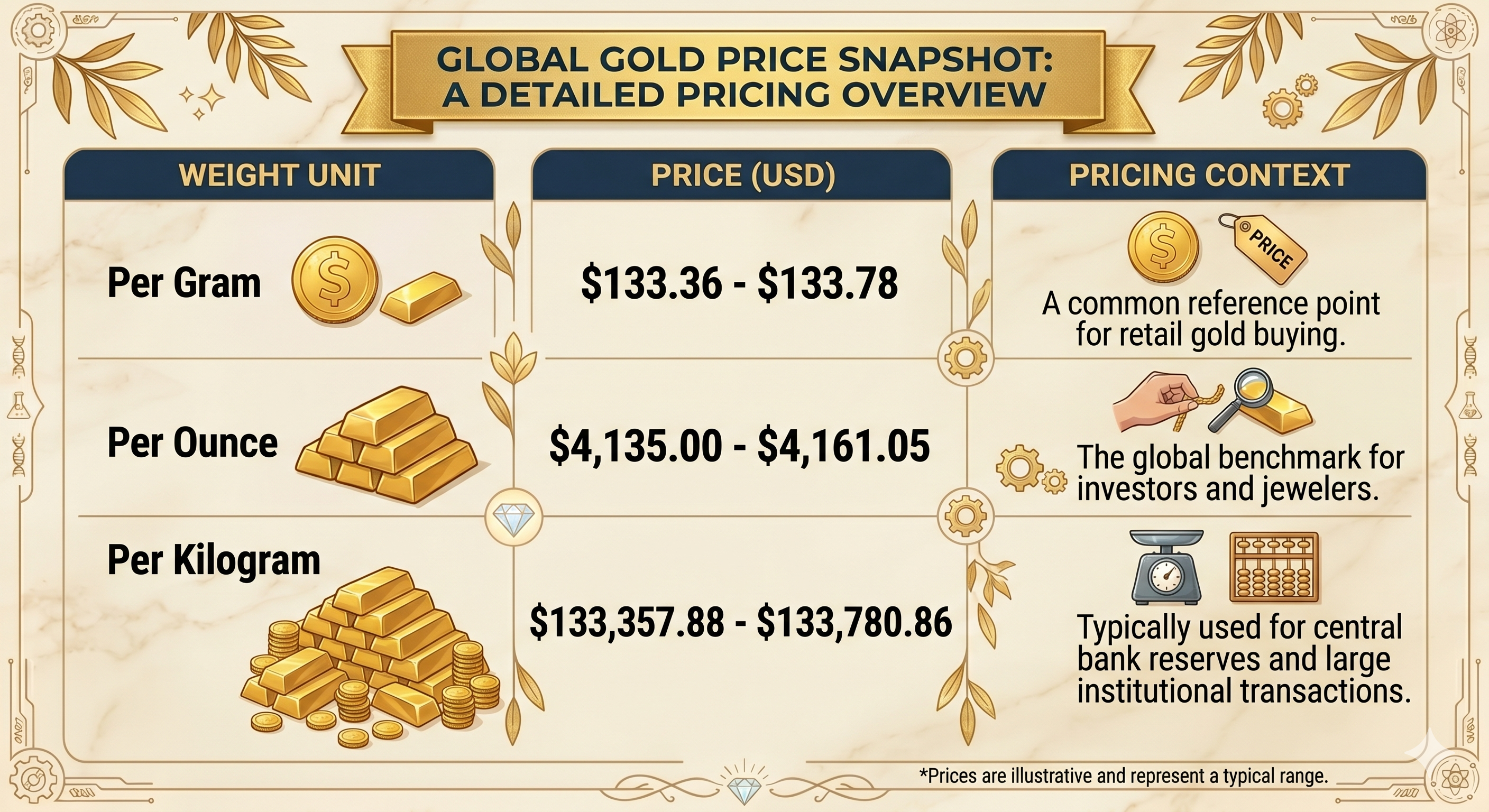
Market Context
The price of gold is dynamic and changes constantly during market hours based on supply and demand. Recently, prices have been trending upward. This is largely because investors are anticipating an interest rate cut from the U.S. Federal Reserve, which weakens the U.S. dollar and makes gold, which doesn't yield interest, a more attractive investment.
What These Prices Mean for You
The prices listed above are spot prices, which are the benchmark prices for raw, unrefined gold. If you are buying a physical gold product like a coin or a bar from a dealer, you will pay a premium over this spot price to cover the dealer's costs and profit. Conversely, if you are selling gold to a dealer, you will typically receive a price that is slightly below the spot price.
I hope this information helps you. Would you like me to help you find the prices for other gold purities, such as 18K or 22K?
For current gold spot prices, visit the Kitco Precious Metals Price Guide.
Is 24 Karat Gold Expensive?
Yes, absolutely. 24-karat gold is the most expensive form of gold you can buy in terms of pure material cost.
Here’s a simple breakdown of why:
1. It's All About Purity
24K gold is 99.9% pure gold. Since its price is based directly on the live market price of gold (the "spot price"), you are paying for the maximum amount of gold content possible. Any other karat of gold (like 18K or 14K) is mixed with less expensive metals, making it cheaper per gram.
2. Price Comparison with Other Karats
Let's say the market price for pure gold is $70 per gram.
A 10-gram 24K gold chain would have a base material cost of 10 grams x $70 = $700.
A 10-gram 18K gold chain is only 75% gold. Its base material cost would be 10 grams x (0.75) x $70 = $525.
So, for the same weight, the 24K item will always have a higher intrinsic value and cost more than a lower-karat item.
Key Takeaway:
While 24K gold is the most expensive due to its purity, it's also the softest and least practical for everyday jewelry. This is why many people choose the excellent balance of purity, durability, and relatively lower cost offered by 18K or 14K gold for items like rings and bracelets.
In short, if you are comparing pure material cost, 24K gold is the most expensive option available.
Is 24K Gold Worth Buying?
Whether 24K gold is worth buying really depends on your goal. It's an excellent choice for pure investment, but less ideal for everyday jewelry.
The Trade-Off: Purity vs. Practicality
The key thing to understand about 24K gold is its main characteristic: it is 99.9% pure gold. This comes with a significant trade-off between purity and practicality, especially when compared to other common purities.
The table below compares 24K gold with 18K and 22K gold to help you see the differences clearly.
In summary, the disadvantage of 24K gold is not its quality or value as a metal, but its practical limitations for use in most jewelry. It is a soft, delicate material best reserved for investment bullion, special-occasion pieces like pendants and earrings, or traditional items not meant for daily wear. For anything you plan to wear regularly, 18K gold is a far more robust and practical choice.
For more on gold as an investment, visit the American Gem Society's investment guide.
Back to [Amethyst Ring Guide]
22K Gold Guide: Purity, Price, vs 24K/18K, Daily Wear and Care
22K Gold Guide: Purity, Price, vs 24K/18K, Daily Wear and Care
22K gold is 91.6% pure gold, with the remaining 8.4% typically comprising metals such as silver, copper, or zinc to add strength. This makes it a popular choice for jewelry where both purity and durability are important.
Here is the content of the tables;
- What Does 22K Mean In Gold?
- Is 22K Gold Good?
- What Is The Purity Of 22K Gold?
- What Are The Characteristics Of 22K Gold?
- How Much Should I Pay For 22K Gold?
- Is 22K Gold Equal To 916?
- Is 22 or 24 Karat Gold Better?
- Can I Wear A 22K Gold Ring Every Day?
- Is 22K Gold Good For Jewelry?
- Does 22K Gold Turn Black?
- How Can You Tell If 22 Carat Gold Is Real?
- What Are The Benefits Of Buying 22K Gold?
- Is 22K Gold Rare?
- What Are The Disadvantages Of 22K Gold?
- Can I Swim With 22K Gold?
Let's break that down in more detail.
What Does 22K Mean In Gold?
The "K" Stands for Karat
Karat (K or kt) is the measurement used to specify the purity of gold. It tells you how much pure gold is in a metal compared to other metal alloys mixed with it.
The system is based on 24 parts. Think of it as dividing your gold item into 24 tiny, equal pieces.
What 22K Actually Means
22K Gold is 22 parts pure gold and 2 parts other metals (like copper, silver, zinc, or nickel).
To calculate the percentage purity: (22 / 24) x 100 = 91.7% pure gold.
So, if you have a 22K gold item, 91.7% of it is pure gold, and the remaining 8.3% is an alloy.
Why Mix Gold with Other Metals?
Pure gold (24K) is very soft and malleable. While this is great for some purposes, it's not ideal for most jewelry or coins that need to be worn and handled regularly. Adding other metals:
Increases Strength and Durability: Makes the gold harder and more resistant to scratches, bending, and denting.
Changes Color: Creates different gold colors.
Mixing with copper creates rose or pink gold.
Mixing with silver, copper, and zinc creates yellow gold.
Mixing with palladium or nickel creates white gold.
Comparison with Other Karats
Here's a quick guide to see how 22K compares to other common purities:
Karat Purity (Gold Content) Common Uses & Characteristics
24K 99.9% Pure Gold Very soft, easily scratched. Used for investment bars, bullion, and some traditional jewelry. Has a rich, deep yellow color.
22K 91.7% Pure Gold Excellent durability while retaining a high gold content. Ideal for high-quality jewelry, especially in South Asian and Middle Eastern markets. Also used for coins like the American Eagle and British Sovereign.
18K 75.0% Pure Gold. The standard for fine jewelry in Western countries. A great balance of purity, strength, and color.
14K 58,3% Pure Gold. The most popular choice for everyday jewelry in the US. Very durable and more affordable.
10K 41.7% Pure Gold.The minimum karat that can legally be called "gold" in the US and many other countries. Very strong and budget-friendly.
Learn more about gold purity and karats on Wikipedia's gold carat page.
Is 22K Gold Good?
Absolutely. 22K gold is considered very high-quality and is prized for its:
High Gold Content: It's very valuable.
Rich Color: It has a vibrant, warm yellow color that is closer to pure gold than lower karats.
Good Durability: It is much more durable for everyday wear than 24K gold.
The only minor drawback is that it is still slightly softer than 14K or 18K gold, so it might be more prone to fine scratches over time. It is not typically used for intricate, gem-set modern jewelry because the prongs holding the gems would be too soft.
What Are The Common Uses Of 22K Gold?
Building on the understanding that 22K gold is 91.7% pure, its uses are specifically chosen to balance high gold content with necessary durability.
Here are the most common uses of 22K gold:
1. Traditional & Cultural Jewelry
This is the primary and most visible use of 22K gold. It is immensely popular in many parts of the world where high purity is culturally and economically valued.
South Asian Markets: In countries like India, Pakistan, Bangladesh, and Sri Lanka, 22K is the standard for most gold jewelry. It's preferred for its:
Vibrant Color: The high gold content gives it a rich, deep yellow hue that is highly desired.
Value and Purity: Gold is a primary form of savings and investment. Buying 22K ensures a high intrinsic value.
Common Items: Bridal sets (like heavy necklaces, bangles, and nose rings), chains, and traditional ornaments like the Indian Mangalsutra or Jhumkas (earrings) are often made in 22K.
Middle Eastern & Southeast Asian Markets: Similar cultural preferences make 22K gold the go-to choice for intricate and statement jewelry in regions like the UAE, Saudi Arabia, Thailand, and Singapore.
2. Investment Gold Coins
22K is a favorite for many of the world's most famous bullion and collectible coins. Governments and mints choose 22K because it offers an excellent compromise:
High Purity: It assures investors of significant gold content.
Durability: The alloying metals make the coins hard enough to resist scratches, dings, and damage during handling, storage, and transport—something 24K gold coins are very prone to.
Famous examples of 22K gold coins include:
American Gold Eagle: The most popular gold bullion coin in the world.
British Sovereign: A historic coin with a long-standing tradition.
South African Krugerrand: The coin that started the modern bullion coin market.
Canadian Gold Maple Leaf (pre-2021): While the modern Maple Leaf is 99.99% pure, earlier versions were 22K.
3. High-End Watches
While most modern luxury watches use 18K gold for its hardness and suitability for intricate case-making, some prestigious and traditional watchmakers, particularly in the past, have used 22K gold for watch cases. It's less common today due to the softness, but it signifies a watch of very high gold content and value.
4. Religious and Ceremonial Artifacts
The high value and beautiful appearance of 22K gold make it a natural choice for important religious and ceremonial objects.
Religious Icons: Used for gilding or creating religious items in churches, temples, and mosques.
Awards and Trophies: Some high-profile awards or ceremonial items may be made from or plated with 22K gold to signify prestige and honor.
Why 22K is NOT Commonly Used for Certain Things:
To fully understand its uses, it's helpful to know its limitations:
Intricate, Modern, and Gem-Set Jewelry: 22K gold is generally not used for delicate rings with prong settings, modern lightweight necklaces, or jewelry with many small gems. The reason is its softness:
Prone to Scratches: It will show wear and tear more quickly than 14K or 18K gold.
Weak Prongs: Prongs holding gemstones can bend and weaken over time, increasing the risk of losing a stone.
Less Suited for Detailed Engraving: While it can be worked, its softness makes it less ideal for the most precise and sharp engraving compared to harder alloys.
In summary, you will most commonly find 22K gold in:
Heavy, traditional jewelry from South Asia and the Middle East.
Popular investment coins like the American Eagle and British Sovereign.
High-value items where their rich color and gold content are prioritized over maximum durability for daily wear.
What Is The Purity Of 22K Gold?
The purity of 22K gold is 91.7%.
This is also expressed as 916 fineness (often stamped as 916 on the gold item itself).
Here's a simple breakdown of how we get that number:
The "K" stands for Karat, which is a measure of gold purity based on 24 parts.
22K means 22 parts out of 24 are pure gold.
To find the percentage, you divide: 22 / 24 = 0.9166
Multiply that by 100 to convert it to a percentage: 0.9166 x 100 = 91.66% (which is rounded to 91.7%).
The remaining 8.3% (100% - 91.7%) is made up of other metals like copper, silver, or zinc. These metals are added to make the gold stronger and more durable for use in jewelry and coins, as pure gold (24K) is too soft for everyday wear.
Quick Comparison to Other Karats:
Karat Purity (Percentage) Fineness Mark
24K 99.9% Pure Gold 999
22K 91.7% Pure Gold 916
18K 75.0% Pure Gold 750
14K 58.3% Pure Gold 585
10K 41.7% Pure Gold 417
So, when you see a piece of jewelry or a coin marked as 22K or 916, you know it is 91.7% pure gold.
What Are The Characteristics Of 22K Gold?
The characteristics of 22K gold are a direct result of its high purity (91.7% gold). It occupies a unique middle ground, offering a blend of premium qualities and some practical compromises.
Here are the defining characteristics of 22K gold:
1. Rich, Deep Yellow Color
Description: 22K gold has a vibrant, warm, and intense yellow color that is much closer to pure 24K gold than lower karats. This is its most prized aesthetic quality.
Reason: The high gold content gives it this distinctive, luxurious appearance that is highly sought after in many cultures.
2. High Value and Purity
Description: With 91.7% gold content, 22K items have a very high intrinsic metal value. It is considered a premium, high-purity gold.
Reason: It is often purchased not just for adornment but also as a form of savings and investment, especially in markets like South Asia and the Middle East.
3. Good, But Not Excellent, Durability
Description: This is 22K gold's key trade-off. It is more durable than 24K gold but softer and more prone to scratches and surface wear than 18K or 14K gold.
Reason: Pure gold is soft. While the 8.3% alloy metals strengthen it, it's still a relatively malleable metal. It will develop a patina of fine scratches over time with regular wear, which many people consider part of its character.
4. Relatively Soft and Malleable
Description: 22K gold is not ideal for jewelry with very fine details or delicate prongs holding gemstones.
Reason: Its softness means that thin chains can stretch, prongs can bend and loosen gems, and intricate designs can wear down faster. This is why it's best suited for heavier, more solid pieces of jewelry like bangles and necklaces.
5. Hypoallergenic Properties
Description: 22K gold is highly hypoallergenic. The primary metal is gold, which is non-reactive.
Reason: The small percentage of alloy metals (like copper or silver) is usually not enough to cause skin irritation for most people, making it a good choice for those with sensitive skin.
6. Heavy Weight and Substantial Feel
Description: Gold is a dense metal, so 22K jewelry has a noticeable heft and a substantial, quality feel when worn.
Reason: This characteristic is often associated with value and luxury, contributing to its desirability for statement pieces.
Summary: The Pros and Cons at a Glance
Characteristic Positive Aspect (The "Pro") Negative Aspect (The "Con")
Purity/Color Rich, deep yellow color, or highly valued for its appearance and prestige.
Value: High intrinsic value; a recognized form of investment.
Durability: Durable enough for many types of jewelry and coins. Softer than lower karats; more prone to scratches and bending.
Malleability is Good for traditional, handcrafted designs. Not suitable for delicate settings; gemstone prongs can be weak.
Hypoallergenic. Excellent for sensitive skin due to high gold content.
In essence, 22K gold is characterized by its luxurious color and high value, making it perfect for bold, traditional jewelry and investment coins. However, its relative softness means it is not the most practical choice for delicate, everyday pieces with gemstones that are subject to a lot of wear and tear.
How Much Should I Pay For 22K Gold?
Determining how much to pay for 22K gold depends on the current market price, which changes daily. Based on today's rates, you can expect a base price for pure 22K gold to be in the range of $124 to $131 per gram.
What You'll Actually Pay at a Jeweler
The prices listed above are benchmark rates. The final price you pay for a piece of 22K gold jewelry will be higher due to several factors:
Making Charges / Craftsmanship: This covers the cost of designing and crafting the jewelry. It can be a flat fee or a percentage of the gold value and varies significantly based on the item's complexity.
Seller's Margin: Jewelers add a profit margin on top of the gold cost.
Taxes: Government taxes, like sales tax or GST, will be applied to the final sale price.
Practical Buying Advice
Check Live Prices: Always check a reliable gold price website immediately before you buy to know the current market rate.
Get Itemized Quotes: Ask the jeweler for a detailed breakdown of the cost, separating the gold value, making charges, and taxes.
Compare Multiple Jewelers: Get quotes from several reputable stores to ensure you are getting a fair price on both the gold and the craftsmanship.
I hope this information helps you make a well-informed purchase. If you can provide the weight of the gold item you are considering, I can help you with a more specific calculation.
For current gold spot prices, visit the Kitco Precious Metals Price Guide.
Is 22K Gold Equal To 916?
This is a very common point of confusion, and the answer is crucial for anyone buying gold.
Yes, 22K gold is equal to 916.
The terms "22K" and "916" are two different ways of expressing the exact purity of gold. They are interchangeable.
Breaking Down the Numbers
The equivalence comes from the different measurement systems used:
The Karat System (K): This system divides gold purity into 24 parts.
22K means 22 out of 24 parts are pure gold.
Calculation: 22 / 24 = 0.9166
The Millesimal Fineness System: This system states purity in parts per thousand.
To convert the karat calculation, you multiply by 1000: 0.9166 x 1000 = 916
This means 916 parts per 1000 are pure gold, or 91.6% pure gold.
Why Are There Two Different Marks?
Jewelers use these stamps, called hallmarks, to certify the purity of the gold.
"22K" is more common in everyday language in countries like the U.S. and India.
"916" is a universal numerical stamp that is understood globally, regardless of language.
You will often find both stamps on a piece of gold jewelry, or sometimes just one.
Quick Reference Chart
Karat Millesimal Fineness Gold Purity Percentage
24K 999 99.9%
22K 916 91.6%
18K 750 75.0%
14K 585 58.5%
10K 417 41.7%
If you see a piece of gold stamped with "916," you can be confident that you are looking at 22-karat gold. It is a direct and reliable indicator of its high purity.
Is 22 or 24 Karat Gold Better?
That's an excellent question, and the answer isn't about one being universally "better" than the other, but about which one is better for your specific needs.
Both 24K and 22K gold have their own strengths and weaknesses. The right choice depends on what you value most: purity or durability.
Here's a direct comparison to help you decide:
At a Glance: 24K vs. 22K Gold
Characteristic 24K Gold 22K Gold Which is "Better"?
Purity 99.9% pure gold, 9,1.7% pure gold, 24K for maximum purity.
Durability: Very Soft. Scratches and bends easily. Not for daily wear. Much More Durable. Harder, more scratch-resistant. Good for regular wear. 22K for durability.
Color Rich, deep, vibrant yellow. Rich yellow, but slightly less intense than 24K. 24K for the most iconic gold color.
Value: Higher intrinsic value per gram. Purity premium. High intrinsic value, but slightly less than 24K. 24K for pure investment value.
Common Use: Bullion bars, coins, high-end electronics, and some traditional jewelry. Jewelry (especially in South Asia/Middle East), investment coins (e.g., American Eagle). Depends on the use case.
Allergies Hypoallergenic. Perfect for sensitive skin. Highly hypoallergenic. Very rare to cause a reaction. Tie. Both are excellent.
When is 24K Gold the Better Choice?
Choose 24K Gold if:
Pure Investment: You are buying gold primarily as a store of value or for investment purposes (e.g., bars, bullion coins). You want the purest form of the metal.
Cultural Significance: In many cultures (like China and India), 24K gold is traditionally preferred for gifts, savings, and ceremonial jewelry because of its unmatched purity.
You Prioritize Purity Over Practicality: You want the absolute deepest yellow color and are willing to handle the item with extreme care.
When is 22K Gold the Better Choice?
Choose 22K Gold if:
Jewelry for Regular Wear: You want high-purity gold jewelry that you plan to wear often. Its added strength makes it resistant to bending and scratching compared to 24K.
Durable Investment Coins: You are buying popular gold coins like the American Gold Eagle or British Sovereign. These are minted in 22K specifically to make them durable enough to handle without damaging them.
The Best Balance: You want a great compromise between high gold content (91.7% is still very high) and practical strength.
The Simple Rule of Thumb
For wearing, 22K is generally more practical.
For storing wealth as bullion, 24K is often preferred.
In summary: Neither is objectively better. It's a trade-off.
If your top priority is purity and maximum metal value, 24K is better.
If your top priority is durability and practicality for jewelry, 22K is better.
Considering what you plan to use the gold for can help you make the right choice. What are you thinking of buying?
Can I Wear A 22K Gold Ring Every Day?
Whether you should wear a 22K gold ring every day depends heavily on your lifestyle, the ring's design, and your tolerance for wear and tear.
Here‘s a breakdown to help you decide:
The Reality of Daily Wear with 22K Gold
Pros for Daily Wear:
High Purity: It's a valuable and beautiful metal with a rich, deep yellow color.
Hypoallergenic: The high gold content makes it very unlikely to cause skin irritation.
Cons & Risks for Daily Wear:
Softness & Scratches: This is the biggest issue. 22K gold (91.7% pure) is significantly softer than 14K or 18K gold. It will develop fine scratches and a matte "patina" over time from daily contact with surfaces. For some, this adds character; for others, it looks worn.
Bending and Denting: The ring is more prone to bending out of shape or denting if knocked against a hard surface.
Weak Prongs (for gemstone rings): This is critical. If your 22K ring has gemstones set in thin prongs, those prongs can wear down, bend, and loosen the stones, leading to a high risk of loss. 22K is generally not recommended for rings with delicate gemstone settings.
When is it Okay to Wear a 22K Ring Daily?
You can feel more confident wearing a 22K ring every day.
A Simple, Solid Band: A plain wedding band or signet ring with no stones is the most suitable for daily wear. Its solid construction can withstand more than a delicate, hollow ring.
Worn with a Conscious Effort to Protect It: You are willing to be mindful of your hands.
You Accept the Patina: You appreciate the "lived-in" look and understand it will not stay perfectly polished.
When Should You Avoid It?
Be very cautious or choose a different ring for daily wear if:
It Has Gemstones: Especially rings with high prong settings or small accent stones.
Your Job or Hobbies are Physical: If you work with your hands (e.g., in construction, gardening, mechanics) or have an active hobby, the ring will get damaged quickly.
The Design is Intricate and Delicate: Detailed filigree or engravings will wear down faster.
Best Practices for Daily Wear
If you decide to wear it daily, follow these tips to preserve it:
Take it Off for Chores: Remove the ring during cleaning, gardening, gym workouts, or any manual labor.
Last On, First Off: Put your rings on after applying lotions, perfumes, and getting dressed. Take them off before washing your hands or showering to slow down the buildup of grime and minimize exposure to chemicals.
Store it Properly: Keep it in a soft, separate pouch or a dedicated slot in a jewelry box to prevent scratches from other items.
Get Regular Check-ups: For any ring, but especially a 22K one, have a jeweler inspect it once a year for any signs of wear, especially if it has stones.
The Practical Alternative
For a ring you plan to wear every day without worry, 18K gold (75% pure) is often the recommended choice for fine jewelry. It offers an excellent balance:
It's significantly more durable and scratch-resistant.
It's still a high-purity gold with a beautiful color (though slightly less yellow than 22K).
It's strong enough to securely hold gemstones.
You can wear a plain 22K gold band every day if you are careful and accept that it will show signs of wear. However, for a ring with stones or if you have an active lifestyle, an 18K gold ring would be a more durable and worry-free choice for daily wear.
22K Gold Daily Wear Guide
| Activity | Recommendation |
|---|---|
| Daily Office Work | ✅ Safe (plain band) |
| Showering/Swimming | ❌ Remove (chemicals, loss risk) |
| Exercising/Gym | ❌ Remove (sweat, impact) |
| Sleeping | ⚠️ Optional (risk of snagging) |
| Gardening/Cleaning | ❌ Remove (impact, chemicals) |
| Rings with Gemstones | ⚠️ Not recommended for daily wear |
For more on jewelry care, visit the American Gem Society's care guide.
Is 22K Gold Good For Jewelry?
Yes, 22K gold is an excellent choice for jewelry, but its suitability depends heavily on the type of jewelry and your personal priorities. It occupies a special place in the world of gold, offering a superb balance of luxury and practicality for specific uses.
Here's a detailed breakdown to help you decide if it's good for your jewelry needs.
The Advantages of 22K Gold Jewelry (The "Pros")
Unmatched Rich Color: 22K gold has a deep, vibrant, and warm yellow hue that is much more intense than lower karats like 18K or 14 K. This luxurious color is highly prized.
High Value and Prestige: With 91.7% pure gold, 22K jewelry is a significant store of value. In many cultures, it is bought as much for investment as for adornment.
Excellent Hypoallergenic Properties: The high gold content makes it very non-reactive, making it an ideal choice for those with sensitive skin or metal allergies.
The Limitations of 22K Gold Jewelry (The "Cons")
Relatively Soft and Prone to Scratches: This is its main drawback. While more durable than 24K gold, it is softer than 18K, 14 K, and 4 K. It will develop a patina of fine scratches over time with regular wear.
Not Ideal for Intricate, Delicate, or Gem-Set Designs:
Weak Prongs: Its malleability means prongs holding gemstones can bend and wear down over time, increasing the risk of losing a stone.
Not for Fine Details: It is less suited for very delicate filigree or intricate designs that could easily get bent or damaged.
Is 22K Gold Right for Your Specific Jewelry?
Here's a quick guide based on jewelry type:
Jewelry Type: Is 22K a Good Choice?
Heavy Bangles & Bracelets. Excellent. Solid construction can withstand minor impacts. The weight and value are part of the appeal.
Chains & Necklaces Good (if not too delicate) Good for heavier chains. Thinner, more delicate chains in 22K can stretch and are more prone to breaking.
Earrings & Pendants. These pieces generally experience less direct physical contact, so durability is less of an issue.
Rings (Plain Bands) Good, with caution. A simple, solid 22K band can be worn daily, but will show scratches and signs of wear.
Rings (with Gemstones) Not Recommended: Soft metal cannot securely hold gems for the long term. 18K is a much better choice.
Intricate / Delicate Pieces Not Recommended. The design is at high risk of bending and losing its detail.
The Verdict: Who is 22K Gold Jewelry Best For?
Choose 22K Gold if:
You prioritize high gold purity and rich color above all else.
You are buying traditional, solid pieces like bangles, chokers, or heavy chains.
You view jewelry as a form of investment or savings.
You are in a cultural context (like South Asia or the Middle East) where 22K is the standard for fine jewelry.
Choose a Lower Karat (like 18K) if:
You need durability for everyday wear.
You want intricate designs, delicate settings, or jewelry with gemstones.
Your lifestyle is active, and your jewelry will get knocked around.
22K gold is exceptionally good for bold, traditional, and solid jewelry where its color and value can shine. For modern, delicate, or gem-set everyday pieces, 18K gold is often a more practical and secure choice.
Does 22K Gold Turn Black?
The direct answer is: Pure 22K gold itself does not tarnish or turn black. However, the items you wear or the environment you're in can cause a black discoloration on the surface of your 22K gold jewelry.
Let's break down why this happens and what you can do about it.
Why 22K Gold Can Appear Black
The key thing to remember is that 22K gold is 91.7% pure gold and 8.3% other metals (alloys), like copper or silver. While highly resistant, it's not entirely immune to surface reactions.
The blackening is almost always a surface-level issue caused by:
Chemical Reactions with the Alloy Metals:
Chlorine: Exposure to chlorine (in swimming pools, hot tubs, or even household bleach) is a prime culprit. It can react with the alloy metals, like copper, to form a dark layer of copper chloride or silver chloride on the surface.
Sulfur: Elements in the air, like sulfur, can react with the alloy metals to form a black sulfide layer. This is more common with silver alloy, but it can affect the non-gold portion of 22K gold.
Surface Contamination (The Most Common Cause):
Lotions, Perfumes, and Cosmetics: Many personal care products contain chemicals that can build up on jewelry and create a black film. This film can also mix with sweat and skin oils, making it appear like the gold itself is turning your skin black.
Soap and Hard Water Residue: A buildup of soap scum and minerals from hard water can create a dull, dark film on the jewelry.
Friction and Abrasion:
Some people suggest that tiny particles of other, cheaper metals (like costume jewelry) can be transferred onto the softer gold surface through friction, causing a black mark. This is more about surface transfer than a chemical change in the gold itself.
What to Do If Your 22K Gold Turns Black
The good news is that this discoloration is almost always easy to remove and does not damage the gold beneath.
Safe Cleaning Methods:
Simple Soap and Water:
Mix a few drops of mild dish soap (like Dawn) in a bowl of warm water.
Soak the jewelry for 15-20 minutes.
Gently scrub with a very soft-bristle toothbrush to loosen the grime.
Rinse thoroughly with clean water and pat dry with a soft, lint-free cloth.
Professional Jewelry Cleaning Solution:
You can buy commercial jewelry cleaning dips or solutions designed for gold. Always follow the instructions carefully.
Take it to a Professional Jeweler:
For a deep clean and polish, a jeweler can clean it ultrasonically and steam-clean it, making it look brand new.
How to Prevent It from Happening
The "Last On, First Off" Rule: Put your gold jewelry on after applying lotions, perfumes, and hairspray. Take it off before you do anything else at the end of the day.
Remove Before Swimming or Cleaning: Always take off your gold jewelry before entering a chlorinated pool or using harsh household cleaners.
Wipe It Down: After wearing, gently wipe your jewelry with a soft, clean cloth to remove oils and sweat.
Store Properly: Keep your gold jewelry in a soft pouch or a separate compartment in a jewelry box to minimize exposure to air and moisture.
No, 22K gold does not spontaneously turn black on its own. Any blackening is a temporary surface reaction caused by chemicals, cosmetics, or environmental factors, and it can be easily cleaned off to restore the gold's original brilliant luster.
How Can You Tell If 22 Carat Gold Is Real?
Telling if 22-carat gold is real is crucial because of its high value. While a definitive analysis requires a professional, there are several reliable methods you can use to verify its authenticity yourself.
Here is a combination of simple checks and more advanced methods.
The First and Easiest Check: Look for Official Hallmarks
This is the most straightforward step. Genuine 22K gold jewelry or items are almost always stamped with an official hallmark indicating their purity. Look for these marks in an inconspicuous spot (like the inside of a ring or the clasp of a necklace):
22K
22KT or 22Kt
916 (This is the millesimal fineness, meaning 91.6% pure gold, which is the same as 22K)
916
Important Note: While a genuine hallmark is a very strong indicator, a fake hallmark can also be stamped on counterfeit items. Therefore, you should use this as a first clue, but not the only proof.
Simple At-Home Tests
You can perform these tests with common household items, but use them with caution.
1. The Magnet Test
This is a great first physical test.
How it works: Gold is not magnetic.
What to do: Hold a strong magnet (a rare-earth neodymium magnet is best) near the item.
Result: If the item is attracted to the magnet or sticks to it, it is definitely not real gold. If there is no attraction, it could be real gold, but it's not a guarantee, as some non-magnetic metals like tungsten can also pass this test.
2. The Skin Discoloration Test (for jewelry)
How it works: Pure gold is non-reactive and will not discolor your skin.
What to do: Wear the jewelry for a short period or rub it firmly between your fingers.
Result: If it leaves a black, green, or blue mark on your skin, it is not real 22K gold. The discoloration comes from other metals reacting with sweat and acids on your skin. (Note: Skin discoloration can sometimes come from dirt or other chemicals on the item, so clean it first.)
More Reliable (but Slightly More Involved) Tests
3. The Density Test
This is one of the most accurate at-home tests because gold has a very specific, high density.
What you need: A precise digital scale (in grams) and a container of water.
How it works:
Weigh the item in grams and record its weight (this is its mass).
Fill a graduated cylinder with enough water to submerge the item and note the water level.
Carefully submerge the item and note the new water level. The difference is the volume in milliliters (ML).
The Calculation: Density = Mass / Volume.
The Result: The density of 22K gold is approximately 17.7 g/mL. If your calculation is close to this number (e.g., between 17.5 and 18.0), it is a very strong indicator of authenticity. If it's significantly lower, it's likely fake or plated.
4. The Ceramic Scratch Test (Unglazed Porcelain)
What you need: An unglazed ceramic tile or plate (the underside of a coffee mug often works).
What to do: Gently drag the item across the ceramic surface, applying light pressure.
Result: If it leaves a golden-yellow streak, it is likely real gold. If it leaves a black streak, it is fake (the streak is from other base metals).
⚠️ Caution: This is a mildly destructive test as it may leave a tiny, microscopic scratch. Only do this on a discreet part of the item.
The Only Definitive Tests: Performed by a Professional
For absolute certainty, especially for high-value items, always go to a professional.
5. The Acid Test (by a Jeweler)
A jeweler will make a tiny, nearly invisible scratch on a testing stone and apply a specific strength of nitric acid. The reaction (or lack thereof) definitively confirms the karat purity. Do not try this at home, as the acids are dangerous and can ruin your item if done incorrectly.
6. Electronic Gold Testers (by a Jeweler)
These devices measure the electrical conductivity of the metal, which is unique to different karats of gold. It is non-destructive and highly accurate.
Summary: A Step-by-Step Approach
Start with the Hallmark: Look for the 22K or 916 stamp.
Do the Magnet Test: If it's magnetic, it's fake. Stop here.
Perform the Skin Test: If it discolors your skin, be very suspicious.
For Higher Confidence: Try the Density Test for a strong, non-destructive verification.
For Absolute Certainty: Take the item to a reputable jeweler for a professional acid or electronic test. They can give you a definitive answer in minutes, often for free or a small fee.
By combining these methods, you can be very confident in determining whether your 22-carat gold is real.
What Are The Benefits Of Buying 22K Gold?
Buying 22K gold offers a unique set of benefits that make it an excellent choice for specific purposes, sitting in a "sweet spot" between pure 24K gold and more durable lower-karat gold.
Here's a detailed look at the key benefits of buying 22K gold:
1. The Perfect Balance of Purity and Durability
This is the single greatest advantage of 22K gold. It successfully bridges the gap between the two most important factors in gold ownership.
High Purity: With a purity of 91.7% (916 fineness), it retains a very high intrinsic value and the prestigious feel of a high-purity metal.
Practical Strength: The 8.3% alloy metals (like copper or silver) make it significantly more durable and scratch-resistant than 24K gold. This means it can be worn regularly as jewelry without being as delicate.
2. Excellent Store of Value and Investment
22K gold is a powerful tool for preserving and growing wealth.
High Intrinsic Value: Unlike 14K or 18K gold, a much larger portion of the item's weight is pure gold, making it a very efficient way to own physical gold.
Liquidity: It is highly recognizable and trusted worldwide, especially in major gold markets like India, the Middle East, and Southeast Asia. This makes it easy to sell or trade when needed.
Hedge Against Inflation: Like all physical gold, 22K gold helps protect your savings from currency devaluation and economic uncertainty.
3. Ideal for Certain Types of Jewelry
Its specific characteristics make it the preferred choice for:
Heavy, traditional jewelry is the standard for intricate and statement pieces, such as bangles, necklaces, and bridal sets, in many cultures, as it offers a luxurious look that can withstand the weight and use.
Distinctive Color: It has a rich, deep yellow color that is noticeably warmer and more vibrant than 18K or 14K gold, which is highly desired for traditional designs.
4. Trusted for Investment Coins
Many of the world's most popular bullion coins are minted in 22K gold for the perfect balance of value and resilience.
Examples: The American Gold Eagle, British Sovereign, and South African Krugerrand are all 22K.
Reasoning: The added hardness prevents these coins from being easily scratched, dented, or damaged during handling and storage, which is a significant risk with pure 24K gold coins.
5. Cultural and Emotional Significance
In many parts of the world, the purity of gold is directly linked to its perceived value and status.
Gifting and Heirlooms: 22K gold is often the metal of choice for weddings, festivals, and as family heirlooms because its high purity symbolizes good fortune, prosperity, and a lasting legacy.
6. High Hypoallergenic Properties
With a gold content of over 91%, 22K gold is an excellent choice for people with sensitive skin or metal allergies. The small percentage of alloy metals is rarely enough to cause a reaction.
Quick Summary: Who Benefits Most from 22K Gold?
You should strongly consider 22K gold if you:
Want a high-purity investment that is still practical.
Are you buying traditional, solid gold jewelry (not delicate, gem-set pieces)
Value the rich, classic yellow gold color.
They are part of a culture where 22K is the standard for savings and adornment.
Want to buy recognizable gold coins like the American Eagle.
When to Consider a Different Karat:
For delicate, everyday rings with gemstones, the softer 22K is not ideal; 18K is a better choice.
If your primary goal is the absolute purest investment with no wearability concerns, 24K is the option.
If you need maximum durability for an active lifestyle on a budget, 14K gold might be more suitable.
The primary benefit of 22K gold is its masterful compromise—it delivers the prestige and value of high-purity gold while being durable enough for practical use in jewelry and coins.
Is 22K Gold Rare?
The answer is nuanced: 22K gold is not chemically rare, but it is less common than other purities in the global jewelry market, depending heavily on where you are and what you're buying.
Here's a breakdown to explain its availability:
1. It's the Standard in Specific Regions (Very Common There)
In many parts of the world, 22K gold is not rare at all; it's the dominant standard for high-quality jewelry. In countries and cultures with a strong tradition of buying gold as both adornment and investment, 22K is overwhelmingly preferred.
South Asia: In India, Pakistan, Bangladesh, and Sri Lanka, a vast majority of traditional gold jewelry is 22K.
Middle East: In countries like the UAE, Saudi Arabia, and other Gulf nations, 22K is extremely popular for jewelry.
Southeast Asia: Thailand, Singapore, and Malaysia have a strong market for 22K gold.
In these regions, finding 22K gold in a jewelry store is easy and expected. It would be more challenging to find 18K or 14K gold.
2. It's Less Common in Western Markets (Rarer There)
In contrast, 22K gold is relatively rare in mainstream Western fine jewelry. If you walk into a typical jewelry store in the United States or Western Europe, you will primarily find:
18K Gold: The standard for fine, gem-set jewelry due to its ideal balance of purity, color, and durability.
14K Gold: The most popular choice for everyday and engagement jewelry because of its strength and affordability.
In this context, 22K gold is a specialty item. You might have to seek out a specific jeweler who carries it or specializes in cultural pieces.
3. It's Common for Investment Coins (Not Rare)
In the world of bullion, 22K gold is far from rare. Some of the world's most popular and widely traded gold coins are minted in 22K gold, including:
American Gold Eagle
British Sovereign
South African Krugerrand
These coins are minted in the millions, making 22K gold in this form very common for investors.
Summary: Is 22K Gold Rare?
Context Rarity Explanation
Traditional Jewelry (e.g., Indian, Middle Eastern) is Very Common. It is the standard purity for cultural and investment-focused jewelry.
Western Fine Jewelry (e.g., USA, Europe) is relatively Rare. The market favors 18K and 14K for their durability and suitability for gem-setting.
Investment Gold Coins: Very Common. Many of the world's most famous bullion coins are 22K.
Bullion Bars Rare Gold bars are almost exclusively 24K (999.9 pure).
22K gold itself is not a rare alloy. Its availability is entirely dependent on geographic location and the type of product you're seeking. You will find it easily in ethnic jewelry stores and in the form of major investment coins, but you will have to look much harder for it in a typical Western mall jewelry chain.
What Are The Disadvantages Of 22K Gold?
While 22K gold is prized for its high purity and rich color, it has several distinct disadvantages that make it unsuitable for certain types of jewelry and uses.
Understanding these drawbacks is crucial for making an informed purchase decision.
Here are the main disadvantages of 22K gold:
1. Softness and Lack of Durability
This is the single biggest drawback.
Prone to Scratches and Dents: Being 91.7% pure gold, it is a relatively soft metal. It will scratch, scuff, and dent much more easily than lower-karat gold like 14K or 18K. Over time, a 22K gold piece will develop a patina of fine scratches, losing its high polish quickly with daily wear.
Not for Everyday Wear: It is not the best choice for rings or bracelets that will endure significant impact or abrasion.
2. Poor Suitability for Intricate and Gem-Set Jewelry
Weak Prongs: Its malleability makes it a poor choice for holding gemstones securely. Prongs can easily bend, warp, or wear down over time, dramatically increasing the risk of losing a valuable stone.
Cannot Hold Detailed Work: The metal is too soft to hold fine filigree, delicate engraving, or intricate designs sharply. These details can blur or wear away with time and cleaning.
3. Higher Cost (Price Premium)
More Expensive: Because it contains more pure gold, 22K gold is significantly more expensive per gram than 14K or 18K gold. This higher upfront cost can be a barrier.
Making Charges: Due to the softness of the metal, crafting 22K gold can be more challenging for jewelers, which can sometimes lead to higher "making charges" (the cost of craftsmanship) on complex pieces.
4. Limited Design and Style Options (In Western Markets)
Mainly Traditional Designs: In many Western countries, 22K gold is not the standard for fine jewelry. As a result, the selection is often limited to traditional, often heavier, designs rather than modern, lightweight, or contemporary styles.
Heavier Weight: The high density of gold means that a 22K piece will be heavier than a similarly sized piece in a lower karat, which can be less comfortable for some types of jewelry.
5. Requires More Care and Maintenance
Easily Damaged: You must be more careful when wearing and storing 22K gold. It should not be worn during physical activities, housework, or gardening.
Frequent Polishing: To maintain its luster, it may require professional polishing more often than harder alloys, which can slowly remove a tiny layer of gold over many years
Quick Guide: When to Avoid 22K Gold
You should strongly consider a lower karat (like 18K or 14K) in these situations:
Everyday Rings: Especially engagement rings or wedding bands.
Jewelry with Gemstones: Any piece where the security of the stones is a priority.
Active Lifestyles: If you are hard on your jewelry or rarely take it off.
Modern, Delicate Designs: If you prefer lightweight, intricate, or contemporary styles.
Budget-Conscious Buying: If you want a larger piece for your budget, lower-karat gold will be more affordable.
The primary disadvantages of 22K gold are its practical limitations. Its softness makes it less durable and ill-suited for many modern jewelry applications, despite its beautiful color and high intrinsic value. It's a trade-off between purity and practicality.
Can I Swim With 22K Gold?
Based on our previous discussion about the properties of 22K gold, the direct answer is:
No, it is not recommended to swim with your 22K gold jewelry.
While it won't dissolve or immediately be ruined, exposing it to pool or ocean water poses several significant risks that can damage your jewelry and increase the chance of losing it.
Here's a breakdown of why it's a bad idea:
1. Chemical Damage (The Biggest Threat)
Chlorine in Pools: Chlorine is a harsh chemical that reacts with the alloy metals in 22K gold (the 8.3% that is copper, silver, etc.). This reaction can create a dull, blackened surface coating that tarnishes the jewelry and makes it look dirty and lackluster.
Salt in Ocean Water: Salt is corrosive. Over time, repeated exposure to saltwater can slowly corrode the alloy metals, weakening the structure of the jewelry and leading to long-term damage.
2. Physical Damage and Loss
Slippery Fingers: Cold water causes your fingers to shrink slightly, making it much easier for a ring to slip off without you noticing.
Loose Prongs: If your 22K gold piece has any gemstones, the soft metal is already prone to having its prongs bend. Getting it caught on clothing or a towel can loosen it further, and a loose stone can easily fall out in the water, lost forever.
3. Accelerated Wear and Tear
Abrasion from Sand: At the beach, microscopic sand particles are highly abrasive. They can put fine scratches all over the surface of your soft 22K gold, permanently dulling its finish.
What to Do If You Accidentally Swim with Your Gold
Don't panic. Accidents happen. The key is to clean it as soon as possible.
Rinse Immediately: Rinse the jewelry thoroughly in a bowl of clean, lukewarm, fresh water. (Don't do this over a sink drain!).
Gently Clean: Use a drop of mild dish soap and a very soft-bristled toothbrush to gently clean the surface, removing any chlorine or salt residue.
Pat Dry: Dry it completely with a soft, lint-free cloth.
Inspect: Check for any damage, such as loose stones or a dull film that won't come off. If it's still discolored, a professional jeweler can clean it safely.
The Golden Rule
The best practice is to make it a habit to take off your 22K gold jewelry last before you get in the water and put it on first after you are fully dry and ready to go.
In short, while your 22K gold won't melt away, the risks of tarnishing, physical damage, and loss are far too high. It's always better to be safe and leave your valuable jewelry in a secure place at home.
Back to [Amethyst Ring Guide]
Oval Cut Diamond Guide: Price, vs Round, vs Radiant and Buying Tips
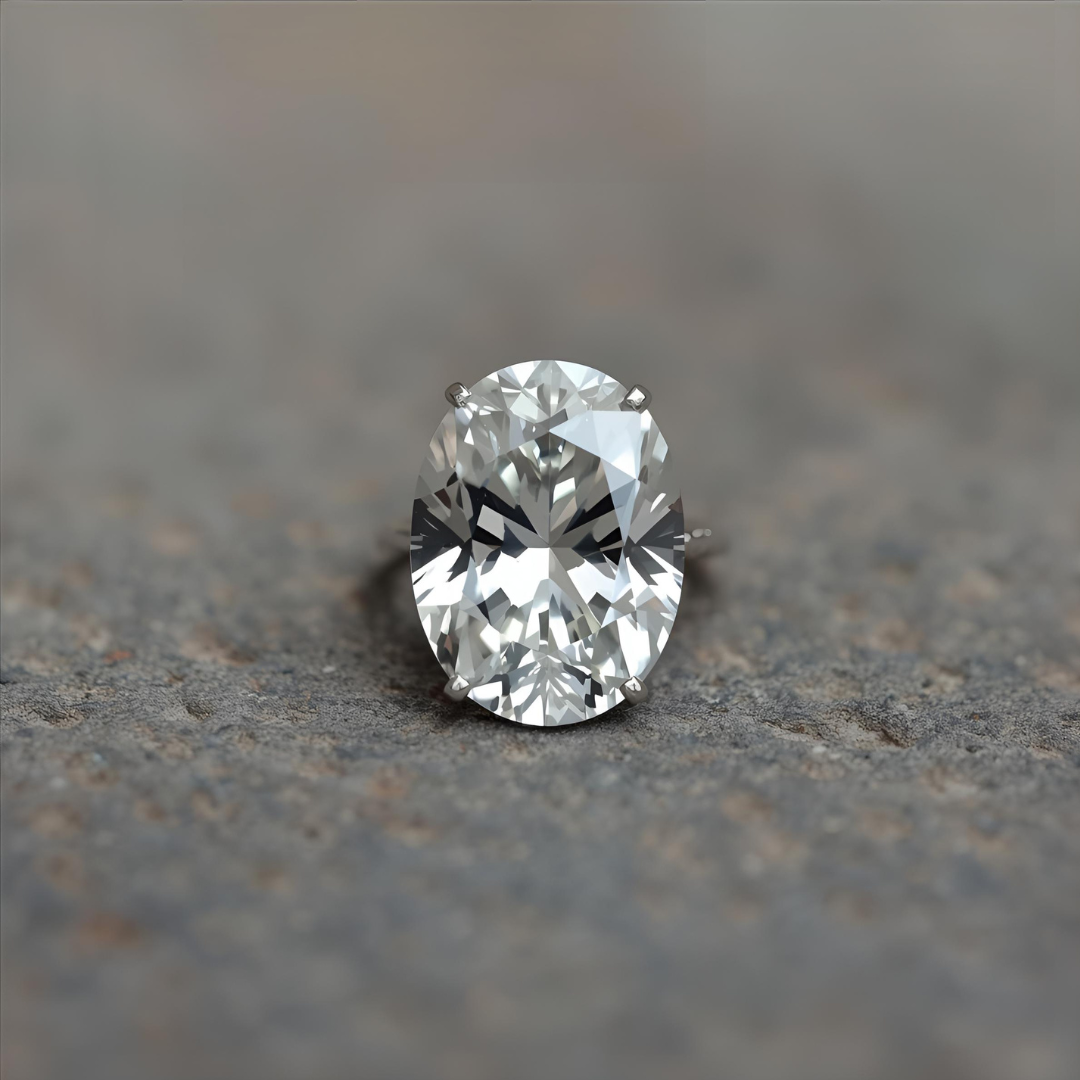
Oval Cut Diamond Guide: Price, vs Round, vs Radiant, and Buying Tips
An Oval Cut is a brilliant-cut gemstone (most commonly a diamond) that has an elongated, elliptical shape. Think of it as a rounded rectangle or a stretched-out circle.
“In 1957, a Russian-born diamond cutter named Lazare Kaplan sat at his workbench in New York City. He had a piece of rough diamond that was too flat for a round brilliant, too long for a cushion. So he did what innovators do: he invented a new shape. Kaplan‘s ‘oval brilliant cut‘ solved a problem cutters had faced for centuries—how to maximize brilliance in an elongated stone without losing sparkle. Today, his design is the second most popular diamond shape in the world. Kaplan didn‘t just cut a diamond. He proved that a diamond doesn‘t have to be round to be brilliant.”
The same shape that Lazare Kaplan invented in 1957 now elongates your finger and your budget. Every oval diamond in our collection is hand-selected for minimal bow-tie and excellent symmetry—because an oval should sparkle, not shadow.”
[Button: Explore Oval Cut Diamonds →]
It's famous for combining the classic sparkle of the most popular shape (the round brilliant) with a unique and flattering elongated form.
Table of Contents
- What Does The Oval Cut Mean?
- Are Oval Cut Diamonds More Expensive?
- Is Round Cut Or Oval Cut Better?
- Is Oval Or Radiant Cut Better?
- Why Are Oval Cuts So Popular?
- What Is The Best Size For An Oval Cut?
- Is An Oval A Good Diamond Cut?
- Is Oval Cut Timeless?
- How To Decide Between the Pear or Oval Cut?
- How Decide Between Oval And Emerald?
Here we talk about the first topic.
What Does The Oval Cut Mean?
In the simplest terms, an oval cut is a brilliant-cut gemstone (most famously a diamond) shaped like an ellipse, similar to a rounded rectangle.
However, it's much more than just a shape. Here’s a detailed breakdown of what the "oval cut" means, including its characteristics, history, and advantages.
Key Characteristics of an Oval Cut:
Shape: It's an elongated circle, blending the classic beauty of a round cut with a unique, elongated shape.
Faceting Pattern: It uses a brilliant-style faceting pattern. This means it has 58 facets (including the culet), just like a modern Round Brilliant Cut. This specific arrangement is designed to maximize light return, creating exceptional sparkle, fire, and brilliance.
Length-to-Width Ratio: This is a crucial aspect of an oval's appearance. It describes how elongated the stone is.
A ratio of 1.35 to 1.50 is considered "classic" and is the most popular, offering a balanced elongation.
A lower ratio (closer to 1.20) will look more like a rounded, "chubby" oval.
A higher ratio (1.60 and above) will appear very long and narrow, sometimes called a "marquise-style" oval.
The choice is purely personal preference.
Advantages of Choosing an Oval Cut:
Illusion of Size: This is one of its biggest selling points. Because of its larger surface area (the "table"), an oval cut diamond will look larger face-up than a round brilliant of the same carat weight.
Elongating Effect on Fingers: The elongated shape creates a flattering, slimming effect on the fingers, making hands appear longer and more elegant.
Brilliance and Sparkle: Thanks to its brilliant faceting, it possesses a sparkle very close to that of a round brilliant, which is the benchmark for brilliance.
Modern yet Timeless: It offers a unique and modern alternative to the round brilliant while still maintaining a classic, timeless feel.
Hides Some Inclusions Well: The elongated shape and complex facet pattern can help conceal minor imperfections (inclusions) better than a step-cut shape like an emerald or Asscher cut.
History and Origin
While elongated diamond shapes have existed for centuries, the modern oval brilliant cut we know today was created in the late 1950s and early 1960s by a Russian diamond cutter named Lazare Kaplan. He is renowned for his ability to cut stones to maximize their beauty and was a pioneer in transforming irregularly shaped rough diamonds into stunning gemstones. His design perfected the facet arrangement to minimize the "bow-tie" effect common in elongated cuts.
Important Considerations When Buying an Oval Cut:
The Bow-Tie Effect: This is a dark, bow-tie-shaped shadow that can appear across the center of many fancy shapes, brilliant cuts, including ovals. It's caused by light leakage due to the stone's proportions and facet angles.
Almost all ovals have some degree of a bow-tie. The key is to find one where the effect is minimal to faint and not a prominent, dark, distracting black band. Always examine the stone in person or via high-quality videos.
Symmetry: The oval should be perfectly symmetrical. Both ends (the "shoulders") should be evenly rounded, and the two halves of the stone should be mirror images of each other.
Color: The color in an oval cut can sometimes be concentrated at the ends (the tips). Because of this, some people can go slightly lower on the color grade (e.g., choose a G or H color) without the stone facing up with a visible yellow tint, especially if it's set in yellow or rose gold.
Proportions and Girdle: As with any diamond, the overall proportions (table %, depth %) are critical for optimal light performance. A girdle that is too thin can make the stone prone to chipping, while one that is too thick can add unnecessary weight (carats) where you don't see it.
The oval cut is a brilliant, elegant, and practical choice for an engagement ring or other fine jewelry. It combines the timeless sparkle of a round diamond with a unique, flattering shape that often appears larger for its carat weight. When chosen carefully—paying close attention to the bow-tie effect, symmetry, and proportions—it results in a stunning and captivating gemstone.
Are Oval Cut Diamonds More Expensive?
Here’s the straightforward answer, followed by the important details:
No, oval-cut diamonds are generally not more expensive than round brilliant diamonds. In fact, they are typically 20-30% less expensive per carat than round diamonds of similar quality.
However, they can be more expensive than other fancy shapes (like cushions or princess cuts). Let's break down the "why" behind this.
The Price Comparison:
This is the most common comparison, and the round brilliant is the benchmark.
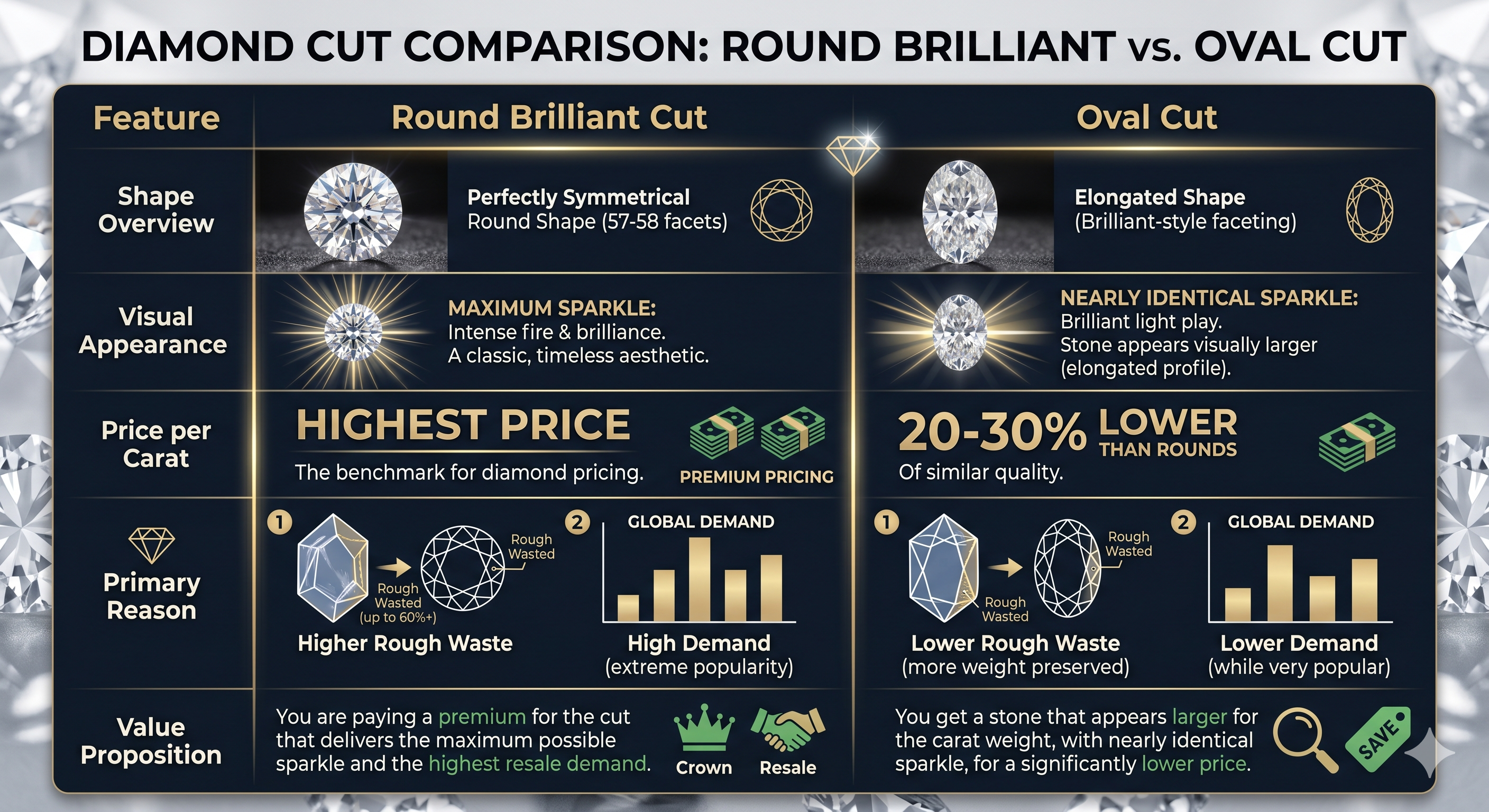
If you are choosing between a round and an oval of the same carat weight and quality (Color, Clarity), the oval will almost always be the more budget-friendly option.
Why Are Ovals Priced the Way They Are?
Several factors influence the final price of an oval diamond:
Demand and Popularity:
Ovals are the second most popular choice for engagement rings after rounds. This high demand keeps their prices stable and stronger than other fancy shapes, but they haven't surpassed the round's premium.
Cut Quality and the "Bow-Tie Effect":
This is a major factor. A well-cut oval with minimal or no visible "bow-tie" (the dark shadow across the center) will command a higher price. Cutters spend more time and skill to achieve this, and these premium stones are rarer. A poorly cut oval with a severe bow-tie will be significantly cheaper.
Carat Weight and Shape:
The elongated shape means an oval will look larger than a round of the same carat weight. This perceived size is a huge part of their appeal. However, as with all diamonds, prices jump at "magic" carat weights (e.g., 1.0 ct, 1.5 ct, 2.0 ct).
Color and Clarity:
Color: Because color can sometimes be concentrated at the tips of the oval, you can often go slightly lower on the color grade (e.g., G or H) without seeing a yellow tint, especially in a yellow gold setting. This can save money.
Clarity: The many facets of the brilliant cut help hide inclusions, so you can often choose a lower clarity grade (e.g., VS1, VS2, or even a clean SI1) without visible flaws. This also reduces cost.
Oval vs. Other Fancy Shapes
Compared to Cushion, Princess, or Emerald Cuts, Ovals are often similarly priced or slightly more expensive due to their current high popularity. A premium is placed on a well-executed oval cut.
Compared to Pear or Marquise: These are generally in a similar price range, with the final cost depending more on the individual stone's cut quality and characteristics.
Are oval-cut diamonds more expensive? Not compared to rounds. They offer a fantastic opportunity to get a larger-looking, brilliantly sparkling diamond for a better price per carat.
Are they "cheap"? Absolutely not. They are still precious diamonds. You are paying for a highly desirable, beautiful, and skillfully cut gemstone. Their pricing represents a very compelling value in the diamond market, which is a key reason for their surge in popularity.
For current diamond market prices, visit the American Gem Society's price guide.
Is Round Cut Or Oval Cut Better?
That's the million-dollar question, and the honest answer is: there is no objectively "better" cut. The choice between a round cut and an oval cut is entirely subjective and depends on your personal priorities for style, budget, and finger appearance.
To help you decide, here is a direct comparison of their key differences.
Round Brilliant vs. Oval Cut: Head-to-Head
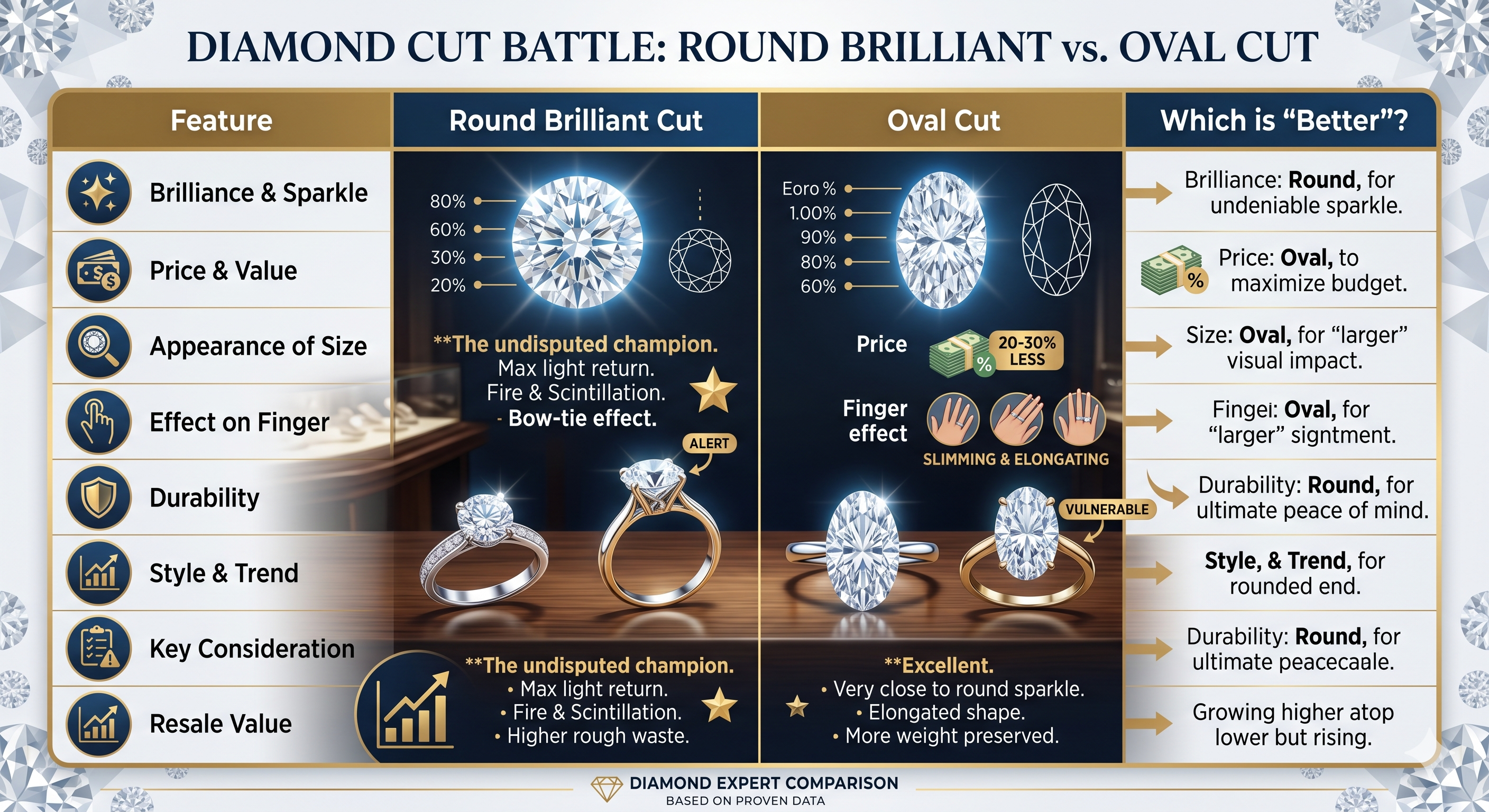
How to Choose: Which is Better FOR YOU?
Ask yourself these questions:
Choose a Round Brilliant Cut if:
Sparkle is your #1 priority. You want the absolute maximum brilliance science can create.
You are a traditionalist and love the classic, timeless look.
You want the easiest buying experience with clear-cut grades (Excellent, Very Good, etc.).
You prioritize durability and want the most robust shape.
Resale value is an important consideration for you.
Choose an Oval Cut if:
You want the best value for your money. You'd rather have a larger-looking stone or save 20-30% on the same budget.
You want a unique yet timeless style that stands out from the crowd.
You love how the elongated shape looks on your hand and want a flattering, finger-lengthening effect.
You are willing to inspect stones carefully (in person or via video) to find one with a minimal bow-tie effect.
Round Cut is the king of sparkle, tradition, and resale value. You pay a premium for this top-tier performance.
Oval Cut is the queen of value, elegance, and modern style. It offers incredible beauty and a larger appearance for a more accessible price.
If possible, try on both shapes! Your personal reaction to how each looks on your hand will be the most important deciding factor. Both are breathtakingly beautiful choices—it just comes down to what you value most.
Is Oval Or Radiant Cut Better?
Choosing between an Oval and a Radiant cut depends on your priorities—sparkle, finger shape, budget, and style. Both are elongated shapes that create a slimming effect on the finger, but they have distinct differences.
Here’s a direct comparison to help you decide.

Detailed Breakdown
1. Sparkle & Brilliance
Oval: Produces a similar sparkle to a Round Brilliant (the sparkliest shape). It has distinct, bold flashes of light (fire) and white light (brilliance). However, ovals are prone to a "bow-tie" effect—dark shadows across the center. A well-cut oval minimizes this.
Radiant: Produces a "crushed ice" sparkle—millions of tiny, glittery facets. It's very forgiving (hides inclusions well) but can appear milky or cloudy in some cuts. It doesn't have the same bold fire as an oval but offers a unique, modern sparkle.
2. Finger Coverage
Both make fingers look longer and slimmer due to their elongated shape.
Winner: Tie. But an oval often looks slightly larger per carat because of its more open facet pattern.
3. Durability (for daily wear)
Oval: Less durable. The pointed ends (tips) are vulnerable to chipping if knocked hard. Requires protective settings (e.g., bezel, V-prongs).
Radiant: More durable. The cropped corners are less prone to chipping than the sharp tips of an oval. Better for an active lifestyle.
4. Hiding Imperfections
Radiant wins here. Its crushed-ice facet pattern scatters light and effectively hides inclusions (spots, feathers) and color (looks whiter even at lower color grades like J-K).
Oval shows inclusions more easily, especially in the center. You typically need a higher clarity grade (VS2 or better) for an oval.
5. Cost (for comparable carat size)
Oval: Generally less expensive than Radiant because demand is slightly lower than Round, and more rough diamonds are retained.
Radiant: Can be slightly more expensive due to higher labor costs for cutting all those facets, but still much cheaper than a Round.
6. Setting Style
Oval: Looks stunning in solitaire, halo, or three-stone settings. Often paired with a pavé band for extra sparkle.
Radiant: Shines in halo settings (especially with a hidden halo) or as a solitaire with double prongs. Popular in east-west settings.
Which One Is Better For You?
Choose Oval Cut if:
You want a soft, romantic, classic look.
You love the sparkle of a Round but want something more unique.
You want the largest possible face-up size for your budget.
You don't mind checking for a minimal bow-tie effect.
You prefer a vintage or delicate aesthetic.
Choose Radiant Cut if:
You love modern, geometric, bold designs.
You prefer "crushed ice" sparkle over bold flashes.
You want a more durable diamond for daily wear (e.g., engagement ring for an active job).
You want to maximize color and clarity (a J-color radiant looks like an H-color oval).
You like step-cut style (like Emerald) but want more fire.
Why Are Oval Cuts So Popular?
The surge in popularity of oval-cut diamonds, especially for engagement rings, is no accident. It's driven by a powerful combination of visual appeal, smart value, and modern trends.
“In 2018, Hailey Bieber stepped out with a massive oval diamond on her finger—estimated between 6 and 12 carats. Within weeks, searches for ‘oval engagement ring‘ tripled. But the oval‘s popularity didn‘t start with Hailey. In 1970, Princess Margaret wore an oval diamond engagement ring. In 1990, Elizabeth Taylor owned an oval diamond brooch. In 2010, Blake Lively‘s oval diamond ring set another wave of trends. The oval has never been out of style. It just waits quietly, generation after generation, for someone to rediscover what Lazare Kaplan knew in 1957: that a circle stretched just a little becomes something even more beautiful.”
Here’s a breakdown of the key reasons why oval cuts are so popular:
1. The Illusion of Size: "Bigger Look" for Your Budget
This is arguably the biggest driver. Due to its elongated shape and larger surface area (the "table"), an oval diamond appears significantly larger face-up than a round brilliant of the same carat weight. For budget-conscious couples, this means you can either get a much larger-looking stone for your money or choose a lighter carat weight and save significantly.
2. The Flattering, Elongating Effect
The oval shape is universally flattering on the hand. Its length creates a visual effect of elongating and slimming the finger, making hands look more elegant. This psychological "perk" is a major selling point that other shapes, like round or cushion, don't offer in the same way.
3. A Perfect Blend of Classic & Unique
For years, the round brilliant was the default choice. Many people today want something that feels more personal and distinctive without being overly unconventional. The oval cut strikes this balance perfectly:
Classic: It has the timeless brilliance and sparkle of a round cut, thanks to its similar faceting pattern.
Unique: It stands out from the crowd. It says the wearer has an eye for style that is elegant yet not mainstream.
4. Brilliant Sparkle (Close to a Round)
While the round brilliant is engineered for maximum sparkle, the oval cut comes incredibly close. Its brilliant-style faceting (typically 58 facets) means it offers exceptional fire, brilliance, and scintillation. People don't have to sacrifice the classic diamond sparkle they love to get a more unique shape.
5. Celebrity and Social Media Influence
When high-profile celebrities like Hailey Bieber (rhodium-covered oval), Blake Lively, and Kate Middleton choose oval diamond engagement rings, it creates a massive trend. These "style icons" make the cut aspirational. Furthermore, platforms like Instagram and Pinterest are flooded with images of oval rings, continuously reinforcing their desirability and modern aesthetic.
6. Versatility in Setting Styles
Oval diamonds are incredibly versatile and look stunning in a wide variety of settings:
Solitaire: Let the unique shape take center stage.
With side stones: Looks beautiful with trapezoid, pear, or round side stones.
Three-stone settings: the past, present, and future.
East-West setting: A trendy, modern orientation where the oval is set horizontally.
Halo setting: A halo of smaller diamonds can enhance the perceived size and brilliance even further.
7. Better Value Than Round Brilliant
As discussed in a previous question, oval diamonds are typically 20-30% less expensive per carat than round brilliants of similar quality. This better value proposition makes a high-quality, larger-looking diamond more accessible, which is a huge draw.
The One Caveat: The "Bow-Tie Effect"
It's important to note that almost all oval cuts have some degree of a "bow-tie effect"—a dark, bow-tie-shaped shadow across the center caused by light leakage. However, a well-cut oval will have a minimal or faint bow-tie. The popularity of ovals has led to cutters becoming more skilled at minimizing this effect, and consumers have become more educated about what to look for.
The oval cut's popularity isn't due to one single factor, but a "perfect storm" of benefits: it looks larger and more flattering on the hand, offers brilliant sparkle, feels both classic and unique, is promoted by influencers, and provides excellent value for money. It’s a shape that truly caters to modern desires.
What Is The Best Size For An Oval Cut?
Excellent question! However, the "best" size for an oval cut is highly personal and depends on your finger, your budget, your style preferences, and your lifestyle.
There isn't a single "best" size, but we can identify the most popular and satisfying sizes and give you a framework to choose the best one for you.
The Most Popular & "Sweet Spot" Sizes
Based on market trends and customer satisfaction, the most sought-after sizes for oval diamonds are in the 1.50 to 2.50-carat range. Here’s a breakdown of what you can expect in terms of visual impact:
1.00 - 1.50 Carats: A classic and elegant choice. This size range is noticeable, sophisticated, and works beautifully on small to average-sized fingers (ring sizes 4-6.5). It's a great balance between presence and budget.
1.50 - 2.00 Carats: This is the current "sweet spot." It offers a substantial and luxurious look that truly showcases the oval's elongated shape. It appears large without being overwhelming for everyday wear for most people.
2.00 - 3.00+ Carats: This is a statement-making size. It offers a bold, luxurious, and undeniable presence on the hand. At this size, the quality of the cut becomes even more critical to avoid a strong bow-tie effect.
How to Choose the Best Size FOR YOU: 3 Key Factors
To find your perfect size, consider these three elements together:
1. Your Finger Size and Shape (The Most Important Factor)
The same carat weight will look very different on a size 4 finger versus a size 8 finger. The goal is to achieve beautiful "finger coverage."
Smaller Fingers (Size 4-5): A 1.0-1.5 carat oval will look proportionally large and dramatic.
Average Fingers (Size 6-7): The 1.5-2.5 carat range is ideal for achieving a balanced, substantial look.
Larger Fingers (Size 8+): YoConsiderove to achieve significant finger coverage. A smaller stone might look disproportionate.
Pro Tip: Don't just focus on carat weight. Look at the millimeter dimensions (length x width). A well-cut 1.5-carat oval might be 10x7mm, while another could be 9x6mm. The 10x7mm will look much larger.
2. Your Budget
Remember the oval's great value: you can often afford a larger carat size than you could with a round brilliant.
Set a realistic budget for the entire ring (setting + diamond).
Be prepared to make trade-offs. A larger carat size might mean selecting a slightly lower color (G-H instead of D-F) or clarity (VS2-SI1 instead of VVS) to stay on budget, which is often a smart compromise with ovals.
3. Your Lifestyle and Personal Style
Active or Hands-On Lifestyle: If you work with your hands, work out frequently, or are generally active, a very large stone (e.g., 3+ carats) might feel impractical or get caught on things. A moderate size (1.0-2.0 carats) in a secure, lower-profile setting might be better.
Style Preference: Do you prefer "understated elegance" or "bold glamour"? Let your personal style guide you.
Understated Elegance: 1.0 - 1.8 carats
Bold Glamour: 2.0+ carats
A Quick Reference Guide: Carat Weight to Millimeter Size
This table gives you a rough idea of what to expect. Note: These are approximate dimensions and will vary based on the individual cut.
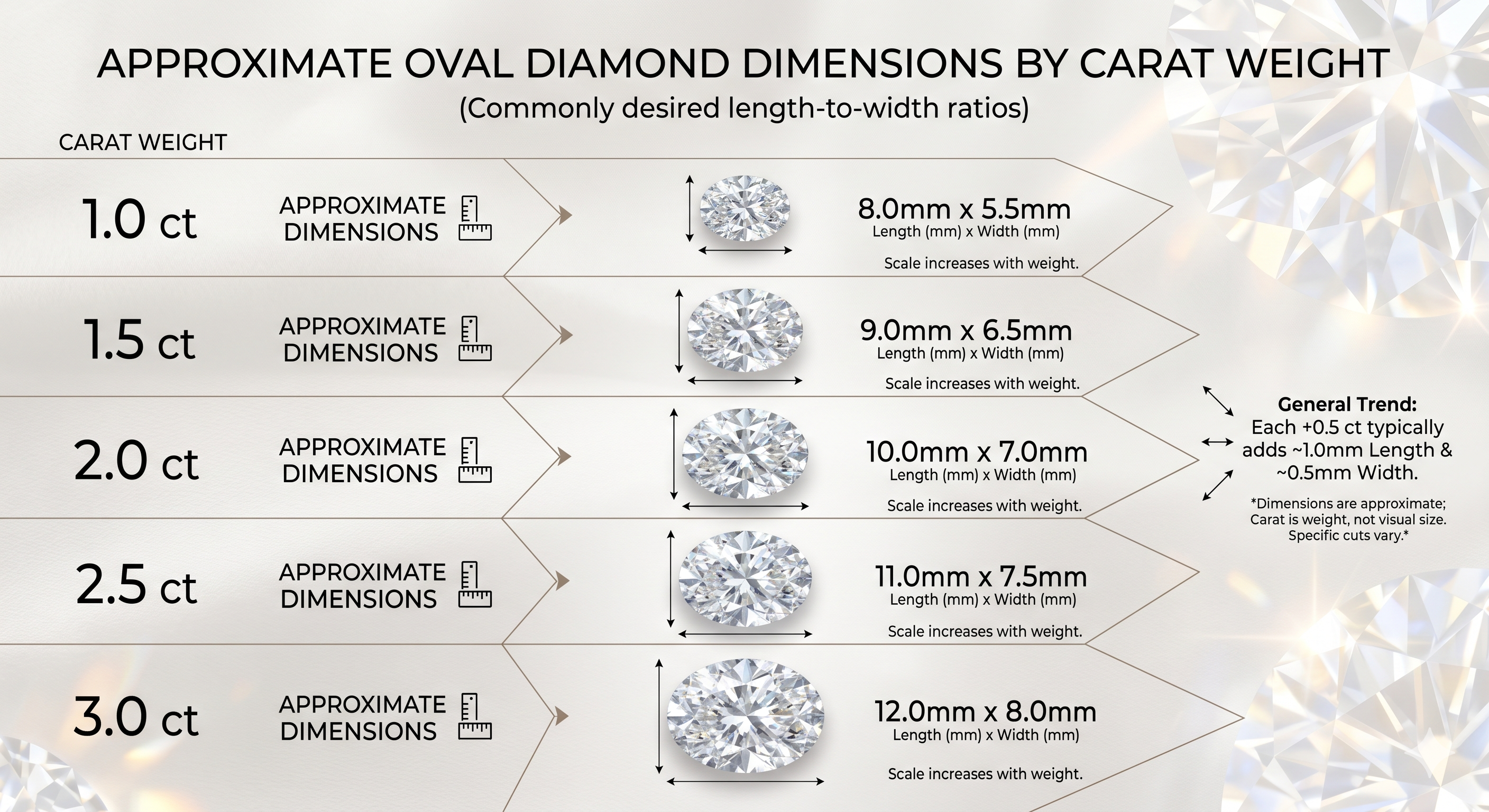
Final Recommendation and Pro Tip
There is no single "best" size, but the 1.5 to 2.0-carat range is widely considered the ideal balance of impressive size, beautiful proportion, and value for the average buyer.
The #1 Best Way to Decide:
Try them on! This is the most crucial step.
Go to a jeweler and try on different sizes on your actual finger.
If that's not possible, use online "ring sizers" or even cut out paper templates in the millimeter dimensions listed above and tape them to your finger.
Seeing the size on your own hand is the only way to know what truly feels and looks right for you. Your perfect size is the one that makes you smile every time you look at it.
Is An Oval A Good Diamond Cut?
Yes, absolutely. An oval cut is not just a good diamond cut; for the right person, it can be a fantastic and brilliant choice.
However, whether it's the best cut for you depends on what you prioritize. Here’s a balanced look at why ovals are highly regarded, along with a few considerations.
The "Good": Why Oval Cuts Are an Excellent Choice
Exceptional Brilliance and Sparkle: The oval cut uses a brilliant-style faceting pattern (typically 58 facets), just like a round brilliant. This means it is engineered to reflect a tremendous amount of light, resulting in incredible sparkle, fire, and brilliance. It is second only to the round brilliant in its ability to dazzle.
Illusion of Larger Size: This is one of its biggest advantages. Due to its elongated shape and larger surface area (the "table"), an oval diamond appears larger face-up than a round brilliant of the same carat weight. This gives you more visual impact for your budget.
Flattering and Elongating Effect: The oval shape is universally flattering on the hand. Its length creates an elegant, slimming effect, making fingers appear longer and more slender.
Modern yet Timeless Style: It offers a unique and fashionable alternative to the very common round brilliant, while still maintaining a classic, timeless feel. It’s distinctive without being overly unconventional.
Great Value: Oval diamonds are typically 20-30% less expensive per carat than round brilliants of comparable quality. This allows you to either get a larger stone or a higher quality stone for the same budget.
The Considerations: What to Watch For
To ensure you get a "good" oval, you need to be an informed buyer. A poorly cut oval is not a good choice.
The Bow-Tie Effect: This is the most critical factor. It's a dark, bow-tie-shaped shadow that appears across the center of many fancy-shaped diamonds, including ovals, caused by light leakage.
Almost all ovals have some degree of a bow-tie. A well-cut oval will have a minimal or faint one. A severe, dark bow-tie is a sign of poor cut and should be avoided. Always view the stone in person or via high-quality videos.
Cut Quality is Less Standardized: Unlike round brilliants, which have strict "Cut Grade" certifications (e.g., Excellent, Very Good), the cut grading for ovals is not as standardized. This puts more responsibility on you to visually assess the stone's performance.
Durability at the Ends: While diamonds are very hard, the pointed ends (especially if cut very thin) can be more vulnerable to chipping compared to the robust round brilliant. A well-made setting (like a V-prong) can protect the ends.
Symmetry is Key: A quality oval must be symmetrical. Both shoulders (the curved ends) should be evenly rounded, and the two halves should be mirror images of each other.
The Verdict: Who is an Oval Cut "Good" For?
An oval cut is an EXCELLENT choice if you:
Want the sparkle of a round brilliant but desire a more unique shape.
You are looking for the best value and want a larger-looking diamond for your budget.
Love how the elongated shape flatters your finger.
Appreciate a style that is both modern and timeless.
Are you willing to spend a little extra time inspecting stones to find one with a minimal bow-tie and great symmetry?
An oval is a brilliant, beautiful, and smart diamond cut. It combines the best of the round brilliant's sparkle with a unique, flattering shape and better value. As long as you carefully select a well-cut stone to minimize the bow-tie effect, an oval diamond is not just "good"—it's a truly stunning and rewarding choice.
Is Oval Cut Timeless?
That's a fantastic and crucial question. The answer isn't a simple yes or no, but a nuanced "Yes, but with an important distinction."
Here’s a detailed breakdown to understand the "timelessness" of the oval cut.
The Case FOR Oval Being Timeless
It's a Classic Shape, Not a Fad: The oval shape itself is not new. It has existed for centuries, with its modern, brilliant-cut version perfected in the 1960s. Unlike some shapes that come and go with dramatic trend cycles (like the ultra-geometric "Asscher" in the Art Deco era or the "Heart" shape), the oval has maintained a consistent, low-level presence for decades. It has a historical precedent.
It's Rooted in a Timeless Cut: The faceting pattern of a modern oval is based on the Round Brilliant cut, which is the undisputed, most timeless diamond shape of all. It borrows its sparkle and fire from this classic, meaning its fundamental appeal is based on a timeless principle: maximum brilliance.
It has "Quiet" Periods, not "Out" Periods: A truly timeless shape remains relevant and never falls completely out of favor. The oval has never truly been "out." Instead, it has experienced periods of being a "quiet classic" and periods of being a "trending classic," like it is now. Its current popularity is a surge, not an invention.
The Case for Oval Being a "Modern Classic"
This is the important distinction. While it has timeless qualities, many experts categorize it as a "Modern Classic."
The Round Brilliant is the Benchmark for Timeless: When people say "timeless" in the diamond world, they are almost always picturing the round brilliant. It has been the consistent, number-one choice for over a century with no significant dips in popularity. It is the safe, forever-choice.
Ovals Have Trend Cycles: The oval's popularity is undeniably cyclical. It experienced a peak in the 60s-70s, faded a bit, and has now exploded in popularity again in the last 5-10 years. Its current ultra-popular status means that, in the future, a ring from this era might be identified as "from the 2020s," much like a pear-shaped diamond can signal the 1980s.
The Bottom Line: Is an Oval Cut a Timeless Choice for You?
Yes, an oval cut is a timeless enough choice for the following reasons:
Its beauty is based on the classic principles of light performance and an elegant, soft shape.
It will never look garish or strange. Its proportions are inherently balanced and pleasing to the eye.
It offers a flattering, elongated silhouette that has universal and enduring appeal.
However, it carries a slight whisper of the era in which it was purchased, much like a halo setting does today. This isn't a bad thing—it gives the ring a story.
Final Verdict:
Think of it this way:
The Round Brilliant is like a little black dress. It is the ultimate, unchanging classic.
The Oval Cut is like a perfectly tailored trench coat. It is also a classic, but its specific details (like the size of the lapels or the hardware) can subtly place it in a certain decade, without ever making it look truly "out of fashion."
If you love the oval, you are choosing a shape with deep roots, enduring elegance, and fantastic sparkle. It may not be as eternally ubiquitous as the round, but it is a sophisticated and beautiful choice that will remain elegant for a lifetime.
How To Decide Between the Pear or Oval Cut?
Choosing between a pear and an oval cut diamond is about balancing a classic, soft shape with a more distinctive, symbolic one. Both are brilliant cuts that sparkle brightly but offer very different looks and feels.
Here is a detailed comparison to help you decide:
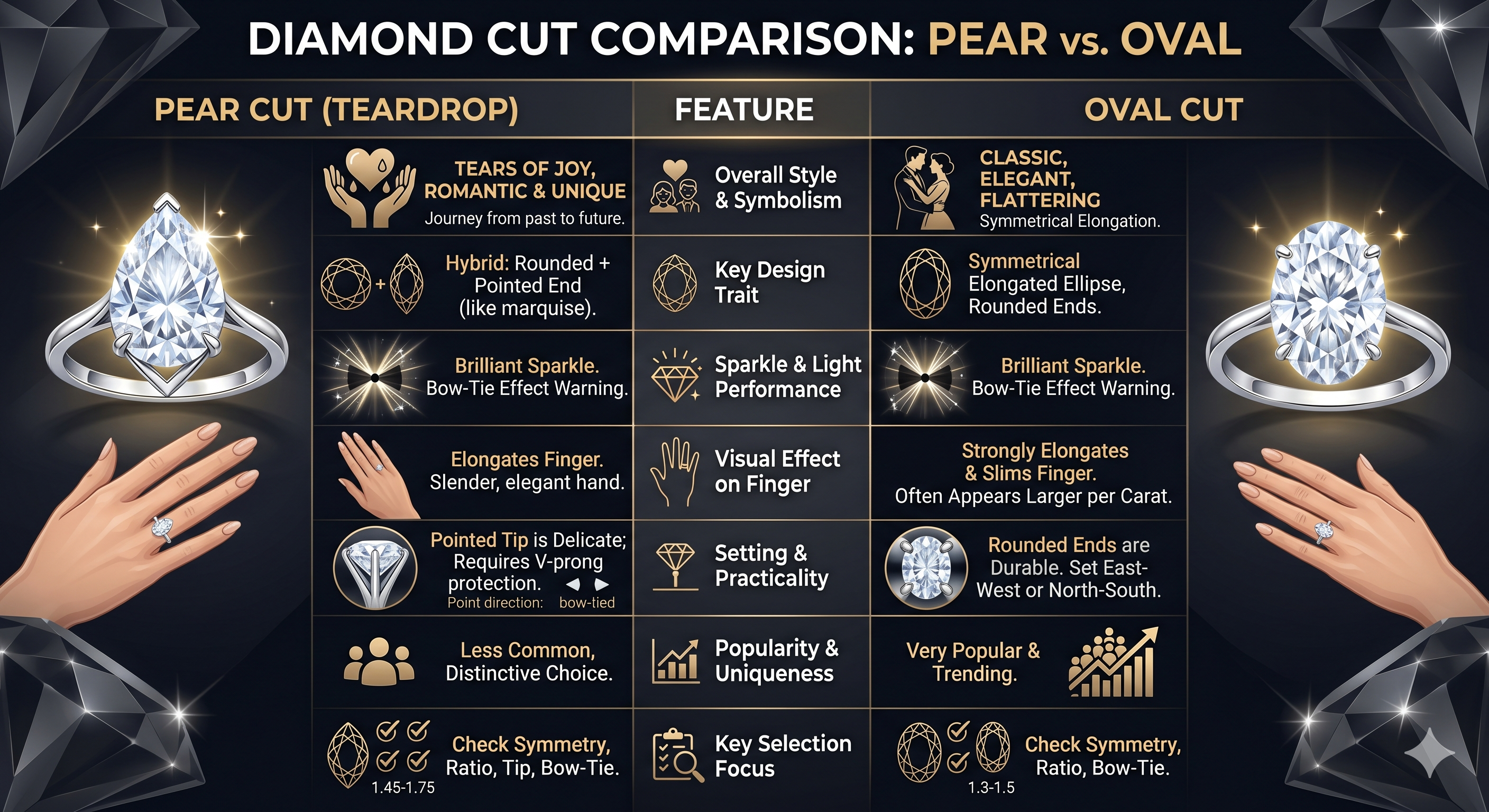
Aesthetic and Character Differences
The core difference is in the silhouette and feel:
Pear Cut is for those who love a story and symbolism. It's romantic, directional, and makes a distinctive statement. Choosing whether to wear the point towards or away from the hand is a personal style decision.
Oval Cut is for those who prefer timeless, balanced elegance. It's soft, symmetrical, and offers a brilliant, modern take on the classic round shape without being overly trendy.
Practical Considerations
Durability: The pointed tip of a pear cut is its vulnerability. A V-prong or bezel setting is highly recommended to protect it from chipping. The oval's rounded ends are less prone to damage.
Setting Style: Both shapes work beautifully in solitaire, halo, or three-stone settings. The pear's direction adds a layer of customization, while the oval offers flexibility in orientation.
Choosing the Stone: For both cuts, personal inspection is non-negotiable. You must look at the diamond in different lights to assess the severity of the bow-tie effect, which is not captured on a certificate. Symmetry is also critical for both shapes.
How to Make Your Decision
Visual Preference: Look at pictures and, most importantly, try both shapes on your hand. Which silhouette do you connect with more?
Lifestyle Fit: Do you prefer a low-maintenance shape (oval), or are you willing to ensure the setting protects a delicate point (pear)?
Symbolism vs. Classic: Does the unique symbolism and directionality of the pear appeal to you, or do you prefer the balanced, timeless nature of the oval?
Try with a Band: Visualize how each shape will look with a wedding band. Some find pairing a band with a pear cut requires more consideration.
Ultimately, your choice depends on whether you are drawn to the distinctive, storytelling nature of the Pear or the harmonious, classic elongation of the Oval.
If you have a preference for a certain carat size or budget, I can help explain how that might influence the appearance and options for each shape.
How Decide Between Oval And Emerald?
Choosing between an oval and an emerald cut comes down to a difference in style and light performance. Oval diamonds are brilliant, sparkly, and romantic, while emerald cuts are sleek, architectural, and sophisticated.
Here’s a side-by-side comparison of their key features:
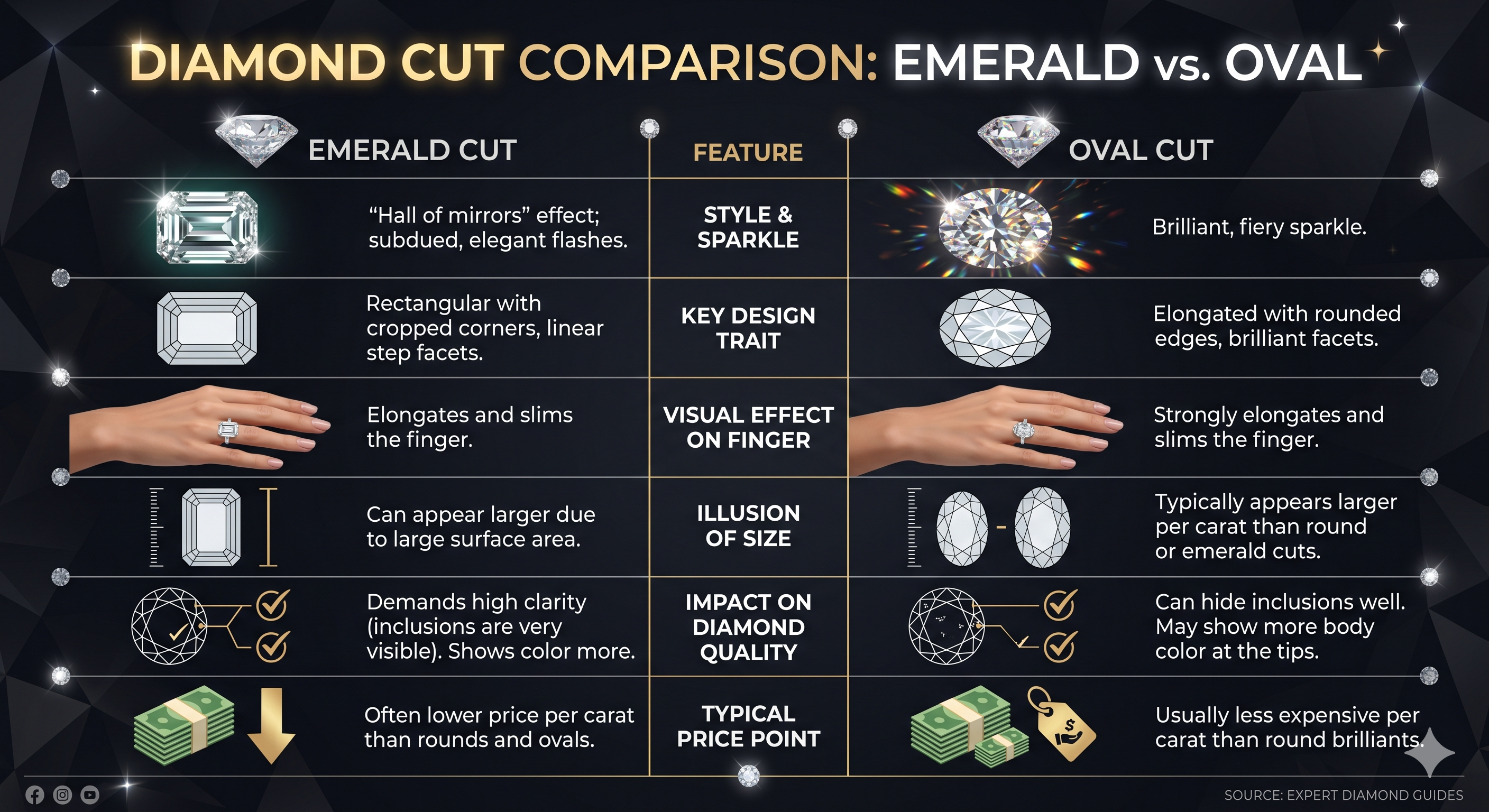
Aesthetic and Character
The most significant difference is in how they interact with light. An oval cut is designed for maximum sparkle and fire, offering a brilliant, eye-catching display similar to a round diamond. An emerald cut is a "step cut," creating a clean, hall-of-mirrors effect with broad, flashing planes of light, prioritizing elegance and clarity over intense sparkle.
Stylistically, emerald cuts are associated with Art Deco, vintage-inspired, or minimalist modern looks. Ovals lean toward romantic, soft, and glamorous styles.
Practical Considerations
Budget & Value: Emerald cuts can offer a lower price per carat. Ovals can make a diamond appear larger for its carat weight, offering value in perceived size.
Diamond Selection: For an emerald cut, prioritize high clarity (VS2 or better) and a good color grade (G or higher) as flaws and color are more visible. For an oval, assess the bowtie effect in person, as it varies widely and isn't graded on certificates.
Lifestyle & Setting: Both shapes elongate the finger. Emerald cuts have flat, snag-free corners, which can be practical. Ovals have rounded edges but delicate,e pointed ends that need protection in their setting. Popular settings for emerald cuts include solitaire, three-stone, or bezel. Ovals look stunning in halo, pavé, or vintage settings.
How to Decide
Define Your Priority: Is it fiery brilliance (Oval) or elegant, geometric clarity (Emerald)?
Consider Your Style: Are your aesthetics more modern/minimalist (Emerald) or romantic/glamorous (Oval)?
Try Them On: This is crucial. Seeing them on your hand is the best way to judge which shape you connect with and to evaluate the bowtie in ovals or the clarity in emeralds.
Consult an Expert: A trusted jeweler can show you a selection of both cuts, explain the nuances of quality, and help you find a stone with excellent proportions.
In summary, let your personal style be your guide: choose the Oval for brilliant sparkle and a romantic feel, or the Emerald for architectural elegance and sophisticated flash.
I hope this detailed comparison helps you feel more confident in your decision. Would you like me to elaborate on specific setting styles or diamond quality factors for either cut?
“You now know the origin, the price comparison, the round vs. oval debate, the popularity reasons, the size guide, the timelessness, and the pear/emerald comparisons. The only question left: will you choose the shape that stretches toward the future?
*Our current collection includes a limited number of GIA-certified oval diamonds — from delicate 0.8-carat stones to stunning 3-carat centerpieces. When stones with minimal bow-tie and ideal length-to-width ratios are gone, sourcing new ones takes time.*
This is not just a diamond. It is Lazare Kaplan‘s 1957 invention, Hailey Bieber‘s trend, and 70 years of proof that a diamond doesn‘t have to be round to be brilliant — it just has to be oval.”
[Button: Claim Your Oval Diamond (Limited) →]
Back to Complete Amethyst Stone Guide
Pear Cut Diamond Guide: Price, vs Round, Sparkle and Buying Tips
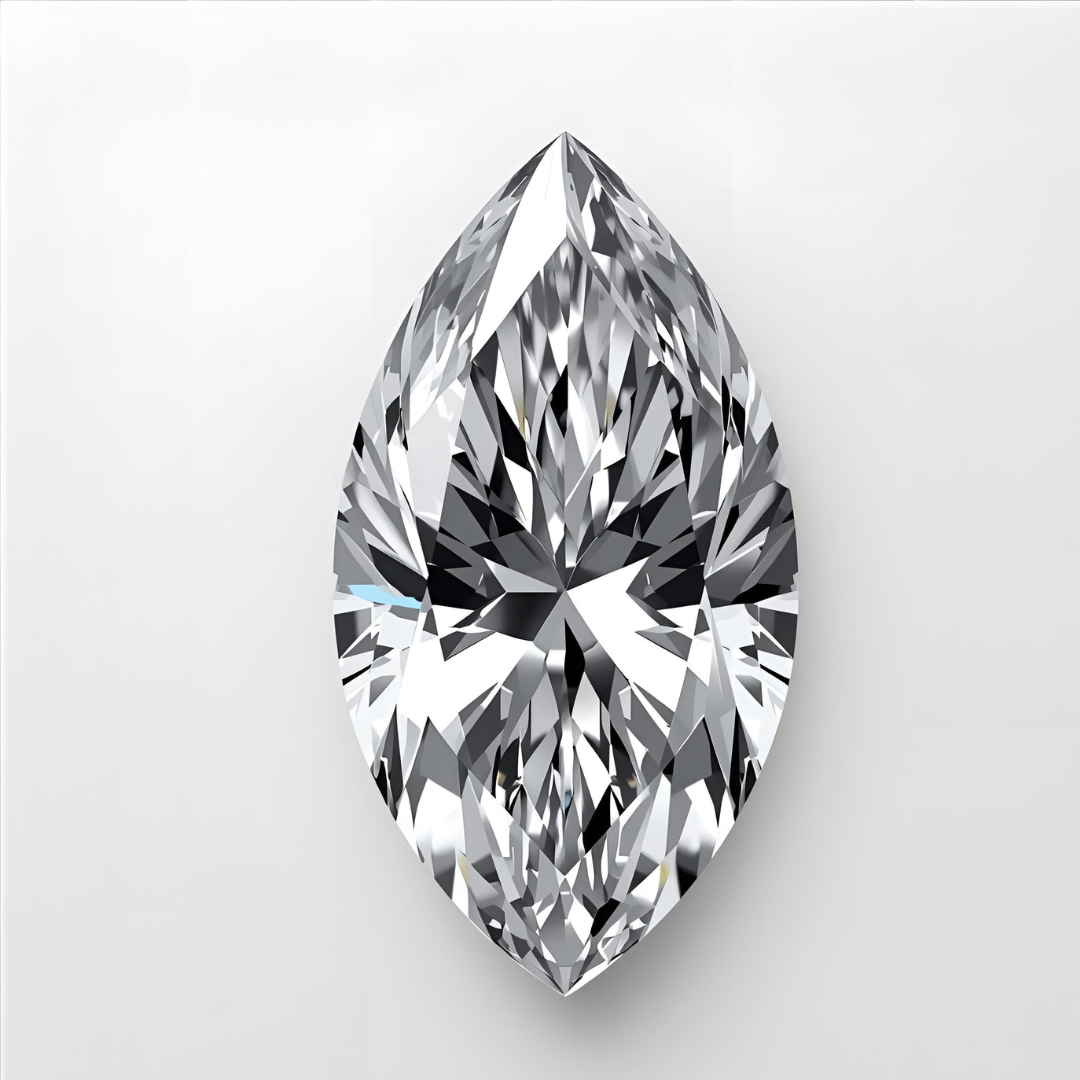
Pear Cut Diamond Guide: Price, vs Round, Sparkle and Buying Tips
“In the 15th century, a Flemish diamond polisher named Lodewyk van Bercken invented the diamond polishing wheel. With it, he could create shapes that were impossible before. His most beautiful creation was the ‘pendeloque‘—a teardrop that caught light like morning dew on a rose petal. For centuries, royalty wore pear-shaped diamonds as pendants and brooches. Then, in 1957, Richard Burton gave Elizabeth Taylor a 69-carat pear diamond. She called it her ‘best friend.‘ Today, when Ariana Grande and Sophie Turner choose pear cuts for their engagement rings, they are wearing 600 years of tear-shaped history—a diamond that is both a drop and a flame.”
The same teardrop that graced Elizabeth Taylor now awaits your own love story — point up for drama, point down for protection. Every pear-cut diamond in our collection is hand-selected for minimal bow-tie and perfect symmetry.”
[Button: Explore Pear Cut Diamonds →]
Here is a detailed explanation of the Pear Cut.
A Pear Cut, also known as a teardrop cut, is a popular fancy shape for gemstones, especially diamonds, that combines the elegance of a round cut with the edginess of a marquise cut.
Table of Contents
What is a Pear-Cut Diamond?
A pear-cut diamond is a brilliant-cut diamond shaped like a teardrop, combining the curves of a round diamond with the pointed end of a marquise. This shape is also sometimes called a teardrop shape.
Here is a summary of how a pear cut compares to the classic round brilliant:
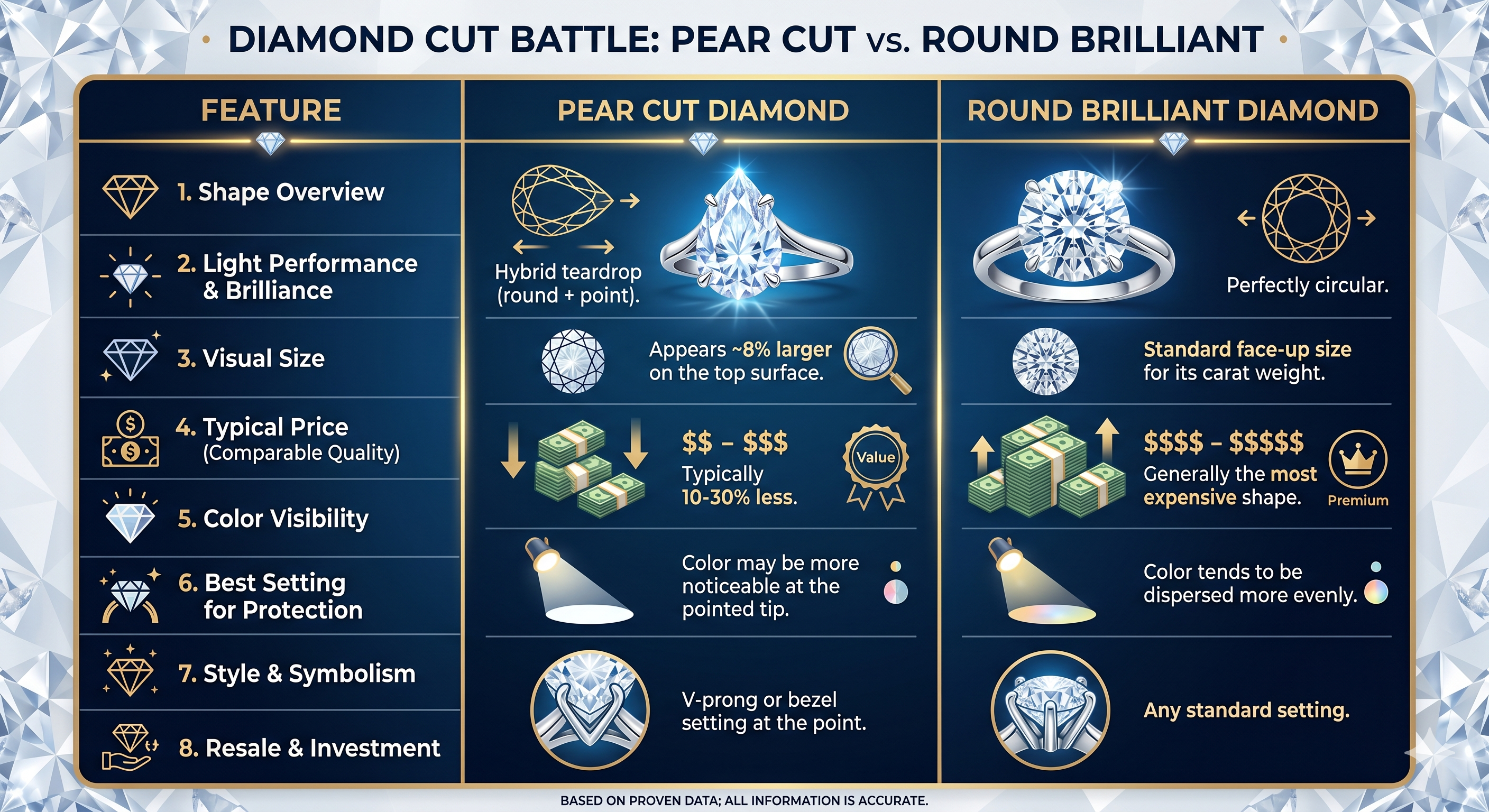
Key Characteristics of the Pear Cut
History and Popularity: The pear cut's design is credited to a Flemish polisher in the 15th century. Today, it's considered a classic yet fashionable choice, often seen in engagement rings.
The Cut and Symmetry: Unlike round diamonds, the pear cut has no single standardized set of proportions, meaning you can choose one that appeals to you personally. A well-executed cut with excellent symmetry is crucial. The two halves should be balanced, and the point should be sharp and centered.
The "Bow-Tie" Effect: A common characteristic in fancy-shaped diamonds, like the pea,r is a dark, bow-tie-shaped area across the middle. A slight bow-tie is normal, but a very prominent one can block light and reduce sparkle.
Why Choose Pear-Cut Diamond?
People are often drawn to the pear shape because:
Visual Impact: Its elongated shape can create a flattering, slimming effect on the finger.
Styling Versatility: The shape is unique, defined by both angles and curves, making it versatile for various ring styles. It can look vintage, modern, or timeless depending on the setting.
Value: You often get a larger-looking diamond for your budget compared to a round brilliant of the same carat weight
Tips for Choosing a Pear Cut
If you're considering a pear-cut diamond, keep these points in mind:
Check the Color: Because the point can concentrate color, many jewelers recommend choosing a higher color grade (D-F) for a colorless look, especially for larger stones.
Consider the Setting: The delicate point is prone to chipping. A V-prong or a bezel setting at the tip offers the best protection. The diamond can also be set with the point facing up or down, offering two distinct looks.
Focus on Personal Preference: Since proportions are not standardized, the "best" pear shape is subjective. Pay attention to the length-to-width ratio; a ratio of 1.50-1.75 is common, but you may prefer a shorter, plumper shape or a longer, more slender one.
Matching with Ring Styles and Wedding Bands
Pear diamonds are highly versatile:
Classic Solitaire: Allows the unique shape to stand alone.
Side Stones: Tapered baguettes or smaller pears can complement the shape.
Halo or Pave Settings: Add extra sparkle, nd can make the center stone appear even larger.
When choosing a wedding band, consider a curved or "V"-shaped band to fit snugly against the pear's tapered shape, or choose a simple band with a small gap.
In summary, the pear cut is a distinctive and elegant choice for those seeking a diamond with a blend of soft curves and a dramatic point. Its versatility in style and potential for excellent value make it a compelling option.
If you have a specific setting style in mind or a particular budget range, I can help you explore what to look for in more detail.
For official diamond cut grading information, visit the GIA Diamond Cut Guide.
Is Pear Cut More Expensive?
Generally, a pear cut is less expensive than a round brilliant cut of the same carat weight and quality. However, it's often more expensive than many other fancy shapes.
Let's break down the factors that determine the price of a pear-cut diamond or gemstone.
1. The Round Brilliant Premium (Why Rounds are Most Expensive)
The round brilliant cut is the king of the diamond market for a reason:
Highest Demand: It's the most popular shape by a huge margin, which drives up the price.
Maximum Waste: Cutting a rough diamond crystal into a round shape results in the most weight loss (up to 60% is lost). This wasted material is factored into the price.
Complex Faceting: It requires the most precise and complex facet pattern to achieve its legendary brilliance.
Because of this, you can often get a larger or higher-quality pear cut for the same price as a smaller or lower-quality round brilliant.
2. Factors That Make a Good Pear Cut Expensive
While pears are cheaper than rounds, a high-quality pear is still a premium stone. Here’s what to look for, as these factors increase its value:
Excellent Cut and Symmetry: This is the most important cost factor for pears. A poorly cut pear can look unbalanced and lifeless. A well-cut pear with perfect symmetry, a great light return, and no "bow-tie effect" (or a very minimal one) will command a much higher price. Achieving this symmetry is difficult and requires a highly skilled cutter.
Color (Especially for Diamonds): The pointed tip of a pear cut can concentrate color, making a lower-grade diamond (like K or L color) appear slightly yellowish at the tip. For this reason, it's often recommended to choose a near-colorless grade (G, H, I) or higher for a pear cut, which increases the cost.
Clarity: The large, open table (top surface) of the pear cut can make inclusions more visible, especially if they are located near the center. A stone with a higher clarity grade (VS1 or higher) that is "eye-clean" will be more expensive.
Length-to-Width Ratio: The "ideal" or most sought-after ratio (typically between 1.55 and 1.65) can sometimes carry a slight premium, though this is more about personal preference.
The Vulnerable Point: A pear cut with a clean, unchipped point is more valuable. Stones that have been chipped at the tip are significantly discounted.
3. How Pear Cut Compares to Other Fancy Shapes
More Expensive Than: Oval, Cushion, Asscher. This is often due to the higher difficulty in achieving the pear's symmetry and the fact that it's a less common shape than an oval or cushion.
Similar in Price To: Marquise, Heart. These are all more complex, symmetrical cuts with points that require skilled craftsmanship.
Less Expensive Than: Round Brilliant (as discussed above) and sometimes Emerald Cut. Emerald cuts can be more or less expensive depending on the clarity requirements, but they are generally in a similar price tier.
Summary Table: Price Comparison (General Guideline)
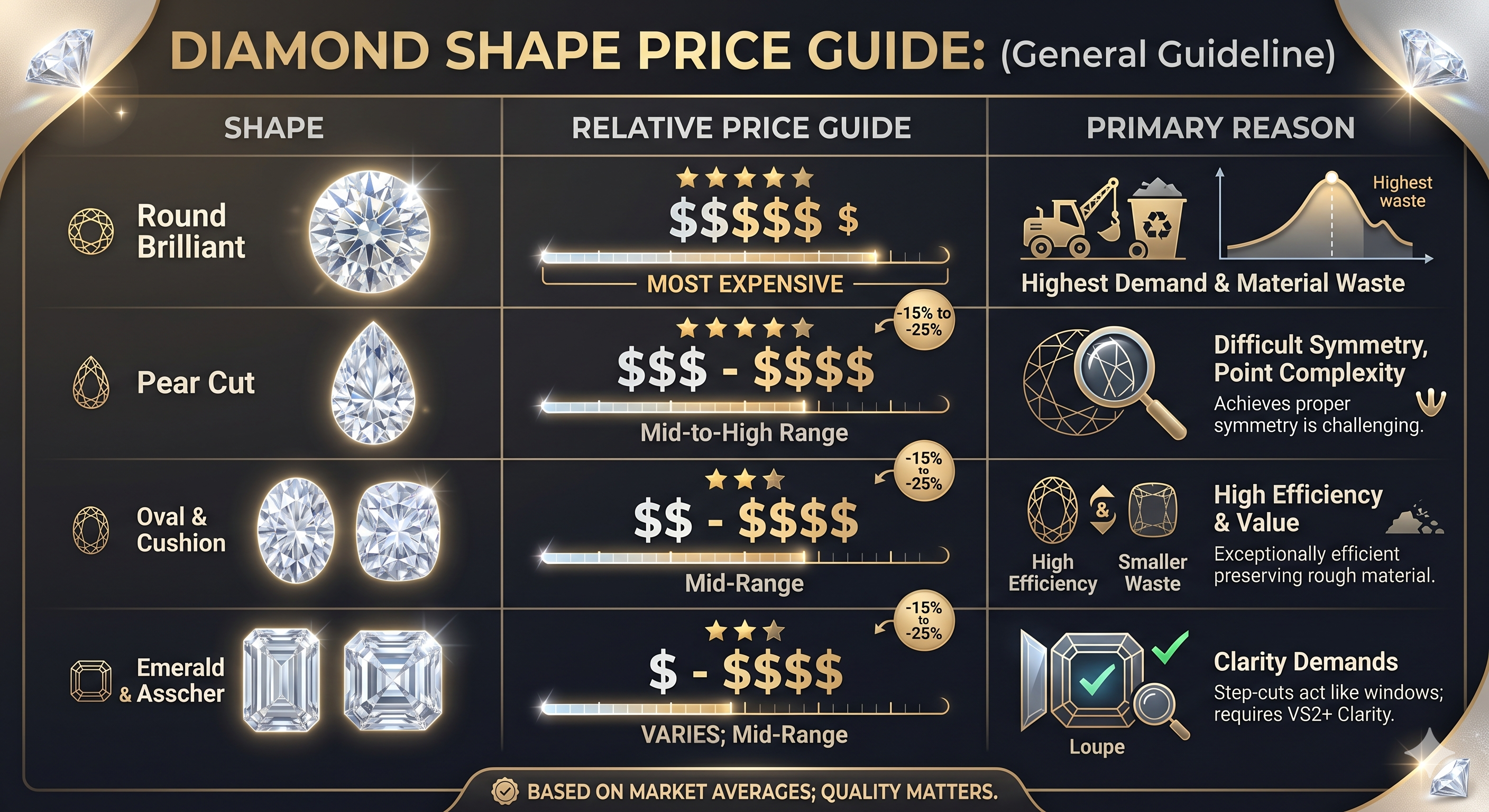
No, a pear cut is not more expensive than a round brilliant. In fact, it's one of the best ways to get a larger-looking stone for your budget.
However, don't assume all pear cuts are "cheap." A high-quality, well-proportioned pear cut from a reputable seller will still be a significant investment. The key is to prioritize an excellent cut and symmetry above all else when choosing a pear-shaped diamond.
Pro Tip: Because of the price advantage, you can often afford to go up in carat size or color/clarity grade with a pear cut compared to what you could get with a round brilliant for the same budget.
For current diamond market prices, visit the American Gem Society's price guide.
Do Pear-Cut Diamonds Look Bigger?
Yes, pear-cut diamonds generally do look larger than round brilliant diamonds of the same carat weight.
This is one of their biggest advantages and a primary reason for their popularity. Here’s a detailed breakdown of why:
The Two Main Reasons Pear Cracks Look Larger
Elongated Shape and Surface Area:
A pear cut is an elongated shape, meaning it covers more surface area from top-down (the "face-up" view) than a round brilliant of the same weight.
Think of it like dough: you can shape the same amount of dough into a compact ball or a long, flat snake. The snake will look longer and cover more space, even though it's the same amount of dough. The pear cut is the "snake" in this analogy.
This elongated shape directs the eye along its length, creating a stronger impression of size.
The "Face-Up" Illusion:
Diamond weight (carat) is a measure of weight, not physical size. A significant portion of a round brilliant's weight is hidden in its depth and pavilion (the bottom part) to maximize brilliance.
Pear cuts and other fancy shapes like ovals and marquises often have a shallower pavilion and a larger table (the top, flat surface). This means more of the carat weight is concentrated in the surface area you actually see.
Visual Comparison: Pear Cut vs. Round Brilliant
To make this concrete, here is a visual comparison of a 1-carat pear-cut diamond versus a 1-carat round brilliant diamond, scaled to their approximate actual sizes.
As you can see from the chart, the pear cut has a much longer length, making it appear significantly larger when viewed from above, especially on a finger.
How to Maximize the Size Effect
If you want a pear cut that looks as large as possible, consider these tips:
Choose a Higher Length-to-Width Ratio: A more elongated pear (e.g., a ratio of 1.60-1.75) will look longer and cover more of the finger than a "chubby" pear (e.g., a ratio of 1.40-1.50).
Opt for a Slimmer Band: A thin, delicate band (e.g., 1.5-2.0mm) will make the diamond appear larger by contrast.
Consider the Setting:
A solitaire setting puts all the focus on the single stone, making it the star and often enhancing its perceived size.
A halo setting (a circle of small diamonds around the center stone) will dramatically increase the overall surface coverage and make the center pear look much larger.
Prioritize Excellent Cut: A well-cut pear will have better light performance and brilliance. A lively, sparkling stone draws more attention and can appear more substantial than a dull, poorly cut one of the same size.
A Word of Caution
While pears look larger face-up, never sacrifice cut quality for size. A poorly cut pear can have a dead center, a severe bow-tie effect, and bad proportions that make it look awkward and less brilliant. A smaller-looking, well-cut stone will always be more beautiful and valuable than a larger-looking, poorly cut one.
Yes, a pear-cut diamond will almost always look larger than a round brilliant diamond of the same carat weight. This perceived size advantage, combined with its elegant and flattering shape, makes it an excellent choice for anyone wanting to maximize the visual impact of their diamond.
Is a Pear-Cut Diamond Popular?
The popularity of the pear-cut diamond is a fascinating topic because it sits in a unique space in the jewelry world.
Here’s a detailed breakdown:
The Short Answer
Yes, the pear cut is popular and has been consistently rising in popularity, but it is not ubiquitous like the round brilliant. It's considered a well-known, beloved choice for those seeking a unique yet classic look.
The Detailed Breakdown
1. Its Ranking and Trend
Consistently in the Top 5: For engagement rings, the pear cut consistently ranks among the top 5 most popular fancy shapes, typically competing with the oval, cushion, and princess cuts. The round brilliant always holds the undisputed #1 spot.
A Significant Rise: Over the last 5-10 years, the pear cut has seen a major surge in popularity. This is part of a broader trend where "fancy shape" diamonds (anything non-round) have become much more sought-after as people look for unique ways to express personal style.
2. Why It's Popular (The Pros)
Unique & Classic Balance: It offers the perfect middle ground. It’s distinctive and less common than a round or oval, but its teardrop shape is timeless and romantic, not overly trendy or edgy.
“In 2018, Ariana Grande posted a photo of her new engagement ring—a pear-shaped diamond estimated at over 3 carats. Within weeks, searches for ‘pear cut engagement ring‘ had doubled. But the pear‘s popularity didn‘t start with Ariana. In 1989, Princess Diana‘s sister-in-law, Sarah Ferguson, wore a pear-cut ruby engagement ring. In 2009, Kate Beckinsale‘s pear diamond ring made headlines. In 2016, Kaley Cuoco‘s pear-shaped sparkler set another trend. The pear has never been the most popular shape. But it has always been the shape that people remember. It is not for everyone. That is exactly why those who choose it love it.”
Flattering and Feminine: The elongated shape is renowned for making the finger appear longer and slimmer, a highly desired effect.
Celebrity Influence: High-profile engagement rings have a massive impact. Celebrities like Ariana Grande, Sophie Turner, and Kaley Cuoco have stunning pear-cut engagement rings, which brings the shape into the mainstream spotlight.
Versatility: It can be set vertically (the classic style), horizontally (a more modern "east-west" setting), or as a stunning pendant. This appeals to people who want a customizable and unique piece of jewelry.
3. Why It's Not #1 (The Factors Limiting Its Popularity)
The Round Brilliant's Dominance: The round cut is the default choice for a reason. Its unparalleled brilliance and timeless status make it the "safe" and most requested option.
The "Bow-Tie" Effect: Many elongated cuts, including the pear, can have a dark, bow-tie-shaped area across the center. While a faint one is normal, a prominent bow-tie is considered a flaw and can be off-putting to some buyers.
The Vulnerable Point: The delicate tip of the pear can be prone to chipping if not protected by the right setting (like a V-prong). This requires a bit more care and consideration, which some prefer to avoid.
Symmetry is Critical: A poorly cut, asymmetrical pear can look awkward and lopsided. Finding a beautifully symmetrical pear requires more careful selection than with a round brilliant.
The "Halo Effect" on Popularity
It's important to note that the pear cut is extremely popular in halo settings. The halo of smaller diamonds encircling the center stone complements the pear's shape beautifully, protects its vulnerable point, and makes the entire ring look much larger and more glamorous. Many of the most celebrated pear-cut rings feature halos.
So, is it popular?
Yes, but in its own tier.
Think of diamond popularity like this:
Tier 1 (The Default): Round Brilliant. In a league of its own in terms of market share.
Tier 2 (The Rising Stars & Classics): Oval, Pear, Cushion, Princess. These are highly popular, fashionable, and commonly seen. The pear cut is a proud member of this group.
Tier 3 (The Niche Favorites): Emerald, Asscher, Marquise, Heart. These are for those with a more specific, distinct taste.
The pear-cut diamond is a popular, prestigious, and stylish choice. It's for someone who appreciates classic romance but wants to step slightly outside the box without being too avant-garde. Its popularity is well-deserved and shows no signs of fading.
Do Pear-Cut Diamonds Sparkle?
Yes, pear-cut diamonds can sparkle brilliantly, but their sparkle is different from that of a round brilliant. When well-cut, they exhibit a mix of fire (flashes of colored light) and brilliance (white light return).
Here’s a quick comparison of their sparkle characteristics:
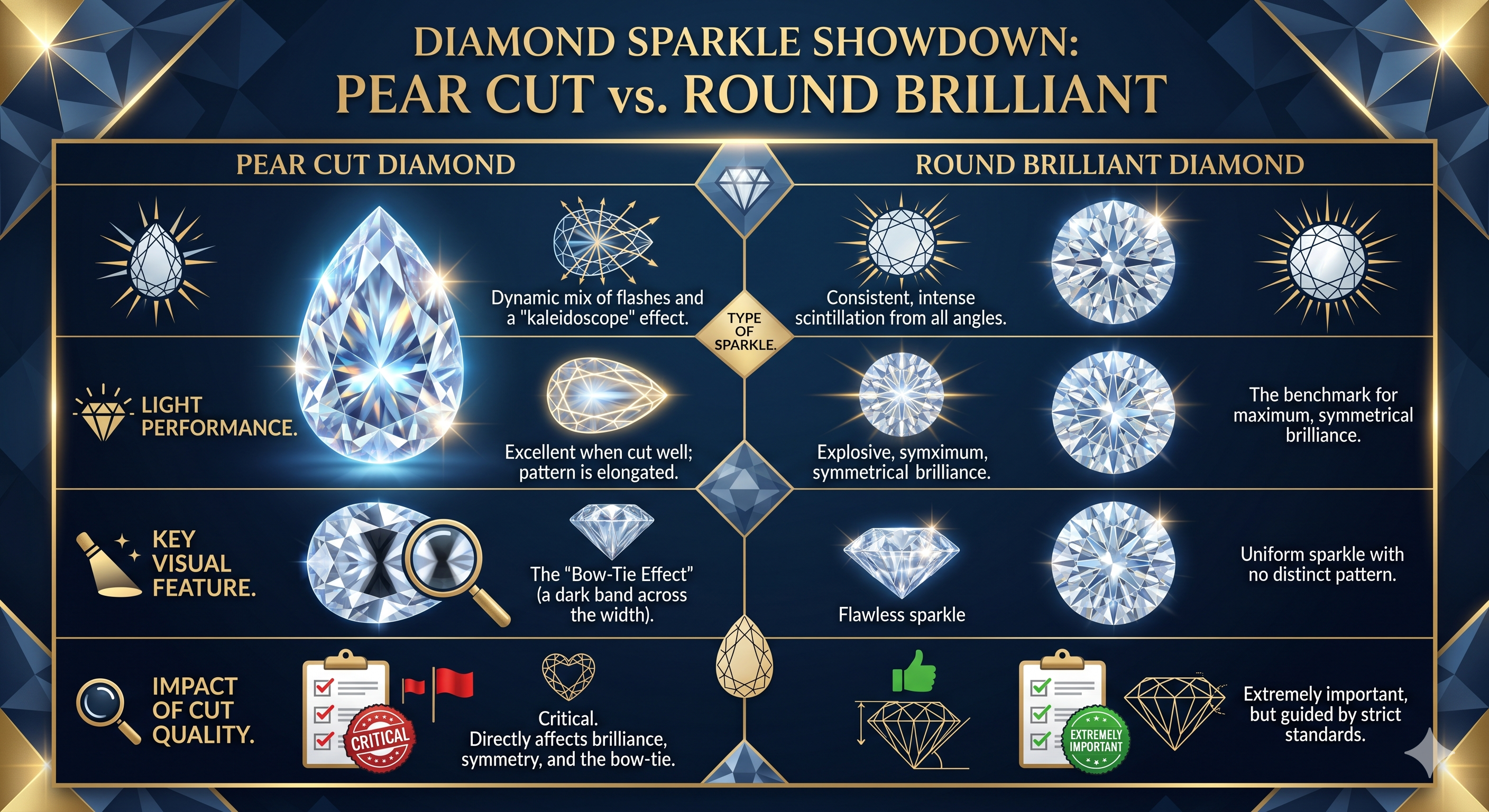
Understanding Pear Cut Sparkle
The sparkle of a pear cut is unique because of its shape:
Elongated Brilliance: Its facets create a long, shimmering light pattern that can make the diamond appear larger and the finger look longer.
The Bow-Tie Effect: This dark area across the middle is caused by light obstruction. A faint to moderate bow-tie is normal and adds contrast, but a very prominent, dark bow-tie means the cut is poor and kills sparkle.
Cut is Everything: For a pear to sparkle, it must be cut with excellent symmetry and proportions. There's no universal "Ideal" grade, so visual inspection is key.
How to Choose a Sparkly Pear Cut Diamond
To ensure you get a stone with great sparkle, focus on these four aspects (beyond the standard 4Cs):
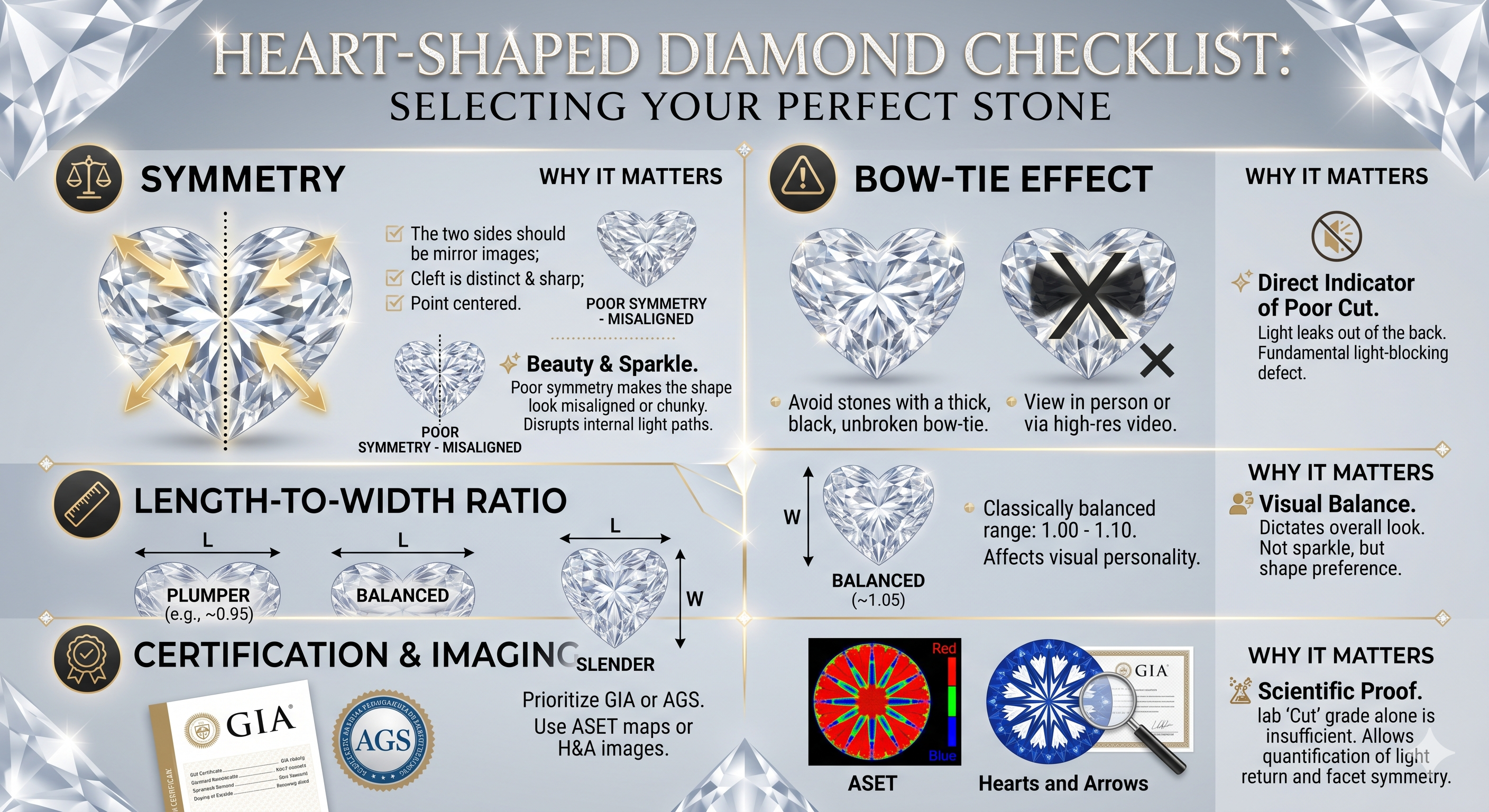
Practical Tip: Always view the diamond in motion. A good pear cut will flash with light from almost every angle as you rotate it.
In short, a pear-cut diamond offers a dramatic and elegant sparkle that is distinct from a round brilliant. Its brilliance is more fluid and elongated. The key is to prioritize cut quality above all else to find a stone that is both fiery and bright.
“You now know the origin, the price comparison, the size illusion, the popularity, the sparkle, and the selection tips. The only question left: will you wear the tear-shaped diamond?
*Our current collection includes a limited number of GIA-certified pear-cut diamonds — from delicate 0.5-carat stones to stunning 3-carat centerpieces. When stones with minimal bow-tie and ideal length-to-width ratios are gone, sourcing new ones takes time.*
*This is not just a diamond. It is Lodewyk van Bercken‘s 15th-century invention, Elizabeth Taylor‘s ‘best friend,‘ and Ariana Grande‘s trend — a teardrop that is both a drop of sorrow and a flame of joy. Point up, point down, or sideways. The choice is yours.”*
[Button: Claim Your Pear Cut Diamond (Limited) →]
Back to Complete Amethyst Stone Guide
Solitaire Setting Guide: 4 vs 6 Prong, Security, Unique Ideas and Comfort
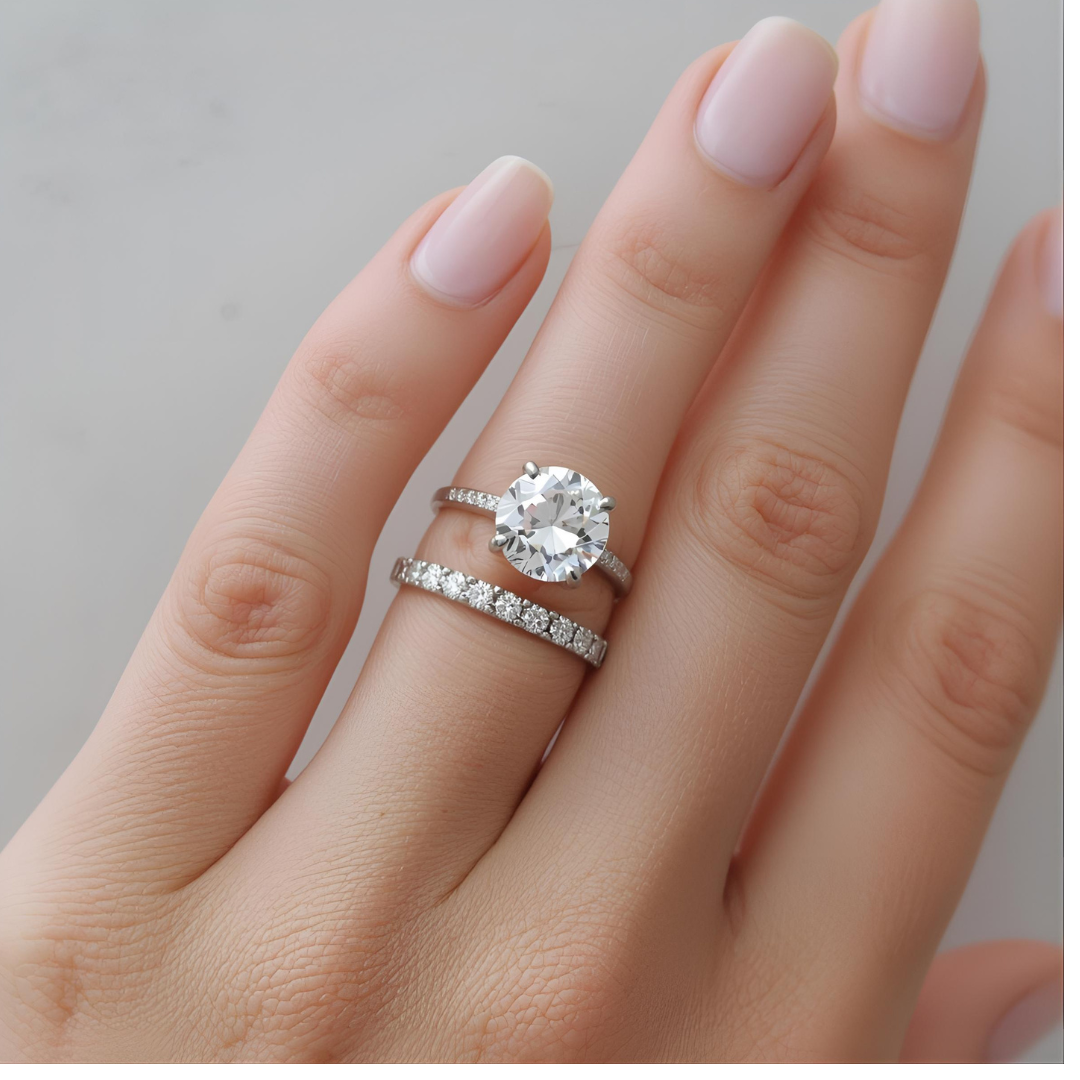
Solitaire Setting Guide: 4 vs 6 Prong, Security, Unique Ideas, and Comfort
In the simplest terms, a solitaire setting is a piece of jewelry, most commonly an engagement ring, that features a single, prominent center stone with no other distracting stones on the band or surrounding the main stone.
“In 1886, Charles Lewis Tiffany introduced a setting that changed engagement rings forever. He took a round brilliant diamond and lifted it above the band with six tiny prongs—allowing light to enter from every angle. Before Tiffany, diamonds were often set in closed-back bezels, hidden and dark. After Tiffany, the diamond floated. It caught the sun. It became the star. That single innovation—the six-prong solitaire—is still the most copied engagement ring design in history. The solitaire does not need side stones, halos, or intricate details. It needs one thing: a diamond. And that diamond needs nothing else.”
The same setting that Tiffany revolutionized in 1886 now awaits your own singular promise. Every solitaire ring in our collection is handcrafted—from classic 6-prong to modern bezel—because a diamond that stands alone should never stand insecure.”*
[Button: Explore Solitaire Rings →]
Table of Contents
What Is A Solitaire Setting?
The word "solitaire" itself comes from the Latin word solitarius, meaning "alone" or "solitary," which perfectly describes this style.
Key Characteristics of a Solitaire Setting:
Single Center Stone: This is the defining feature. The entire design is built to showcase one gemstone, usually a diamond.
Minimalist Band: The band is typically plain (though it can be polished, satin, or engraved) and is designed not to take attention away from the center stone.
Focus on the Diamond: The primary goal of a solitaire is to maximize the beauty, brilliance, and perceived size of the single stone. All eyes go straight to it.
The Most Common Types of Solitaire Settings:
While the principle is simple, there are different ways to hold that single stone in place. The most popular is the Prong Setting.
Prong Setting: This is the classic and most popular type of solitaire. Metal claws (called prongs) hold the stone securely.
4-Prong: Makes a round diamond look more square or cushion-like and allows more light to enter, but offers slightly less security.
6-Prong: Creates a more rounded look for a round diamond and offers superior security.
Why is the Solitaire Setting So Popular for Engagement Rings?
Timelessness: It's a classic style that has been popular for over a century and will never go out of fashion.
Focus on the Stone: It puts the quality and size of the center diamond on full display.
Versatility: Its simplicity allows it to be paired with virtually any wedding band style, from a plain band to an ornate eternity ring.
Symbolism: The single, unadorned stone is often seen as a powerful symbol of singular love and commitment.
Solitaire vs. Other Settings:
Solitaire vs. Halo: A halo setting has a central stone surrounded by a "halo" of smaller pavé diamonds, making the center stone appear larger. A solitaire is just a single stone.
Solitaire vs. Three-Stone: A three-stone ring has (as the name implies) three stones, often symbolizing the past, present, and future of a relationship.
In short, a solitaire setting is the epitome of "less is more." It's a timeless, elegant, and powerful design choice that ensures the beautiful center stone is the undeniable star of the show.
For official information on jewelry settings, visit the GIA Jewelry Setting Guide.
What Does Solitaire Set Mean?
While it sounds very similar to "solitaire setting," the phrase "solitaire set" can have two distinct meanings, and the correct one depends entirely on the context.
Meaning 1: A Matched Pair of Jewelry (Most Common Meaning)
In the world of fine jewelry, especially in the context of engagement and weddings, a solitaire set most often refers to a matched pair of rings designed to be worn together: the engagement ring and the wedding band.
The Engagement Ring: This is the classic solitaire ring with a single, prominent center stone (like a diamond) in a simple setting.
The Wedding Band: This is a complementary ring, usually a plain metal band or one with a simple design, that is sold as a perfect match to the engagement ring.
Why is it called a "set"?
Because the two rings are designed and sold together to ensure they fit together perfectly, both in style and physically. When worn together, they look like one cohesive piece of jewelry.
Key Idea: In this context, "solitaire set" means "engagement ring + matching wedding band."
Meaning 2: A Complete Game of Solitaire
In the context of games, a solitaire set refers to the physical equipment needed to play the classic card game of Solitaire (also known as Patience) by yourself.
This typically includes:
A special deck of cards (often with larger, easy-to-read indices).
A playing board or tablet with a patterned layout to place the cards. This helps keep the cards organized and is ideal for playing on a table or while traveling.
This is much less common today, as most people play Solitaire on computers or phones, but physical solitaire sets are still available and cherished by enthusiasts.
How to Tell the Difference
To know which meaning is intended, just look at the context:
If the conversation is about diamonds, engagement, or jewelry, it's Meaning 1 (the ring set).
If the conversation is about games, cards, or hobbies, it's Meaning 2 (the card game set).
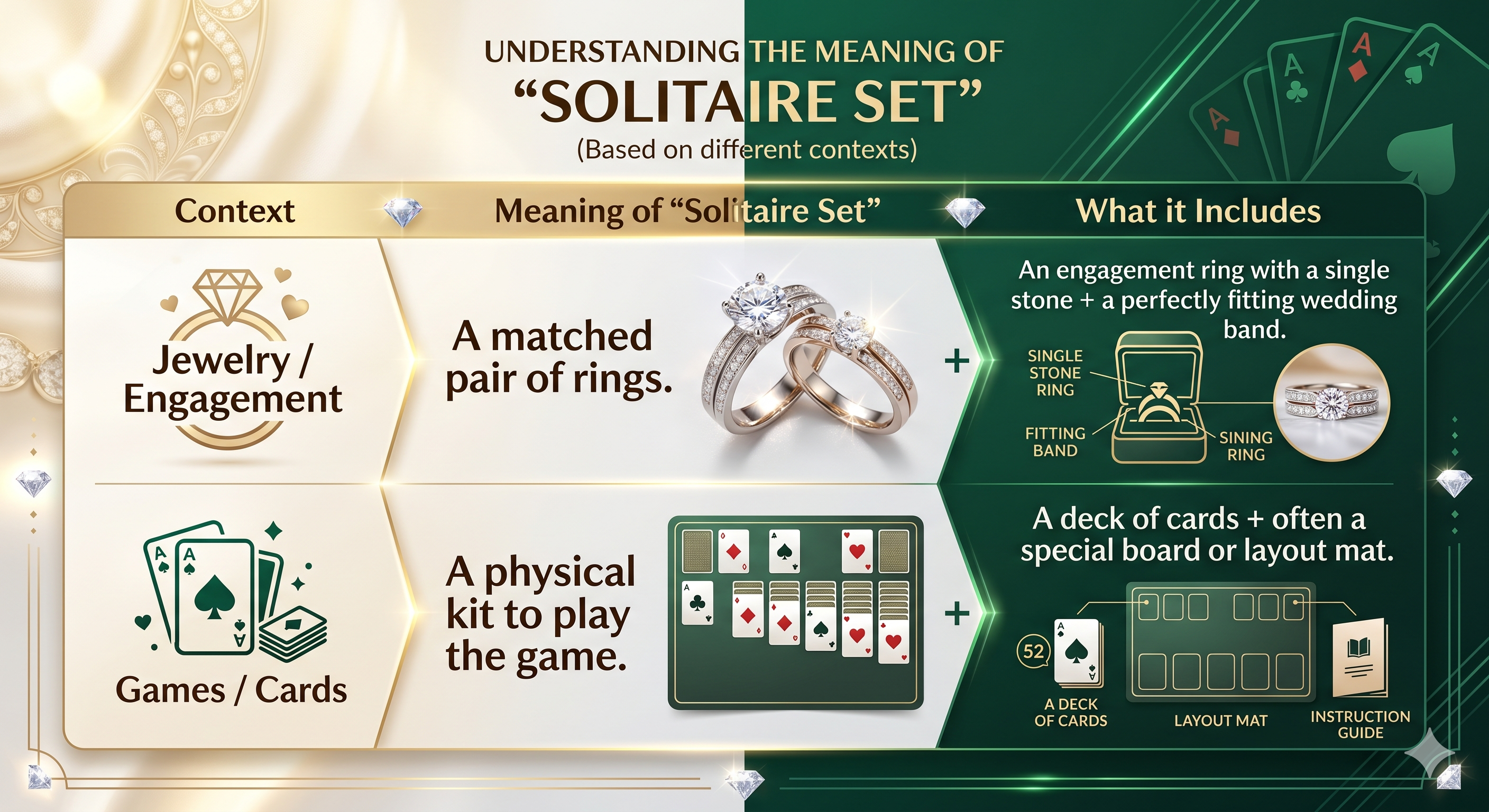
In everyday conversation, especially when discussing jewelry, you will almost always be referring to the matched pair of rings.
What Is The Classic Solitaire Setting?
The classic solitaire setting is the most iconic and timeless style for an engagement ring. When people imagine a "traditional" diamond ring, this is almost certainly what comes to mind.
It is defined by its elegant simplicity, designed to do one thing perfectly: showcase the beauty of a single, spectacular diamond.
The Hallmarks of the Classic Solitaire
Here are the key features that define this legendary setting:
A Single Central Stone: The star of the show. It's always one stone, typically a round brilliant cut diamond, chosen for its unmatched fire and brilliance.
The Prong Setting: This is the most classic and popular way to hold the stone. Metal claws, known as prongs, extend up from the band to clutch the diamond securely.
Four-Prong: Offers a more modern, square-like appearance and allows slightly more light to enter the diamond, potentially making it look brighter. However, it offers marginally less security than six prongs.
Six-Prong: The quintessential classic. This style creates a more rounded look for a round diamond and is renowned for its superior security and traditional feel.
A Simple, Unadorned Band: The band is almost always a plain, precious metal shank (round or knife-edge in profile). It is free of any additional diamonds or intricate detailing. This ensures that nothing distracts from the central stone.
Elevated Height: The head of the ring (the part that holds the diamond) is raised off the band. This lifts the diamond to catch more light from all angles, maximizing its sparkle, and also allows a wedding band to sit flush against it.
Why is it considered the "Classic"?
Timelessness: The design has been popular for over a century and has never gone out of style. It avoids trends, making it a forever-fashionable choice.
Focus on Quality: Because there is nothing else to look at, the quality of the single diamond is paramount. The setting puts the diamond's cut, color, clarity, and carat weight on full display.
Ultimate Versatility: Its simplicity means it pairs beautifully with any wedding band, from a plain metal band to a more ornate diamond-encrusted one.
Symbolism: The single, unaccompanied stone is a powerful and pure symbol of singular love and commitment.
Is A Solitaire Setting Secure?
That's a very important and practical question. The security of a solitaire setting is a common concern because it holds such a valuable stone.
The short answer is: Yes, a solitaire setting can be very secure, but its security depends heavily on the specific type of setting and, most importantly, on proper maintenance.
Let's break down the security of different solitaire settings from most to least secure.
Security Ranking of Common Solitaire Settings
1. Most Secure
Bezel Setting: This is widely considered the most secure solitaire setting. A continuous rim of metal wraps around the entire girdle (the widest edge) of the diamond, fully enclosing it. It offers excellent protection against impacts and snagging, and it's almost impossible for the stone to fall out.
2. Very Secure
Six-Prong Setting: With six prongs holding the stone, this setting offers superior security compared to a four-prong setting. Even if one prong were to become damaged or loose, the other five would likely keep the stone safely in place. The classic setting is a six-prong design for this reason.
3. Secure (with a caveat)
Four-Prong Setting: This is the classic and most popular solitaire look. It is perfectly secure for everyday wear as long as the prongs are well-made and maintained. The caveat is that if a single prong is badly damaged, the stone is at a much higher risk of falling out compared to a six-prong or bezel setting.
4. Least Secure (and requires special design)
Tension Setting: This is the most modern and dramatic style, where the stone appears to float. The security relies entirely on the precise engineering and metal strength of the band. While it's designed to be secure, a hard, direct impact to the exact point of tension could potentially dislodge the stone, which is less likely in a prong or bezel setting. Always buy a tension setting from a highly reputable and experienced jeweler.
The Real Key to Security: Maintenance and Prong Care
No matter which setting you choose, prongs are the number one point of failure. Over time, they can wear down from daily wear, especially if the ring is knocked against hard surfaces.
Here’s what you must do to ensure your solitaire setting stays secure:
Regular Professional Inspections: Take your ring to a jeweler at least once a year. They have specialized tools to check if the prongs are worn down, cracked, or loose. They will also check the overall integrity of the band.
Prong Retipping: Over many years, prongs can wear thin. A jeweler can add new metal to them in a process called "retipping," which restores their security without needing a whole new setting.
Be Mindful of Daily Wear: Remove your ring during activities that could subject it to hard impacts or chemicals (e.g., gardening, gym workouts, cleaning with harsh chemicals).
Get it Insured: Always ensure your engagement ring. Even with the most secure setting and perfect care, accidents can happen. Insurance provides peace of mind.
Is a solitaire setting secure? Absolutely. A well-made six-prong or bezel solitaire is an excellent and secure choice for a lifetime of wear.
However, the security is not "set it and forget it." Think of it like a car—it's built to be safe, but it requires regular check-ups and maintenance to stay that way. The classic four-prong solitaire is beautiful and secure, but its long-term safety is directly tied to your commitment to having those prongs checked and maintained by a professional.
Final Recommendation: If you are very active, hard on your hands, or want the ultimate peace of mind, a bezel or six-prong solitaire is your best bet. If you love the classic four-prong look, just be diligent about those annual check-ups.
For more on jewelry care, visit the American Gem Society's care guide.
How To Make A Solitaire Setting Unique?
Making a solitaire setting unique is about adding character to the classic "single stone on a band" concept. The goal is to preserve the solitaire's timeless elegance while injecting personality through unexpected details.
Here’s a breakdown of how to achieve a unique solitaire setting, from subtle tweaks to bold statements.
“In 1947, De Beers launched the most famous advertising campaign in history: ‘A Diamond Is Forever.‘ The campaign featured one image—a solitaire engagement ring. For 70 years, that single image shaped the dreams of millions of couples. But here is what the ads didn‘t show: the solitaire is not a formula. It is a canvas. The band can be hammered or engraved. The prongs can be clawed or rounded. The metal can be yellow, white, or rose. The diamond can be round, oval, or pear. A solitaire is not a lack of creativity. It is the discipline to let one stone say everything.”
1. Rethink the Shank (The Band)
This is the most impactful place to start, as it changes the ring's overall silhouette.
Split Shank: The band splits into two or more strands as it approaches the center stone. This creates a beautiful, airy feel and makes the center stone appear larger.
Unique twist: Try a V-split shank or an asymmetrical split where one side is thinner or textured differently.
Euro Shank: The bottom of the ring is squared off instead of perfectly round. This prevents spinning on the finger and feels surprisingly modern and architectural.
Tapered Band: The band starts thicker at the bottom and tapers as it reaches the head. This draws all focus to the center stone.
Textured Band: Move beyond polished metal. Consider hand-engraved patterns (vines, geometric lines, art deco shapes), hammered or brushed finishes, or a milgrain edge (tiny beaded metal dots along the band's edge).
2. Elevate the Prongs & Basket
Prongs aren't just functional; they are a prime opportunity for micro-personalization.
Prong Shape: Instead of standard round prongs, use claw prongs (more delicate, vintage feel), bunny-ear prongs (softer, rounded), V-prongs (ideal for pointed stones like pear or marquise), or even square or flat tab prongs (modern and minimalist).
Prong Color: Use a different metal color for the prongs than the band.
Example: A platinum band with rose gold prongs so the warmth subtly reflects into the diamond.
Example: A yellow gold band with white gold prongs to make a colorless diamond appear whiter and brighter.
Decorative Gallery/Basket: The "gallery" is the structure under the stone. Don't leave it plain.
Add a hidden halo (a tiny circle of micro-pavé diamonds underneath the main stone).
Add an open-worked design (a carved-out shape like a heart, a trefoil, or geometric cutouts).
Set a tiny accent gemstone (like a sapphire, ruby, or emerald) inside the basket, visible only from the side.
3. Play with Stone Shape & Setting
The "classic solitaire" usually means a round brilliant. Deviating here creates instant uniqueness.
Unconventional Fancy Shapes: An oval is popular, but a cushion, radiant, asscher (art deco vibes), marquise, or pear is less common. A hexagonal or kite-shaped diamond is very rare.
Alternative Center Stones: A colored diamond (champagne, grey, fancy yellow, or a subtle blue) or a different gemstone (sapphire, ruby, emerald, moissanite, or a salt-and-pepper diamond) makes the solitaire instantly unique.
Unusual Setting Styles:
Bezel Setting: The metal completely encircles the stone's girdle. A partial bezel (open on the sides) is a modern hybrid.
Tension or Compression Setting: The stone is held by the sheer force of the metal squeezing it from two sides. It looks like the stone is floating. Requires a specific, durable stone (diamond, moissanite, sapphire).
Gypsy (Flush) Setting: The stone is set flush into the band itself. For a solitaire, this creates an ultra-low-profile, sleek, almost brutalist look.
4. Embrace Negative Space & Asymmetry
Symmetry is classical, but breaking it is a surefire way to be unique.
Off-Center Stone: Set the diamond slightly to one side of the band's center. It's subtle but incredibly compelling.
Open (Voided) Shank: The band has a deliberate cut-out or gap on one side. This is very modern and architectural.
Asymmetrical Shoulders: One shoulder of the ring has a tiny pavé accent or a subtle curve, while the other is plain.
5. The Ultimate Unique Move: The Hidden Surprise
This is for a truly personal touch that only the wearer and a few others will ever know.
Engraving on the inside of the gallery: Not just the band, but under the stone. A date, a word, or a small symbol.
A Secret Birthstone: Set a tiny birthstone on the inside of the shank, facing the palm.
A Scented or Textured Inner Band: Some jewelers can create a subtle texture (like a fingerprint or a Morse code message) on the inside of the band.
Summary Table: A Unique Solitaire by Category
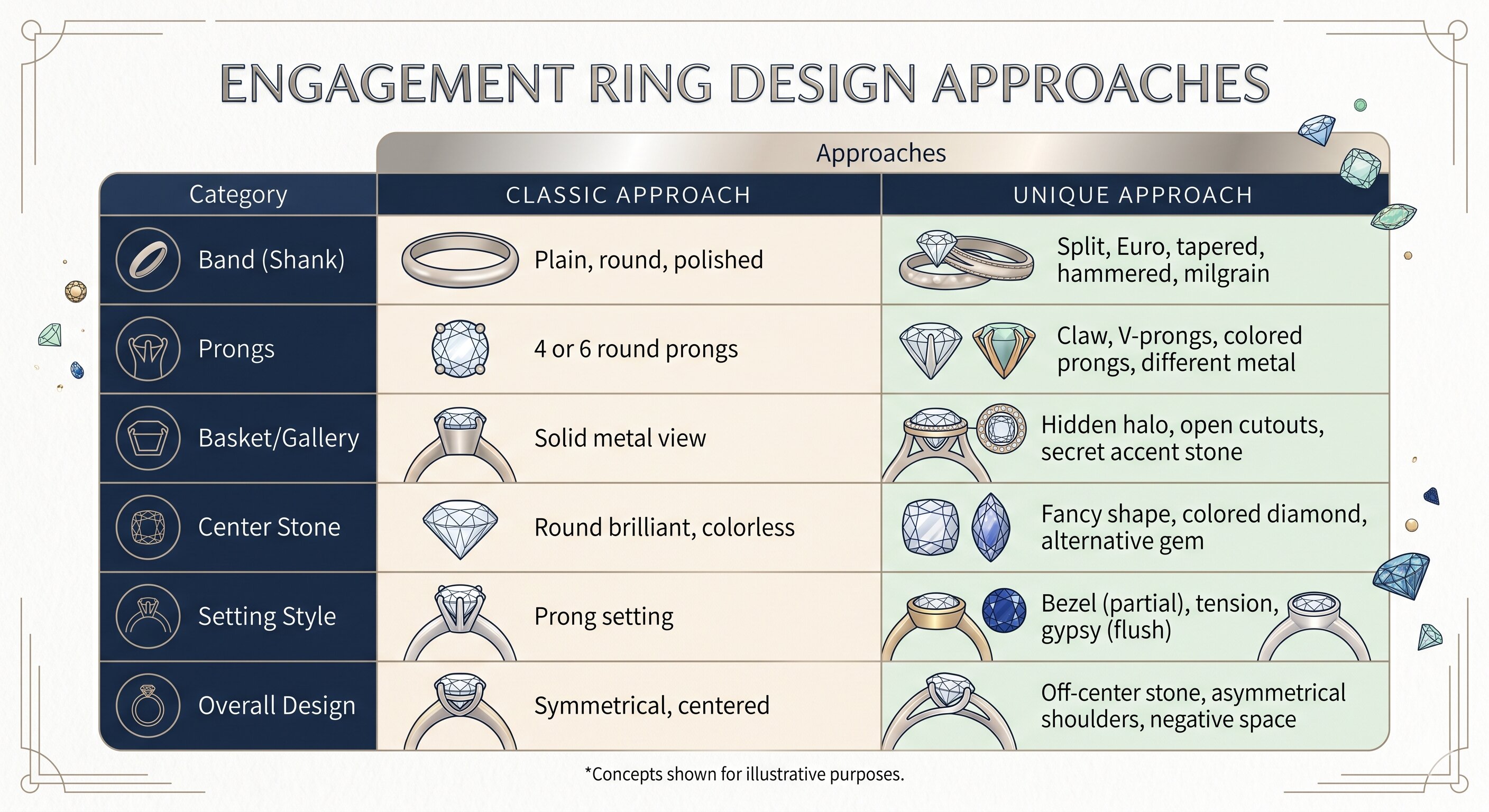
Final Pro-Tip: Don't try to incorporate all of these at once. Pick two or three elements that resonate with your personal style. A hammered band + a hidden halo + a pear-shaped diamond = a stunning, unique solitaire. A split shank + rose gold prongs + a yellow diamond = a masterpiece. Let the design breathe. Less is often more, even when aiming for unique.
Are Solitaires Comfortable To Wear?
Solitaires with a "comfort-fit" band design can be exceptionally comfortable for everyday wear. This feature, widely offered by jewelers, is engineered specifically for long-term comfort.
What Makes a Solitaire "Comfort-Fit"?
The comfort comes from the band's internal shape. Unlike a traditional flat band, a comfort-fit band has a gently curved interior that sits against your finger. This design prevents the edges from rubbing or digging into your skin, which is key for a ring worn every day.
Here’s a quick look at how comfort-fit compares to a standard fit:
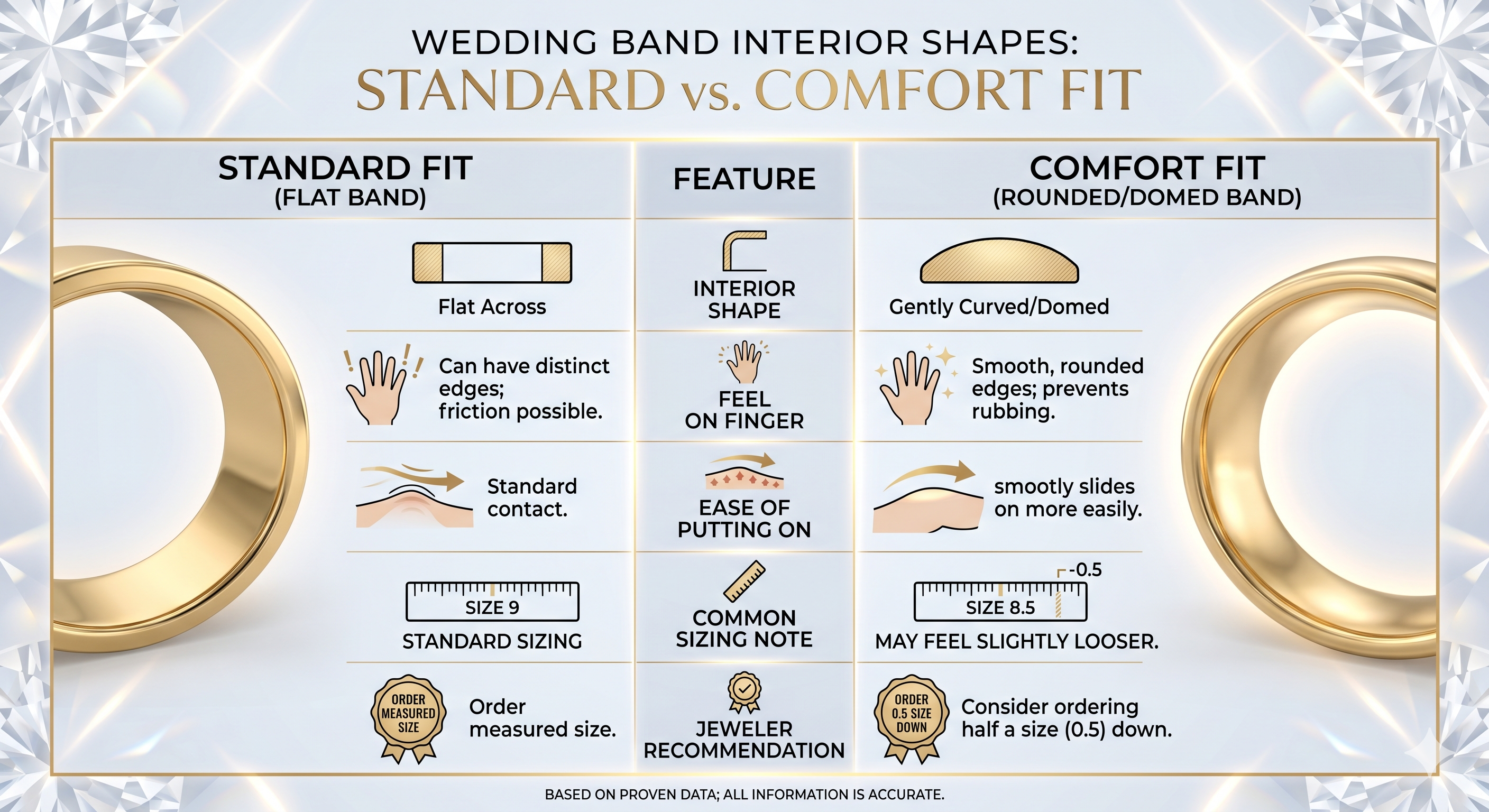
Choosing a Comfortable Solitaire
When selecting your ring, focus on these details beyond just the fit:
Band Width and Profile: Narrower, "petite" bands (e.g., 1.5mm - 2.2mm) are less obtrusive, while a slightly wider band offers a more substantial feel.
Setting Security and Profile: A four or six-prong head securely holds the center diamond. A lower-profile setting keeps the diamond closer to your finger, making it less likely to catch on clothing.
Metal Choice: Comfort-fit is available in all common metals like platinum, white, yellow, or rose gold. The choice here affects the ring's look, durability, and price, not the comfort of the fit itself.
Perfecting the Fit: Always get professionally sized. Remember that fingers swell and shrink; the ring should fit snugly but slide over your knuckle with slight resistance. A reputable jeweler will offer a resizing period.
Key Considerations for Daily Wear
Even with a comfort-fit band, keep in mind that a solitaire ring is a piece of fine jewelry:
Prongs and Snagging: The prongs that hold the diamond can occasionally catch on fine fabrics like knitwear.
Stone Size and Weight: Larger center stones (over ~1.5 carats) will make the ring top-heavy, which some may find less comfortable than a lighter ring.
Lifestyle Adjustments: It's wise to remove your ring during activities like heavy gardening, gym workouts, or cleaning with harsh chemicals to protect both the ring and your finger.
A comfort-fit solitaire is designed to be a joy to wear every day. By prioritizing the curved band design and paying attention to the other features that suit your lifestyle, you can find a ring that is both stunning and comfortable.
I hope this helps you find the perfect ring! If you have a specific metal or diamond shape in mind, I can look for more tailored information.
“You now know the definition, the classic features, the security rankings, the personalization tips, and the comfort factors. The only question left: will you choose the setting that needs no distraction?
*Our current collection includes a limited number of solitaire rings — from classic 6-prong Tiffany-style to bezel solitaires, from split shanks to euro shanks. When certain designs are gone, restocking takes time because each setting is handcrafted.*
This is not just a ring. It is Charles Lewis Tiffany‘s 1886 rebellion, De Beers‘ ‘A Diamond Is Forever,‘ and 140 years of proof that one stone, held by a few tiny prongs, can say everything that needs to be said.”
[Button: Secure Your Solitaire Ring (Limited) →]
Back to Complete Aquamarine Ring Guide
News for Saturday 13 June, 2026
- Ring Finger Meaning: Which Finger for Wedding, Single and More | Complete Guide
- Bezel Setting Guide: Benefits, Styles, and Buying Tips
- Sterling Silver Guide: 925 Meaning, Care, vs Silver and Green Skin
- Channel Setting Guide: Pros, Cons, Safety and Cost vs Pavé
- Prong Setting Guide: 4 vs 6 Prongs, Security, Size and Types
- Ring Setting Guide: Types, Best for Daily Wear, and Size Tips
View all news for Saturday 13 June, 2026 on one page
Recent News
- Friday 12 June, 2026
- Thursday 11 June, 2026
- Wednesday 10 June, 2026
- Tuesday 09 June, 2026
- Monday 08 June, 2026