

Art Deco Jewelry: History, Value and How to Identify Authentic Pieces
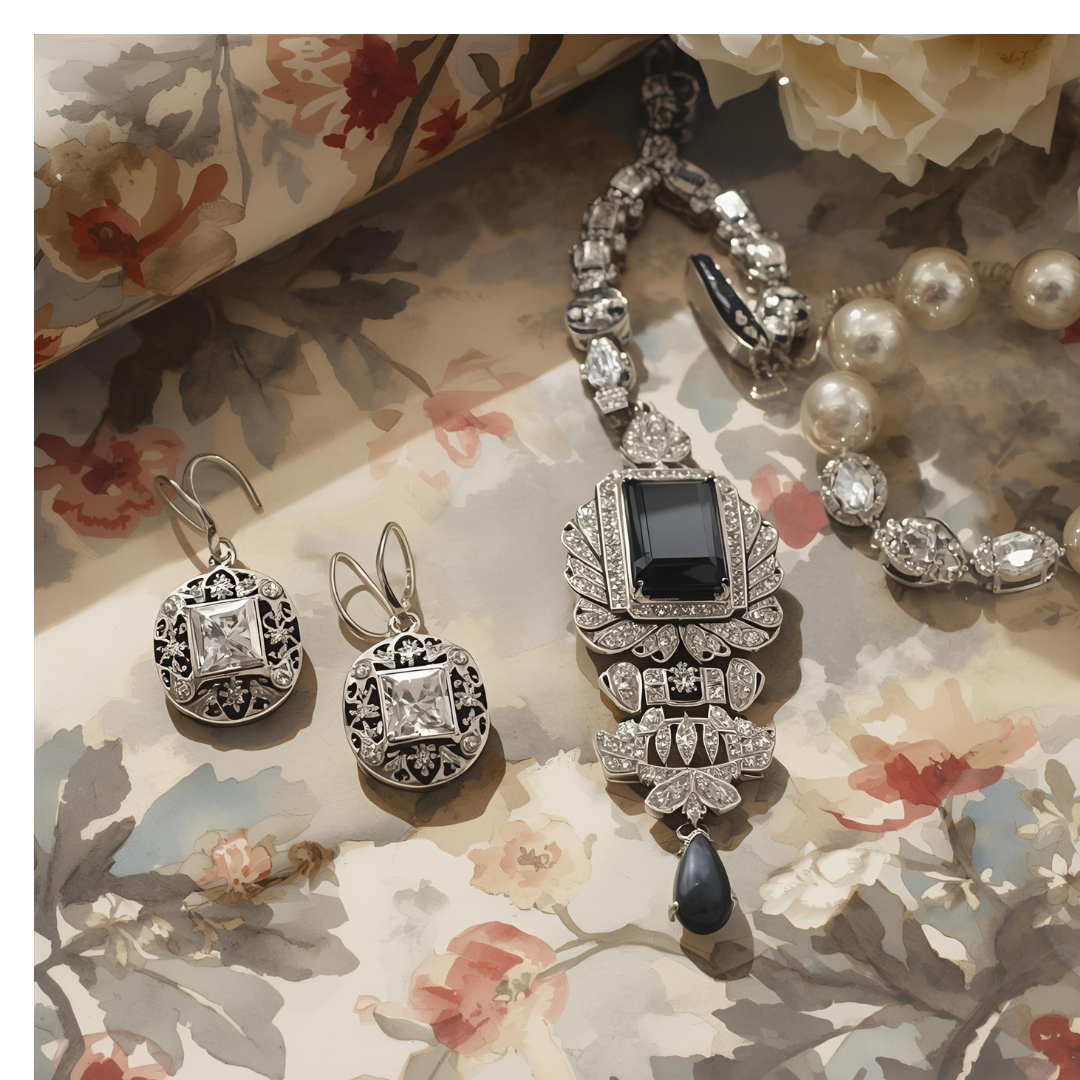
Art Deco Jewelry: History, Value, and How to Identify Authentic Pieces
Discover the allure of Art Deco jewelry. Learn about its history, key designers, value, and how to spot genuine pieces from the 1920s-30s.
In 1922, Howard Carter opened King Tutankhamun‘s tomb. The world went mad for Egypt. Jewelers like Cartier and Van Cleef & Arpels replaced flowers with scarabs, lotus flowers, and pyramids. But the bigger influence was not ancient Egypt—it was the modern city. The skyscraper. The automobile. The jazz club. Art Deco jewelry was not designed for candlelit ballrooms. It was designed for women who drove cars, smoked cigarettes, and danced the Charleston. It was the first jewelry of the modern woman—and it still looks like the future.”
The same geometric glamour that defined the Jazz Age now awaits your own modern elegance — from platinum filigree to onyx and diamond contrasts. Every Art Deco piece in our collection is inspired by the 1920s and 1930s, whether authentic antique or vintage-inspired.”
[Button: Explore Art Deco Jewelry →]
Here is the content of the table;
- • What Is Considered Art Deco Jewelry?
- • What Is The History Of Art Deco Jewelry?
- • Is Art Deco Jewelry Valuable?
- • Is Art Deco Antique Or Vintage?
- • How Can You Tell If Jewelry Is Art Deco?
- • Is Art Deco Gold Or Silver?
Here’s a breakdown of what Art Deco jewelry looks like, with its key characteristics:
The Overall Vibe: Geometric and Bold
Imagine the sleek, graphic lines of a skyscraper, the energy of a jazz club, and the discovery of King Tut's tomb all fused into wearable art. The result is jewelry that is architectural, symmetrical, and strikingly modern.
Key Visual Characteristics:
1. Geometric Shapes & Patterns
This is the most defining feature. Look for:
Strong, clean lines: Rectangles, squares, and triangles.
Abstract motifs: Sunbursts, chevrons (zigzags), and stepped forms (inspired by Mayan temples).
Symmetrical and repeating patterns.
2. Color Palette: High Contrast
Art Deco designers loved dramatic color combinations.
Classic Combination: Platinum or white gold paired with black-and-white gems. This was a stark departure from the yellow gold of the previous eras.
Black Materials: Onyx, black enamel, and jet were used extensively to create graphic outlines and contrast.
Vivid Color Pops: Gems like ruby, emerald, and sapphire were often cut into precise shapes and used as bold accents against diamonds and onyx.
Other Popular Gems: Rock crystal, jade, coral, and lapis lazuli.
3. Gem Cuts: Precision and Angle
Forget the soft, rounded cuts of the past. Art Deco favored linear, geometric cuts.
Emerald Cut and Baguette Cut: These long, rectangular cuts were quintessential.
Other Popular Cuts: Calibré-cut gems (small stones cut to fit precisely into a channel setting), triangle cuts, and French cuts.
Mix and Match: It was common to see several different geometric cuts in a single piece.
4. Influences: A Global Melting Pot
The style was a fusion of several powerful influences:
The Machine Age: Celebrating the sleekness of modern technology, cars, and skyscrapers.
Cubism & Fauvism: Borrowing abstract, fragmented forms and bold color from modern art.
Ancient Worlds: The 1922 discovery of Tutankhamun's tomb sparked "Egyptomania," leading to motifs like scarabs, pyramids, and lotus flowers. Influences from African, Asian, and Mesoamerican art were also prevalent.
5. Craftsmanship & Settings
Platinum was King: Its strength allowed for open, lacy, and intricate settings without sacrificing durability. This led to the popular filigree and milgrain details.
Pave and Channel Settings: These were used to create seamless surfaces of diamonds and gems, making the metal almost invisible.
Pieces were often large and architectural, but they maintained a light, open feel due to the skilled metalwork.
Iconic Art Deco Jewelry Pieces:
Long Pearl Necklaces & Sautoirs: Long strands of pearls, often with a geometric platinum, diamond, and onyx pendant (called a "tassel pendant"), worn by flappers.
Cocktail Rings: Large, statement rings with a central geometric motif (like a square or octagon) surrounded by diamonds and accented with a pop of color.
Geometric Bracelets & Bangle Cuffs: Stiff, linear bracelets that sat squarely on the wrist, often with a central plaque decorated with a sunburst or chevron pattern.
Drop Earrings: Geometric pendants hanging from a stud, often featuring precise rows of baguette and round-cut diamonds.
Double-Clip Brooches: A large, dress clip that could be worn as one piece or separated into two matching brooches.
How to Spot Art Deco Jewelry
If a piece of jewelry looks like it has...
Angular, symmetrical designs (not flowing or floral).
A "black and white" color scheme with platinum, diamonds, and onyx.
Bold, graphic patterns like sunbursts and zigzags.
Step-like or architectural forms.
Precise, geometric gem cuts like emerald and baguette.
...you are almost certainly looking at Art Deco.
It's a style that embodies the glamour, innovation, and bold spirit of the Roaring Twenties and remains incredibly popular and collectible today.
What Is Considered Art Deco Jewelry?
Building on the visual description, "What is considered Art Deco jewelry?" is about defining its core parameters—the specific time period, design principles, materials, and forms that classify a piece as truly Art Deco.
Here is a detailed breakdown of what is considered Art Deco jewelry:
1. The Defining Era: The Roaring Twenties and Thirties
Art Deco jewelry was created primarily during the 1920s and 1930s. This period is crucial for authentic antique pieces.
Peak (1925-1935): The style was officially launched by the 1925 Exposition Internationale des Arts Décoratifs et Industriels Modernes in Paris.
Decline: The style began to wane in the late 1930s with the onset of World War II, as materials became scarce and the mood of society shifted.
2. The Core Design Principles
A piece is considered Art Deco if it embodies these fundamental principles:
Geometric Symmetry: Designs are almost always balanced and symmetrical. Think of a central motif flanked by identical patterns on each side.
Abstraction over Nature: Unlike the flowing flowers and vines of the prior Art Nouveau period, Art Deco abstracted natural forms into geometric patterns (e.g., a sun becomes a sharp sunburst, a flower becomes a series of concentric circles and triangles).
Architectural Influence: The style is directly inspired by the sleek lines of skyscrapers, the step-backs of ziggurats, and the bold forms of modern machinery.
3. Key Materials and Gemstones
The materials used are a major indicator:
Primary Metals:
Platinum: The king of Art Deco metals. Its strength allowed for delicate, openwork settings.
White Gold: Became popular as a more affordable alternative to platinum, achieving the same desired "white" look.
Iconic Gemstone Combinations:
The "Black and White" Palette: Diamonds (often in calibre, baguette, or round cuts) paired with Onyx is the quintessential combination.
Accent Gems: Rubies, emeralds, and sapphires were used as bold, contrasting color blocks.
Other Common Stones: Rock crystal, jade, coral, lapis lazuli, and black enamel.
Cultural Influences in Material:
Egyptian Revival: After the discovery of King Tut's tomb in 1922, motifs using lapis lazuli, turquoise, and carnelian became highly fashionable.
4. Specific Gem Cuts
The cut of the gem is as important as the gem itself. Art Deco favored linear and precise cuts:
Step Cuts: Emerald cut, baguette cut.
Geometric Cuts: Triangle cut, trapezoid cut, half-moon cut.
Calibré Cut: Small gems (like rubies or sapphires) cut to specific, non-standard sizes and shapes to fit perfectly into a channel setting, creating a seamless flow of color.
5. Hallmark Techniques and Settings
Filigree: Delicate, lacy openwork, usually in platinum.
Milgrain: Tiny, beaded edges applied to metal to add texture and definition, a very common decorative detail.
Pave Setting: Small stones set closely together so the metal surface appears to be "paved" with gems.
Channel Setting: Stones set side-by-side within a channel, with no metal separating them, creating a smooth, continuous line.
6. Iconic Jewelry Forms and Pieces
Certain types of jewelry are synonymous with the era:
The Cocktail Ring: A large, bold, and statement-making ring, often with a central geometric motif (like a square or octagon) surrounded by diamonds and accented with a pop of color.
Long Sautoir Necklaces: Long pearl or bead necklaces, often terminating in a dramatic geometric pendant or a tassel.
Geometric Bracelets and Bangle Cuffs: Stiff, linear bracelets that sat squarely on the wrist, often with a central plaque.
Double-Clip Brooches: A large, dress clip that could be worn as one piece or separated into two matching brooches to be worn on straps, lapels, or a band to create a bracelet.
Drop Earrings: Geometric pendants hanging from a stud, often featuring precise rows of baguette and round-cut diamonds.
What Qualifies a Piece as Art Deco?
A piece is considered Art Deco if it combines most of the following elements:
Timeframe: Made between 1920 and 1939.
Design: Geometric, symmetrical, and abstract.
Materials: Platinum/white gold, with onyx, diamonds, and calibrated colored gems.
Craftsmanship: Features cuts like emerald and baguette, and techniques like milgrain and filigree.
Form: Belongs to a classic Art Deco style like a cocktail ring, sautoir, or double-clip brooch.
A Note on "Art Deco Style" Jewelry: You will also find modern and vintage-inspired jewelry that is not from the 20s/30s but is "Art Deco style." It replicates the look but may use different materials (e.g., white gold instead of platinum, synthetic stones) and modern manufacturing techniques. For collectors, an authentic Art Deco piece is verifiably from the period.
What Is The History Of Art Deco Jewelry?
The history of Art Deco jewelry is a fascinating story that mirrors the dramatic social, technological, and artistic shifts of the early 20th century. It's a tale of moving from the soft, natural forms of the past into a bold, machine-age future.
Here is a detailed history of Art Deco jewelry:
The Precursors: A Reaction Against Art Nouveau
To understand Art Deco's birth, we must look at what came before it: Art Nouveau (c. 1890-1910).
Art Nouveau was characterized by organic, flowing lines, themes from nature (flowers, insects, women with flowing hair), and a sense of romanticism.
Art Deco was a direct and deliberate rejection of this. It swapped soft curves for hard angles, naturalism for abstraction, and hand-crafted whimsy for machine-age precision.
The Catalyst: The 1925 Paris Exposition
The single most important event in launching the Art Deco style was the Exposition Internationale des Arts Décoratifs et Industriels Modernes, held in Paris in 1925.
This massive world fair was dedicated to modern industrial and decorative arts.
The requirement for entry was that designs had to be truly modern—no copying of historical styles was allowed.
The jewelry showcased here was a sensation. It featured the geometric patterns, bold color contrasts, and innovative use of platinum and diamonds that would define the era. The exposition gave the style its name: "Arts Décoratifs" was shortened to "Art Deco."
The Influences: A "Melting Pot" of Ideas
Art Deco jewelry didn't emerge from a vacuum. It was a fusion of several powerful influences:
The Machine Age & Cubism:
The world was enthralled with speed, skyscrapers, and machinery. Jewelry reflected this with sleek, aerodynamic, and geometric forms.
The artistic movement of Cubism, pioneered by Picasso and Braque, which broke down objects into geometric shapes, directly influenced the abstract, fragmented designs.
The Discovery of Tutankhamun's Tomb (1922):
This archaeological event sparked "Egyptomania" across the Western world.
Jewelers began incorporating pyramids, scarabs, sphinxes, hieroglyphics, and lotus flowers into their designs.
The color palette of ancient Egypt—lapis lazuli, turquoise, carnelian, and gold—was blended with the classic Deco black and white.
The Rise of "Exotic" Cultures:
A growing fascination with African, Asian, and Mesoamerican art introduced bold, geometric patterns and stylized forms. African tribal patterns and the step-pyramids of Aztec and Mayan temples became direct design sources.
The Social Context: The Roaring Twenties
The jewelry was perfectly suited to the spirit of the time:
“In 1926, the flapper was born. She cut her hair short, raised her hemline, and wore long strands of pearls that swung as she danced. She wore cocktail rings on her right hand—not her left—because she was not waiting for a man to put a ring on it. She was buying her own. The jewelry industry panicked. Then it adapted. Cartier created the ‘Tutti Frutti‘—a riot of carved rubies, emeralds, and sapphires. Van Cleef invented the ‘Mystery Set‘—stones so precisely cut that no metal showed. Art Deco jewelry was not just decoration. It was armor for a new kind of woman.”
Women's Liberation: The 1920s saw the rise of the independent "flapper." She smoked, drank, drove cars, and danced with a new sense of freedom. The long, dangling sautoir necklaces and rigid, geometric bangle bracelets were designed to move with the dances of the Jazz Age, like the Charleston.
The Cocktail Party: With Prohibition in the US, illicit cocktail parties became fashionable. Women wore large, dramatic "cocktail rings" as a symbol of rebellion and sophistication.
Fashion: The move from restrictive corsets to the dropped-waist, sleeveless silhouettes of flapper dresses created a new canvas for jewelry. Pieces were worn as bold architectural elements against simple, elegant fabrics.
The Peak and the Craftsmen (c. 1925-1935)
This was the golden age of Art Deco jewelry. Legendary houses like Cartier, Van Cleef & Arpels, Boucheron, and Mauboussin were at their peak.
Technical Mastery: They perfected the use of platinum, which was strong enough to create delicate, lace-like filigree and milgrain details while holding precious gems securely.
Innovation in Form: The "double-clip brooch" became an icon, a versatile piece that could be worn as one large brooch or separated into two.
Iconic Pieces: The Tutti Frutti style (pioneered by Cartier), which mixed carved emeralds, rubies, and sapphires with diamonds, is a quintessential example of the era's vibrant color and cultural fusion.
The Decline: The End of an Era
The opulent and optimistic Art Deco period could not survive the global economic and political turmoil of the late 1930s.
The Great Depression (1930s): The market for extravagant luxury jewelry shrank dramatically.
World War II (1939-1945): Platinum was declared a strategic metal for the war effort, making it unavailable for jewelry. The mood of the world shifted from glamour to austerity.
The Rise of Retro Modern: Jewelry that was produced during and after the war became heavier, more curvaceous, and used more gold, evolving into the "Retro" style, which marked the end of the pure Art Deco era.
The Legacy
Art Deco jewelry never truly went out of style. It experienced a major revival in the 1980s and continues to be one of the most sought-after and influential periods in jewelry history. Its emphasis on geometry, bold color, and architectural form continues to inspire contemporary designers, cementing its status as a timeless and revolutionary style.
Is Art Deco Jewelry Valuable?
The short answer is yes, authentic Art Deco jewelry is often highly valuable, but the price can range from relatively affordable to astronomical at auction.
The value depends on a delicate balance of factors. Here’s a detailed breakdown of what makes Art Deco jewelry valuable and what to look for.
Factors That Drive High Value in Art Deco Jewelry
1. The "Big Four" Houses (Top-Tier Value)
Jewelry from the most celebrated French houses of the era commands the highest prices. If a piece is signed by one of these, its value is significantly elevated:
Cartier
Van Cleef & Arpels
Boucheron
Mauboussin
A signed piece from one of these makers, especially with original documentation and in excellent condition, is considered the pinnacle of collectibility.
2. Quality of Materials and Craftsmanship
Platinum: The primary metal for fine Art Deco jewelry. Its use indicates a high-quality piece.
Gemstone Quality: The presence of high-caliber diamonds (often with old European or transitional cuts) and natural, untreated rubies, emeralds, and sapphires adds immense value.
Technique: Look for exceptional craftsmanship like intricate platinum filigree, precise milgrain edging, and sophisticated settings like calibre-cut stones and invisible settings. This level of handcrafting is difficult and expensive to replicate today.
3. Distinctive Art Deco Design Elements
Pieces that perfectly encapsulate the era's style are more desirable:
Strong Geometry: Bold, symmetrical, and architectural designs.
Classic Color Contrasts: The iconic "black and white" combination of onyx and diamonds.
Cultural Influence: Pieces showing clear Egyptian Revival motifs (like scarabs or pharaohs) or other exotic influences can be particularly sought-after.
4. Condition and Provenance
Condition: Pieces in excellent, unaltered condition are far more valuable. This means no broken or replaced clasps, no significant damage to the metalwork, and original stones without chips or cracks.
Provenance: A documented history of ownership, especially if it belonged to a famous person or was sold by a prestigious retailer, can add a significant premium.
5. Rarity and Desirability of the Form
Certain types of Art Deco jewelry are especially collectible:
Double-Clip Brooches: Highly iconic and versatile.
Long Sautoir Necklaces: Especially those with geometric pendants.
Cocktail Rings: Large, bold, and statement-making.
Complete Suites: A matching parure (e.g., necklace, bracelet, earrings, and brooch) is exceptionally rare and valuable.
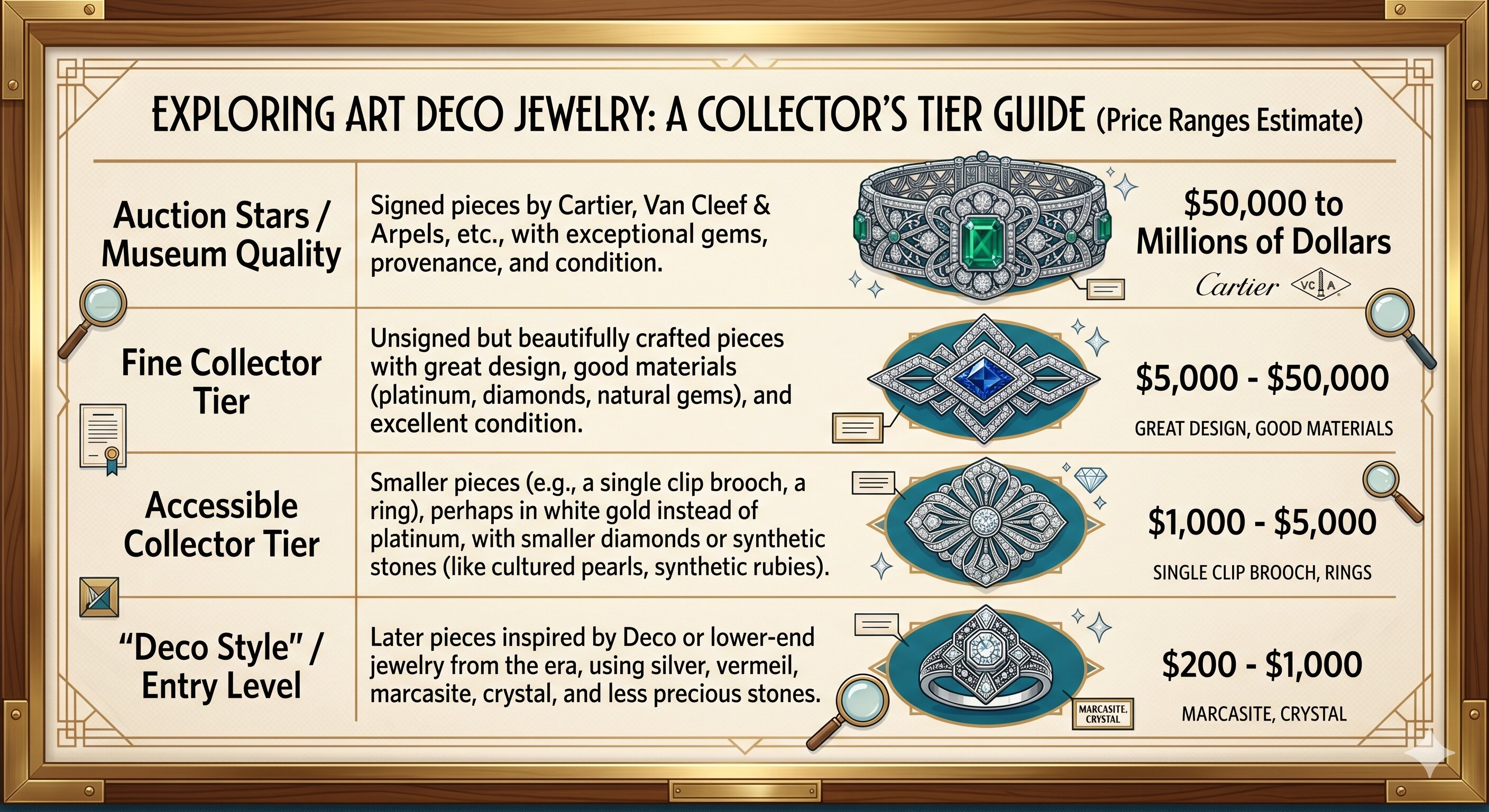
The Value Spectrum: From Affordable to Auction Star
To give you a better idea, here’s how the value can break down:
A Note on "Costume" or Semi-Fine Jewelry
The Art Deco era also saw a boom in affordable fashion jewelry. Pieces made with chrome, rhodium, marcasite, bakelite, and synthetic stones are also collectible but hold value as vintage costume jewelry, not fine jewelry. Their value is typically in the hundreds, not thousands, of dollars.
Is It a Good Investment?
Yes, for Fine Pieces: Top-tier, signed Art Deco jewelry has proven to be a very stable and often appreciating asset. Its timeless design, historical significance, and finite supply ensure continued demand.
Focus on Quality: For investment purposes, focus on the best quality you can afford—prioritizing condition, materials, and craftsmanship.
Buy What You Love: Ultimately, the greatest value of Art Deco jewelry often lies in its beauty and the wearer's connection to a glamorous and revolutionary period in history.
Is Art Deco Antique Or Vintage?
The answer is that Art Deco is primarily considered Antique, but some later pieces can also be considered Vintage.
Here’s a clear breakdown of why, based on the standard definitions:
The Definitions
Antique: By the most widely accepted definition (especially for customs and in the art/antiques world), an item must be 100 years old or older to be considered an antique.
Vintage: This term is looser but generally refers to items that are at least 20-40 years old but less than 100. "Vintage" often implies an item that is characteristic of the best of a certain past era.
Retro: Short for "retrospective," this describes items that are consciously imitative of a past style. A new piece made to look like Art Deco is "Retro" or "Art Deco-style."
Applying the Definitions to Art Deco
The Art Deco era spanned roughly 1920 to 1939.
Is Art Deco Antique?
YES. As of 2025, any piece made in 1925 or earlier is over 100 years old, making it officially an antique.
Even pieces from the later years of the era (e.g., 1935) are now 90 years old, approaching the antiquity threshold, and are universally treated as antiques in the marketplace due to their age, craftsmanship, and historical significance.
Is Art Deco Vintage?
YES, but with a caveat. The term "vintage" can accurately be applied to Art Deco jewelry, as it is a distinct style from a past era. In the more casual, collectible sense, all Art Deco is "vintage."
However, in the precise world of art, antiques, and jewelry, calling a 90-year-old piece "vintage" can sometimes undersell its age and value. "Antique" is the more technically correct and respected term.
The "Sliding Scale" of Time
This is a great example of how these definitions are on a sliding scale. A piece from 1925 was "vintage" in 1965, but it became "antique" in 2025.
Pure Art Deco (1920-1939): These pieces are now Antique (or very close to it).
Retro Modern (1940s): This style immediately followed Art Deco. It was heavily influenced by Deco but became more bold, curvaceous, and used more yellow gold. A piece from 1945 is now 80 years old. Most would call it Vintage, though it's well on its way to being an antique.
Art Deco Revival (1980s-Present): Jewelry made later that copies the Art Deco style. This is not antique or vintage Art Deco—it is Retro-style or Art Deco-inspired jewelry.
Summary
To put it simply:
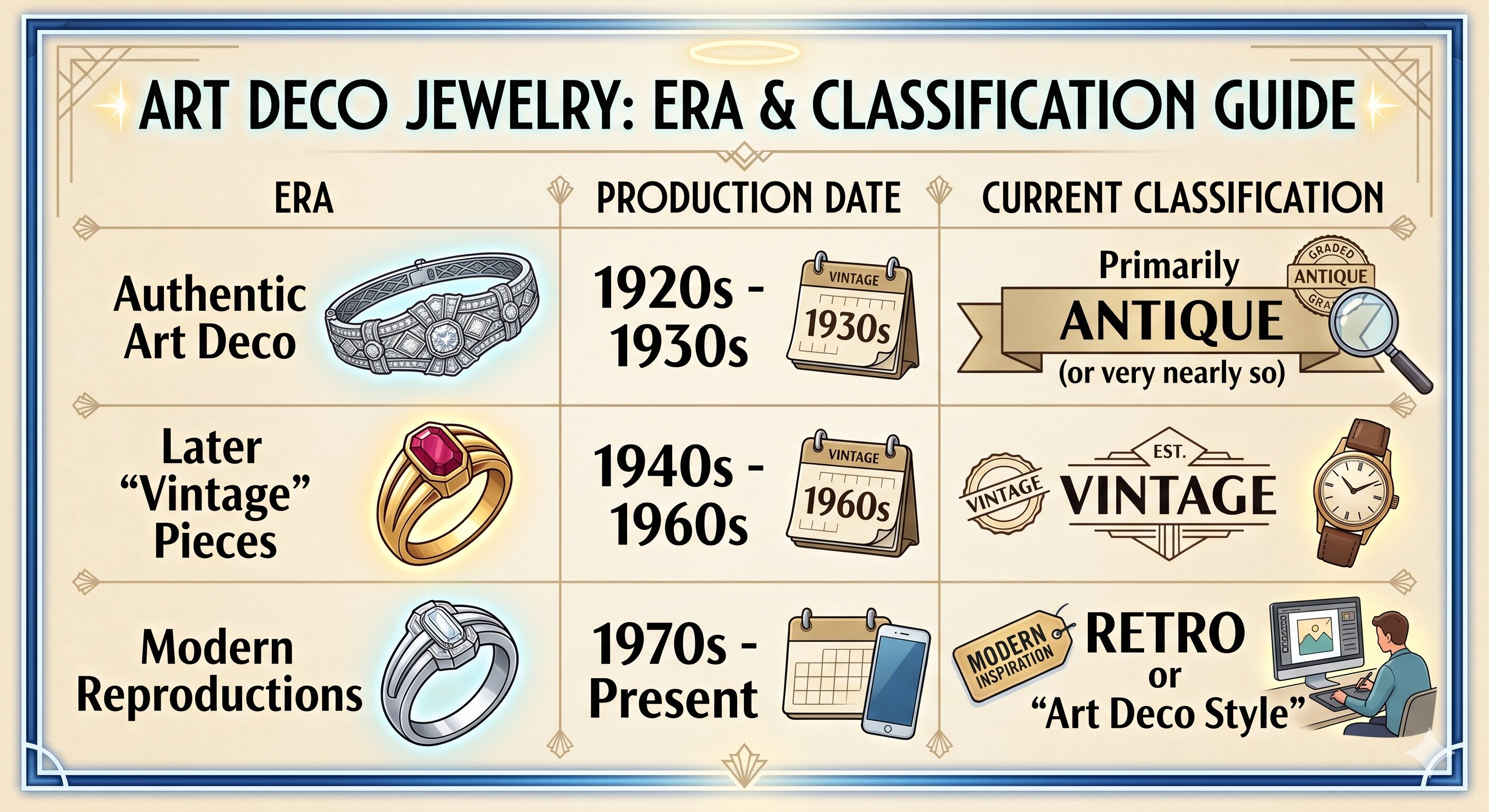
In the world of jewelry collecting and auction houses, authentic Art Deco pieces are firmly in the "Antique" category. So, if you own or are looking at a genuine piece from the 1920s or 1930s, you are dealing with an antique.
How Can You Tell If Jewelry Is Art Deco?
You can identify authentic Art Deco jewelry by looking for a distinct combination of geometric design, specific materials, and fine craftsmanship from the 1920s and 1930s.
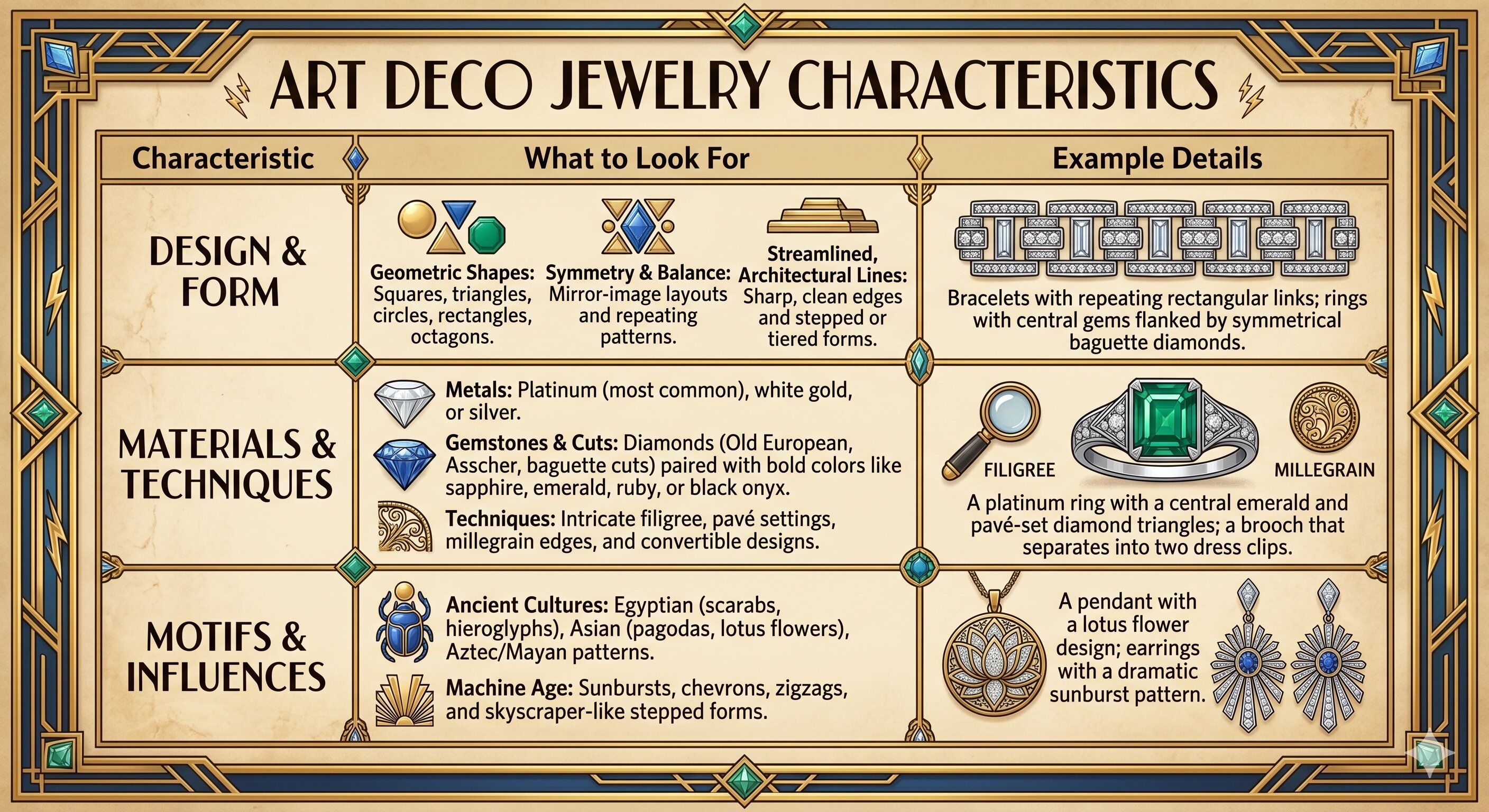
Quick Reference: Key Characteristics of Art Deco Jewelry
Here is a table summarizing the defining features to help you assess a piece at a glance.
Understanding the Era's Influences
The Art Deco period (approximately 1920 to 1935) was shaped by a fascination with modernity and global discoveries. Jewelry design reflected this through:
Cultural Revivals: The 1922 discovery of Tutankhamun's tomb sparked a craze for Egyptian motifs. Designers also incorporated stylized patterns from Asian, African, and Mesoamerican art.
The Machine Age: The sleek lines of new skyscrapers, the speed of automobiles, and industrial geometry were translated into bold, abstract patterns.
Social Change: As women's fashion modernized, jewelry became more structural and dramatic to complement shorter hairstyles and sleeveless dresses.
How to Check for Authenticity
When examining a piece you suspect is an antique, look beyond the style to its construction and marks:
Examine the Metal and Craftsmanship: Authentic pieces from the era primarily use platinum or early white gold, which often has a slightly greyish hue compared to the brighter white of modern alloys. Look for fine, precise millegrain (beaded) edges and hand-finished filigree work.
Look for Hallmarks: Check inside rings or on clasps for tiny stamps. These may indicate the metal purity (e.g., "PT" for platinum, "18K"), a maker's mark (like "Cartier"), or an assay office mark. Note: U.S. hallmarking was less formal, so their absence isn't a definitive sign of a reproduction.
Inspect the "Hardware": Clasps and fittings offer clues. Authentic period pieces typically have fold-over or box clasps, often with elaborate filigree. A modern lobster clasp strongly suggests the piece is a later reproduction.
Consider the Gemstones: Look for the characteristic cuts of the era: baguette, emerald, Asscher, and old European cut diamonds. Calibré-cut gemstones (small stones cut to fit precisely into a pattern) are also a hallmark of the time.
Important: These guidelines help identify style and age. For a definitive valuation or authentication, especially for expensive items, always consult a qualified jeweler, appraiser, or auction house specializing in antique jewelry.
If you have a specific piece you're curious about, feel free to describe its design and any marks you see, and I can offer more tailored insights.
Is Art Deco Gold Or Silver?
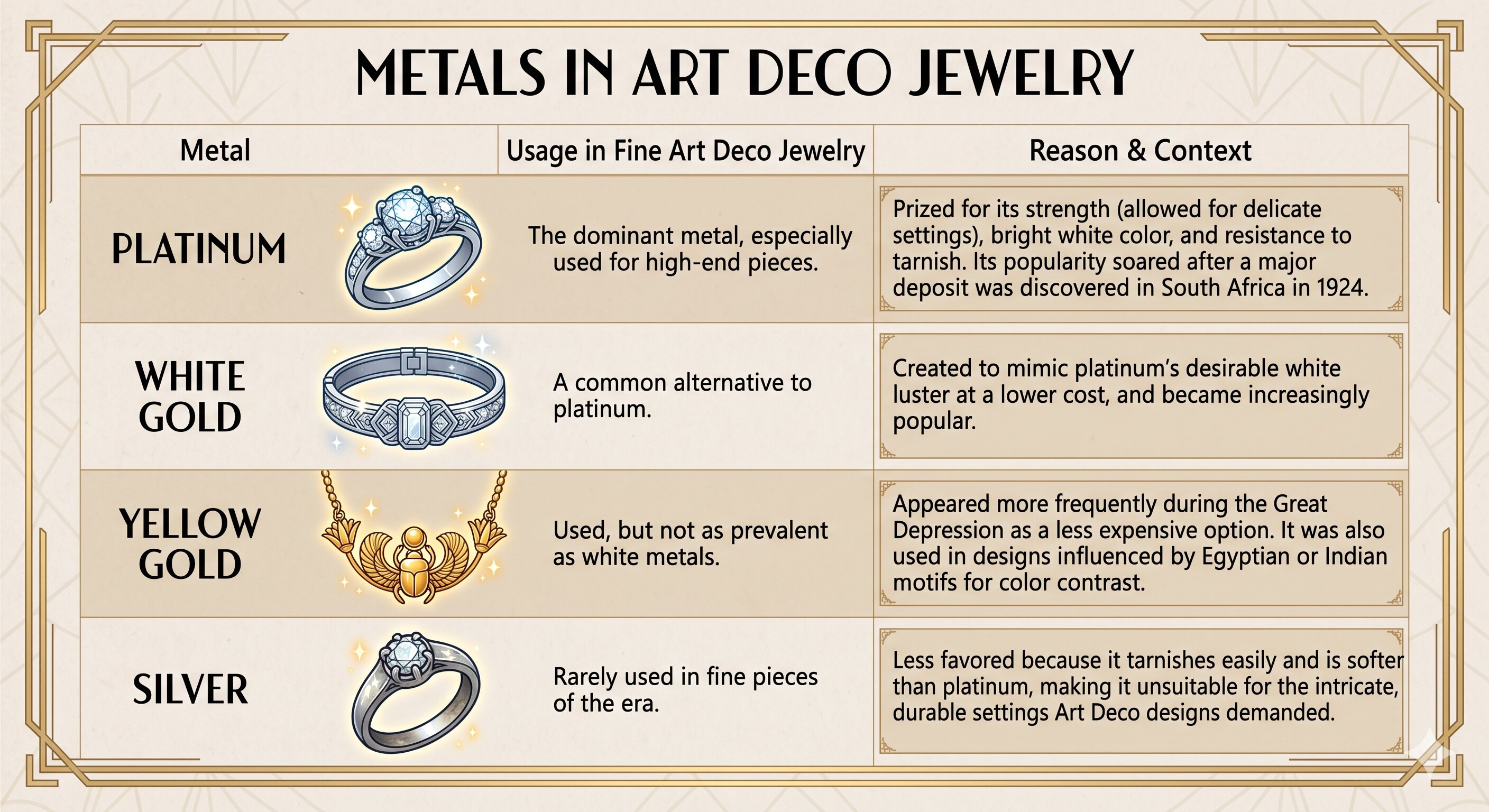
Art Deco jewelry is defined more by its white metal color than by a single metal type. Platinum was the preferred choice for fine jewelry, with yellow gold used more sparingly and silver being quite rare. This preference was due to both style and practicality.
Primary Metals of Art Deco Jewelry
Here is a comparison of the metals used during the period:
Identifying the Metal in Authentic Pieces
To determine what a piece is made of, look for these clues:
Hallmarks: Inspect clasps and ring interiors for tiny stamps. Look for "PT" or "Plat" for platinum, "14K" or "18K" for gold, or maker's marks from famous houses like Cartier or Van Cleef & Arpels.
Color and Weight: Platinum has a distinct, dense heaviness and a cooler, grey-white hue compared to the brighter white of modern white gold or silver.
Craftsmanship: The intricate geometric patterns, millegrain (beaded) edges, and delicate filigree work of the period were made possible by platinum's strength.
In summary, when identifying authentic Art Deco jewelry, you should primarily look for platinum or white gold. Yellow gold can be authentic but is less common, while finding a piece in silver would be unusual for a fine antique.
If you have a specific piece you'd like help identifying, describing its color, markings, and design can help provide more tailored insights.
“You now know the look, the definition, the history, the value, the antique vs. vintage status, the identification methods, and the metals. The only question left: will you wear the jewelry of the modern woman?
*Our current collection includes a limited number of Art Deco pieces — from authentic antiques (pre-1935) to vintage-inspired designs. When authentic signed pieces from Cartier, Van Cleef, or Mauboussin are gone, they are gone. No one is making more 1920s platinum filigree.*
This is not just jewelry. It is King Tut‘s tomb, the skyscraper‘s rise, the flapper‘s dance, and the cocktail ring‘s rebellion — a style that still looks like the future, 100 years later.”
Q: What is the most valuable Art Deco jewelry?
A: Signed pieces from Cartier or Van Cleef & Arpels with original cases.
Q: Is Art Deco jewelry a good investment?
A: Top-quality pieces have proven to be stable and appreciating assets.
Q: What are the defining characteristics of Art Deco jewelry?
A: Art Deco jewelry is defined by its geometric shapes, symmetrical designs, bold color contrasts (like black onyx with white diamonds), and the use of white metals like platinum and white gold. It often features precise gem cuts such as emerald, baguette, and calibre-cut stones.
Q: Is all Art Deco jewelry from the 1920s considered an antique?
A: Yes, as of today, authentic Art Deco jewelry made during the 1920s is over 100 years old and is officially considered antique. Pieces from the 1930s are also very close to this age and are universally treated as antiques due to their historical significance and craftsmanship.
Q: Which jewelers are most famous for Art Deco pieces?
A: The most celebrated and collectible Art Deco jewelry comes from the "Big Four" French houses: Cartier, Van Cleef & Arpels, Boucheron, and Mauboussin. A signed piece from these makers commands the highest value.
Q: What metals were commonly used in Art Deco jewelry?
A: Platinum was the premier metal, prized for its strength, which allowed for intricate filigree work. White gold was also popular as a more affordable alternative to achieve the same desired "white" look.
[Button: Claim Your Art Deco Piece (Limited) →]


Other news for Tuesday 16 June, 2026
- Teardrop Diamond Guide: Meaning, Price, vs Round and Wearing Direction
- Vintage Rings Guide: Styles, Identification, Pros and Cons
- Diamond 4Cs Guide: Cut,Color,Clarity,Carat,Prices and Buying Tips
- Three-Stone Engagement Rings: The Ultimate Buying Guide
- Morganite Guide: Meaning, Price, vs Diamond, Colors and Care
- Gold Plated Jewelry Guide: Care, Durability, vs Solid Gold and Buying Tips
- Titanium Jewelry Guide: Pros, Cons, vs Gold, Price and Care
- Excellent Cut Diamond Guide: Meaning, vs Brilliant, vs Ideal
View all news for Tuesday 16 June, 2026 on one page
News for Monday 15 June, 2026
- Asscher Cut Guide: Complete Guide to Square Emerald Cut Diamonds
- Classic Cut Guide: Old Mine vs Old European vs Modern Round
- Marquise Cut Guide: Price, Size Illusion, vs Oval and Buying Tips
- Pavé Setting Guide: Pros, Cons, Cost, Security and Channel/Bezel
- Radiant Cut Guide: Price, vs Emerald, 1ct, 3ct Cost, Sparkle and Tips
- Vintage Cut Guide: Old Mine vs Old European vs Rose Cut
- Heart-Shaped Diamond Guide: Meaning, Price, 2ct Cost and Buying Tips
View all news for Monday 15 June, 2026 on one page
Recent News
- Sunday 14 June, 2026
- Saturday 13 June, 2026
- Friday 12 June, 2026
- Thursday 11 June, 2026
- Wednesday 10 June, 2026