

Black Onyx Stone: Complete Buying Guide, Real vs. Fake and Prices [2026]
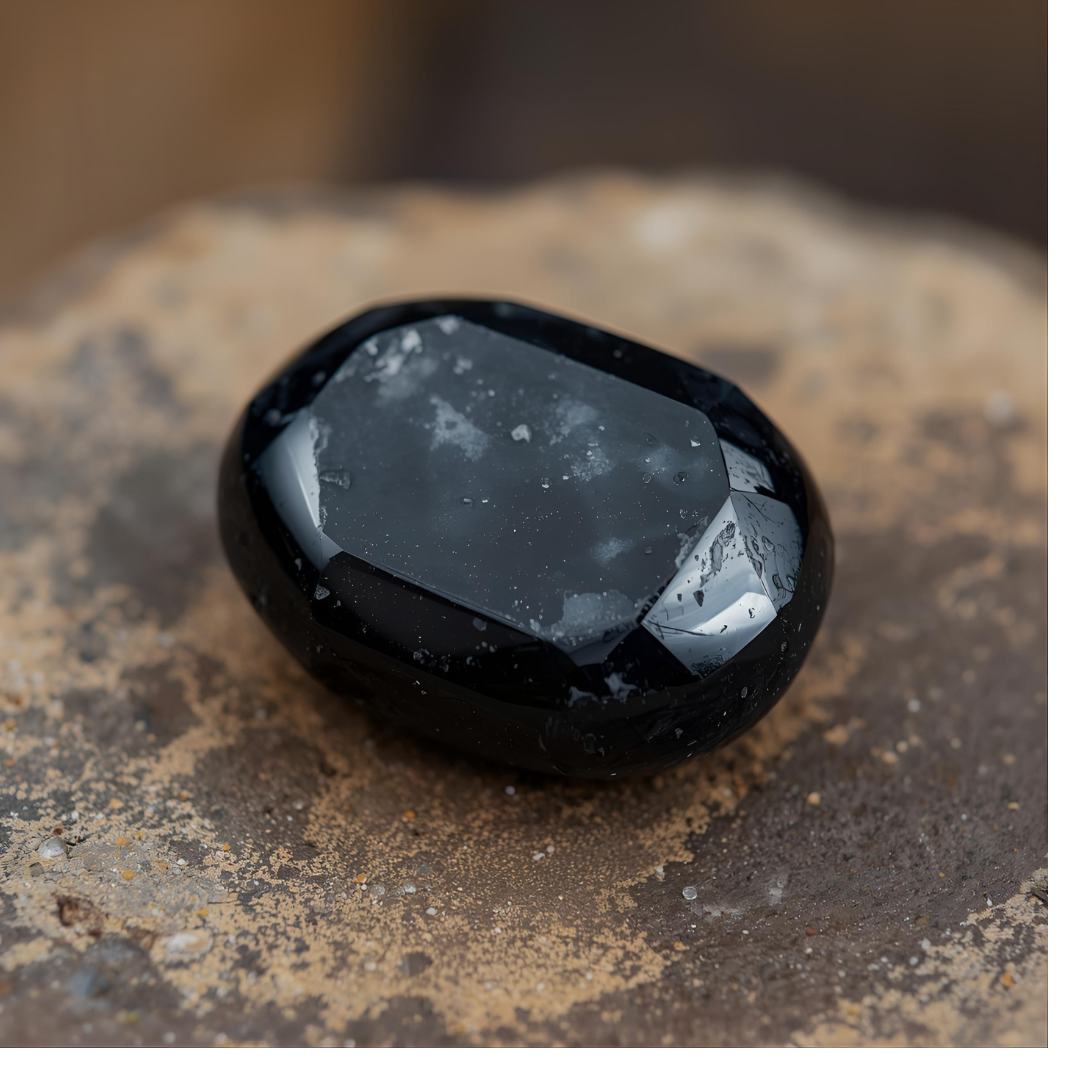
Onyx Stone Guide: Meaning, Colors, Price, and How to Tell Real
Here is a comprehensive overview of the Onyx stone, covering its properties, uses, meanings, and important practical considerations.
“The word ‘onyx‘ comes from the Greek word for ‘fingernail‘ or ‘claw.‘ Ancient Romans believed the stone was once part of the goddess Venus—cut from her fingernails by Cupid's arrow and scattered to the earth. They did not wear it for beauty. They wore it for war. Roman soldiers carried onyx talismans into battle, believing the stone would make them fierce, focused, and unbreakable. In Victorian England, widows wore black onyx for mourning—not as a symbol of death, but of strength to survive it. Onyx does not promise joy. It promises you will not break. That is a different kind of gift.”
The same stone that guarded Roman soldiers and Victorian widows now awaits your own journey — whether for protection, grounding, or quiet strength. Every onyx in our collection is genuine, from solid black to banded sardonyx.
[Button: Explore Onyx Jewelry →]
Here is the content of the table;
- What Is The Onyx Stone Good For?
- What Are The Benefits Of The Onyx Stone?
- Is Onyx An Expensive Stone?
- How Much Does Onyx Stone Cost?
- What Are The Different Colors Of Onyx Stone?
- What Is The Rarest Color Of Onyx Stone?
- Is Onyx The Same As Black Onyx?
- What Are The Disadvantages Of Onyx Stone?
- Is Onyx A Lucky Stone?
- How to Activate an Onyx Stone?
- How To Identify Onyx Stone?
- What Is Green Onyx Really?
- Should You Sleep With Onyx?
- What Determines Onyx's Value?
- What Are The Side Effects Of Wearing Black Onyx?
Let's see the list of content;
What is Onyx Stone?
Onyx is a stunning variety of chalcedony, a type of quartz (SiO₂), characterized by its fine, parallel bands. While most people know it as a solid black stone, it naturally occurs in bands of black and white. The pure, solid black onyx commonly sold is often a treated form of agate.
What Is The Onyx Stone Good For?
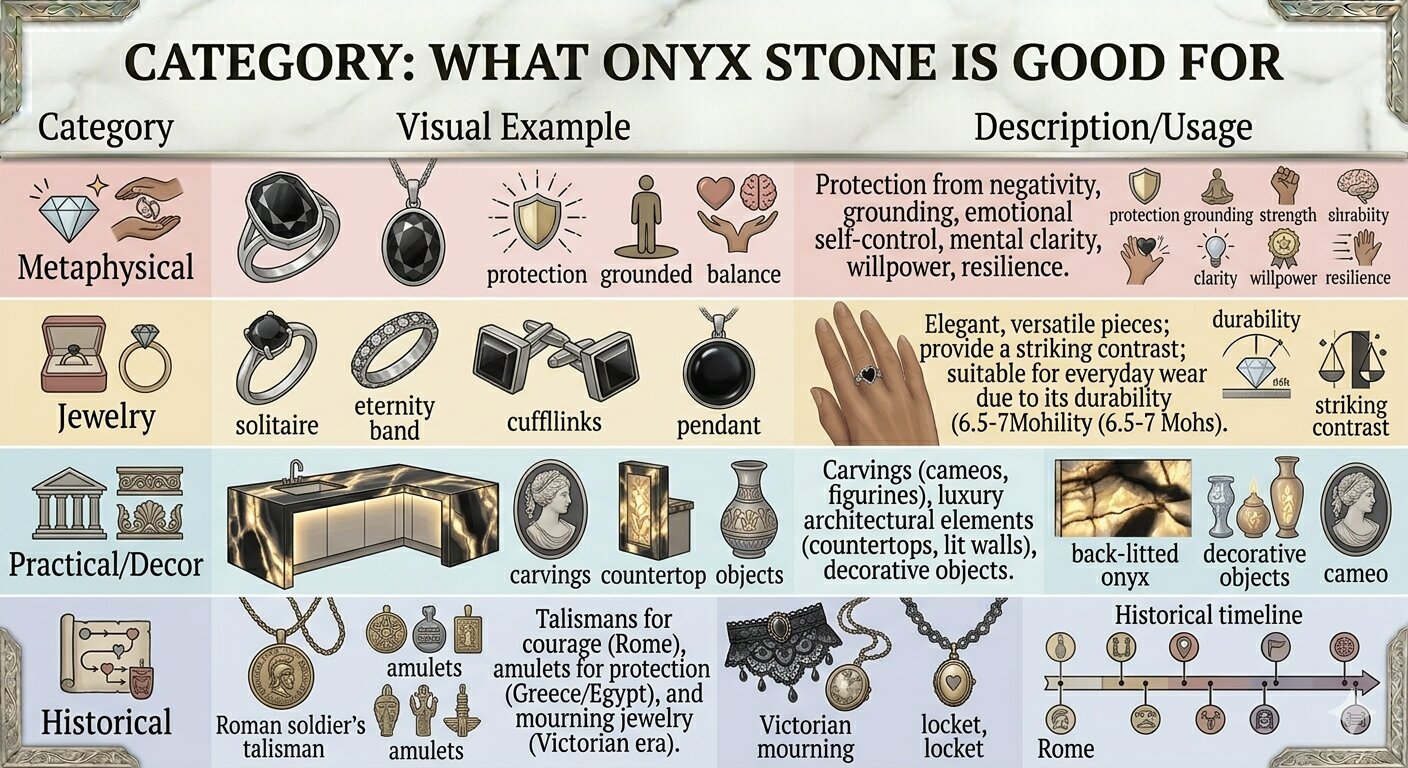
The onyx stone is celebrated for a wide range of uses, spanning from practical and decorative applications to powerful symbolic and metaphysical properties.
Here’s a comprehensive breakdown of what the onyx stone is good for:
1. Metaphysical and Healing Properties (Crystal Healing & Folklore)
In the realm of crystal healing and spiritual practices, onyx is considered a profoundly powerful and protective stone. Its deep black color is associated with grounding, strength, and resilience.
Protection & Shielding: This is its most famous attribute. Onyx is believed to be a potent shield against negative energy, psychic attacks, and "energy vampires." It's often used to create a protective bubble around the wearer.
Grounding & Stability: As an earth stone, it's thought to have a strong grounding effect, connecting one to the physical world and promoting stability, especially during times of stress or upheaval.
Emotional Strength & Self-Control: Onyx is considered a stone of discipline and self-mastery. It is said to help with overcoming grief, anxiety, and unhealthy attachments, fostering emotional balance and wise decision-making.
Mental Strength & Willpower: It's believed to boost mental clarity, concentration, and determination, making it a popular talisman for students, entrepreneurs, and anyone facing a significant challenge.
Past-Life Work: Some practitioners use black onyx in meditation to access and heal from past-life traumas.
2. Physical Uses and Applications (Jewelry & Decor)
Beyond the metaphysical, onyx has been prized for centuries for its physical beauty and practical properties.
Jewelry: Onyx is a classic gemstone for all types of jewelry—rings, pendants, bracelets, and cufflinks. Its opaque black surface provides a stunning contrast to diamonds, other gemstones, and precious metals, making it a staple in men's and women's jewelry.
Cameos and Intaglios: Due to its fine grain and ability to be carved, banded onyx (especially with white and black layers) has been used for centuries to create detailed cameos (raised-relief carvings) and intaglios (incised carvings).
Decorative Objects: Onyx is carved into beautiful figurines, spheres, eggs, and pyramids for collectors and for use in home decor and meditation spaces.
Architectural and Interior Design: Slabs of onyx (often the calcite-based "onyx marble") are used for countertops, tiles, wall panels, and even lampshades. When backlit, its translucency creates a warm, glowing effect that is highly sought after in luxury design.
3. Historical and Cultural Significance
The uses of onyx are deeply rooted in history, confirming its long-standing value.
Ancient Rome: Roman soldiers carried onyx talismans into battle, believing the stone would make them courageous and fierce.
Ancient Greece and Egypt: It was used for amulets, seals, and inlay work in pottery and artifacts, valued for its protective qualities and beauty.
Mourning Jewelry: In the Victorian era, black onyx was extensively used in mourning jewelry due to its somber and elegant appearance.
A Note on Practicality: While the metaphysical beliefs are popular and meaningful to many, they are not scientifically proven. The most universally accepted benefits of onyx are its stunning beauty, durability, and historical significance as a material for jewelry and art.
“In ancient India, onyx was carved into the eyes of temple statues — not for decoration, but because priests believed the stone could ‘see‘ into the spiritual realm. In Hebrew tradition, onyx was one of the twelve stones in the High Priest's breastplate, representing the tribe of Joseph. In Renaissance Europe, onyx was set into rings for diplomats and spies — not for vanity, but because the stone's layered bands made it the perfect material for carving secret intaglios, messages hidden in plain sight. Onyx has always been the stone of secrets: strength in silence, power in protection, and a darkness that hides more than it reveals.”
In essence, whether you are drawn to it for its powerful protective energy or simply for its sleek, elegant appearance, the onyx stone is a versatile and timeless gem good for both personal empowerment and aesthetic enjoyment.
Learn more about onyx's geological properties on Wikipedia's onyx page.
What Are The Benefits Of The Onyx Stone?
The benefits of the onyx stone are celebrated across two main areas: its well-documented practical and historical uses, and its popular metaphysical and spiritual properties rooted in crystal healing traditions.
Here is a comprehensive breakdown of the benefits of the onyx stone:
1. Metaphysical & Spiritual Benefits (Crystal Healing Lore)
In the realm of energy work and spirituality, onyx is considered a powerhouse of grounding and protection.
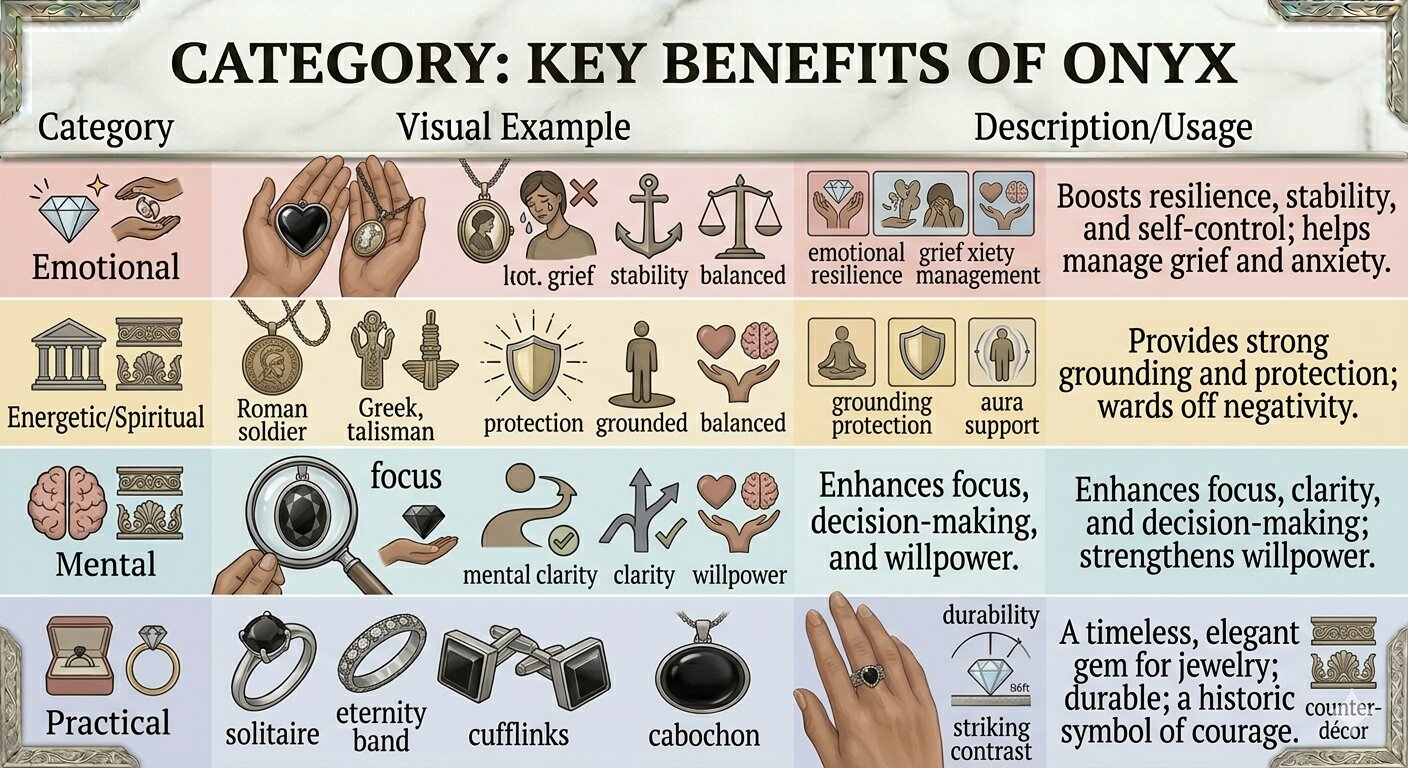
Emotional Resilience & Strength: Onyx is renowned for its ability to absorb and transform negative emotions like grief, anxiety, and stress. It is believed to provide support during challenging times, fostering emotional mastery, stability, and a feeling of being "unshakable."
Powerful Grounding: As a deep, black, earthy stone, it is strongly associated with the root chakra. It's said to help anchor your energy to the present moment and the physical world, preventing you from feeling scattered or disconnected.
Protection from Negativity: This is one of its most famous benefits. Onyx is thought to act as a shield against negative energy, whether from your surroundings or from other people (sometimes called "psychic attack" or "energy vampires").
Enhanced Willpower & Self-Discipline: It's considered a stone of self-control, helping to overcome unhealthy habits, procrastination, and impulses. This makes it a popular talisman for anyone pursuing a difficult goal.
Mental Clarity & Decision-Making: By promoting a calm and focused mind, onyx is believed to aid in clear thinking, sharp concentration, and making logical, wise decisions under pressure.
Support with Grief: Historically, onyx has been used to help process and release sorrow, providing strength to navigate the pain of loss.
2. Practical & Aesthetic Benefits
These benefits are tangible and universally appreciated, regardless of one's belief in crystal metaphysics.
Stylish and Versatile Jewelry: Onyx's sleek, opaque black appearance is highly versatile and elegant. It pairs beautifully with precious metals and other gemstones, making it a timeless choice for rings, pendants, bracelets, and cufflinks for all genders.
Durability for Daily Wear: With a hardness of 6.5-7 on the Mohs scale, onyx is durable enough for regular wear in jewelry, though it should be protected from hard knocks.
Historical Talisman of Courage: Ancient Roman and Greek soldiers carried onyx into battle as a talisman for courage, cool-headedness, and protection in conflict.
Beautiful Decorative Objects: Beyond jewelry, onyx is carved into stunning figurines, spheres, and boxes. The banded calcite variety (often sold as "onyx marble") is used for luxurious table tops, lamps, and wall panels that glow warmly when backlit.
Summary of Key Benefits
Who Can Benefit Most from Onyx Stone?
Onyx is an excellent stone for:
Leaders, Entrepreneurs, and Students: Anyone who needs mental focus and determination to achieve their goals.
People in High-Stress Situations: Those dealing with grief, major life changes, or emotional turmoil who need grounding and strength.
Empaths or Sensitive Individuals: People who easily absorb the negative energy of others and want a protective shield.
Anyone Seeking a Classic, Powerful Gem: Someone who appreciates both the aesthetic beauty and the rich, symbolic history of the stone.
A Final Note: While the metaphysical benefits of onyx are widely embraced in spiritual communities, they are based on tradition and belief rather than scientific evidence. The most universally accepted benefits remain its stunning beauty, historical significance, and durability as a gemstone.
Is Onyx An Expensive Stone?
Onyx is generally an affordable and accessible gemstone, but its price can range from very inexpensive to quite expensive depending on the type, quality, and setting.
To understand why, let's break down the factors that influence the cost of onyx.
1. Type of Onyx: The Biggest Factor
This is the most important distinction, and it goes back to the chemical composition we discussed earlier.
Gemstone Onyx (Silicate - SiO₂): This is the solid black or banded chalcedony used in jewelry.
Price Range: Inexpensive to Mid-Range.
Why? It's relatively abundant and often treated. Most solid black onyx on the market has been dyed to achieve its uniform color. This process is common and accepted, but it keeps the cost low. High-quality, naturally black onyx with a fine polish will cost more.
"Onyx Marble" (Carbonate - CaCO₃): This is the banded, translucent calcite/travertine used for carvings, lamps, and interior design.
Price Range: Moderate to Very Expensive.
Why? As a decorative stone, its value is in the size and quality of the slab. Large, high-quality slabs with beautiful, consistent banding and good translucency can be very costly, especially when used for luxury architectural projects like backlit bars, walls, or flooring.
2. Key Factors That Determine the Price of Gemstone Onyx
For a piece of onyx jewelry, the cost is influenced by:
Color & Uniformity: A pure, deep, and uniform black is most valued. Stones with uneven color or visible banding (unless it's a feature) are less expensive.
Cut & Polish: A well-executed cut (e.g., a fine cabochon or faceted cut) and a high-quality, mirror-like polish significantly increase the value.
Carving: Intricately carved onyx, such as cameos or intaglios, commands a higher price due to the skilled labor involved.
Size and Weight: Larger pieces of fine-quality onyx are rarer and thus more expensive.
Treatment: As mentioned, dyed black onyx is very common and affordable. Untreated, natural black onyx is rarer and will be priced higher.
The Setting: This is a huge factor. An onyx cabochon in a silver ring will be very affordable. The same stone set in 18k gold with a diamond halo from a luxury brand like Cartier or Tiffany & Co. will be extremely expensive. In this case, you're paying for the metal and the brand, not the onyx itself.
3. Price Comparison with Other Stones
To give you context:
Onyx vs. Black Diamond: Onyx is dramatically less expensive. Black diamonds are genuine diamonds and are priced accordingly.
Onyx vs. Obsidian: They are similarly priced, both being affordable black gemstones. Obsidian (volcanic glass) is often even less expensive.
Onyx vs. Lapis Lazuli or Turquoise: High-quality lapis or turquoise is typically more expensive than common onyx.
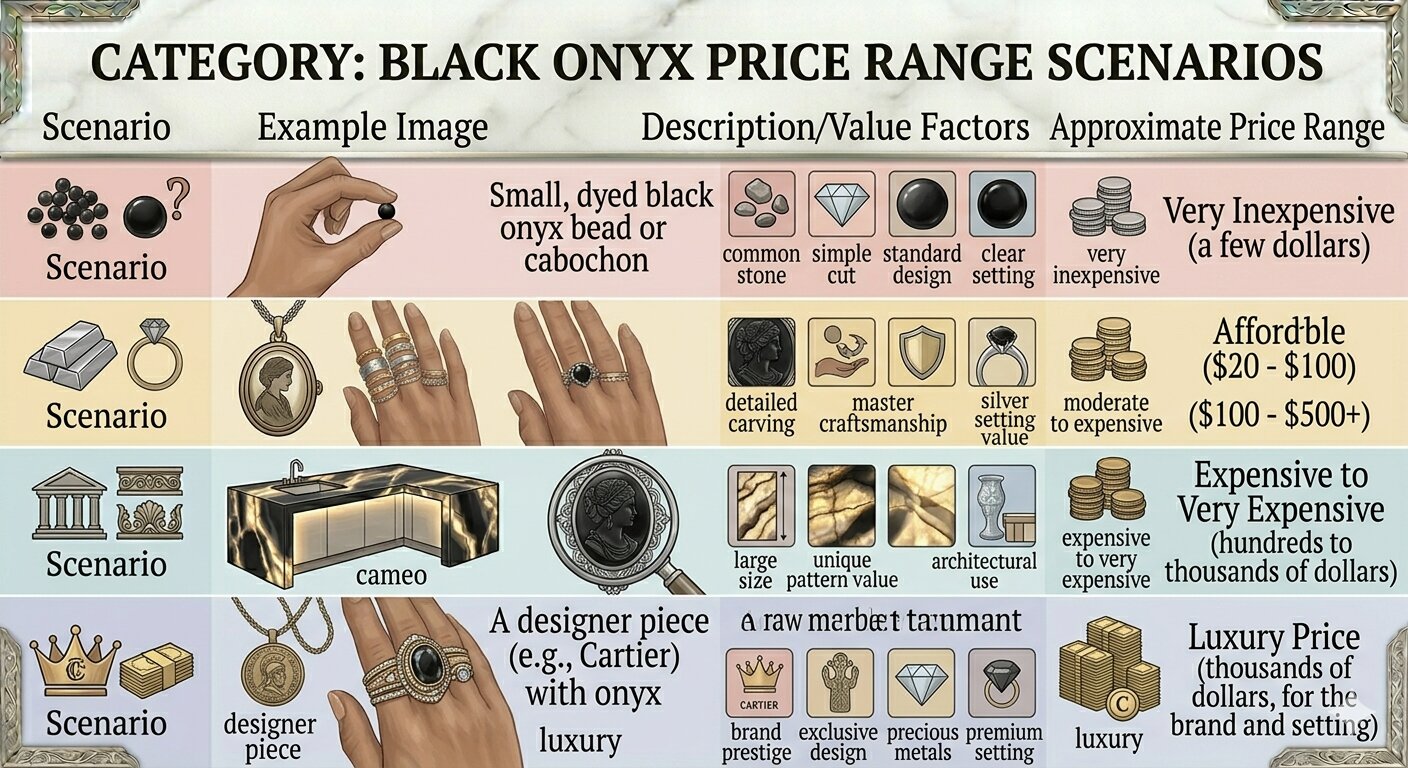
You can easily find beautiful onyx jewelry that is very budget-friendly. However, like any material, it can be transformed into a high-cost item through exceptional quality, skilled craftsmanship, or a luxury brand name. So, while the raw stone itself is not typically considered expensive, the final product can be.
How Much Does Onyx Stone Cost?
Giving a single price for onyx is impossible, as it varies dramatically based on its form, quality, and setting. However, I can provide clear price ranges for the most common ways you would buy it.
To understand the cost, it's crucial to remember the two types we discussed earlier:
Gemstone Onyx (SiO²): Used in jewelry.
Onyx Marble (CaCO³): Used for slabs, tiles, and decorative objects.
Here’s a detailed breakdown:
1. Raw Onyx Stones & Tumbled Pieces (For Collection/Crafting)
This is the most affordable way to buy onyx.
Small Tumbled Stones: A small, tumbled black onyx stone can cost $2 to $10.
Palm-Sized Raw Pieces: A larger, raw chunk of banded onyx or onyx marble might be $10 to $30.
2. Onyx in Jewelry
The price here depends heavily on the craftsmanship, size, and metal setting.
Loose Cabochons (Polished, domed stones):
A standard, dyed-black onyx cabochon (e.g., 20mm x 15mm) can cost $5 to $20.
A finer quality, naturally black or intricately banded cabochon will be $20 to $75.
Finished Jewelry Pieces:
Silver Jewelry: [Explore our collection of sterling silver onyx rings] with prices ranging from $30 to $50.
Gold Jewelry: The price skyrockets due to the metal. A simple 10k-14k gold ring with onyx can be $200 to $600. A high-end designer piece (like one from Cartier) with onyx can cost thousands of dollars, where you're paying for the brand more than the stone.
3. Decorative Onyx Marble Slabs & Tiles (For Home Design)
This is where onyx can become a true luxury item. Price is usually per square foot (sq. ft.).
Standard Onyx Tiles: Common varieties can start at $20 to $50 per sq. ft.
High-Quality Slabs: For large, beautifully veined, translucent slabs used for a countertop or a backlit feature wall, expect to pay $100 to $250+ per sq. ft. The most exquisite, rare slabs can be even more expensive.
Price Comparison Table
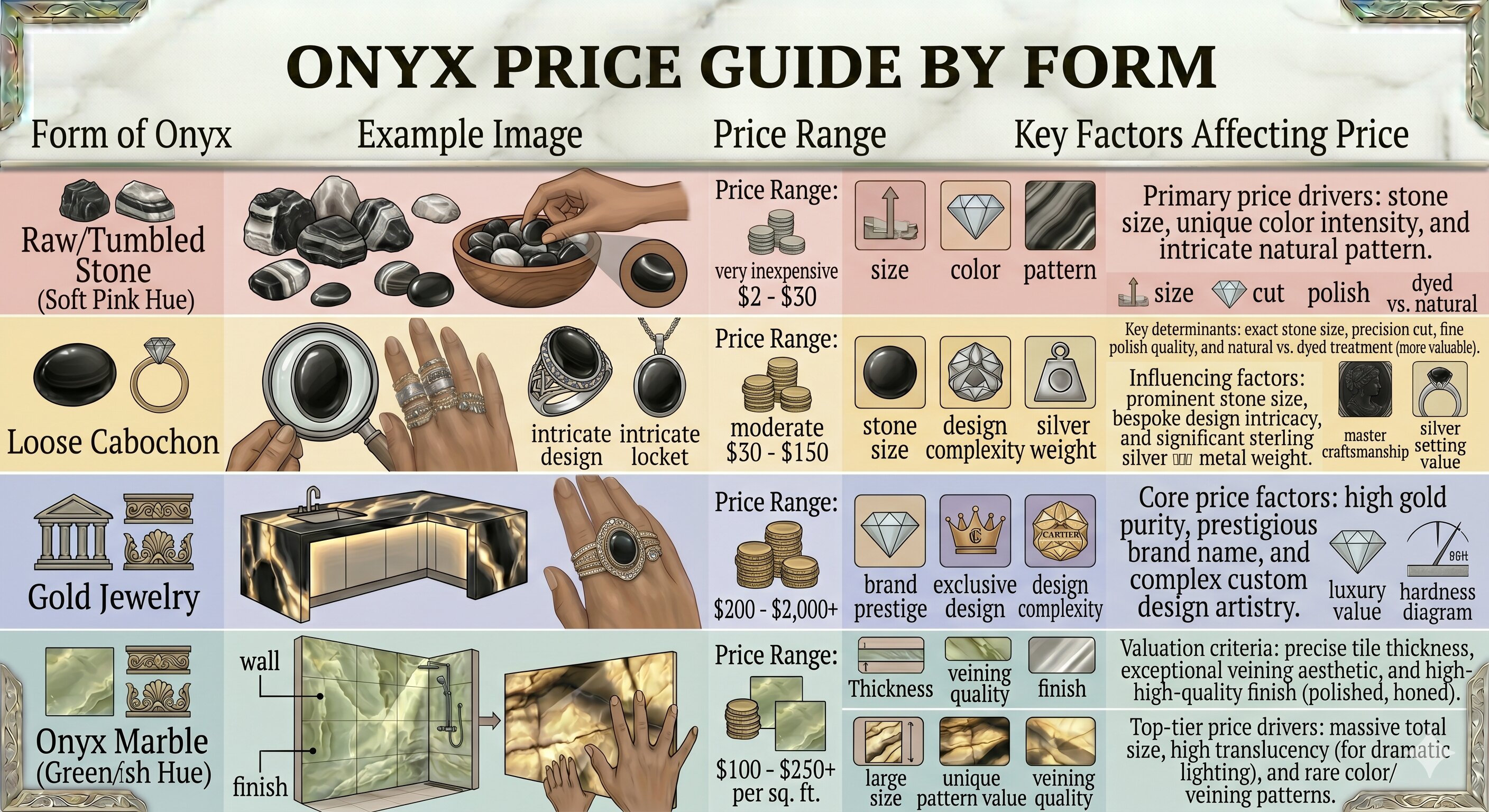
Is it Expensive?
For a jewelry lover on a budget, onyx is an incredibly affordable gemstone. You can easily find beautiful, stylish pieces without spending a lot of money.
For a homeowner or interior designer, Onyx is a luxury material. Using it for a countertop, vanity, or backlit wall is a high-end design choice comparable to premium marble or granite.
In short, onyx is unique in that it can be both an accessible, everyday gem and an opulent, statement material, with a price tag to match.
For current gemstone market prices, visit the American Gem Society's price guide.
What Are The Different Colors Of Onyx Stone?
While most people picture a solid black stone when they think of onyx, it actually comes in a fascinating variety of colors and patterns.
The key to understanding onyx's colors lies in its two main types:
Chalcedony Onyx (SiO₂): The gemstone variety is known for its parallel bands.
Onyx Marble / Calcite Onyx (CaCO₃): The decorative stone, known for its swirling, translucent layers.
Here’s a detailed breakdown of the different colors of onyx:
1. Chalcedony Onyx (The Gemstone)
This is the type used in jewelry and carvings. Its colors are almost always banded.
Black Onyx: This is the most famous and popular variety. It is typically a solid, uniform jet black. It's important to know that most solid black onyx on the market has been dyed to achieve this consistent color, as natural, solid black chalcedony is rare.
Sardonyx: This is a very common and popular type of banded onyx. It features alternating layers of brownish-red (sard) and white or black. It has been used for centuries in cameos and intaglios.
Classic Banded Onyx: The "textbook" definition of onyx is a stone with parallel, straight bands in contrasting colors. The most classic combination is black and white.
Other Color Combinations: While less common, you can find chalcedony onyx with bands in:
Brown and White
Red and White
Gray and White
2. Onyx Marble / Calcite Onyx (The Decorative Stone)
This is the type used for tabletops, lamps, and wall panels. Its colors are more blended and swirling, and it is prized for its translucency.
Green Onyx: Ranges from pale, minty green to deep emerald hues. This is one of the most sought-after colors for decorative purposes.
Honey/Yellow Onyx: Features warm, golden-yellow tones that can look like honey or amber, especially when backlit.
Red Onyx: Can vary from soft pinkish-red to deep, dramatic crimson.
White Onyx: Often a creamy, translucent white with subtle veins of gold, gray, or brown running through it.
Blue Onyx: A rarer color, typically appearing as light sky-blue or teal shades.
Multi-Colored & Veined: Most decorative onyx slabs are not a single solid color. They feature stunning, organic patterns where multiple colors blend and swirl together, creating unique "landscapes" of veining.
Summary Table of Onyx Colors
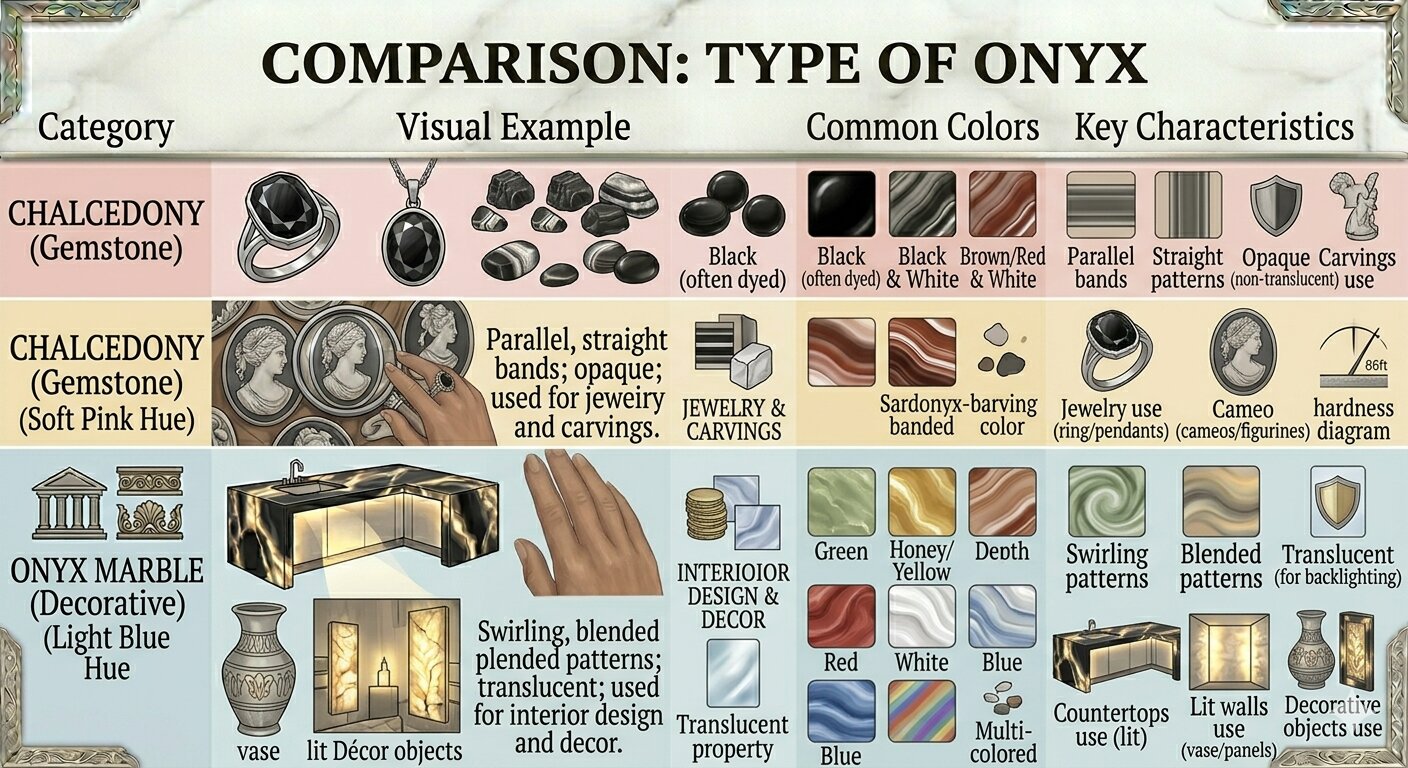
A Note on Rarity and Treatment
Natural vs. Treated: The vibrant, solid colors in chalcedony onyx (especially pure black, deep green, or bright red) are almost always the result of dyeing or sugar-acid treatment. This is a common and accepted practice in the gem trade.
Natural Beauty: The banded patterns of sardonyx and the swirling patterns of onyx marble are typically natural and enhance the stone's value and uniqueness.
The world of onyx is far more colorful than just black. From the sharp bands of sardonyx to the glowing, honey-gold panels of onyx marble, this stone offers a diverse palette for both jewelers and interior designers.
What Is The Rarest Color Of Onyx Stone?
The rarest color of onyx depends heavily on which type of onyx we're discussing, as the two main types form in completely different ways.
Here’s a clear breakdown:
The Rarest Color: A Two-Part Answer
1. For Chalcedony Onyx (The Banded Gemstone)
The rarest and most valuable color for this type is natural, untreated solid blue onyx.
Why it's so rare: The classic banded chalcedony onyx gets its colors from iron and manganese impurities, which typically create black, brown, red, and white bands. A true, solid blue color is not a typical outcome of this process. Virtually all solid blue "chalcedony" on the market is a different mineral, like howlite or magnesite, that has been dyed.
What you might find: On the extremely rare occasion that blue appears in banded chalcedony, it is usually a very pale, grayish-blue and is rarely a solid, vibrant color. A genuine, solid blue chalcedony onyx would be a collector's item.
In this category, a naturally occurring, vibrant solid color of any kind (black, red, blue) is exceptionally rare. Most solid-colored onyx jewelry has been dyed.
2. For Onyx Marble (The Decorative Calcite)
The rarest and most sought-after color for this type is a vibrant, richly patterned green onyx.
Why it's so rare: The green color in calcite onyx is caused by traces of copper or other specific minerals during its formation. Achieving a deep, uniform, and saturated green without flaws or muddying is a geologically uncommon event.
What makes it valuable: When this rich green color is combined with the stone's natural translucency and dramatic swirling patterns, it creates a breathtaking effect, especially when backlit. Large, high-quality slabs of green onyx marble command the highest prices in the interior design world.
Summary of Rarity
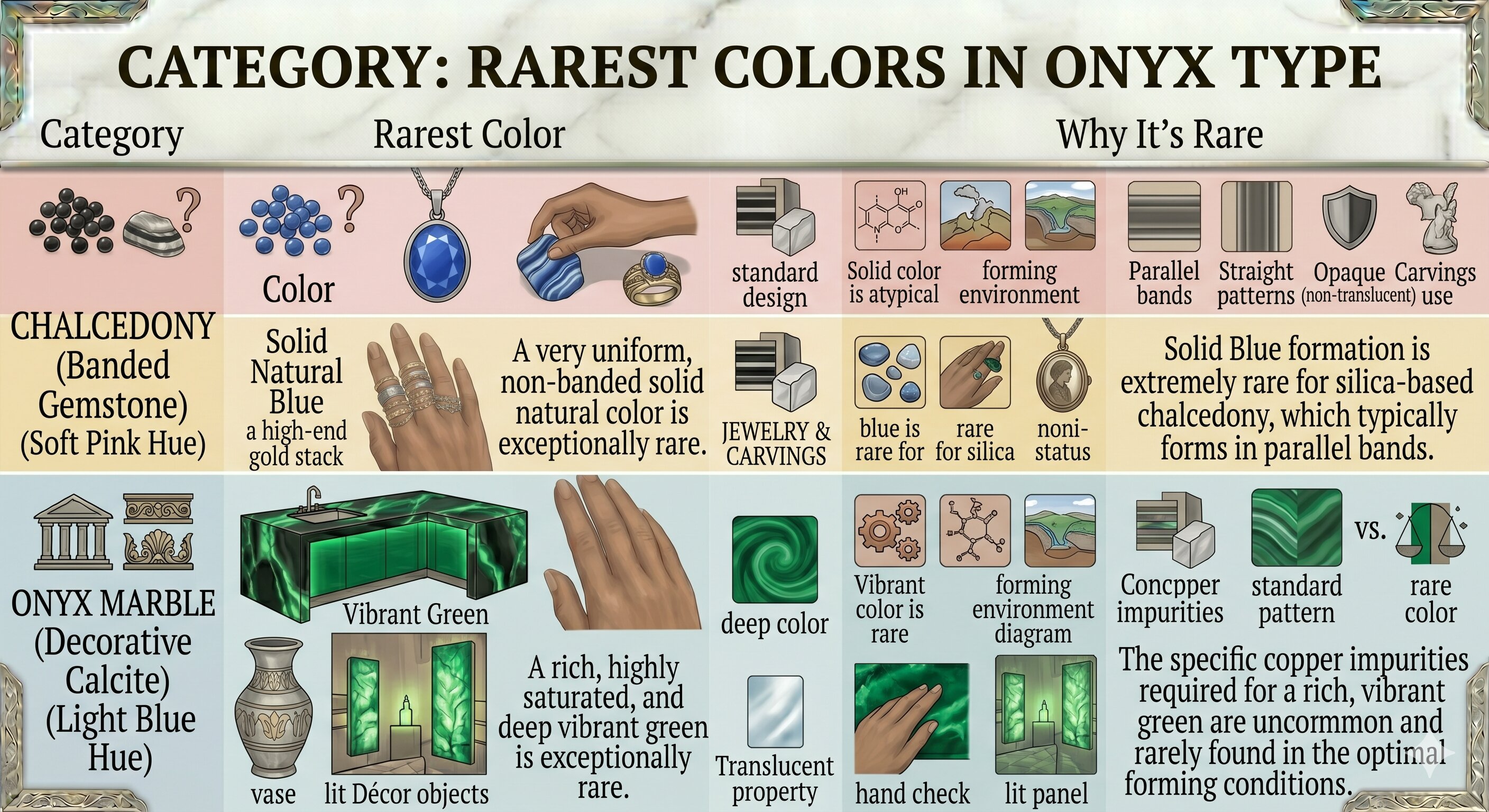
Other Notable Rare Colors
Natural Solid Black Chalcedony: While common on the market, it's almost always dyed. A naturally pure, deep black chalcedony with no banding is quite rare.
Pure White Onyx Marble: A completely pure, brilliant white calcite onyx with no veining is also very rare and valuable for its elegant, minimalist look.
If you're looking at jewelry, a naturally solid blue onyx is the holy grail. If you're looking at a stunning backlit wall or tabletop, a vibrant green onyx marble is the pinnacle of rarity and luxury.
Is Onyx The Same As Black Onyx?
The short answer is: No, "Onyx" and "Black Onyx" are not the same thing, but in the modern gem and jewelry market, they are often used interchangeably.
Here’s the detailed breakdown of the relationship:
"Onyx" is the General Category
Think of "Onyx" as the umbrella term for a specific variety of the mineral chalcedony. By its strict geological definition, onyx is a banded stone, characterized by parallel layers of color. The most classic and natural form of onyx has alternating black and white or brown and white bands.
A specific, well-known type of banded onyx is Sardonyx, which has layers of brownish-red (sard) and white.
"Black Onyx" is a Specific (and Often Treated) Type
"Black Onyx" refers to a solid, pure black version of the stone. Here's the crucial part:
Most Black Onyx on the market is not naturally solid black. It is created by taking gray or white banded agate/chalcedony and dyeing it black. This process is permanent, stable, and completely accepted in the jewelry industry.
Naturally occurring, solid black chalcedony is relatively rare. So, when you see a piece of affordable, jet-black jewelry, it is almost certainly dyed.
The Key Difference: Banded vs. Solid
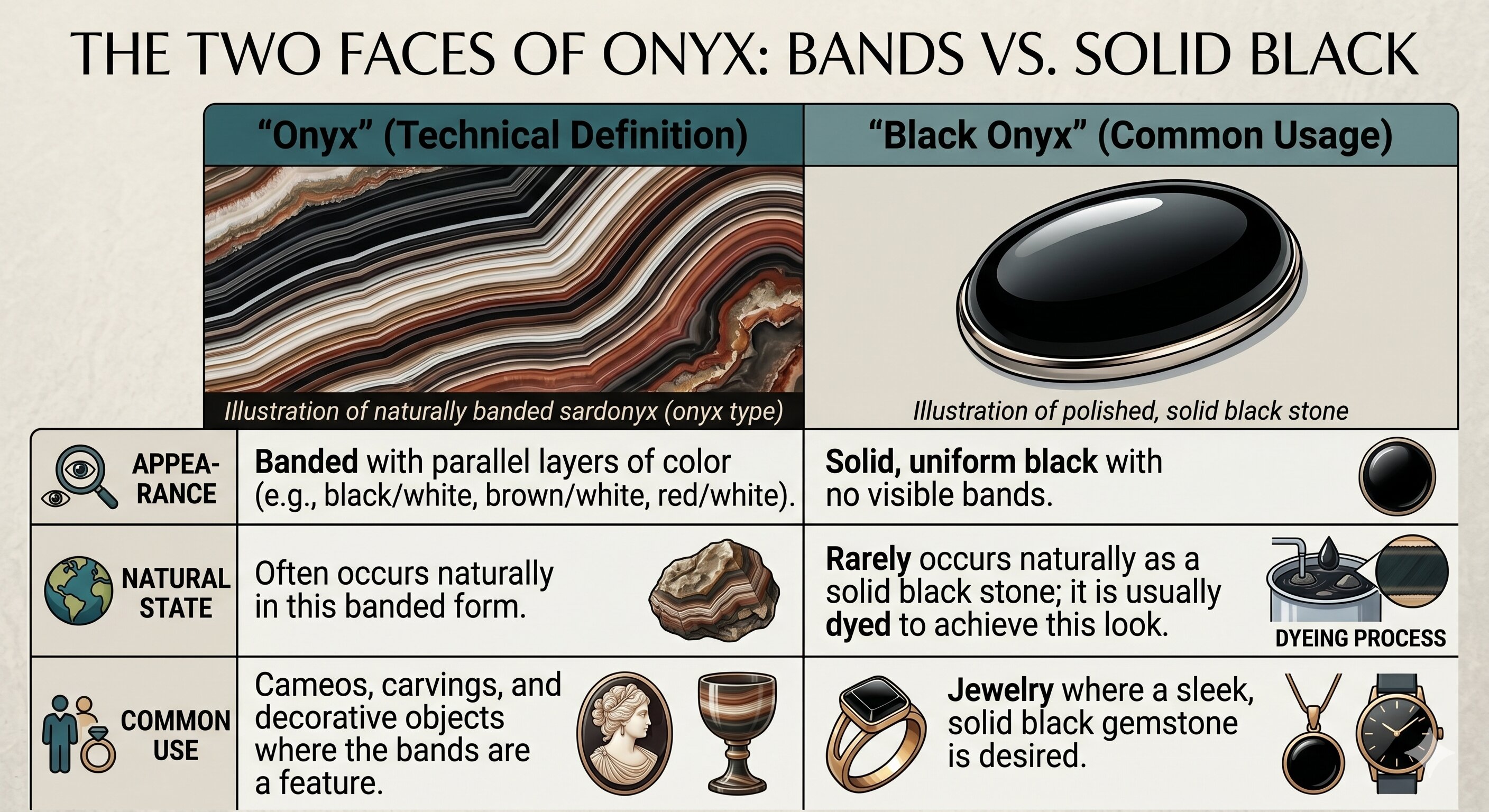
The Simple Analogy
Think of it like "Marble" and "White Marble."
Marble comes in many colors (Carrara White, Nero Marquina Black, Rosa Português Pink).
When someone says "White Marble," they are specifying the color, but it's still a type of marble.
Similarly:
Onyx can be banded in various colors.
Black Onyx specifies the color, and in today's market, it almost always means the solid black, often-dyed variety.
In a jewelry store, if you ask for "Onyx," the salesperson will almost certainly show you a solid black stone. If you are a geologist or mineral collector, "Onyx" means the banded stone.
So, while all Black Onyx is a type of Onyx, not all Onyx is Black Onyx. The term "Black Onyx" has simply become the standard name for the dyed-black gemstone used in jewelry.
What Are The Disadvantages Of Onyx Stone?
Onyx is a stunning natural stone, prized for its dramatic, translucent veining and use in luxury designs. However, it comes with several significant disadvantages that make it unsuitable for many applications.
Here is a detailed breakdown of the disadvantages of onyx, categorized for clarity.
1. Durability and Physical Vulnerabilities
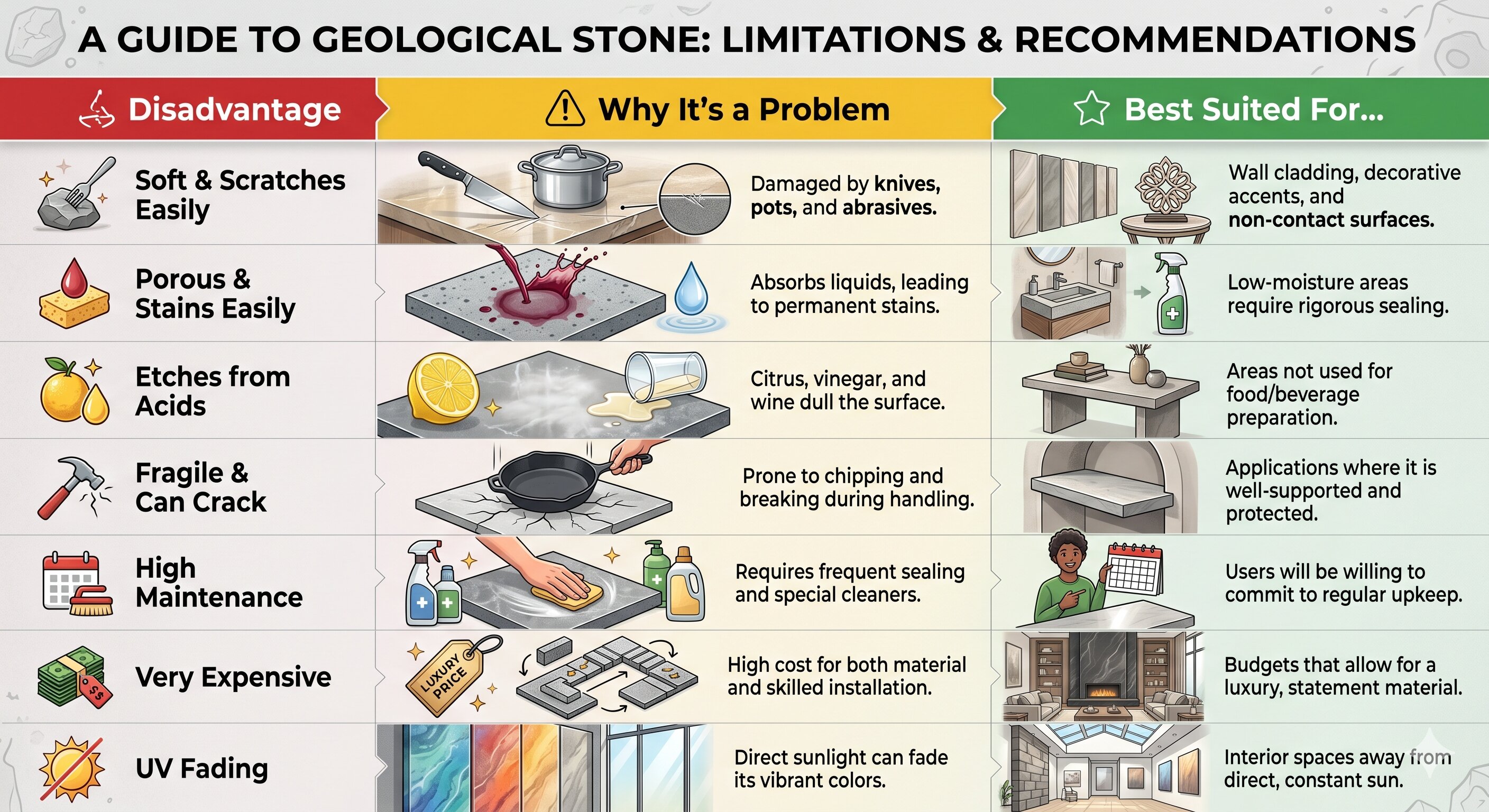
Softness and Scratches: Onyx is a form of calcite, which ranks a 3 on the Mohs hardness scale. For comparison, granite is 6-7, nd quartzite is 7-8. This means it is very soft and can be easily scratched by knives, abrasive cleaners, or even dust. It is not recommended for kitchen countertops for this reason.
Porosity and Staining: Onyx is a porous stone. Without a high-quality sealer, it will readily absorb spills of oil, wine, coffee, and acidic liquids like citrus juice or vinegar. This can lead to permanent, deep-set stains.
Susceptibility to Etching: Because its primary component is calcium carbonate, onyx is highly reactive to acids. Any acidic spill will cause "etching"—a chemical burn that dulls the surface finish, leaving a light-colored mark. This damage is often permanent and requires professional re-polishing.
Chipping and Cracking: The veining in onyx can be a point of structural weakness. It is more prone to chipping on edges and can crack under heavy impact or stress. Its translucency often means it is cut into thinner slabs, making it even more fragile during fabrication and installation.
2. High Maintenance and Care
Requires Frequent Sealing: To mitigate staining, onyx must be sealed with a high-quality, penetrating sealer upon installation and then resealed regularly—often every 6 to 12 months, depending on use. This is a higher maintenance requirement than most other natural stones.
Demanding Cleaning Regimen: You cannot use standard, all-purpose, or acidic cleaners. Only pH-neutral, stone-specific cleaners are safe. Harsh chemicals will permanently damage the surface.
Heat Sensitivity: While generally heat resistant, onyx can be damaged by sudden, extreme temperature changes (thermal shock), which can cause it to crack. It's always best to use trivets and hot pads.
3. Cost and Installation Challenges
High Material Cost: High-quality onyx is a rare and exotic stone, making it one of the most expensive natural stone options available, often comparable to high-end marble.
Expensive and Difficult Installation: Due to its fragility, installing onyx requires highly skilled fabricators and installers. The risk of breaking a slab is high, which increases labor costs. For backlit applications, the installation becomes even more complex and costly.
4. Practical Limitations for Certain Uses
Poor Choice for High-Traffic or Wet Areas: It is not recommended for kitchen countertops, bathroom vanities (especially near sinks), or flooring in high-traffic areas due to its susceptibility to scratches, stains, and etches.
Light Can Cause Fading: If used in a sun-drenched area, the vibrant colors of onyx can fade over time due to prolonged exposure to direct UV light.
Not for Outdoor Use: It is strictly an indoor material. Weather, freezing temperatures, and direct sunlight will quickly degrade and damage onyx.
5. Sourcing and Environmental Concerns
Limited Availability: True, high-quality, translucent onyx is not as universally available as granite or marble. This can limit your design options and increase lead times.
Variability: As a natural stone, no two slabs are identical. While this can be an advantage for a unique look, it also means you must personally view and select the exact slab you will be using, as samples are not always representative.
Environmental Impact: Quarrying and transporting any heavy natural stone have a significant carbon footprint.
Summary Table: Disadvantages of Onyx
When to Use Onyx
Despite its many disadvantages, onyx is unparalleled in creating a breathtaking, luxurious ambiance. Its disadvantages are really just practical constraints.
Use onyx for: spectacular backlit feature walls, bar fronts, wall cladding, decorative inlays, tabletops (used with extreme care), and bathroom walls (away from the shower and sink).
Avoid onyx for: kitchen countertops, high-traffic flooring, outdoor applications, and any area where it will face frequent abrasion, impacts, or chemical exposure.
Is Onyx A Lucky Stone?
The answer is nuanced because whether onyx is considered a "lucky stone" depends entirely on the cultural, historical, and metaphysical lens you are looking through.
In short, onyx is not universally considered a lucky stone in the way jade or citrine might be. In fact, in some traditions, it has quite the opposite reputation. However, in modern crystal metaphysics, its "luck" is tied to its protective and grounding properties.
Let's break down the different perspectives:
1. Historical and Cultural Perspectives (Often Not "Lucky")
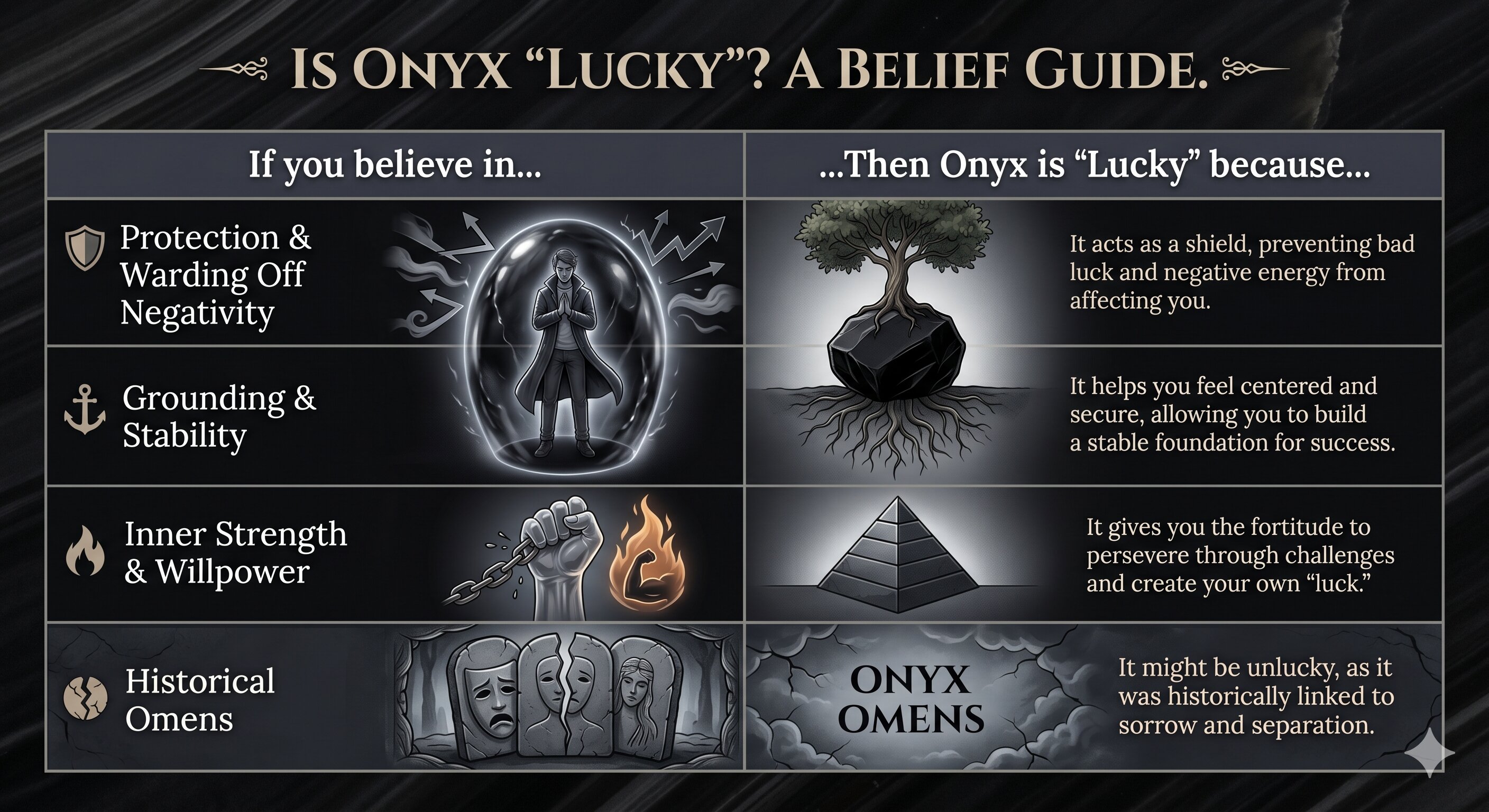
Ancient Roman & Greek Associations: In ancient Rome, onyx was often associated with bad luck, sorrow, and contention. Its layered, banded appearance was thought to resemble a fingernail (the word "onyx" comes from the Greek word for "claw" or "fingernail"). There was a belief that it could provoke separations and arguments between lovers. Roman soldiers would carry onyx into battle not for luck, but for courage and protection.
Indian (Hindu) Beliefs: In some Indian traditions, onyx is considered an inauspicious stone. It is sometimes associated with Saturn (Shani), a planet linked to hardship, discipline, and karmic lessons. While wearing it can be beneficial for strengthening oneself against Saturn's challenges, it is not typically worn for general "good luck."
2. Modern Metaphysical and Crystal Healing Perspectives (The "Protective Luck" View)
This is where the concept of onyx as a "lucky" stone emerges, but it's a specific kind of luck—the luck of protection, stability, and resilience.
A Stone of Protection and Grounding: This is its primary "power." Onyx is considered a powerfully grounding stone, connecting the wearer to the Earth. It is believed to absorb and transform negative energy, creating a protective shield around the user. In this sense, it brings "luck" by warding off bad luck, negativity, and psychic attacks.
Strength and Endurance: It's known as a stone of strength, helping to build inner fortitude, perseverance, and self-control. The "luck" here is in giving you the strength to overcome challenges and bad habits, making your own luck through resilience.
Emotional Balance: Onyx is said to help during times of great stress, grief, or confusion, providing stability and promoting wise decision-making. This can be seen as "lucky" in navigating life's difficult periods.
3. Practical & Symbolic "Luck".
A Stone for Business and Focus: Because of its associations with discipline and self-control, some businesspeople keep a piece of onyx on their desk, believing it helps with focus, willpower, and making prudent decisions—leading to success, which is a form of "earned luck."
Black Stones in General: In many cultures, black stones are seen as protective talismans against the "evil eye" and negative intentions. Onyx, being a classic and beautiful black stone, fits into this category.
Summary: Is Onyx Lucky For You?
Don't choose onyx if you are looking for a stone to attract sudden windfalls, lottery wins, or chance encounters (for that, people often turn to citrine or green jade).
Do choose onyx if your idea of "luck" is being protected from harm, feeling emotionally strong and grounded, and having the discipline to achieve your goals. Its power is not in attracting external fortune but in forging internal strength and resilience, which often leads to a more fortunate and controlled life.
Ultimately, its effect is highly personal. If you are drawn to its deep, elegant beauty and feel a sense of calm and strength when you hold it, then for you, it is a lucky stone.
How to Activate an OnyxStone?
"Activating" an onyx stone is a concept from crystal healing and metaphysics, not science. The process is about clearing any stored energies and programming the stone with your specific intention, essentially turning it from a decorative object into a personal talisman.
Here is a comprehensive guide on how to activate your onyx stone, drawing from common practices.
Step 1: Cleansing (The Most Important First Step)
Before you activate a new stone, it's believed you should cleanse it of any energies it may have absorbed during its journey to you. Choose the method that feels right for you and is safest for the stone.
Important Note: Onyx is a soft, porous, and layered stone. Avoid using water, especially salt water, for cleansing, as it can seep into the layers, cause clouding, or even dissolve the stone over time.
Safe Cleansing Methods for Onyx:
Smoke Cleansing: This is one of the best methods. Pass your onyx through the smoke of sacred herbs like Palo Santo, sage, or cedar. As you do this, visualize the smoke purifying the stone and carrying away all stagnant energies.
Sound Cleansing: Use a singing bowl, a bell, or tuning forks. The high-frequency vibrations are thought to "shake loose" and reset the energy of the stone without any physical contact.
Earth Cleansing: Bury your onyx in the earth (in a safe, clean spot) or in a bowl of dry brown rice for 24 hours. The earth/rice is believed to absorb negative energies. Be sure to brush off any dirt or discard the rice afterward.
Moonlight Bath: Place your onyx in the light of the full moon overnight. Moonlight is considered a gentle and powerful cleanser. Avoid direct sunlight, as it can fade the color of some stones over time.
Breath (Pranic Cleansing): Hold the onyx in your hands, take a few deep breaths, and then gently exhale onto the stone with the intention of clearing it with your own life force energy.
Step 2: Setting Your Intention (The "Activation" Proper)
This is the core of the activation process. Your intention programs the stone with a specific purpose.
Find a Quiet Space: Sit comfortably in a place where you won't be disturbed.
Hold the Stone: Take your cleansed onyx in your hands. If it's a palm stone, hold it in your receiving (non-dominant) hand.
Center Yourself: Close your eyes and take several deep, calming breaths. Feel yourself becoming present and grounded.
Formulate Your Intention: Clearly and calmly state your purpose for the stone. Onyx is particularly associated with protection, grounding, strength, and self-control. Your intention could be something like:
"I program this onyx to be a shield, absorbing and transforming all negative energy directed toward me."
"I activate this stone to help me feel grounded, stable, and secure during times of change."
"I infuse this onyx with the energy of willpower to help me overcome [a specific challenge or bad habit]."
Visualize: As you state your intention, visualize the corresponding energy. For protection, imagine a shield of black light emanating from the stone. For grounding, visualize roots growing from the stone deep into the earth.
Ask for Confirmation (Optional): Some people like to ask for a sign that the activation is complete, such as a slight warmth, a tingle in their hand, or simply a feeling of "rightness."
Step 3: Charging (Amplifying the Energy)
After setting your intention, you can "charge" the stone to amplify its newly programmed energy.
Place it with a Selenite Tower: Selenite is believed to be a self-cleansing and high-vibration stone. Placing your onyx on or next to a piece of selenite will keep it charged and active.
Use a Crystal Cluster: Placing your onyx on an amethyst or clear quartz cluster is another common way to charge it, as clusters are seen as powerful energy amplifiers.
Carry it With You: The simplest way to charge your onyx is with your own energy. Carry it in your pocket, wear it as jewelry, or hold it during meditation. The more you use it with intention, the stronger your connection to it will become.
How to Use Your Activated Onyx
For Protection: Carry it in your pocket or wear it as jewelry (like a bracelet or pendant) when you feel the need for energetic shielding.
For Grounding: Hold it in your hand during meditation, or simply sit quietly and focus on its weight and coolness, imagining yourself connecting to the center of the Earth.
For Strength & Willpower: Keep it on your desk at work or in a space where you need to exercise discipline and focus.
Summary and Key Precautions
Avoid Water & Salt: Do not soak or rinse your onyx in water, especially salt water, as it can damage the stone.
Intention is Key: The most powerful tool in this process is your focused mind and clear intention. The stone is a tool to amplify your own will.
Re-cleansing and Re-activating: If you feel the stone's energy has become dull or it has been through a particularly negative experience, simply repeat the cleansing and intention-setting process.
By following these steps, you move the onyx from being a passive object to an active partner in your journey toward protection, grounding, and personal strength.
How To Identify Onyx Stone?
Identifying onyx can be tricky because the name is used for two distinct materials. The key is to first determine whether you have true onyx (siliceous) or the more common calcareous onyx.
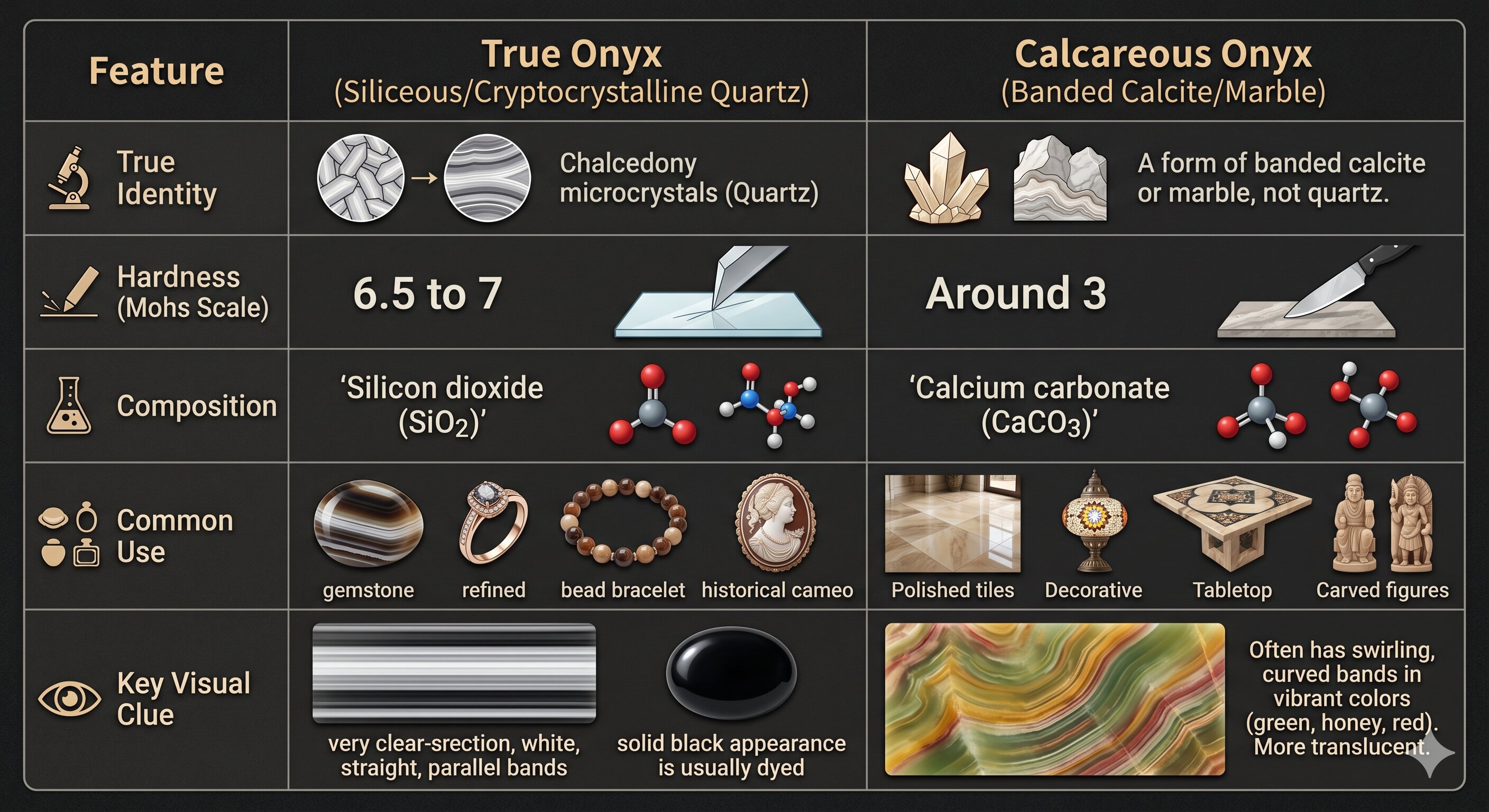
How to Visually Identify Onyx
Look for these key characteristics:
Banding: True gem onyx often shows straight, parallel layers of alternating colors (e.g., black and white). Sardonyx has red, brown, or yellow bands.
Color: Black is the most famous, but solid black onyx is rare. Most is dyed grey.
Chalcedony. Be wary of perfect, uniform jet black.
Luster & Texture: It has a vitreous (glassy) to waxy luster and feels very smooth when polished.
Simple Tests You Can Perform
Important: Perform destructive tests only on an inconspicuous area or a loose stone.
Scratch Test (for hardness):
True onyx (hardness ~7) will scratch glass and cannot be scratched by a steel knife.
Calcareous onyx (hardness ~3) can be scratched by a knife or even a copper coin.
Plastic or resin will scratch very easily.
Temperature Test:
Genuine stone feels noticeably cool to the touch and warms slowly in your hand. Plastic or glass feels closer to room temperature.
Weight Test:
True onyx feels dense and heavy for its size. Plastic imitations feel surprisingly light.
Important Market Considerations
Most Black Onyx is Treated: It's standard industry practice to dye grey chalcedony black. This is still considered "real onyx" (it's a treated natural stone), unlike fake plastic or glass.
Beware of Misnomers: Terms like "Mexican onyx" or "onyx marble" almost always refer to the softer calcareous onyx.
In summary, to identify onyx, start by checking its hardness and looking for banding patterns. A hard stone with straight bands is likely true onyx, while a softer stone with vibrant, swirling bands is calcareous onyx.
I hope this guide helps you identify your stone! If you can share more details about the item (e.g., where it's from, what it feels like, if you see any banding), I may be able to offer more specific insights.
What Is Green Onyx Really?
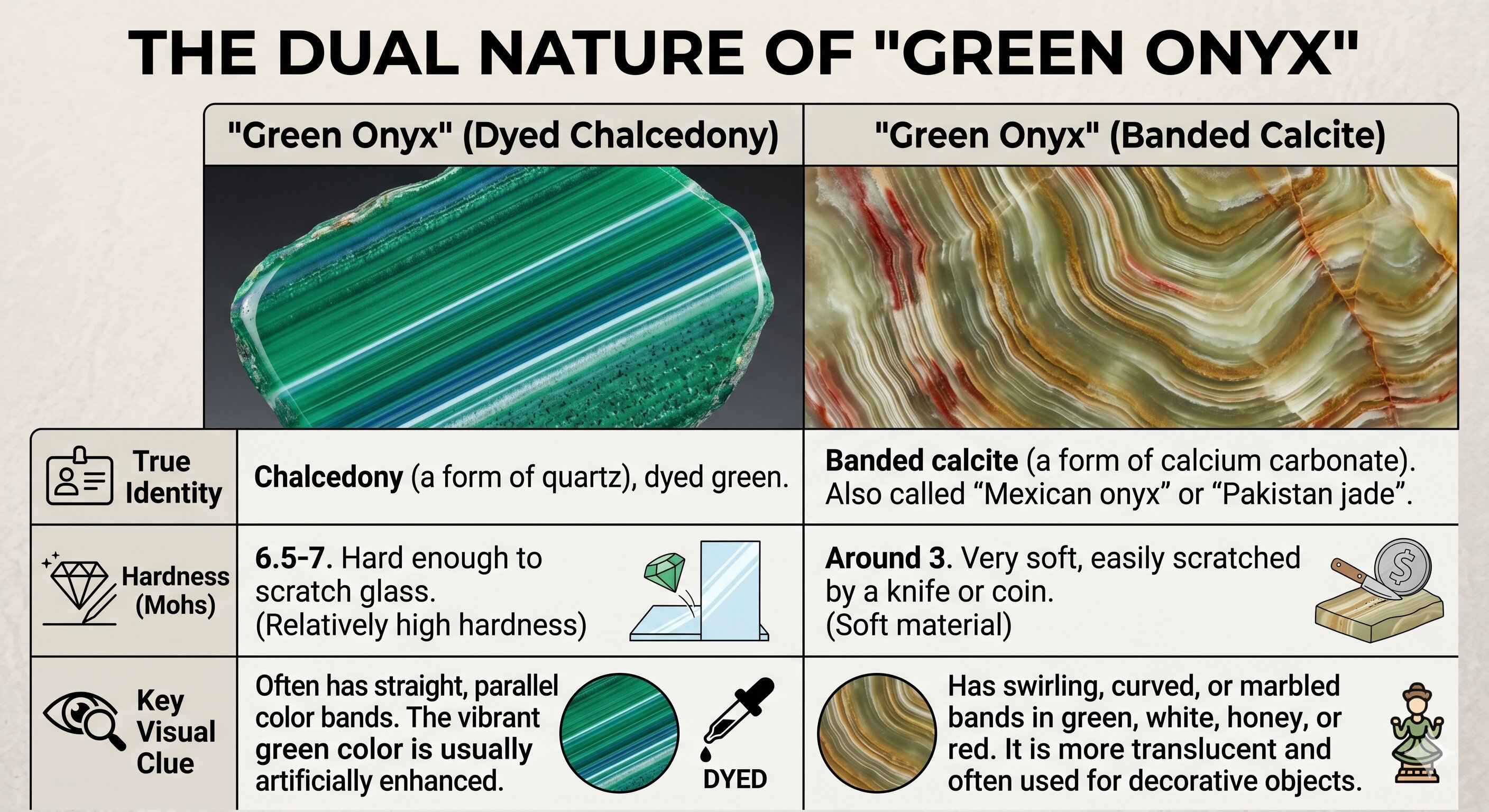
"Green Onyx" is usually not a distinct, naturally green gemstone. The name typically describes two different man-altered stones: dyed grey chalcedony or the softer banded calcite.
The Two Faces of "Green Onyx"
Here’s what the term usually means in practice:
How to Identify What You Have
You can tell them apart with simple tests:
Look at the banding: Straight, parallel lines suggest dyed chalcedony. Swirling, marble-like patterns suggest banded calcite.
Test the hardness: If it can scratch a glass bottle, it's likely hard chalcedony. If it is easily scratched by a steel knife or even a copper coin, it's soft calcite.
Acid Test (Definitive): Place a single drop of white vinegar on an inconspicuous spot. If it fizzes, it is banded calcite. No reaction means it is likely quartz-based chalcedony.
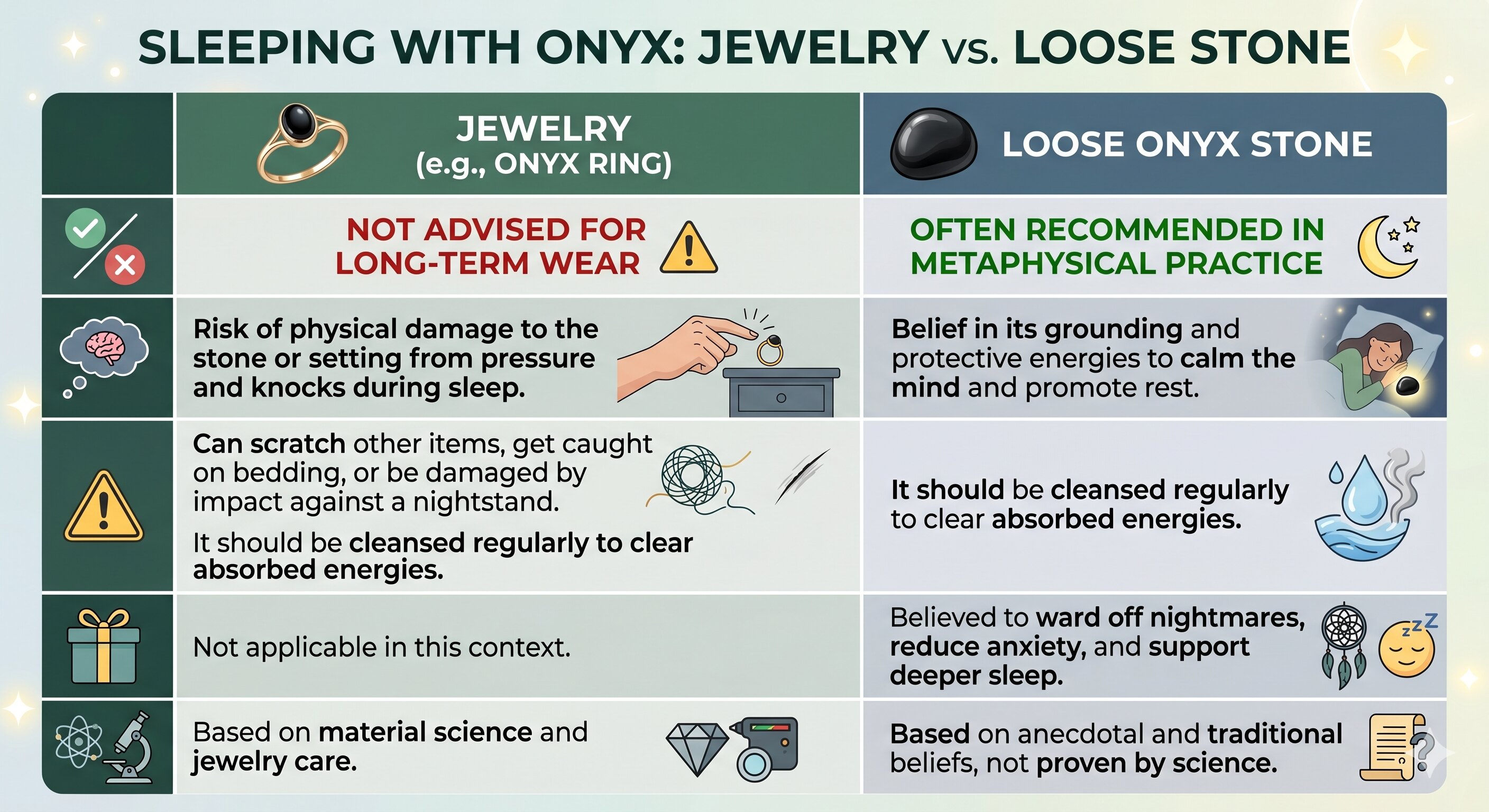
Should You Sleep With Onyx?
"Green Onyx" is usually not a distinct, naturally green gemstone. The name typically describes two different man-altered stones: dyed grey chalcedony or the softer banded calcite.
The Two Faces of "Green Onyx"
Here’s what the term usually means in practice:
Key Visual Clue often has straight, parallel color bands. The vibrant green color is usually artificially enhanced. Has swirling, curved, or marbled bands in green, white, honey, or red. It is more translucent and often used for decorative objects.
How to Identify What You Have
You can tell them apart with simple tests:
Look at the banding: Straight, parallel lines suggest dyed chalcedony. Swirling, marble-like patterns suggest banded calcite.
Test the hardness: If it can scratch a glass bottle, it's likely hard chalcedony. If it is easily scratched by a steel knife or even a copper coin, it's soft calcite.
Acid Test (Definitive): Place a single drop of white vinegar on an inconspicuous spot. If it fizzes, it is banded calcite. No reaction means it is likely quartz-based chalcedony.
What Determines Onyx's Value?
Within the semi-precious category, an onyx stone's value is influenced by:
Color: The most sought-after variety is solid black onyx. However, "pure" black onyx that occurs naturally in thick, solid layers is actually quite rare. "Green onyx" (which you asked about earlier) is often banded calcite or dyed chalcedony and falls into a different value category.
Banding: High-contrast, sharp, and parallel bands (common in classic black-and-white onyx) are valued.
Treatments: It's important to know that the majority of solid black onyx on the market has been dyed to achieve its uniform color. This is a standard and accepted practice, but it affects value compared to a rare, naturally solid piece.
Summary: Why Onyx is Semi-Precious
The table below summarizes how onyx compares to the criteria for precious stones:
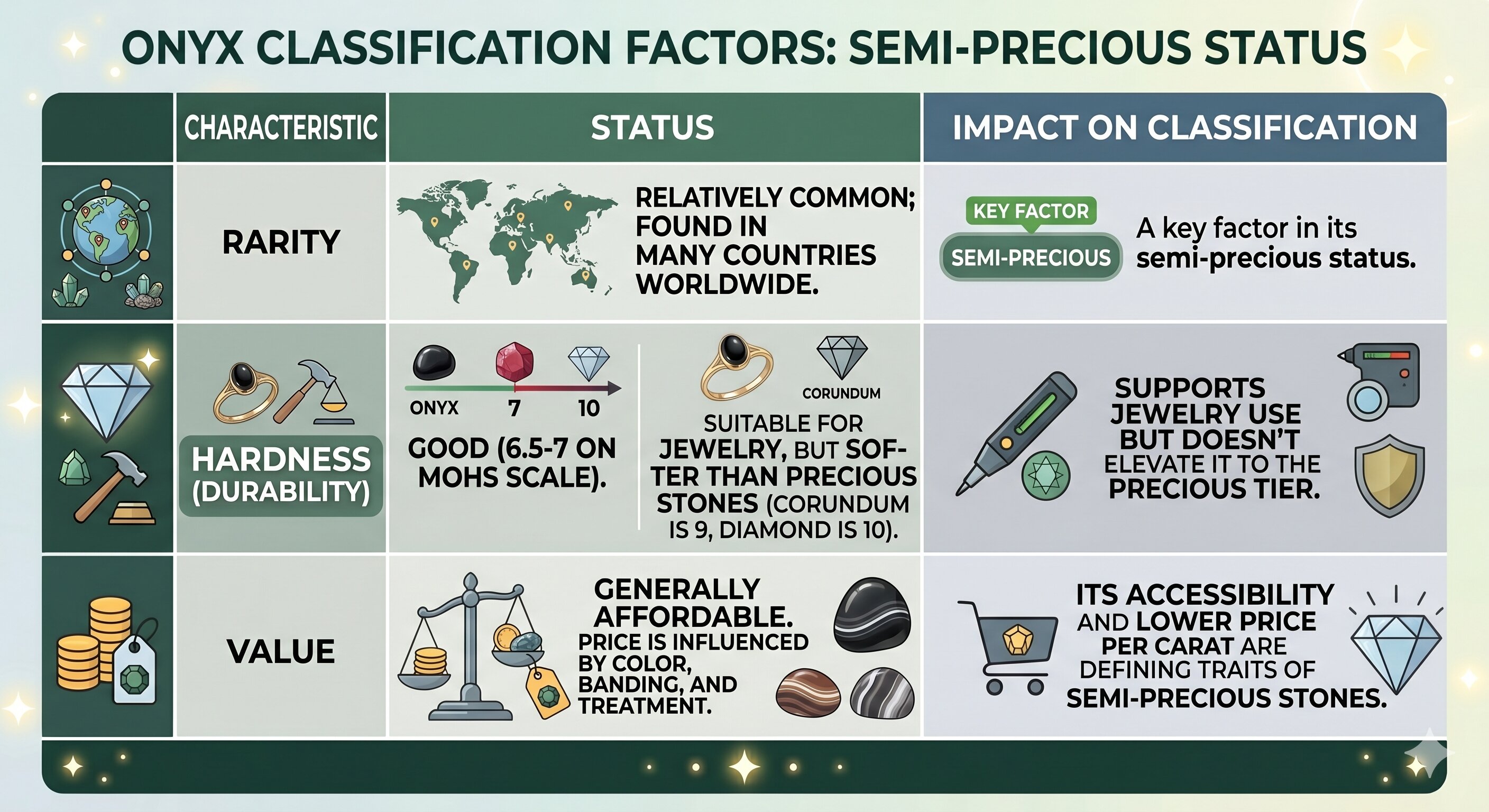
To summarize, onyx is a beautiful and durable semi-precious stone, valued for its deep colors and striking bands. Its classification aligns with what you've learned about "green onyx" being a common trade name and its general accessibility in the market.
If you're evaluating a specific piece of onyx jewelry, would you like to know more about what to look for in terms of quality or how to care for it?
What Are The Side Effects Of Wearing Black Onyx?
Wearing black onyx is generally considered safe from a physical standpoint, but there are important considerations regarding its care and the metaphysical beliefs surrounding it. The potential effects can be grouped into two areas:
Physical/material and metaphysical.
Potential Considerations of Wearing Black Onyx
The table below summarizes key points to help you weigh the considerations.
Aspect Key Considerations
Physical/Material - Routine Wear & Tear: Onyx (Mohs hardness 6.5-7) is durable but can chip if struck hard.
- Skin Contact: A properly polished stone shouldn't harm skin. Ensure settings have smooth edges.
- Treatment Sensitivity: Most black onyx is dyed; avoid harsh chemicals to prevent color fading.
Metaphysical Beliefs - Reported Benefits: Believed to offer grounding, protection, and emotional strength.
- Reported "Side Effects": Some traditions suggest it may intensify negative emotions or feel too grounding/draining if worn constantly by sensitive individuals.
- Individual Energy: Effects are said to be highly personal; what works for one may not for another.
Practical Guidance for Wearing Onyx
To ensure a good experience and care for your stone, consider the following:
Start Gradually: If you're new to onyx, try wearing it for shorter periods to see how you feel.
Set Intentions & Cleanse: In metaphysical practice, it's common to set a purpose for the stone (e.g., "for grounding") and cleanse it regularly. Methods include rinsing under lukewarm water, placing it on selenite, or leaving it in moonlight.
Listen to Your Body and Intuition: If you feel consistently low or heavy while wearing it, it might not be the right stone for you at this time.
Provide Proper Care: Remove jewelry before sports, sleeping (as mentioned earlier), or using chemicals. Clean with a soft, damp cloth.
Connecting to Your Previous Questions
This aligns with our earlier discussion, where "green onyx" is often dyed chalcedony or calcite, and sleeping with loose onyx is a common practice in crystal healing for its grounding energy. The concept of potential energetic heaviness relates to why some traditions advise against constant wear.
In summary, the main physical "side effect" is the risk of damaging the stone itself, while metaphysical effects are subjective. The experience is personal, so paying attention to how you feel is the best guide.
“You now know the meaning, the benefits, the costs, the colors, the rarity, the disadvantages, the luck, the activation, the identification, and the side effects. The only question left: will you wear the stone that promises you will not break?
Our current collection includes a limited number of natural and treated onyx stones — from solid black onyx (dyed, but genuine) to rare natural sardonyx with sharp banding. When certain varieties are gone, sourcing new stones with consistent color takes time.
This is not just a gemstone. It is the fingernail of Venus, the Roman soldier's shield, the Victorian widow's strength — a stone that does not promise joy, but promises you will endure.”
[Button: Claim Your Onyx (Limited) →]
Connecting to Your Previous Questions
This aligns with our earlier discussion, where "green onyx" is often dyed chalcedony or calcite, and sleeping with loose onyx is a common practice in crystal healing for its grounding energy. The concept of potential energetic heaviness relates to why some traditions advise against constant wear.
In summary, the main physical "side effect" is the risk of damaging the stone itself, while metaphysical effects are subjective. The experience is personal, so paying attention to how you feel is the best guide. If you have specific concerns about allergies or a particular piece of jewelry, I can try to offer more tailored advice.


Other news for Thursday 11 June, 2026
- Opal Guide: Meaning, Price, How to Tell Real | October Birthstone
- Sapphire Rings Guide: Meaning, Colors, Settings and Value | September Birthstone
- 10K Gold Guide: Purity, Price, vs 14K/18K, Daily Wear and Care
- November Birthstones: Topaz vs Citrine Guide | Prices, Care and Meaning
View all news for Thursday 11 June, 2026 on one page
News for Wednesday 10 June, 2026
- Pearl Birthstone Guide: Meaning, Price, Care And Types
- Moonstone Meaning 2026: Complete Guide to Benefits, Price, Real VS Fake
View all news for Wednesday 10 June, 2026 on one page
Recent News
- Tuesday 09 June, 2026
- Monday 08 June, 2026
- Sunday 07 June, 2026
- Saturday 06 June, 2026
- Friday 05 June, 2026