

Opal Guide: Meaning, Price, How to Tell Real | October Birthstone
Opal Birthstone
Opal is the birthstone for October, sharing the spotlight with Tourmaline. It is a gemstone unlike any other, famous for its stunning display of flashing rainbow colors, a phenomenon known as play-of-color.
“Ancient Romans called opal the ‘Queen of Gems‘ — the most precious stone of all. They believed it combined the beauty of every gem: the red of ruby, the green of emerald, the blue of sapphire, and the purple of amethyst, all dancing in one stone. Arabic legends said opals fell from the heavens with lightning strikes — capturing thunder and rainbows in a single flash. And for centuries, European monarchs wore opals as talismans against evil, believing the stone‘s shifting fire could predict danger. Then, in 1829, a novel changed everything. Sir Walter Scott wrote a story where a cursed opal brought tragedy, and a gem that had been loved for 3,000 years suddenly became feared. But the truth never changed: Oopalis is not cursed. It is simply too magical for the faint of heart.”
The same stone that Romans called the Queen of Gems now awaits your October birthday — or your own rainbow promise. Every opal in our collection is genuine, from Australian black opals to Ethiopian crystal opals, chosen for that signature play-of-color.”
[Button: Explore Opal Jewelry →]
Meaning and Symbolism
Opal is steeped in meaning, often associated with:
Magic and Hope: Its ever-changing colors have linked it to magic, illusion, and the world of dreams for centuries.
Emotional Expression: Opal is believed to amplify emotions, encourage creativity, and inspire originality.
Love and Passion: In ancient times, it was a symbol of love and desire.
Good Luck: While sometimes associated with superstitions about bad luck, this is a relatively modern and unfounded belief. In most cultures, opal is considered a stone of great good fortune and hope.
Here is the content of the table.
- Which Birthstone Is Opal?
- How Is Opal Formed?
- Where Is Opal Found?
- What Does Wearing An Opal Symbolize?
- How To Tell If an Opal Birthstone Is Real?
- What Color Of Opal Birthstone Is Expensive?
- Is Opal Birthstone Worth More Than Diamonds?
- Does the Opal Birthstone Hold Value?
- In Which Metal Opal Birthstone Is Worn?
- Is Black Opal A Birthstone?
- How Much Is A 2ct Opal Worth?
- What Does Opal Do To Your Body?
- Should Opal Be Worn In Gold Or Silver?
Which Birthstone Is Opal?
Opal is the traditional birthstone for October. It shares this distinction with tourmaline, making October one of the few months with two official birthstones.
Here is a detailed comparison of the October birthstones and key facts about opal:
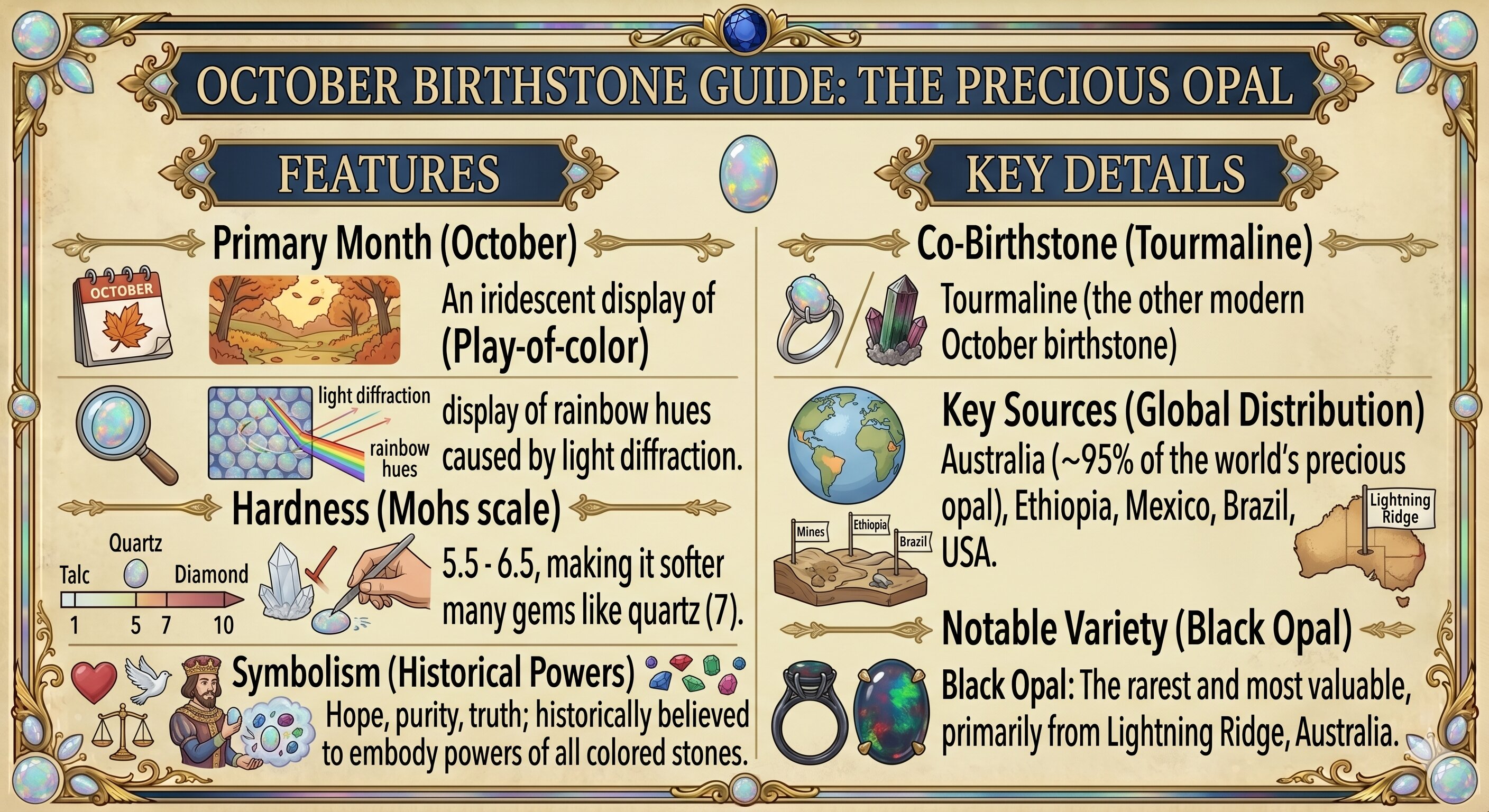
Understanding the "Play-of-Color"
What makes opal truly unique is its play-of-color. This phenomenon is not a single color, but a shimmering interplay of rainbow-like flashes that change with the viewing angle. This occurs because opal is made of microscopic silica spheres arranged in a grid-like structure that diffracts light. Gems that display this are classified as "precious opal," while those that do not are called "common opal".
Care and Considerations
Due to its structure and water content (typically 6-10%), opal needs special care:
Avoid extreme temperatures, sudden temperature changes, harsh chemicals, and ultrasonic cleaners.
Clean only with warm, soapy water and a soft cloth.
Store separately from harder gems to prevent scratches.
I hope this detailed overview helps you understand why opal is such a cherished gem. If you are considering an opal for a specific purpose, such as an engagement ring versus a pendant, I can offer more tailored advice on its suitability.
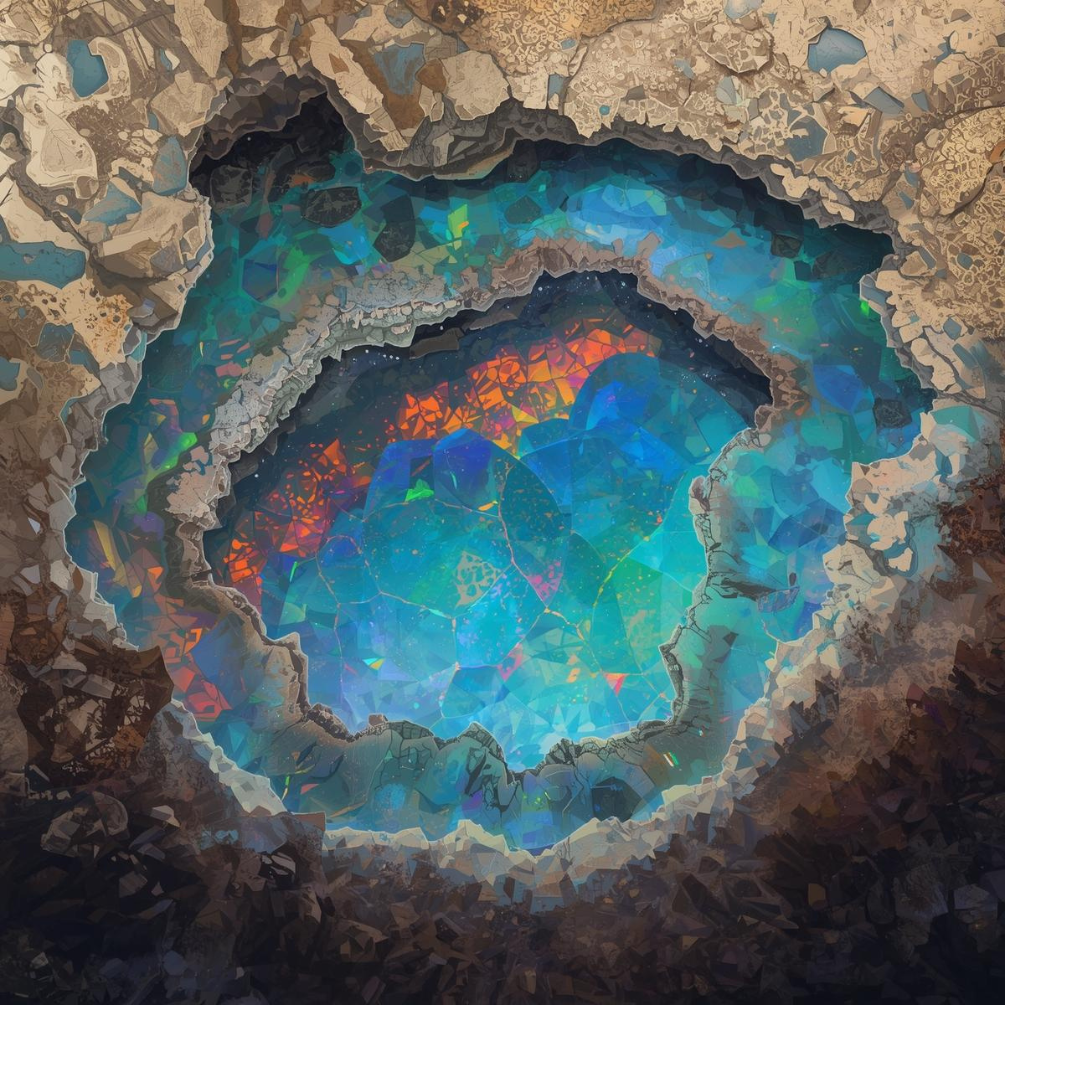
How Is Opal Formed?
Opal forms through a fascinating and specific geological process over millions of years. Its unique "play-of-color" is a result of its microscopic structure, not from pigments.
Here’s a timeline of the typical formation process:
The Science Behind the Color Play
The "play-of-color" that defines precious opal occurs because of its internal structure:
The deposited silica forms into perfectly sized and arranged microscopic spheres.
These spheres stack in a 3D grid-like structure.
When light enters this grid, it diffracts and splits into spectral colors—just like light passing through a prism or a water droplet creates a rainbow.
The size and arrangement of the spheres determine which colors you see:
Larger spheres diffract red and orange light (the rarest colors).
Smaller spheres diffract blue and violet light (more common).
If the spheres are irregularly sized or arranged, the stone becomes common opal (or "potch"), which lacks the play-of-color.
Why Australia is the Perfect Environment
Australia produces about 95% of the world's precious opal because its Great Artesian Basin provides ideal conditions:
Ancient Inland Sea: A large sea deposited silica-rich sediment.
Climate Change: The sea retreated, and the climate became arid.
Acidic Weathering: Acidic rain weathered the sandstone, releasing soluble silica into the groundwater.
Perfect Deposition: This silica-rich groundwater seeped into cracks and voids. As the water table fluctuated in the dry climate, silica slowly deposited layer by layer over vast geological time.
This specific sequence—silica solution, cavities for deposition, and the right conditions for slow evaporation—is why high-quality opal is rare and geographically concentrated.
Would you like to know more about the different types of opal this process creates, like boulder opal versus seam opal?
Learn more about opal's geological formation on Wikipedia's opal page.
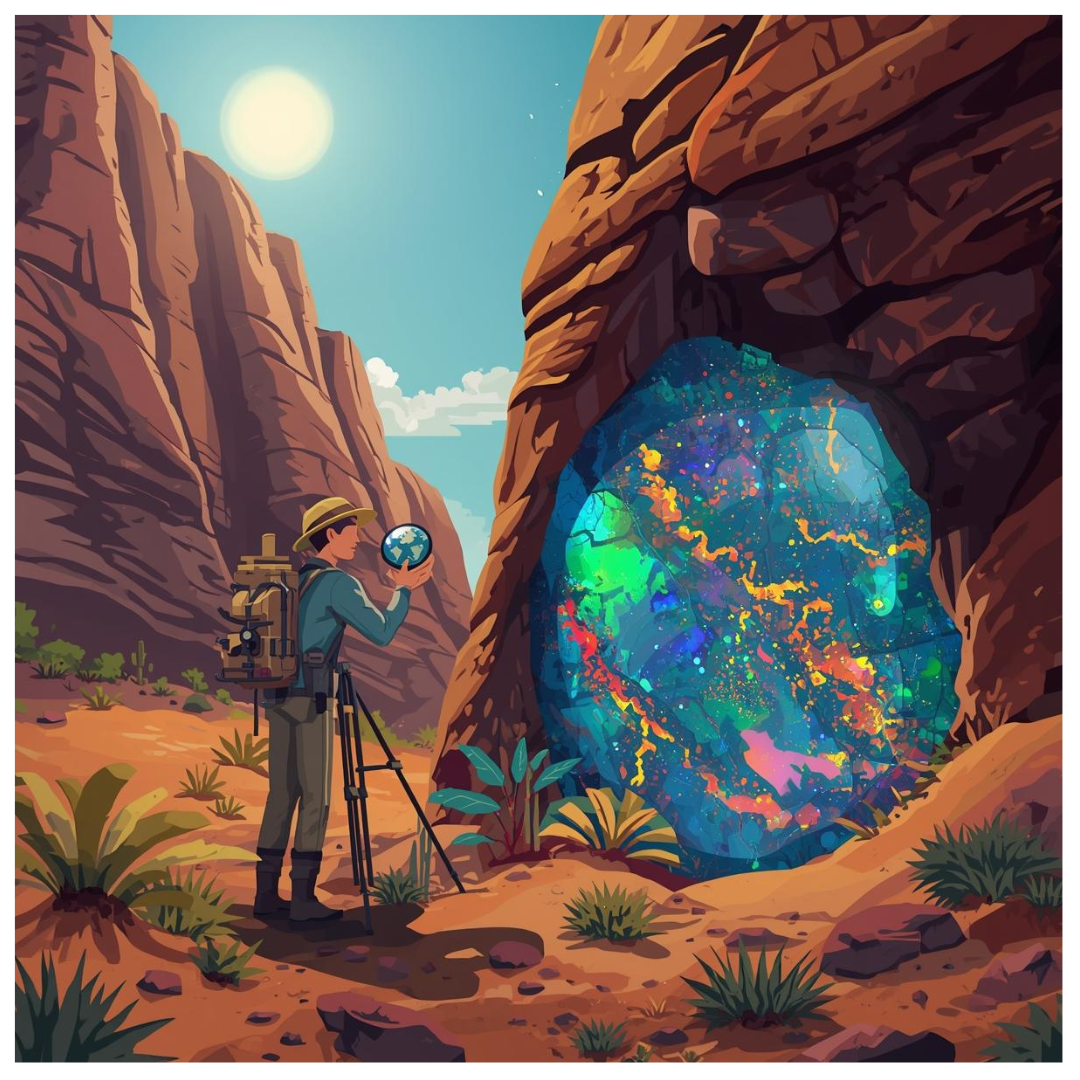
Where Is Opal Found?
Opal is found on almost every continent, but a few countries dominate the global supply and produce the most prized gem-quality stones. Australia is by far the world's leading source, responsible for approximately 95% of all precious opal. Ethiopia has emerged as a major and important supplier since the 1990s, while countries like the United States, Brazil, and Mexico have smaller but significant deposits.
Major Opal-Producing Regions
The following table compares the key characteristics of opal from the world's most significant sources:
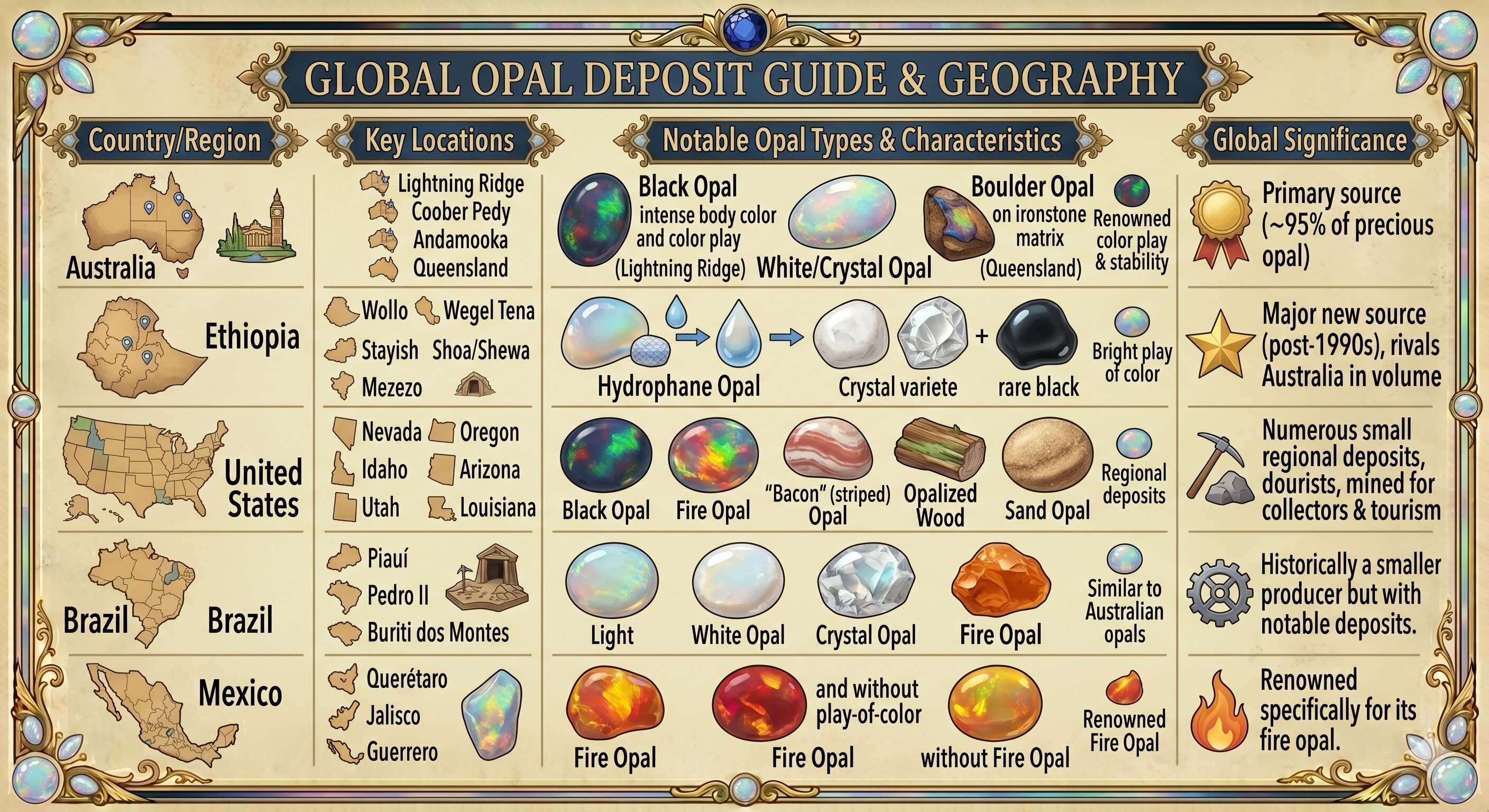
Why Dominant: Its unique geology—the ancient Great Artesian Basin—created ideal conditions for opal formation over millions of years. This has resulted in vast deposits of high-quality, stable opal.
Famous Fields:
Lightning Ridge, NSW: The exclusive source of the world's most valuable black opal.
Coober Pedy, SA: Known as the "opal capital of the world," it's the main producer of white opal.
Queensland Fields: Produce unique boulder opal, where the opal forms in veins within ironstone host rock.
Ethiopia: The Rising Star
Key Feature: Much Ethiopian opal is hydrophane, meaning it can absorb water or liquids, which can temporarily change its appearance and requires careful handling.
Major Discoveries: The 1994 find in Shewa was followed by the 2008 discovery in Wollo, which revolutionized the market. A 2013 discovery in Wollo's Stayish mine also yielded rare natural black opal.
What to Consider Based on Origin
Your choice might depend on the characteristics you value most:
For the most classic, durable opal for jewelry, Australian opals are the benchmark due to their stability. Often more affordable, bright play-of-color, Ethiopian opals are an excellent choice, though they require specific care due to their hydrophane nature.
For unique colors and forms, like Mexican fire opal or American opalized wood, looking to smaller producers can yield fascinating collector's pieces.
If you are curious about the specific mining processes in a place like Coober Pedy, or how to care for hydrophane Ethiopian opals, I can provide more detailed information on those topics.
What Does Wearing An Opal Symbolize?
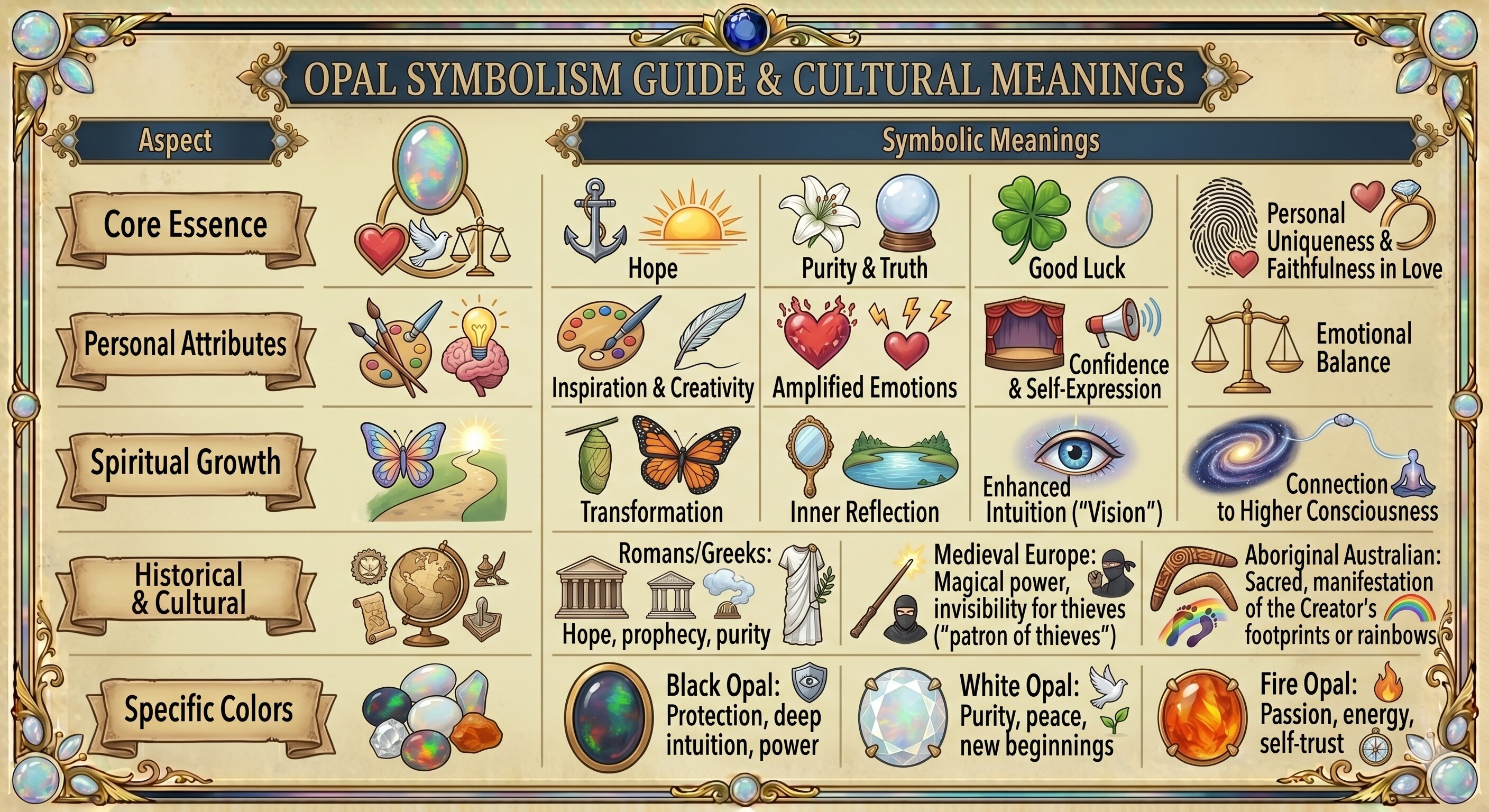
The symbolism of wearing an opal is as varied and colorful as the gem itself, representing everything from love and good fortune to creativity and personal transformation. For centuries, it was a highly prized stone of luck and royalty, though a brief period of superstition gave it an undeserved reputation for bad luck.
The table below summarizes the key symbolic meanings associated with opals:
A History of Shifting Perceptions
The opal's journey in human culture explains its complex symbolism:
Ancient Reverence: In Ancient Rome, opal was among the most prized gems, a symbol of hope and good fortune. The Ancient Greeks believed it granted the gift of prophecy and protection.
The "Patron of Thieves": During the Middle Ages in Europe, a curious belief arose that an opal wrapped in a bay leaf could render the wearer invisible. This led to its nickname as the "patron of thieves".
The Bad Luck Superstition: The opal's most famous—and unfounded—association with bad luck largely stems from a 19th-century Gothic novel. In Sir Walter Scott's Anne of Geierstein (1829), a central character meets a tragic end linked to her opal. This fictional tale, combined with the gem's fragility, sparked a long-lasting superstition that haunted opals for decades.
Modern Spiritual and Emotional Meanings
Today, opal is primarily celebrated for its positive and personal symbolism, particularly in crystal healing and spiritual practices:
The "Amplification" Stone: Opal is often called a stone of amplification. It is believed to intensify emotions and thoughts, bringing them to the surface for clarity and helping to release old patterns.
Emotional Healer and Creativity Spark: It's associated with emotional healing, calming the mind, and boosting creativity and inspiration.
Zodiac and Birthstone Connections: As the modern birthstone for October, it symbolizes individuality and wonder for those born in that month. It is also strongly linked to the zodiac signs Libra (for harmony and love) and Scorpio (for passion and transformation).
“In ancient Greece, opal was believed to give the gift of prophecy. Worn by oracles and seers, it was said to reveal hidden truths and protect the wearer from disease. Medieval thieves carried opal wrapped in bay leaves — not for malice, but because they believed it could make them invisible. In the deserts of Australia, Aboriginal peoples call opal the ‘rainbow serpent‘s breath‘ — a stone that holds the colors of creation itself. Opal asks nothing of you except to look closely. And when you do, you will see not one color, but every color — a reminder that beauty is never simple, and magic is never safe.”
Ultimately, wearing an opal is a deeply personal choice. Many choose it as a talisman of luck, a symbol of unique identity, or a token of faithful love, embracing its long history of positive meaning over its temporary bout with superstition.
Note: If you are considering opal jewelry, remember that it is a softer, more delicate stone (5.5-6.5 on the Mohs scale). It requires gentle care: avoid harsh chemicals, extreme temperature changes, and hard knocks.
I hope this helps you appreciate the rich symbolism of the opal. If you have a specific type of opal (like black or fire opal) or are curious about its use in a particular type of jewelry, feel free to ask for more details.
How To Tell If an Opal Birthstone Is Real?
Determining if an opal birthstone is genuine involves a mix of visual inspection, simple physical tests, and understanding common imitations.
Here's a step-by-step guide:
1. Check the "Play-of-Color" (Most Important!)
Real opal displays a dynamic, shifting "fire" (rainbow flashes) that changes with viewing angle and light. Colors appear to "turn on/off" as you move the stone.
Fakes (plastic/glass/resin):
Show static, uniform patterns (e.g., glitter-like sparkle or fixed "snakeskin" patterns).
Colors don’t shift organically.
Synthetic opal (e.g., Gilson): May look too perfect, with unnaturally large color patches or a "lizard skin" pattern under magnification.
2 . Look for Imperfections & Natural Features
Natural opal: Often has slight irregularities:
Minor cracks ("crazing"), color zoning, or natural inclusions.
Backing may show rough matrix (in boulder opal) or host rock.
Fakes:
Too flawless (e.g., plastic/resin).
Bubble-like inclusions (glass).
Perfectly uniform patterns (synthetics).
3. Temperature & Weight Tests
Touch Test:
Real opal feels cool to the touch and warms slowly in your hand (like glass/stone).
Plastic/resin fakes feel warm quickly.
Weight Test:
Glass/imitation opal feels heavier than genuine opal.
Plastic/resin feels lighter.
4. The "Tooth Test" (For Solid Opals Only)
Gently tap the stone against your front tooth:
Real opal feels slightly gritty/sandy (due to its silica structure).
Glass/plastic feels smooth.
Note: Don’t use on delicate doublets/triplets!
5. Check for Treatments & Composites
Doublets/Triplets:
Look for a glued "seam" around the edge (magnification helps).
The top layer (dome) may look like glass/quartz, not opal.
Smoked/Sugar-Treated Opal:
Enhances dark body color. Scratch the back with a toothpick – black residue indicates treatment.
Dye: Uneven color concentration or bleeding into cracks.
6. Water Absorption Test (For Ethiopian Opal Only)
Ethiopian hydrophane opal is porous:
Temporarily absorbs water, becoming semi-transparent and losing play-of-color until dry.
Don’t test Australian opal – water can damage it!
7. Professional Verification
Use a jeweler’s loupe (10x magnification):
Synthetic opals show a distinctive "columnar" or "chicken-wire" pattern.
Doublets reveal glue lines.
UV Light: Some synthetics/plastics fluoresce unnaturally.
Gemologist lab report (e.g., GIA): Essential for high-value opals.
Common Fakes to Spot:
Plastic/Resin: Lightweight, warm feel, no natural flaws.
Slocum Stone (Glass): Bubbles inside, heavy, "confetti" sparkle
.
Gilson Synthetic: Overly perfect "lizard skin" pattern.
Opalite (Man-Made Glass): Milky, bluish glow with no true play-of-color.
What Color Of Opal Birthstone Is Expensive?
The most expensive opal birthstone colors are determined by two key factors:
Body tone (the base color of the stone)
Play-of-color (the rainbow flashes).
Here's the breakdown of what drives high value in opals:
1. Body Tone (Base Color)
The darker the base, the more valuable the opal if it has vibrant play-of-color:
Black Opal (N1–N4 on the body tone scale):
Most valuable category (e.g., Lightning Ridge, Australia).
Deep gray to jet black base makes colors "pop" dramatically.
*Top specimens can fetch $10,000+/carat.*
Dark/Boulder Opal (N5–N6):
Attached to ironstone matrix (e.g., Queensland, Australia).
Natural dark backing enhances color contrast.
White/Light Opal (N7–N9):
Most common, usually least expensive (e.g., Coober Pedy).
2 . Play-of-Color (The "Fire")
Spectral colors matter more than body tone alone. Value hierarchy:
RED flashes:
Rarest and most prized (requires larger silica spheres).
Can triple an opal's value vs. green/blue-only stones.
ORANGE flashes
GREEN flashes
BLUE flashes (most common, least valuable)
Key: A black opal birthstone with dominant red fire is the holy grail. A white opal with red flashes may outvalue a black opal with only blue/green.
Pattern: "Harlequin" (geometric mosaic) or "Pinfire" (small, dense flashes) command premiums.
Brightness: Vivid > Dull.
Clarity: Clean > Included (crazing/cracks reduce value).
Carat Weight: Larger stones spike exponentially in price.
Origin: Australian black opals (esp. Lightning Ridge) > Ethiopian hydrophane (less stable).
Price Comparison Examples
High-grade Black Opal (5ct with red fire): $50,000–$100,000+
Ethiopian Crystal Opal (5ct with red/orange): $5,000–$20,000
White Opal (5ct with blue-green): $500–$2,000
Beware!
Treated opals (e.g., smoked, dyed, or sugar-acid darkened) look "black" but are worth far less.
Synthetics (e.g., Gilson opal) show unnaturally large color patches.
Doublets/triplets are layered composites (not solid opal).
Opal Types: Value Comparison Guide
| Type | Origin | Key Features | Price per Carat Range |
|---|---|---|---|
| Black Opal | Lightning Ridge, Australia | Dark body tone, vivid play-of-color | $5,000 - $150,000+ |
| Boulder Opal | Queensland, Australia | Natural ironstone backing | $500 - $5,000 |
| White/Light Opal | Coober Pedy, Australia | Light body tone, common blue/green fire | $50 - $500 |
| Ethiopian Opal | Ethiopia | Hydrophane (absorbs water), bright colors | $30 - $500 |
| Fire Opal | Mexico | Transparent orange-red, may lack play-of-color | $50 - $2,000 |

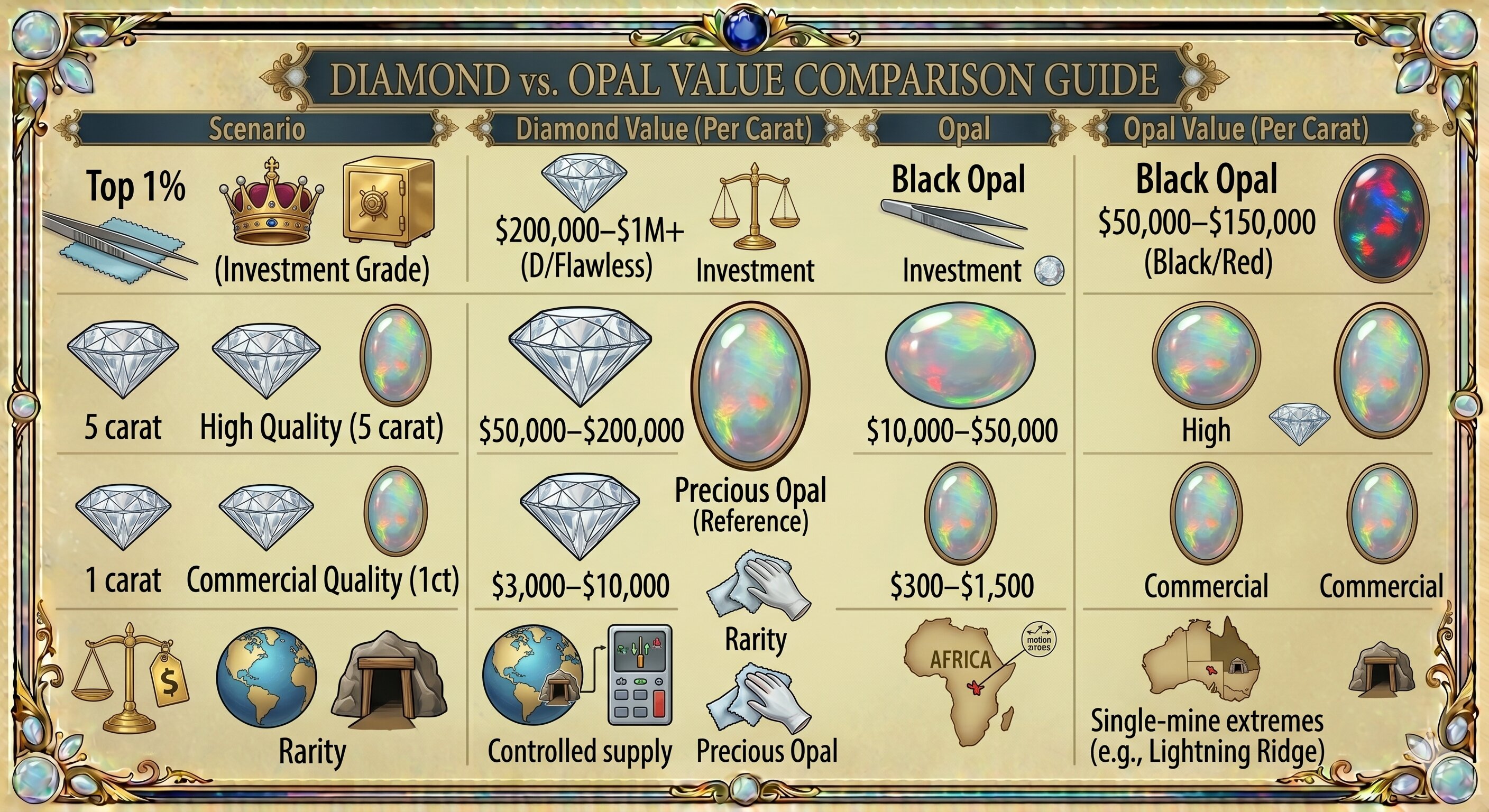
Is Opal Birthstone Worth More Than Diamonds?
That's a fantastic question that reveals how gemstone valuation works! The answer is nuanced:
Generally, diamonds are worth more overall and at the top investment tier.
But certain rare opals can surpass diamonds in value per carat.
Here’s the breakdown:
When Opal Rings for Women Are Worth More
High-Investment Tier:
Flawless D-color diamonds (5+ carats) → $200,000–$1M+/carat
Example: A 10ct D/Flawless diamond → $15–$30M+
No opal approaches this level.
Mainstream Market:
Average 1ct engagement diamond (G/VS2) → $5,000–$7,000
Same-sized top white opal → $500–$2,000
Liquidity & Recognition:
Diamonds have a massive, global market with standardized pricing (Rapaport). Opals are niche.
When Opals Are Worth More (Per Carat)
Rare Black Opals:
Lightning Ridge (Australia) opal with dominant red flashes + harlequin pattern:
5ct+ stones → $50,000–$150,000/carat
Outvalues all but the rarest colored diamonds.
Example: The "Virgin Rainbow" opal (sold for ~$1M in 2021) → $200,000+/carat for its size.
Large Collector Stones:
A 20ct top black opal with red fire → $1M–$2.5M
A 20ct non-exceptional diamond → $200,000–$500,000
Historic Auction Prices:
The "Olympic Australis" opal (17,000 ct) → Valued at $2.5M in the 1950s (~$30M today).
The "Fire of Australia" opal (4,300 ct) → Insured for $1M in 2022.
Key Comparison Table
Critical Factors
Opal’s Value Triggers:
Black body tone + Red flashes + Harlequin pattern + Size (5ct+).
Diamond’s Edge:
Durability (Opal is soft: Mohs 5.5–6.5 vs. Diamond’s 10).
Market stability (Opals fluctuate with mining output).
Reality Check
99% of opals are cheaper than diamonds of equal size.
Ethiopian opals (often porous/temporary color) → 1/10th the value of Australian opals.
Treated opals (e.g., smoked "black" opals) → Fraction of natural value.
Does the Opal Birthstone Hold Value?
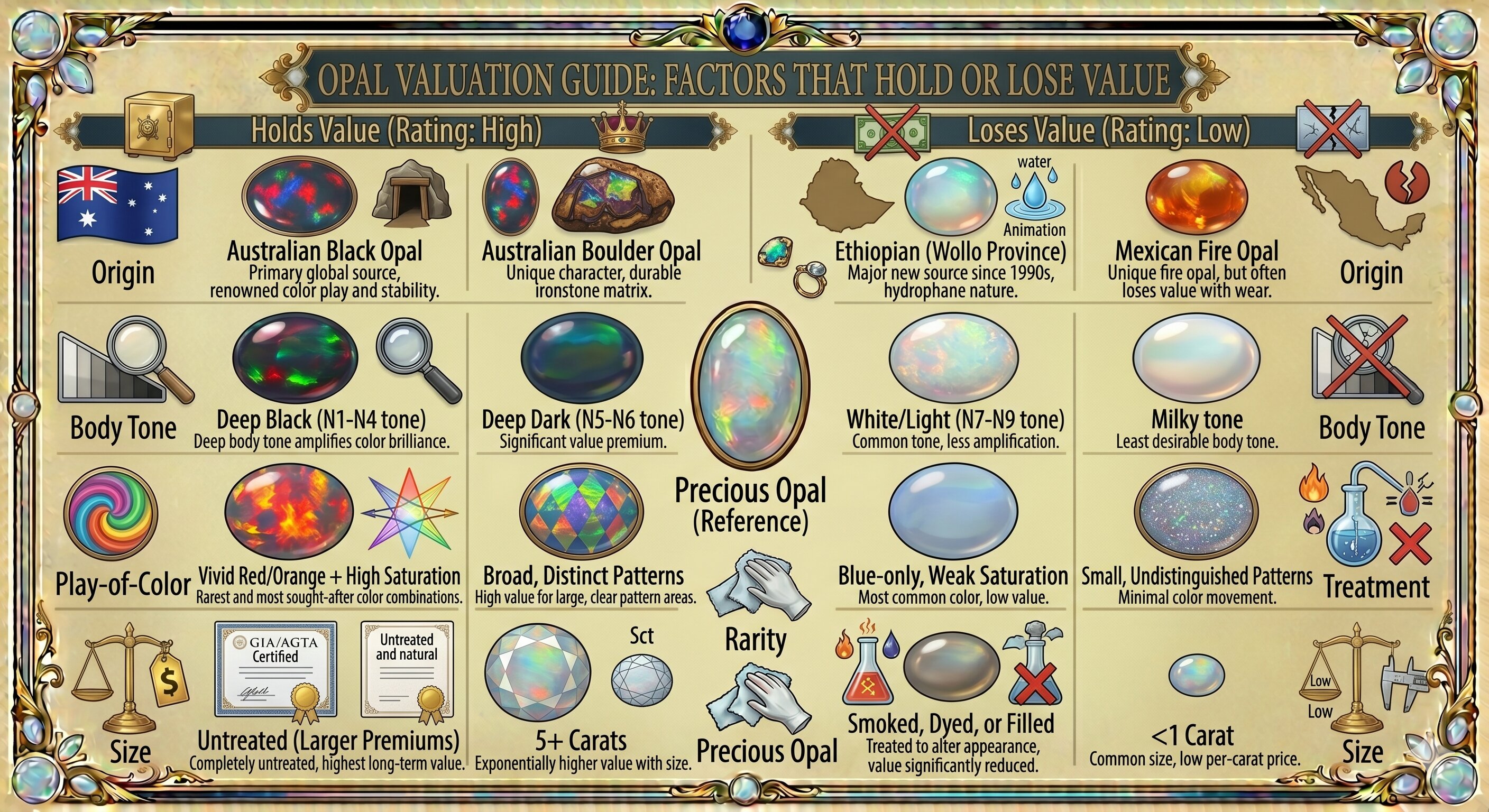
The value retention of opal's birthstone is highly nuanced—while certain rare opals can appreciate significantly, most commercial-grade opals do not hold value like diamonds or sapphires.
Here’s a clear breakdown:
Opals That Hold (or Increase) Value
Top-Tier Australian Black Opals
Especially: Stones from Lightning Ridge with:
Dominant red/orange fire
Harlequin or pinfire patterns
Dark body tone (N1-N4)
5+ carats, eye-clean, and untreated.
Value trend: ▲ Appreciates 5–10% annually for decades (e.g., stones sold at auction for 6–7 figures).
Historic/Rare Collector Opals
Named specimens (e.g., "Aurora Australis," "Virgin Rainbow") or opals with unique provenance.
High-Quality Boulder Opals
Natural ironstone-backed stones (Queensland, Australia) with vibrant color and thick seams.
Opals That Lose Value
Ethiopian Hydrophane Opals
Prone to water damage/cracking → unstable long-term.
Value trend: ▼ Rapid depreciation if damaged.
Treated/Enhanced Opals
Smoked, dyed, or sugar-acid "black" opals → resale value drops 50–80%.
Commercial White/Light Opals
Common material (e.g., Coober Pedy) with weak blue/green fire → commodity pricing.
Doublets/Triplets
Layered composites → delaminate over time → negligible resale value.
Key Factors Influencing Value Retention
Realistic Value Scenarios
$10,000 Australian black opal (5ct, red fire, certified):
→ Likely holds/appreciates over 20+ years.
$500 Ethiopian crystal opal (3ct, blue-green):
→ Loses 30–70% if crazed or damaged.
$200 white opal doublet:
→ Worth $0 once glue yellows or layers separate.
Critical Advice for Buyers
Prioritize Australian opals (Lightning Ridge, Andamooka, Boulder fields).
Demand certification from reputable labs (e.g., Australian Opal Centre, GIA, ICA).
Avoid treatments—ask for "natural, untreated" in writing.
Invest in settings that protect the stone (bezel > prongs).
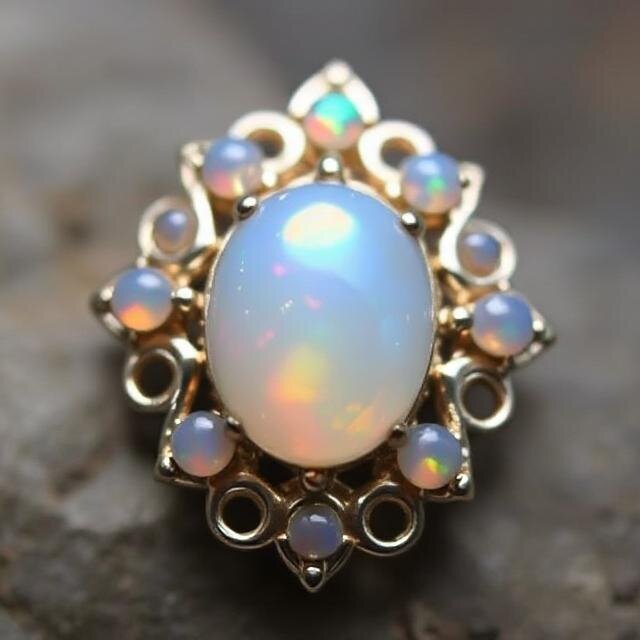
In Which Metal Opal Birthstone Is Worn?
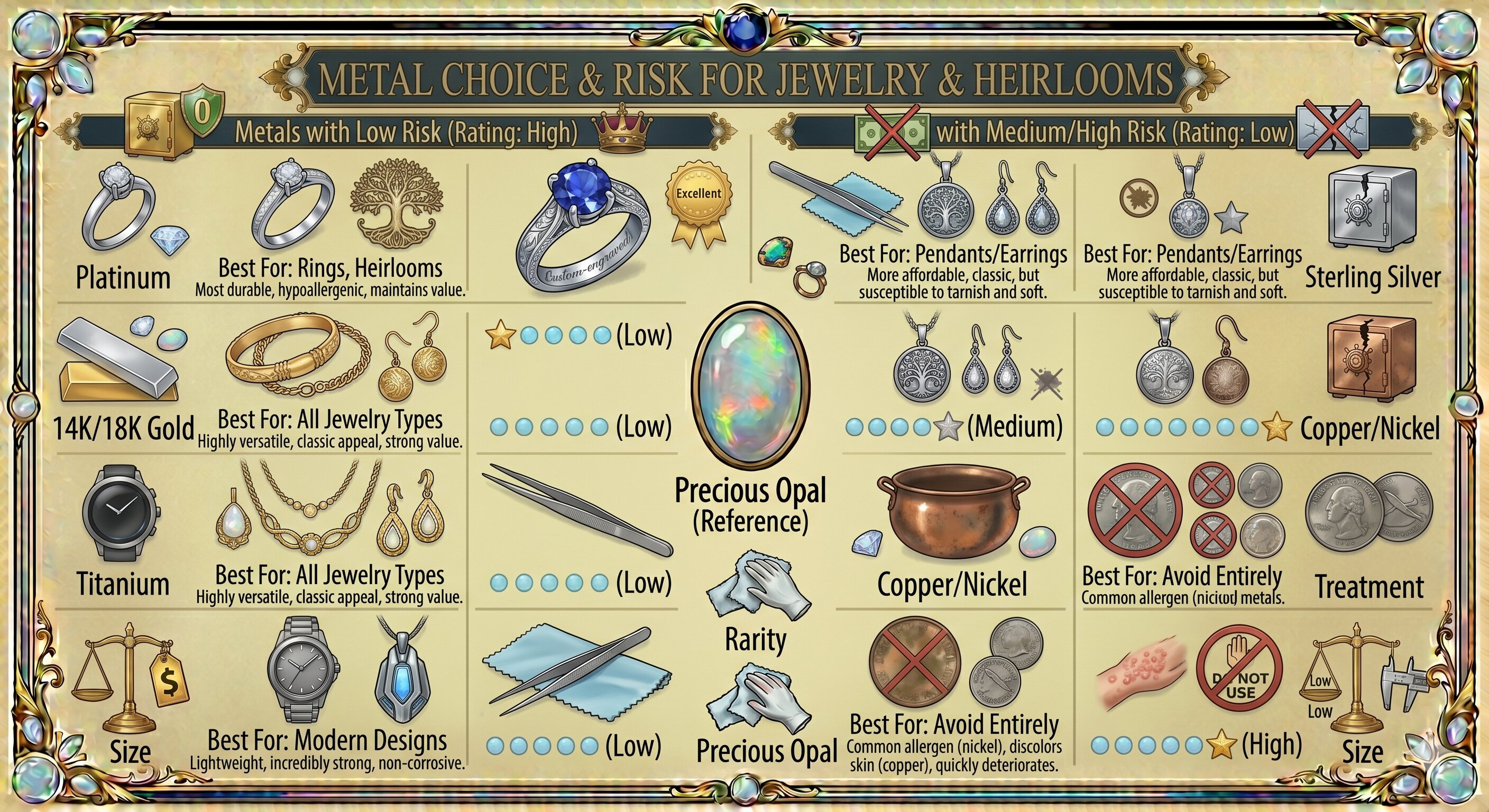
The best metals for opal birthstone jewelry prioritize protection, stability, and hypoallergenic properties due to opal's fragility (Mohs 5.5–6.5). Here’s a breakdown of ideal and risky metals:
Best Metals for Opal
Platinum / Palladium
Why: Extremely durable, hypoallergenic, and chemically inert.
Ideal for: Heirloom opal promise rings or high-value opals.
Note: Heavyweight metal offers superior impact protection.
Yellow or White Gold: Classic choice; balances durability with elegance.
Rose Gold: Acceptable if alloyed with non-reactive metals (avoid copper-heavy alloys).
Key: Higher gold content (18K) is softer but more corrosion-resistant.
Sterling Silver (925)
Why: Affordable, traditional for opal jewelry.
Caveat: Requires rhodium plating to prevent tarnish from touching the opal.
Best for: Occasional-wear pieces (e.g., pendants, earrings).
Titanium
Why: Lightweight, hypoallergenic, and highly durable.
Ideal for: Modern, protective settings.
Metals to AVOID
Base Metals (Copper, Brass, Nickel)
Risk: React with skin acids or moisture → tarnish seeps into opal, causing discoloration/cracks.
Common in: Cheap fashion jewelry.
High-Copper Alloys
Why: Copper oxidizes into verdigris (green gunk), damaging opal’s porous surface.
Especially risky: Unplated rose gold <14K or bronze.
Porous Metals (e.g., Pewter)
Why: Absorb moisture → transfer humidity to water-sensitive opals (e.g., Ethiopian).
Critical: Setting Style Matters More Than Metal!
Even in platinum, opals need protective settings:
Bezel Setting: Fully encircles the opal’s edges (best for rings).
Domed Design: Minimizes direct impacts.
Avoid: Prong settings (expose edges) or tension mounts.
Opal-Specific Tips
Australian Opals: Stable; work with any safe metal.
Ethiopian Opals: Extra vulnerable → must avoid moisture-conducting metals (e.g., unsealed copper).
Doublets/Triplets: Seal edges with epoxy to prevent glue degradation from metal reactions.
Bottom Line:
Always pair opals with bezel settings in inert metals to ensure longevity. For high-value stones, platinum or gold is worth the investment!
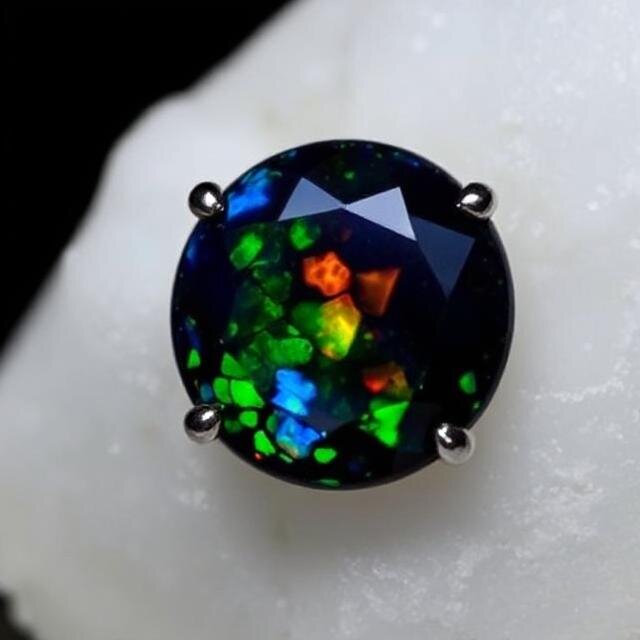
Is Black Opal A Birthstone?
Yes, black opal birthstone is absolutely real—and they're among the rarest, most valuable gemstones on Earth. Here's what makes them authentic and highly prized:
What Makes a Black Opal "Real"?
Natural Formation:
Formed over millions of years when silica-rich water seeps into cracks in Australian sedimentary rock.
No human manipulation—just nature’s artistry!
Unique Structure:
Composed of amorphous silica spheres that diffract light into "play-of-color" (the rainbow flashes).
The dark body tone comes from natural iron oxide or carbon traces in the host rock.
How to Spot Real vs. Fake Black Opals
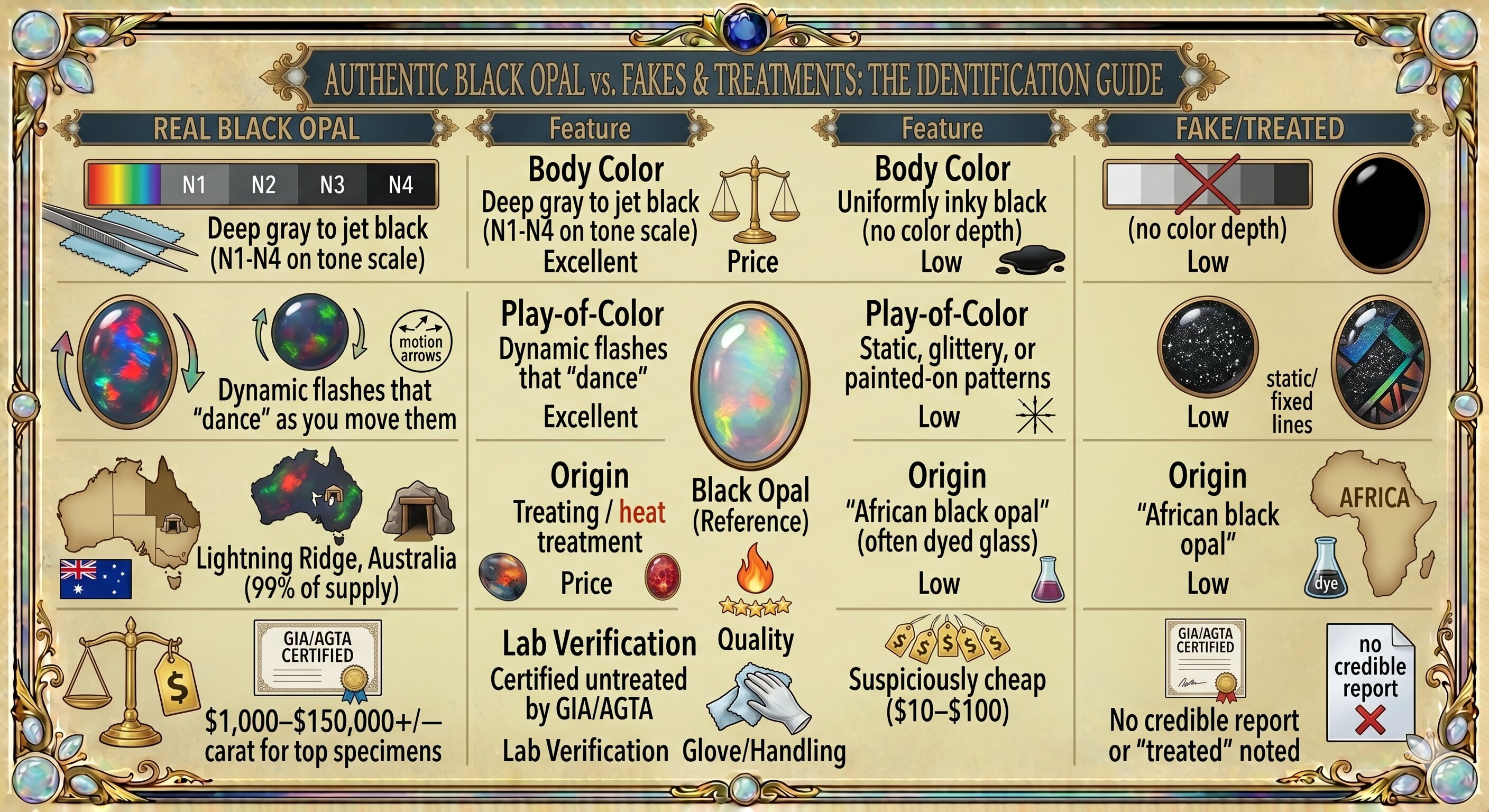
Common Fakes & Treatments
Smoked Opals:
Low-quality white opals are baked in sugar/acid to look black.
Test: Scratch the back—black residue rubs off.
Dyed Opals:
Pale opals injected with black dye.
Test: Dye concentrates in cracks (use 10x loupe).
"Opalite" Glass/Plastic:
Milky blue synthetic material with no true play-of-color.
Gilson Synthetics:
Lab-created opals with unnatural "lizard skin" patterns.
Why Lightning Ridge (Australia) is Key
Geological Rarity: Formed under unique conditions in a single dry region of New South Wales.
Color Superiority: Produces the richest reds/blues against dark backgrounds.
No Viable Alternatives: Ethiopian "black" opals are unstable hydrophane stones (avoid for investment).
Top-Tier Value Examples
5ct+ with red harlequin pattern: $50,000–$150,000/carat
Record Sale: The "Virgin Rainbow" (63ct) → $1+ million
How to Guarantee Authenticity
Demand Origin Proof: Lightning Ridge certification.
Require Lab Reports: GIA, AGTA, or Australian Opal Centre.
Buy from Reputable Dealers: Members of the ICA (International Colored Gemstone Association).
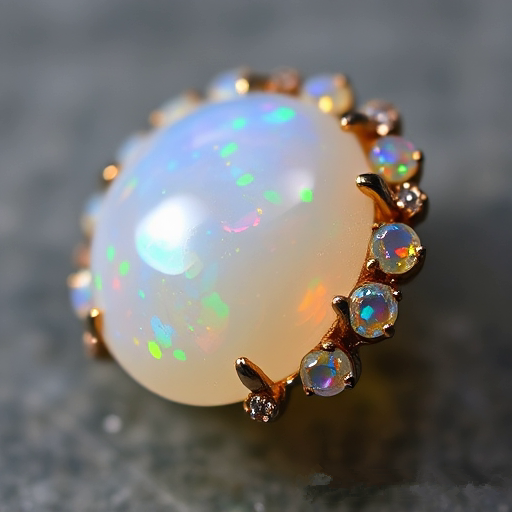
How Much Is A 2ct Opal Worth?
The value of a 2ct opal birthstone varies dramatically based on type, quality, and origin—from $10 to over $30,000. Below is a detailed breakdown, followed by opal's status as a birthstone:
2ct Opal Value Guide
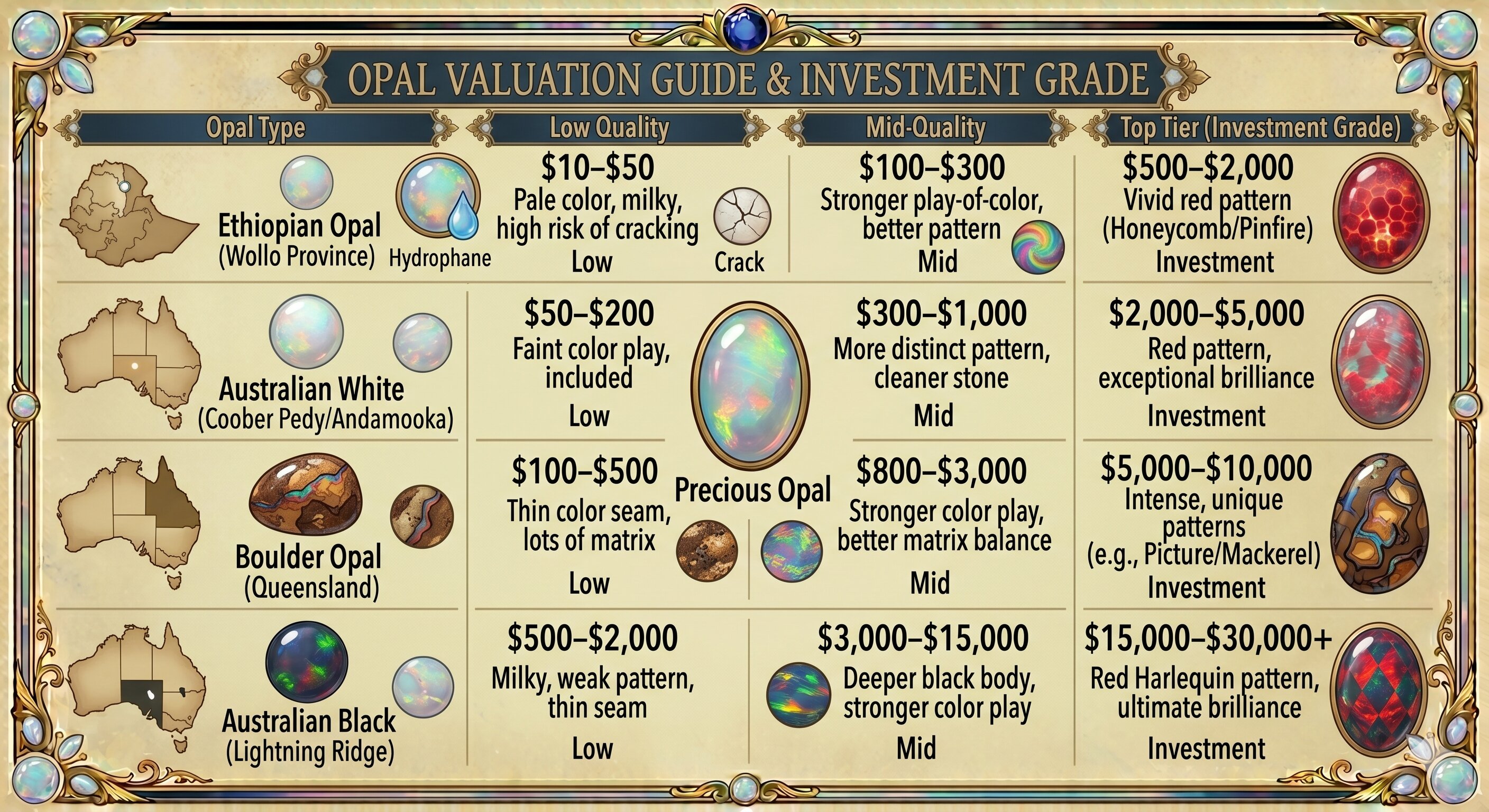
Key Value Drivers:
Play-of-Color: Red > Orange > Green > Blue .
Pattern: "Harlequin" (mosaic) or "Pinfire" > random flashes.
Clarity: Eye-clean stones command 200–500% premiums.
Treatment: Natural/unheated > smoked/dyed (value drops 50–90%).
Origin: Lightning Ridge (Australia) opals dominate the premium tier.
Example: A 2ct Lightning Ridge black opal with red harlequin pattern could sell for $25,000, while a 2ct included Ethiopian opal with weak blue flashes might cost $30.
Symbolism & History:
Ancient Beliefs: Romans saw opal as the "Queen of Gems," symbolizing hope and purity.
Folklore: Arabic legends claimed opals fell from lightning strikes; medieval Europeans linked them to healing.
Modern Meaning: Represents creativity, spontaneity, and emotional balance.
Myth Busting:
Despite superstitions about opals bringing "bad luck" (a 19th-century novel invention), they’re celebrated globally as lucky stones for October babies. Australia even designates opal as its national gemstone!
Quick Price Reference (Per Carat)
- Ethiopian Opal (blue/green): $30 - $200
- White/Light Opal (Australia): $100 - $500
- Boulder Opal: $500 - $5,000
- Black Opal (blue/green): $2,000 - $10,000
- Black Opal (with red fire): $10,000 - $150,000+
For current opal market prices, visit the American Gem Society's price guide.
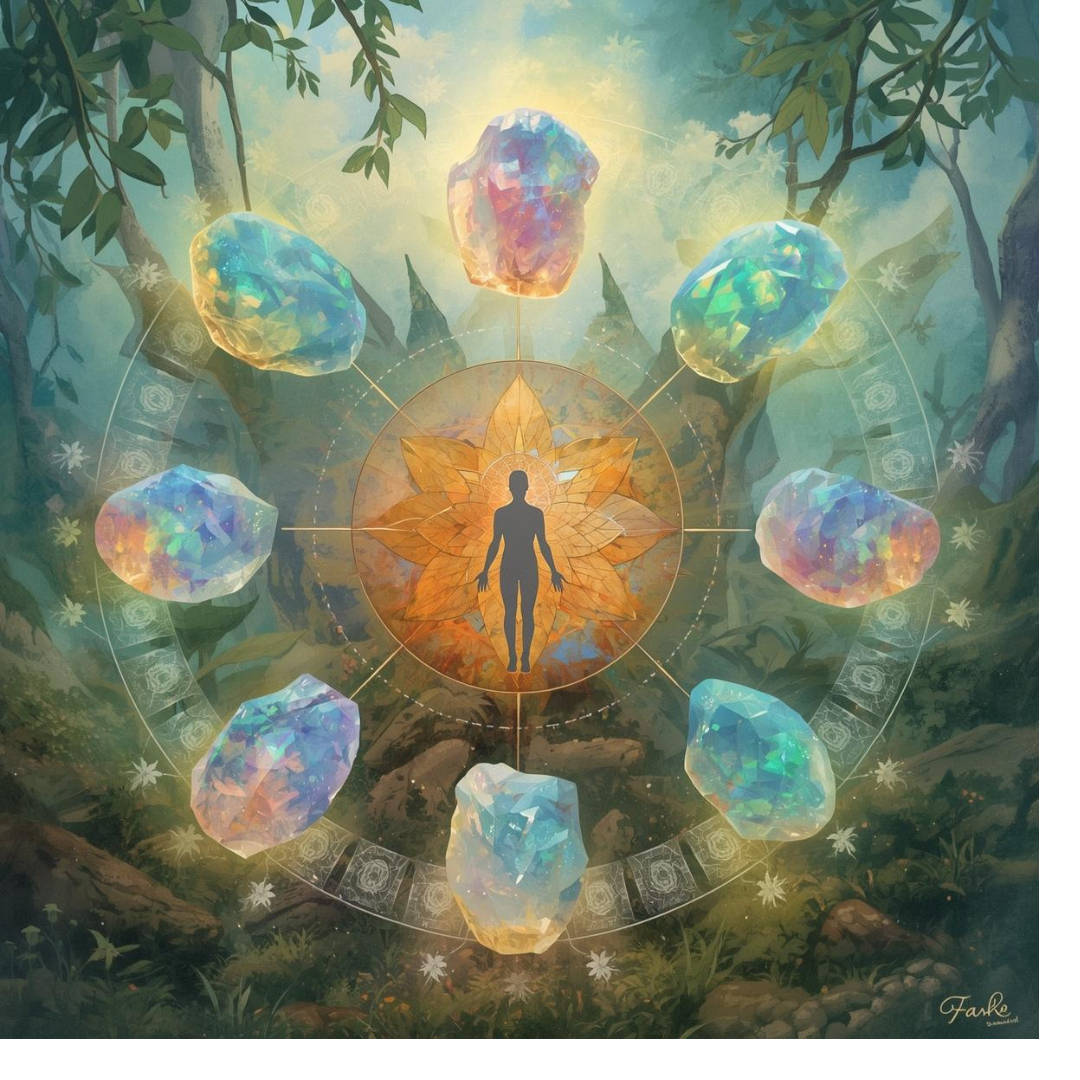
What Does Opal Do To Your Body?
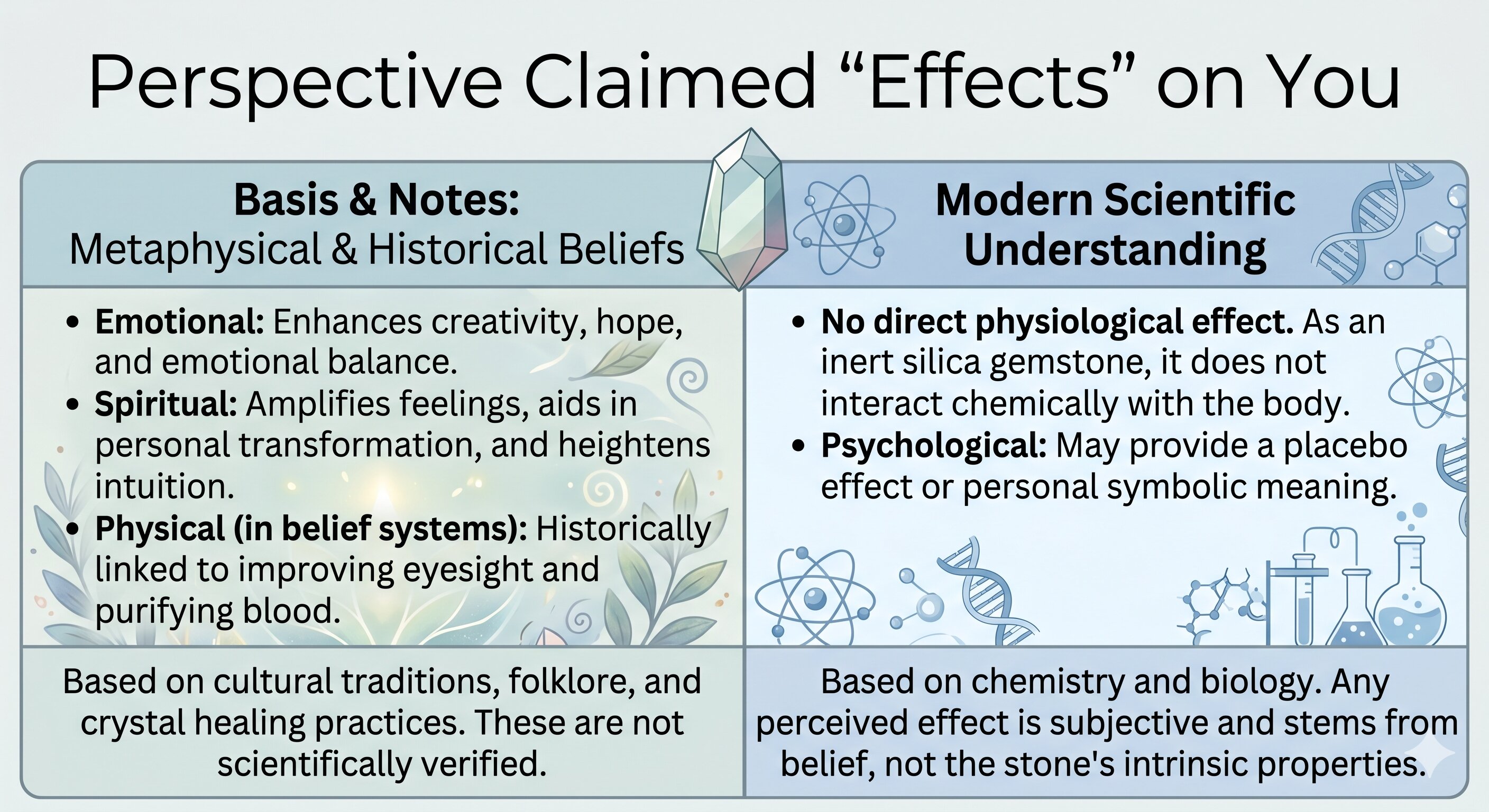
Wearing or using opal is primarily a personal or aesthetic choice, as there is no scientific evidence that opal has direct biological effects on the human body. Its "effects" are rooted in historical belief systems and metaphysical traditions, not medical science.
It is crucial to distinguish between symbolic meanings and proven physical effects. The table below contrasts the two perspectives:
The Main Physical Consideration: Care and Handling
The most practical physical interaction with opal relates to its delicate nature and your need to care for it:
Opal is Relatively Soft: With a hardness of 5.5-6.5 on the Mohs scale, it can be easily scratched by dust (which contains quartz, hardness 7).
It Can Be Fragile: It has a risk of chipping or cracking from knocks or sudden temperature changes.
Some Types Absorb Water: Hydrophane opals (common from Ethiopia) can absorb liquids, which may temporarily cloud or crack the stone.
Therefore, opal "does" require you to handle it gently, store it separately from harder gems, and clean it only with a soft, damp cloth.
While opal is rich in cultural symbolism and personal meaning, it does not have active, proven effects on your physical body. Its true value lies in its beauty and the personal significance you assign to it.
If you are interested in the specific care instructions for a type of opal jewelry you own, I can provide more detailed guidance on that.
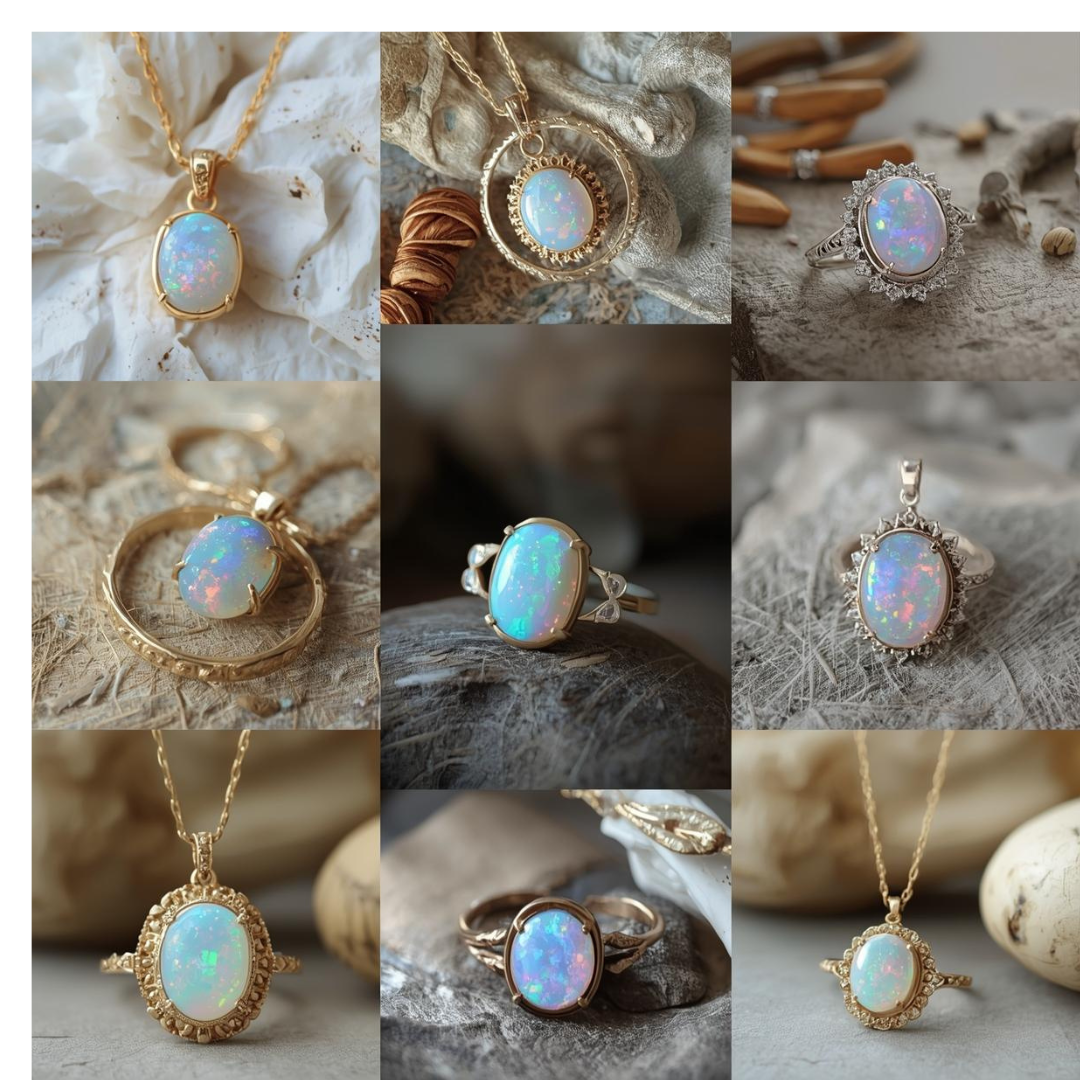
Should Opal Be Worn In Gold Or Silver?
Choosing between gold and silver for an opal is a common dilemma. The best metal depends on your budget, lifestyle, style preferences, and the opal itself.
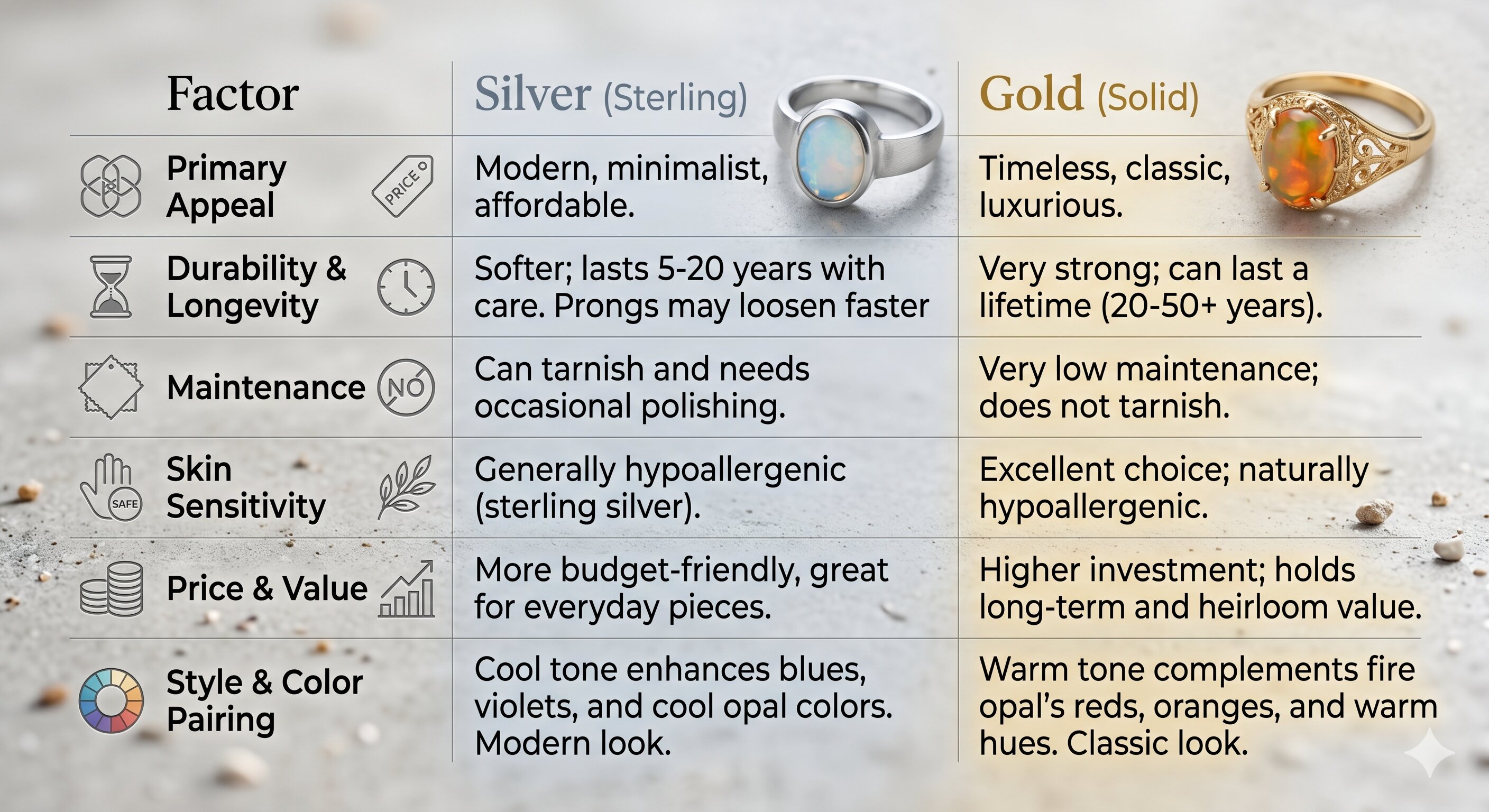
The table below compares the key factors to help you decide:
How to Choose Based on Your Needs
Consider these questions to narrow down your choice:
For a piece worn daily (like a work ring): Solid gold (especially 9k or 14k) is more durable and scratch-resistant. If opting for silver, choose a robust bezel setting.
For a special gift or heirloom: Solid gold (14k or 18k) offers timeless value and emotional significance.
On a tighter budget or for trend-focused styles: Sterling silver offers great value and a modern look.
Considering the opal's color: Think about color harmony. Gold highlights warm tones, while silver makes cool colors pop.
If you have sensitive skin, both are good, but solid gold is the safest bet.
Important Considerations Beyond the Metal
The Setting is Crucial: Opals are softer gems. A bezel setting (metal fully encircling the stone) offers the best protection, especially for rings.
Understanding Gold Karats: A higher karat means more gold content, but softer metal. 14k gold is often recommended as the best balance of purity, durability, and rich color.
Opal Type Matters: If you have a doublet/triplet opal or a hydrophane Ethiopian opal, extra care is needed, as they can be damaged by water, limiting your choices.
Final Recommendation
For a durable, low-maintenance piece you'll wear often, solid gold (14k) is the most reliable long-term choice. For an affordable, stylish piece for occasional wear, sterling silver is excellent.
Since you've been exploring opals in-depth, would you like to know more about the specific care routines for gold versus silver opal jewelry or the pros and cons of different setting styles?
“You now know the history, the formation, the origins, the symbolism, the tests, the colors, the value, the metals, and the care. The only question left: will you wear the rainbow serpent‘s breath?
Our current collection includes a limited number of natural, untreated opals — from Lightning Ridge black opals with red fire to Ethiopian crystal opals with harlequin patterns. When stones of this color saturation and play-of-color are gone, sourcing new ones can take months.
This is not just a birthstone. It is 3,000 years of Roman reverence, Greek prophecy, and Australian creation — the Queen of Gems, the lightning‘s gift, and the only stone that holds every color at once.”
[Button: Claim Your Opal (Limited) →]


Other news for Thursday 11 June, 2026
- Sapphire Rings Guide: Meaning, Colors, Settings and Value | September Birthstone
- Black Onyx Stone: Complete Buying Guide, Real vs. Fake and Prices [2026]
- 10K Gold Guide: Purity, Price, vs 14K/18K, Daily Wear and Care
- November Birthstones: Topaz vs Citrine Guide | Prices, Care and Meaning
View all news for Thursday 11 June, 2026 on one page
News for Wednesday 10 June, 2026
- Pearl Birthstone Guide: Meaning, Price, Care And Types
- Moonstone Meaning 2026: Complete Guide to Benefits, Price, Real VS Fake
View all news for Wednesday 10 June, 2026 on one page
Recent News
- Tuesday 09 June, 2026
- Monday 08 June, 2026
- Sunday 07 June, 2026
- Saturday 06 June, 2026
- Friday 05 June, 2026