

Diamond 4Cs Guide: Cut,Color,Clarity,Carat,Prices and Buying Tips
Diamond 4Cs Guide: Cut,Color,Clarity,Carat,Prices and Buying Tips
The 4Cs of Diamond Quality is a universal standard for evaluating and describing the quality of any diamond, anywhere in the world.
“In 1953, a young woman named Marilyn Monroe sang ‘Diamonds Are a Girl‘s Best Friend.‘ At the time, the 4Cs did not exist. GIA had only introduced the system two years earlier, and most jewelers still argued by feel, not by science. Then something changed. A diamond with a GIA report could be bought and sold anywhere in the world with confidence. No more guesswork. No more tricks. The 4Cs did not just standardize diamonds. They democratized them. For the first time, a bride in Ohio and a buyer in Tokyo could compare the same stone. The 4Cs are not a checklist. They are a promise: what you see is what you get.”
Created by the Gemological Institute of America (GIA) in the mid-20th century, it provides a consistent and objective language for comparing diamonds.
Table of Contents
- What Is The 4C Diamond Guide?
- 4 c's Diamond Chart
- How Much Is A 4 C Diamond?
- How Do The 4 C's Affect Diamond Cost?
- How Do the 4 C's Impact A Diamond's Sparkle?
- Is A 4-Carat Diamond Considered Big?
- How Rare Is A 4 Carat Diamond?
- Is A 4ct Diamond Good?
- Why Are The 4Cs Important?
- How Can You Tell If A Diamond Is Good Quality?
The first topic;
What Is The 4C Diamond Guide?
The 4Cs stand for Cut, Color, Clarity, and Carat Weight. Think of them as the four key characteristics that determine a diamond's beauty, rarity, and ultimately, its price.
A Detailed Breakdown of the 4Cs
Here is a comprehensive look at each of the four components:
1. Cut (The Most Important "C" for Brilliance)
What it is: Cut refers not to the diamond's shape (e.g., round, princess, oval) but to how well its facets interact with light. It is the quality of the diamond's proportions, symmetry, and polish.
Why it matters: The cut is responsible for a diamond's sparkle, fire (the flashes of color), and brilliance (the white light return). A well-cut diamond will reflect light beautifully from one facet to another and then back out through the top, making it dazzling. A poorly cut diamond will look dull and lifeless, even if it has perfect color and clarity.
Grading Scale (for Round Brilliant diamonds):
Excellent/Ideal: Maximum brilliance and fire. Precise craftsmanship.
Very Good: High brilliance and sparkle. Reflects nearly all light that enters.
Good: Reflects most light that enters. A good value.
Fair: Allows a significant amount of light to leak out from the sides and bottom, resulting in a dull appearance.
Poor: Most light leaks out, resulting in a very dull appearance.
Key Takeaway: Prioritize cut quality above all else. It has the greatest impact on a diamond's beauty.
2. Color (The "C" for Purity)
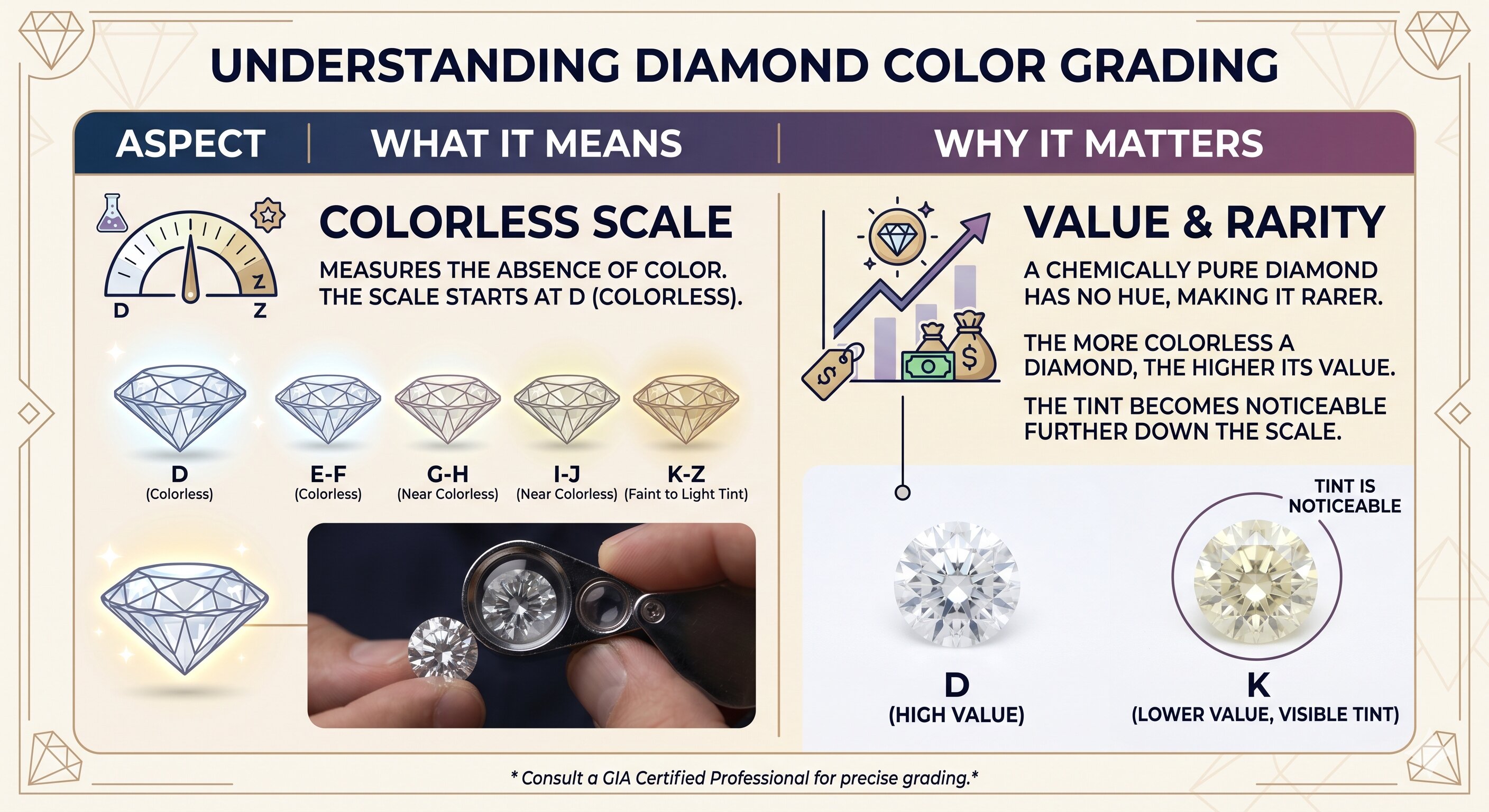
What it is: Color grade actually measures the absence of color in a diamond. The GIA scale starts at D (completely colorless) and goes to Z (light yellow or brown).
Why it matters: A chemically pure and structurally perfect diamond has no hue, like a drop of pure water, and is rarer and more valuable. The color tint becomes more noticeable as you move down the scale.
Grading Scale:
Colorless (D-F): The rarest and most valuable. Differences between D, E, and F are virtually undetectable to the untrained eye.
Near Colorless (G-J): An excellent value. These diamonds appear colorless to the naked eye, especially when set in jewelry.
Faint (K-M): A faint yellow tint is noticeable.
Very Light (N-R) / Light (S-Z): A visible yellow or brown tint.
Key Takeaway: For a "white" appearance, aim for a G-J grade for the best balance of quality and value.
3. Clarity (The "C" for Inclusions)
What it is: Clarity measures the number, size, relief, and location of internal characteristics (called inclusions) and surface characteristics (called blemishes) within a diamond.
Why it matters: Most diamonds have these tiny birthmarks formed deep within the earth. The fewer and less visible they are, the rarer and more valuable the diamond. Clarity refers to the diamond's appearance, or how "clean" it looks to the eye.
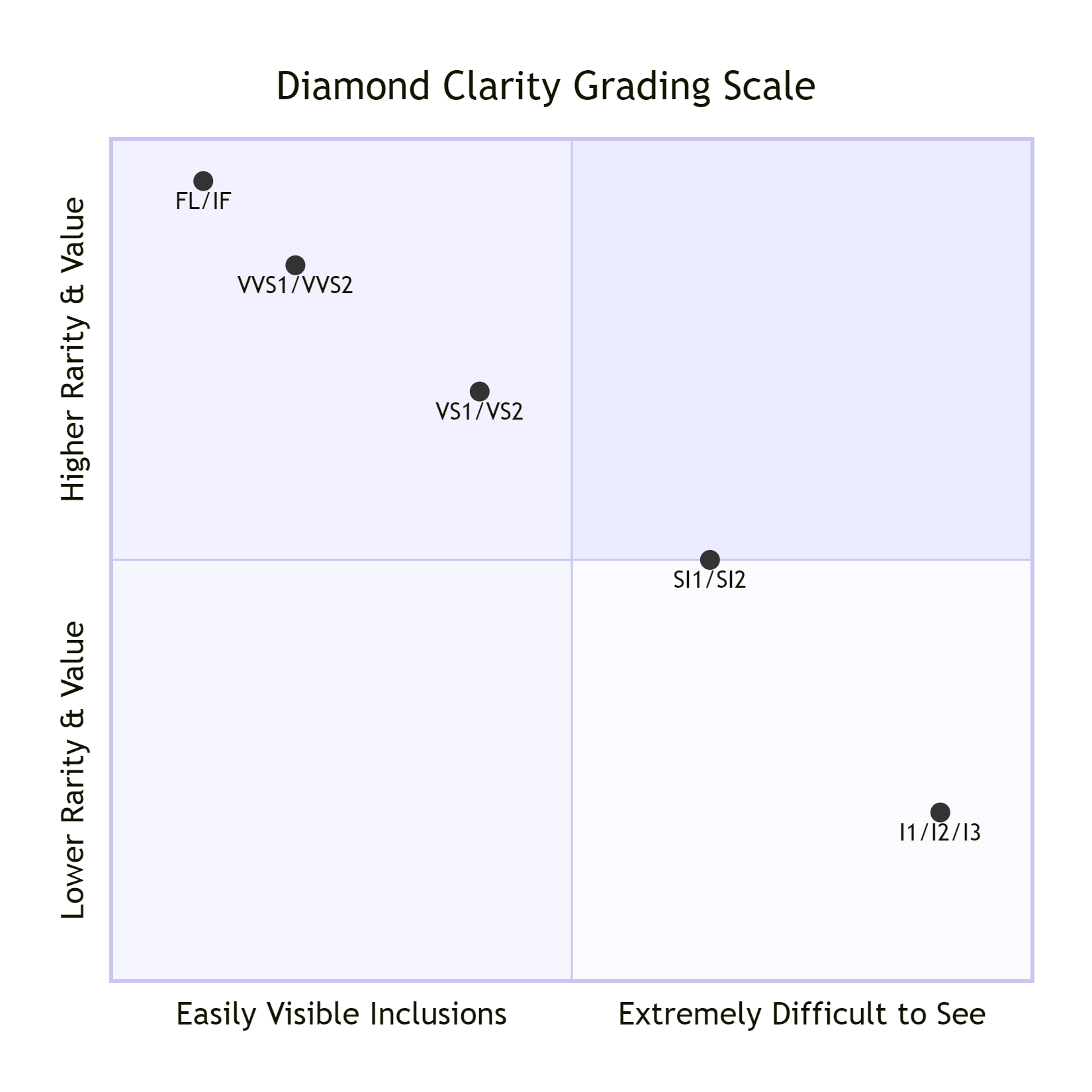
Grading Scale:
Flawless (FL) / Internally Flawless (IF): Extremely rare. No inclusions visible under 10x magnification.
Very, Very Slightly Included (VVS1, VVS2): Minute inclusions that are difficult for a skilled grader to see under 10x magnification.
Very Slightly Included (VS1, VS2): Minor inclusions that range from difficult to somewhat easy to see under 10x magnification. Often considered "eye-clean."
Slightly Included (SI1, SI2): Inclusions are noticeable under 10x magnification and may be visible to the naked eye. SI1 is often the sweet spot for an eye-clean diamond.
Included (I1, I2, I3): Inclusions are obvious under 10x magnification and typically visible to the naked eye, potentially affecting brilliance and durability.
Key Takeaway: You don't need a Flawless diamond. Choose a grade that is "eye-clean" (no visible inclusions to the naked eye), such as VS2 or SI1, for the best value.
4. Carat Weight (The "C" for Size)
What it is: Carat is the standard unit of weight for diamonds and other gemstones. One metric carat equals 200 milligrams (0.2 grams).
Why it matters: All else being equal, a larger carat weight means a rarer and more expensive diamond. However, carat weight does not equal size. A well-cut diamond can face up (appear larger) than a poorly cut diamond of the same weight.
Key Takeaway: Diamond prices jump at "magic sizes" (e.g., 0.5 ct, 1.0 ct, 1.5 ct, 2.0 ct). Consider a diamond just under these sizes (e.g., 0.90 ct or 1.80 ct) for significant savings with no visible difference in size.
How the 4Cs Work Together
The 4Cs are not independent; they must be balanced based on your budget and priorities. A common strategy is to:
Prioritize Cut: Never compromise on cut, as it's the key to sparkle.
Choose the best Color and Clarity you can afford that is "face-up" beautiful (i.e., no yellow tint or visible inclusions to the naked eye).
Decide on Carat Weight based on the size you desire after balancing the other three Cs.
Summary Table
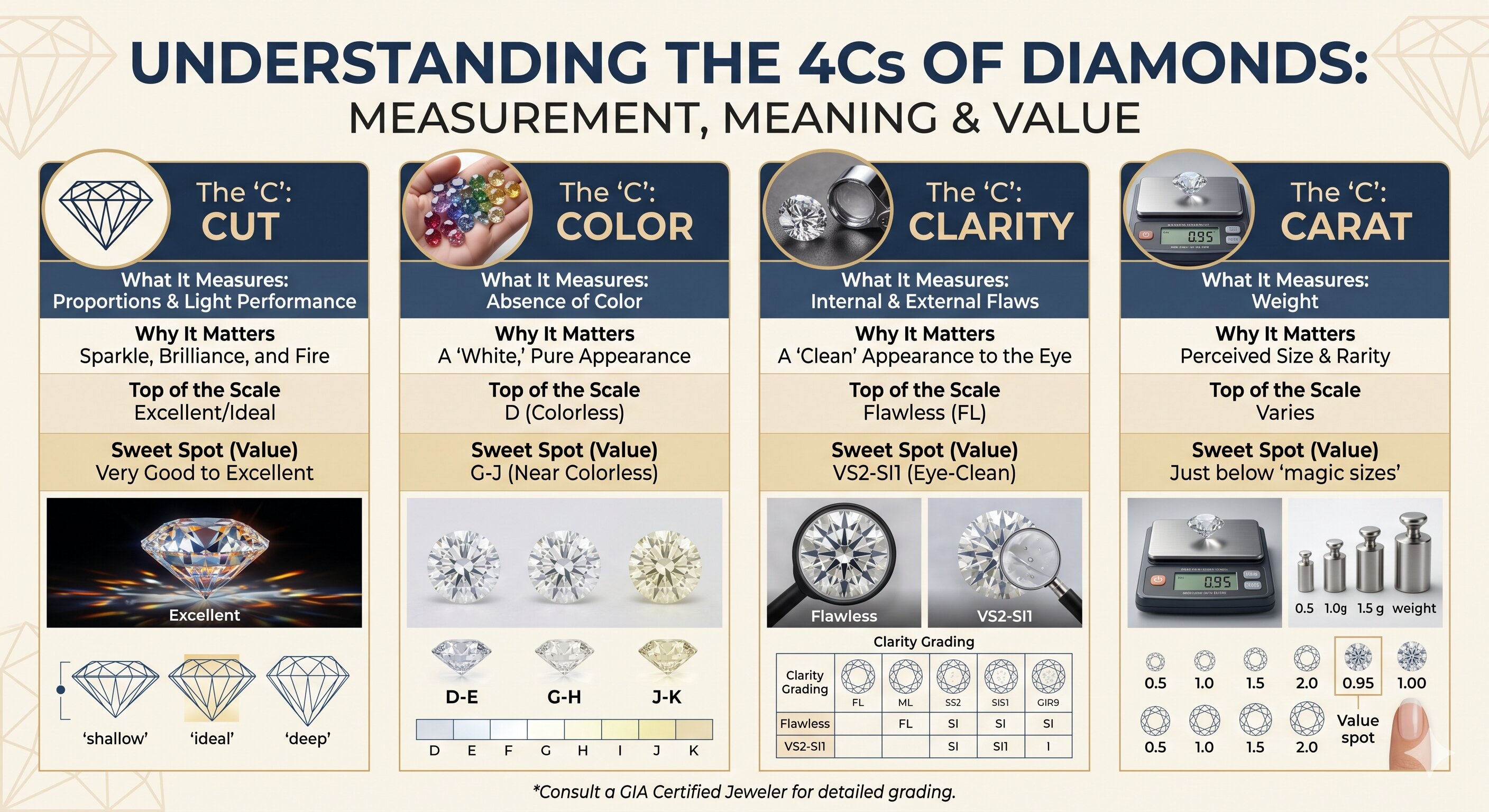
By understanding the 4Cs, you are equipped to make an informed and confident decision when purchasing a diamond, ensuring you find a stone that is not only beautiful but also represents excellent value for your investment.
For official 4Cs information, visit the GIA 4Cs Guide.
4 c's Diamond Chart
Here is a clear and detailed chart of the 4Cs, breaking down each characteristic's meaning and grading scale.
The 4Cs of Diamonds: Quick-Reference Chart
This chart provides a visual overview of the grading scales for each of the 4Cs.
Detailed Breakdown of Each "C"
1. Cut: The Most Important "C" for Sparkle
Excellent/Ideal: Maximum brilliance and fire. Top-tier craftsmanship.
Very Good: High brilliance and sparkle. Excellent value.
Good: Reflects most light. A good budget-friendly choice.
Fair/Poor: Significant light leakage; appears dull and lifeless.
Key Takeaway: Never compromise on Cut. It is the primary driver of a diamond's beauty.
2. Color: The "C" for Purity
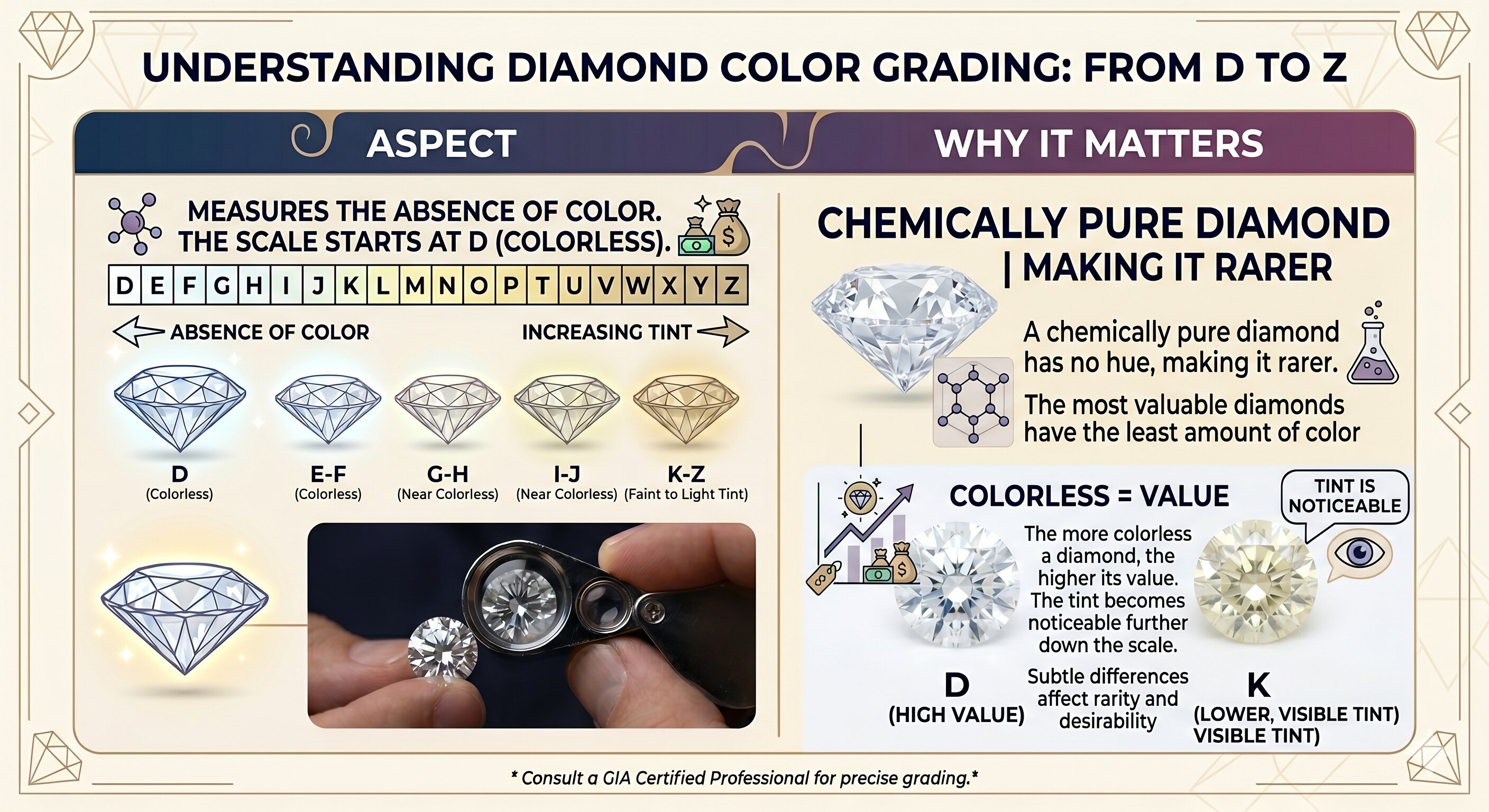
Color Grading Scale:
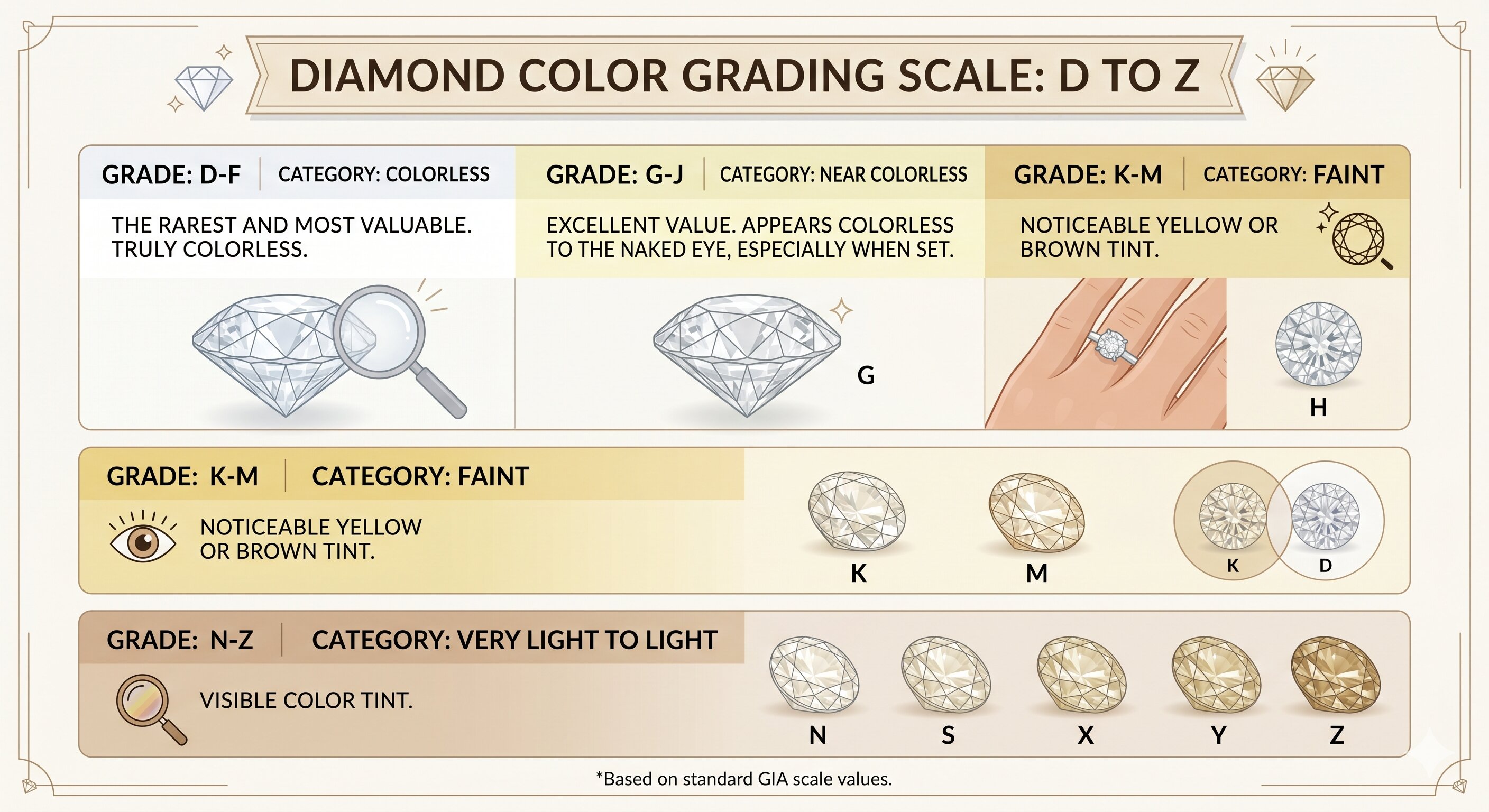
Key Takeaway: For a "white" appearance without the top-tier price, choose a G-J grade.
3. Clarity: The "C" for Internal Flaws
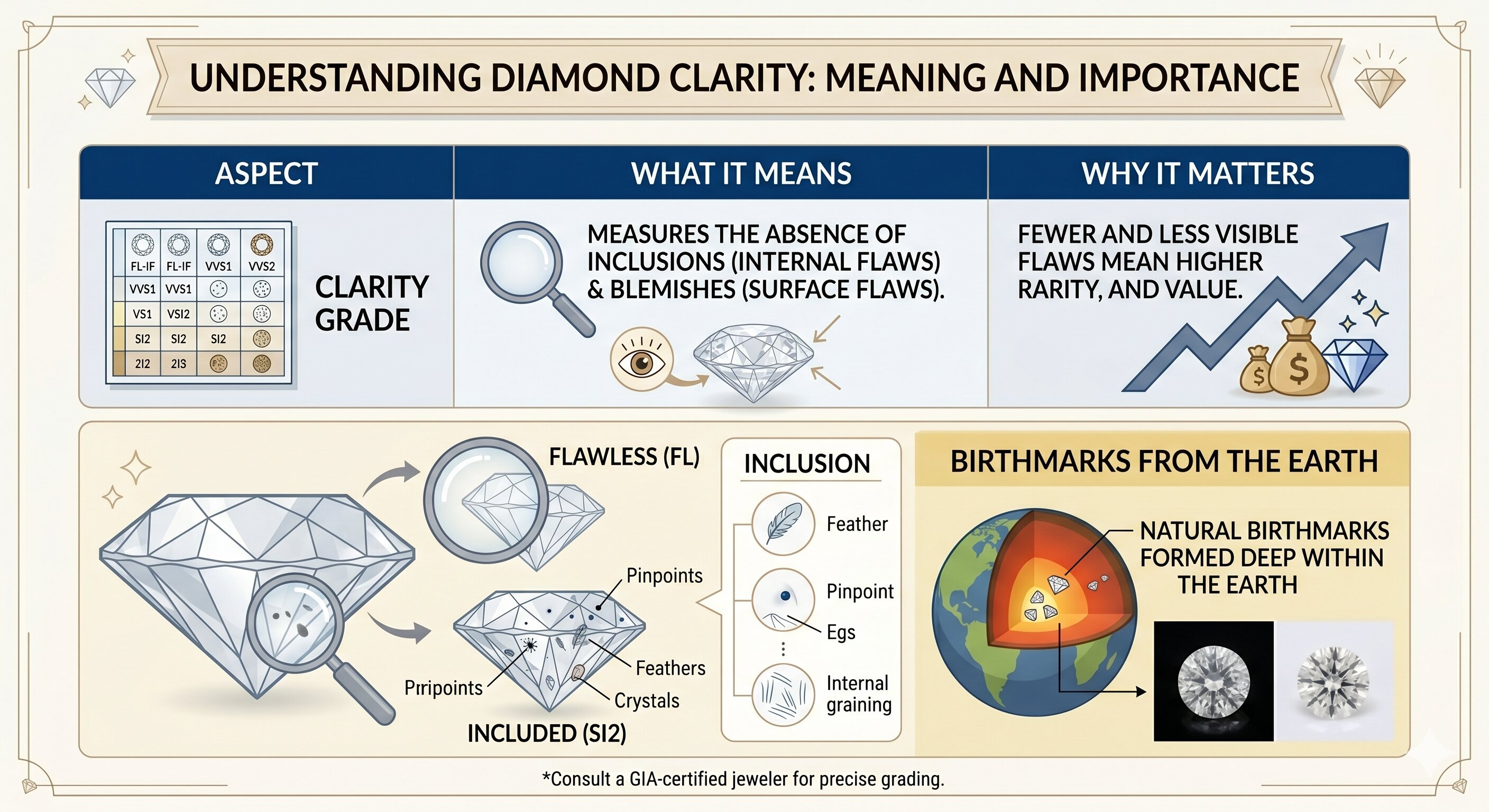
Clarity Grading Scale:
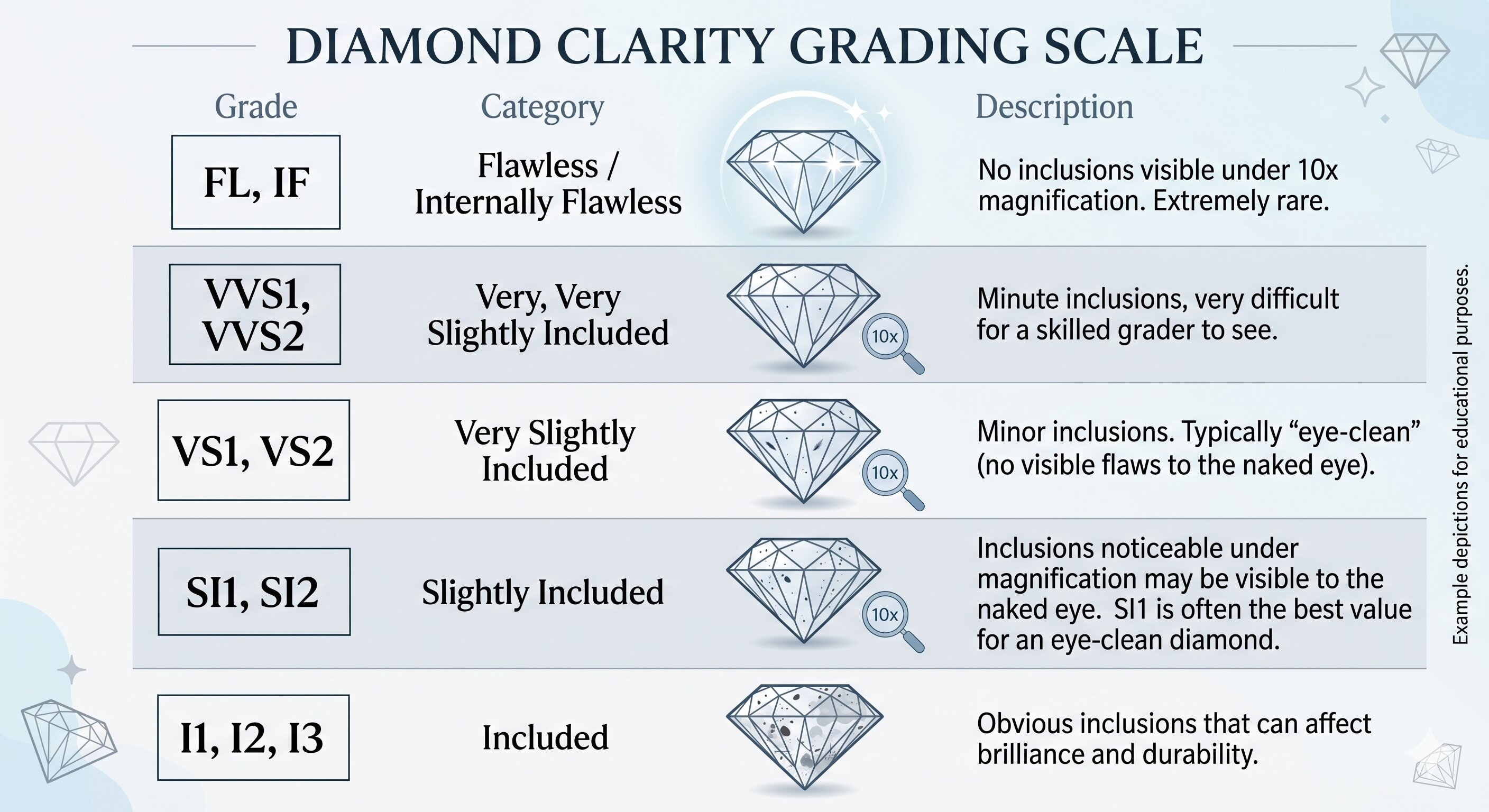
Key Takeaway: You don't need a flawless diamond. Prioritize a diamond that is "eye-clean" (like VS2-SI1), where no flaws are visible without magnification.
4. Carat Weight: The "C" for Size
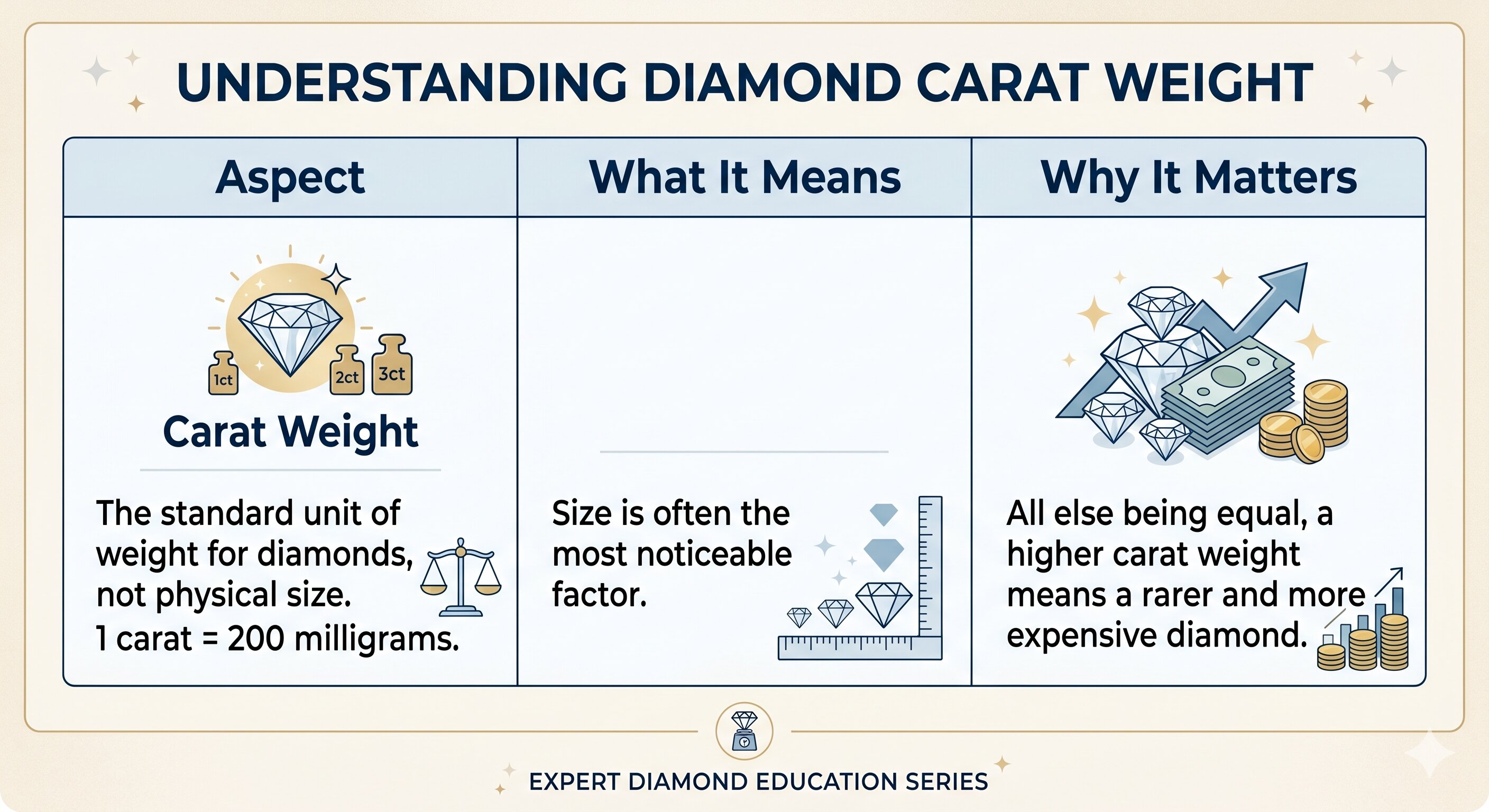
Important Note on Carat:
Cut Affects Size: A well-cut diamond can face up (look larger) than a poorly cut diamond of the same weight.
Price Jumps: Diamond prices jump at "magic sizes" (e.g., 0.5 ct, 1.0 ct, 1.5 ct, 2.0 ct). Consider a diamond just under these sizes (e.g., 0.90 ct or 1.80 ct) for significant savings with no visible difference in size.
Key Takeaway: Balance carat weight with the other Cs. A smaller, well-cut diamond can be more beautiful than a larger, poorly cut one.
How to Use This Chart
When shopping, use the 4Cs to balance your priorities and budget:
Priority #1: Cut for maximum sparkle.
Priority #2: Color & Clarity, choose the grade that looks clean and white to your eye.
Priority #3: Carat Weight Choose the size that fits your budget after balancing the other three Cs.
How Much Is A 4 C Diamond?
This is the most common and important question after learning about the 4Cs, but it's also one that doesn't have a single answer.
The price of a diamond graded on the 4Cs can range from a few hundred dollars to millions of dollars because "a 4C diamond" isn't a single quality. It's a combination of four different variables.
To give you a meaningful answer, let's look at price ranges for a classic, popular choice: a 1-carat, round brilliant, solitaire diamond with different combinations of Cut, Color, and Clarity.
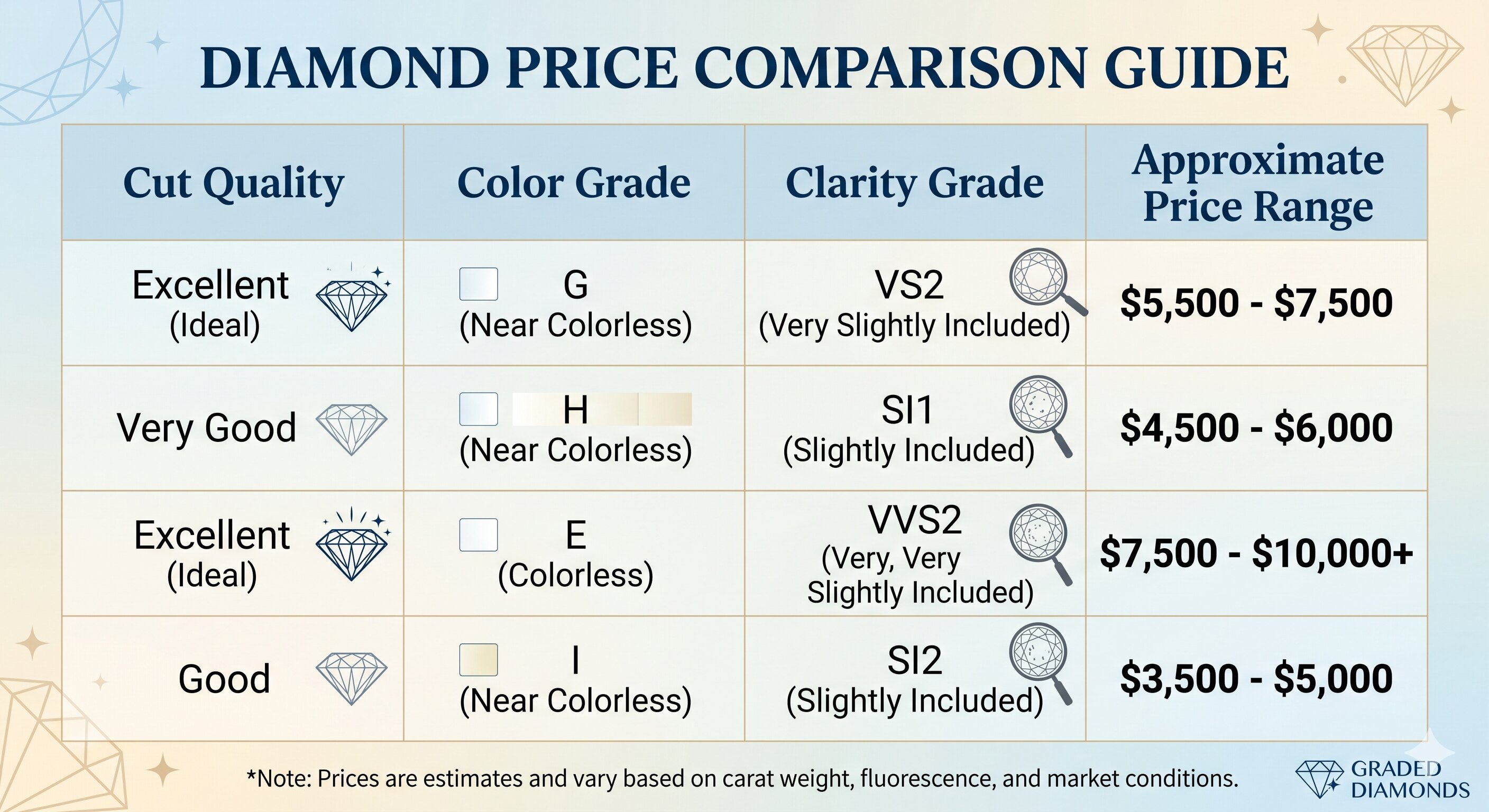
Estimated Price Ranges for a 1-Carat Diamond (Round Brilliant)
The following table illustrates how different combinations of the 4Cs affect the price. These are approximate retail price ranges for a well-cut round brilliant diamond.
What Drives the Massive Price Differences?
The prices vary so wildly because each "C" significantly impacts the rarity and cost.
1. Carat Weight (The Biggest Driver of Price)
The "Size" Factor: Larger diamonds are exponentially rarer. This means the price per carat increases as the total carat weight goes up.
Price Jump Example: A 2-carat diamond with the same Cut, Color, and Clarity as a 1-carat diamond will cost more than double the price of the 1-carat stone.
2. Cut Quality (The Driver of Beauty)
The "Sparkle" Factor: An Excellent/Ideal cut diamond commands a significant premium over a Good or Fair cut diamond because it requires more skilled labor and wastes more of the original rough crystal. This is a price worth paying for brilliance.
3. Color & Clarity (The Drivers of Purity)
The "Rarity" Factor: A Flawless (FL), D-color diamond is one of the rarest objects on Earth. Moving just a few steps down the scale to a VS1, G-color diamond makes it vastly more common and affordable, while often appearing identical to the naked eye.
General Price Tiers for a 1-Carat Diamond
To simplify, here's a broad look at price tiers:
Budget-Conscious ($3,000 - $5,000): Focuses on good performance. Expect a Good/Very Good Cut, I-J Color, and SI1-SI2 Clarity. The goal is an "eye-clean" stone with good sparkle.
Balanced Value ($5,000 - $7,500): The most popular range for engagement rings. Expect a Very Good/Excellent Cut, G-H Color, and VS2-SI1 Clarity. This offers an excellent balance of size, sparkle, and purity.
High Quality ($7,500 - $12,000+): For those prioritizing quality over size. Expect an Excellent Cut, D-F Color, and VVS-VS Clarity. This is for a nearly flawless, maximum-brilliance stone.
Exceptional/Investment Grade ($15,000+): Features the absolute top grades: Excellent Cut, D Color, and IF/FL Clarity. These are collector-grade stones.
How to Get a Real Price
Since the combination is everything, the only way to get an accurate price is to specify the exact 4Cs you want. For example:
"How much is a 1.5-carat, Excellent cut, G color, VS2 clarity diamond?"
"How much is a 0.9-carat, Very Good cut, I color, SI1 clarity diamond?"
Crucial Next Steps:
Get a Certificate: Always buy a diamond with a grading report from a reputable lab like the GIA (Gemological Institute of America) or AGS (American Gem Society). This guarantees the 4Cs have been objectively assessed.
Set a Budget First: Decide what you are comfortable spending before you start looking.
Prioritize the Cs: Remember the hierarchy for beauty: Cut > Carat > Color & Clarity. It's better to have a smaller, stunning diamond than a larger, dull one.
In short, the price of a "4C diamond" is determined by the specific grades you choose for each of those C's. By understanding how they interact, you can find a beautiful diamond that fits your budget.
How Do The 4 C's Affect Diamond Cost?
The relationship between the 4Cs and diamond cost is fundamental. It's not just that they affect the price; they are the price.
Think of it like this: The 4Cs are a formula where Rarity + Beauty = Cost. Each "C" adds a multiplier to the diamond's value, and they work together in a complex, often exponential, way.
Here’s a detailed breakdown of how each "C" drives the cost.
1. Cut: The Exponential Multiplier for Beauty
How it Affects Cost: The Cut has the most dramatic and non-linear impact on cost per carat. A jump from "Good" to "Excellent" can increase the price by 20-50% or more for the same carat weight, color, and clarity.
Why: A higher cut grade means the cutter had to sacrifice more of the original rough diamond crystal to achieve the ideal proportions. This "wasted" material is factored into the cost. An Excellent cut diamond is both rarer (because it's harder to achieve) and more beautiful (commanding a premium for its brilliance).
Analogy: It's the difference between a master chef using premium ingredients and perfect technique to create a spectacular dish versus a simple home-cooked meal. You pay for the skill and the result.
2. Carat Weight: The Geometric Cost Driver
How it Affects Cost: Price increases exponentially with carat weight, not linearly.
Why: Large diamond crystals are much rarer than small ones. Finding a 2-carat rough crystal is vastly more rare and valuable than finding two 1-carat crystals. This rarity is reflected in the price. The price per carat jumps significantly at "magic sizes" like 0.5ct, 1.0ct, 1.5ct, and 2.0ct.
Example: A 1-carat diamond might be $5,000. A 2-carat diamond of the same quality will not be $10,000; it could be $20,000 or more because a 2-carat stone of that quality is that much rarer.
3. Color: The Cost of Purity
How it Affects Cost: The closer to colorless (D), the higher the premium. The price increase from one color grade to the next can be 5-20% per step, depending on the range.
Why: Truly colorless diamonds are the rarest in nature. As you move down the scale, diamonds become more common. The premium for a D-F (Colorless) grade is very high. The difference between G and H (Near Colorless) might be smaller, but it's still a significant cost factor.
Key Insight: The jump from J (Near Colorless) to I (Near Colorless) is smaller than the jump from G (Near Colorless) to F (Colorless). The boundaries between categories (e.g., G to F) carry a major price premium.
4. Clarity: The Cost of Perfection
How it Affects Cost: Higher clarity grades command a high premium, but the cost increase is most dramatic at the very top of the scale.
Why: Flawless (FL) and Internally Flawless (IF) diamonds are geological miracles and are exponentially rarer than even a VVS1 diamond. The price difference between IF and VVS1 is enormous. However, the difference between a VS2 and an SI1 (both often "eye-clean") might be a more modest 10-15% cost increase.
Key Insight: You pay a huge premium for perfection that is invisible to the naked eye. The value sweet spot is in the VS-SI range, where diamonds are eye-clean but don't carry the "flawless" rarity price tag.
How They Work Together: The Pricing Matrix
The 4Cs don't operate in isolation. Their effect on cost is interconnected, creating a complex pricing matrix.
Example Scenario: The Quest for a 1.5-Carat Diamond
Option A (Budget-Focused):
Carat: 1.50 ct
Cut: Good
Color: K (Faint Tint)
Clarity: I1 (Included, visible flaws)
Cost: ~$3,000 - $4,000
You prioritized size by sacrificing cut, color, and clarity. The diamond will be large but may appear dull and have visible inclusions or a yellowish tint.
Option B (Balanced & Brilliant):
Carat: 1.50 ct
Cut: Excellent
Color: G (Near Colorless)
Clarity: VS2 (Eye-Clean)
Cost: ~$12,000 - $15,000
You balanced all factors. You have a large diamond that is also brilliantly sparkly, white, and clean to the eye. This is where most of the cost is.
Option C (Ultimate Purity):
Carat: 1.50 ct
Cut: Excellent
Color: D (Exceptional White)
Clarity: IF (Internally Flawless)
Cost: ~$25,000+
You prioritized ultimate rarity and perfection in all categories. The price reflects the extreme rarity of this combination.
Summary: The Hierarchy of Cost Impact
To maximize your budget, understand this typical hierarchy of impact on both beauty and cost:
Cut: Has the greatest impact on beauty. A high-grade cut is the most worth-it cost multiplier.
Carat: Has the most obvious impact on size. Its cost increases geometrically.
Color & Clarity: These are the "fine-tuning" factors. You can save significant money by opting for a grade that is slightly lower but visually identical to a higher grade (e.g., G color instead of D, or VS2 clarity instead of VVS).
The Golden Rule: You are always paying for a combination of these four factors. A change in any one of them will directly and predictably affect the final cost.
How Do the 4 C's Impact A Diamond's Sparkle?
This is an excellent question because it gets to the heart of what makes a diamond beautiful.
The 4Cs do not all impact sparkle equally. One is overwhelmingly the most important, while the others play supporting roles or have an indirect effect.
Here’s a breakdown of how each "C" impacts a diamond's sparkle, in order of importance.
1. Cut: The Master Controller of Sparkle
Impact: DIRECT and OVERWHELMINGLY THE MOST IMPORTANT
The Cut is the single greatest factor determining a diamond's sparkle (which is a combination of brilliance [white light], fire [flashes of color], and scintillation [the sparkle when moved]).
How it Works: A well-cut diamond acts like a precision optical device. When light enters the diamond, the angles and proportions of the cut are designed to reflect the light from one facet to another and then back out through the top of the diamond to your eye.
An Excellent/Ideal Cut: Maximizes light return, creating a dazzling, brilliant, and fiery stone.
A Poor Cut: Allows light to "leak" out the bottom or sides of the diamond. Instead of reflecting as sparkle, the light is lost, leaving the diamond looking dull, dark, and lifeless.
Key Takeaway: Cut is king for sparkle. You can have a diamond with perfect Color and Clarity, but if the Cut is poor, it will have little sparkle. Always prioritize an Excellent or Very Good cut grade.
2. Clarity: The Sparkle Inhibitor
Impact: INDIRECT and POTENTIALLY SIGNIFICANT
Clarity itself doesn't create sparkle, but poor clarity can destroy it.
How it Works: Inclusions (internal flaws) can block or disrupt the path of light as it travels through the diamond. A large or strategically located inclusion can act like a tiny black hole, creating a dead spot that kills light return and reduces sparkle.
The "Eye-Clean" Threshold: The good news is that most minor inclusions (in the VS or SI ranges) do not interfere with sparkle at all because they are too small or located on the edge, where they don't block major light paths. The goal is to find a diamond that is "eye-clean" so that clarity has no negative impact on sparkle.
Key Takeaway: You don't need high clarity for sparkle; you just need the clarity to be good enough not to interfere. An "eye-clean" SI1 diamond can be just as sparkly as a Flawless one if they have the same Cut quality.
3. Color: The Subtle Filter
Impact: INDIRECT and MINOR
Color has a very minor and indirect role in sparkle.
How it Works: A diamond's color acts as a very subtle filter. A strong yellow or brown tint (lower color grade, like L-Z) can slightly absorb some of the white light that would otherwise be reflected as brilliance. This can make the diamond appear slightly less bright and can mute the flashes of fire (color).
The Reality: For diamonds in the Near Colorless (G-J) and Colorless (D-F) ranges, this effect is negligible. The human eye cannot detect any difference in sparkle between a D color and a G color diamond if the Cut is identical.
Key Takeaway: Color's impact on sparkle is minimal for most diamonds on the market. Don't sacrifice Cut quality for a higher color grade in the belief that it will be "sparklier."
4. Carat Weight: The Bystander
Impact: NONE (Directly)
Carat weight has no direct impact on sparkle.
How it Works: Sparkle is determined by the quality of the cut, not the weight. A small, well-cut diamond will be incredibly sparkly, while a large, poorly cut diamond will be dull.
The Indirect Connection: There is an indirect relationship. As carat weight increases, it becomes more challenging and expensive for cutters to maintain an excellent cut while preserving weight. Many larger diamonds are cut to retain carat weight (making them more valuable by weight) at the expense of ideal proportions, which sacrifices sparkle.
Key Takeaway: A diamond's size does not determine its sparkle. A well-cut 0.5-carat diamond will easily outsparkle a poorly cut 2-carat diamond.
The Hierarchy of Sparkle
To visualize how the 4Cs impact a diamond's sparkle, the following chart ranks their influence:
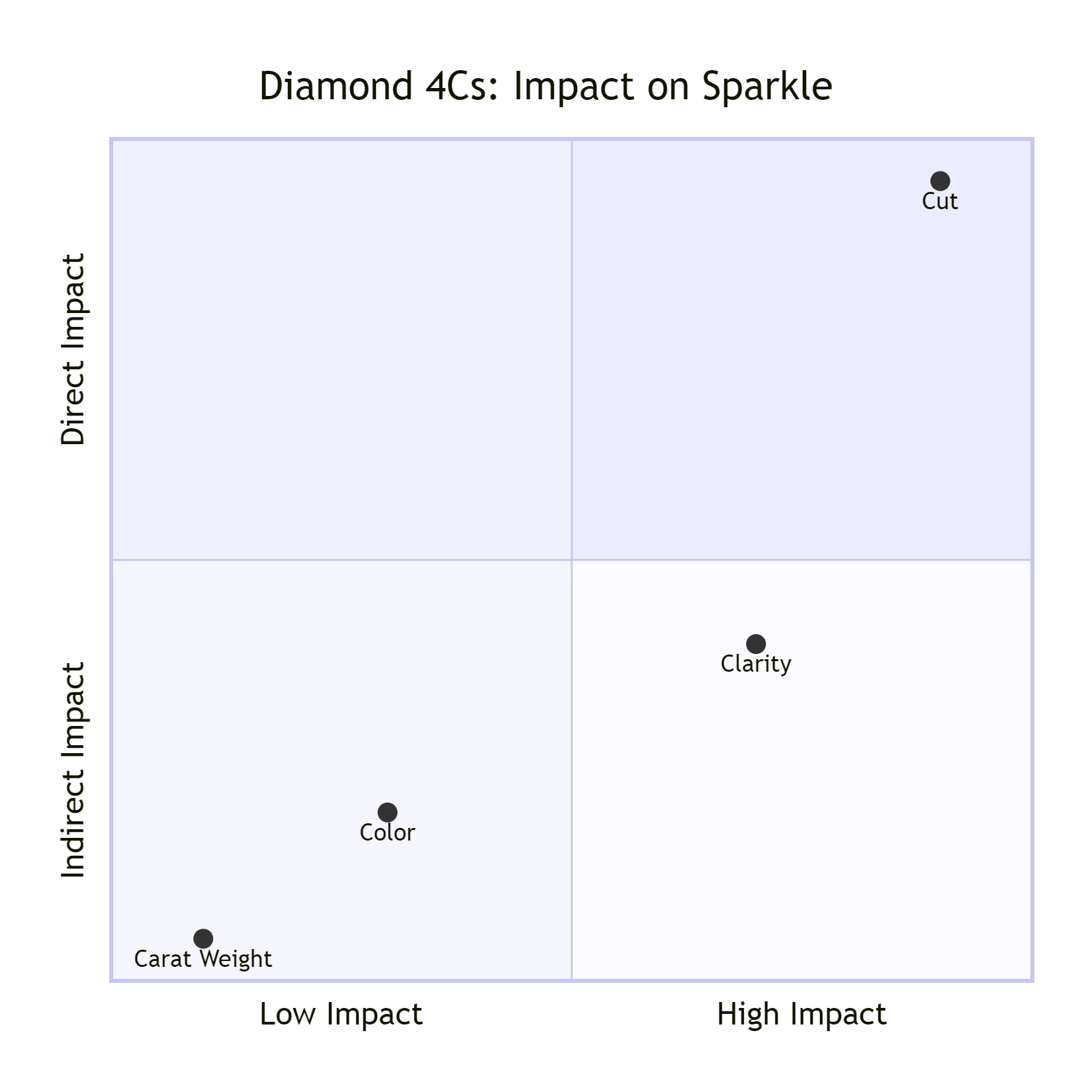
If your primary goal is maximum sparkle, your budget should be allocated as follows:
Invest first and foremost in the BEST CUT you can afford.
Allocate the remainder of your budget to Carat, Color, and Clarity in a balance that gives you the size you want and a stone that appears white and clean to your eye.
Is A 4-Carat Diamond Considered Big?
Yes, absolutely. A 4-carat diamond is considered very large and is a significant stone by any standard.
To put it in perspective, here’s a breakdown of why a 4-carat diamond is considered "big":
1. Physical Size and Presence
A 4-carat diamond has a major visual presence on the hand. Depending on the cut, its approximate diameter will be around 10.2 - 10.4 millimeters.
Comparison: That's wider than the eraser on a standard pencil and about the size of a small marble or a navy bean. On a finger, especially for a ring like an engagement ring, this is a dominant and highly noticeable stone.
2. Extreme Rarity and Price
This is where the "big" factor really hits home. Diamonds become exponentially rarer as their carat weight increases.
Rarity: A 4-carat diamond is exceptionally rare. To find a rough diamond crystal large and clean enough to yield a polished 4-carat gem is a challenge. This scarcity is the primary driver of its cost.
Price: You are entering a very high budget category. Depending on the other 3Cs (Cut, Color, Clarity), a 4-carat diamond can easily cost tens of thousands to several hundred thousand dollars. For example, a 4-carat diamond with excellent cut, good color, and clarity can easily surpass $100,000.
3. Social and Cultural Perception
Statement Piece: A 4-carat diamond is universally recognized as a luxury item and a statement of significant means. It is far beyond the average size for an engagement ring.
Average Size Context: The average engagement ring diamond in the United States is currently between 1.0 and 1.5 carats. A 4-carat diamond is more than double that size, placing it in a distinct category.
Important Considerations for a 4-Carat Diamond
Because of its size, every other characteristic is magnified—both the good and the bad.
Cut is CRITICAL: A poor cut on a 4-carat diamond is a massive wasted opportunity. It will look like a large, dull piece of glass. An excellent cut is essential to make a stone of this size come alive with sparkle.
Clarity is More Visible: Inclusions that might be hidden in a smaller stone can be much more visible to the naked eye in a 4-carat diamond. You will likely need to aim for a higher clarity grade (e.g., VS2 or better) to ensure it is eye-clean.
Color is More Noticeable: The body color of a larger diamond is easier to perceive. A near-colorless grade (G-H) is often the sweet spot, but if you want the diamond to face up as completely white, you may need to go into the colorless range (D-F).
Setting and Lifestyle: A ring with a 4-carat diamond is substantial. It requires a secure, well-crafted setting (often with a V-prong or bezel for protection). It's also tall on the finger, which may not be ideal for someone with a very active lifestyle.
Yes, a 4-carat diamond is unquestionably big. It is a rare, valuable, and impressive stone that makes a bold statement. Choosing a diamond of this size means you are selecting a top-tier gem where the quality of the Cut, Color, and Clarity must be carefully evaluated to match its impressive carat weight.
How Rare Is A 4 Carat Diamond?
A 4-carat diamond is not just "big"—it is exceptionally rare.
To put its rarity into perspective, let's break down the reasons why finding a 4-carat diamond, especially a high-quality one, is like finding a needle in a haystack.
The Rarity in Numbers and Geology
Extreme Scarcity by Weight:
It's estimated that only 1-2% of all diamonds mined globally are over 1 carat in their rough form.
The percentage of diamonds that reach 4 carats after polishing is a tiny fraction of that already small percentage. You are looking at a rarity that places a 4-carat diamond in the top 0.1% or even rarer of all gem-quality diamonds.
The "Yield" Problem from Rough to Polished:
The process of cutting a diamond results in a significant loss of weight. On average, a cutter loses 50-60% of the original rough crystal's weight.
This means to get a 4-carat polished diamond, a cutter would need to start with a rough diamond crystal weighing between 8 and 12 carats. Finding a rough diamond of that size that is also of gem quality (i.e., not destined for industrial use) is incredibly uncommon.
Rarity is a Combination of the 4Cs
The rarity of a 4-carat diamond skyrockets when you consider the other three Cs. A 4-carat diamond with poor color and clarity is rare. A 4-carat diamond with excellent cut, color, and clarity is a genuine geological treasure.
A 4-Carat Diamond with Good Quality (e.g., G Color, VS2 Clarity): This is very rare. You are dealing with a significant, high-value stone that is well beyond what most people will ever encounter.
A 4-Carat Diamond with Top-Tier Quality (e.g., D Color, Flawless Clarity, Excellent Cut): This is exceptionally and extraordinarily rare. A diamond that combines immense size with perfection in every other category is a museum-quality piece and one of the most exclusive objects you can own. The price reflects this, often reaching well into the high six or seven figures.
Perspective on Rarity
Compared to Average: The average engagement ring diamond in the U.S. is between 1.0 and 1.5 carats. A 4-carat stone is more than double that size and exponentially rarer.
The "Magic Size" Effect: Diamond prices jump at "magic sizes" (0.5ct, 1.0ct, 1.5ct, 2.0ct, 3.0ct, 4.0ct, 5.0ct). The jump from a 3-carat to a 4-carat diamond of the same quality is massive, not just in price but in rarity. Each whole-carat milestone makes the diamond significantly more scarce.
So, how rare is a 4-carat diamond?
Extremely rare. It is not a stone you will see in a typical jewelry store. Owning one signifies the acquisition of a truly exceptional natural object. Its rarity is due to a perfect storm of geological circumstances, the high loss from the cutting process, and the extreme difficulty of finding a large crystal that is also clear and colorless enough to be considered a fine gem.
In short, while many diamonds exist, a 4-carat gem-quality diamond is a member of an elite and exclusive club.
Is A 4ct Diamond Good?
A 4-carat diamond can be an excellent choice, but its quality and value are judged by stricter standards than a smaller diamond. Due to its size, the other quality factors (the 4 C's) become more noticeable and important for maximizing beauty and value.
Key Factors for a "Good" 4-Carat Diamond
When evaluating a 4-carat diamond, the same principles apply but with higher benchmarks:
Higher Standards for Color & Clarity: The large surface area makes color tints and inclusions easier to see. Experts recommend prioritizing:
Color: H grade or above (near colorless) is advised for round brilliants to ensure no visible yellow tint. For fancy shapes like emerald or Asscher, consider going to F or G.
Clarity: VS2 or higher is ideal, as inclusions are typically only visible under magnification, making the stone "eye-clean".
Cut is Paramount: An Excellent or Ideal cut is non-negotiable. It maximizes sparkle, can make the diamond appear its best, and is the most important factor for overall beauty.
Secure Settings: A 4-carat stone needs a sturdy setting. Solitaire, cathedral, or three-stone settings with a wider band and secure prongs (like double or claw prongs) are recommended for safety and proper support.
Understanding Price and Value
A 4-carat diamond is a major investment. Prices are exponentially higher, not linear, due to the rarity of large, high-quality rough diamonds.
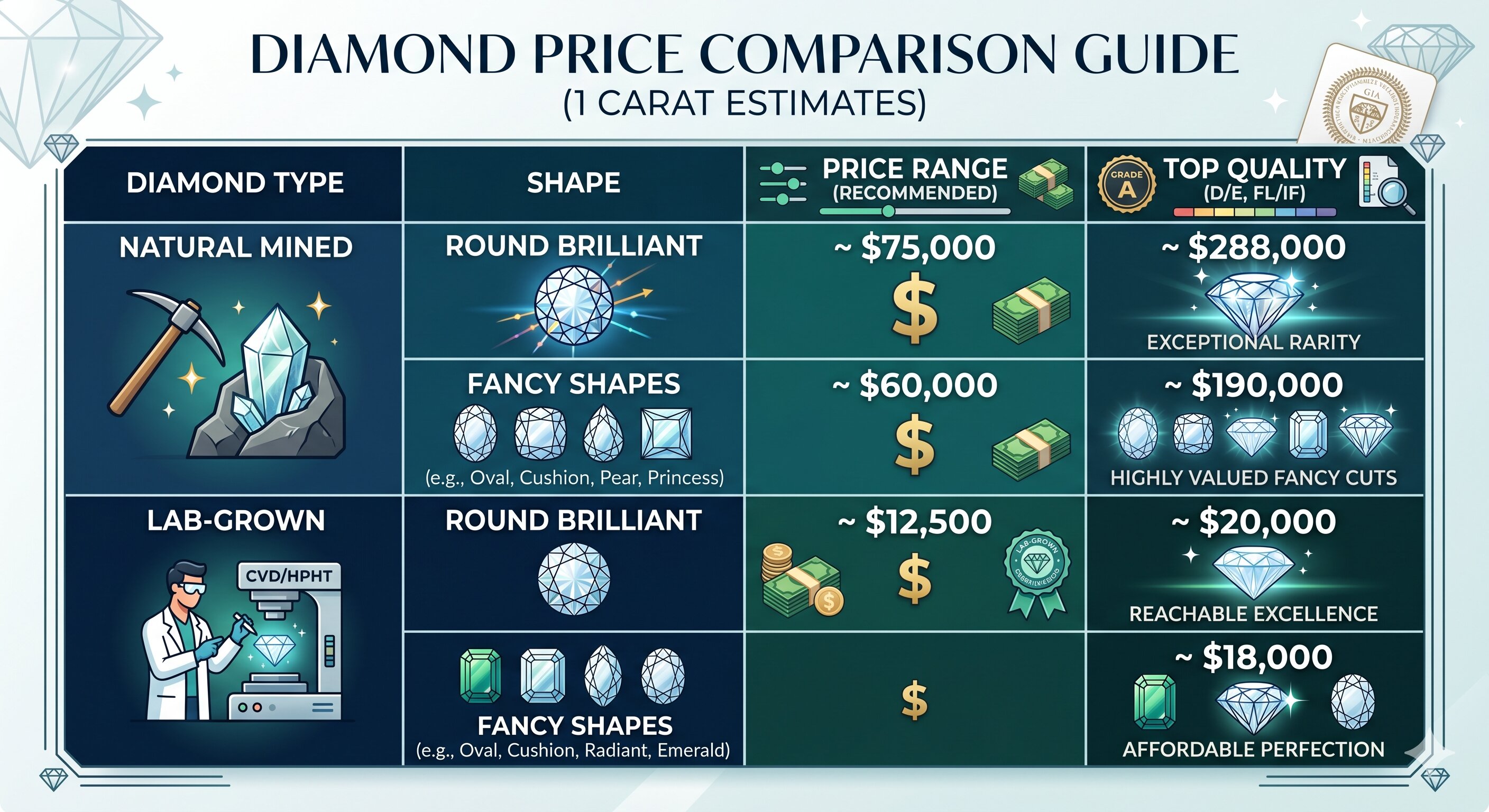
Important Note on Lab-Grown Diamonds: They offer the same physical properties at a significantly lower cost, making a 4-carat size more accessible. However, they are not expected to retain monetary value like a rare natural stone and are considered a purchase for personal enjoyment, not investment.
How to Ensure You Get a Good Diamond?
Insist on Reputable Certification: Only consider diamonds with grading reports from GIA (Gemological Institute of America) or AGS (American Gem Society). These labs provide accurate, unbiased assessments of the 4 C's.
Prioritize Cut Over Carat: It's better to have a slightly smaller stone (e.g., 3.9 carats) with an Excellent cut than a poorly cut 4.0-carat diamond. This "buying shyness" can also save money.
Consider Shape for Value: Round brilliant cuts command the highest prices. Choosing a fancy shape like an oval, cushion, or marquise can offer significant savings (often 10-30%) while giving a large surface appearance.
Review the Diamond Visually: Use high-resolution images and 360° videos provided by retailers to inspect the stone yourself for color and clarity before purchasing.
Ultimately, a "good" 4-carat diamond is one with a top-tier cut, well-chosen color and clarity for its size, a secure setting, and comes with the proper certification to guarantee its quality.
If you have a specific budget or setting style in mind, I can help narrow down the most important quality factors to focus on for your search.
Why Are The 4Cs Important?
The 4Cs are critically important because they provide the universal framework for objectively evaluating diamond quality, determining its beauty and value, and ensuring you get exactly what you pay for.
1. The 4Cs Provide a Universal Language
They established a standardized, objective grading system (pioneered by GIA) used worldwide. Without them, comparing diamonds would be subjective and confusing. This system protects consumers and creates a consistent market.
“Before the 4Cs, diamond buying was a gamble. A stone that looked white in one jeweler‘s window could look yellow in another. A ‘flawless‘ stone in one store could have visible cracks under a loupe. The public had no defense. Then GIA‘s founder, Robert Shipley, asked a radical question: what if diamonds were graded like eggs? Grade A, Grade B, Grade C. His team spent years studying thousands of stones, mapping inclusions, calibrating color scales, and measuring light performance. In 1953, the first GIA Diamond Grading Report was issued. The diamond industry never looked back. The 4Cs are not just letters. They are a shield against deception.”
2. They Directly Determine a Diamond's Beauty
Each "C" directly impacts the stone's visual appeal:
Cut (The Most Important "C" for Sparkle): This is the quality of the diamond's proportions and polish. An Excellent cut maximizes light return, creating the brilliance, fire (flashes of color), and scintillation that make a diamond captivating. A poor cut can leave even a high-color, high-clarity diamond looking dull.
Color (For Purity of Light): Graded on a D (colorless) to Z (light yellow/brown) scale. Less color allows more white light to pass through, enhancing brilliance. The goal is often a grade where any tint is invisible to the naked eye (typically G-J for many).
Clarity (For Purity of the Stone): Refers to internal inclusions and surface blemishes. Most diamonds have minor imperfections. The key is finding a stone that is "eye-clean" (no flaws visible without magnification), which is often achievable at the VS or SI1 grades, offering great value.
3. They Define a Diamond's Value and Rarity
The combination of the 4C grades establishes a diamond's rarity and price. A flawless, colorless, perfectly cut 2-carat diamond is exponentially rarer and more valuable than a diamond with trade-offs in each category. Understanding the 4Cs helps you prioritize what matters most to your budget.
4. They Enable Smart, Balanced Choices
The 4Cs teach you how to balance trade-offs to maximize beauty within your budget. For example:
Prioritize Cut: Never compromise on cut grade; it's the primary driver of beauty.
Optimize Color & Clarity: Choose the lowest color and clarity grades that still appear colorless and clean to your eye in its setting. Savings here can be redirected to carat weight or a better cut.
Use Carat Weight Strategically: "Buying shy" (e.g., 0.9 ct vs. 1.0 ct) can offer significant savings with no visible size difference.
Practical Application: The 4C Hierarchy
For the best value, prioritize them in this order when selecting a diamond:
Cut: For maximum sparkle.
Carat: For your desired size.
Color: For a white appearance.
Clarity: For an eye-clean stone.
Ultimately, the 4Cs are important because they empower you to make an informed decision. The "best" diamond isn't the one with the highest grades, but the one where the 4Cs are balanced to create the most beautiful stone for your personal preferences and budget.
Would you like to explore how to apply these priorities for a specific shape or budget you have in mind?
How Can You Tell If A Diamond Is Good Quality?
You can tell if a diamond is good quality by systematically checking its certification, cut performance, and visual appeal, moving from paperwork to personal inspection.
Here is a practical, step-by-step guide to evaluating quality:
Step 1: The Non-Negotiable – Check the Certificate
A diamond's quality is officially defined by a lab report. Never buy a significant diamond without one.
Accept Only Top-Tier Labs: Look for certificates from the Gemological Institute of America (GIA) or the American Gem Society (AGS). These are the most stringent and consistent.
Verify the Report: Match the unique report number on the certificate to the laser inscription on the diamond's girdle (viewable with a jeweler's loupe). Ensure all details (4Cs, measurements) match the stone you're viewing.
Step 2: Assess the 4Cs with a Strategic Eye
Use the certificate as your guide, but prioritize wisely for beauty and value.
Cut (The Most Critical "C"): For round brilliants, prioritize GIA Excellent or AGS Ideal grades. For fancy shapes (oval, pear), study the diamond's proportions and ask for expert assessment or performance images.
Color: For a white appearance, G-J grades are an excellent value. Set in yellow gold, you can go slightly lower (K-L); in white metal, stick to H or above.
Clarity: The goal is "eye-clean." Diamonds graded VS1-VS2 or SI1 are often perfectly clean to the naked eye. Use magnification only to confirm you cannot see any dark inclusions with your own eyes.
Carat: This is personal preference. Remember that a well-cut 0.9-carat diamond can appear larger and more brilliant than a poorly cut 1.0-carat stone.
Step 3: The Visual and Physical Inspection
The certificate tells you the grade; your eyes confirm the beauty.
Examine Sparkle & Light: View the diamond under different lights (daylight, spotlights, office light). A good cut diamond will sparkle brightly with a balanced pattern of white and colored flashes, and not have large, dark, or dull areas.
Look for Common Flaws: Tilt the diamond and look for a fisheye effect (a reflection of the girdle that makes it look like a dull ring) or a bow-tie effect (a dark, bow-tie-shaped area across the center of some fancy shapes), which indicates poor cutting.
Check for Durability: Ensure no major inclusions (like feathers or cavities) are located at the girdle (the outer edge), as this makes the stone vulnerable to chipping.
Step 4: Avoid Common Pitfalls
Don't Over-Prioritize Clarity: Paying a premium for FL/IF grades offers no visible benefit if VS/SI is already eye-clean.
Beware of "Bargain" Certificates: Certificates from unknown or commercial labs often have inflated grades and are not reliable.
Always See It First (or Get Detailed Media): If buying online, the retailer must provide a high-resolution video (ideally 360°) and magnified images. A static photo is insufficient.
To make this concrete, here is a quick checklist for your evaluation:
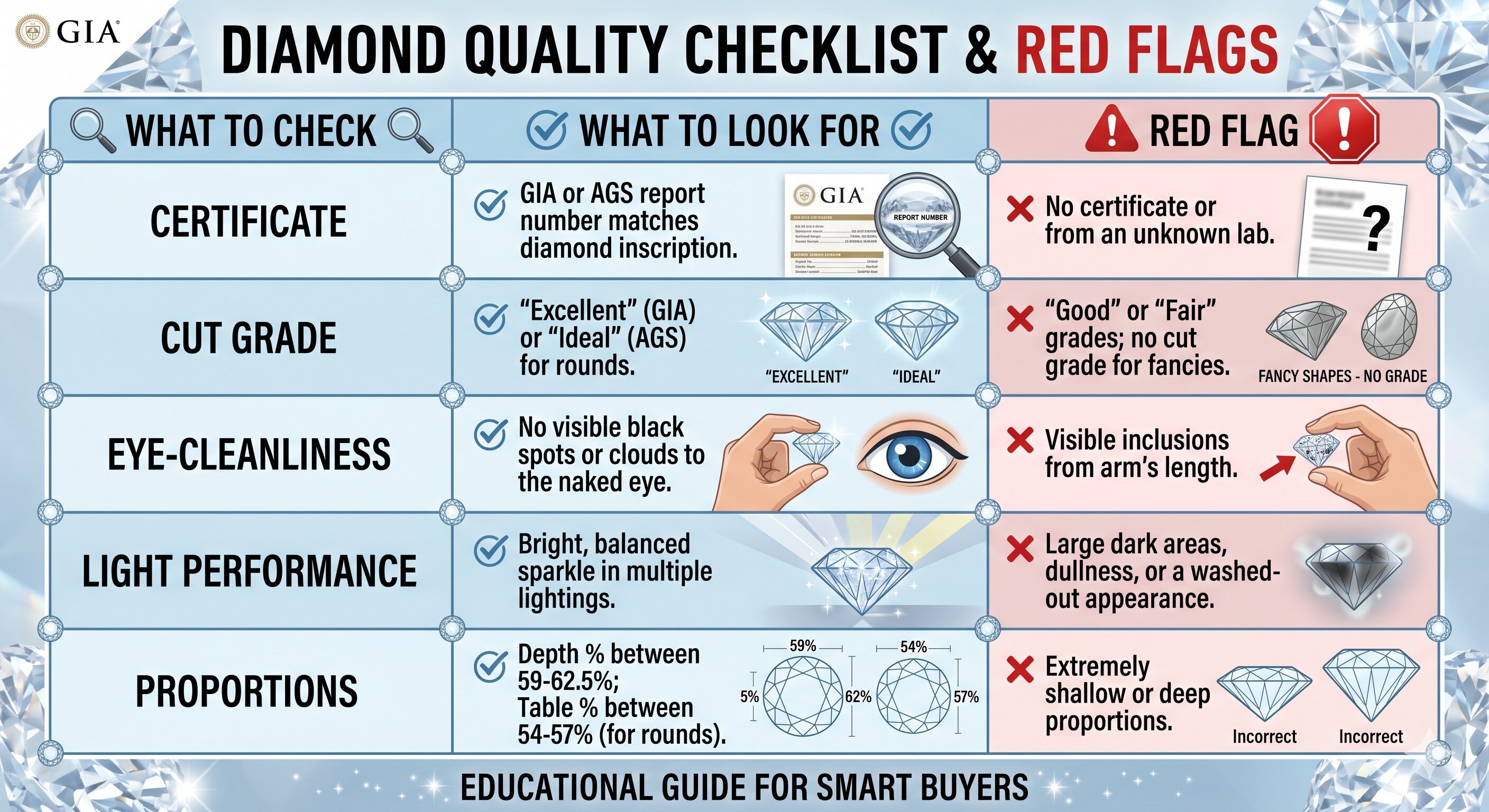
Ultimately, a "good quality" diamond balances an excellent cut with smartly chosen color and clarity, is backed by a reliable certificate, and, most importantly, looks beautiful to you.
If you're considering a specific shape or have a budget range in mind, I can help you understand which quality factors to prioritize most.


Other news for Tuesday 16 June, 2026
- Teardrop Diamond Guide: Meaning, Price, vs Round and Wearing Direction
- Vintage Rings Guide: Styles, Identification, Pros and Cons
- Three-Stone Engagement Rings: The Ultimate Buying Guide
- Morganite Guide: Meaning, Price, vs Diamond, Colors and Care
- Gold Plated Jewelry Guide: Care, Durability, vs Solid Gold and Buying Tips
- Titanium Jewelry Guide: Pros, Cons, vs Gold, Price and Care
- Excellent Cut Diamond Guide: Meaning, vs Brilliant, vs Ideal
- Art Deco Jewelry: History, Value and How to Identify Authentic Pieces
View all news for Tuesday 16 June, 2026 on one page
News for Monday 15 June, 2026
- Asscher Cut Guide: Complete Guide to Square Emerald Cut Diamonds
- Classic Cut Guide: Old Mine vs Old European vs Modern Round
- Marquise Cut Guide: Price, Size Illusion, vs Oval and Buying Tips
- Pavé Setting Guide: Pros, Cons, Cost, Security and Channel/Bezel
- Radiant Cut Guide: Price, vs Emerald, 1ct, 3ct Cost, Sparkle and Tips
- Vintage Cut Guide: Old Mine vs Old European vs Rose Cut
- Heart-Shaped Diamond Guide: Meaning, Price, 2ct Cost and Buying Tips
View all news for Monday 15 June, 2026 on one page
Recent News
- Sunday 14 June, 2026
- Saturday 13 June, 2026
- Friday 12 June, 2026
- Thursday 11 June, 2026
- Wednesday 10 June, 2026