

Heart-Shaped Diamond Guide: Meaning, Price, 2ct Cost and Buying Tips
Heart-Shaped Diamond Guide: Meaning, Price, 2ct Cost, and Buying Tips
That's a wonderful question. A heart-shaped diamond is one of the most symbolic and romantic choices in the world of jewelry.
“The heart shape as a symbol of love is only 500 years old. Before the 16th century, lovers exchanged rings shaped like ivy leaves (for fidelity) or clasped hands (for union). Then, in a French manuscript from the 1250s, an illustrator drew a man giving his heart to a woman—not a realistic heart, but a simplified shape we now recognize instantly. By the Victorian era, heart-shaped jewelry had exploded. Soldiers going to war gave their loves heart-shaped lockets, brooches, and rings. Today, when you give a heart diamond, you are not giving a trend. You are giving a 750-year-old conversation between two people—a shape that has no words, but says everything.”
The same shape that has meant ‘I love you‘ for 750 years now awaits your own bold declaration — whether for an engagement, an anniversary, or simply because. Every heart diamond in our collection is hand-selected for perfect symmetry, because a lopsided love is no love at all.”*
[Button: Explore Heart-Shaped Diamonds →]
Here is the content of the tables;
- What Does A Heart-Shaped Diamond Mean?
- Is A Heart Diamond The Ultimate Romantic Gesture?
- Are Heart-Cut Diamonds More Expensive?
- Heart Shape Diamond Chart
- How Big Is A 1 Carat Heart-cut Diamond?
- What Size Is A 2 Carat Heart-Shaped Diamond?
- How Much Is A 2 Carat Heart Diamond Worth?
- How Does Everyone Feel About Heart-Shaped Diamonds?
- How To Choose A Heart-Shaped Diamond?
- How To Measure A Heart-Shaped Diamond?
Here we talk first about the topic.
What Does A Heart-Shaped Diamond Mean?
At its most fundamental level, a heart-shaped diamond is a universal symbol of love and romance.
However, its meaning goes much deeper than that simple association. Here’s a breakdown of what a heart-shaped diamond truly represents:
1. The Ultimate Symbol of Love
This is the most immediate and powerful meaning. The heart shape itself is synonymous with love, affection, and deep emotional connection. Gifting a heart-shaped diamond is a profound and unmistakable declaration of love. It’s often chosen for significant milestones like:
Engagements: It transforms a proposal into a powerful, visual promise of love.
Anniversaries: Celebrating a lasting love and the journey a couple has shared.
Valentine's Day: The ultimate romantic gift.
2. Vulnerability and Emotional Openness
The heart is not just a symbol of love, but also of our emotional core. It represents feelings, passion, and vulnerability. Giving or wearing a heart-shaped diamond can signify a willingness to be open, trusting, and emotionally available to your partner. It says, "I give you my whole heart."
3. Rarity and Uniqueness
Heart-shaped diamonds are one of the rarest fancy cut diamonds. They require a highly skilled cutter to achieve perfect symmetry between the two lobes (the rounded top parts) and the point (the cleft). Because of this difficulty and the amount of rough diamond that is lost in the process, they are less common than rounds, ovals, or princess cuts. Choosing one signifies a love that is unique, rare, and not like anyone else's.
4. A Blend of Tradition and Playfulness
The heart shape combines the brilliance of a traditional round cut (the top lobes act like a round brilliant's facets) with a distinctive and whimsical silhouette. This makes it a perfect choice for someone romantic at heart but also has a unique, confident, and sometimes playful style. It's for the individual who isn't afraid to make a bold statement of love.
5. Commitment and Devotion
The single, uninterrupted shape of the heart symbolizes a unity of spirit. There are no separate parts; it is a single, complete symbol. This can represent the merging of two lives into one, total devotion, and an unwavering commitment to the relationship.
The Importance of Craftsmanship and "The Heart"
The meaning of a heart-shaped diamond is deeply tied to its quality and craftsmanship. A poorly cut heart will look misshapen and lose its symbolic power. When evaluating one, symmetry is paramount.
The Lobes: Should be even, rounded, and identical in size and shape.
The Cleft (Point): Should be sharp, well-defined, and centered.
The Wings: The sides of the heart should have a gentle, symmetrical curve.
A perfectly symmetrical heart is not just more beautiful; it’s a testament to the care and skill that went into creating it, mirroring the care and intention in the relationship it represents.
Who is a Heart-Shaped Diamond For?
This cut is ideal for a person who is:
Deeply Romantic: They love grand gestures and classic symbols of love.
Confident and Unique: They aren't afraid to stand out and wear something distinctive.
Feminine and Playful: They appreciate elegance but with a touch of whimsy.
Sentimental: They value the profound meaning behind the jewelry they wear.
A heart-shaped diamond is far more than just a pretty stone. It is a bold, unapologetic, and deeply sentimental statement. It encapsulates the very essence of love—its rarity, its beauty, its vulnerability, and its enduring promise. It’s a choice that says, "Our love is the guiding force," making it one of the most meaningful selections for a piece of jewelry meant to last a lifetime.
Is A Heart Diamond The Ultimate Romantic Gesture?
A heart-shaped diamond is a powerful and direct romantic symbol, but whether it is the "ultimate" gesture depends on whether its bold, sentimental style matches your partner's taste and the sentiment you want to express.
Here's a quick summary of its major advantages and potential drawbacks:
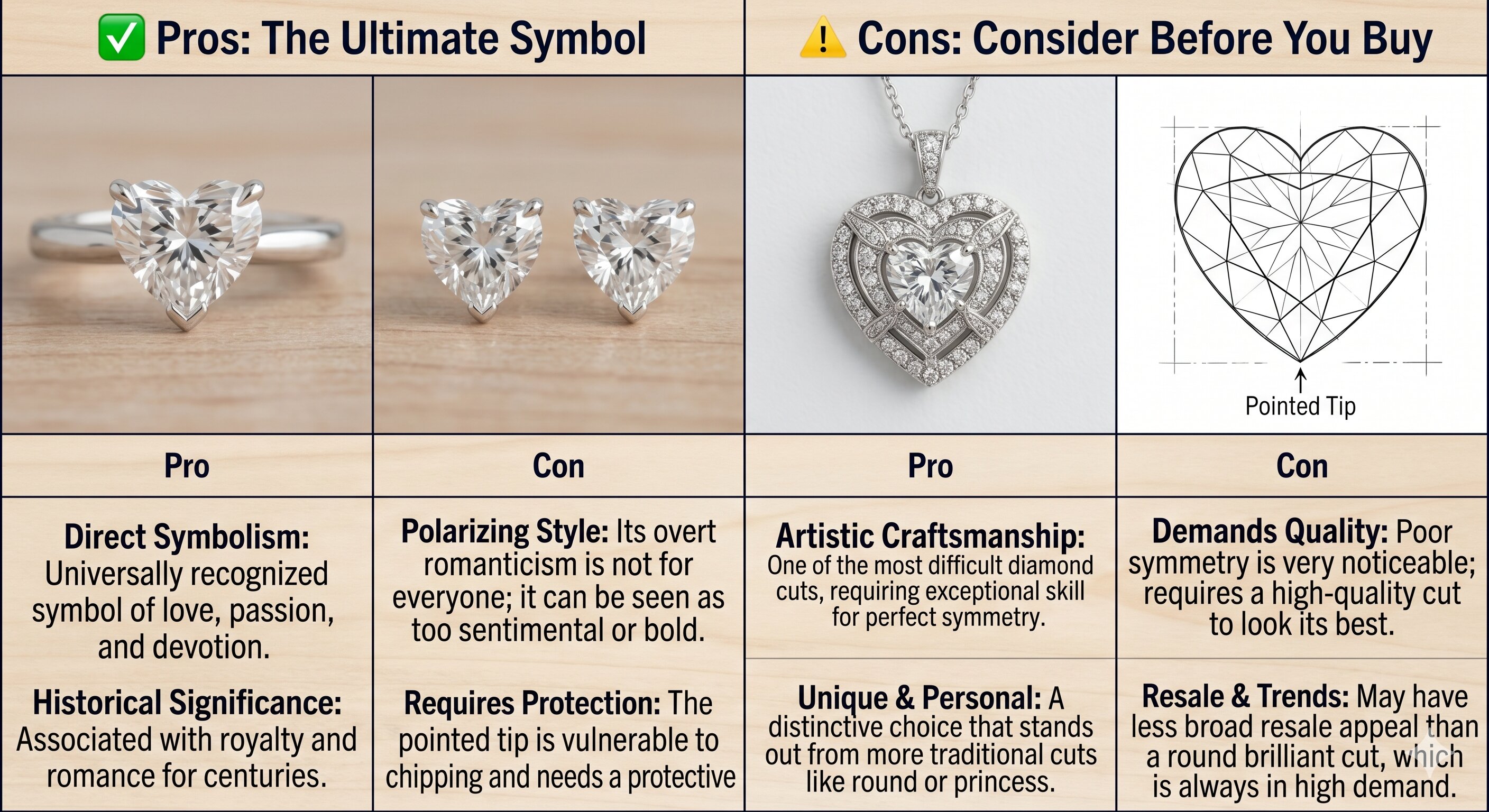
I hope this detailed view helps you decide. If you can share a bit about your partner's general jewelry style, I might be able to offer more tailored thoughts.
Are Heart-Cut Diamonds More Expensive?
Heart-cut diamonds are not inherently more expensive per carat than the most popular shape, the round brilliant, but they are often more expensive than many other fancy shapes.
Here’s a detailed explanation of the factors that influence their price:
1. The "Round Brilliant" Premium
Round brilliant cut diamonds are typically the most expensive shape per carat. This is due to two main reasons:
Highest Demand: They are the most popular and traditional choice for engagement rings, creating immense market demand.
Greatest Rough Waste: Cutting a round diamond from a raw crystal results in the most wasted material (often over 50%). You are paying for the rough diamond that was cut away to achieve that brilliant sparkle.
2. The Cost of Cutting a Heart Shape
This is where heart diamonds become costly. While they may not surpass the round brilliant, they are often priced higher than ovals, cushions, or princess cuts. The reasons are:
Cutting Difficulty & Skill: The heart shape is one of the most difficult and time-consuming cuts to execute perfectly. It requires a master cutter to create perfect symmetry between the two lobes and a sharp, centered point. This specialized labor comes at a premium.
Rarity: Because of the cutting complexity and lower demand compared to rounds, fewer heart-shaped diamonds are produced. This relative rarity can drive up the price.
Rough Diamond Waste: Similar to rounds, cutting a symmetrical heart from a raw crystal also results in significant waste of the original material, contributing to a higher price per carat.
3. The "Fancy Shape" Discount (and its Exception)
Generally, fancy shapes (like Oval, pear, marquise, and heart) are less expensive per carat than round brilliants because they are cut to retain more of the original rough crystal, resulting in less waste.
However, the heart shape is often the exception to this rule. Its technical difficulty can push its price closer to, and sometimes even surpass, the price of a round brilliant of similar quality.
The Price Spectrum
To make it simple, think of it in terms of a general price hierarchy (for stones of equal Carat weight, Cut quality, Color, and Clarity):
Most Expensive: Round Brilliant (due to high demand and high waste).
Upper-Mid Range: Heart Shape (due to cutting difficulty and rarity, often competing with rounds).
Mid-Range: Other Complex Fancy Shapes like Pear and Marquise.
Most Affordable Fancy Shapes: Oval, Cushion, Princess (high yield from rough, high demand keeps production up).
The Crucial Factor: The "Cut" is King
With heart-shaped diamonds, the Cut quality is everything—not just for beauty, but for price.
A "Very Good" or "Excellent" cut heart diamond with perfect symmetry will command a high price. You are paying for the skill and the stunning result.
A "Good" or "Fair" cut heart diamond will be less expensive, but it may have a lopsided, chubby, or otherwise misshapen appearance that defeats the romantic purpose of the stone.
You should expect to pay a premium for a well-cut heart-shaped diamond, often comparable to a round brilliant. However, you are not just paying for the carat weight; you are paying for the exceptional craftsmanship required to create a perfect symbol of love. For many, that artistry and symbolism are worth the investment.
Heart Shape Diamond Chart
Here is a detailed "chart" or guide to understanding and evaluating a heart-shaped diamond. This breaks down the key characteristics you should look for.
Heart-Shaped Diamond Evaluation Chart
The most important factor for a heart-shaped diamond is its cut and symmetry. A poorly cut heart will look misshapen and lose its sparkle. Use the following visual and descriptive guide to assess quality.
1. The Anatomy & Symmetry
A perfectly symmetrical heart is the ultimate goal. Here are the parts to examine:
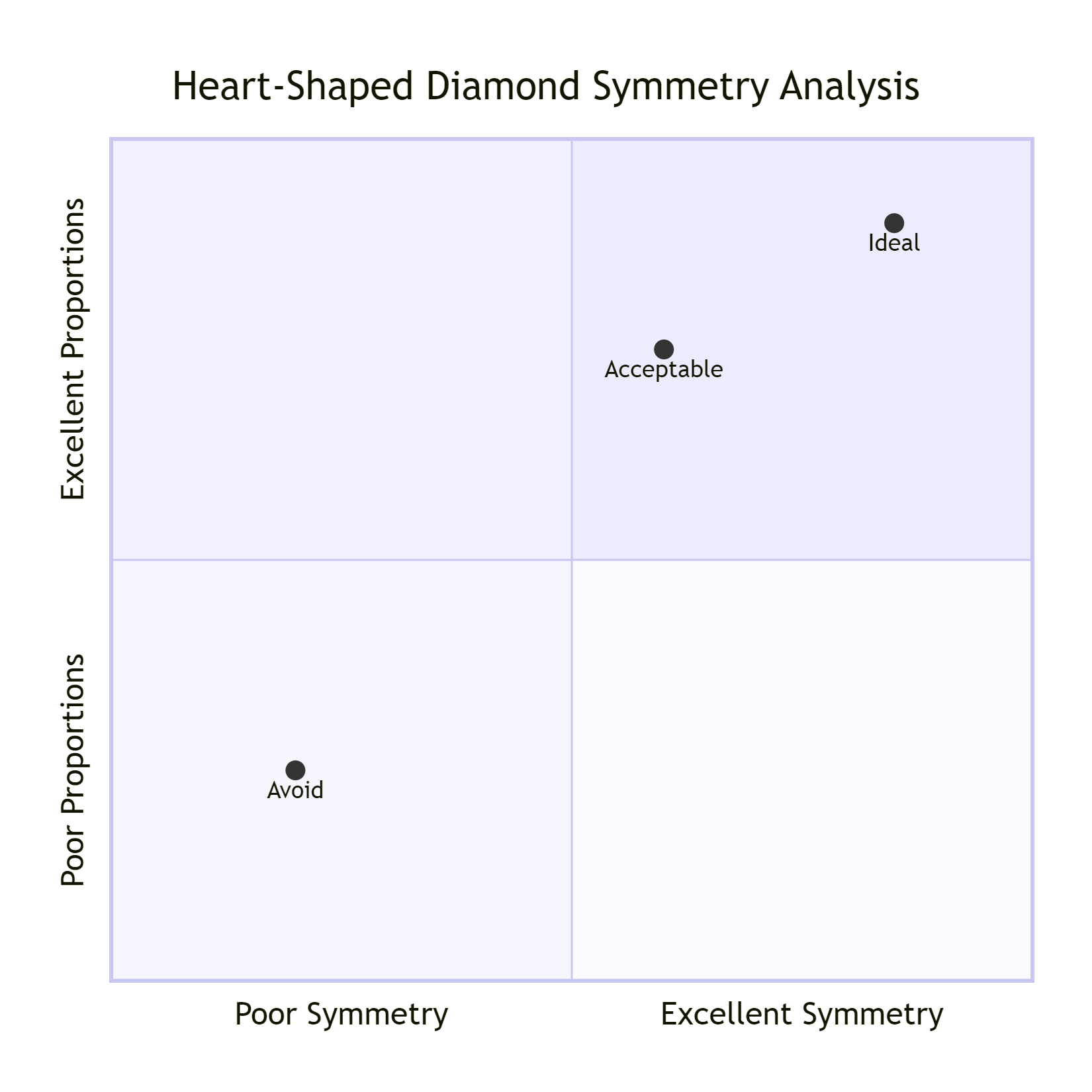
A. The Lobes (The two rounded top halves):
Excellent: The lobes are identical in size, shape, and curvature. They are plump, rounded, and even.
Poor: One lobe is larger, flatter, or a different shape than the other. This makes the heart look lopsided.
B. The Cleft (The V-shaped dip at the top):
Excellent: The cleft is sharp, well-defined, and centered perfectly between the two lobes. It should be a clear "V" shape.
Poor: The cleft is shallow, rounded, or off-center. A very shallow cleft makes the diamond look like a rounded triangle.
C. The Point (The bottom tip):
Excellent: The point is sharp, well-defined, and aligned with the center of the cleft. It should not be rounded or chipped.
Poor: The point is rounded or blunt. A fragile point is also prone to chipping.
D. The Wings (The curved sides of the heart):
Excellent: The wings have a smooth, symmetrical, and graceful curve from the lobes down to the point.
Poor: The wings are flat or asymmetrical, making the heart look "chubby" or misshapen.
2. Length-to-Width Ratio
This determines how "fat" or "slender" the heart appears. It's a matter of personal preference, but there is a classic range.
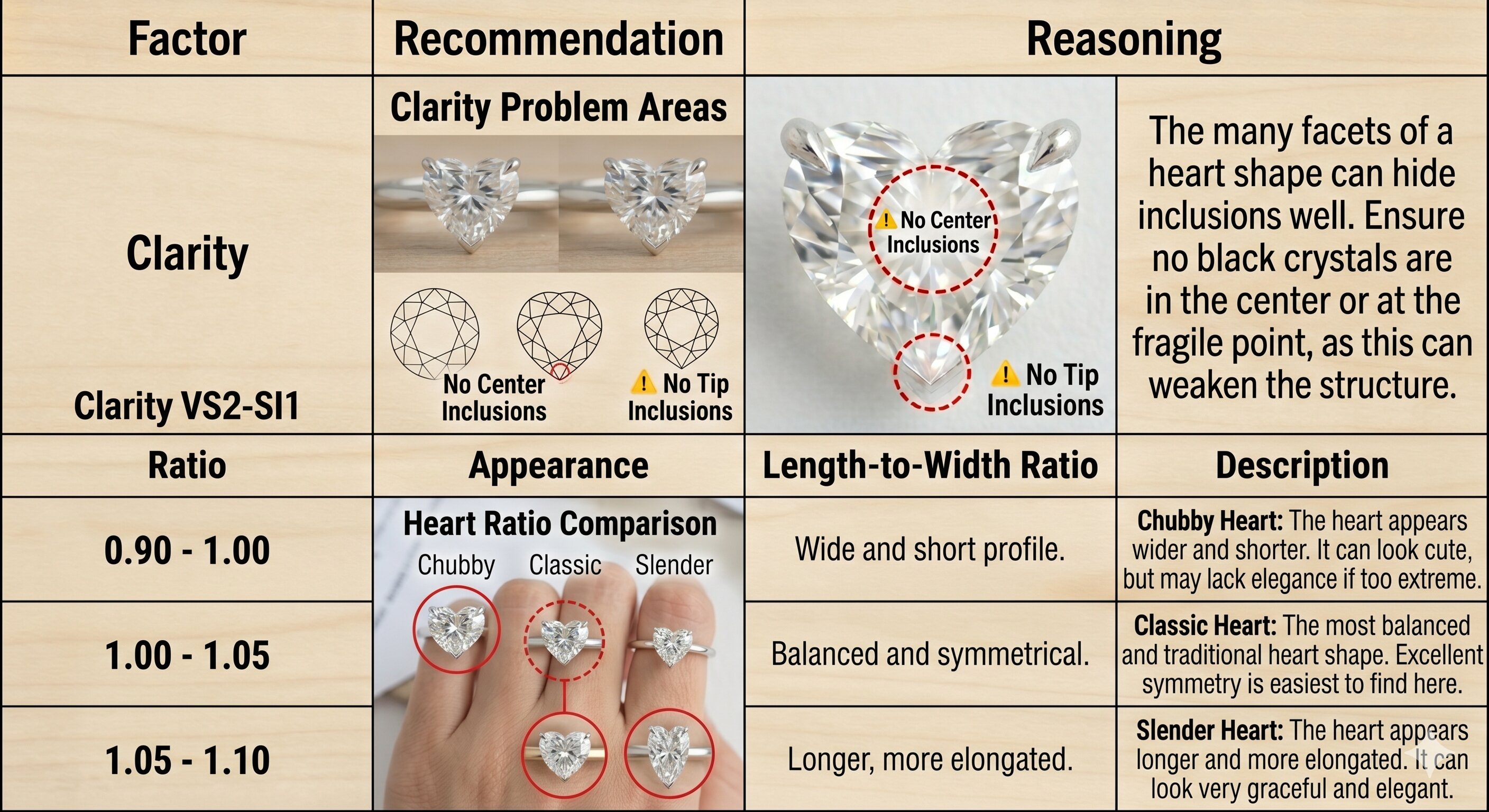
Note: The choice of ratio is subjective. Always look at the diamond (or a video) to see which shape appeals to you most.
3. The Bow-Tie Effect
Like other fancy shapes (oval, marquise, pear), heart-shaped diamonds are prone to a bow-tie effect—a dark band across the center that resembles a bow-tie.
Minimal/None: Ideal. The diamond has an even light return and sparkle across its entire face.
Pronounced: A problem. A dark, noticeable bow-tie blocks light and makes the diamond look dead in the center. Always ask to see the diamond in motion to check for this.
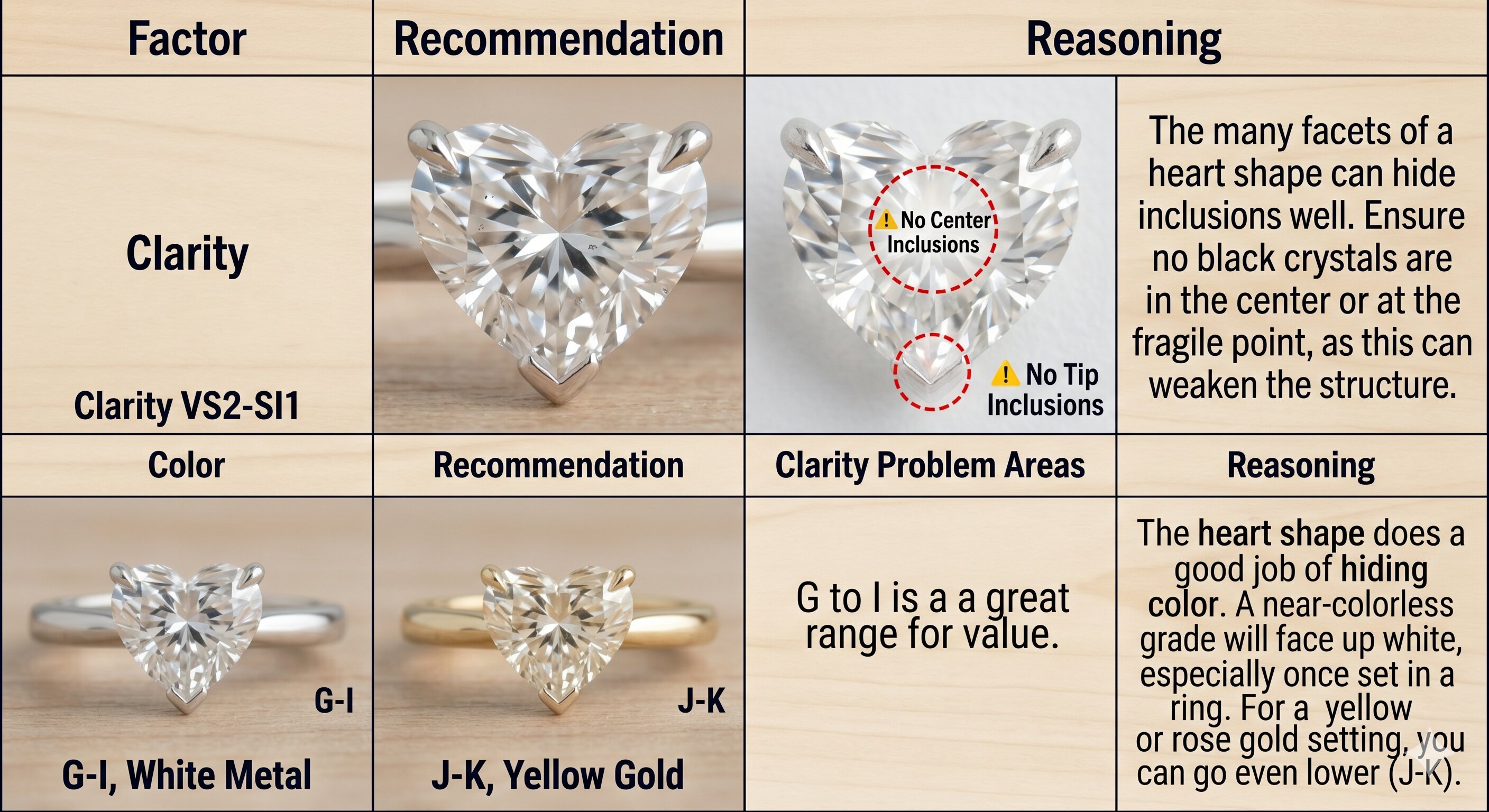
4. Clarity & Color Guide
Quick Buying Checklist
Symmetry First: Is the heart perfectly symmetrical? Check lobes, cleft, and point.
No Bow-Tie: View the diamond in different lights. Does it have a minimal bow-tie effect?
Sharp Point: Is the bottom point sharp and not rounded? Is it protected by the setting?
Certification: Always buy a certified diamond (e.g., GIA or AGS) that includes a detailed cut assessment and symmetry grade.
Trust Your Eyes: Use the chart as a guide, but ultimately, choose the heart that looks beautiful and captivating to you.
How Big Is A 1 Carat Heart-cut Diamond?
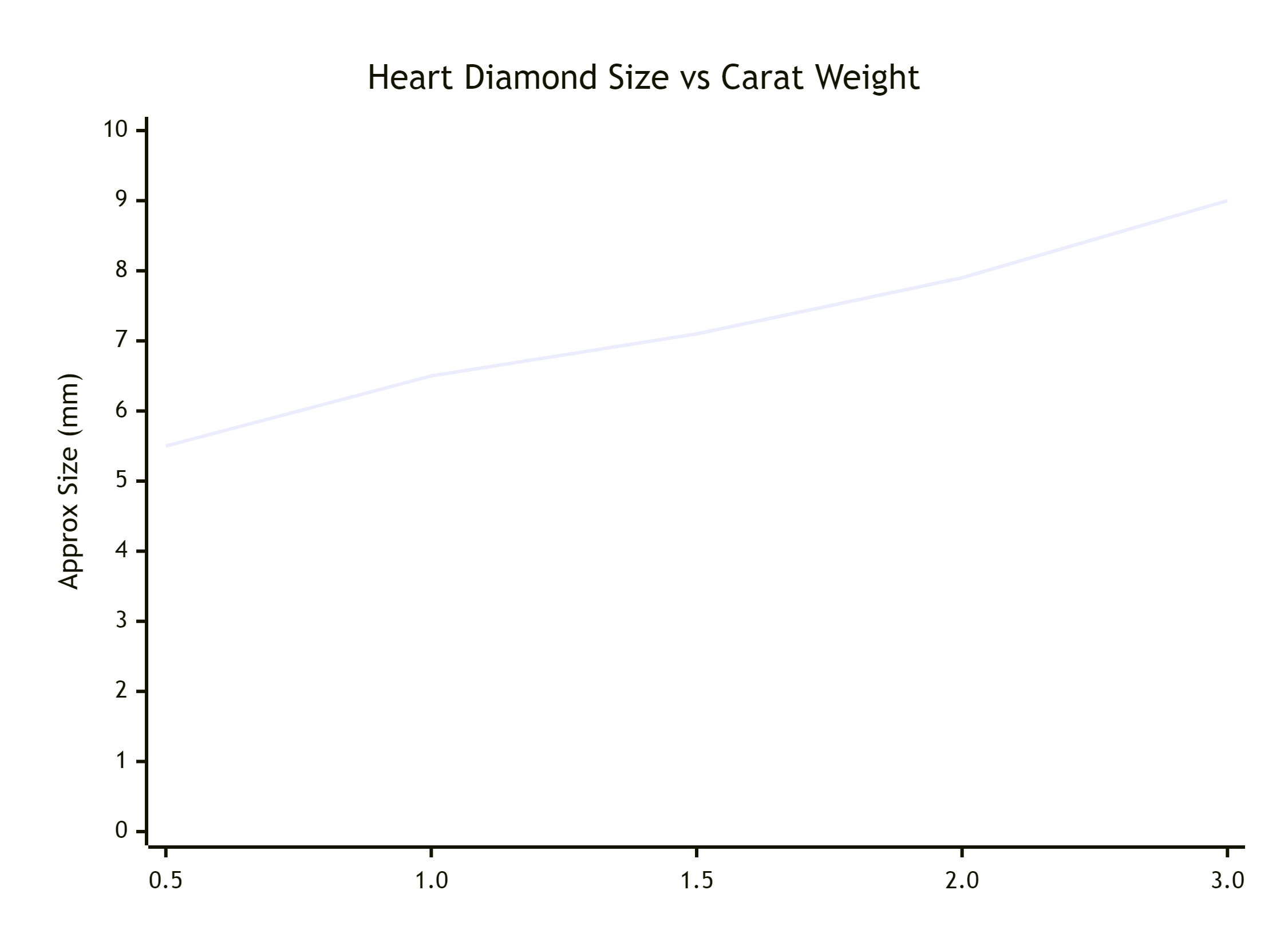
A 1-carat heart-cut diamond typically measures approximately 6.5mm in length and 6.5mm in width, but this can vary slightly based on its specific proportions (its length-to-width ratio).
To help you visualize that size, here are some real-world comparisons:
The size of a standard pencil eraser.
Slightly smaller than a standard green pea.
Roughly the size of a U.S. nickel's "C" in "CENT".
The most accurate way to think about its size is by its face-up dimensions (how it covers the finger), which is what the measurements in millimeters represent.
Key Factors That Affect How Big a 1-Carat Heart Diamond Looks
1. The Cut Quality & Proportions (Most Important)
This is the biggest factor. A well-cut heart will have excellent light performance (sparkle) and be cut to maximize its face-up size without looking too flat or shallow.
Shallow Cut: A diamond cut too shallow will have a larger surface area (spread) for its carat weight, so it may look bigger than another 1-carat stone. However, it will lack depth and brilliance, making it look glassy and less sparkly.
Deep Cut: A diamond cut too deep will carry more of its weight "underneath," so it will have a smaller face-up diameter and look smaller than a well-proportioned 1-carat heart. The benefit is that it can have more intense sparkle, but the size sacrifice is often not worth it.
2. The Length-to-Width Ratio
This determines the heart's shape—whether it's short and "chubby" or long and "slender." Both can be 1 carat, but they will have different dimensions.
A "Chubby" Heart (Ratio ~0.9): Will appear wider and cover more width on the finger.
A "Slender" Heart (Ratio ~1.1): Will appear longer and cover more length on the finger.
A classic, balanced heart shape typically has a length-to-width ratio between 1.0 and 1.05.
3. The Setting
The setting can dramatically alter the perceived size.
A Halo Setting: A circle of smaller diamonds around the heart will make the entire centerpiece look much larger.
Long Side Stones: Marquise or tapered baguette stones going down the band can elongate the finger and make the heart appear larger.
A Simple Solitaire Setting: Will show the true, elegant size of the 1-carat heart on its own.
Visual Comparison to Other 1-Carat Shapes
It's helpful to see how a 1-carat heart compares to other popular shapes. Due to its elongated shape, a heart will often look larger than a round brilliant of the same carat weight because rounds are cut for maximum sparkle, not maximum spread.
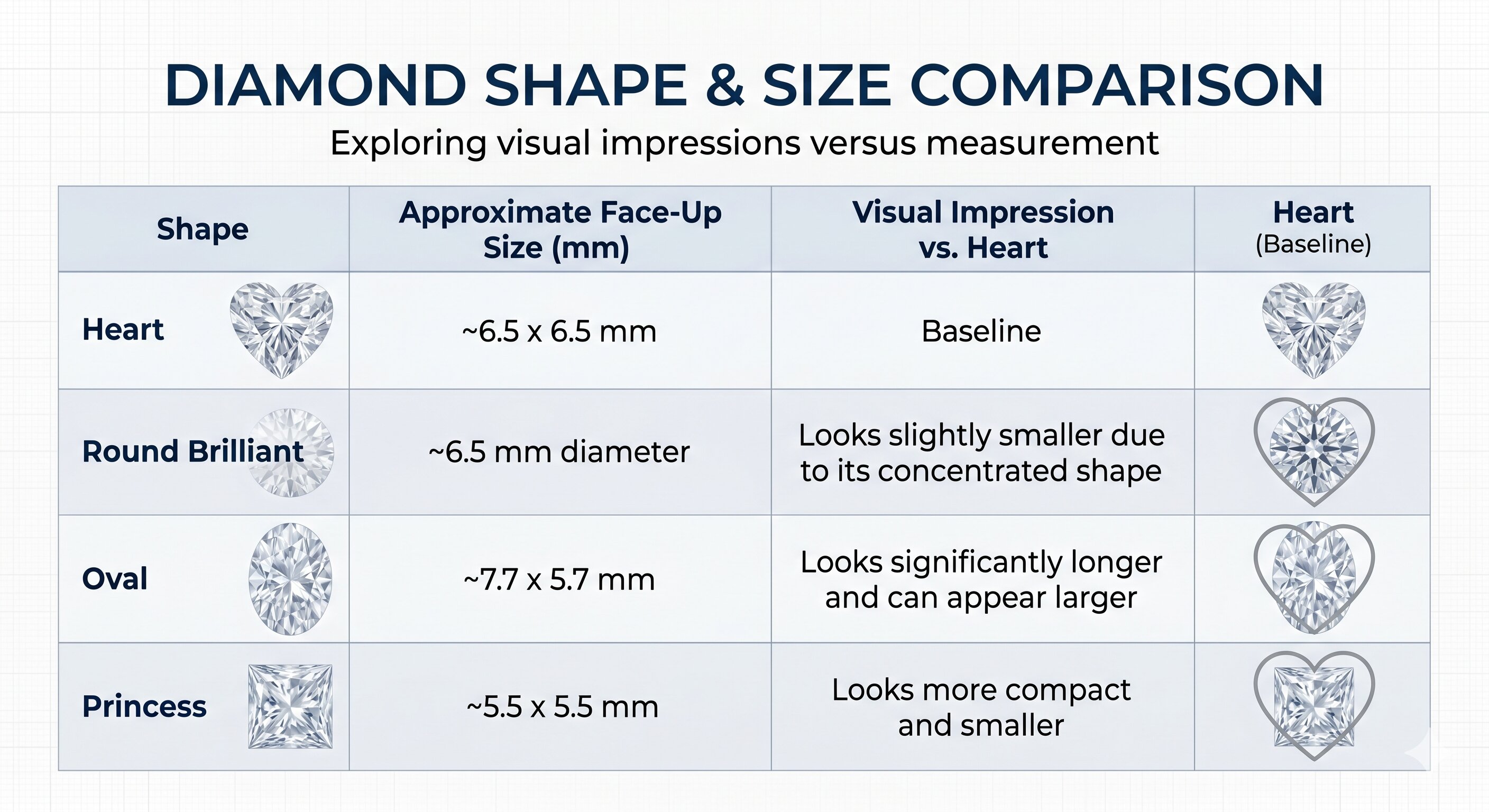
A 1-carat heart-cut diamond is a substantial and beautiful size for a piece of jewelry like an engagement ring. Its unique shape and excellent cut will make it a noticeable and sparkling feature on the hand. When choosing, always prioritize cut quality over everything else, as a well-cut stone will not only be the most beautiful but will also be cut to show off its size to the best advantage.
What Size Is A 2 Carat Heart-Shaped Diamond?
A 2-carat heart-shaped diamond is a truly impressive and statement-making stone. Its size is noticeably larger and more dominant on the finger than a 1-carat version.
Here’s a detailed breakdown of the size and the factors that influence it.
Physical Dimensions
A 2-carat heart-shaped diamond typically measures approximately 8.0mm in length and 8.0mm in width.
To help you visualize this size, it's comparable to:
The size of a standard green pea.
Slightly larger than the face of a standard-sized button on a dress shirt.
Roughly the same width as the "I" in "LIBERTY" on a U.S. quarter.
About 25% larger in surface area than a 1-carat heart diamond.
Key Factors That Influence the Perceived Size
Just like with a 1-carat heart, the exact measurements and how large it looks depend on a few critical factors:
1. The Cut Quality & Proportions (Most Important)
This is the ultimate determinant of both size and beauty. A 2-carat diamond is a significant investment, so cut quality is paramount.
Excellent Cut: A well-cut 2-carat heart will have ideal proportions, maximizing its face-up size without sacrificing sparkle. It will be bright, fiery, and look its full carat weight.
Shallow Cut: A diamond cut too shallow can spread its weight over a larger area, potentially measuring over 8.5mm. However, this comes at a cost: it will lack depth and brilliance, appearing glassy and lifeless. It might measure bigger, but it won't look more impressive.
Deep Cut: A deeply cut stone will retain more of its weight "hidden" in its pavilion (the bottom). It might only measure 7.5mm face-up, making it look smaller than other 2-carat hearts, even though it weighs the same.
2. Length-to-Width Ratio
This defines the heart's silhouette. A 2-carat heart can come in different shapes, all weighing the same but appearing different.
A "Chubby" Heart (Ratio ~0.9): Will be wider and have a very plump, cute appearance.
A "Classic" Heart (Ratio 1.0 - 1.05): This is the balanced, traditional heart shape. For a 2-carat stone, this is often the most sought-after proportion.
A "Slender" Heart (Ratio ~1.1): Will appear more elongated and elegant.
3. The Setting and Ring Style
The setting can dramatically enhance the perceived size of a 2-carat heart.
A Halo Setting: Adding a halo of smaller diamonds around the heart will make the entire centerpiece look massive, easily adding the visual impact of an extra half-carat or more.
Side Stones: Tapered baguettes or trillion-shaped stones going down the band can elongate the finger and frame the heart, making it appear even more substantial.
Solitaire Setting: A simple solitaire will showcase the beautiful, impressive size of the 2-carat heart all on its own.
Visual Comparison to Other 2-Carat Shapes
To put it in context, here's how a 2-carat heart generally compares in face-up size to other popular shapes:
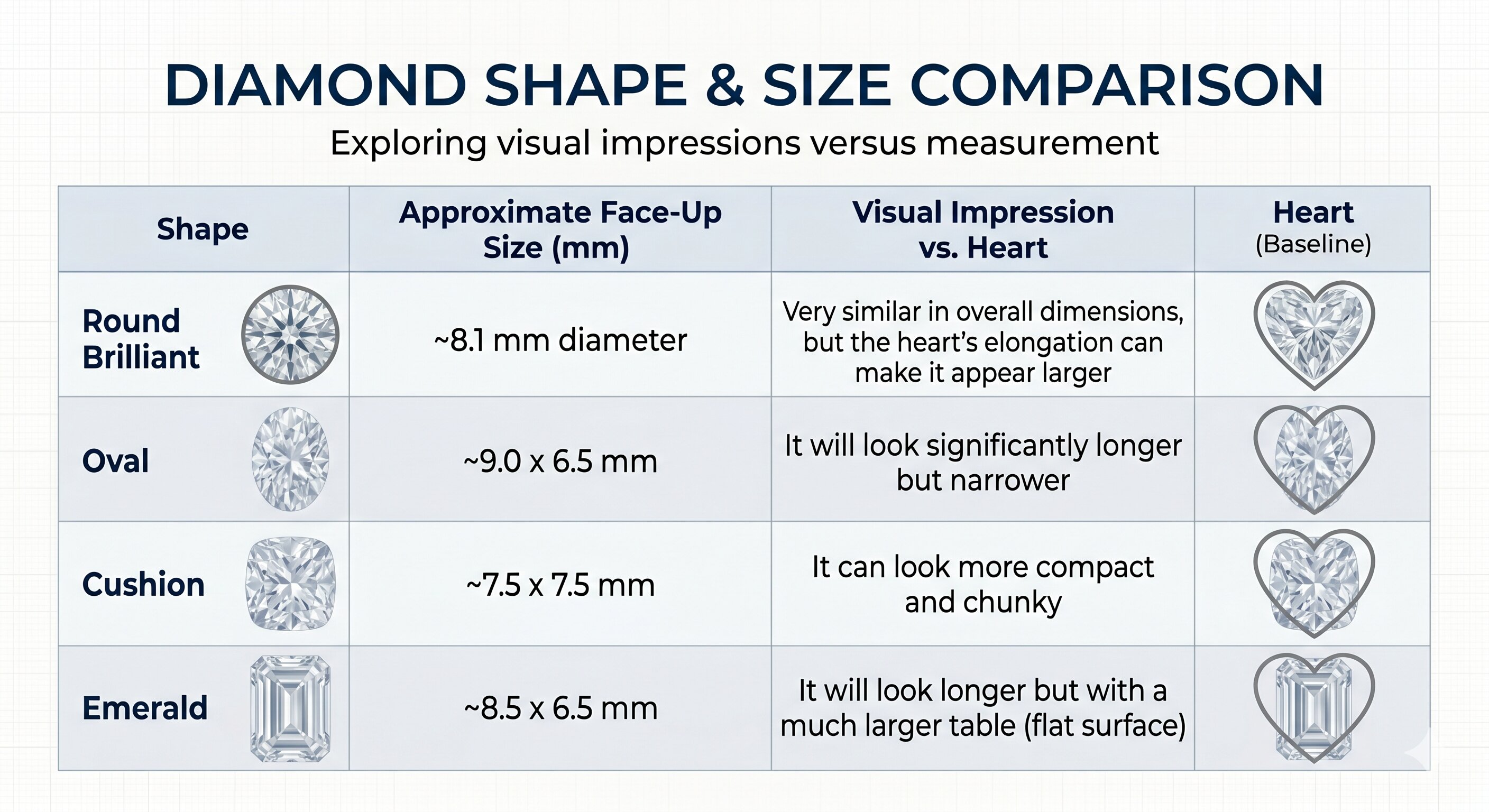
A 2-carat heart-shaped diamond is a bold, luxurious, and undeniably romantic choice. It offers a magnificent presence on the hand. When shopping for a stone of this size, prioritize an "Excellent" or "Very Good" cut grade above all else. This ensures you get a diamond that is not only large but also brilliantly sparkling and perfectly symmetrical—a true representation of its significant carat weight.
How Much Is A 2 Carat Heart Diamond Worth?
This is a crucial question, and the answer requires a detailed breakdown because the price of a 2-carat heart-shaped diamond can vary dramatically.
There is no single price, but to give you an immediate range, you can expect a 2-carat heart diamond to cost anywhere from $8,000 to $40,000+.
The final price is entirely dependent on the "Four Cs" (Cut, Color, Clarity, Carat) and the diamond's certification.
Here is a visual breakdown of how these factors influence the price for a 2-carat heart diamond:
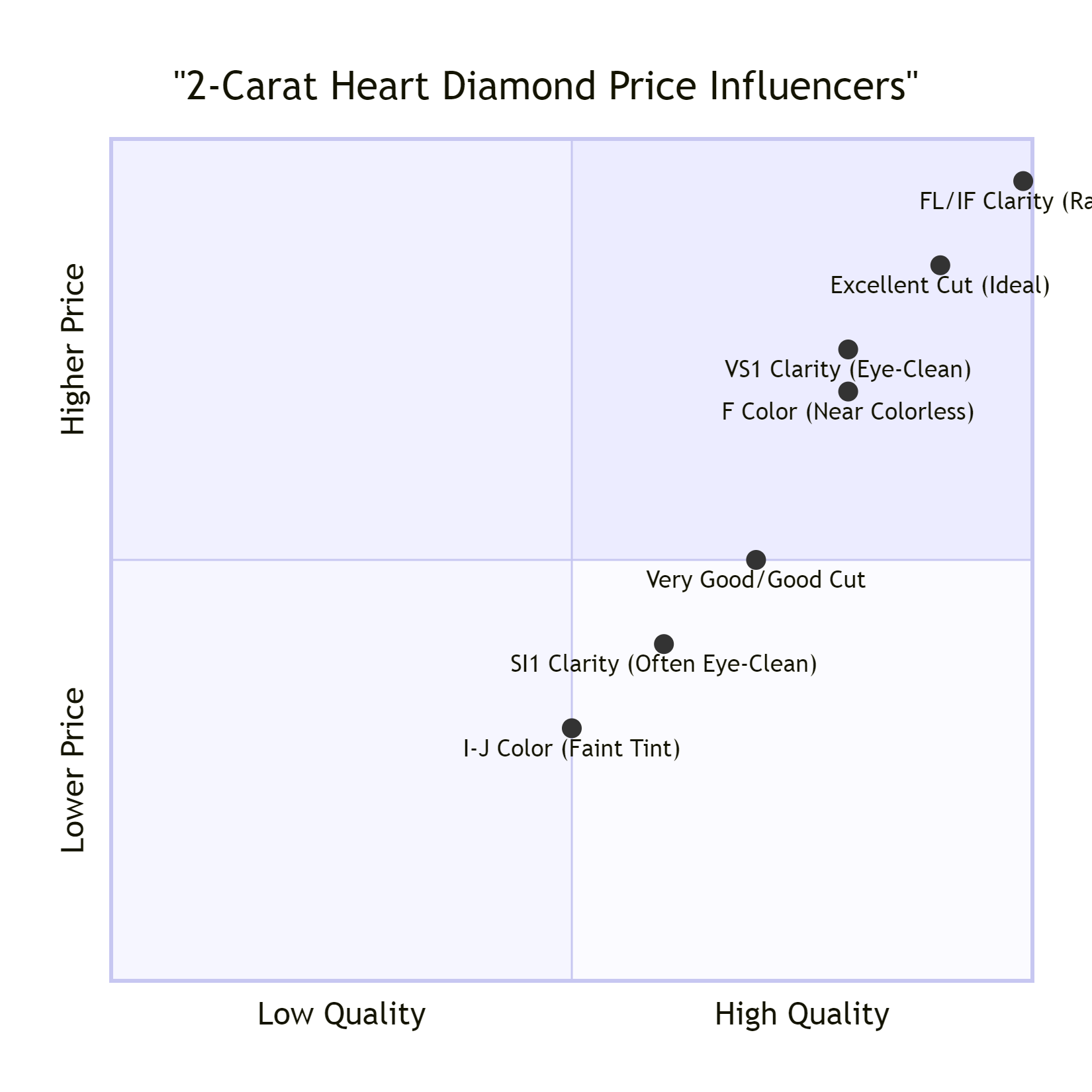
Detailed Price Ranges for a 2-Carat Heart Diamond
The following ranges assume a diamond with a GIA or AGS certificate and a good to excellent cut.
1. Budget-Conscious Range: $8,000 - $15,000
Color: K-M (Will have a noticeable yellow or brown tint, especially in a white metal setting).
Clarity: SI2-I1 (Inclusions may be visible to the naked eye).
Cut: Good or Fair. This is a major risk here, as a poor cut will result in a lifeless, poorly shaped heart.
Overall: This range offers the 2-carat weight but makes significant compromises on beauty and quality.
2. Best Value Range: $15,000 - $25,000
This is the sweet spot for balancing quality and cost for a 2-carat heart diamond.
Color: G-I (Near colorless to faint tint. Will face up white to the naked eye, especially in a rose or yellow gold setting).
Clarity: VS2-SI1 (Typically "eye-clean," meaning no inclusions visible without magnification).
Cut: Very Good to Excellent. This ensures a symmetrical, well-proportioned heart with great sparkle.
Overall: This is where you find a beautiful, sparkling diamond that is excellent quality for daily wear.
3. High-Quality / Investment Range: $25,000 - $40,000+
Color: D-F (Exceptionally colorless).
Clarity: VVS1-VS1 (Flawless to very few tiny inclusions under magnification).
Cut: Excellent or Ideal. Perfect symmetry and maximum brilliance.
Overall: This is for the buyer seeking the absolute best in terms of color, purity, and cut. Prices can exceed $40,000 for top-tier stones from renowned brands.
The Critical Factors That Determine the Price
1. Cut quality is the most important factor for a heart shape.
This is non-negotiable. A heart diamond with a poor cut will be misshapen, have a dark bow-tie, and lack sparkle, regardless of its color and clarity. You are paying for beauty, so prioritize an Excellent or Very Good cut grade from a reputable lab like GIA.
2. Color can be flexible.
Because the heart shape has many facets that can hide color, you can often go down to an H or I color and still have a stone that looks white, especially set in yellow or rose gold. This can save a significant amount without sacrificing appearance.
3. Clarity has a "sweet spot."
You don't need a Flawless diamond. A VS2 or SI1 clarity grade is often the best value, as the diamond will be "eye-clean." Just ensure no large, dark inclusions are right in the center or at the fragile point.
4. Certification is a must.
Always insist on a certificate from a top-tier gemological lab like the GIA (Gemological Institute of America) or AGS (American Gem Society). This guarantees an unbiased assessment of the diamond's quality. Diamonds with no certificate or from less rigorous labs are a major risk.
Real-World Example from Online Retailers (as of 2023-2024):
A 2-carat, I-color, SI1 clarity, Good Cut heart diamond might be listed for ~$12,000.
A 2-carat, G-color, VS2 clarity, Very Good Cut heart diamond might be listed for ~$19,000.
A 2-carat, F-color, VVS2 clarity, Excellent Cut heart diamond might be listed for ~$28,000.
While the 2-carat weight is a key goal, do not compromise on the cut. A smaller, brilliantly cut 1.5-carat heart will be more beautiful than a poorly cut 2-carat one. Use the price ranges as a guide, but always view the diamond (or high-quality videos and images) to judge its symmetry, sparkle, and overall beauty for yourself.
How Does Everyone Feel About Heart-Shaped Diamonds?
The feelings about heart-shaped diamonds are deeply personal and often split—they are one of the most polarizing diamond shapes.
Here’s a breakdown of how people generally feel about them, representing both sides of the coin.
The "Hearts" (The Admirers) ❤️
For those who love them, heart-shaped diamonds are:
The Ultimate Romantic Statement: This is the biggest draw. They see it as the most literal and unabashed symbol of love. It’s not just a gemstone; it’s a message. For them, it’s the perfect shape for an engagement ring or a significant romantic gift.
Whimsical and Playful: They appreciate the shape's fairy-tale, joyful quality. It’s for someone who doesn't take themselves too seriously and has a fun, confident style.
Unique and Personal: In a world of ovals and rounds, a heart shape stands out. The wearer is often seen as someone who is individualistic, bold, and not afraid to defy tradition.
Sentimental and Emotional: The shape resonates deeply on an emotional level. It’s chosen for its profound meaning above all else, representing the giving of one’s whole heart.
On the other hand, some people have reservations:
Too "Cutesy" or Juvenile: The primary criticism is that the shape can sometimes be perceived as childish or too sugary-sweet, lacking the sophistication and timelessness of a classic round or emerald cut. They worry it might not feel "age-appropriate" in the decades to come.
Polarizing and Trend-Driven: While not a fleeting fad, it's certainly not as timeless as a Round Brilliant. Some fear that the heart shape is a trend they might grow out of, whereas a more traditional shape is a "safer" bet for a lifetime piece.
Concerns about Practicality: The delicate point (the cleft) at the top of the heart is often cited as a potential vulnerability, making it more prone to chipping if not protected by the right setting.
Difficulty in Pairing: Some find it challenging to find matching wedding bands, as standard bands won't sit flush against the V-shaped cleft.
The Balanced, Middle-Ground Perspective
Most people in the jewelry industry and informed buyers land somewhere in the middle, acknowledging that:
It's a "Personality" Cut: You don't choose a heart-shaped diamond; it chooses you. It perfectly suits a specific type of person—one who is romantic, confident, and expressive.
Cut is Everything: A poorly cut heart diamond that is lopsided or has a bad bow-tie justifies all the skepticism. A perfectly cut, high-quality heart diamond is a breathtaking work of art that can convert skeptics.
It's Not for the Faint of Heart (Pun Intended): The wearer needs to have the personality to carry it off. It’s a bold choice that invites comments and questions, both positive and negative.
“In 1957, Richard Burton gave Elizabeth Taylor a 29.4-carat heart-shaped diamond. She wore it on a necklace, close to her heart, and called it her ‘best friend.‘ The world called it extravagant. Taylor didn‘t care. When asked why she loved it, she said: ‘Because he knew I would never take it off.‘ The heart diamond has always been a risk. It is not safe. It is not subtle. It is the diamond of people who would rather be remembered than approved. That is why it will never go out of style—not because everyone loves it, but because the people who love it, love it forever.”
How Should You Feel?
Ultimately, the only opinion that matters is yours and your partner's.
If you or your partner are romantic, sentimental, confident, and love the idea of wearing a symbol of love every day, then a heart-shaped diamond is a perfect and deeply meaningful choice.
If you or your partner prefer timeless, understated, or traditional elegance and want to avoid any potential for the ring to be perceived as "trendy," then a round, oval, or cushion cut might be a better fit.
Heart-shaped diamonds are loved and loathed in equal measure, but for the right person, they are the most perfect diamond in the world. They are a declaration, not just an accessory. If you love it, that's all that counts.
How To Choose A Heart-Shaped Diamond?
Choosing a heart-shaped diamond is a beautiful and romantic process, but it requires careful attention to detail. Here is a comprehensive, step-by-step guide to help you select the perfect one.
The Ultimate Guide to Choosing a Heart-Shaped Diamond
Think of this as a checklist, where Step 1 is the most critical.
Step 1: Prioritize the **CUT & SYMMETRY Above All Else
This is non-negotiable for a heart-shaped diamond. A poor cut will result in a lopsided, unappealing stone. You are buying a symbol, and that symbol must be perfectly formed.
What to look for:
Perfect Symmetry: The two lobes (rounded top halves) must be identical in size, shape, and curvature. There should be no "chubbier" lobe.
A Sharp, Centered Point: The cleft (the dip at the top) and the bottom point must be sharp, well-defined, and aligned with the center of the diamond.
Even Wings: The curved sides (wings) should be smooth and symmetrical.
Minimal Bow-Tie Effect: Like other elongated shapes, hearts can have a dark, bow-tie-shaped area across the center. A well-cut diamond will minimize this. Always view the diamond in motion (in a video) to check for this.
Certification: Only consider diamonds graded by a reputable lab like the GIA (Gemological Institute of America) or AGS. Their reports will include a symmetry grade. Look for "Excellent" or "Very Good."
Expert Tip: If the heart shape doesn't look perfect to your eye in a video or in person, walk away. No other "C" can compensate for a poorly shaped heart.
Step 2: Select the CARAT Weight and Face-Up Size
Carat is about weight, but you care about how big it looks (its face-up size).
Use the chart below as a guide for popular heart diamond carat weights and their typical measurements. Remember that a well-cut heart can face up larger than a round brilliant of the same carat weight.
Step 3: Find the CLARITY "Sweet Spot"
You don't need a flawless diamond. You need an "eye-clean" one—no visible inclusions to the naked eye.
Recommended Grade: VS2 or SI1.
These grades typically offer the best value. The facets of a heart can hide inclusions well.
What to Avoid: Ensure no large, dark crystals are located in the center of the stone (where they'll be most visible) or, crucially, at the delicate point, as this can weaken the diamond and make it prone to chipping.
Step 4: Choose a COLOR Grade that Complements the Setting
The heart shape can hide color slightly better than a round brilliant.
Best Value Range: G to I (Near Colorless). In a heart shape, these grades will face up white to the naked eye, especially once set.
For Yellow or Rose Gold: You can confidently go down to J or K. The metal's color will mask the faint yellow tint in the diamond, saving you a significant amount of money.
For Platinum or White Gold: Stick to H or I for a guaranteed white appearance without paying the premium for D-F colors.
Step 5: Pick a Protective and Complementary SETTING
The setting is crucial for both safety and style.
Protecting the Point: The point is the most vulnerable part of the heart. Choose a setting like a V-prong or a bezel at the tip to cradle and protect it from chipping.
Popular Setting Styles:
Solitaire: Timeless, and it puts the unique shape entirely in the spotlight.
Halo: A circle of smaller diamonds around the heart makes it look much larger and adds a vintage, romantic feel.
Three-Stone: Often symbolizes your past, present, and future together. Two tapered baguettes or trillion side stones can beautifully frame the heart.
Pave Band: Adds extra sparkle and brilliance to the ring without distracting from the center stone.
Your Quick-Action Checklist
Cut/Symmetry is King: Found a diamond with perfect symmetry and an Excellent/Very Good cut grade from GIA/AGS?
Viewed in Motion: Watched a high-quality video to check for a minimal bow-tie and overall sparkle?
Clarity is Eye-Clean: Chosen a VS2 or SI1 diamond with no inclusions at the point?
Color is Strategic: Selected a G-I color for white gold, or a J-K for yellow/rose gold?
Setting is Secure: Chosen a setting with a V-prong or bezel to protect the delicate point?
It Speaks to You: Does the diamond make your heart skip a beat? The final decision is always an emotional one.
By following these steps, you can confidently navigate the selection process and find a heart-shaped diamond that is not only technically excellent but also a perfect and enduring symbol of your love.
How To Measure A Heart-Shaped Diamond?
Measuring a heart-shaped diamond correctly is crucial for understanding its proportions, ensuring it's well-cut, and for designing a properly fitting setting. Here’s a clear, step-by-step guide.
The Standard Measurements for a Heart-Shaped Diamond
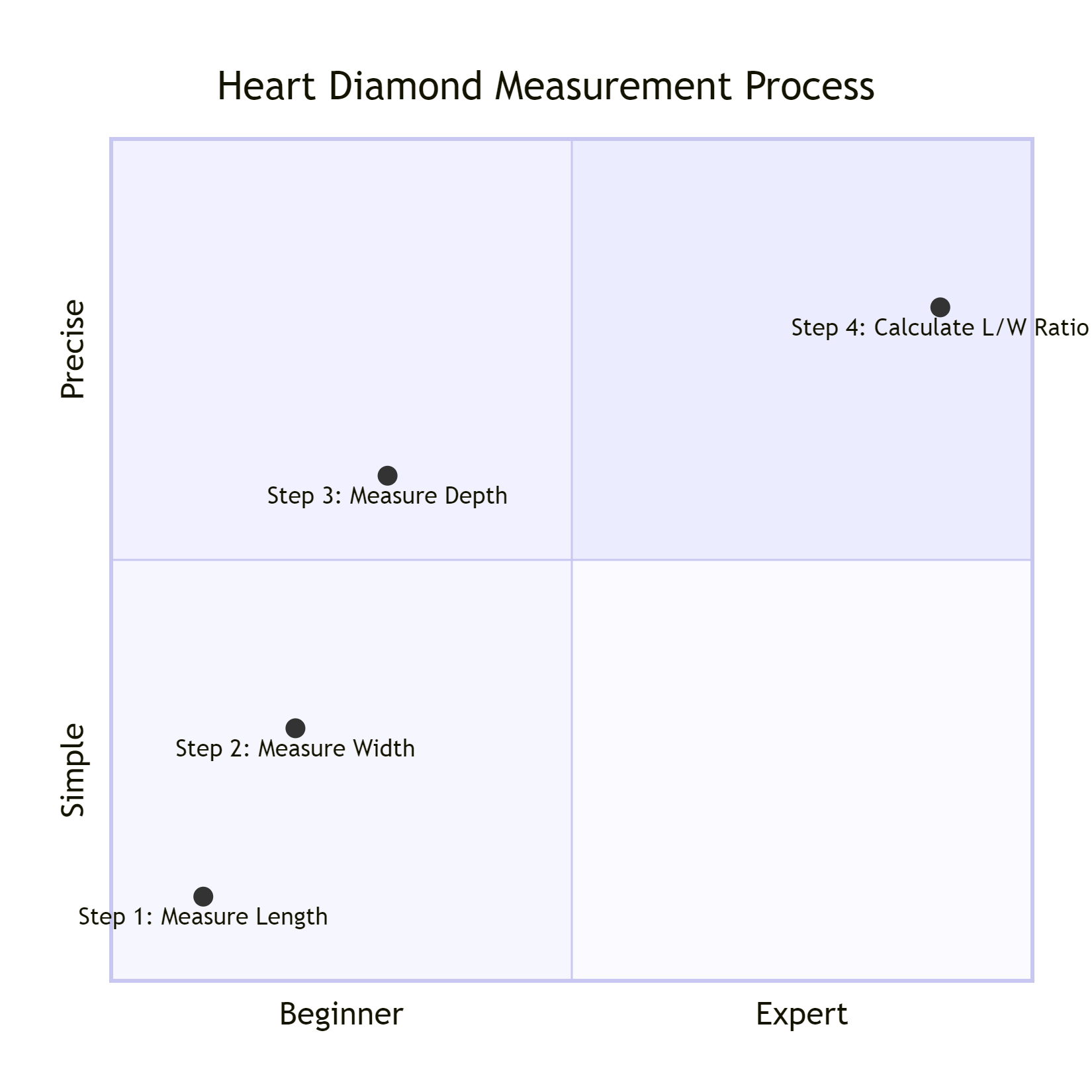
A heart-shaped diamond is measured using three key dimensions, typically listed in millimeters (mm) as Length x Width x Depth on a diamond certificate.
Step-by-Step Measurement Guide
Tools You Will Need:
A millimeter gauge (highly recommended for precision).
A non-digital caliper can also work carefully.
Your diamond's GIA or AGS certificate, which lists the official measurements.
Step 1: Measure the LENGTH
This is the most straightforward measurement.
Place the diamond with its point facing down.
Measure from the very tip of the cleft (the "V" at the top) to the very tip of the point at the bottom.
This is the total length of the diamond.
Step 2: Measure the WIDTH
This is the widest part of the diamond.
Measure from the outermost curve of the left lobe (wing) to the outermost curve of the right lobe (wing).
Ensure your caliper is perpendicular to the length measurement you just took.
Step 3: Measure the DEPTH
This is the height of the diamond from the table (top) to the culet (bottom point) when viewed from the side.
This measurement is trickier without a gemologist's gauge and is best taken from the certificate.
The Most Important Calculation: Length-to-Width Ratio
Once you have the Length and Width, you can calculate the single most important number for understanding the heart's shape.
Formula: Length-to-Width Ratio = Length / Width
Example: If your heart diamond is 8.0mm long and 7.6mm wide, the ratio is 8.0 / 7.6 = 1.05.
What the Ratio Means:
Ratio < 1.0: A "chubby" or wide heart. (e.g., 7.5mm L x 8.0mm W = 0.94 Ratio)
Ratio 1.0 - 1.05: A "classic" or balanced heart. This is the most common and often most desired proportion.
Ratio > 1.05: A "slender" or elongated heart. (e.g., 8.2mm L x 7.8mm W = 1.05 Ratio)
This ratio is a matter of personal preference, but it objectively tells you the diamond's shape profile.
Pro Tips and What to Watch For
Rely on the Certificate: The most accurate measurements are performed by gemological labs like GIA using highly precise instruments. Always use the certificate as your primary source.
Depth Percentage Matters Too: The lab also calculates a Depth Percentage.
Formula: (Depth / Width) x 100
Why it's important: A depth percentage that is too high means the diamond is cut too deeply and will look smaller for its carat weight. A percentage that is too low means it's too shallow and will lack brilliance. For heart shapes, a depth percentage between 58% and 65% is often in a good range, but the overall appearance is king.
Symmetry is Everything: While measuring, you are also verifying symmetry. If the two halves of the heart look equal and the measurements are consistent, you have a well-cut stone. If one "wing" is wider than the other, it will be visibly lopsided.
Why Proper Measurement is Critical
For the Setting: A jeweler needs the exact length and width to create a secure setting that protects the delicate point and holds the diamond snugly.
For Value Comparison: It allows you to compare diamonds effectively. A well-cut 1-carat heart should have expected dimensions (~6.5mm x ~6.5mm). If one is significantly smaller, it's likely cut too deeply.
For Personal Preference: It helps you define and find the exact silhouette you love—whether it's a chubby, classic, or slender heart.
To measure a heart-shaped diamond, you need its Length, Width, and Depth. From there, calculate the Length-to-Width Ratio to understand its shape profile, and always use the certified measurements from a lab like GIA for accuracy.
“You now know the meaning, the romantic gesture debate, the pricing, the size charts, the 2-carat value, the public opinion, the selection guide, and the measurement method. The only question left: will you give your whole heart?*
*Our current collection includes a limited number of GIA-certified heart-shaped diamonds — from delicate 0.5-carat stones to breathtaking 2-carat centerpieces. When stones with perfect symmetry and minimal bow-tie are gone, sourcing new ones takes months.*
*This is not just a diamond. It is the 13th-century French manuscript, the Victorian soldier‘s locket, Elizabeth Taylor‘s ‘best friend,‘ and Richard Burton‘s risk — a shape that has no words, but says everything. Give your whole heart. Or give nothing.”*
[Button: Claim Your Heart Diamond (Limited) →]


Other news for Monday 15 June, 2026
- Asscher Cut Guide: Complete Guide to Square Emerald Cut Diamonds
- Classic Cut Guide: Old Mine vs Old European vs Modern Round
- Marquise Cut Guide: Price, Size Illusion, vs Oval and Buying Tips
- Pavé Setting Guide: Pros, Cons, Cost, Security and Channel/Bezel
- Radiant Cut Guide: Price, vs Emerald, 1ct, 3ct Cost, Sparkle and Tips
- Vintage Cut Guide: Old Mine vs Old European vs Rose Cut
View all news for Monday 15 June, 2026 on one page
News for Sunday 14 June, 2026
- Round Brilliant Cut Guide: Price, Facets, vs Other Cuts and Buying Tips
- The Allure of the Cushion Cut Diamond: What You Need to Know
- Square Cut Diamond Guide: Princess, Cushion, Asscher and Radiant
- 24K Gold Guide: Purity, Price, vs 18K, Investment and Buying Tips
- 22K Gold Guide: Purity, Price, vs 24K/18K, Daily Wear and Care
- Oval Cut Diamond Guide: Price, vs Round, vs Radiant and Buying Tips
- Pear Cut Diamond Guide: Price, vs Round, Sparkle and Buying Tips
- Solitaire Setting Guide: 4 vs 6 Prong, Security, Unique Ideas and Comfort
View all news for Sunday 14 June, 2026 on one page
Recent News
- Saturday 13 June, 2026
- Friday 12 June, 2026
- Thursday 11 June, 2026
- Wednesday 10 June, 2026
- Tuesday 09 June, 2026