

Pear Engagement Ring Guide: Symbolism, History, Cost And Tips
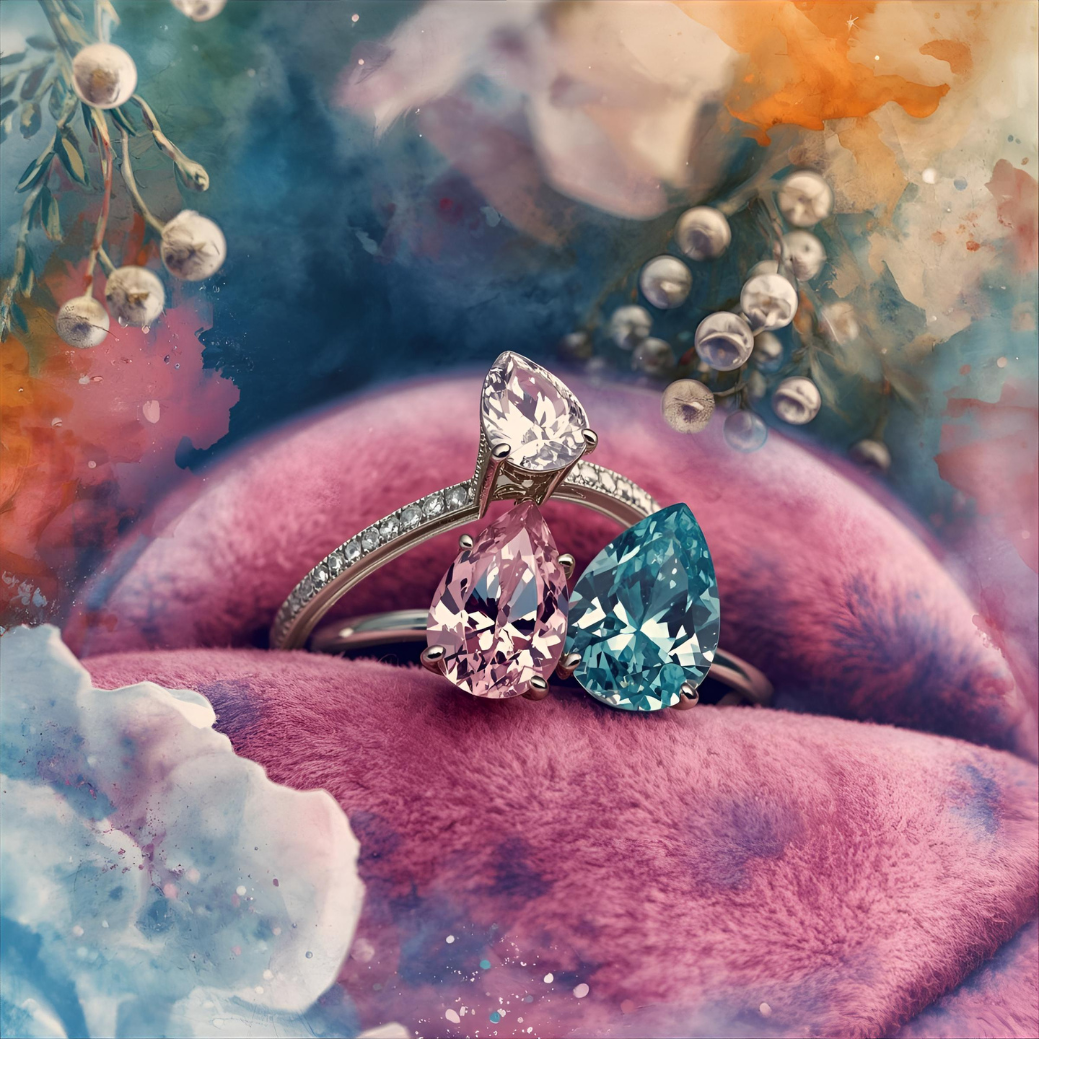
The Symbolism of Pear Engagement Ring
The pear engagement ring is a perfect choice for someone with a bold, romantic, and individualistic style.
While it requires careful attention to cut quality and a protective setting,
The result is a breathtakingly elegant and unique piece of jewelry that exudes personality and sparkle.
Here’s a comprehensive guide to everything you need to know about a pear engagement ring.
Table of Contents
- What Is a Pear Engagement Ring?
- What Is The History Of The Pear Engagement Ring?
- The Symbolism of Pear Engagement Ring
- What Wedding Ring Goes With A Pear Engagement Ring?
- Which Finger Is Meant For A Pear Engagement Ring?
- Which Way Are You Supposed To Wear A Pear Engagement Ring?
- What Is The Difference Between A Pear And a Teardrop Engagement Ring?
- What Is The Difference Between A Marquise And A Pear Engagement Ring?
- Why Wear a Pear Engagement Ring On Your Left Hand?
- Is A Pear Engagement Ring Timeless?
- Are Pear-Shaped Rings More Expensive?
- What Nail Shape Is Best For A Pear Engagement Ring?
Let's first discuss the topic.
What Is a Pear Engagement Ring?
Pear engagement Ring Dating refers to a modern, non-verbal way of signaling that you're single and open to meeting someone—by wearing a small, green pear-shaped ring on your finger. It’s part of a global movement to encourage real-life connections (instead of relying on dating apps).
How It Works:
Wear the Ring – A green pear ring (often silicone) is worn on your left middle finger to show you’re open to dating.
Spot Others – If you see someone else wearing one, it’s a cue they’re single and approachable.
Start a Conversation – No swiping required—just strike up a chat in person!
Why a Pear?
The pear shape is unusual, making it easy to recognize.
Green symbolizes growth, freshness, and new connections.
Pros of Pear Engagement Ring Dating:
Encourages real-life interactions (no more "missed connections").
Low-pressure—no public dating profile or awkward "Are you single?" questions.
Global community (popular in the U.S., U.K., and Europe).
Cons:
Not yet mainstream, so you might not see many wearers yet.
Requires confidence to approach strangers (but that’s the point!).
Where to Get One:
Sold on the official Pear Ring website (joinpear.com) or through social campaigns.
Perfect for: People tired of dating apps who want to meet organically—whether for relationships, flirting, or friendship!
What Is The History Of The Pear Engagement Ring?
The pear engagement ring has a rich history that blends romance, artistry, and cultural shifts. Here’s its fascinating evolution:
“In 1458, a Flemish diamond cutter named Lodewyk van Bercken invented the diamond-polishing wheel — and with it, the first ‘pendeloque‘ cut. For centuries, French royalty wore pear-shaped diamonds as pendants, believing the teardrop caught light like morning dew. Then, in 1957, Richard Burton gave Elizabeth Taylor a 69-carat pear diamond. She called it her ‘best friend.‘ Today, when Ariana Grande and Sophie Turner choose pears for their engagement rings, they aren‘t following a trend. They‘re wearing 600 years of rebel history — a stone that refuses to be round.”
The same cut that graced Elizabeth Taylor‘s finger now awaits your love story. Every pear diamond in our collection is hand-selected for symmetry — because a true pear never hides a bow-tie.”
[Button: Explore Pear Engagement Rings →]
1. 15th Century: Birth of the "Pendeloque" Cut
Origin: The pear cut emerged in 1458 when Flemish diamond cutter Lodewyk van Bercken invented the diamond-polishing wheel. His "pendeloque" cut (French for "pendant") combined the round brilliant and marquise shapes, creating the first pear diamonds.
Royal Love: French royalty adored the cut for its elegance, often using it in drop earrings and necklaces.
2. 18th–19th Century: Georgian & Victorian Eras
Symbolism: The teardrop shape symbolized tears of joy or mourning (widows wore pear-shaped mourning jewelry).
Romantic Gestures: Victorian suitors gifted pear-shaped acrostic rings (hidden gemstone messages, like a diamond + pearl for "D.P." — Désir Passionné).
3. Early 20th Century: Hollywood Glamour
Iconic Moments:
1920s: Art Deco designers embraced geometric pears for their drama and asymmetry.
1957: Elizabeth Taylor’s 29.4-carat pear diamond (a gift from Mike Todd) made headlines, cementing its star power.
4. 1970s–1990s: Bold Statements
Celebrity Influence:
1979: Tennis star Chris Evert lost her pear diamond ring during a match (and found it!), sparking a trend.
1990s: Pop culture embraced pears as extravagant symbols (e.g., Madonna’s pearl-and-diamond pear ring).
5. 21st Century: Modern Revival
Trendsetters:
2018: Ariana Grande’s pear diamond engagement ring from Pete Davidson went viral.
2020s: "Unique over traditional" mindsets made pears a top choice for nonconformist couples.
Symbolic Shift: Today, the pear represents individuality, progress (pointing forward), and gender-neutral design.
Why the Pear Endures
Dual Nature: Its blend of curves (feminine) and a point (masculine) appeals to all genders.
Optical Magic: The shape makes diamonds appear larger than rounds of the same carat weight.
Timeless Drama: From Marie Antoinette to Cardi B, it’s always been a rebel’s gem.
Fun Fact: The world’s largest pear diamond is the 530.2-carat Cullinan I (set in the British Sovereign’s Sceptre)!
For more on diamond cut history, visit the GIA guide to fancy shape diamonds.
The Symbolism of Pear Engagement Ring
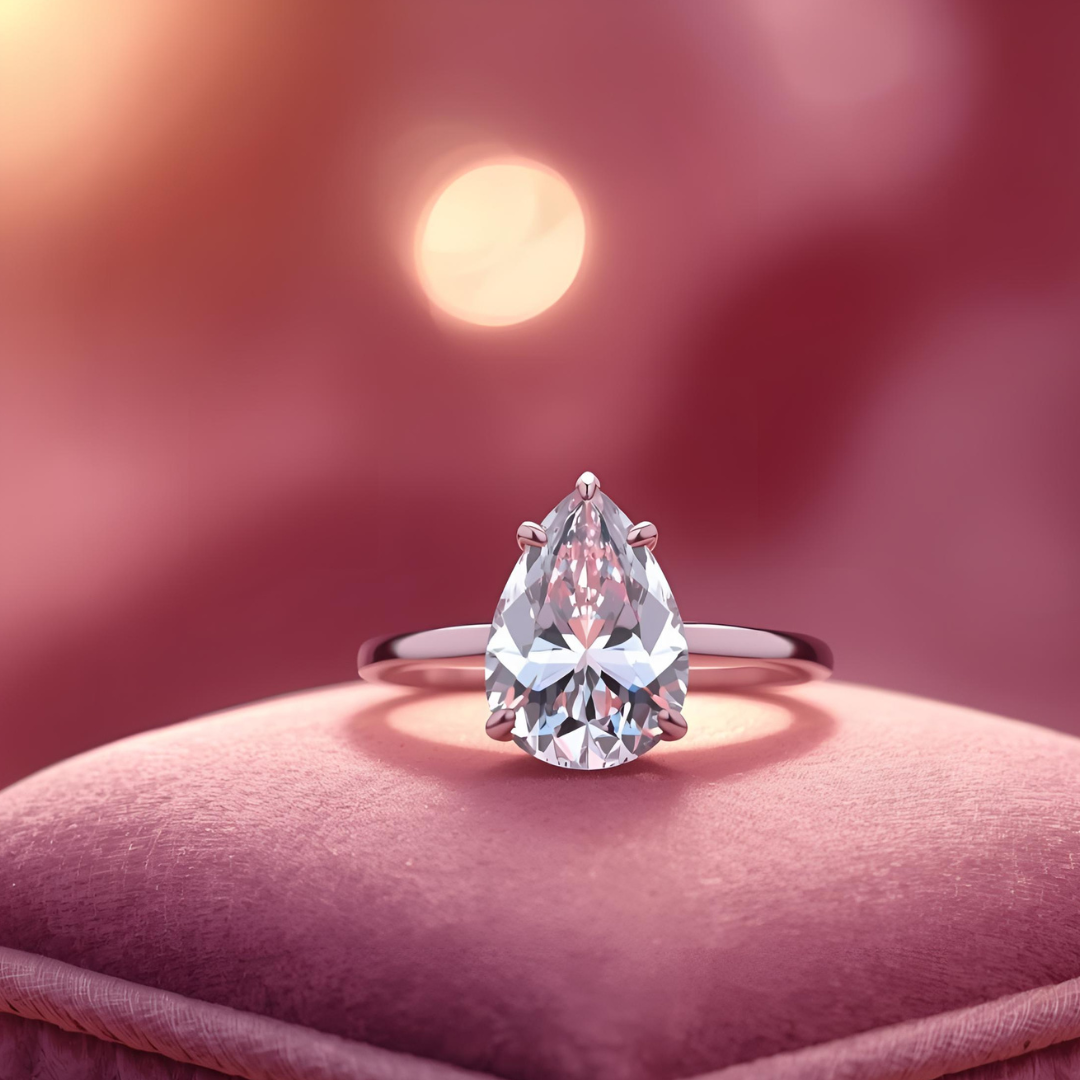
The pear-shaped engagement ring is a captivating blend of symbolism, merging romance, individuality, and forward-moving energy.
“The pear shape has always been a symbol of emotional truth. In Victorian England, widows wore pear-shaped mourning jewelry — the teardrop pointing down for grief, then later turned upward to signal healing. Today, the same shape carries the opposite meaning: tears of joy. When you wear a pear engagement ring with the point facing outward, you are saying: ‘We have cried, we have healed, and now we are walking forward together.‘ It is not just a diamond. It is a promise written in light and water.”
Here’s what it represents:
1. Unique Love Story
Its hybrid shape (round + marquise) symbolizes a one-of-a-kind bond—like two personalities merging into something beautifully distinct.
2. Tears of Joy & Emotional Depth
The teardrop silhouette evokes emotional sincerity, representing tears of happiness, passion, or the ups and downs of a shared life.
3. Direction & Future Growth
Worn with the point facing outward: Signifies a couple’s journey reaching toward the future together.
Worn point inward: Can symbolize love flowing into the heart (or protection of the relationship).
4. Balance & Harmony
The rounded end (feminine, softness) and sharp tip (masculine, strength) reflect duality and partnership—a union of complementary energies.
5. Abundance & Optimism
The elongated shape appears larger than its carat weight, echoing expansive love and prosperity.
6. Vintage Glamour & Modern Edge
Associated with Old Hollywood icons (like Elizabeth Taylor), it carries timeless drama, yet feels fresh and unconventional today.
7. Cultural & Spiritual Notes
In Renaissance art, pear-shaped gems symbolized divine grace.
Some believe its waterdrop form connects to purification and renewal (like a "clean slate" for marriage).
What Wedding Ring Goes With A Pear Engagement Ring?
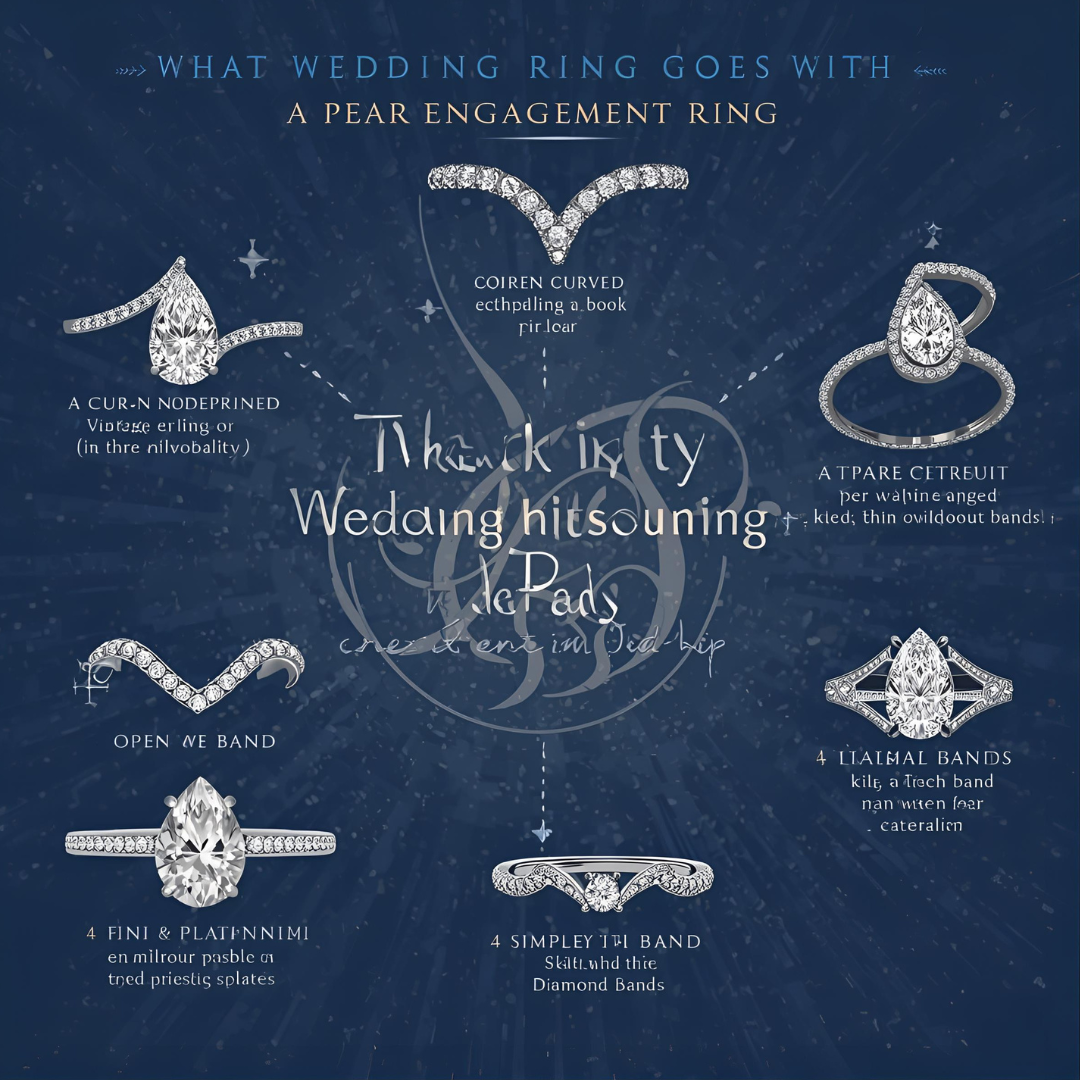
A pear-shaped engagement ring is elegant and unique, so the wedding ring you choose should complement its distinctive shape without overwhelming it. Here are some great options:
1. Curved or Contoured Wedding Bands
A custom curved band that fits snugly around the pear-shaped diamond ensures a seamless look.
A V-shaped or chevron band can mirror the taper of the pear shape beautifully.
2. Open Wedding Bands
An open cuff or gap band allows the pear engagement ring to sit perfectly without competing for space.
3. Vintage or Milgrain Bands
If your pear engagement ring has vintage details, a milgrain-edged or engraved band can enhance its antique charm.
4. Diamond-Accented Bands
A pavé or channel-set band adds sparkle without taking attention away from the pear diamond.
A half-eternity band (diamonds only on the top half) can be more comfortable while still adding brilliance.
5. Simple & Classic Bands
A plain gold or platinum band lets the pear engagement ring shine as the focal point.
A delicate thin band (1.5–2mm) keeps the look elegant and balanced.
6. Stackable Bands for Versatility
Multiple thin bands (plain and diamond-accented) can be stacked for a modern, layered look.
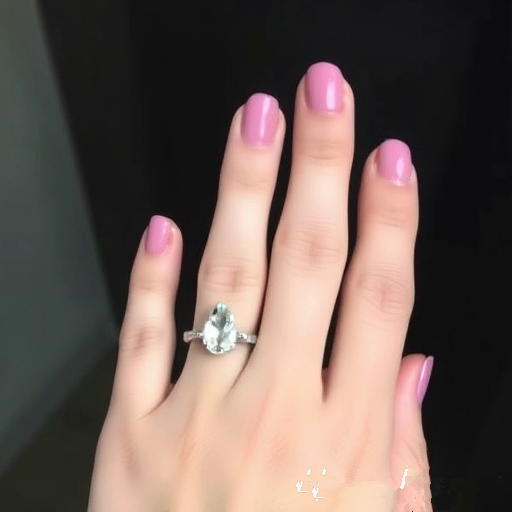
Which Finger Is Meant For A Pear Engagement Ring?
Traditionally, an engagement ring is worn on the fourth finger of the left hand (the finger between the middle finger and the pinky). This custom dates back to ancient Roman times, where it was believed that the "vena amoris" (vein of love) ran directly from this finger to the heart.
Key Points:
Left Hand, Ring Finger (4th Finger): Common in the U.S., Canada, U.K., France, and many Western countries.
Right Hand, Ring Finger: Some countries (e.g., Russia, Germany, Spain, India) traditionally wear engagement rings on the right hand.
After Marriage: In many Western cultures, the engagement ring is moved to the right hand temporarily during the wedding ceremony when the wedding band is placed on the left hand. The two rings are then often stacked together on the left ring finger.
For more on engagement ring traditions, visit the American Gem Society's engagement ring guide.
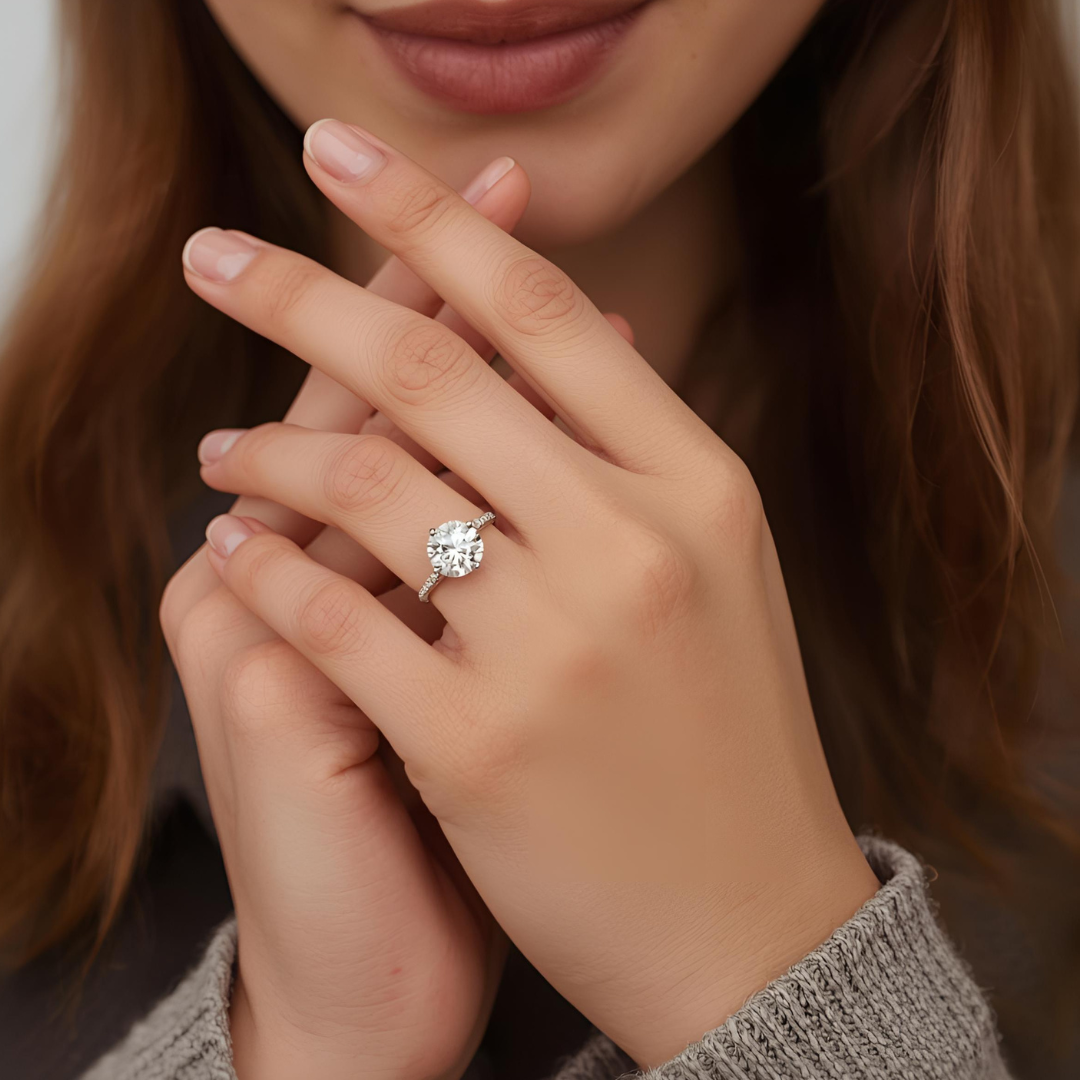
Which Way Are You Supposed To Wear A Pear Engagement Ring?
The direction you wear a pear-shaped engagement ring is a matter of personal preference, but there are traditional and practical considerations to keep in mind. Here’s a breakdown:
1. Point Facing Out (Away from You) – Traditional Choice
The tapered end elongates the finger, creating an elegant, flattering look.
Symbolism: Some believe the point facing outward represents "reaching toward the future."
Best for: Classic solitaires or rings worn alone (without a wedding band).
2. Point Facing In (Toward Your Hand) – Modern & Practical
Why? Protects the delicate tip from snagging and damage.
Symbolism: Some interpret it as the "teardrop" pointing toward the heart.
Best for: Active lifestyles or when paired with a curved wedding band.
3. Sideways (Horizontal) – Trendy & Unique
A less common option, but some designers set pears horizontally for a modern twist.
Key Factors to Consider:
Setting Style: A V-prong or bezel setting adds security if the point faces out.
Wedding Band Pairing: A notched or curved band may influence the direction.
Comfort: Try both ways—some find the point digs into their finger if facing in.
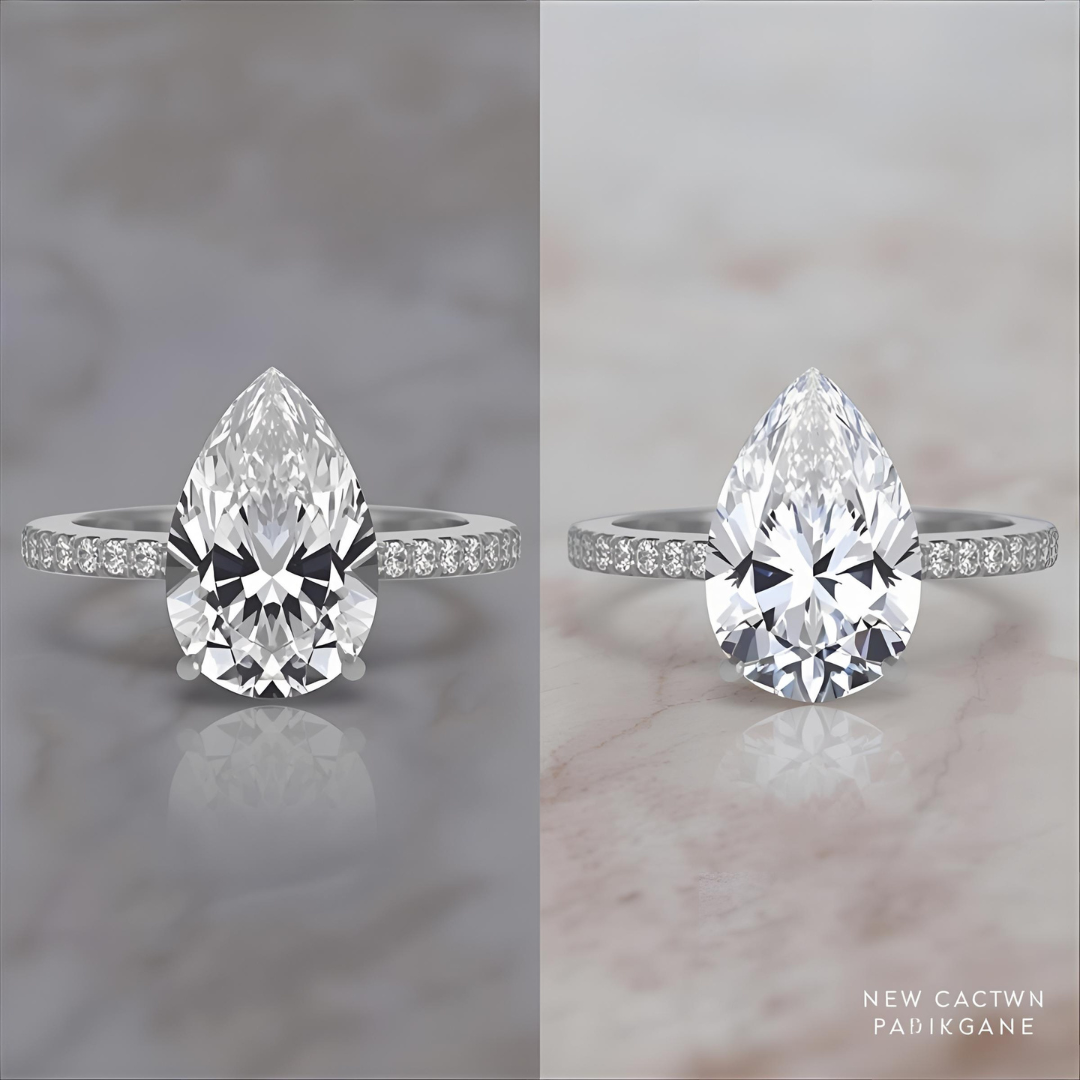
What Is The Difference Between A Pear And a Teardrop Engagement Ring?
Great question! The terms "pear" and "teardrop" are often used interchangeably for engagement rings, but there can be subtle differences in how they're described or designed. Here’s the breakdown:
1. Shape Terminology
Pear Shape: A hybrid between a round brilliant and a marquise cut, with a rounded end and a single pointed tip. It’s symmetrical and technically a type of teardrop.
Teardrop Shape: A broader term that can include less symmetrical, softer curves (like a literal waterdrop), sometimes with a more exaggerated taper.
2. Cut & Symmetry
Pear Cut: Has strict symmetry standards—the two sides should mirror each other perfectly, and the point should align with the apex of the rounded end.
Teardrop Cut: May be slightly asymmetrical or organic-looking (e.g., a rounded base with a gentle, uneven taper).
3. Jewelry Industry Usage
"Pear" is the standard term in fine jewelry for this diamond shape (also called "pendeloque").
"Teardrop" is sometimes used for non-diamond gemstones (e.g., pearls, opals) or designs with a more fluid, artistic shape.
4. Practical Differences
Pear diamonds are precision-cut for sparkle, while teardrop gemstones may prioritize color or uniqueness over symmetry.
A poorly cut "pear" might be labeled a "teardrop" to justify irregularities.
Which Should You Choose?
For a classic, sparkly engagement ring, opt for a pear-cut diamond (check for symmetry and no bow-tie effect).
For vintage or organic styles, a teardrop gemstone (like a sapphire or morganite) can be romantic.
What Is The Difference Between A Marquise And A Pear Engagement Ring?
The teardrop shape signifies tears of joy, emotional depth, or growth (pointing toward the future).
Combines feminine curves (rounded end) with masculine edges (pointed tip).
Practical Considerations
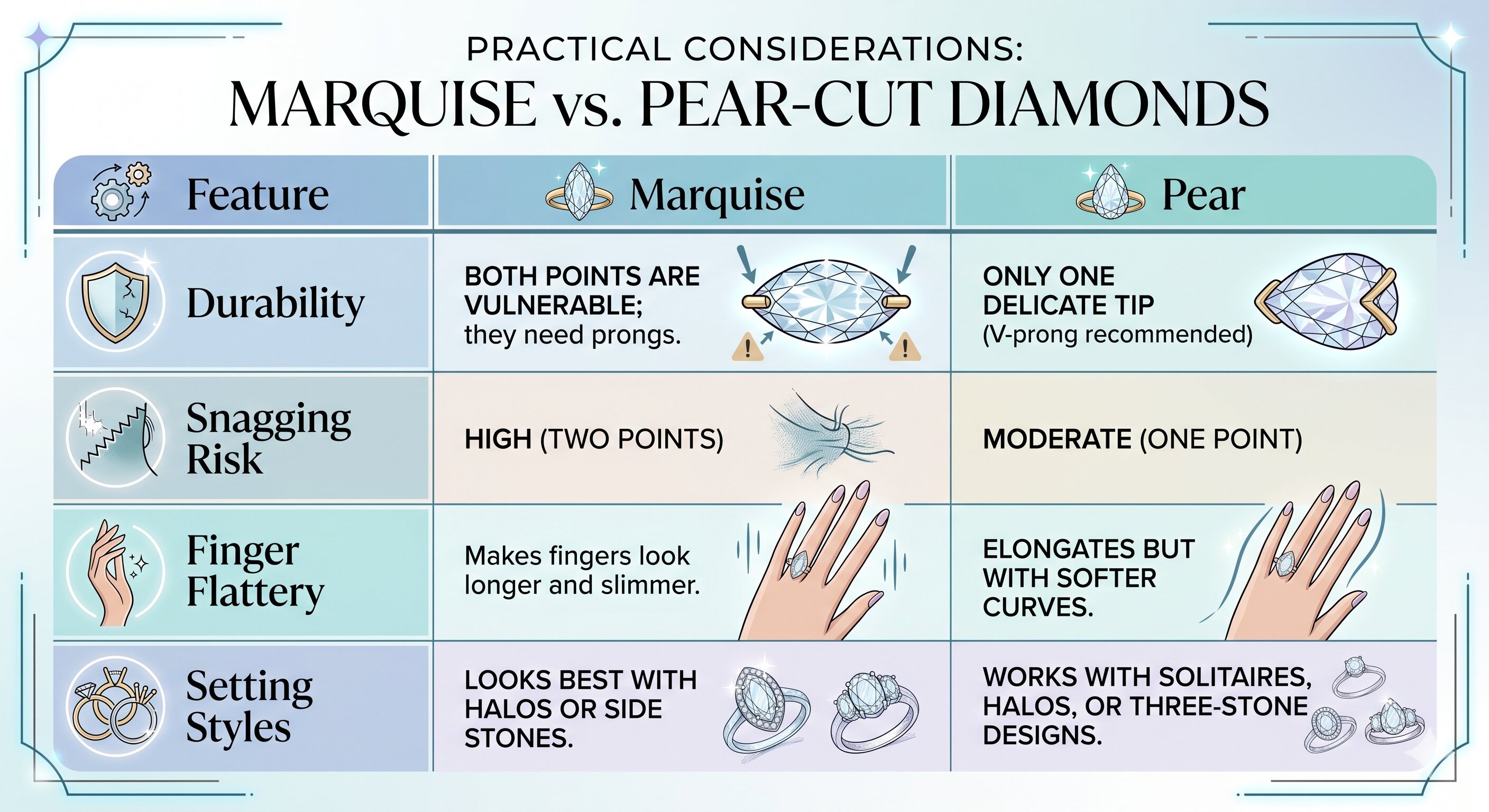
Popularity & Trends
Vintage glamour (popular in the 18th century and 1970s).
Recently revived by celebs like Ashley Simpson and Victoria Beckham.
Pear:
Modern romance (favored by Ariana Grande, Sophia Richie).
Seen as more "playful" and unconventional.
Which to Choose?
Pick a Marquise if: You love drama, symmetry, and vintage vibes.
Pick a Pear if: You want a mix of softness and edge, with deeper symbolism.
Pro Tip: Try both on—the marquise suits bold personalities, while the pear flatters romantic free spirits!
Learn more about diamond shape differences on Wikipedia's diamond cut page.
Why Wear a Pear Engagement Ring On Your Left Hand?
The tradition of wearing an engagement ring on the left hand’s ring finger (the fourth finger) has deep historical and cultural roots.
Here’s why it’s still popular today:
1. Ancient Roman & Egyptian Beliefs
The "Vena Amoris" (Latin for "vein of love") was thought to run directly from this finger to the heart.
Romans adopted this idea, symbolizing a romantic connection between the ring and the heart.
2. Christian Influence in Medieval Europe
Early Christian weddings incorporated the left-hand ring placement during ceremonies.
The "ring finger" was blessed by priests in the 11th century, reinforcing the tradition.
3. Practicality (for Right-Handed People)
Most people are right-handed, so wearing a ring on the left hand reduces wear and tear.
Fewer scratches, snags, or damage to delicate settings.
4. Modern Western Tradition
Countries like the U.S., U.K., Canada, France, and Australia follow this custom.
The engagement ring is later paired with a wedding band on the same finger (often stacked).
5. Exceptions & Cultural Variations
Right-Hand Rings: In Germany, Russia, Spain, India, and some Orthodox Christian cultures, engagement rings are worn on the right hand.
Same Finger, Different Hands: Some move the engagement ring to the right hand during the wedding ceremony, then return it to the left afterward.
6. Symbolic Meaning Today
While science has debunked the "vein to the heart" myth, the tradition persists as a romantic gesture and cultural norm.
Fun Fact: Some historians believe the left hand was chosen because it was considered less "dominant, —making the ring a humble symbol of love.
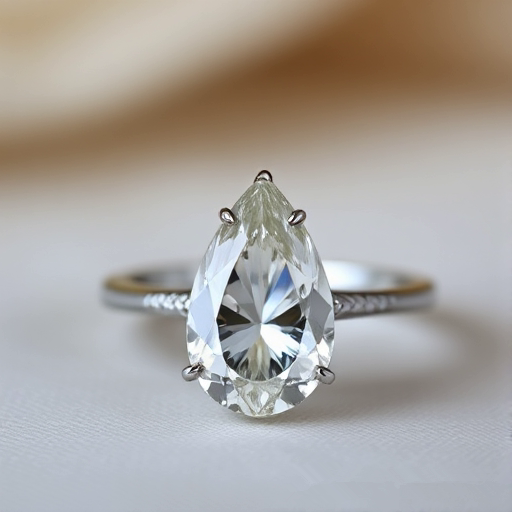
Is A Pear Engagement Ring Timeless?
A pear-shaped engagement ring sits at the intersection of timeless elegance and modern individuality. While it may not have the centuries-old ubiquity of a round brilliant, its unique blend of classic and contemporary traits gives it enduring appeal. Here’s why:
Why a Pear Ring Can Be Timeless
Historical Roots
Pear cuts (also called pendeloque) date back to the 1400s, popularized by French jewelers. They’ve adorned royalty (like Marie Antoinette) and icons (Elizabeth Taylor’s 69-carat pear diamond).
Versatile Aesthetic
Its hybrid shape—round brilliance + marquise taper—offers both vintage glamour and modern edge.
Works with solitaire, halo, or three-stone settings, adapting to trends while staying recognizable.
Elongating Flair
The teardrop silhouette has always been prized for flattering fingers—a practical beauty that never goes out of style.
Why Some Question Its Timelessness
Less Common Than Round/Oval: It’s bolder, so it feels more "trendy" to minimalists.
Symmetry Demands Skill: A poorly cut pear can look dated (e.g., 1980s "bow-tie" flaws).
How to Keep It Timeless
✔ Choose a High-Quality Cut (avoid strong bow-tie effects).
✔ Opt for Secure Settings (e.g., V-prong tip protection).
✔ Pair with a Simple Band (let the pear shine as the star).
Verdict: Like an Art Deco piece or a vintage emerald cut, the pear’s allure is timeless for those who appreciate its character. It may not be "neutral," but it’s far from fleeting.
Are Pear-Shaped Rings More Expensive?
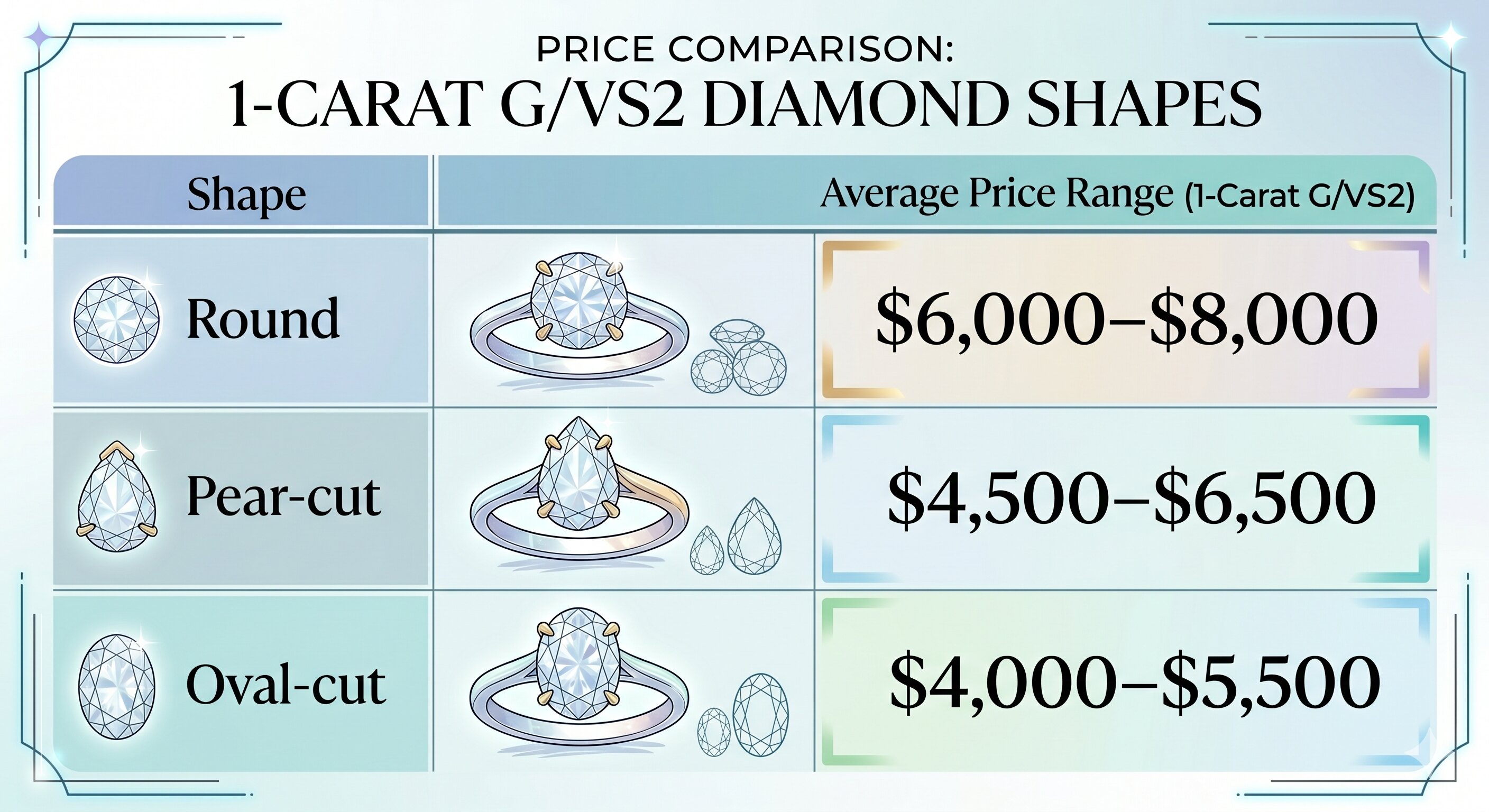
The cost of a pear-shaped ring depends on several factors, but it’s not inherently more expensive than other shapes. Here’s a breakdown of how pricing compares:
1. Diamond Cost: Pear vs. Round
Generally Less Expensive Than Round: Pear-shaped diamonds typically cost 20–30% less per carat than round brilliants of the same quality.
Why? Rounds are in higher demand and require more rough diamond waste during cutting.
But More Than Some Fancy Shapes: Pears are usually pricier than marquise or oval cuts, but cheaper than cushion or emerald cuts.
2. Factors Affecting Price
Cut Quality: A well-cut pear with excellent symmetry/no bow-tie effect costs more.
Carat Weight: Larger pears (2+ carats) may have a higher price jump due to rarity.
Color/Clarity: Pears hide inclusions better than step cuts (e.g., emerald), so you can prioritize color.
3. Setting Costs
V-Prong or Bezel Settings: Adding a protective tip prong may slightly increase labor costs.
Custom Designs: Curved or chevron bands (to fit the pear) can add $200–$500.
4. Budget-Friendly Perk
Face-Up Size: Pears appear larger than rounds of the same carat weight (elongation trick!). A 1.5-carat pear can look like a 2-carat round.
Verdict
Pear rings are mid-range in price—more affordable than rounds but not the cheapest. Their value shines in unique beauty and flattering wearability.
Price Comparison (1 carat, G-H color, VS1 clarity)
- Round Brilliant: $6,000 - $10,000 (most expensive)
- Pear Shape: $4,500 - $7,000 (20-30% less than round)
- Oval Cut: $4,000 - $6,500
- Marquise: $3,500 - $5,500 (most affordable among elongated shapes)
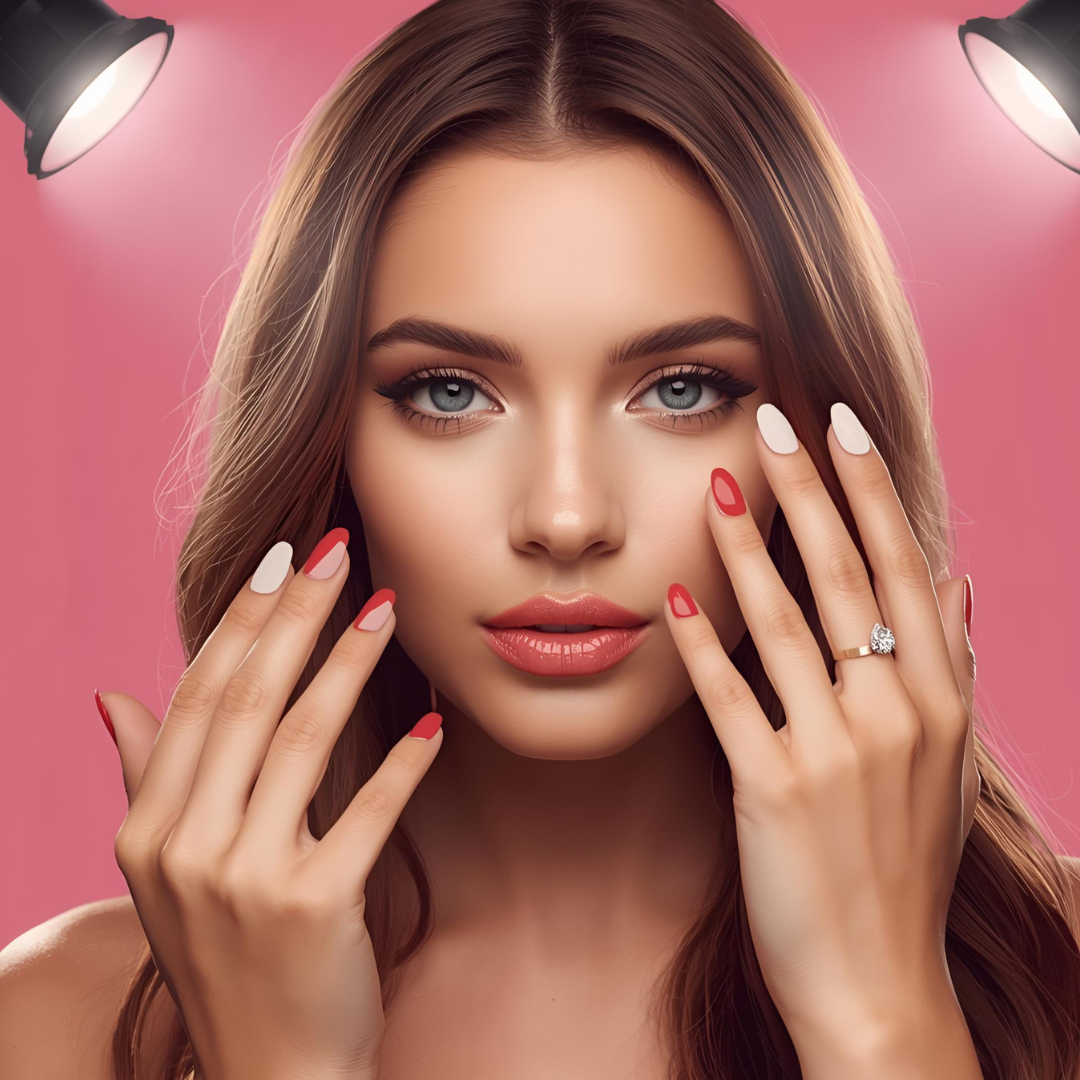
What Nail Shape Is Best For A Pear Engagement Ring?
The best nail shape for a pear engagement ring should complement its elegant taper and elongate the fingers for a harmonious look. Here are the top choices:
1. Oval or Almond
Why? Soft, tapered shapes mirror the pear diamond’s silhouette, creating a balanced, feminine look.
Bonus: Elongates fingers, making the ring appear even more graceful.
2. Coffin/Ballerina
Why? The squared-off tip adds a modern edge to contrast the pear’s curves, perfect for a bold, fashion-forward vibe.
3. Squoval (Square-Oval Hybrid)
Why? Offers structure without sharp corners, letting the pear diamond remain the star.
4. Short Rounded
Why? Low-maintenance and classic, ensuring the ring (not nails) gets all the attention.
Avoid:
Stiletto: Too sharp—competes with the pear’s delicate point.
Extreme Square: Can make hands look wider, dulling the pear’s elongating effect.
Pro Tips:
Nail Color: Nude/neutral shades keep focus on the ring.
Sparkle Accent: A pear-shaped nail art gem on the ring finger echoes your diamond!
Final Touch: Match your nail shape to your personal style—romantic (almond), edgy (coffin), or timeless (oval).
A pear-shaped (or teardrop) diamond engagement ring is a beautiful and unique choice, full of personality and elegance. Read more gemstone rings.
“You now know the history, the symbolism, the wedding band pairings, the finger placement, and the direction to wear it. The only question left: will you wear the Rebels' diamond?
Our current collection includes a limited number of GIA-certified pear diamonds — each with excellent symmetry to avoid the dreaded ‘bow-tie‘ effect. When they‘re gone, sourcing new stones with this cut quality takes months.
This is not just a ring. It is 600 years of royal tears, Hollywood glamour, and modern love — pointing forward, toward your future.”
[Button: Claim Your Pear Diamond (Limited) →]


Spinel Guide: Price, Colors, How to Tell Real | August Birthstone
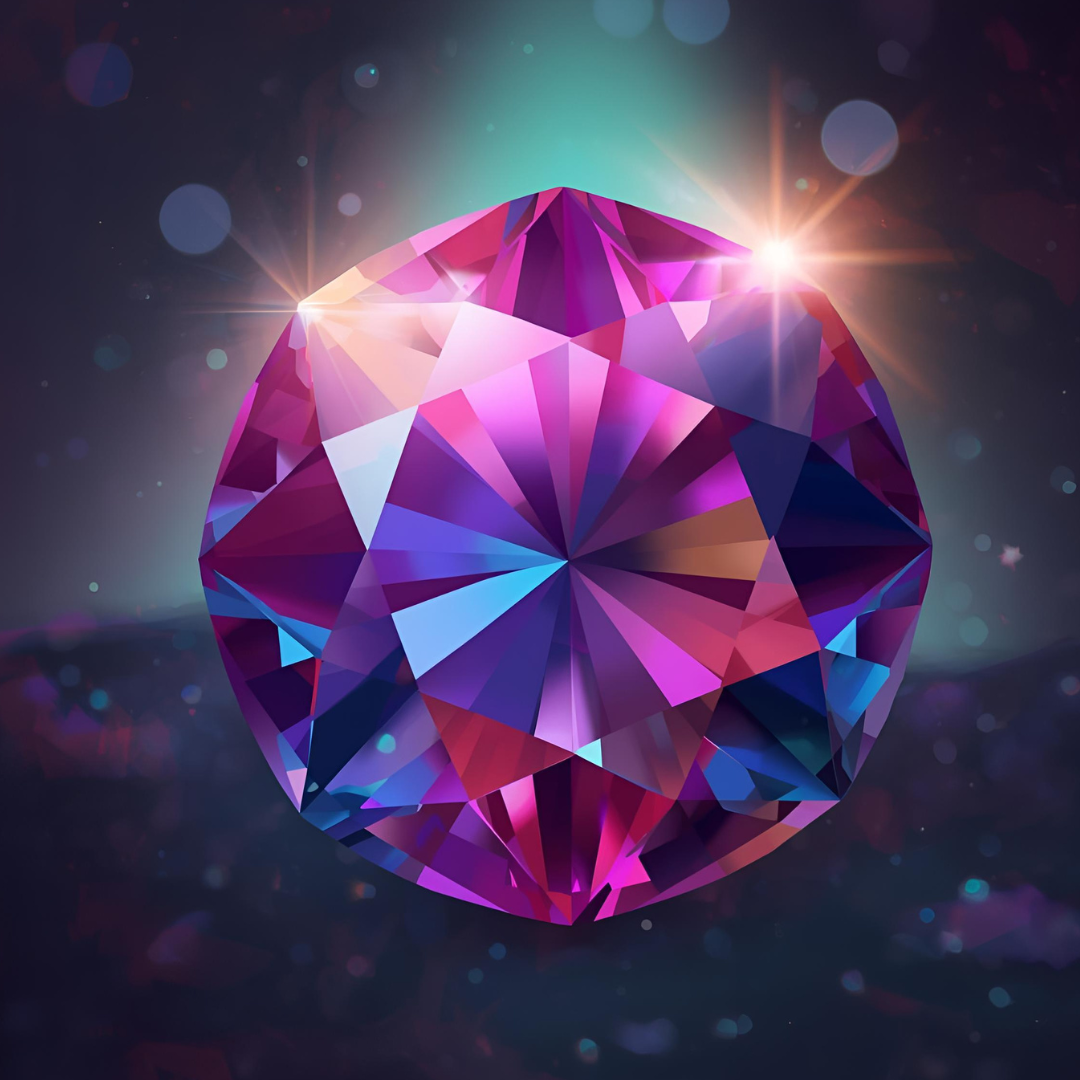
Spinel Birthstone
Spinel was one of the most famous "impostors" in the gem world, often mistaken for ruby or sapphire due to its brilliant colors and exceptional clarity.
Table of Contents
- What Birthstone Is Spinel?
- Why Is Spinel A Great Birthstone?
- How Can You Tell If A Spinel Is Real?
- How Rare Is Spinel?
- Which Color Spinel Is Best?
- How Much Does Spinel Cost?
- Which Is Better, Spinel Or Sapphire?
- Can Spinel Get Wet?
- What Zodiac Is Spinel?
- Why Is Spinel So Popular?
- Is Spinel Good For Everyday Wear?
Here we begin following;
What Birthstone Is Spinel?
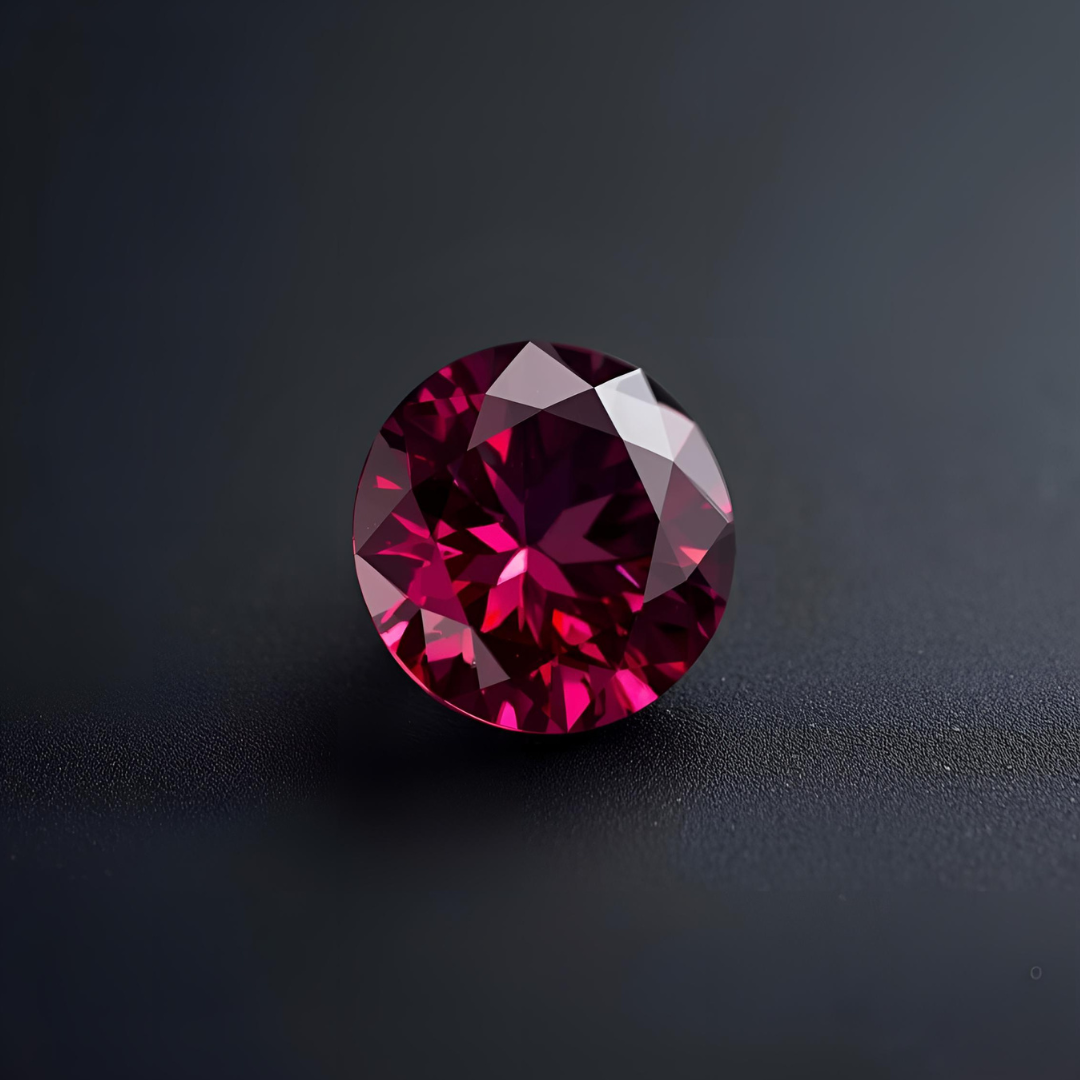
Spinel is recognized as a modern birthstone for August. It shares this designation with peridot and sardonyx.
Here's a bit more detail on its status:
Official Recognition: In 2016, the American Gem Trade Association (AGTA) and the Jewelers of America officially added spinel as a second, modern birthstone for August. This was a significant move, as it was the first time the list had been updated since 1952.
Historical Connection: Even before its official designation, spinel has a long historical connection to August. For centuries, many famous "rubies" in crown jewels around the world were actually red spinels. This misidentification, due to their similar color and occurrence in the same mines, gives spinel a royal and ancient pedigree.
Why Is Spinel A Great Birthstone?
Durability: With a hardness of 8 on the Mohs scale, it is durable and perfect for everyday wear in jewelry like rings and bracelets.
Variety of Colors: While often associated with vibrant reds and hot pinks, spinel comes in a stunning range of colors, including lavender, blue, violet, and even black. This gives August babies many beautiful options.
Brilliance: Spinel has excellent brilliance and clarity, often requiring no heat treatment to enhance its natural beauty.
So, in summary: Yes, spinel is absolutely a birthstone for August, and it's a beautiful, durable, and historically rich gemstone for anyone born in that month.
Learn more about spinel's geological properties on Wikipedia's spinel page.
How Can You Tell If A Spinel Is Real?
Excellent question. Given that spinel was historically mistaken for other gems like ruby and sapphire, it's fitting that we now need to know how to identify it!
The good news is that for a beginner, there are some simple observations you can make, but for a definitive answer, professional gemological testing is usually required.
Here’s a breakdown of how to tell if a spinel is real, from simple checks to scientific methods.
Simple At-Home Observations (Clues, Not Proof)
These can raise red flags for fakes like glass, but cannot conclusively identify a natural spinel.
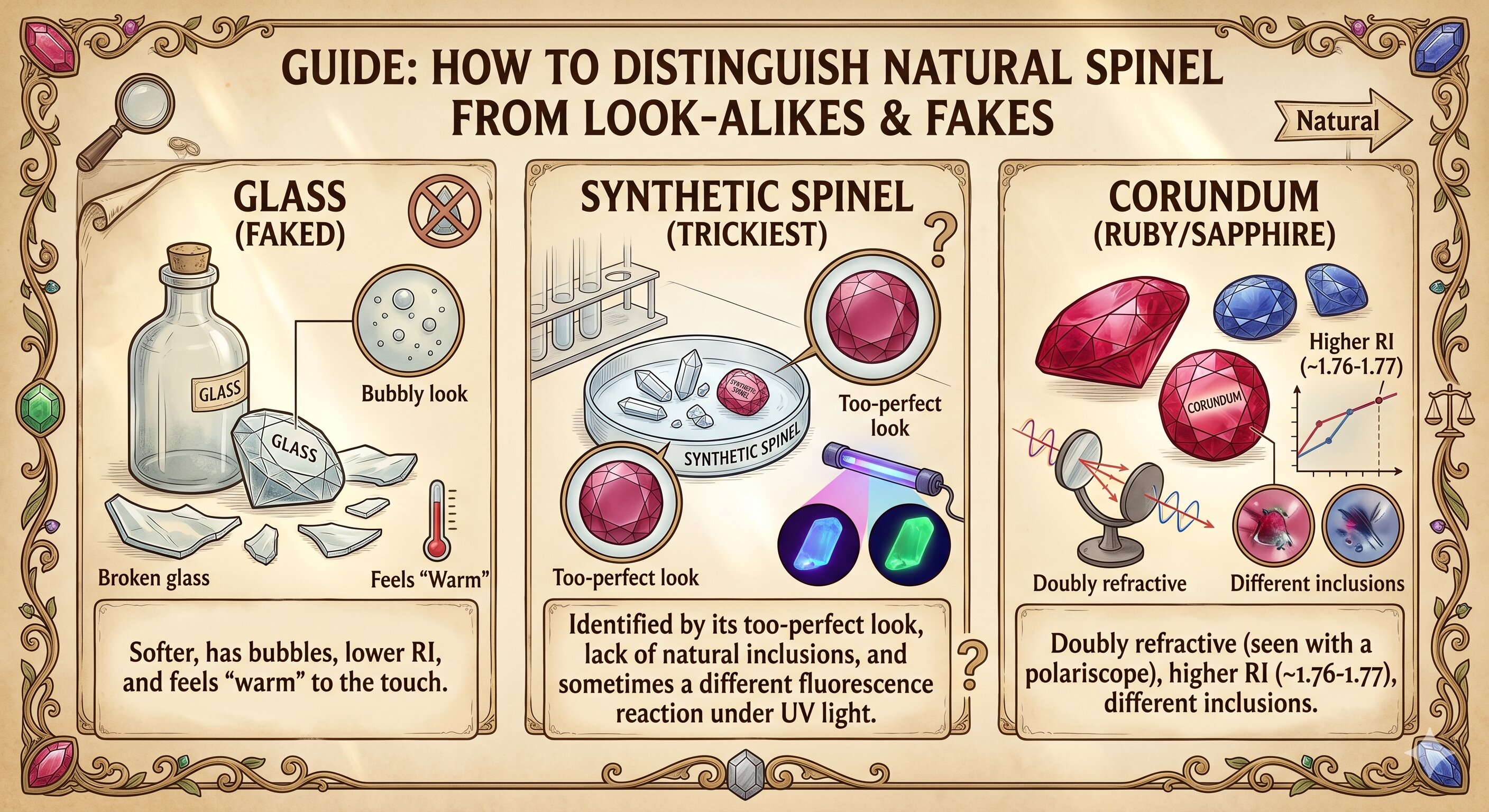
Look for Bubbles: Imitations like glass will often have tiny gas bubbles or swirl marks visible under a 10x loupe. Natural spinel, being a crystalline gem, will not have bubbles. It may have natural inclusions like crystals, fingerprints, or tiny fractures, but never bubbles.
Check the Hardness: Spinel is very hard (8 on the Mohs scale). It should not be easily scratched by a steel file (hardness ~6.5). Warning: This is a destructive test and should only be done as a last resort on an unset stone and in an inconspicuous area. It's not recommended.
The "Sparkle" Test (Dispersion): Spinel has a nice brilliance, but its "fire" (the separation of light into spectral colors) is lower than that of diamond. If a stone is being sold as spinel but has rainbow-colored flashes as strong as a diamond's, it's likely a fake like cubic zirconia (CZ).
Professional Gemological Testing (Definitive Proof)
This is how gemologists and labs definitively identify spinel. The most common imitations or look-alikes are synthetic spinel and glass, which require these tools to detect.
Refractometer (Measuring Refractive Index - RI):
Every gem has a specific RI, which is how much it bends light.
Natural Spinel's RI: Typically around 1.718.
Glass Imitations: Usually have a lower RI (1.50 - 1.70).
Synthetic Spinel: Often has a slightly higher RI than natural spinel. This is a key indicator.
Polariscope:
This tool tests a gem's optical character.
Spinel is Isotropic: This means it is singly refractive. When rotated under a polariscope, it will remain dark or stay the same.
Common Look-alikes are Anisotropic: Corundum (ruby/sapphire) is doubly refractive and will appear to lighten and darken when rotated. This is one of the easiest ways to tell a red spinel from a ruby.
Spectroscope:
This instrument analyzes the light spectrum absorbed by a gem, revealing a unique "fingerprint."
Spinel's Spectrum: Red and pink spinels show a distinct pattern of bright fluorescent lines, most notably in the red region. Blue spinels show complex bands of absorption. This is a very reliable test.
Checking for Inclusions:
Under a microscope, gemologists look for natural inclusions that confirm a stone's identity.
Natural Spinel Inclusions: Often contain small, octahedral crystals, "fingerprint" inclusions, or zoning.
Synthetic Spinel Inclusions: Often have curved striae (growth lines) and are often too clean.
Common Fakes & How to Spot Them
The Single Best Way to Know for Sure
Get a certificate from a reputable gemological laboratory.
If you are making a significant purchase, the safest and most reliable method is to have the stone graded and certified by a lab like:
GIA (Gemological Institute of America)
AGL (American Gemological Laboratories)
Gübelin Gem Lab
SSEF (Swiss Gemmological Institute)
A lab report will definitely state the gem species as "Spinel," its origin (e.g., Myanmar, Vietnam), and note if it is natural or synthetic.
How Rare Is Spinel?
That's the key question, and the answer is fascinating because spinel's rarity is a paradox:
As a mineral, spinel is relatively common. But as a fine gemstone, it is exceptionally rare.
Think of it like this: finding a spinel crystal in the earth is not unusual, but finding one that is large, clean, and has a vibrant, desirable color is a true treasure.
Here’s a breakdown of its rarity:
1. Gem-Quality vs. Mineral Specimens
Common: Small, included, or poorly colored spinel crystals are found in many locations around the world. These are not suitable for cutting into faceted gems for jewelry and have little commercial value.
Rare: Transparent crystals with intense color and good clarity that can be cut into beautiful gems are much, much rarer.
2. The Rarity of Specific Colors
This is where spinel's rarity truly shines. The most sought-after colors are incredibly scarce:
Which Color Spinel Is Best
Vivid Red ("Jedi" Spinel): This is the "holy grail." A pure, neon-bright red with no secondary brown or purple tones is one of the rarest finds in the gem world, especially from the legendary mines in Myanmar (Burma).
Cobalt Blue: The stunning, saturated blue caused by cobalt (primarily from Vietnam and Tanzania) is also extremely rare. A fine, vivid blue spinel over 2-3 carats is a major collector's item.
Vivid Hot Pink: Intense, electric pink stones are highly prized and very rare.
3. The Rarity of Size
While small spinels (under 1-2 carats) in nice colors can be found, large, fine-quality spinels are extraordinarily rare.
Finding a 5-carat spinel with top color and clarity is a significant event.
Historical spinels like the 170-carat "Black Prince's Ruby" in the British Crown Jewels are legendary precisely because such sizes with good color are almost unheard of today.
4. The "Natural" Rarity
Unlike many other gemstones, spinel is rarely heat-treated or enhanced. This is a critical point:
~98% of Sapphires and a large percentage of rubies and tanzanite are heat-treated to improve their color and clarity.
~99.9% of Spinels are sold exactly as they came out of the ground.
This means when you buy a beautiful spinel, you are almost always buying a gem in its pure, natural state. The rarity of a beautiful, untreated gemstone is, in itself, a rare thing in the modern market.
Comparison to Other Gemstones
vs. Ruby/Sapphire: Fine, unheated ruby and sapphire are rarer and more expensive than fine spinel. However, you can find beautiful spinels that rival the color of these gems for a fraction of the price, making spinel an exceptional value.
vs. Diamond: Gem-quality diamond is much more common in the market than gem-quality spinel. The diamond supply is tightly controlled, creating an illusion of rarity, while the spinel supply is genuinely fragmented and limited for top-quality material.
Spinel is not a rare mineral, but a fine gem spinel is very rare.
Its rarity is defined by a perfect storm of factors: the right color, the right clarity, and the right size, all in a naturally occurring, untreated package. This combination is what makes the finest spinels some of the most coveted and passionate pursuits for gem collectors and connoisseurs.
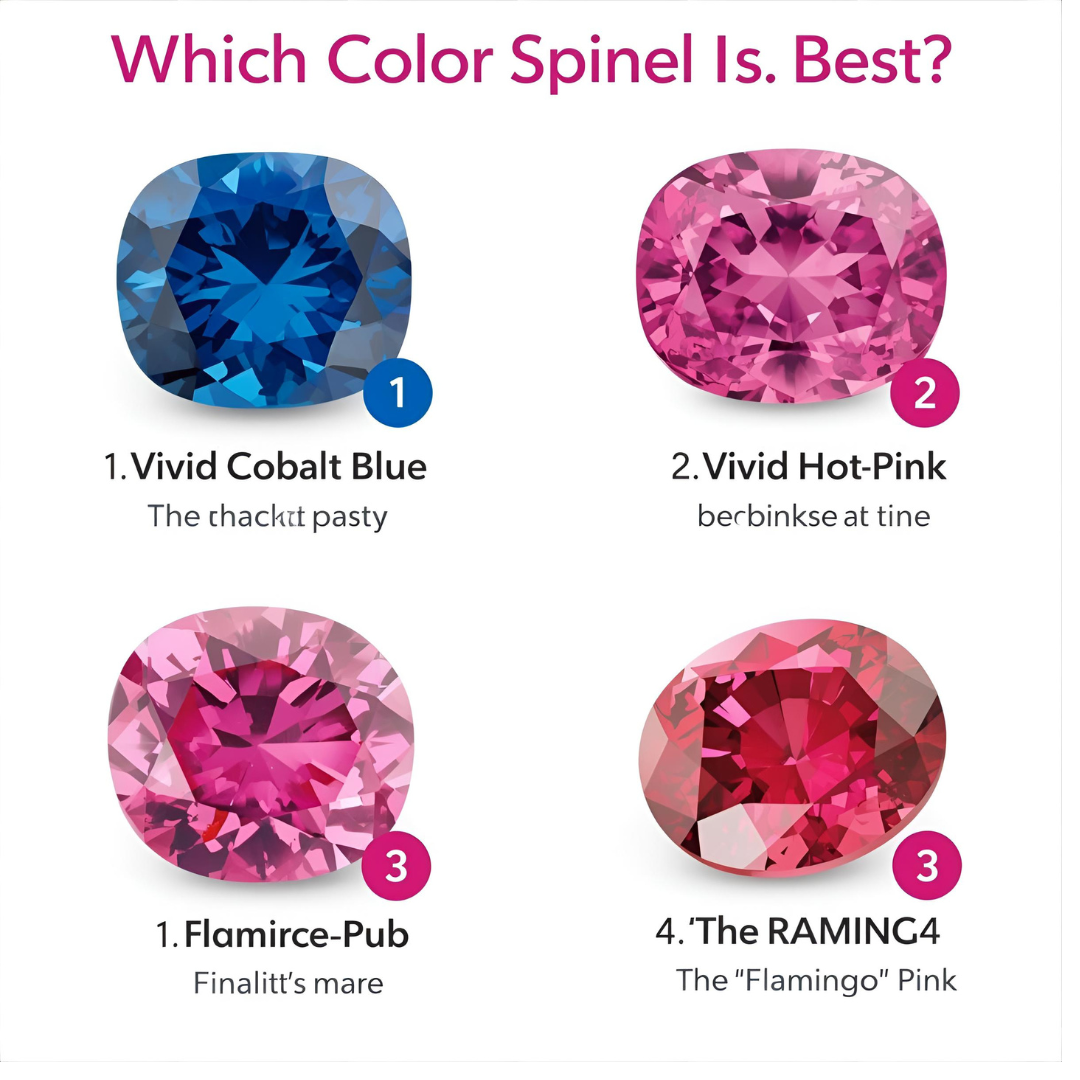
Which Color Spinel Is Best?
That's the million-dollar question! The "best" color in spinel is highly subjective and depends on what you value most—rarity, value, or personal taste. However, from a gemological and market perspective, there is a clear hierarchy.
Here’s a breakdown of the most prized spinel colors, from the ultimate collector's choice to other stunning options.
The Ultimate "Best": Vivid Red (The "Jedi" Spinel)
Why it's top-tier:
Rarity: This is the most legendary and rarest color. A pure, intense, neon-red with no secondary brown or purple tones is the holy grail for collectors.
The "Jedi" Name: A trade term for the finest red spinels from Myanmar, named for their "force-of-nature" vivid red, supposedly with no "dark side" (no dark tones).
Historical Significance: This is the color that was mistaken for ruby in the crown jewels for centuries. It carries a royal pedigree.
Price: Commands the highest prices per carat, often tens of thousands of dollars for top-quality stones.
If you want the absolute best in terms of rarity and prestige, a vivid "Jedi" red spinel is it.
The Other Top Contenders
These colors are also exceptionally rare and valuable, sometimes rivaling reds.
1. Vivid Cobalt Blue
Why it's prized: The stunning, saturated blue is caused by cobalt, the same element that gives some sapphires their famous color. This is extremely rare, especially from sources like Vietnam and Tanzania.
Appeal: It's a brilliant, electric blue that is very distinctive and highly sought-after by connoisseurs.
2. Vivid Hot Pink
Why it's prized: An intense, almost fluorescent pink is incredibly eye-catching. The most famous source for this color is the Mahenge mine in Tanzania, which produces stones with an unforgettable neon glow.
Appeal: It offers a modern, vibrant alternative to pink sapphires, often with more brilliance and a brighter tone.
3. Flaming Red-Pink or Pinkish-Red (The "Flamingo" Pink)
Why it's prized: This color sits in a beautiful zone between pure red and pure pink. It's less orange than a ruby but has a fiery, saturated warmth that is incredibly desirable.
Appeal: It captures the best of both red and pink, offering a unique and passionate color.
A Guide to Choosing Your "Best" Spinel
Since "best" is personal, here’s how to decide:
For the Collector & Investor: Seek a Vivid Red "Jedi" or a Vivid Cobalt Blue. These are the ones that will hold and increase in value the most due to their extreme rarity.
For Someone Who Loves Vibrant, Modern Gems: A Vivid Hot Pink from Mahenge or a Flamingo Pink offers incredible brilliance and a contemporary look that is hard to match.
For the Best Value & Beauty: Don't overlook other beautiful colors! Lavender, soft pink, and violet spinels can be absolutely stunning and are much more affordable, offering incredible beauty for the price. They are perfect for jewelry.
For a Unique, Earthly Tone: Greyish-blue spinels have a sophisticated, subtle beauty that is very trendy in modern jewelry design.
Summary Table of Spinel Colors
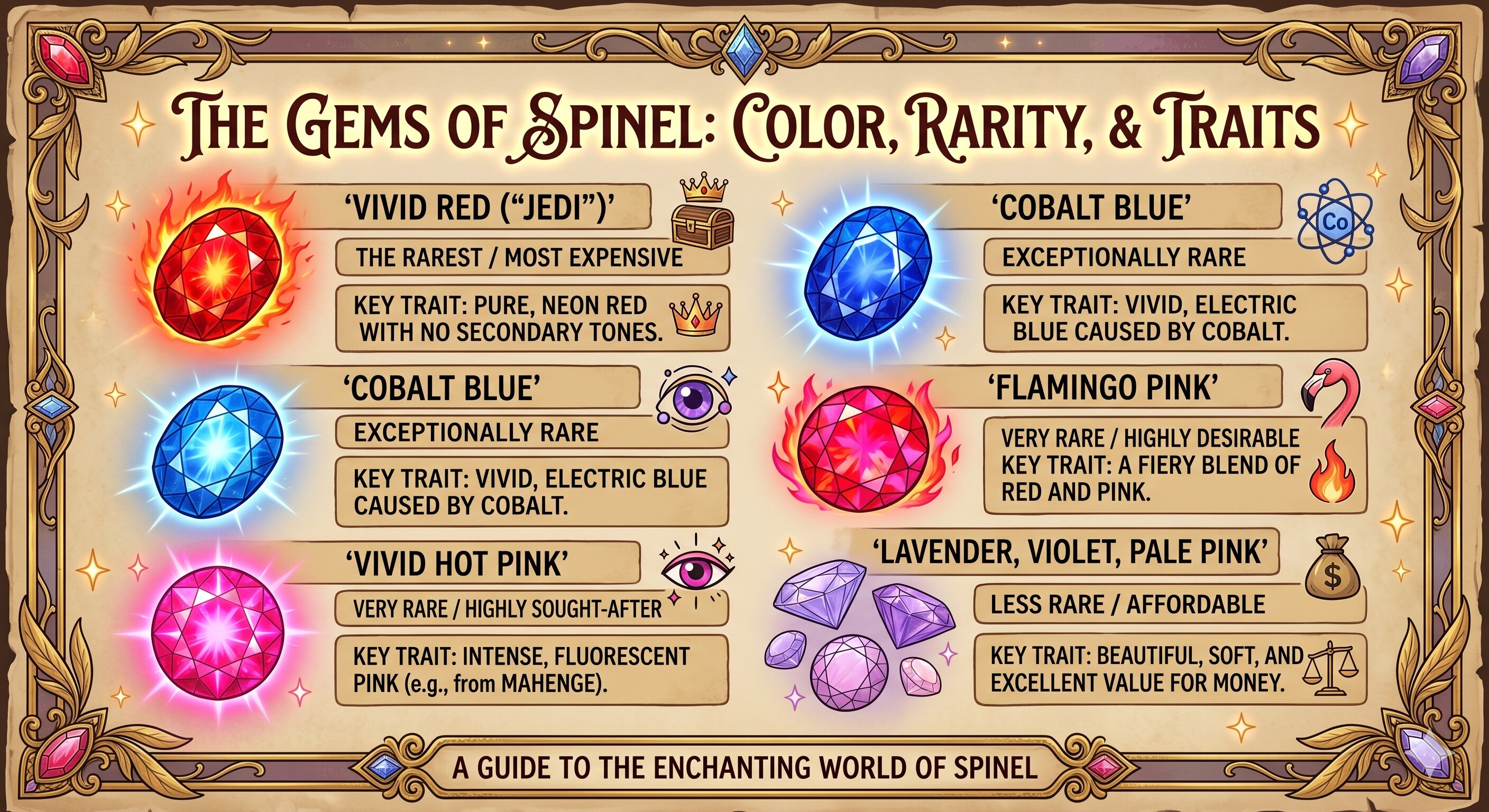
There is no single "best" color, but the uncontested champion for rarity and prestige is the vivid red "Jedi" spinel. However, the "best" spinel for you is the one whose color captivates you the most. The great thing about spinel is that in any of these colors, you are getting a durable, brilliant, and almost always untreated gemstone.
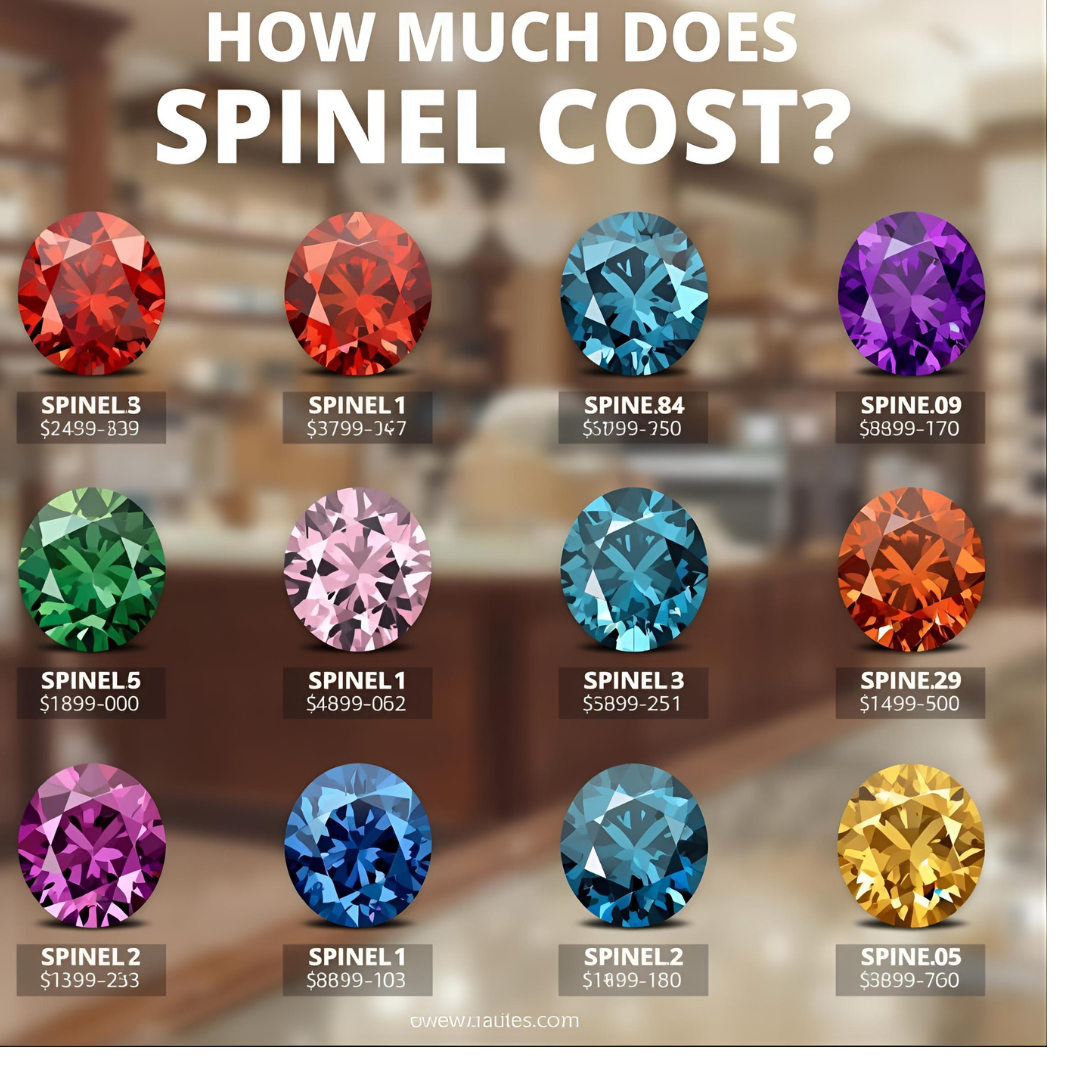
How Much Does Spinel Cost?
The cost of spinel has a wider range than almost any other gemstone, so it's a great question. To give you a practical answer, let's break it down by quality and color.
The price of spinel is primarily determined by Color, Carat Weight, and Clarity.
Here is a general price guide per carat for faceted, natural spinels (prices are in USD and can fluctuate).
Spinel Price Ranges (Per Carat)
1. Commercial Grade: $50 - $300 per carat
What you get: These are the most common spinels. They are typically pale, muted, or have grayish/brownish undertones. Colors include light lavender, dusty pink, and grayish-blue.
Best for: Affordable, colorful jewelry where top-tier color isn't the priority.
2. Good Quality: $300 - $1,500 per carat
What you get: This is the sweet spot for many jewelry lovers. You'll find nice, noticeable color here—clean stones with pretty pinks, vibrant purples, and decent reds or blues that just aren't the "top" saturation.
Best for: Beautiful, eye-catching jewelry that offers excellent value for a high-quality, natural gem.
3. Fine Quality: $1,500 - $5,000+ per carat
What you get: This tier is for exceptional color. Think vivid hot pinks, strong cobalt blues, and rich reds. The stones will be eye-clean and well-cut to maximize their brilliance.
Best for: The discerning buyer or collector seeking a gem with investment potential and stunning beauty.
4. Exceptional / Collector Quality: $5,000 - $30,000+ per carat
What you get: This is for the absolute rarest of the rare.
Vivid "Jedi" Red (no secondary tones)
Intense Cobalt Blue from Vietnam
Large sizes (over 3-5 carats) with the above colors.
Best for: Serious collectors and investors. These gems are comparable in price to fine sapphires and rubies.
Cost by Color (General Guide)
Red Spinel: The most expensive. Starts around $800-$1,000/ct for decent color and can soar to $30,000/ct for the finest "Jedi" reds over 2 carats.
Cobalt Blue Spinel: Extremely rare and valuable. Expect to pay $2,000 - $10,000/ct for good to fine quality.
Hot Pink Spinel (e.g., from Mahenge): Highly sought-after. Prices range from $1,000 - $7,000/ct for vibrant stones.
Violet/Purple Spinel: More affordable. Can range from $200 - $1,500/ct depending on saturation.
Lavender & Pastel Spinel: The most affordable colors. Typically $50 - $500/ct.
Real-World Examples:
A 1-carat, good-quality pink spinel for a ring: might cost $500 - $900.
A 2-carat, fine-quality violet spinel for a pendant might cost $2,500 - $4,000.
A 3-carat, exceptional cobalt blue spinel for an investment piece: could easily cost $25,000 - $60,000+.
Why Such a Wide Range? The Value Proposition
Remember, spinel is rarely treated. This is a massive advantage. When you buy a spinel in the $300 - $1,500/ct range, you are often getting a gem with a natural color that would cost 3-5 times more if it were a ruby or sapphire.
You can spend a little on a pretty spinel or a fortune on a rare masterpiece. This makes spinel an exciting gemstone, as it offers both incredible beauty for the budget-conscious and supreme rarity for the collector. Always buy from a reputable dealer and ask if the stone has a lab report for important purchases.
For current gemstone market prices, visit the American Gem Society's price guide.
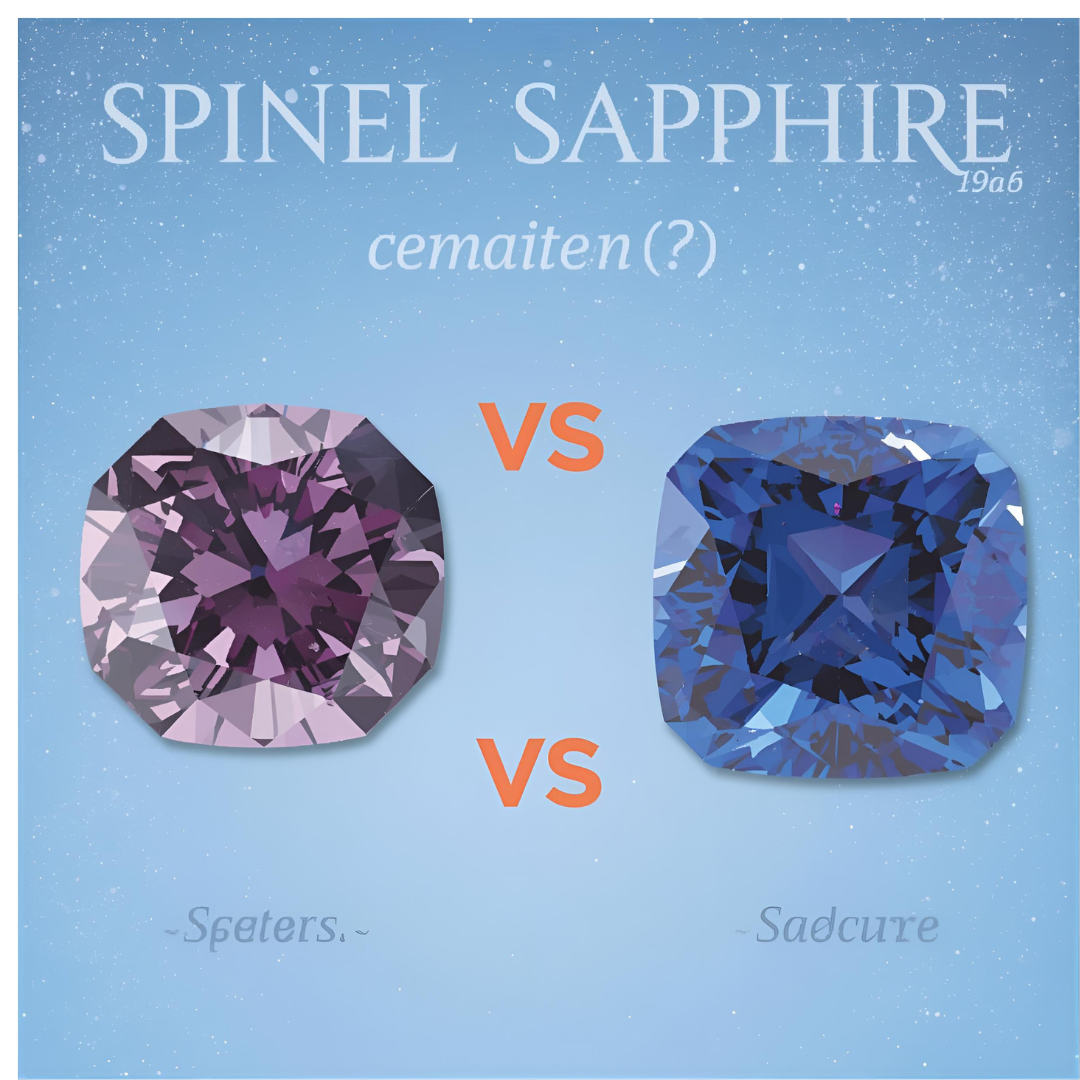
Which Is Better, Spinel Or Sapphire?
This is a classic question in the gem world, and the answer isn't straightforward because "better" depends entirely on what you're looking for. There is no outright winner; each gem has its own crown.
Think of it like comparing a sports car (spinel) to a luxury sedan (sapphire). Both are excellent, but they serve slightly different purposes and appeal to different tastes.
Here’s a detailed comparison to help you decide which is "better" for you.
Head-to-Head Comparison
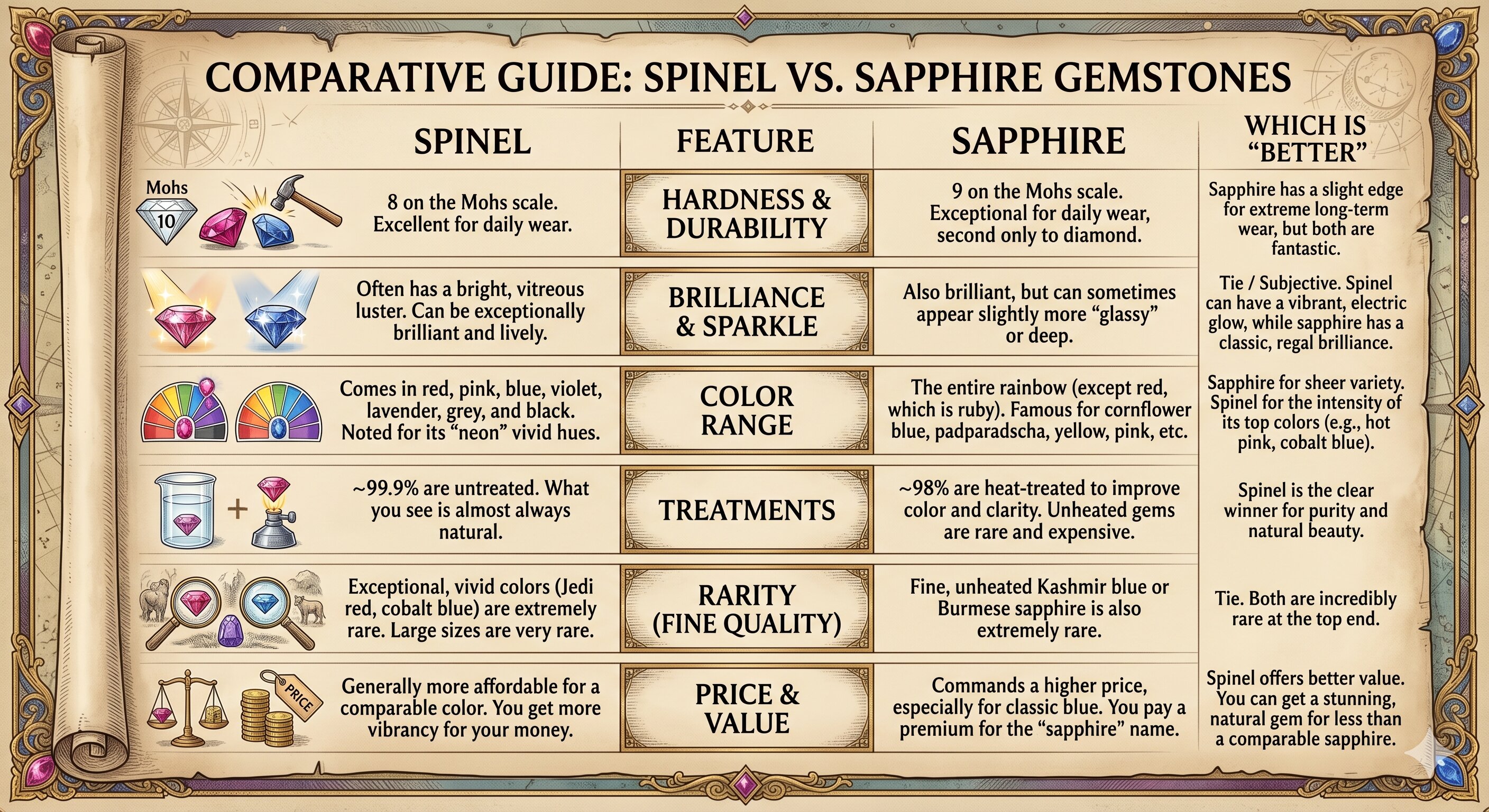
When to Choose Spinel:
You value a natural, untreated gem. This is spinel's biggest advantage.
You love vibrant, electric colors. The best spinels have a neon-like glow that is hard to match.
You want the look of a ruby or sapphire for a better price. A fine red spinel can rival a ruby, and a cobalt blue spinel can mimic a sapphire, often at a fraction of the cost.
You appreciate something unique. Spinel is a gem for those who know and love stones, making it a conversation piece.
When to Choose Sapphire:
You need maximum durability for an heirloom piece. While spinel is very durable, sapphire's hardness of 9 is the practical pinnacle.
You are drawn by tradition and symbolism. Sapphires are associated with royalty, wisdom, and romance (think Princess Diana's ring).
You want a specific, classic color. The iconic cornflower blue sapphire is a timeless choice.
Resale value and brand recognition are important. Sapphire is a universally recognized precious gemstone.
The Bottom Line:
Choose Spinel if... You are a purist who prizes a completely natural gem, you are captivated by intense color, and you are looking for exceptional value and uniqueness.
Choose Sapphire if... You desire the ultimate in durability for daily wear, you are inspired by centuries of tradition and fame, and you are willing to pay a premium for a recognized "precious" gemstone.
In short, for the gem connoisseur and value-seeker, Spinel is often the more exciting choice. For the traditionalist seeking a proven heirloom, Sapphire is the timeless champion.
You truly cannot go wrong with either. The "better" gem is the one that speaks to you personally.
Can Spinel Get Wet?
Yes, spinel can get wet. It is perfectly safe for spinel to come into contact with water.
However, there are a few important nuances to consider, especially regarding the jewelry setting and how it gets wet.
Why Spinel is Safe in Water
Excellent Durability: Spinel is very hard (8 on the Mohs scale), making it resistant to scratches from everyday wear and tear. Water won't damage the gem itself.
Chemical Stability: Spinel is not affected by water, mild soaps, or most common chemicals. It won't dissolve, etch, or become cloudy from water exposure.
When to Be Cautious (It's About the Setting)
The risk isn't the spinel itself, but the metal of the jewelry setting and how the activity might physically impact the piece.
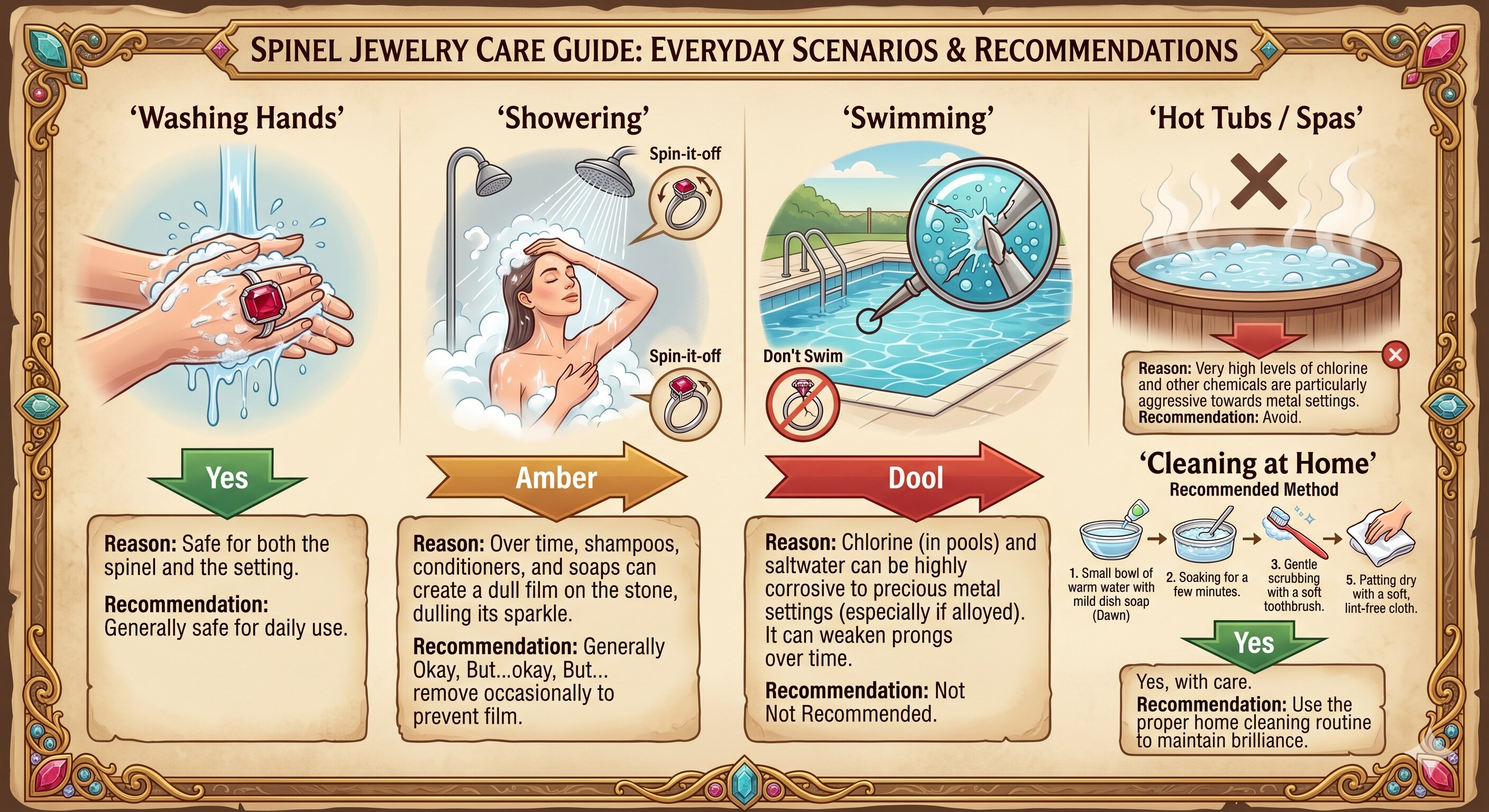
Quick Guide: Can I Get My Spinel Jewelry Wet?
✅ Okay: Handwashing, rain, accidental splashes.
⚠️ Be Cautious: Showering (can cause buildup, dulling sparkle).
Avoid: Swimming pools, hot tubs, ocean swimming, and applying lotions or perfumes while wearing it.
What Zodiac Is Spinel?
Spinel's connection to the zodiac isn't as direct as it is to birthstones, but we can make a clear connection based on its birthstone status.
Spinel is most strongly associated with the zodiac signs of Leo and Virgo.
Here's why:
As the modern August birthstone, spinel's primary astrological connection is with the two zodiac signs that rule most of August:
Leo (July 23 - August 22): Leos are known for their fiery, passionate, and regal nature. The vibrant red and hot pink spinels perfectly match Leo's dramatic and powerful energy.
Virgo (August 23 - September 22): Virgos are associated with purity, practicality, and wisdom. The cleaner, more subdued shades of spinel, like soft lavender or blue, can resonate with Virgo's analytical and calm demeanor.
Spinel's Energetic Properties and the Zodiac
Beyond the birth month link, spinel is known in metaphysical circles for certain properties that can benefit various signs:
Revitalization and Energy: Spinel is often called the "stone of immortality" for its ability to revitalize and renew energy. This can be beneficial for signs that experience burnout or need a boost of motivation.
Passion and Joy: The red varieties are linked to passion, vitality, and joy, which can complement fire signs like Leo, Aries, and Sagittarius.
Calm and Clarity: The blue and lavender varieties are associated with peace, clarity, and emotional balance, which can be supportive for water signs like Pisces, Cancer, and Scorpio, or to help ground air signs like Gemini and Libra.
While any zodiac sign can wear and appreciate spinel, it has a direct astrological link to Leos and Virgos due to its status as the primary modern birthstone for August.
If you're choosing a spinel based on your zodiac sign, you might also select a color that aligns with your sign's element (e.g., a fiery red for a Leo or a calming blue for a Pisces). Ultimately, the "best" spinel is the one you're most drawn to.
Why Is Spinel So Popular?
Spinel's rise in popularity is a fascinating story in the gem world, and it's not due to a single factor, but a perfect storm of several key reasons.
Once a gem known mainly to collectors and connoisseurs, spinel is now a sought-after star. Here’s why:
1. The "Purity" and "No Treatment" Appeal
This is arguably the biggest factor for modern buyers. In an era where consumers are more knowledgeable, spinel’s greatest selling point is that it is rarely treated or enhanced.
Comparison: ~98% of sapphires and a vast majority of rubies are heat-treated to improve their color and clarity. With spinel, what you see is its natural, authentic beauty. This authenticity is incredibly appealing.
2. Exceptional Color Range and Vibrancy
Spinel comes in a stunning array of colors, but it's not just the variety—it's the quality of the color.
"Neon" Hues: Spinel is famous for its intensely saturated, almost electric colors. The "Jedi" reds from Myanmar and the vivid hot pinks from Tanzania (Mahenge) have a glow that is very rare in other gemstones.
Cobalt Blue: The vibrant blue spinels from Vietnam and Tanzania rival the finest sapphires in color, without the need for heat treatment.
3. Brilliance and Durability
Hardness: With a hardness of 8 on the Mohs scale, it is extremely durable for everyday wear in rings, earrings, and pendants.
Sparkle: It has a high refractive index, giving it excellent brilliance and fire. A well-cut spinel is exceptionally lively and bright.
4. Rarity and Exclusivity
While common in lower grades, fine-quality spinel in large sizes is genuinely rare. As consumers look for unique alternatives to the "big three" (diamond, ruby, sapphire), spinel offers a sense of individuality and exclusivity. Owning a beautiful spinel feels like being "in the know."
5. The "Great Imposter" History Adds Romance
The fact that some of the world's most famous "rubies" in crown jewels (like the Black Prince's Ruby) are actually spinels adds a layer of royal intrigue and romance to the gem. This fascinating history makes it a great conversation piece and connects it to a rich, if misunderstood, past.
6. Official Recognition as a Birthstone
In 2016, the Jewelers of America officially added spinel as a modern birthstone for August, alongside peridot and sardonyx. This was a massive boost to its public profile and commercial availability, introducing it to millions of new customers.
7. A Shift in Consumer Mindset
Modern gem buyers are often:
More educated and seek out unique stones.
Value-conscious, and spinel offers the look of a ruby or sapphire for a more accessible price point (at the non-top-tier level).
Drawn to a story, and Spinel has a compelling one.
Spinel's popularity is a classic case of a "hidden gem" being discovered. It combines the modern desire for authenticity and unique beauty with the timeless qualities of durability, brilliance, and a royal pedigree. It’s no longer just an alternative; it’s a first-choice gem in its own right.
Is Spinel Good For Everyday Wear?
Yes, spinel is an excellent choice for everyday wear.
It's one of the most durable and practical colored gemstones you can choose for a piece of jewelry, like an engagement ring or a daily-worn pendant. Here’s a breakdown of why it's so well-suited for this purpose.
The Case FOR Everyday Wear
Exceptional Hardness: Spinel scores 8 on the Mohs scale of mineral hardness. This makes it very resistant to scratching from everyday hazards like dust (which is around 7-7.5 on the scale). For context:
Diamond: 10
Sapphire/Ruby: 9
Spinel: 8
Emerald: 7.5-8
Quartz (Dust): 7
High Toughness: Unlike gems like emerald that are inherently brittle and can chip easily, spinel has good toughness. This means it can better withstand accidental bumps and knocks without cracking or chipping.
Excellent Stability: Spinel is not affected by light, heat, or common chemicals. It won't fade over time, and it's safe to clean with standard jewelry cleaning methods (warm water, mild soap, ultrasonic cleaners).
Important Considerations for Daily Wear
While the gem itself is perfectly suited, the longevity of any everyday jewelry also depends on the setting and your lifestyle.
The Setting is Key: For a ring worn every day, a protective setting is highly recommended. A bezel setting or a setting with strong, sturdy prongs (like six-prong for a round stone) will protect the spinel from hard impacts from the side.
Your Activities: If you have a very active lifestyle (e.g., working with your hands, heavy manual labor), it's always wise to remove any fine jewelry, including spinel, to avoid sharp, direct blows.
Maintenance: Like all jewelry, spinel will accumulate dirt, oils, and lotions over time, dulling its sparkle. Regular gentle cleaning will keep it looking its best.
Comparison to Other Popular Gemstones
vs. Sapphire (9): Sapphire is slightly harder and marginally more scratch-resistant, but for all practical purposes, spinel's hardness of 8 is more than sufficient for a lifetime of wear.
vs. Emerald (7.5-8): Spinel is generally a much better choice for everyday wear. Emerald is more brittle and often has inclusions that make it prone to chipping.
vs. Tanzanite (6.5-7): Spinel is a far superior choice for daily wear. Tanzanite is much softer and can be easily scratched.
Spinel is a fantastic, durable, and worry-free gem for everyday wear. Its combination of hardness, toughness, and stability makes it a top-tier choice for engagement rings and other frequently worn jewelry.
Just remember: No matter how hard the gemstone, the single most important factor for longevity is the security of the setting. Have a jeweler check the prongs and setting every year or so to ensure everything is secure.
So, if you love the vibrant colors of spinel, you can confidently choose it for a piece you plan to wear every day.
News for Monday 01 June, 2026
View all news for Monday 01 June, 2026 on one page
Recent News
- Sunday 31 May, 2026
- Saturday 30 May, 2026
- Tuesday 12 May, 2026
- Tuesday 02 December, 2025
- Tuesday 18 November, 2025