

Citrine Stone Ultimate Guide: Benefits, How to Spot Fakes, Wear and Care Tips
Citrine Stone Ultimate Guide: Benefits, How to Spot Fakes & Complete Wearing Tips
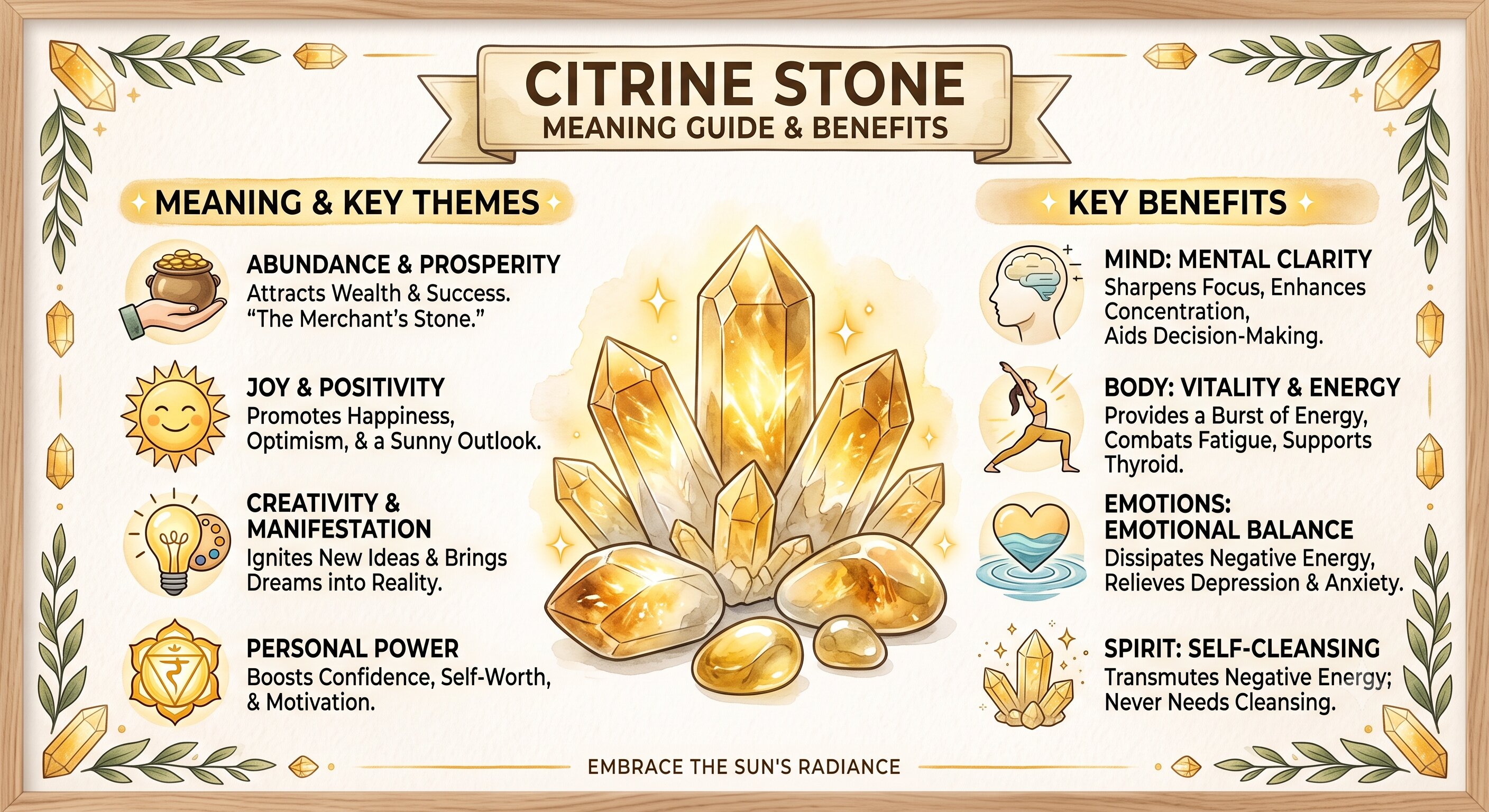
Citrine is the sunny November birthstone, known as the "Merchant's Stone" for attracting wealth, boosting confidence, and lifting your mood. This complete guide covers citrine's benefits, how to identify real vs. heat-treated stones, wearing tips, zodiac associations, and care instructions—everything you need to choose and use this lucky crystal.
Table of Contents
What Birth Month Is Citrine Stone?
To be perfectly clear: November is the birth month for the citrine stone.
Just to clarify my previous answer—citrine and topaz share the month of November as birthstones, but citrine is the primary or modern birthstone for November, while topaz is the traditional one. So if you're looking for the month specifically tied to citrine, it's November!
Citrine and the Zodiac Signs
November is the birth month for the citrine stone.
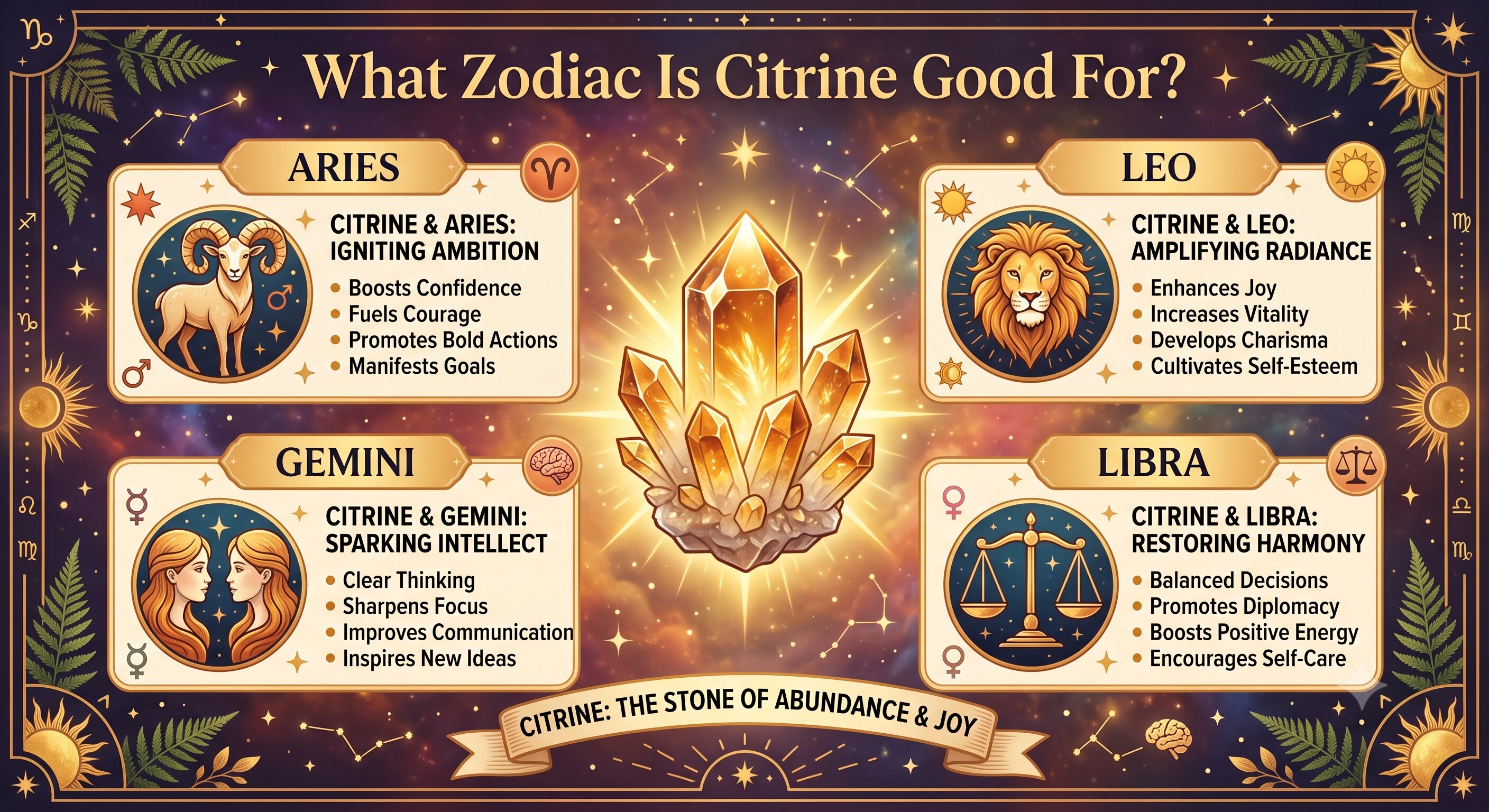
Based on crystal lore, citrine is most frequently associated with the fire signs Leo, Aries, and Gemini. Different sources also link it to Libra, Scorpio, and Sagittarius.
Here is a breakdown of the zodiac signs that citrine is commonly associated with and why its properties are thought to benefit them.
Citrine and the Zodiac Signs
Leo (July 23 – August 22): This is a very strong match. Citrine's sunny, confident energy is believed to amplify a Leo's natural leadership, creativity, and charisma. It's thought to enhance their personal power and drive.
Aries (March 21 – April 19): For the passionate and sometimes impulsive Aries, citrine is said to promote patience, focus, and constructive use of their abundant energy, helping them channel their drive to achieve goals effectively.
Gemini (May 21 – June 20): Geminis are quick-witted but can be prone to indecisiveness and overthinking. Citrine is believed to provide mental clarity, boost self-esteem, and aid in confident decision-making.
Other Associated Signs: Some sources also connect citrine to Libra, Scorpio, and Sagittarius. Interestingly, one source even mentions it as a planetary gem for Virgo, showing that associations can vary.
Feeling inspired to bring citrine's sunny energy into your life? [Browse our citrine jewelry collection ] and find the perfect piece for yourself or a loved one.
Is Citrine A Powerful Crystal?
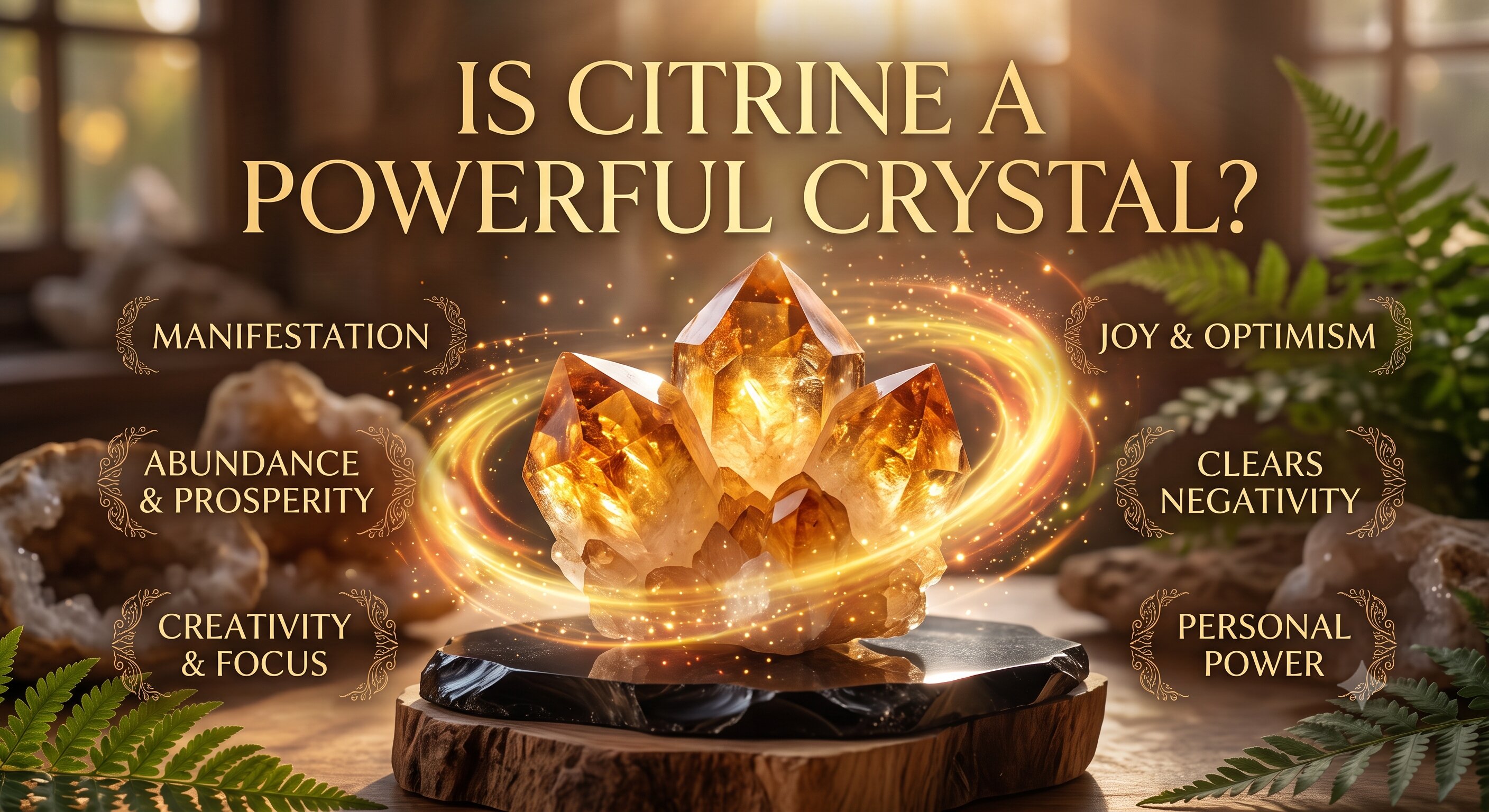
Yes, citrine is widely considered one of the most powerful crystals in the metaphysical world—but its power is very specific. Unlike some crystals that are used for protection or grounding, citrine's strength lies in its high energy, manifestation abilities, and permanent positivity.
Here is a breakdown of why it’s considered so powerful and what kind of "power" it actually holds:
1. The "Merchant's Stone" (Manifestation & Abundance)
Citrine is famously known as the "Merchant's Stone" because it is believed to be one of the best crystals for attracting wealth, prosperity, and success. Its power is said to not only help you earn money but also to retain it, encouraging financial discipline. Many people place a citrine cluster in the wealth corner of their home or business (the far-left corner from the entrance in Feng Shui).
2. A "Non-Absorbing" Crystal (Never Needs Cleansing)
This is one of its most unique and powerful traits. Most crystals absorb negative energy and need to be regularly cleansed (with moonlight, sage, etc.). Citrine is one of the few crystals that never absorbs or holds onto negativity. Instead, it transmutes and dissipates it on the spot. This means its power is always "clean" and working at full capacity without you having to maintain it.
3. Solar Plexus Power (Personal Will & Confidence)
Metaphysically, citrine is directly tied to the Solar Plexus Chakra (your energetic core of personal power, willpower, and self-esteem). Its power is incredibly effective at:
Boosting self-confidence and courage.
Clearing brain fog and sharpening focus (great for decision-makers).
Overcoming fears, phobias, and feelings of unworthiness.
4. A Natural Energizer (Vibrational Frequency)
Crystal healers describe citrine as having a "high vibrational frequency." It carries the warm, life-giving energy of the sun, making it a powerful mood-lifter. It is often used to combat depression, lethargy, and apathy by literally "lighting up" your emotional and energetic body.
The Big Catch: Natural vs. Heat-Treated
Because we're talking about "power," it's important to know that most deep orange/amber citrine on the market is actually heat-treated Amethyst, which is then sold as "Citrine."
Natural Citrine (pale yellow to golden) is rarer and carries a gentler, more stable vibration.
Heat-Treated Citrine (deep orange, often opaque) is still considered powerful, but many purists say its energy is more aggressive and sharp, whereas natural citrine has a more nurturing and sustainable power.
In short: Yes, it's very powerful—but its power isn't about shielding you from harm. Its power is about attracting good things (wealth, joy, confidence) and igniting your inner fire to go after what you want.
What Is The Spiritual Meaning of Citrine Stone?
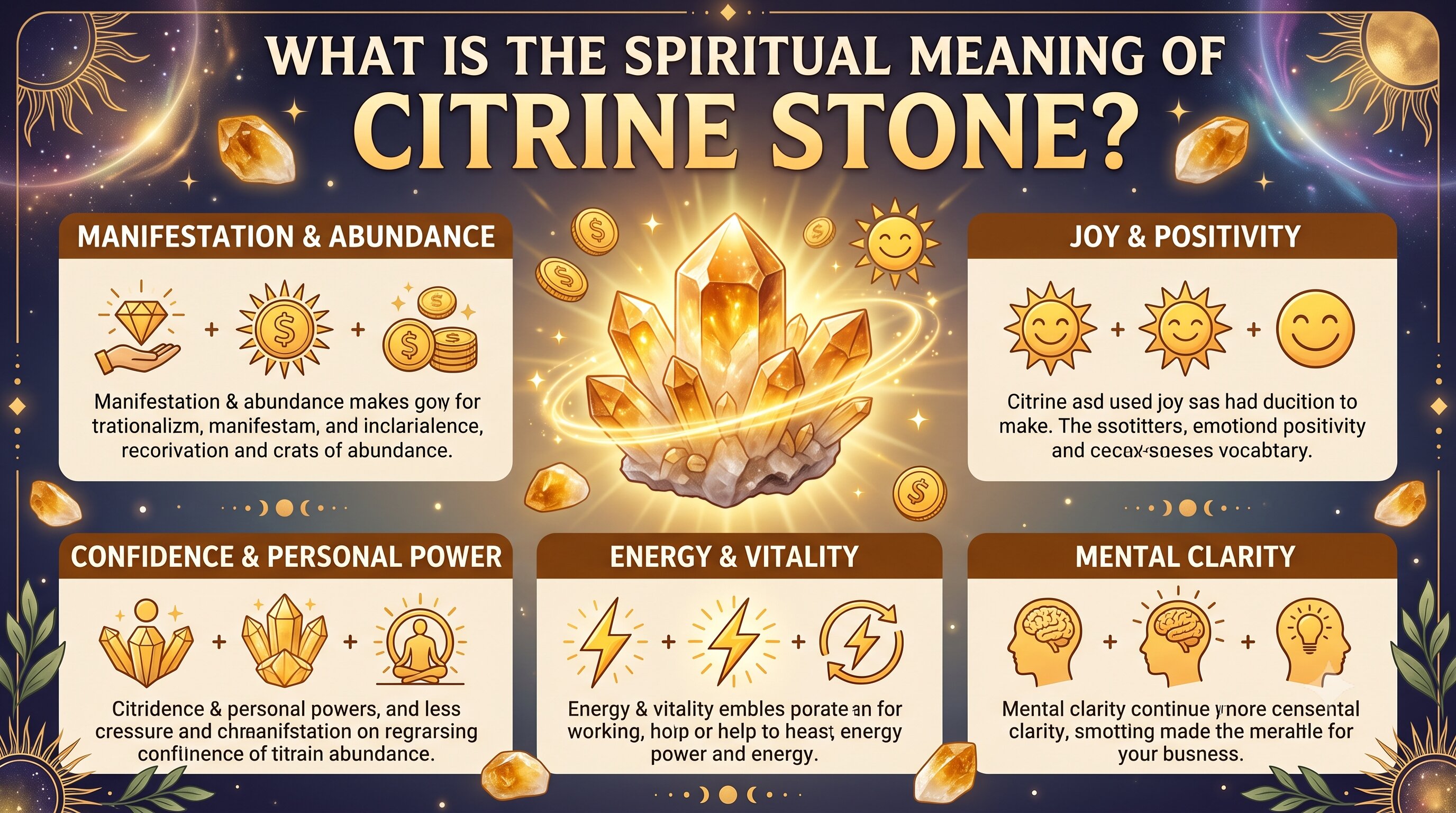
Building on everything we've talked about—its power, its sunny energy, and its ties to November—the spiritual meaning of citrine boils down to one beautiful concept: embodied light.
Spiritually, citrine is seen as the crystal of joy, manifestation, and divine connection. It doesn't just make you feel happy; it spiritually aligns you with the frequency of abundance so that happiness and prosperity become your natural state.
Here is a deeper dive into its core spiritual meanings:
1. The Light-Bearer (Spiritual Radiance)
In many spiritual circles, citrine is called the "Light Maker" or "Stone of the Sun." Its spiritual purpose is to clear away energetic cobwebs—like old trauma, self-doubt, and stagnant grief—and fill that void with pure, golden light. Spiritually, it acts like a personal sun, helping your soul shine authentically without fear of being judged.
2. Manifestation and "Sacred Will"
While other crystals connect you to higher spiritual realms (like the crown chakra), citrine roots spiritual energy into the physical world. It holds the spiritual meaning that divine guidance is meant to be acted upon. It encourages you to take the inspired ideas from your soul and turn them into tangible reality—whether that's a new career, a healthier body, or a loving relationship. It spiritually validates that wanting abundance is not "greedy"; it is your birthright.
3. The "Giver" (Not the "Taker") of Energy
Spiritually, crystals fall into two camps: yin (receptive, calming, absorbing) and yang (active, projective, giving). Citrine is strongly yang. It does not absorb, hold, or transmute your negative energy away from you; instead, it overpowers it with its own radiant frequency. Spiritually, this means you don't have to "fight" your darkness—you just have to let citrine's light shine so brightly that the darkness naturally recedes.
4. Emotional Sobriety and Inner Peace
One of its deeper, lesser-known spiritual meanings is emotional sobriety. Citrine is used in spiritual practices to calm the inner critic and stop the cycle of self-sabotage. It brings clarity to the mind, allowing you to observe your emotions without being consumed by them. This creates a state of spiritual peace where you trust the flow of life, rather than fighting against it.
5. Connection to the Solar Plexus Chakra
Spiritually, the Solar Plexus Chakra (Manipura) is where your personal power resides. When you activate it with citrine, you aren't just feeling confident—you are spiritually affirming that you are a co-creator with the universe. It shifts your spiritual identity from victim (things happening to you) to victor (things happening through you).
A beautiful spiritual practice:
Many people hold a piece of natural citrine to their solar plexus (just above the belly button) during meditation and silently repeat: "I am a vessel of light. I receive all good things with grace." They visualize a golden sun expanding in their core, dissolving all fear.
Since citrine never needs cleansing (as we talked about), it is considered a perpetual spiritual battery—it's always working, always shining, always supporting your soul's growth.
Does that resonate with what you were looking for, or were you curious about its spiritual meaning in a specific tradition, like Feng Shui or Reiki? I can go deeper into either!

Can Citrine Stone be Worn By Anyone?
The short answer is yes—absolutely anyone can wear citrine! It is one of the most universally friendly and safe crystals out there.
Unlike some stones that are heavily tied to a specific zodiac sign or gender (like a "male" or "female" stone), citrine is completely neutral and welcoming. It doesn't have any "rules" about who can or cannot wear it.
However, there are a few important things to consider before you put one on. Here is the real lowdown on who should wear it, and who might want to pause before wearing it every single day:
Who Should Wear Citrine?
Everyone looking for a mood boost: If you want more joy, optimism, and energy in your daily life, citrine is a perfect daily companion.
Career-driven people: Entrepreneurs, managers, salespeople, and freelancers benefit from its focus and abundance-attracting properties.
Students and creatives: It cuts through brain fog and sparks innovative thinking.
Anyone healing from low self-esteem: Its solar energy is incredibly nurturing for people rebuilding their confidence after a tough period.
Who Should Be Cautious with Citrine?
Because citrine's energy is very "yang" (active, projective, and fast-moving), there are two groups of people who might find it too stimulating if worn daily:
People prone to anxiety or insomnia: If you are already an overthinker, have a racing mind, or struggle to fall asleep, wearing citrine (especially on your skin) late in the day can over-activate your solar plexus chakra and make you feel "wired."
Solution: Wear it only during work or daytime hours, and take it off at least 2 hours before bed.
Very sensitive empaths: If you absorb other people's emotions easily, citrine's bright energy can feel a bit "loud" at first.
Solution: Start by wearing it for just a few hours a day, or pair it with a grounding stone like Smoky Quartz or Hematite to balance out the intensity.
Important Practical Considerations Before Wearing It:
Which hand to wear it on?
Wear it on your left hand (the "receiving" side of your body) if you want to attract new opportunities, wealth, and love into your life.
Wear it on your right hand (the "projecting" side) if you want to push your confidence outward—like for public speaking, interviews, or negotiations.
Is it durable? Yes! With a hardness of 7, it is tough enough for rings, bracelets, and necklaces. Just avoid wearing it while doing heavy lifting or gardening to prevent scratches.
Beware of "Fake" Citrine: As I mentioned earlier, a lot of deep orange citrine jewelry is actually heat-treated amethyst. It still works energetically, but if you specifically want natural citrine's gentler vibration, look for pale yellow or champagne-colored stones instead.
Citrine doesn't judge, discriminate, or exclude. It simply amplifies your own energy. If you feel drawn to its sunny glow, that's your intuition telling you it's the right stone for you—regardless of your age, gender, zodiac sign, or spiritual background!
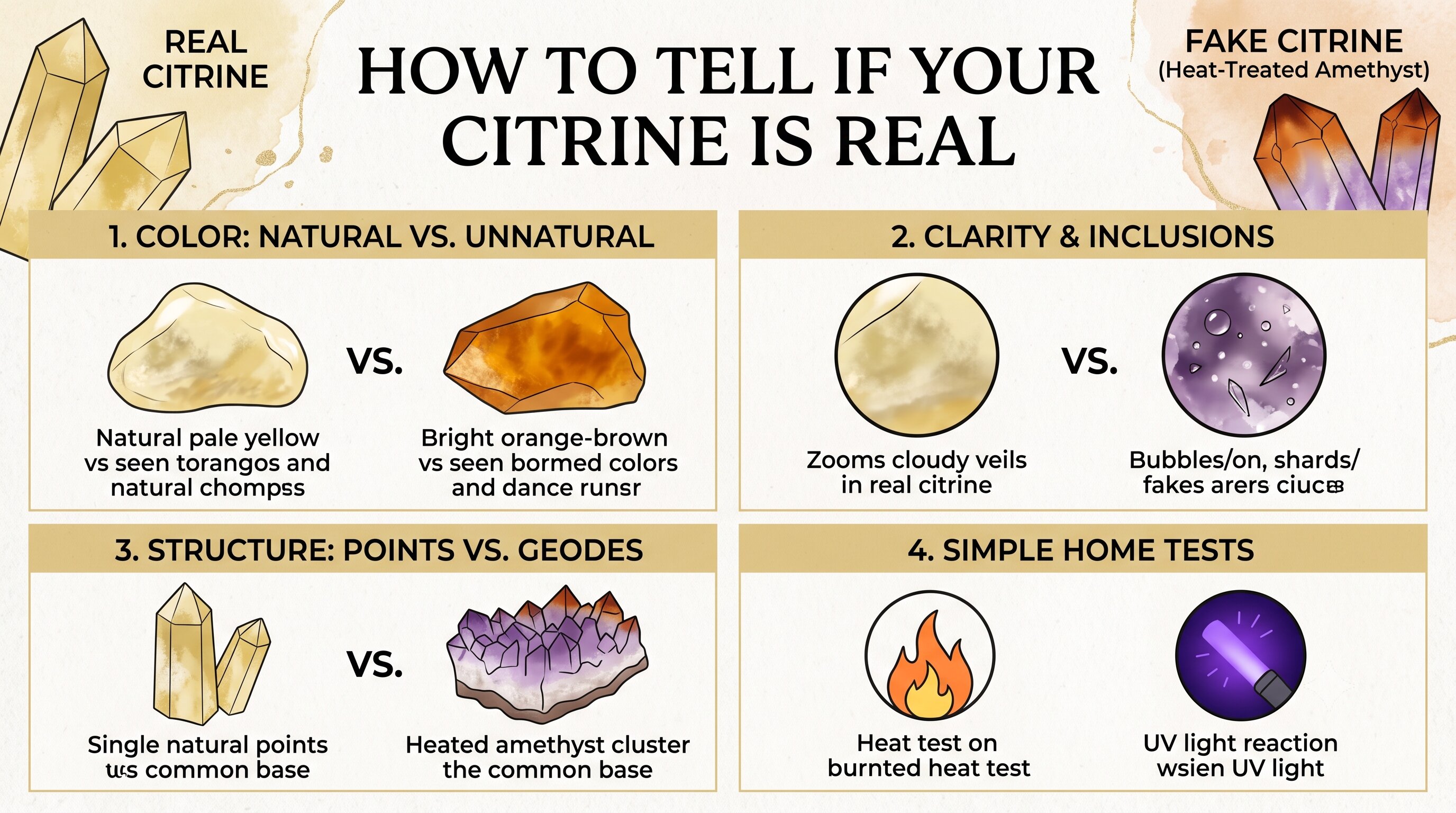
How To Tell If Your Citrine Is Real?
This is the most important question you can ask, because I mentioned earlier that most of the deep orange "citrine" sold in stores is actually heat-treated amethyst (or even glass!).
The good news is that you can spot the difference with just your eyes and a few simple tests. Here is your ultimate guide to telling if your citrine is real (natural), heat-treated, or completely fake.
1. The Color Test (Your #1 Clue)
Real Natural Citrine: Ranges from pale champagne/yellow to a smoky golden-amber. It rarely gets very dark. The color is evenly distributed and looks soft, like diluted honey or white wine.
Heat-Treated Amethyst (Fake Citrine): Has a deep, fiery orange, rust, or reddish-brown color. You can often see white or cloudy bands at the base of the crystal—this is the ghost of the original amethyst that didn't turn orange.
Glass/Plastic Fake: Often has an unnaturally bright, neon-yellow or greenish-yellow color that you would never see in nature.
2. The "Zebra Stripe" or "Smoky Base" Test
Look at the bottom of the crystal or the tip.
Real Citrine: The color is consistent throughout the entire stone, from tip to base.
Heat-Treated Amethyst: Because the heat only affects the top part of the crystal, you will often see a cloudy, milky-white, or smoky-gray root at the bottom. Some people call this the "zebra stripe" effect—dark orange on top, white on the bottom.
3. The Pleochroism Test (Turning the Stone)
This is a fancy word for "does it change color when you tilt it?"
Real Citrine: When you tilt it back and forth under a bright lamp, it will show two different shades of yellow (e.g., pale yellow and slightly darker golden). This is a natural optical property.
Heat-Treated Amethyst: It will show hints of purple or bluish-gray in certain lights or angles—the leftover signature of its original amethyst nature.
Glass: Shows no color change at all when tilted.
4. The Clarity and Inclusion Test (Imperfections = Good!)
Grab a magnifying glass or your phone's zoom camera.
Real Citrine: Almost always has tiny natural flaws—small fractures, "rainbow" inclusions, wisps, or tiny mineral specks inside. These are birthmarks of a natural stone.
Heat-Treated Amethyst: Often very clear and glass-like, but you might see small "crackle" marks inside, which are actually thermal fractures caused by the sudden intense heating.
Glass/Plastic: Completely flawlessly clear, with round bubbles inside. (Natural stones never have perfectly round bubbles).
5. The Hardness Scratch Test (At Your Own Risk!)
Citrine is a 7 on the Mohs hardness scale (it can scratch glass and steel).
The safe way: Try gently scratching a piece of unglazed ceramic (like the bottom of a coffee mug). Real citrine will leave a white or colorless streak.
The risky way: Try to scratch the citrine with a steel knife. A real citrine will NOT get scratched. A fake piece of glass or resin will scratch easily. Only do this on an ugly, tumbled piece you don't mind potentially damaging!
6. The Temperature Test (Quick and Easy)
Real Citrine / Heat-Treated Amethyst: Both are natural quartz, so they will feel cool to the touch at first and take a while to warm up in your hand.
Glass or Resin: Will feel room-temperature or slightly warm immediately when you pick it up, and will heat up very quickly in your palm.
The Golden Rule of Buying Citrine:
If it is deep, dark, burnt orange and sold at a cheap price—it is 100% heat-treated amethyst. Natural citrine is actually quite rare and more expensive.
How to check right now: Go to a window with your stone. If you see any white, milky patches at the bottom, or if you tilt it and catch a hint of purple, you are holding heat-treated amethyst.
Does it matter? Energetically, many people still love heat-treated amethyst for its vibrant, aggressive energy. But if you specifically wanted the gentle, nurturing natural citrine we talked about spiritually, then you'll want to hunt for that pale, honey-colored stone instead.
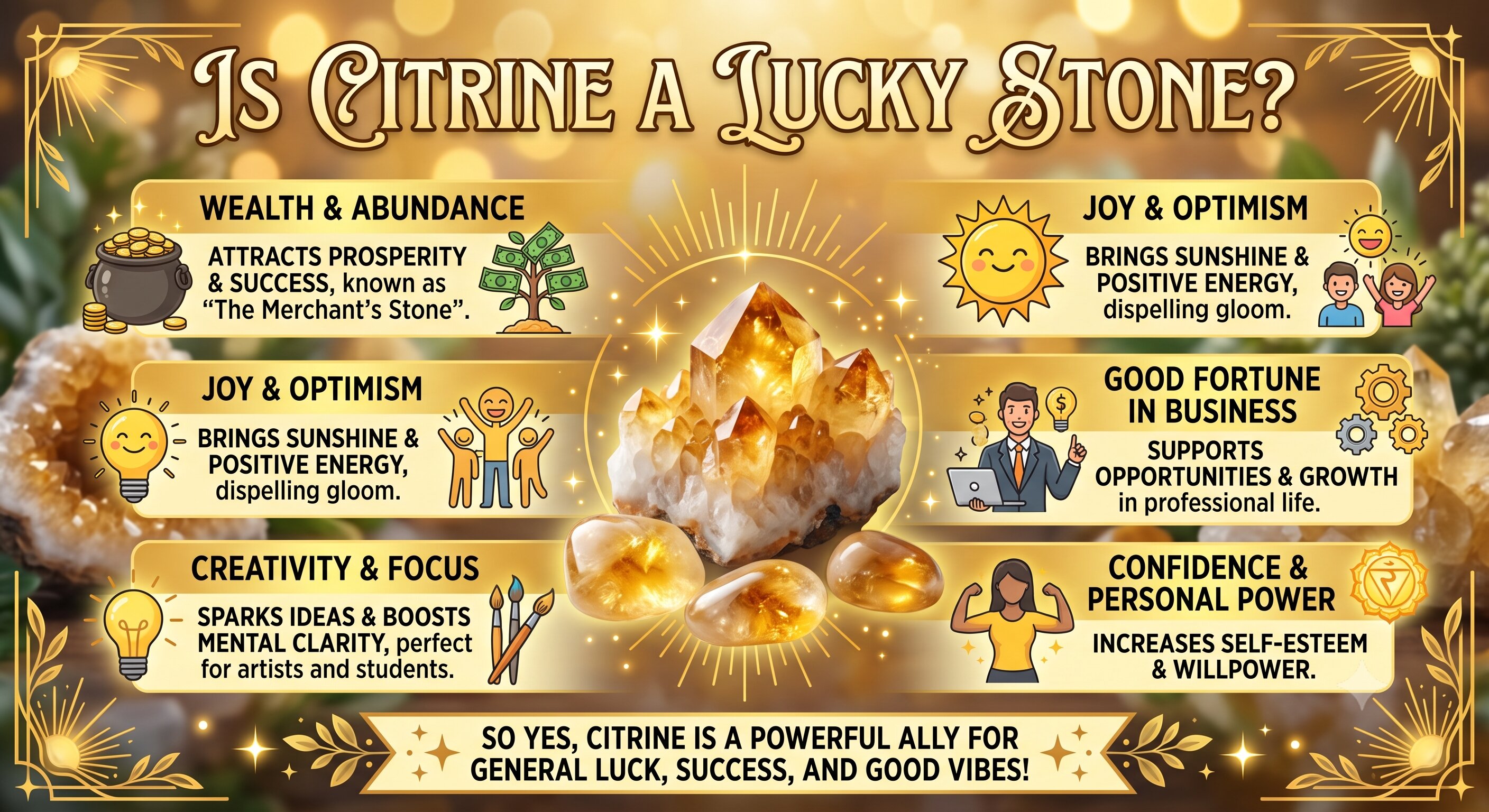
Is Citrine A Lucky Stone?
Yes, absolutely—citrine is considered one of the luckiest stones in the metaphysical world! In fact, if you were to ask crystal collectors which stone they'd grab for a stroke of good fortune, citrine would be at the top of the list, right up there with jade and pyrite.
But here is the key distinction when it comes to citrine: its "luck" isn't random. It doesn't work like a lottery ticket where you just sit back and hope for the best. Instead, citrine's luck is active, magnetic, and self-made.
Here is exactly why it's considered so lucky and how that "luck" actually works:
1. The "Magnet" for Money and Opportunity
Citrine's nickname is the "Merchant's Stone" because historically, shopkeepers would place it in their cash registers to attract customers and boost sales. Its luck comes from its ability to pull prosperity toward you—whether that’s a surprise bonus, a new client, a promotion, or even just finding a $20 bill on the street. People carry it in their wallets or purses to ensure they never run out of money.
2. The "Law of Attraction" Stone
In spiritual circles, citrine is considered a master manifestor. It works on the principle that like attracts like. Because citrine radiates warm, joyful, and optimistic energy, it vibrates at the same frequency as "good fortune." By wearing or holding it, you are energetically broadcasting to the universe: "I am open to receiving good things." And the universe, in turn, mirrors that energy back to you.
3. The "No Bad Luck" Guarantee
Most "lucky" crystals need to be cleansed regularly to wash away bad luck or negative energy that clings to them. Citrine is uniquely lucky because it never holds onto negativity. It instantly transmutes and dissipates bad vibes on the spot. This means your luck is never blocked, delayed, or diluted by old, stagnant energy. It's perpetually "primed" for good fortune.
4. Emotional Luck (The Lucky Mindset)
Often, we think of luck as external events. But citrine creates internal luck—meaning it shifts your mindset. It banishes fear, anxiety, and self-doubt, replacing them with boldness and optimism. When you feel lucky and confident, you naturally notice opportunities, take risks, and speak up at the right moments. In this way, citrine makes you "lucky" by making you brave enough to seize your chances.
5. Feng Shui "Wealth Corner"
In Feng Shui, citrine is considered a powerhouse for financial luck. Placing a raw cluster or a citrine globe in the "wealth corner" of your home or office (the far-left corner from the entrance) is said to activate the flow of money and career luck into your life.
A fun piece of folklore:
There is an old crystal superstition that if you give a citrine as a gift, its "lucky" properties double for the receiver. It is seen as a gesture of wishing someone great success and happiness—making it an incredibly thoughtful, luck-filled present!
The one thing to remember:
Citrine's luck works best when paired with action. You can't just put it on your desk and wait for money to rain from the sky. Its job is to amplify your efforts, sharpen your intuition to spot opportunities, and keep your energy high so you can follow through. Think of it as your energetic co-pilot—it opens the doors, but you have to walk through them.
So, yes—citrine is incredibly lucky! But its real magic is teaching you that you are the source of your own good fortune, and it's just there to give you a brilliant, sunny boost along the way.
Frequently Asked Questions (FAQ)
1. Can I wear citrine to bed?
It’s not recommended. Citrine has an active, uplifting energy that stimulates the solar plexus chakra. Wearing it to sleep may keep your mind buzzing and interfere with restful sleep, especially if you're prone to anxiety or overthinking. For best results, wear citrine during the day and remove it at least 2 hours before bedtime.
2. Can I wear citrine and amethyst together?
Absolutely! In fact, they make a wonderful pair. Citrine works on the physical world (action, confidence, wealth), while amethyst works on the spiritual realm (calm, intuition, protection). Together, they balance your mind, body, and spirit. A popular practice is to wear citrine during the day and keep amethyst on your nightstand at night.
3. How can I tell if my citrine is real or heat-treated?
Check the color and base. Natural citrine ranges from pale champagne to honey-gold, with even color throughout. Heat-treated amethyst (often sold as citrine) is deep orange or reddish-brown and usually has a cloudy white or smoky "root" at the bottom. Tilt the stone—if you see a hint of purple, it's likely heat-treated amethyst.
4. Does citrine need to be cleansed?
No—that's one of its superpowers! Unlike most crystals, citrine never absorbs or holds negative energy. It instantly transmutes and dissipates it. This means your citrine is always energetically "clean" and working at full power without any cleansing required. If you feel it needs a refresh, a night under moonlight works beautifully.
5. Which hand should I wear citrine on?
It depends on your intention:
Left hand (receiving side): Wear it here to attract new opportunities, wealth, and love into your life.
Right hand (projecting side): Wear it here to push confidence outward—great for public speaking, interviews, or negotiations.
6. Is citrine safe for everyday jewelry?
Yes, with care. Citrine scores a 7 on the Mohs hardness scale, making it durable enough for rings, bracelets, and necklaces. However, avoid wearing it during heavy lifting, gardening, or dishwashing, as a hard knock can chip or scratch it. Also, keep it out of prolonged direct sunlight—its vibrant color can fade over time.
7. What is citrine best used for?
Attracting abundance and boosting confidence. Citrine is famously known as the "Merchant's Stone" for drawing money, career opportunities, and business success. It's also excellent for lifting your mood, clearing brain fog, and overcoming self-doubt. Many people place it in their wallet, desk, or the wealth corner of their home.
Looking for a meaningful gift for a November birthday or someone who could use a boost of confidence? [Explore our handpicked citrine jewelry collection ] — each piece is crafted to shine as brightly as the stone itself.
Conclusion; Citrine is the sunny, lucky stone of November—great for attracting wealth, boosting confidence, and lifting your mood. Anyone can wear it, just remember: most orange citrine is heat-treated amethyst, so if you want the real deal, look for pale honey colors, and always keep it out of direct sunlight!


News for Thursday 16 July, 2026
View all news for Thursday 16 July, 2026 on one page
Recent News
- Wednesday 15 July, 2026
- Monday 13 July, 2026
- Sunday 12 July, 2026
- Wednesday 08 July, 2026
- Wednesday 01 July, 2026