Monday 27 October, 2025 | RSS Feed

From Security to Style: Everything You Need to Know About Bezel Settings

Bezel Setting


The Ring That Survived Everest


In 1953, Sir Edmund Hillary and Tenzing Norgay became the first men to reach the summit of Mount Everest. Few people know that Hillary carried something precious with him—not on his finger, but tucked safely inside his jacket.

It was a ring for his wife, set not with prongs, but with a full metal rim. A bezel setting.

"Prongs would have caught on ropes," he later explained. "The stone might have chipped against the ice and rock. But a bezel? It wraps around the stone like armor. It doesn't snag. It doesn't bend. It simply holds."

That ring traveled to the top of the world and back—enduring sub-zero temperatures, violent winds, and constant impacts. And it arrived home perfect.

This is why adventurers, soldiers, and anyone who lives an active life chooses the bezel setting. It's not the flashiest choice. It's the smartest.


The same setting that protected a ring to the top of Everest now awaits your own active life — whether you‘re a nurse, a gardener, a parent, or simply someone who refuses to take off their jewelry. Every bezel setting in our collection is handcrafted for security, from full bezels to partials.”


[Button: Explore Bezel Setting Rings →]


What Is A Bezel Setting?


Of course! Let's dive deep into the world of the bezel setting.


In simple terms, a bezel setting is a style of mounting a gemstone (like a diamond, sapphire, etc.) in which a thin strip of metal (the "bezel") completely or partially wraps around the stone's girdle (its widest point) to secure it in place. Here is the table of contents;


What Is A Bezel Setting?


Who Is A Bezel Setting For?


What Are The Disadvantages Of Bezel Setting?


Are Bezel Settings Old-fashioned


Is A Bezel Setting Timeless?


Is A Bezel Setting Modern Or Classic?


What Are The Benefits Of The Bezel Setting?


Is Bezel Setting Good for Everyday Wear?


It's one of the oldest, most secure, and most modern-looking settings available.


Key Characteristics of a Bezel Setting


The Bezel Wall: This is the defining feature. It's a thin, custom-formed rim of metal that is pressed or rubbed over the edge of the gemstone. It can be a full circle or a partial one.


Security: Because the gemstone is surrounded and held by metal, it is extremely secure. The chances of the stone being knocked loose, chipped, or falling out are minimal.


Modern & Sleek Aesthetic: Bezels offer a clean, smooth, and continuous line. They have a minimalist, contemporary look that is very popular in modern jewelry design.


Protection: The metal rim protects the gemstone's edges and girdle from direct impacts, which is ideal for active lifestyles or for softer stones.


Types of Bezel Settings


There are two main types:


Types of Bezel Settings


1. Full Bezel


A complete circle of metal surrounds the entire circumference of the gemstone.


Pros: Maximum security and protection. A very unified and solid look.


Cons: Slightly less light enters the stone from the sides, which can potentially reduce brilliance (sparkle) compared to a prong setting, though this effect is often minimal with a well-made setting.


2  . Partial Bezel (or Half Bezel)


The metal rim only surrounds part of the stone, leaving two opposite sides exposed.


Pros: Allows more light to enter the stone from the open sides, which can enhance brilliance. It also makes the stone appear slightly larger and offers a unique, modern look. It's easier to clean around the open edges.


Cons: Slightly less protective than a full bezel, though still very secure.


Bezel vs. Prong Setting: A Quick Comparison


Bezel vs. Prong Setting


The Process of Creating a Bezel Setting


Creating a bezel is a skilled jewelry technique:


Measurement: The jeweler precisely measures the gemstone.


Fabrication: A strip of metal (usually the same as the ring's shank, e.g., platinum or gold) is cut and shaped into a perfect circle or oval to match the stone's girdle.


Soldering: This bezel wire is carefully soldered onto the base plate of the setting.


Setting: The gemstone is placed inside the bezel. Using a special tool (a bezel rocker or burnisher), the jeweler gently and evenly presses the top edge of the metal over the stone's crown, locking it securely in place. This requires a steady hand to avoid scratching the stone.


Variations and Styles


Collet Setting: A pre-made, tube-like bezel that is soldered onto the piece. Often used for standard round stones.


Flush Bezel (Gypsy Setting): The stone is set into a hole drilled into the metal, so its table (top) is flush with the metal's surface. Extremely secure and low-profile. Common in men's rings.


Open Back Bezel: The back of the setting is open, allowing maximum light to pass through the stone, enhancing its brilliance. Used for transparent stones.


Closed Back Bezel: A solid metal backing covers the back of the stone. This can be used to enhance the color of certain stones or create a specific look.


It is a permanent setting; resizing a bezel-set ring can be more complex than a prong-set one.


Who Is A Bezel Setting For?


A bezel setting is an excellent choice for:


People with active lifestyles (healthcare workers, gardeners, athletes).


Anyone who values security and doesn't want to worry about their stone.


Those who prefer a modern, minimalist aesthetic.


Individuals who dislike the feeling of prongs catching on sweaters or hair.


Owners of softer gemstones (like opals or emeralds) benefit from the extra protection.


Is the Bezel Set More Expensive?


That's an excellent question. The short answer is:


Yes, a bezel setting is generally more expensive than a classic prong setting.


However, the price difference isn't always huge, and it's important to understand why it costs more and whether it's the right choice for you.


Let's break down the reasons for the cost and the pros and cons.


Why a Bezel Setting is More Expensive


More Metal Weight:


A bezel is a continuous band of metal that surrounds the entire girdle (the outer edge) of the gemstone.


A prong setting uses only a few small "claws" to hold the stone.


Simply put, a bezel uses significantly more gold or platinum, which is a major factor in the price of any piece of jewelry.


Higher Labor and Skill Requirement:


Crafting a bezel is a more complex and time-consuming process. The jeweler must perfectly form the metal strip to the exact contours of the stone.


It requires a high level of skill to ensure the stone is set securely and evenly without any gaps or warping. This precision labor costs more than the relatively simpler process of soldering and polishing prongs.


Is the Extra Cost Worth It?


This depends entirely on your priorities:


Choose a Bezel Setting if you value:


Security and Peace of Mind: It's the most protective setting available.


Low Maintenance: You don't want to worry about frequent jewelry check-ups.


A Modern or Minimalist Aesthetic: You love the smooth, clean lines.


An Active Lifestyle: If you work with your hands, work out, or are generally hard on your jewelry.


Protecting a Valuable or Delicate Stone: Ideal for soft stones like opals or emeralds, or for heirloom stones.


Choose a Prong Setting if you value:


Maximizing Sparkle and Brilliance: The open design allows the most light to enter and exit the stone.


A Traditional, Classic Look: The timeless appearance of a solitaire diamond engagement ring.


Making the Stone Appear Larger: Since it covers less of the gem, a prong setting can make a stone look bigger for its carat weight.


A Lower Upfront Cost.


Yes, a bezel-set piece of jewelry will typically have a higher price tag than a comparable prong-set piece due to the increased materials and skilled labor involved.


What Are The Disadvantages Of Bezel Setting?


Does a bezel setting make a diamond look larger?


A bezel setting does not make the diamond's actual size (carat weight) look larger, but it can create the illusion of a larger overall appearance.


Here’s the breakdown of how it works, both for and against the "larger look":


How a Bezel Can Make a Diamond Look Larger


It creates a Larger Silhouette: The continuous metal rim adds a border around the diamond. When you glance at the ring, your eye often takes in the entire bezel-set structure, not just the diamond itself. This can make the total footprint on your finger appear larger than a prong-set diamond of the same carat weight.


Analogy: Think of a picture with a thick matte and frame. The picture itself is the same size, but the whole framed piece on the wall commands more attention and looks bigger.


The Reflection Effect: A well-crafted bezel, especially in a highly polished white metal like platinum or white gold, can act as a mirror. It reflects light onto the sides of the diamond and can blend seamlessly with the diamond's edge, making it difficult to tell where the metal ends and the diamond begins. This blurring of lines can enhance the perceived size.


It provides a Stable Base for Illusion Effects: Because the bezel securely holds the entire girdle, it's an excellent setting for fancy-shaped diamonds (like ovals, pears, or marquise). The bezel can emphasize the length or width of these shapes, making them look more substantial.


How A Bezel Can Make A Diamond Look Smaller


It covers the Girdle: This is the main point against it. A prong setting elevates the diamond and leaves its entire circumference (the girdle) visible. A bezel physically covers the girdle with metal. Since you're not seeing the full outer edge of the diamond, the visible face-up table can appear slightly smaller than it would in a prong setting.


It Can Reduce Light Entry: While a well-designed bezel doesn't significantly impact brilliance, a very thick or poorly made bezel can block a small amount of light from entering the diamond from the sides. Less light can mean less sparkle, and a less sparkly diamond can sometimes appear less prominent.


The Verdict: Illusion vs. Actual Measurement


To visualize this, imagine two identical 1-carat round diamonds:


In a Prong Setting: You see the entire diameter of the diamond. It might look like a perfect, defined circle that's floating. The focus is entirely on the exposed stone.


In a Bezel Setting: You see the diamond's table (top surface), but its outer edge is bordered by metal. The overall piece you see is a metal circle containing the diamond. The total diameter of the ring's head is larger.


So, which effect wins?


It often comes down to personal perception and the specific design.


If you are someone who focuses on the exact borders of the diamond, you might think the bezel makes it look smaller.


If you take in the entire ring head as a single unit, you will likely perceive the bezel-set diamond as having a larger presence on your finger.


Pro Tip: The Best of Both Worlds


If you love the security of a bezel but want to maximize the look of size, consider these options:


A "Halo": A bezel-set center stone is the perfect foundation for a halo of smaller diamonds. The bezel around the center stone seamlessly integrates with the halo, creating a massive, continuous sparkly surface that dramatically increases the overall appearance of size.


A Thin, Knife-Edge Bezel: Modern jewelers can create very delicate bezels that use the least amount of metal necessary to secure the stone. This minimizes the coverage on the girdle while still providing superior security.


A Half-Bezel: This setting uses two bezel arms on opposite sides of the diamond, leaving the other two sides open. It offers more protection than prongs and a modern look, while showing more of the diamond's circumference.


Are Bezel Settings Old-fashioned?


Bezel settings are not old-fashioned. While they are one of the oldest jewelry setting techniques, originating in ancient times, they are currently enjoying a major resurgence and are considered a sleek, modern, and highly trendy choice.


Why Bezel Settings Are Timeless, Not Dated


The appeal of a bezel lies in its clean, architectural lines and practical benefits, which feel relevant in any era.


Modern Popularity: Major publications like Vogue note that bezel settings are a significant trend for 2025, and recent celebrity choices (like Taylor Swift's engagement ring) have brought them back into the spotlight.


Contemporary Benefits: The style is praised for its security, durability, and low-maintenance design, which suits active, modern lifestyles. The smooth metal rim prevents snagging on clothing.


Versatile Aesthetic: Bezel settings provide a minimalist, "clean" look that aligns with current tastes. They work equally well with vintage-inspired details or ultra-modern, sculptural bands.


What Makes a Bezel Look Modern vs. Vintage


Whether a bezel ring feels contemporary or antique depends entirely on its specific design, not the setting style itself. Here's how the details change the look:


What Makes a Bezel Look Modern vs Vintage


How to Choose a Bezel Setting


When selecting a bezel ring, consider these factors to get the look you want:


For Maximum Security & Low Profile: A full bezel is the most protective option.


For More Sparkle & Light: A partial, semi-, or open bezel exposes more of the stone's edges, potentially increasing its brilliance.


For a Unique Look: A flush bezel sets the stone level with the band surface for an ultra-smooth, modern feel.


In short, a bezel setting is a classic style that has been successfully reinvented for contemporary tastes. Its current popularity proves it's a fresh and stylish choice.


If you have a specific style in mind (like Art Deco, ultra-minimalist, or something with colored gemstones), I can offer more tailored information on what to look for.


Is A Bezel Setting Timeless?


Yes, a bezel setting is timeless. Its design has been cherished for thousands of years precisely because it combines enduring elegance with practical durability, making it a perennially relevant choice.


Historical & Modern Evidence of Timelessness


Its longevity is proven both by history and current trends:


Ancient Origins: Used in ancient Egyptian, Roman, and Byzantine jewelry, the bezel is one of the oldest setting techniques.


Modern Resurgence: As noted in the previous answer, it is a highlighted trend for 2025 in major fashion publications and has been popularized recently by celebrities.


Why the Bezel Has Endured for Millennia


Its timelessness comes from a powerful combination of form and function:


Unmatched Protection: The continuous metal rim fully encircles the stone, securing it firmly and protecting its edges from chipping—a practical advantage that never goes out of style.


Clean, Architectural Aesthetic: The smooth lines offer a minimalist look that fits seamlessly into any era, from antique to ultra-modern design languages.


Practical Elegance: Its low profile and snag-free design make it ideal for everyday wear, suiting active lifestyles across generations.


What Makes a Bezel "Timeless" vs. "Trendy"


While the setting itself is timeless, specific designs can feel more tied to a particular era. A "timeless" bezel often leans on simplicity and balance.


What Makes a Bezel Timeless


A Fundamentally Enduring Choice


A bezel setting is a fundamentally enduring choice. It transcends fleeting trends because its core advantages—security, sleek aesthetics, and comfort—are always in demand. Choosing a bezel is less about following fashion and more about selecting a proven, intelligent design for a piece meant to last a lifetime.


If you are considering a bezel for a specific type of jewelry, like an engagement ring or a pendant, I can provide more focused insights on what to consider.


Is A Bezel Setting Modern Or Classic?


A bezel setting is both modern and classic. It is a classic design with ancient origins that is currently experiencing a strong modern revival. Its unique ability to bridge eras makes it a versatile and enduring choice.


The Dual Nature of Bezel Settings


The bezel's design is simple enough to adapt to any period's aesthetic, making it perennially relevant.


Is A Bezel Setting Modern Or Classic


How Design Choices Influence the Style


You can lean into either the classic or modern side through specific design choices:


For a "Classic" Look: Opt for yellow or rose gold, a round- or cushion-cut stone, a delicate band with milgrain or engraving, and a full bezel.


For a "Modern" Look: Choose platinum or white gold, a geometric cut (like an emerald or Asscher), a bold, sculptural band, an east-west orientation, or an open/partial bezel.


Ultimately, the bezel setting is a chameleon. Its fundamental design is so strong and simple that it can be executed to feel either deeply traditional or strikingly contemporary.


If you're considering a bezel for a specific piece (like an engagement ring or a signature necklace), describing the style you're drawn to can help me offer more specific guidance on achieving that look.


What Are The Benefits Of The Bezel Setting?


Based on your questions, it seems you're looking for a secure, elegant, and practical jewelry setting. The bezel setting is an excellent choice that meets all these criteria, offering a unique combination of style and substance.


The core benefit of a bezel setting is that it offers unparalleled security and protection for a gemstone by encircling it with a continuous rim of metal. This fundamental design provides several major advantages, especially for active lifestyles or daily wear.


Primary Benefits of the Bezel Setting


Benefits of the Bezel Setting


“In the 19th century, sailors wore bezel-set signet rings to stamp wax seals on letters sent from distant ports. The smooth metal rim meant the ring wouldn‘t snag on ropes during storms. In World War II, pilots chose bezel-set rings for the same reason — no prongs to catch on parachute cords or cockpit controls. When Hillary climbed Everest, he chose a bezel. When your grandmother gardened, she chose a bezel. When you type, cook, exercise, and sleep, you might choose a bezel too. It is not the setting for a life in a glass case. It is the setting for a life fully lived.”


Points to Consider


A balanced view is important. The main considerations with bezel settings are:


Light Performance: The metal rim can slightly reduce the amount of light entering the stone from the sides, which may alter its sparkle compared to a prong setting. Some designs use open or semi-bezels to allow more light in.


Perception of Size: A full bezel can make a stone appear slightly smaller because it covers the outer edge. Opting for a thin bezel or a metal color that matches the stone can create an illusion of a larger size.


Cost: They often use more metal and require skilled craftsmanship, which can make them more expensive than simpler prong settings.


Is A Bezel Right for You?


A bezel setting is an outstanding choice if your top priorities are security, low maintenance, and modern elegance. It's perfect for anyone with an active, hands-on lifestyle who wants to wear their jewelry every day without worry.


If your primary goal is to maximize the traditional sparkle and fire of a diamond and you prefer a classic look, a prong setting might be more suitable.


Note: If you choose a bezel, regular cleaning is still important. Dirt can accumulate where the metal meets the stone. Gentle cleaning with a soft brush, mild soap, and warm water is recommended.


If you have a specific gemstone or a particular style in mind (like Art Deco or ultra-minimalist), I can help you explore what type of bezel design might work best.


Is Bezel Setting Good for Everyday Wear?


Based on your questions about safety and practicality, yes, bezel settings are widely regarded as excellent for everyday wear. Multiple jewelers highlight their security and comfort as ideal for a busy, active lifestyle.


Their popularity stems from a combination of protective design and modern aesthetics that offer peace of mind without sacrificing style.


Core Benefits for Daily Wear


Here are the main reasons a bezel setting works so well every day:


Superior Security & Protection: The continuous metal rim fully encircles the stone, protecting its edges from chips and knocks. This is perfect for active individuals, healthcare workers, or parents.


Smooth & Snag-Free Comfort: With no prongs to catch on clothing, hair, or fabrics, the smooth, low-profile design is exceptionally comfortable and prevents accidental pulls.


Low Maintenance & Durability: Unlike prong settings that need periodic checking and tightening, a well-made bezel is designed for long-term, worry-free wear with minimal upkeep.


Modern & Versatile Style: The clean, architectural lines offer a sleek look that fits both contemporary and minimalist aesthetics, making it a stylish choice for any occasion.


Choosing the Right Bezel for Daily Life


Not all bezels are the same. The best type for you depends on your priorities for security, sparkle, and style.


Choosing the Right Bezel for Daily Life


Points to Consider


For a complete view, it helps to know the common trade-offs mentioned with bezel settings:


Light & Sparkle: The metal rim can slightly reduce light entering the stone compared to a prong setting, which may affect its traditional brilliance. A partial bezel or an open-back design can mitigate this. 


Perception of Size: A full bezel can make the center stone appear slightly smaller as it covers the outer edge. Opting for a thin bezel or a metal color that matches the stone can minimize this effect.


Craftsmanship & Cost: They often require more metal and skilled craftsmanship, which can make them more expensive than simpler prong settings. Quality craftsmanship is crucial for a secure and lasting setting.


Final Recommendation


A bezel setting is an outstanding, practical choice if your top priorities for an everyday piece are security, low maintenance, and modern comfort. It's designed to integrate seamlessly into an active life.


If maximizing traditional sparkle and a classic look is your primary goal, a prong setting might be more suitable, though it requires more care.


Note: For the best everyday performance, ensure your bezel setting is well-crafted by a reputable jeweler. Also, regular gentle cleaning is still recommended to prevent dirt from building up where the metal meets the stone.


I hope this detailed breakdown helps you decide. If you can tell me what kind of jewelry you're considering (e.g., engagement ring, pendant, stud earrings) or describe your typical daily activities, I can offer more specific advice on which bezel type might be the perfect fit for your lifestyle.


“You now know the history, the benefits, the disadvantages, the timelessness, the modern vs. classic debate, and the everyday practicality. The only question left: will you choose the setting that has survived pharaohs, soldiers, sailors, and the summit of Everest?


Our current collection includes a limited number of bezel-set rings — from full bezels for maximum protection to partial bezels for more light, and flush settings for an ultra-low profile. When certain styles are gone, restocking takes time because each bezel is hand-fitted to its specific stone.


This is not just a setting. It is 4,000 years of Egyptian goldsmiths, Roman soldiers, WWII pilots, and Everest climbers — the ring that never catches, never loosens, and never lets go.”


[Button: Secure Your Bezel Ring (Limited) →]


by Administrator


What Makes a Channel Setting Ring Unique?

Channel Setting Ring


The Queen's Secret


In 1953, Queen Elizabeth II wore a very special piece of jewelry to her coronation—a bracelet set with rows of diamonds, each one nestled snugly between two metal walls, with no prongs in sight.


That bracelet, now known as the "Channel Set Diamond Bracelet," became one of her most worn pieces. Why? Because channel setting is the most comfortable way to wear multiple stones.


No prongs to catch on her gloves. No gaps for dirt to hide. Just a smooth, continuous line of sparkle that glides over the skin.


For a queen who spent her days greeting world leaders and her nights at state banquets, channel setting offered something priceless: effortless elegance.


The same setting that graced a queen‘s bracelet and Hollywood‘s brightest stars now awaits your own everyday elegance — no prongs, no snags, just a smooth line of sparkle. Every channel setting ring in our collection is crafted with closed ends for maximum security.”


[Button: Explore Channel Setting Rings →]


Channel Setting Ring Meaning


A channel setting ring is a jewelry method where gemstones are set into a channel created by two parallel walls of metal. 


Channel Setting Ring Meaning


What Is A Channel Setting In A Ring?


Are Channel Set Rings More Expensive?


Are Channel Set Diamonds Safe?


Are Channel Set Rings Good?


What Is A Channel Setting In A Ring?


In simple terms, a channel setting is a method of securing gemstones (usually diamonds) in a ring by suspending them between two parallel walls of metal, creating a smooth, seamless "channel" of stones.


Think of it like a beautiful, paved path of gems set flush within the band of the ring.


Here’s a more detailed breakdown:


How a Channel Setting Works


The "Channel": The jeweler creates a groove or a channel from a solid piece of metal. This channel has two vertical walls on either side.


Securing the Stones: The gemstones are carefully slid into this channel. Each stone sits snugly against its neighbors.


The "Rail": The top edges of the metal walls are then gently rolled or pressed over the girdle (the widest part) of the gems. This holds the stones securely in place without the use of individual prongs.


Key Characteristics & Visual Appearance


Sleek and Continuous: The stones are set in a straight or curved line with no metal separating them from the sides, creating an uninterrupted line of sparkle.


Smooth and Snag-Free: Because there are no prongs, the surface is very smooth. This makes it an excellent choice for people with active lifestyles or those who work with their hands, as it's less likely to catch on clothing or hair.


Modern and Uniform: It offers a clean, modern, and elegant look. The symmetry of the stones is a major part of its appeal.


Advantages of a Channel Setting


Excellent Security: The stones are extremely well-protected. With metal on both sides and no exposed edges, it's very difficult for a stone to become loose or fall out.


Durability: The design protects the stones from impact and everyday wear and tear.


Comfort: The smooth, low-profile design is very comfortable to wear.


Enhances the Band: It can make the ring's band look more substantial and luxurious. It's a popular choice for wedding bands and eternity rings.


Disadvantages of a Channel Setting


Less Brilliance than Prong Settings: Because a significant portion of the top and bottom of each stone is covered by metal, less light can enter and exit the stone. This can result in slightly less sparkle and brilliance compared to a prong setting, which allows more light in from all angles.


Difficult to Repair/Resize: Resizing a channel-set ring can be very challenging and expensive, especially if it's a full eternity band (with stones all the way around). It can also be difficult for a jeweler to access and tighten an individual stone if it becomes loose.


Accumulation of Dirt: Over time, dirt and grime can build up in the channel, making the stones look dull. Regular cleanings are necessary to maintain its sparkle.


Channel Setting vs. Other Popular Settings


/Channel Setting vs Other Popular Settings


Common Uses for Channel Settings


Wedding Bands and Eternity Rings: This is the most classic use, often featuring a single or double row of channel-set diamonds.


Accenting an Engagement Ring: It's frequently used on the shank (band) of an engagement ring to add extra sparkle and detail alongside a central stone.


Three-Stone Rings: Sometimes the side stones are set in vertical channels.


In summary, a channel setting is a stylish, secure, and durable choice that prioritizes a smooth, modern look and protection for the gemstones, making it an excellent option for everyday wear.


Are Channel Set Rings More Expensive?


The answer isn't a simple yes or no, because the cost of a channel-set ring depends on a balance of several factors, some of which can make it less expensive, and others that can make it more expensive than other styles.


Here’s a breakdown to help you understand the pricing:


Factors That Can Make Channel Set Rings Less Expensive


Potential for Lower Diamond Quality:


Because the channel setting protects the stones and hides their sides, jewelers often use diamonds with slightly lower grades in color and clarity (e.g., SI clarity, I-J color). The metal walls mask imperfections, and the reduced light performance means extreme brilliance is not the priority.


Result: Using these more affordable stones can significantly lower the overall cost compared to a ring that requires high-quality, eye-clean stones.


No Cost for Multiple Prongs:


A pavé setting, for example, requires the intricate and labor-intensive work of carving out and setting dozens of tiny prongs. Channel setting avoids this prong-work altogether.


Factors That Can Make Channel Set Rings More Expensive


Higher Labor and Craftsmanship Cost:


Creating a perfect channel requires a highly skilled artisan. The metal walls must be milled with absolute precision. Each stone must be perfectly calibrated (cut to an exact size) to fit snugly in the row without gaps.


Result: This specialized labor can be more costly than the labor for a simpler prong setting.


More Metal Weight:


Channel settings require a substantial amount of metal to create the two strong, parallel walls. This increased gold or platinum weight adds to the raw material cost of the ring.


Difficulty in Resizing and Repair:


While not an upfront cost, it's an important long-term cost consideration. Resizing a channel-set ring is very difficult and expensive. If a stone becomes loose, repairing it is complex. This can add to the lifetime cost of owning the ring.


Cost Comparison vs. Other Settings


vs. Prong-Set Ring: A channel-set eternity band will often be comparable to or slightly more expensive than a prong-set eternity band of similar carat weight. This is because the labor and metal savings from a lack of prongs are offset by the higher craftsmanship and metal weight of the channel. A channel setting is almost always more expensive than a simple 4-prong setting for a single stone.


vs. Pavé-Set Ring: This is the most common comparison. A channel set ring can be less expensive than a pavé ring of the same carat weight and diamond quality. Why? Pavé requires extremely precise and time-consuming labor to set all the tiny prongs. However, if the pavé ring uses lower-quality diamonds than the channel ring, the pavé ring could be cheaper.


A channel-set ring is not inherently more expensive, but it is often priced higher due to its craftsmanship and metal content, not because of the diamonds used.


To generalize: You are often paying more for the expert labor and precious metal than for the diamonds themselves. For a similar style (like an eternity band), a channel-set ring will typically be in a similar price range to a pavé or prong-set band, with the final cost being determined by the specific diamond quality and the jeweler's labor rates.


When shopping, compare rings based on:


Total carat weight of the diamonds.


Type of metal (platinum vs. gold) and its weight.


The quality of the diamonds (if disclosed).


The reputation of the jeweler.


Are Channel Set Diamonds Safe?


Excellent and very important question. When it comes to security and protection, channel-set diamonds are considered one of the safest and most durable settings available.


Here’s a detailed breakdown of why they are so safe, along with the few vulnerabilities to be aware of.


Why Channel Set Diamonds Are Very Safe


Excellent Protection from Impact: The two parallel metal walls act as a "bumper" for the diamonds. The gems are shielded from knocks and bumps from the sides, which is a common way stones in prong settings get damaged or dislodged.


No Prongs to Snag or Wear Down: Unlike prong or pavé settings, there are no tiny metal claws that can bend, break, or wear thin over time. This eliminates the most common point of failure for lost stones in other settings.


Stones are secured from the Top: The gemstones are held in place by the "rails" of the channel—the metal lips that are pressed over the girdle of each stone. This creates a continuous, strong hold along the entire row of diamonds.


Stones Support Each Other: Because the diamonds are set side-by-side with no gaps, they act as a single, solid unit. This collective strength makes it very difficult for an individual stone to work itself loose.


In short, for everyday wear and tear, a channel setting is one of the most secure choices you can make.


Potential Vulnerabilities and Important Considerations


While extremely secure, no setting is completely infallible. Here are the potential risks and maintenance needs for a channel set ring:


The "Open Channel" Risk (Most Common Issue):


On some older or lower-quality channel settings, the ends of the channel might be open. If the ring is hit hard from the side, a diamond could potentially be forced out of this open end.


Modern Solution: Most high-quality channel settings today are "closed-end" or "French-set," meaning the ends of the channel are capped with metal, eliminating this risk. Always ask your jeweler if the channel is closed.


Difficulty in Identifying a Loose Stone:


It can be very hard to tell if a single diamond has become loose because they are all packed so tightly together. A loose stone might not rattle or be obvious until it's on the verge of falling out.


Wear and Tear on the Metal Rails:


Over many years, the metal lips that hold the stones can wear down, especially if the ring is made from a softer gold like 14k or 18k. If these rails wear too thin, they can lose their grip.


Challenging Repairs:


If a stone does become loose or falls out, or if the channel walls get bent, the repair is complex and requires a highly skilled jeweler. It is often more expensive to fix than a simple prong retipping.


How to Keep Your Channel Set Ring Safe?


Keeping a channel set ring safe requires a combination of daily care, mindful wearing habits, and professional maintenance. The channel setting, where stones are set side-by-side within a "channel" of metal with no prongs, is prized for its sleek look and security, but it has its own unique vulnerabilities.


Buy Quality: Purchase from a reputable jeweler who uses a closed-channel design and sturdy metal.


Get Regular Inspections: Have a jeweler inspect your ring every 6-12 months. They have special tools to check if any stones are loose and if the metal rails are still strong.


Clean It Regularly: Dirt and grime can build up in the channel, making the stones look dull and potentially putting pressure on the setting over time. Regular cleanings will keep it sparkling and allow you to spot any issues.


Be Realistic: While very durable, no jewelry is indestructible. It's still wise to remove your ring during heavy manual work, gym sessions, or other high-impact activities.


The Verdict


Yes, channel-set diamonds are exceptionally safe for daily wear. Their design prioritizes security and protection above all else, making them an ideal choice for wedding bands, eternity rings, and for people with active lifestyles.


The key is to ensure you have a well-made, modern channel setting and to maintain it with regular professional check-ups.


Are Channel Set Rings Good?


Channel set rings are a unique and popular jewelry choice. Their suitability depends heavily on your priorities for security, design, and maintenance. Here is a quick overview of their main advantages and disadvantages:


Are Channel Set Rings Good


What Makes a Channel Setting Different?


A channel setting involves placing a row of gemstones into a groove or "channel" carved into the ring's band, secured by two metal walls. This differs significantly from pavé settings, where small stones are held on the surface by tiny metal beads.


Key Features That Define a Channel Setting


To truly understand what makes it different, focus on these three characteristics:


“In the 1940s, a New York jeweler named Paul Flato invented the modern channel setting. His clients included Hollywood stars like Greta Garbo and Rita Hayworth. Flato wanted a ring that looked like a single, seamless ribbon of diamonds — no metal visible between stones, no prongs to distract the eye. His solution was to carve a groove into the band, drop stones into it, and press the metal walls over their edges. The result was revolutionary: diamonds that seemed to hold themselves. Today, when you wear a channel-set ring, you are wearing a piece of Hollywood history — the setting that made diamonds look like they were floating.”


1. The "Two-Rail" Security System


Unlike a prong setting that holds a single stone with four or six individual fingers of metal, a channel setting uses two continuous, solid bars of metal running along the entire length of the stones. One bar sits on the inside of the ring (next to the finger) and one on the outside. The stones are dropped into the "channel" created between them, and then the metal edges are pressed down (burnished) over the stones' girdles.


What this means for you: This is one of the most secure ways to set a row of small stones. If one prong on a pave ring breaks, you can lose a stone. With a channel, the entire side rail would have to be damaged to lose a stone. It's ideal for active lifestyles.


2. A Smooth, Continuous Profile


Because there are no prongs, beads, or shared claw marks between the stones, the finished channel setting feels perfectly smooth to the touch. Run your finger over a channel-set band, and it will feel like a single, solid piece of metal.


What this means for you: It will never snag on sweaters, hair, gloves, or delicate fabrics. This is a major practical advantage for an everyday-wear ring like a wedding band.


3. Uninterrupted Light Show (With a Catch)


The stones are held only on their sides. Their crowns (tops) and pavilions (bottoms) are fully exposed. In a well-executed channel setting, the stones are placed directly next to each other, creating a near-continuous line of sparkle. From the top, it looks like a solid ribbon of diamonds.


The catch (The "Gap" Myth): The photo you provided perfectly illustrates the main visual difference. Because the stones are held only by their sides, and the metal on the inside of the band is often curved, you can sometimes see small triangular gaps under the stones. This is normal and a hallmark of a true channel setting. Novice jewelers might fill this gap with metal (creating a modified bezel-channel), but that would block light from below, reducing the stones' brilliance.


“You now know the history, the security, the cost factors, the safety, and the pros and cons. The only question left: will you choose the setting that keeps stones in perfect formation?


Our current collection includes a limited number of channel setting rings — from classic wedding bands to engagement rings with channel-set accents. When certain designs are gone, restocking takes time because each channel must be milled with precision to fit stones without gaps.


This is not just a setting. It is the Roman‘s lattice, the Art Deco modernist‘s line, the queen‘s favorite bracelet, and Hollywood‘s floating diamonds — stones that march together, prong-free, for a lifetime.”


[Button: Secure Your Channel Setting Ring (Limited) →]


by Administrator


Diamond Prong Setting: Get the Most Sparkle and Security

Prong Setting


The Engagement Ring That Almost Fell Off


Sarah thought she had found the perfect ring—a beautiful diamond set in delicate prongs. Six months later, she reached into her coat pocket and felt something horrible: an empty setting.


The Engagement Ring That Almost Fell Off


The diamond had fallen out somewhere between the office and the subway. She never found it.


"I wish someone had told me about settings," she says now. "I would have chosen a bezel or a channel set. I just didn't know."


“In 1886, Charles Lewis Tiffany solved this problem forever. He introduced the Tiffany Setting — a six-prong mounting that lifted the diamond up, allowing light to enter from every angle. Before that, diamonds were mostly set in closed-back bezels, hidden and dark. Tiffany‘s innovation was revolutionary: the diamond no longer sat in a box of metal. It floated. It caught light from the sides, from the bottom, from everywhere. Today, the six-prong setting is still the most copied engagement ring design in history. Sarah‘s story is a tragedy of a poorly made setting, not the prong setting itself. Because when prongs are done right, they don‘t just hold a diamond. They let it shine like nothing else can.”


The same setting that revolutionized engagement rings in 1886 now awaits your own love story. Every prong setting in our collection is hand-finished — from classic 6-prong Tiffany-style to sleek 4-prong solitaires. Because a diamond that catches light catches hearts.”*


[Button: Explore Prong Setting Rings →]


That's why this guide exists. Choosing a ring setting isn't just about looks. It's about how you live, what you do, and what you need your ring to survive.


Let's find your perfect match.


What Is Prong Setting?


Here is a detailed explanation of the Prong Setting, one of the most popular and classic techniques in jewelry. Here are the details about the Prong setting the table of contents.;


What Is Prong Setting?


What Is The Best Prong Setting?


What Types of Prong Settings?


Which Prong Setting Makes Diamonds Look Bigger?


Which Prong Setting Is Most Secure?


For Which Diamond Shape Can A V-Prong Setting Be Used?


What Is The Prong Setting For A Marquise Diamond?


Prong Setting: Simple Definition


A prong setting is a metal claw or wire that extends from the base of a piece of jewelry to hold a gemstone securely in place. It is the most common type of setting for diamond engagement rings, especially solitaires, because it uses minimal metal, allowing maximum light to enter the stone and enhance its brilliance.


Key Characteristics of a Prong Setting


The Prongs: These are the small metal "claws" that you can see and feel. They are bent over the gemstone's girdle (its widest part) to secure it.


The Head: The collection of prongs and the base they are attached to is often called the "head." This head is then soldered onto the ring's shank or band.


Minimalist Metal: It uses the least amount of metal possible to hold the stone, making the gemstone the undeniable star of the show.


“In the 19th century, jewelers called prongs ‘claws‘ — not because they looked like animal feet, but because they gripped the stone with the same tenacity. A well-made prong does not merely hold a diamond. It cradles it, like fingers holding a candle flame. The number of prongs tells a story: four prongs for a square stone, six prongs for a round one, eight prongs for a stone you never want to lose. The Tiffany setting chose six because six prongs create a perfect hexagon around a round stone — the strongest geometric shape in nature. A prong setting is not a cage. It is a promise: this stone is safe, but it will never be hidden.”


Anatomy of a Prong Setting


Prong: The metal claw that holds the stone.


Head/Base: The platform the prongs are attached to.


Girdle: The widest part of the gemstone, where the prongs grip.


Culet: The bottom point of a faceted stone (like a diamond), which can sometimes be seen through the base.


Advantages of a Prong Setting


Maximizes Light & Brilliance: This is its biggest advantage. With less metal covering the stone, more light can enter from all angles, reflect off the internal facets, and return as sparkle (brilliance, fire, and scintillation).


Showcases the Stone: It elevates the stone away from the band, making it the central focus and often making it appear larger.


Versatile & Classic: It works with almost any gemstone shape (round, princess, oval, etc.) and is a timeless style that never goes out of fashion.


Easier to Clean: Because it's so open, it's easier to clean the stone and the underside, preventing dirt and grime from building up.


Allows for Secure Side Stones: Prong settings are ideal for setting smaller accent stones on a band or halo.


Disadvantages of a Prong Setting


Prone to Snagging: The prongs can catch on clothing, hair, or other fabrics. This is a common issue, especially with higher settings.


Requires Maintenance: Over time, prongs can wear down or become loose. It's crucial to have them checked by a jeweler every 6-12 months to ensure the stone is still secure.


Less Protective: Compared to other settings (like a bezel), it offers less protection to the edges and girdle of the gemstone, making it more vulnerable to chips and impacts.


Potential for Damage: If a prong is bent or broken, the gemstone can easily fall out and be lost.


What Is The Best Prong Setting?


Excellent question! While there is no single "best" prong setting that wins for every situation, we can identify the best prong setting for specific goals, such as security, appearance, or stone shape.


The "best" choice is a balance of security, style, and practicality.


Here’s a breakdown of the top contenders and what makes them the best in different categories.


The Top Contenders for "Best Prong Setting"


1 . For Maximum Security: The Six-Prong Setting


Why it's the best: Simple math, six prongs holding the stone are stronger and more secure than four. If one prong becomes loose, the other five still have a firm grip, significantly reducing the risk of losing the stone.


Best for: Round brilliant diamonds. The six prongs create a hexagonal shape that beautifully frames a round stone, making it look perfectly circular.


Trade-off: The additional prongs cover slightly more of the diamond's crown (the top part) than a four-prong setting, but the increase in security is often worth it.


2. For Maximum Sparkle and a Modern Look: The Four-Prong Setting


Why it's the best: With only four points of contact, less metal covers the gemstone. This allows more light to enter and exit the stone, which can maximize its brilliance and make it appear slightly larger from the top down. It offers a more modern, square-like silhouette.


Best for: Those who prioritize sparkle over ultimate security and prefer a contemporary aesthetic. It works well with many stone shapes.


Trade-off: It is slightly less secure than a six-prong setting. If one prong fails, the stone is held by only three points, making it vulnerable.


Best Prong Setting by Stone Shape


The "best" prongs often depend on the shape of your gemstone.


For Round, Oval, and Cushion Cuts: Both four and six prongs work well. Six prongs are recommended for stones over 1 carat for added security.


For Princess, Square, and Emerald Cuts: Four prongs are standard, typically placed at the corners. A V-prong on the four corners can enhance the geometric look and protect the sharp angles.


For Pear, Marquise, and Heart Shapes: The "best" setting must include V-prongs at the pointed ends. A V-prong is a prong that is folded into a "V" shape to cradle a delicate point and prevent it from chipping or snagging. A minimum of a V-prong at the tip and two standard prongs on the rounded end is essential.


Key Factors That Make Any Prong Setting "The Best"


Beyond the number of prongs, these details are crucial for quality and security:


Prong Material: The prongs should be made from a durable metal. Platinum is often considered the best for prongs because it is incredibly strong and wear-resistant. 18k Gold is also excellent, while 14k offers a great balance of durability and color.


Prong Shape and Finish:


Claw Prongs: Offer a very secure hold and a decorative, often vintage, look.


Round Prongs: Are common, durable, and less likely to snag than sharp claw prongs.


Double Prongs: Using two thin prongs instead of one thick one at each point is a design feature that adds security and a unique, detailed look.


Prong Height and Profile: The prongs should be substantial enough to hold the stone securely, yet can be worn down over time. A skilled jeweler can ensure they are the right height and thickness for long-term wear.


Final Recommendation: The "Safest Bet"


If we have to choose one all-around "best" for a classic round diamond solitaire, the winner is:


The Six-Prong Setting in Platinum.


Why: It offers the perfect balance of superior security, timeless elegance (thanks to the Tiffany legacy), and excellent light performance. The strength of platinum prongs further minimizes long-term wear and tear.


Quick Guide: How to Choose Your "Best" Prong Setting


My #1 priority is security. → Choose a Six-Prong setting.


I want my stone to look as large and sparkly as possible. → Choose a Four-Prong setting.


My stone has sharp points (Pear, Marquise). → Choose a setting with V-Prongs at the points.


I have an active lifestyle and worry about snagging. → Choose Round Prongs over Claw Prongs, or consider a lower-profile setting like a Bezel.


I want a vintage or custom look. → Choose Double Prongs or Claw Prongs.


What Types of Prong Settings?


Prong settings are far more varied than just four or six claws. The type of prong setting affects the ring's security, style, and how the gemstone is presented.


Here is a detailed breakdown of the different types of prong settings, categorized for clarity.


Category 1: By Number of Prongs


This is the most common way to classify prong settings.


1. Four-Prong Setting


Description: Four metal claws hold the stone at cardinal points (like 12, 3, 6, and 9 o'clock).


Effect on a Round Stone: Makes the stone look more square or cushion-shaped.


Pros: Allows more light to enter, maximizing brilliance; modern and minimalist look.


Cons: Slightly less secure than a six-prong setting; if one prong fails, the stone is vulnerable.


Best for: A modern aesthetic and maximizing the perceived size and sparkle of the stone.


2. Six-Prong Setting


Description: Six metal claws hold the stone, creating a hexagonal outline.


Effect on a Round Stone: Enhances and reinforces the round shape.


Pros: Superior security; classic, timeless look (epitomized by the Tiffany Setting).


Cons: Covers slightly more of the diamond's crown.


Best for: Anyone prioritizing security and the classic round solitaire look.


Category 2: By Prong Shape and Style


The shape of the prong tip dramatically changes the ring's character.


3. Round Prongs


Description: The most common type, featuring prongs with a rounded, ball-like tip.


Pros: Very durable, less likely to snag on clothing compared to claw prongs.


Cons: Can look a bit bulky on very delicate rings.


Best for: Everyday wear and a classic, low-maintenance look.


4. Claw Prongs / Talon Prongs


Description: Prongs that are filed to a point, resembling an animal's claw.


Pros: Offers a very secure grip; elegant, decorative, and often used in vintage-inspired designs.


Cons: More likely to snag on fabrics like sweaters or stockings.


Best for: Creating a vintage, custom, or high-end look; securing larger stones.


5. V-Prongs (Chevron Prongs)


Description: Prongs that are folded into a "V" shape.


Pros: Excellent for protecting the delicate points of fancy-shaped stones from chipping.


Cons: A more specialized pris ong is used only where needed.


Best for: Pear, Marquise, and Heart-shaped stones. They are almost always used at the tips.


6. Tab Prongs


Description: Flat, rectangular prongs that offer a sharp, geometric look.


Pros: Very modern and architectural aesthetic; provides a unique, flat surface that can be decorated with milgrain or engraving.


Cons: The flat edges can be more prone to catching than rounded prongs.


Best for: Modern, art deco, and geometric jewelry designs; often used with emerald and baguette-cut stones.


Category 3: Advanced and Decorative Variations


These styles combine multiple prongs or integrate them with other setting techniques.


7. Double Prong Setting


Description: Two thin prongs are used at each holding point instead of one thick one.


Pros: Adds a layer of intricate detail and security; creates a more delicate and custom look.


Cons: Requires more skill to create and maintain.


Best for: A bespoke, high-jewelry appearance; often seen in vintage and custom designs.


8. Shared Prong Setting


Description: A single prong is shared between two adjacent stones in a row. Common in eternity bands and some three-stone rings.


Pros: Creates a continuous line of sparkle with very little metal visible; allows more light to enter the stones.


Cons: If one prong is damaged, the two stones become loose. Can be less secure than a setting where each stone has its own prongs.


Best for: Channel-set alternatives and eternity bands where a seamless look is desired.


9. Trellis Setting


Description: A decorative setting where the prongs are not straight upright but are twisted or curved, often in an "X" shape, before holding the center stone.


Pros: Extremely elegant and ornate; adds significant visual interest and a vintage feel.


Cons: A more complex design can be harder to clean; it may not suit a minimalist taste.


Best for: Creating a dramatic, romantic, and unique centerpiece ring.


Summary Table for Quick Reference


comprehensive Prong Settings type


How to Choose the Right Type for You


Prioritize Security? → Choose Six-Prong or V-Prongs for pointed stones.


Want Maximum Sparkle? → Choose Four-Prong.


Have a Vintage Style? → Choose Claw Prongs or a Trellis setting.


Want a Modern Look? → Choose Tab Prongs or Four-Prong with round tips.


Love the Details? → Choose Double Prongs.


The best type of prong setting ultimately depends on your personal style, the shape of your gemstone, and your lifestyle. A good jeweler can show you examples of each to help you decide.


Which Prong Setting Makes Diamonds Look Bigger?


The winner for making a diamond look bigger is, without a doubt, the Four-Prong Setting.


Here’s a detailed breakdown of why, along with other design tricks that can enhance the effect.


The Champion: Four-Prong Setting


Why it wins:


Less Metal, More Diamond: With only four points of contact instead of six, less of the diamond's surface (specifically the crown and table) is covered by metal. This exposes more of the diamond to the eye, allowing it to appear larger.


Square Illusion: On a round diamond, four prongs create a square-like silhouette. Our eyes tend to perceive this squared-off shape as taking up more space on the finger than the perfectly round shape framed by six prongs.


Visual Comparison:


A four-prong setting can make a diamond of the same carat weight look noticeably larger from a top-down view compared to a six-prong setting.


Runners-Up & Design Tricks to Enhance Size


While the four-prong is the best starting point, you can amplify the effect with these design choices:


1. The Peg Head (or Tiffany Style) Setting


What it is: This is a type of prong setting where the "head" (the base holding the prongs and diamond) is elevated on a thin, single stem and soldered onto the band.


Why it works: By lifting the diamond high above the band, it's completely isolated and unobstructed. This maximizes light entry from all angles, which increases brilliance and makes the diamond more prominent. The high profile creates a larger visual presence.


2. Thin, Delicate Prongs


What it is: Using prongs that are as thin and refined as structurally possible.


Why it works: This is an extension of the "less metal" principle. Slim, knife-edge, or claw prongs cover a minimal amount of the diamond, making the stone itself the absolute focus.


3. A Knife-Edge Band


What it is: A band that is thin and tapers to a sharp edge, rather than being a thick, rounded, or flat strip of metal.


Why it works: A delicate band creates a visual contrast that makes the center diamond appear more substantial by comparison. A thick, chunky band can easily dwarf the same diamond.


4. An Illusion Setting (Advanced Prong Use)


What it is: A metal base (often engraved or patterned) is built into the ring head, extending slightly under the girdle of the diamond. The prongs are then attached to this base.


Why it works: The metal base acts as a "halo" or frame, tricking the eye into perceiving the diamond as being one continuous size with its metal foundation. This is a very effective, though less common, way to increase perceived size.


The Trade-Off: Why You Might Not Always Choose Four Prongs


It's crucial to know the downside. The very feature that makes a four-prong setting look bigger is also its weakness: less security.


A six-prong setting is significantly more secure. If one prong fails in a six-prong setting, five others are still holding the stone. In a four-prong setting, if one fails, only three remain, making the diamond vulnerable to falling out.


A six-prong setting also makes a round diamond look more classically "round."


Quick Guide: Which to Choose?


To MAXIMIZE Perceived Size: Choose a Four-Prong setting on a thin, knife-edge band.


To MAXIMIZE Security: Choose a Six-Prong setting (it will still look large, just not as large as the four-prong equivalent).


For a Diamond over 1.5 Carats: A six-prong setting is often recommended for security, as the size of the stone is already impressive.


For a Fancy Shape (Oval, Cushion, etc.): A four-prong setting is standard and will also provide the maximum size appearance.


Which Prong Setting Is Most Secure?


This is a critical question when choosing a ring for everyday wear, especially for an active lifestyle.


The most secure prong setting is, unequivocally, the Six-Prong Setting.


Here’s a detailed breakdown of why it wins, along with other key factors that contribute to a secure setting.


The Winner: Six-Prong Setting


Why it's the most secure:


Simple Mathematics: With six points of contact holding the gemstone, the grip is distributed more evenly around the stone's circumference.


Redundancy is Safety: If one prong in a six-prong setting becomes damaged or worn down, you still have five other prongs firmly holding the stone. This provides a critical safety net, drastically reducing the chance of the stone falling out before you can get it repaired.


Superior Grip: It simply holds more of the stone's girdle (its widest edge), making it much harder for the stone to become dislodged from an impact.


Best For: Round brilliant diamonds. The six-prong design also enhances the stone's round shape, making it a classic and secure choice.


Trade-off: The six prongs cover slightly more of the diamond's crown than a four-prong setting, but the increase in security is almost always worth this minimal visual trade-off.


The Runner-Up: Four-Prong Setting


The four-prong setting is beautiful and popular, but it is less secure than the six-prong.


The Vulnerability: If a single prong in a four-prong setting is damaged, the stone is now being held by only three prongs. This creates a significant weak point, and the stone can easily become loose, rotate, or even fall out.


When it's Secure Enough: For a stone that is worn less frequently or for someone with a less active lifestyle, a well-made four-prong setting is still a solid and classic choice. Its advantage is that it shows off more of the stone.


Beyond the Number: Other Critical Factors for Security


The number of prongs is just the starting point. The design and execution of the prongs are equally important.


1. V-Prongs for Pointed Stones


What they are: Prongs folded into a "V" shape to cradle a pointed end.


Why they're secure: They provide the most secure and protective method for holding the delicate points of stones like Marquise, Pear, and Heart shapes. A standard round prong on a point is a recipe for chipping and damage.


2. The Prong Head & Setting Height


Low-Profile Setting: A setting that sits lower and closer to the finger is inherently more secure because it's less likely to be knocked against surfaces.


High/“Peg Head” Setting: While beautiful and classic, a very high setting is more exposed and vulnerable to impacts that can bend prongs.


3. Prong Material and Thickness


Metal Type: Platinum is the most secure metal for prongs. It is incredibly durable and wear-resistant, meaning the prongs themselves are less likely to thin out over time. While strong, gold (especially 14k and 18k) is more malleable and can wear down faster.


Substantial Prongs: Prongs need to have enough metal to be strong. While very thin, delicate prongs are fashionable, they can be a security risk for a valuable stone meant for daily wear. A jeweler can ensure they are thick enough to be secure while still being aesthetically pleasing.


4. Double Prongs


While often a design choice, using two prongs at each corner (common with square stones) can add an extra layer of security. If one thin prong fails, its partner is still there.


Quick Guide: Choosing for Maximum Security


Prong Setting security


The Most Important Factor of All: Maintenance


No prong setting is 100% secure forever. The single most important thing you can do to keep your stone safe is regular maintenance.


Home Checks: Gently run your fingernail over the prongs once a month. They should feel smooth and solid. If you feel a catch or a sharp edge, a prong may be lifting.


Professional Inspections: Have a professional jeweler inspect your ring every 6 to 12 months. They will check for worn-down metal, loose prongs, and structural issues you can't see with the naked eye.


For the absolute most secure prong setting, choose a six-prong setting and commit to a schedule of professional inspections. This combination offers the best possible protection for your precious gemstone.


For WhichDiamond Shape Can A V-Prongg Setting Be Used?


Here is a breakdown of the diamond shapes that benefit most from aV-prong setting, categorized by how essential it is.


Category 1: Highly Recommended (Almost Essential)


These shapes have very sharp, delicate points that are highly susceptible to chipping. A V prong is strongly advised for these.


Princess Cut: This square-shaped diamond has four sharp, 90-degree corners. These are extremely vulnerable. V-prongs are considered the standard and most secure way to set all four corners of a princess-cut diamond.


Marquise Cut: This "football-shaped" diamond has two pointed ends. Both ends should be secured with V prongs to protect them from impact.


Pear Cut: This teardrop-shaped diamond has one rounded end and one pointed end. The single point is very delicate and must be protected with a V prong for long-term security.


Heart Cut: The distinct cleft at the top of the heart creates two delicate points. Using V prongs at the top of the heart is crucial to protect this defining feature.


Radiant Cut & Emerald Cut (on the corners): While sometimes set with beveled corners, the sharp corners of these rectangular or square step-cut diamonds are also prime candidates for V prongs for enhanced protection.


In short, if the diamond shape has a sharp point, it needs a V prong.


Category 2: Aesthetic Choice (Not for Protection)


For these shapes, a V prong is not necessary for security, but can be used as a design element to create a specific look.


Round Brilliant Cut: A round diamond has no points, so it doesn't need V-prongs for protection. However, a jeweler might use them as a stylistic choice to create a modern, geometric look, often placing them at the cardinal points (12, 3, 6, and 9 o'clock) instead of standard round prongs.


Oval Cut: Similar to the round, an oval doesn't have sharp points. However, some designers use small V prongs on the ends of the oval to accentuate its elongated shape and add a unique design flair, even though the ends are rounded.


Visual Summary Table


Diamond Shape  Why Use a V Prong?  Where to Place It
Princess Cut  Protection of four sharp corners. On all four corners.
Marquise Cut  Protection of two pointed ends. On both tips.
Pear Cut  Protection of the single pointed tip.   On the pointed end.
Heart Cut  Protection of the two points in the cleft. On top of the heart.
Radiant/Emerald Protection of the sharp corners. On the four corners.
Round Brilliant Aesthetics (geometric, modern look).  Optional, at cardinal points.
Oval Cut  Aesthetics (to accentuate the ends) Optional, on the two ends.


Key Takeaway


The V-prong setting is fundamentally a functional feature for protection. Its use is dictated by the geometry of the diamond.


For pointed shapes (Princess, Marquise, Pear, Heart): A V prong is a critical security measure.


For rounded shapes (Round, Oval): A V prong is a purely decorative design choice.


When selecting a setting for a diamond with points, always ensure the jeweler is using V prongs to protect your investment from chipping and damage.


What Is The Prong Setting For A Marquise Diamond?


The marquise diamond, with its elongated, "football-shaped" silhouette and two pointed ends, requires a specific prong setting to highlight its beauty and, most importantly, protect its vulnerable tips.


The best and most classic prong setting for a marquise diamond is a setting that uses V-prongs on both pointed ends.


The Standard & Most Secure Setting: Dual V-Prongs


This is the gold standard for a reason. It directly addresses the marquise cut's primary vulnerability.


Why it's essential: The two sharp points of a marquise diamond are extremely prone to chipping if struck. A standard round prong would sit awkwardly on the point, leaving it exposed. A V-prong is custom-shaped to cradle and wrap around the point, providing a secure shield against impact.


Typical Configuration: Most marquise settings use a total of 4 or 6 prongs.


In a 4-prong setting, the two main prongs are the V-prongs on the ends. The other two prongs are standard (like claw prongs) secured on the long, curved sides.


In a 6-prong setting, you have the two V-prongs on the ends, and then four prongs along the sides (two on each long curve). This offers even more security.


While the dual V-prong setting is the top recommendation, other styles work beautifully and offer different aesthetic benefits.


1. The Six-Prong Setting with V-Tips


This is a very secure and popular choice.


How it works: Two V-prongs protect the tips. The four additional prongs are spaced evenly along the curved sides.


Best for: Those who want maximum security and a classic, well-anchored look. The extra prongs can make the stone look even more elongated.


2. The Bezel Setting (Ultimate Security)


A bezel is a fantastic, modern alternative to prongs.


How it works: A thin metal rim completely encircles the entire outline of the marquise diamond, including both points.


Pros: This offers the highest level of protection possible, making it ideal for an active lifestyle. It also creates a sleek, modern look.


Cons: It covers more of the diamond's edge than prongs, which can slightly reduce the perceived size and brilliance for some viewers.


3. The Five-Prong "Trellis" Setting


This is a beautiful and secure hybrid option.


How it works: The two points are secured with V-prongs. The stone is then set at a diagonal within a basket, with three additional prongs on the sides creating a trellis-like structure underneath.


Best for: Adding vintage-inspired detail and allowing a lot of light to enter the diamond from the sides, boosting its brilliance.


4. The Halo Setting with V-Prongs


To maximize visual impact, a halo is a brilliant choice.


How it works: The marquise diamond is surrounded by a circle of smaller diamonds. Crucially, the halo itself should be set with V-prongs or a protective bezel at the tips to safeguard the center stone.


Best for: Creating a dramatic, larger-looking piece of jewelry. The halo adds significant sparkle and carat weight appearance.


Key Considerations for Your Marquise Setting


Prong Style: Claw prongs are a great choice as they are minimalistic and grip the diamond well with less metal visibility.


The "Bow-Tie" Effect: Marquise diamonds are famous for having a dark, bow-tie-shaped shadow across the center if cut poorly. A good setting can't fix a bad cut, but a skilled jeweler can ensure the prongs are placed to minimize any accentuation of this effect.


Orientation: This is a major style decision!


North-South (Traditional): The stone points lengthwise along the finger. This is the classic orientation and is fantastic for elongating the finger.


East-West (Modern): The stone is set horizontally across the finger. This is a unique, fashion-forward look that is increasingly popular.


The Gallery Rail: Ensure the setting has a sturdy gallery rail (the metal structure underneath the stone). This provides critical support and prevents the prongs from bending if they snag on something.


What to AVOID


Settings with Round Prongs on the Points: This is the biggest mistake. It leaves the tips exposed and insecure.


A Flimsy, Low-Profile Setting: A setting that sits too low or has weak, thin prongs will not offer adequate protection for this elongated shape.


Summary & Final Recommendation


Essential seetings for marquise cut diamonds


Final Verdict: For a marquise diamond, always choose a setting that uses V-prongs on both pointed ends. The classic 4 or 6-prong setting with dual V-prongs is the most recommended choice as it perfectly balances security, elegance, and the diamond's inherent beauty.


Still not sure? Explore each setting in detail:


“You now know the history, the pros and cons, the best prong types for each stone shape, the security differences, and the marquise-specific advice. The only question left: will you trust your stone to the setting that lets it shine brightest?


*Our current collection includes a limited number of prong-set rings — from delicate 4-prong solitaires to secure 6-prong classics, double-prong vintage styles, and V-prongs for pointed stones. When certain designs are gone, restocking takes time because each prong is hand-shaped and polished.*


This is not just a setting. It is 140 years of Tiffany‘s genius, the diamond‘s best friend, and the most copied design in jewelry history — a few small claws that hold the world‘s hardest substance, trusting light to do the rest.”


[Button: Secure Your Prong Setting Ring (Limited) →]


by Administrator


The Ultimate Question: What Ring Setting Is Right for You?

Ring Setting 


The Engagement Ring That Almost Fell Off


Sarah thought she had found the perfect ring—a beautiful diamond set in delicate prongs. Six months later, she reached into her coat pocket and felt something horrible: an empty setting.


The diamond had fallen out somewhere between the office and the subway. She never found it.


"I wish someone had told me about settings," she says now. "I would have chosen a bezel or a channel set. I just didn't know."


The same choice that has faced lovers for centuries now awaits your own ring. Whether you need a bezel for security, a prong for sparkle, or a pavé for drama, every setting in our collection is crafted by jewelers who understand what‘s at stake.”


[Button: Explore All Ring Settings →]


That's why this guide exists. Choosing a ring setting isn't just about looks. It's about how you live, what you do, and what you need your ring to survive.


“In 1886, Charles Lewis Tiffany solved Sarah‘s problem before it existed. He introduced the Tiffany Setting — a six-prong mounting that lifted the diamond up, allowing light to enter from every angle. But more importantly, his prongs were engineered with precision: thick enough to hold, shaped to avoid snags, and made from platinum that wouldn‘t wear thin. Sarah‘s ring failed because her setting was poorly made, not because the prongs were bad. The right setting, crafted by the right hands, doesn‘t fail. That is what this guide will help you find: not just a beautiful ring, but one that stays beautiful — and stays on your finger.”


Let's find your perfect match.


What Is A Ring Setting?


A ring setting is the metal framework that holds a gemstone securely in place on a ring. It's the "architecture" of the jewelry, and it is one of the most important elements determining a ring's overall style, security, and functionality.


What Is A Ring Setting? 


What Does Ring Setting Mean?


What Are The Different Types of Ring Settings?


What Ring Setting Is Best For Daily Wear?


Which Ring Setting Makes A Diamond Look Bigger?


Can You Buy A Setting Without The Diamond?


Think of it as the combination of the base, support beams, and protective frame for your gemstone.


The Primary Functions of a Ring Setting


Security: Its most critical job is to hold the gemstone firmly and prevent it from falling out.


Style & Design: The setting defines the ring's character—whether it's classic, modern, vintage, or minimalist.


Protection: It can shield the gemstone's vulnerable edges from chipping and damage.


Showcase: It enhances the stone's beauty by allowing the right amount of light to enter and reflect, maximizing its sparkle.


Comfort: The design of the setting affects how the ring feels on your finger (e.g., a low-profile setting is less likely to snag on clothing).


What Does Ring Setting Mean?


Excellent question! In jewelry, "ring setting" refers to the specific style and method used to hold a gemstone (or diamond) securely in place on a ring. It's one of the most important design elements, as it determines not only the ring's appearance and style but also its security, durability, and the amount of light entering the stone (affecting its brilliance).


You can think of it as the "architecture" or "mount" for the gemstone.


The Two Main Purposes of a Ring Setting:


Security: To hold the gemstone firmly and protect it from falling out or getting damaged.


Style & Design: To define the ring's overall aesthetic—whether it's modern, vintage, minimalist, or ornate. It also influences how the stone is presented (e.g., raised high or nestled low).


Key Functions of a Setting:


Reveals the Stone: A good setting maximizes the stone's beauty by allowing light to enter and reflect from all angles.


Protects the Stone: It shields vulnerable edges (such as the girdle) and points (such as the culet of a diamond) from chipping.


Complements the Metal: The setting integrates the stone with the band and any side stones or accent details.


Affects Wearability: Some settings sit high and may snag on clothing (e.g., prong settings), while others sit flush and are very low-profile (e.g., bezel settings).


Common Types of Ring Settings (with meanings/styles):


Here’s a quick guide to the most popular settings:


Ring Setting Meaning


How to Choose a Setting: Factors to Consider


Lifestyle: Active or hands-on work? A bezel or flush setting is more durable.


Style Preference: Love classic elegance? Prong. Prefer modern lines? Bezel or tension. Want maximum sparkle? Halo or pavé.


Stone Security: If security is your top concern, bezel and channel are excellent choices.


Stone Shape: Certain settings complement specific shapes (e.g., a bezel looks great with a cushion cut, prongs are classic for rounds).


Maintenance: Are you willing to get prongs checked regularly? If not, consider a low-maintenance bezel.


The ring setting is the design and metal framework that holds your gemstone. It’s a crucial choice that balances aesthetics, security, and practicality. When selecting an engagement ring or any significant piece of jewelry, understanding the setting helps you choose a design that perfectly fits your personal style and daily life.


What Are The Different Types of Ring Settings?


“In 15th-century Europe, ring settings were simple — stones were glued into metal cups or held by a single clumsy prong. Then, Renaissance goldsmiths discovered that bending multiple metal claws over a stone‘s edge could hold it forever. By the 1700s, jewelers had perfected the prong, the bezel, and the channel — three settings that remain unchanged today. The Art Deco era of the 1920s added the pavé (French for ‘paved‘) — tiny stones set so close together they looked like a solid carpet of diamonds. And in 1960, a German designer invented the tension setting — a stone held by nothing but the pressure of the metal band itself. Every setting in this guide has survived centuries. The question is not which is newest. It is what fits your hand, your life, and your story.”


Here are the most popular setting styles, each with a distinct look and purpose.


1. Prong Setting


What it is: Metal claws (called prongs) that extend from the base to grip the gemstone.


Pros: Maximizes light exposure for superior sparkle; classic and versatile.


Cons: Prongs can snag and require periodic maintenance to stay secure.


Best for: Solitaire rings and showcasing a single, beautiful stone.


2. Bezel Setting


What it is: A custom-fitted metal rim that surrounds the entire circumference of the gemstone.


Pros: Extremely secure and protective; modern look; smooth surface that doesn't snag.


Cons: Covers more of the gemstone's edges, which can reduce the perceived size and slightly limit light entry compared to a prong setting.


Best for: Active lifestyles, modern designs, and protecting softer gemstones.


3. Channel Setting


What it is: A row of gemstones set into a channel between two vertical metal walls. There is no metal between the stones.


Pros: Very secure, sleek look, and a smooth surface.


Cons: Can be difficult to resize; requires skilled craftsmanship.


Best for: Eternity bands and accent stones on a wedding band.


4. Pavé Setting


What it is: (Pronounced pah-vay). The band is covered with many small gemstones set very close together, held in place by tiny metal beads or prongs. The name comes from the French for "paved."


Pros: Creates a continuous surface of sparkle, making the ring look incredibly brilliant.


Cons: The tiny prongs can wear down over time; they can be harder to clean.


Best for: Adding extra sparkle and luxury to a band, often used as an accent to a center stone.


5. Halo Setting


What it is: A center stone surrounded by a circle (or "halo") of smaller pavé-set stones.


Pros: Makes the center stone appear significantly larger and more brilliant; adds a vintage or glamorous touch.


Cons: A more intricate design can be harder to clean.


Best for: Creating a dramatic, eye-catching effect and maximizing the visual impact of the center stone.


6. Tension Setting


What it is: A modern setting where the gemstone appears to be "floating" between two sides of the metal band, held by the pressure (tension) of the metal.


Pros: Ultra-modern and dramatic; allows light to hit the stone from all angles.


Cons: Requires a very strong metal and expert engineering; can be less secure if damaged, and is often difficult to resize.


Best for: A bold, contemporary statement.


Summary Table


Types Of Ring Settings


The setting is fundamental to a ring's identity. It works in concert with the metal and the gemstone(s) to create a piece of jewelry that is not only beautiful but also perfectly suited to the wearer.


What Ring Setting Is Best For Daily Wear?


For daily wear, the best ring setting is one that balances security, comfort, and your personal style. The top choices generally prioritize a low profile to minimize snagging and a secure hold to protect the stone.


The ideal setting for you depends heavily on your daily activities. Here’s a comparison of the most recommended settings for daily wear:


Ring Setting Is Best For Daily Wear


How to Choose Based on Your Lifestyle


Your daily routine is the most important factor:


Highly Active/Hands-On Professions (Nurse, Mechanic, Athlete): Prioritize security and smoothness. A bezel or flush setting in a durable metal like platinum is highly recommended.


Moderately Active/Office Work: You have more flexibility. A low-profile prong setting offers a classic look with good security, or a low-set halo for extra sparkle.


For Minimalist or Stackable Styles: Consider a plain band, a channel-set band (stones protected between metal walls), or a delicate pavé band for subtle sparkle.


Additional Factors for a Durable Daily Ring


Beyond the setting, these elements are crucial:


Metal Matters: Platinum is the most durable and requires the least maintenance. 14K or 18K gold (white, yellow, or rose) is classic but softer and will show scratches more.


Stone Shape & Hardness: For daily wear, round and oval diamonds are most resilient. If choosing a gemstone, ensure it's hard enough (e.g., sapphire, ruby). Avoid very soft stones like opal or emerald for a ring you never take off.


Practical Tips: Ensure a proper fit to avoid loss. Ensure your ring. Remove it during high-risk activities like heavy lifting, gym workouts, swimming, or using harsh chemicals. Schedule a professional cleaning and inspection at least once a year.


To refine your choice further, it would help to know:


What does your typical day look like (e.g., office work, hands-on tasks, frequent gym visits)?


Do you have a strong preference for a particular style (e.g., classic solitaire, modern, vintage-inspired)?


Which Ring Setting Makes A Diamond Look Bigger?


Several ring settings are designed to make a diamond appear larger by creating optical illusions with surrounding stones or metal, or by minimizing visual competition.


The most effective settings for this purpose, along with specific design tips, are outlined below.


Ring Setting Makes A Diamond Look Bigger


Key Design Choices to Enhance Size


Beyond the main setting, these design elements have a major impact:


Band Width & Profile: A thinner band (1.8mm - 2.2mm) creates a visual contrast that makes the diamond appear larger. A tapered shank (band that narrows as it approaches the stone) achieves a similar effect.


Setting Height: A higher setting (like a cathedral style) raises the diamond closer to the eye and allows more light to enter, which can enhance its presence. However, this can make the ring more prone to snagging.


What to Avoid: Large side stones in a three-stone ring can compete with and diminish the center stone. Overly thick or bulky bands will visually overwhelm the diamond.


How to Choose the Right Setting for You


Your choice should balance the desire for size with other priorities:


For Maximum Sparkle & Illusion: A Halo setting is the most dramatic for size enhancement.


For a Modern, Secure, and Active Lifestyle: A Bezel setting offers excellent protection, a contemporary look, and still effectively enlarges the diamond's silhouette.


For Classic Brilliance: A Solitaire with four petite prongs on a thin band showcases the diamond's inherent beauty with minimal distraction, letting it shine on its own.


Considering your previous question about daily wear, a bezel or a low-profile pavé setting would offer a great combination of enhanced size, security, and comfort for active use.


I hope this helps you visualize the options. To give more tailored advice, what is the shape of the diamond you have in mind?


Can You Buy A Setting Without The Diamond?


Yes, you can absolutely buy a ring setting without a diamond. This is a common practice known as purchasing a "setting only," "ring mount," or "semi-mount". Many jewelers and online retailers offer this service, especially for engagement rings.


There are two main approaches to doing this, each with different processes:


buy ring Setting Without The Diamond


Practical Steps & Important Considerations


If you're considering this route, here are key points to keep in mind:


Be Clear with Your Jeweler: Before buying anything, talk to your chosen jeweler. Ask if they are willing to set a diamond purchased elsewhere, as not all jewelers offer this service. They may need to verify the diamond's certification and specifications first.


Understand the Costs and Responsibility: Using two different suppliers can complicate shipping and insurance. If something goes wrong (like a stone is damaged during setting), it may be harder to determine who is responsible if multiple parties are involved. Many jewelers recommend buying both the diamond and setting from the same source to have a single point of contact and warranty.


It's Ideal for Customization and Heirloom Stones: This approach is perfect if you have a specific, unique design in mind or if you want to reuse a diamond from a family heirloom or an existing piece of jewelry.


Ultimately, buying a setting separately gives you maximum flexibility, but it requires more coordination than buying a pre-set ring. The best choice depends on your priorities—whether it's complete customization, using a special stone, or simplicity.


To help you decide, what is your main reason for considering buying the setting separately? Are you planning to use a diamond you already own, or do you want to design a completely custom ring?


Still not sure? Explore each setting in detail:


“You now know the history, the options, the daily-wear winners, the size illusions, and the separate-setting buying process. The only question left: which setting will hold your story?


Our current collection includes a limited number of rings in every major setting type — from secure bezels to brilliant prongs, from pavé halos to channel-set eternity bands. When certain settings are gone, restocking takes time because each setting is handcrafted for its specific stone.


This is not just a setting. It is 500 years of jewelers‘ wisdom — the prong that never snags, the bezel that never loosens, the channel that never collects dirt, and the tension that never fails. Sarah lost her diamond. You won‘t lose yours.”


[Button: Find Your Perfect Setting (Limited) →]


by Administrator


Platinum Explained: Everything You Need to Know About This Rare Element

What Metal Is Platinum


Metal from the Stars


Long before platinum became the metal of choice for engagement rings, it arrived on Earth from outer space.


During the Late Heavy Bombardment—a period about 4 billion years ago when asteroids pummeled our young planet—platinum was delivered in massive quantities. Scientists believe most of the platinum on Earth today came from these cosmic impacts.


Ancient Egyptians found platinum in small grains mixed with gold as early as 1200 BCE. They prized it for its mysterious luster but couldn't melt it—their fires weren't hot enough.


When Spanish conquistadors discovered platinum in Colombia, they called it platina—"little silver"—and considered it a worthless nuisance. They threw it back into the rivers.


Today, we know better. Platinum is 30 times rarer than gold. It doesn't tarnish. It doesn't fade. And it came from the stars.


The same metal that conquistadors threw away now awaits your own forever promise — from engagement rings to wedding bands. Every platinum piece in our collection is 95% pure (Pt950), handcrafted for daily wear, and built to outlast generations.


[Button: Explore Platinum Jewelry →]


“In 1788, Spanish conquistadors in Colombia found platinum mixed with gold. They called it ‘platina‘ — ‘little silver‘ — and considered it a worthless nuisance. It wouldn‘t melt in their fires. It was too heavy. So they threw it back into the rivers.


For centuries, platinum was the metal that no one wanted. Then, in the 19th century, French and Russian jewelers discovered that platinum could hold diamonds more securely than any other metal. Louis Cartier began using it in his‘garland style‘ jewelry — delicate lace-like creations that were impossible in gold.


By 1900, platinum had gone from river trash to the most exclusive metal in the world. Today, when you wear platinum, you are wearing a metal that conquistadors threw away — and that kings fought to own. The only thing that changed was not the metal. It was our understanding of its worth.”


What Metal Is Platinum?


At its simplest, platinum is a chemical element, a pure metal found on the periodic table with the symbol Pt and atomic number 78.


Let's begin the table of contents.


What Metal Is Platinum?


How Much Is 1g of Platinum?


Is Platinum Worth More Than Gold?


Does Platinum Turn Yellow?


What Is The Disadvantage Of Platinum?


Is Platinum A Good Investment?


Which Is Better, Platinum Or White Gold?


Can I Wear Platinum Every Day?


What Color Does Platinum Fade To?


To truly understand what kind of metal it is, we need to look at its properties and how it's classified. Here’s a breakdown of what makes platinum so special.


Here is the first topic;


1. It's a Precious Metal


This is the category most people are familiar with. Platinum belongs to the elite group of rare, naturally occurring metals of high economic value, alongside:


Gold (Au)


Silver (Ag)


Palladium (Pd), etc.


Its rarity, beautiful silvery-white appearance, and resistance to tarnish make it highly desirable for jewelry and investment.


2. It's a Noble Metal


This is a scientific classification. Noble metals are resistant to corrosion and oxidation in moist air. This is why platinum doesn't rust or tarnish like iron or silver.


Key Property: It is highly unreactive. You can dip platinum in most acids, and it won't corrode.


Other Noble Metals: Gold, Rhodium, Ruthenium.


3. It's a Transition Metal


This is its formal classification on the periodic table. Transition metals are found in the central block of the periodic table and are known for:


High melting and boiling points: Platinum has an extremely high melting point of 1,768°C (3,215°F).


High density: It is a very heavy metal; a cube of platinum with 1-foot sides would weigh over 1,300 pounds (about 590 kg).


Good conductors of heat and electricity.


Malleability and Ductility: It can be hammered into thin sheets and drawn into fine wire.


Catalytic properties: This is one of platinum's most important modern uses.


Key Characteristics of Platinum:


Color: Silvery-white, giving it a bright, reflective luster.


Durability: It is much harder and more durable than gold, making it excellent for jewelry that needs to withstand daily wear (like engagement rings).


Hypoallergenic: Because it is so unreactive, it is an excellent choice for people with metal allergies.


Rarity: It is 30 times rarer than gold. All the platinum ever mined would fit into an average-sized living room.


Common Uses of Platinum:


Jewelry: Known for its purity (often 95% pure, compared to 75% for 18k gold), strength, and beautiful white sheen.


Catalytic Converters: Their most significant industrial use. It helps convert harmful pollutants from vehicle exhaust (like carbon monoxide) into less harmful substances (like carbon dioxide and water vapor).


Industrial Catalysts: Used in the production of fertilizers, explosives, and for refining petroleum.


Medical and Laboratory Equipment: Used for pacemaker electrodes, dental implants, and lab crucibles because it does not react with other substances.


Investment: Minted into bars and coins, similar to gold and silver.


Comparison to Other White Metals:


People often confuse platinum with white gold and silver. Here’s a quick guide:
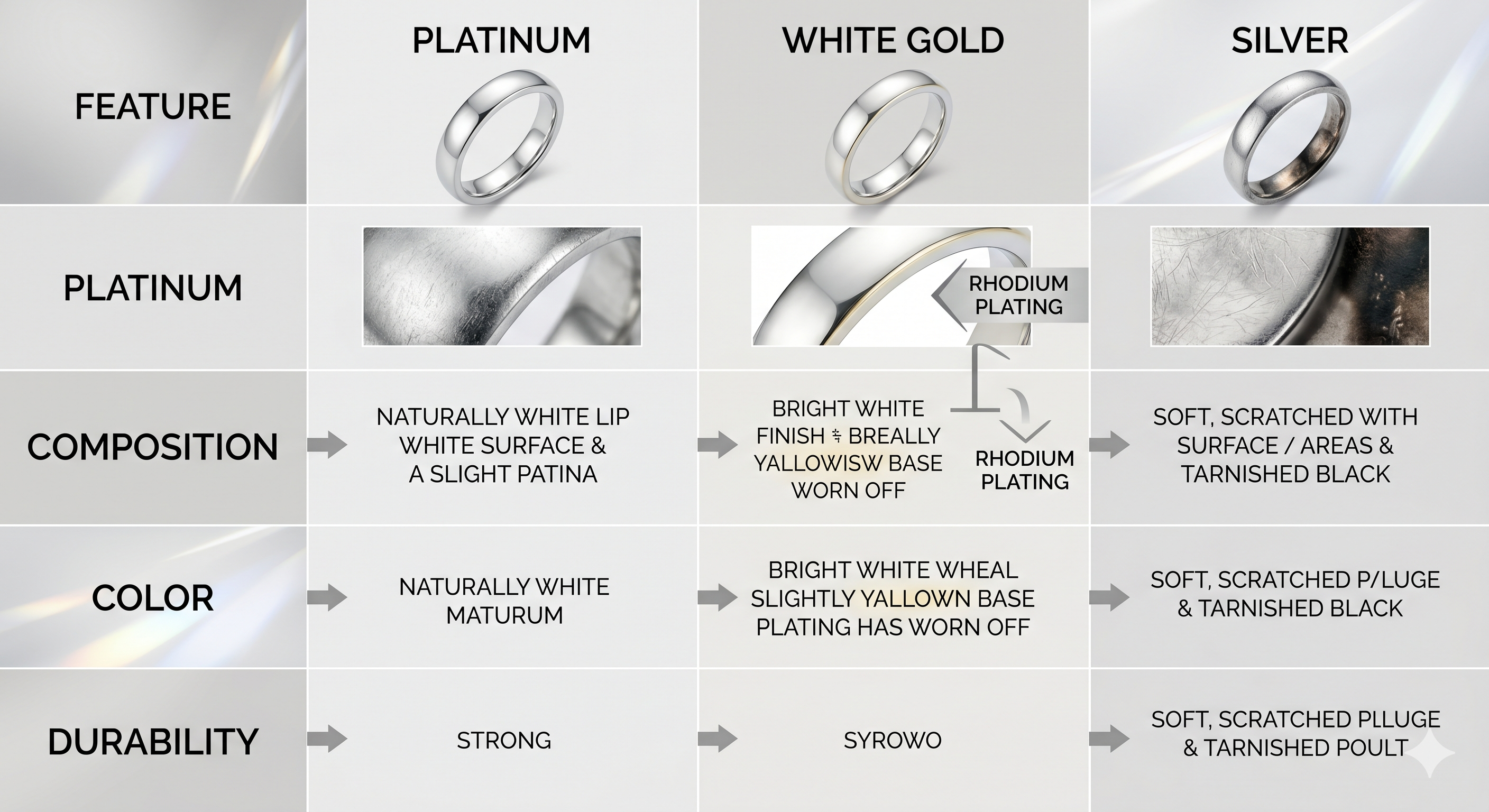
 

Comparison to Other White Metals


“In 1953, when Sir Edmund Hillary reached the summit of Mount Everest, he carried a platinum brooch for his wife. He chose platinum not because it was expensive, but because it would not tarnish in the extreme cold. In 1969, when Neil Armstrong stepped onto the moon, the Apollo 11 astronauts carried a platinum medallion — because platinum is the only metal that can survive the vacuum of space without corroding. From the top of the world to the surface of the moon, platinum has been the metal of extremes. It does not fade. It does not crack. It simply endures. That is why we choose it for rings that promise forever. Not because it is flashy, but because it will still be here when we are not.”


In summary: Platinum is a rare, noble, and transition metal, prized for its stunning silvery-white appearance, incredible durability, and vital role in industry and technology.


How Much Is 1g of Platinum?


The price of platinum, like all precious metals, fluctuates constantly based on the global market. Therefore, I cannot give you a single, exact number, but I can provide a clear picture of its value range and the factors that affect it.


As of my last update, I do not have live data. However, I can tell you how to find the current price and what to expect.


The Short Answer (Based on Recent Trends)


Historically, the price of 1 gram of platinum has often been less than that of 1 gram of gold. In recent years, it has typically ranged from $25 to $35 USD per gram.


To get the absolute live price, you should check a reliable financial source.


How to Find the Live Price


The price of platinum is set by the global "spot price."


Search Online: A simple search for "platinum spot price" or "price of platinum per gram" will bring up live tickers.


Understanding the Price You'll Actually Pay


This is the most important part. The "spot price" is the wholesale price for a raw ounce of metal. When you buy a small quantity like 1 gram, you will pay more due to several factors:


Premium: This is the extra cost over the spot price that covers the minting, fabrication, distribution, and a small profit margin for the dealer. The smaller the item, the higher the premium per gram.


Form of Platinum: The price varies drastically depending on what you're buying.


Taxes and Shipping: These can add to the final cost.


Price Breakdown by Form (Approximate Estimates)


Here’s a realistic look at what you might pay for 1 gram of platinum in different forms:
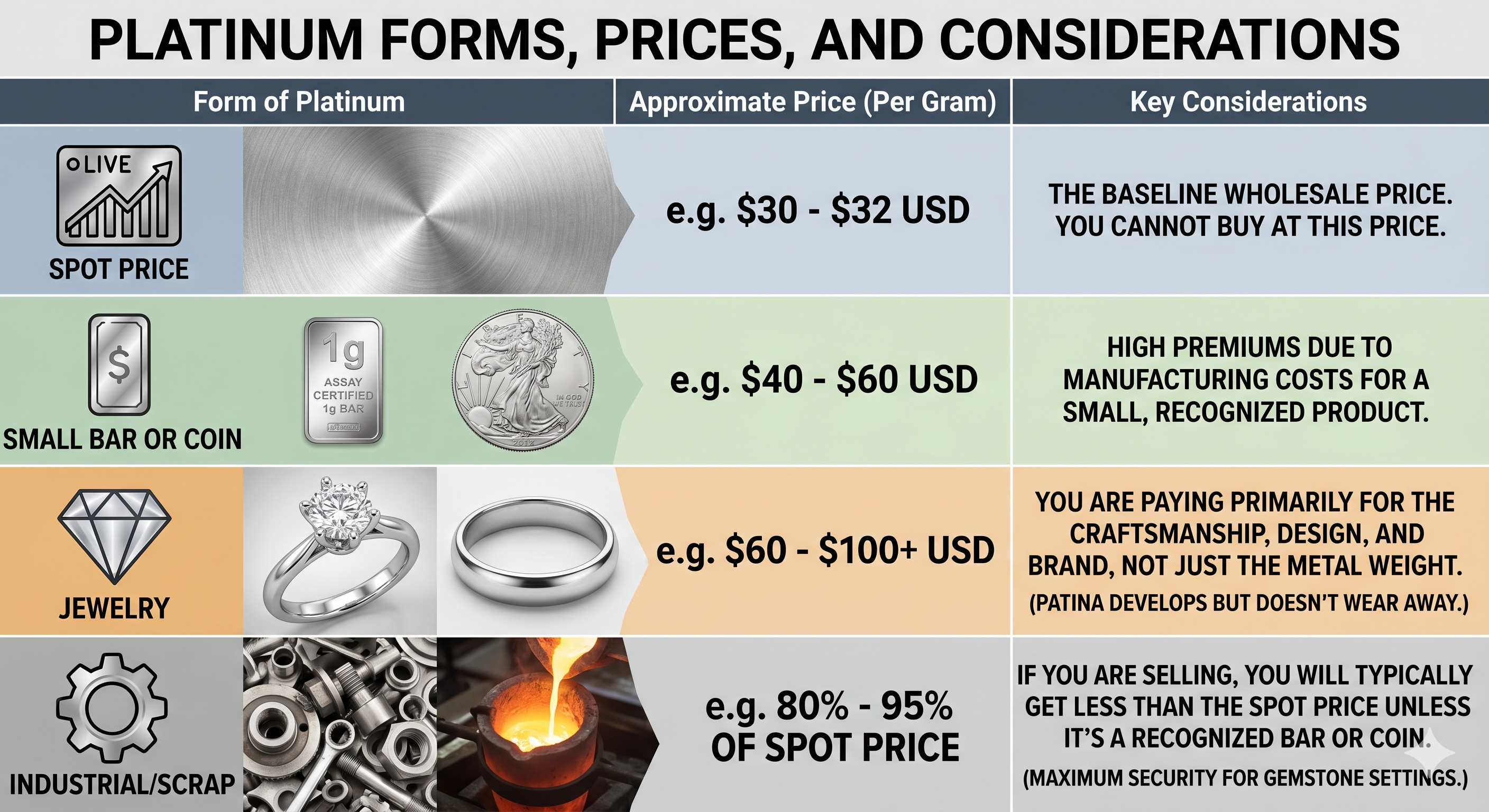
 

How Much Is 1g of Platinum


Comparison to Other Precious Metals (Per Gram)


To give you context, here is the typical price hierarchy of major precious metals:


Rhodium: The most expensive (significantly higher than all others).


Gold: Consistently more expensive than platinum per gram.


Platinum: Historically cheaper than gold, but rarer.


Palladium: Has been more expensive than platinum in recent years due to high industrial demand.


Silver: By far the least expensive (usually less than $1 per gram).


Why is Platinum Valuable?


As discussed in the previous question, its value comes from:


Extreme Rarity: 30 times rarer than gold.


High Industrial Demand: Its use in catalytic converters for diesel vehicles and other chemical processes creates constant demand.


Jewelry Demand: Prized for its durability and beautiful, dense white luster.


Investment Demand: Seen as a store of value and a hedge against inflation.


While the base price for 1 gram of platinum is generally between $25 and $35, the price you pay at a dealer for a 1-gram bar will be closer to $40-$60 due to premiums. Always check a live spot price and compare prices from reputable dealers before making a purchase.


Is Platinum Worth More Than Gold?


Historically and based on rarity alone, platinum should be more expensive than gold. However, as of the last several years (since about 2015), gold has consistently held a higher market price per ounce.


So, in the current market, no, platinum is not worth more than gold. Gold is more expensive.


Let's break down why this is the case and the fascinating dynamics behind it.


The Price Comparison: A Snapshot


Platinum: It is about 30 times rarer than gold.


Gold: Is about 2-3 times more expensive than platinum (per ounce).


This seems counterintuitive, so here’s the explanation.


Why Platinum Should Be More Expensive


Extreme Rarity: All the platinum ever mined would fit into an average-sized living room. Its annual mining output is only a fraction of gold's.


Density and Purity: Platinum is denser and heavier than gold. A platinum ring will be heavier than a gold ring of the same size. Jewelry is also often 95% pure (Pt950), compared to 75% pure for 18k gold.


Industrial Difficulty: Platinum has a much higher melting point and is more difficult to extract and refine.


Why Gold Is Actually More Expensive Now


The price is not just about rarity; it's about demand and market perception.
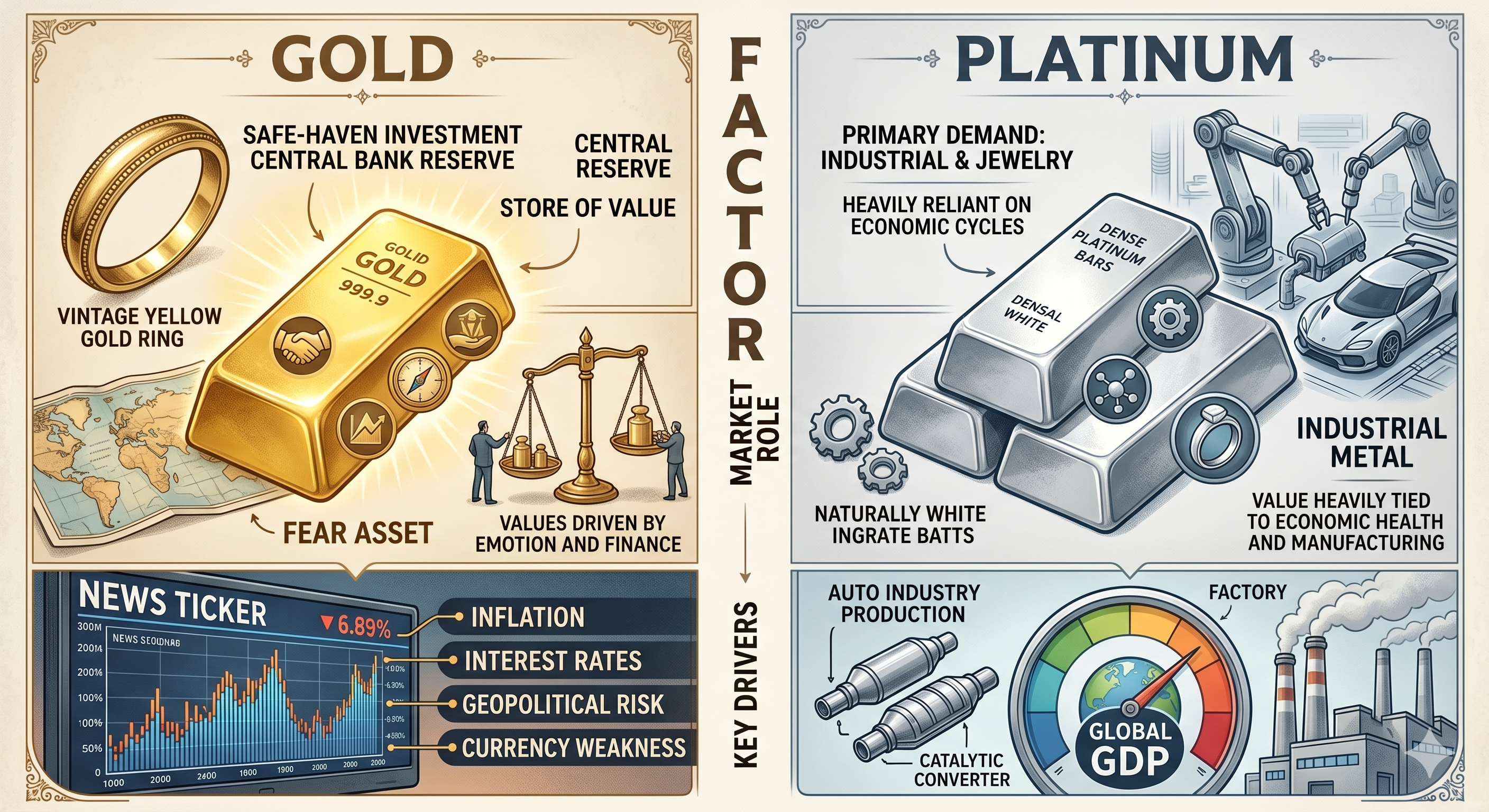
 

Is Platinum Worth More Than Gold


Here’s what happened to platinum:


Diesel Decline: The 2015 "Dieselgate" scandal and a global shift away from diesel cars (which use more platinum in catalytic converters) significantly reduced a major source of demand.


Economic Sensitivity: Platinum's price drops during economic downturns (like the 2008 crisis or the COVID-19 pandemic) because factories slow down.


Substitution: Automakers have become better at using less platinum or substituting it with the cheaper (but now often more expensive) palladium.


Gold's Strength: Meanwhile, gold has seen massive investment demand due to low interest rates, high inflation, and global uncertainty.


Investment & Jewelry Perspective


For Investors: Some see platinum as undervalued and a potential investment opportunity, betting that its price will eventually correct to be above gold's again. However, it's a much more volatile and speculative bet than gold.


For Jewelry Buyers: Platinum offers excellent value for money. You are getting a rarer, denser, more durable, and purer metal for a lower price per ounce than gold. This is why it's often favored for high-end, durable pieces like engagement rings.


While gold currently has a higher market price due to its unshakable role as a financial safe-haven, platinum is the rarer metal and is often considered the better value in jewelry for its superior durability and purity.


Does Platinum Turn Yellow?


This is a common concern, especially for people investing in platinum jewelry.


The direct and reassuring answer is: No, pure platinum itself does not turn yellow.


Platinum is a noble metal, which means it is highly resistant to tarnish and corrosion. The bright, silvery-white color you see when it's new is its natural, permanent color. It will not oxidize or change color like silver or copper.


However, there are a few reasons why a platinum item might appear to lose its luster or take on a different hue, and it's almost always due to surface-level issues.


Why Your Platinum Might Look Discolored


Here are the most common reasons:


Surface Scratches and the "Patina":


This is the most frequent cause of a perceived color change. Platinum is a soft, malleable metal. When it gets scratched, it doesn't lose metal (like gold does); instead, the metal is displaced. Over time, these tiny scratches build up a matte, frosted-looking surface called a patina.


What it looks like: It doesn't look yellow, but rather a less reflective, dull gray or white. This patina is often considered a sign of quality and enduring love in jewelry circles, as it shows the piece has been worn and cherished.


Dirt, Oils, and Grime:


Just like any object you handle frequently, platinum jewelry can accumulate a film of lotion, soap, skin oils, and everyday dirt. This grime can make the platinum look dull, less white, and in certain lights, it might even have a slight yellowish or off-white tint.


Solution: A simple cleaning with a soft jewelry cloth, a mild soap solution, and a soft-bristled brush (like a baby toothbrush) will almost always restore its original brilliant shine.


Rhodium Plating (A Common Misconception):


This is a crucial point! Many people confuse platinum with white gold.


White Gold: Is naturally a slightly yellowish or grayish color. To give it a bright, white finish, it is almost always plated with a thin layer of rhodium, another platinum-group metal that is very white and shiny.


What happens: Over time, this rhodium plating wears off, revealing the natural color of the white gold beneath, which can look yellow in comparison. This does not happen with platinum, as its natural color is already white.


Alloyed Metals:


Pure platinum (Pt1000) is too soft for most jewelry, so it is often alloyed with other metals for strength. Common alloy metals include:


Ruthenium and Iridium: These are also white metals and will not change platinum's color.


Cobalt: This is another common alloy that maintains a white color.


It is highly unlikely that a reputable jeweler would use an alloy that would cause yellowing.


Summary Table: Platinum vs. Other Metals
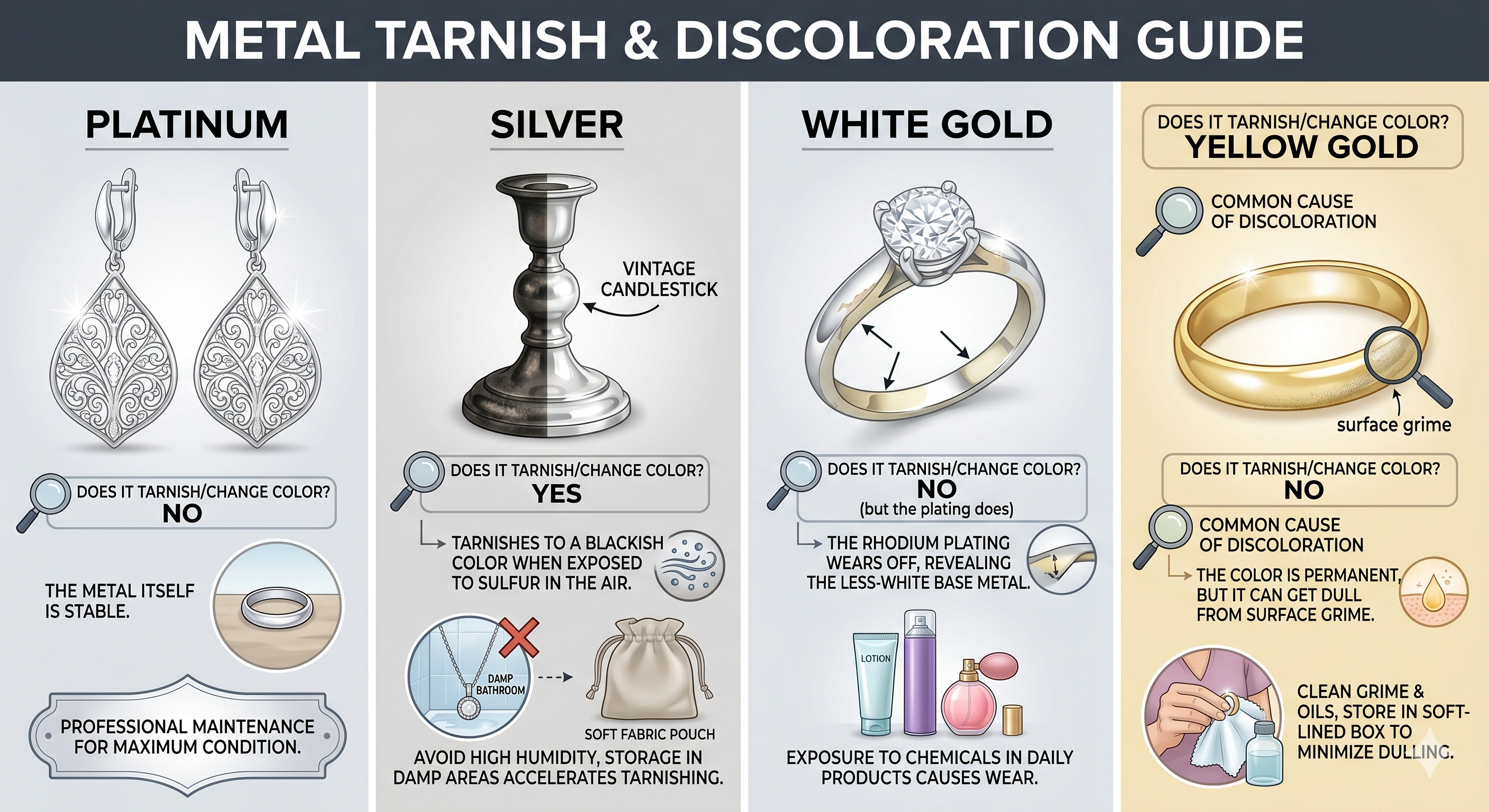
 

Summary Table Platinum vs Other Metals


What to Do If Your Platinum Looks Yellow


Clean It First: Give it a gentle clean with warm water, a drop of dish soap, and a soft brush. This will remove any oils or dirt that are clouding its surface.


If Still Dull, Take it to a Jeweler: If cleaning doesn't restore the shine, a professional jeweler can easily polish the platinum to remove the patina and surface scratches, bringing back its original mirror-like finish. Unlike rhodium-plated white gold, this is a permanent restoration of the metal itself, not just a new coating.


You can be confident that your platinum will not turn yellow. Any loss of its brilliant shine is a surface-level issue that can be easily and completely reversed with simple cleaning or polishing.


What Is The Disadvantage Of Platinum?


While platinum is a magnificent metal prized for its beauty and durability, it does have several distinct disadvantages, especially when compared to other precious metals like gold.


The drawbacks can be grouped into a few key areas:


1. Cost: The High Initial Price


More Expensive Than Gold (for the raw material): While the market price per ounce of platinum is often lower than that of gold, the final cost of a piece of platinum jewelry is almost always higher. This is because:


Higher Purity: Jewelry platinum is typically 95% pure (Pt950), while 18k gold is only 75% pure. You are simply using more precious metal.


Density: Platinum is denser and heavier than gold. A platinum ring of the same size will weigh significantly more, increasing the cost based on weight alone.


2. Weight and Feel


Heaviness: Its high density makes it very heavy. Some people love the substantial, luxurious "heft" of platinum. Others may find a large platinum ring or bracelet to be uncomfortably heavy for daily wear.


3. Maintenance and Surface Finish


Develops a Patina: This is one of the most debated characteristics. Platinum is soft and malleable. Over time, it develops a satiny, matte finish called a patina from microscopic scratches.


Proponents see this as a desirable, understated "lived-in" look that signifies quality and history.


Those who see it as a disadvantage prefer the constant high-gloss, reflective shine of polished white gold. Restoring the original mirror-like polish requires a professional jeweler.


4. Durability (A Mixed Bag)


Scratch-Prone: While platinum is very strong and resistant to breaking or wearing thin, its surface is relatively soft and scratches more easily than 18k white gold.


Important Note: When platinum scratches, the metal is displaced rather than lost. It's like pushing sand to the side. This is different from gold, where the material is actually worn away. A jeweler can often re-polish a scratched platinum piece to look new again.


5. Limited Design and Repair Flexibility


Difficulty for Intricate Designs: Its strength and high melting point make it more challenging for jewelers to work with, especially for very delicate, filigree, or detailed designs. Gold is generally more malleable for complex craftsmanship.


Harder to Resize and Repair: Due to its strength and high melting point, resizing or repairing platinum requires more skill, time, and specialized equipment, which can make these services more expensive.


6. Market and Resale Value


Poorer Resale Value: This is a significant disadvantage for those who view jewelry as an investment. The market for reselling pre-owned platinum jewelry is much smaller than for gold. You will rarely get back the high premium you paid for the craftsmanship and metal. Gold, due to its universal role as a currency and investment, has a much more liquid and straightforward resale market.


Summary Table: Disadvantages at a Glance
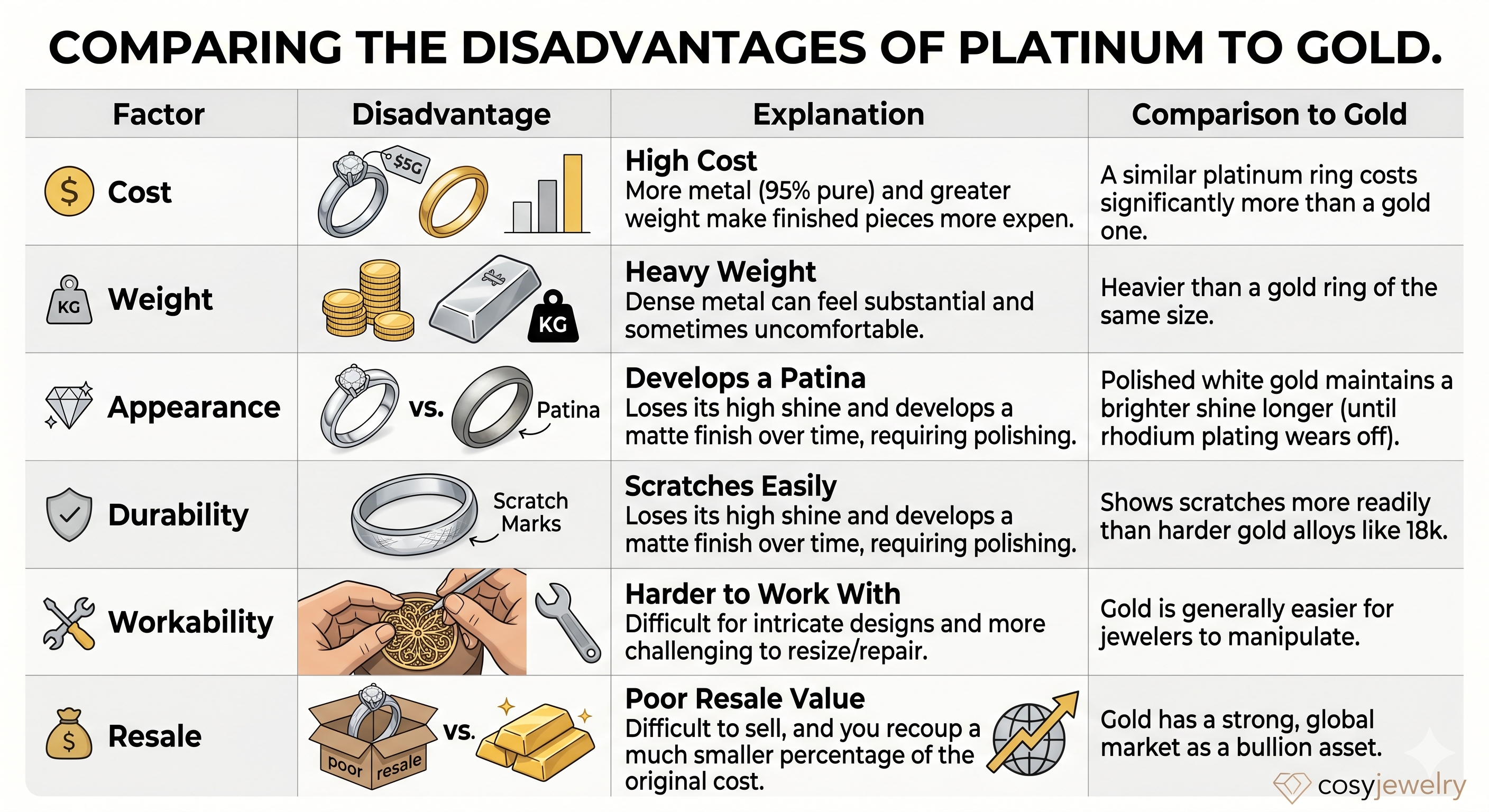
 

Summary Table Disadvantages at a Glance


Who Might Want to Avoid Platinum?


Platinum is an excellent choice for someone who:


Prioritizes purity and a natural white color.


Values extreme durability and longevity (e.g., for an engagement ring worn daily).


Has metal allergies and needs a hypoallergenic metal.


Appreciates the weight and patina as signs of quality.


However, you might prefer white gold if you:


Have a stricter budget.


Prefer a lighter-weight piece of jewelry.


Want a consistently bright, reflective shine (and don't mind getting it re-plated with rhodium every few years).


We are planning on a very intricate, delicate design.


Is Platinum A Good Investment?


The answer isn't a simple yes or no, as platinum is one of the most divisive and speculative investments in the precious metals world.


Here’s a balanced look at the arguments for and against investing in platinum.


The Bull Case: Reasons Why Platinum Could Be a Good Investment


Extreme Rarity:


Platinum is 30 times rarer than gold. All the platinum ever mined would fit into an average-sized living room. In the long run, fundamental scarcity often supports value.


Deep Discount to Gold:


Historically, platinum almost always traded at a premium to gold. Since 2015, this relationship has flipped. Many investors see this as a major opportunity, believing platinum is significantly undervalued and due for a "mean reversion" where its price rises to meet or exceed gold's again.


High Industrial Demand & The Green Economy:


Platinum's primary use is in industry, especially:


Catalytic Converters: It is essential for reducing emissions in diesel vehicles. While the diesel passenger car market has declined, diesel still dominates heavy machinery, trucks, and ships.


Hydrogen Economy: This is the most compelling future catalyst. Platinum is a critical catalyst in hydrogen fuel cells, which produce clean electricity. If the hydrogen economy takes off, demand for platinum could surge.


Constrained Supply:


Over 70% of the world's platinum comes from South Africa, where mining is plagued by deep-level mining challenges, labor unrest, and persistent energy shortages (load-shedding). This makes supply fragile and susceptible to disruptions, which can cause sharp price spikes.


Investment Diversification:


It behaves differently from gold and stocks. Adding a small amount of platinum to a diversified portfolio can potentially reduce overall risk.


The Bear Case: Reasons for Caution


Economic Sensitivity:


Unlike gold (a "safe-haven" asset), platinum is an industrial commodity. Its price is tightly linked to global economic health. During recessions or manufacturing slowdowns, demand and price can fall sharply.


Technological Substitution:


The auto industry is constantly seeking to use less platinum or replace it with cheaper alternatives, like palladium. The rise of Electric Vehicles (EVs), which don't need catalytic converters at all, is a major long-term threat to a key source of demand.


Volatility:


Platinum is a much smaller market than gold, making it far more volatile. Its price can swing wildly based on industrial data, auto sales figures, or supply news from South Africa.


Weak Investment Demand & Liquidity:


Gold has a massive and deeply entrenched investment market (coins, bars, central banks, ETFs). Platinum's investment market is tiny in comparison. This means it can be harder to sell large quantities quickly, and it lacks the same "store of value" prestige.


Unpredictable Hydrogen Future:


While the hydrogen story is exciting, it is still speculative and years away from making a significant impact on platinum demand. Betting on platinum based solely on this is a high-risk gamble.


Comparison Platinum vs. Gold as an Investment


How to Invest in Platinum (If You Decide To)


If you believe the bull case, the most common ways to invest are:


Physical Platinum: Buying coins (e.g., American Eagle, Canadian Maple Leaf) or bars from reputable dealers. Be aware of high premiums over the spot price and secure storage.


ETFs (Exchange-Traded Funds): Funds like the abrdn Physical Platinum Shares ETF (PPLT) hold physical platinum bullion. This is the easiest way for most people to get exposure without storing metal.


Mining Stocks: Buying shares of companies that mine platinum (e.g., Anglo American Platinum, Impala Platinum). This is even more volatile, as it adds company-specific risks.


So, Is It a Good Investment?


Platinum is not a core, safe-haven holding like gold. It is a speculative, high-risk, high-potential-reward investment.


It might be a good investment for you if:


You have a well-diversified portfolio and want to add a small, speculative position.


You believe the global economy will remain strong.


You are betting on the hydrogen economy becoming a reality.


You strongly believe the price discount on gold is unsustainable.


You should avoid it if:


You are a conservative investor seeking capital preservation.


You are worried about a potential economic downturn.


You want a highly liquid asset you can sell easily at any time.


Never invest more than you are willing to lose in platinum. Consider it a tactical bet on specific economic and technological trends, not a foundational pillar of your wealth.


Which Is Better, Platinum Or White Gold?


The choice between platinum and white gold isn't about one being objectively "better" than the other, but about which is better for you, based on your priorities for budget, maintenance, appearance, and lifestyle.


Here’s a detailed comparison to help you decide.


Quick Summary: The Core Difference


Platinum: A naturally white, heavy, and durable pure metal (typically 95% pure). It's the premium, low-maintenance long-term choice.


White Gold: An alloy of yellow gold mixed with white metals (like nickel or palladium) and plated with a very white metal called rhodium. It's the popular, budget-friendly choice that requires periodic upkeep.


Head-to-Head Comparison
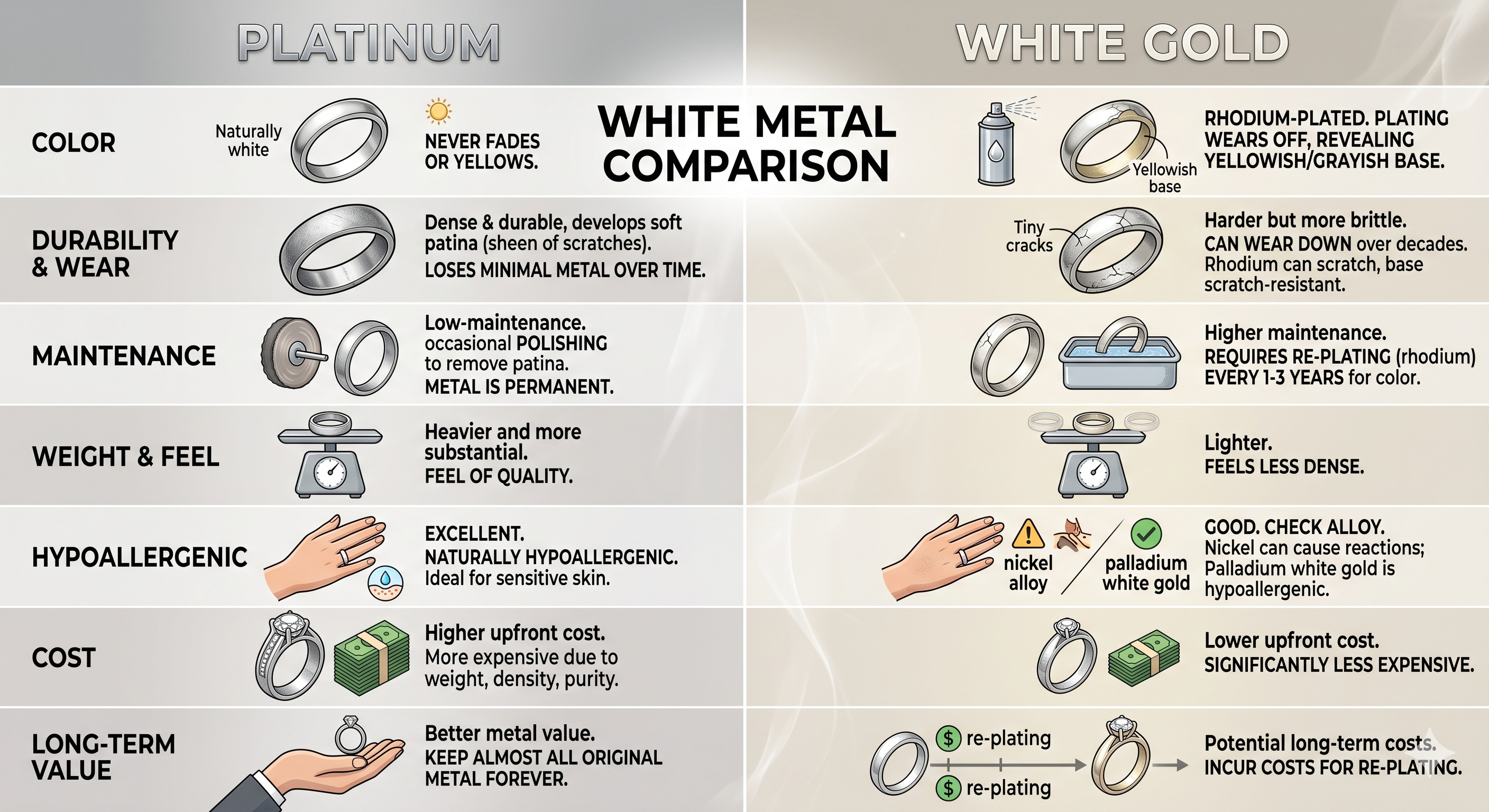
 

Which Is Better Platinum Or White Gold


How to Choose: Which One is Right for You?


Choose PLATINUM:


"I want the best, and money is not the primary concern." You value premium quality and are willing to pay for it.


"I want a 'lifetime metal' for an engagement ring or wedding band." Its durability and permanence are perfect for a piece worn every day, forever.


"I hate maintenance and don't want to worry about replating." You prefer a metal that ages gracefully and only needs an occasional polish.


"I have sensitive skin or metal allergies." Its purity makes it the safest choice.


"I love the feel of a heavy, substantial piece of jewelry."


Choose WHITE GOLD :


"I need to stick to a budget." It gives you the bright white look of platinum for a significantly lower initial price.


"I don't mind the occasional maintenance." You're okay with getting your jewelry re-plated every few years to keep it bright white.


"I prefer a lighter-weight piece of jewelry." The lighter feel is more comfortable for you.


"I like the brightest possible white finish." A fresh rhodium plating is the brightest white available, brighter than platinum's natural white.


The Visual Test: A Helpful Analogy


Think of it like cars:


Platinum is like a heavy-duty, premium sedan with a solid metal body. It might get surface scratches over time, but it's built to last a lifetime with just basic care (washing and waxing/polishing).


White Gold is like a sleek, affordable sports car with a brilliant custom paint job (the rhodium plating). To keep it looking showroom-new, you need to repaint it every few years, but the engine and frame (the gold alloy) are solid.


Both are excellent choices for beautiful, white jewelry.


For maximum durability, low maintenance, and a premium feel, choose Platinum.


For a lower initial cost and the brightest white color, and if you don't mind periodic upkeep, choose White Gold.


There is no wrong answer, only the right answer for your personal preferences and priorities. The best advice is to visit a reputable jeweler and hold and try on both. The difference in weight and feel can often be the deciding factor.


Can I Wear Platinum Every Day?


Absolutely, yes. Platinum is one of the best metals you can choose for everyday wear, which is why it's so highly recommended for lifetime pieces like engagement rings and wedding bands.


Here’s a breakdown of why it's so suitable and what you can expect over time.


Why Platinum is Excellent for Daily Wear


Extreme Durability: Platinum is a strong, tough metal that is highly resistant to breaking, cracking, or wearing thin. It holds gemstones very securely, making it an ideal setting for valuable stones like diamonds.


Density and Longevity: Because it is so dense and heavy, platinum withstands the rigors of daily life exceptionally well. While it can scratch, it loses very little metal over decades of wear. When gold scratches, metal is actually lost; when platinum scratches, the metal is merely displaced, forming what is called a patina.


Hypoallergenic: Being 95% pure (typically Pt950), platinum is an excellent choice for those with sensitive skin or metal allergies, as it contains no common irritants like nickel.


The "Patina": The Key to Understanding Daily Wear


This is the most important concept to grasp when wearing platinum daily.


What is it? A patina is a soft, satiny sheen that develops on the surface of the metal over time from millions of microscopic scratches.


Is it a bad thing? This is a matter of taste.


Many people love it: They see the patina as a desirable, distinguished "living finish." It proves the ring is real, well-loved, and has a history. It's an understated, matte look that many find beautiful.


If you prefer a high-shine look: If you want your ring to always look brand-new and mirror-polished, the patina will be a drawback.


The great news is that the patina is not permanent. A jeweler can easily polish the ring to restore it to its original, brilliant, high-shine finish. This process removes a tiny, negligible amount of metal.


What to Expect: A Realistic Timeline


First 6-12 months: Your new platinum jewelry will have a bright, mirror-like polish.


After 1-3 years of daily wear: You will likely notice the shine softening into a more satiny, matte finish (the patina). The metal itself will remain strong and intact.


As needed: When you feel the piece looks too dull, take it to a professional jeweler for polishing. They can make it look new again in no time.


Comparison for Daily Wear: Platinum vs. White Gold
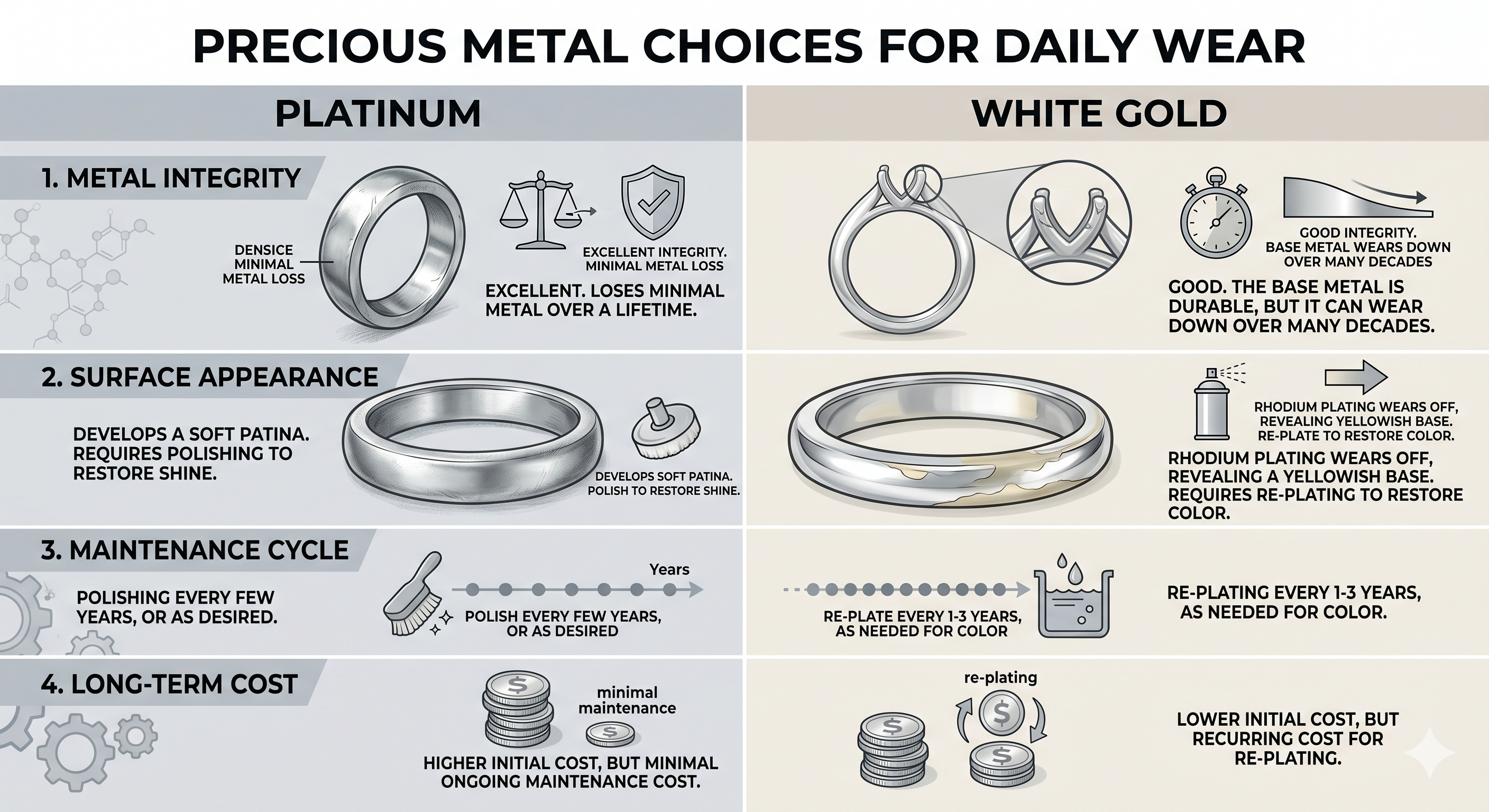
 

Comparison Platinum vs. Gold as an Investment


Yes, you can and should wear platinum every day. It is built to last a lifetime.


Choose Platinum: You want the most durable, long-lasting metal that ages gracefully and requires less frequent, less expensive maintenance. You are okay with—or even love—the idea of it developing a soft patina.


Consider White Gold: You prefer a consistently bright white look and don't mind the recurring task and cost of getting it re-plated every couple of years.


For a piece you plan to wear every day for the rest of your life, platinum's resilience and timeless character make it an outstanding choice.


What Color Does Platinum Fade To?


Platinum does not technically "fade" or change its fundamental color.


Unlike other metals that undergo a chemical reaction (like silver tarnishing black), platinum's core color remains the same. However, its surface appearance can change over time. Here’s what really happens:


The "Patina": A Sign of Character, Not Fading


With daily wear, platinum develops a soft, matte, satin-like finish called a patina.


What it looks like: The patina is not a new color, but a dulling of the mirror-like shine. It appears as a consistent, frosted, whitish-gray sheen across the surface of the metal.


What it is NOT: It does not turn yellow, brown, or black.


Why Does This Happen?


Platinum is a relatively soft (though very strong) and malleable metal. When it gets scratched through daily wear, the metal is displaced rather than being worn away (as happens with gold). These millions of tiny, microscopic scratches scatter light instead of reflecting it directly, creating the soft, matte appearance we call a patina.


Platinum vs. Other Metals: A Key Distinction


This is the most important point to understand:
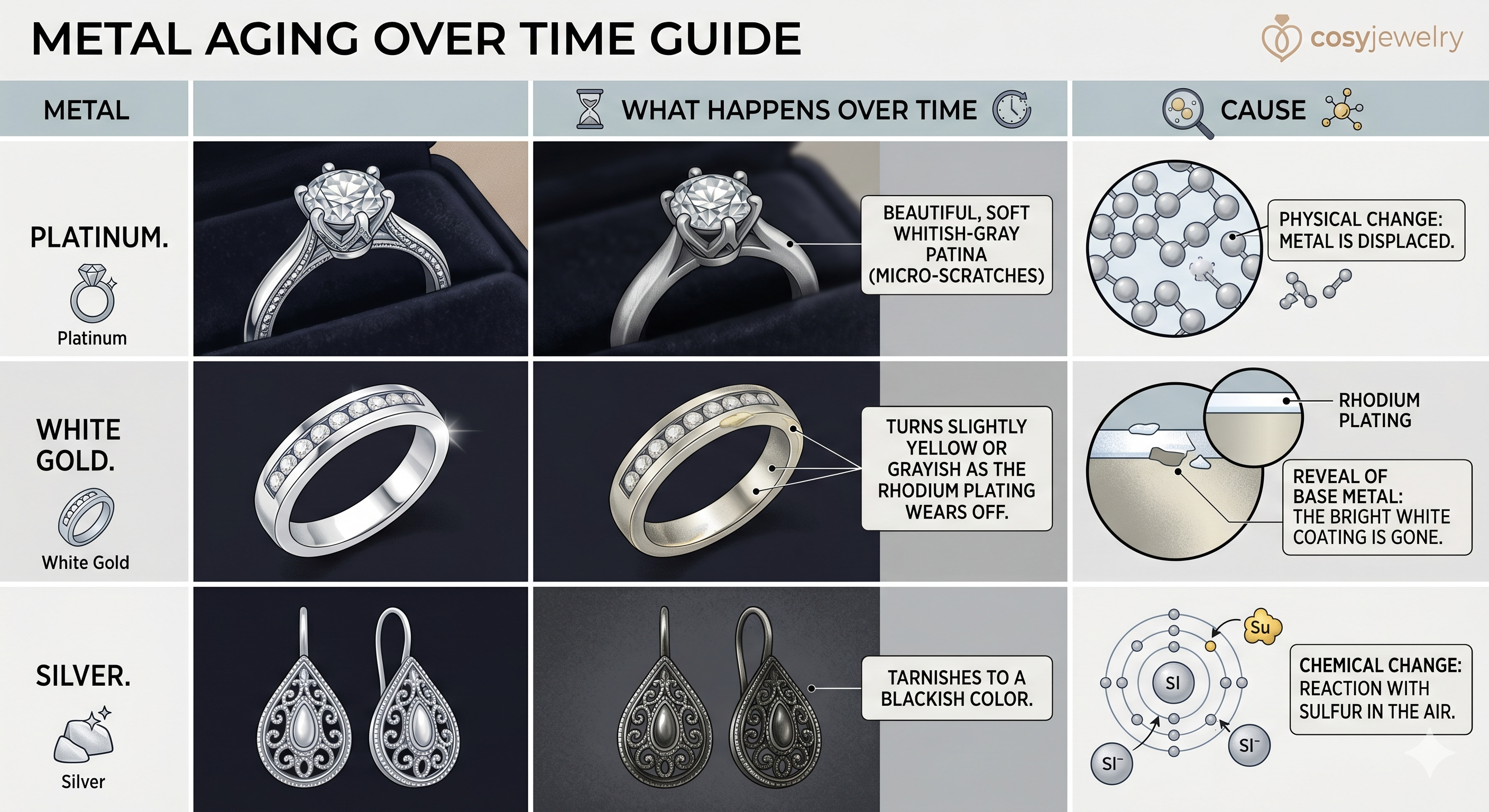
 

Platinum vs Other Metals A Key Distinction


So, if you see a platinum ring that looks "yellow," it is almost certainly not platinum, or it is covered in dirt and skin oils. A simple professional cleaning will confirm this.


What to Do About the Patina


The patina is not permanent and is easily reversed.


It's a Matter of Preference: Many people love the patina! It gives the jewelry a distinguished, "lived-in" look that signifies quality and history. It's understated and elegant.


Easy to Restore: If you prefer the original high-shine, mirror finish, a jeweler can easily polish the platinum. This process smooths out the microscopic scratches, restoring the brilliant, like-new luster. Unlike re-plating white gold, this is a simple process that doesn't add a new layer—it just restores the original metal surface.


Platinum does not fade to a different color. Its natural, bright white color is permanent. The whitish-gray patina it develops is simply a change in surface texture from scratches, which can be polished away at any time to restore the original shine.


“You now know the cosmic origin, the price, the gold comparison, the yellowing truth, the disadvantages, the investment case, the white gold debate, the daily wear advice, and the color truth. The only question left: will you wear the metal that came from the stars?


Our current collection includes a limited number of platinum rings — from classic solitaires to intricate pavé bands. When platinum stock is gone, restocking takes time because it is 30 times rarer than gold and mined in only a few places on Earth.


This is not just a metal. It is asteroid dust from 4 billion years ago, the conquistador‘s trash, the king‘s treasure, the mountaineer‘s choice, and the astronaut‘s companion — a metal that does not fade, does not crack, and will still be here when we are not.”


[Button: Secure Your Platinum Ring (Limited) →]


by Administrator


News for Tuesday 21 October, 2025


View all news for Tuesday 21 October, 2025 on one page


Recent News


News archive