

December Birthstone Guide: Turquoise, Tanzanite and Zircon
December Birthstone: Turquoise, Zircon, and Tanzanite
The birthstone for December is unique because it has three beautiful and distinct gemstones associated with it: Turquoise, Zircon, and Tanzanite.
“December babies are the only ones who get three stones — not because one wasn‘t enough, but because December itself is a month of endings and beginnings. Turquoise, the ancient protector, has been found in Egyptian tombs dating back to 6000 BCE, still blue after 8,000 years. Zircon holds the oldest known materials on Earth — crystals over 4.4 billion years old, surviving continents shifting and ice ages. And tanzanite, the newest gem on the planet, was discovered in 1967 — in our lifetime — and will be mined out in our children‘s. December does not have one birthstone. It has a past, a present, and a future — all in blue.”
The same stone that adorned Egyptian queens and survived 8,000 years now awaits your December birthday — or your own new beginning. Whether you choose ancient turquoise, brilliant zircon, or rare tanzanite, every stone in our collection is genuine and hand-selected.”*
[Button: Explore December Birthstone Jewelry →]
Here is the content of the table
- What Is The Official Birthstone Of December?
- Why Are There Three Birthstones For December?
- Which Stone Is Lucky For December?
- What Is The Rarest December Birthstone?
- What Color Is Good For December-born?
- How Can You Tell If A December Birthstone Is Real?
- What Is The Birthstone For December Jewellery?
- What Is The Alternative Birthstone For December?
Let us talk about the first topic.
What Is The Official Birthstone Of December?
The spiritual meaning of the December birthstone is wealth because December has not one, but three modern birthstones: Turquoise, Tanzanite, and Zircon.
Each stone carries its own unique spiritual significance, offering a beautiful spectrum of energies for those born in this month.
1. Turquoise (The Ancient Protector)
Turquoise is one of the oldest known gemstones, revered by ancient cultures from the Egyptians and Persians to the Native Americans of the Southwest.
Spiritual Meanings & Properties:
Protection & Purification: This is its core spiritual function. Turquoise is considered a master talisman of protection, believed to guard against negative energy, accidents, and evil spirits. Warriors and travelers often wore it for safe passage.
Wholeness and Healing: It promotes spiritual attunement and enhances communication between the earthly and spiritual realms. It's said to heal the spirit on all levels, bringing a sense of peace and wholeness.
Friendship and Compassion: Known as a stone of friendship, Turquoise fosters empathy, honest communication, and reliable relationships. Giving a Turquoise gem signifies a bond of friendship and goodwill.
Good Fortune: Many cultures consider it a lucky stone, attracting prosperity and success.
Who it's for: The person seeking grounding, protection, and a deeper connection to ancient wisdom and healing.
“For 8,000 years, turquoise has been the stone of kings and shamans. Persian rulers wore it, carved with verses from the Quran for protection. Tibetan monks used it in ritual offerings. The Native Americans of the Southwest believed turquoise could connect heaven and earth, and that the stone‘s color would fade if its wearer was in danger. When the tomb of Queen Puabi of Ur was opened in the 1920s, archaeologists found her draped in turquoise — still blue after four millennia. Turquoise is not just a gem. It is a promise that some things outlast time.”
2. Tanzanite (The Stone of Transformation)
A relatively modern discovery (1967), Tanzanite is prized for its stunning violet-blue color and is found in only one place on Earth: Tanzania.
Spiritual Meanings & Properties:
Metaphysical Transformation: Tanzanite is a powerful stone for facilitating profound spiritual awakening and transformation. It helps to elevate consciousness and open the gateway to higher spiritual knowledge.
Psychic Abilities & Intuition: It is strongly connected to the Third Eye and Crown Chakras, enhancing intuition, psychic perception, and visionary abilities. It helps one to "see" beyond the veil of the physical world.
Communication with Higher Realms: Often used in meditation, Tanzanite is believed to aid in connecting with guides, angels, and receiving spiritual insights.
Calming the Mind: Its high-vibrational energy can calm a troubled mind, alleviate stress, and promote a state of deep peace and meditation.
Who it's for: The seeker, the mystic, and anyone ready for a significant shift in their spiritual path and consciousness.
3 . Zircon (The Stone of Virtue)
Often confused with synthetic Cubic Zirconia, natural Zircon is a magnificent and ancient gemstone that comes in a variety of colors, though blue is the most popular for December.
Spiritual Meanings & Properties:
Spiritual Grounding & Balance: Despite its high spiritual energy, Zircon is known for its ability to ground spiritual energy into the physical body, creating balance and promoting a sense of order and clarity.
Amplifying Energy: It is known as an amplifier stone, meaning it can intensify the properties of other stones and the energy of the wearer, both positive and negative. This makes it a stone for self-awareness.
Wisdom and Honor: In the Middle Ages, Zircon was believed to induce sound sleep, ward off evil, and promote riches, honor, and wisdom. It helps in banishing ignorance and fostering a love for learning.
Healing Past Trauma: Some traditions hold that Zircon can help heal emotional wounds from the past, allowing for spiritual growth and moving forward.
Who it's for: The individual seeking to bring their spiritual insights down to earth, create balance in their life, and amplify their inner virtues.
Summary Table for Quick Reference
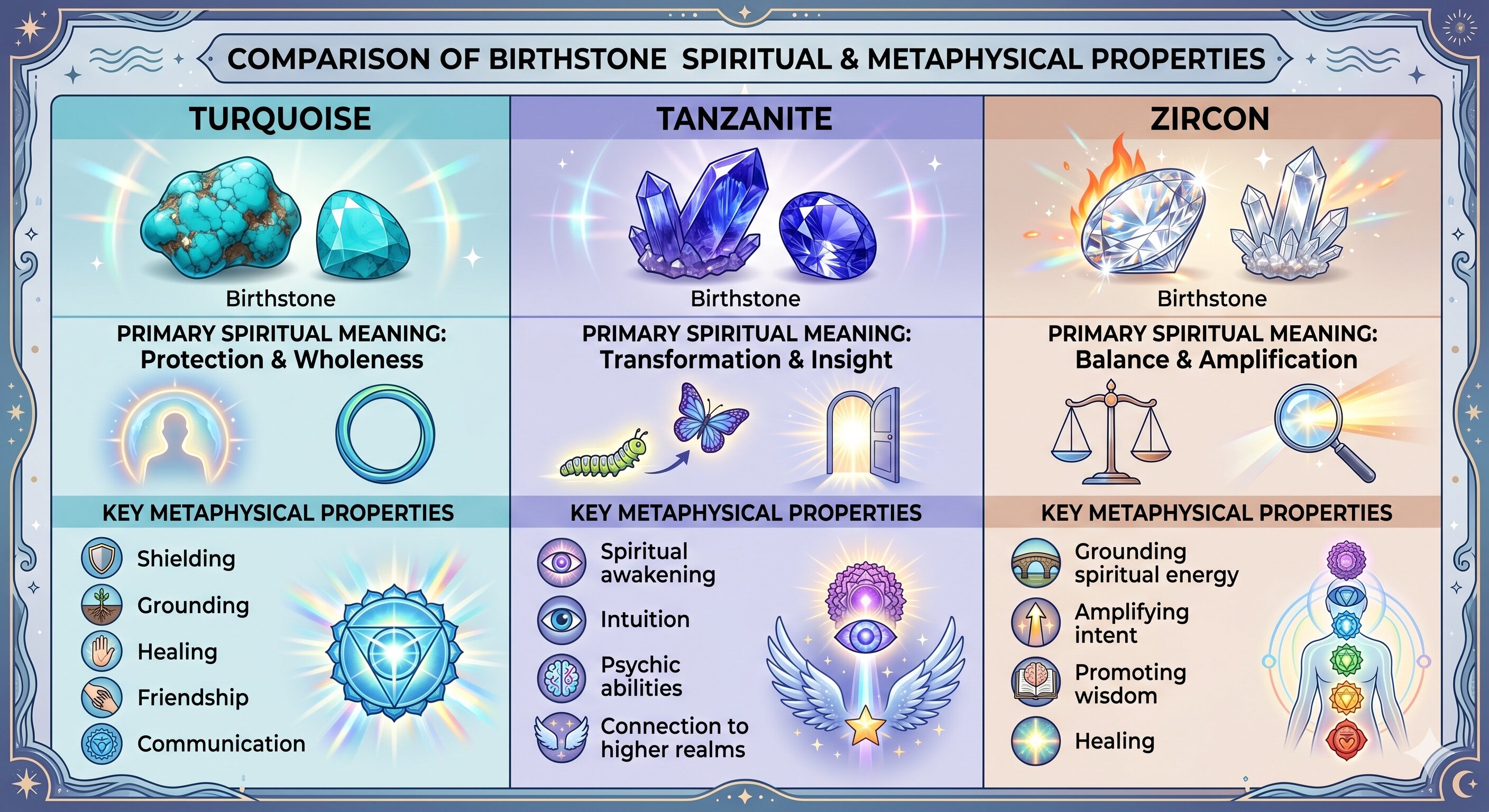
In Essence:
The spiritual journey of a December soul can be seen as a path:
Starting with the protective and grounding energy of Turquoise.
Moving into the transformative and high-vibrational shift with Tanzanite.
And finally, grounding and integrating that transformation into daily life with the balancing power of Zircon.
For official birthstone information, visit the GIA Birthstone Guide.
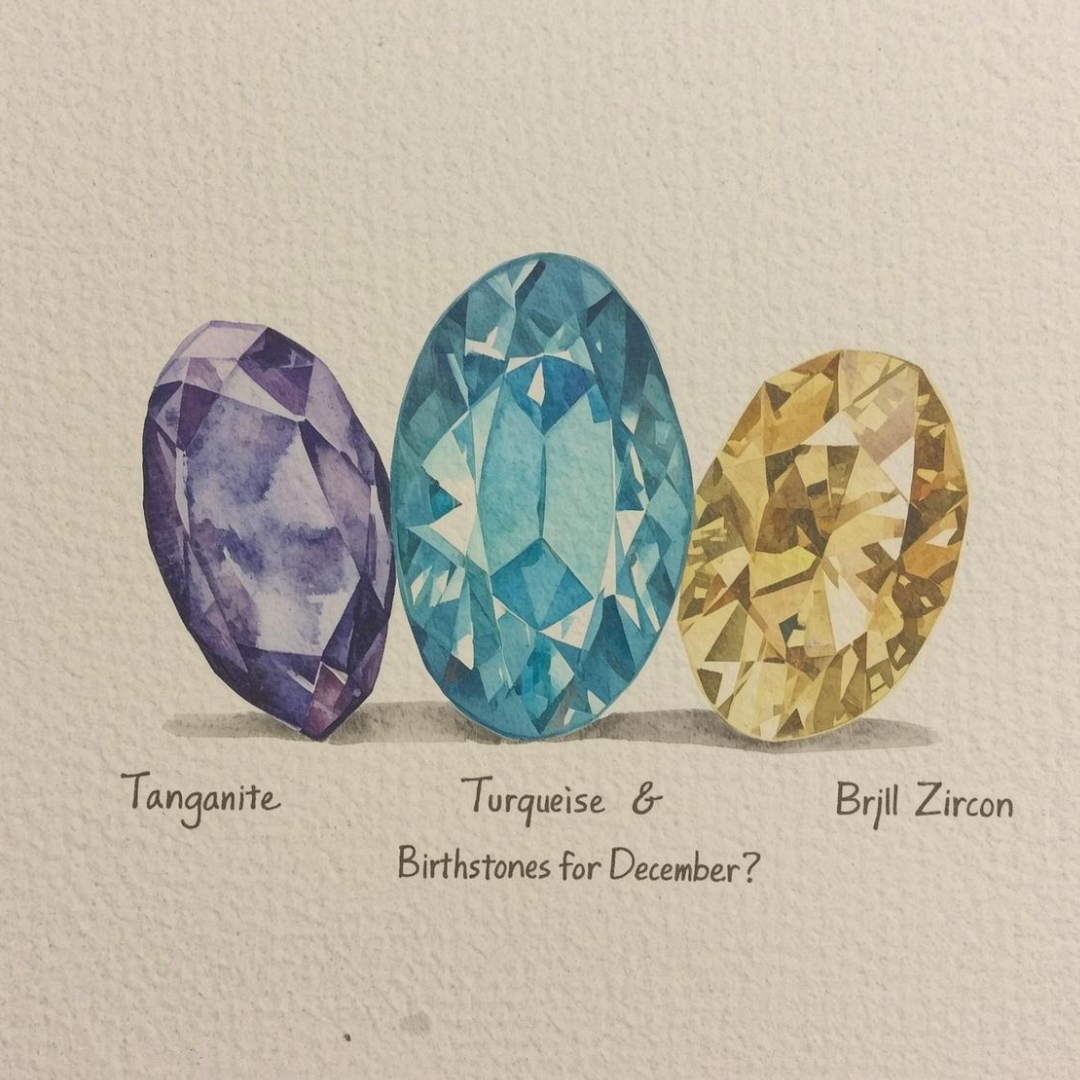
Why Are There Three Birthstones For December?
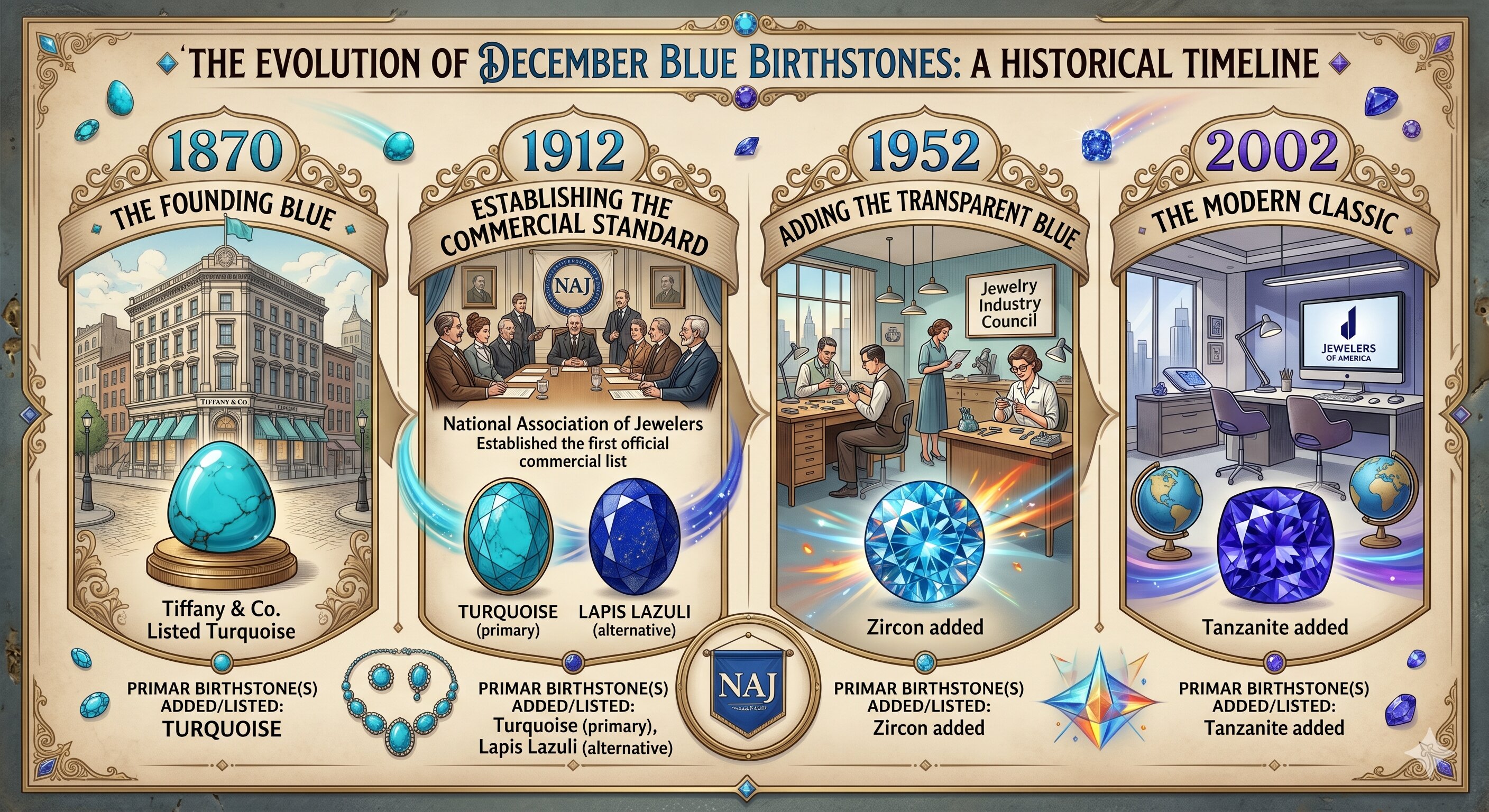
The primary reason December has three widely recognized birthstones is that the official list has been updated multiple times over the last century, adding new gemstones while retaining older, traditional ones. The result is a blend of ancient history and modern discovery.
The Historical Timeline of December's Birthstones
Birthstone lists are not fixed; they evolve due to gem discoveries, industry marketing, and availability. December's list has changed more than most.
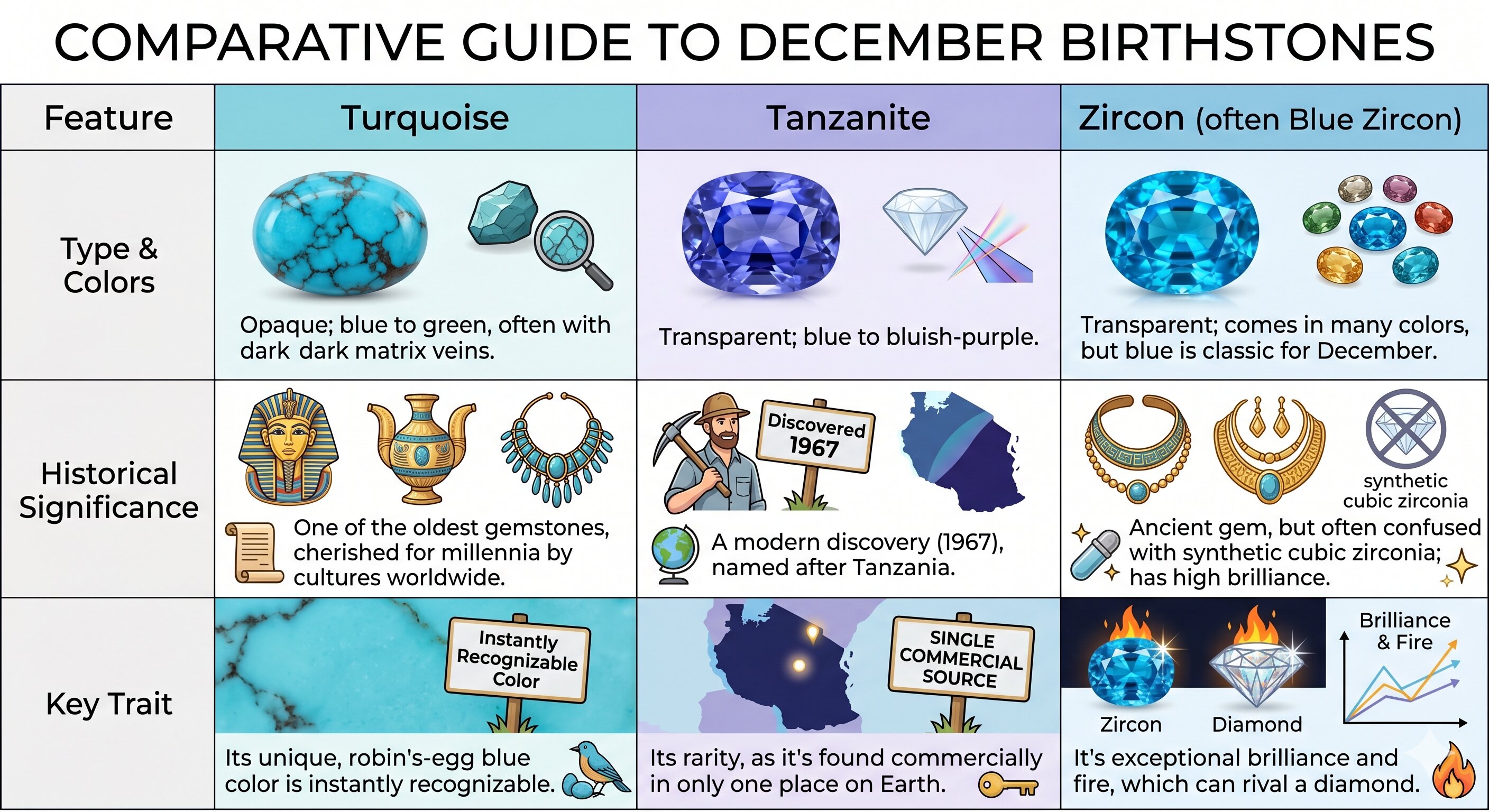
A Comparison of the Three Stones
Each of December's birthstones offers a distinct look, history, and character.
Why Some Sources Mention a Fourth Stone
You may find references to Blue Topaz as a December birthstone. This highlights a key point: there is no single universal authority. The Jewelers of America list is the most widely followed modern standard in the U.S. and includes turquoise, tanzanite, and zircon. Blue Topaz appears in some commercial or alternative lists, but it is not part of this core trio.
In summary, December's three birthstones reflect a layered history: turquoise represents ancient tradition, zircon is a 20th-century addition, and tanzanite is a very modern gem. The choice between them often comes down to personal preference for color, history, or meaning.
Which Stone Is Lucky For December?
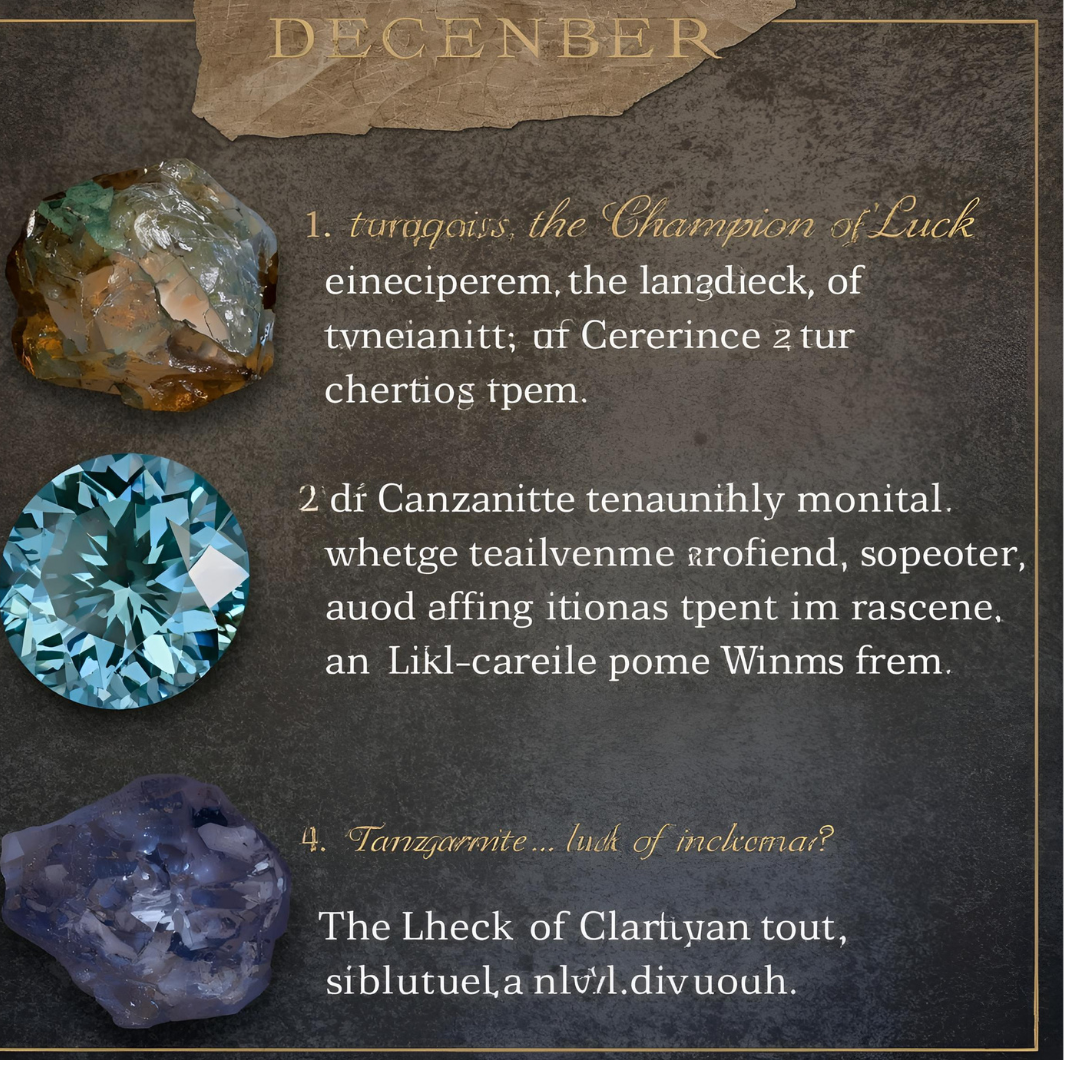
While all three December birthstones are associated with positive energies, the title of the "lucky" stone for December goes most definitely to Turquoise.
Here’s a breakdown of why Turquoise is considered the quintessential lucky stone, and how the others can also bring good fortune:
1. Turquoise Champion of Luck
For centuries, across numerous cultures, Turquoise has been revered as a powerful talisman for luck and protection.
Universal Talisman: Ancient Persians believed it offered protection against the "evil eye" and brought good fortune. Native American cultures held it as a sacred stone that connects heaven and earth, bringing health and luck to the wearer.
Stone of the Victor: It was often worn by warriors, hunters, and shamans to ensure success in their endeavors and safe passage.
Attractor of Prosperity: Its vibrant blue-green color is associated with abundance and vitality in many traditions, believed to attract prosperity and success.
A Selfless Luck: A key piece of Turquoise lore is that it brings luck, especially when given as a gift. This ties into its strong association with friendship and selfless love.
If you are looking for a traditional, all-purpose good luck charm for a December-born individual, Turquoise is the undisputed choice.
The Other Stones: Alternative "Luck"
While Turquoise holds the primary title, the other two December stones bring their own form of "good fortune," though in a slightly different context:
2 . Tanzanite: The Luck of Transformation
Tanzanite's "luck" is less about everyday wins and more about profound spiritual opportunity. Its fortune lies in:
Serendipitous Discovery: It was discovered in 1967 and is found in only one place on Earth (Tanzania), making its very existence feel like a lucky gift from the planet. Lackck of New Beginnings: It is a stone of transformation, helping you to attract and recognize life-changing opportunities and spiritual growth. Its "luck" is the fortune of elevated consciousness and finding your true path.
3. Zircon: TheLackk of Clarity and Wisdom
Zircon's luck is connected to intellectual and virtuous pursuits:
Luck Through Wisdom: In the Middle Ages, it was believed to promote riches, honor, and wisdom. Its "luck" comes from attracting success by banishing ignorance and promoting sharp thinking.
Amplifying Luck: As an amplifier stone, it's believed to intensify your own positive energy and intentions, thereby helping you to attract what you focus on.
Quick Guide: Which "Lucky" Stone to Choose
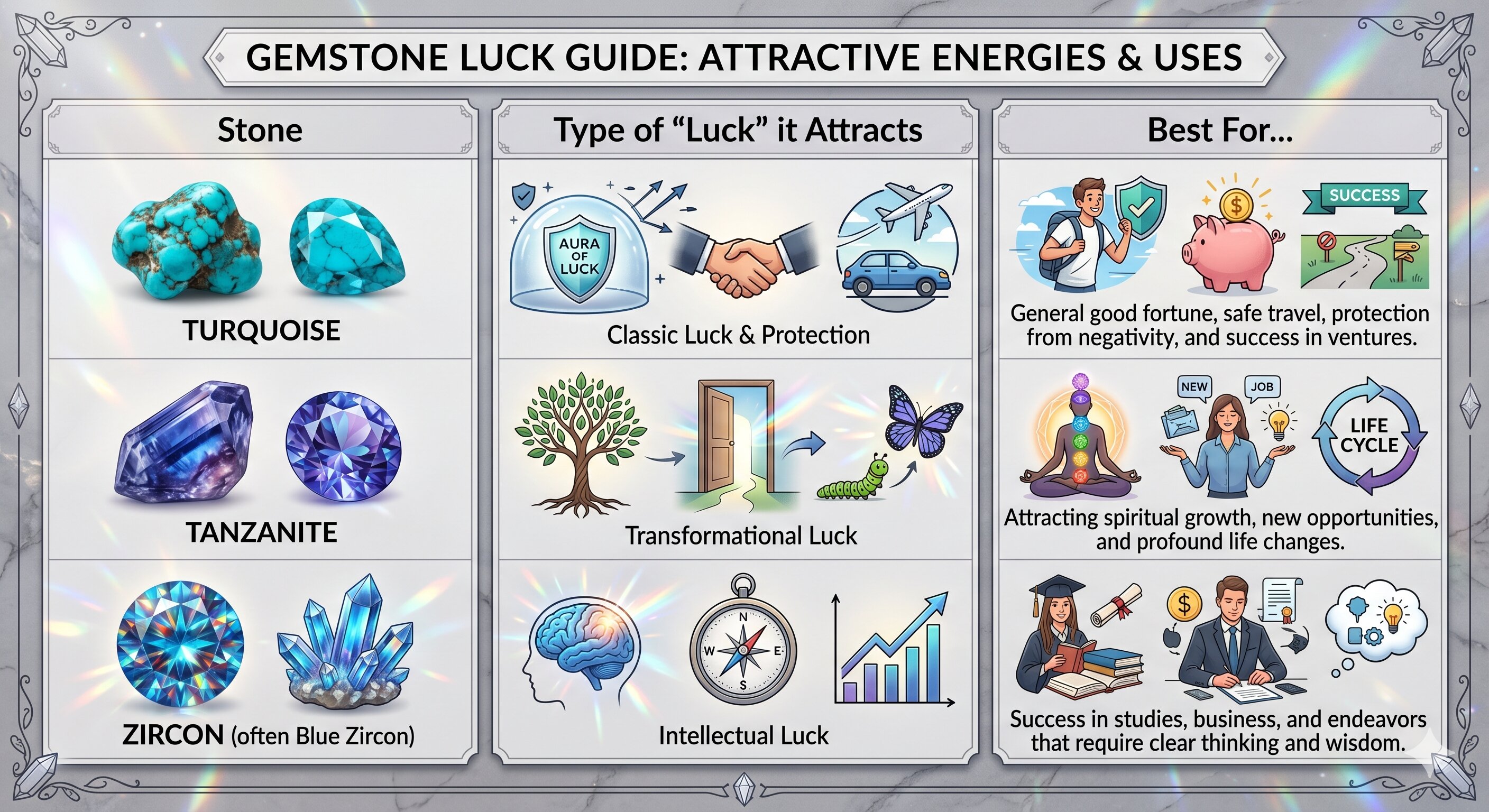
For the most direct and traditional answer to "which stone is lucky for December," the answer is Turquoise.
However, if the December-born person in your life is on a spiritual journey, Tanzanite might be the "luckier" stone for them. Or, if they are a student or professional, Zircon could bring the "luck" of sharp insight.
What Is The Rarest December Birthstone?
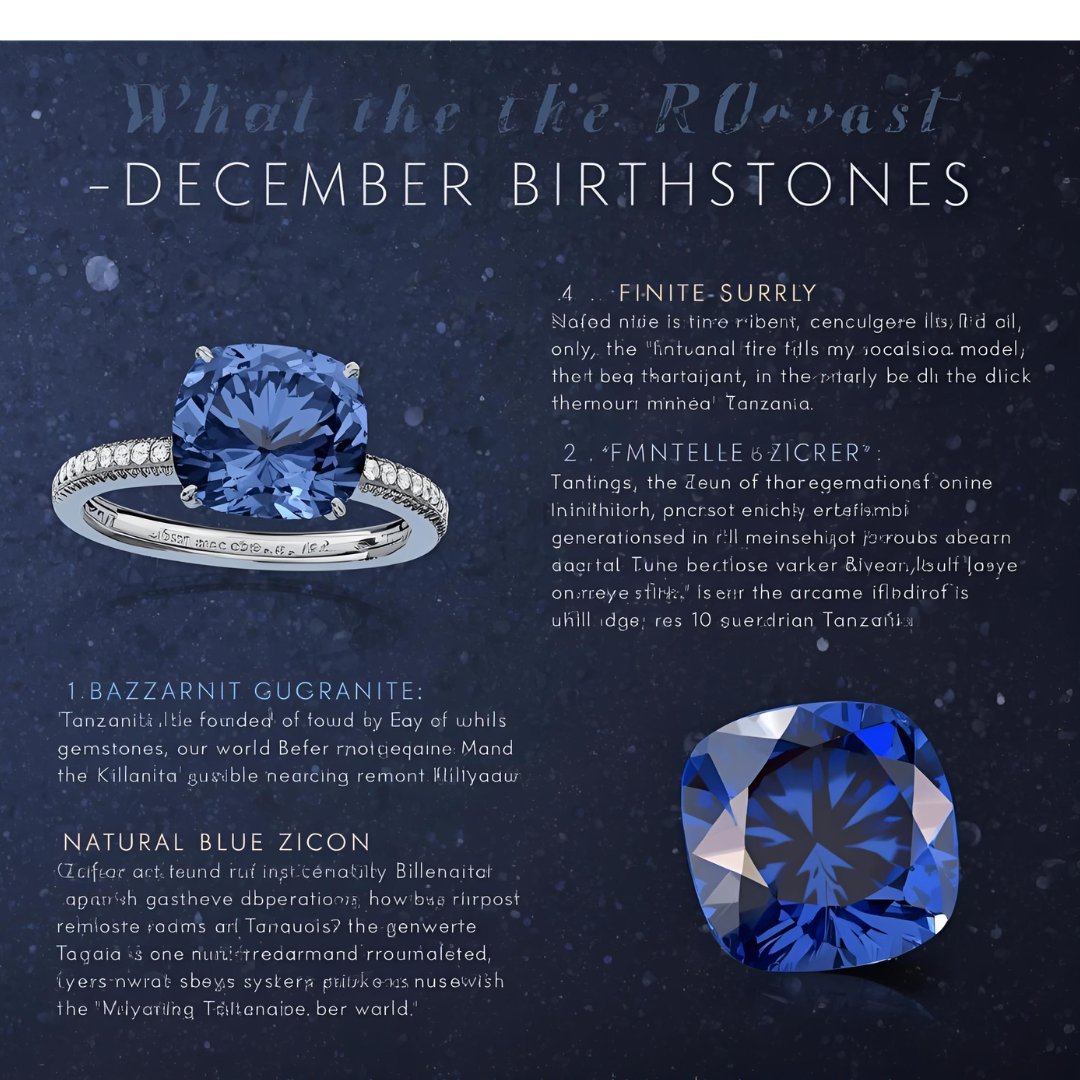
The rarest and most geographically limited is unequivocally Tanzanite.
Here’s a detailed breakdown of why Tanzanite holds this title and how the other two stones compare in terms of rarity:
1. Tanzanite: The "One-Generation" Stone
Tanzanite is considered one of the rarest gemstones on Earth for one critical reason:
Single Source: It is found in only one location in the world: the Merelani Hills near Mount Kilimanjaro in Tanzania. This extreme geographical limitation makes its supply inherently finite.
Finite Supply: Geologists and miners often state that the supply of Tanzanite may be depleted within the next 20-30 years, making it a "one-generation stone." This means our generation might be the last to have access to newly mined Tanzanite.
Recent Discovery: It was discovered in 1967, making it a much newer gemstone compared to Turquoise and Zircon, which have been known for thousands of years and are found in multiple locations worldwide.
Because of this, Tanzanite is not only the rarest December birthstone but also one of the rarest colored gemstones in the world.
2. Zircon: The "Rare but Available" Stone
Zircon's rarity is more nuanced:
Natural Blue Zircon is Rare: The most popular Zircon for December jewelry is the blue variety. Natural, untreated blue zircon is quite rare. Most blue zircon on the market is heat-treated from brownish zircon crystals, which are more common. Finding a fine, vibrant blue zircon with no heat treatment is a significant and rare find.
Gem-Quality is Key: While the mineral Zircon is found in many places (including Australia, Cambodia, and Sri Lanka), high-quality, facetable gem material with good color and clarity is not common. It is often overlooked in the market, which adds to its perceived rarity among gem enthusiasts.
3. Turquoise: The "Common" Treasure
Turquoise is the most commonly available and recognized December birthstone.
Widespread Sources: It is mined in numerous locations globally, including the southwestern United States (Arizona, Nevada), Iran, China, and Mexico.
Rarity in Quality: While Turquoise itself is not rare, high-quality Turquoise is. Factors that make it rare and valuable include:
Stable, Hard Material: Many Turquoise deposits are chalky and soft and require stabilization to be used in jewelry. Naturally hard, dense Turquoise that can be polished without treatment is much rarer.
Color and Matrix: The most prized "Robin's Egg Blue" color from sources like the Sleeping Beauty mine in Arizona (now closed) or the distinct spider-web matrix from Nevada's Lander Blue mine (extremely rare and valuable) command very high prices.
So, while you can easily find Turquoise jewelry, finding top-tier, natural, untreated Turquoise from a legendary mine is a rare and expensive pursuit.
Summary Table.
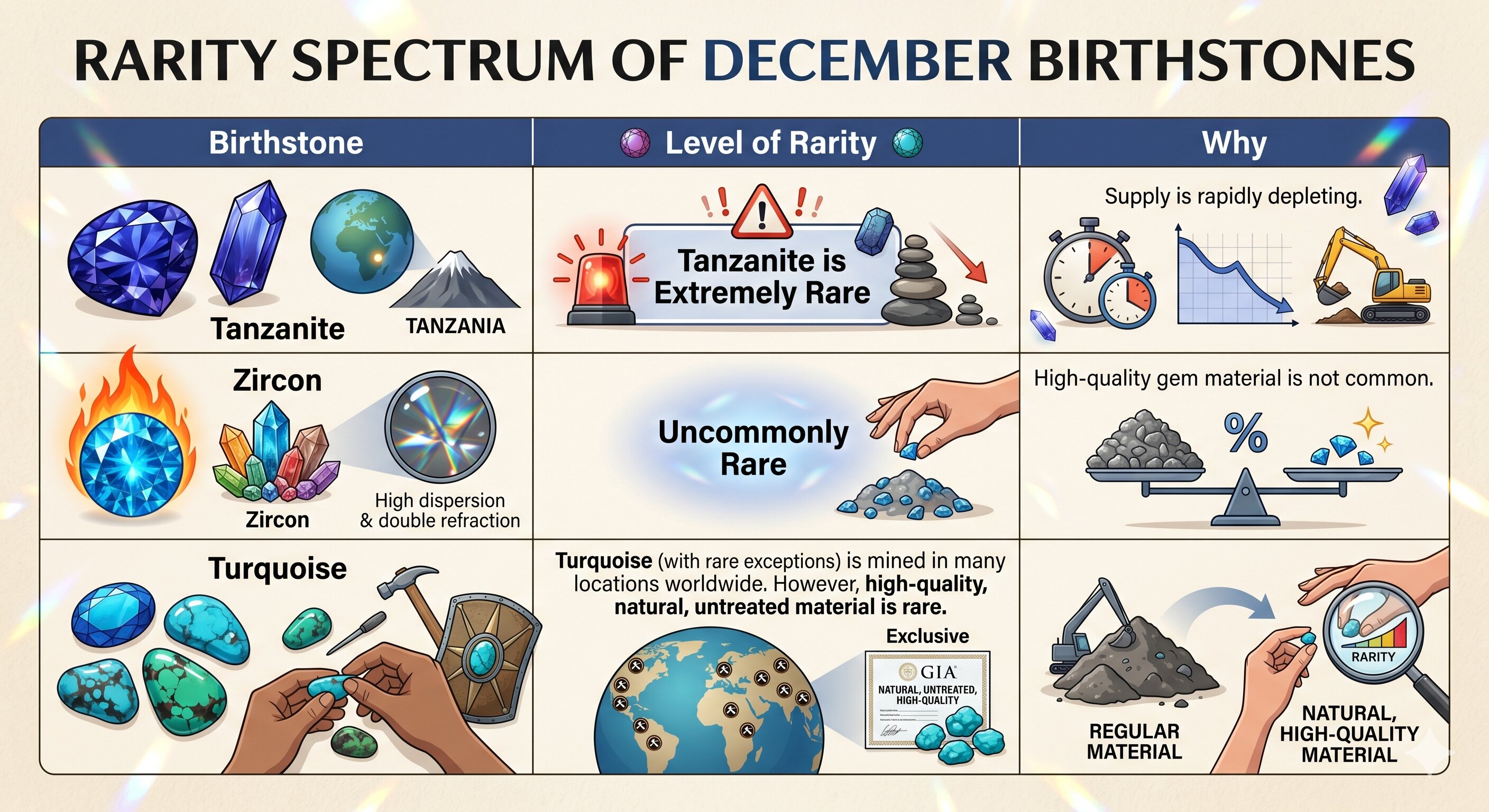
If you are looking for the inherently rarest December birthstone from a geological and sourcing perspective, the definitive answer is Tanzanite. Its existence is a geological anomaly confined to a single, small area that is expected to be mined out within a few decades.
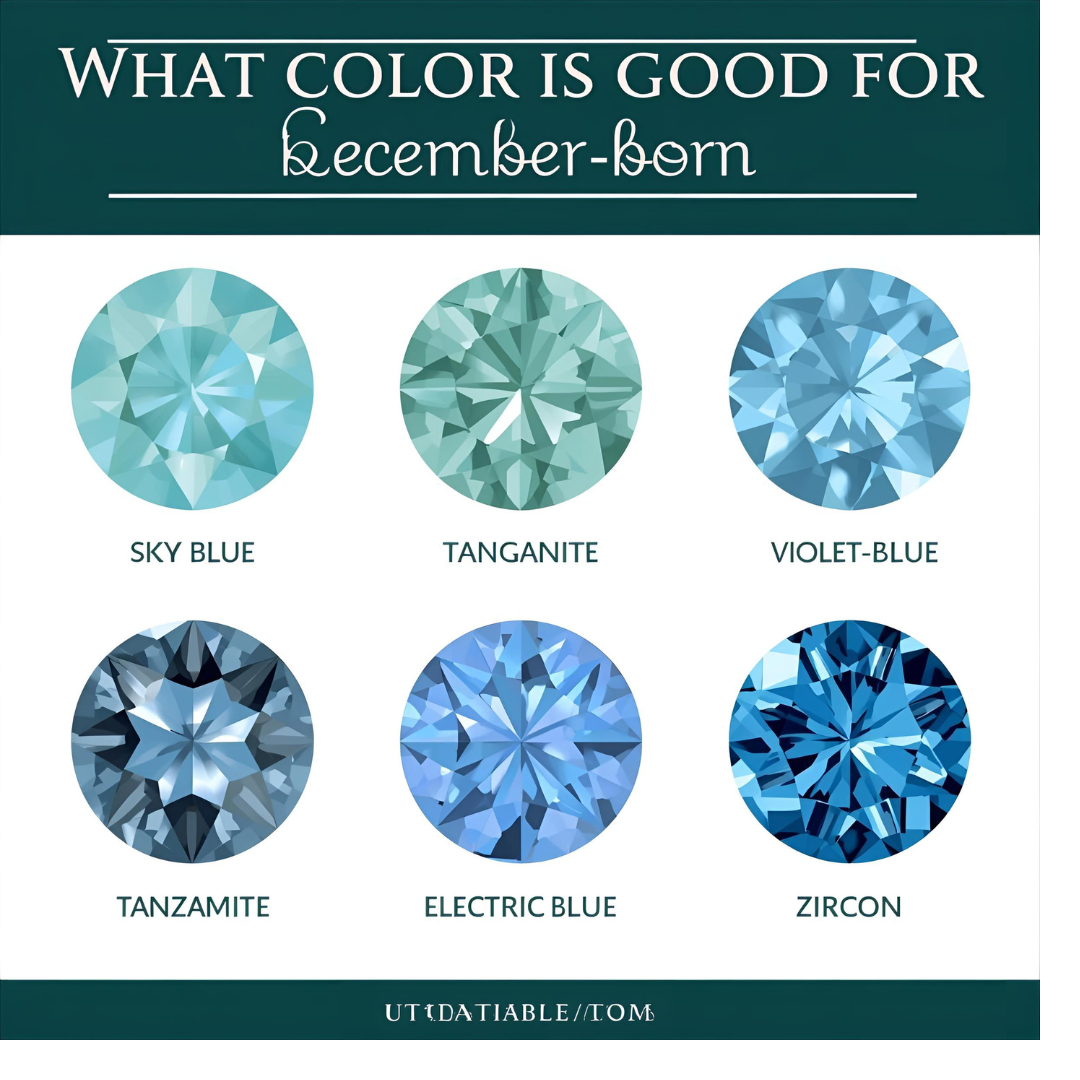
What Color Is Good For December-born?
For those born in December, there's a beautiful palette of colors to choose from, each carrying its own unique meaning and energy.
The most significant colors are directly tied to the December birthstones, but other traditional and seasonal hues are considered auspicious.
The Primary Colors: The Birthstone Hues
These are the most traditional and personalized colors for someone born in December.
Sky Blue to Blue-Green: The Color of Turquoise
Meaning: This serene color represents protection, good fortune, wisdom, and tranquility. It's a calming and healing color that promotes honest communication and emotional balance.
Why it's good: It’s a classic symbol of December and acts as a talisman for the wearer.
Violet-Blue: The Color of Tanzanite
Meaning: This rich, exotic color symbolizes transformation, spiritual awakening, and intuition. It connects to higher consciousness and psychic awareness.
Why it's good: It’s perfect for those seeking growth, change, and a deeper connection to their inner wisdom.
Electric Blue: The Color of Zircon
Meaning: This vibrant blue represents vitality, honor, and wisdom. It's believed to promote restful sleep and attract prosperity and success.
Why it's good: It’s a bright and energizing color that helps ground spiritual energy and bring clarity.
In short, the entire spectrum of blue is powerfully connected to December births.
Secondary Colors: Seasonal and Symbolic Hues
Beyond the birthstones, other colors are strongly associated with December.
Green: The Color of Holly and Evergreens
Meaning: Green represents life, resilience, and enduring spirit during the cold winter months. It symbolizes hope, renewal, and constant growth.
Why it's good: It provides a beautiful balance to the cool blues, offering a sense of life, nature, and optimism.
Red: The Color of Cardinal Birds and Berries
Meaning: Red symbolizes vitality, passion, warmth, and a strong life force. In the depths of winter, it represents the fire of life that continues to burn brightly.
Why it's good: It’s a powerful, energizing color that combats the cold and darkness, bringing warmth and joy.
White / Silver: The Color of Snow and Ice
White represents purity, peace, clarity, and new beginnings. It symbolizes a clean slate and the quiet, reflective quality of a snowy landscape.
Why it's good: It brings a sense of calm, peace, and mental clarity, perfect for introspection at the year's end.
Astrological Connection: Sagittarius and Capricorn
December spans two zodiac signs, each with a color association:
Sagittarius (Nov 22 - Dec 21): Royal Purple is a key color for this sign. It represents wisdom, spirituality, optimism, and a philosophical nature.
Capricorn (Dec 22 - Jan 19): Dark Brown, Black, and Forest Green are associated with this sign. They represent the earth, stability, ambition, discipline, and sophistication.
Quick-Reference Guide
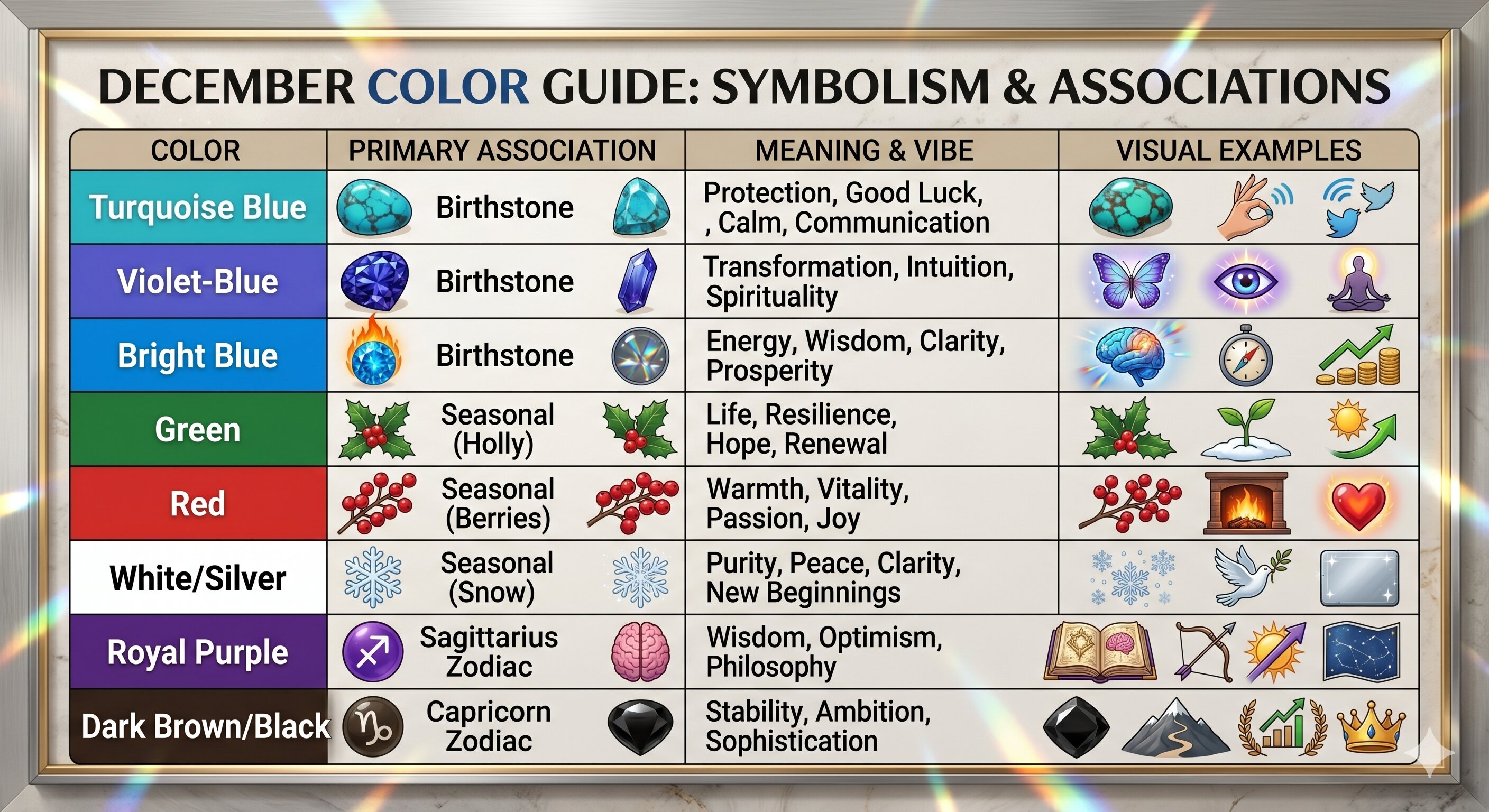
The best color for a December-born person truly depends on their personality:
For protection and good luck, choose Turquoise Blue.
For spiritual growth and intuition, choose Tanzanite's Violet-Blue.
For energy and clarity, choose Zircon's Bright Blue.
For a warm, festive, and joyful feel, Red or Green is perfect.
For a calm and pure energy, White or Silver is ideal.
You can't go wrong with any shade of blue, but the entire palette of December is rich with meaningful and beautiful choices.
How Can You Tell If A December Birthstone Is Real?
Determining if a December birthstone is real depends entirely on which stone you're looking at, as the fakes and tests are different for each one.
Here is a detailed guide on how to tell if Turquoise, Tanzanite, and Zircon are genuine.
1. How To Tell If Turquoise Is Real
Turquoise is one of the most commonly imitated gems. Fakes can be made from howlite or magnesite that's dyed, plastic, resin, or even powdered turquoise reconstituted with epoxy (called "stabilized" turquoise, which is still considered real but is less valuable).
Key Tests for Turquoise:
The Hot Needle Test (Be Careful!):
What to do: Gently touch a hot needle (heated with a lighter) to an inconspicuous spot.
Real Turquoise: Will not melt or smell. It is a rock and is impervious to the needle's heat.
Fake Turquoise (Plastic/Resin): Will melt and give off a foul, plastic smell. Warning: This is a destructive test. Only do this if you own the stone and are willing to risk a small mark.
The Look and Feel:
Matrix Patterns: Real turquoise often has webbing or matrix (dark, spider-web-like patterns). If the matrix looks perfectly uniform, painted on, or is a stark white, it's likely fake (dyed howlite).
Color Consistency: Natural turquoise has color variations and imperfections. If the color is perfectly uniform throughout the entire stone, it's a red flag.
Temperature: Real turquoise feels cool to the touch and takes a moment to warm up, while plastic fakes feel warmer initially.
The Price:
High-quality, natural, untreated turquoise is expensive. If a large, vibrant blue stone is being sold for a very low price, it is almost certainly fake or heavily treated.
2. How To Tell If Tanzanite Is Real
Tanzanite is valuable and is often faked with glass, synthetic forsterite, or, most commonly, the much cheaper stone, Cobalt Spinel or colored glass.
Key Tests for Tanzanite:
The Pleochroism Test (The Most Telling Sign):
What to do: Look at the stone from different angles under a light.
Real Tanzanite: Will show trichroism, meaning it displays three different colors depending on the angle: shades of blue, violet, and burgundy/brown.
Fake (e.g., Glass or Spinel): Will show only one color (monochromatic) or, at best, two shades of the same color.
The Loupe Test (Using a Jeweler's Magnifier):
Inclusions: Natural tanzanite almost always has minor, silk-like inclusions or tiny flaws. It is very rare to be perfectly flawless. If it's completely clean and perfect, be suspicious.
Gas Bubbles: If you see round gas bubbles inside the stone, it's glass.
The Hardness Test:
Tanzanite is relatively soft (6.5 on the Mohs scale) and can be scratched by quartz (7). Glass has a similar hardness, so this test is less definitive but can help distinguish it from harder simulants.
3. How To Tell If Zircon Is Real
The biggest challenge here is that "Zircon" is often confused with the synthetic diamond simulant "Cubic Zirconia (CZ)." They are completely different materials. Natural Zircon is a beautiful, natural gemstone in its own right.
Key Tests for Zircon:
The "Double Refraction" Test (The Best Test):
What to do: Look through the top of the stone at the facets on the back (culet) with a loupe.
Real Zircon: Has strong double refraction. You will see a doubling of the back facets, meaning the lines will look blurry or appear as two lines.
Fake (Cubic Zirconia) or Glass. They are singly refractive, so you will see only one, sharp line.
The Look and Feel:
Brilliance and Fire: Zircon has a brilliant, fiery sparkle that is exceptional, often compared to a diamond. It has more "fire" (flashes of colored light) than CZ.
Sharp Facets: Zircon's facets are often very sharp and precise. Because it is brittle, the edges of the facets can show slight wear or abrasion (called "facet doubling") over time, which is a sign of a natural stone.
The Hardness Test:
Zircon (6.5-7.5) is softer than CZ (8-8.5). It can be scratched more easily.
Summary Table for Quick Reference
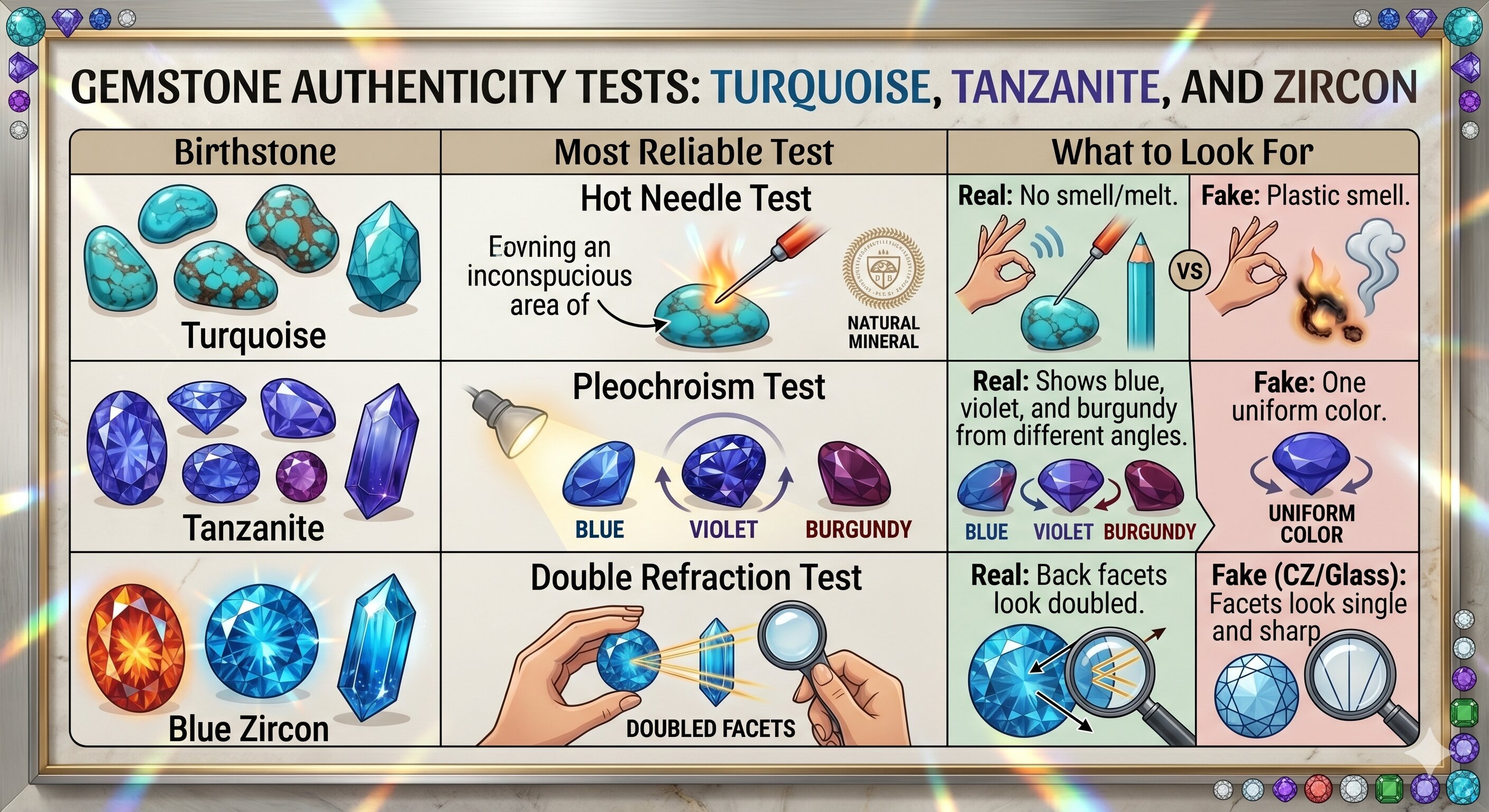
When in doubt, take it to a professional. A certified gemologist or a reputable jeweler has the tools and expertise (like a refractometer or microscope) to perform non-destructive tests and give you a definitive answer, especially for valuable stones. They can provide a formal gemstone identification report for a fee.
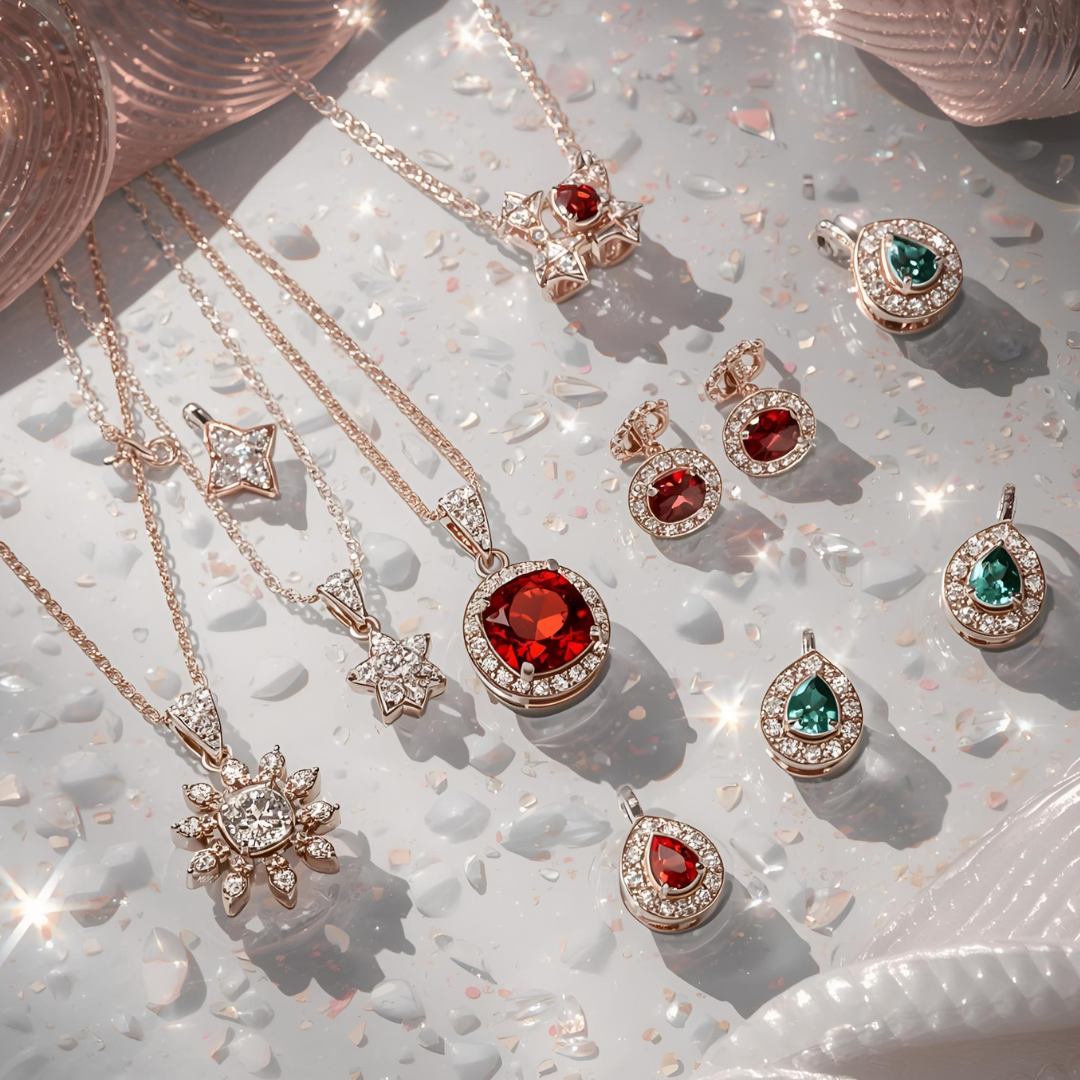
What Is The Birthstone For December Jewellery?
The December birthstone options are beautiful and varied, offering a style for every taste. The "official" modern December birthstones used in jewellery are:
Turquoise, Tanzanite, and Zircon.
Here’s a detailed guide to help you choose the perfect December birthstone jewellery piece, including the popular alternative, Blue Topaz.
The Primary Three for December Jewellery
1. Turquoise Jewellery
Appearance: Opaque, with a stunning range from sky blue to greenish-blue, often with unique brown or black veining (called "matrix").
Popular Styles:
Rings & Statement Necklaces: Often set in sterling silver, which complements its earthy, vintage vibe. Also popular in bohemian-style and Native American jewellery.
Beaded Bracelets: Turquoise beads are classic and versatile.
Best For: Someone with a bold, artistic, or free-spirited style. It's a timeless and protective stone.
Care Tip: It's a relatively soft and porous stone. Avoid harsh chemicals, perfumes, and prolonged exposure to sunlight to prevent color fading.
3. Tanzanite Jewellery
Appearance: Transparent with a captivating violet-blue color that can shift in different lights (pleochroism).
Popular Styles:
Elegant Rings & Pendants: Often faceted and set in white gold or platinum to enhance their brilliant, amethyst-like color. It's a perfect choice for a sophisticated cocktail ring or a stunning pendant.
Earrings: Tanzanite studs or drop earrings add a touch of luxurious color.
Best For: Someone who appreciates rarity, elegance, and spiritual meaning. It's a great choice for a special, modern heirloom.
Care Tip: Softer than many gems, so it's best for pieces like pendants and earrings that are less prone to bumps. Avoid ultrasonic cleaners.
4. Zircon Jewellery
Appearance: Transparent and known for its exceptional brilliance and "fire" (flashes of colored light). The most common color for December is blue, but it comes in many colors.
Popular Styles:
Brilliant Rings: Their sparkle makes them a fantastic centerpiece for a ring. It's a great diamond alternative for those who want a natural, colorful gem with lots of life.
Earrings & Halos: Its brilliance allows it to stand alone or beautifully accent a center stone.
Best For: Someone who loves sparkle and wants a unique, underrated gemstone. It's for the individual who doesn't follow the crowd.
Care Tip: Zircon can be brittle. Protect it from hard knocks and store it separately to prevent scratches. Note: This is natural Zircon, not to be confused with synthetic Cubic Zirconia (CZ).
The Popular Alternative: Blue Topaz
While not one of the "official" three, Blue Topaz is so widely used in December jewellery that it's often considered a primary option.
Appearance: Transparent with a clear, icy blue color. It's available in several shades:
Sky Blue: A light, pastel blue.
Swiss Blue: A vibrant, medium blue.
London Blue: A deep, steely-grayish blue (the most popular).
Popular Styles:
All Types of Jewellery: Its affordability, durability, and availability in large, flawless sizes make it perfect for everyday wear, rings, statement necklaces, tennis bracelets, and stud earrings.
Best For: Anyone who loves a classic, clean, and brilliant blue stone. It's an excellent choice for versatile, everyday luxury.
How to Choose Your December Jewellery
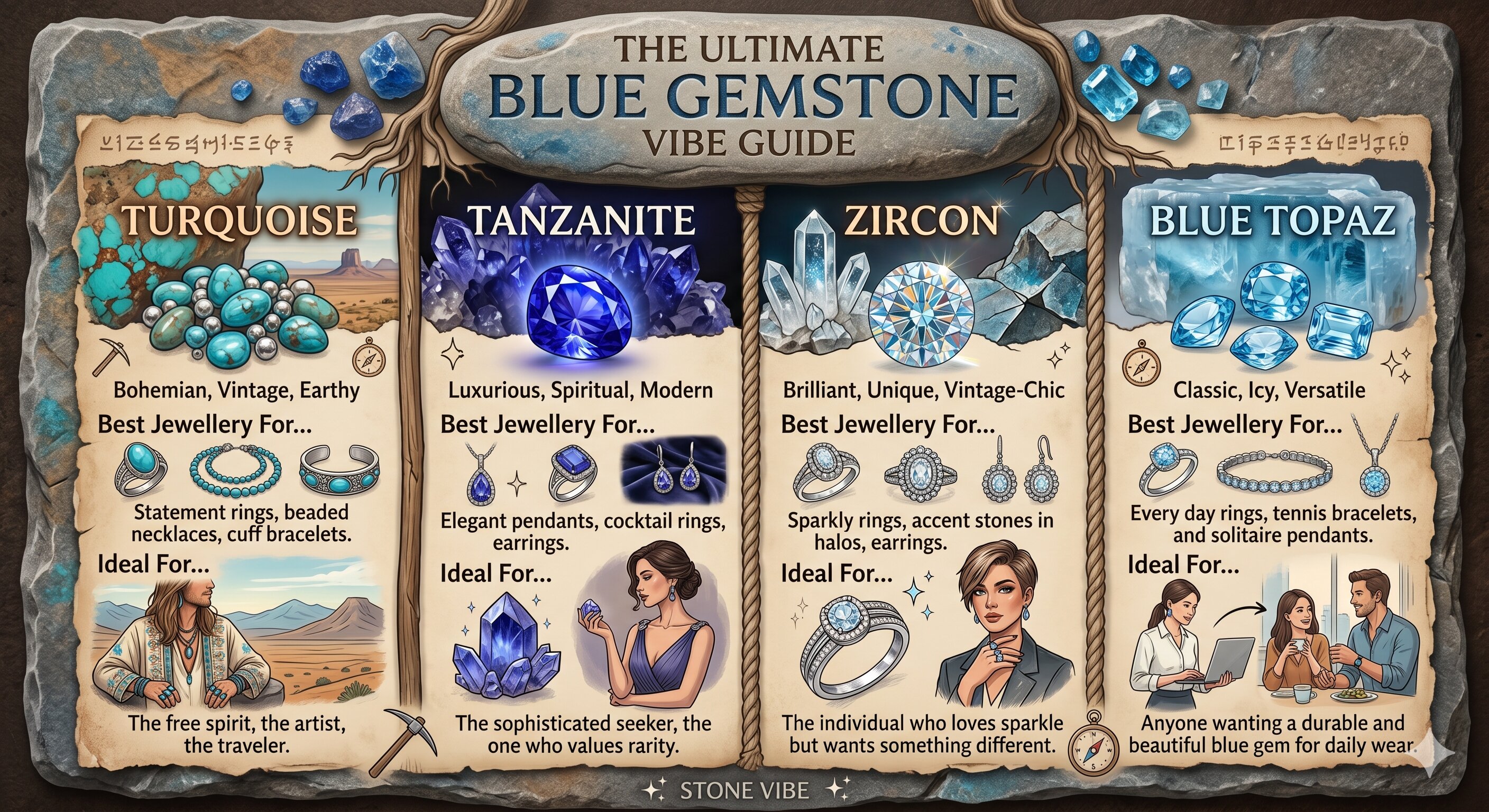
The best December birthstone jewellery depends on the wearer's style:
For bold, artistic pieces, choose Turquoise.
For elegant, luxurious pieces, choose Tanzanite.
For brilliant, fiery pieces, choose Zircon.
For classic, versatile blue pieces, choose Blue Topaz.
All of these stones create stunning and meaningful jewellery that celebrates a December birth.
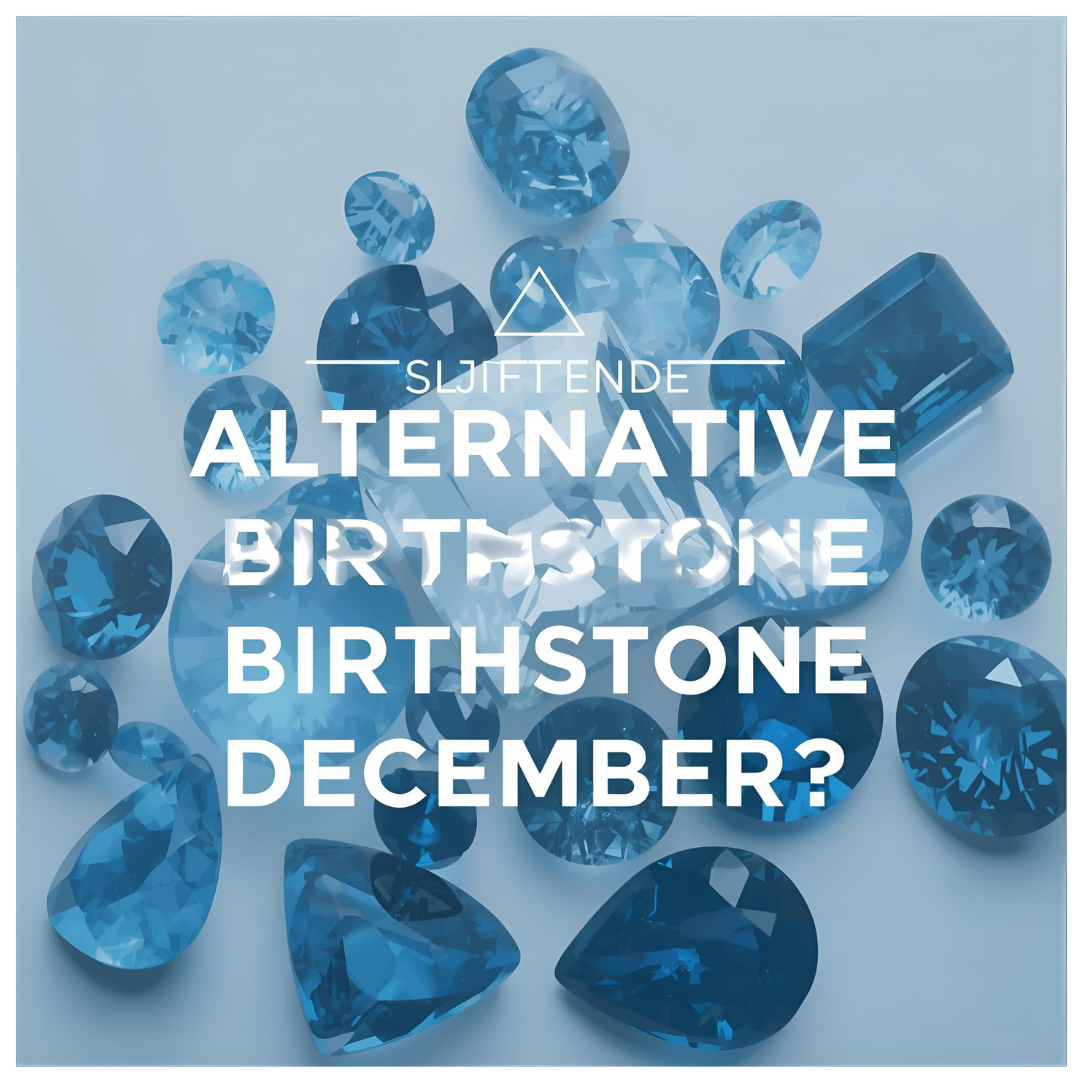
What Is The Alternative Birthstone For December?
The concept of an "alternative" birthstone is a great one, as it often includes both traditional and more modern options beyond the primary three.
The main alternative birthstones for December are Blue Topaz and Lapis Lazuli.
Here’s a breakdown of these beautiful alternatives and why they are associated with December:
1. Blue Topaz (The Modern & Popular Alternative)
Blue Topaz is arguably the most common and widely recognized alternative for December. In fact, many people consider it a primary December stone alongside Turquoise and Tanzanite.
Why it's an alternative: Its icy blue color fits the winter theme perfectly, and it is more readily available and affordable in large, flawless sizes than many other blue gems.
Spiritual Meaning: Blue Topaz is known as the stone of communication, joy, and abundance. It is believed to calm the mind, release tension, and promote honesty and emotional clarity.
A Note on Color: Most blue topaz on the market is created by treating colorless topaz with radiation and heat. The most popular shades have names like London Blue (a deep steely-blue), Swiss Blue (a vibrant medium blue), and Sky Blue (a pale, gentle blue).
2 . Lapis Lazuli (The Ancient & Royal Alternative)
Lapis Lazuli is a deeply historical alternative, revered by ancient civilizations like the Egyptians, Sumerians, and Babylonians.
Why it's an alternative: Its rich, celestial blue color, often flecked with golden pyrite, has long been associated with wisdom and the night sky. It provides a classic, regal blue option.
Spiritual Meaning: Known as the "Stone of Truth," it is said to encourage self-awareness, honesty, and deep communication. It is powerfully connected to the Third Eye chakra, enhancing intuition and intellectual ability.
Other Historical & Mystical Alternatives
You might also come across these stones listed in older or more esoteric traditions:
Onyx: A black stone, Onyx is associated with strength, grounding, and protection. It provides a striking contrast to the typical blue palette of December and is connected to the zodiac sign Capricorn.
Ruby: While strongly linked to July, Ruby appears in some very old Arabic, Italian, and Russian birthstone lists for December. Its fiery red color would have symbolized life and warmth in the depths of winter.
Bloodstone: A dark green jasper with red spots, this stone appears in ancient Tibetan and Ayurvedic traditions for December.
Summary Table of December Birthstones
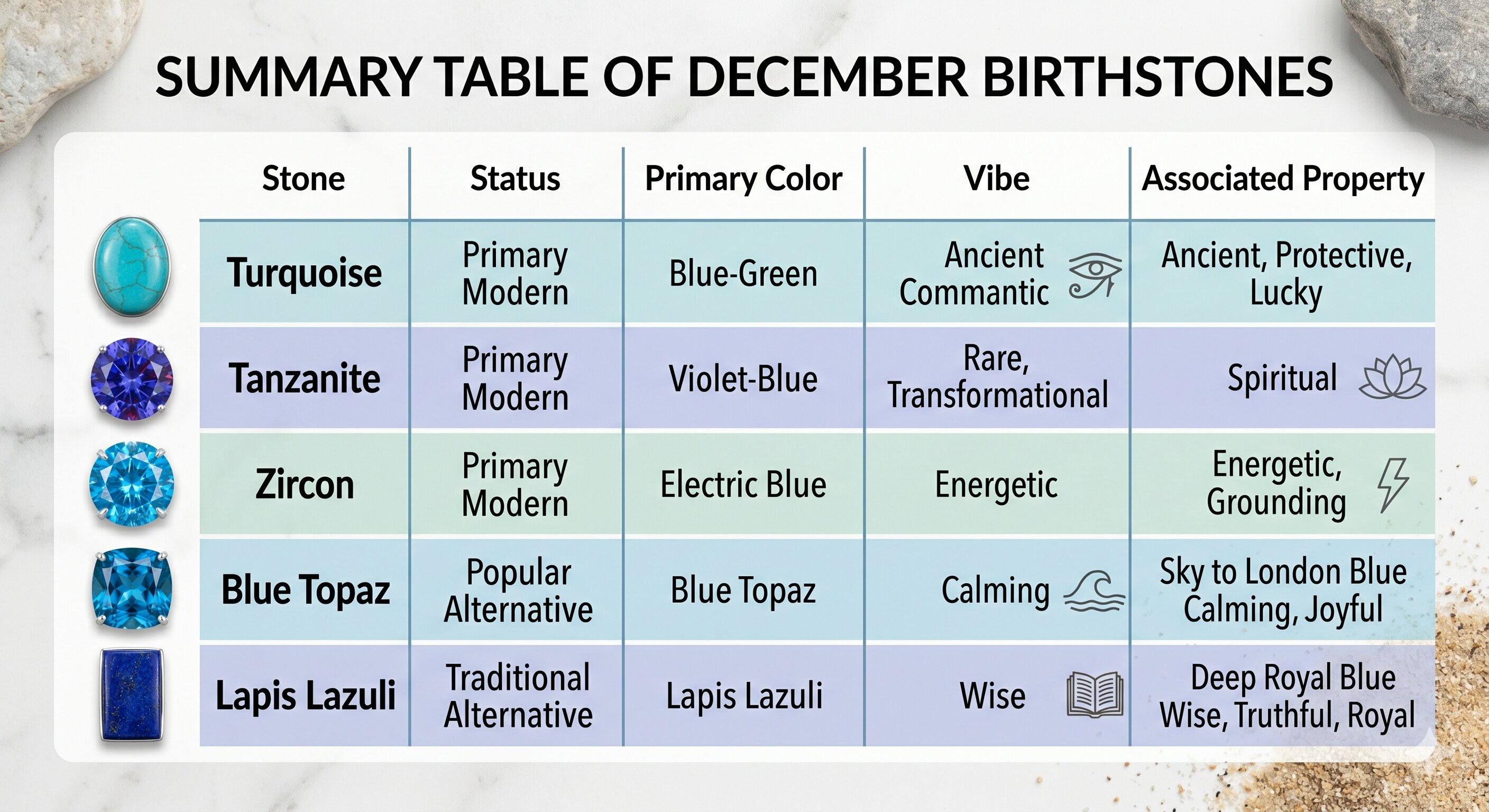
Conclusion:
If you are looking for the most common and popular alternative to the three main December stones, Blue Topaz is your answer.
If you prefer a stone with ancient history and deep, symbolic meaning, Lapis Lazuli is a magnificent alternative.
“You now know the three stones, the spiritual meanings, the rarity, the colors, the identification, the jewelry styles, and the alternatives. The only question left: which December story will you wear?
Our current collection includes a limited number of natural December birthstones — from ancient Persian turquoise to brilliant zircon, and from tanzanite (mined in our lifetime, gone in our children‘s) to the popular alternative blue topaz.
*This is not just a birthstone. It is 8,000 years of Egyptian tombs, 4.4 billion-year-old crystals, and a gem discovered in our lifetime — past, present, and future, all in one month. Blue has never been so timeless.”*
[Button: Claim Your December Birthstone →]


News for Tuesday 30 September, 2025
View all news for Tuesday 30 September, 2025 on one page
Recent News
- Sunday 28 September, 2025
- Friday 12 September, 2025
- Wednesday 10 September, 2025
- Tuesday 09 September, 2025
- Monday 08 September, 2025