

18K Gold Jewelry for Sensitive Skin: What You Need to Know
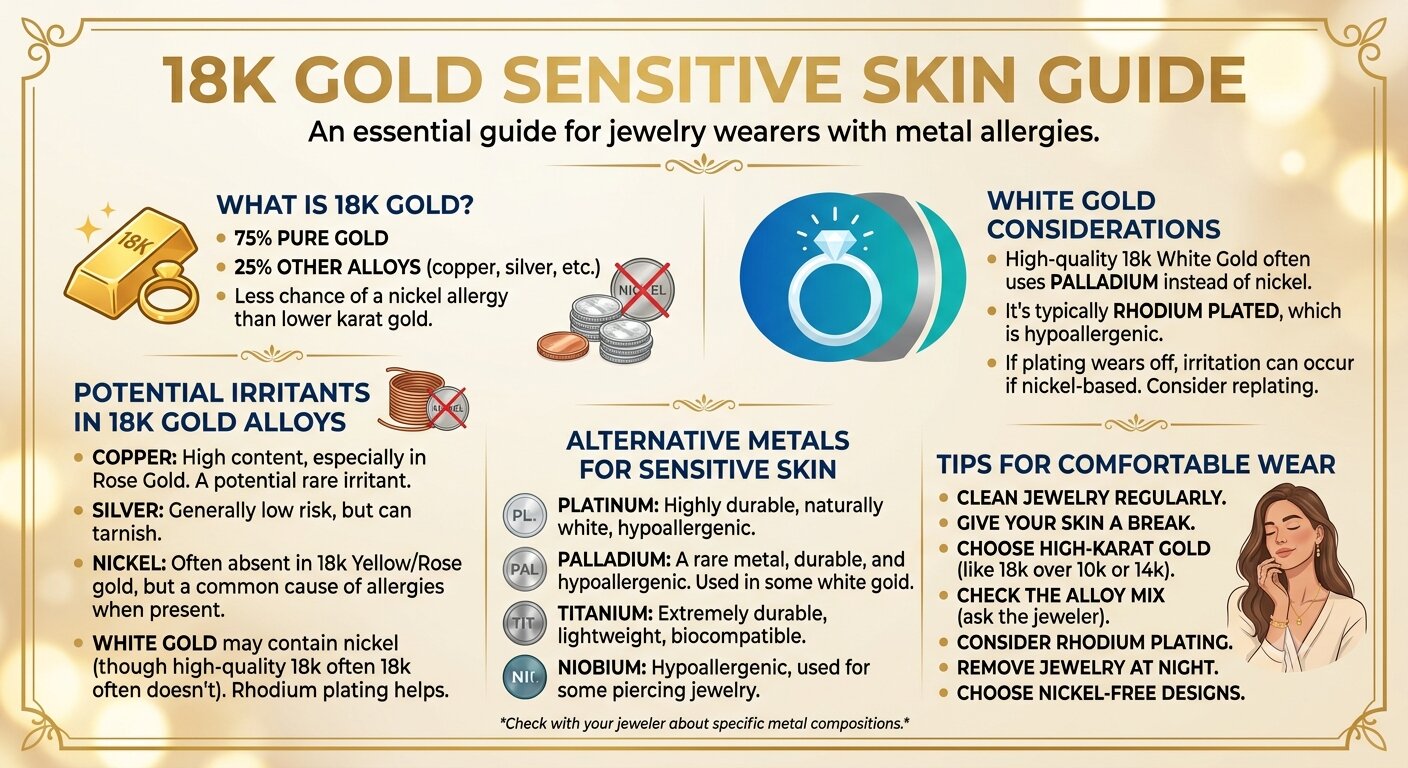
18k Gold Sensitive Skin Guide
For people with sensitive skin, finding jewelry that won't irritate can be a real challenge. The good news is that 18K gold is widely considered one of the best choices for sensitive skin.
However, not all 18K gold is created equal, and understanding the details can help you make a truly skin-safe purchase.
Why 18K Gold Is a Hypoallergenic Choice
The key to 18K gold's skin-friendliness lies in its composition. 18K gold is 75% pure gold, with the remaining 25% being other metals (alloys) that provide strength and color. Because pure gold itself is non-reactive and rarely causes allergies, a higher gold content means fewer potentially irritating metals in the alloy.
The primary culprit behind most jewelry allergies is nickel. 18K gold contains a lower percentage of alloy metals compared to lower-karat options like 14K (58.3% gold) or 10K, making it less likely to contain enough nickel to trigger a reaction. For this reason, both medical sources and jewelry experts consistently recommend 14K or 18K gold as safe options for sensitive skin.
Important Nuances: It's Not Always the Gold
While 18K gold is generally safe, a few important points should be considered:
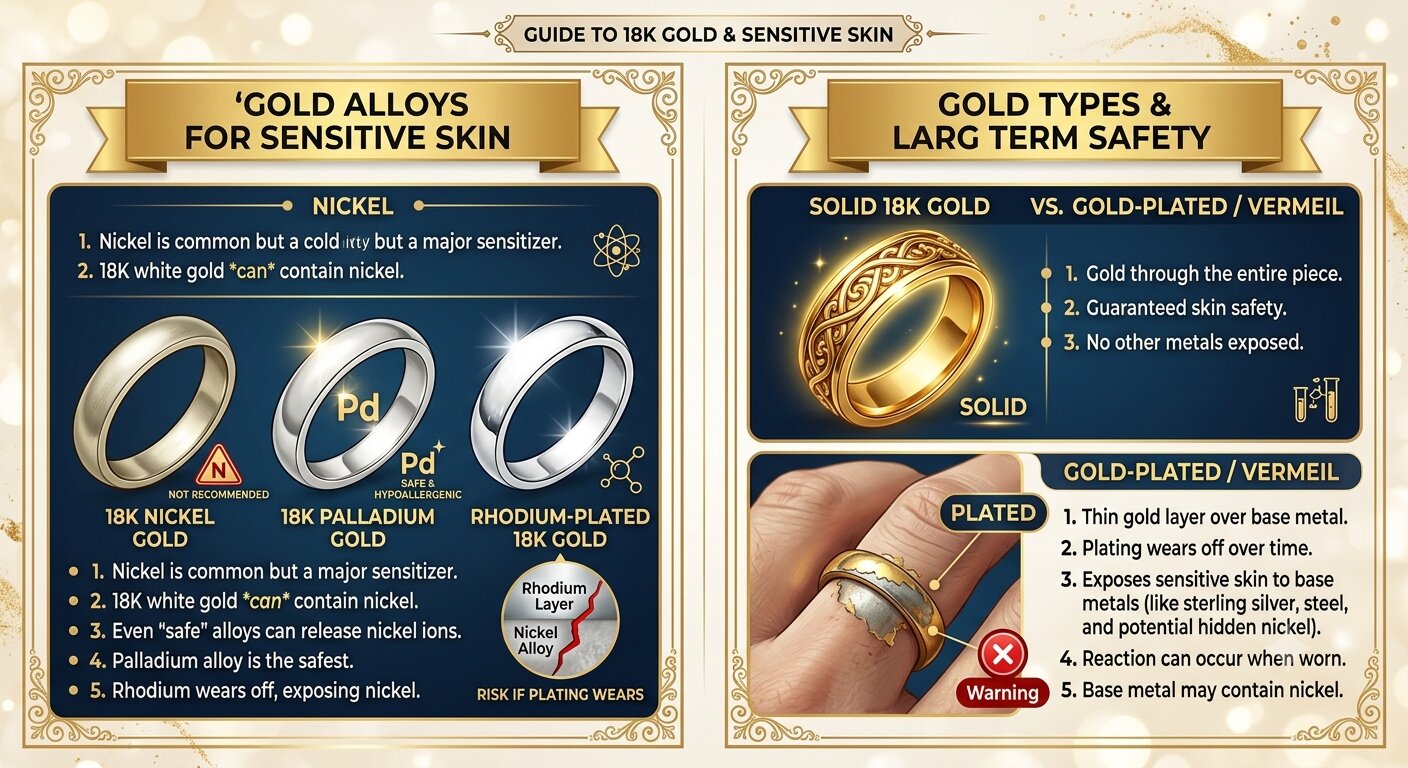
How to Choose the Right 18K Gold for Your Skin
Always Choose Solid 18K Gold Over Plated: This ensures the metal in contact with your skin is consistently 75% pure gold. Look for hallmarks like "18K," "18KT," or "750".
Ask About the Alloy Mix: Especially for white gold. Inquire if the piece is alloyed with nickel or palladium. Palladium is a safer, hypoallergenic alternative.
Check for a "Nickel-Free" Guarantee: Many reputable jewelers explicitly state their pieces are nickel-free, providing extra peace of mind.
Consider 18K Yellow or Rose Gold: Yellow gold traditionally uses copper and silver alloys, which are less likely to cause issues than nickel-based white gold. Rose gold, which is alloyed with a higher proportion of copper, is also a safe and durable choice.
A Note on Allergies
While a gold allergy is very rare, it is not impossible. A board-certified dermatologist notes that "a gold allergy isn’t very common, but your body can still react to it if you’re allergic". However, this is far less common than a nickel allergy, making high-purity gold like 18K an excellent first choice for most people with sensitive skin.


18K Gold vs 14K Gold vs Platinum: Which Metal Is Best for Your Ring
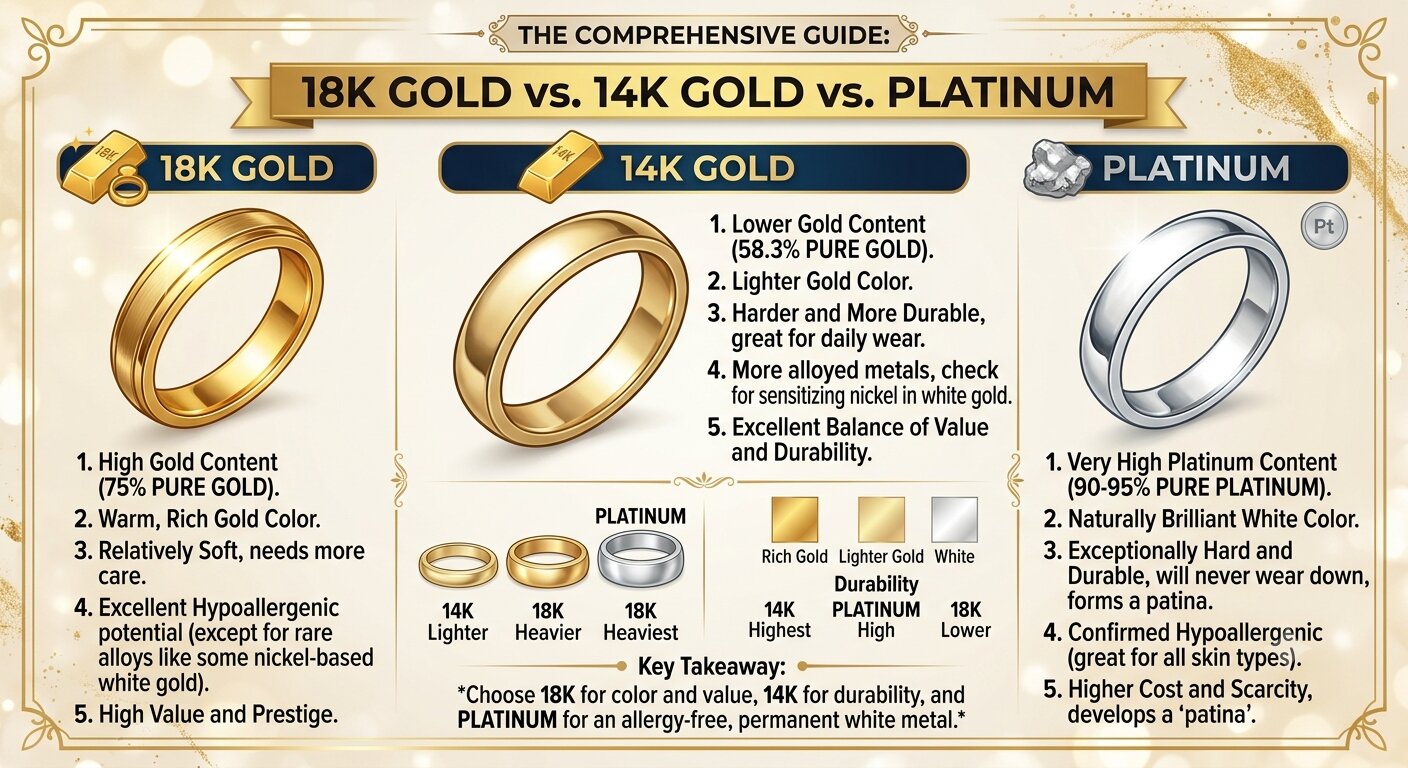
18K Gold vs 14K Gold vs Platinum: The Ultimate Ring Metal Guide
Confused between 18K gold, 14K gold, and platinum rings? Compare purity, durability, cost, and hypoallergenic properties to choose the best metal for your lifestyle and budget.
Hook: Start with a relatable scenario: "You’re staring at three rings, each stunning, each with a very different price tag. One is 18K gold, another 14K gold, and the third is platinum. How do you choose?"
Problem: Briefly state the common confusion: purity, durability, color, and cost all play a role, making the decision overwhelming.
Promise: "This guide will break down everything you need to know about 18K gold, 14K gold, and platinum, comparing them side-by-side so you can make a confident decision based on your lifestyle, budget, and style."
Understanding the Basics: What Do 18K, 14K, and Platinum Actually Mean?
This section explains the fundamental nature of each metal.
What is 18K Gold?
Composition: Explain it's an alloy of 75% pure gold and 25% other metals (like copper, silver, palladium).
Hallmark: Mention the "750" stamp.
Characteristics: Known for its rich, deep color and high intrinsic value. It's the standard for high-end jewelry in Europe and Asia.
What is 14K Gold?
Composition: It is 58.3% pure gold and 41.7% alloy metals.
Hallmark: Mention the "585" stamp.
Characteristics: The most popular choice in the U.S. for its ideal balance of durability and purity. It offers a good gold color at a more accessible price point.
What is Platinum?
Composition: Clarify it's a naturally white precious metal, typically 90-95% pure (e.g., PT950 or PT900).
Characteristics: It's significantly denser and heavier than gold. It's prized for its naturally white luster that never fades or requires plating.
The Showdown: A Side-by-Side Comparison
Use a clear, easy-to-read comparison table here. It's highly effective for SEO and user experience.
| Feature | 18K Gold | 14K Gold | Platinum |
| Purity | 75% Pure Gold | 58.3% Pure Gold | ~95% Pure Platinum |
| Hallmark | 750 | 585 | PT950 / PT900 |
| Durability | Good. Softer than 14K, prone to fine scratches. | Very Good. More scratch-resistant due to higher alloy content. | Excellent. Very strong and durable. |
| Color | Rich, deep yellow; pinker rose; white requires rhodium plating. | Lighter yellow, warm rose, and white require rhodium plating. | Naturally White. Never fades or changes color. |
| Maintenance | Can be polished. White 18K needs periodic replating. | Can be polished. White 14K needs periodic replating | Develops a natural 'patina' over time, and can be re-polished. No plating needed. |
| Weight & Feel | Lighter than platinum. | Lighter than platinum. | Heavy & Dense. Has a substantial, premium feel. |
| Hypoallergenic | Generally safe (nickel-free alloys). | May contain nickel; potential for allergic reactions. | Best Choice. Extremely hypoallergenic. |
| Price | More expensive than 14K. | Most Affordable. Best value. |
Most Expensive. Highest initial investment. |
Deep Dive: Pros and Cons of Each Metal
Provide a balanced view to help the reader weigh their options.
18K Gold: The Luxurious Classic
Pros: High gold content, rich color, prestigious feel, a good investment piece.
Cons: Softer and scratches more easily, white gold requires re-plating, higher price point than 14K.
14K Gold: The Durable Favorite
Pros: Excellent durability for everyday wear, most affordable, widely available, good color.
Cons: Lower gold purity, slightly less rich, white gold requires re-plating, potential for nickel allergies.
Platinum: The Forever Metal
Pros: Naturally white, never fades, extremely durable and strong, hypoallergenic, develops a unique patina over time.
Cons: Most expensive, heavy (which some may find uncomfortable), develops a patina (which some may not like).
Which Metal Is Right for YOU? A Decision-Making Guide
This is the most critical section for conversion. Help the user self-identify with a scenario.
Choose 18K Gold if...
You prefer the color of high-purity gold.
You're buying an heirloom piece.
You're investing in a piece from a luxury designer.
You're okay with slightly more maintenance.
Choose 14K Gold if...
You want the best value for everyday wear.
You're on a budget but still want a quality gold ring.
You lead an active lifestyle and need a scratch-resistant ring.
Choose Platinum if...
You want a white metal that never needs re-plating.
You have sensitive skin or metal allergies.
You like the weight and substantial feel of high-end metal.
You see this as a lifetime, forever ring.
Frequently Asked Questions (FAQ) Section
Adding an FAQ section with structured data can help your page get featured snippets on Google.
Is 18K gold better than 14K gold?
It depends. 18K has more gold, making it richer and more valuable, but 14K is more durable and affordable for daily wear.
Why is platinum more expensive than gold?
Platinum is rarer, denser, and requires more metal to make a ring (due to its weight), which drives up the cost. It's also 95% pure compared to 75% (18K) or 58% (14K) gold.
Do 18K and 14K white gold turn yellow over time?
The white gold itself doesn't change color, but the rhodium plating that gives it a bright white finish wears off over time, revealing the slightly warm, yellowish natural color of the white gold alloy. This is easily fixed by replating.
Is platinum better for engagement rings than 18K gold?
Not necessarily "better," but different. Platinum is stronger and more durable for a ring worn every day. 18K gold is softer but offers a richer, warmer color. Your choice depends on your priorities for durability versus color and prestige.
Can I wear my ring in the shower or while swimming?
It's generally not recommended for any of these metals. Chlorine and harsh soaps can damage the alloys or dull the finish over time.
18K White Gold vs Yellow Gold vs Rose Gold: Key Differences Explained
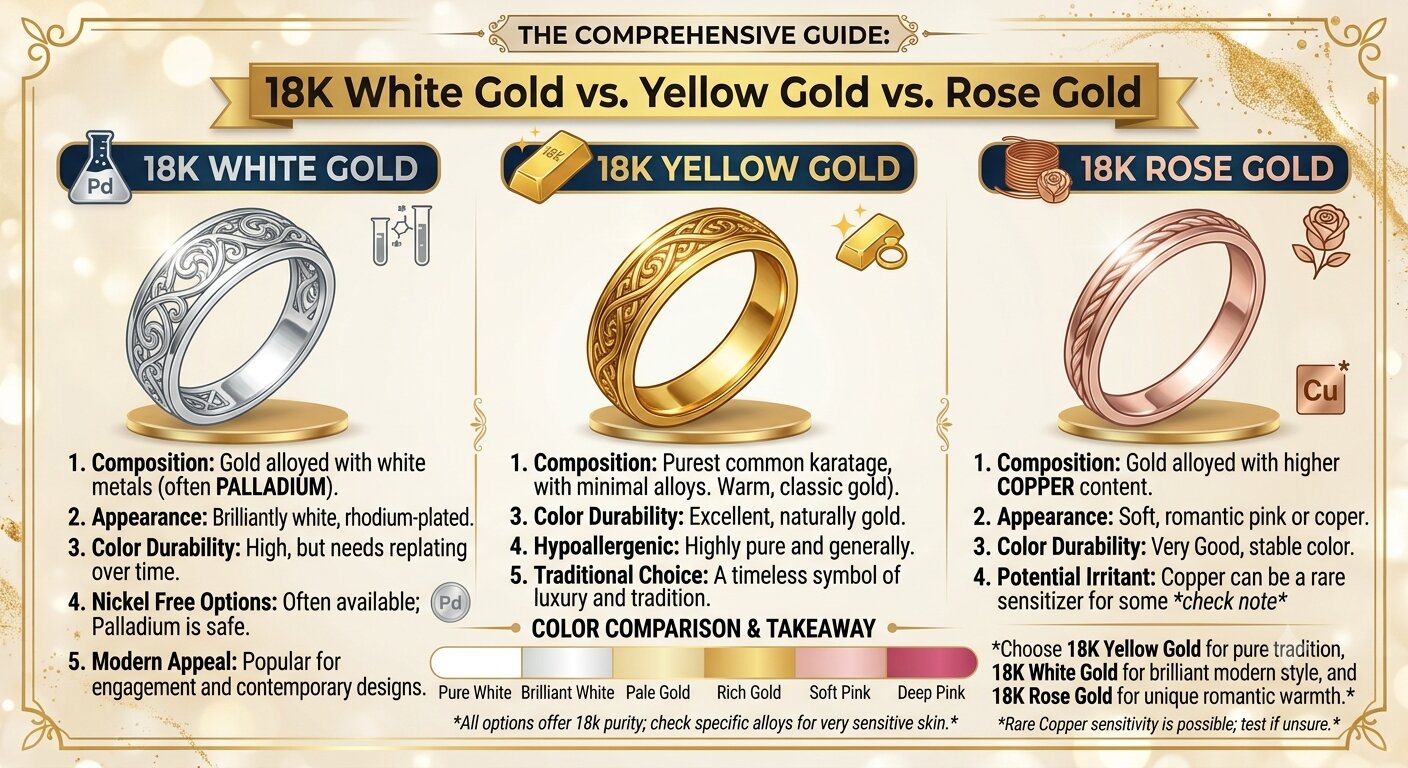
18K White Gold vs Yellow Gold vs Rose Gold: Key Differences Explained
Choosing between 18K white, yellow, or rose gold? Learn how alloy mixes create unique colors, compare durability and maintenance needs, and find the best shade for your skin tone.
Hook: Start with a relatable scenario. "You've decided on 18K gold for its quality and durability. But then you're faced with three stunning options: white, yellow, and rose. Each is beautiful, but which one is truly you?"
Problem: Briefly state the confusion. "Choosing a color isn't just about aesthetics. It's about how the metal complements your skin tone, matches your personal style, and fits your lifestyle. The differences go deeper than just the surface."
Promise: "In this guide, we'll break down everything you need to know about 18K white, yellow, and rose gold. By the end, you'll know exactly which shade is the perfect match for you."
The Science Behind the Color: How Alloys Create Different Hues
This section establishes fundamental knowledge about why the colors differ, which builds trust and authority.
The Common Base: 75% Pure Gold
Reminder: All three options are 18K gold, meaning they contain exactly 75% pure gold. The color difference comes entirely from the remaining 25% alloy mix.
Key Point: The hallmark "750" applies to all of them, guaranteeing the same gold purity and value.
How Each Color is Made
18K Yellow Gold: The classic choice. The alloy mix typically includes copper and silver (and sometimes zinc). This combination preserves and enhances the natural warm yellow color of pure gold.
18K White Gold: A modern favorite. The alloy mix includes palladium, nickel, or silver (metals that have a white/grey color). This "bleaches" the gold, creating a silvery-white base. It's then almost always plated with a hard, bright-white metal called Rhodium to give it that mirror-like finish.
18K Rose Gold: The romantic choice. The alloy mix includes a higher proportion of copper. Copper gives the metal its signature pinkish-red hue. The more copper, the pinker the final color becomes.
The Showdown: A Side-by-Side Comparison
Use a clear, easy-to-read comparison table. This is highly effective for SEO and user experience.
| Feature | 18K White Gold | 18K Yellow Gold | 18K Rose Gold |
| Primary Alloy | Palladium, Nickel, or Silver | Copper & Silver | High Proportion of Copper |
| Underlying Color | Slightly warm, greyish-white | Rich, warm yellow | Pinkish-red hue |
| Key Characteristic | Bright, modern, mirror-like finish (from rhodium plating) | Classic, timeless, warm luster | Romantic, vintage, warm, and feminine tone |
| Rhodium Plating | Yes. Almost always plated to achieve a bright white shine. | No. The color comes from the gold itself. | No. The color comes from the gold itself. |
| Durability | High. (Same as all 18K gold) | High. (Same as all 18K gold) | Very High. The copper alloy makes it slightly harder and more scratch-resistant than yellow or white gold. |
| Maintenance | Higher. Requires periodic re-plating (re-rhodiuming) to maintain its bright white color. | Very High. The copper alloy makes it slightly harder and more scratch-resistant than yellow or white gold. | Develops a beautiful patina over time. |
| Skin Tone | Flatters cool undertones (pink, blue). | Flatters warm undertones (golden, olive). | Universally flattering; especially beautiful on warm and neutral skin tones. |
| Price | Comparable (slightly more due to the rhodium plating process). | Comparable | Comparable |
Deep Dive: Pros and Cons of Each Color
Provide a balanced view to help the reader weigh their options.
18K White Gold: The Modern Classic
Pros:
Bright, sleek, and contemporary appearance.
Pairs exceptionally well with diamonds and colorless gemstones, enhancing their brilliance.
Versatile and matches any outfit.
Provides a platinum-like look at a more accessible price point.
Cons:
Requires periodic rhodium re-plating to maintain its white sheen (usually every 1-2 years for rings).
The rhodium plating can wear off on high-friction areas.
May cause allergic reactions in those sensitive to nickel (though high-quality 18K uses palladium instead).
18K Yellow Gold: The Timeless Icon
Pros:
No maintenance is required to maintain its color—it doesn't tarnish or fade.
Classic, luxurious, and instantly recognizable as "gold."
Flatters warm skin tones beautifully.
Can be easily polished to restore its original luster.
Cons:
May not pair as well with cool-toned gemstones (like blue sapphires) compared to white gold.
Some find the bright yellow color too bold for modern, minimalist styles.
18K Rose Gold: The Romantic Choice
Pros:
Trendy yet timeless, with a vintage-inspired, romantic feel.
Extremely flattering on all skin tones, making it a safe and beautiful choice.
The copper alloy makes it slightly more durable and scratch-resistant than other 18K gold colors.
Develops a unique, warm patina over time that many find more beautiful than a bright polish.
Cons:
The copper content can cause the metal to darken slightly over time (this is a patina, not tarnish, and can be polished away).
Some may find it too trendy and worry it won't be timeless.
Which Color Is Right for YOU? A Decision-Making Guide
This is the most critical section for conversion. Help the user self-identify with a scenario.
Choose 18K White Gold if...
You prefer a sleek, modern, and minimalist aesthetic.
Your ring features diamonds or white gemstones, and you want to maximize their brilliance.
You wear mostly cool-toned clothing and prefer silver-toned accessories.
You don't mind a bit of regular maintenance (re-plating) to keep it looking new.
Choose 18K Yellow Gold if...
You love vintage, classic, and timeless styles.
You want a low-maintenance piece that never needs color restoration.
You have a warm skin tone and feel that yellow gold enhances your complexion.
You want the most "traditional" and instantly recognizable gold look.
Choose 18K Rose Gold if...
You love romantic, unique, and fashion-forward jewelry.
You want a metal that's flattering on almost any skin tone.
You appreciate the slightly higher durability of a copper alloy.
You're looking for a vintage-inspired look with a modern twist.
Frequently Asked Questions (FAQ) Section
Adding an FAQ section with structured data can help your page get featured snippets on Google.
Will 18K white gold turn yellow over time?
The gold itself doesn't turn yellow, but the rhodium plating on the surface wears off, revealing the slightly warm, greyish-white natural color of the white gold alloy. This is easily fixed by having a jeweler replate it.
Is rose gold more durable than yellow or white gold?
Yes, slightly. The copper used in the alloy makes rose gold harder and more scratch-resistant than yellow or white gold, making it a great choice for everyday rings.
Which gold color is best for my skin tone?
White gold complements cool undertones (pink, blue, red). Yellow gold is stunning on warm undertones (golden, peach, olive). Rose gold is considered universally flattering and works well on nearly all skin tones.
Can I mix different colors of gold in one ring?
Absolutely! Multi-tone or two-tone gold rings (e.g., combining white and yellow gold, or rose and white gold) are a beautiful and stylish way to enjoy multiple colors and create a unique, personalized look.
Does rose gold tarnish?
Rose gold itself does not tarnish, but the copper in the alloy can oxidize over time, causing the metal to darken or develop a richer, more antique-looking patina. This is not damage and can be polished away to restore its original pink hue.
Conclusion & Final Recommendation
Summary: Reiterate that the "best" color is personal. 18K white gold offers modern elegance; yellow gold provides timeless luxury; and rose gold brings romance and warmth. The right choice depends on your personal style, skin tone, and how much maintenance you're willing to commit to.
Is 18K Gold Jewelry Durable Enough for Everyday Wear?
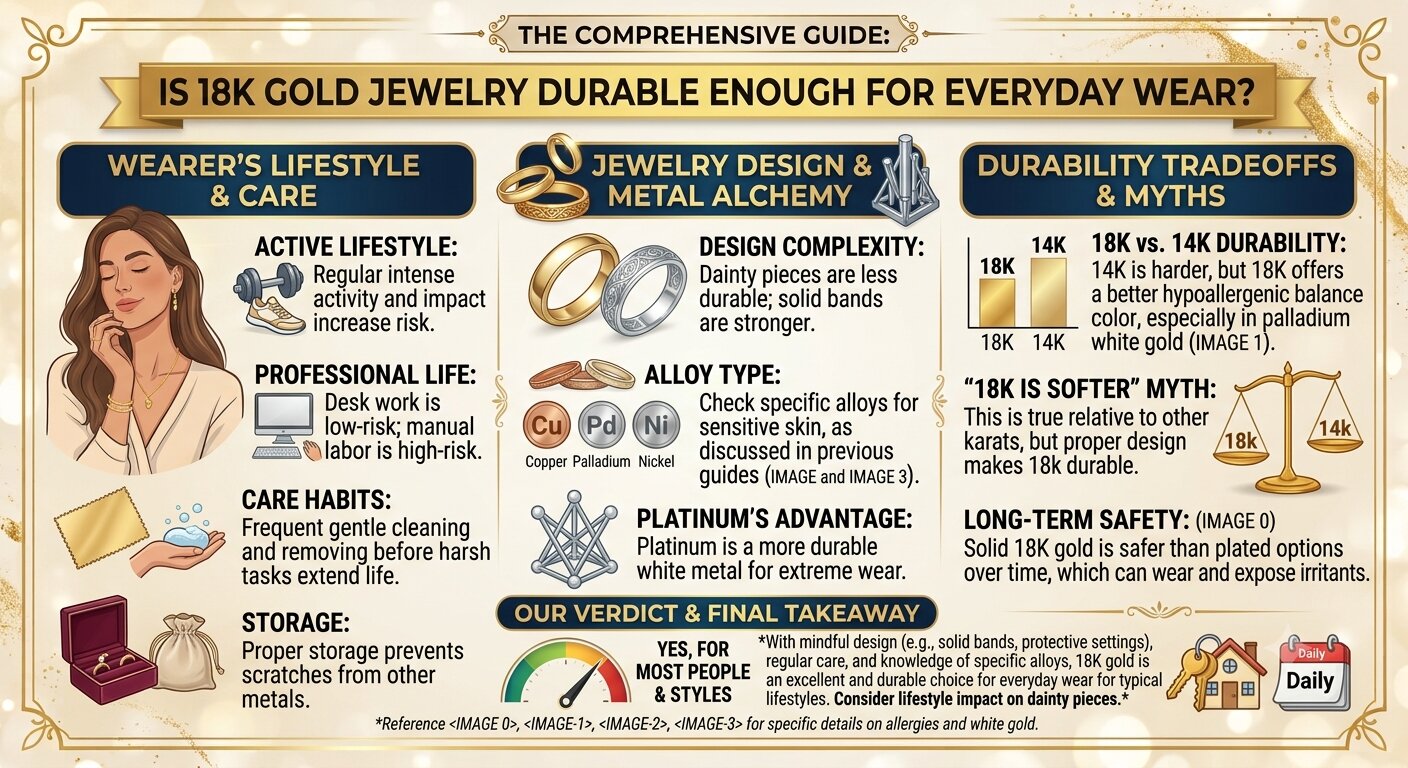
Is 18K Gold Jewelry Durable Enough for Everyday Wear?
The short answer is: Yes, but with important considerations. 18K gold can absolutely be worn daily, but its durability depends heavily on your lifestyle and how you care for it. Let's break down what that really means.
Understanding 18K Gold's Composition and Durability
18K gold is made of 75% pure gold and 25% alloy metals like copper, silver, or palladium. This combination gives it a rich, luxurious color that's noticeably deeper than 14K gold. However, because pure gold is inherently soft, the higher gold content makes 18K softer and more prone to scratches than lower-karat options like 14K (58.3% gold).
| Karat | Pure Gold Content | Durability Level | Best For |
| 18K Gold | 75% | Good, but softer; shows scratches more easily | Special occasions, low-impact daily wear, heirloom pieces |
| 14K Gold | 58.3% | Very good; more scratch-resistant and durable | Everyday wear, active lifestyles, engagement rings |
How Lifestyle Affects Durability
The key question isn't just "can it be worn daily?" but rather, "how do you live your daily life?"
For Low-Impact Lifestyles: If your daily routine involves mostly desk work, running errands, and social events, 18K gold is an excellent choice. It's considered durable enough for people with low-impact or sedentary lifestyles. Jewelers note that 18K gold performs well with "regular but careful wear".
For Active Lifestyles: If you frequently exercise, work with your hands, garden, or participate in sports, 18K gold may not be the most practical choice. In these cases, 14K gold is often recommended because its higher alloy content makes it more resistant to scratches, bending, and general wear and tear.
What to Expect Over Time
Does 18K gold "wear out"? Not exactly. The gold itself does not wear away. Instead, it develops surface changes over time—fine scratches and a soft patina that many people actually appreciate as a sign of a loved, well-worn piece. These surface marks are cosmetic and can be polished away by a jeweler to restore the original shine.
Care Tips for Daily-Worn 18K Gold
If you decide to wear 18K gold every day, a few simple habits will help it stay beautiful longer:
"Last On, First Off": Put your jewelry on after applying lotions, perfumes, and hairspray, and remove it before washing hands, showering, or using cleaning products.
Wipe After Wear: Gently wipe each piece with a soft, lint-free cloth after removing it to lift oils and dust.
Store Properly: Keep pieces separate in soft pouches or lined compartments to prevent scratches from rubbing against other jewelry.
Avoid Harsh Chemicals: Chlorine (from pools and hot tubs) can damage gold alloys and should always be avoided.
The Verdict
18K gold is durable enough for everyday wear, provided you have a relatively low-impact lifestyle and are willing to care for it mindfully. It offers a richer, more luxurious color and higher gold content than 14K, making it a premium choice for fine jewelry that's meant to be enjoyed daily.
If you want a piece that can withstand a more active, hands-on lifestyle without showing as much wear, 14K gold is the more practical choice. Ultimately, the decision comes down to whether you prioritize the richness of color and purity (18K) or maximum durability and scratch resistance (14K).
How to Restore the Shine of Dull 18K Gold Jewelry
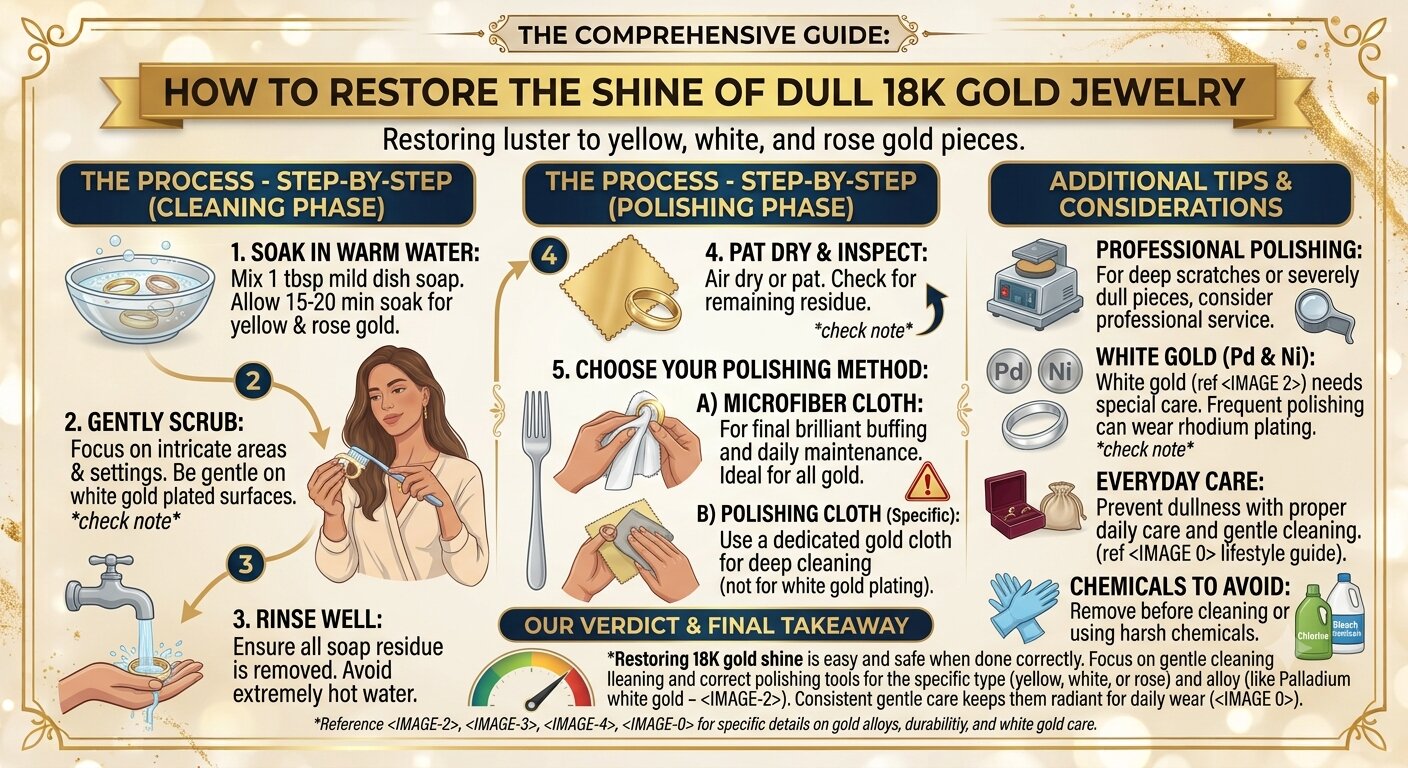
How to Restore the Shine of Dull 18K Gold Jewelry
Is your 18K gold jewelry looking dull? Learn how to restore its shine with safe at-home cleaning methods, find out when to seek professional help, and get tips for white gold and plated pieces.
Hook: "You pull out your favorite 18K gold necklace, but it no longer has that warm, radiant glow it once did. Instead, it looks dull, lifeless, and covered in a thin film. Don't worry—this doesn't mean your jewelry is ruined."
Problem: 18K gold jewelry naturally dulls over time due to skin oils, lotions, perfumes, dust, and tiny scratches from everyday wear. This is not a sign of poor quality, but simply a sign that it needs cleaning.
Promise: "In this guide, we'll walk you through exactly how to restore your 18K gold's brilliance—from simple at-home methods to professional services—and share tips to keep it shining longer."
Why Does 18K Gold Jewelry Become Dull?
Understanding the cause helps you choose the right solution.
Pure Gold vs. Gold Alloys
Pure (24K) gold does not tarnish. However, 18K gold is an alloy—75% pure gold mixed with 25% other metals like copper and silver.
These alloy metals can react with oxygen, moisture, and chemicals, leading to a dull film or discoloration over time.
Common Causes of Dullness
Everyday Residue: Skin oils, sweat, lotions, perfumes, and hairspray leave a film on the surface.
Chemical Exposure: Household cleaners, chlorine (from pools), and saltwater can damage the alloy metals and cause dullness or discoloration.
Micro-scratches: Regular wear creates tiny scratches that scatter light, making the surface appear less shiny.
Step 1: Quick Daily Care – Prevention Is Easier Than Restoration
These habits slow down dullness and reduce how often you need to deep-clean.
"Last On, First Off" Rule
Put your 18K gold jewelry on after applying lotions, perfumes, and hairspray, and take it off before washing hands, showering, or using cleaning products.
Remove rings before swimming—chlorine and saltwater can cause micro-etching.
Wipe After Each Wear
Gently wipe your pieces with a soft, lint-free microfiber cloth after removing them. This lifts oils and dust before they build up.
Proper Storage
Store each piece separately in a soft pouch or compartmentalized jewelry box to prevent scratches from rubbing against other pieces.
In humid environments, add a silica gel packet to your storage box to reduce moisture.
Step 2: The Safest At-Home Cleaning Method (For Most 18K Gold)
This is the method recommended by jewelers for solid 18K gold—gentle, effective, and low-risk.
What You'll Need:
Small bowl
Warm (not hot) water
A few drops of mild dish soap (fragrance-free, like Dawn original)
Soft-bristled baby toothbrush or jewelry brush
Lint-free microfiber cloth
Step-by-Step Instructions:
| Mix | Fill the bowl with warm water and add a few drops of mild dish soap. |
| Soak | Place your jewelry in the solution and let it soak for 10–15 minutes (up to 30 minutes for heavily soiled pieces). |
| Gently Brush | Using the soft brush, gently scrub the jewelry—pay special attention to crevices, settings, and chain links. Use light pressure to avoid scratches. |
| Rinse | Rinse thoroughly under lukewarm running water to remove all soap residue. |
| Dry & Polish | Pat dry immediately with a soft microfiber cloth—never air-dry, as minerals in water can leave spots. For added shine, buff with a jewelry polishing cloth. |
Step 3: When to Use Alternative Cleaning Methods
Some sources suggest these methods, but caution is advised.
Jewelry Polishing Cloth
Excellent for removing light tarnish and restoring shine quickly. Use a cloth specifically designed for gold.
Caution: Avoid using on gemstones like pearls or opals, as the polishing agent can be abrasive.
Baking Soda Paste (Use with Caution)
Some recommend mixing baking soda with water to form a paste.
Warning: Baking soda is mildly abrasive and can create tiny scratches on the gold surface. Use it only as a last resort and with very gentle pressure. Not recommended for plated jewelry.
What to AVOID at All Costs
Vinegar: Acidic and can damage the finish.
Toothpaste: Abrasive and will scratch the gold.
Abrasive Cloths or Materials: Paper towels, tissues, or rough cloths can cause micro-scratches.
Ultrasonic Cleaners: Only safe for solid gold without delicate stones. Can loosen settings or damage fragile gemstones.
Step 4: Special Cases – 18K White Gold and Gold-Plated Jewelry
Not all "18K gold" is the same. Different materials require different care.
18K White Gold – Restoring the Bright White Shine
18K white gold is naturally a warm, slightly greyish color. To achieve its bright white finish, it is almost always plated with rhodium.
Over time, the rhodium plating wears off, and the underlying metal shows through, making the piece look yellowish or dull.
Solution: Soap and water will not restore the bright white shine. The piece needs to be re-rhodium-plated by a professional jeweler. Chanel, for example, offers this service for $195–$260 CAD.
18K Gold-Plated or Vermeil Jewelry – Gentle Handling Required
If your piece is 18K gold-plated or vermeil (gold over sterling silver), the gold layer is thin and can be worn away by abrasive cleaning.
Cleaning Method: Dampen a soft cloth with plain warm water (no soap) and gently wipe the surface. Do not soak, brush vigorously, or use any abrasives.
Tip: Gold plating is not waterproof—remove before showering, swimming, or exercising.
Step 5: When to Seek Professional Help
Sometimes, professional services are the safest and most effective option.
Deep Polishing: A professional jeweler can polish away fine scratches and restore the original luster. Chanel notes this service can only be performed a limited number of times (about 3) as it removes a tiny amount of metal.
Re-Rhodium Plating: As mentioned above, this is necessary for 18K white gold to restore its bright white finish.
Gemstone Safety: If your jewelry has delicate stones (pearls, opals, emeralds), or if stones feel loose, take it to a professional to avoid damage.
Worn-Through Plating: If the gold layer on plated jewelry has worn off to reveal the base metal, cleaning will not fix it—re-plating is required.
Frequently Asked Questions (FAQ) Section
How often should I clean my 18K gold jewelry?
A light polish every few weeks and a deep clean (soap and water) every 3–6 months are usually sufficient.
Can I wear my 18K gold ring in the shower?
It's best not to. Soap and water can create a dull film, and over time, exposure can affect the alloy metals.
Will 18K gold tarnish?
Solid 18K gold does not tarnish like sterling silver, but the alloy metals can react with the environment, causing a dull film or slight discoloration—both of which are easily cleaned.
Is cleaning 18K gold the same ascleaning 14K gold?
Yes, the same mild soap and water method is safe for both 14K and 18K solid gold.
Can I use toothpaste to clean my gold ring?
No. Toothpaste is abrasive and will create tiny scratches that dull the surface over time.
Conclusion & Final Recommendations
Summary: Restoring the shine of dull 18K gold is simple with the right approach. For most solid 18K gold pieces, the mild soap and warm water soak is safe, effective, and recommended by jewelers. For white gold, professional rhodium re-plating is the only way to restore the bright white finish. And for plated pieces, the gentlest possible method is essential.
Final Thought: "Your 18K gold jewelry is an investment meant to last a lifetime. With simple, consistent care, it will retain its warmth and brilliance for decades to come."
How to Choose the Right 18K Gold Chain Length and Thickness
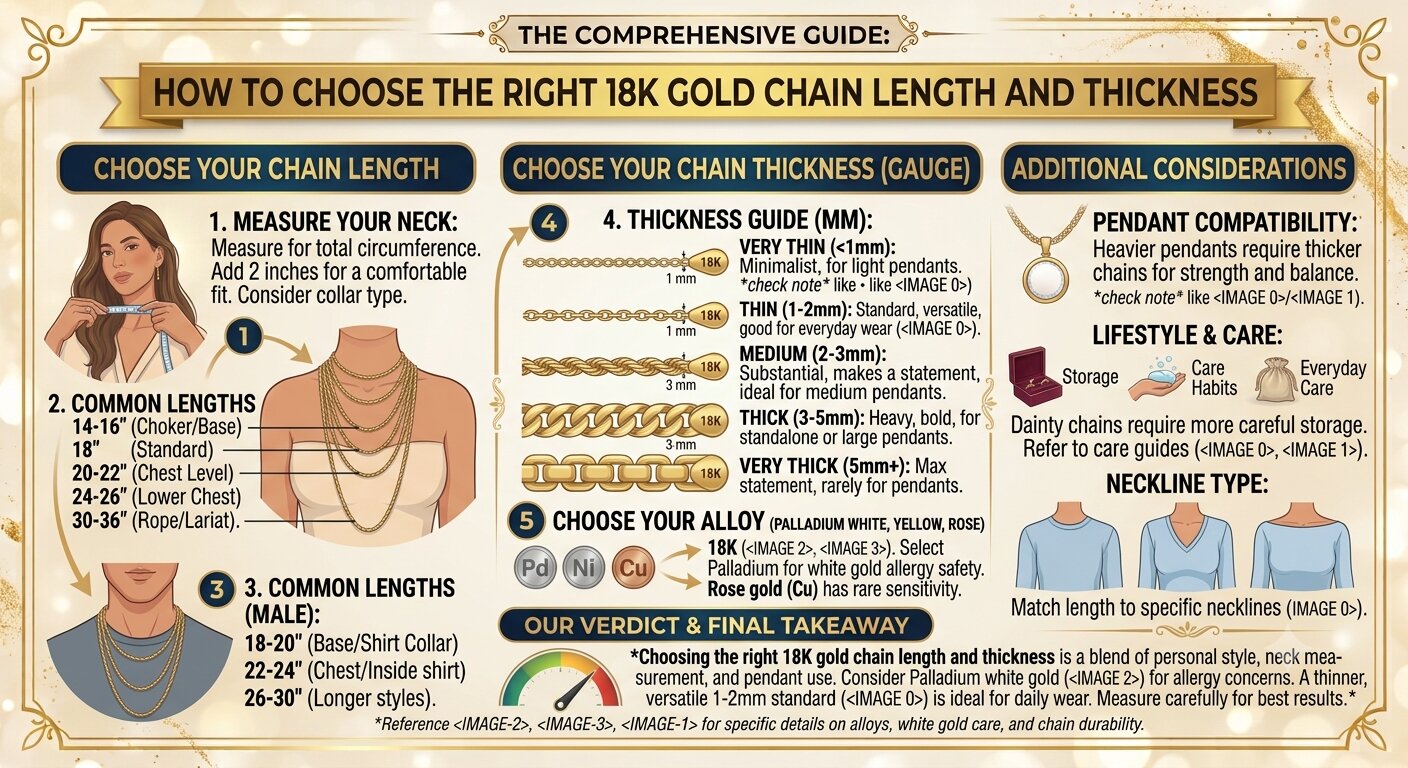
How to Choose the Right 18K Gold Chain Length and Thickness
Choosing the right chain is about finding the perfect balance between your personal style, physical proportions, and how you plan to wear it. Here’s a practical guide to help you decide on both length and thickness for an 18K gold chain.
Finding the Right Length
The ideal length depends on your height, neck size, and the neckline of your outfits.
| Length Range | Name | Placement & Style | Best For |
| 14–16 inches | Choker | Sits snugly at the base of the neck or on the collarbone. | A bold, defined look. Perfect for off-shoulder tops or a minimalist statement. |
| 17–19 inches | Princess | The most popular "classic" length. Sits at or just below the collarbone. | Everyday wear for most people. Versatile and suits almost every neckline and body type. |
| 20–24 inches | Matinee | Falls to the mid-chest area, sitting below the collarbone. | Layering over shirts, pairing with higher necklines, or creating a relaxed look. |
| 28–34+ inches | Opera/Rope | Falls to the chest or below, creating a dramatic, elegant silhouette. | Layering to create a statement look or wearing with formal outfits. |
Height and Frame Tips:
Petite or short neck: Stick to 16–18 inches so the chain doesn't overwhelm your frame.
Average height (5'4"–5'7"): 18 inches is almost universally flattering.
Tall or long neck: 20–24 inches often looks the most elegant and balanced.
Broader neck or fuller bust: Longer lengths (20 inches or more) can be more comfortable and draw the eye downward beautifully.
Choosing the Right Thickness
Thickness (or width) is measured in millimeters (mm). The right choice can make or break a chain's look.
Thin chains (Approx. 1–3 mm): Offer a subtle, polished, and delicate look, perfect for everyday wear or for wearing with a small pendant.
Medium chains (Approx. 4–5 mm): This is a sweet spot. They provide good visibility and a substantial feel while remaining comfortable for daily wear, balancing style and comfort.
Thicker chains (6 mm and above): Make a bold, powerful statement. They are best for casual, fashion-focused outfits and are often worn as standalone pieces.
Important Tips
Test It: If you can, try the chain on before buying to see how it looks and feels.
Consider the Pendant: If you plan to wear a pendant, choose a chain that's 2 inches longer than you normally would so the pendant hangs at the right spot. Also, ensure the chain is sturdy enough to hold the pendant's weight.
Durability for Daily Wear: For a chain you wear every day, a 14K to 18K solid gold chain is best for its durability. A medium thickness (4–5 mm) in a sturdy design like a cable or box chain will hold up well.
Ultimately, the perfect chain is the one that feels great and makes you feel confident.
How to Choose an 18K Gold Gift for Your Mother That She’ll Treasure
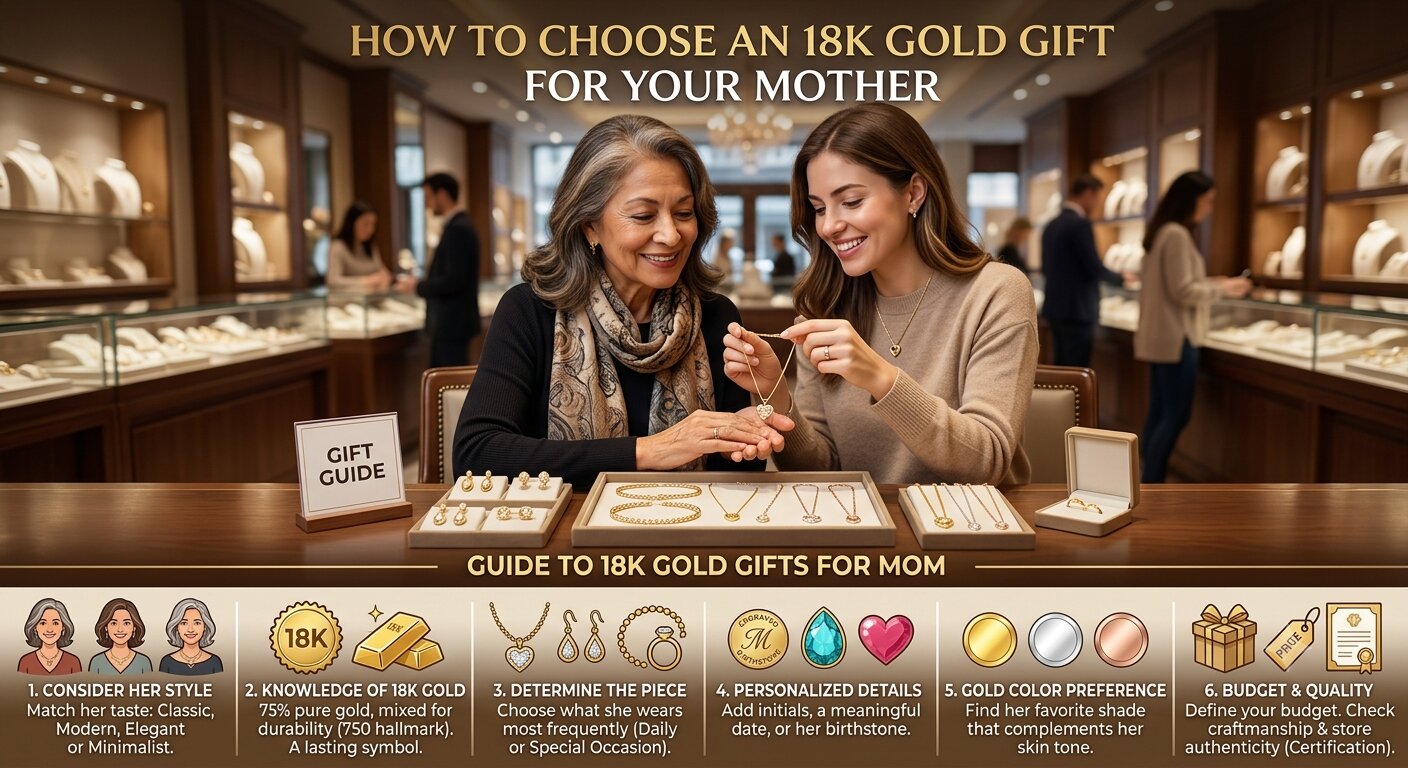
How to Choose an 18K Gold Gift for Your Mother That She’ll Treasure
Find the perfect 18K gold gift for your mother. This thoughtful guide covers how to match her style, select meaningful pieces (necklaces, earrings, rings), and choose the right gold color.
Hook: "Finding the perfect gift for your mother is one of the most joyful—and sometimes most daunting—tasks. You want something that says, 'I see you, I appreciate you, and you are cherished.' An 18K gold gift does exactly that. It’s not just jewelry; it’s a symbol of enduring love, crafted from a metal that, like your bond, never fades.
Problem: The challenge isn't just finding any gift; it's finding one that resonates with her personal style, fits your budget, and feels as special as she is. With countless styles, colors, and designs available, where do you even start?
Promise: "This guide will walk you through a thoughtful, step-by-step process to choose an 18K gold gift for your mother in 2026. We’ll cover how to decode her style, select the most meaningful piece, and ensure you’re making a choice she’ll wear and treasure for a lifetime.
Step 1: Decode Her Personal Style (The Golden Rule)
Before you look at any jewelry, you need to understand her taste. A gift that matches her style will be worn daily; one that doesn’t will stay in the box.
Observe Her Current Jewelry
What metal does she wear most? Yellow, white, or rose gold?
Is her style classic and minimalist (think thin chains, solitaire pendants) or bold and statement-making (chunky links, large gemstones)?
Does she wear a lot of jewelry, or does she prefer a few carefully chosen pieces?
Actionable Tip: Sneak a photo of her jewelry box or take note of what she wears to family dinners.
Match Her Lifestyle
The Active Mom: If she’s always on the go, a pair of stud earrings or a sturdy chain bracelet is more practical than a delicate ring that might catch on things.
The Professional: A classic pendant necklace or elegant hoop earrings in 18K gold adds a touch of sophistication to a work wardrobe.
The Social Butterfly: A statement cocktail ring or a layered necklace set gives her something to show off and talk about at events.
Consider Her Generation & Personality
Classic/Traditional Moms: May appreciate timeless pieces like a yellow gold bangle or a simple cross pendant.
Modern/Trendy Moms: An 18K rose gold necklace with a unique shape or a chunky chain bracelet shows you know what's current.
"If she's active, 14K gold is a durable choice, as covered in our everyday wear guide."
Step 2: Choose the Right 18K Gold Color
Help the reader understand the emotional and visual impact of each color to match their mother's aura."For a deeper dive into the science and style of each color, see our complete color guide."
18K Yellow Gold – The Heirloom Classic
Why it's perfect: It’s the most recognizable and traditional form of gold. It symbolizes warmth, tradition, and lasting value. It's the gold of wedding bands and heirlooms, representing a love that’s passed down through generations.
Ideal for: Moms who love vintage style, classic elegance, and pieces that feel “rich” and substantial.
18K White Gold – The Modern Grace
Why it's perfect: It offers a sleek, contemporary look that pairs beautifully with diamonds and modern outfits. It represents sophistication, clarity, and a forward-thinking style.
Ideal for: Moms with a minimalist aesthetic, or those who prefer silver-toned jewelry but want the value and prestige of gold.
18K Rose Gold – The Romantic Heart
Why it's perfect: Its warm, pinkish hue is universally flattering and feels romantic, gentle, and fashion-forward. It’s the color of love and warmth, a perfect reflection of a mother’s heart.
Ideal for: Moms who embrace modern trends, have a warm skin tone, or simply love anything that feels a little different and special.
Step 3: Select the Most Meaningful Piece of Jewelry
Now, connect the style to a specific type of jewelry, each with its own symbolic meaning.
Necklaces & Pendants – Close to the Heart
Symbolism: A pendant hangs near the heart, making it a deeply personal and intimate gift. It’s a constant, gentle reminder of the giver.
Top Picks:
Initial/Pendant: A simple, elegant initial pendant in 18K gold is a modern, personalized classic.
Heart Pendant: A timeless symbol of love, especially meaningful in 18K rose gold.
Birthstone Pendant: Add a pop of color with her birthstone, adding an extra layer of personalization.
Earrings – The Ever-Present Sparkle
Symbolism: Earrings frame the face, enhancing her natural beauty. They are often the most frequently worn pieces of jewelry, ensuring your gift is seen and admired daily.
Top Picks:
Classic Studs: Simple 18K gold studs are versatile, elegant, and perfect for everyday wear. Consider round, square, or floral shapes.
Huggie Hoops: A modern, comfortable update on classic hoops, perfect for a chic, everyday look.
Drop Earrings: Add a touch of elegance and movement, perfect for a special occasion or a night out.
Bracelets & Bangles – The Circle of Love
Symbolism: A circle has no beginning and no end, representing eternity and the unending bond between mother and child.
Top Picks:
Classic Bangle: A solid 18K gold bangle is a true heirloom piece she can pass down one day.
Chain Bracelet: A delicate 18K gold chain bracelet is elegant and goes with everything. A tennis bracelet in 18K white gold is a stunning choice.
Charm Bracelet: Allows you to add a unique charm that represents a shared memory, hobby, or something she loves.
Rings – The Ultimate Statement
Symbolism: A gift of a ring is a powerful statement of commitment and love. It’s a piece she’ll see on her own hand daily, a beautiful reminder of you.
Top Picks:
Stackable Bands: A simple, elegant 18K gold band (yellow, white, or rose) that she can stack with her wedding ring or other jewelry.
Cocktail Ring: A bold, stylish ring with a single, eye-catching gemstone or a unique design.
Step 4: Nail the Budget – Smart Buying Tips
Address the financial aspect directly, offering practical strategies to get the best value.
Understanding the 18K Gold Price
Remind the reader that 18K gold’s price is tied to the spot price of pure gold, but jewelry includes a markup for labor, design, and brand. Focus on the piece's total value, not just the weight.
Smart Strategies for 2026
Consider Weight, Not Just Size: A hollow or lighter piece will cost less than a solid, heavier one. For a bracelet or necklace, 3-5 grams is a typical, substantial weight for a classic gift.
Explore Alternatives: If a solid 18K gold piece is beyond budget, consider an 18K gold-plated or vermeil piece for a similar look, or a smaller, well-chosen solid piece like a pendant.
Watch for Sales: Many jewelers have special promotions around Mother’s Day, anniversaries, and the holiday season. Shop around and compare prices.
Step 5: Give It the Perfect Finish
The presentation is part of the gift. These details elevate the experience.
Presentation & Packaging:
Have it beautifully wrapped in a high-quality box.
Add a personal, handwritten note explaining why you chose that specific piece.
Guarantees & Care:
Provide her with the receipt, guarantee, and care instructions so she knows the piece is authentic and how to keep it beautiful for years.
"Ensure your gift is genuine by reviewing our tips on spotting fake gold."
Consider including a small jewelry polishing cloth with the gift.
Frequently Asked Questions (FAQ) Section
Is 18K gold a good gift for mom?
Absolutely. 18K gold is a premium metal with high purity (75%) and excellent durability. It’s the standard for fine, heirloom-quality jewelry, making it the ideal way to show your lasting appreciation.
Should I buy 18K or 14K gold for a gift?
Choose 18K for a richer color and higher gold content, perfect for a special, significant gift. Choose 14K if you're on a tighter budget or if she has a very active lifestyle.
What if I don’t know her ring size?
Opt for a necklace, bracelet, or earrings—these are size-friendly gifts. If you want a ring, borrow one of her existing rings (from the same finger) to have it sized.
How do I care for an 18K gold gift?
Include a quick tip: Clean it gently with warm water, mild dish soap, and a soft brush. Store it in a soft pouch to prevent scratches.
What is the best 18K gold color for a timeless gift?
Yellow gold is the most classic and timeless. However, if she prefers modern styles, white gold is ideal. Rose gold offers a perfect blend of romance and contemporary fashion.
Conclusion & Final Thoughts
Summary: "Choosing an 18K gold gift for your mother is an act of love. By understanding her style, selecting a meaningful piece, and presenting it with care, you're giving her more than just jewelry. You're giving her a tangible symbol of your bond—something she can wear, cherish, and one day, pass on."
How to Spot Fake 18K Gold Jewelry Before You Buy: A 2026 Guide
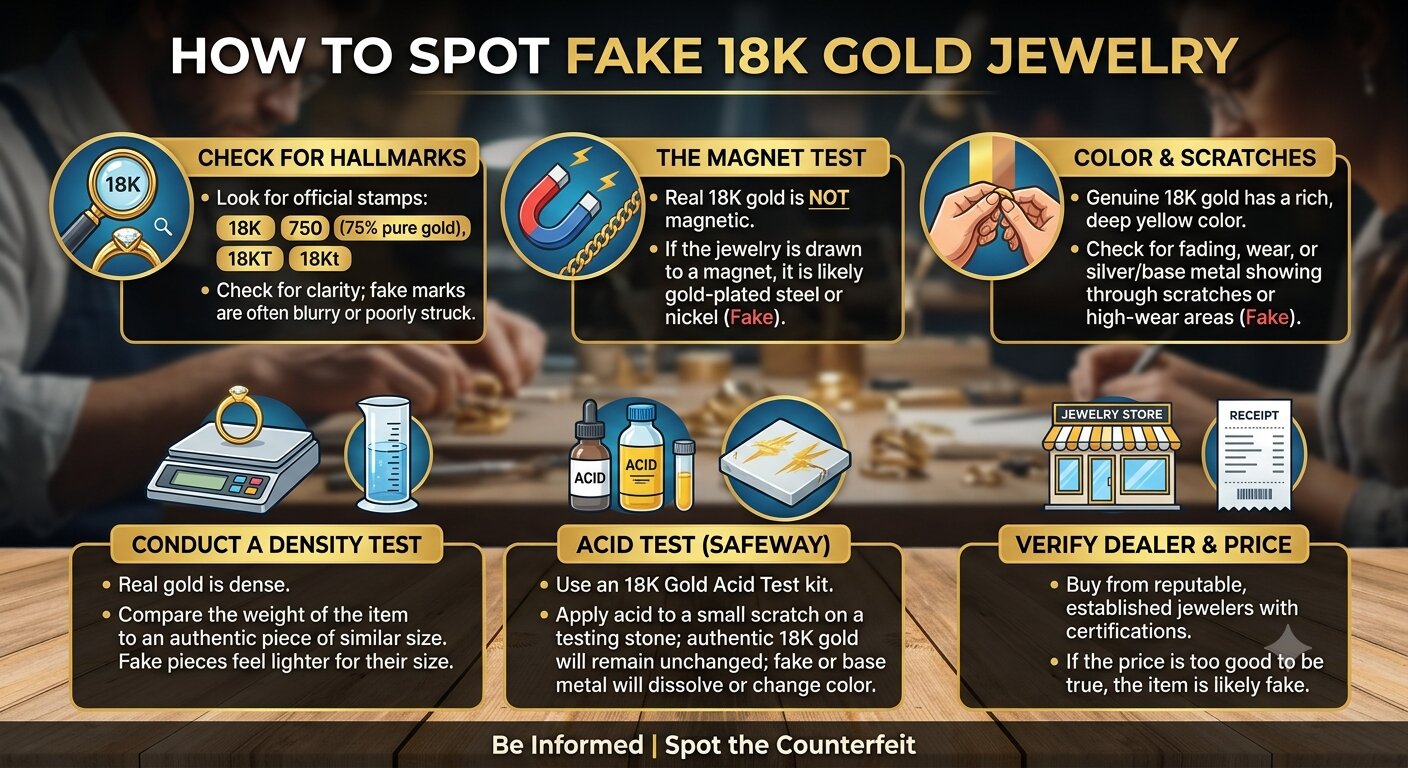
How to Spot Fake 18K Gold Jewelry Before You Buy: A 2026 Guide
Find the perfect 18K gold chain. This guide covers standard chain lengths (choker to opera), thickness options (1mm to 6mm+), and tips for choosing based on your height, body type, and style.
Hook: "You've found a beautiful 18K gold piece at an unbelievably good price. The stamp says '750,' and it even looks the part. But is it real? In 2026, counterfeiters are using techniques so sophisticated they can fool even X-ray fluorescence (XRF) testing machines."
Problem: With gold prices at record highs, jewelry scams are on the rise. From gold-plated low-karat alloys to hollow pieces filled with base metals, fake 18K gold has never been harder to detect.
Promise: "This guide will walk you through everything you need to know to spot fake 18K gold—from simple at-home checks to professional verification methods. By the end, you'll have the knowledge to make a confident, safe purchase."
Understanding the Target: What Real 18K Gold Should Be
This section establishes the baseline for comparison.
Composition and Hallmarks
Gold Content: 75% pure gold, 25% alloy metals (copper, silver, palladium, etc.).
Standard Hallmarks: Look for 18K, 18KT, 18kt, 750, or .750. In India, BIS hallmarking also includes a 6-digit HUID for traceability.
Key Point: Absence of a hallmark is a red flag—but presence alone is not a guarantee of authenticity.
Why "Fake" Is Harder to Spot Than Ever
Gold-Plated Gold Scam: According to GIA (2025), counterfeiters are plating lower-karat gold (e.g., 10K) with a layer of gold that causes XRF testers to incorrectly read it as 14K or 18K.
Hollow & Filled Jewelry: Some fake pieces have a gold exterior but contain base metals like silver, copper, or nickel inside—undetectable by surface-level tests.
Step 1: Visual Inspection - What to Look For
Simple checks you can do with your eyes and a magnifying glass.
Examine the Hallmark Quality
A genuine hallmark should be crisp, clear, and deeply etched.
Red Flags: Blurry, crooked, shallow, or poorly defined stamps.
Incorrect Markings: Be wary of stamps like 18KGP or 18KGF—these indicate gold-plated or gold-filled, not solid 18K gold.
Check the Color
Real 18K gold (yellow) has a rich, warm, slightly deep yellow hue—not overly bright or brassy.
If the color is too bright, too dull, or uneven, it could be fake.
Inspect for Plating Wear
Look closely at edges, clasps, and high-friction areas. If you see flaking or a different metal color underneath, the piece is only gold-plated.
Step 2: Simple At-Home Tests (With Caution)
These tests can help identify obvious fakes but are not 100% conclusive.
The Magnet Test
Gold is not magnetic. Use a strong neodymium magnet.
What it means: If the piece is strongly attracted, it contains iron or steel—definitely not 18K gold. If it doesn't react, this does not prove it's real, as many non-magnetic metals also pass this test.
The Weight Test
Gold is dense. Real 18K gold should feel heavier than it looks.
If the piece feels unexpectedly light for its size, it may be hollow or made of a lighter base metal.
The Ceramic Scratch Test
Gently drag the piece across unglazed ceramic (the bottom of a tile or coffee mug).
A golden-yellow streak suggests real gold; a black or dark streak indicates a fake.
Warning: This is mildly abrasive and could damage genuine gold.
Step 3: Professional Verification Methods
For definitive authentication, these methods are recommended.
X-ray Fluorescence (XRF) Testing
A non-destructive test that analyzes metal composition.
The Caveat: As GIA warns, a gold coating can produce false results—XRF only reads the surface layer. Always combine with visual inspection.
Acid Testing
A common method is to make a small scratch on the piece and apply acid.
Reaction: No reaction suggests genuine 18K or higher; a green/milky reaction indicates base metal or lower purity.
Drawback: This is a semi-destructive test and should only be done by a professional.
Density/Specific Gravity Test
Uses precise weight and water displacement measurements to calculate density.
18K gold density is approximately 15.2 - 15.9 g/cm3.
Limitation: Not accurate for pieces with gemstones or hollow sections.
Ultrasonic Testing (Advanced)
Measures the speed of sound traveling through the metal. Gold has a unique sound velocity (3240 m/s).
According to scientific research, this method can detect fake gold bars with tungsten cores that otherwise pass XRF and weight tests.
Step 4: Before You Buy - Best Practices
Prevention is better than detection.
Buy from Reputable Sources
Choose established jewelers with positive reviews and clear return policies.
Avoid deals that seem "too good to be true"—they usually are.
Demand Full Documentation
Request a detailed receipt that specifies metal purity (e.g., "18K gold" or "750").
In India, look for the BIS hallmark with the 6-digit HUID, which can be verified via the BIS Care App.
Ask About the Setting
18K gold is less common for mass-produced, low-cost jewelry due to material cost.
If a piece with multiple gemstones is priced surprisingly low, be suspicious.
Frequently Asked Questions (FAQ) Section
What does 18KGP mean on jewelry?
18KGP stands for 18K Gold Plated. It is not solid 18K gold and has minimal intrinsic value.
Can fake 18K gold pass an acid test?
A thick enough layer of gold plating can sometimes pass a surface acid test, which is why professional testing often involves scratching to reach the base metal.
Is it safe to buy 18K gold online?
Yes, if you buy from reputable sellers with documented authenticity guarantees and good return policies. Always verify the hallmark and request certification.
Why does my "18K" gold look dull?
Real 18K yellow gold can develop a patina. However, dullness combined with visible flaking or discoloration may indicate the plating has worn off.
What is the BIS HUID number?
In India, it's a 6-digit alphanumeric code unique to each hallmarked piece, allowing you to verify authenticity through the BIS Care App.
Conclusion & Final Recommendations
Summary: Spotting fake 18K gold requires a multi-layered approach: visual inspection of hallmarks, simple at-home tests (like the magnet test), and, for high-value purchases, professional verification like XRF or acid testing.
Final Thought: "In an era where counterfeiters are using increasingly sophisticated methods—including gold-plated gold that can trick XRF machines—your best defense is knowledge and choosing reputable sellers. Don't just trust the stamp; trust the source."
News for Wednesday 08 July, 2026
View all news for Wednesday 08 July, 2026 on one page
Recent News
- Wednesday 01 July, 2026
- Tuesday 16 June, 2026
- Monday 15 June, 2026
- Sunday 14 June, 2026
- Saturday 13 June, 2026