

The Allure of the Cushion Cut Diamond: What You Need to Know
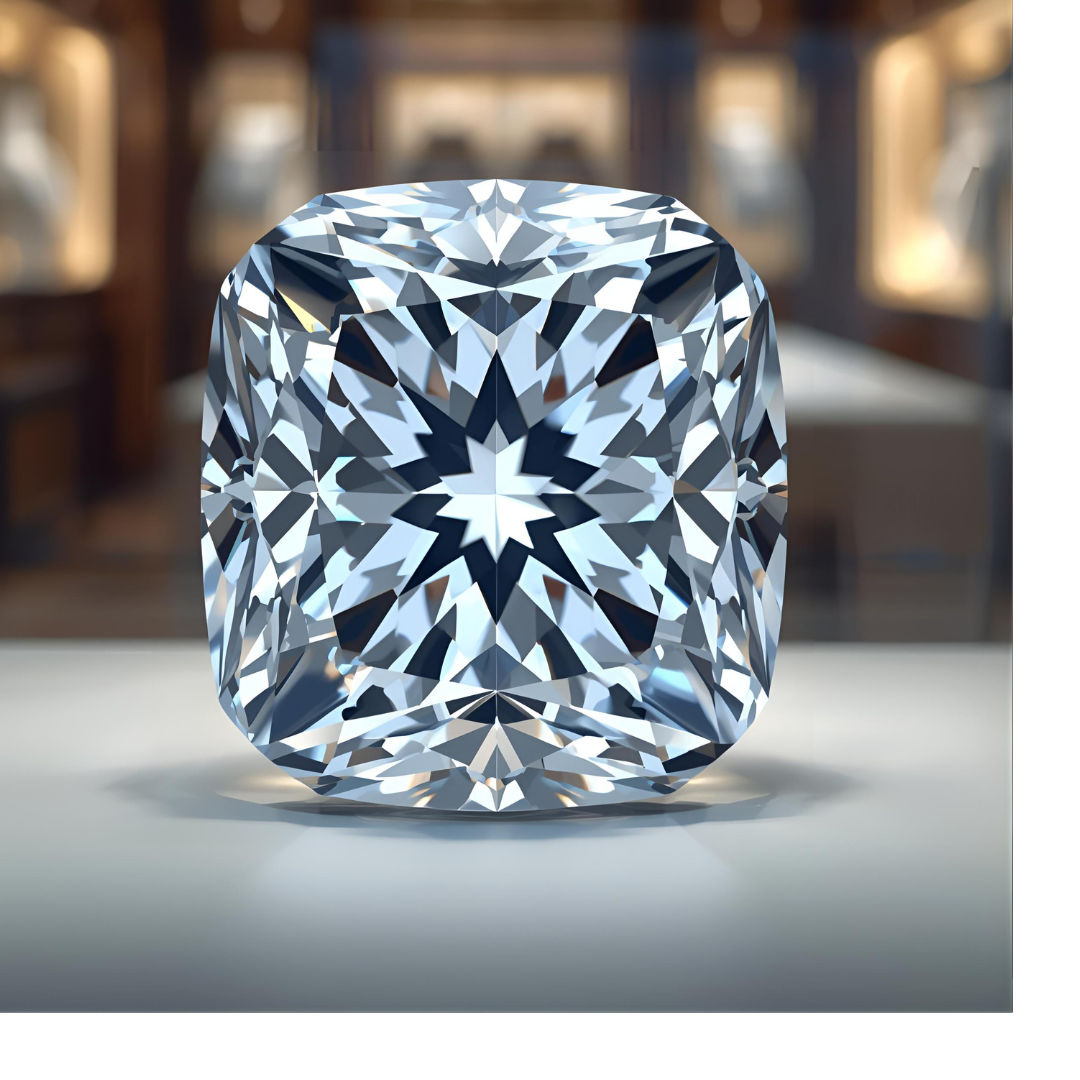
The Allure of the Cushion Cut Diamond: What You Need to Know
Cushion-cut diamonds are a timeless choice with a blend of vintage charm and modern sparkle.
“In the 18th century, before electricity, diamonds were judged by candlelight. The ‘old mine cut‘—the cushion‘s ancestor—was designed to glow in the soft, flickering flames of ballrooms and boudoirs. Its deep pavilion and large facets caught the fire of wax and wick. When the Hope Diamond—one of the most famous gemstones in history—was cut, it was shaped as a cushion. When the Regent Diamond, once owned by Marie Antoinette, was displayed in the Louvre, it was on a cushion. For 300 years, the cushion cut has been the diamond of romance—not because it is the most sparkly, but because it glows like memory itself.”
The same cut that glowed in candlelit ballrooms now awaits your own love story — whether you choose chunky vintage facets or modern crushed ice. Every cushion cut diamond in our collection is hand-selected for that unmistakable pillow-soft sparkle.”
[Button: Explore Cushion Cut Diamonds →]
They are popular for their rounded square or rectangular shape (like a pillow), excellent fire (colorful flashes of light), and are generally more affordable than round brilliants.
Here is all you want to know about the content.
What Does A Cushion Cut Diamond Say About You?
What Is The History of The Cushion Cut Diamond?
Is Cushion Cut A Good Diamond?
What Are The Characteristics Of A Cushion Cut Diamond?
What Are the Different Styles of Cushion Cut Diamonds?
How Much Does A Cushion Cut Diamond Cost?
Is A Cushion Cut Diamond A Real Diamond?
Are Cushion-Cut Rings Out of Style?
How to Decide Between a Cushion and a Round?
Are Cushion Cuts Trendy Or Classic?
Emerald Cut vs Elongated Cushion
What Is The Difference Between A Cushion Cut And A Princess Cut?
Let's first topic.
What Does A Cushion Cut Diamond Say About You?
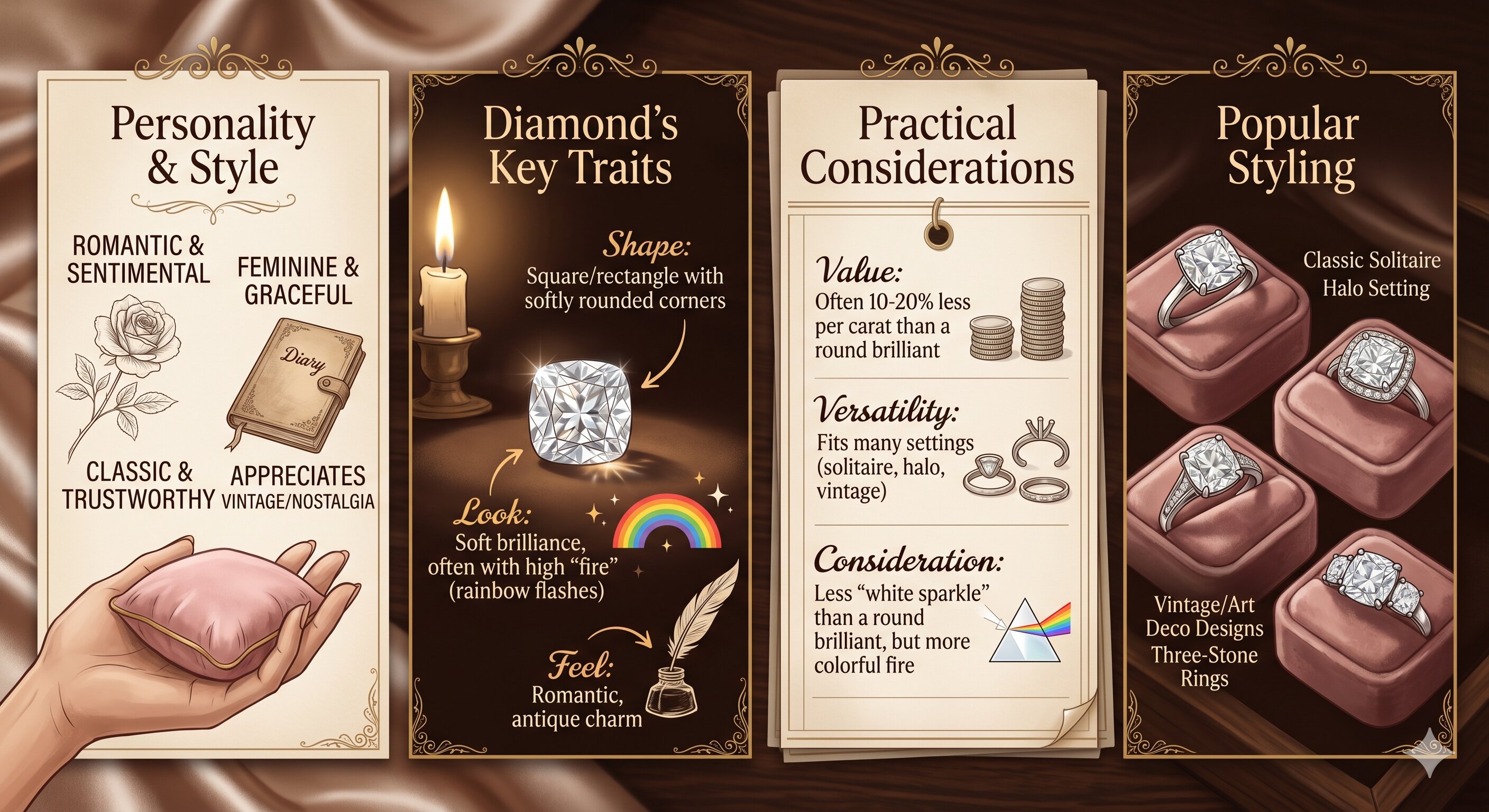
A cushion cut diamond often suggests you value romance, timeless elegance, and warmth. Its soft, pillow-like shape and historical charm attract those with a classic yet individualistic style.
The table below summarizes what this choice often says about you, along with the diamond's key traits and popular styles.
History & Evolution
The cushion cut has a rich history, evolving from the "old mine cut" of the 18th and 19th centuries, which was designed to sparkle beautifully under candlelight.
Its enduring popularity, especially during romantic eras like the Victorian period, contributes to its symbolism of enduring love and commitment.
The modern version retains the soft shape but is cut with more facets for enhanced brilliance.
“In 1958, the Smithsonian Institution acquired the Hope Diamond. It had been a cushion cut for over two centuries—passed from French kings to English bankers to American socialites. When it arrived in Washington, crowds lined up for hours to see its deep blue glow. But what they didn‘t know was that the Hope Diamond‘s cushion shape was not chosen for its rarity. It was chosen because the cushion cut, with its soft corners and deep belly, is the only cut that can hold a diamond‘s history without hiding it. Every scratch, every facet, every imperfection tells a story. That is what a cushion cut says about you: that you are not afraid of the past. You wear it like a jewel.”
Is Cushion Cut A Good Diamond?
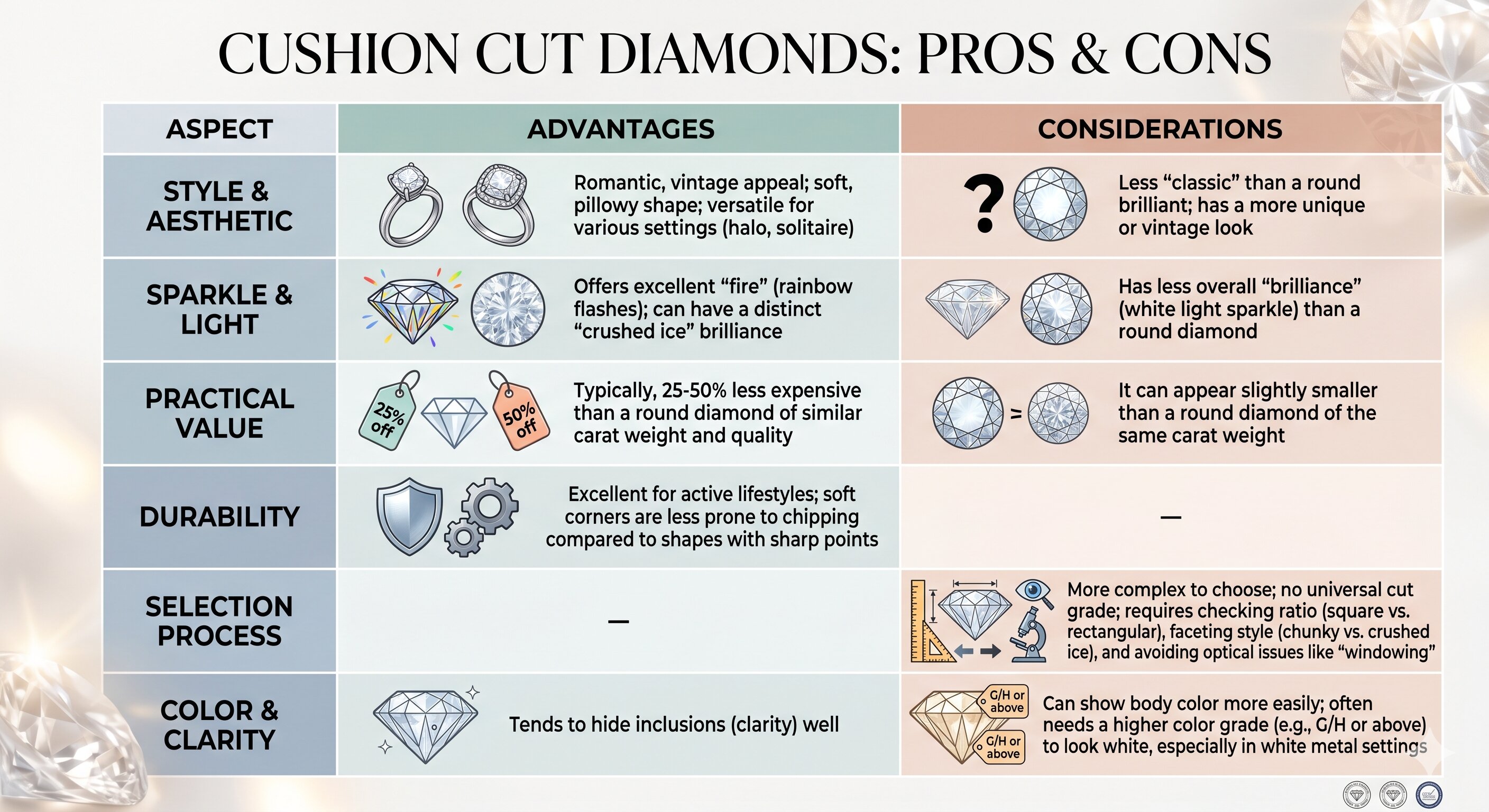
Yes, a cushion cut diamond is a very good choice for many people, especially if you appreciate vintage charm and romantic appeal. However, whether it's the right diamond for you depends on your personal priorities regarding style, sparkle, and the selection process.
To give you a clear overview, here are the key advantages and considerations:
Is the Cushion Cut Right for You?
A cushion cut is a great choice if you check several of these boxes:
You love vintage, romantic, or antique-inspired styles.
You prefer a softer, more unique look than the ultra-common round brilliant.
Getting good value for your budget is important to you.
You have an active lifestyle and want a durable shape.
You're willing to invest a bit more time in selecting the exact right stone, ideally with expert help or by viewing it in person/video.
It might be less ideal if:
Maximum, fiery white sparkle is your absolute top priority.
You prefer a shape with a perfectly standardized and easy selection process.
You want the diamond that looks the largest possible per carat.
I hope this detailed comparison helps you make a more informed choice. If you are also considering other diamond shapes (like round brilliant, oval, or emerald), I can provide a similar analysis to help you compare.
What Are The Characteristics Of A Cushion Cut Diamond?
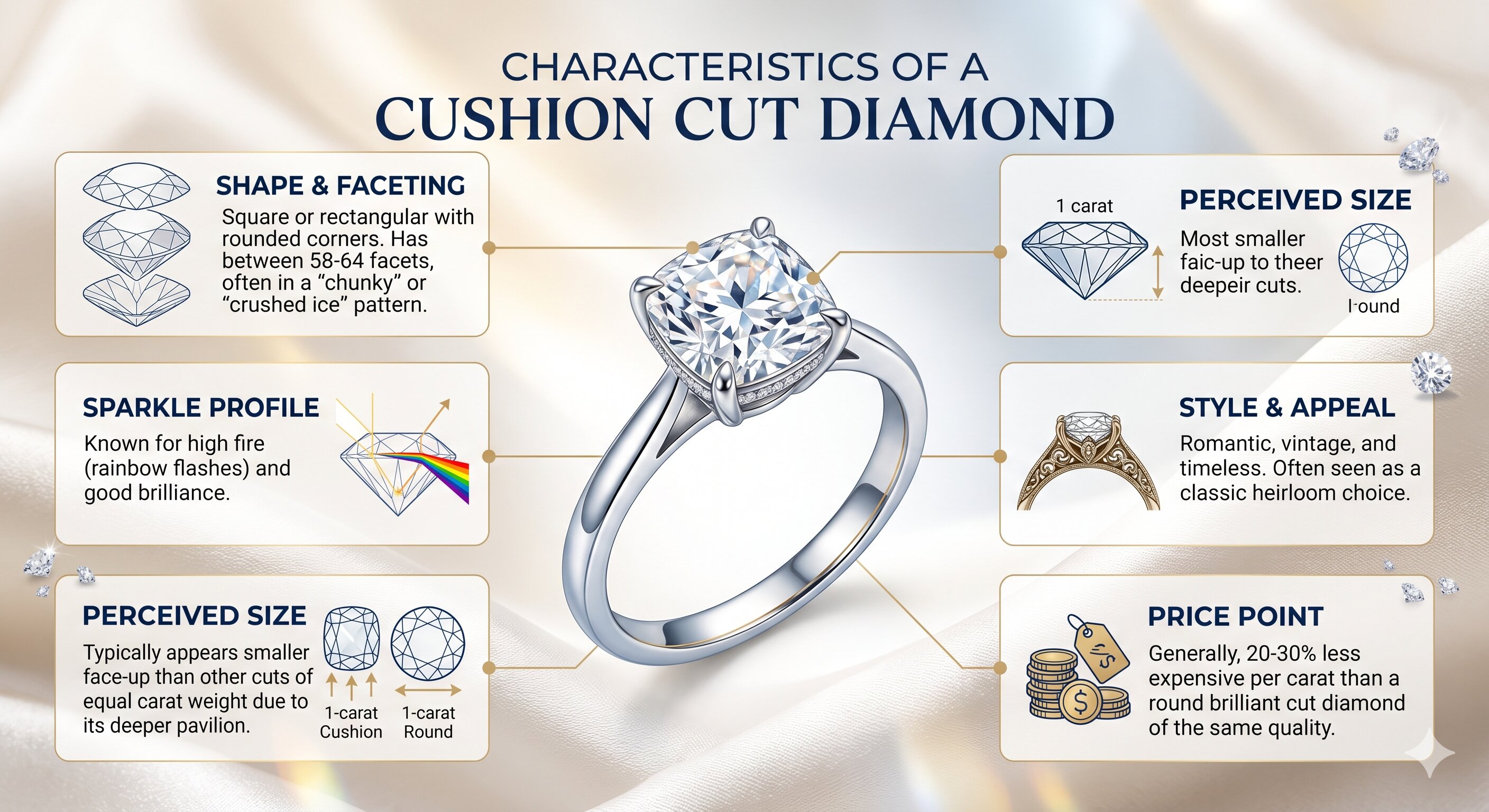
A cushion cut diamond's defining feature is its square or rectangular shape with softly rounded corners, resembling a pillow or cushion. This shape has a rich historical connection to the "old mine cut" from the 1700s.
Here is a summary of its main characteristics:
Detailed Look at Key Features
Facet Pattern Variation: Cushion cuts can look quite different:
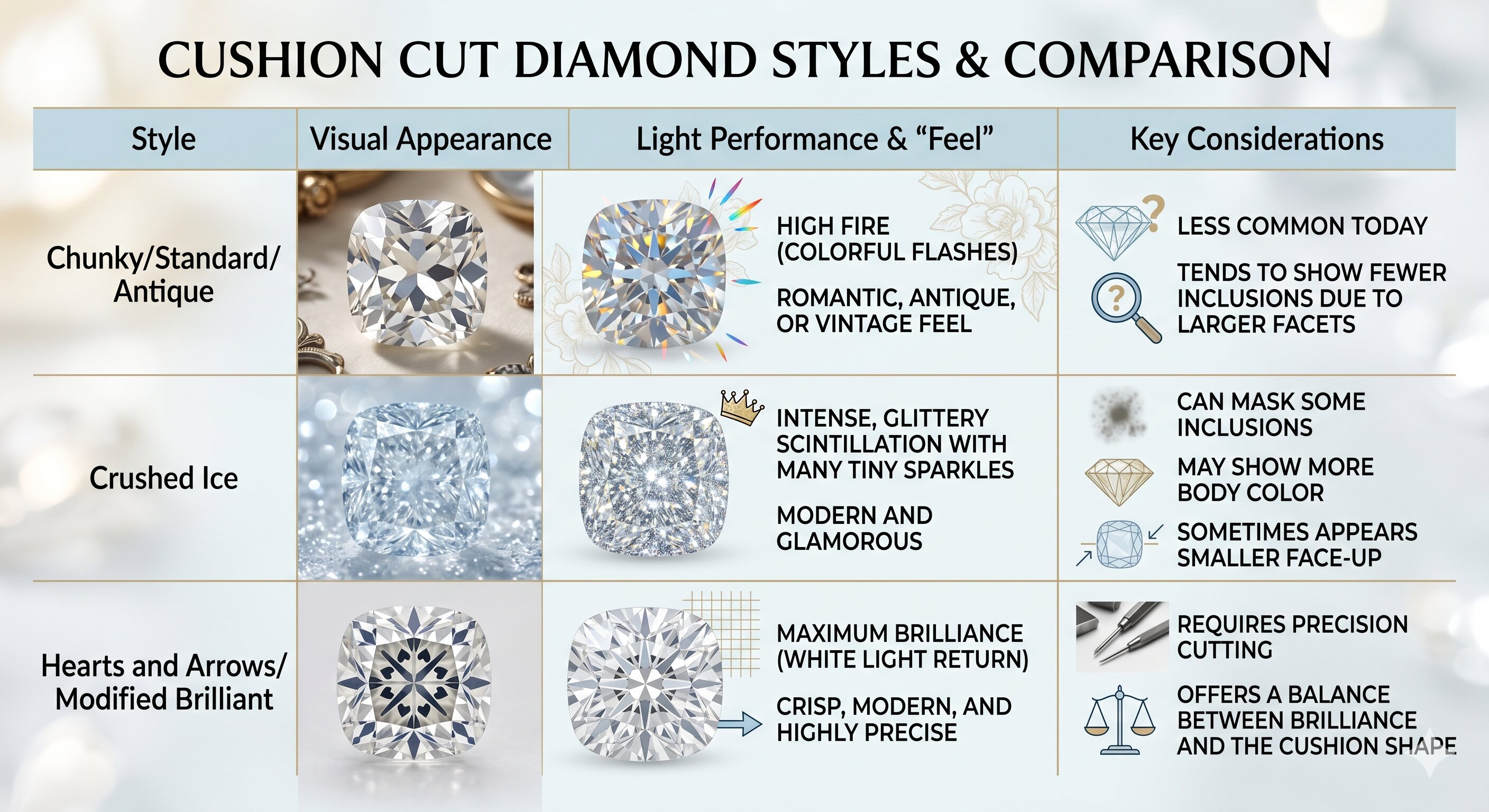
Chunky facets: Show broader, more distinct flashes of light for an antique, romantic look.
Crushed ice facets: Create a glimmering, splintered effect for a modern sparkle.
Shape (Length-to-Width Ratio): You can choose the visual shape by looking at the length-to-width (L/W) ratio.
Square (1.00–1.05 L/W): Most popular; gives a classic, balanced shape.
Elongated (1.15+ L/W): Rectangular; can make the finger appear longer.
Historical Roots: It evolved from the 18th-century "old mine cut", designed to sparkle under candlelight. Many world-famous diamonds (like the Hope Diamond) are cushion cuts.
What Are the Different Styles of Cushion Cut Diamonds?
Cushion-cut diamonds come in several distinct styles, mainly differing by their facet pattern. These patterns significantly change how the diamond sparkles and its overall look. Here are the three main styles:
How This Compares to Other Cuts
If you're comparing shapes, it's useful to know:
A radiant cut has a similar facet pattern to a crushed ice cushion but with sharp, cut corners for a more angular look.
A princess cut is also square but has sharp, pointed corners.
I hope this helps you distinguish between the different cushion cut styles. If you're curious about how a specific style, like a crushed ice cushion, compares in detail to a radiant cut, I can provide a more focused comparison.
How Much Does A Cushion Cut Diamond Cost?
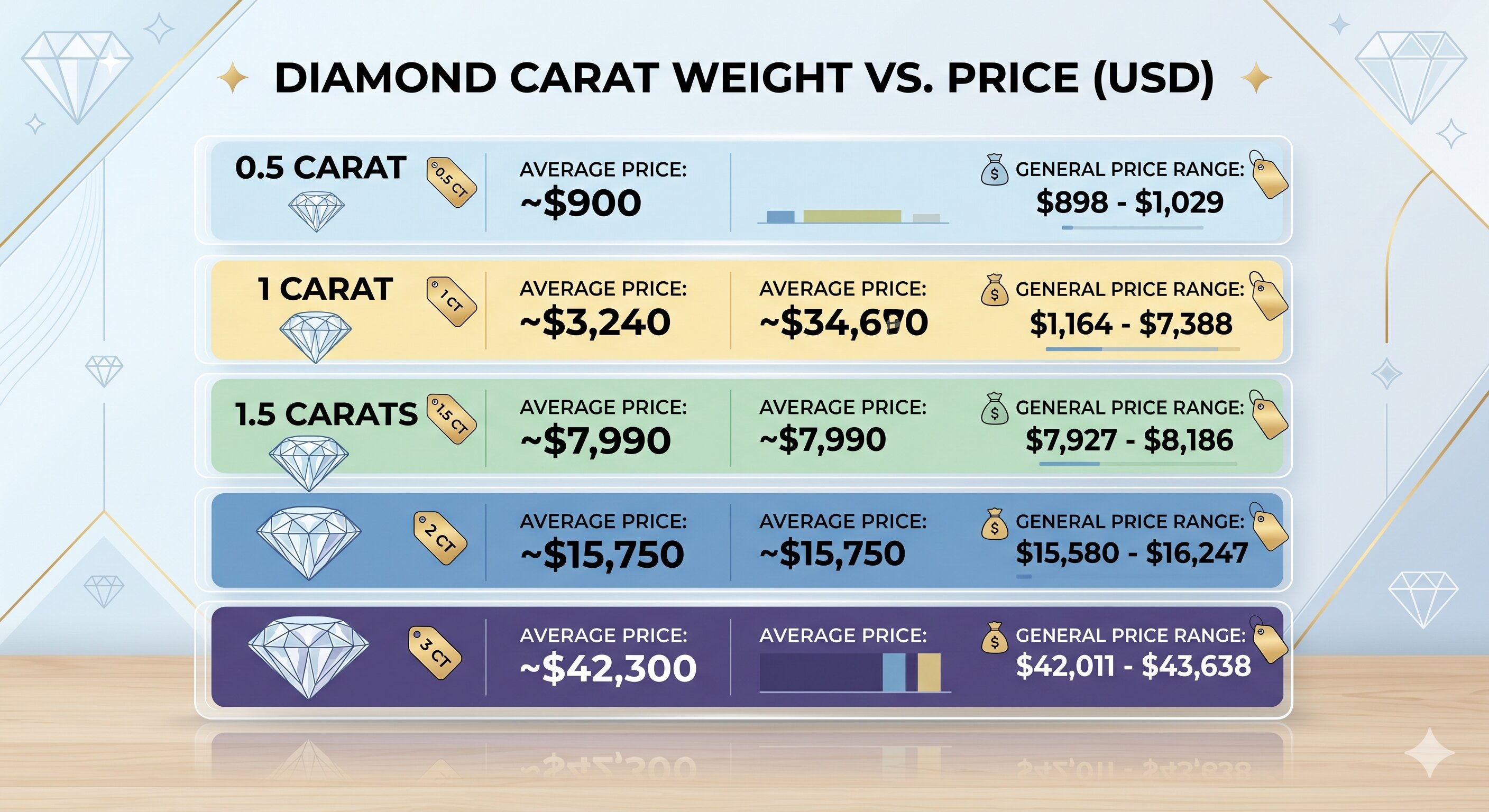
The cost of a cushion-cut diamond depends mainly on its carat weight and quality. Compared to popular round brilliants, cushion cuts are often more affordable, costing around 25% less for a similar quality stone.
Based on current market data, here are the average price ranges for loose, natural cushion cut diamonds:
What Makes the Price Change?
These price ranges are largely determined by the "4Cs":
Carat: The single biggest factor. As shown above, price increases significantly with size, especially over 1 carat.
Color & Clarity: Higher grades cost more. For a balanced budget, near-colorless (G-H) and clarity grades like VS2 or SI1 are popular.
Cut: A well-cut cushion diamond sparkles beautifully. Since cushion cuts don't have a universal cut grade, rely on high-quality videos or in-person viewing to judge sparkle.
Practical Buying Examples
For a $3,000 Budget: You could likely find a ~1-carat cushion diamond with G-H color and VS2 clarity.
For a $15,000 Budget: This could get you a ~2-carat stone, or a high-quality ~1.5-carat diamond with excellent color and clarity.
How to Get the Best Value
Compare Shapes: A 1-carat round brilliant averages over $5,000, while a cushion is about $3,240. You can often get a larger or higher-quality cushion for the same budget.
Consider Styles: The "crushed ice" facet style may allow for a slightly lower clarity grade, as its many facets can hide tiny inclusions.
Prioritize Viewing: Always review diamonds via high-resolution videos (available on retailer sites like Ritani or Blue Nile) or in person to ensure you love their individual sparkle.
I hope this detailed breakdown helps you with your budget planning. If you can share your target carat size or price range, I could provide more specific guidance on what quality to expect.
Is A Cushion Cut Diamond A Real Diamond?
Yes, a cushion cut diamond is absolutely a real diamond. It refers specifically to a shape and style of cutting, not the diamond's authenticity.
The confusion often arises because the term describes the cut (how the diamond is faceted), not the type of diamond. A cushion cut diamond can be either:
Natural Diamond: Mined from the earth.
Lab-Grown Diamond: Created in a laboratory with identical chemical and physical properties.
Why the Confusion Exists
The term "cushion" describes the diamond's pillow-like shape with rounded corners. It is one of many established diamond cuts, like the round brilliant or princess cut. It doesn't indicate if the stone is natural, lab-created, or a simulant like cubic zirconia.
How to Verify a Diamond's Authenticity
To confirm you are buying a real diamond, look for these, not just the shape:
Reputable Certification: Always insist on a grading report from a major gemological lab like the GIA (Gemological Institute of America) or AGS (American Gem Society). The certificate will detail the "4Cs" (Cut, Color, Clarity, Carat) and confirm it is a natural or lab-grown diamond.
Purchase from Trusted Sources: Buy from established, reputable jewelers who provide full transparency and certificates.
Understand the "4Cs": A real diamond's value is assessed through these grades, which will be listed on its certificate.
In short, "cushion cut" describes the shape; certification proves it's a real diamond. If you are looking at a specific diamond and would like help understanding its certificate, feel free to share the details.
Are Cushion-Cut Rings Out of Style?
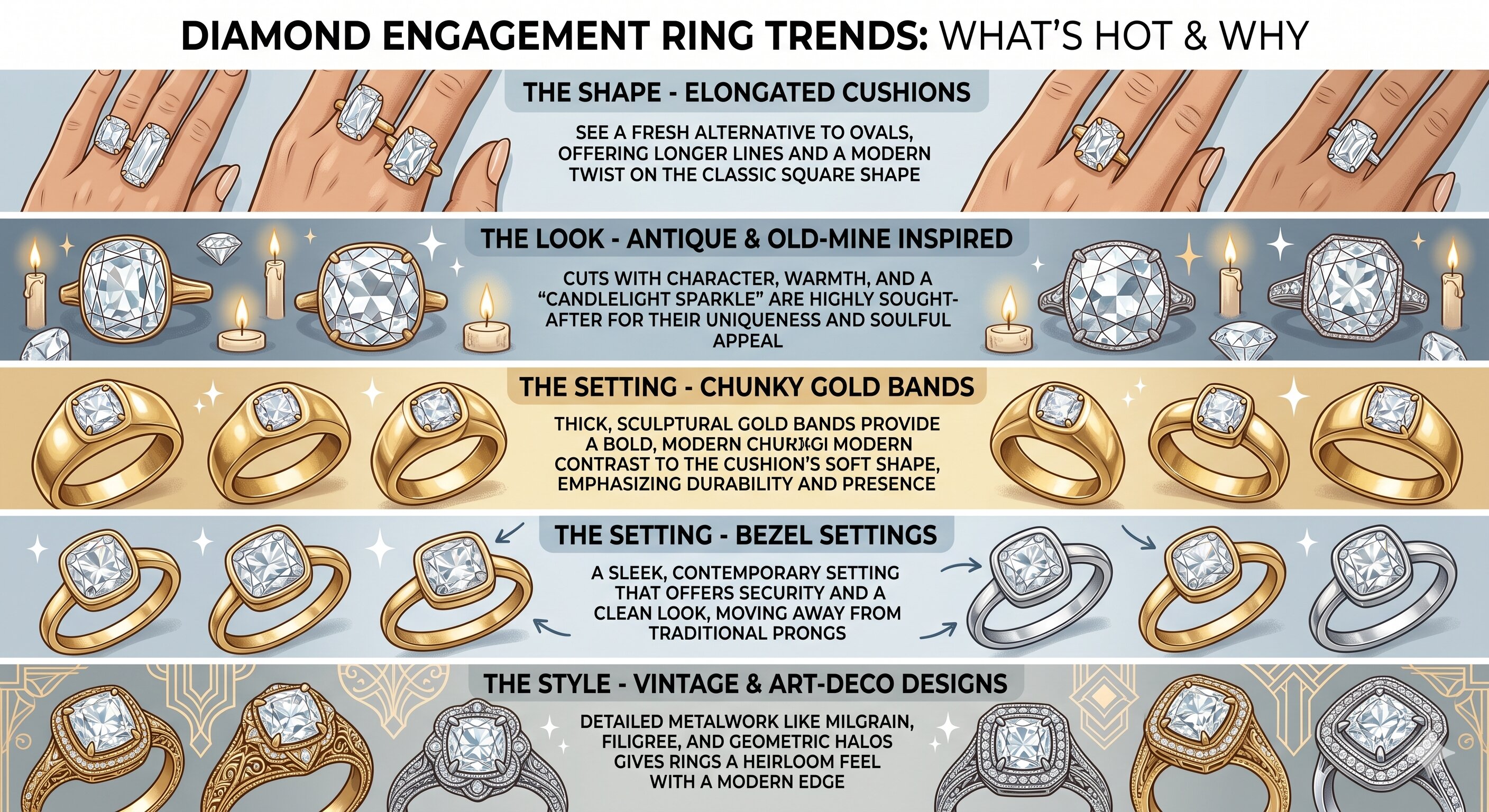
No, cushion-cut diamond rings are not out of style. In fact, for 2026, they are positioned as one of the most popular and trending engagement ring choices, frequently highlighted alongside other sought-after shapes like ovals and emerald cuts.
The trend is not just about the basic shape; it's driven by specific, modern interpretations that update this classic cut. Below is a summary of the key ways cushion cuts are trending:
Why Cushion Cuts Are Timeless
Beyond the 2026 trends, the cushion cut has enduring appeal because it is a classic silhouette. Its soft, romantic shape has been cherished for centuries, evolving from the 18th-century "Old Mine Cut". This long history means it's a shape that has consistently remained in fashion, making it a safe choice for a piece meant to last a lifetime.
Celebrity influence is also a significant factor in the current trend, with stars like Zendaya, Taylor Swift, and Miley Cyrus recently choosing or being gifted cushion-cut rings.
Choosing a Timeless Cushion Cut
To pick a cushion cut ring that will feel stylish for years to come:
Embrace Modern Proportions: Consider an elongated cushion for a contemporary look that flatters the finger.
Select a Durable Setting: The trending chunky band or bezel setting is not only stylish but also offers excellent protection for everyday wear.
Focus on Quality: Regardless of trends, prioritize a well-cut stone with good proportions. Reviewing a diamond in person or via high-quality video is the best way to judge its sparkle.
In summary, if you're drawn to the romantic, soft-cornered look of a cushion cut, you can choose one with confidence—it is both a historically significant and currently fashionable choice.
If you have a particular setting style (like halo, three-stone, or Solitaire) in mind and would like to know how it's being interpreted in the latest trends, feel free to ask for more details.
Are Cushion Cuts Trendy Or Classic?
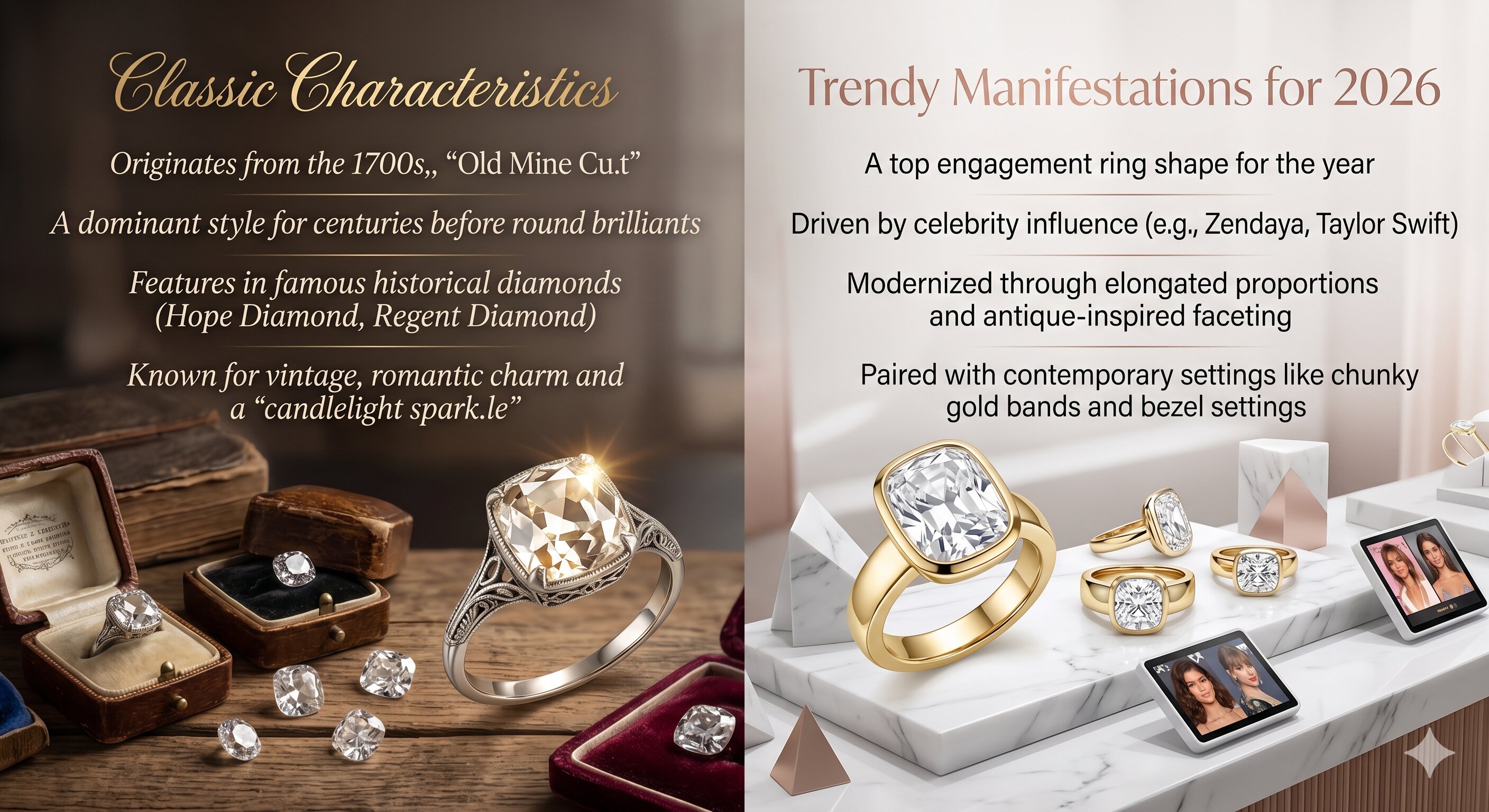
Cushion-cut diamonds are uniquely positioned as both timeless classics and hot trends, with their current popularity being a modern reinterpretation of their historic appeal.
Here's a breakdown of how they embody both qualities:
Choosing a Timeless Cushion
Since "trends" can change, here is how to ensure your cushion cut remains a classic:
Focus on Quality: A well-proportioned, symmetrical stone will always look beautiful. High-quality specifications for cushion cuts include an ideal depth between 60-68% and a table between 57-65%.
Avoid Faddish Exaggerations: A slightly elongated shape (e.g., length-to-width ratio of 1.05-1.15) offers a modern look, while extremely rectangular shapes are more fashion-specific.
Select a Complementary Setting: Classic styles like a simple solitaire or a delicate halo will never look dated.
In summary, the cushion cut is a classic shape currently enjoying a major trend, especially in its elongated and antique-inspired forms.
If you are considering specific diamond proportions (like a 1.10 ratio) or a particular setting style (chunky band vs. halo), feel free to ask for more detailed advice.
Emerald Cut vs Elongated Cushion
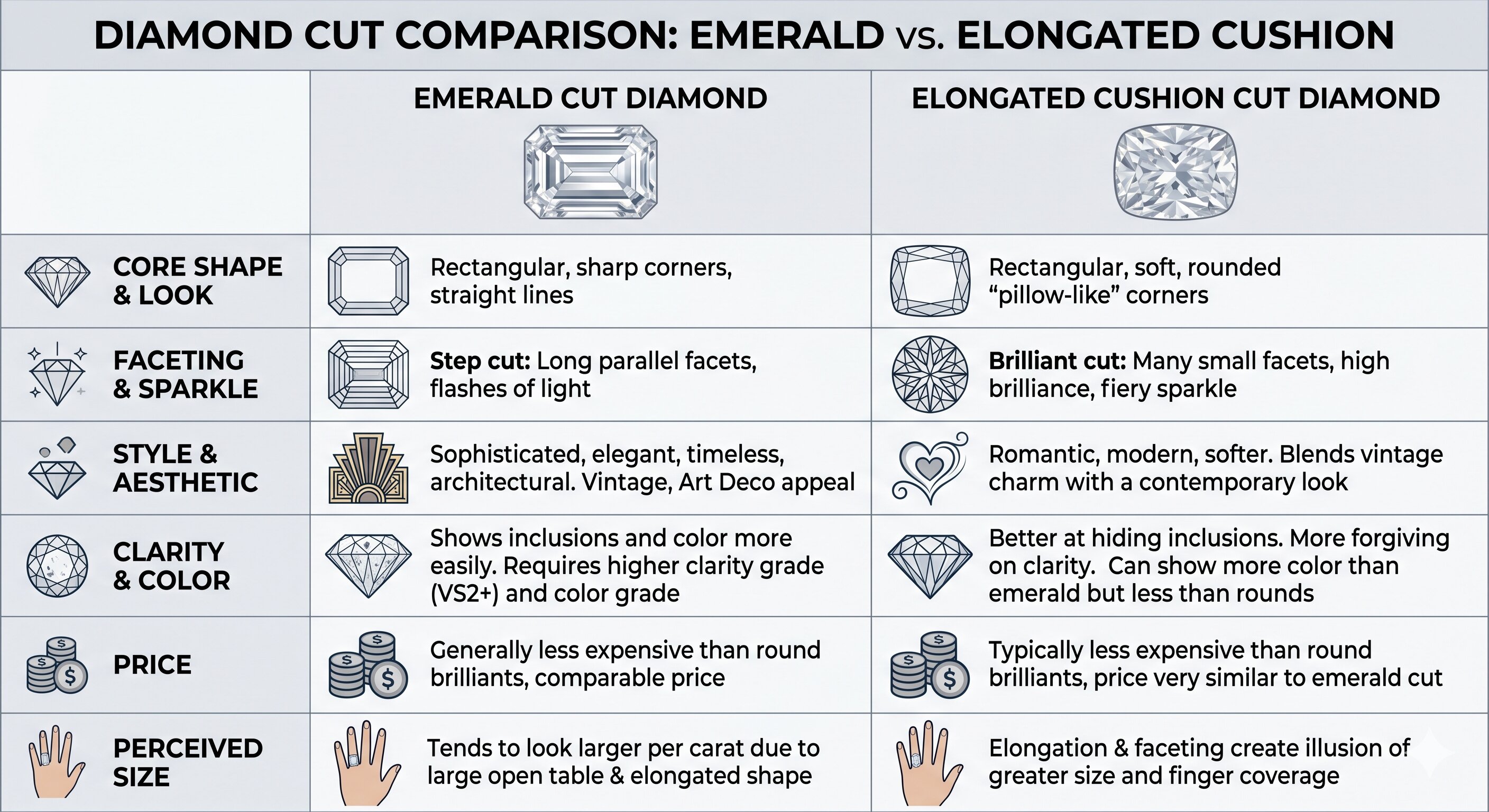
To directly compare an emerald cut and an elongated cushion cut, think of them as offering two distinct diamond experiences: one is about sophisticated clarity and bold geometry, while the other prioritizes romantic sparkle and soft curves.
Here is a breakdown of their key differences:
Key Factors for Your Decision
When choosing between the two, focus on these practical aspects:
The "Sparkle" Factor: This is the biggest differentiator. Do you prefer the dramatic, linear flashes of the hall of mirrors (Emerald), or the abundant, scattered sparkle and fire of a Brilliant cut (Elongated Cushion)?
Clarity Requirements: With an emerald cut, you'll likely need to invest in a higher clarity grade (VS2 or above) to avoid visible inclusions. Cushion cuts are more forgiving, potentially saving you money on clarity.
Shape Proportions: For an elongated cushion, a length-to-width ratio between 1.15 and 1.25 is popular for a balanced rectangular look. For emerald cuts, a classic rectangular shape falls between 1.30 and 1.50.
Hand Appearance: Both shapes are known for creating a finger-lengthening effect due to their elongated forms.
Which One is for You?
Choose an Emerald Cut if:
You are drawn to clean lines, bold geometry, and understated elegance.
You love the sophisticated, "hall of mirrors" flash over intense sparkle.
You appreciate vintage, Art Deco-inspired style.
Choose an Elongated Cushion Cut if:
You want the softness of rounded corners but the modern look of an elongated shape.
Maximum sparkle and brilliance are your top priorities.
You want a romantic, modern aesthetic with a vintage touch.
The best way to decide is to see them in person or via high-quality videos. If you know your preferred style (e.g., solitaire, halo, three-stone) and have a budget in mind, I can help you explore what to look for in a specific diamond for that setting.
What Is The Difference Between A Cushion Cut And A Princess Cut?
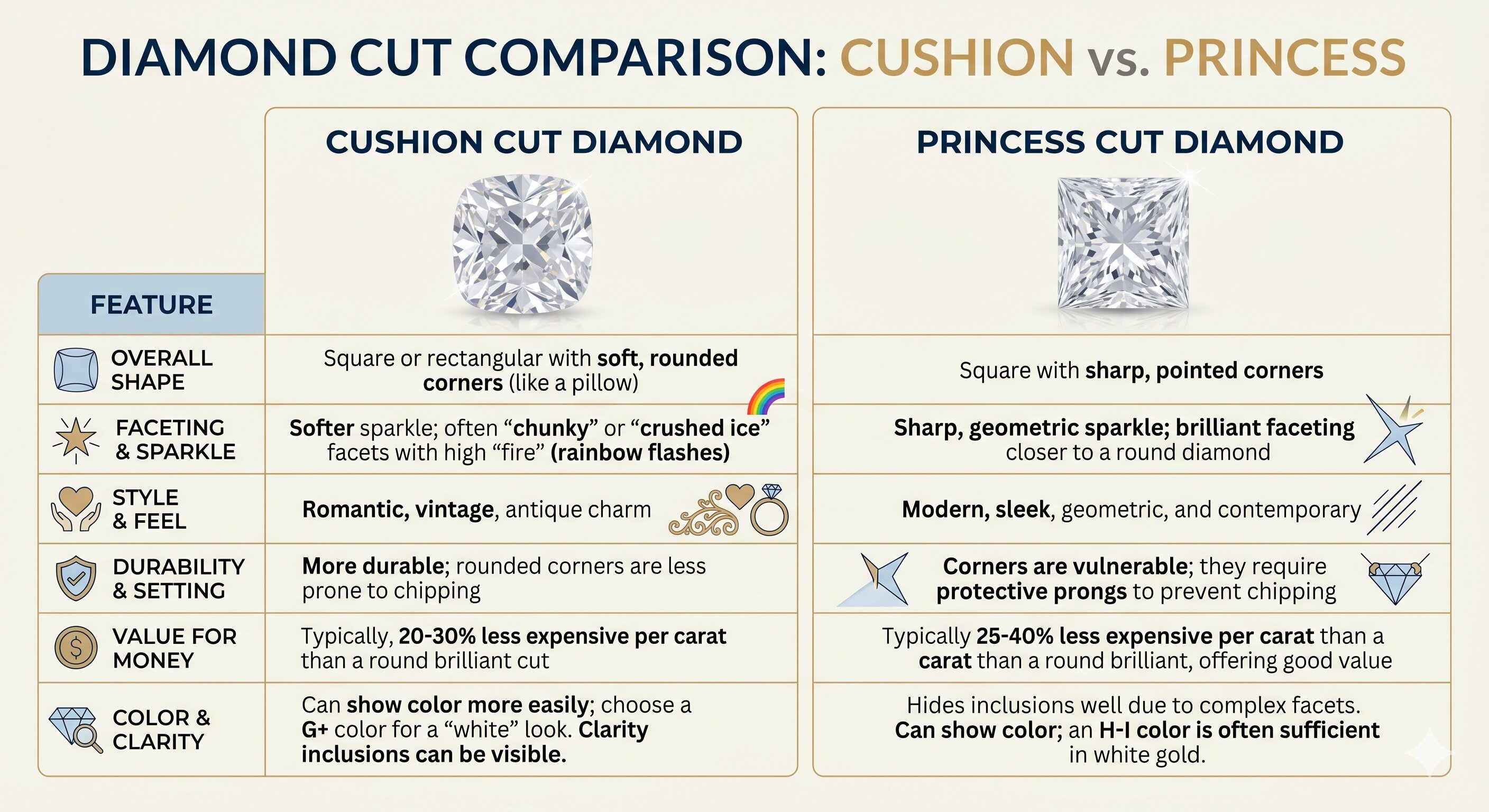
Here’s a comparison between cushion and princess cut diamonds. While both can appear square, they have very different characteristics.
Practical Implications and How to Choose
These differences influence how each diamond looks, feels, and wears:
Protection and Setting: The princess cut's sharp corners are its biggest weak point and must be protected by a secure four-prong (or similar) setting. Cushion cuts, with their rounded corners, are naturally more durable for daily wear.
Size Perception and Budget: Both cuts offer better value than a round brilliant. A princess cut may appear to have a larger diagonal measurement, while a cushion cut’s face-up size can vary with its specific proportions.
Style Match: Your choice heavily depends on aesthetic preference. The cushion cut has an enduring, romantic, and vintage vibe. The princess cut offers a clean, bold, and modern look.
Key Decision Factors
Consider these points to help decide:
Choose a Cushion Cut if you love vintage or romantic styles, prefer a softer, more diffused sparkle, and want a durable shape for an active lifestyle.
Choose a Princess Cut if you prefer a modern, geometric look with sharp, brilliant sparkle similar to a round diamond, and are comfortable with a setting that protects its corners.
I hope this detailed comparison helps you narrow down your choice. If you are considering specific settings (like a halo or solitaire) and would like to know which cut tends to look best, I can provide further insights.
“You now know the personality, the history, the characteristics, the styles, the prices, the authenticity, the trend status, and the comparisons (round, emerald, princess). The only question left: will you choose the diamond that glows like candlelight?
Our current collection includes a limited number of GIA-certified cushion cut diamonds — from antique-style chunky facets to modern crushed ice, and from square classics to elongated rectangles. When stones with ideal proportions and minimal bow-tie are gone, sourcing new ones takes time.
This is not just a diamond. It is the Hope Diamond‘s shape, Marie Antoinette‘s Regent, and 300 years of romance — the cut that doesn‘t just sparkle. It glows.”
[Button: Claim Your Cushion Cut Diamond (Limited) →]


News for Friday 31 October, 2025
- Round Brilliant Diamond Cut: Everything You Need to Know
- The Oval Cut: What It Means and Why It's Popular?
View all news for Friday 31 October, 2025 on one page
Recent News
- Thursday 30 October, 2025
- Wednesday 29 October, 2025
- Tuesday 28 October, 2025
- Monday 27 October, 2025
- Tuesday 21 October, 2025