

Alexandrite Stone: Everything You Need to Know About This Rare Gem
Alexandrite stone
Alexandrite is one of the most remarkable and coveted gemstones in the world, famous for its stunning color-changing ability.
In 1834, Russian miners working in the Ural Mountains discovered a strange green gem. Under candlelight that same night, they watched in disbelief as the stone turned ruby-red. They called it ‘alexandrite‘ after the future Tsar Alexander II. The timing was impossible to ignore: the stone‘s colors matched Imperial Russia‘s military uniform — green by day, red by night. It became a legend overnight. Today, alexandrite is still the magician of the gem world — rarer than diamond, more mysterious than sapphire, and the only stone that asks you to look twice.”
The same stone that changed color for Russian royalty now awaits your June birthday — or your own transformation. Every alexandrite in our collection is certified natural or lab-created (you choose), with the dramatic green-to-red shift.”
[Button: Explore Alexandrite Rings ]
It is a true chameleon of the gem kingdom and a primary birthstone for June (alongside pearl and moonstone).
Here is a comprehensive guide to the table of contents.
What Is The Spiritual Meaning Of Alexandrite Stone?
How Much Is Alexandrite Worth?
Why Is Alexandrite Stone So Expensive?
What Is The Most Expensive Color of Alexandrite Stone?
Is Alexandrite Considered A Precious Stone?
How Do I Tell If My Alexandrite Stone Is Real?
What Is The Rarest Color of Alexandrite?
Which Zodiac Can Wear Alexandrite?
Can Alexandrite Be Worn Every Day?
Which Is More Expensive, Ruby or Alexandrite?
Here is the first topic;
What Is The Spiritual Meaning Of Alexandrite Stone?
The spiritual meaning of Alexandrite Stone is deeply tied to its most famous and mesmerizing property: its ability to change color.
This remarkable gemstone, which appears green or bluish-green in daylight and transforms to a red or purplish-red under incandescent light, is seen as a powerful symbol of profound spiritual concepts.
Here is a breakdown of the spiritual meaning of the Alexandrite stone:
1. The Master of Transformation and Change
At its core, Alexandrite stone is the ultimate stone of personal and spiritual transformation. Its color shift is a physical metaphor for the soul's ability to adapt, evolve, and embrace change.
Alchemy of the Self: Just as the stone "alchemizes" light to reveal a different color, it teaches us to alchemize our experiences—turning challenges into wisdom, grief into compassion, and fear into courage.
Embracing Life's Dualities: It helps the wearer navigate major life transitions—such as a career change, a spiritual awakening, or the end of a chapter—with grace and resilience. It reminds us that we, like the stone, can reveal different aspects of our strength depending on the circumstances.
“In Victorian England, alexandrite became known as the ‘stone of luck‘ for a strange reason: if you lost it, you were meant to find something better. The belief was that the stone‘s color shift could reveal hidden truths — a green hue meant good fortune ahead; a red glow warned of danger. But the real magic was deeper: Alexandrite teaches that change is not loss. It is only light moving differently. When you wear this stone, you are not wearing a gem. You are wearing the permission to transform.”
2. Balance Between Opposites (The Divine Union)
Alexandrite is a powerful symbol of balance and integration, specifically between seemingly opposing forces.
The Heart and the Mind: The green color is often associated with the heart chakra (love, growth, healing), while the red color connects to the root chakra (vitality, passion, survival). Alexandrite helps bridge the gap between unconditional love and grounded, passionate action.
The Physical and Spiritual Worlds: It acts as a bridge between the earthly realm (green, nature) and the spiritual or celestial realm (red, passion of the soul). It aids in bringing spiritual insights down to earth to be lived practically.
Yin and Yang: It embodies the perfect harmony of masculine and feminine energies within the self, promoting wholeness and inner peace.
3. Joy, Hope, and Spiritual Optimism
Alexandrite is known as a "stone of luck" and "good omen" in many cultures. Spiritually, this translates to a deep-seated sense of hope and optimism.
Seeing the Good: Its color change reminds us that our perception shapes our reality. What appears one way in a certain "light" (or situation) can reveal hidden beauty and opportunity when the perspective shifts.
Manifesting Joy: It is believed to uplift the spirit, attract abundance, and help manifest joy and creativity into one's life. It encourages a playful and joyful exploration of spirituality.
4. Inner Strength and Intuition
The rarity and strength of Alexandrite stones are seen as metaphors for inner fortitude.
Courage: It provides spiritual courage to walk your unique path, especially when it involves change or going against the grain.
Intuitive Development: By working with the third eye chakra, it is said to enhance intuition and psychic abilities. Its changing nature helps the user become more sensitive to subtle energies and shifts in their environment.
Chakra Associations
Alexandrite is a unique gem that works primarily with three key chakras:
Heart Chakra (Anahata): The green color connects to the heart, fostering love, emotional healing, and compassion.
Root Chakra (Muladhara): The red color grounds spiritual energy into the physical body, promoting stability, security, and vitality.
Crown Chakra (Sahasrara): As a stone of high spiritual vibration, it can open the crown chakra, facilitating a stronger connection to the divine, higher consciousness, and universal wisdom.
How to Use Alexandrite Spiritually
Meditation: Hold an Alexandrite stone (or visualize one) during meditation to connect with its energy of transformation. Focus on an area of your life you wish to change and ask for guidance.
As Jewelry, wearing Alexandrite stone as a ring or pendant keeps its transformative energy close to your aura throughout the day, helping you navigate change with balance.
On an Altar: Placing it on a personal altar can serve as a powerful reminder of your commitment to spiritual growth and balance.
How Much Is Alexandrite Worth?
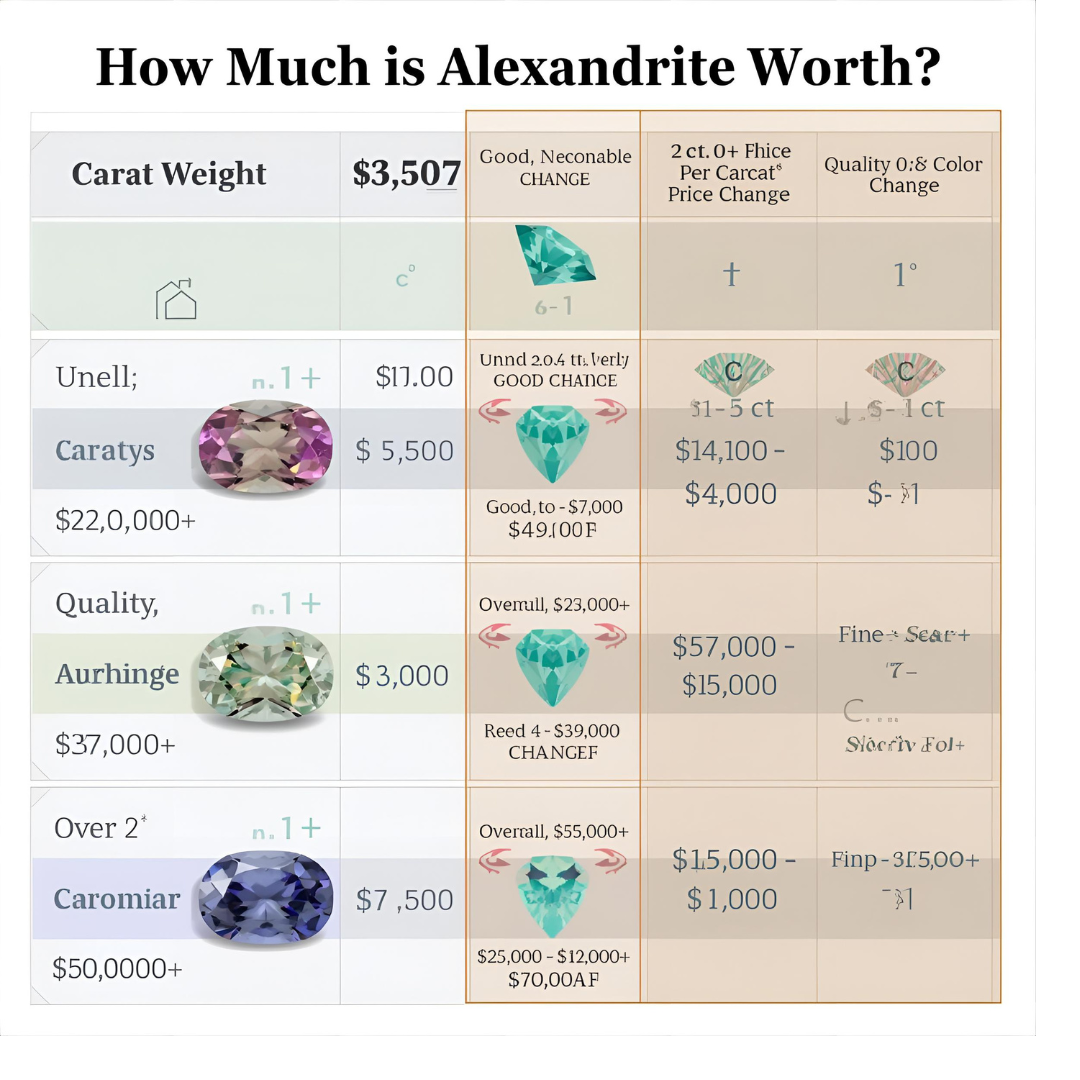
This is an excellent question, because the value of alexandrite stone is one of the most complex and variable in the gem world. The short answer is: Natural alexandrite stone can be more valuable than a diamond, while synthetic alexandrite is quite affordable.
The price is almost entirely determined by the strength of its color-change, the quality of its colors, and its origin.
To give you a clear picture, here’s a breakdown of what influences its worth.
The #1 Factor: The Color Change
This isn't just *a* factor; it's the most critical one. The value is directly tied to the strength and dramatic nature of the color change.
Excellent Change: Vivid emerald green in daylight to a vivid purplish-red or raspberry red in incandescent light. This commands the highest prices.
Good Change: Strong green to a strong purple/red.
Poor Change: Muddy or faint green to a brownish or faint red. This is significantly less valuable.
Price Ranges for Natural Alexandrite
Because alexandrite is so rare, especially in larger sizes, the price per carat increases exponentially with size. The following are estimated price ranges for natural, untreated stones in the market.
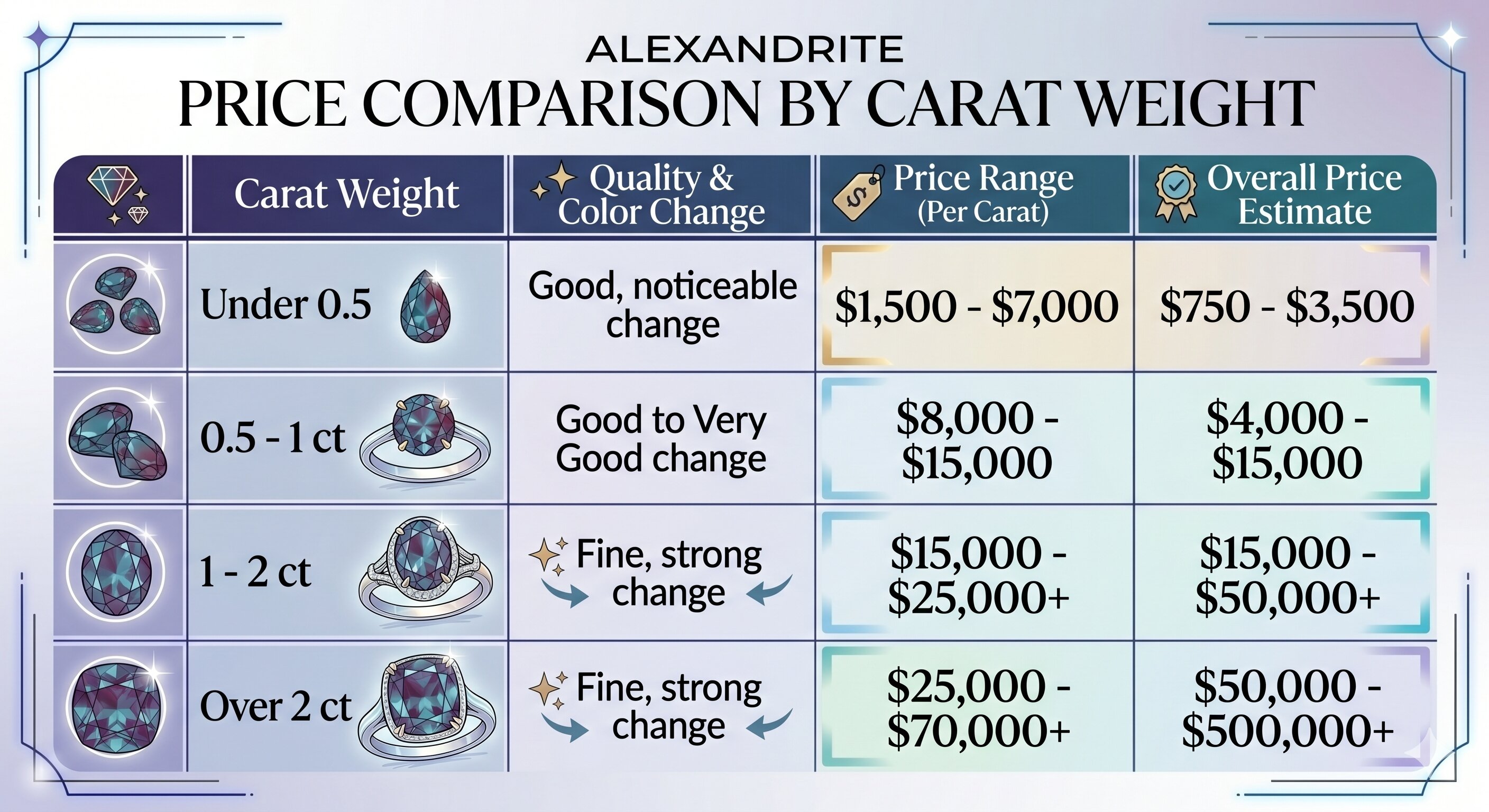
Extreme High-End Examples:
A top-quality 5-carat natural alexandrite could easily exceed $250,000.
A record-setting 65.7-carat alexandrite sold for over $4 million at auction.
Other Critical Factors Affecting Value
Origin: This is a huge deal for collectors.
Russian (The Original): Stones from the original Ural Mountains deposit are the most legendary and often have the classic "emerald by day, ruby by night" change. They are incredibly rare and command a massive premium.
Brazilian: Generally considered the next best in terms of color change and quality. Often has a bluish-green in daylight.
Sri Lankan (Ceylon): Can be larger but often has a less dramatic, more brownish color change.
Indian, Tanzanian, etc.: Other sources exist, and their value depends on the individual stone's quality.
Clarity: Alexandrite is a Type II gemstone, meaning some inclusions are expected. A stone with excellent color change can still be very valuable even with visible inclusions, as long as they don't severely impact its durability or brilliance.
Cut: A good cut will maximize the color change effect. A poorly cut stone that masks the change will be worth much less.
Synthetic vs. Natural: A Critical Distinction
This is where most of the confusion about alexandrite's price comes from.
Synthetic Alexandrite (Lab-Created): This is real alexandrite, with the same chemical composition and physical properties as natural stone, but created in a lab. Its color change can be absolutely perfect and dramatic.
Price: Very affordable, typically $50 to $500 per carat.
Alexandrite Simulants (FAKE): These are completely different materials, like color-change sapphire or lab-grown corundum, that are designed to look like alexandrite. They do not have the same chemical composition.
Price: Very cheap, often $5 to $50 per carat.
Common Names: "Synthetic Alexandrite" is sometimes incorrectly used to describe these simulants, confusing.

Why Is Alexandrite Stone So Expensive?
The extreme expense of natural alexandrite can be boiled down to one overarching concept: It is one of the rarest and most capricious gems on Earth, and it possesses a magical optical property that is almost impossible to find in nature.
Here is a detailed breakdown of why it commands such astronomical prices.
1. Extreme Rarity: A "Perfect Storm" of Geology
Alexandrite isn't just rare; it's a geological anomaly. It requires very specific, and often mutually exclusive, elements to come together in the right place, at the right time, and in the right amounts.
Contradictory Chemistry: Alexandrite is a variety of the mineral chrysoberyl. Its legendary color change happens when the common element iron is replaced by the rare element chromium.
Hostile Environment: Chromium is the same element that gives ruby its red color. However, for chromium to be incorporated into chrysoberyl instead of corundum (ruby's family), the geology must be beryllium-rich but silicon-poor. This is a very unusual combination, as beryllium and silicon are typically found together.
The "Perfect Storm": This means alexandrite only forms in very specific pegmatites or metamorphic rocks where these unusual conditions are met. Finding a mine that produces genuine alexandrite is like finding a needle in a haystack the size of a planet.
2. The "Alexandrite Effect" Itself
The color-change phenomenon isn't just a neat trick; it's an incredibly rare and desirable optical property.
Not Just Any Change: Many stones can change color in different lights, but alexandrite's shift is the most famous and dramatic. The most prized stones go from a vivid grass-green in daylight to a vivid raspberry-red under incandescent light.
A Delicate Balance: This effect occurs because the stone absorbs light in a very specific part of the yellow-green spectrum. The human eye perceives the stone as green in daylight (which is rich in blue-green wavelengths) and red in incandescent light (which is rich in red wavelengths). This precise balance is easily disrupted by even slight chemical impurities, making a stone with a perfect change exceptionally rare.
3. The "Trinity" of Value: Color, Change, and Clarity
For alexandrite to be considered top-quality, it must excel in three areas simultaneously, which is incredibly difficult to find.
Strength of Color Change: The shift must be strong and dramatic, not subtle or muddy. A weak change drastically reduces the value.
Quality of the Colors: The stone shouldn't just change color; it should change to beautiful colors. A perfect green and a perfect red are the goal. Many stones are a dull green or a brownish-red.
Good Clarity and Size: Like all gems, inclusions can lower the value. However, because alexandrite is so rare, a stone with a strong color change can still be valuable even with visible inclusions. Finding a large stone (over 1-2 carats) with a strong color change and good clarity is the ultimate treasure hunt and sends the price into the stratosphere.
4. Legendary Origins and Depleted Mines
The Original Source: The first alexandrite was discovered in Russia's Ural Mountains in the 1830s and was named after the future Tsar Alexander II. These original Russian stones set the standard for quality with their stunning color change.
Mined Out: The original Russian mines were largely depleted within a few decades. While new sources have been found in Brazil, Sri Lanka, and Africa, stones from the original Russian locality are considered legendary and command a huge premium on the collector's market. Fine-quality material from any source remains exceptionally rare.
5. High Demand vs. Microscopic Supply
Alexandrite checks all the boxes for what makes a gem desirable:
Beauty: Its color change is mesmerizing and unique.
Rarity: It is far rarer than diamond, ruby, or sapphire.
Lore: It has a romantic history and is the modern birthstone for June.
This creates intense demand from collectors, investors, and connoisseurs. However, the supply of fine-quality natural alexandrite is minuscule and unpredictable. When a top-quality stone appears on the market, it often sparks bidding wars at auctions, further driving up its perceived value and price.
The Synthetic vs. Natural Confusion
It's crucial to remember that the lab-created alexandrite you see for sale for $50-$500 per carat is a real alexandrite in terms of its chemical and physical properties. Its color change can be flawless. However, because it is not a product of nature's rare and chaotic process, it lacks the scarcity that makes natural stones so valuable.
What Is The Most Expensive Color of Alexandrite Stone?
This is a fantastic question that gets to the very heart of what makes Alexandrite stones so special and valuable.
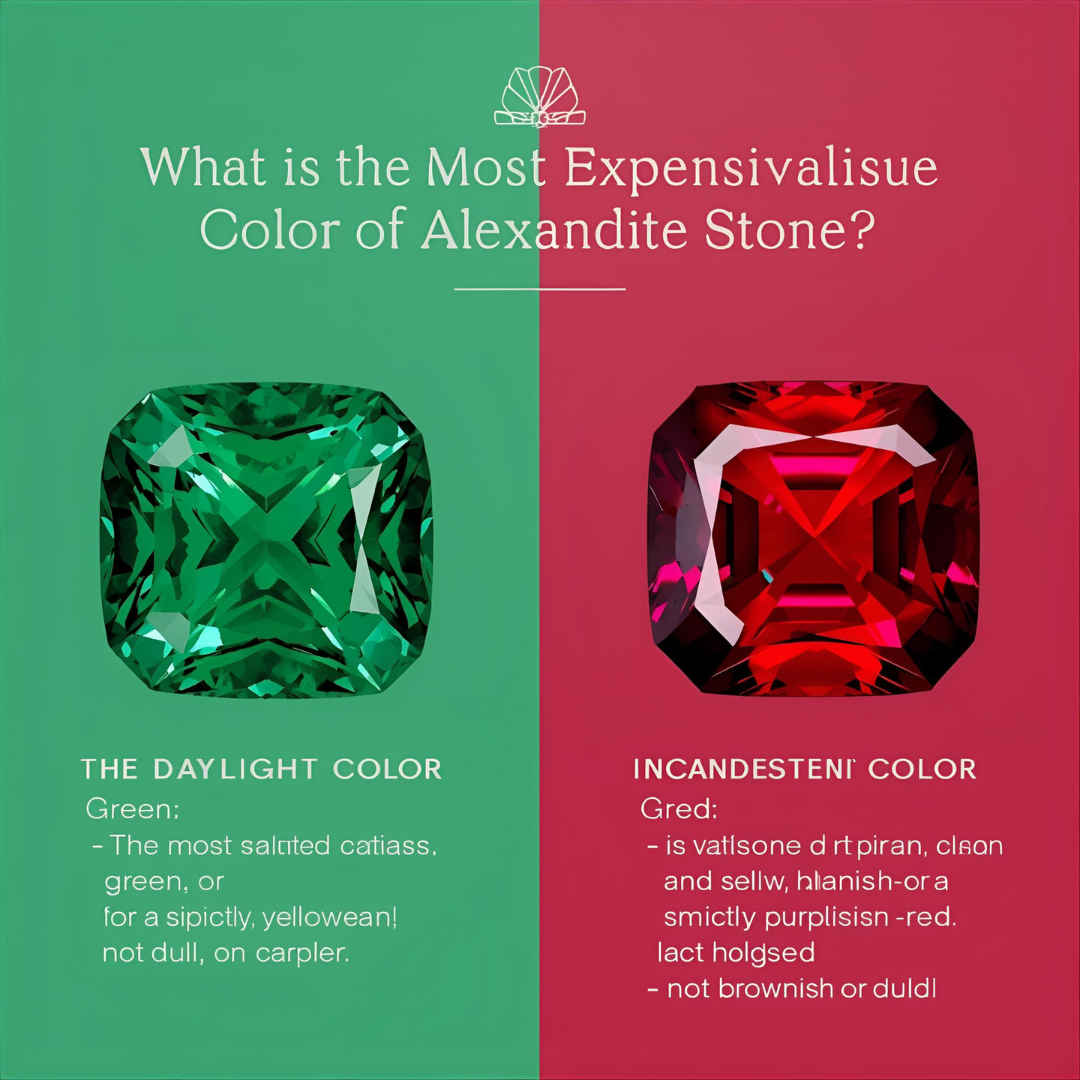
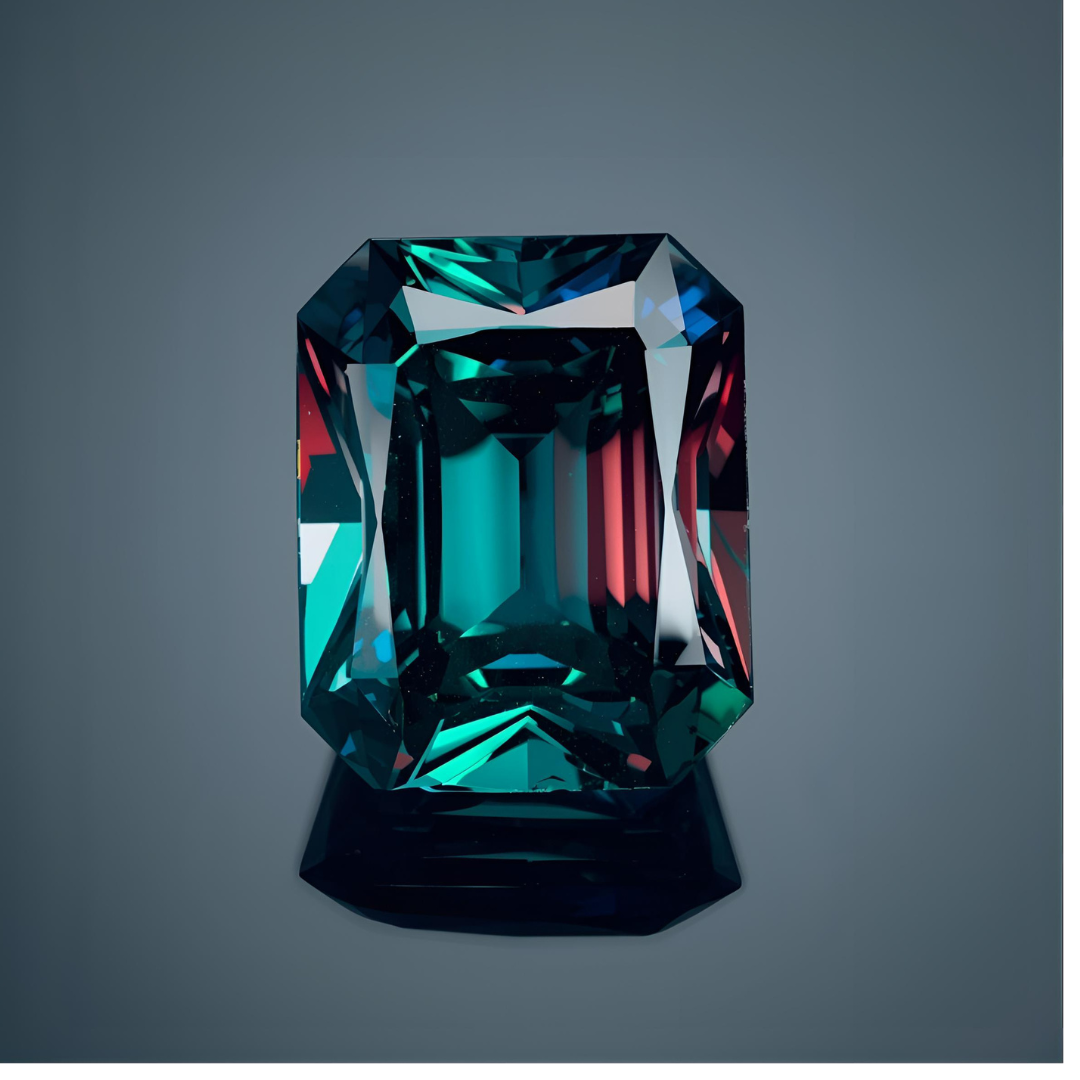
The most expensive color of alexandrite stone is not a single color, but a specific and dramatic color change. The highest prices are commanded by stones that display a strong and vivid shift from a bluish-green or pure grass green in daylight to a purplish-red or intense raspberry red in incandescent light.
Here’s a detailed breakdown of why this specific combination is the peak of value:
The "Ideal" or "Classic" Change
This specific color change is known as the "emerald by day, ruby by night" phenomenon, a description stemming from the original 19th-century Russian stones that set the standard.
The Daylight Color (Green): The most valued green is a saturated, vivid "grass green" or a slightly bluish-green. It should be clean and vibrant, not dull, yellowish, or muddy.
The Incandescent Color (Red): The most valued red is a vivid "raspberry red" or a slightly purplish-red. It should be intense and glowing, not brownish or dull.
Why This Combination is So Valuable
Completeness and Contrast: This pairing represents the most complete and dramatic transformation possible. The two colors are on opposite sides of the color wheel, creating a stunning visual effect that is highly sought after.
Purity of Hue: The top-tier stones have "pure" colors with no undesirable modifiers. The absence of brown, gray, or yellow tones in the green and the absence of brown in the red are critical for achieving the highest price.
Saturation: The colors must be strong and intense. A stone with a 100% color change that is pale is often less valuable than one with a 90% change that has highly saturated, vivid colors.
Rarity of the Combination: Finding a gemstone that naturally possesses both a fine emerald-green and a fine ruby-red in one stone is exceptionally rare. This perfect balance of chemistry (primarily chromium as an impurity in a beryllium-rich, silicon-poor environment) is a geological lottery win.
The Origin Connection
The "classic" green-to-red change is most famously associated with the original, now largely depleted, Russian mines from the Ural Mountains. Because these stones are the historical benchmark and incredibly rare, that specific color profile commands a huge premium, especially among collectors.
Lower-Value Color Combinations
To understand the peak, it helps to see what is considered less valuable:
Moderate Value: A change from a greenish-teal to a pinkish-purple or a less intense reddish-purple.
Lower Value: A weak or "muddy" change, such as a dull khaki green to a brownish-red. Stones that are too light (washed-out) or have a very subtle shift are significantly less expensive.
Is Alexandrite Considered A Precious Stone?
Yes, absolutely. Alexandrite is universally classified as a precious stone.
It belongs to the most exclusive category of gems, standing alongside diamond, ruby, sapphire, and emerald. Here’s a detailed breakdown of why it holds this prestigious status.
The Traditional Definition of a "Precious Stone"
Historically, the term "precious stone" was reserved for a very small group of gems that met the following criteria:
Extreme Rarity
Exceptional Beauty (color, brilliance, optical phenomena)
High Hardness and Durability (suitable for everyday jewelry)
Consistently High Value
For a long time, the list was limited to just four: Diamond, Ruby, Sapphire, and Emerald.
How Alexandrite Earned Its Place
Alexandrite not only meets but, in some aspects, exceeds the criteria for being a precious stone.
Rarity: Alexandrite is far rarer than any of the other traditional precious stones. Finding a large, high-quality natural alexandrite is a monumental challenge, making it a true collector's gem.
Beauty: Its legendary color-change phenomenon is its defining feature. This unique and mesmerizing optical property gives it a beauty that is dynamic and unmatched by any other gem.
Durability: With a hardness of 8.5 on the Mohs scale, alexandrite is very durable and excellent for use in all types of jewelry, including rings worn daily. It is harder than emerald and only slightly softer than ruby and sapphire.
Value: As we've discussed in previous questions, fine-quality natural alexandrite can be more expensive per carat than diamond. Its value is consistently high and has appreciated significantly over time.
The Modern "Big Five"
In modern gemology and the jewelry trade, the category of "precious stones" has been unofficially expanded to include alexandrite. It is now widely considered the fifth precious stone, forming a "Big Five":
Diamond
Sapphire
Emerald
A Critical Distinction: Natural vs. Lab-Created
This is a crucial point of clarification:
Natural Alexandrite is a precious stone.
Lab-Created (Synthetic) Alexandrite has the same chemical and physical properties, but is not considered "precious" in the same way because it is not rare. It is, however, a beautiful and affordable alternative.
How Do I Tell If My Alexandrite Stone Is Real?
This is a crucial question, given the value of natural alexandrite and the prevalence of synthetics and simulants.
Determining if your alexandrite is "real" can mean two different things, so we'll break it down into a step-by-step process, from simple at-home observations to the definitive professional method.
First, Understand What "Real" Means
Natural Alexandrite: The "real" thing in the gemological sense. Mined from the earth, incredibly rare and valuable.
Lab-Created (Synthetic) Alexandrite: This is real alexandrite in terms of its chemical and physical properties, but it was grown in a lab. It is much more affordable.
Simulant: A fake. This is a completely different material (like Color-Change Sapphire, Spinel, or even glass) designed to look like alexandrite. It has a different chemical composition.
Here is how you can tell them apart.
Step 1: The At-Home Color Change Test (The Most Telling Sign)
This is the first and most important test you can do yourself.
What You Need: Two different light sources: daylight (near a window is best) and incandescent light (a non-LED, non-fluorescent bulb like in a classic lamp).
What to Do: Observe the stone under both lights.
What to Look For:
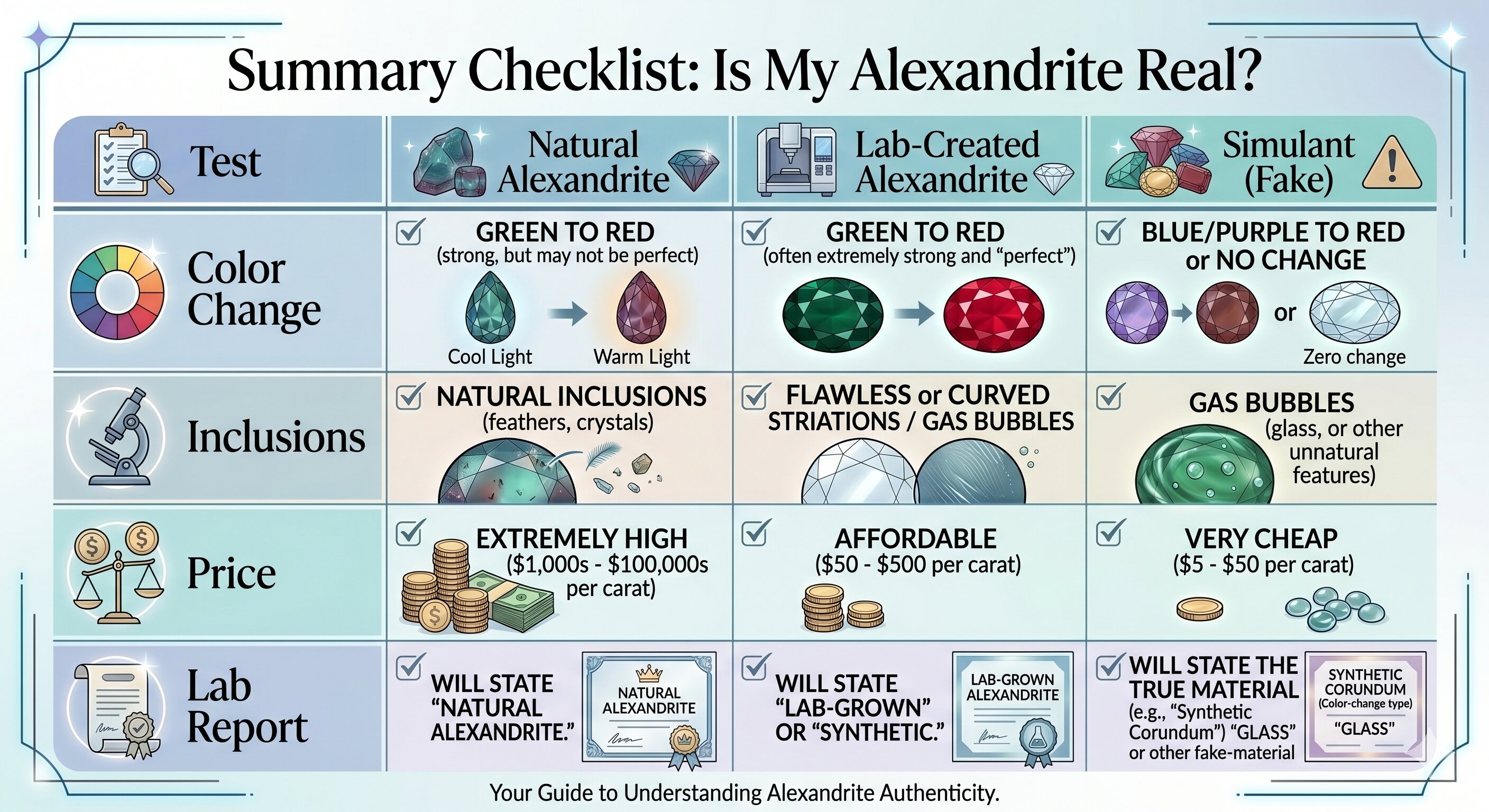
Natural Alexandrite: Will show a distinct color change, typically from greenish or bluish-green in daylight to reddish or purplish-red in incandescent light. The change may not be 100% complete, but it should be obvious.
Lab-Created Alexandrite: Will often show an extremely strong and dramatic color change, sometimes even more perfect than a natural stone. It can be impossible to distinguish natural from artificial based on color change alone.
Simulant (like Color-Change Sapphire): Will usually change from bluish or purplish in daylight to a purplish-red under incandescent light. It rarely, if ever, shows the classic "green to red" shift.
Glass or Cheap Simulant: May show no color change at all, or a very faint, muddy one.
If your stone shows no color change, it is almost certainly not a natural alexandrite.
Step 2: Look for Inclusions (The "Fingerprints" of Nature)
Use a jeweler's loupe (10x magnification) if you have one.
Natural Alexandrite: Almost always has inclusions (natural imperfections). These can look like tiny feathers, fingerprints, or crystal inclusions. A completely flawless natural alexandrite is extraordinarily rare.
Lab-Created Alexandrite: Can be completely flawless or may have characteristic curved growth lines or gas bubbles, which are a sign of the manufacturing process.
Simulants: Inclusions will vary, but glass will often have gas bubbles or a "too-perfect" look.
Step 3: Consider the Context (Price and Setting)
This is a major red flag detector.
The Price: If you bought a large (e.g., 2-carat) "alexandrite" ring for a few hundred dollars, it is definitely not natural. Remember, natural alexandrite of that size can cost tens of thousands of dollars.
The Setting: Is it set in cheap, plated metal? A genuine natural alexandrite, given its value, would almost always be set in a high-quality gold or platinum setting.
Step 4: The ONLY Definitive Method: Professional Gemological Lab Report
This is the only way to be 100% certain. If you have a significant investment or are unsure, this is non-negotiable.
Take your stone to a reputable jeweler who can send it to a major gemological laboratory, like:
GIA (Gemological Institute of America)
AGL (American Gemological Laboratories)
Gübelin or SSEF (in Europe)
These labs have advanced equipment that can:
Confirm the gem species is chrysoberyl.
Identify the trace elements that prove it is alexandrite.
Determine its origin (Natural or Synthetic). This is the key piece of information you need.
A report from one of these labs is the ultimate certificate of authenticity.
Summary Checklist: Is My Alexandrite Real?
What Is The Rarest Color of Alexandrite?
This question gets to the very heart of what makes alexandrite stone so legendary and valuable.
The rarest color of alexandrite is not a single color, but a specific and dramatic color-change combination. The rarest and most coveted alexandrite displays a precise, 100% shift from a vivid, saturated bluish-green in daylight to an intense, purplish-red or raspberry red in incandescent light.
Here’s a more detailed breakdown of why this specific combination is so exceptionally rare:
The "Holy Grail" of Color Change
This ideal change is often described by the famous phrase "emerald by day, ruby by night," a standard set by the original 19th-century Russian stones.
The Daylight Color: The rarest green is a "bluish-green" or a very pure, vibrant "grass green." It must be completely free of any gray, yellow, or brown modifiers. It should look like a fine emerald.
The Incandescent Color: The rarest red is a "raspberry red" or a clean "purplish-red." It must be strong and glowing, with no hint of brown or muddiness.
Why Is This Exact Change So Rare?
The rarity stems from a perfect and unforgiving geological recipe:
The Chromium Imperative: The color change is caused by the presence of the trace element chromium. However, for chromium to be incorporated into the crystal structure of chrysoberyl (alexandrite's mineral family) instead of corundum (where it makes ruby), the geological conditions must be just right—specifically, a beryllium-rich but silicon-poor environment. This is an unusual combination.
A Delicate Balance: The exact hue of the color change depends on the precise balance of chromium and other impurities, as well as the crystal's structure. Achieving the perfect balance for a pure green-to-red shift, without any "contaminating" colors, is a geological lottery win. Most stones have some imperfection in their color, like:
A green that is too yellowish or olive.
A red that is too brownish.
A change that is only partial or murky.
The Origin Factor: The Russian Benchmark
The stones that came from the original Ural Mountains mines in Russia are the archetype for this rarest color change. These mines have been largely depleted for over a century, making stones with this classic "Russian" color profile the rarest of the rare on the collector's market.
While new sources in Brazil, Sri Lanka, and Africa produce beautiful alexandrite, they often have a slightly different character (e.g., a darker, more brownish change or a shift from green to a more pinkish-purple). A stone from any location that can match the classic Russian color profile is considered top-tier and extremely rare.
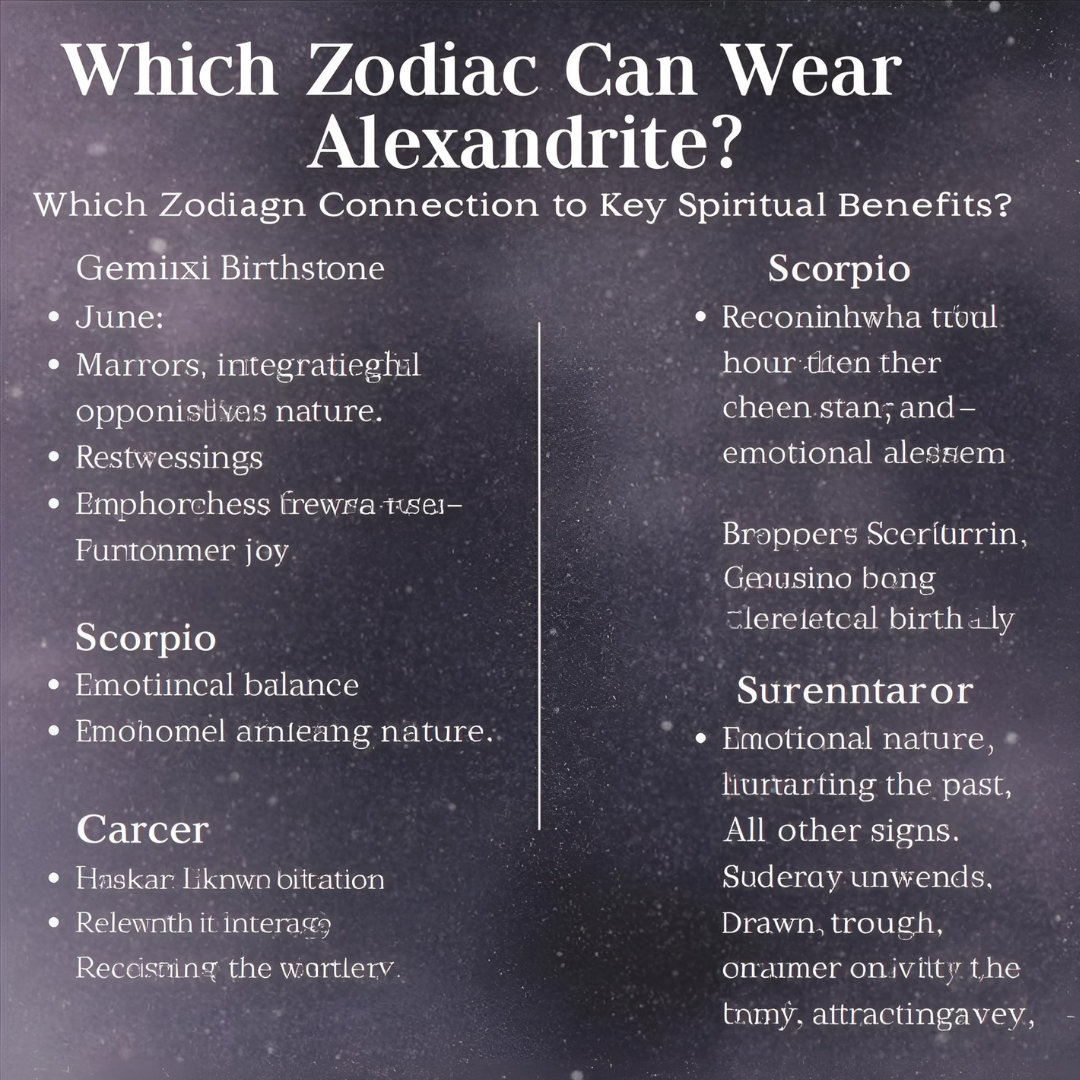
Which Zodiac Can Wear Alexandrite?
This is a wonderful question that blends gemstone lore with astrology.
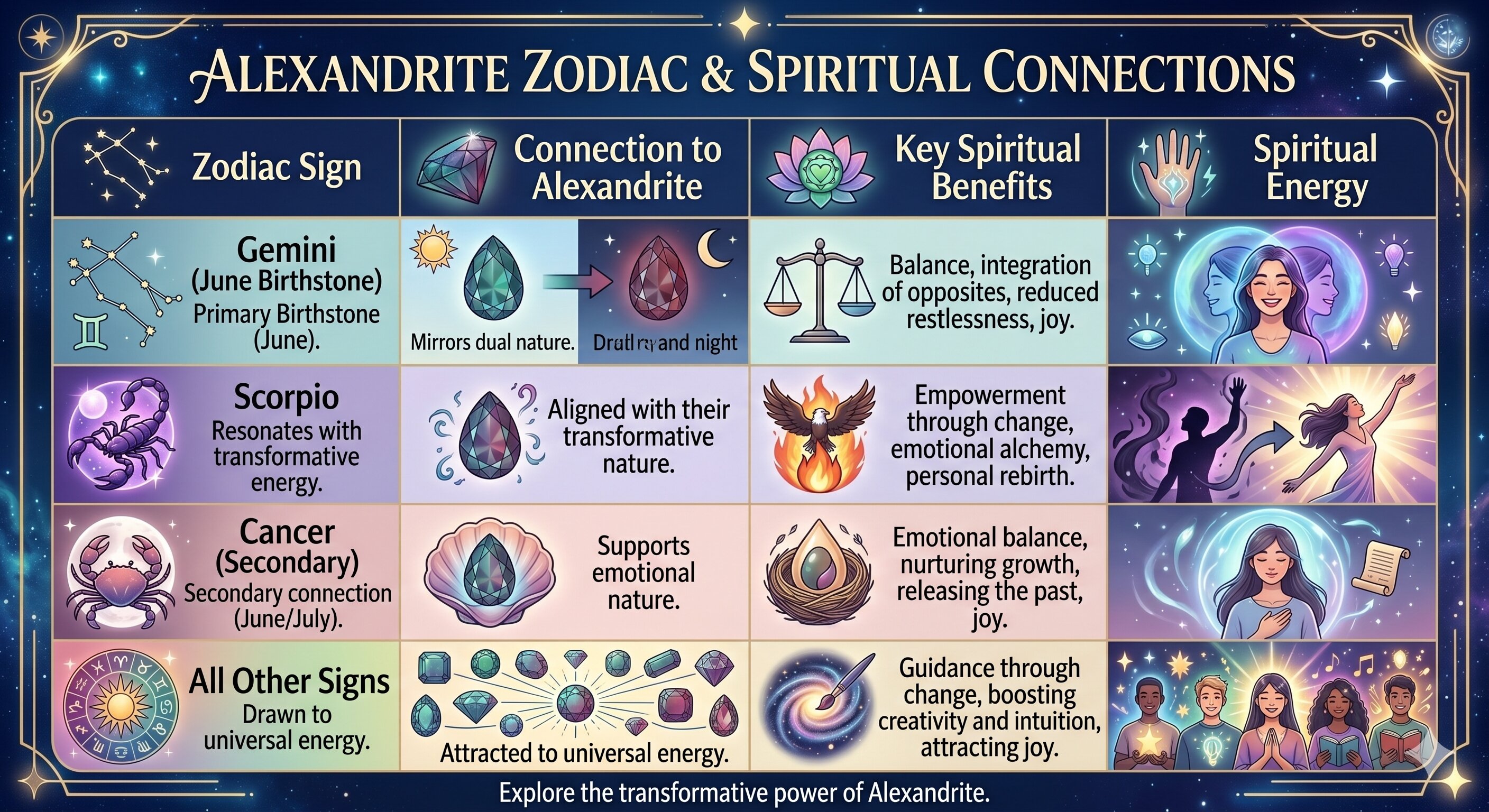
While anyone can wear and benefit from alexandrite's energy, it has particularly strong connections to certain zodiac signs. The primary association is with Gemini, but it also holds powerful significance for Scorpio and Cancer.
Here’s a breakdown of which zodiac signs can wear alexandrite and why:
1. The Primary Connection: Gemini (May 21 - June 20)
Alexandrite is the modern birthstone for June, making it the primary birthstone for Geminis.
Why it's a perfect match: Alexandrite is the ultimate gem for the "twins" of the zodiac. Its dramatic color change (green to red) beautifully mirrors Gemini's dual nature. It symbolizes the integration of their multifaceted personality—the intellectual, communicative side (linked to the mind and green color) with their passionate, curious side (linked to the heart and red color).
Spiritual Benefit: It helps Geminis find balance and harmony between their different moods and interests, reducing restlessness and encouraging personal transformation.
2. The Powerful Ally: Scorpio (October 23 - November 21)
While not a traditional birthstone, alexandrite is an exceptionally powerful stone for Scorpios.
Why it's a powerful match: Scorpio is the zodiac sign of death, rebirth, and profound transformation. Alexandrite, the "stone of transformation," resonates deeply with this core Scorpio theme. Its color shift symbolizes the Scorpio's ability to constantly evolve, shed old skins, and rise anew.
Spiritual Benefit: It enhances Scorpio's natural intensity and passion, channeling it into positive change and personal alchemy. It can help them navigate their powerful emotions and emerge stronger.
3. The Nurturing Stone: Cancer (June 21 - July 22)
As a June/July stone, alexandrite also has a strong connection to Cancers.
Why it's a supportive match: Cancer is a sign deeply connected to home, family, and emotional security. Alexandrite's connection to the heart chakra (green) and the root chakra (red) helps to ground Cancer's emotions while encouraging emotional balance and joy.
Spiritual Benefit: It can help Cancers navigate their deep emotional waters, bringing a sense of optimism and helping them to release old emotional patterns to make way for new growth.
Can Other Zodiac Signs Wear Alexandrite?
Yes, absolutely. Alexandrite's core themes are universal and can benefit anyone, regardless of their sign. Its main energies are:
Transformation & Change: Ideal for anyone going through a major life transition (career change, moving, spiritual awakening).
Balance & Joy: Helps to balance the mind and emotions, bringing a sense of hope and optimism.
Intuition & Creativity: Stimulates the imagination and intuitive faculties.
If you are drawn to alexandrite, it is often a sign that its energy is what you need at this moment in your life.
Summary Table
Can Alexandrite Be Worn Every Day?
This is a very practical consideration, especially given the stone's value and significance.
The short answer is: Yes, alexandrite can be worn every day, but with a very important understanding of its properties and some necessary precautions.
Here’s a detailed breakdown to help you decide:
The "Yes" - Durability (Hardness)
The primary reason alexandrite is suitable for daily wear is its exceptional hardness.
Mohs Hardness: Alexandrite scores an 8.5 on the Mohs scale of mineral hardness.
What this means: This makes it one of the hardest gemstones in the world. For context:
Diamond: 10
Ruby/Sapphire: 9
Alexandrite: 8.5
Emerald: 7.5-8
Quartz (Dust in everyday air): 7
This high hardness means it is highly resistant to being scratched by materials encountered in daily life. Only materials harder than it (like diamond, moissanite, or corundum) can scratch it.
The "But" - Toughness and Care
While hard (resistant to scratching), alexandrite, like many gems, has a degree of brittleness. This is referred to as its toughness, or resistance to chipping and breaking.
Cleavage: Alexandrite has distinct cleavage in one direction. This is a structural plane that can be split more easily if struck with a sharp, direct blow.
What this means: You need to protect it from hard knocks, impacts, and pressure.
Guidelines for Wearing Alexandrite Every Day
If you plan to wear your alexandrite daily (for example, in an engagement ring), follow these guidelines:
Choose a Protective Setting: The setting is your first line of defense.
Best: A bezel setting or a halo setting that surrounds the stone and protects its girdle (the outer edge).
Good: A sturdy prong setting with strong, well-made prongs.
Avoid: Very high or fragile prong settings that leave the stone exposed.
Be Mindful of Activities:
Take it off for heavy manual work, gardening, gym workouts (especially weights), or any activity where it could be hit against a hard surface.
Remove it when using harsh chemicals (bleach, cleaners) or when in chlorinated water, as these can dull the metal of the setting over time.
Regular Maintenance is Key:
Inspect the Setting: Have a jeweler check the prongs and setting every 6-12 months to ensure it is secure. This is crucial for any frequently worn ring.
Clean Gently: Clean with warm water, mild dish soap, and a soft brush. Ultrasonic cleaners are generally safe for alexandrite itself due to its stability, but can be risky if the stone has inclusions or fractures. It's always safer to avoid them unless you are certain.
Natural vs. Lab-Created for Daily Wear
This is an important consideration:
Lab-Created Alexandrite: This is a fantastic option for daily wear. It has the same superb hardness and durability as natural alexandrite. Since it is more affordable to replace, you may feel less anxiety about wearing it every day.
Natural Alexandrite: You can absolutely wear it daily, but the emotional and financial risk is higher. If a rare, expensive natural stone is damaged or lost, it is a significant loss. For a daily-wear ring like an engagement ring, many people opt for a very secure setting and may also insure the piece.
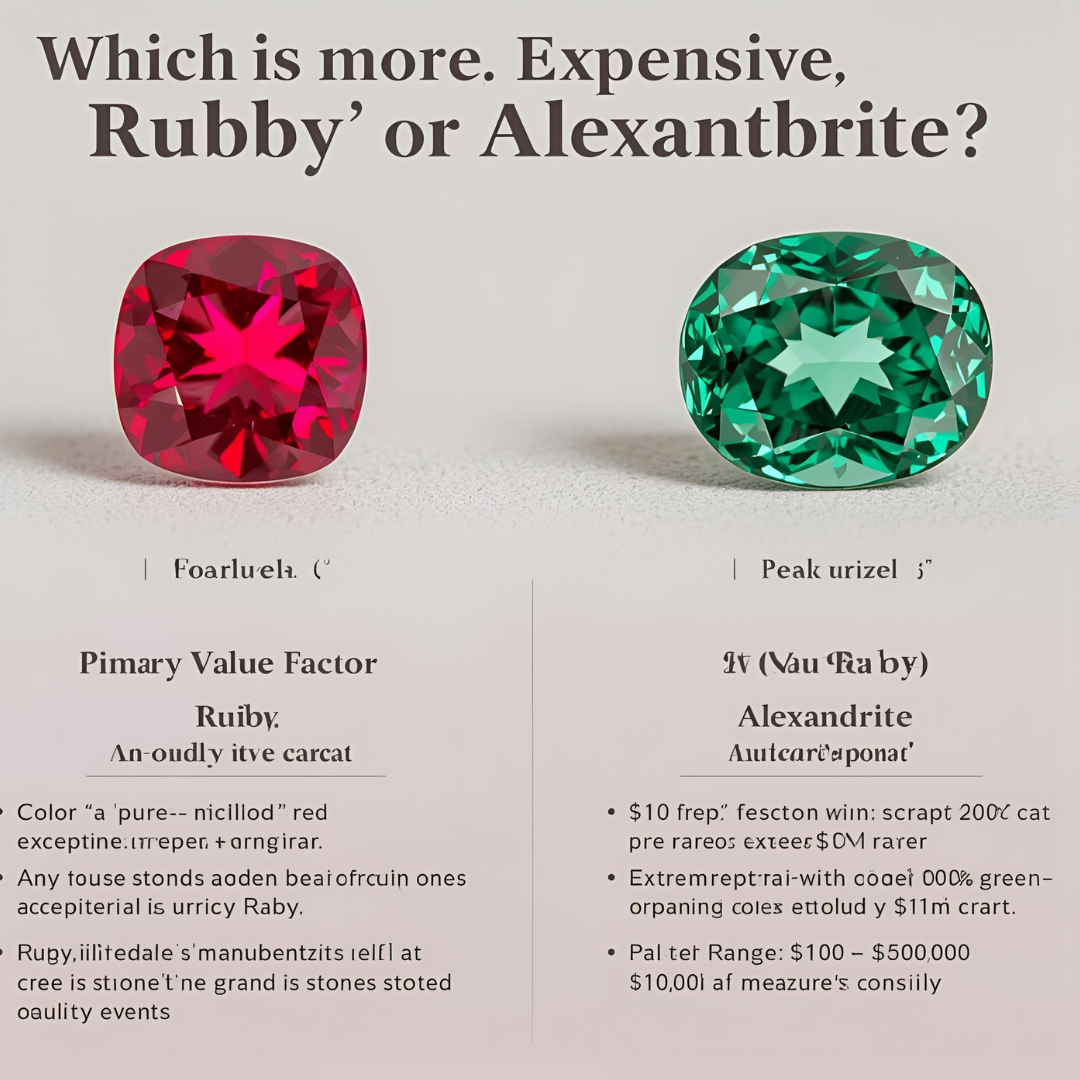
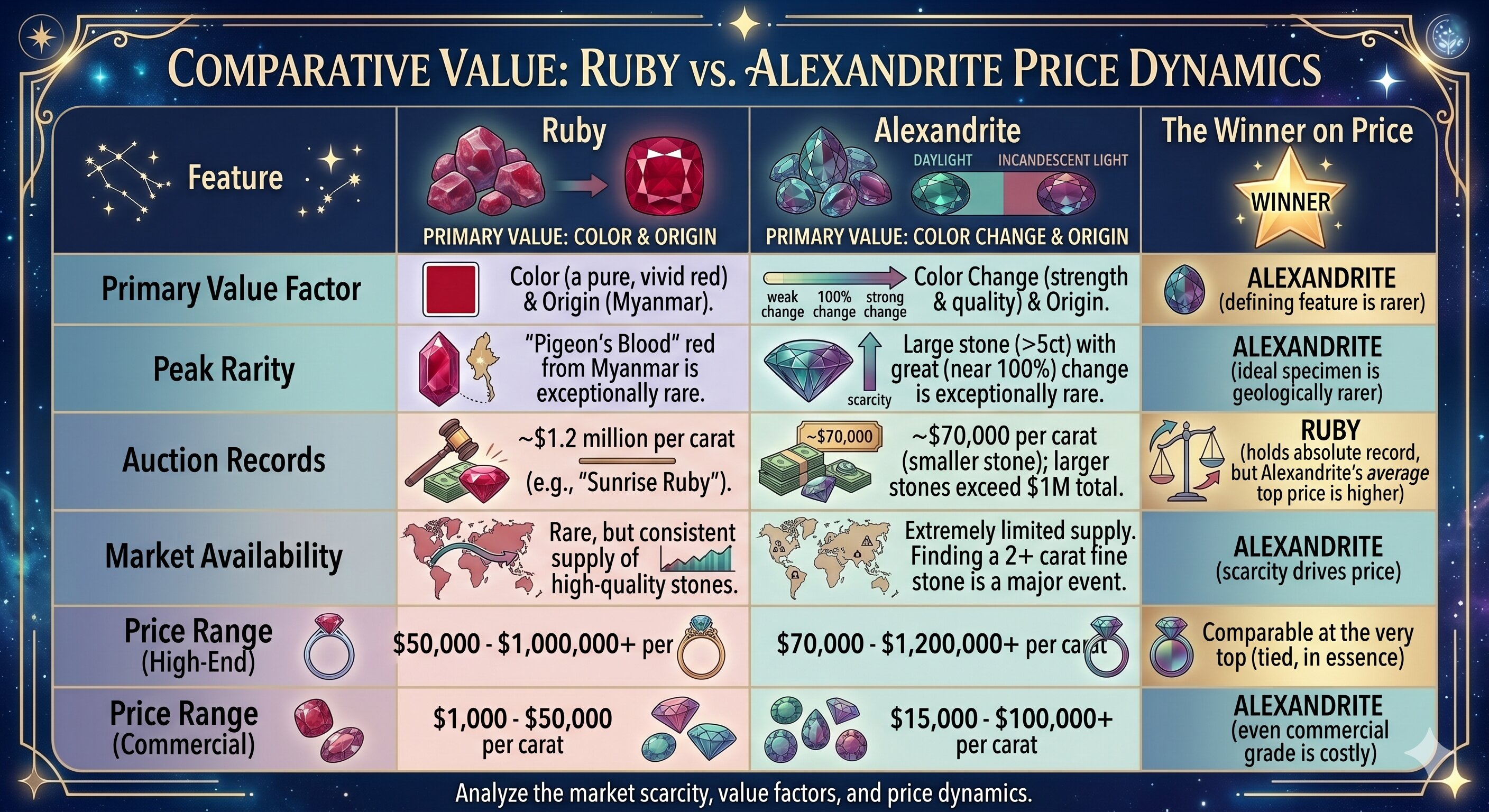
Which Is More Expensive, Ruby or Alexandrite?
This is a classic "clash of the titans" in the gem world. The answer is nuanced, but here’s the clear breakdown:
For top-quality, large stones of comparable size, natural alexandrite is almost always more expensive—and often significantly so—than ruby.
However, the price of both gems spans a wide range, and a fine ruby will almost always be more expensive than a low-quality alexandrite.
Let's dive into the details.
The Short Answer
At the Peak: Alexandrite is more expensive. A fine, large, natural alexandrite stone with a strong color change is one of the rarest gems on Earth, and its price per carat can dwarf that of a ruby.
In the Mainstream High-End: They can be rivals. An exceptional "Pigeon's Blood" ruby from Myanmar and a fine Brazilian alexandrite can command similar, astronomically high prices.
In the Average Market: Ruby is more commonly expensive. It's easier to find a high-quality ruby (though still very costly) than it is to find any sizeable, quality alexandrite at all.
Detailed Comparison: Why Alexandrite Generally Wins on Price
Key Reasons Alexandrite Commands a Premium
The "Two Gems in One" Factor: Alexandrite's value isn't just in one color, but in possessing two precious gemstone colors (emerald-green and ruby-red) in a single stone. This unique optical phenomenon is vastly rarer than a single, stable color.
Extreme Geological Scarcity: The conditions needed to form alexandrite are more specific and rarer than those for ruby. While ruby deposits are found in several countries, sources for fine color-change alexandrite are virtually limited to Russia (largely depleted) and Brazil.
Supply and Demand: The supply of high-quality alexandrite is tiny and unpredictable. When a great stone appears, it is pursued by a dedicated group of collectors and connoisseurs, driving prices to extreme heights.
When a Ruby Can Be More Expensive
At Auction for Legendary Stones: The absolute price record for a colored gemstone is held by a ruby (the Sunrise Ruby, selling for over $1 million per carat). A specific, legendary ruby of historical significance can surpass a specific alexandrite.
Very Large Sizes: While a 5-carat top-quality alexandrite is almost unheard of, 5-carat top-quality rubies, while immensely rare and expensive, do exist and will command a higher total price due to their size and prestige.
The Critical Caveat: Synthetic Stones
This discussion applies only to natural gems.
Lab-Grown Ruby: Inexpensive and widely available, costing tens to hundreds of dollars per carat.
Lab-Grown Alexandrite: Also inexpensive, costing hundreds of dollars per carat for a stone with a perfect color change.
Important Buying Advice
Always get certification: For any significant purchase, insist on a report from a major gemological laboratory like GIA or AGL. This is crucial for verifying authenticity, natural origin, and any treatments.
"Eye-clean" is key for rubies: Since most rubies have natural inclusions, a stone that appears clean to the naked eye ("eye-clean") is much more valuable.
Be specific about alexandrite quality: When evaluating alexandrite, ask about the percentage and strength of the color change. A strong, 80-100% change is a hallmark of top-grade material.
I hope this detailed comparison helps you understand the market for these beautiful gems. If you can share more about your intended use (e.g., an engagement ring, a collector's piece) or budget range, I could offer more tailored guidance.
“You now know the spiritual meaning, the price, the rarity, the zodiac matches, and the care secrets. The only question left: will you wear the magician‘s stone?
Our current collection includes a limited number of natural alexandrites (from classic Russian to fine Brazilian) and high-quality lab-created stones with perfect color change. When natural stones of this grade are gone, sourcing new ones can take years.
This is not just a gem. It is 190 years of mystery — green by day, red by night, and the only stone that changes with your light.”
[Button: Claim Your Alexandrite (Limited) →]


News for Friday 10 October, 2025
View all news for Friday 10 October, 2025 on one page
Recent News
- Thursday 09 October, 2025
- Wednesday 08 October, 2025
- Sunday 05 October, 2025
- Saturday 04 October, 2025
- Friday 03 October, 2025