

Sardonyx Guide: Meaning, Benefits, Price and How to Tell Real | August Birthstone
What is Sardonyx?
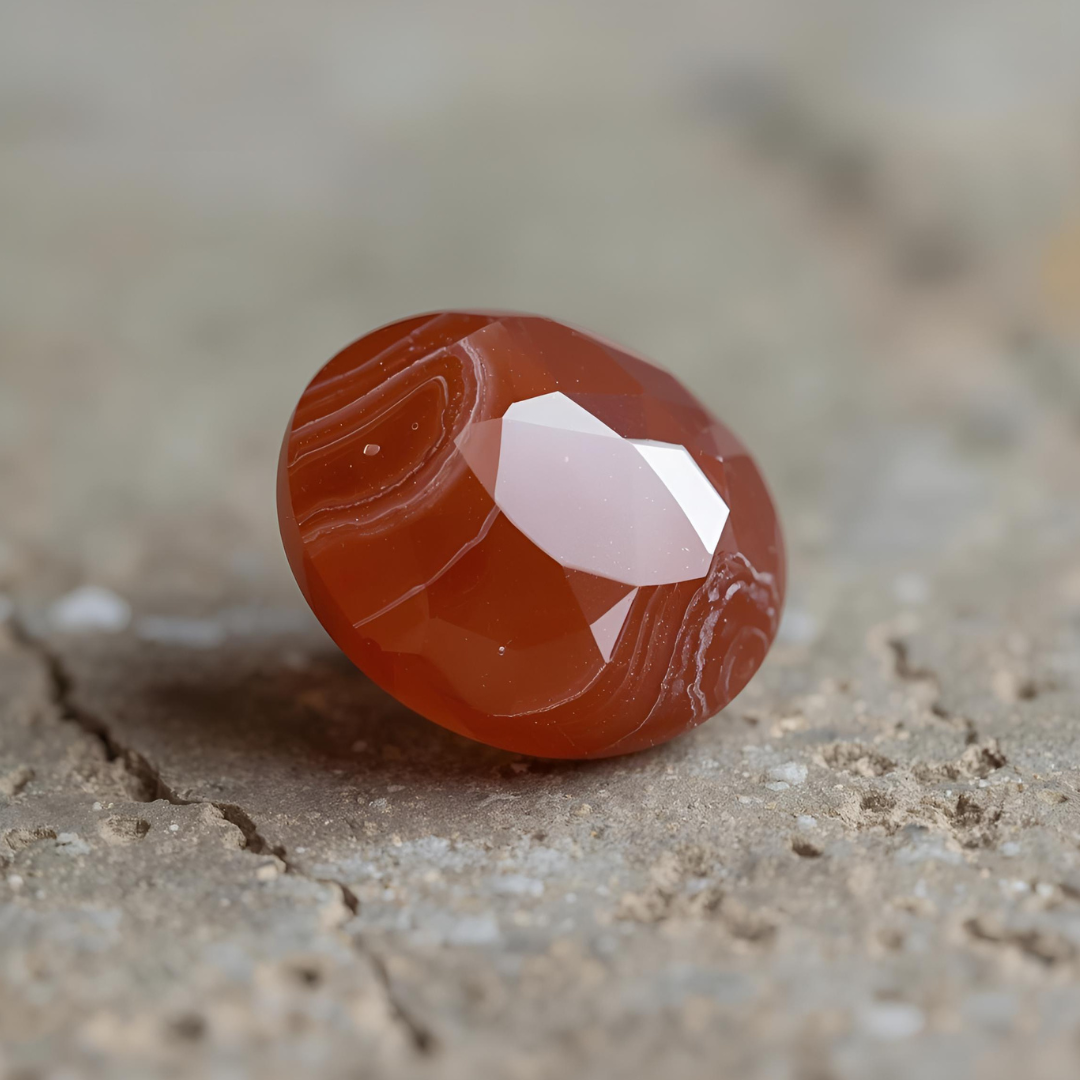
Sardonyx is a distinctive and powerful gem, known for its striking bands of color. It is a variety of the mineral chalcedony (a type of quartz) and has been a prized gem since antiquity.
Roman generals did not wear sardonyx for beauty. They wore it for victory. Before battle, they carved the image of Mars, god of war, into the stone‘s white band — leaving the reddish-brown background as a promise of blood and glory. They believed the stone‘s layers mirrored their own: strength built on strength, courage layered over fear. In the British Museum today, you can still see ancient Roman signet rings carved from sardonyx, their images sharp after 2,000 years. August‘s forgotten birthstone is not flashy. It is the stone of soldiers, senators, and soulmates — a gem that asks nothing of you except to stand your ground.”
The same stone that guarded Roman generals and sealed Renaissance vows now awaits your August birthday — or your own quiet promise. Every sardonyx in our collection is chosen for sharp banding and natural color — because true strength doesn‘t need to shout.”
[Button: Explore Sardonyx Jewelry →]
Here I show the topic of content.
- Is Sardonyx A Birthstone?
- What Does Sardonyx Symbolize?
- Is Sardonyx A Real Gem?
- What Are The Benefits Of Wearing Sardonyx?
- What Is Sardonyx Stone Good For?
- Is Sardonyx Stone Expensive?
- What Color Is Sardonyx Stone?
- Can I Sleep With Sardonyx?
- How To Tell If Sardonyx Is Real Or Fake?
- Is Sardonyx The Same As Onyx?
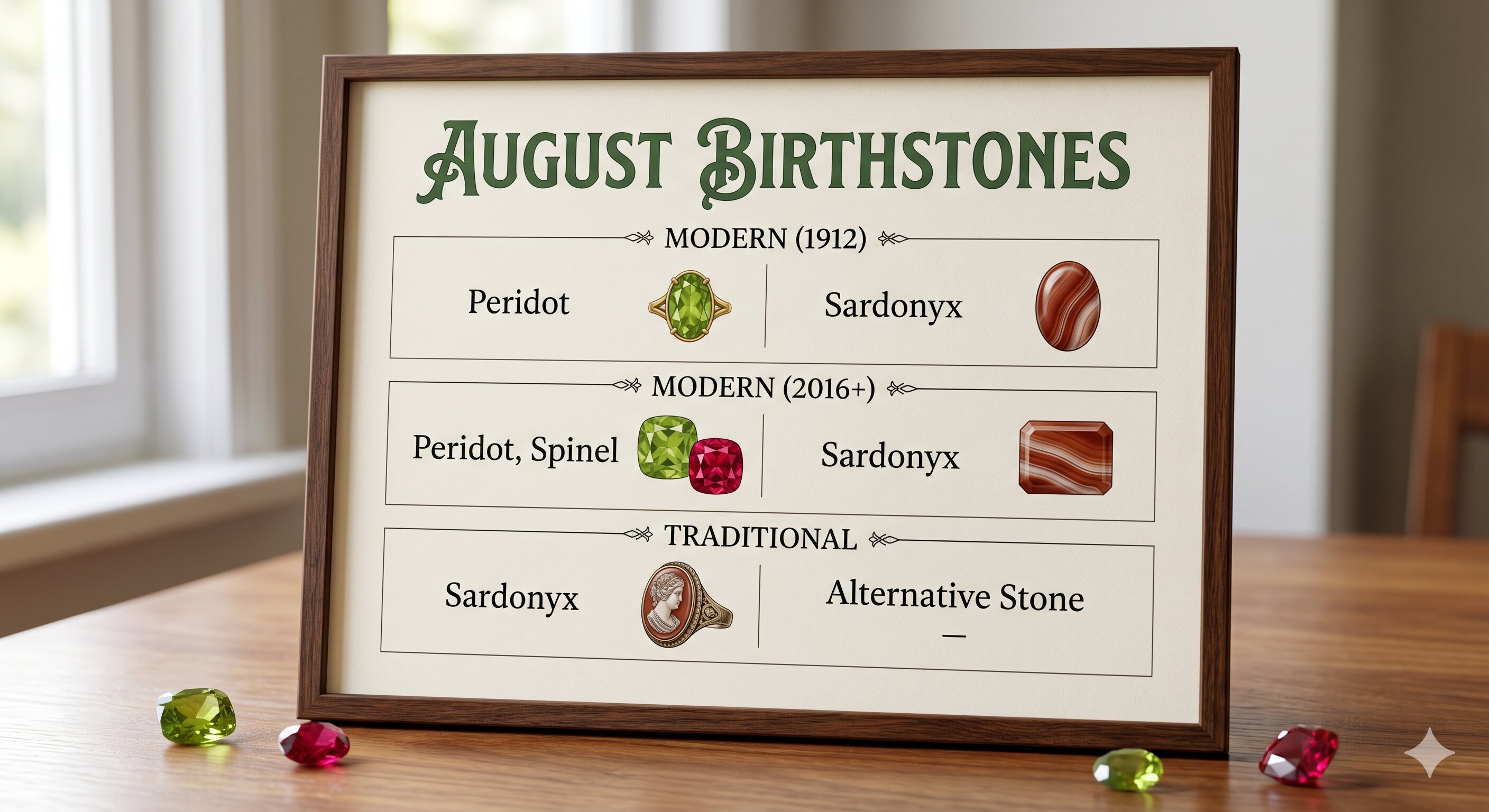
Sardonyx is primarily known as a traditional birthstone for August. However, its status has evolved with the creation of "modern" birthstone lists.
Is Sardonyx A Birthstone?
Here's a more detailed breakdown:
1. Sardonyx as the Traditional August Birthstone
For centuries, sardonyx was the primary gemstone associated with August. This dates back to ancient times and was codified in traditional, historical, and ancient birthstone lists.
Symbolism: It was highly valued for its reputation to bring courage, happiness, and stable communication, and was often carved into cameos and intaglios.
2 . The Modern August Birthstones
In 1912, the National Association of Jewelers in the USA standardized a modern birthstone list to streamline the jewelry industry. On this list:
The primary modern birthstone for August is Peridot.
Spinel was added as a more modern August birthstone in 2016.
So, where does that leave Sardonyx?
Sardonyx is still widely recognized as an alternative or traditional birthstone for August. You will often see it listed alongside Peridot and Spinel on comprehensive birthstone charts.
In summary:
Bonus Fact: Sardonyx is also considered a zodiac birthstone for Leo (July 23 - August 22), which overlaps with much of August.
For official chalcedony grading information, visit the GIA Chalcedony Guide.
What Does Sardonyx Symbolize?
Sardonyx is a gemstone steeped in rich symbolism, with meanings that have evolved from ancient battlefields to modern meditation practices. Its unique appearance—alternating layers of reddish-brown sard and white or black onyx—is the source of its powerful symbolism.
Here’s a breakdown of what sardonyx symbolizes:
Core Symbolic Meanings
“In medieval Europe, sardonyx was carved into cameos of saints and worn as a charm against the plague. Travelers sewed it into their clothes for protection on dangerous roads. But its most intimate symbolism came from marriage: Renaissance husbands and wives exchanged sardonyx rings engraved with clasped hands — a vow that words alone could not hold. The stone‘s bands, light and dark layered together, became a metaphor for partnership: two lives, one foundation. Today, sardonyx still carries that quiet promise. It is not the loudest gem. But it has outlasted empires.”
Courage, Strength, and Victory
This is one of its oldest and most potent associations. In ancient Rome and Greece, warriors carved symbols of gods like Mars or Hercules into sardonyx and wore them as talismans into battle. They believed the stone would make them brave, powerful, and victorious. It was seen as a source of protection and invincibility.
Stability and Grounding
The stone's strong, banded structure symbolizes a solid foundation. It is believed to promote emotional stability, resilience, and the ability to "stand your ground." Sardonyx helps with willpower, self-control, and overcoming negative patterns or addictions.
Clear Communication and Partnership
Sardonyx is renowned as a stone of marriage and commitment. It's believed to encourage harmony, fidelity, and open, honest communication between partners. Its energy is said to help couples speak their truth with love and listen with understanding, strengthening the bond.
Happiness and Optimism
The warm, reddish bands of sard are associated with vitality and joy. Sardonyx is thought to banish grief, attract good fortune, and promote a positive outlook on life. It's a stone that encourages you to see the brighter side of situations.
Protection
Historically, sardonyx was used as a powerful protective amulet against evil spirits, negative energy, and "the evil eye." Its layered structure was thought to create a defensive barrier around the wearer.
Symbolism in Different Contexts
Due to its Layering:
Duality and Balance: The contrasting layers (light/dark, red/white) symbolize the balance of opposites—such as yin and yang, male and female, logic and emotion.
Strength in Layers: It represents the idea that strength is built in layers, much like character and resilience are built through life's experiences.
As an August Birthstone:
For August babies, it reinforces themes of personal power, positive relationships, and a joyful approach to life.
In Spiritual and Metaphysical Practices:
Root Chakra: Sardonyx is strongly connected to the Root Chakra (Muladhara), which is the center of security, survival, and grounding.
Solar Plexus Chakra: Its reddish hues also connect it to the Solar Plexus Chakra (Manipura), the seat of personal power, will, and confidence.
Historical Use in Cameos:
Sardonyx was the premier stone for carved cameos because its distinct layers allowed artisans to create a contrasting raised image on one color with a background of another. This art form itself symbolizes legacy, artistry, and the revelation of inner beauty.
.png)
Is Sardonyx A Real Gem?
Yes, Sardonyx is absolutely a real gemstone.
It is a natural, mineral-based gem that has been used in jewelry and carvings for thousands of years.
Here’s a more detailed breakdown of what it is, which should clear up any confusion:
1.It's a Variety of Chalcedony
Sardonyx is not a single mineral but a variety of Chalcedony, which is itself a microcrystalline form of the common mineral Quartz (Silicon Dioxide, SiO₂). This places it in the same large family as gems like Agate, Carnelian, and Onyx.
2. Its Defining Characteristic: Banding
What makes Sardonyx unique and recognizable is its parallel banding.
The reddish-brown or orange-brown layers are Sard.
The white or black layers are Onyx.
This straight, parallel banding is what differentiates it from Agate, which typically has curved or concentric bands.
3 . How It Forms
Sardonyx forms in a geologically fascinating way. It is a type of cryptocrystalline quartz that precipitates from silica-rich groundwater in the cavities of volcanic or sedimentary rock. The different colored bands are created by varying amounts of impurities—typically iron oxides for the sard layers.
Learn more about sardonyx's geological properties on Wikipedia's sardonyx page.
What Are The Benefits Of Wearing Sardonyx?
The benefits of wearing sardonyx are rooted in both ancient tradition and modern crystal healing practices. It's important to note that while these benefits are widely reported in metaphysical circles, they are not scientifically proven. The power of the stone often works through the placebo effect and the intention of the wearer.
Here is a comprehensive look at the purported benefits of wearing sardonyx, categorized for clarity:
Emotional and Psychological Benefits
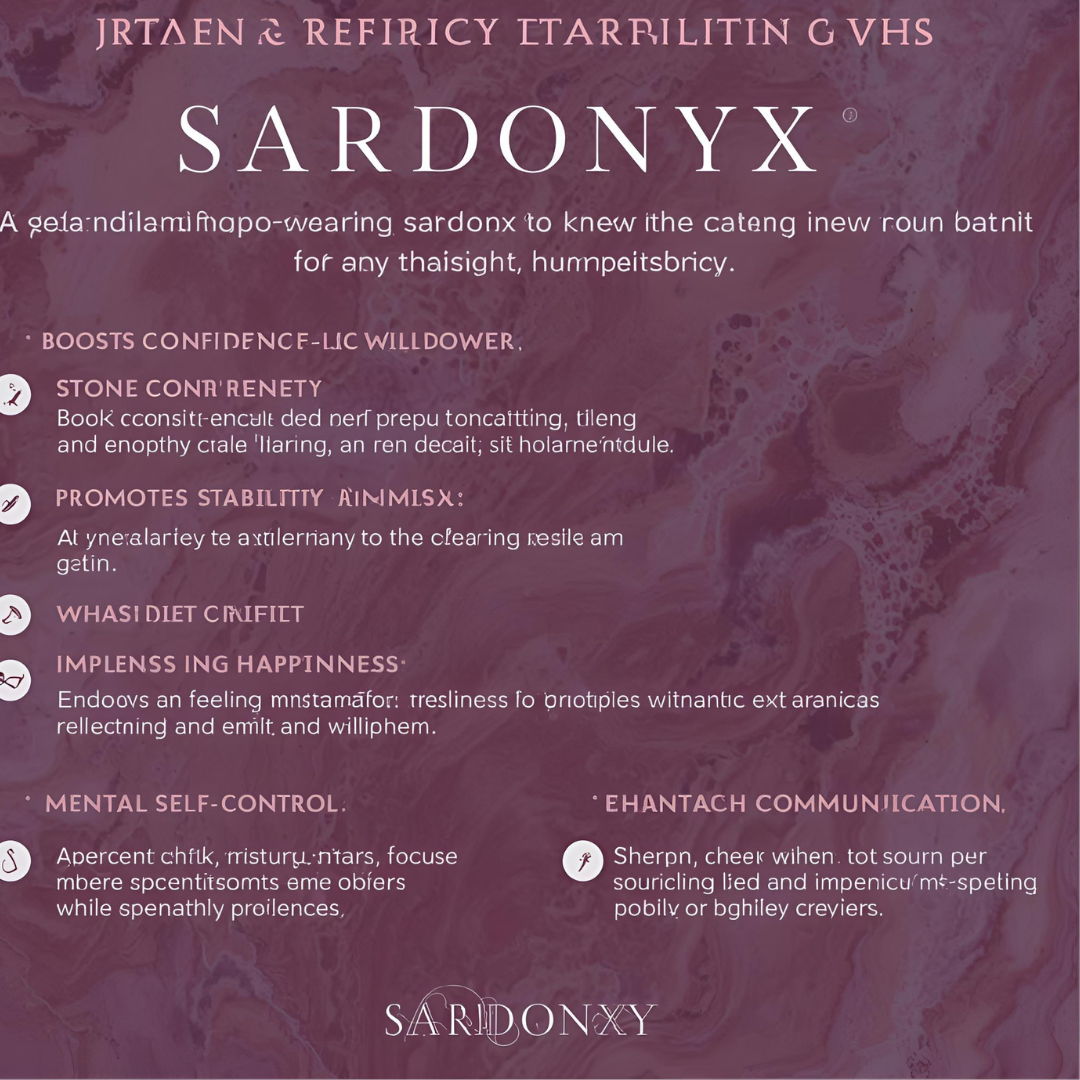
Boosts Confidence and Willpower: Sardonyx is known as a stone of strength and determination. Wearing it is believed to help you overcome self-doubt, procrastination, and negative habits, replacing them with increased resolve and personal power.
Promotes Stability and Grounding: Its layered structure is seen as a symbol of a solid foundation. If you're feeling scattered, flighty, or emotionally volatile, sardonyx is said to provide a stabilizing influence, helping you feel more centered and resilient in the face of challenges.
Encourages Happiness and Optimism: The warm, reddish bands of sard are associated with joy and vitality. It's thought to banish melancholy and attract good fortune, promoting a more optimistic outlook on life.
Enhances Self-Control: Historically linked to discipline (especially for Roman soldiers), it is believed to help with impulse control, whether related to anger, spending, or unhealthy cravings.
Mental and Communicative Benefits
Sharpens the Intellect and Concentration: Sardonyx is said to help clear mental fog, improve focus, and enhance analytical abilities. This makes it a popular stone for students, researchers, and anyone needing to tackle complex problems.
Improves Communication: This is one of its most celebrated benefits. Sardonyx is believed to help you speak your truth clearly, honestly, and effectively. It encourages eloquence and helps you articulate your thoughts in a way that can be easily understood by others, making it excellent for public speakers, teachers, and negotiators.
Relationship and Social Benefits
Strengthens Commitment and Marriage: Known as a supreme talisman for marriage, sardonyx is believed to promote fidelity, harmony, and lasting commitment between partners. It encourages open dialogue and helps resolve conflicts through understanding.
Attracts Lasting Friendships: Its energy is said to radiate integrity and reliability, which can help you attract like-minded, loyal friends and strengthen existing bonds.
Spiritual and Energetic Benefits
Provides Protection: Since ancient times, sardonyx has been used as a powerful protective amulet against negative energy, evil spirits, and "the evil eye." It is thought to create a defensive shield around the wearer.
Grounding Energy: In spiritual practices, it is strongly connected to the Root Chakra (Muladhara), which is responsible for our sense of security and connection to the physical world. Wearing it can help ground spiritual energy into practical, everyday life.
Boosts Personal Power: Its connection to the Solar Plexus Chakra (Manipura) is linked to themes of will, confidence, and personal authority. It's believed to empower you to take control of your life and destiny.
Practical and How to Wear It
To maximize these benefits, here's how you can wear sardonyx:
As Jewelry: Wearing it as a ring, bracelet, or pendant keeps its energy in your personal aura throughout the day. A ring on your dominant hand is said to be especially powerful for projecting willpower.
Set an Intention: Hold the stone and clearly state your purpose for it (e.g., "I wear this for clear communication in my meeting today"). This focuses its symbolic energy.
Placement: For grounding, carry a piece in your pocket. For relationship harmony, place a piece in a common room in your home.
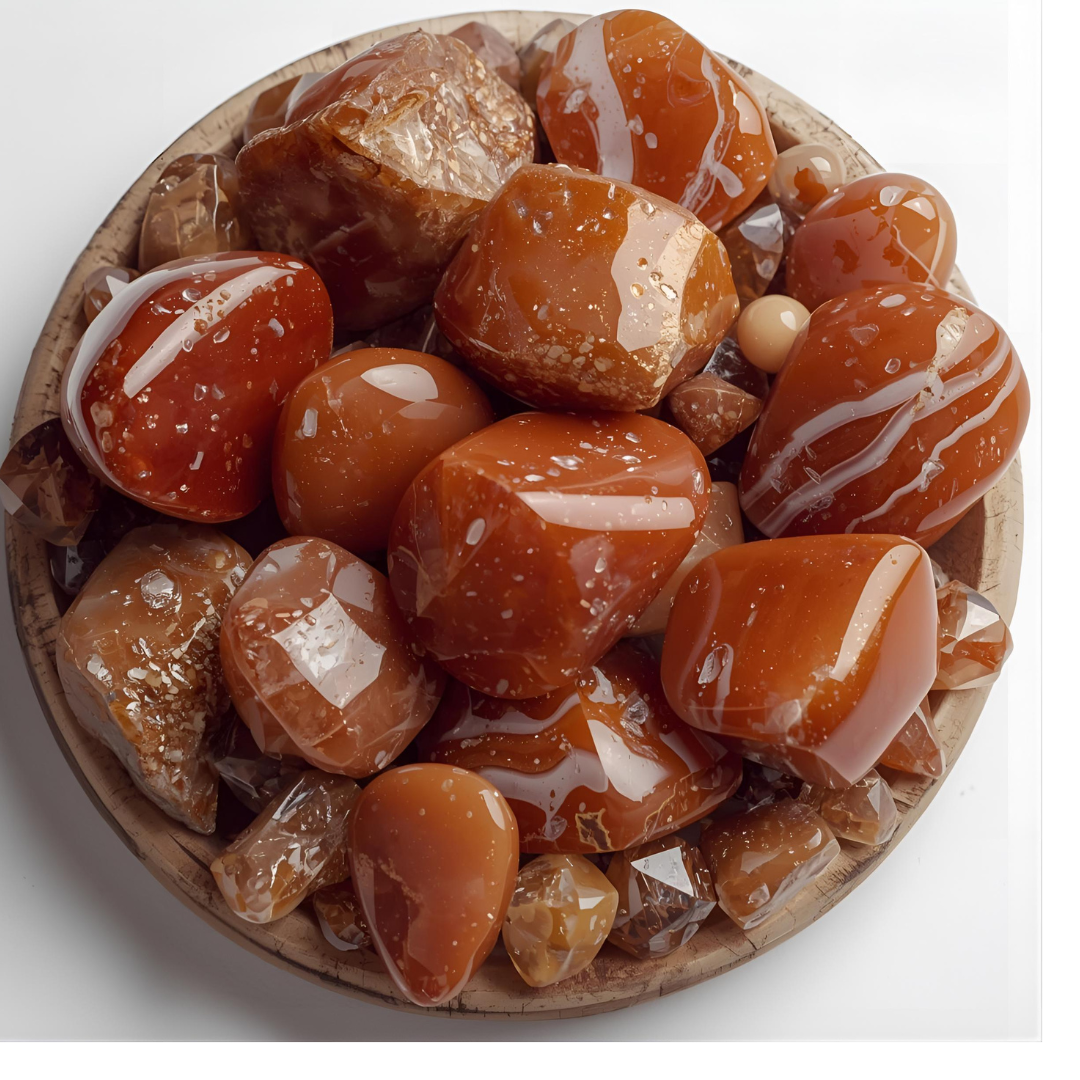
What Is Sardonyx Stone Good For?
Building on our previous discussion, sardonyx is a versatile gemstone valued for a wide range of practical, metaphysical, and historical uses.
Here’s a comprehensive look at what sardonyx is good for, from ancient talismans to modern jewelry.
Metaphysical & Wellness Uses (Based on Tradition and Crystal Healing)
In this context, sardonyx is considered good for:
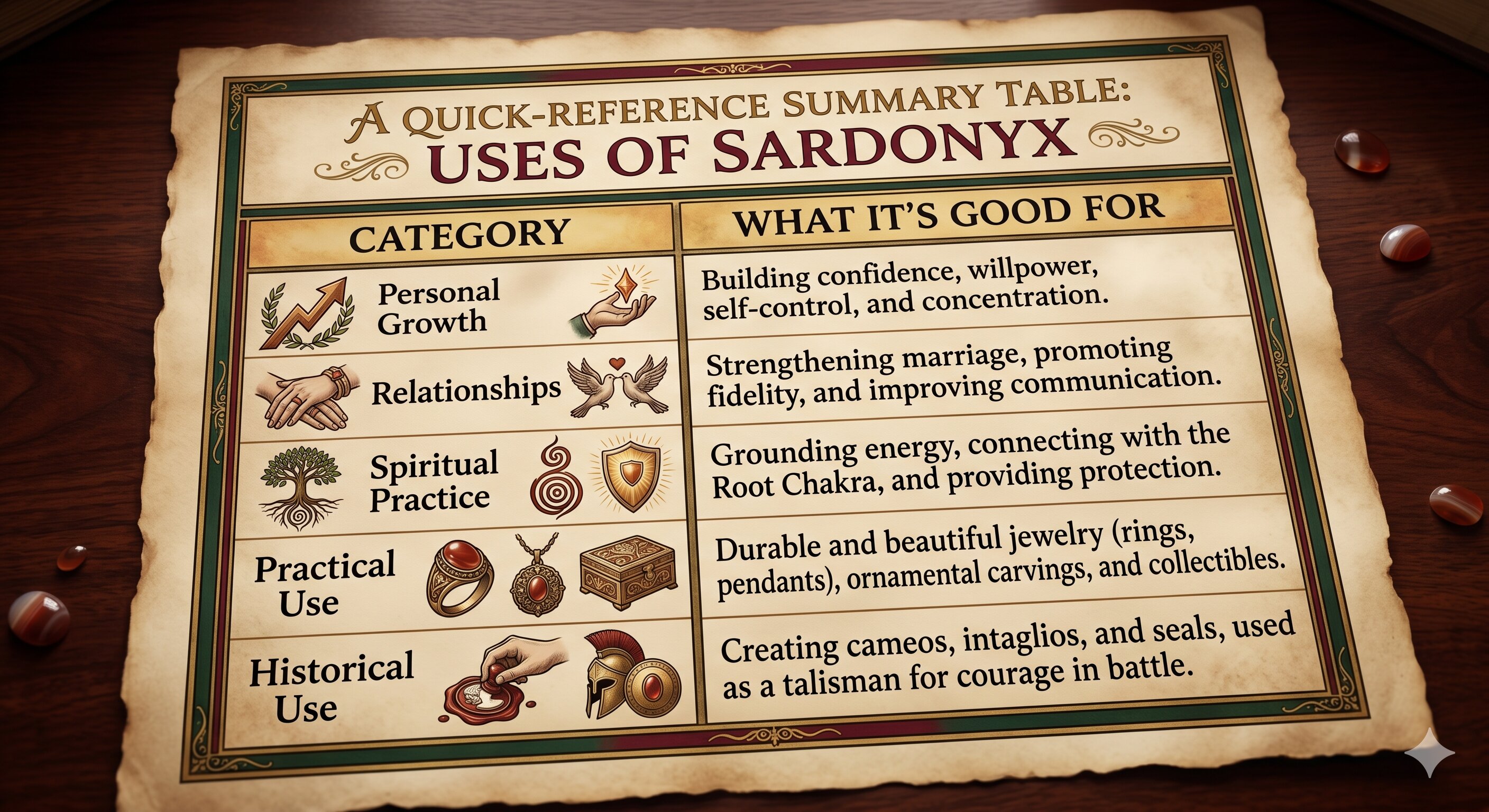
Boosting Willpower & Confidence: It's a powerful stone for overcoming procrastination, addiction, and self-doubt. It's believed to strengthen your resolve and help you stick to your goals.
Enhancing Communication: It promotes eloquence, honesty, and clear expression. This makes it excellent for public speakers, writers, and anyone who needs to navigate difficult conversations or negotiations.
Providing Protection & Grounding: Historically used as a talisman against negative energy and "the evil eye," it is thought to create a protective shield. Its connection to the Root Chakra provides a strong grounding energy, helping you feel stable and secure.
Fostering Relationship Harmony: Known as a stone of commitment, it is believed to encourage fidelity, happiness, and lasting love between partners. It helps promote open and honest communication within relationships.
Promoting Optimism & Vitality: The warm, reddish bands are associated with joy and vitality. It's used to dispel melancholy and attract good fortune, supporting a more positive outlook on life.
Practical & Decorative Uses
Beyond the metaphysical, sardonyx has very tangible and historical uses:
Jewelry: This is its most common modern use. Its durability (6.5-7 on the Mohs scale) makes it suitable for all types of jewelry, including rings, bracelets, necklaces, and earrings. Its striking banding makes for unique and conversation-starting pieces.
Cameos and Intaglios: This is one of sardonyx's most famous historical uses. The distinct layers of color (e.g., a white layer on a brown base) were perfect for artisans to carve raised relief images (cameos) or incised designs (intaglios). These were used as seals, signet rings, and decorative art.
Ornamental Objects: Sardonyx has been used for centuries to create beautiful decorative items like boxes, inlays in furniture, and small carvings or figurines.
Collecting: Due to its unique and varied banding patterns, no two pieces of sardonyx are exactly alike, making it a popular stone for mineral and gemstone collectors.
A Quick-Reference Summary Table
Is Sardonyx Stone Expensive?
The answer is generally no, sardonyx is not considered an expensive gemstone, especially when compared to gems like diamonds, rubies, or sapphires. It is valued for its beauty and accessibility rather than its rarity.
However, the price can vary significantly based on several factors. You can think of it as a spectrum from very affordable to moderately priced for exceptional pieces.
Here’s a breakdown of what influences the cost of sardonyx:
Factors Affecting the Price of Sardonyx
Color and Contrast (The Most Important Factor):
High-Value: Pieces with sharp, dramatic contrast between the layers (e.g., vibrant red-orange sard against pure, snow-white onyx) are the most desirable and command higher prices.
Lower-Value: Stones with muted colors, muddy brown layers, or low contrast between bands are much more common and affordable.
Banding and Pattern:
High-Value: Straight, parallel, and evenly spaced bands are highly prized.
Lower-Value: Irregular, wavy, or poorly defined banding is less valuable.
Quality of the Cut and Polish:
A well-cut and highly polished stone will showcase the banding beautifully and be worth more than a poorly finished stone of the same material.
Carving (Cameos):
This is where prices can rise significantly. The value of a sardonyx cameo depends less on the raw stone and more on the artistry, detail, and age of the carving. An antique, masterfully carved cameo can be quite valuable, while a modern, mass-produced one is very affordable.
Size and Treatment:
Large, high-quality pieces are rarer than small ones.
Sardonyx is often dyed to enhance its color. Naturally vibrant stones are more valuable than dyed ones, which are very common and inexpensive.
General Price Ranges
To give you a practical idea (please note, prices are approximate and can vary by retailer):
Raw Stones or Simple Tumbled Stones: $2 - $10 per piece.
Small, Standard-Quality Cabochons (for jewelry making): $5 - $20 per stone.
High-Quality Cabochons with Excellent Contrast: $20 - $50+ per stone.
Mass-Produced Sardonyx Beads: $1 - $5 per bead.
Finished Jewelry (e.g., a silver ring): A sardonyx ring in a sterling silver setting can typically be found for $30 - $150. The price here is often more influenced by the metal and craftsmanship than the stone itself.
Carved Cameos: Prices range wildly from $20 for a small, modern piece to hundreds or even thousands of dollars for a large, antique, or expertly carved cameo.
What Color Is Sardonyx Stone?
The color of sardonyx is its most defining and beautiful characteristic.
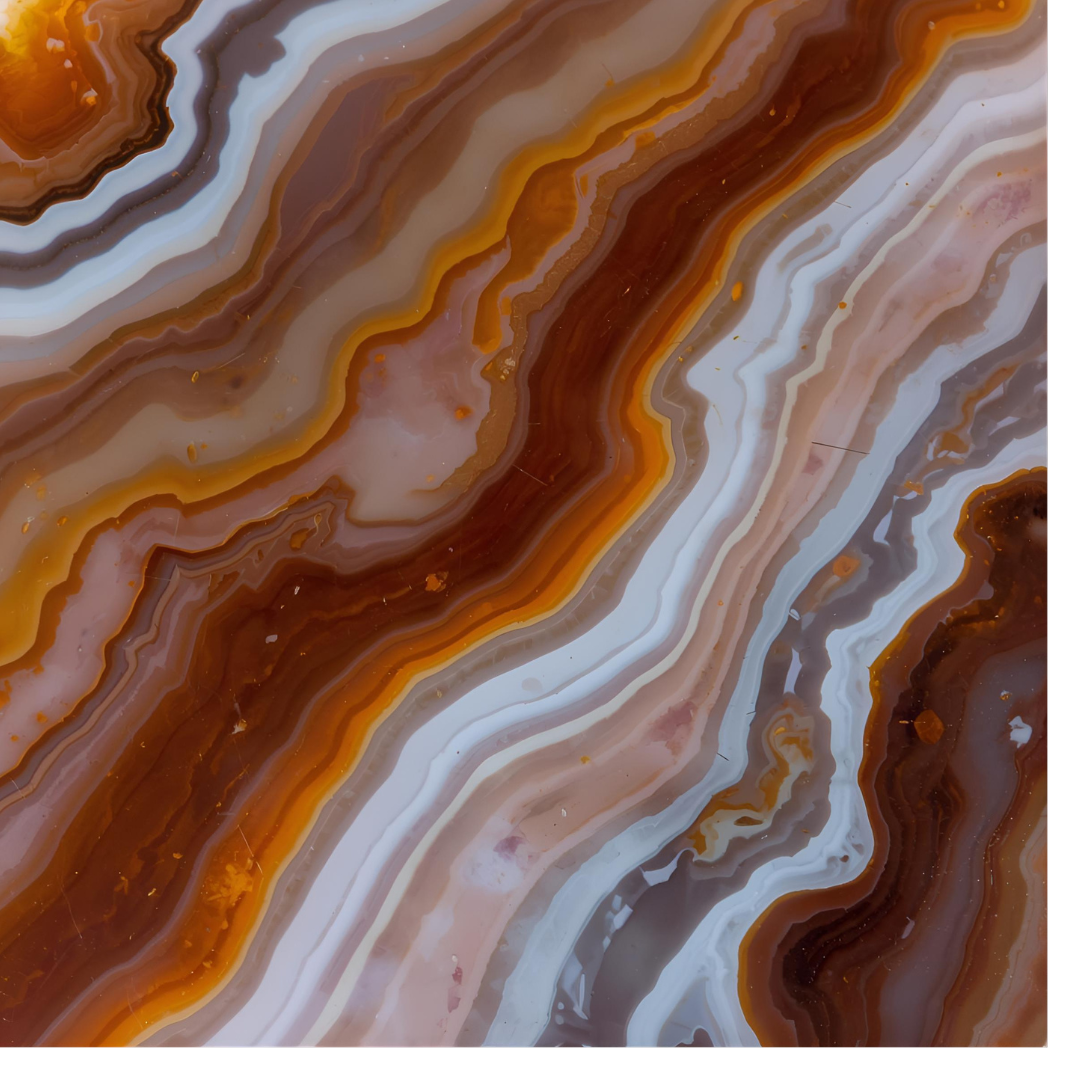
Sardonyx is characterized by its parallel bands of two distinct colors:
Reddish-Brown or Orange-Brown: This color comes from the Sard layer. The hue can range from a pale, flesh-toned orange to a deep, rich, reddish-brown.
White or Black: This color comes from the Onyx layer. While black is possible, the classic and most sought-after sardonyx features crisp, snow-white bands.
The Classic Look: Striking Contrast
The most valued sardonyx stones have a sharp, dramatic contrast between these layers. The straight, parallel bands create a striking visual effect, which is why it has been used for cameos for centuries—an artisan can carve a raised image from the white layer, leaving the reddish-brown layer as a contrasting background.
Visual Color Variations
To help visualize the color range, here are the most common combinations:
Classic Sardonyx: Vibrant reddish-brown bands alternating with pure white bands. This is the most traditional and popular look.
Subtle Sardonyx: Muted, softer shades of orange-brown or tan with off-white or beige bands. This is very common and often more affordable.
Sardonyx with Black: Dark brown or red bands with black onyx layers. This creates a more dramatic, less "classical" appearance.
Can I Sleep With Sardonyx?
Whether or not you should sleep with sardonyx depends entirely on your personal goals and how you react to its energy.
Here’s a breakdown of the perspectives to help you decide:
The Case FOR Sleeping with Sardonyx
If you are seeking its specific grounding and protective properties at night, sleeping with sardonyx could be beneficial. It is believed to:
Promote a Sense of Security and Protection: As a powerful protective stone, it can create a calming and secure environment for sleep, which is especially helpful if you are prone to nightmares, fear, or anxiety at night.
Provide Emotional Stability: If you go to bed with a racing mind or heavy emotions, sardonyx's grounding energy (connected to the Root Chakra) may help quiet mental chatter and make you feel more stable, facilitating a restful sleep.
Strengthen Commitment Bonds: Placing it under your pillow or on a nightstand is sometimes recommended in crystal healing to encourage fidelity and deepen the connection between partners sharing a bed.
The Case AGAINST Sleeping with Sardonyx
The primary reason to avoid sleeping with sardonyx is its association with energy and willpower.
It Can Be Overstimulating: Sardonyx is known as a stone of vitality, motivation, and action. Its energy is more aligned with the daytime—getting things done, being courageous, and communicating clearly. For some people, having this energetic, "get-up-and-go" stone nearby can be too stimulating and may lead to:
Restlessness or insomnia
Vivid, intense dreams
Difficulty winding down
How to Make the Decision: A Simple Guide
The best approach is to listen to your own body and intuition.
Try a Nightstand: A perfect compromise is to place your sardonyx on your nightstand or a shelf near your bed. This allows you to benefit from its protective and stabilizing energy without the risk of it being overstimulating right next to your body.
Experiment and Observe: If you want to try sleeping with it, do so for a night or two. Pay close attention to the quality of your sleep and your dreams.
Did you sleep more soundly and feel more secure?
Or did you feel restless, have intense dreams, or struggle to fall asleep?
Use it for Intention: If you have a specific issue like recurring nightmares, you can hold the stone before bed, set a clear intention for protection and peaceful sleep, and then place it on your nightstand.
Which Stone Is Best For Sleeping?
This is a fantastic question, especially after discussing sardonyx, which is better for daytime energy. When it comes to sleep, you generally want stones that promote calm, relaxation, and protection rather than energy and motivation.
Here are some of the best and most highly recommended stones for sleeping, based on crystal healing traditions and user experiences:
Top Choices for Deep, Restful Sleep
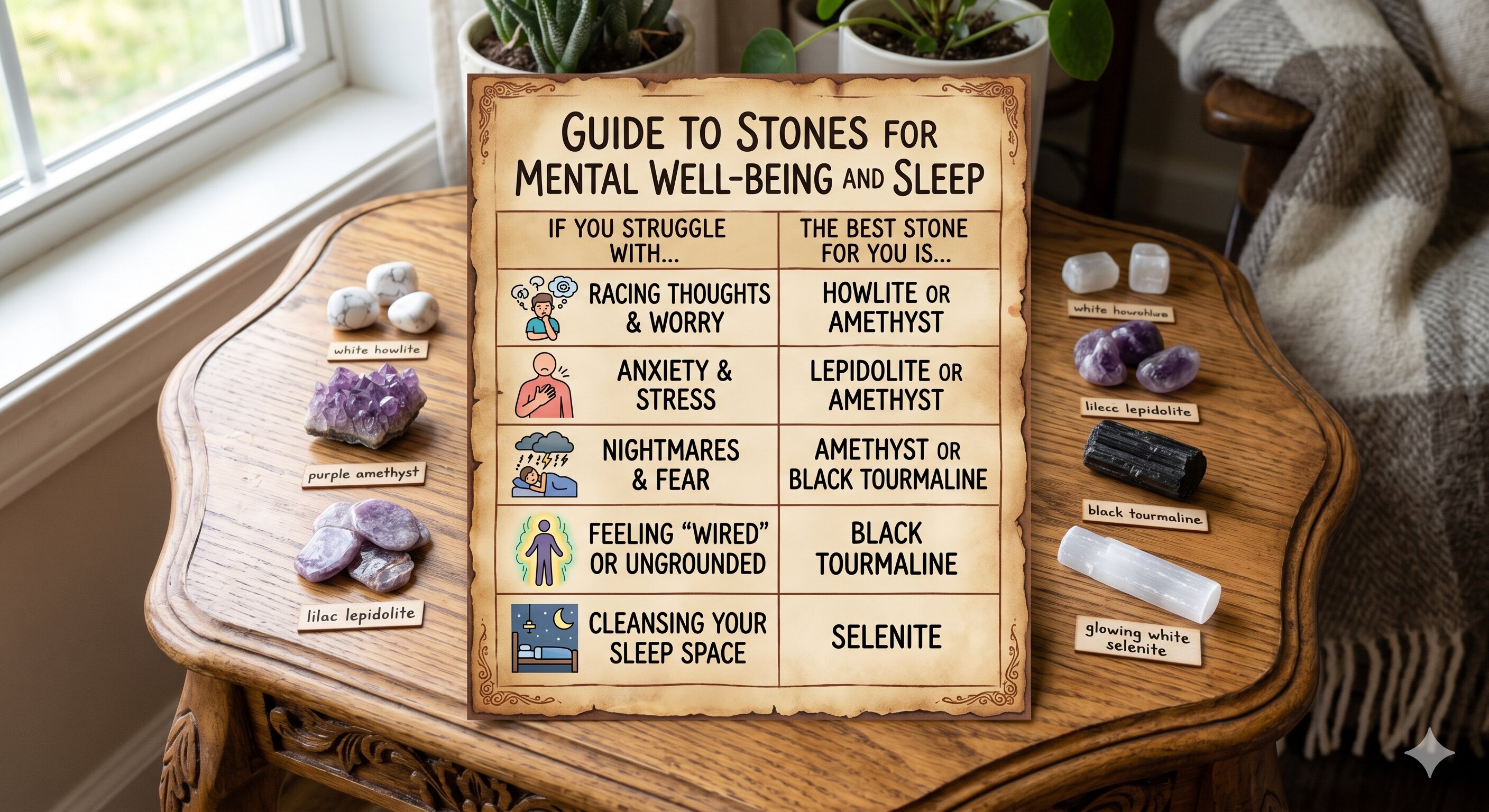
Amethyst: The undisputed champion for sleep.
Why it's good: It's a powerful yet gentle stone known for calming the mind, relieving stress and anxiety, and quieting mental chatter. It promotes peaceful sleep and can help prevent nightmares.
How to use: Place a cluster on your nightstand or tuck a small tumble stone under your pillow.
Howlite: The best for an overactive mind.
Why it's good: If you lie in bed with racing thoughts, howlite is your go-to stone. It's renowned for calming anger, impatience, and stress. Its white color is associated with purity and peace.
How to use: Keep it on your nightstand or hold it in your hand as you try to fall asleep.
Selenite: For cleansing and angelic peace.
Why it's good: Selenite is a high-vibration stone that cleanses the energy of your room and your aura. It promotes a deep sense of peace, mental clarity, and connection to higher guidance, which can lead to very tranquil sleep.
How to use: Place a wand or plate of selenite on your nightstand or under your bed. (Note: It's water-soluble and soft, so it's not good for under-pillow use.)
Lepidolite: A natural tranquilizer.
Why it's good: This is one of the best stones for anyone dealing with anxiety or insomnia. It contains lithium, which is used in anti-anxiety medications, and is known for bringing deep emotional calm and balance.
How to use: Place a piece under your pillow or on your chest/heart as you lie in bed.
Black Tourmaline: For protection and grounding.
Why it's good: If you feel vulnerable, fearful, or are sensitive to environmental stress, black tourmaline creates a powerful protective shield. It grounds negative energy and electromagnetic frequencies (EMFs), making your sleep space feel safer.
How to use: Place it near the door to your room, on your nightstand, or under your bed.
Other Excellent Options
Moonstone: Connects to the intuitive, dreamy energy of the moon. Enhances intuition and promotes pleasant, prophetic dreams.
Lavender Jade: A gentle stone that combats stress and brings a sense of serenity and comfort, perfect for drifting off.
Blue Lace Agate: A wonderfully soothing stone that calms the throat chakra, helping you release the words and worries of the day.
Quick Guide: Which Stone to Choose?
How to Use Them Effectively
Create a Sleep Ritual: Hold the stone in your hand for a few minutes before sleep, setting an intention for restful and rejuvenating sleep.
Nightstand is Key: Simply placing your chosen stone on your nightstand is one of the easiest and most effective methods.
Under the Pillow: Small, smooth tumbled stones can be placed under your pillow or in a pillowcase.
Cleanse Them: Remember to cleanse your sleep stones regularly, as they can absorb stagnant energy. You can do this by placing them in moonlight, on a selenite plate, or by smudging them.
Final Recommendation: If you're new to this, Amethyst is the perfect, all-around starting point for improving sleep. It's widely available, gentle, and highly effective.
Sardonyx is a variety of the mineral Chalcedony, which itself is a form of Quartz. It is known for its striking, parallel bands of color.
How To Tell If Sardonyx Is Real Or Fake?
Here’s a guide in English on how to distinguish real sardonyx from treated or fake imitations.
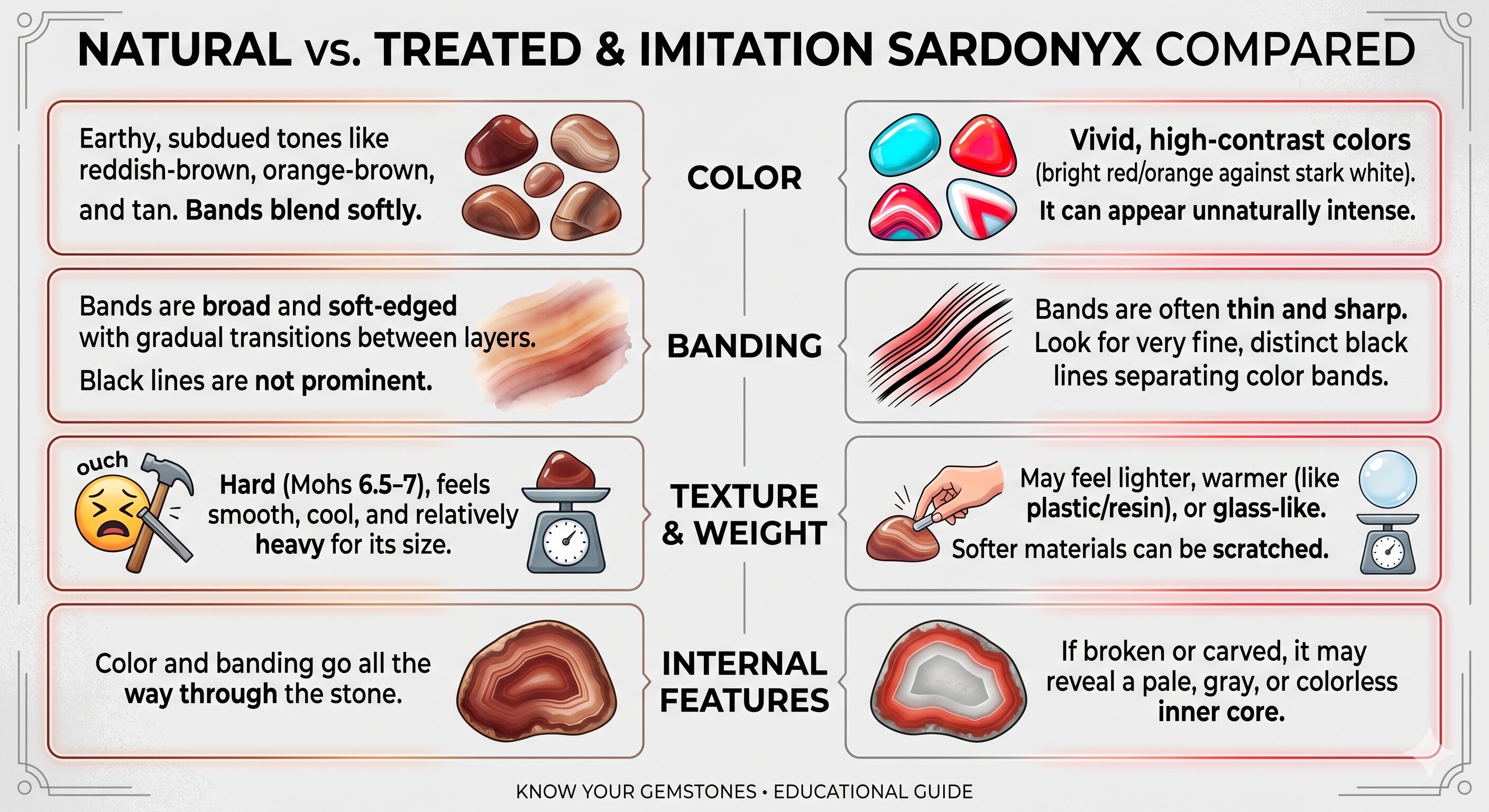
Key Identification Features
Simple Tests and Buying Advice
Quick Checks: Genuine sardonyx is hard—it shouldn't be easily scratched by metal. It should feel cooler to the touch than plastic or glass imitations. Under a magnifier, look for natural imperfections; imitations may contain bubbles.
Common Treatments: Be cautious with highly polished items like eggs or cabochons sold as "sardonyx" with sharp red/white/black bands. These are often chemically treated (sugar-acid or nitric acid) gray agate. Natural, vividly colored sardonyx is relatively rare.
Professional Verification: For valuable pieces, seek a report from a reputable gemological lab (e.g., GIA, AGL). This is the most reliable method.
In summary, focus on color authenticity, banding patterns, and physical properties. When in doubt, a professional assessment is recommended.
If you can describe your piece's specific appearance or its origin, I can offer more tailored insights.
Is Sardonyx The Same As Onyx?
No, sardonyx and onyx are not the same stone, but they are closely related "cousins" within the same mineral family.
Think of them as siblings with different personalities. Here’s a breakdown of their relationship and key differences:
The Family Relationship: Chalcedony
Both sardonyx and onyx are varieties of chalcedony, a type of quartz. They are both cryptocrystalline, meaning they have a fine, smooth structure.
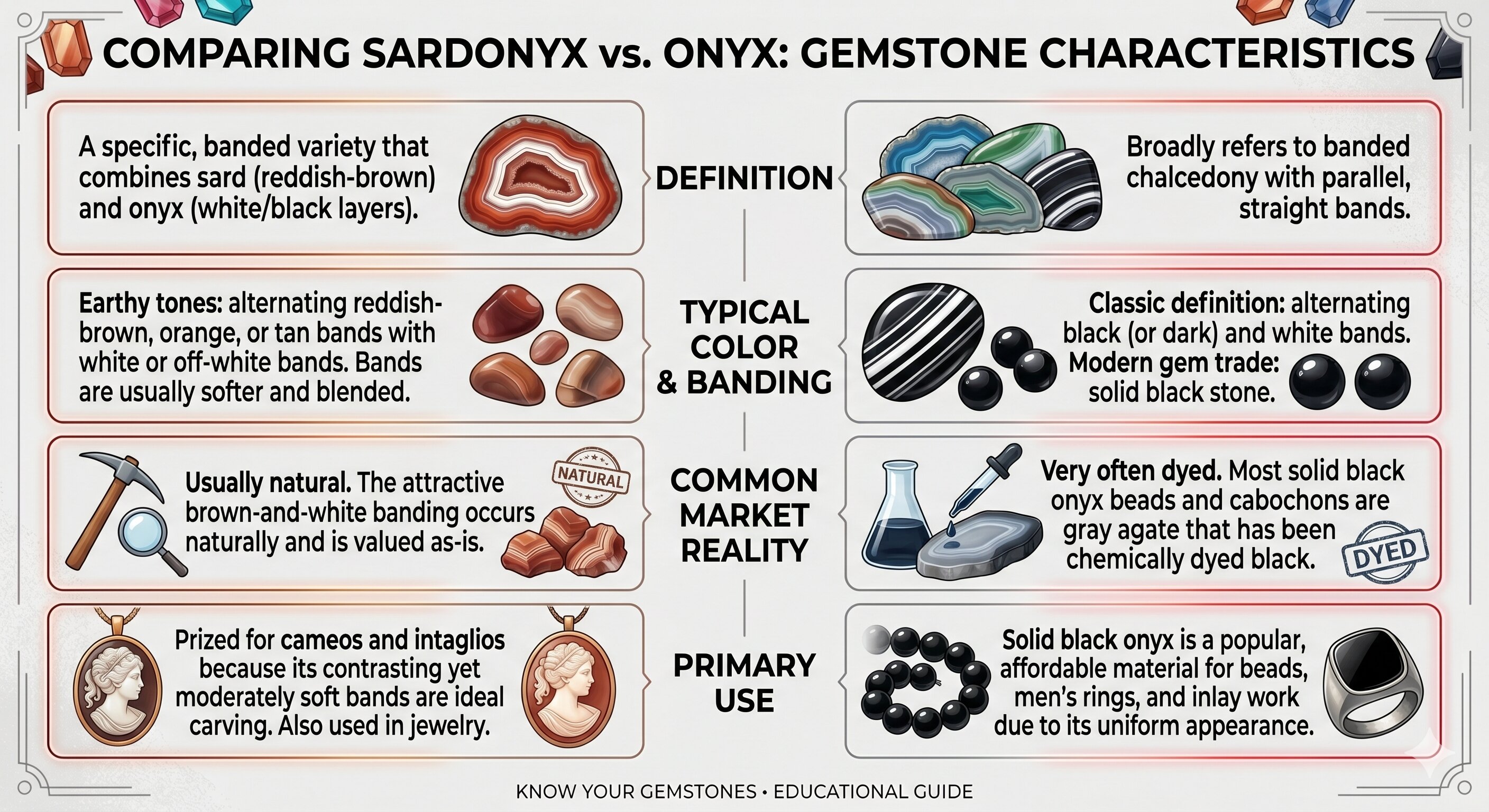
Key Differences at a Glance
How to Tell Them Apart
Look at the Bands:
If you see distinct reddish-brown or orange layers with white, it's sardonyx.
If you see sharp, parallel black and white bands, it's technically banded onyx.
If the stone is a uniform, solid black with no visible bands, it is sold as "onyx" but is almost certainly dyed black agate.
Consider the Purpose:
A carved piece with a raised, light-colored design on a darker background (a cameo) is very likely made from sardonyx, as it is the traditional and ideal material for this art form.
The Biggest Confusion: "Black Onyx"
The term "onyx" itself causes the most confusion. In geology, true onyx is banded. However, in the jewelry industry, "onyx" almost always means the solid black, dyed stone. True, naturally occurring solid black onyx is extremely rare.
Sardonyx is a specific, naturally attractive blend of brownish and white bands.
Onyx in jewelry is typically solid black and dyed, while in geology, it refers to a banded black/white stone.
If you have a specific piece in mind and describe its colors or what it looks like, I can help you identify which one it likely is.
“You now know the history, the symbolism, the benefits, the prices, the colors, and the care. The only question left: will you wear the stone that outlasted empires?
Our current collection includes a limited number of natural, untreated sardonyx stones — with sharp red-and-white banding perfect for cameo lovers, and subtle earthy tones for minimalist styles. When stones with this contrast are gone, sourcing new ones with natural (not dyed) color takes months.
This is not just a birthstone. It is 2,000 years of Roman courage, medieval protection, and Renaissance vows — the quiet gem of soldiers and soulmates, now waiting for your story.”
[Button: Claim Your Sardonyx (Limited) →]


News for Tuesday 02 June, 2026
- Pear Engagement Ring Guide: Symbolism, History, Cost And Tips
- Spinel Guide: Price, Colors, How to Tell Real | August Birthstone
View all news for Tuesday 02 June, 2026 on one page
Recent News
- Monday 01 June, 2026
- Sunday 31 May, 2026
- Saturday 30 May, 2026
- Tuesday 12 May, 2026
- Tuesday 02 December, 2025