

Curious About Vintage Rings? Here's What Makes Them Special
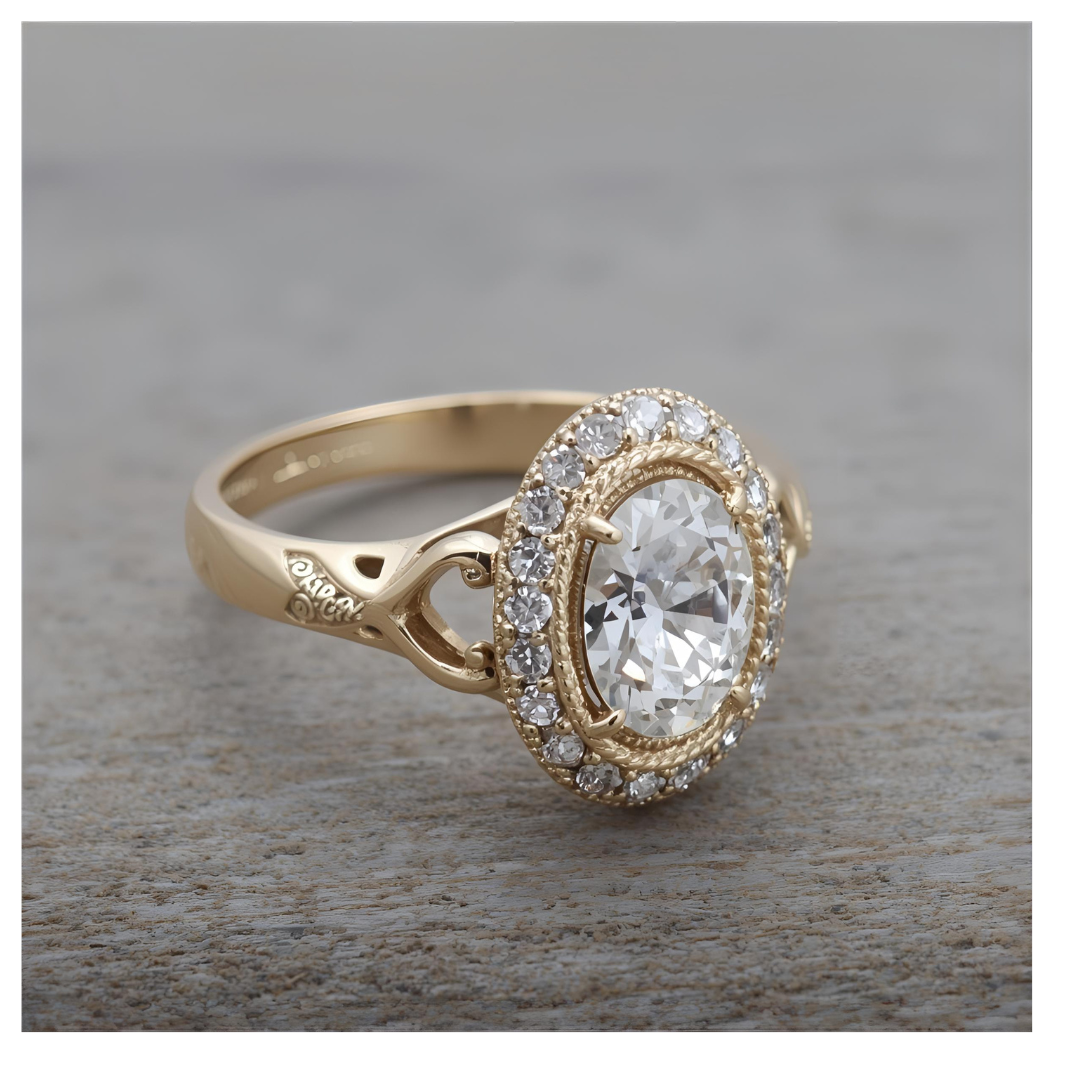
Vintage Rings
Vintage rings captivate us because they are far more than just jewelry—they are tangible pieces of history, artistry, and personal story.
Here’s a look at what makes them truly special:
-
Timeless Craftsmanship: Many vintage rings were crafted in an era of meticulous hand-finishing, featuring intricate engraving, milgrain detailing, and unique stone cutting techniques (such as old mine or rose cuts) rarely seen today.
-
-
Unique & One-of-a-Kind: Unlike mass-produced modern jewelry, vintage rings often possess a unique character and variations, ensuring you wear something with an individual personality.
-
-
A Link to History: Owning a ring from the Art Deco, Victorian, or Retro period connects you to the design movements and social eras of the past.
-
-
A Sustainable Choice: Choosing vintage is a form of conscious consumption, giving new life to a beautiful object without new resource extraction.
-
-
Enduring Value & Quality: Rings from certain periods are known for their substantial metalwork and enduring quality, and well-maintained pieces from sought-after eras often retain or appreciate.
Here is the content of the table;
What Makes A Ring Vintage Style?
How Do I Tell If My Ring Is Vintage?
What Is The Most Popular Vintage Ring Style?
Are Vintage Rings Cheaper?
What Are The Pros And Cons Of Vintage Rings?
How To Help Identify A Vintage Ring?
Let's see the first topic.
What Makes A Ring Vintage Style?
Here’s a breakdown of what makes a ring "vintage style," whether it's a genuine antique or a modern reproduction.
The Core Idea: Eras and Inspiration
True vintage and antique rings are categorized by the period they were made in. "Vintage style" rings are modern pieces that deliberately draw inspiration from these periods. The most commonly referenced eras are:
Victorian (1837-1901): Romantic, symbolic, and nature-inspired.
Art Nouveau (1890-1915): Whiplash curves, flowing lines, and ethereal themes like fairies and nymphs.
Edwardian (1901-1915): Delicate, lace-like, and incredibly elegant.
Art Deco (1920-1935): Geometric, bold, symmetrical, and full of sharp angles.
Retro (1940-1950): Chunky, bold, and sculptural, often using rose gold.
Key Characteristics of a Vintage Style Ring
1. Intricate Metalwork and Filigree
This is one of the most telltale signs. Instead of a plain, solid band, vintage-style rings feature delicate, lace-like patterns of metal.
Filigree: Thin wires of metal twisted and soldered into intricate patterns, often creating an openwork effect.
Milgrain: A beaded edge detail applied to the metal, giving it a soft, finished look and highlighting design elements. It's a hallmark of Edwardian and Art Deco styles.
Engraving: Scrolls, leaves, or floral patterns hand-engraved directly into the band or setting.
2. Distinctive Gemstone Cuts
Modern rings often feature brilliant cuts (like the round brilliant) designed for maximum sparkle. Vintage-style rings use cuts that were popular in the past.
Old European & Old Mine Cuts: The precursors to the modern round brilliant. They have a high crown, a small table, and a large, chunky culet. They possess a unique, fiery, and "crushed ice" sparkle.
Rose Cuts: Flat bottom with a dome top covered in triangular facets. They have a gentle, glass-like glow rather than a blinding sparkle.
Oval, Cushion, and Emerald Cuts: While still used today, their proportions in vintage-style pieces often mimic the older, more elongated or pillowy versions.
Cabochon Gems: Smooth, polished, non-faceted stones (like moonstone or opal) were very popular in Art Nouveau and Victorian eras.
3. Unique Gemstone Settings
How the stone is held in place is a major style indicator.
Cluster Settings: Multiple smaller stones are grouped to look like one larger flower or geometric shape.
Halo Settings: While still popular now, the halo was invented in the Georgian era. Vintage-style halos are often more intricate, with milgrain edges or smaller, differently shaped stones.
Three-Stone Settings ("Past, Present, Future"): A classic design, especially popular in the Edwardian and Victorian periods.
Illusion Settings: Popular in the Retro period, a metal frame surrounds the diamond to make it appear larger.
4. Romantic and Symbolic Motifs
Vintage-style rings are often full of meaning.
Nature: Flowers (especially daisies and roses), leaves, vines, and birds.
Celestial: Stars, moons, and sunbursts were huge in the Art Deco era.
Sentimentality: Hearts, bows, and clasped hands were common in Victorian "acrostic" rings or "Mizpah" rings.
5. Use of Specific Materials
Yellow and Rose Gold: While platinum was king in the Edwardian and Art Deco eras for the wealthy, yellow gold was the most common metal for centuries, and rose gold had a major moment in the Retro period.
Pearls: Often used as accents or even as center stones in Victorian and Edwardian rings.
Diamond Accents: Small, old-cut diamonds are frequently used as pavé or channel-set accents to frame a center stone or decorate the shoulders of the band.
Colored Gemstones: Sapphires, rubies, and emeralds were frequently used, often in combination with diamonds.
How to Get a Vintage Style Ring
Buy a Genuine Antique/Vintage Ring: The ultimate way to get the real thing. This requires research and buying from a reputable dealer.
Buy a Modern Reproduction: Many jewelers specialize in creating new rings with all the vintage hallmarks (milgrain, filigree, old-cut stones).
Custom Design: Work with a jeweler to create a unique piece that incorporates the specific vintage elements you love.
In essence, a vintage-style ring is not defined by its age, but by its design soul. It’s a piece that tells a story, evokes a sense of history and romance, and showcases the intricate artistry that characterizes jewelry from the past.
How Do I Tell If My Ring Is Vintage?
Determining if your ring is genuinely vintage involves playing detective and looking for clues in its materials, craftsmanship, design, and markings. It's a fun process of observation and research.
Here is a step-by-step guide to help you tell if your ring is vintage.
Step 1: Look for Hallmarks and Stamps (The Most Important Clue)
This is your first and most reliable step. Look inside the band with a magnifying glass or jeweler's loupe.
What to Look For:
Purity Marks: Numbers like 14K, 18K, 750 (for 18k gold), 925 (for Sterling Silver), PT or Plat (for Platinum).
Maker's Mark: The logo or name of the manufacturer (e.g., T&Co. for Tiffany & Co., J.E.C. for a specific artisan).
Assay Marks: In older (especially British and European) pieces, look for complex symbols in a cartouche (a shield shape). These can include:
A Standard Mark: (e.g., a crown for gold, a lion for sterling).
A Town Mark: (e.g., an anchor for Birmingham).
A Date Letter: A single letter representing the year it was assayed.
What It Tells You:
No "K" or "925" mark? It could be very old (pre-1900), or it could be costume jewelry.
Is the mark worn? Heavy wear on the inside of the band can indicate age.
"Platinum" or "PT"? Platinum became popular for fine jewelry in the Edwardian (1901-1910) and Art Deco (1920s-1935) eras. Its presence strongly suggests a vintage piece from that time or later.
You can search online for "jewelry hallmark identification" or consult a book to decipher specific marks.
Step 2: Examine the Design and Craftsmanship
Compare the style of your ring to the iconic eras mentioned in the previous answer.
Look for Hand-Crafted Details:
Filigree: Is the metalwork delicate, lacy, and intricate? This is a hallmark of Edwardian and early Art Deco styles.
Milgrain: Look closely at the edges. Are there tiny, beaded borders? This is a classic sign of Edwardian and Art Deco jewelry and is often done by hand on vintage pieces (modern milgrain can be machine-made).
Hand-Engraving: Are there scrolls, flowers, or patterns cut directly into the metal? Modern rings often have laser engraving, which looks sharper and more perfect. Hand-engraving has slight imperfections and a softer look.
Identify the Style:
Geometric, symmetrical, and bold? Think Art Deco.
Delicate, lacy, and floral? Think Edwardian or Late Victorian.
Romantic, nature-inspired with flowing lines? Think Art Nouveau.
Chunky, bold, sculptural, and often in rose/yellow gold? Think Retro (1940s-50s).
Step 3: Analyze the Gemstones and Settings
How the stones are cut and set is a major giveaway.
The Cut of the Stones:
Diamonds: Look for Old Mine Cut (cushion-shaped with a high crown and small table) or Old European Cut (round with a high crown and small table). These have a different, more "fiery" and less "brilliant" sparkle than modern round brilliants. They are a sure sign of age (typically pre-1940s).
Colored Stones: Look for cabochon (smooth, polished domes) or older step cuts like the "old emerald cut."
The Setting Style:
Cluster Settings: A central stone surrounded by a cluster of smaller stones was very popular in Victorian and Edwardian times.
Illusion Settings: Popular in the Mid-Century period, this uses a metal frame to make a small diamond look larger.
Closed-Back Settings: Older rings often have a closed back behind the stone, unlike the open, "holey" settings of modern rings designed for maximum light return.
Step 4: Assess the Signs of Age and Wear
A genuinely old ring will show its history.
Patina: The metal, especially silver or low-karat gold, may have a soft, even wear and a darkened appearance in the crevices. This is called a patina and is highly valued by collectors (do not polish it off!).
Natural Wear Patterns:
Look for wear on the parts that touch other surfaces. Is the band slightly thinner on the bottom?
Are the engravings slightly softened?
Is the milgrain a bit worn down? This is a great sign of age.
"Old European Cut" Faceting: As mentioned, this is a key indicator for diamonds.
A Simple Checklist to Get You Started
Answer these questions about your ring:
Are there any hallmarks or stamps inside the band? (Research them!)
Does the diamond have a large, open culet (flat spot at the bottom) and a chunky, irregular faceting pattern? (Likely Old Mine or Old European Cut).
Is there intricate, delicate metalwork like filigree or milgrain?
Does the design match a specific era (e.g., Geometric = Art Deco)?
Is there a soft patina and even wear on the metal?
The more "yes" answers, the more likely your ring is vintage.
When in Doubt, Consult a Professional
If you're still unsure, take your ring to a reputable, independent jeweler or an estate jewelry specialist. They have the expertise and tools (like high-powered loupes) to:
Properly identify hallmarks.
Authenticate the gemstone cuts and settings.
Give you a confident assessment of its age and origin.
This process is like uncovering a small piece of history. Enjoy the investigation
What Is The Most Popular Vintage Ring Style?
This is a fantastic question, and the answer has a clear frontrunner, though it depends slightly on whether we're talking about pure collector interest or modern trendiness.
The most popular and sought-after vintage ring style is, without a doubt, the Art Deco ring (from the 1920s-1930s).
Here’s a breakdown of why Art Deco reigns supreme, along with other highly popular contenders.
The Undisputed Champion: Art Deco (1920s-1930s)
Art Deco rings are instantly recognizable and perennially fashionable. They capture the spirit of the Roaring Twenties—bold, modern, and sophisticated.
Why it's so popular:
Geometric Boldness: Their strong, symmetrical lines with shapes like squares, triangles, and baguettes feel both classic and strikingly modern, fitting seamlessly with contemporary fashion.
Dramatic Color Contrast: They often feature a central gemstone (like a diamond or sapphire) accented with starkly contrasting stones, such as onyx, emerald, or ruby. This "paved" look is highly distinctive.
Exquisite Craftsmanship: Hallmarks like intricate filigree, delicate milgrain edging, and calibrated cut gemstones that fit together like a puzzle showcase incredible artistry.
Versatility: While bold, the geometric patterns are often more wearable and stackable than the more delicate Edwardian or the bulkier Retro styles.
If you see a vintage ring with a geometric, "architectural" look, it's almost certainly Art Deco-inspired and is the most likely candidate for the title of "most popular."
Other Highly Popular Vintage Ring Styles
While Art Deco is the king, these other eras have massive followings and are also incredibly popular for different reasons.
The Romantic Runner-Up: Edwardian (1901-1915)
Edwardian rings are the epitome of delicate, feminine elegance. They are the "lace" of the jewelry world.
Key Features: Airy, platinum settings that resemble lace or doilies, extensive use of milgrain, and motifs like bows, flowers, and garlands.
Why it's popular: For those who love a romantic, ethereal, and supremely elegant look. The craftsmanship is incredibly refined.
The Bold & Glamorous: Retro (1940s-1950s)
Retro rings were a reaction to the austerity of World War II—they are big, bold, and unapologetically glamorous.
Key Features: Chunky, sculptural curves, large cocktail-sized stones, extensive use of rose and yellow gold, and patriotic motifs like ribbons and flags. A classic design is the "cluster" or "cocktail" ring with a large central stone surrounded by smaller ones.
Why it's popular: For someone who wants a statement piece that is warm, dramatic, and has a Hollywood Golden Age flair.
The Timeless Classic: Victorian (1837-1901)
Victorian rings are rich with symbolism and romance, covering a long period with varied styles.
Key Features: Serpent rings (symbolizing eternity), acrostic rings (where the first letter of each gemstone spells a word, like "DEAREST"), horseshoes, flowers, and heavy yellow gold.
Why it's popular: Collectors and those who love deep history, symbolism, and a truly "antique" feel are drawn to these pieces.
Why is Art Deco the Most Popular Today?
Modern Aesthetic: The clean lines and geometric shapes of Art Deco align perfectly with modern design sensibilities.
Trend in Engagement Rings: Art Deco rings are a top choice for unique, non-traditional engagement rings, driving their popularity.
High Collectibility: Their distinct look and fine craftsmanship make them highly prized by collectors, keeping demand and prices strong.
Instant Recognition: The style is so defined that it's easy to identify and appreciate.
While personal taste is everything, if you're looking for the style with the broadest and most enduring appeal, the Art Deco ring is the most popular vintage style. It represents a perfect storm of iconic design, exquisite craftsmanship, and a look that feels both historic and freshly modern.
Are Vintage Rings Cheaper?
That's an excellent and very common question. The answer isn't a simple yes or no, because the value of a vintage ring is a complex mix of its materials, era, condition, and rarity.
In short, Vintagee rings can be a fantastic value for your money, but they are not automatically "cheaper" than new rings. They are often differently priced.
Here’s a breakdown of when they can be more affordable and when they can be significantly more expensive.
When Vintage Rings Can Be Cheaper or a Better Value:
Cost of Materials vs. Craftsmanship:
A new ring from a large, mainstream jeweler has a high price tag that includes not just the materials and labor, but also massive marketing budgets, retail markups, and brand prestige.
A vintage ring's price is often more directly tied to its intrinsic value: the gold weight, the quality and size of the gemstones, and its condition. You are often paying for the object itself, not the brand name.
Unique, Labor-Intensive Details:
You can often find intricate hand-engraving, filigree, and milgrain work on a vintage ring for a price that would be prohibitively expensive to replicate today. Handcrafting those details on a new ring would require a master jeweler and command a very high price.
The "Old Mine" and "Old European" Cut Diamond Factor:
These antique diamond cuts are often priced lower per carat than a modern brilliant cut of the same weight and color/clarity. This is because the modern market prioritizes the fiery, blinding sparkle of the brilliant cut.
For you, this means you can often get a larger carat weight for your budget by choosing a ring with an old-cut diamond, and you'll get a stone with unique, historical character.
Avoiding Depreciation:
Like a new car, a brand-new mass-produced ring can lose a significant portion of its value the moment you walk out of the store.
A vintage ring has already gone through this initial depreciation. A well-chosen vintage piece from a desirable era can hold its value exceptionally well or even appreciate, especially if it's a sought-after style like Art Deco.
When Vintage Rings Can Be More Expensive:
Rarity and Desirability:
Rings from highly sought-after eras, like pristine Art Deco pieces or delicate Edwardian rings, are in high demand. Their rarity and beauty can drive prices very high, often exceeding the cost of a comparable new ring.
Exceptional Condition:
Finding a vintage ring in perfect, unworn condition is rare. A piece that has survived 80-100 years without significant damage or alteration will be priced higher than one that needs repair.
Unique Gemstones:
A vintage ring featuring a rare, natural, and untreated gemstone of high quality (e.g., a no-heat Kashmir sapphire) can be astronomically expensive due to its collectibility.
The "Value" Beyond the Price Tag
Even when a vintage ring isn't "cheaper," it often represents a different kind of value:
Uniqueness: You are almost guaranteed to have a one-of-a-kind piece. You won't see it on everyone else's hand.
History and Character: The ring has a story. The patina and slight signs of wear are part of its charm.
Quality Craftsmanship: Many vintage rings were built to last with a level of detail that is hard to find in today's mass-market jewelry.
Sustainable Choice: Buying vintage is a form of recycling. It's an eco-friendly and ethical choice, as no new mining is required.
Practical Price Comparison
For a simple solitaire: A new one might be similarly priced or even cheaper than a vintage one, as solitaires are mass-produced efficiently today.
For a ring with intricate detail: A vintage ring with filigree, milgrain, and engraving will almost always be far more affordable than having a jeweler custom-make an identical new one.
Conclusion:
Think of it this way: Vintage rings offer more bang for your buck in terms of craftsmanship, character, and uniqueness, but not necessarily a lower final sale price.
If you are comparing a simple new ring to a simple vintage ring, prices may be similar. But if you are looking for intricate, artistic design and a piece of history, vintage rings provide access to a level of craftsmanship and materials that would be far more expensive to create new.
Your best strategy is to shop around, compare prices for the style you love, and focus on the incredible value and story a vintage ring provides, rather than just the initial cost.
What Are The Pros And Cons Of Vintage Rings?
Choosing a vintage ring is a big decision with many unique factors to consider. Here is a detailed breakdown of the pros and cons to help you make an informed choice.
The Pros of Vintage Rings
Unique Character and Story:
Pro: A vintage ring is a one-of-a-kind piece of wearable history. It has a story and a soul that a new ring simply cannot replicate. The patina, slight wear, and unique craftsmanship mean you will own something truly individual that no one else has.
Superior Craftsmanship:
Pro: Many vintage rings feature handcrafted details like intricate filigree, hand-engraving, and milgrain that are either too expensive or impossible to replicate with modern mass-production techniques. You are getting a level of artistry that is rare today.
Exceptional Quality Materials:
Pro: Vintage rings often feature:
Old-Cut Diamonds: Old European and Old Mine cuts have a unique, romantic sparkle and are often cut from high-quality diamond rough.
Solid Precious Metals: They are typically made with solid gold or platinum, unlike some modern pieces that can be hollow or heavily alloyed.
Natural Gemstones: Stones are typically natural and untreated, as many enhancement processes are modern.
Inherently Sustainable and Eco-Friendly:
Pro: Choosing a vintage ring is the ultimate form of recycling. It requires no new mining, reducing your environmental footprint and ensuring your purchase is ethically conscious.
Potential for Value Retention:
Pro: A well-chosen vintage ring from a desirable era (like Art Deco) can hold its value very well and often appreciates. Unlike a new mass-produced ring that depreciates quickly, a vintage piece has already gone through that initial drop.
Timeless, Enduring Style:
Pro: These rings have already stood the test of time. A style that was beautiful 100 years ago will likely remain beautiful for the next 100. You're investing in a classic, not a fleeting trend.
The Cons of Vintage Rings
Limited Sizing and Potential for Damage:
Con: This is one of the biggest challenges.
Sizing Restrictions: Rings can often only be sized up or down one or two sizes. Extremely intricate bands or eternity bands may not be resizable at all.
Brittleness: Older metals can become brittle over time. Resizing can sometimes lead to cracking, especially with platinum from certain eras.
Condition and Necessary Repairs:
Con: Wear and tear is expected. Prongs can be worn down, stones can be loose, and metal can be thin. You must budget for potential repairs, which should be done by a jeweler experienced with antique pieces to preserve their character.
The Need for Expert Verification:
Con: It's crucial to buy from a reputable source. You need to verify that the ring is what the seller claims it is—that the stones are natural, the metal is as marked, and there are no hidden repairs or damage. This often requires an additional appraisal cost.
Less "Sparkle" by Modern Standards:
Con: If you love the blinding, fiery brilliance of a modern brilliant-cut diamond, an old-cut diamond might disappoint you. Old cuts were designed to sparkle beautifully in candlelight, not halogen lights, giving them a softer, more chunky and reflective sparkle.
Limited Choice and the "Hunt":
Con: You can't just walk into a chain store and pick the exact style you saw online. Finding the perfect vintage ring requires patience, research, and a willingness to embrace the "hunt." You have to fall in love with what's available.
Potential for Unknown History:
Con: While some see a story as a pro, others may be uncomfortable with not knowing the full history of the ring. This is a personal preference.
Summary Table
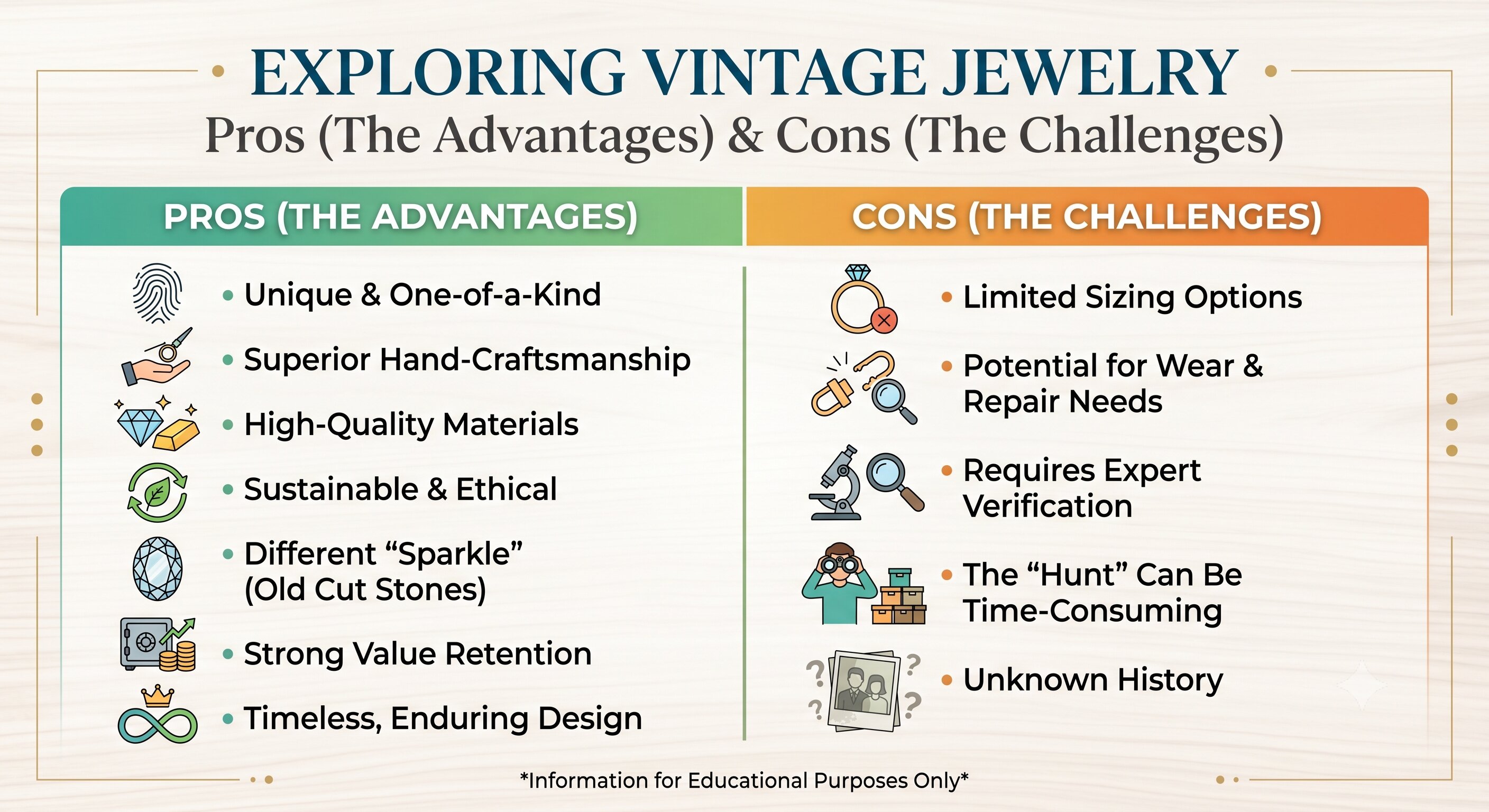
Final Verdict
A vintage ring is perfect for you if:
You value unique artistry, history, and sustainability over a perfectly uniform, brilliant sparkle. You are a patient person who enjoys the thrill of the hunt and is willing to do some research and potentially invest in maintenance.
You may want to stick with a new ring if:
Your top priority is maximum brilliance (sparkle), you need a specific, readily available design, you require a standard ring size that's hard to find, or you want the convenience of a walk-in purchase with a brand-new warranty.
.
How To Help Identify A Vintage Ring?
To identify your vintage ring, you'll need to examine both its physical markings and its design style. Here is a systematic guide to help you get started.
Step 1: Locate and Document the Hallmarks
First, carefully inspect your ring for any small stamps or engravings, which are usually found on the inside of the band. Use a jeweler's loupe (10x magnification) and good lighting, as these marks can be very tiny and worn.
Common marks you might find include:
Metal Purity Mark: Indicates the gold, silver, or platinum content (e.g., 14K, 585 for gold; 925 for sterling silver; PT950 for platinum).
Maker's Mark: Could be initials, a name, or a unique symbol representing the jeweler or manufacturer.
Assay Office Mark: A symbol for the office that tested the metal. For UK rings, common ones are a leopard's head (London), an anchor (Birmingham), or a castle (Edinburgh).
Date Letter: Primarily found on UK pieces, these single letters in specific shields indicate the year it was hallmarked.
Take clear, magnified photographs of all marks.
Step 2: Analyze the Ring's Style and Construction
The design, motifs, and craftsmanship are key clues to its era. Use this chart to compare your ring's features.
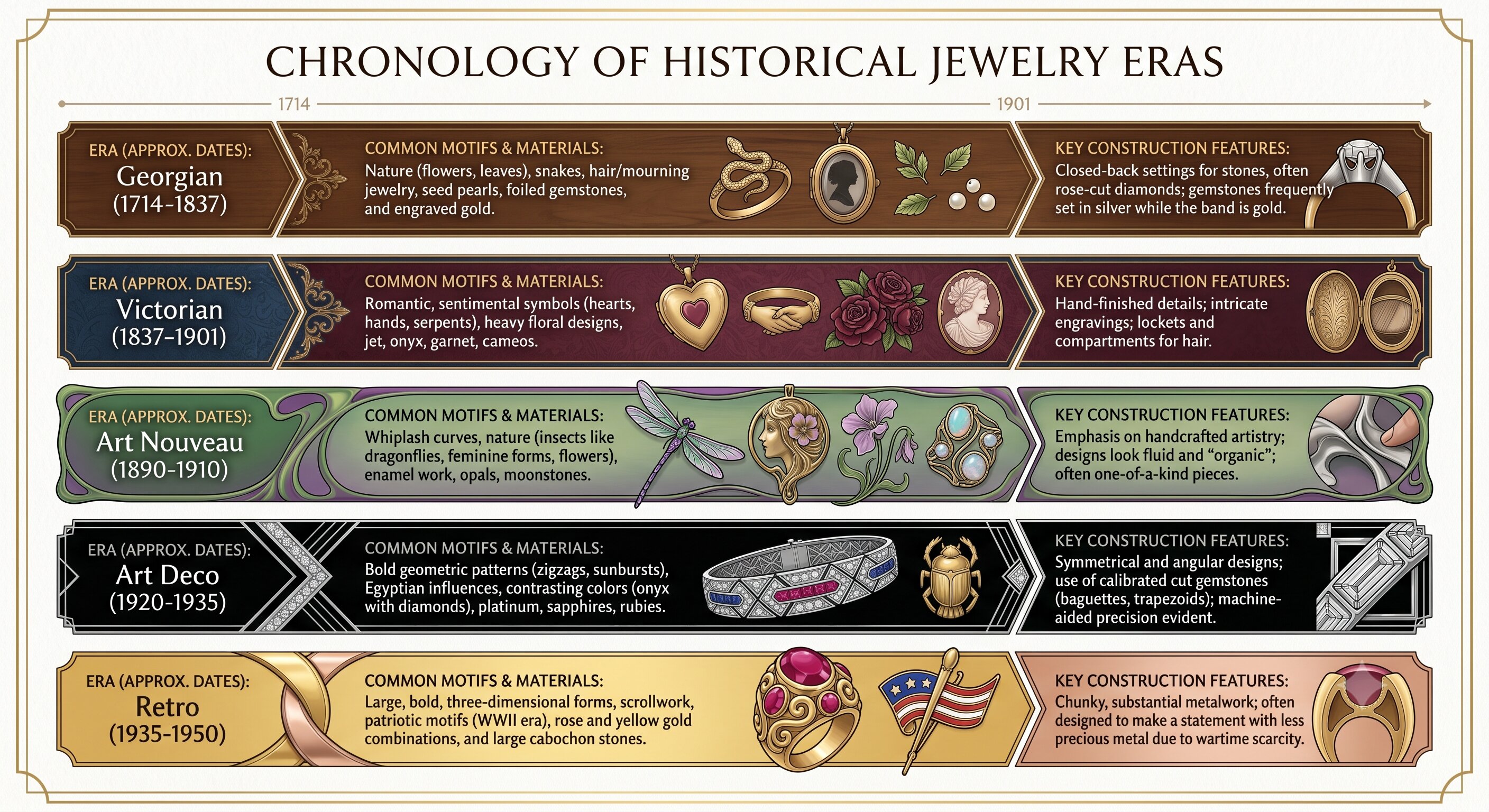
Step 3: Research and Seek Expert Help
Cross-reference Marks: Once you have a potential country and era, use online databases or reference books to research the specific marks. A great starting point is the pictorial index of the Antique Jewelry University.
Consult a Professional: For a definitive identification or valuation, especially if the ring appears valuable, consult a certified antique jewelry appraiser or a reputable auction house specialist. They have access to extensive archives and can often identify obscure makers and provide accurate dating.
Important Considerations
Worn or Missing Marks: It's common for older rings to have faint, partial, or missing stamps due to polishing or wear. In these cases, style analysis becomes your main tool.
Counterfeits: Be aware that some modern pieces may have fake hallmarks. Authenticity is best judged by a combination of marks, style, wear patterns, and construction quality.
I hope this guide gives you a clear path to uncovering the story of your ring. If you manage to find and photograph any hallmarks or can describe the design in more detail, feel free to share, and I can offer more specific insights.


News for Tuesday 11 November, 2025
- Teardrop Cut Diamond: A Comprehensive Guide to Their Unique Appeal
- Wondering About Gemstone Cuts? Here's the Truth About Excellent.
View all news for Tuesday 11 November, 2025 on one page
Recent News
- Monday 10 November, 2025
- Friday 07 November, 2025
- Thursday 06 November, 2025
- Wednesday 05 November, 2025
- Tuesday 04 November, 2025