

Unlock the Meaning: What Your Asscher Cut Diamond Represents
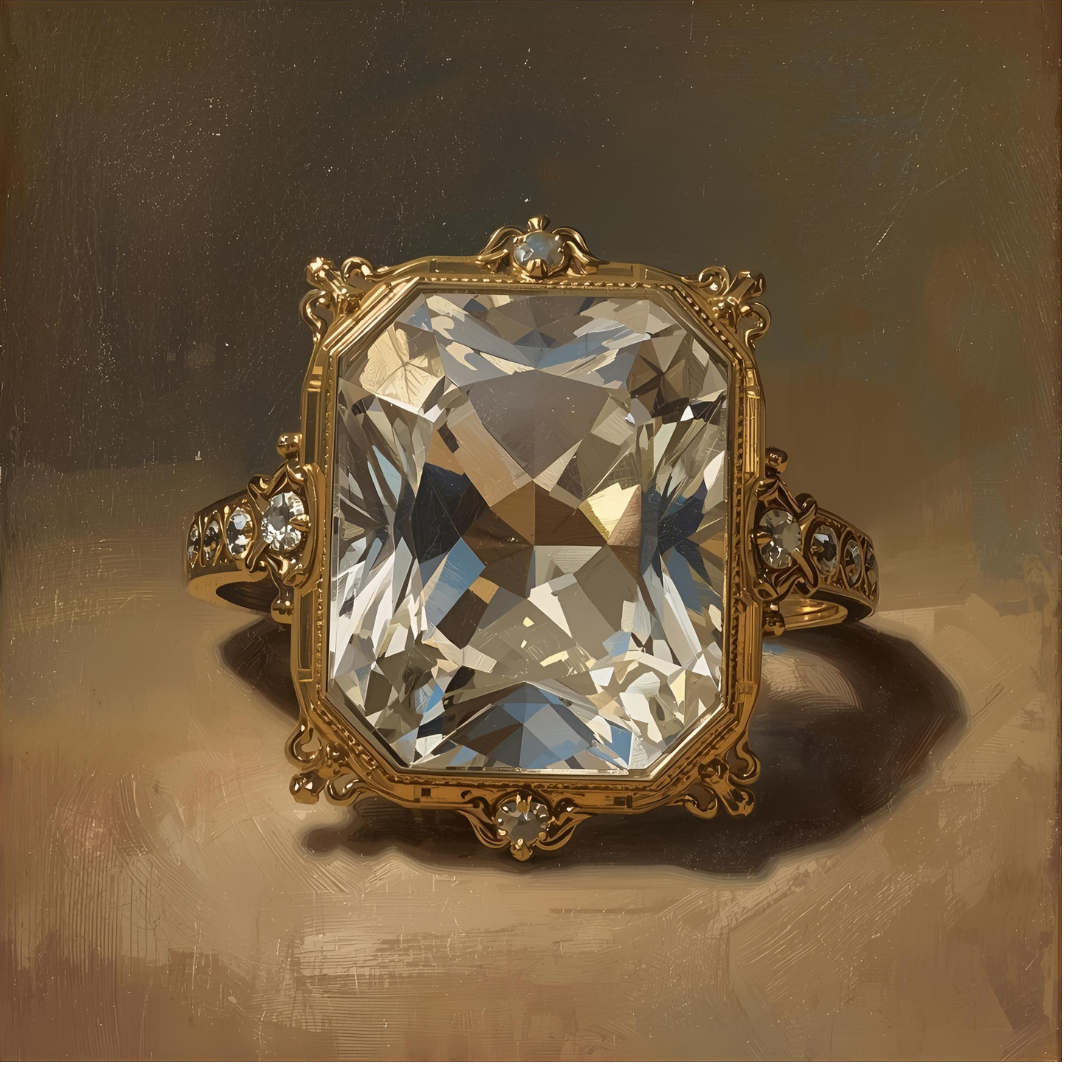
What Does Asscher Cut Symbolize?
That's an excellent question, as the Asscher cut is rich with history and meaning beyond its beautiful geometry.
“In 1902, the Asscher family of Amsterdam patented a new diamond cut. It was square, stepped, and hypnotic—like descending into a hall of mirrors. For decades, it was the diamond of royalty. The Asscher cut was chosen for the Cullinan diamonds—the largest gem-quality rough ever found—set into the British Crown Jewels. Then, the round brilliant took over, and the Asscher faded. But in the early 2000s, the Royal Asscher Company re-cut the design with 74 facets instead of 58. The revival began. The Asscher cut is not the most popular diamond shape. But it is the one that makes you stop. Look closer. And fall into its depth.”
The same cut that adorned the British Crown Jewels now awaits your own descent into depth. Every Asscher cut diamond in our collection is hand-selected for that hypnotic ‘hall of mirrors‘ effect—because a diamond should not just sparkle. It should draw you in.”
[Button: Explore Asscher Cut Diamonds →]
Unlike birthstones or certain gems that have ancient symbolic systems, the symbolism of the Asscher cut is deeply tied to its design, history, and the visual effect it creates.
What Does Asscher Cut Symbolize?
Is Asscher Cut A Vintage Style?
What Is The Best Asscher Cut Size?
Do Asscher Cuts Look Smaller?
Why Are Asscher Cuts Not Popular?
Is Asscher Cut More Expensive?
Is Asscher Or Princess Cut Better?
Here’s a breakdown of what the Asscher cut symbolizes:
1. Timeless Elegance and Refined Taste
The "Hall of Mirrors" Effect: The signature feature of an Asscher cut is its high crown, stepped facets, and small, clipped corners, which create a mesmerizing "hall of mirrors" or a kaleidoscopic effect. This complex play of light symbolizes depth, complexity, and a sophisticated inner world.
Art Deco Heritage: Patented in 1902, the Asscher cut became the quintessential gem of the Art Deco era (1920s-1930s). This period was defined by a focus on symmetry, bold geometry, and luxury. Therefore, an Asscher cut symbolizes a connection to this golden age of design, representing glamour, opulence, and a classic, enduring style.
2. Clarity and Integrity
A Window to the Soul: The large, open table (the flat top facet) and the clean, linear steps act like a window into the stone. Because of this, the Asscher cut is less forgiving than others and requires a high-quality diamond with exceptional clarity. It symbolizes honesty, transparency, and purity. It doesn't hide imperfections; it showcases the true, unadulterated beauty of the crystal.
3. Stability and Order
Geometric Precision: The Asscher cut is essentially a square emerald cut. Its clean lines, perfect symmetry, and balanced proportions evoke a sense of stability, order, and harmony. It's a cut for those who appreciate structure, logic, and a clear, well-defined path.
4. Individuality and Confidence
A Bold Choice: While round brilliants are the most popular, choosing an Asscher cut is a deliberate and distinctive choice. It signifies a person who is confident, individualistic, and has a strong sense of personal style. They are not swayed by trends but are drawn to unique beauty with a story.
5. Royalty and Legacy
The "Royal" Asscher: The original Asscher family in Amsterdam cut some of the world's most famous diamonds, including the Cullinan diamonds, for the British Royal Family. This royal connection imbues the cut with a sense of nobility, heritage, and a timeless legacy. Wearing an Asscher cut can feel like owning a piece of history.
The Asscher Cut's Symbolic Meaning
If an Asscher cut could speak, it would say:
"I am not the loudest, but I am the most profound. I value history, clarity, and order. My beauty is not fleeting; it is eternal, geometric, and deeply intellectual. I symbolize a refined elegance and the confidence to choose a path less traveled."
Comparison to Other Cuts:
Round Brilliant: Symbolizes universal love and tradition. It's the most popular and fiery.
Emerald Cut: Shares the step-cut elegance but in a rectangular form, often seen as even more modern and sleek.
Oval Cut: Symbolizes creativity and uniqueness, while also having a classic feel.
In essence, the Asscher cut is for the person who sees their life as a work of art—structured, beautiful, deep, and timeless. It’s a cut that tells a story of heritage, clarity, and confident individuality.
Is Asscher Cut A Vintage Style?
The short answer is yes, the Asscher cut is fundamentally a vintage style, but with an important modern twist that keeps it relevant today.
Think of it as a classic design that has been revived and refined for the contemporary era.
Here’s a more detailed breakdown:
Why It's Considered a Vintage Style
Historical Origins: The Asscher cut was first created and patented by the Asscher family in Amsterdam in 1902. Its birth places it squarely in the Edwardian era.
The Quintessential Art Deco Cut: The Asscher cut reached the peak of its popularity during the Art Deco period (1920s-1930s). The Art Deco style was defined by:
Bold Geometry: Sharp angles, symmetrical lines, and stepped patterns.
Dramatic Contrasts. The Asscher cut, with its concentric steps and high crown, perfectly embodied these principles. It became the go-to cut for the glamorous and sophisticated style of the Roaring Twenties.
A "Period" Piece: When you see an original Asscher-cut diamond in an antique jewelry piece, it is almost certainly a genuine vintage or antique item. Its design is instantly evocative of a specific, iconic era in history.
The Modern Revival: It's Not Just Vintage
While its roots are vintage, the Asscher cut is far from being a relic. It has experienced a major resurgence since the early 2000s.
The key to this revival was the introduction of the Royal Asscher Cut in 2001. The modern Royal Asscher Company (run by the original Asscher family) re-cut and improved the design for the 21st century. Key differences include:
74 Facets: The modern Royal Asscher has 74 facets, compared to the original's 58 or so. This enhances its brilliance and sparkle, making it more competitive with modern brilliant cuts.
Improved Proportions: Advances in computer modeling allowed for more precise angles and proportions to maximize light performance.
Continued Popularity: Its unique, geometric appeal has made it a popular choice for those seeking an alternative to the ubiquitous round brilliant, often chosen for its blend of old-world charm and modern sparkle.
Conclusion: Vintage Spirit, Modern Execution
So, to summarize:
Is it a vintage style? Absolutely. Its design DNA is inextricably linked to the Art Deco era. It carries a timeless, elegant, and historical feel.
Is it an outdated style? Not at all. The modern iterations have updated the cut for better performance, making it a vibrant and sought-after choice for contemporary engagement rings and jewelry.
When you choose an Asscher cut today, you are often choosing a piece that pays homage to a vintage aesthetic but benefits from modern cutting techniques. It’s a perfect choice for someone who loves the glamour and history of the past but wants a diamond that sparkles with today's standards.
The Asscher cut is the architectural masterpiece of the diamond world—a classic, vintage design that has been beautifully restored for modern living.
What Is The Best Asscher Cut Size?
This is a fantastic and very practical question. The "best" Asscher cut size isn't a single number; it's a range that depends on your priorities: finger coverage, sparkle performance, budget, and personal style.
However, we can break down the key considerations to help you find your perfect size.
The Goldilocks Zone for Asschers: 2.0 - 3.0 Carats
For a classic, well-proportioned Asscher cut that balances face-up size, sparkle, and structural integrity, the sweet spot is generally between 2.0 and 3.0 carats.
In this range, you get a stone with significant presence that fully expresses the "hall of mirrors" effect without compromising on light performance. The facets are large enough to be bold and geometric, yet the stone is cut deep enough to retain brilliance.
Size Guide & Visual Impact by Carat Weight
Here’s a more detailed look at what to expect at different sizes:
Under 1.5 Carats: Delicate & Elegant
Best for: More modest budgets, smaller hands, or those who prefer a subtle, elegant look. It can be a beautiful accent stone or a classic solitaire.
Consideration: The intricate facet pattern can look a bit small and tight. A halo setting can dramatically increase the visual size and presence of a smaller Asscher.
1.5 - 2.5 Carats: The Classic & Popular Range
Best for: Most people. This is the most popular range as it offers a substantial look without being overwhelming.
At ~2.0 carats: You have a definite "wow" factor. The geometric pattern is clear and captivating. This is a great balance of size, sparkle, and cost-efficiency.
At ~2.5 carats: The stone becomes a true centerpiece. The face-up size is impressive, and the classic Asscher characteristics are on full display.
3.0 Carats and Above: Statement & Luxurious
Best for: A bold, luxurious, and undeniable statement piece. It's the ultimate expression of the cut.
Consideration: At these larger sizes, the quality of the cut is paramount. A poorly cut large Asscher can look dark and "glassy." You also need a high clarity grade (VS2 or better is strongly recommended) as inclusions are more visible in the large, open table. The cost increases significantly.
The Most Important Factor: It's Not Just Carat Weight
For an Asscher cut, more than any other shape, quality and proportions are just as important as size. A well-cut 2.0 carat Asscher can look more impressive and sparkly than a poorly cut 3.0 carat one.
Here are the key specs to look for:
Cut Quality (The #1 Priority): There's no official "Ideal" grade for Asschers from labs like GIA, so you must rely on proportions and your own eye.
Table %: Aim for 60% - 68%. A table that is too large (e.g., over 70%) kills the sparkle.
Depth %: Aim for 60% - 68%. Too shallow, and it loses brilliance; too deep, and it looks small for its carat weight and can have a dark center.
Look for a strong "Hall of Mirrors" effect: The concentric squares should be clear, sharp, and draw your eye into the stone.
Length-to-Width Ratio: A "square" Asscher typically has a ratio of 1.00 to 1.05. If you prefer a slightly rectangular look (more like an emerald cut), you might go up to 1.10. This is purely aesthetic.
Clarity: Due to the large, open table, inclusions are highly visible. VS2 clarity or higher is a safe recommendation. For stones over 2.5 carats, VS1 or VVS is often worth the investment to ensure the stone is "eye-clean."
Practical Recommendation
If you want a single, actionable answer: Start your search by focusing on a 2.0 to 2.5-carat Asscher cut with excellent proportions (table ~62-66%, depth ~62-66%) and a VS1-VS2 clarity grade.
This combination will give you a stunning, classic Asscher that is large enough to be impressive, brilliantly cut to maximize sparkle, and clean to the naked eye.
Pro Tip: Because the Asscher cut is a "step cut," it faces up smaller than a round brilliant of the same carat weight. If you're comparing it to a round diamond you've seen, you may want to size up by about 10-15% to get a similar face-up coverage. For example, a 2.0 carat Asscher will have a face-up area similar to a ~1.8 carat Round Brilliant.
Do Asscher Cuts Look Smaller?
Yes, Asscher cuts can often look smaller than other diamond shapes of the same carat weight, particularly when compared to round brilliants and oval cuts.
However, this isn't a flaw—it's a characteristic of their unique structure. Here’s a detailed breakdown of why and how they compare.
The Reason: It's All About "Face-Up" Size and Weight Distribution
The perceived size of a diamond is its "face-up" appearance—how much surface area it covers on your finger. Carat weight measures mass, not spread.
Deep Pavilion and High Crown: Asscher cuts are a "step cut" with a deep pavilion (the bottom part of the diamond) and a high crown (the top part). A significant portion of their weight is hidden in this depth, rather than being spread out across the top. A shallower cut would look larger but would leak light and lack brilliance.
Concentrated Weight: The weight is concentrated within a square outline. Compared to shapes that are elongated (like ovals or marquise) or that have more external facets that push the weight to the edges (like rounds), the Asscher's mass is more centrally located.
Size Comparison: Asscher vs. Other Popular Cuts
To give you a visual understanding, here’s a general comparison of how different 1-carat diamonds might appear face-up:
Asscher Cut vs. Round Brilliant: The round brilliant will almost always look larger. A 1-carat Round Brilliant has a typical diameter of ~6.5mm, while a 1-carat Asscher is often around ~5.5mm to 6.0mm. The Round can look 10-15% larger.
Asscher Cut vs. Oval/Marquise/Pear: These elongated shapes have a much larger surface area for their carat weight and will appear significantly larger than an Asscher.
Asscher Cut vs. Cushion Cut: This is a closer comparison, but many modern cushions are cut to maximize their spread and can still appear slightly larger.
Asscher Cut vs. Princess Cut: A princess cut is also square but is typically cut shallower, meaning it will often have a slightly larger face-up size than an Asscher of the same weight.
Asscher Cut vs. Emerald Cut: This is the most direct comparison, as they are both step cuts. They will look very similar in size, with the difference being primarily in their shape (square vs. rectangular).
How to Compensate and Make an Asscher Look Larger
If you love the Asscher cut but want to maximize its presence, here are some pro tips:
Focus on Millimeter Dimensions, Not Just Carat Weight. Always ask for the length and width measurements in millimeters. A well-cut 2-carat Asscher should be around 7mm x 7mm. Compare this to the mm dimensions of other shapes to get a true sense of size.
Choose a "Spread" Stone (Carefully): Some Asschers are cut with slightly shallower proportions to increase their face-up size. Be cautious here—if it's cut too shallow, it will lose the deep, mesmerizing "hall of mirrors" effect and can appear dark or glassy. A good depth percentage is between 60% and 68%.
Use a Strategic Setting:
A Thin Bezel or Knife-Edge Band: A slim setting minimizes visual bulk around the stone, making the diamond itself the star.
A Halo: This is the most effective way to dramatically increase the visual size of an Asscher. The geometric lines of the Asscher pair perfectly with a square or circular halo, creating a seamless, larger-looking centerpiece.
Long, Tapered Side Stones: Baguettes or trapezoid stones running alongside the Asscher can elongate the entire ring, making the center stone appear larger and more impressive.
Don't let the smaller appearance deter you. The Asscher cut trades a bit of surface spread for unparalleled depth, elegance, and a unique, mesmerizing sparkle. Its beauty is in its intricate geometry and Art Deco glamour, not in dominating size.
Practical Advice: If you have a specific face-up size in mind (e.g., you want it to look as large as a 2-carat round), you may need to choose an Asscher that is 10-20% heavier in carats to achieve a similar finger coverage. Always prioritize excellent cut proportions above all else to ensure your Asscher is as brilliant and beautiful as possible.
Why Are Asscher Cuts Not Popular?
That's an excellent question that gets to the heart of diamond market trends. While Asscher cuts are beloved by connoisseurs and have a dedicated following, they are indeed far less popular than rounds, ovals, or even their rectangular cousin, the emerald cut.
The reasons are a mix of market dynamics, optical science, and consumer psychology.
Here’s a breakdown of why Asscher cuts are not as popular:
1. The Dominance of "Brilliance" and Sparkle
The Round Brilliant is the Benchmark: The diamond market, especially for engagement rings, is overwhelmingly dominated by the round brilliant cut. It is scientifically engineered to maximize fire (flashes of color) and brilliance (white light return). For most consumers, this "sparkle factor" is the primary definition of a beautiful diamond.
Asscher's "Quiet" Elegance: Asscher cuts are step-cuts, known for their elegant "hall of mirrors" effect and clarity. They produce flashes of light rather than a constant, all-over sparkle. To an untrained eye, they can appear less flashy and more "glassy" or "clear" than a brilliant cut, which can be mistaken for a lack of life or sparkle.
2. Higher Cost Perceived as Lower Value
The "Spread" Illusion: As discussed in the previous question, Asscher cuts can look smaller than a round brilliant of the same carat weight because their weight is held in depth. A consumer spending 2 carats' worth of money might feel they are getting a "smaller-looking" stone compared to a round or oval.
Demands High Clarity: The large, open table of an Asscher cut makes inclusions highly visible. To get a beautiful, eye-clean stone, you often need a higher (and more expensive) clarity grade (e.g., VS2 or better). This can make a quality Asscher more expensive than a round brilliant, where you can sometimes "get away" with a lower clarity grade (e.g., SI1) because its facets hide inclusions.
3. The "Vintage" Niche
It's a Specific Aesthetic: While its Art Deco heritage is a major selling point for some, it can be a deterrent for others. Many people want a ring that feels "modern" and "timeless" in a contemporary sense, and they may (mistakenly) associate the Asscher cut with being "old-fashioned" or "dated." Its popularity is cyclical, whereas the round brilliant is perpetually in style.
4. Lack of Exposure and Availability
Jewelers Push What Sells: Most local jewelers will have a vast selection of round brilliants and a few ovals or cushions. They may not even stock an Asscher cut because it's a slower-moving, niche item. When salespeople are trained to sell what's most popular and easiest to move, the Asscher gets overlooked.
Less Celebrity Influence: While some celebrities have Asscher cuts (Jessica Alba is a famous example), they are far outnumbered by those with ovals, emeralds, and rounds. Celebrity trends have a massive impact on consumer desire.
5. It's a "Connoisseur's Cut."
Ultimately, the Asscher cut appeals to a specific type of person:
Someone who values geometry, symmetry, and Art Deco history over maximum sparkle.
Someone with confidence and individualistic taste, who doesn't want the same ring as everyone else.
Someone who appreciates the clarity and depth, the optical illusion of the "hall of mirrors."
The Silver Lining: Why Its Niche Status is a Strength
For the right person, the fact that Asscher cuts are not popular is their greatest asset.
Uniqueness: In a sea of round brilliants, an Asscher cut stands out as a clear statement of personal style.
Intellectual Beauty: Its beauty is more subtle and architectural. It invites you to look closer and appreciate its craftsmanship.
Timelessness: While trends come and go (the current craze for ovals will eventually fade), the Asscher cut has a permanent, classic elegance rooted in a definitive design period.
“In 2003, actress Jessica Alba chose an Asscher cut engagement ring. It was a quiet rebellion against the round brilliant. In 2015, Neil Patrick Harris gave his husband an Asscher-cut ring. In 2020, searches for ‘Asscher cut‘ spiked after a viral TikTok showed a 1920s Art Deco Asscher ring. The Asscher will never be number one. It does not want to be. Its power is not in numbers. It is in the people who choose it—the ones who see a diamond not as a flash of light, but as a descent into depth. The Asscher cut is not for the crowd. It is for the one who stands apart.”
Asscher cuts aren't unpopular because they are inferior; they are less popular because they cater to a more refined, specific taste that prioritizes elegance and geometry over ubiquitous sparkle.
They are the architectural masterpiece of the diamond world—not for everyone, but utterly breathtaking for those who appreciate their unique language of beauty.
Is Asscher Cut More Expensive?
Excellent question. The answer is nuanced, but here’s the quick summary:
No, the Asscher cut is not inherently more expensive per carat than a Round Brilliant. In fact, it is often 20-40% less expensive for a diamond of the same carat weight, color, and clarity.
However, there are specific scenarios where the final cost of a beautiful Asscher can be higher due to its unique demands.
Let's break down the pricing factors.
The Cost Advantage: Why Asschers Can Be Cheaper
Higher Yield from the Rough: The Round Brilliant cut is designed for maximum sparkle, not for conserving the original rough diamond crystal. To achieve its 58 facets and perfect angles, a cutter must remove more of the original material. The Asscher's square shape and stepped facets often allow the cutter to preserve more of the original rough diamond, resulting in a higher yield. This lower "waste" translates to a lower cost per carat.
Lower Market Demand: As discussed in the previous question, Round Brilliant cuts dominate the market. High demand allows retailers to charge a premium for them. The niche popularity of the Asscher cut means it doesn't carry the same "brand premium" as a round.
The Hidden Costs: Where an Asscher Can Get Expensive
While the base price per carat is lower, achieving the ideal look for an Asscher can add cost in other ways:
The Clarity Premium: This is the biggest factor.
Round Brilliant: Its numerous, complex facets are excellent at hiding (or "masking") small inclusions. You can often get away with a lower clarity grade (like SI1) and still have a stone that appears "eye-clean."
Asscher Cut: The large, open, flat table and step-cut facets act like windows into the stone. Inclusions are highly visible. To ensure an Asscher is eye-clean, you often need a higher clarity grade (VS2 or better), which costs more.
The Cost of an Excellent Cut:
There's no official GIA "Ideal" cut grade for Asschers, so finding a truly well-proportioned one requires more effort.
A poorly cut Asscher can look dead, dark, and glassy. A superb cut with a mesmerizing "hall of mirrors" effect is crucial and often comes from specialty cutters, which can command a premium over a generic, poorly cut stone.
Size Perception vs. Reality:
Because an Asscher looks smaller than a round of the same carat weight, you might feel the need to size up to get the visual presence you want. So, while a 2-carat Asscher is cheaper than a 2-carat Round, you might be comparing a 2.5-carat Asscher to a 2-carat Round, which could narrow the price gap.
Price Comparison Table (General Estimate)
Let's compare a well-cut, eye-clean 2-carat diamond with G color:
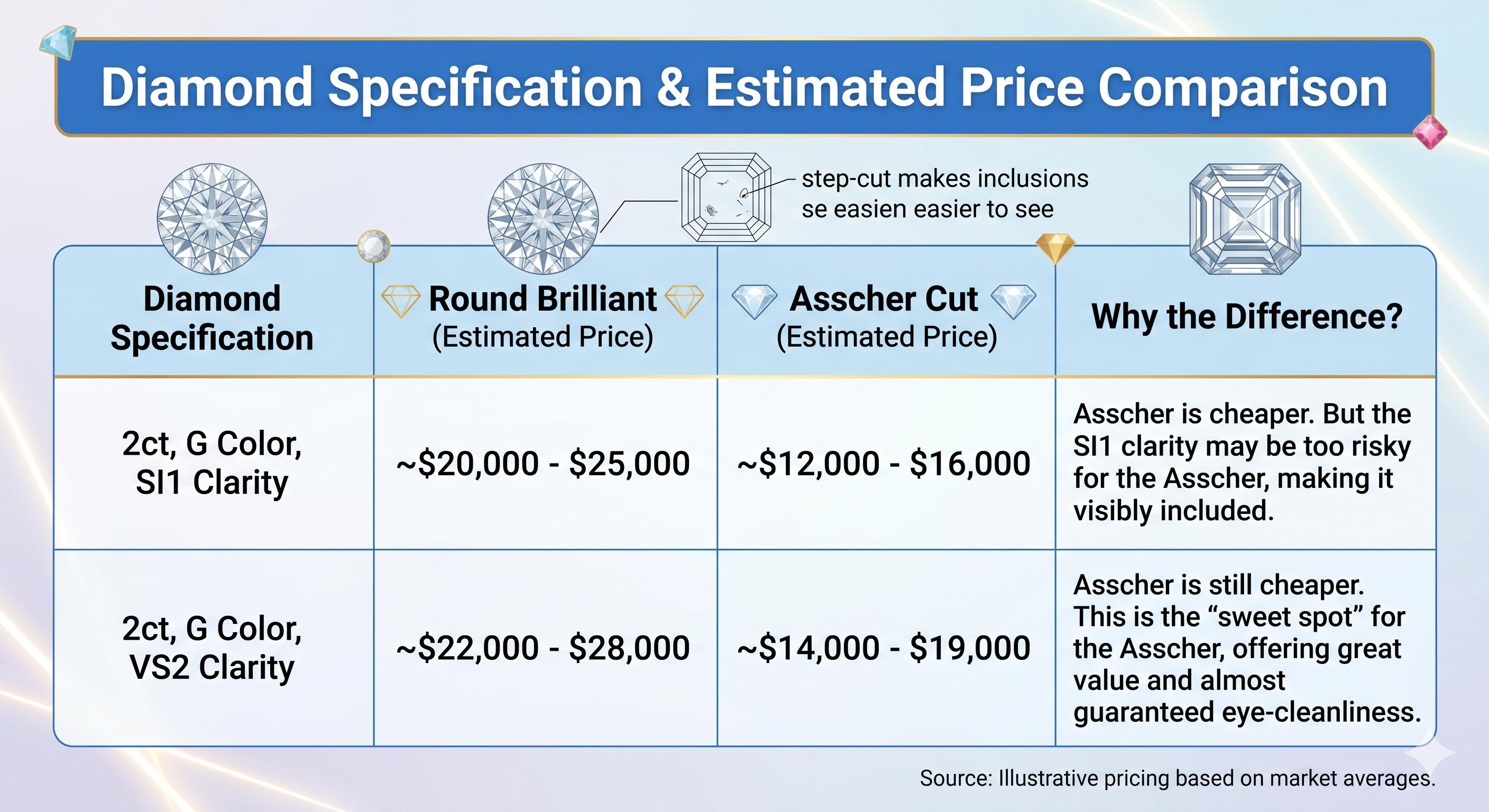
Note: Prices are illustrative and can vary based on market conditions and the specific retailer.
Is an Asscher Cut More Expensive?
For the same carat weight: No, it is significantly less expensive than a Round Brilliant.
For the same visual quality, the gap narrows, but the Asscher is still cheaper. You pay more for higher clarity, but the savings from the lower base price per carat usually still result in a lower total cost.
For the best possible stone: A top-tier, precision-cut Asscher from a renowned cutter (like the original Royal Asscher) can be very expensive, but it's still typically priced below a Round Brilliant of equivalent excellence.
You can get a larger or higher-quality Asscher cut for the same budget as a smaller or lower-quality Round Brilliant. The value proposition of the Asscher is one of its biggest advantages, allowing you to prioritize size or quality without breaking the bank.
Is Asscher Or Princess Cut Better?
There is no single "better" cut, as Asscher and Princess cuts offer distinct styles and visual effects. The right choice depends on whether you prefer vintage elegance with geometric patterns or modern brilliance with maximum sparkle.
To help you compare the key differences, here is a detailed breakdown:
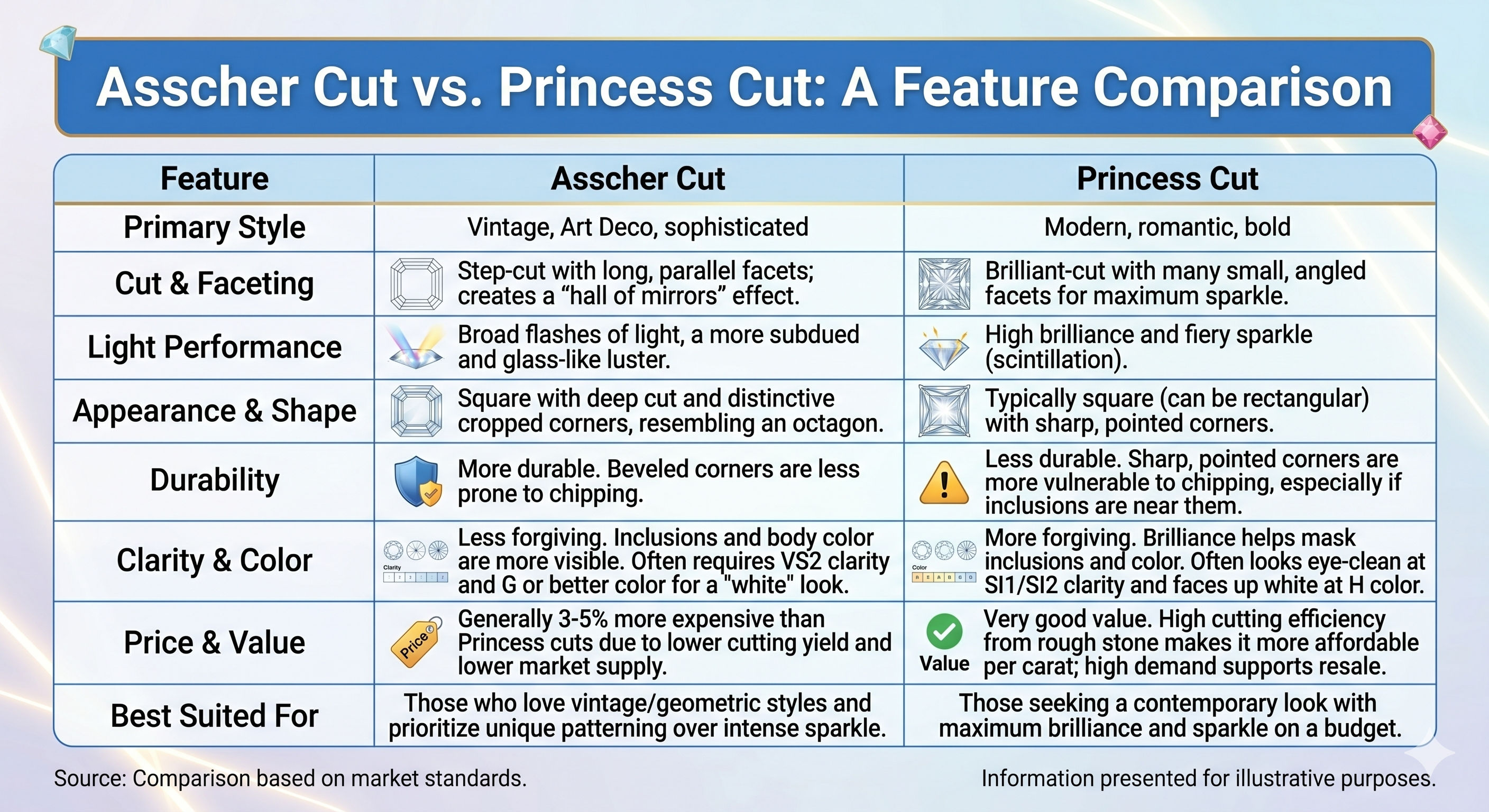
Key Selection Tips
Based on the differences above, here is what to prioritize for each cut:
For an Asscher Cut: Prioritize high clarity (VS2 or above) and high color (G or above) to ensure it looks clean and bright. Its beauty lies in symmetry and clean lines, so excellent cut quality is crucial.
For a Princess Cut: Prioritize a very good to excellent cut to maximize its signature sparkle. You can potentially save by choosing a slightly lower color (like H) and clarity (like SI1), provided the diamond looks eye-clean.
How to Make Your Final Decision
Since personal style is the deciding factor, ask yourself:
Do you prefer the geometric, vintage elegance of an Asscher or the brilliant, modern sparkle of a Princess?
Consider your lifestyle: If you are very active, the Asscher's more durable corners might be a practical advantage.
Ultimately, view stones in person. The visual difference between step-cut facets and brilliant-cut sparkle is significant and best appreciated firsthand.
“You now know the symbolism, the vintage status, the size guide, the perception of size, the popularity reasons, the pricing, and the princess comparison. The only question left: will you choose the cut that makes people look twice?
*Our current collection includes a limited number of GIA-certified Asscher cut diamonds — from classic originals to modern Royal Asscher cuts with 74 facets. When stones with ideal proportions and VS2+ clarity are gone, sourcing new ones takes time.*
This is not just a diamond. It is the Asscher family‘s 1902 patent, the Cullinan diamonds in the British Crown Jewels, and 120 years of proof that a diamond doesn‘t need to be round to be royal — it just needs to be Asscher.”
[Button: Claim Your Asscher Cut Diamond (Limited) →]
Back to Complete Aquamarine Ring Guide


Marquise Cut: Everything You Need to Know
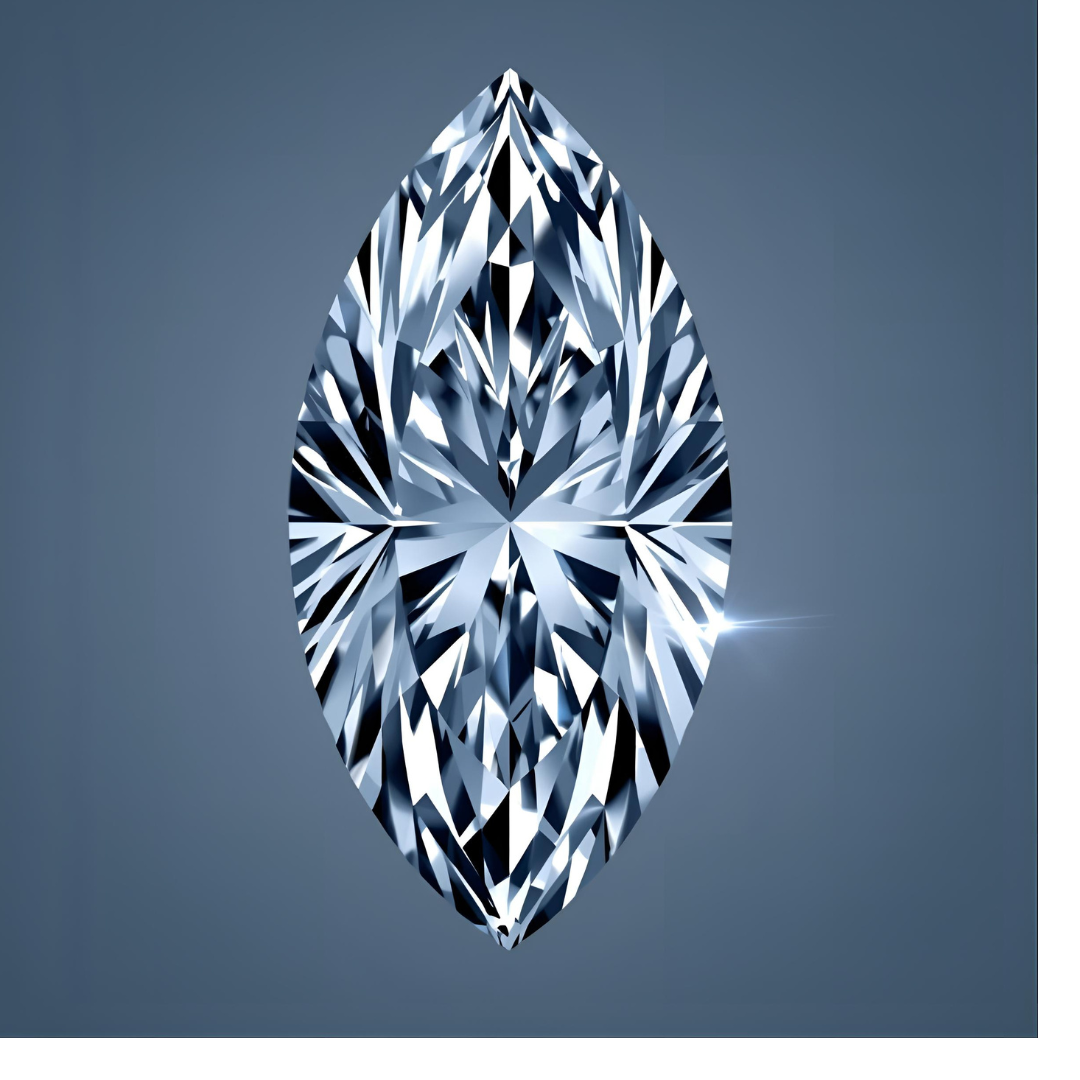
What Is Marquise Cut?
“In the 18th century, King Louis XV of France wanted a diamond that would perfectly capture the smile of his mistress, Jean Antoinette Poisson, the Marquise de Pompadour. His court jewelers created an elongated, boat-shaped cut with two pointed ends—graceful, dramatic, and unforgettable. They named it the ‘marquise.‘ For centuries, it has been the diamond of lovers who dare to be different. When Elizabeth Taylor wore a marquise diamond ring, she wasn‘t following fashion. She was wearing a king‘s obsession—and making it her own.”
The same smile that inspired a king now awaits your own love story — elongated, dramatic, and unforgettable. Every marquise cut diamond in our collection is hand-selected for minimal bow-tie and perfect symmetry.”
[Button: Explore Marquise Cut Diamonds →]
Here is a comprehensive explanation of the marquise cut.
What Is Marquise Cut?
What Does Marquise Cut Symbolize?
Is Marquise Cut More Expensive?
Is Marquise Cut Outdated?
Does The Marquise Cut Look Bigger?
What Is The Ideal Marquise Size?
How Big Is A 1 Carat Marquise Cut?
Do Marquise Cut Diamonds Look Bigger?
Is Marquise Cut Good For An Engagement Ring?
What Is The Price Difference Between A Marquise Cut and An Oval Cut Diamond?
Do Marquise Cut Diamonds Sparkle?
Here is the Marquise Cut Meaning.
The most defining feature of the marquise cut is its ability to create an illusion of greater size. Due to its elongated shape and the way it distributes weight, a marquise-cut diamond will have a larger surface area (or "face-up" size) than a round brilliant of the same carat weight, making the stone appear significantly larger.
Key Characteristics of the Marquise Cut
Shape: Elongated and elliptical with two pointed ends (called "points").
Faceting: It typically has 56-58 facets, similar to a round brilliant, which allows it to sparkle brilliantly when cut well.
The Bow-Tie Effect: Almost all marquise cuts will display a dark, bow-tie-shaped pattern across the center. This is caused by light leakage and is a normal characteristic of the cut. A high-quality cut will minimize a very dark or prominent bow-tie.
Points: The two sharp points are both beautiful and vulnerable. They require a protective setting (like a V-prong) to prevent chipping.
History and Origin
The marquise cut has a rich and royal history. It is said to have been commissioned in the 18th century by King Louis XV of France.
The Inspiration: The king wanted a diamond cut that would perfectly resemble the smile of his mistress, Jean Antoinette Poisson, the Marquise de Pompadour.
The Name: The cut was named "marquise" in her honor.
The Allusion: The elongated shape was also designed to make the wearer's fingers appear longer and slimmer, a flattering effect that remains one of its key appeals today.
Why Choose a Marquise Cut?
Pros:
Maximizes Carat Weight: It looks larger than other shapes of the same weight.
Flattering and Unique: Its elongated shape makes fingers look longer and slimmer.
Brilliant Sparkle: When well-cut, it can be exceptionally fiery.
Versatile Setting Options: It looks stunning as a solitaire and pairs beautifully with side stones (like in a three-stone ring) or as the centerpiece in a vintage-inspired design.
Regal and Romantic: Its history adds a touch of royal romance.
Cons:
Vulnerable Points: The pointed ends are prone to chipping and need a protective setting.
The Bow-Tie Effect: A poorly cut marquise can have a very dark, distracting bow-tie.
Demanding Cut Quality: The cut must be symmetrical; if it's off, the stone can look unbalanced or have a "wobble" when it spins.
Can Highlight Color: In diamonds, the elongated shape can make a yellow or brown tint more noticeable in stones of lower color grades.
What to Look For in a Quality Marquise Cut
When selecting a marquise-cut diamond, pay close attention to:
Symmetry: This is crucial. Both halves of the stone should be perfect mirror images. The points should align perfectly in a straight line.
Length-to-Width Ratio: This determines how "stout" or "slender" the stone looks.
A classic ratio is around 1.85:1 to 2.00:1.
A more modern look is around 1.75:1.
A more elongated, dramatic look is over 2.10:1. This is a matter of personal preference.
Cut Quality: A well-cut marquise will have strong brilliance and fire, with a minimal, faint bow-tie.
Clarity: Due to its large table (top surface), inclusions can be more visible. Look for a stone that is "eye-clean."
Setting: Ensure the points are secured with V-prongs for maximum protection.
The marquise cut is a timeless, elegant, and dramatic choice for an engagement ring or other fine jewelry. It combines a fascinating royal history with a flattering, modern silhouette and an unbeatable ability to maximize the perceived size of the stone. With careful attention to its cut quality and setting, a marquise diamond is a truly stunning and unique statement piece.
What Does Marquise Cut Symbolize?
The marquise cut is rich with symbolism, blending its unique history with the powerful metaphors its shape evokes.
Beyond its beautiful, boat-like appearance, the marquise cut symbolizes:
1. Royalty, Elegance, and Individuality
The most famous story of its origin—commissioned by King Louis XV to mimic the smile of his mistress, the Marquise de Pompadour—instantly imbues it with a sense of royalty, romance, and refined taste. Choosing a marquise cut can symbolize a love that is celebrated, distinctive, and even a little regal. It's for someone who doesn't follow trends but sets them, much like the Marquise de Pompadour herself.
2. Elegance and a Flattering Illusion
The cut was designed to make the wearer's finger appear longer and more slender. This intentional, flattering effect translates symbolically into grace, elegance, and sophistication. It represents a love that is not only beautiful but also enhancing—a relationship that makes you feel like the best version of yourself.
3. The Union of Two Souls
With its two pointed ends coming together to form a single, continuous shape, the marquise diamond is often seen as a symbol of partnership and the coming together of two people. Each point can represent a partner, and the stone itself is the unified life they build together. This makes it a profoundly meaningful choice for an engagement ring.
4. A Vessel of Love and Adventure
The shape is frequently compared to a boat, a navette (the French word for "little ship"), or even a smiling mouth.
As a Boat: It can symbolize a journey, representing the couple's voyage through life together, navigating its waters as a team.
As a Smile: Directly linking back to its history, it symbolizes joy, happiness, and laughter. It's a constant reminder of the happiness your partner brings you.
5. Victory and Achievement
The elongated, pointed shape is reminiscent of a laurel wreath or a victor's crown from classical times. In this sense, it can symbolize triumph, accomplishment, and a victorious love. It can represent overcoming obstacles to be together or celebrating the success of a lasting partnership.
Summary of Symbolic Meanings:
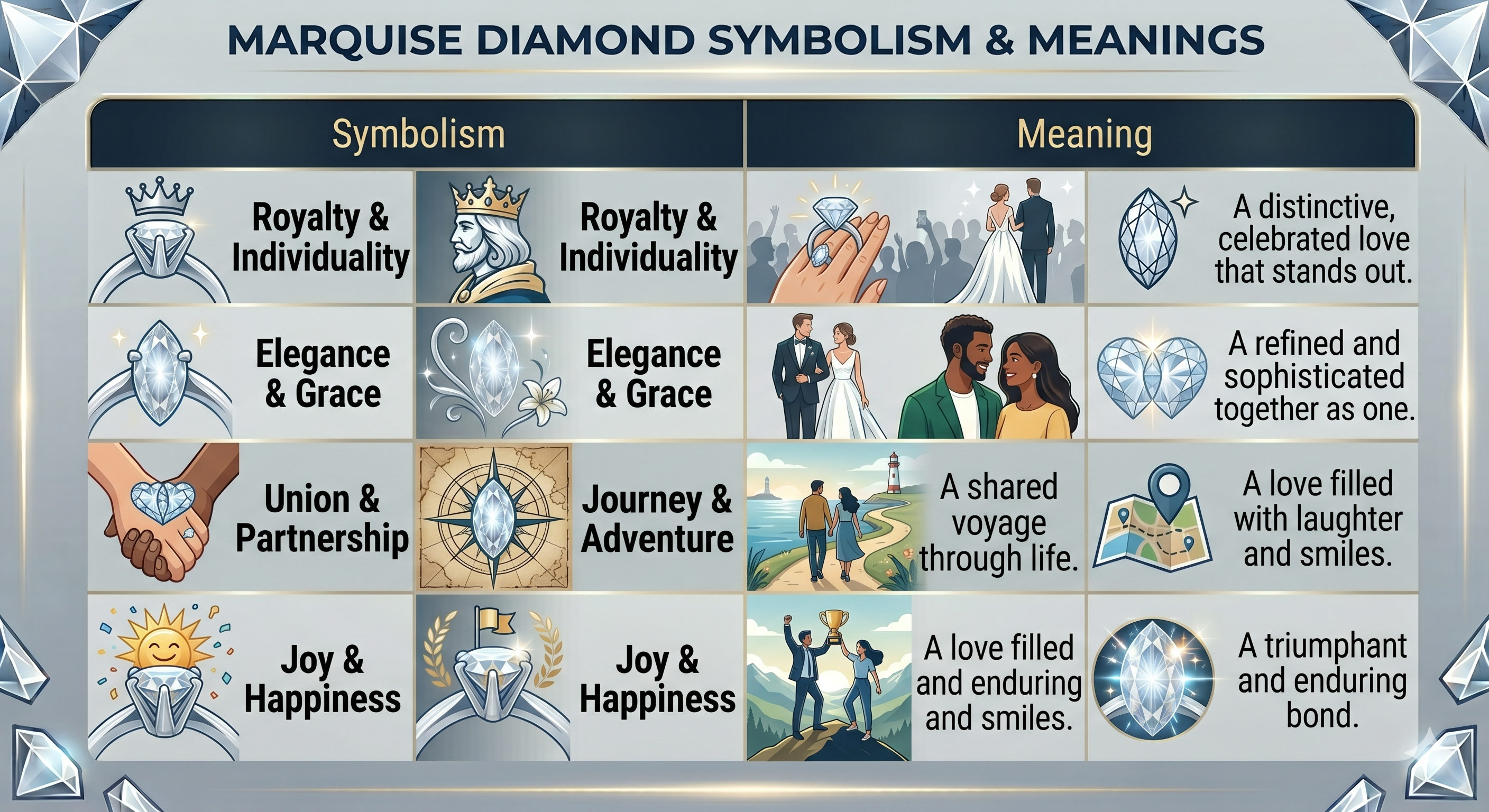
In essence, the marquise cut is far more than just a shape. It is a narrative gemstone, telling a story of royal romance, personal elegance, and the beautiful, ongoing journey of two people united in love. Its unique and bold character makes it a perfect symbol for a strong, individual, and passionate relationship.
Is Marquise Cut More Expensive?
That's an excellent and practical question. The answer is a bit nuanced, but generally:
No, a marquise cut is typically less expensive than a round brilliant cut of the same carat weight, quality, and grade.
However, the price is influenced by several key factors related to its unique shape. Here’s a detailed breakdown.
The Price Comparison: Marquise vs. Round Brilliant
The main reason for the price difference comes down to yield and demand.
Higher Yield (Lower Cost): The marquise shape is more efficient to cut from a rough diamond crystal (often an octahedron). The cutter can preserve more of the original rough stone's weight, resulting in less waste. Because less raw material is "lost" during the cutting process, the cost to produce it is lower, and this saving is passed on to the consumer.
Lower Demand (Lower Cost): The round brilliant cut is the most popular and classic choice, commanding an estimated 60-75% of the diamond market. This immense demand allows retailers to charge a premium for rounds. The marquise, while stunning, is a "fancy shape" with lower demand, which also contributes to its lower price per carat.
In short, you can often get a larger marquise diamond for the same budget as a smaller round one.
What Influences the Price of a Marquise Cut?
While generally more affordable than rounds, the price of a marquise diamond can vary significantly based on these critical factors:
1. Cut Quality and Symmetry (The Most Important Factor)
This is where costs can rise. A well-cut marquise is challenging to produce.
Excellent Symmetry: Both halves must be perfect mirror images. Any deviation wobbly shape, misaligned points) significantly reduces the value.
Minimal Bow-Tie Effect: A dark, bow-tie-shaped shadow across the center is common, but a severe one indicates a poor cut and makes the stone much less valuable. A high-quality marquise will have a faint, acceptable bow-tie or none at all.
A marquise with an "Excellent" or "Ideal" cut grade from a reputable lab (like GIA) will command a higher price than one with a "Good" or "Fair" grade.
2. Length-to-Width Ratio
This is a matter of preference, but extreme ratios can affect price.
Classic Ratios (1.75:1 to 2.15:1) are most common and readily available.
Very Elongated or Very Stout Ratios are less common. Finding a well-proportioned and symmetrical stone at these extremes can be more difficult and may carry a slight premium due to rarity.
3. Protection of the Points
The two sharp points are vulnerable to chipping.
A V-prong setting is highly recommended to protect them. This doesn't make the diamond more expensive, but it adds to the overall cost of the ring's setting and craftsmanship.
4. The "Face-Up" Size Advantage
This is a major value proposition. Because of its elongated shape, a marquise diamond has a larger surface area than a round or princess cut of the same carat weight. You are paying for a lower price per carat but getting a stone that looks even larger. This is often called "carat weight efficiency."
Price Comparison Table (General Estimate)
.png)
Is Marquisee cut more expensive? No, it is generally a more budget-friendly option compared to a round brilliant.
Should you choose one for its value? Absolutely, if you love the shape. A marquise cut offers exceptional visual size and unique elegance for your money. Just remember that your budget should prioritize an excellent cut and symmetry above all else, as this is what makes a marquise diamond truly sparkle and hold its value.
Is Marquise Cut Outdated?
That's a very common question, and the answer is a resounding no; the marquise cut is not outdated.
While its popularity has ebbed and flowed over the decades, it is currently experiencing a significant resurgence and is considered a stylish, vintage-inspired, and unique choice.
Here’s a breakdown of why the marquise cut is firmly back in style:
1. The Vintage and Retro Revival
Fashion and jewelry trends are cyclical. There's a massive appreciation for all things vintage, art deco, and retro. The marquise cut, with its 18th-century origins and strong presence in the Victorian and Art Deco eras, fits perfectly into this trend. It offers a touch of "old-world" glamour and history that many modern brides and jewelry lovers are seeking.
2. A Desire for Uniqueness
In a sea of round and oval brilliants, many people are looking for a shape that stands out. The marquise is distinctive and memorable. Choosing a marquise diamond is a way to express personal style and break away from the conventional.
3. Celebrity and Designer Influence
The marquise cut has been seen on red carpets and in collections from high-end designers, giving it a fresh, modern cachet. When celebrities choose marquise engagement rings or jewelry, it immediately pushes the style back into the contemporary spotlight.
4. Modern Settings Re-invent the Look
The perception of a cut being "dated" often comes from the setting, not the cut itself. The marquise cut is being given new life in modern settings that dispel any notions of it being old-fashioned:
As a Solitaire: A simple, sleek solitaire setting lets the unique shape shine, making it look modern and architectural.
East-West Setting: Placing the marquise horizontally is a hugely contemporary and fashion-forward trend.
With Minimalist Bands: Pairing it with a thin, plain band or a delicate pavé band creates a fresh contrast.
In Alternative Stones: Marquise cuts are stunning in sapphires, moissanite, and other gemstones, appealing to a modern audience.
Why Do Some People Think It's Outdated?
The perception of the marquise being outdated usually stems from its peak popularity in specific eras:
The 1980s: The marquise was hugely popular during this time, often set in yellow gold with bulky, elaborate settings that are now associated with that decade's style. It's this specific setting style that can feel dated, not the cut itself.
The "Grandma's Ring" Effect: Because it was popular in past decades, some people might associate it with their grandmother's or mother's jewelry. However, this "heirloom" quality is now seen as a positive, connecting the wearer to a legacy of love.
The Verdict: Timeless, Not Dated
Think of the marquise cut not as "outdated," but as "timeless."
A classic cut with a rich history that has endured for centuries.
A versatile cut that can be styled to look either vintage or ultra-modern, depending on the setting.
A unique cut for those who want to make a personal statement.
“In the 1980s, the marquise cut was everywhere—set in yellow gold, surrounded by chunky settings, worn by power brokers and princesses. Then, the 1990s arrived, and the marquise faded. But in 2018, a marquise engagement ring appeared on the red carpet—worn by a young actress who paired it with a thin, minimalist band. The internet went wild. Searches for ‘marquise ring‘ spiked. The marquise had not changed. The setting had. That is the secret of the marquise: it is not dated. It is waiting for the right setting to make it modern again.”
The marquise cut is far from outdated. It's a sophisticated and elegant choice that has successfully transitioned from a symbol of royal romance to a hallmark of individual style for the modern era. If you are drawn to its elongated shape and fascinating history, you can confidently choose a marquise cut knowing it is a timeless and currently fashionable option.
Does The Marquise Cut Look Bigger?
Yes, absolutely. The marquise cut is renowned for creating the illusion of being significantly larger than many other diamond shapes of the same carat weight.
This is one of its biggest advantages and a primary reason many people choose it. Here’s a detailed explanation of why it looks bigger and how it compares.
Why the Marquise Cut Looks Bigger
Elongated Shape & Largest Face-Up Area: The marquise cut is designed to be long and narrow. This shape covers more surface area on your finger than other shapes. When you compare a 1-carat marquise diamond to a 1-carat round brilliant diamond, the marquise will have a much longer length and a larger overall "face-up" appearance.
The "Corners" Effect: Like other elongated shapes (such as the oval and pear), the marquise's ends (or "points") extend the visible length of the diamond. Your eye follows the entire length from tip to tip, making the stone appear much larger than a round or square-shaped diamond that concentrates its mass in a more compact area.
Carat Weight Efficiency: Cutters can be very efficient when shaping a rough diamond crystal into a marquise, preserving more of the original weight. This means you often get a stone that looks like it's more carats than it actually is.
Visual Comparison
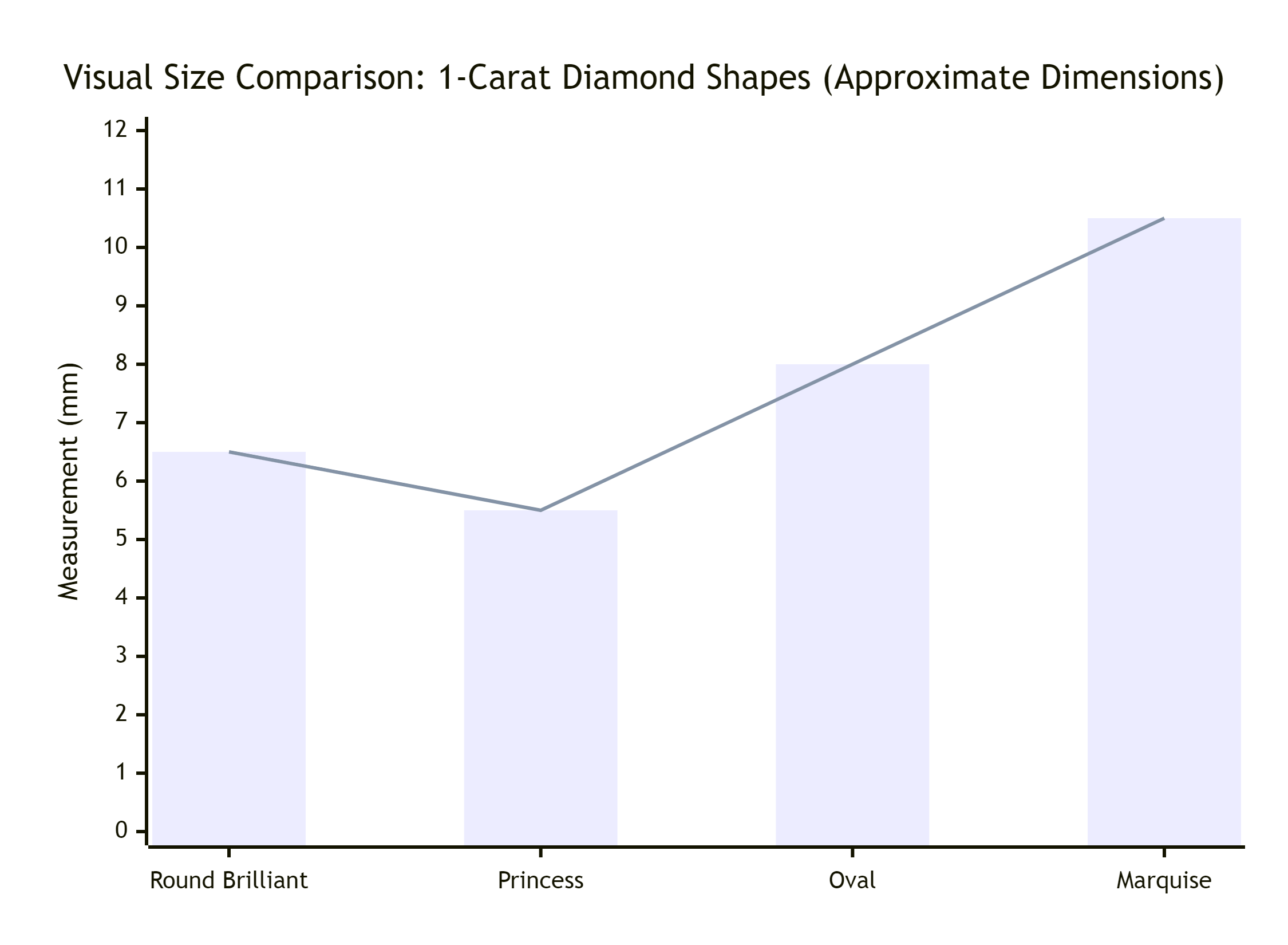
To give you a practical idea, here is a visual comparison of different diamond shapes, all in a 1-carat size, showing their relative face-up dimensions. As you can see, the marquise is one of the longest shapes.
Note: The dimensions are approximate and can vary based on the specific cut proportions. The marquise and oval have the highest length-to-width ratios, making them appear the largest.
What to Keep in Mind
While the marquise looks larger, there are a couple of factors to consider:
The Bow-Tie Effect: This dark area across the center of the stone is common in elongated shapes. A well-cut marquise will have a minimal, faint bow-tie, but a prominent one can make the stone look smaller or broken. Always view the diamond in person or via high-quality video.
The Trade-Off is Width: While the marquise is very long, it is also typically quite narrow. Some people prefer the "spread" of a round or cushion cut, which may feel wider even if it covers less total area.
Setting Matters: A bezel setting will make the stone appear slightly smaller, while a setting with long, tapered baguette side stones can further enhance its elongated look, making it appear even longer.
If your primary goal is to get the largest-looking diamond for your budget, the marquise cut is an outstanding choice. It consistently offers more visual size per carat than a round brilliant, princess, or cushion cut, making it a brilliant and elegant way to maximize your ring's presence.
What Is The Ideal Marquise Size?
The concept of an "ideal" marquise size is a bit more complex than for a round diamond because it involves two key aspects: 1. Carat Weight, and 2. Proportions (Length-to-Width Ratio).
There is no single "ideal" size that works for everyone, as it depends heavily on personal preference, ring finger size, and budget. However, we can break down the ideal ranges for a balanced and beautiful appearance.
1. The "Ideal" Carat Weight
This is largely subjective and budget-dependent, but here’s a general guide based on popular preferences for engagement rings:
Classic & Budget-Friendly: 0.75 - 1.00 Carats
This is a very popular range. It offers significant visual size and presence without a premium price tag. A 1-carat marquise will look much larger than a 1-carat round brilliant.
Sweet Spot & Modern Standard: 1.50 - 2.00 Carats
This is often considered the "sweet spot" where the marquise shape truly shines. It has a dramatic, elegant presence on the finger and is a common choice for a standout center stone.
Statement & High-End: 2.50+ Carats
At this size, the marquise becomes a true showstopper. Its elongated shape makes it look exceptionally large and luxurious.
Key Consideration: The most "ideal" carat weight is proportionate to the wearer's hand. A size 4 finger will make a 1.5-carat marquise look massive, while the same stone might look more moderate on a size 8 finger.
2. The "Ideal" Proportions (Length-to-Width Ratio)
This is the most critical factor for the shape's appearance. The ratio determines how elongated or stout the stone looks.
Length-to-Width Ratio = Length ÷ Width
The "ideal" is a matter of taste, but here’s a guide to the most common and sought-after ratios:
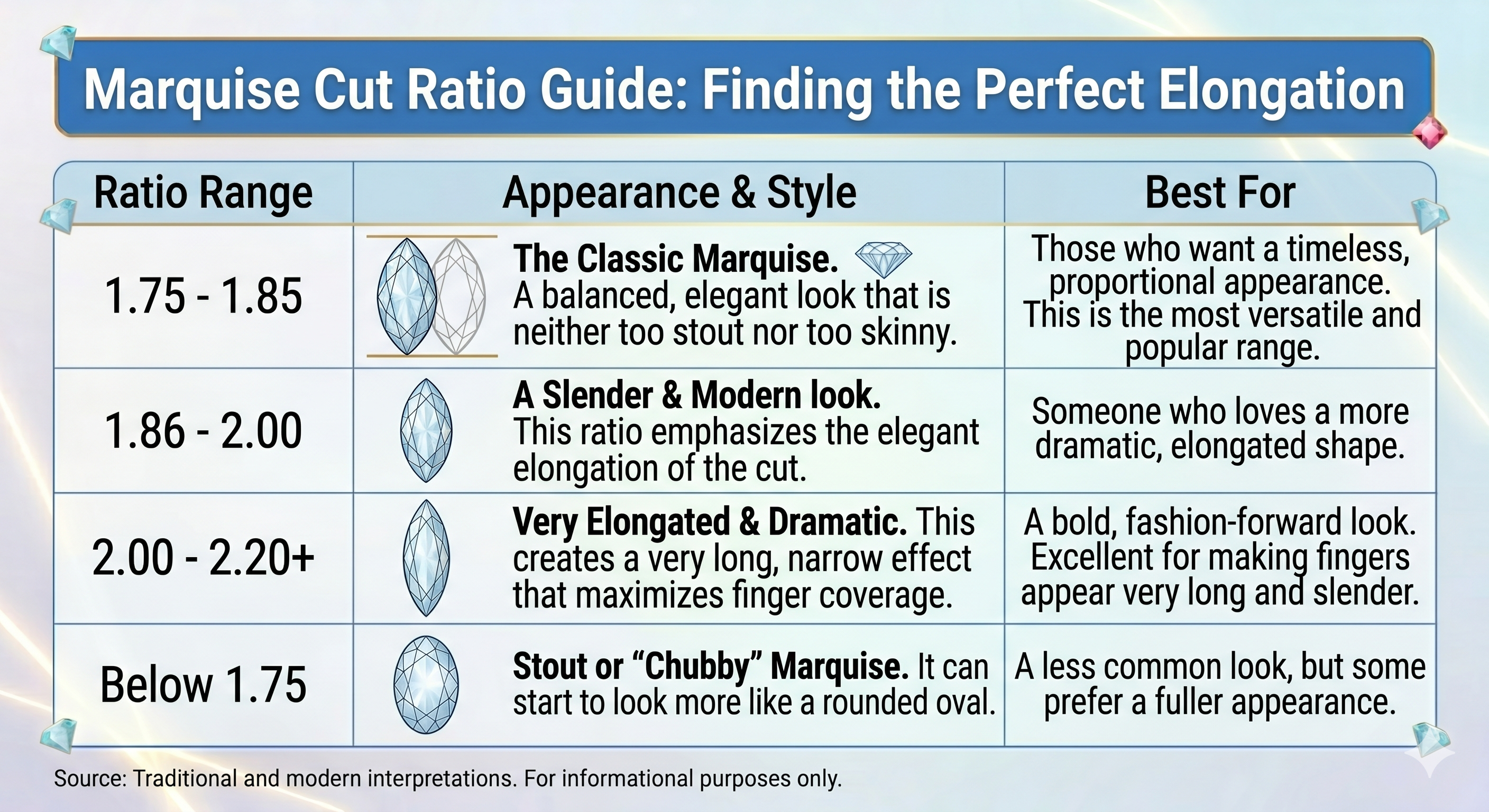
The True "Ideal": Most jewelers and diamond experts consider a ratio between 1.75 and 2.00 to be the most universally flattering and classic for a marquise cut.
Putting It All Together: A Practical Guide
To find your ideal size, follow these steps:
Set Your Budget: This will narrow down your carat weight options immediately.
Determine Your Preferred Ratio: Look at pictures online or try on different marquise shapes in a jewelry store. Do you love the classic look (1.8) or the ultra-elongated look (2.1)? This is the most important stylistic choice.
Consider Your Finger Size:
Small Hands (Size 4-5): A 1.0 - 1.5 carat stone will have a powerful presence. You can carry a more elongated ratio (e.g., 2.0) without it looking overwhelming.
Average Hands (Size 6-7): The 1.5 - 2.0 carat range is perfect. A classic ratio of 1.8 is an excellent choice.
Larger Hands (Size 8+): To ensure the ring has enough presence, consider 2.0 carats and above. A very low ratio (a "chubby" marquise) might look too small.
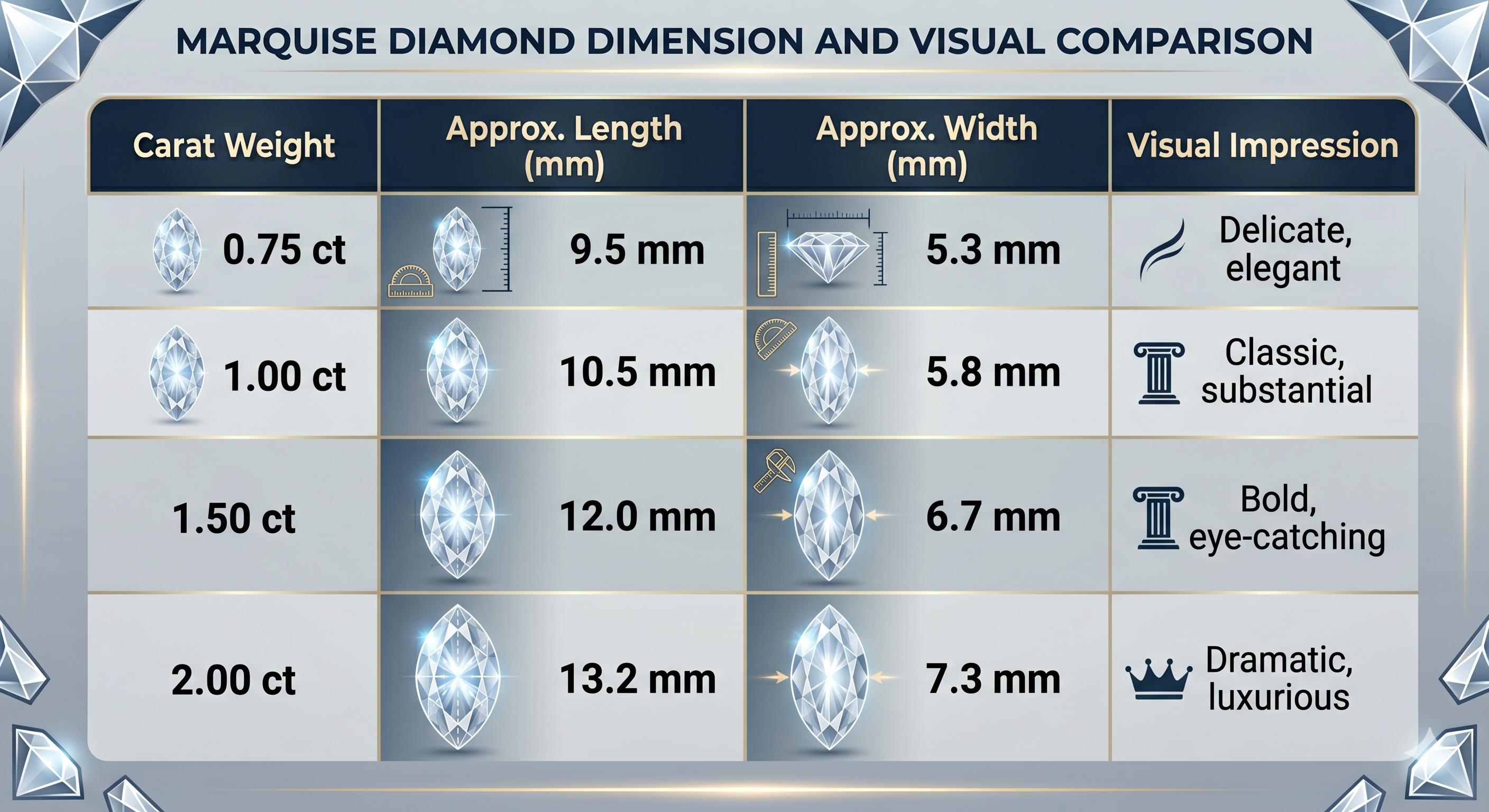
Visual Size Reference Chart
The table below provides approximate length and width dimensions for different carat weights, assuming a classic ratio of around 1.8. This shows you just how much finger coverage you get.
Final Recommendation
There is no single "ideal" size, but if you're looking for a safe, classic, and universally flattering starting point, aim for:
A carat weight between 1.50 and 2.00 carats.
A length-to-width ratio between 1.80 and 1.95.
The best way to find your perfect size is to try them on! A picture can only tell you so much. Seeing how different carat weights and ratios look on your own finger is the ultimate way to decide.
How Big Is A 1 Carat Marquise Cut?
This is a great question because the "size" of a 1-carat marquise cut can be a bit surprising due to its elongated shape.
A 1-carat marquise cut doesn't have one fixed measurement, as it depends on its specific proportions (length-to-width ratio). However, we can give you a very clear range of what to expect.
Typical Dimensions of a 1-Carat Marquise
For a well-proportioned 1-carat marquise diamond, you can expect the following approximate dimensions:
Length: 10.0 mm to 11.0 mm
Width: 5.0 mm to 6.0 mm
A very common and classic measurement for a 1-carat marquise is around 10.5mm long by 5.8mm wide.
Visualizing the Size
To help you truly grasp how big this is, here are some helpful comparisons:
On the Finger: A 1-carat marquise will have a very significant presence on the finger. Its length will cover a good portion of the width of an average-sized finger, making it look larger than most other 1-carat shapes.
Compared to a 1-Carat Round: A 1-carat round brilliant diamond is typically about 6.5mm in diameter. As you can see in the chart below, the marquise is substantially longer, giving it a much larger visual footprint.
Everyday Objects:
It's slightly longer than a standard Tic Tac.
It's about the same width as a standard pencil eraser.
It's roughly the length of a small ladybug.
What Affects the Perceived Size?
Length-to-Width Ratio: This is the key factor.
A low ratio (e.g., 1.75) will result in a "chubbier," stouter marquise (e.g., 10.0mm x 5.7mm).
A high ratio (e.g., 2.10) will result in a very long, slender, and dramatic marquise (e.g., 11.0mm x 5.2mm).
The Setting: The ring setting can enhance or reduce the perceived size.
A solitaire setting will show off the full length and make it look larger.
An east-west setting (placed horizontally) creates a very modern, unique look.
A halo setting (a circle of small stones around it) will make the entire centerpiece look much larger.
A 1-carat marquise cut is a fantastic choice if you want a diamond that looks impressively large for its weight. Its elongated shape provides exceptional finger coverage and an elegant, dramatic presence.
Do Marquise Cut Diamonds Look Bigger?
Yes, marquise-cut diamonds consistently look larger than many other diamond shapes of the same carat weight, especially when compared to the most popular shape, the round brilliant.
This is one of the marquise cut's most famous and desirable characteristics. Here’s a detailed breakdown of why it creates such a powerful illusion of size.
The Key Reason: The "Face-Up" Spread
The perceived size of a diamond is determined by its "face-up" appearance—how much surface area it covers on your finger—not just its carat weight (which is a measure of mass).
The marquise cut's elongated, tapered shape is designed to maximize this surface area. It spreads its carat weight outwards along its length, creating a much larger visual footprint.
How Much Bigger Does It Look?
It's common to hear that a marquise cut can look 20-30% larger than a round brilliant of the same carat weight. In some cases, the difference can feel even more pronounced.
A 1-carat marquise will often have the visual presence of a 1.2 to 1.3-carat round brilliant.
This makes it an exceptional value for your money if your primary goal is to maximize perceived size.
Why the "Bigger" Illusion Works So Well
Elongation: The long, narrow shape draws the eye from tip to tip, making the diamond occupy more visual space on your finger. This also has the flattering effect of making the finger itself appear longer and slimmer.
Corners and Points: Unlike a round diamond, which holds its mass in a concentrated circle, the marquise's points extend its outline far outwards, capturing more light and space.
Efficient Cut: The shape allows diamond cutters to be very efficient with the original rough crystal, preserving more of the carat weight in the final gem's length and width rather than its depth.
The Important Caveat: The Bow-Tie Effect
While a marquise looks bigger, its appearance can be affected by a common characteristic called the bow-tie effect. This is a dark, bow-tie-shaped shadow that can appear across the center of the diamond if it is poorly cut.
A faint or minimal bow-tie is normal and doesn't detract from the size.
A very dark and prominent bow-tie, however, can make the diamond look broken or smaller, as it creates a dead spot in the center.
The key is to choose a well-cut marquise where the bow-tie is minimal, allowing the diamond's full size and brilliance to shine.
If you are looking for a diamond that offers the maximum visual size for your budget, the marquise cut is arguably one of the best choices you can make. It provides incredible finger coverage and a dramatic, elegant look that truly stands out.
In short: Yes, it looks bigger, and that's a well-known and celebrated feature of the cut.
Is Marquise Cut Good For An Engagement Ring?
Absolutely, yes. A marquise cut can be a spectacular and unique choice for an engagement ring, but it's a choice that comes with distinct advantages and important considerations.
It's not for everyone, but for the right person, it's a perfect blend of vintage romance, modern drama, and brilliant sparkle.
Here’s a balanced look at why it's a great choice and what you need to keep in mind.
Pros: Why a Marquise is a Brilliant Engagement Ring Choice
Maximizes Size & Brilliance: This is its biggest selling point. The elongated shape makes the diamond look much larger than a round brilliant of the same carat weight. It also has a high number of facets, meaning it can sparkle just as fiercely as a round diamond when cut well.
Flattering and Feminine: The elongated shape is renowned for making the finger appear longer and more slender. This flattering effect is a major reason for its enduring popularity.
Unique and Distinctive: In a world of ovals and rounds, a marquise stands out. It signals individuality, style, and a taste for something with history and character.
Rich with Romance and History: Born from a king's desire to capture his mistress's smile, the marquise cut is inherently romantic. It carries a story of passion and royalty.
Versatile Style Options: It can be set in a variety of ways to create different looks:
Classic Solitaire: Let the unique shape take center stage.
East-West Setting: A modern, fashion-forward orientation.
With a Halo: Enhances its size and adds a vintage vibe.
With Side Stones: Tapered baguettes or round brilliants complement its length beautifully.
Cons & Important Considerations
Vulnerable Points: The two sharp points are the most vulnerable parts of the stone and are prone to chipping if struck hard. This is the most critical practical consideration.
Solution: Always opt for a V-tip or V-prong setting at each point. This is a non-negotiable for protecting the stone in an everyday-wear piece like an engagement ring.
The Bow-Tie Effect: Almost all marquise diamonds will have a dark, bow-tie-shaped area across their center. A faint one is normal, but a prominent, dark bow-tie is a sign of a poor cut and can be distracting.
Solution: Inspect the diamond carefully (in person or via high-quality video) to ensure the bow-tie is minimal and doesn't detract from the stone's beauty.
Demands Excellent Symmetry: A poorly cut marquise will look off-balance or even "wobbly" when it spins. The two halves must be perfect mirror images.
Can Be Perceived as "Pointy": Some wearers find the points uncomfortable or worry they might catch on clothing. A bezel setting can alleviate this concern by smoothing out the profile.
Who is the Marquise Cut PERFECT For?
A marquise engagement ring is an ideal choice for someone who:
Wants the largest-looking stone for their budget.
Has a unique, bold, or vintage-inspired personal style.
Appreciates the history and romance behind their jewelry.
Wants a ring that flatters their hand by making fingers look longer.
Is willing to prioritize a protective setting and careful craftsmanship.
Is a marquise cut good for an engagement ring? Yes, it is an excellent choice for the right person.
It offers a powerful combination of visual size, historical romance, and dazzling brilliance that is hard to match. However, its success hinges on two critical factors:
Choosing a high-quality stone with excellent symmetry and a minimal bow-tie.
Protecting it with a properly designed setting, specifically with V-prongs.
If you are drawn to its elegant, elongated shape and are willing to accommodate its needs, a marquise cut engagement ring will be a stunning, unique, and deeply meaningful symbol of your love.
What Is The Price Difference Between A Marquise Cut and An Oval Cut Diamond?
The price difference between marquise and oval diamonds is primarily due to market demand. Marquise diamonds, being less common, are generally more affordable, while the highly popular oval cut usually commands a higher price.
Here is a comparison of current market prices for natural, near-colorless diamonds in these two shapes:
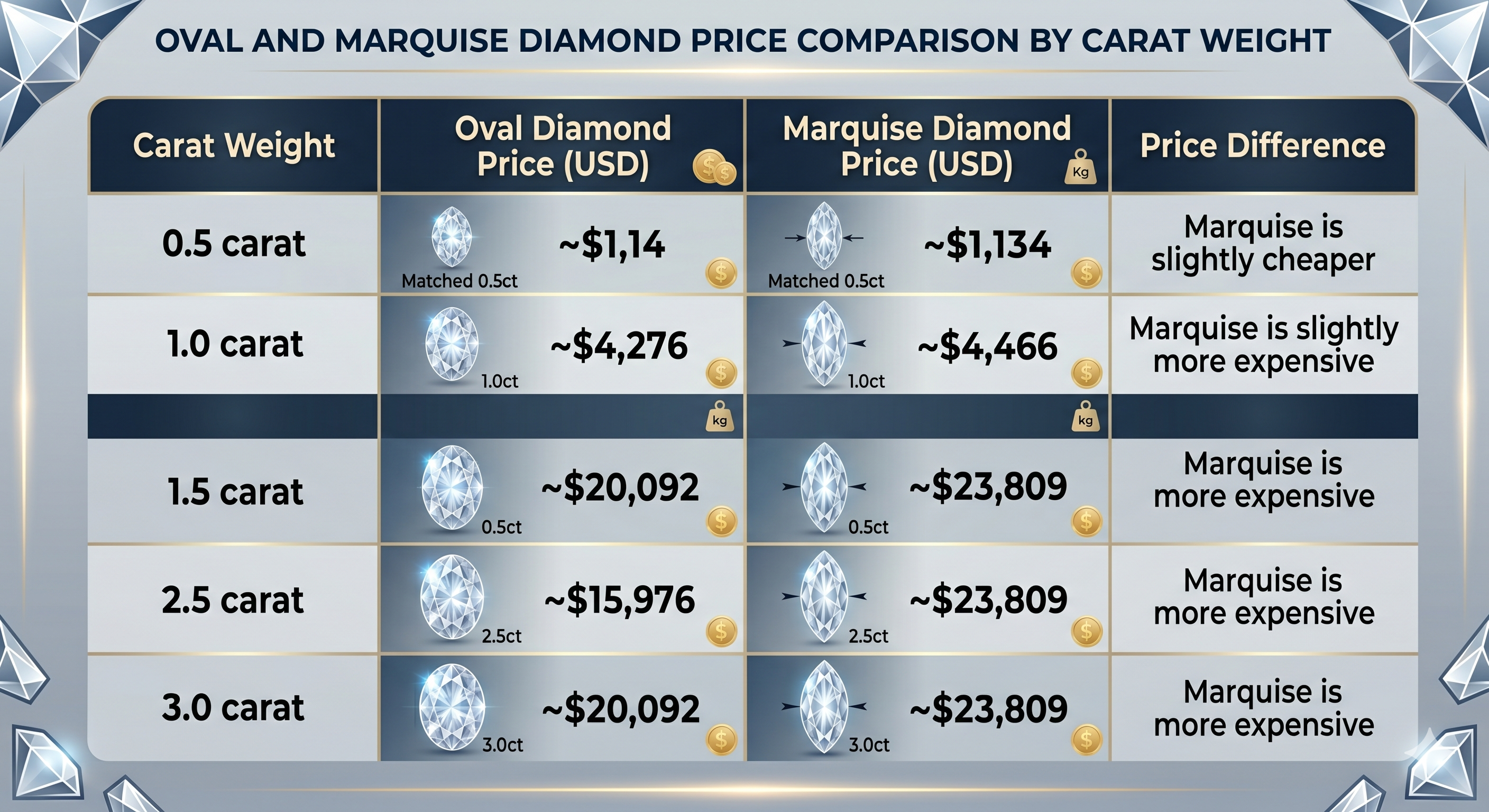
Why Diamond Shape Affects Price
The price difference isn't about quality, but rather these key market factors:
Demand and Popularity: The oval cut has become one of the most popular diamond shapes in recent years. High demand allows sellers to price oval diamonds higher. Marquise cuts are less common, which generally makes them more affordable.
Cutting Costs and Yield: Round diamonds are the most expensive to produce due to high material waste. For fancy shapes like ovals and marquise, the impact is smaller, but differences in cutting complexity and how efficiently a cutter can shape the rough stone still influence final cost.
Perceived Value and Trends: Oval diamonds are prized for their elongated shape, which makes fingers appear longer, and the diamond looks larger per carat. This desirable optical effect supports their premium. Marquise cuts also create an elongated look and have a larger surface area for their carat weight, offering a distinct, bold style often at a better value.
Key Buying Considerations
When comparing prices, keep these points in mind:
Quality is Individual: The prices above are averages. For any shape, the final price depends heavily on the specific diamond's Cut quality, Color, and Clarity grades. A marquise diamond with top grades can easily cost more than an oval with average grades.
Compare Like-for-Like: Always compare diamonds of the same carat weight and similar quality grades (Cut, Color, Clarity) to see the true shape-based price difference.
Check Live Market Data: Diamond prices can fluctuate. For the most current prices, you can use diamond price trackers like the ones cited here or filters on major online jewelers' websites to see real-time listings.
I hope this detailed comparison helps you in your search. Are you looking at a specific carat size, or would you like to understand more about how other quality factors like color or clarity affect the price for these shapes?
Do Marquise Cut Diamonds Sparkle?
Yes,marquise-cut diamonds can have a brilliant and distinctive sparkle. Their sparkle depends heavily on the quality of the cut, which is the most important factor, but their character is different from that of a round brilliant diamond.
Here’s a breakdown of how a marquise diamond's sparkle works, its unique features, and what to look for:
How Marquise Diamonds Achieve Sparkle
Like all diamonds, sparkle comes from light performance—how well the diamond's facets reflect and refract light.
Facet Pattern: A well-cut marquise uses a brilliant-style facet pattern (like a round diamond) adapted to its elongated shape. This creates a mix of bright flashes (brilliance), colorful fire (dispersion), and contrasting dark and light areas (scintillation).
The Elongation Effect: The long, narrow shape creates a larger surface area for its carat weight. This can make the diamond appear larger and spread light and sparkle over a greater length.
The "Bow-Tie" Effect: A Key Consideration
This is the most important visual characteristic to check. Due to their elongated shape, nearly all marquise diamonds have a dark pattern across the center that resembles a bow-tie.
What it is: A shadow or area of reduced light return caused by the pavilion (bottom) facets. A faint or moderate bow-tie is normal.
What to Avoid: A very thick, dark, and obvious bow-tie can block light and make the center of the diamond look dead, significantly reducing its sparkle. It's the #1 sign of a poor cut.
How to Ensure Maximum Sparkle
Because sparkle is so dependent on cut quality, here is how to evaluate it:
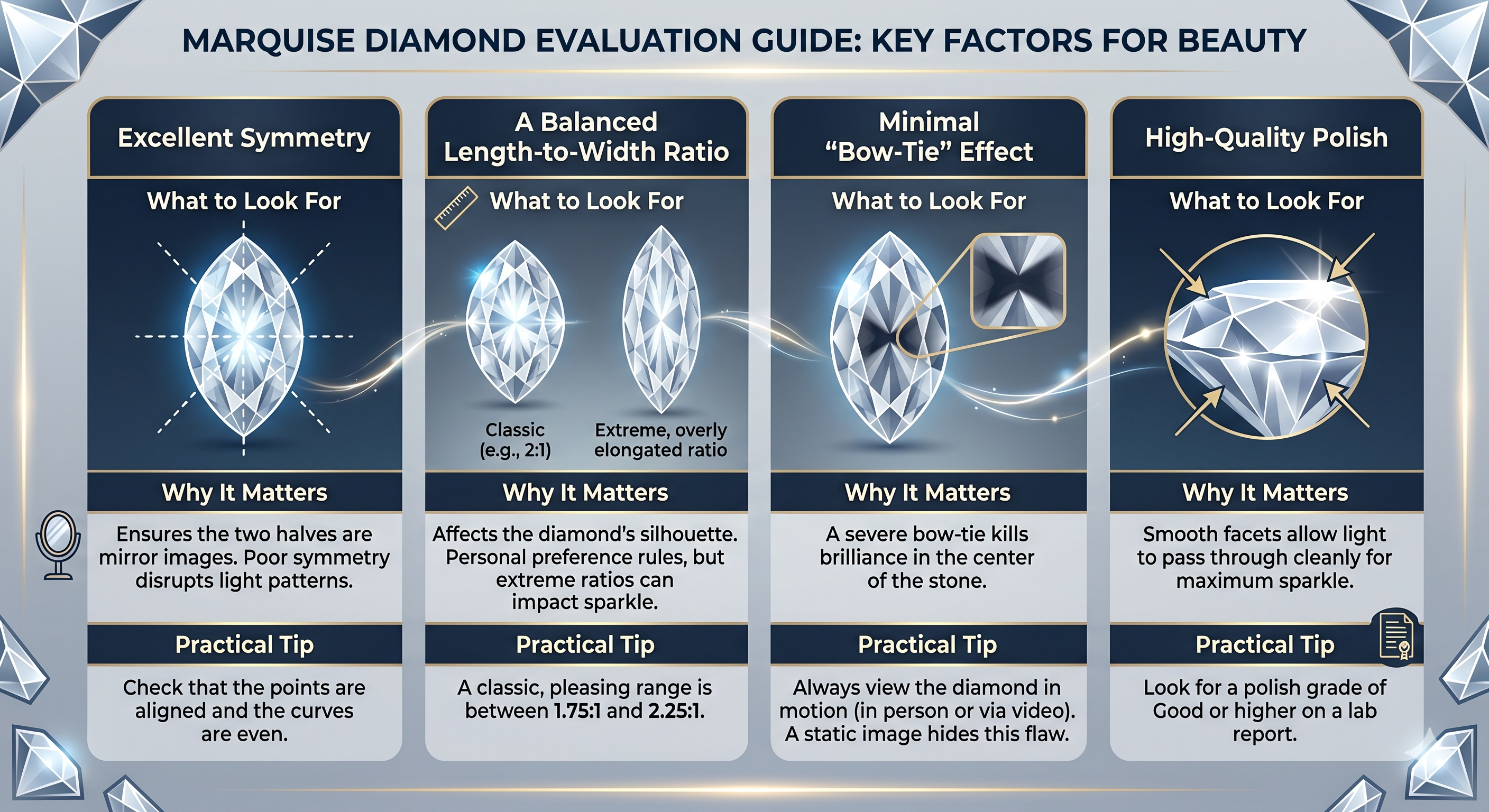
Marquise Sparkle vs. Other Cuts
Versus Round Brilliant: A round cut is engineered for maximum, balanced sparkle. A marquise offers a more dynamic and elongated flash of light. It's different, not lesser.
Versus Oval Cut: Both are elongated brilliant cuts. Ovals tend to hide the bow-tie effect better, while the marquise's pointed ends create a more dramatic, bold sparkle pattern.
Key Takeaway: A well-cut marquise diamond is exceptionally sparkly with a unique, eye-catching character. The cut quality is paramount—always prioritize it over minor differences in color or clarity. Since the "bow-tie" is critical, try to view the diamond on video from a reputable online retailer or, ideally, see it in person before purchasing.
To help you further, are you comparing the marquise's sparkle to a specific other shape, or would you like tips on what clarity grade to look for in a marquise to ensure it is eye-clean?
“You now know the origin, the symbolism, the pricing, the outdated debate, the size illusion, the ideal proportions, the engagement ring suitability, the oval comparison, and the sparkle. The only question left: will you wear the smile that inspired a king?
*Our current collection includes a limited number of GIA-certified marquise cut diamonds — from classic ratios to ultra-elongated, from delicate 0.5-carat stones to dramatic 3-carat centerpieces. When stones with minimal bow-tie and V-prong-ready points are gone, sourcing new ones takes time.*
*This is not just a diamond. It is King Louis XV‘s 18th-century obsession, the Marquise de Pompadour‘s smile, and 300 years of proof that a diamond can be both a boat and a smile — a voyage and a joy.”*
[Button: Claim Your Marquise Cut Diamond (Limited) →]
Back to Complete Aquamarine Ring Guide
News for Monday 03 November, 2025
- Ever Wondered What A Square Cut Diamond Is Called? Find Out Now!
- What to Know About Pear Cut Diamonds: An Informative Overview
- The Anatomy of a Solitaire Setting: What Makes It Special
View all news for Monday 03 November, 2025 on one page
Recent News
- Sunday 02 November, 2025
- Friday 31 October, 2025
- Thursday 30 October, 2025
- Wednesday 29 October, 2025
- Tuesday 28 October, 2025