

Ever Wondered What A Square Cut Diamond Is Called? Find Out Now!
What Is A Square Cut Diamond Called?
Excellent question! When people refer to a "square cut" diamond, they are most commonly talking about the Princess Cut.
“In the late 1970s, a London cutter named Basil Watermeyer created a square diamond with sharp corners and a brilliant faceting pattern. He called it the ‘princess‘ not because it was delicate, but because it refused to be round. For 500 years, the round brilliant had been king. Then came the princess—geometric, modern, and unapologetically square. It is now the second most popular diamond shape in the world. The princess cut is not a compromise. It is a statement: I choose my own shape.”
The same cut that refused to be round now awaits your own modern love story — whether you choose a brilliant princess, a romantic cushion, a vintage Asscher, or a radiant hybrid. Every square-cut diamond in our collection is hand-selected for symmetry and sparkle.”
[Button: Explore Square Cut Diamonds →]
However, "square cut" is a bit of a general term in the jewelry world, and it actually refers to a family of diamond shapes that have a square outline when viewed from above.
What Is A Square Cut Diamond Called?
Is A Square-cut Diamond Good?
How Much Is A 1 Carat Square Cut Diamond Worth?
Is Square Cut The Same As Princess Cut?
Here are the main types of square cut diamonds, starting with the most popular:
1. The Princess Cut (The Most Common Square Cut)
This is the definitive modern square cut and is the second most popular diamond shape in the world (after the round brilliant).
Key Features:
Perfectly square or nearly square shape.
Sharp, uncropped corners.
A brilliant-style faceting pattern (like a round diamond), which gives it exceptional sparkle and fire.
Why it's popular: It combines a contemporary square shape with the dazzling brilliance of a round diamond. It often has a lower price per carat than a round brilliant because it retains more of the original rough diamond.
2. The Asscher Cut (A Vintage, Art Deco Square)
The Asscher cut is a distinctive and elegant square cut with a vintage feel.
Key Features:
A square shape with cropped corners, giving it an octagonal outline.
A "step-cut" faceting pattern, with concentric rows of facets that create a "hall of mirrors" effect (similar to an emerald cut).
A high crown and a small table, which creates a deep, luminous look.
Appeal: It is known for its classic, geometric beauty and incredible clarity, though it shows less fiery sparkle and more flashes of light (brilliance vs. scintillation).
3. The Cushion Cut (The Soft Square)
The cushion cut is a classic shape that often appears as a square with softly rounded corners.
Key Features:
A square or rectangular shape with pronounced rounded corners, resembling a pillow or cushion.
Can have either a "brilliant" faceting pattern for more sparkle or a "chunky" faceting pattern for a more antique look.
Appeal: It offers a romantic, soft, and vintage appearance with large, open facets that showcase the diamond's clarity.
4. The Radiant Cut (The Brilliant Square with Cropped Corners)
The Radiant cut is a brilliant hybrid, combining the shape of an emerald cut with the faceting of a round brilliant.
Key Features:
A square or rectangular shape with beveled, cropped corners.
A brilliant faceting pattern on both the crown and pavilion, making it exceptionally sparkly.
Appeal: It was the first rectangular cut to have a completely brilliant faceting pattern. The cropped corners make it more durable than a Princess cut and help hide color in the diamond.
Quick Comparison Guide
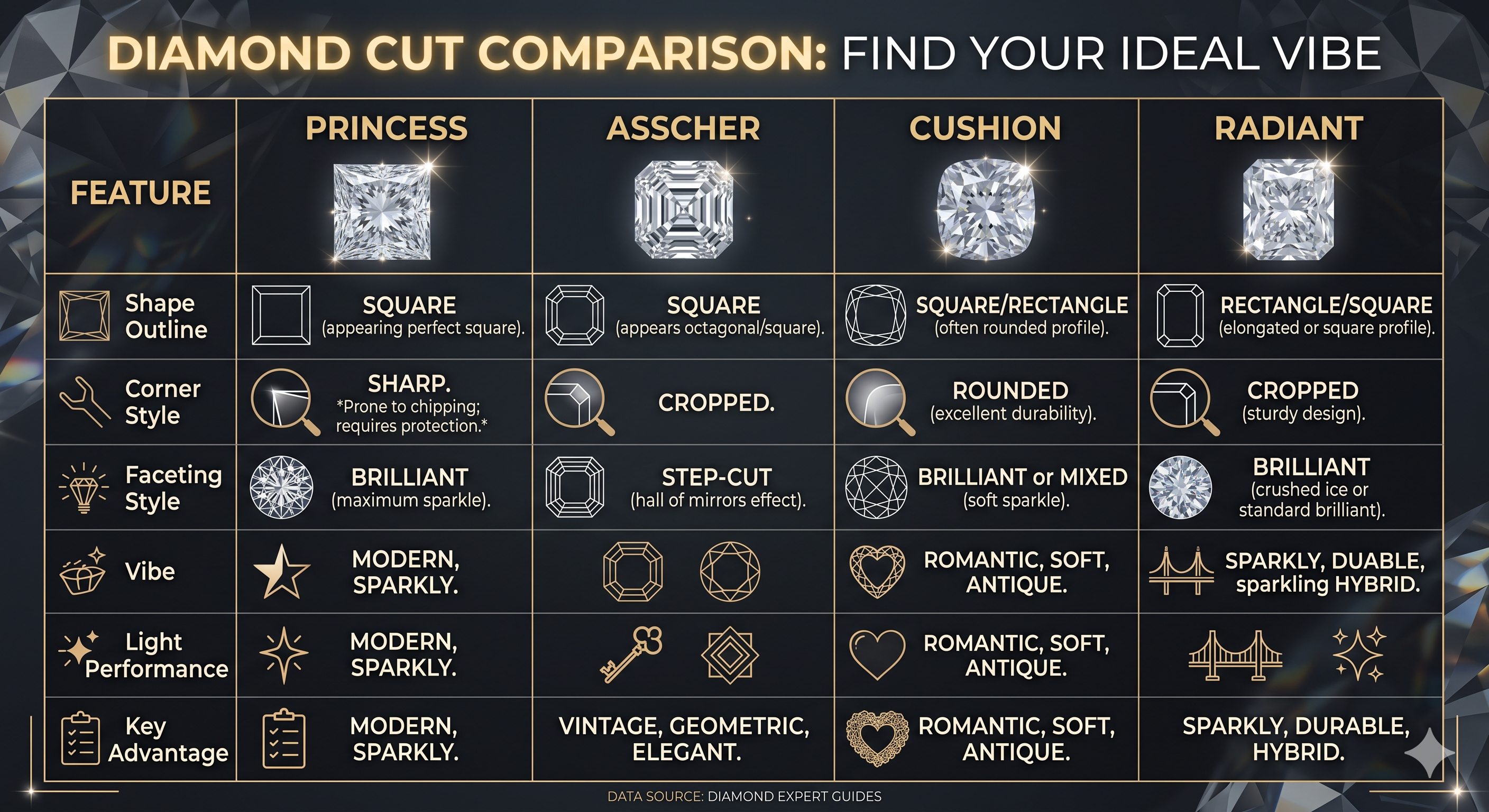
If someone says "square cut diamond," they are most likely referring to the Princess Cut. However, it's always best to clarify, as it could also mean a Cushion, Asscher, or Radiant cut depending on the specific style they have in mind.
Pro Tip: Princess-cut diamonds have very sharp corners that can be prone to chipping. It is highly recommended to set them in a protective setting (like a V-prong or bezel) at the four corners.
Is A Square-cut Diamond Good?
That's an excellent and practical question. The short answer is: Yes, a square cut diamond can be an excellent choice, but "good" depends heavily on your priorities and which specific square cut you choose.
They offer a fantastic blend of modern style, brilliance, and often, better value than a round diamond. However, they have unique characteristics you need to be aware of.
Let's break down the pros and cons, primarily focusing on the most popular square cut: the Princess Cut.
Advantages of Square Cut Diamonds (Why They Are "Good")
Modern and Stylish: Square cuts, especially the Princess and Asscher, offer a contemporary, geometric aesthetic that many find more unique and modern than the traditional round brilliant.
Exceptional Brilliance: The Princess and Radiant cuts use a brilliant-style faceting pattern, meaning they are engineered to sparkle with both fire (flashes of color) and brilliance (white light) nearly as much as a round diamond.
Excellent Value for Money: This is a major advantage. Square cuts retain more of the original rough diamond crystal than a round cut. Because of this higher yield, you often get a larger-looking diamond for the same price per carat. A 1-carat princess cut will typically cost significantly less than a 1-carat round brilliant.
Flattering on the Finger: The elongated appearance of square shapes (especially when set with side stones) can create a flattering, finger-lengthening effect.
Variety within the Category: As we discussed, "square cut" isn't one thing. You can choose the fiery and modern Princess, the soft and romantic Cushion, or the vintage and elegant Asscher.
Potential Disadvantages & Things to Consider (The "But...")
Durability of Corners (Crucial for Princess Cuts): The sharp, pointed corners of a Princess cut diamond are its most vulnerable points and can be prone to chipping if struck hard. This is the single biggest practical concern.
Solution: Always set a Princess cut in a protective setting.
such as a V-prong or a bezel setting at the four corners.
Bow-Tie Effect: Elongated or square-shaped fancy cuts (especially Ovals, Marquise, and Cushion/Radiant/Asscher cuts) can suffer from a "bow-tie" effect. This is a dark, bow-tie-shaped shadow that appears across the center of the diamond when viewed from above, caused by light leakage. A well-cut diamond will minimize this, so it's essential to inspect the stone in person or via high-quality video.
Color and Clarity Can Be More Visible:
Color: In brilliant square cuts (like Princess), the facets can sometimes make body color slightly more noticeable than in a round brilliant. You might need to choose a color grade one step higher (e.g., a G instead of an H) for it to look "colorless" to the naked eye.
Clarity: In step-cuts (like the Asscher), the large, open table facets act like windows, making inclusions (flaws) much easier to see. For an Asscher, you should prioritize a higher clarity grade (e.g., VS2 or better).
Cut is Still King (and More Complex): For round brilliants, cut grading is standardized (Excellent, Very Good, etc.). For fancy shapes like square cuts, there is no universal "Ideal" cut grade. It's more subjective and requires careful visual inspection. GIA certificates for fancy shapes don't give a Cut grade, only Polish and Symmetry.
Quick Guide: Which Square Cut is "Good" For You?
Choose a Princess Cut if: You want the ultimate in modern sparkle and brilliance, you're budget-conscious, and you ensure it's set in a protective setting.
Choose a Cushion Cut if: You love a soft, romantic, or antique vibe. You prefer a mix of brilliant sparkle and larger, "chunkier" facets.
Choose an Asscher Cut if: You are drawn to bold, vintage, Art Deco geometry and value mesmerizing clarity and hall-of-mirrors effects over fiery sparkle.
Choose a Radiant Cut if: You want the brilliance of a Princess cut but with the added durability of cropped corners, and you like a hybrid look.
Is a square-cut diamond good? Absolutely. It can be a brilliant, beautiful, and smart financial choice.
It's a GREAT choice if: you value modern style, want maximum sparkle for your budget, and are willing to pay attention to cut quality and setting protection.
You might prefer a Round Brilliant if: your top priority is the absolute maximum, scientifically proven brilliance, and you want the simplest, most standardized cut grading system.
“In 1902, the Asscher brothers of Amsterdam invented a square cut with cropped corners and concentric step facets—a ‘hall of mirrors‘ that dazzled the Art Deco world. For decades, it was the diamond of royalty. Then the princess cut arrived, and the Asscher faded. But in the 2000s, a revival began. Celebrities chose Asscher cuts for their vintage glamour. Jewelers rediscovered its quiet elegance. The Asscher did not die. It simply waited. Square cuts are like that—they don‘t scream. They sit on your finger and let the light find them. That is their power. Not to shout, but to be seen.”
The best advice is always to look at them in person. Compare a few square cuts side-by-side with a round brilliant. Your eyes will tell you which sparkle and style you truly love.
How Much Is A 1 Carat Square Cut Diamond Worth?
This is a crucial question, and the answer is: There is no single price. The value of a 1-carat square cut diamond can range from roughly $1,000 to over $12,000 for a natural diamond.
The price depends entirely on the "Four Cs" (Cut, Color, Clarity, and Carat), with the specific type of square cut and whether the diamond is natural or lab-grown being the most significant factors.
To give you a practical understanding, let's break it down.
The Biggest Factor: Natural vs. Lab-Grown
This is the most significant determinant of price today.
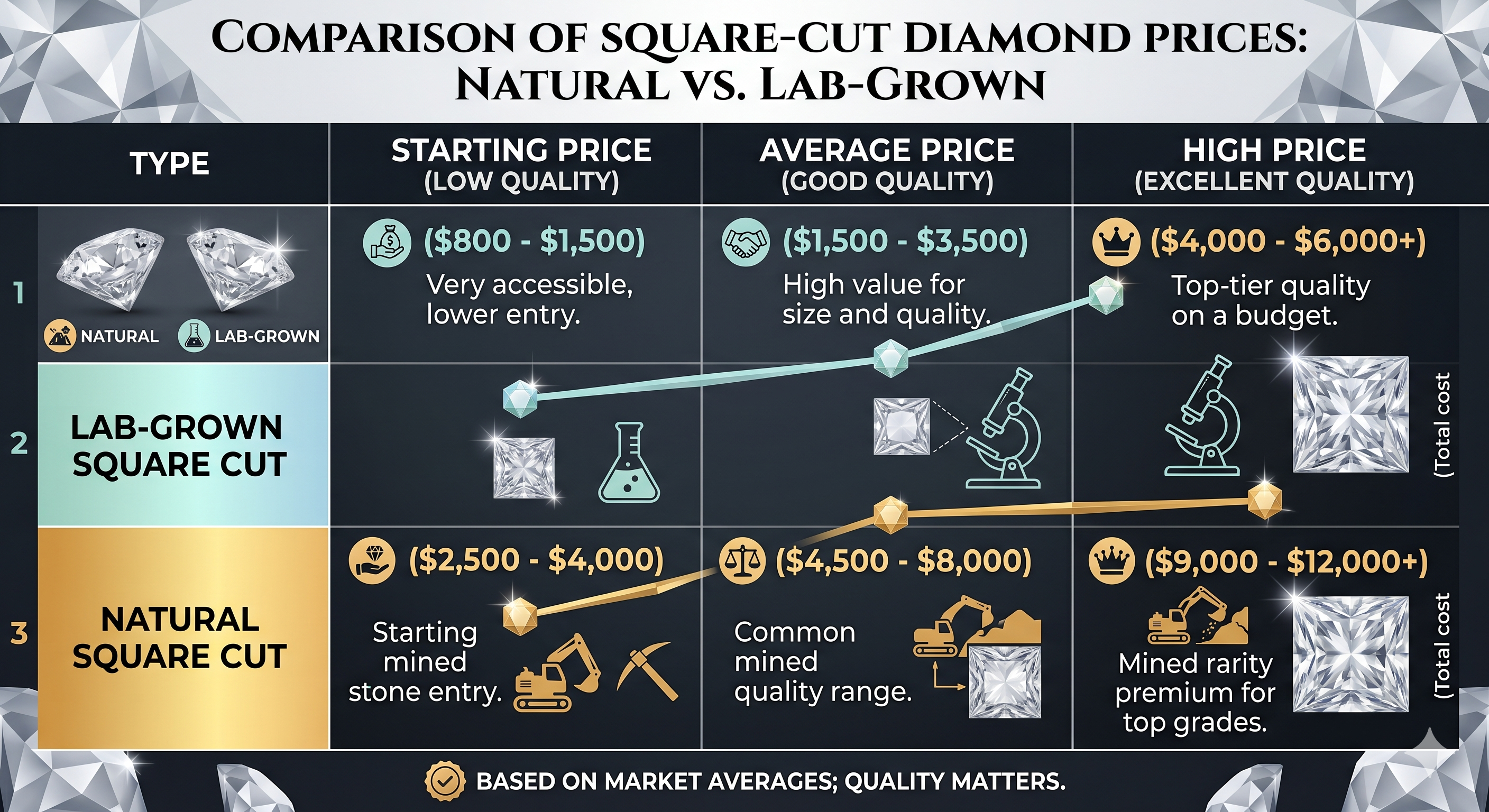
Why the huge difference? Lab-grown diamonds are physically and chemically identical but are created in a week, making them far more abundant and less expensive than mined diamonds.
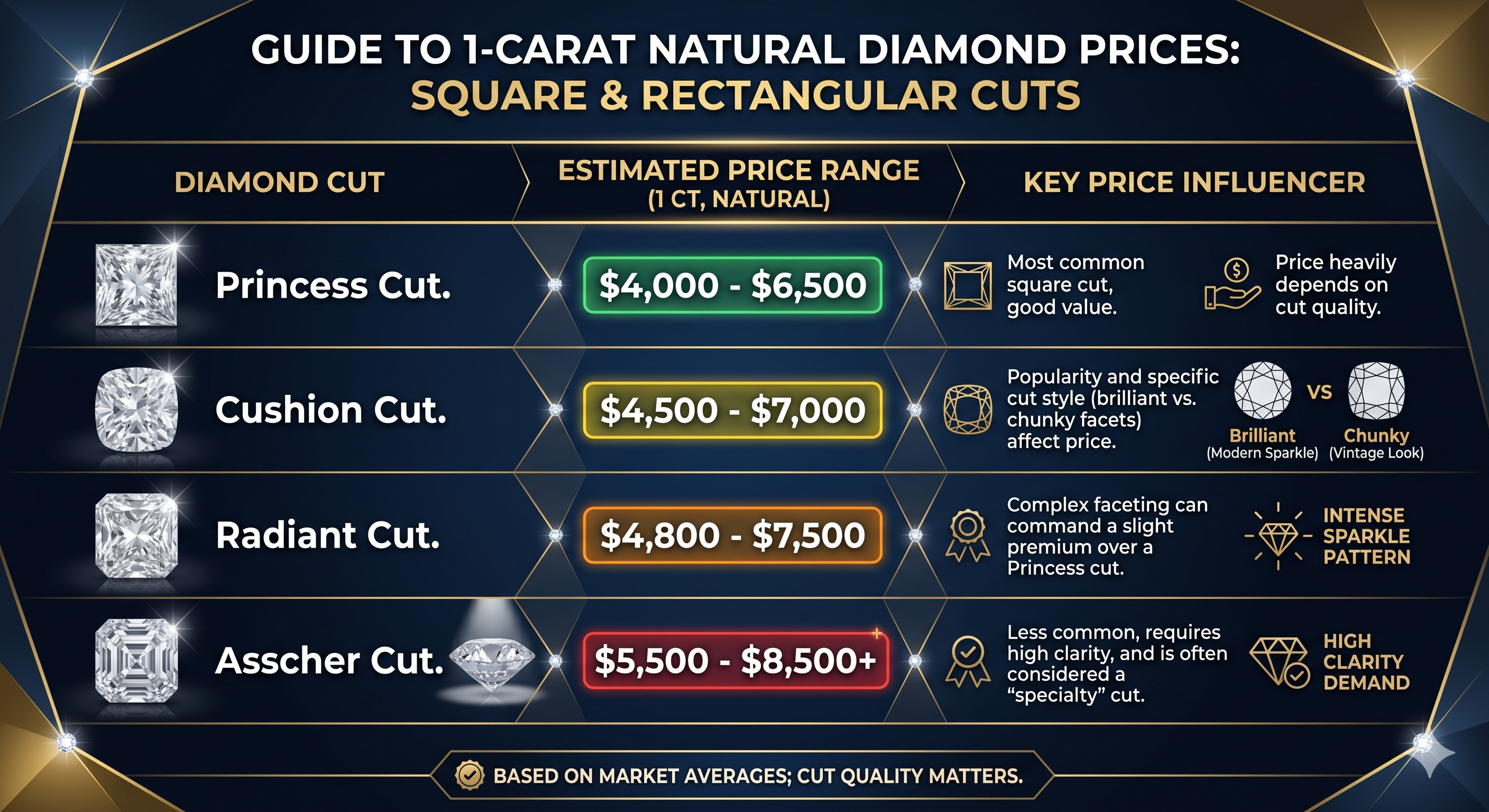
For comparison: A 1-carat Round Brilliant with similar specs would typically cost $6,500 - $9,000, making square cuts generally a better value per carat.
The Real Price Drivers: The Other "Cs"
The following chart illustrates how the two most variable "Cs" - Color and Clarity - dramatically impact the price of a 1-carat diamond, using a Princess cut as an example. Notice the sharp price increase for the highest grades.
As you can see, prioritizing the "eye-clean" and "near-colorless" grades (like the G/VS1 or I/SI1 in the chart) offers the best balance of beauty and value for most people.
How to Get a Realistic Price
Define Your Type: First, decide between Natural and Lab-Grown. This will set your overall budget.
Choose a Shape: Narrow it down to Princess, Cushion, Radiant, or Asscher.
Set Quality Ranges: You don't need a "D Flawless" stone. For the best value, aim for:
Color: G-H (Near Colorless)
Clarity: VS2-SI1 (Eye-Clean)
Cut: Very Good or Excellent (This is critical for sparkle, even in shapes without a formal GIA cut grade).
Shop Retailers: Prices vary significantly. Always get a certificate from a reputable lab (like GIA or AGS).
Example for a Realistic Budget:
A beautiful, eye-clean 1-carat lab-grown princess cut with G color and VS2 clarity will likely cost between $1,800 and $2,800.
A comparable natural diamond with the same specs would likely cost between $5,000 and $6,500.
Final Recommendation: Use online diamond search engines (like James Allen, Blue Nile, or Brilliant Earth) to filter for the exact specifications you want. This will give you the most accurate, real-time market price for a 1-carat square cut diamond.
Is Square Cut The Same As Princess Cut?
No, "Square Cut" is not the same as "Princess Cut," though they are closely related. Princess Cut is the most common specific type of square-shaped diamond, but the term "Square Cut" is not a standard industry name and can refer to several different diamond shapes.
"Square Cut" is a descriptive term for diamonds with a square outline. It is not a specific cut and can include several distinct styles like the Princess, Cushion, Asscher, and Radiant cuts.
"Princess Cut" is a specific and popular diamond shape. Its technical name is "square modified brilliant," which combines a square outline with a brilliant-style faceting pattern for maximum sparkle. True princess cuts have sharp, pointed 90-degree corners.
To help you see the differences, here’s a comparison of popular square-shaped diamond cuts:
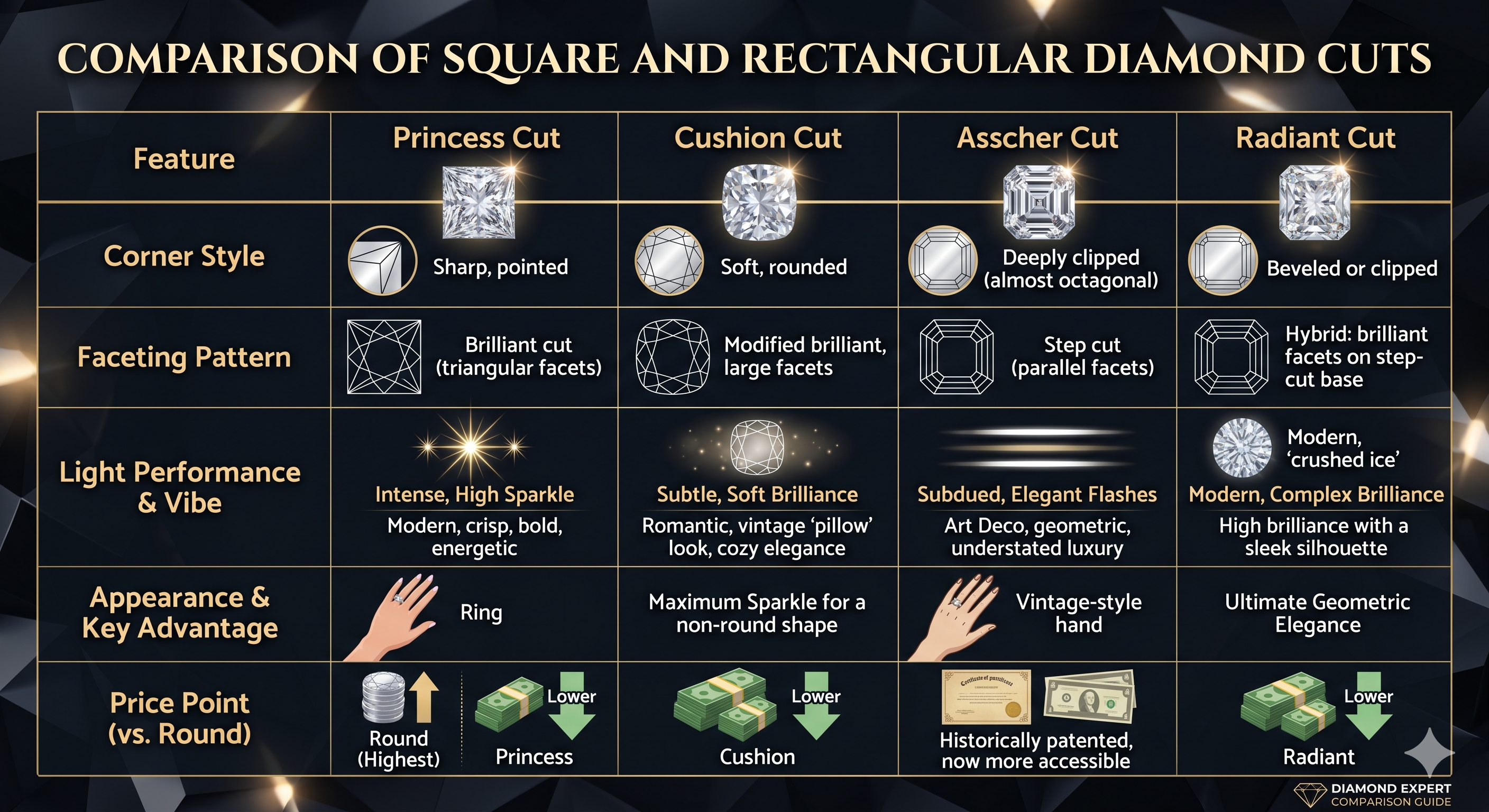
Key Facts About Princess Cut Diamonds
Popularity: It is the second most popular diamond cut after the round brilliant, often used in engagement rings.
Value: They are generally 10-25% less expensive per carat than round brilliant diamonds because the cutting process wastes less of the original stone.
Consideration: The sharp corners can be prone to chipping, so it's important to choose a setting (like a four-prong or bezel) that protects them.
How to Ensure You Get What You Want
To avoid confusion when shopping:
Use Specific Names: Instead of asking for a "square cut," specify the exact cut you want, like Princess, Cushion, or Asscher.
Check the Certificate: Look at the diamond grading report (e.g., from GIA or AGS). A true princess cut will often be described as "Square Modified Brilliant".
Look at the Corners: Visually, the sharp, pointed corners are the easiest way to identify a classic princess cut.
In short, while a princess cut is square, not all square-shaped diamonds are princess cuts.
I hope this helps clarify the terminology.
“You now know the names, the types, the pros and cons, the pricing, and the terminology. The only question left: which square will you choose?
Our current collection includes a limited number of GIA-certified square cut diamonds — from brilliant princess cuts to soft cushions, from vintage Asschers to radiant hybrids. When stones with ideal proportions are gone, sourcing new ones takes time.
This is not just a diamond. It is Basil Watermeyer‘s 1970s rebellion, the Asscher brothers‘ Art Deco masterpiece, and 500 years of round brilliants finally being challenged — a shape that says: I choose my own corners.”
[Button: Claim Your Square Cut Diamond (Limited) →]
Back to Complete Amethyst Stone Guide


What to Know About Pear Cut Diamonds: An Informative Overview
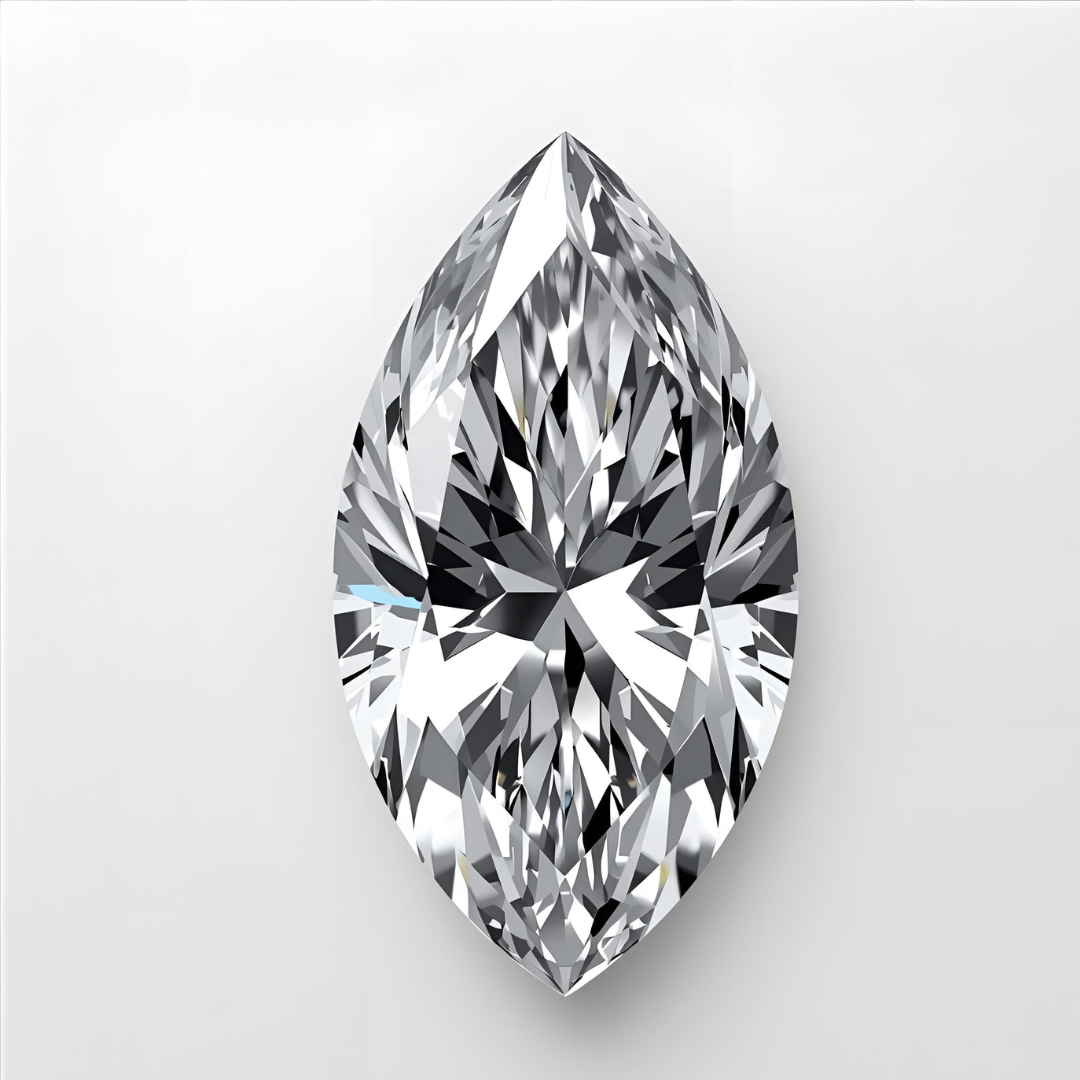
What is a Pear-Cut Diamond?
“In the 15th century, a Flemish diamond polisher named Lodewyk van Bercken invented the diamond polishing wheel. With it, he could create shapes that were impossible before. His most beautiful creation was the ‘pendeloque‘—a teardrop that caught light like morning dew on a rose petal. For centuries, royalty wore pear-shaped diamonds as pendants and brooches. Then, in 1957, Richard Burton gave Elizabeth Taylor a 69-carat pear diamond. She called it her ‘best friend.‘ Today, when Ariana Grande and Sophie Turner choose pear cuts for their engagement rings, they are wearing 600 years of tear-shaped history—a diamond that is both a drop and a flame.”
The same teardrop that graced Elizabeth Taylor now awaits your own love story — point up for drama, point down for protection. Every pear-cut diamond in our collection is hand-selected for minimal bow-tie and perfect symmetry.”
[Button: Explore Pear Cut Diamonds →]
Here is a detailed explanation of the Pear Cut.
A Pear Cut, also known as a teardrop cut, is a popular fancy shape for gemstones, especially diamonds, that combines the elegance of a round cut with the edginess of a marquise cut.
What is a Pear-Cut Diamond?
Is Pear Cut More Expensive?
Do Pear-Cut Diamonds Look Bigger?
Is a Pear-Cut Diamond Popular?
Is a Pear-Shaped Diamond Good?
Do Pear-Cut Diamonds Sparkle?
A pear-cut diamond is a brilliant-cut diamond shaped like a teardrop, combining the curves of a round diamond with the pointed end of a marquise. This shape is also sometimes called a teardrop shape.
Here is a summary of how a pear cut compares to the classic round brilliant:
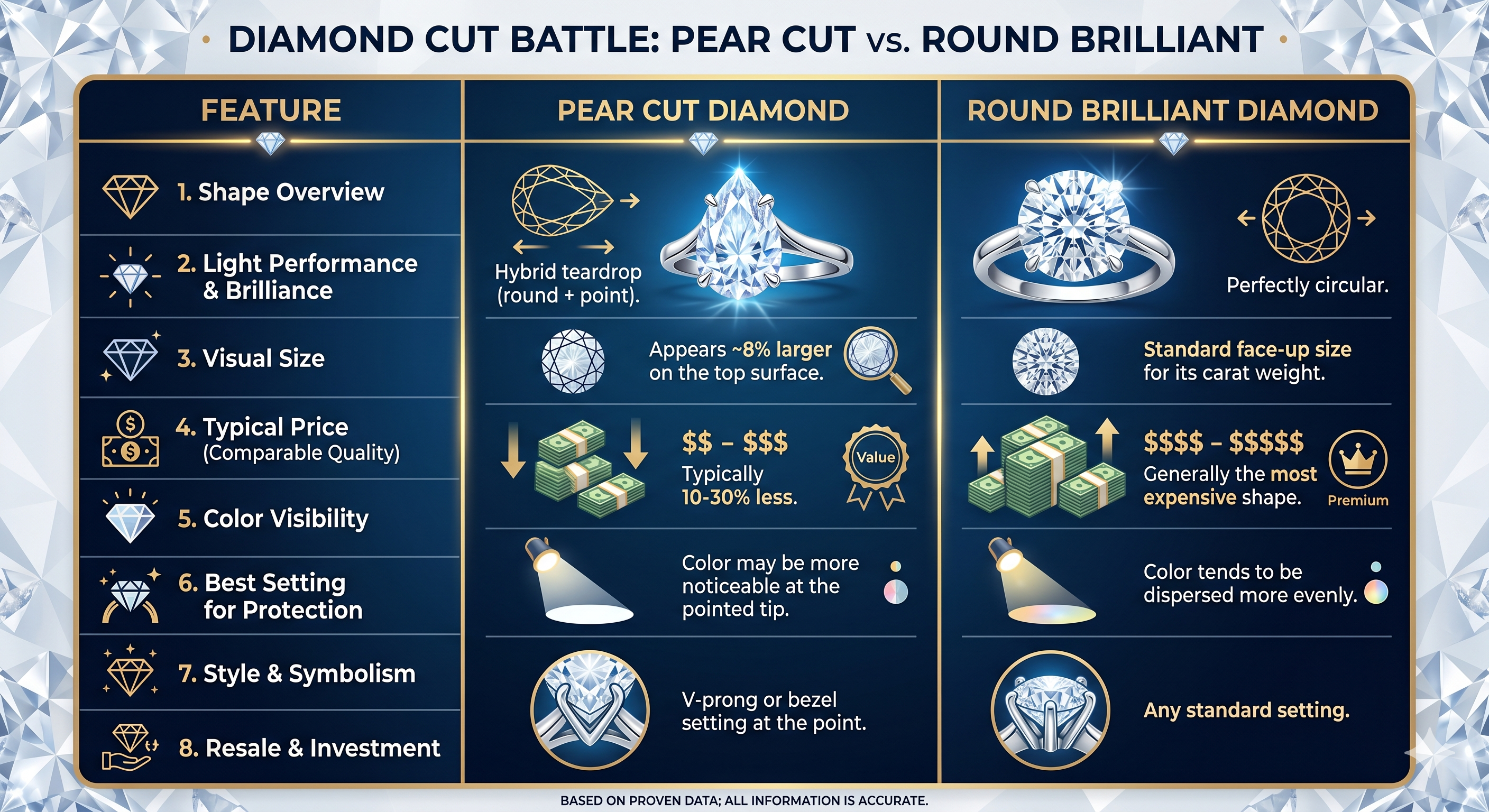
Key Characteristics of the Pear Cut
History and Popularity: The pear cut's design is credited to a Flemish polisher in the 15th century. Today, it's considered a classic yet fashionable choice, often seen in engagement rings.
The Cut and Symmetry: Unlike round diamonds, the pear cut has no single standardized set of proportions, meaning you can choose one that appeals to you personally. A well-executed cut with excellent symmetry is crucial. The two halves should be balanced, and the point should be sharp and centered.
The "Bow-Tie" Effect: A common characteristic in fancy-shaped diamonds, like the pea,r is a dark, bow-tie-shaped area across the middle. A slight bow-tie is normal, but a very prominent one can block light and reduce sparkle.
Why Choose Pear-Cut Diamond?
People are often drawn to the pear shape because:
Visual Impact: Its elongated shape can create a flattering, slimming effect on the finger.
Styling Versatility: The shape is unique, defined by both angles and curves, making it versatile for various ring styles. It can look vintage, modern, or timeless depending on the setting.
Value: You often get a larger-looking diamond for your budget compared to a round brilliant of the same carat weight
Tips for Choosing a Pear Cut
If you're considering a pear-cut diamond, keep these points in mind:
Check the Color: Because the point can concentrate color, many jewelers recommend choosing a higher color grade (D-F) for a colorless look, especially for larger stones.
Consider the Setting: The delicate point is prone to chipping. A V-prong or a bezel setting at the tip offers the best protection. The diamond can also be set with the point facing up or down, offering two distinct looks.
Focus on Personal Preference: Since proportions are not standardized, the "best" pear shape is subjective. Pay attention to the length-to-width ratio; a ratio of 1.50-1.75 is common, but you may prefer a shorter, plumper shape or a longer, more slender one.
Matching with Ring Styles and Wedding Bands
Pear diamonds are highly versatile:
Classic Solitaire: Allows the unique shape to stand alone.
Side Stones: Tapered baguettes or smaller pears can complement the shape.
Halo or Pave Settings: Add extra sparkle, nd can make the center stone appear even larger.
When choosing a wedding band, consider a curved or "V"-shaped band to fit snugly against the pear's tapered shape, or choose a simple band with a small gap.
In summary, the pear cut is a distinctive and elegant choice for those seeking a diamond with a blend of soft curves and a dramatic point. Its versatility in style and potential for excellent value make it a compelling option.
If you have a specific setting style in mind or a particular budget range, I can help you explore what to look for in more detail.
Is Pear Cut More Expensive?
Generally, a pear cut is less expensive than a round brilliant cut of the same carat weight and quality. However, it's often more expensive than many other fancy shapes.
Let's break down the factors that determine the price of a pear-cut diamond or gemstone.
1. The Round Brilliant Premium (Why Rounds are Most Expensive)
The round brilliant cut is the king of the diamond market for a reason:
Highest Demand: It's the most popular shape by a huge margin, which drives up the price.
Maximum Waste: Cutting a rough diamond crystal into a round shape results in the most weight loss (up to 60% is lost). This wasted material is factored into the price.
Complex Faceting: It requires the most precise and complex facet pattern to achieve its legendary brilliance.
Because of this, you can often get a larger or higher-quality pear cut for the same price as a smaller or lower-quality round brilliant.
2. Factors That Make a Good Pear Cut Expensive
While pears are cheaper than rounds, a high-quality pear is still a premium stone. Here’s what to look for, as these factors increase its value:
Excellent Cut and Symmetry: This is the most important cost factor for pears. A poorly cut pear can look unbalanced and lifeless. A well-cut pear with perfect symmetry, a great light return, and no "bow-tie effect" (or a very minimal one) will command a much higher price. Achieving this symmetry is difficult and requires a highly skilled cutter.
Color (Especially for Diamonds): The pointed tip of a pear cut can concentrate color, making a lower-grade diamond (like K or L color) appear slightly yellowish at the tip. For this reason, it's often recommended to choose a near-colorless grade (G, H, I) or higher for a pear cut, which increases the cost.
Clarity: The large, open table (top surface) of the pear cut can make inclusions more visible, especially if they are located near the center. A stone with a higher clarity grade (VS1 or higher) that is "eye-clean" will be more expensive.
Length-to-Width Ratio: The "ideal" or most sought-after ratio (typically between 1.55 and 1.65) can sometimes carry a slight premium, though this is more about personal preference.
The Vulnerable Point: A pear cut with a clean, unchipped point is more valuable. Stones that have been chipped at the tip are significantly discounted.
3. How Pear Cut Compares to Other Fancy Shapes
More Expensive Than: Oval, Cushion, Asscher. This is often due to the higher difficulty in achieving the pear's symmetry and the fact that it's a less common shape than an oval or cushion.
Similar in Price To: Marquise, Heart. These are all more complex, symmetrical cuts with points that require skilled craftsmanship.
Less Expensive Than: Round Brilliant (as discussed above) and sometimes Emerald Cut. Emerald cuts can be more or less expensive depending on the clarity requirements, but they are generally in a similar price tier.
Summary Table: Price Comparison (General Guideline)
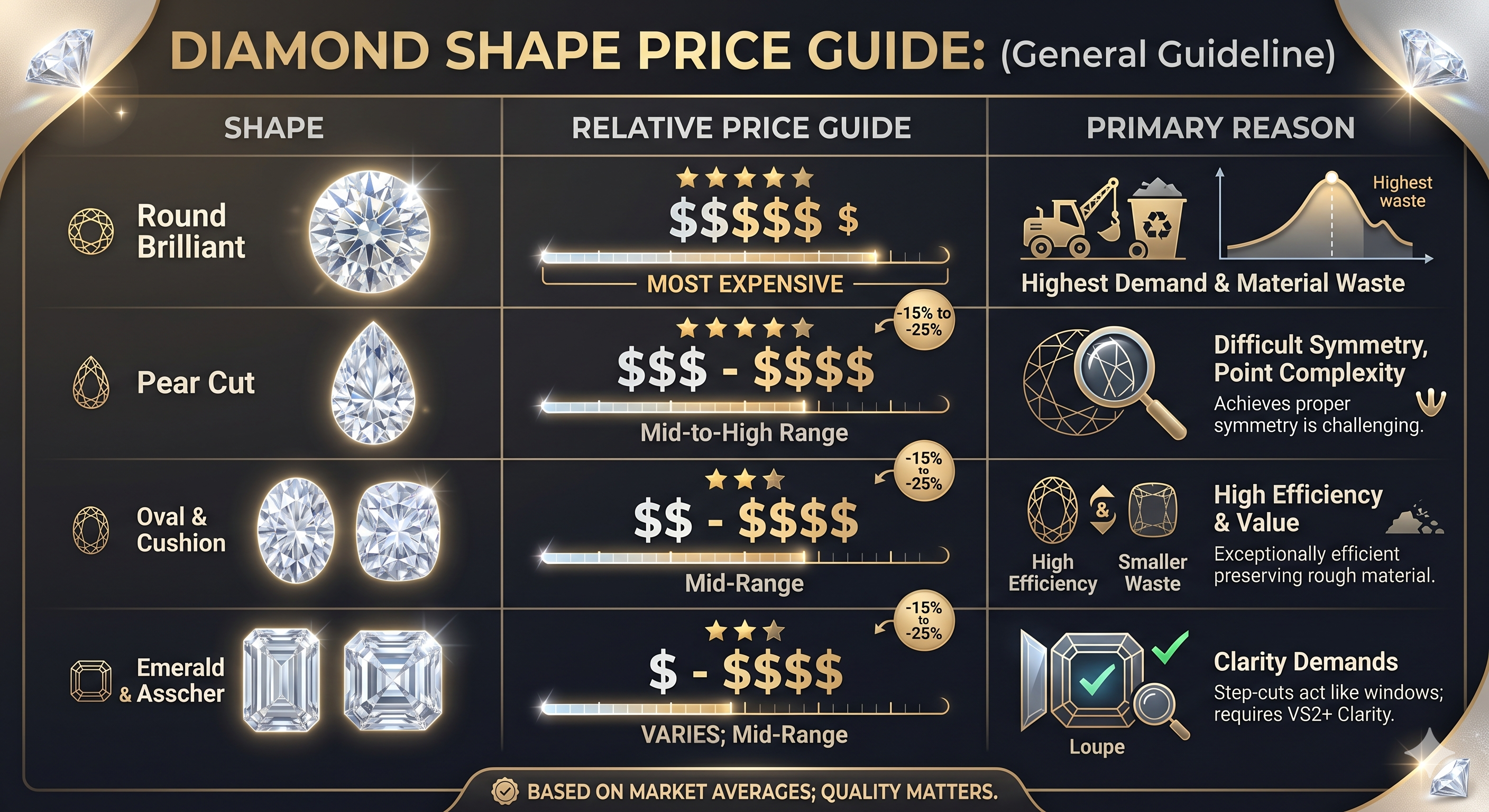
No, a pear cut is not more expensive than a round brilliant. In fact, it's one of the best ways to get a larger-looking stone for your budget.
However, don't assume all pear cuts are "cheap." A high-quality, well-proportioned pear cut from a reputable seller will still be a significant investment. The key is to prioritize an excellent cut and symmetry above all else when choosing a pear-shaped diamond.
Pro Tip: Because of the price advantage, you can often afford to go up in carat size or color/clarity grade with a pear cut compared to what you could get with a round brilliant for the same budget.
Do Pear-Cut Diamonds Look Bigger?
Yes, pear-cut diamonds generally do look larger than round brilliant diamonds of the same carat weight.
This is one of their biggest advantages and a primary reason for their popularity. Here’s a detailed breakdown of why:
The Two Main Reasons Pear Cracks Look Larger
Elongated Shape and Surface Area:
A pear cut is an elongated shape, meaning it covers more surface area from top-down (the "face-up" view) than a round brilliant of the same weight.
Think of it like dough: you can shape the same amount of dough into a compact ball or a long, flat snake. The snake will look longer and cover more space, even though it's the same amount of dough. The pear cut is the "snake" in this analogy.
This elongated shape directs the eye along its length, creating a stronger impression of size.
The "Face-Up" Illusion:
Diamond weight (carat) is a measure of weight, not physical size. A significant portion of a round brilliant's weight is hidden in its depth and pavilion (the bottom part) to maximize brilliance.
Pear cuts and other fancy shapes like ovals and marquises often have a shallower pavilion and a larger table (the top, flat surface). This means more of the carat weight is concentrated in the surface area you actually see.
Visual Comparison: Pear Cut vs. Round Brilliant
To make this concrete, here is a visual comparison of a 1-carat pear-cut diamond versus a 1-carat round brilliant diamond, scaled to their approximate actual sizes.
As you can see from the chart, the pear cut has a much longer length, making it appear significantly larger when viewed from above, especially on a finger.
How to Maximize the Size Effect
If you want a pear cut that looks as large as possible, consider these tips:
Choose a Higher Length-to-Width Ratio: A more elongated pear (e.g., a ratio of 1.60-1.75) will look longer and cover more of the finger than a "chubby" pear (e.g., a ratio of 1.40-1.50).
Opt for a Slimmer Band: A thin, delicate band (e.g., 1.5-2.0mm) will make the diamond appear larger by contrast.
Consider the Setting:
A solitaire setting puts all the focus on the single stone, making it the star and often enhancing its perceived size.
A halo setting (a circle of small diamonds around the center stone) will dramatically increase the overall surface coverage and make the center pear look much larger.
Prioritize Excellent Cut: A well-cut pear will have better light performance and brilliance. A lively, sparkling stone draws more attention and can appear more substantial than a dull, poorly cut one of the same size.
A Word of Caution
While pears look larger face-up, never sacrifice cut quality for size. A poorly cut pear can have a dead center, a severe bow-tie effect, and bad proportions that make it look awkward and less brilliant. A smaller-looking, well-cut stone will always be more beautiful and valuable than a larger-looking, poorly cut one.
Yes, a pear-cut diamond will almost always look larger than a round brilliant diamond of the same carat weight. This perceived size advantage, combined with its elegant and flattering shape, makes it an excellent choice for anyone wanting to maximize the visual impact of their diamond.
Is a Pear-Cut Diamond Popular?
The popularity of the pear-cut diamond is a fascinating topic because it sits in a unique space in the jewelry world.
Here’s a detailed breakdown:
The Short Answer
Yes, the pear cut is popular and has been consistently rising in popularity, but it is not ubiquitous like the round brilliant. It's considered a well-known, beloved choice for those seeking a unique yet classic look.
The Detailed Breakdown
1. Its Ranking and Trend
Consistently in the Top 5: For engagement rings, the pear cut consistently ranks among the top 5 most popular fancy shapes, typically competing with the oval, cushion, and princess cuts. The round brilliant always holds the undisputed #1 spot.
A Significant Rise: Over the last 5-10 years, the pear cut has seen a major surge in popularity. This is part of a broader trend where "fancy shape" diamonds (anything non-round) have become much more sought-after as people look for unique ways to express personal style.
2. Why It's Popular (The Pros)
Unique & Classic Balance: It offers the perfect middle ground. It’s distinctive and less common than a round or oval, but its teardrop shape is timeless and romantic, not overly trendy or edgy.
“In 2018, Ariana Grande posted a photo of her new engagement ring—a pear-shaped diamond estimated at over 3 carats. Within weeks, searches for ‘pear cut engagement ring‘ had doubled. But the pear‘s popularity didn‘t start with Ariana. In 1989, Princess Diana‘s sister-in-law, Sarah Ferguson, wore a pear-cut ruby engagement ring. In 2009, Kate Beckinsale‘s pear diamond ring made headlines. In 2016, Kaley Cuoco‘s pear-shaped sparkler set another trend. The pear has never been the most popular shape. But it has always been the shape that people remember. It is not for everyone. That is exactly why those who choose it love it.”
Flattering and Feminine: The elongated shape is renowned for making the finger appear longer and slimmer, a highly desired effect.
Celebrity Influence: High-profile engagement rings have a massive impact. Celebrities like Ariana Grande, Sophie Turner, and Kaley Cuoco have stunning pear-cut engagement rings, which brings the shape into the mainstream spotlight.
Versatility: It can be set vertically (the classic style), horizontally (a more modern "east-west" setting), or as a stunning pendant. This appeals to people who want a customizable and unique piece of jewelry.
3. Why It's Not #1 (The Factors Limiting Its Popularity)
The Round Brilliant's Dominance: The round cut is the default choice for a reason. Its unparalleled brilliance and timeless status make it the "safe" and most requested option.
The "Bow-Tie" Effect: Many elongated cuts, including the pear, can have a dark, bow-tie-shaped area across the center. While a faint one is normal, a prominent bow-tie is considered a flaw and can be off-putting to some buyers.
The Vulnerable Point: The delicate tip of the pear can be prone to chipping if not protected by the right setting (like a V-prong). This requires a bit more care and consideration, which some prefer to avoid.
Symmetry is Critical: A poorly cut, asymmetrical pear can look awkward and lopsided. Finding a beautifully symmetrical pear requires more careful selection than with a round brilliant.
The "Halo Effect" on Popularity
It's important to note that the pear cut is extremely popular in halo settings. The halo of smaller diamonds encircling the center stone complements the pear's shape beautifully, protects its vulnerable point, and makes the entire ring look much larger and more glamorous. Many of the most celebrated pear-cut rings feature halos.
So, is it popular?
Yes, but in its own tier.
Think of diamond popularity like this:
Tier 1 (The Default): Round Brilliant. In a league of its own in terms of market share.
Tier 2 (The Rising Stars & Classics): Oval, Pear, Cushion, Princess. These are highly popular, fashionable, and commonly seen. The pear cut is a proud member of this group.
Tier 3 (The Niche Favorites): Emerald, Asscher, Marquise, Heart. These are for those with a more specific, distinct taste.
The pear-cut diamond is a popular, prestigious, and stylish choice. It's for someone who appreciates classic romance but wants to step slightly outside the box without being too avant-garde. Its popularity is well-deserved and shows no signs of fading.
Do Pear-Cut Diamonds Sparkle?
Yes, pear-cut diamonds can sparkle brilliantly, but their sparkle is different from that of a round brilliant. When well-cut, they exhibit a mix of fire (flashes of colored light) and brilliance (white light return).
Here’s a quick comparison of their sparkle characteristics:
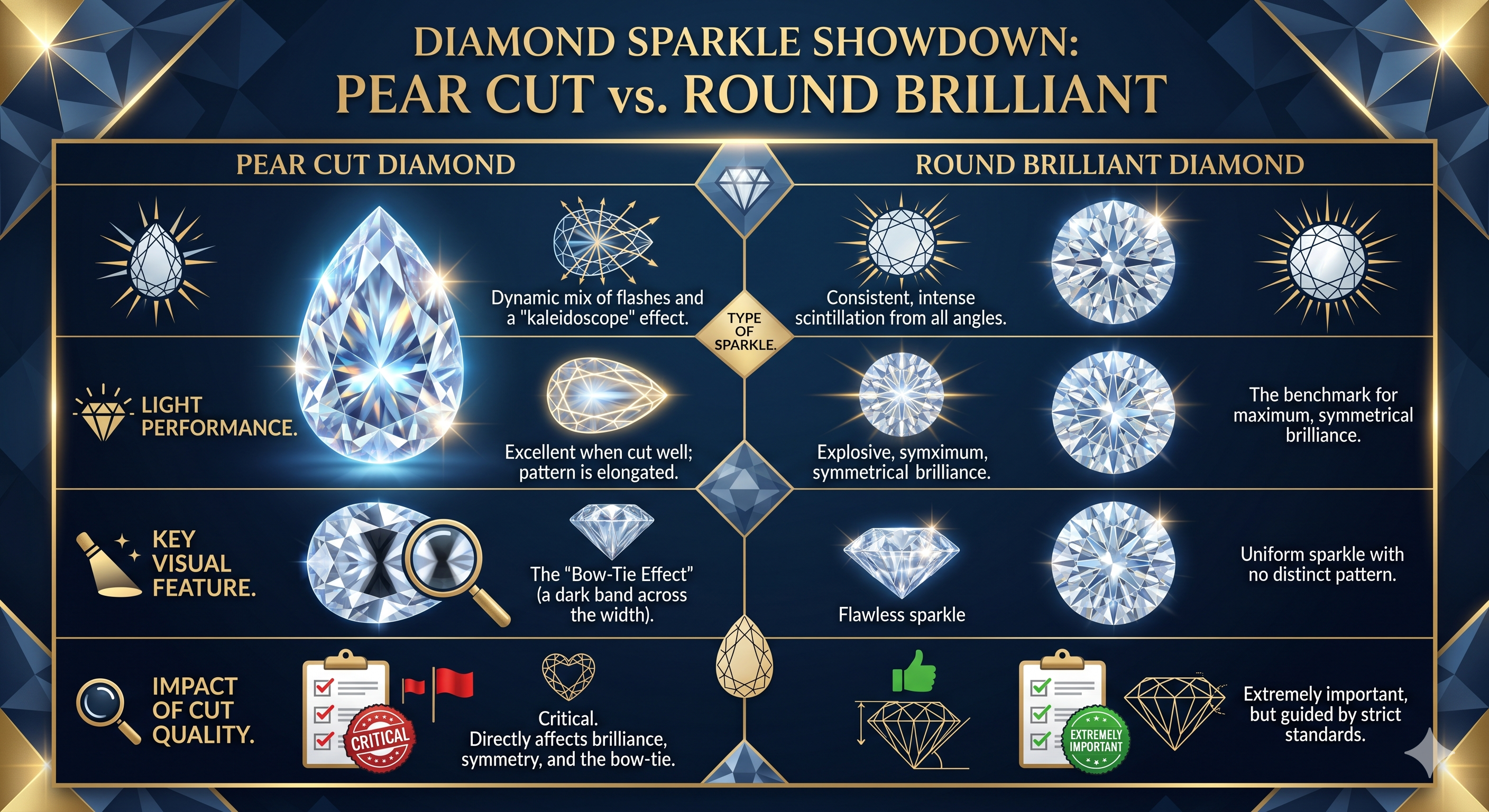
Understanding Pear Cut Sparkle
The sparkle of a pear cut is unique because of its shape:
Elongated Brilliance: Its facets create a long, shimmering light pattern that can make the diamond appear larger and the finger look longer.
The Bow-Tie Effect: This dark area across the middle is caused by light obstruction. A faint to moderate bow-tie is normal and adds contrast, but a very prominent, dark bow-tie means the cut is poor and kills sparkle.
Cut is Everything: For a pear to sparkle, it must be cut with excellent symmetry and proportions. There's no universal "Ideal" grade, so visual inspection is key.
How to Choose a Sparkly Pear Cut Diamond
To ensure you get a stone with great sparkle, focus on these four aspects (beyond the standard 4Cs):
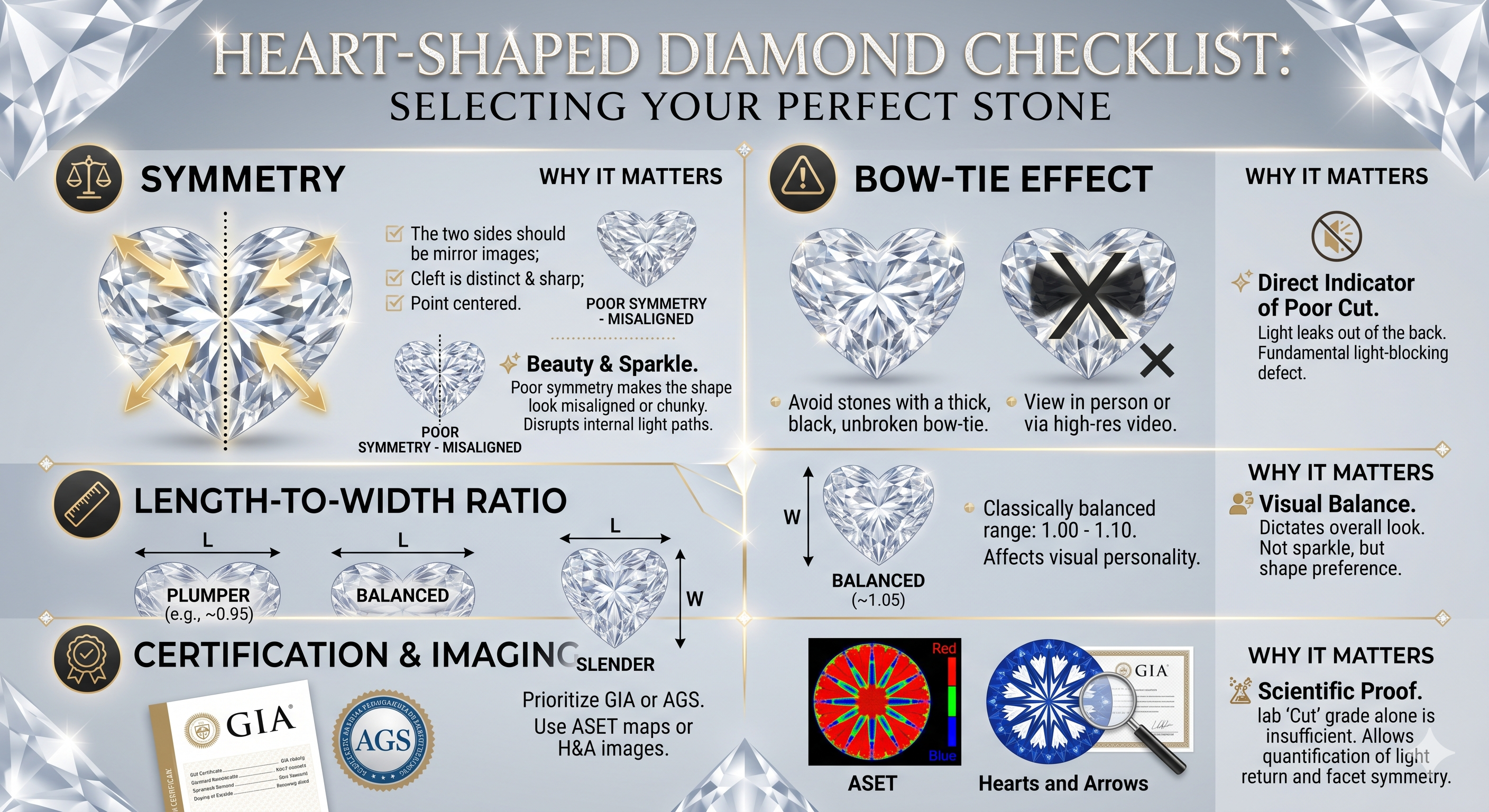
Practical Tip: Always view the diamond in motion. A good pear cut will flash with light from almost every angle as you rotate it.
In short, a pear-cut diamond offers a dramatic and elegant sparkle that is distinct from a round brilliant. Its brilliance is more fluid and elongated. The key is to prioritize cut quality above all else to find a stone that is both fiery and bright.
“You now know the origin, the price comparison, the size illusion, the popularity, the sparkle, and the selection tips. The only question left: will you wear the tear-shaped diamond?
*Our current collection includes a limited number of GIA-certified pear-cut diamonds — from delicate 0.5-carat stones to stunning 3-carat centerpieces. When stones with minimal bow-tie and ideal length-to-width ratios are gone, sourcing new ones takes time.*
*This is not just a diamond. It is Lodewyk van Bercken‘s 15th-century invention, Elizabeth Taylor‘s ‘best friend,‘ and Ariana Grande‘s trend — a teardrop that is both a drop of sorrow and a flame of joy. Point up, point down, or sideways. The choice is yours.”*
[Button: Claim Your Pear Cut Diamond (Limited) →]
Back to Complete Amethyst Stone Guide
The Anatomy of a Solitaire Setting: What Makes It Special
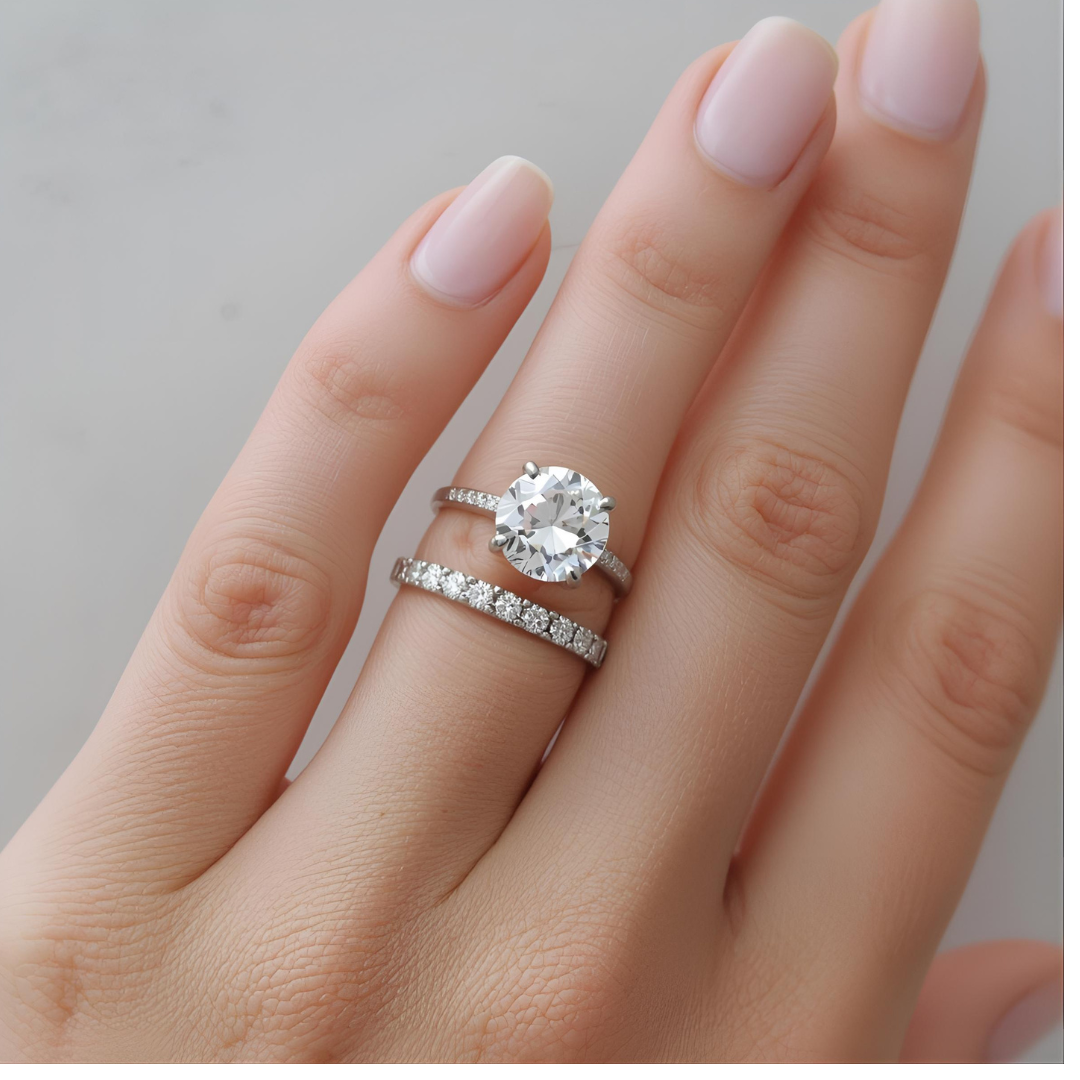
What Is A Solitaire Setting?
In the simplest terms, a solitaire setting is a piece of jewelry, most commonly an engagement ring, that features a single, prominent center stone with no other distracting stones on the band or surrounding the main stone.
“In 1886, Charles Lewis Tiffany introduced a setting that changed engagement rings forever. He took a round brilliant diamond and lifted it above the band with six tiny prongs—allowing light to enter from every angle. Before Tiffany, diamonds were often set in closed-back bezels, hidden and dark. After Tiffany, the diamond floated. It caught the sun. It became the star. That single innovation—the six-prong solitaire—is still the most copied engagement ring design in history. The solitaire does not need side stones, halos, or intricate details. It needs one thing: a diamond. And that diamond needs nothing else.”
The same setting that Tiffany revolutionized in 1886 now awaits your own singular promise. Every solitaire ring in our collection is handcrafted—from classic 6-prong to modern bezel—because a diamond that stands alone should never stand insecure.”*
[Button: Explore Solitaire Rings →]
What Is A Solitaire Setting?
What Does Solitaire Set Mean?
What Is The Classic Solitaire Setting?
Is A Solitaire Setting Secure?
How To Make A Solitaire Setting Unique?
Are Solitaires Comfortable To Wear?
The word "solitaire" itself comes from the Latin word solitarius, meaning "alone" or "solitary," which perfectly describes this style.
Key Characteristics of a Solitaire Setting:
Single Center Stone: This is the defining feature. The entire design is built to showcase one gemstone, usually a diamond.
Minimalist Band: The band is typically plain (though it can be polished, satin, or engraved) and is designed not to take attention away from the center stone.
Focus on the Diamond: The primary goal of a solitaire is to maximize the beauty, brilliance, and perceived size of the single stone. All eyes go straight to it.
The Most Common Types of Solitaire Settings:
While the principle is simple, there are different ways to hold that single stone in place. The most popular is the Prong Setting.
Prong Setting: This is the classic and most popular type of solitaire. Metal claws (called prongs) hold the stone securely.
4-Prong: Makes a round diamond look more square or cushion-like and allows more light to enter, but offers slightly less security.
6-Prong: Creates a more rounded look for a round diamond and offers superior security.
Why is the Solitaire Setting So Popular for Engagement Rings?
Timelessness: It's a classic style that has been popular for over a century and will never go out of fashion.
Focus on the Stone: It puts the quality and size of the center diamond on full display.
Versatility: Its simplicity allows it to be paired with virtually any wedding band style, from a plain band to an ornate eternity ring.
Symbolism: The single, unadorned stone is often seen as a powerful symbol of singular love and commitment.
Solitaire vs. Other Settings:
Solitaire vs. Halo: A halo setting has a central stone surrounded by a "halo" of smaller pavé diamonds, making the center stone appear larger. A solitaire is just a single stone.
Solitaire vs. Three-Stone: A three-stone ring has (as the name implies) three stones, often symbolizing the past, present, and future of a relationship.
In short, a solitaire setting is the epitome of "less is more." It's a timeless, elegant, and powerful design choice that ensures the beautiful center stone is the undeniable star of the show.
What Does Solitaire Set Mean?
While it sounds very similar to "solitaire setting," the phrase "solitaire set" can have two distinct meanings, and the correct one depends entirely on the context.
Meaning 1: A Matched Pair of Jewelry (Most Common Meaning)
In the world of fine jewelry, especially in the context of engagement and weddings, a solitaire set most often refers to a matched pair of rings designed to be worn together: the engagement ring and the wedding band.
The Engagement Ring: This is the classic solitaire ring with a single, prominent center stone (like a diamond) in a simple setting.
The Wedding Band: This is a complementary ring, usually a plain metal band or one with a simple design, that is sold as a perfect match to the engagement ring.
Why is it called a "set"?
Because the two rings are designed and sold together to ensure they fit together perfectly, both in style and physically. When worn together, they look like one cohesive piece of jewelry.
Key Idea: In this context, "solitaire set" means "engagement ring + matching wedding band."
Meaning 2: A Complete Game of Solitaire
In the context of games, a solitaire set refers to the physical equipment needed to play the classic card game of Solitaire (also known as Patience) by yourself.
This typically includes:
A special deck of cards (often with larger, easy-to-read indices).
A playing board or tablet with a patterned layout to place the cards. This helps keep the cards organized and is ideal for playing on a table or while traveling.
This is much less common today, as most people play Solitaire on computers or phones, but physical solitaire sets are still available and cherished by enthusiasts.
How to Tell the Difference
To know which meaning is intended, just look at the context:
If the conversation is about diamonds, engagement, or jewelry, it's Meaning 1 (the ring set).
If the conversation is about games, cards, or hobbies, it's Meaning 2 (the card game set).
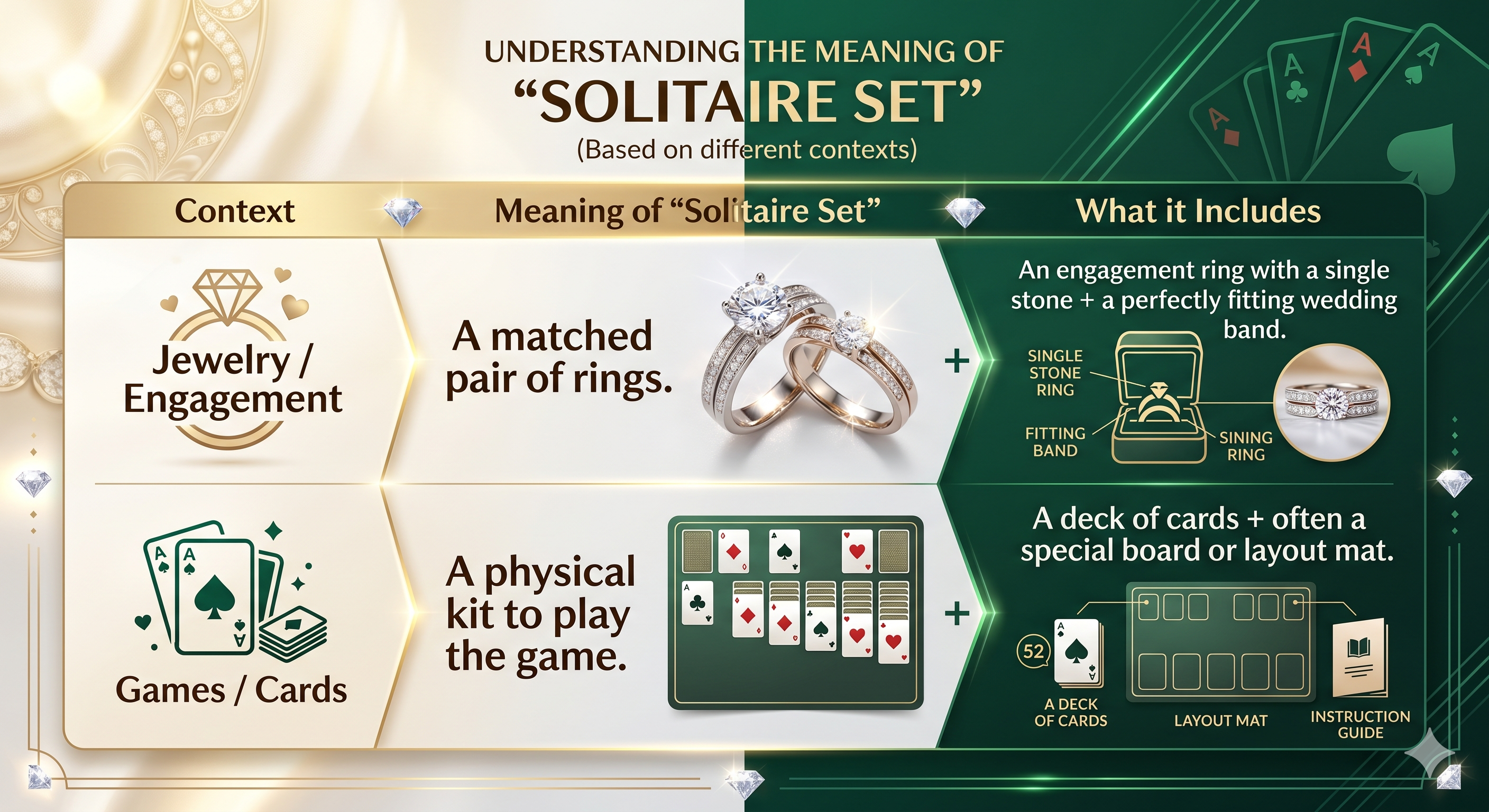
In everyday conversation, especially when discussing jewelry, you will almost always be referring to the matched pair of rings.
What Is The Classic Solitaire Setting?
The classic solitaire setting is the most iconic and timeless style for an engagement ring. When people imagine a "traditional" diamond ring, this is almost certainly what comes to mind.
It is defined by its elegant simplicity, designed to do one thing perfectly: showcase the beauty of a single, spectacular diamond.
The Hallmarks of the Classic Solitaire
Here are the key features that define this legendary setting:
A Single Central Stone: The star of the show. It's always one stone, typically a round brilliant cut diamond, chosen for its unmatched fire and brilliance.
The Prong Setting: This is the most classic and popular way to hold the stone. Metal claws, known as prongs, extend up from the band to clutch the diamond securely.
Four-Prong: Offers a more modern, square-like appearance and allows slightly more light to enter the diamond, potentially making it look brighter. However, it offers marginally less security than six prongs.
Six-Prong: The quintessential classic. This style creates a more rounded look for a round diamond and is renowned for its superior security and traditional feel.
A Simple, Unadorned Band: The band is almost always a plain, precious metal shank (round or knife-edge in profile). It is free of any additional diamonds or intricate detailing. This ensures that nothing distracts from the central stone.
Elevated Height: The head of the ring (the part that holds the diamond) is raised off the band. This lifts the diamond to catch more light from all angles, maximizing its sparkle, and also allows a wedding band to sit flush against it.
Why is it considered the "Classic"?
Timelessness: The design has been popular for over a century and has never gone out of style. It avoids trends, making it a forever-fashionable choice.
Focus on Quality: Because there is nothing else to look at, the quality of the single diamond is paramount. The setting puts the diamond's cut, color, clarity, and carat weight on full display.
Ultimate Versatility: Its simplicity means it pairs beautifully with any wedding band, from a plain metal band to a more ornate diamond-encrusted one.
Symbolism: The single, unaccompanied stone is a powerful and pure symbol of singular love and commitment.
Is A Solitaire Setting Secure?
That's a very important and practical question. The security of a solitaire setting is a common concern because it holds such a valuable stone.
The short answer is: Yes, a solitaire setting can be very secure, but its security depends heavily on the specific type of setting and, most importantly, on proper maintenance.
Let's break down the security of different solitaire settings from most to least secure.
Security Ranking of Common Solitaire Settings
1. Most Secure
Bezel Setting: This is widely considered the most secure solitaire setting. A continuous rim of metal wraps around the entire girdle (the widest edge) of the diamond, fully enclosing it. It offers excellent protection against impacts and snagging, and it's almost impossible for the stone to fall out.
2. Very Secure
Six-Prong Setting: With six prongs holding the stone, this setting offers superior security compared to a four-prong setting. Even if one prong were to become damaged or loose, the other five would likely keep the stone safely in place. The classic setting is a six-prong design for this reason.
3. Secure (with a caveat)
Four-Prong Setting: This is the classic and most popular solitaire look. It is perfectly secure for everyday wear as long as the prongs are well-made and maintained. The caveat is that if a single prong is badly damaged, the stone is at a much higher risk of falling out compared to a six-prong or bezel setting.
4. Least Secure (and requires special design)
Tension Setting: This is the most modern and dramatic style, where the stone appears to float. The security relies entirely on the precise engineering and metal strength of the band. While it's designed to be secure, a hard, direct impact to the exact point of tension could potentially dislodge the stone, which is less likely in a prong or bezel setting. Always buy a tension setting from a highly reputable and experienced jeweler.
The Real Key to Security: Maintenance and Prong Care
No matter which setting you choose, prongs are the number one point of failure. Over time, they can wear down from daily wear, especially if the ring is knocked against hard surfaces.
Here’s what you must do to ensure your solitaire setting stays secure:
Regular Professional Inspections: Take your ring to a jeweler at least once a year. They have specialized tools to check if the prongs are worn down, cracked, or loose. They will also check the overall integrity of the band.
Prong Retipping: Over many years, prongs can wear thin. A jeweler can add new metal to them in a process called "retipping," which restores their security without needing a whole new setting.
Be Mindful of Daily Wear: Remove your ring during activities that could subject it to hard impacts or chemicals (e.g., gardening, gym workouts, cleaning with harsh chemicals).
Get it Insured: Always ensure your engagement ring. Even with the most secure setting and perfect care, accidents can happen. Insurance provides peace of mind.
Is a solitaire setting secure? Absolutely. A well-made six-prong or bezel solitaire is an excellent and secure choice for a lifetime of wear.
However, the security is not "set it and forget it." Think of it like a car—it's built to be safe, but it requires regular check-ups and maintenance to stay that way. The classic four-prong solitaire is beautiful and secure, but its long-term safety is directly tied to your commitment to having those prongs checked and maintained by a professional.
Final Recommendation: If you are very active, hard on your hands, or want the ultimate peace of mind, a bezel or six-prong solitaire is your best bet. If you love the classic four-prong look, just be diligent about those annual check-ups.
How To Make A Solitaire Setting Unique?
Making a solitaire setting unique is about adding character to the classic "single stone on a band" concept. The goal is to preserve the solitaire's timeless elegance while injecting personality through unexpected details.
Here’s a breakdown of how to achieve a unique solitaire setting, from subtle tweaks to bold statements.
“In 1947, De Beers launched the most famous advertising campaign in history: ‘A Diamond Is Forever.‘ The campaign featured one image—a solitaire engagement ring. For 70 years, that single image shaped the dreams of millions of couples. But here is what the ads didn‘t show: the solitaire is not a formula. It is a canvas. The band can be hammered or engraved. The prongs can be clawed or rounded. The metal can be yellow, white, or rose. The diamond can be round, oval, or pear. A solitaire is not a lack of creativity. It is the discipline to let one stone say everything.”
1. Rethink the Shank (The Band)
This is the most impactful place to start, as it changes the ring's overall silhouette.
Split Shank: The band splits into two or more strands as it approaches the center stone. This creates a beautiful, airy feel and makes the center stone appear larger.
Unique twist: Try a V-split shank or an asymmetrical split where one side is thinner or textured differently.
Euro Shank: The bottom of the ring is squared off instead of perfectly round. This prevents spinning on the finger and feels surprisingly modern and architectural.
Tapered Band: The band starts thicker at the bottom and tapers as it reaches the head. This draws all focus to the center stone.
Textured Band: Move beyond polished metal. Consider hand-engraved patterns (vines, geometric lines, art deco shapes), hammered or brushed finishes, or a milgrain edge (tiny beaded metal dots along the band's edge).
2. Elevate the Prongs & Basket
Prongs aren't just functional; they are a prime opportunity for micro-personalization.
Prong Shape: Instead of standard round prongs, use claw prongs (more delicate, vintage feel), bunny-ear prongs (softer, rounded), V-prongs (ideal for pointed stones like pear or marquise), or even square or flat tab prongs (modern and minimalist).
Prong Color: Use a different metal color for the prongs than the band.
Example: A platinum band with rose gold prongs so the warmth subtly reflects into the diamond.
Example: A yellow gold band with white gold prongs to make a colorless diamond appear whiter and brighter.
Decorative Gallery/Basket: The "gallery" is the structure under the stone. Don't leave it plain.
Add a hidden halo (a tiny circle of micro-pavé diamonds underneath the main stone).
Add an open-worked design (a carved-out shape like a heart, a trefoil, or geometric cutouts).
Set a tiny accent gemstone (like a sapphire, ruby, or emerald) inside the basket, visible only from the side.
3. Play with Stone Shape & Setting
The "classic solitaire" usually means a round brilliant. Deviating here creates instant uniqueness.
Unconventional Fancy Shapes: An oval is popular, but a cushion, radiant, asscher (art deco vibes), marquise, or pear is less common. A hexagonal or kite-shaped diamond is very rare.
Alternative Center Stones: A colored diamond (champagne, grey, fancy yellow, or a subtle blue) or a different gemstone (sapphire, ruby, emerald, moissanite, or a salt-and-pepper diamond) makes the solitaire instantly unique.
Unusual Setting Styles:
Bezel Setting: The metal completely encircles the stone's girdle. A partial bezel (open on the sides) is a modern hybrid.
Tension or Compression Setting: The stone is held by the sheer force of the metal squeezing it from two sides. It looks like the stone is floating. Requires a specific, durable stone (diamond, moissanite, sapphire).
Gypsy (Flush) Setting: The stone is set flush into the band itself. For a solitaire, this creates an ultra-low-profile, sleek, almost brutalist look.
4. Embrace Negative Space & Asymmetry
Symmetry is classical, but breaking it is a surefire way to be unique.
Off-Center Stone: Set the diamond slightly to one side of the band's center. It's subtle but incredibly compelling.
Open (Voided) Shank: The band has a deliberate cut-out or gap on one side. This is very modern and architectural.
Asymmetrical Shoulders: One shoulder of the ring has a tiny pavé accent or a subtle curve, while the other is plain.
5. The Ultimate Unique Move: The Hidden Surprise
This is for a truly personal touch that only the wearer and a few others will ever know.
Engraving on the inside of the gallery: Not just the band, but under the stone. A date, a word, or a small symbol.
A Secret Birthstone: Set a tiny birthstone on the inside of the shank, facing the palm.
A Scented or Textured Inner Band: Some jewelers can create a subtle texture (like a fingerprint or a Morse code message) on the inside of the band.
Summary Table: A Unique Solitaire by Category
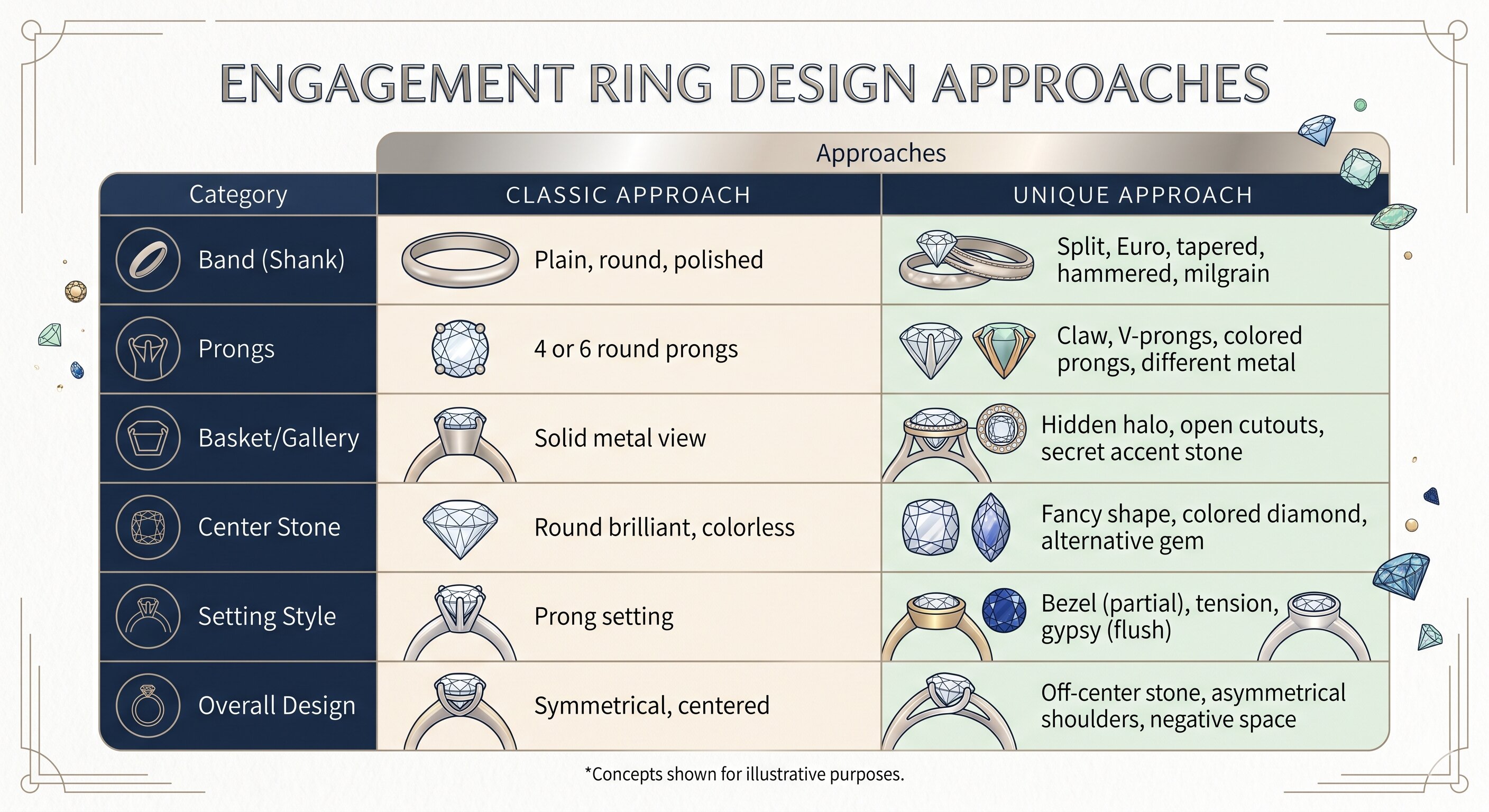
Final Pro-Tip: Don't try to incorporate all of these at once. Pick two or three elements that resonate with your personal style. A hammered band + a hidden halo + a pear-shaped diamond = a stunning, unique solitaire. A split shank + rose gold prongs + a yellow diamond = a masterpiece. Let the design breathe. Less is often more, even when aiming for unique.
Are Solitaires Comfortable To Wear?
Solitaires with a "comfort-fit" band design can be exceptionally comfortable for everyday wear. This feature, widely offered by jewelers, is engineered specifically for long-term comfort.
What Makes a Solitaire "Comfort-Fit"?
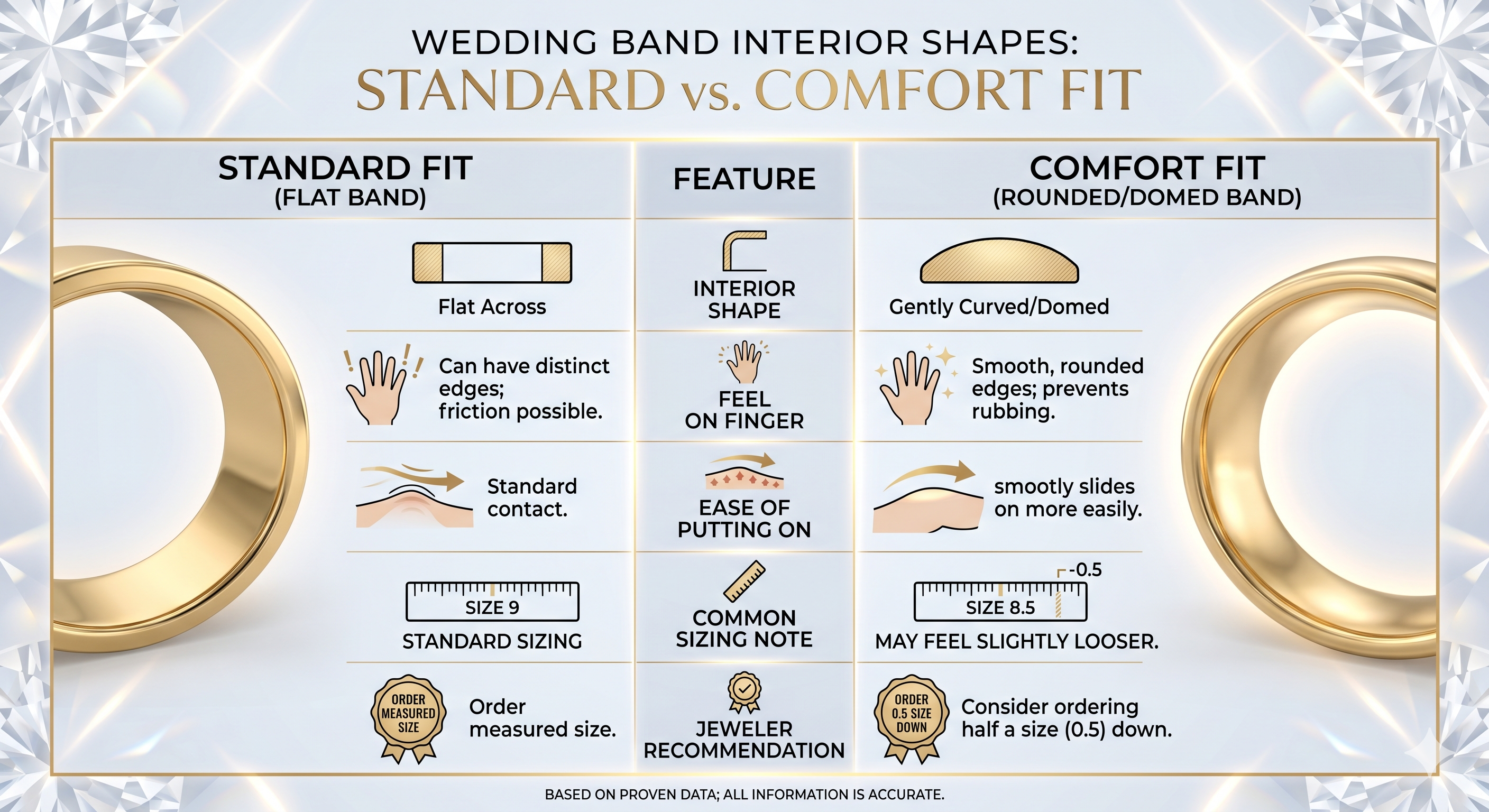
The comfort comes from the band's internal shape. Unlike a traditional flat band, a comfort-fit band has a gently curved interior that sits against your finger. This design prevents the edges from rubbing or digging into your skin, which is key for a ring worn every day.
Here’s a quick look at how comfort-fit compares to a standard fit:
Choosing a Comfortable Solitaire
When selecting your ring, focus on these details beyond just the fit:
Band Width and Profile: Narrower, "petite" bands (e.g., 1.5mm - 2.2mm) are less obtrusive, while a slightly wider band offers a more substantial feel.
Setting Security and Profile: A four or six-prong head securely holds the center diamond. A lower-profile setting keeps the diamond closer to your finger, making it less likely to catch on clothing.
Metal Choice: Comfort-fit is available in all common metals like platinum, white, yellow, or rose gold. The choice here affects the ring's look, durability, and price, not the comfort of the fit itself.
Perfecting the Fit: Always get professionally sized. Remember that fingers swell and shrink; the ring should fit snugly but slide over your knuckle with slight resistance. A reputable jeweler will offer a resizing period.
Key Considerations for Daily Wear
Even with a comfort-fit band, keep in mind that a solitaire ring is a piece of fine jewelry:
Prongs and Snagging: The prongs that hold the diamond can occasionally catch on fine fabrics like knitwear.
Stone Size and Weight: Larger center stones (over ~1.5 carats) will make the ring top-heavy, which some may find less comfortable than a lighter ring.
Lifestyle Adjustments: It's wise to remove your ring during activities like heavy gardening, gym workouts, or cleaning with harsh chemicals to protect both the ring and your finger.
A comfort-fit solitaire is designed to be a joy to wear every day. By prioritizing the curved band design and paying attention to the other features that suit your lifestyle, you can find a ring that is both stunning and comfortable.
I hope this helps you find the perfect ring! If you have a specific metal or diamond shape in mind, I can look for more tailored information.
“You now know the definition, the classic features, the security rankings, the personalization tips, and the comfort factors. The only question left: will you choose the setting that needs no distraction?
*Our current collection includes a limited number of solitaire rings — from classic 6-prong Tiffany-style to bezel solitaires, from split shanks to euro shanks. When certain designs are gone, restocking takes time because each setting is handcrafted.*
This is not just a ring. It is Charles Lewis Tiffany‘s 1886 rebellion, De Beers‘ ‘A Diamond Is Forever,‘ and 140 years of proof that one stone, held by a few tiny prongs, can say everything that needs to be said.”
[Button: Secure Your Solitaire Ring (Limited) →]
Back to Complete Aquamarine Ring Guide
News for Sunday 02 November, 2025
View all news for Sunday 02 November, 2025 on one page
Recent News
- Friday 31 October, 2025
- Thursday 30 October, 2025
- Wednesday 29 October, 2025
- Tuesday 28 October, 2025
- Monday 27 October, 2025